CDC: COVID-19 Was 3rd Leading Cause Of Death In 2020, People Of Color Hit Hardest

More confirmation of COVID-19 racial disparities:

COVID-19 was the third-underlying cause of death in 2020 after heart disease and cancer, the Centers for Disease Control and Prevention confirmed on Wednesday.

A pair of reports published in the CDC’s Morbidity and Mortality WeeklyReport sheds new light on the approximately 375,000 U.S. deaths attributed to COVID-19 last year, and highlights the pandemic’s disproportionate impact on communities of color — a point CDC Director Rochelle Walensky emphasized at a White House COVID-19 Response Team briefing on Wednesday.

She said deaths related to COVID-19 were higher among American Indian and Alaskan Native persons, Hispanics, Blacks and Native Hawaiian and Pacific Islander persons than whites. She added that “among nearly all of these ethnic and racial minority groups, the COVID-19 related deaths were more than double the death rate of non-Hispanic white persons.”

“The data should serve again as a catalyst for each of us [to] continue to do our part to drive down cases and reduce the spread of COVID-19, and get people vaccinated as soon as possible,” she said.

The reports examine data from U.S. death certificates and the National Vital Statistics System to draw conclusions about the accuracy of the country’s mortality surveillance and shifts in mortality trends.

One found that the age-adjusted death rate rose by 15.9% in 2020, its first increase in three years.

Overall death rates were highest among Black and American Indian/Alaska Native people, and higher for elderly people than younger people, according to the report. Age-adjusted death rates were higher among males than females.

COVID-19 was reported as either the underlying cause of death or a contributing cause of death for some 11.3% of U.S. fatalities, and replaced suicide as one of the top 10 leading causes of death.

Similarly, COVID-19 death rates were highest among individuals ages 85 and older, with the age-adjusted death rate higher among males than females. The COVID-19 death rate was highest among Hispanic and American Indian/ Alaska Native people.

Researchers emphasized that these death estimates are provisional, as the final annual mortality data for a given year are typically released 11 months after the year ends. Still, they said early estimates can give researchers and policymakers an early indication of changing trends and other “actionable information.”

“These data can guide public health policies and interventions aimed at reducing numbers of deaths that are directly or indirectly associated with the COVID-19 pandemic and among persons most affected, including those who are older, male, or from disproportionately affected racial/ethnic minority groups,” they added.

The other study examined 378,048 death certificates from 2020 that listed COVID-19 as a cause of death. Researchers said their findings “support the accuracy of COVID-19 mortality surveillance” using official death certificates, noting the importance of high-quality documentation and countering concerns about deaths being improperly attributed to the pandemic.

Among the death certificates reviewed, just 5.5% listed COVID-19 and no other conditions. Among those that included at least one other condition, 97% had either a co-occurring diagnosis of a “plausible chain-of-event” condition such as pneumonia or respiratory failure, a “significant contributing” condition such as hypertension or diabetes, or both.

“Continued messaging and training for professionals who complete death certificates remains important as the pandemic progresses,” researchers said. “Accurate mortality surveillance is critical for understanding the impact of variants of SARS-CoV-2, the virus that causes COVID-19, and of COVID-19 vaccination and for guiding public health action.”

Officials at the Wednesday briefing continued to call on Americans to practice mitigation measures and do their part to keep themselves and others safe, noting that COVID-19 cases continue to rise even as the country’s vaccine rollout accelerates.

The 7-day average of new cases is just under 62,000 cases per day, Walensky said, marking a nearly 12% increase from the previous 7-day period. Hospitalizations are also up at about 4,900 admissions per day, she added, with the 7-day average of deaths remaining slightly above 900 per day.

Dr. Celine Gounder, an infectious disease specialist at New York University who served as a COVID-19 adviser on the Biden transition team, told NPR’s Morning Edition on Wednesday that she remains concerned about the rate of new infections, even as the country has made considerable progress with its vaccination rollout.

She compared vaccines to a raincoat and an umbrella, noting they provide protection during a rainstorm but not in a hurricane

“And we’re really still in a COVID hurricane,” Gounder said. “Transmission rates are extremely high. And so even if you’ve been vaccinated, you really do need to continue to be careful, avoid crowds and wear masks in public.”

Source: CDC: COVID-19 Was 3rd Leading Cause Of Death In 2020, People Of Color Hit Hardest

British Government’s ‘Gaslighting’ Report on Racism Says Slavery Had Some Upsides

Not a great headline if a government wants to demonstrate awareness and sensitivity to racism. More denial of systemic barriers and bias, including how the report was released:

Last summer, after George Floyd’s killing sparked mass anti-racism demonstrations around the globe, British Prime Minister Boris Johnsonasked a dedicated team to investigate and report back on racism in the U.K.. On Wednesday, they came back with their findings—that institutional racism no longer exists, and that the slave trade had some upsides.

The report, published by the British government’s Commission on Race and Ethnic Disparities, has been branded as “gaslighting” and “an insult” by anti-racism activists. While the study went as far as admitting that Britain is not yet a “post-racial country,” it lauds the country’s race relations as “a model for other white-majority countries.”

“Put simply, we no longer see a Britain where the system is deliberately rigged against ethnic minorities,” it says. “The impediments and disparities do exist, they are varied, and ironically very few of them are directly to do with racism. Too often ‘racism’ is the catch-all explanation, and can be simply implicitly accepted rather than explicitly examined.”

The report went on to say that other factors—such as geography, socio-economic background, culture, family influence, and religion—had “more significant impact on life chances than the existence of racism.”

Appearing on BBC Radio 4’s Today show on Wednesday, the chairman of the commission, Dr Tony Sewell, explained his questionable findings further, saying: “No-one denies and no-one is saying racism doesn’t exist… We found anecdotal evidence of this. However, evidence of actual institutional racism? No, that wasn’t there, we didn’t find that.”

Perhaps the low point of the report is when it appears to find some benefits of the African slave trade—an atrocity in which Britain very much led the way. The government report chirpily states: “There is a new story about the Caribbean experience which speaks to the slave period not only being about profit and suffering but how culturally African people transformed themselves into a re-modelled African/Britain.”

The report also criticized anti-racism campaigners, dismissing Black Lives Matter and related demonstrations as the “idealism” of “well-intentioned young people” that risks “alienating the decent centre ground” of British politics. The commission condemned what it described as an “increasingly strident form of anti-racism thinking that seeks to explain all minority disadvantage through the prism of white discrimination.”

The report has, predictably, received an extremely bad reaction from anti-racism advocates. Rehana Azam, the national secretary of the GMB trade union, said: “Only this government could produce a report on race in the 21st century that actually gaslights Black, Asian, Minority and Ethnic people and communities. This feels like a deeply cynical report that not only ignores Black and ethnic minority workers’ worries, but is part of an election strategy to divide working class people and voters.”

David Lammy, a lawmaker for the opposition Labour Party and shadow Justice Secretary, described the report as “an insult to anybody and everybody across this country who experiences institutional racism.” He added: “Boris Johnson has just slammed the door in their faces by telling them that they’re idealists, they are wasting their time. He has let an entire generation of young white and Black British people down.”

Prof Kehinde Andrews, a professor of Black Studies at Birmingham City University, said: “It’s complete nonsense. It goes in the face of all the actual existing evidence. This is not a genuine effort to understand racism in Britain. This is a PR move to pretend the problem doesn’t exist.”

To make matters worse, HuffPost reported that selected journalists were not briefed about the report in advance—including Britain’s only race correspondent, The Independent’s Nadine White. White was sent an emailshowing that the commission asked for briefings on their report on racial disparities be sent to a “tight list of journos” only.

Institutional racism in Britain has been under the spotlight in recent weeks after Prince Harry and Meghan Markle’s allegation that the royal family expressed concerns about how dark their baby’s skin would be. Harry said racism in the British media was a “large part” of why he left the country, adding: “Unfortunately, if the source of information is inherently corrupt or racist or biased, then that filters out to the rest of society.”

Source: British Government’s ‘Gaslighting’ Report on Racism Says Slavery Had Some Upsides

Nicholas: La honte [history of France’s suppression of minority languages and related issues]

Refreshing reminder of history and its impact:

On prend rarement le temps, au Québec, de rappeler qu’il n’y a pas si longtemps que tous les Français parlent français.

C’est que l’Europe s’est développée au Moyen Âge comme un ensemble de royaumes aux frontières instables, et donc les monarques se mariaient entre eux, évoluant dans un univers culturel et linguistique à part de populations très diversifiées. Et la France ne fait pas exception. L’occitan, le catalan, le breton, le picard, l’alsacien, le basque ne sont que quelques-unes des langues autochtones de la France, parlées comme langues maternelles et souvent comme seules langues de bien des sujets de la France de l’Ancien Régime, dans l’indifférence quasi totale de la monarchie. Ce qui importait au pouvoir politique des rois qui ont administré notamment la Nouvelle-France, c’était surtout que le français soit normé et imposé comme langue de l’État et de l’administration pour supplanter le latin, et donc le pouvoir de l’Église.

C’est principalement avec la Révolution française qu’on s’est mis à s’intéresser à cette diversité linguistique, perçue alors comme un obstacle à la circulation des idées politiques républicaines et laïques. Et après la période de va-et-vient politique qu’a connue la France au XIXe siècle, la Troisième République instaure dans les années 1880 une série de lois sur l’instruction primaire obligatoire — en français — sur l’ensemble du territoire. On veut alors une république, unie et unitaire. Et avec l’industrialisation et la montée du capitalisme, la bourgeoisie dominante a avantage à créer une masse qui suit les mêmes normes, travaille de la même manière, consomme les mêmes produits et les mêmes journaux.

Dans les écoles de France, on déploie un ensemble de châtiments, souvent physiques, pour punir les enfants qui parlent leur langue maternelle. On leur enseigne finalement non seulement le français, mais aussi l’infériorité de leur culture et de leur milieu familial. En occitan, on parle de vergonha pour nommer l’effet des politiques républicaines sur la psyché populaire. La honte. C’est par la honte, et souvent par la violence envers les enfants, que le français est devenu la langue de la République. Le projet linguistique républicain est donc fondamentalement un projet disciplinaire. Il faut parler le français, le bon, le patriotique, le beau, l’exact, le supérieur, le vrai, le pur. Une liste de notions qui, faut-il le spécifier, n’ont d’assises dans aucune science du langage. Les dogmatiques les plus orthodoxes de la langue française n’ont souvent (nécessairement) aucune notion de sociolinguistique.

L’unitarisme républicain a bien sûr été amené dans les colonies françaises au même moment qu’il a été imposé en France même. On a aussi tenté, tant bien que mal, d’enseigner aux fils des potentats « indigènes » non seulement le français, mais aussi la fierté et le sentiment de supériorité qui viennent avec le rapprochement avec la norme, ainsi que la honte et le mépris de sa langue maternelle ou des variants locaux du français. Cette honte, elle laisse des traces, d’une génération à l’autre, tant en France que dans son (ex) empire.

Après des décennies de lavage de cerveau, une France transformée par cet idéal politique « redécouvre » le Québec, et sa langue qui a échappé à cette entreprise de réingénierie sociale républicaine. Et une partie des élites québécoises, à son contact, internalisent aussi cette honte et la transmettent à leur tour aux gens d’ici, au nom, paradoxalement, de la fierté nationale. Frustrés d’être l’objet des moqueries des Hexagonaux, on se moque à son tour des Saguenéens ou des gens d’Hochelaga. Des Parisiens disent aux élites montréalaises qu’elles sonnent comme le Moyen Âge, et elles, à leur tour, traitent les Acadiens, les Cajuns et les Franco-Manitobains comme des vestiges du passé.

Si l’on prend rarement le temps d’expliquer cette histoire de la langue française au Québec, c’est notamment que l’on se préoccupe, avec raison, de la place prépondérante de l’anglais en Amérique du Nord, et surtout de cet autre projet impérialiste qu’est le Régime britannique à l’origine du Canada moderne. On croit que nos insécurités linguistiques nous viennent de cette situation de minoritaires sur le continent. C’est vrai, en bonne partie. Mais il ne faut pas non plus oublier d’examiner cette francophonie, le projet politique qu’elle porte, ses effets insécurisants et sa logique disciplinaire génératrice de honte et de hiérarchie qui pèsent sur les francophones « hors norme » de tous les continents, Européens y compris.

Il faut réfléchir à la langue française en Amérique non seulement face à l’anglais, mais aussi face à elle-même, dans toute sa complexité. Qu’est-ce que cela veut dire de dénoncer les tentatives d’assimilation et de stigmatisation vécues par les enfants francophones des Amériques aux mains des Britanniques et des Américains, tout en ayant participé à des projets missionnaires visant à assimiler les enfants haïtiens, sénégalais ou innus et à stigmatiser leur langue maternelle ? Qu’est-ce que ça signifie de dénoncer le règlement 17 qui a longtemps compliqué l’enseignement du français en Ontario pendant que l’État québécois s’acharne à franciser les jeunes du Nunavik ? Qu’est-ce qui se produit quand des militants de gauche, qui militent pour l’équité et l’inclusion, s’en prennent à l’orthographe des internautes moins scolarisés qu’eux plutôt qu’à leurs idées ? Ou lorsqu’on « se donne un accent » pour faire sérieux à la télévision d’État ou à l’université ?

Dénonce-t-on les effets néfastes de l’impérialisme britannique parce qu’on est anti-impérialiste ou parce qu’on lui aurait préféré un impérialisme différent, où l’on aurait été plus dominant ? Est-on contre le mépris des Franco-Québécois ou contre le mépris tout court ? Se pencher sur ces questions, c’est s’interroger sur ce que l’on veut que notre francophonie signifie à la face du monde, et aussi sur la manière dont les francophones se traitent entre eux, et sur le rapport traversé de contradictions, d’émotions et souvent d’insécurité de chacun envers sa langue et son identité. À nous de voir, avec les francophones de partout dans le monde, ce que signifie parler français, de mettre en question ses normes et de s’approprier (enfin) sa langue

Source: La honte

Evidence Mounts That Reducing Immigration Harms America’s Economy

Some useful recent studies, particularly with respect to H1-B visas and skilled workers. Less convinced by some of the general demographic arguments, similar to those made in Canada by the Century Initiative and others. Shout-out to Canadian Darrell Bricker and John Ibbitson, authors of the book Empty Planet, making the same broader arguments (with some of the same fallacies):

Donald Trump’s immigration policies were harmful to America’s long-term economic future. That becomes clearer as one compares the Trump administration’s actions to the projected increase in the number of immigrants under recently introduced immigration legislation. The U.S. Citizenship Act, developed by the Biden administration, would aid long-term economic growth by increasing the number of legal immigrants by 28%. In contrast, Trump administration policies would have cut legal immigration in half. The immigration policy path America chooses in the long-term will make a significant impact on economic growth and future labor force growth, of which immigrants are a vital part.

Economic growth or growth in Gross Domestic Product (GDP) is necessary for a country’s inhabitants to improve their standard of living. “GDP growth [economic growth] is made up of growth in the workforce plus growth in labor productivity,” according to Robert S. Kaplan, president and CEO of the Federal Reserve Bank of Dallas. “Unless slower workforce growth is offset by improved productivity growth, U.S. GDP growth will slow.”

The Trump administration’s immigration policies harmed long-term economic growth by reducing labor force growth and potential productivity growth through restrictive policies.

High-skilled foreign nationals are important to productivity growth. Yet the Trump administration increased the denial rates of H-1B petitions, causing many long-time H-1B visa holders to leave the United States. The administration also blocked the entry of H-1B visa holders and published regulations that employers believed would make it nearly impossible for many foreign-born scientists and engineers to work in the United States.

“When we aggregate at the national level, inflows of foreign STEM [science, technology, engineering and math] workers explain between 30% and 50% of the aggregate productivity growth that took place in the United States between 1990 and 2010,” according to economists Giovanni Peri (UC, Davis), Kevin Shih (RPI) and Chad Sparber (Colgate University). Research by economist Britta Glennon found rather than saving jobs, H-1B restrictions “have the unintended consequence of encouraging firms to offshore jobs abroad.”

While the Biden-supported U.S. Citizenship Act may have a difficult time becoming law, it serves as a marker for changes to legal immigration by increasing both family and employment-based immigration. The bill would have a positive impact on labor force growth by raising immigration by 28% a year after a transition period.

“Increasing legal immigration by 28% a year would increase the average annual labor force growth in the United States by 23% over current U.S. projections, which would help economic growth and address a slower-growing U.S. workforce,” according to an analysis by the National Foundation for American Policy (NFAP). “The average annual labor force growth could be even more than 23% compared to a scenario of no immigration increases because the Bureau of Labor Statistics currently projects the U.S. labor force will grow by 800,000 a year, and that baseline growth may be lower after 2029 without the increase in immigration contained in the bill.”

“In contrast,” the analysis continues, “if the United States continued the Trump administration’s policies that administratively reduced legal immigration by approximately 49%, average annual labor force growth would be approximately 59% lower than compared to a policy of no immigration reductions, according to an NFAP analysis. Under policies that reduced legal immigration by half, in 40 years the United States would have only about 6 million more people in the labor force than it has today. Admitting fewer immigrants results in lower economic growth because labor force growth is an important element of economic growth and immigrants play a major part in both current and future labor force growth.”

A recent National Foundation for American Policy study by Madeline Zavodny, an economics professor at the University of North Florida, shows the positive impact of immigration.

“Analysis of U.S. Census Bureau data finds international migration was the only source of population growth in rural areas as a whole during most of the 2010s,” writes Zavodny. “International migration is strongly related to employment growth in both rural and metro counties. Each additional international migrant is associated with an additional 1.2 jobs in rural counties over 2010 to 2018. The estimate for rural areas suggests that international migration adds to total employment well beyond the jobs filled by international migrants. International migrants may have a larger impact on employment because of the jobs they fill. International migrants may work in jobs that otherwise would go unfilled by local residents and thereby enable businesses to expand.”

Due to declines in fertility, immigration keeps the United States from experiencing negative population growth, according to the U.S. Census Bureau.

New economic research finds that negative or falling population growth may yield harmful economic outcomes beyond slowing labor force growth. Fewer available minds may mean fewer solutions to our problems. What if the breakthrough advances in mRNA made by Katalin Karikó, an Hungarian-born immigrant to America, never happened or occurred years later because Karikó was never born? How would that have affected the development of vaccines and other potential solutions to medical problems?

In a recent paper, “The End of Economic Growth? Unintended Consequences of a Declining Population,” Charles I. Jones, a professor of economics at the Stanford Graduate School of Business, writes, “What happens to economic growth if population growth is negative? We show below—first in models with exogenous [external] population growth and then later in a model with endogenous (internal) fertility—that negative population growth can be particularly harmful.” He asks: “How do idea-based growth models behave when population declines?”

In sum, with fewer people, “knowledge and living standards stagnate.” Jones writes, “If knowledge were to depreciate at a constant exogenous [external] rate, it is easy to show in the simple models at the start of this paper that this would lead to declining living standards in the presence of negative population growth, an even more dire outcome.”

“We refer to this as the Empty Planet result,” writes Jones. “Economic growth stagnates as the stock of knowledge and living standards settle down to constant values.”

Immigration can prevent population decline in the United States and allow America to grow—if U.S. elected officials choose the right policies. “Among great powers, the coming population decline uniquely advantages the United States,” according to Darrell Bricker and John Ibbitson, authors of the book Empty Planet, the title to which Charles Jones referred. “For centuries, America has welcomed new arrivals, first from across the Atlantic, then the Pacific as well, and today from across the Rio Grande. Millions have happily plunged into the melting pot—America’s version of multiculturism—enriching both its economy and culture. Immigrants made the twentieth century the American century, and continued immigration will define the twenty-first as American as well.

“Unless. The suspicious, nativist, America First groundswell of recent years threatens to choke off the immigration tap that made America great by walling up the border between the United States and everywhere else. Under President Donald Trump, the federal government not only cracked down on illegal immigrants, it reduced legal admissions for skilled workers, a suicidal policy for the U.S. economy. If this change is permanent, if Americans out of senseless fear reject their immigrant tradition, turning their backs on the world, then the United States too will decline, in numbers and power and influence and wealth. This is the choice that every American must make: to support and open, inclusive, welcoming society, or to shut the door and wither in isolation.” It is a significant choice.

Source: Evidence Mounts That Reducing Immigration Harms America’s Economy

Ibbitson: It’s time for Canada to focus on expanding our population

As regular readers will know, I am not convinced that the arguments of the Century Initiative take into account the shorter-term impact of COVID on immigrant outcomes and the longer-term impact of automation and AI in their support of vastly increased immigration.

But the range of well-known people they have mobilized in their advocacy is impressive.

Their National Scorecard on Canada’s Growth and Prosperity is yet another approach to measuring how well Canada is doing with respect to overall socio-economic outcomes.

I do find it odd that a newspaper would take such a high profile advocacy role, essentially organizing a promotional event rather than a discussion more inclusive of diverse perspectives. Preaching to the converted rather than engaging those who need to be engaged.

That being said, the idea of a white paper makes sense, but its mandate needs to take a broader perspective on immigration, citizenship and multiculturalism than just justifying increased immigration levels.

And should we not also consider how to manage an aging population, not just focussing on increasing it?

On Brian Mulroney’s watch, Canada almost tripled the number of immigrants coming to Canada each year, from fewer than 90,000 people to more than 250,000.

Now Canada’s 18th prime minister is calling on Canadians to embrace what he calls “a new national policy” that would commit this country to achieving a population of 100 million by the end of the century.

“If we are going to maintain … our internal strength and our growth and our capacity and our outside influence, we need more people – a lot more,” Mr. Mulroney said Tuesday at a forum presented by The Globe and Mail and by Century Initiative, which champions the goal of a Canada that is 100-million strong by 2100.

Increasing the population by more than 60 million people would be “an historic and challenging initiative,” Mr. Mulroney acknowledged in an interview. After all, it took more than 150 years to get Canada’s population to 38 million. More than doubling it in about half that time would require much greater political and popular will than exists today.

Hence his proposal for “a white paper which indicates the need for 100 million people by the turn of the century.”

A white paper is a document through which a government puts forward a major policy proposal. If there is sufficient support, after consultation with experts, provincial governments and the broader population, it becomes settled policy, maintained by future governments whatever their partisan stripes.

Criticism of a white paper can be more important than the white paper itself. A deeply flawed white paper in 1969 that essentially called for the assimilation of First Nations into the general population helped give birth to Indigenous activism.

Conversely, a white paper on immigration produced three years earlier, which called for the final dismantling of racial barriers to accepting newcomers, led the Pearson government to invent the points system, which rated applicants based on how well they matched what the country was looking for, regardless of race.

High levels of race-blind immigration, embraced by both Liberal and Conservative governments, gave us the Canada we live in today. But the pandemic has restricted recruitment, and once the shortfall has been made up, there remains this vital question: How many people should live here?

A white paper on population, followed by a parliamentary committee travelling across the land, would encourage discussion, build momentum and, no doubt, focus opposition, which deserves to be heard.

Ideally, both Liberals and Conservatives at the federal level would express support for a target of 100 million through votes in the House and Senate.

If so, “that would become the new objective of Canada in this area,” Mr. Mulroney said, “and all governments would be bound to strive to achieve it.”

Such a goal would push Canada ahead of Germany and France and Britain in population, and probably ahead of Japan and South Korea and Vietnam as well.

That’s because the economic insecurity generated by the pandemic has exacerbated the decades-long trend of fertility decline. Low fertility, coupled with resistance to immigration, has led to population decline in dozens of countries.

Canada’s willingness to aggressively recruit newcomers leaves us better positioned to weather the demographic storms ahead than just about any other country. Taking immigration from 300,000 a people a year to a million, along with enhanced supports for child care and parental leave, would reduce labour shortages and help pay for the health care and pension needs of older Canadians, while boosting creativity and innovation. Imagine the contribution that a Toronto that was the size of New York or London or Tokyo would make to this country and to the world.

That said, the pandemic has completely disrupted how we live and work. The patterns of the past may never return. All sorts of assumptions – about downtowns and suburbs and rural areas, about commutes – may have to be rethought.

And as fertility continues to drop, the greatest obstacle to achieving a population of 100 million might be, not internal resistance, but a shrinking pool of available immigrants.

Nonetheless, Mr. Mulroney urges us to embrace “this indispensable cause.” For him, “this is a great dream of Canada, and it requires leadership to bring it true.”

Let the discussion begin, and let it begin with a new white paper on population.

Source: https://www.theglobeandmail.com/politics/article-its-time-for-canada-to-focus-on-expanding-our-population/

En prison pour deux publications Facebook

More on Cihan Erdal:

C’est le sort injuste qui a été réservé à Cihan Erdal, 32 ans, doctorant en sociologie de l’Université Carleton à Ottawa, emprisonné depuis six mois en Turquie, son pays d’origine, où il se trouvait pour mener ses recherches universitaires et voir sa famille. 

Le 25 septembre 2020, son amoureux, Omer Ongun, qui habite Ottawa, a été réveillé par un appel au beau milieu de la nuit. 

C’était Cihan. 

« Les policiers étaient à sa porte et ils l’emmenaient en détention. Et tout ce qu’il a pu dire au téléphone, c’est : ‟Je t’aime. Fais tout ce que tu peux. J’ai besoin de votre soutien.” » 

C’est la dernière fois qu’Omer a entendu la voix de Cihan. 

Même si nous sommes ensemble depuis 10 ans, la Turquie est un de ces nombreux pays qui malheureusement ne reconnaissent pas les unions de même sexe. Je ne suis donc pas considéré comme étant sa famille et ne suis pas autorisé à lui parler.

Omer Ongun, conjoint de Cihan Erdal

Depuis, Omer tente de remuer ciel et terre pour faire libérer Cihan, avec qui il ne peut communiquer que par écrit. Toutes les semaines, il lui envoie une lettre par l’entremise d’une application payante conçue expressément pour pouvoir correspondre avec des prisonniers en Turquie. 

« La lettre est imprimée, mise dans une enveloppe et envoyée à la prison. Cihan la reçoit environ une semaine plus tard. » 

Soutenu par un mouvement de solidarité de plus en plus grand, Omer ne perd pas espoir de retrouver son amoureux. Il suit des cours de français en ce moment en rêvant de jours libres où il pourra s’installer à Montréal avec lui. « Cihan parle français. Mieux que moi ! Pour l’heure, nous sommes locataires. Mais si un jour on achète une maison, ce sera à Montréal. On a toujours aimé l’énergie de cette ville. » 

***

Emprisonné à Ankara, Cihan Erdal, qui a un statut de résident permanent au Canada, doit avoir un procès le 26 avril. On l’accuse d’être lié à des manifestations qui ont eu lieu en octobre 2014 en Turquie. Son arrestation survient alors que les autorités turques accusent le Parti démocratique des peuples de Turquie (HDP), auquel Cihan Erdal a déjà été lié comme ex-membre de son comité exécutif central, d’avoir incité des gens à participer à des soulèvements violents. 

Sa détention arbitraire n’est malheureusement qu’un cas parmi d’autres d’utilisation de lois antiterroristes pour faire taire toute voix discordante en Turquie, selon Amnistie internationale. 

Officiellement, ce que l’on reproche à Cihan Erdal, ce sont deux publications Facebook de 2014 et 2015 dans lesquelles l’étudiant, qui est aussi assistant de recherche à l’Université Carleton depuis 2017, relayait des articles critiques du gouvernement turc. 

La cible ici, ce n’est pas Cihan personnellement. La cible, c’est le peuple turc.Les accusations sont destinées à faire en sorte que les gens aient peur de s’impliquer dans un parti politique qui pourrait provoquer une sorte d’opposition au parti au pouvoir.

Paul Champ, avocat spécialisé en droits de la personne, lors d’une conférence organisée lundi par l’Université Carleton

Dans une lettre ouverte publiée le 15 mars, Cihan Erdal dit qu’il se considère comme un « otage politique ». Militant queer et pacifiste, il s’est toujours opposé aux prédicateurs de violence. Il dit trouver « honteux » pour le droit et la justice d’être soumis à des « accusations terrifiantes », non fondées, d’incitation au terrorisme. 

Lisez la lettre (en anglais)

***

De nombreuses voix se sont élevées ces derniers mois pour réclamer la libération de Cihan Erdal. La communauté universitaire, des défenseurs des droits de la personne, le Syndicat canadien de la fonction publique (dont Cihan est membre) et d’autres encore mènent une campagne pour dénoncer l’injustice qu’il subit. Sa détention arbitraire apparaît comme une cruelle illustration d’une tendance inquiétante à brimer la liberté universitaire. 

C’est un aspect dont on a peu parlé dans la foulée des controverses récentes autour de cet enjeu important. Mais il est extrêmement préoccupant. Entre janvier 2011 et août 2020, le réseau international Scholars at Risk, qui vient en aide aux universitaires faisant face à de graves menaces, a recensé à lui seul plus de 1700 attaques contre l’enseignement supérieur dans une centaine de pays. Qu’il s’agisse d’actes violents et prémédités contre des universités, des professeurs et des étudiants ou de restrictions à la liberté d’expression des chercheurs, l’objectif est toujours le même : punir des gens pour leurs idées et tenter de les réduire au silence. 

C’est exactement ce que l’on a fait à Cihan Erdal, dont les recherches portent sur la jeunesse militante en Turquie, en Grèce et en France. Sa méthodologie exigeait qu’il interviewe de jeunes militants sur le terrain, explique son conjoint. « Il n’a jamais pensé qu’il y avait là un risque puisqu’il n’a rien fait de mal. » 

Pendant 21 jours, Cihan Erdal a été gardé dans une cellule d’isolement, dans des conditions extrêmement pénibles, selon les informations obtenues par son conjoint. Aujourd’hui, il va mieux, bien qu’il soit toujours détenu. « Il est pleinement concentré sur ses études. Il lit et écrit des articles et des chapitres de livres. » 

Le vendredi 2 avril, il y aura une audience pour déterminer si le doctorant peut être libéré sous caution en attendant son procès. La campagne #FreeCihanErdal (#LibérezCihanErdal) demande au gouvernement canadien et aux autorités turques sa libération immédiate. 

« Le Canada a fait part de ses préoccupations aux autorités turques et continue de suivre cette affaire de près », me dit le porte-parole d’Affaires mondiales Canada, Jason Kung. 

Omer reste optimiste. « Depuis le jour où j’ai reçu cet appel de Cihan, je me dis : on ne peut contrôler ce qui nous arrive, mais on contrôle notre façon d’y réagir. Nous répondons à cette injustice et à cette torture par la résistance et la solidarité. » 

Source: https://www.lapresse.ca/actualites/2021-03-31/en-prison-pour-deux-publications-facebook.php

Quebec politicians denounce rise in online hate as Ottawa prepares to act

Ironic given some of the political discourse in Quebec:

Death threats over an animal control plan, personal insults over stop signs, social media attacks targeting spouses — these are examples of what politicians in Quebec say has become an increasingly difficult reality of their jobs during COVID-19.

From suburban mayors to the premier, politicians in the province have been raising the alarm about the rise in hateful and occasionally violent online messages they receive — and some are calling for stronger rules to shield them.

On Saturday, Premier Francois Legault denounced the torrent of hateful messages that regularly follow his online posts, which he said has worsened “in the last months.”

“Each time I post something now, I’m treated to an avalanche of aggressive and sometimes even violent comments, and to insults, obscenities and sometimes threats,” Legault wrote on Facebook.

Several Quebec municipal politicians have announced they won’t be running again in elections this fall, in part because of the hostile climate online. Others, including the mayors of Montreal and Quebec City, have spoken in the past about receiving death threats. In November, police in Longueuil, Que., arrested a man in connection with threats against the city’s mayor and other elected officials over a plan to cull deer in a municipal park.

Philippe Roy, the mayor of the Town of Mount-Royal, an on-island Montreal suburb, says he’s leaving municipal politics when his current term ends, partly because of the constant online insults directed at him and his spouse.

While taking criticism is part of the job, he said he’s seen a shift in the past two years toward more falsehoods and conspiracy theories, which he said are undermining the trust between elected officials and their constituents. After 16 years in politics, he said he’s tired of the constant accusations directed his way.

“When people are questioning your integrity, you start saying, ‘Well, maybe I have better things to do somewhere else,’ ” he said in a recent interview.

The problem is serious enough that the group representing Quebec municipalities has launched an awareness campaign and drafted a resolution denouncing the online vitriol. It has so far been adopted by some 260 municipal councils.

Suzanne Roy, the group’s president, says the campaign was launched in response to a “flood of testimonials” from mayors and councillors about an increase in abuse and hate speech during the pandemic.

She attributes the phenomenon to a rise in “stress and frustration.”

“People, without having the proper tools to manage their stress, will let off steam on social media and write inappropriate statements towards decisions taken at city council about a stop sign at the wrong place, a hole in the road, everything,” she said in a phone interview.

Roy, who is mayor of Ste-Julie on Montreal’s South Shore, said she experienced the perils of social media firsthand earlier this year when someone stole her identity online and posted anti-COVID conspiracy theories from her Facebook account.

She is among those pushing for stronger rules to combat hate speech, and for platforms such as Facebook to take quicker action to remove hateful comments or restore someone’s identity when it’s stolen. She said the platforms need to take down the messages as soon as they appear to ensure debate remains respectful and false messages aren’t spread.

“It’s a question of debate and a question of democracy,” she said.

Federal Heritage Minister Steven Guilbeault has promised to introduce new legislation to combat hate speech this spring.

In an interview Tuesday, he said the legislation will define five categories of illegal online activities and create a regulator. The regulator’s job would include pushing online platforms to respect the law and to remove hateful messages within 24 hours.

He said the bill’s goal is to take stronger actions against hate speech, child porn and non-consensual sharing of intimate images. He was careful to say that it would not tackle misinformation, saying it’s not the government’s job to “legislate information.”

Guilbeault said his government has also had to contend with critics who accuse the government of wanting to limit free speech, a charge he denies. Rather, he says the aim of the legislation is to ensure that laws, such as those against hate speech, are applied online as they are in the real world — something he argues will protect free speech rather than stifle it.

“Right now in the virtual world and, I’m sad to say, in the physical world, we’re seeing the safety and security of Canadians is being compromised, that freedom of speech is being affected online,” he said in a phone interview.

“We’re seeing it now with Quebec politicians who say, ‘No, no I don’t want to run for politics, it’s so violent.'” He said the chilling effect extends to equity-seeking groups and racialized Canadians, many of whom avoid the platforms because they’re constant targets of abuse.

“How does that protect free speech?” he asked. “Well, it doesn’t.”

Suzanne Roy says her group, the Union des municipalities du Quebec, gives new councillors some training on how to manage social media accounts, including advice on handling adversarial situations. She says the advice generally includes not getting into debates online and instead steering people to more formal channels to express their opinions, such as city council meetings and public consultations.

Philippe Roy, the soon-to-be ex-mayor of Mont-Royal, says that while there appear to be strong candidates to take his place, he’s already met people who have been discouraged from running by the prospect of online hate — something that bodes poorly for the future if the problem isn’t tackled.

“We’re losing people who could give back to the community, and that’s one of the threats that comes from this situation,” he said.

Source: Quebec politicians denounce rise in online hate as Ottawa prepares to act

Ottawa to extend eligibility criteria for Yazidi refugees: Mendicino

Good:

Ottawa is adopting a new policy to help more Yazidis and other survivors of the Islamic State of Iraq and the Levant reunite with their families in Canada, Immigration Minister Marco Mendicino said Tuesday.

Mendicino said it will allow more Yazidi refugees to join extended family members, including siblings, grandparents, aunts and uncles.

The Yazidis and other groups who survived abuse, torture and even genocide at the hands of ISIL are among the most vulnerable refugees in the world, he said.

“Guided by compassion, we are now redoubling our efforts to reunite their families.”

The Immigration Department said the new policy will help Yazidis and members of other communities in Northern Iraq to start new lives in Canada.

These refugees were victims of threats or acts including sexual slavery, general enslavement, torture, inhuman or degrading treatment, family separation and forced displacement, the department said.

Canada has welcomed more than 1,400 survivors of ISIL from Northern Iraq since 2017.

This includes 1,356 government-assisted refugees and 94 privately sponsored ones. Women and girls comprise the vast majority.

The Yazidi newcomers have been primarily resettled to Toronto, London, Ont., Winnipeg and Calgary where Yazidi communities existed and adequate support, including medical, social and interpretation services, was in place.

Source: Ottawa to extend eligibility criteria for Yazidi refugees: Mendicino

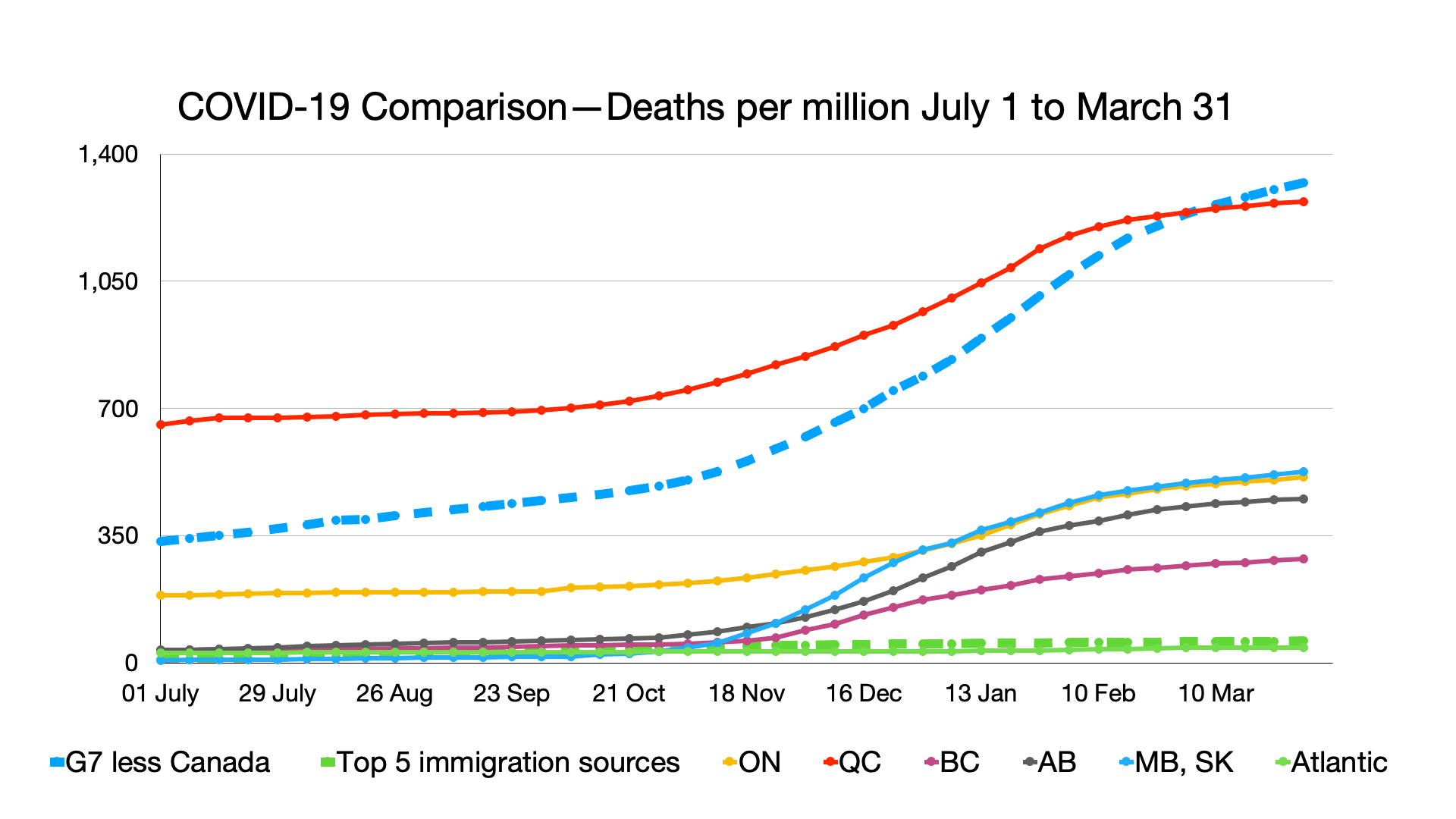
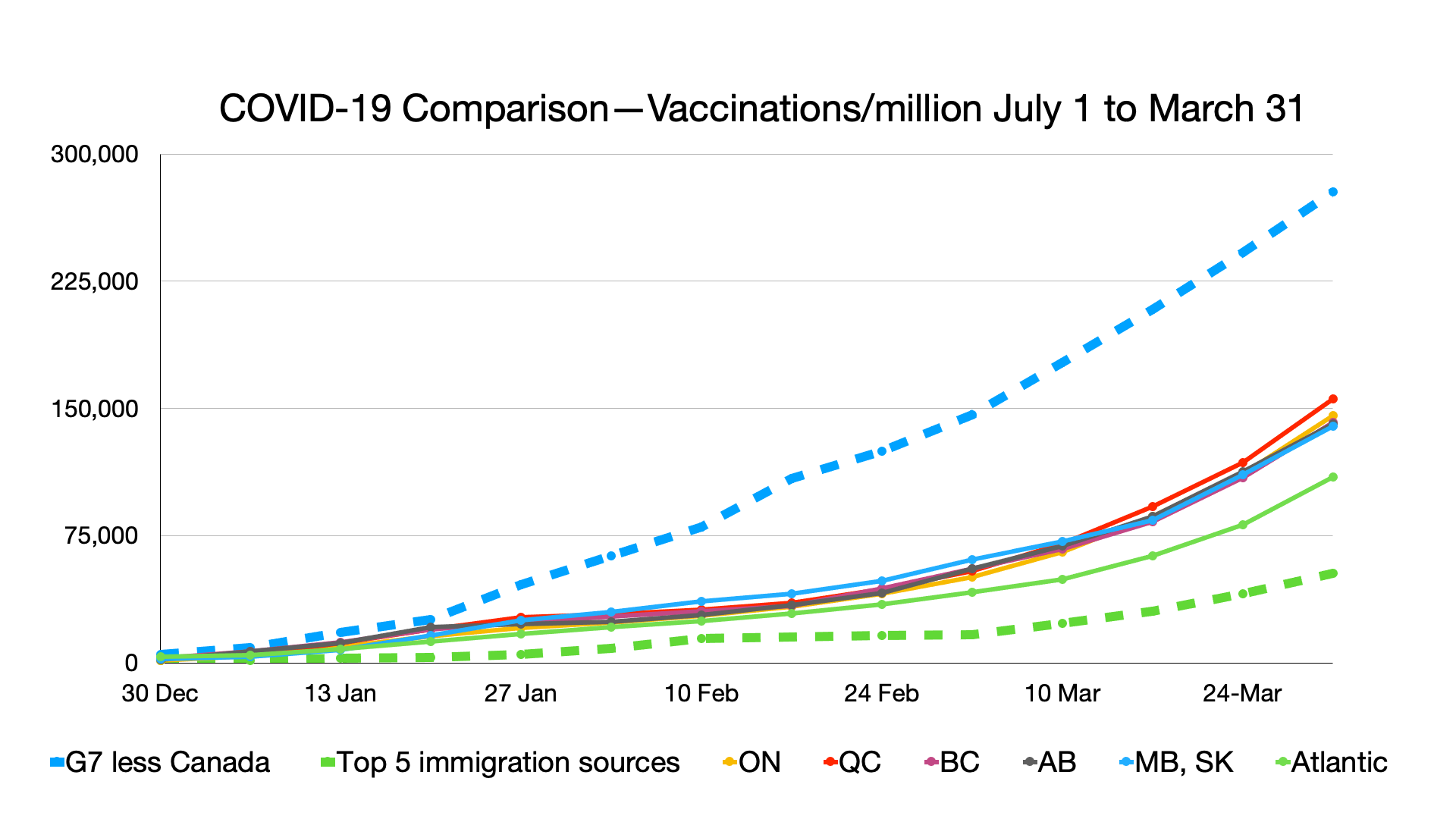
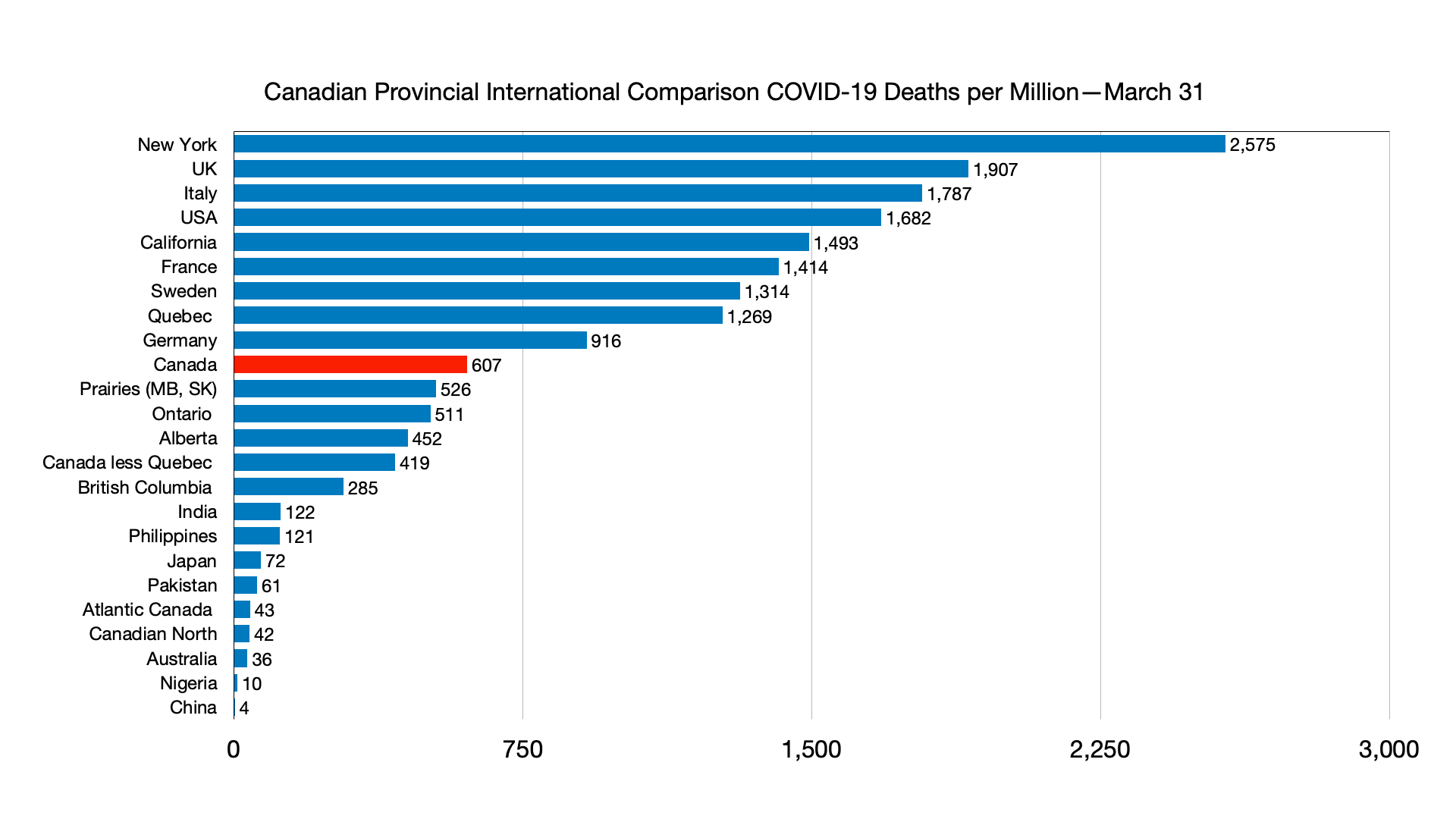
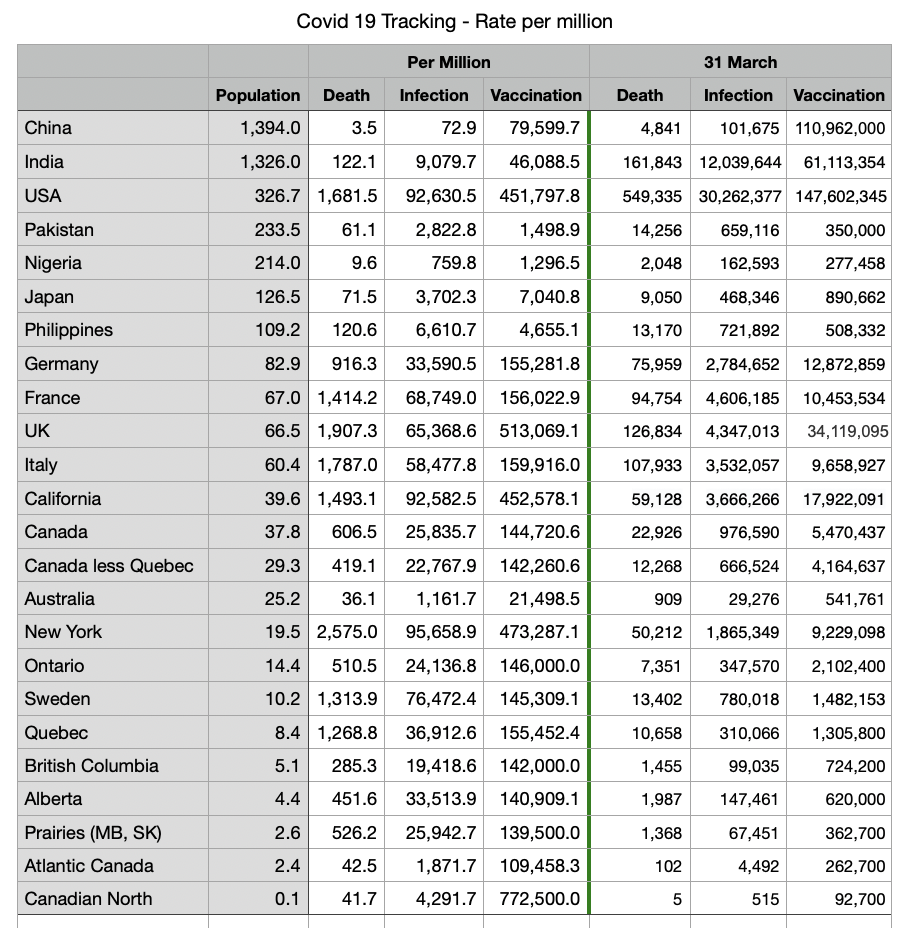
#COVID-19: Comparing provinces with other countries 31 March Update

The latest charts, compiled 31 March, in the context of a likely third wave.

Vaccinations: Change from last week: Slight decline in gap between EU countries and Canadian provinces. USA overall ahead of California, New York, France and Quebec ahead of Germany, Ontario ahead of Sweden but Sweden ahead of Canada and Canada less Quebec, British Columbia ahead of Alberta and Prairies.

Trendline charts

Infections per million: The previous trend of a flattening curve is seen in G7 countries and most provinces appears to be changing for the worse.

Deaths per million: Most Canadian provinces continue to flatten the curve, Quebec most dramatically. Overall G7 death rate continue to surpass Quebec’s by an increasing margin.

Vaccinations per million: While the gap between G7 and Canada remains despite the arrival of more vaccines, one can see that Canadian provinces have been ramping up. The increase in vaccination rates of immigration source countries driven by China and India.

Weekly

Infections per million: Some minor shifts: New York ahead of USA and California, Germany ahead of Alberta.

Deaths per million: No relative change.

Turkish Germans are finally finding their voice

Interesting overview and history (long read):

IScores of young Turkish men in sober suits move towards the train that will take them to Germany, while their wives and mothers cry on the platform. A few days earlier, these hopefuls had been bare-chested as their teeth and bodies were checked by German doctors to ensure they were strong enough for the physical work awaiting them. Those that pass the test feel immense pride: “I am Yılmaz Atalay from Çorum!” announces one, gazing wide-eyed into the camera in footage originally shot by Turkish state television.

Atalay was among the first Gastarbeiter, or guest workers, to leave a poor part of Turkey for West Germany’s booming post-war economy and a better life. The deal signed in 1961 by Ankara and Bonn sparked an enormous migration between two countries that shared little in terms of culture, religion or prosperity. It changed not only the workers’ lives, but also the nature of their new country. By the end of the first year, 5,623 Turkish workers lived in Germany. When the scheme officially ended, in 1973, there were 900,000. Now the Turkish-German community, comprising the original migrants and their descendants (about half of whom are German citizens) numbers nearly three million, constituting the biggest minority group in the country.

Most of those original migrants spent their working lives in low-paid, backbreaking jobs on assembly lines and building sites, as well as in mines. Their descendants include global successes, such as Game of Thrones actress Sibel Kekilli and World Cup-winning footballer Mesut Özil as well as—most recently—the Covid-19 vaccine creators, the married couple Uğur Şahin (whose parents were doctors) and Özlem Türeci of BioNTech.

But while such figures conjure up an immigrant rags-to-riches story, the truth for most is less romantic. As the 60th anniversary of the Turkish Gastarbeiter programme approaches, the younger generation is struggling to find its proper place. In 2021, Turkish Germans are still among the least integrated, least educated in the country. At the same time, the effects of German xenophobia remain pervasive. Many young Turkish Germans are angry that even after three generations, they don’t appear to fully belong.