Burton: Time for transparency in China’s dealings with Canadian universities

Indeed:

Canada’s free society is based on cultural expectations of reciprocal fairness and goodwill in our dealings with fellow citizens. This is what makes Canada a great place to live, and so attractive to immigrants. But our trusting nature is also vulnerable to being exploited by foreign actors with agendas that threaten our security and sovereignty.

In the case of China, its intricate manipulation practices have had enormous success in transferring research data from Canadian universities in strategically sensitive areas that serve PRC purposes. According to former CSIS director Richard Fadden, these areas include avionics, space technology, nuclear science and high-level optics research.

The fact is, China’s interference and espionage activities are hiding in plain sight in our open institutions. We need transparency about what these activities comprise, which Canadians are receiving benefits from agents of foreign states, and what form these benefits take.

Recent and troubling media reports reveal that, in 2018, the China Institute at the University of Alberta accepted a major donation from Hong Kong-based billionaire Jonathan Koon-Shum Choi, but refuses to disclose the size of Mr. Choi’s gift, the purposes to which the money has been allocated, and who are the de facto beneficiaries of this largesse.

Choi is a member of the Standing Committee of the Chinese People’s Political Consultative Conference (CPPCC), part of the Chinese Communist Party’s United Front Work Department (UFWD), whose main mission is to gain outside support for Beijing’s political agenda.

As the U of A is a public institution, surely Alberta taxpayers deserve transparency regarding any money that supports or influences the university’s research.

Under an agreement with China’s Minister of Science and Technology, U of A researchers have had access to at least 50 state labs in China since 2005, while upward of 60 professors have received funding for more than 90 joint projects with state and national labs in China. Likewise, at the University of British Columbia, more than 300 professors have significant professional interest in China, and faculty have partnerships with over 100 Chinese institutions.

But agreements through China’s Ministry of Science and Technology are not like those with partners in democratic societies. These are not simply benign, mutually beneficial collaborations between autonomous scholars seeking to expand the frontiers of science and human understanding, as much as the UFWD would have us believe.

In China, professors are cadre-ranked state employees, their research dictated by the state ministries to which their universities and labs are subordinate. Their ultimate goal is to advance the Chinese Communist Party’s five-year plans for domestic development and global geo-strategic advantage.

China would not be funding Canadian researchers if there were no ability to access the data which the professors generate. This is about obtaining information or intellectual property that could serve the PRC’s economic and military objectives. Indeed, some Canadian participants over the long term appear to derive significant Chinese income streams beyond their university salaries, through lucrative PRC-associated board appointments and commercial inducements.

The money is an effective device. Chinese grants help Canadians pursue research projects that might not have been so well funded by Canada’s Natural Sciences and Engineering Research Council. The profs gain prestige from undertaking work in important and sensitive areas, enjoy wonderful hospitality in China, and benefit from considerable talented Chinese research assistance — providing they hand over their work to the Chinese state to develop. The strategy spends years cultivating a Canadian target, with the recipients often not fully aware of what they’re getting themselves into.

It is reassuring that Alberta government officials have promised to protect Canada’s national interest by curtailing U of A collaborations with China in strategically sensitive science and technology, but will Ottawa initiate federal legislation such as requiring transparency in reporting of foreign sources of income? There is a powerful pro-PRC lobby in Ottawa, mostly retired politicians who are on China-related boards, including Canadian companies and law firms that benefit from the PRC. In taking China’s money, they are expected to support the interests of the PRC in Canada in return.

Beijing seems confident that, once Canadian public outrage fades over the latest reports of China’s shameless flouting of the norms of international relations, the Canadians on the PRC gravy train will resume quietly lobbying for Ottawa’s restraint in any new measures. This United Front work is a sophisticated engagement of Canada, and the PRC always seems to end up on top.

Charles Burton is a senior fellow at the Macdonald-Laurier Institute in Ottawa, and non-resident senior fellow of the European Values Center for Security Policy in Prague. He is a former professor of political science at Brock University, and served as a diplomat at Canada’s embassy in Beijing.

Source: https://ottawacitizen.com/opinion/columnists/opinion-time-for-transparency-in-chinas-dealings-with-canadian-universities/wcm/d6768c22-f35e-4eea-849c-8b41e2bf4191

My latest: Increasing immigration to boost population? Not so fast.

In Policy Options:

Former prime minister Brian Mulroney recently called for a government white paper on immigration to support the Century Initiative’s advocacy in favour of a Canada of 100 million people by 2100. Immigration is seen as the most likely way to address Canada’s aging population and ensure there are a sufficient number of working adults to pay for increased health care and other costs of seniors, with calls for more than 80 per cent of Canada’s population growth to be due to immigration.

In many ways, this has parallels with the Royal Commission on the Economic Union and Development Prospects for Canada initiated under a Liberal government in the early 1980s that paved the way for the Canada-U.S. free trade agreement under the Conservative Mulroney government.

While a comprehensive and independent look at our immigration policies and programs is merited, any such review should take a critical look at Canada’s current and future needs, what fundamental questions need to be asked and the realities of what an increase would entail across Canadian society.

In the short term, we need to consider what the experience of past economic downturns tells us about immigrant economic outcomes. Statistics Canada’s Feng Hou gave a presentation in January of this year regarding the labour market outcomes during the COVID-19 lockdown and recovery. That presentation pointed out that following the 1990-91 recession, many recent immigrants were unemployed and under-employed, leading to criticism that Canada was overselling immigration. In contrast, immigrants arriving around the time of the 2008-9 recession were largely unscathed. It is too early to tell whether immigrant outcomes will resemble the deep and prolonged impact of 1990-91 or the minimal impact of 2008-9.

However, given what we know about which sectors (hospitality, travel, retail) and which groups (women, immigrants and visible minorities) have been most affected during COVID-19, how confident should we be that these sectors and groups will bounce back quickly? Will increased immigration exacerbate the difficulties these sectors and groups face? How likely is increased immigration to result in improved working conditions and equality for those we now recognize as “essential workers?”

In the longer term, it is striking the relative lack of attention regarding what sectors and workers are more likely to be vulnerable to automation, artificial intelligence (AI) and remote work, particularly in the context of setting a target some 80 years from now. Will professionals such as accountants, lawyers and other white-collar occupations become increasingly replaced in whole or in part? Will increased automation and AI result in “creative destruction” and new industry and job creation, or a further hollowing out of manufacturing? Will improved remote working technology lead to more offshoring and reduce the interest of moving and immigrating?

Only 8.7 per cent of recent immigrants settle outside our major urban areas. How realistic is the call for more immigrants to settle outside our major cities and urban areas? While the Provincial Nominee Program has had some success as have the various pilots (e.g., Atlantic, Northern and Remote), most new immigrants tend to settle in the larger provinces and urban centres. Government efforts to encourage immigration to francophone communities in English Canada continue to fall short of targets.

There are a number of other medium- and longer-term issues that will need to be addressed to successfully manage such growth.

To start, will governments invest in the public and private infrastructure needed to accommodate such growth, ranging from roads, transit, housing, health care, utilities and parks? Doug Saunders, in Maximum Canada, makes the convincing case that large-scale immigration requires these investments, along with other measures such as zoning to increase population density. However, experience to date suggests that Canadian governments have not done so, hampering growth and quality of life.

Canada already has difficulties meeting its climate change commitments. How likely is it that Canada will be able to do so with a significant increase in population creating further urban sprawl? Even if Canada manages to reduce emissions on a per-capita basis, a larger population will mean an overall increase in carbon emissions.

Will the general consensus among provincial governments in favour of more immigration increasingly confront the reality of Quebec’s reduced percentage of the Canadian population and the consequent increasing imbalance between population and representation in our various political and judicial institutions? How will Indigenous peoples, the fastest-growing group in Canada, perceive increased immigration, compared to addressing their socioeconomic and political issues?

The coalition that the Century Initiative is building in favour of increased immigration across the business community, non-governmental organizations, academics and others is impressive. The business community interest is clear: more immigrants mean more customers. But for any review or commission to be meaningful, it needs to engage with a broader group than those who already favour increased immigration and focus on per capita, rather than overall, growth.

Moreover, such a review has to question the fundamental premise that more immigration will “substantially alter Canada’s age structure and impending increase in the dependency ratio” when the available evidence suggests it will not.

A white paper that largely replicates the group think of the Century Initiative and related players rather than a much-needed more thoughtful and balanced discussion would be a disservice to Canadians.

Source: https://policyoptions.irpp.org/magazines/may-2021/increasing-immigration-to-boost-population-not-so-fast/

After Australia Banned Its Citizens in India From Coming Home, Many Ask: Who Is Really Australian?

Valid questioning:

When Ara Sharma Marar’s father had a stroke in India in early April, she got on the first flight she could from her home in Melbourne, Australia to New Delhi.

She had planned to return to Australia, where she works in risk management at a bank, on May 14. But then her government banned her from coming home. Australian Prime Minister Scott Morrison announced on April 27 that travelers from India—including citizens—were barred from the country. The government emphasized that anyone who tried to come home would face up to five years in jail and a $50,000 fine.

“It’s immoral, unjustifiable and completely un-Australian because, you know, Australia prides itself saying that we are multicultural, we embrace all cultures, we welcome everyone,” she says.

Morrison faced a furious backlash from many corners from the country—especially from Australians of South Asian ethnicity, many of whom said the ban was racist—and quickly backed down. On May 15 the first repatriation flight from India landed in Darwin. But around 9,000 Australians remain stranded in India and the saga has revived the debate about what it means to be Australian—a longstanding, at times acrimonious, national conversation driven by the country’s ever-changing demographics.

Today, there are more foreign-born Australians than at any time since 1893, when Australia was still a British colony. Migrants make up 30% of all Australians, and Indian-born Australians are the second-largest group. (British immigrants remain the largest foreign-born population, with people from China in third place). Immigration is now the main driver of population growth in several states and migrants are a significant driver of economic growth. But some immigrants say they aren’t always accepted in a country that once closed its doors to non-Europeans.

“Many Anglo-Celtic Australians still believe that we are but guests in this country and that to acknowledge us as equals they will somehow lose their Australianism,” says Molina Asthana, co-founder of advocacy group Asian Australian Alliance. “Does being Australian mean you have to be light skinned, blond, love your barbies, brekkies and beers?” she asks.

‘Fortress Australia’ strands citizens overseas

Several countries, including the U.S., restricted flights from India or tightened quarantine rules on travelers coming from the country as a devastating second wave hit it. But Australia’s total ban on arrivals from India follows a pandemic policy of imposing of some of the strictest COVID-19 border controls in the world.

Australia bans nearly all non-residents from traveling to the country, and those who are able to enter must quarantine for 14 days in a hotel. Caps on international arrivals have prevented tens of thousands of Australians from returning from overseas during the pandemic. The hashtag #strandedaussies has been used hundreds of times on social media, and some have started referring to the country as “Fortress Australia.” One group of Australians is taking a complaint against the Australian government to the United Nations Human Rights Committee for not allowing its citizens to return home.

Nevertheless, the controls are very popular. A poll in conservative newspaper The Australian found that 73% of voters supported international borders remaining closed until at least mid-2022. That’s likely because the policies—along with swift, strict lockdowns when cases pop up—mean that the country has had remarkable success against COVID-19. With a population of 26 million, it has recorded fewer than than 30,000 coronavirus cases and just 910 deaths. Life appears normal. Employees have returned to their offices. Thousands of mostly maskless fans packed into a Melbourne stadium to watch the Australian Open in February and the following month saw tens of thousands of not-so-socially-distanced revelers attend the LGBT+ celebration Sydney Mardi Gras.

Authorities justified the blanket ban on arrivals from India as necessary to protect public health; India is facing a devastating second wave of COVID-19 and a variant first identified there—which scientists say is likely more infectious and better at evading human immune systems—is being detected across the Asia-Pacific. Australia’s chief medical officer Paul Kelly said on May 7 that the ban was explicitly linked to Australia’s limited quarantine capacity.

But many Australians of Indian descent feel singled out because the Australian government has not barred citizens returning home from other countries with large outbreaks. “Why weren’t these steps taken when it was America or U.K.?” asks Sharma Marar, who believes that the government has failed all of its nationals stuck overseas. She says that she is suffering from panic attacks and having trouble sleeping as the result of the stress of not being able to return home.

Kim Soans-Sharma, who remains stuck in Mumbai, India after she traveled there in January following her father’s death, says the ban has made her feel “unwanted.” That’s something she has never felt in Perth, Australia, which she’s called home since 2013. She adds that vitriolic comments from some Australians on social media showing no sympathy for other citizens like her stuck in India have been hard to bear.

“At this stage, I’m not proud to call myself an Australian,” she says.

How Australia became an ‘immigration nation’

Australia’s rising diversity in recent decades follows the expressly racist White Australia Policy that prevented migration by non-Europeans for much of the 20th century. When it became clear that immigration from Britain couldn’t provide the necessary population growth, more migrants from continental Europe were allowed, and the policy was slowly eased after World War II. The first step towards dismantling it was made in 1966, when the government allowed migration based on what skills people could offer Australia, instead of race or nationality. The White Australia Policy was then formally renounced in the early 1970s, and the government officially embraced multiculturalism.

However, the topic of immigration has been used as a political football for decades, with some successive governments unsupportive of migration. Many who arrive in Australia are skilled migrants, and some economists say that the country’s 27-year recession-free streak would not have been possible without immigration. A report by the research institute the McKell Institute calls the country “the world’s most successful” multicultural society. “Australia has truly embraced multiculturalism following an approach of integration between the different ethnicities and cultural groups where the dominant and minority groups are expected to respect each other’s cultures,” it says.

There are some tensions, however. Concerns over immigration have sparked a nativist movement, including a right-wing populist political party with an anti-immigration platform that has had minor success at the polls. A 2020 report on social cohesion released by the Scanlon Foundation, a foundation focused on fostering social cohesion in Australia, found that a large majority of Australians think that having a multicultural society makes Australia better, but 60% of people agreed with the statement that “too many immigrants are not adopting Australian values.” The report also noted substantial negative sentiment towards immigrants from Africa, Asia and the Middle East.

In one 2019 survey, more than two-thirds said that Australia did not need more people. The same year, Morrison announced a cap on permanent migration at 160,000, a cut of 30,000 a year, to address crowding in cities that has increased real estate prices and caused congestion. “This plan is about protecting the quality of life of Australians right across our country,” he said.

Like in many places in the world, immigrants in Australia have faced racism as the result of the pandemic. The Asian Australian Alliance has received 530 reports of COVID-19-related racism since April 2020. When a COVID-19 surge hit Melbourne in mid-2020, representatives from a Muslim migrant community spoke out about being unfairly blamed. In March, Australia’s race discrimination commissioner Chin Tan called for a new national anti-racism framework to address prejudice against Asian-Australians related to the coronavirus pandemic and the legacy of “hatred” towards Muslims.

Asthana, of the Asian Australian Alliance, says the India travel ban is emblematic of the racism that migrants can face in Australia. “Whether it is overt racism or unconscious bias, most migrants have been at the receiving end of discriminatory treatment,” she says. “Only the communities change over time, from Greek and Italian to Chinese, then the Vietnamese, Indian and African and now back to the wider Asian Community during COVID.”

Tim Soutphommasane, Australia’s former race discrimination commissioner, says that Australia’s multicultural diversity is not represented yet in its major institutions. “It’s not yet there among our leaders of politics, government, and business. Nor is it there among the faces you see in the national media,” he says. “So that can feed into a sense within our elite political, business and media circles that being Australian is still essentially being Anglo-Celtic or European.”

Other experts say that what it means to be Australian is shifting along with its demographics. “Australia is a settler country,” says Catherine Gomes, an ethnographer at RMIT University in Australia, with a “social and cultural identity, that keeps on changing. Those identities start to adapt, according to how demographics are also changing.”

But for some Australians, those changes aren’t coming quickly enough. Despite the lifting of the ban, Sharma Marar says she won’t forget being barred from coming home.

“I think the scars of these policies and what has been done in last few weeks,” she says, “will live with us forever.”

Source: After Australia Banned Its Citizens in India From Coming Home, Many Ask: Who Is Really Australian?

H-1B visa: American Silicon Valley veteran employs foreign workers in Canada for U.S. firms

Canadian competitive advantage:

When a client of Marc Pavlopoulos’ tech-recruiting company asked for help placing an engineer outside the U.S. four years ago, Pavlopoulos thought of a possible solution: Canada. It might be a long shot since he knew from his time getting an MBA and working there that immigration officials were wary of foreign citizens taking jobs from Canadians. It turned out things had changed up north.

Eager to build up its technology industry, Canada had just launched a pilot project to provide Canadian companies with fast, reliable access to skilled foreign workers by making visas quick and easy to obtain. “Sure enough, we got the person in,” recalled Pavlopoulos, who spent years in Silicon Valley watching companies and foreign workers struggle with U.S. immigration and work permit systems.

But it wasn’t until he responded to another request for help from a frustrated Bay Area startup founder, and ended up talking to a Canadian immigration officer who encouraged him to use the new “Global Talent Stream” program to bring in “a bigger volume” of tech workers, that Pavlopoulos realized he might be onto a budding new business: employing tech workers for U.S. companies in Canada.

His outsourcing startup, Syndesus, makes an end-run around a big problem plaguing U.S. businesses seeking top tech talent. Foreign workers are often out of reach because the H-1B visa, allocated by lottery and intended for jobs requiring specialized skills, is hard to get and the path to a green card and citizenship is long and uncertain. Syndesus, a small but growing part of Pavlopoulos’ tech-talent business, helps American companies obtain workers who can’t get a visa in the U.S.

“Same laptop, same job, but they’re sitting in Vancouver,” he said.

Pavlopoulos has found opportunity amid a confluence of thorny issues in a global tech market: competition for skilled workers, a shortage of American workers with specialized skills, high labor costs in Silicon Valley and other U.S. hubs, and underlying it all, dramatic differences between the American and Canadian processes for bringing in foreign workers. In Canada, permanent residency — the equivalent of a green card — usually comes after a year or two, and citizenship typically follows in three to four-and-a-half years, Pavlopoulos said. In the U.S., the average wait for a green card is nearly six years, according to a Cato Institute report, with another five years before citizenship is possible. Many foreign workers wait much longer.

At the root of the problem for U.S. employers is that their demand outstrips the supply of new H-1B visas allocated each year. Around 200,000 applications from employers typically pour in each year for 85,000 visas. When an employer’s candidate — or a worker already employed on an expiring student visa — has not won the H-1B lottery, firms like Pavlopoulos’ step in. They remotely employ the workers, pay them and provide benefits and legal compliance, while billing the U.S. company for their costs and services.

America’s furor over immigration has swept up the H-1B, which helps firms secure foreign workers but whose critics say is used to acquire cheaper labor. Uncertainty about lingering effects from a crackdown on the H-1B program by the administration of former President Donald Trump, combined with relatively onerous immigration and work permit processes and a pandemic-induced shift to remote work, have made the demand for Syndesus’ services stronger.

“Every day now, I’m on a call with someone whose H-1B didn’t get picked in the lottery,” Pavlopoulos said.

Pavlopoulos, who worked in the Bay Area in software sales before launching a recruiting firm, is now based in New York, employing a handful of skilled workers in Canada on behalf of U.S. companies through an outsourcing model known as a “professional employer organization.” Typically, PEOs provide a worker with the benefits of direct employment in a structure that resembles contract work.

Canada’s Consul General in San Francisco said the PEO industry is expanding rapidly, to his country’s benefit. “We’re in a global talent race right now,” Rana Sarkar said.

Canada, after relying for decades on logging, mining, hydroelectric power, and oil and gas to power its economy, has diversified rapidly and successfully into tech, leveraging a group of high-caliber universities and world-leading research centers. The country for nearly a decade has been smoothing the way for foreign workers to feed its boom, even buying billboard ads in Silicon Valley to woo workers at one point.

Pavlopoulos also believes the PEO industry is ripe to expand, in part because “most Silicon Valley tech companies do not know that this option exists.” In the first two years of his new business, Syndesus helped three tech workers who couldn’t stay in the U.S. get Canadian work visas. Pavlopoulos is applying for work permits for another six tech workers on expiring student visas and expects they’ll be living and working in Canada in four to eight weeks.

Companies whose work is done in Canada via a PEO also get the advantage of lower health insurance costs, and usually, lower salaries, Pavlopoulos said. But what many employers say they want most is good people, and quickly, he said.

Daniel Mandelbaum, a Toronto immigration lawyer who works with Pavlopoulos, added that Syndesus provides certainty for U.S. companies and employees. “The worker doesn’t have to be looking over their shoulder on temporary residence status,” he said.

Given Canada’s drive to bring in 1.2 million immigrants this year and the next two, and U.S. demand for skilled workers continuing to outstrip available visas, Mandelbaum expects he’ll continue to “feed this hungry beast south of the border” with tech workers located in Canada.

“This is the start of it,” Mandelbaum said. “We’re ramping up.”

Source: H-1B visa: American Silicon Valley veteran employs foreign workers in Canada for U.S. firms

Kheiriddin: Boycotting Beijing 2022 may not change China, but it will spoil its glory

Of note and agree:

As the countdown continues to the 2022 Olympic Winter Games in Beijing, human rights groups called this week for a full-blown boycott, given accusations of China committing genocide against its minority Uyghur Muslim population and its recent suppression of basic freedoms in Hong Kong.

According to a coalition that includes Uyghurs, Tibetans and Hong Kong residents, “The time for talking with the IOC (International Olympic Committee) is over.” The statement comes the same week that the U.S. Congress is holding hearings on the issue, and days after the United States Olympic and Paralympic Committee said boycotts are ineffective and only hurt athletes.

Source: Boycotting Beijing 2022 may not change China, but it will spoil its glory

Public servants say they work better from home, despite stress: survey

Interesting (on my to do list, look at the survey’s disaggregated data):

During the pandemic, employees of local, provincial, and federal governments from coast to coast to coast have provided essential services while working from home.

And it would appear that federal employees are happier now about their workplace than they were before the pandemic, according to the 2020 Public Service Employee Survey released by the Treasury Board Secretariat last week.

While we don’t know the full story of the “big pivot” over a single weekend in March 2020 — when public servants started working from home — we do know many have been working over weekends and statutory holidays and forgoing annual leave.

This isn’t sustainable over the long term. If not attended to, such behaviour could result in a crash or organizational failure.

Stress has increased since 2019. A third of employees said they felt emotionally drained after their workday, up from 29 per cent in 2019. Just over a quarter said their workload was heavier, up slightly from 24 per cent in 2019.

However, new questions in the 2020 survey about work-life balance during the pandemic revealed some silver linings:

  • 39 per cent of employees had requested flexible work hours since the start of the pandemic; and
  • 83 per cent said their immediate supervisor allowed them.

Employees said the quality of their work improved, too. For example:

  • only 23 per cent of employees said their work quality suffered because their department or agency lacked stability, which was down from 30 per cent in 2019; and
  • just 24 per cent of employees said their work suffered because of high staff turnover, down from 32 per cent in 2019.

Employees’ perceptions of change management also improved in 2020, with 59 per cent saying change was managed well in their department or agency, compared to 50 per cent in 2019.

They also reported better feedback from their supervisors in 2020, compared to 2019:

  • 69 per cent said they received meaningful recognition for work well done, up from 65 per cent in 2019; and
  • 77 per cent said they got useful feedback from their immediate supervisor about their job performance, up from 74 per cent in 2019.

Overall job satisfaction improved in 2020, too:

  • 83 per cent of employees said they liked their job, up from 81 per cent in 2019;
  • 78 per cent reported getting a sense of satisfaction from their work, up from 76 per cent in 2019;
  • 75 per cent said they were satisfied with their department or agency, up from 71 per cent in 2019;
  • 75 per cent said they would recommend their department or agency as a great place to work, up from 70 per cent in 2019; and
  • 71 per cent of employees said they felt valued at work, up from 68 per cent in 2019.

Respondents also felt their workplace was “psychologically” healthier. For example:

  • 68 per cent said their workplace was psychologically healthy, up from 61 per cent in 2019; and
  • 81 per cent said their department or agency was doing a good job of raising awareness of mental health in the workplace, up from 73 per cent in 2019.

In response to a new question in 2020, 69 per cent of employees said they’d feel comfortable sharing concerns about their mental health with their immediate supervisor.

The survey included new questions about working during the pandemic:

  • 70 per cent said senior managers were taking adequate steps to support their mental health during the pandemic;
  • 84 per cent felt their department or agency was effectively communicating the mental-health services and resources available to them; and
  • 81 per cent said they were satisfied with the measures their department or agency was taking to protect their physical health and safety during the pandemic.

Employees were also asked about the information they received from their department or agency about the pandemic:

  • 78 per cent said it was clear and easy to understand;
  • 81 per cent said it was consistent with the information they got from their immediate supervisor; and
  • 92 per cent said the information was available in both official languages.

And finally, instances of harassment also fell. In 2020, 11 per cent of employees said they’d been harassed on the job in the previous 12 months, down from 14 per cent in 2019. In addition, 71 per cent said their department or agency worked hard to create a workplace that prevents harassment, up from 69 per cent in 2019.

So while the pandemic isn’t over, public servants remain engaged. It would appear that working from home and away from the office has improved their view of the workplace and of their senior managers.

Stephen Van Dine is the senior vice-president of public governance at the Institute on Governance.

Source: Public servants say they work better from home, despite stress: survey

#COVID-19: Comparing provinces with other countries 19 May Update

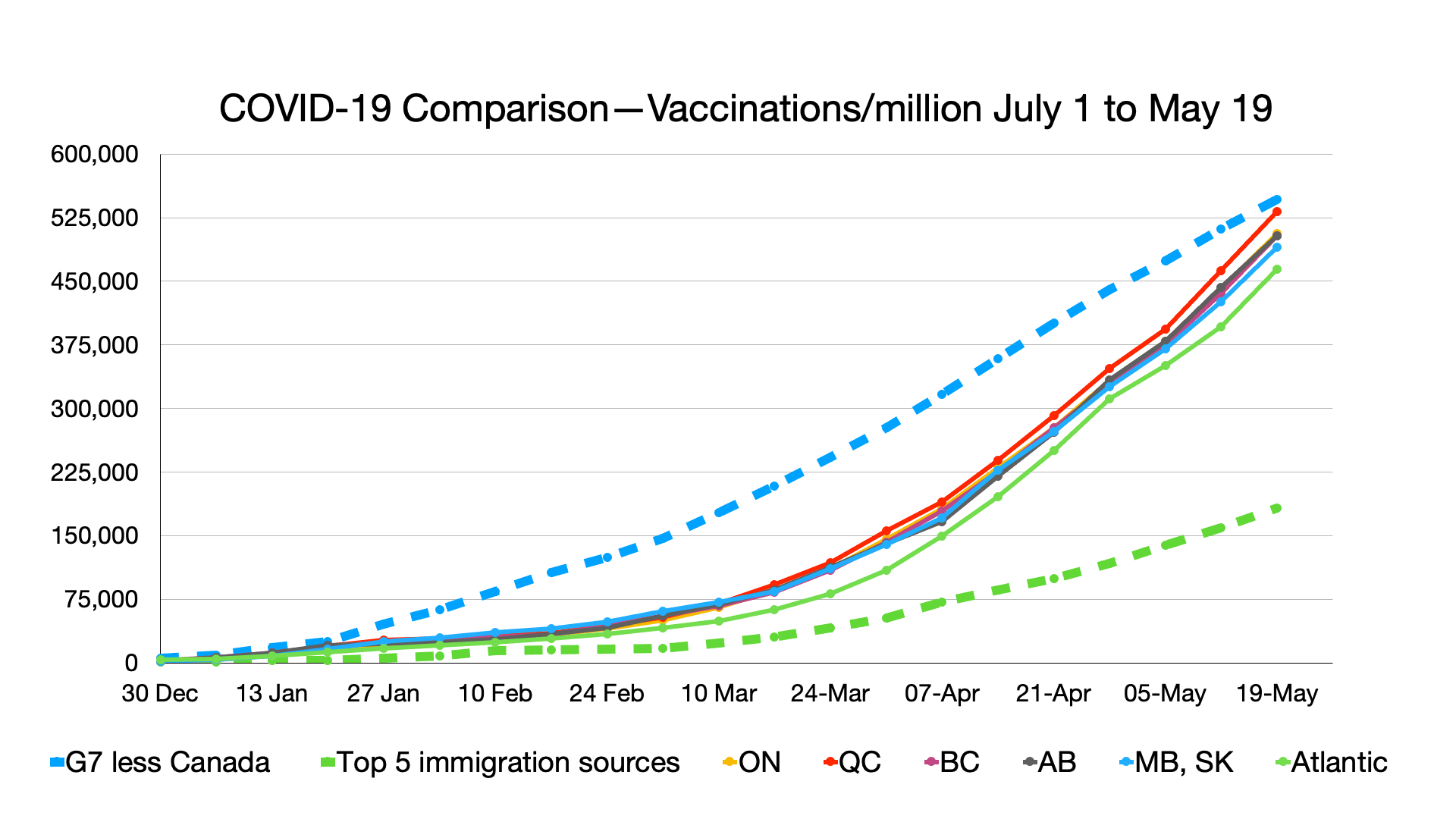
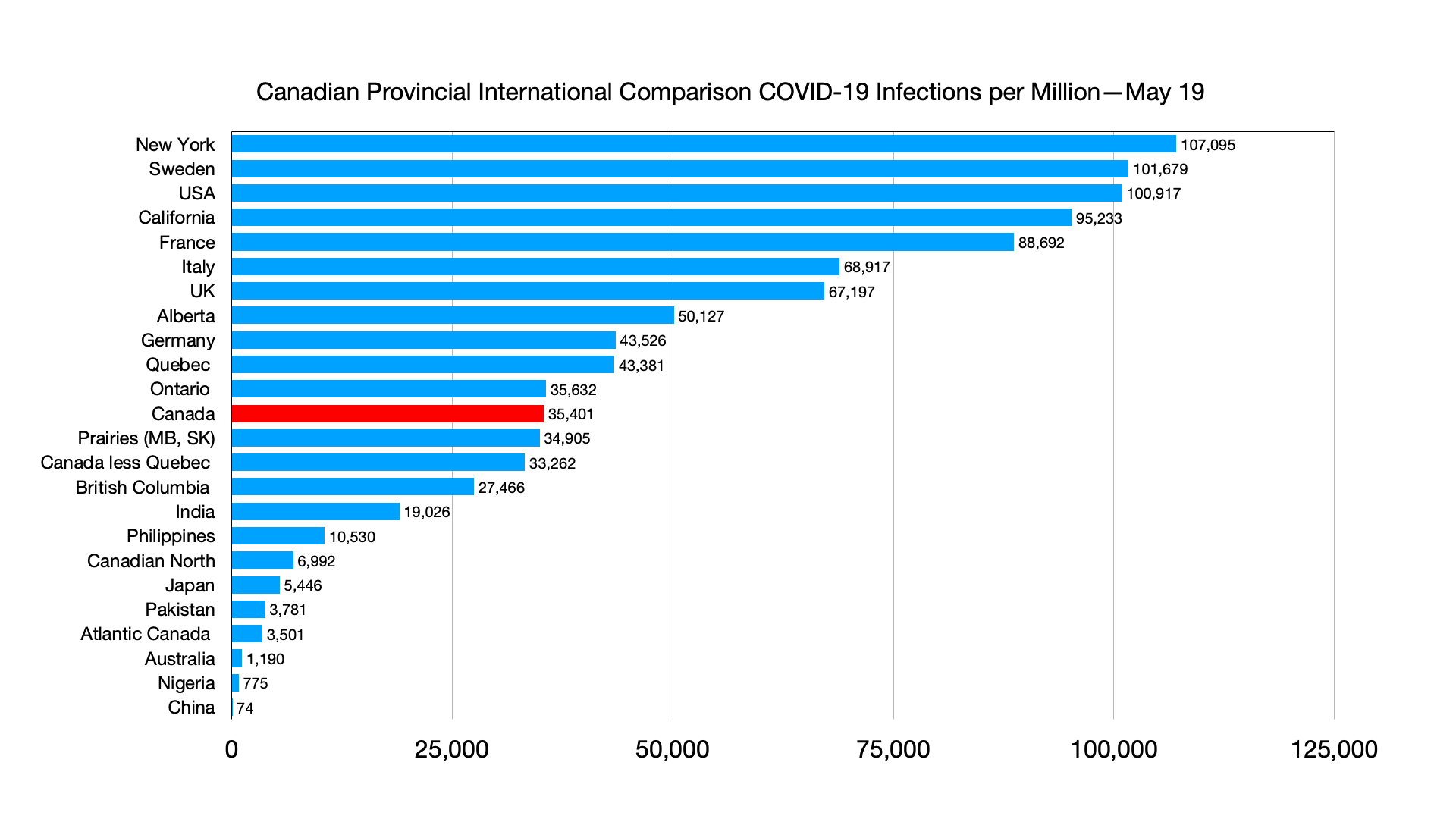
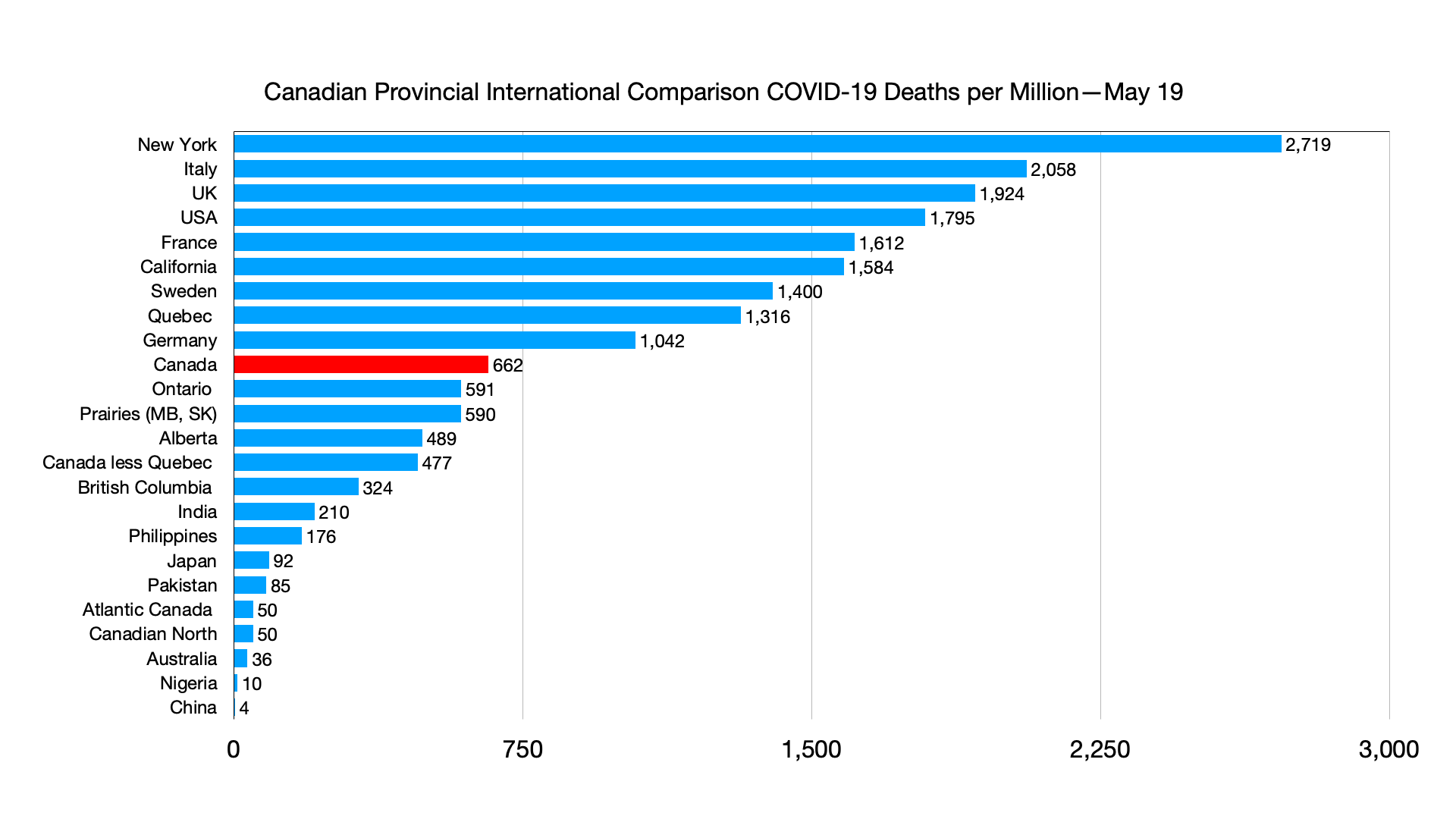
The latest charts, compiled 19 May as the third wave continues.

Vaccinations: No significant relative changes

Trendline charts

Infections per million: Alberta spike continues and upsurge in Manitoba is driving Prairie rates closer to Ontario.

Deaths per million: Gap between G7 and Canadian provinces continues to grow.

Vaccinations per million: Canadian vaccination rates continue to catch up to G7 less Canada and are likely to exceed G7 shortly (at least in some provinces).

Weekly

Infections per million: Minor shifts between some EU countries and Canadian provinces.

Deaths per million: Atlantic Canada ahead of the North.

Krugman: Learning to Live With Low Fertility

Interesting, rather than advocating for higher levels of immigration, Krugman takes the alternate take of adapting to lower fertility and population growth. Canadian governments, policy makers and advocates would be wise to also consider this alternate scenario:

Last week the Bureau of Labor Statistics reported much higher inflation than almost anyone predicted, and inflationistas — people who always predict runaway price rises, and have always been wrong — seized on the news as proof that this time the wolf is real.

Financial markets, however, took it in stride. Stocks fell on the report, but they soon made up most of the losses.

Bond yields rose only slightly on the news, then ended the weekright where they started — namely, extremely low.

Why so little reaction to the inflation news? Part of the answer, presumably, was that once investors had time to digest the details they realized that there was little sign of a rise in underlying inflation; this was a blip reflecting what were probably one-time rises in the prices of used cars and hotel rooms.

Beyond that, however, is what I think is the realization that while we’re achieving dramatic, almost miraculous success in defeating Covid-19, once the pandemic subsides we’re likely to be in an environment of sustained low interest rates as a result of weak investment demand. And the biggest reason for that low-rate environment is plunging fertility, which implies slow or even negative growth in the number of Americans in their prime working years.

This isn’t a new issue. Last month’s census report showing the lowest U.S. population growth since the 1930s only confirmed what everyone studying the subject already knew. And America is relatively late to this party. Japan’s working-age population has been declining since the mid-1990s. The euro area has been on the downslope since 2009. Even China is starting to look like Japan, a legacy of its one-child policy.

Is stagnant or declining population a big economic problem? It doesn’t have to be. In fact, in a world of limited resources and major environmental problems there’s something to be said for a reduction in population pressure. But we need to think about policy differently in a flat-population economy than we did in the days when maturing baby boomers were rapidly swelling the potential work force.

OK, let me admit that there is one real issue: An aging population means fewer active workers per retiree, which raises some fiscal issues. But this problem is often exaggerated. Remember all the panic about how Social Security couldn’t survive the burden of retiring boomers? Well, many boomers have already retired; by 2025 most of the growth in the number of beneficiaries per worker caused by retiring baby boomers will already have occurred. Yet there’s no crisis.

There is, however, a different issue with low population growth. To maintain full employment, a market economy must persuade businesses to invest all the money households want to save. Yet a lot of investment demand is driven by population growth, as new families need newly built houses, new workers require the construction of new office buildings and factories, and so on.

So low population growth can cause persistent spending weakness, a phenomenon diagnosed in 1938 by the economist Alvin Hansen, who awkwardly dubbed it “secular stagnation.” The term and concept have been revived recently by Larry Summers, and on this issue I think he’s right.

Secular stagnation can be a problem, because if interest rates are very low even in good times there’s not much room for the Fed to cut rates during recessions. But a low-interest-rate world can also offer major policy opportunities — if we’re willing to think clearly.

For what we’re looking at here is a world awash in savings with nowhere to go: Households are eager to lend money out, but businesses don’t see enough good investment opportunities. (Bitcoin doesn’t count.) Well, why not put the money to work for the public good? Why not borrow cheaply and use the funds to rebuild our crumbling infrastructure, invest in the health and education of our children, and more? This would be good for our society, good for the future, and would also provide a cushion against future recessions.

What about the burden of debt, you ask? Well, federal debt as a percentage of G.D.P. is twice what it was in 1990, but interest payments on the debt are only about half as high. That’s what low borrowing costs — largely a byproduct of demographic stagnation — do.

So, are the Biden administration’s infrastructure and family proposals the kind of things I have in mind? They’re a gratifying step in the right direction. But they aren’t nearly as ambitious as they’re often portrayed, and to my mind they’re too fiscally responsible — the administration is excessively concerned with paying for its plans.

The fact is that, like it or not, we’re going to be living for a long time with very slow population growth. And we need to start thinking about economic policy with that reality in mind.

Source: https://www.nytimes.com/2021/05/17/opinion/low-population-growth-economy-inflation.html

How Australia can benefit from low or no immigration

A critical look, one that the Australian government appears to have largely adopted, but not going so far as “no immigration”:

For years there has been an often heated debate about the impact of high immigration on the Australian economy.

It is clear that population growth driven by some of the highest immigration levels in the world have supported bottom line GDP growth – the new Australians work, eat, live and spend.

High immigration has also fuelled strong demand for housing and was, at least in part, one of the divers of the unrelenting rise in house prices for many decades.

At the same time, population growth outpaced infrastructure capacity, most notably the transport networks in the big cities where most immigrants settled. Congestion was also seen in productivity destroying traffic chaos, overcrowded schools, hospitals and other government services.

Immigration was also a source of labour for many businesses, which has seen the government slash trade training funding, made university costs oppressive and generally undermined the skills set of many Australians.

If workers were needed to pick fruit, work as highly skilled engineers in the mines or IT gurus for businesses, the government simply granted work visas and the problem was solved.

Resources to train and upskill the 2 million Australians unemployed and underemployed – many of who do not have the skills needed in today’s economy – were hopelessly inadequate which is why, with the borders closed, there is a widespread skills shortage.

The benefits of high immigration were being offset or at least diluted by the costs.

COVID-19 and the border closures

With the onset of the COVID-19 pandemic, the government effectively closed the international borders to immigrants.

Indeed, the latest figures from the Australian Bureau of Statistics show that more people are leaving Australia permanently than are arriving. This is the first time this has happened in 100 years.

A year after net immigration turned negative, there are some economic trends emerging that might give a few insights into the sort of immigration policy that is best for Australians after the COVID-19 pandemic is over or at least when we learn to live with the virus in an orderly way.

Perhaps the most obvious issue is a skills shortages among the current workforce which is sparking up opportunities for a long overdue acceleration in wages growth. Business are reporting it difficult to find suitable workers and for obvious reasons, this cannot be fixed by working visas and immigration.

A recent RBA survey of business shows expectations for wages growth is at its highest level in over a decade. Weak wages growth, for so long a problem for the Australian economy, is poised to turn with a substantial pick up in private sector wages unfolding.

It is well understood that rising wages growth will fuel household incomes and with that, consumer spending.

And the key thing about this wages growth is that firms are able to meet this higher wages bill given there has been solid growth in bottom line profits and margins as the economy expands.

Border closures are now linked to higher wages.

With the working from home phenomenon that has been experienced due to the COVID-19 restrictions, congestion in most CDBs and on public transport is less common. Again this is good news and if sustained, will ease the pressure on State budgets for future infrastructure spending. Fewer people are using existing public transport and roads.

While it is yet to be fully tested, there is tentative evidence that low immigration has reduced demand for residential property.

The mini-boom in house prices evident over the last 8 or 9 months has been driven by favourable affordability with first home buyers using stunningly low interest rates and a raft of financial incentives to get into the market and pay-up for their home.

New immigrants have, obviously, been absent from auctions of the queues for rental properties.

Immigration an election issue?

The next Federal election is less than a year away. It could even be in October as Prime Minister Morrison works to take advantage of the favourable economic news and as some of the measures in the budget start to impact on voters.

It is possible that immigration will be an election issue particularly if one side, or other, uses the good news from low immigration as part of a platform to improve the well being of Australians with strong per capita growth.

Of course, Australia needs to maintain its humanitarian immigration program, and when health conditions permit, this should resume.

But the bigger picture immigration program, which saw 1 million people arrive in the three years prior to COVID-19, needs to be scaled back even when the borders reopen.

If we go back to huge population growth in the years ahead, get set for weaker wages, further house price gains, pressure on infrastructure and higher unemployment.

Source: How Australia can benefit from low or no immigration

La balle est dans le camp de Québec, dit le ministre Mendicino

This “blame game” has been going on for some time:

Le gouvernement fédéral a beau être celui qui a le pouvoir d’octroyer la résidence permanente, Québec a sa part de responsabilité dans les dizaines de milliers de dossiers de travailleurs qualifiés en attente, croit le ministre de l’Immigration, Marco Mendicino. En entrevue au Devoir, il s’est dit « encouragé » par le fait que Québec a légèrement augmenté ses seuils pour 2021, mais estime que la balle est toujours dans son camp.

« Il faut comprendre très clairement que Québec établit ses propres seuils d’immigration annuels, et nous recevons plus de demandes pour le PTQQ [Programme des travailleurs qualifiés du Québec] que les [places] permis [es] par Québec. C’est la raison pour laquelle il y a plus d’applications dans l’inventaire », a dit le ministre dans une entrevue accordée en français au Devoir.

Il rappelle que 50 000 travailleurs qualifiés sont en attente d’une résidence permanente, mais que les cibles du Québec ne permettent pas d’absorber toutes les demandes traitées. « Les seuils d’immigration de Québec en 2021, cette année, sont de maximum 26 000 personnes. Ça, c’est la réalité », a déclaré le ministre Mendicino, qui a succédé à Ahmed Hussen à ce poste à la fin 2019.

Il ne cache pas que cette « réalité », soit les seuils trop bas du Québec pour écouler les dossiers en attente, est à l’origine d’une demande de la ministre de l’Immigration, Nadine Girault, enjoignant au fédéral de traiter en priorité les dossiers de travailleurs qualifiés déjà ici. Or, cela n’est pas sans conséquence sur les autres catégories d’immigration, souligne M. Mendicino. « Quand nous faisons l’exercice de priorisation du PTQQ, la réalité est que les autres applications ne sont pas priorisées. […] Ça va rester comme ça tant et aussi longtemps que la demande sera plus grande que les niveaux d’immigration établis par le Québec. »

Regarder vers l’avenir

Il y a deux semaines, Le Devoir avait révélé qu’Ottawa avait reconnu avoir ralenti le traitement des dossiers de travailleurs qualifiés et que c’était attribuable « aux restrictions imposées par le gouvernement du Québec quant aux admissions en raison d’un nombre limité de places dans les niveaux annuels », pouvait-on lire dans des documents gouvernementaux. Ces déclarations avaient agacé Québec, qui a continué de rejeter la responsabilité des délais de traitement sur le gouvernement fédéral, le seul à pouvoir délivrer des résidences permanentes.

Mais le ministre canadien dit qu’il ne souhaite pas « débattre du passé », mais plutôt assainir le climat entre lui et le Québec. « Je vais me concentrer sur aujourd’hui et l’avenir, et je vais livrer tous les travailleurs dont le Québec a besoin pour appuyer sa relance économique. C’est la chose la plus importante pour moi et mon gouvernement », a-t-il dit, en ajoutant qu’Ottawa est un « partenaire de bonne foi » dans cette affaire.

Marco Mendicino rappelle que son ministère a déjà octroyé une résidence permanente à plus de 7000 travailleurs qualifiés du Québec, soit une augmentation de 54 % par rapport à l’an dernier. Il aurait également contribué à fournir au Québec plus de 7000 travailleurs temporaires.

Plus d’anges gardiens

Quant au programme des « anges gardiens », qui vise à régulariser le statut des demandeurs d’asile ayant travaillé en soins directs aux patients pendant la première vague, le ministre fédéral de l’Immigration a dit continuer de talonner son homologue québécoise pour qu’elle élargisse le programme. « J’ai répété que la porte restait ouverte de notre côté pour revisiter les paramètres de programme », a-t-il indiqué, en évoquant une rencontre avec Nadine Girault il y a exactement deux semaines. « Je pense que le Québec veut attendre un peu plus pour regarder le progrès. Mais s’[il] veut élargir le programme, nous sommes prêts. »

En date du 10 avril, seulement 3200 dossiers (représentant 7500 personnes au total) avaient été reçus dans le cadre de ce programme, dont 1400 au Québec. Soucieux d’atteindre sa cible historique de 401 000 immigrants en 2021, le gouvernement fédéral a également lancé le mois dernier un programme permettant à plus de 90 000 étudiants et travailleurs temporaires d’obtenir la résidence permanente.

Source: La balle est dans le camp de Québec, dit le ministre Mendicino