2021 Might Be A Decisive Year For H-1B Visas

Significant, given possible effects on relative attractiveness of Canada to potential immigrants:

The Trump administration was hostile to high-skilled immigration, but the Biden administration may enact the most enduring policy changes to H-1B visas. And the changes might not be positive for employers. A series of decisions loom on regulations that would affect who can receive H-1B petitions, how much employers must pay H-1B professionals and much more.

The Big Picture: “H-1B visas are important because they generally represent the only practical way for high-skilled foreign nationals, including international students, to work long-term in the United Statesand have the chance to become employment-based immigrants and U.S. citizens,” as discussed in a recent Forbes article. “In short, without H-1B visas, nearly everyone from the founders of billion-dollar companies to the people responsible for the vaccines and medical care saving American lives would never have been in the United States.”

The number of H-1B visas is small for a country the size of the United States. The 85,000 annual H-1B limit—the 65,000 regular cap and the 20,000-exemption for H-1B visa holders with a master’s degree or higher from a U.S. university—comes to 0.05% of the U.S. labor force. Companies are allowed to file for only 85,000 new H-1B petitions in a year, and about two-thirds, or 56,000 a year, are in computer occupations. 

The U.S. job market is strong for individuals who work in computer occupations. The unemployment rate in math and computer occupationswas 2.5% in April 2021, below the 3%, lower than in January 2020 before the pandemic began. 

Today, there are well over 1 million active job vacancy postings in computer occupations, according to a National Foundation for American Policy (NFAP) analysis of Emsi Job Posting Analytics. “There is not a fixed number of jobs, and people with high skills often create more jobs for people with complementary skills,” notes the NFAP analysis. “Still, even if one adopts a zero-sum approach, there are nearly 20 times more job vacancy postings in computer occupations than new H-1B petitions typically used by companies in computer occupations each year. There are also likely many more openings than publicly posted positions.”MORE FOR YOUFederal Judge Hears Arguments Against Trump’s H-1B Visa BanH-1B Visa Denials Continue To Mount For CompaniesCourt Hearing Shows Businesses Could Prevail Against H-1B Visa Rules

With regional Covid-19 bans still in place and many U.S. consulates either not operating or working in a limited capacity, visa backlogs, including for H-1B and L-1 visa, will continue to mount until the State Department commits to new policies. Jeffrey Gorsky, former Chief of the Legal Advisory Opinion section of the Visa Office in the U.S. Department of State, believes the State Department could become more creative with biometric intake, give visa processing a higher priority and conduct more interviews via video. He believes interviews via Zoom would meet the statutory definition of in-person interviews.

Due to Trump administration policies that U.S. courts found unlawful, H-1B denial rates reached 24% for initial employment and 12% for continuing employment in FY 2018 (compared to 6% and 3% in FY 2015). After USCIS agreed to a settlement with the ITServe Alliance that overturned years of restrictive policies, H-1B denial rates returned to pre-Trump levels (after costing companies millions of dollars). The Biden administration may remove some restrictions on H-1B visa holders that prevent them from starting businesses, according to the New York Times.

Still, the H-1B annual limit is low. Employers filed 308,000 H-1B registrations for cap selection for FY 2022, according to USCIS. That means over 72% of H-1B registrations for high-skilled foreign nationals were rejected even before an adjudicator evaluated the application.

The economic literature shows loosening restrictions on H-1B visas would benefit the U.S economy and American workers. A study by economists Giovanni Peri, Kevin Shih, Chad Sparber and Angie Marek Zeitlin found, “The number of jobs for U.S.-born workers in computer-related industries would have grown at least 55% faster between 2005-2006 and 2009-2010, if not for the denial of so many applications in the recent H-1B visa lotteries.”

Britta Glennon, an assistant professor at the Wharton School of Business at the University of Pennsylvania, found in her research that H-1B restrictions push technology-related jobs out of the United States: “[A]ny policies that are motivated by concerns about the loss of native jobs should consider that policies aimed at reducing immigration have the unintended consequence of encouraging firms to offshore jobs abroad.”

Some policymakers argue America needs even more restrictive laws and rules to block the hiring of foreign-born scientists and engineers. As discussed below, the Biden administration will soon decide on a series of restrictions that could produce significant changes in H-1B visa policy.

Rule Would Make it Less Likely International Students Will Get H-1B Petitions: Before Donald Trump left office, his administration finalized a regulation that would end the H-1B lottery and replace it with a system that awards H-1B petitions by highest to lowest salary level. Many attorneys consider the regulation to be unlawful, and there are pending lawsuits against the rule. Instead of taking steps to rescind the rule, the Biden administration only delayed the regulation until next year’s H-1B cap selection.

In addition to questions of legality, the rule finalized by the Trump administration would fulfill a long-standing goal of Trump White House adviser Stephen Miller and his allies to make it more difficult for international students to obtain an H-1B petition, which would discourage many students from coming to America in the first place.

International students are disadvantaged under the rule because choosing H-1B petitions by salary level favors individuals with the most experience in the labor market over those with the least experience. “The National Foundation for American Policy found that an international student may be 54% more likely to get an H-1B petition under the current H-1B lottery system than under the Trump administration’s regulation that would end the H-1B lottery,” according to an NFAP analysis of actual cases of recent international students and filings for H-1B petitions. “The data demonstrate the new regulation would have a significant negative effect on the ability of international students to gain an H-1B petition.”

“The law firm Curran, Berger & Kludt provided NFAP with 170 cases of F-1 students with applications for H-1B cap selection for FY 2018, FY 2019, FY 2020 and FY 2021,” according to NFAP. “Under the current system that randomly selects H-1B petitions, 60% of the F-1 students were chosen through the H-1B lottery. However, the law firm provided information on the pay levels (Level 1 through 4) for the students’ H-1B applications, and NFAP found if the new regulation had been in effect, only 39% of the students’ H-1B petitions would have been selected.” Education organizations had warned the Trump administration’s rule would harm international students and make studying in America less attractive.

Rule to Force Employers to Pay H-1B Visa Holders and Employment-Based Green Card Applicants Well Above Market Wages: Under a Department of Labor (DOL) rule, published in the final days of the Trump administration, “employers must pay 23% to 41% higher salaries than under the current system across a range of occupations if they want to employ high-skilled foreign nationals in America,” according to a National Foundation for American Policy (NFAP) analysis. https://embedly.forbes.com/widgets/media.html?src=https%3A%2F%2Fdatawrapper.dwcdn.net%2FUsMsI%2F1%2F&display_name=Datawrapper&url=https%3A%2F%2Fdatawrapper.dwcdn.net%2FUsMsI%2F1%2F&key=3ce26dc7e3454db5820ba084d28b4935&type=text%2Fhtml&schema=dwcdn

The rule would apply to H-1B visa holders and employment-based immigrants and could have a devastating impact on both. H-1B visa holders waiting in the green cards backlog might be forced to leave the country if an employer could not extend their H-1B status at the new, much higher required salary level.

There is no evidence H-1B visa holders and employment-based immigrants as a group are underpaid relative to native-born professionals. Numerous economic studies have found high-skilled foreign nationals, on balance, earn more than their native-born counterparts. For example, Andrew Chamberlain, the chief economist at Glassdoor, found, “Across the 10 cities and roughly 100 jobs we examined, salaries for foreign H-1B workers are about 2.8% higher than comparable U.S. salaries on Glassdoor.” A recent study by Utah State University economist Omid Bagheri finds a larger wage premium for high-skilled foreign nationals.

The Biden administration published a notice of an agency action to delay the DOL rule until November 14, 2022. At the same time, the administration requested information from the public on data sources for calculating the prevailing wage.

Three courts blocked the rule when it was published as “interim final” in October 2020. On January 14, 2021, the Trump administration published a final rule that was only slightly modified from the original and carried the same aim—to price H-1B visa holders and employment-based immigrants out of the U.S. labor market. “The revisions to the rule don’t change the fact that it still fails to do what the law requires—to reflect the actual, prevailing wage for workers in that geographical area doing similar work,” said Kevin Miner, a partner at Fragomen. 

The U.S. Chamber of Commerce and allied business groups and education organizations filed an amended complaint that argues the regulation to end the H-1B lottery is unlawful and continued its lawsuit to end the Department of Labor wage regulation.

New Regulation on Work at Third-Party Sites: “USCIS is still aiming to have a regulation in place by FY23 cap season to restrict use of the H-1B category by outsourcing companies by changing the ‘employer-employee relationship’ definition,” according to Berry Appleman & Leiden. Peter Bendor-Samuel, founder and CEO of Everest Group, argues access to talent is key for competitiveness as information technology services companies attempt to build digital platforms for U.S. companies. “Almost every major U.S. firm is building some form of digital platform so it can enhance its competitive position both domestically and internationally,” he said. “This is probably the most important thing these firms are doing and success will define both company and global success as we move into the future.”

The mistaken premise of nearly all restrictions on high-skilled immigration is that foreign-born scientists and engineers offer no value to America or U.S. companies except for a willingness to work for less money. Some policymakers believe that people born in other countries possess inferior abilities to people born in the United States—hence the belief companies must pay them lower salaries—and incorrectly assume that only a fixed number of jobs exist in the U.S. economy. The Biden administration has an opportunity to adopt a more forward-looking policy.

Source: https://www.forbes.com/sites/stuartanderson/2021/06/02/2021-might-be-a-decisive-year-for-h-1b-visas/?utm_source=newsletter&utm_medium=email&utm_campaign=follow&cdlcid=5e4bc7f55b099ce02faa6b40&utm_source=newsletter&utm_medium=email&utm_campaign=follow&cdlcid=5e4bc7f55b099ce02faa6b40&sh=7932dc0018df

Buckingham Palace’s Institutional Racism Revealed in Damning Unearthed Documents

Of interest:

Less than three months ago, Meghan Markle and Prince Harry accused an unnamed member of the royal family of having asked a racist question about the likely color of any of their then-unborn children’s skin.

In response, Prince William told reporters, “We are very much not a racist family.”

However, British newspaper the Guardian today revealed that the monarchy has explicitly employed racist hiring practices and that it continues to claim a special exemption from British equality legislation.

Source: Buckingham Palace’s Institutional Racism Revealed in Damning Unearthed Documents

Should statues of Sir John A. Macdonald be taken down? Canada’s minister of Indigenous services says no

Of note and right approach:

As shock waves continue to reverberate following the discovery of a gravesite of 215 Indigenous children, Indigenous Services Minister Marc Miller spoke out Wednesday against taking down the statues of the prime minister responsible for creating the residential schools that led to their deaths.

Miller said removing statues of Sir John A Macdonald from public display would amount to Canadians taking their eyes off the brutal history and legacy of the schools.

“Knocking things down, breaking things is not my preferred option. Turning my eyes away from things is not my preferred option,” Miller said during a news conference in a government building named after Macdonald.

“Looking at things as painful as they are, explaining why they are, is my preferred option.”

Across the country, institutions and local governments are resuming efforts to remove statues of Canada’s first prime minister, and to rename streets and schools whose namesakes have a direct connection to Canada’s residential school program.

Similar such movements have become flashpoints over the last several years, including last summer in the wake of global Black Lives Matter protests, when Miller and Prime Minister Justin Trudeau spoke out against taking down the monuments.

But the outpouring of anger now is more directly targeted at the heart of one of Macdonald’s legacies: the residential school system.

The revelation last week that 215 children were buried in unmarked graves on the site of a former residential school in Kamloops, B.C. is leading to fresh rounds of soul-searching about whether and how Canada must come to grips with the deadly effect of those schools, which were initiated by Macdonald’s government in 1883.

During the century that followed — the last school closed in 1996 — about 150,000 Indigenous children were removed from their homes and forced to attend what Miller called “labour camps” that were built for the express purpose of eradicating their culture.

At least 4,000 children are known to have died while attending residential schools. Following the discovery of the graves in Kamloops last week, those estimates have begun to climb, with some now speculating the number could be as high as 25,000.

“We know there are lots of sites similar to Kamloops that are going to come to light in the future. We need to begin to prepare ourselves for that,” former senator Murray Sinclair said in a written statement late Tuesday.

“Those that are survivors and intergenerational survivors need to understand that this information is important for all of Canada to understand the magnitude of the truth of this experience.”

What must be done with that information is a debate taking many forms, be it the removal of Macdonald statues or the demands for the federal government to move much faster to implement the calls to action on missing children and burial information contained in the Truth and Reconciliation Commission’s report on residential schools.

In 2019, some $27 million was set aside to respond to those calls, but the funds were redirected to address the impacts of the pandemic and to finish off virtual engagement sessions on the response to the TRC, Crown-Indigenous Relations Minister Carolyn Bennett’s office said Wednesday.

Some money began to flow last year. On Wednesday, Bennett announced communities that want to begin the work of documenting, locating and memorializing missing children could apply anew and the money would flow on an “urgent” basis.

How that work is done must be determined in consultation with communities, Bennett and Miller have insisted.

The ministers said on Tuesday it is also important to listen to those who speak out against Macdonald.

However, Miller said the debate over renaming buildings or taking down statues has become too partisan, and misses the point.

“I respect the meaning and the expression of people saying we need to take this down, rip it down,” he said.

“It’s an expression of pain. I understand. I’m not a proponent of it. I think we have to keep explaining. We have to keep explaining so that we don’t repeat those errors.”

Conservative politicians have also spoken out against the need to tear down statues, though for different reasons, arguing doing so amounts to so-called “cancel culture.”

Conservatives including Alberta Premier Jason Kenney and federal Leader Erin O’Toole have also said removing statues of people like Macdonald would also erase all acknowledgment of the benefits they provided to Canada.

Source: Should statues of Sir John A. Macdonald be taken down? Canada’s minister of Indigenous services says no

Nicholas: L’amnésie du Canada missionnaire

Important reminder of the cultural genocide impact of missionaries:

Ce sont d’abord les noms qui m’ont mis la puce à l’oreille. Les porte-parole de la Nation Tk’emlúps te Secwépemc, où l’on a retrouvé les restes des 215 enfants du pensionnat de Kamloops, en Colombie-Britannique, s’appellent notamment Baptiste, Jules, Casimir, Michel, Gosselin, Antoine, Lampreau. Pourquoi ?

J’ai donc replongé dans Le Canada français missionnaire de Lionel Groulx, paru pour la première fois en 1962. « En bref, je voudrais raconter la grande aventure d’un petit peuple qui, à peine né, se jette dans la conquête religieuse de l’Indien en Amérique du Nord », commence-t-il. La phrase décrit bien le projet de l’essai, qui recense la longue liste des missions catholiques canadiennes-françaises au fil des siècles, de l’Atlantique au Pacifique à l’Arctique et aux États-Unis, puis celles de l’Afrique, de l’Asie, de l’Amérique latine, de la Caraïbe. Tout y passe, méticuleusement. Il s’agit, pour le chanoine Groulx, de démontrer que l’esprit impérialiste fait toujours partie de l’âme des gens d’ici, malgré la Conquête : « Son empire de jadis, il semble […] qu’il le veuille reconstituer sur un plan supérieur, le plan spirituel cette fois, avec des frontières indéfiniment extensibles ».

L’essai débute au temps de la Nouvelle-France, où il vante « l’audace conquérante » des premiers missionnaires, qui a persisté sous le régime anglais. Il déplore qu’au XIXe siècle, « les épreuves ou misères n’ont que très peu changé depuis le temps de la Nouvelle-France. Le Sauvage reste encore sauvage, ou peu s’en faut : homme-enfant, léger, fantasque, incapable d’efforts soutenus, mal débarrassé de son vieux paganisme ». Il ajoute : « Comme aux temps anciens l’alcool le fascine ; le concubinage sévit ».

Les descriptions racistes ne sont pas accessoires au livre, mais une partie importante de l’argumentaire. C’est qu’il n’y aurait pas autant de noblesse dans le missionnariat si les Autochtones n’étaient pas dépeints comme des sous-humains en attente de rédemption. Par exemple, le chanoine nous décrit les Dénés (Territoires du Nord-Ouest) comme « barbares, presque sataniques », mais tient à nous rassurer. Au contact des missionnaires, « les infanticides, le cannibalisme, souvent provoqués par la misère, disparaissent ».

Dans son récit, le chanoine Groulx insiste sur le rôle des Oblats de Marie-Immaculée, ordre français que l’évêque de Montréal Ignace Bourget invite, en 1841, à s’établir près de lui pour recruter activement au sein de la population du Bas-Canada. Les Oblats « se livrent aux missions indiennes avec une véritable fougue évangélique », nous assure Groulx. Ainsi des missions sont lancées un peu partout au Québec et au Canada bien avant l’ouverture officielle des pensionnats autochtones. Lorsque ceux-ci sont mis en place, on se porte volontaire pour les faire fonctionner. Ainsi, au moins 57 des 139 pensionnats financés par le gouvernement du Canada ont été gérés par les Oblats durant leurs années d’opération. Riches de leur expérience dans l’Ouest, ils font d’ailleurs pression sur les députés francophones du gouvernement Mackenzie King, dans les années 1930, afin que des pensionnats soient aussi ouverts au Québec.

C’est ainsi que des religieuses de la vallée du Saint-Laurent partent nombreuses « à l’aventure », notamment dans l’Ouest. Les frères emploient les Sœurs de l’Assomption de la Sainte Vierge pour s’occuper du pensionnat de Onion Lake, en Saskatchewan. Les Sœurs missionnaires du Christ Roi, après avoir géré des camps de concentration pour les Canadiens d’origine japonaise durant la Deuxième Guerre mondiale, sont assignées aux « écoles indiennes ». Les Sœurs de Sainte-Croix et des Sept-Douleurs ouvrent quant à elle un pensionnat à Moricetown, au nord-est de Prince Rupert. Et les Sœurs de Sainte-Anne, originaires de Saint-Jacques-de-l’Achigan, dans Lanaudière, se chargent notamment des « écoles indiennes de Kamloops, de Kuper Island et des Songhees », en Colombie-Britannique.

Finalement, on commence à comprendre le pourquoi de ces noms à consonance francophone des membres de la Nation Tk’emlúps te Secwépemc, où ont été retrouvés les 215 enfants du pensionnat de Kamloops.

On commence à comprendre qu’on avait peut-être tort de présenter la découverte macabre des restes des enfants de Kamloops avec une plus grande distance, ici, parce que « l’Ouest, c’est loin de nous ». On commence à voir que ce qui s’est passé au Québec comme dans les Prairies, le Grand Nord ou l’Ouest s’est déroulé avec la participation de certains de nos grands-oncles, de nos grands-tantes, dont le lien avec l’Église faisait la fierté et l’orgueil de bien des familles d’ici. On aperçoit aussi que l’amnésie collective sur les pensionnats autochtones est bien étrange, alors que certains de nos intellectuels les plus célèbres et célébrés se sont même vantés du rôle de l’Église canadienne-française dans leur établissement, afin d’y puiser un sentiment de fierté nationale.

Cette Église, et cette vision du nationalisme, bien des Québécois en ont un souvenir douloureux, et s’en sont dissociés à l’époque même des pensionnats et de Lionel Groulx, et bien sûr ensuite. Mais la dissociation peut-elle justifier les trous de mémoire ? L’anachronisme qui sépare l’Ouest canadien de l’histoire des francophones ? La prétention que ces administrateurs coloniaux ne font pas partie de nos histoires familiales ? Le détachement de ce qui s’est passé ici même au Québec ?

Rappelons-nous que la commission qui a fait la lumière sur les pensionnats s’appelle Vérité et Réconciliation. Et cette vérité inclut que les idées du chanoine Groulx fassent écho à une vision sociale et politique qui a influencé, pour le meilleur et pour le pire, les rapports entre les peuples autochtones et les francophones de partout au pays pendant plusieurs décennies. Sans vérité, quelle réconciliation est possible ?

Source: L’amnésie du Canada missionnaire

We can’t have Indigenous reconciliation without closing the employment gap

Good piece:

There’s a fine line between patient, incremental progress and leaning on a lethargic, long-term plan as an excuse for inaction, especially when it comes to grappling with the legacy of the residential school system.

Glenn Nolan is on the right side of that line.

He is the vice-president of government affairs for Noront Resources Ltd., and a member of the Missanabie Cree First Nation with a reputation in the mining world as an executive who knows how to bring Indigenous communities and economic development together.

His grandparents were both residential school survivors. In Nolan’s words, they were self-destructive, alcoholic and neglected their children. His grandfather told his father about seeing a youngster beaten unconscious in front of the class when he was in grade 4. The child was never heard from again; the teacher was simply transferred.

For the next generation, life was difficult, but not as difficult. His father was angry but quit drinking in his 30s. Nolan became the first in his family to get a post-secondary education. And he can hardly believe his luck these days at being able to spend the pandemic in his long-time home by the lake near Atikokan, Ont.

“It affected all of us,” Nolan says, reflecting on the generations since the residential school experience snaked through his family history. “But the valleys aren’t as deep, and the climb up out of it wasn’t as steep. So we’ve actually been very successful.”

At a society-wide level, however, progress in vanquishing the economic fallout of residential schools — poverty and inequality — is harder to see.

Statistics Canada published data in April that drew from the 2016 census, and its numbers are harsh. About 76 per cent of non-Indigenous working-age people were employed in 2016, the same as in 2006, the report shows. But for First Nations people living on reserve, the employment rate was just 47 per cent in 2016, which was actually a decline from the 50 per cent noted in 2006. The situation was slightly better for First Nations people living off reserve, with 60 per cent employed — compared to 62 per cent a decade earlier.

So, a huge gap, and getting wider.

As for the unemployment rate, it was 23 per cent on reserve in 2016 and 14 per cent off reserve, compared to just six per cent for the non-Indigenous population.

Income rose for everyone between 2006 and 2016, but the gap between non-Indigenous and First Nations people remains enormous. The median employment income for a non-Indigenous person was $34,000 in 2016 — double that of a First Nations person.

Similarly, poverty rates have declined for everyone over the decade, but the gap is outrageous. About 48 per cent of people on reserve were considered to be low income, compared to 14 per cent of non-Indigenous people.

There’s some hope in education. The gap is huge, but it’s getting narrower.

A 2019 report by the National Indigenous Economic Development Board compiled a whole range of pertinent indicators to assess progress over time, and found that “in general, outcomes for Indigenous peoples in Canada are improving and some gaps are decreasing, but to varying and sometimes small degrees.”

Right now, though, we have a pivotal moment.

The public is mortified by the discovery of the remains of 215 undocumented children by the Kamloops Indian Residential School, and the painful realization that there may well be thousands and thousands more bodies out there.

The calls from politicians, Indigenous leaders and people across the country to take urgent action, mitigate the harmful generational effects of residential schools and seek justice for the missing children are loud and clear.

At the same time, we have a federal government that proposes an aggressive attempt to rebuild the post-pandemic economy in a more just way, investing for inclusive growth that will not just repair the damage of the pandemic recession but also addresses the glaring inequities of the past.

And we have a private sector that anticipates labour shortages in the near future.

It’s a moment where federal policy and fiscal power could turn incremental, or sometimes invisible, progress into something more meaningful.

Yes, there were measures in the spring budget — $140 million for lending to small Indigenous businesses as well as $1 billion to ramp up rural broadband services.

And the federal government already supports numerous training, community and employment initiatives, Nolan points out.

The Indigenous economic development board has done some thorough research on economic reconciliation, and points to a few key areas where governments could do more and make an outsized difference in enabling Indigenous communities to develop their own strengths: beefing up procurement practices, improving access to capital, expanding education and training opportunities, and enabling Indigenous stakes in natural resource development. 

These are all practical suggestions that have the added benefit of ramping up existing support systems and encouraging local initiative — scaffolding, rather than starting from the ground up.

Nolan warns about moving too fast, when well-meaning help for economic development that doesn’t come with proper supports only sets up communities to fail.

“When you build a business, you can’t be the CEO of a multibillion-dollar company right away,” he says. “Businesses fail unless they have all the parameters in place.”

And that’s where the fine line is — finding that place between a lethargic status quo and patient progress that will, one day, take us all closer to reconciling with the past.

Source: https://www.thestar.com/politics/political-opinion/2021/06/01/we-cant-have-indigenous-reconciliation-without-closing-the-employment-the-gap.html

Alberta Premier Jason Kenney defends John A. Macdonald’s legacy amid backlash over residential schools’ deadly legacy

Rare defence these days. But like all historical figures, a mix of the good and the bad, just as we too will likely be judged by future generations:

Alberta Premier Jason Kenney drew criticism Tuesday with a staunch defence of the legacy of Canada’s first prime minister — who is back in the spotlightafter the discovery of a mass burial site of Indigenous children near a former residential school.

Yet another statue of Sir John A. Macdonald was carted off in the back of a truck Tuesday; this time, it was a jaunty seated version of Macdonald removed from a Charlottetown street corner.

The removal in Prince Edward Island was the latest public consequence of Macdonald’s role in creating a residential school system for Indigenous children, which spawned decades of abuse and death.

Three quarters of a country to the west, Kenney decried what he described as the cancellation of one of the architects of the country, “imperfect” though he may have been.

“I think Canada is a great historical achievement,” Kenney told reporters in response to a question that followed an update on his province’s vaccine rollout.

“It is a country that people all around the world seek to join as new Canadians. It is an imperfect country, but it is still a great country, just as John A Macdonald was an imperfect man, but was still a great leader.”

Grand Chief Vernon Watchmaker of Treaty Six, an area that includes much of the central parts of Alberta and Saskatchewan, said in a statement he was “appalled” at the insensitivity of the premier’s comments at a time when Indigenous people from coast to coast are grieving the discovery of the remains of 215 children at a former residential school in Kamloops, B.C.

“The country and the province was established at the cost of our lives and well being,” he said.

“Just when we think we are experiencing acts of reconciliation, the premier contradicts all the efforts towards an understanding.”

Macdonald, a Scottish immigrant who became Canada’s first prime minister in 1867, has been under increasing scrutiny for his role creating the residential schools system. In 1883, Macdonald spelled out in the House of Commons his thinking on the schools, which would come to number more than 130 from coast to coast.

“Indian children should be withdrawn as much as possible from the parental influence, and the only way to do that would be to put them in central training industrial schools, where they will acquire the habits and modes of thought of white men,” he said, as quoted in the House of Commons record of debates.

Tuesday is not the first time that Kenney has gone to bat for Macdonald, who, Kenney points out, tried to extend the vote to some First Nations. Last summer, Kenney said he’d like to see a Macdonald statue toppled by protesters in Montreal installed on the grounds of the Alberta legislature.

The discovery of the bodies in Kamloops, however, has triggered a fresh wave of pushback against Macdonald and the other creators of the system.

The Macdonald statue in Prince Edward Island, which news reports note has been defaced several times this year, is going into storage. Meanwhile, a group of students at Ryerson University say they will now refer to the institution as ‘X University,’ because of Egerton Ryerson’s association with the schools. And in Calgary, a school named for cabinet minister Hector-Louis Langevin is being rebranded.

When asked Tuesday, Kenney said he was unaware of that last decision, which had been announced hours earlier and instead, repeated his support for the former first minister.

He said that when he was a federal minister he’d founded a bill to recognize a John A Macdonald Day, to acknowledge the man “without whom Canada would not exist.”

“This is the problem with your line of questioning,” he said, speaking to the reporter who’d asked about the statue. “If the new standard is to cancel any figure in our history associated with what we now rightly regard as historical injustices, then essentially that is the vast majority of our history.”

Kenney listed Tommy Douglas and the Famous Five, who pushed to get the vote for white women, all of whom to some extent supported eugenics as a way to sterilize the weak.

He also mentioned Prime Minister William Lyon Mackenzie King, who made it effectively impossible for Jews to immigrate to Canada during the Holocaust, and prime minister Pierre Trudeau, who brought in martial law that led to the arrest of “thousands of people with absolutely nothing to do with the FLQ Crisis.”

On the other hand, he pointed out that former prime minister Stephen Harper made an official apology to residential school survivors, and that the federal government has provided more than $3.5 billion in restitution.

After the discovery in Kamloops was announced last week, Kenney tweeted that it was a “terrible reminder of the legacy of Canada’s system of aboriginal residential schools.”

His then became the first province to announce it would help fund the search for more unmarked graves, though officials have announced no details or specific dollar amounts so far.

But his unflagging support of Macdonald comes at a time when his government is facing growing fire for failing to educate children about residential schools.

The Truth and Reconciliation Commission has called on every child to learn about residential schools starting in kindergarten. But the proposed curriculum drafted by Kenney’s government doesn’t begin teaching that history until Grade 5.

As reported by CBC, one of the people hired to review the social studies draft, a man named Chris Champion who previously worked for Kenney when he was a federal minister, has called the inclusion of First Nations perspectives in school a fad, and said the blanket exercise commonly used to teach about the effects of colonialism brainwashes children.

Furthermore, some Indigenous leaders asked to consult on the new curriculum have accused the government of engaging in tokenism and of misrepresenting their positions.

Kenney said the new plan would be an improvement over the current curriculum, which doesn’t introduce residential schools until Grade 10 and that the amount of content students will learn increases overall.

“I think that’s the solution, which is to present young people, to present all Canadians, including new Canadians, with a balanced depiction of our history, including the terrible gross injustice and tragedy of the Indian residential schools.”

Source: Alberta Premier Jason Kenney defends John A. Macdonald’s legacy amid backlash over residential schools’ deadly legacy

Drastic drop in COVID infected international flights in May

Of note:

Transport Canada’s decision to ban passenger flights from India appears to have had an impact.

While numbers are always updated as new cases are diagnosed, data posted online by Health Canada as of Tuesday shows only 113 flights landing at Canadian airports last month carried passengers infected with COVID-19.

That’s compared to 288 flights counted in April — 66 of which were direct flights from India’s capital of Delhi.

Federal Transport Minister Omar Alghabra halted passenger flights from India and Pakistan for 30 days as of April 22, as well as adding additional restrictions on travellers arriving from India via connecting flights — including requiring a negative PCR COVID-19 test taken at the last port of entry before entering Canada.

This all but halted passenger traffic from both countries, as laboratory tests that typically require 24 hours can’t be accommodated during airport stopovers usually only lasting a few hours.

As many travellers from India had been connecting through Middle Eastern airports like Dubai, Abu Dhabi and Doha, infected passengers on those flights likewise saw big drops — just four from the United Arab Emirates last month compared to 35 in April.

Initially meant to last 30 days, the flight ban was extended last month to June 22.

During the first part of the pandemic, India typically only saw a handful of infected flights landing at Canadian airports each month.

All that changed in mid-February with a spike of infected flights coinciding with that country’s devastating variant-fuelled second wave.

Pakistan, meanwhile, has never been a significant factor, with Health Canada only reporting five such flights in April.

The United States was Canada’s largest source of infected flights last month, seeing 23 planes land with at least one passenger testing COVID positive — that’s compared to 49 in April.

Paris and Doha, Qatar, tied for second place with 11, followed by 10 from Guatemala, eight each from Frankfurt and Panama, seven from Istanbul, six from Amsterdam and five from Mexico City.

Toronto saw the most arrivals last month with 49 compared to 167 in April; followed by Montreal with 43 versus 57 in April; 14 in Vancouver compared to 42 in April; and six landing in Calgary compared to 19 the month previous.

Top sources of international flights with COVID-19 infected passengers in May (April’s total in parentheses)

1. USA: 23 (49)
2. Doha: 11 (21)
3. Paris: 11 (16)
4. Guatemala: 10 (4)
5. Amsterdam: 6 (12)
6. Frankfurt: 8 (13)
7. Panama: 8 (4)
8. Istanbul: 7 (18)
9. Mexico City: 5 (5)
10. Kingston, Jamaica: 3 (8)

Source: Drastic drop in COVID infected international flights in May

USA: The Brewing Political Battle Over Critical Race Theory

Latest iteration of the “culture wars:”

Last month, Republican lawmakers decried critical race theory, an academic approach that examines how race and racism function in American institutions.

“Folks, we’re in a cultural warfare today,” Rep. Ralph Norman, R-S.C., said at a news conference alongside six other members of the all-Republican House Freedom Caucus. “Critical race theory asserts that people with white skin are inherently racist, not because of their actions, words or what they actually believe in their heart — but by virtue of the color of their skin.”

Rep. Lauren Boebert, R-Colo., added: “Democrats want to teach our children to hate each other.”

Republicans, who are fighting the teaching of critical race theory in schools, contend it divides Americans. Democrats and their allies maintain that progress is unlikely without examining the root causes of disparity in the country. The issue is shaping up to be a major cultural battle ahead of next year’s midterm elections.

Academics, particularly legal scholars, have studied critical race theory for decades. But its main entry into the partisan fray came in 2020, when former President Donald Trump signed an executive order banning federal contractors from conducting certain racial sensitivity trainings. It was challenged in court, and President Biden rescinded the order the day he took office.

Since then, the issue has taken hold as a rallying cry among some Republican lawmakers who argue the approach unfairly forces students to consider race and racism.

“A stand-in for this larger anxiety”

Andrew Hartman, a history professor at Illinois State University, described the battle over critical race theory as typical of the culture wars, where “the issue itself is not always the thing driving the controversy.”

“I’m not really sure that the conservatives right now know what it is or know its history,” said Hartman, author of A War for the Soul of America: A History of the Culture Wars.

He said critical race theory posits that racism is endemic to American society through history and that, consequently, Americans have to think about institutions like the justice system or schools through the perspective of race and racism.

However, he said, “conservatives, since the 1960s, have increasingly defined American society as a colorblind society, in the sense that maybe there were some problems in the past but American society corrected itself and now we have these laws and institutions that are meritocratic and anybody, regardless of race, can achieve the American dream.”

Confronted by the Black Lives Matter protests of last summer, as well as the Pulitzer Prize-winning 1619 curriculum, which roots American history in its racist past, Hartman said many Americans want simple answers.

“And so critical race theory becomes a stand-in for this larger anxiety about people being upset about persistent racism,” he said.

Legislative action

States such as Idaho and Oklahoma have adopted laws that limit how public school teachers can talk about race in the classroom, and Republican legislatures in nearly half a dozen states have advanced similar bills that target teachings that some educators say they don’t teach anyway.

There’s movement on the national level too.

Sen. Tom Cotton, R-Ark., has introduced the Combating Racist Training in the Military Act, a bill that would prohibit the armed forces and academics at the Defense Department from promoting “anti-American and racist theories,” which, according to the bill’s text, includes critical race theory.

Rep. Byron Donalds, R-Fla., said he is co-sponsoring legislation that would prevent federal dollars from being spent on critical race theory in schools or government offices.

“The ideas behind critical race theory and [its] implementation is creating this oppressor-oppressed divide amongst our people,” Donalds told NPR. “And so no matter how you feel about the history of our country — as a Black man, I think our history has actually been quite awful, I mean, that’s without question — but you also have to take into account the progression of our country, especially over the last 60 to 70 years.”

Donalds said the country’s history, including its ills, should be taught, but that critical race theory causes more problems than solutions.

“It only causes more divisions, which doesn’t help our union become the more perfect union,” he said.

A post-racial country?

Nearly half of the speakers at the Republican news conference in May invoked Martin Luther King Jr., expressing their desire to be judged “by the content of their character, not the color of their skin.”

But Eduardo Bonilla-Silva, a sociology professor at Duke University, said King’s dream was about the future. “He didn’t say, ‘We are now in a colorblind society,’ ” he said.

Bonilla-Silva, whose book Racism Without Racists critiques the notion that America is now “colorblind,” says he too shares King’s dream, “but in order for us to get to the promised land of colorblindness, we have to go through race. It’s the opposite of what these folks are arguing.”

He says the idea that American society is post-racial is nonsense.

“We are not, because we watched the video of George Floyd, and we are not because we have the data on income inequality, on wealth inequality, on housing inequality,” he said.

As an example, Bonilla-Silva noted the opposition of whites to affirmative action in the post-civil rights era.

“Many whites said things such as, ‘I’m not a racist. I believe in equal opportunity, which is why I oppose affirmative action, because affirmative action is discrimination in reverse,’ ” he noted.

“That statement only works if one believes that discrimination has ended,” he added. “But because it has not ended, claiming that you oppose affirmative action because it’s presumably discrimination in reverse ends up justifying the racial status quo and the inequalities.”

Motivator for the midterms?

The fight over critical race theory will likely continue to be a heated issue ahead of next year’s midterm elections. Although November 2022 seems a long way away, Christine Matthews, president of Bellwether Research and a public opinion pollster, says pushback to anti-racism teaching is exactly the kind of issue that could maintain traction among certain voters.

“I think it’s just one more addition to the culture war that the Republicans really want to fight and it’s what they want to make the 2022 midterms about,” she said.

Matthews noted that Biden’s approval ratings, in the mid-50s, are significantly higher than Trump’s were throughout his term in office, “so Republicans are wanting to make this about othering the Democrats and making them seem as extreme and threatening to white culture as possible.”

“If Republicans can make [voters] feel threatened and their place in society threatened in terms of white culture and political correctness and cancel culture, that’s a visceral and emotional issue, and I do think it could impact turnout.”

These issues could be used to galvanize conservative voters and increase their numbers at the polls.

“We have seen evidence that the Republican base is responding much more to threats on cultural issues, even to some degree more than economic issues,” Matthews said.

But Rep. Donalds said the Republican Party doesn’t need to rally the base to get it to show up to vote.

“When it comes to the ’22 elections, we don’t need additional ammunition,” he said, pointing to what he views as a list of failures from the Biden administration, from budget and taxes to shutting down the Keystone pipeline.

Doug Heye, the former communications director for the Republican National Committee, said in some ways, the attempts to mandate what schools can or can’t teach highlights just how far the GOP under Trump has moved away from traditionally conservative principles — like wanting less federal involvement in schools.

“A lot of what we might have described as conservative policy five years ago, 10 years ago, now just isn’t that case,” he said. “If we’re pushing what is a current priority for the Trump base, that’s defined as conservative, whether or not that’s a federal top-down policy or not. So the old issues of federalism has really been upended under Donald Trump’s reign as the leader of the party.”

Heye said at this point, critical race theory is still politically a “niche issue” among conservative voters, but he expects it to play a larger role in state assemblies, governors races and school boards rather than in national politics.

He said he believes it’s an issue some candidates will raise “to further rile up the base that is already pretty riled.”

“So the question will be then for Republicans: What else are they really emphasizing?” he said.

From a strategy perspective, Matthews says she thinks it will all come down to messaging.

“The Republicans are trying to make it a bad thing,” she said, “but I feel like if the Democrats got the messaging right, they could make it a good thing.”

Both sides have a little more than a year to do that.

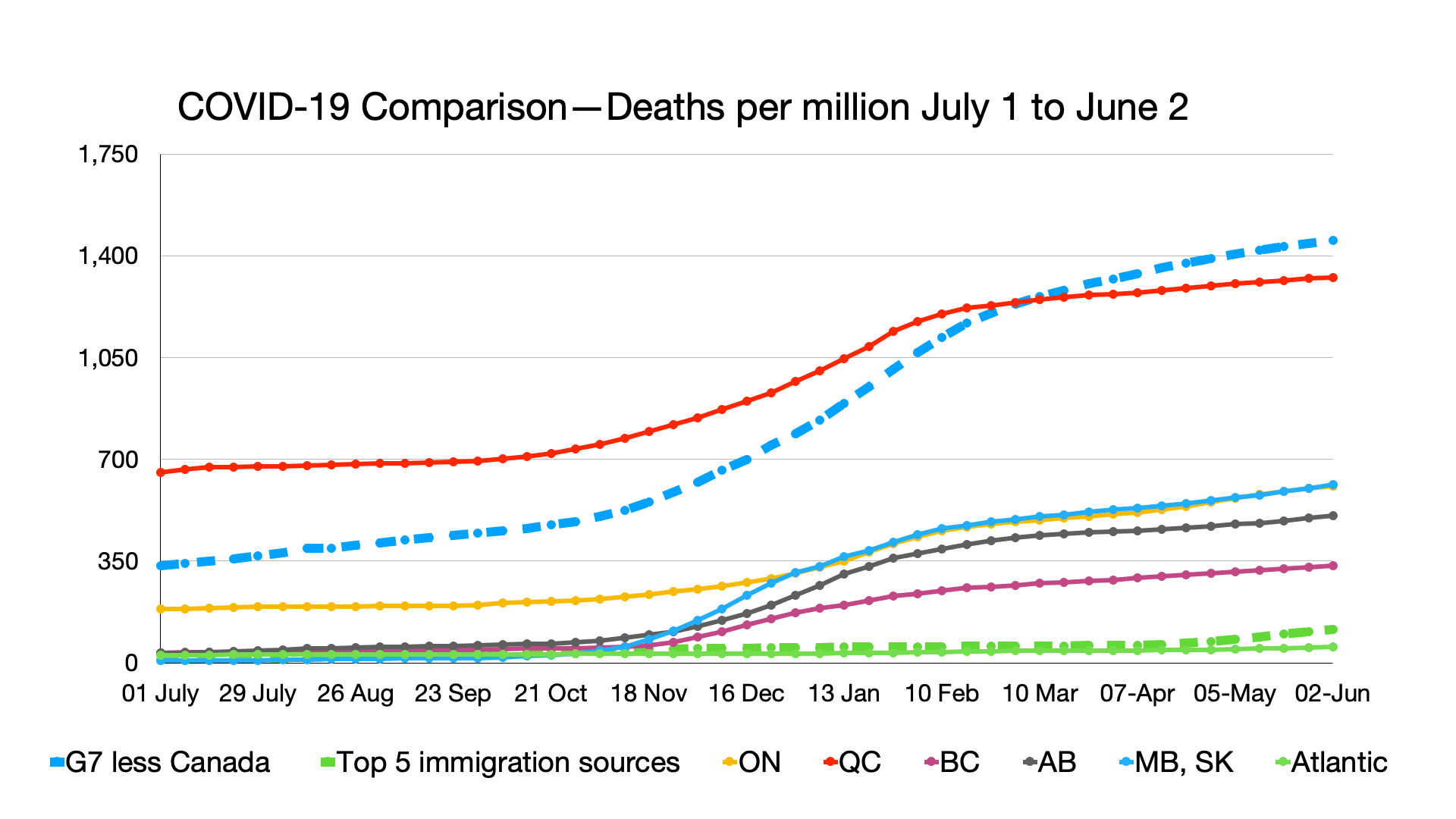
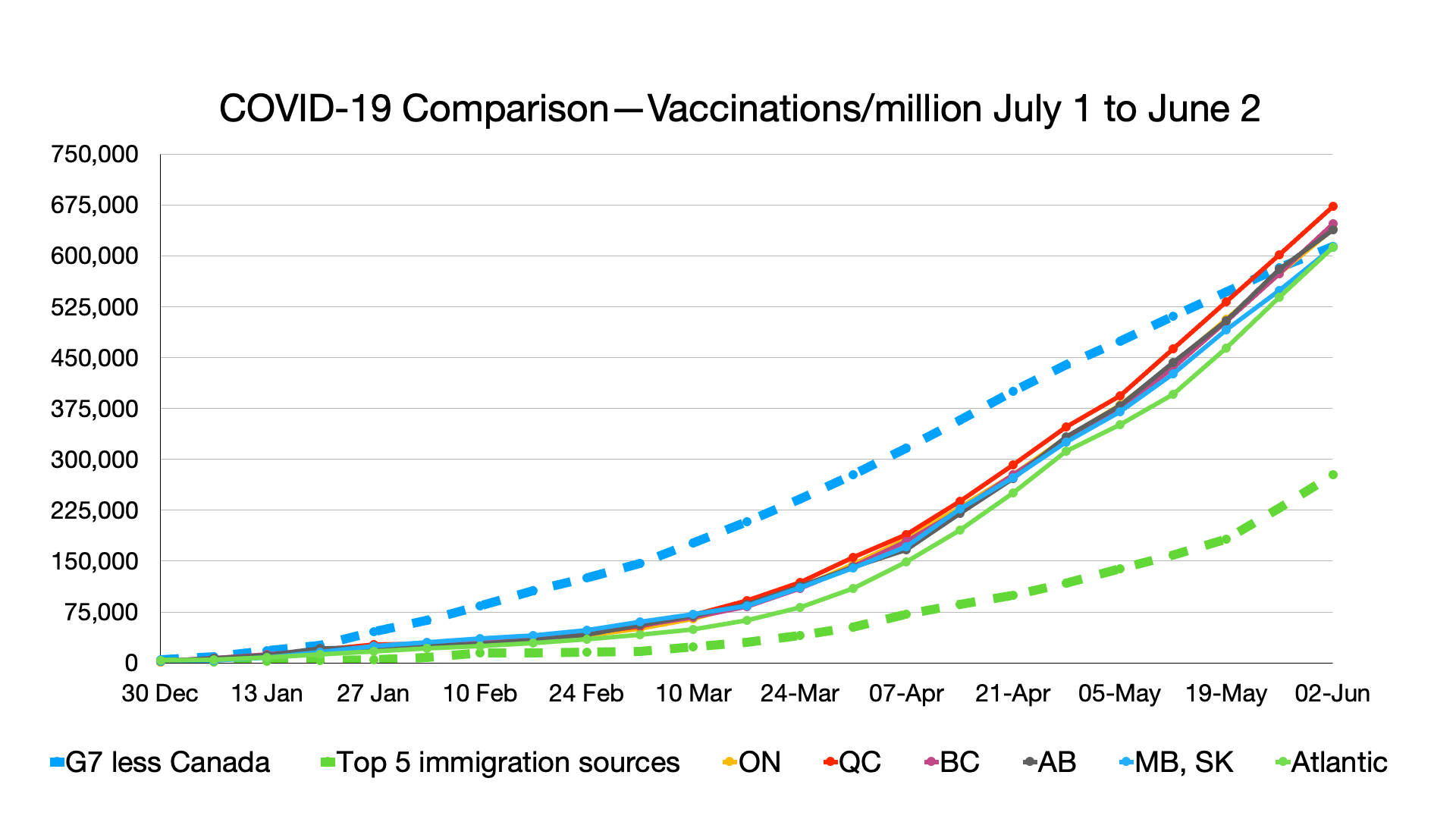
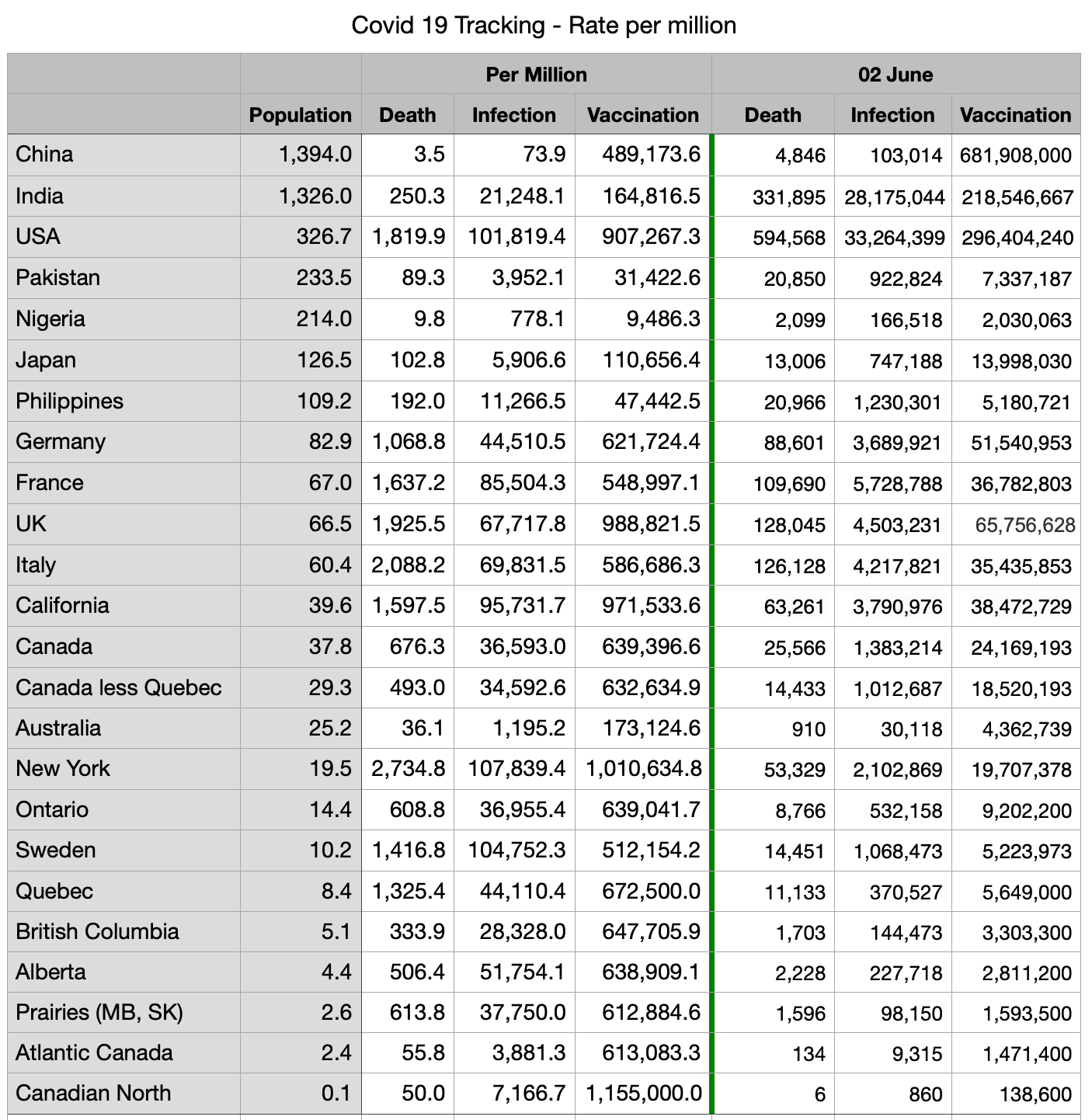
#COVID-19: Comparing provinces with other countries 2 June Update

The latest charts, compiled 2 June as overall rates in Canada continue in all provinces save Manitoba to come down along with increased vaccinations.

Vaccinations: Minor relative changes, Canadian provinces all ahead of EU countries save Germany.

Trendline charts

Infections per million: No major relative changes and recent surges appear to be levelling off save for the Prairies (mainly Manitoba).

Deaths per million: No significant change, Prairies slightly ahead of Ontario.

Vaccinations per million: Canadian vaccination rates have caught up to G7 less Canada with Quebec ahead as US vaccination rates are stalling.

Weekly

Infections per million: No relative change.

Deaths per million: Prairies ahead of Ontario, driven by Manitoba.

Federal government launches loan program for Black-owned businesses

Useful initiative and will be interesting to see the results over the next few years:

The federal government is opening the doors to a loan program that will provide financing to Black-owned businesses that often face a steep hill to access capital.

The Black Entrepreneurship Loan Fund will provide loans of up to $250,000 for businesses that are majority Black-owned, or entrepreneurs for their startups or existing for-profit small businesses.

Social enterprises, partnerships and co-operative businesses are also eligible for the financing.

The government says applicants must have a business number, a business plan and financial statements, or project plans in the case of startups.

The Liberal government seeded the loan fund with $33.3 million, while the remainder of the $291.3 million program comes from a $130-million infusion from Business Development Bank of Canada, a Crown corporation, and $128 million split between the country’s biggest banks and two credit unions.

The Federation of African Canadian Economics will administer the loans, which will initially flow through BDC, and credit unions Alterna Savings and Vancity.

The latter two institutions will also take part in a pilot project in Ontario and British Columbia to provide microloans of between $10,000 and $25,000 to help those Black businesses that need some support to start or grow to address what the government calls a critical gap in the marketplace.

The launch of the loan program comes months after the Liberals first laid out the plan last September, and days after the one-year anniversary of the death of George Floyd at the hands of a white Minneapolis police officer, which sparked a worldwide reckoning with racial inequality.

In its wake, the Black parliamentary caucus, backed by multiple cabinet ministers, outlined a series of recommendations for the government to address, including financing aid.

“This is a meaningful historic step to correct a historic wrong: the systemic barriers in accessing financing faced by people of African descent,” Greg Fergus, chair of the Black parliamentary caucus, said in a statement.

“This loan fund partnership unlocks our extraordinary potential and creates economic prosperity for all Canadians.”

A recent survey of 342 Black entrepreneurs, commissioned by the African Canadian Senate Group, found three-quarters of respondents said their race makes it harder to succeed in business, with systemic racism, access to capital and the lack of a business network all cited as barriers to growth.

Source: Federal government launches loan program for Black-owned businesses