Afghan Hazaras being killed at school, play, even at birth

Awful situation:

Just running errands in the mainly Hazara neighborhoods of west Kabul can be dangerous. One day last week, Adila Khiari and her two daughters went out to buy new curtains. Soon after, her son heard that a minibus had been bombed — the fourth to be blown up in just 48 hours.

When his mother didn’t answer her phone, he frantically searched hospitals in the Afghan capital. He found his sister, Hosnia in critical condition with burns over 50% of her body. Then he found his mother and other sister, Mina, both dead. Three days later, on Sunday, Hosnia died as well.

In all, 18 people were killed in the two-day string of bombings against minivans in Kabul’s Dasht-e-Barchi district. It was the latest in a vicious campaign of violence targeting Afghanistan’s minority Hazara community — one that Hazaras fear will only get worse after the final withdrawal of American and NATO troops this summer.

Hundreds of Afghans are killed or injured every month in violence connected to the country’s constant war. But Hazaras, who make up around 9% of the population of 36 million people, stand alone in being intentionally targeted because of their ethnicity — distinct from the other ethnic groups, such as Tajik and Uzbek and the Pashtun majority — and their religion. Most Hazaras are Shiite Muslims, despised by Sunni Muslim radicals like the Islamic State group, and discriminated against by many in the Sunni majority country.

After the collapse of the Taliban 20 years ago, the Hazaras embraced hopes for a new democracy in Afghanistan. Long the country’s poorest community, they began to improve their lot, advancing in various fields, including education and sports.

Now many Hazaras are moving to take up arms to protect themselves in what they expect will be a war for control among Afghanistan’s many factions.

Inside the Nabi Rasool Akram Mosque compound, protected by sandbags stacked against its ornate doors and 10-foot high walls, Qatradullah Broman was among the Hazaras attending the funeral of Adila and Mina this week.

The government doesn’t care about Hazaras and has failed to protect them, he said. “Anyone who can afford to leave, they are leaving. Those who can’t are staying here to die,” said Broman. “I see a very dark future for our people.”

There is plenty for Hazaras to fear.

Since it emerged in 2014 and 2015, a vicious Islamic State group affiliate has declared war on Afghanistan’s Shiites and has claimed responsibility for many of the recent attacks on the Hazaras.

But Hazaras are also deeply suspicious of the government for not protecting them. Some worry that government-linked warlords, who also demonize their community, are behind some of the attacks.

Former government adviser Torek Farhadi told the Associated Press that within the political leadership, “from the top down,” there is a “sorry culture” of discrimination against Hazaras. “The government, in a cynical calculation, has decided Hazara lives are cheap,” he said.

Since 2015, attacks have killed at least 1,200 Hazaras and injured another 2,300, according to Wadood Pedram, executive director of the Kabul-based Human Rights and Eradication of Violence Organization.

Hazaras have been preyed on at schools, weddings, mosques, sports clubs, even at birth.

Last year, gunmen attacked a maternity hospital in the mainly Hazara districts of west Kabul. When the shooting ended, 24 people were dead, including newborns and their mothers. Last month, a triple bombing at the Syed Al-Shahada school in the same area killed nearly 100 people, mostly Hazara schoolgirls. This week, when militants attacked a compound of de-mining workers, shooting at least 10 to death, witnesses said they tried to pick Hazaras out of the workers to kill.

Some of these attacks, deliberately targeting civilians, hospitals and children, could rise to the level of war crimes, said Patricia Gossman, Associate Director of the Asia Program of Human Rights Watch.

Pedram’s organization has petitioned the U.N. Human Rights Commission to investigate the killing of Hazaras as genocide or a crime against humanity. It and other rights groups also helped the International Criminal Court in 2019 compile suspected war crimes cases in Afghanistan.

“The world doesn’t speak about our deaths. The world is silent. Are we not human?” said Mustafa Waheed, an elderly Hazara weeping at the burial of Mina and her mother.

A black velvet cloth inscribed in gold with Quranic verses was draped over the two bodies. Family and friends carried them on wooden beds, then placed them inside the graves. Mina’s father fell to the ground crying.

“The U.S. can go into space, but they can’t find out who is doing this?” Waheed said. “They can see an ant move from space, but they can’t see who is killing Hazaras?”

In the face of the killings, talk has turned to arming Hazara youth to defend the community, particularly in the districts that the community dominates in western Kabul. Some Hazaras say the May 8 attack on the Syed al-Shahada school was a turning point.

It is a significant reversal for a community that showed such hope in a new Afghanistan. After the fall of the Taliban, many Hazara militias gave up their weapons under a government disarmament program, even as other factions were reluctant.

“We used to think the pen and the book were our greatest weapon, but now we realize it is the gun we need,” said Ghulam Reza Berati, a prominent Hazara religious leader. Fathers of the girls killed in the school attack are being told to invest in weapons, said Berati, who helped bury many of the girls.

Sitting on the carpets of west Kabul’s Wali Asar Mosque, Berati said Hazaras are disappointed in the democracy brought by the U.S.-led coalition. Hazaras have largely been excluded from positions of prominence, he said.

Hazaras worry about continuing Islamic State group attacks and about the potential return of the Taliban to power after the American withdrawal. But they also worry about the many heavily armed warlords who are part of the government. Some of them carried out violence against Hazaras in the past, and Hazaras fear they will do so again if post-withdrawal Afghanistan slides into a repeat of the brutal inter-factional civil war of the early 1990s.

One warlord who is still prominent in Kabul, Abdul Rasool Sayyaf, led a Pashtun militia that massacred Hazara civilians during a ferocious 1993 battle with Hazara militias in Kabul’s mainly Hazara neighborhood of Afshar.

Rajab Ali Urzgani became a sort of folk hero in his community as one of the youngest Hazara commanders during the Battle of Afshar — only 14 at the time.

Now 41 and still known by his nom de guerre, Mangol, he returned to Afshar earlier this month with the AP to visit the site. He stopped to give a prayer for the dead at a mass grave where nearly 80 men, women and children killed in the bloodshed are buried. A black Shiite banner flies at the entrance.

Mangol held out little hope for peace in Afghanistan following the withdrawal.

“When the foreigners withdraw, the war will happen 1000%,” he said. “The war will happen like in the past with the different groups, and we will defend our family and our dignity.”

Source: Afghan Hazaras being killed at school, play, even at birth
Regg Cohn: When it comes to recognizing Islamophobia, some Conservatives recognize that words matter

Of note:

A massacre changes everything. And, sometimes, nothing.

Four years ago, in the face of a Quebec mosque attack that killed six Muslims at prayer, the federal Conservatives closed their eyes and their hearts to the reality — literally — of Islamophobia.

Then-leader Andrew Scheer led the charge against uttering the word Islamophobia. He relied on a pretext of free speech so specious as to be unspeakable today.

What a difference leadership makes — a change of leaders, a change of mind, a change of heart. And another massacre.

Much is being said, now, about how Scheer’s successor, Erin O’Toole, used the word Islamophobia freely and unselfconsciously after this week’s attack against a Muslim family that killed four in London, Ont. O’Toole showed the sensitivity and humanity that were conspicuously absent — in him and his party — back then.

What remains unsaid, however, is that not all Tories were so far behind the times that they were so overdue for change. At the very moment federal Conservatives were playing intemperate word games in Ottawa in 2017, their provincial cousins in the Ontario legislature were displaying tolerance and togetherness in their choice of words.

Then-leader Patrick Brown rallied his Progressive Conservative caucusbehind him to recognize and respect the term Islamophobia, unequivocally and unreservedly, in a legislative vote. How to explain the stark difference between federal and provincial Tories — and the subsequent about-face by O’Toole?

There is no single reason, but there is one common thread: Walied Soliman.

Brown and O’Toole are both close to Soliman, an influential lawyer and persuasive political operator who also happens to be a person of faith. For Soliman, as a Muslim, the massacres were also intensely personal.

“Islamophobia is real,” he wrote on Twitter this week. “Call it out. Call out anyone who doesn’t use the word. Call them out. Shame them. Cut the crap. Enough. If you’ve got a problem using the term you are part of the problem.”

Soliman has known Brown since they were both Young Tories in their twenties, and he later played a key role as Ontario PC chair, helping the party pivot toward broader community outreach. As co-chair of O’Toole’s leadership run, he raised the candidate’s game — and raised money for the campaign.

Soliman tells me he never raised the Islamophobia issue directly with either leader. Perhaps he didn’t have to, knowing that the mere fact that they know him — were thinking about him — might have influenced them.

“They came to their conclusions on their own,” Soliman insists.

But even if he didn’t have to say a word about using the word Islamophobia, they also had to look him in the eye. And they knew what his reaction would be when they said it.

“When they both started talking about it, there was this distinct feeling of happiness that I felt,” Soliman recalls. Even if it took O’Toole a lot longer to find the words, “The first time Erin publicly talked about Islamophobia, it made me very happy.”

It must be said that Soliman himself has been a target for vicious Islamophobia against the backdrop of leadership races and internal policy debates. As chair of the Norton Rose Fulbright law firm — where he has worked with Brian Mulroney, another early champion of tolerance — his high profile attracted slurs about a supposedly hidden agenda for Islamic sharia law.

“I’ve often wondered if my friendships were a burden, that maybe it’d be easier for them if I wasn’t involved, wasn’t a friend,” Soliman muses. But when a person is a friend or a neighbour, he inevitably has influence because “you see them every day, you see their humanity — that’s me.”

The old Conservative word games — the claim in 2017 that Islamophobia was a made-up word because it literally suggests “fear of Islam” — never made sense. Everyone knows what homophobia means to gays who faced discrimination and demonization for centuries, which is why Soliman encouraged Brown to march in a Pride parade.

Not every word must be taken literally. Misogyny means hatred of women, but it is often used interchangeably with sexism, referring to prejudice, discrimination and contempt. The term anti-Semitism is only about 150 years old, but “Jew hatred” goes back centuries and makes the point more powerfully.

The Muslim family killed in London this week had immigrated to Canada from the Islamic State of Pakistan in search of sanctuary. They thought they had found it here, only to be blindsided by bigotry and intolerance, police say, on the streets — on the sidewalk — of an Ontario city.

We live in a time of slogans and slurs. We cannot coexist in a world where words are weaponized or accountability is avoided altogether.

Hate crimes are rising, not falling, but there is a way for us to insulate and inoculate ourselves. It falls to our political leaders to show the way on civility and tolerance, lest we fall victim to the internecine intolerance that we witness in America today.

Democracy alone cannot protect minorities from the perils of majority rule. Only pluralism can preserve our common humanity.

Our leaders must say what needs to be said — on Islamophobia, homophobia, anti-Semitism and other forms of racism and discrimination that badmouth the “other.” And that lead to massacres.

Words matter. Leadership matters.

Source: https://www.thestar.com/politics/political-opinion/2021/06/09/when-it-comes-to-recognizing-islamophobia-some-conservatives-recognize-that-words-matter.html

Khan: The London attack reaffirms why Muslims often feel unsafe in their own country

Good commentary:

Every few years, I feel very vulnerable and unsafe. This is one of those times.

On Sunday, five members – three generations – of a Muslim family went out for a walk on a summer’s evening in London, Ont., an opportunity relished by many Canadians during the COVID-19 pandemic. For this family, it was a regular activity before returning home to offer the sunset prayer, according to a neighbour.

Yet this simple act of enjoying nature with one’s family is no more because of an act of pure, unadulterated hatred.

While waiting at a stoplight, Madiha Salman, her husband Salman Afzaal, 15-year-old daughter Yumna, nine-year-old son Fayez, and 74-year-old mother-in-law were allegedly rammed by a 20-year-old driver who, according to police and witnesses, deliberately accelerated his pickup toward the family, targeting them because they were Muslim.

Initially, police said the extended family requested to keep the victims’ names private, but the family identified them in a statement Monday. Only Fayez survived. Now an orphan, he is recuperating in hospital.

What kind of world are we living in?

For Muslims, it is unfortunately one where the slow drumbeat of hate-filled violence has become louder. The 2017 Quebec City massacre, in which worshippers were gunned down at a mosque – a place of spiritual refuge – shook all of us to the core.

As a nation, we vowed to fight the scourge of Islamophobia. Muslims wondered if a visit to their local mosque might be their last. Such was, and is, the fear. Enhanced safety features – including screened entries and guards – became the uneasy norm.

Yet this was still not enough back in September, when 58-year-old Mohamed-Aslim Zafis was killed outside an Etobicoke, Ont., mosque by an apparent white supremacist. Mr. Zafis was a volunteer caretaker of the mosque he cherished. On that fateful evening, he sat outside, controlling entry to the mosque in compliance with COVID-19 protocols. The accused perpetrator slipped behind Mr. Zafis, slashed his throat and fled.

Violence is happening all over the country. This year alone, there have been multiple reported assaults in Edmonton, where strangers have threatened Muslim women. In at least five cases, women were pushed, kicked and/or punched in public.

Calgary has similarly witnessed numerous cases of assault against Muslims; three involved women physically attacked in broad daylight because of their hijab. Understandably, the women have been emotionally and physically traumatized.

And now, a family has been killed in London. Is it any wonder why Muslims – especially women – don’t feel safe?

Yet this country is far greater than the hate-filled zealots who seek to intimidate, sow fear and spread the bigotry that fuels them. The outpouring of grief and support from Canadians has been a balm to the shock felt by Muslims across the land.

Since the news came out about the attack, I have received heartfelt messages of support, including the following from my friend and colleague Myriam Davidson: “It breaks my heart,” she wrote. “The best I have is we are here standing with you. There is no place for Islamophobia in our communities – it is despicable. Whenever a synagogue gets attacked – what brings me comfort is when non-Jews speak up, call it out and reaffirm that we are an inclusive society where this is not tolerated. So I’m modelling the best I know how.”

And that is the key: reaching out the best way each of us can. Our society will be stronger for it. While Muslims will rely on their faith for spiritual succour, we will need emotional support from others to overcome our fears and to know that we are valued members of the Canadian family.

There are many ways to help. Some Muslims are fearful to go for a simple walk, so offer to accompany them. Donate to a fund for nine-year-old Fayez. Attend a vigil. Perhaps the most powerful gesture is to simply say, “I am here for you.”

Last week, I was mesmerized by the haunting, powerful rendition of O Canada by Winnipeg folk singer-songwriter Don Amero, accompanied by Elders Wally and Karen Swain, prior to a Habs-Jets playoff game. While Mr. Amero sang, I asked myself: “How does he have the fortitude to sing an anthem of a country whose government, for 150 years, committed cultural genocide against the Indigenous peoples of this land?”

I know I could not. Yet Mr. Amero taught me something that resonates today, which is that the power of love, of resilience, of dignity always conquers bitterness.

We will come together – whether it is to address deep-rooted historical prejudices against Indigenous communities, or contemporary hatred against minority communities. Let us dig deep into the well of human compassion to continuously build a more just, inclusive society.

Source: https://www.theglobeandmail.com/opinion/article-the-london-attack-reaffirms-why-muslims-often-feel-unsafe-in-their-own/

Contrasting commentaries on the London killings

Contrasting commentaries, starting with Rupa Subramanya, who while providing perspective on racism in Canada and how it also exists between minority groups, downplays the extent of racism and Islamophobia. Noor Javed provides a useful counterpoint on her lived experiences:

There is certainly no question that hate crimes against many minority groups — including Jewish, Muslim and Asian Canadians — have been on the rise recently. Statistics Canada found that police-reported hate crimes increased in 2019 from the previous year, and reports of anti-Asian hate crimes have surged throughout the pandemic.

A 2019 Ipsos Reid poll found that 26 per cent of respondents believed that prejudice against Muslims had become “more acceptable” in the previous five years. This compares to 21 per cent for refugees, 23 per cent for immigrants as a whole and 15 per cent or less for other minority groups, including Indo-Canadians and Jewish-Canadians.

Any evidence that racism is on the rise is deplorable and every racist incident must be condemned in the strongest possible terms. However, Singh does the cause of fighting racism no favours by taking an extreme and exaggerated position that I, as an immigrant and person of colour, cannot agree with. Are there racists in Canada? Sure. Is Canada a racist country? Absolutely not.

Source: No, Jagmeet, Canada is not a racist country. It’s one of the most tolerant places on earth

Noor Javed, on her lived experiences:

In the early morning hours, the day after the most recent terror attack in Ontario, I couldn’t sleep.

It was still dark when I got out of bed and did the only thing that would comfort my heart: I prayed for the Afzaal family — Salman Afzaal, Madiha Salman, 15 year-old Yumna, her grandmother, Talat, and nine-year-old survivor Fayez. The family were intentionally run down by a truck in their hometown of London, Ont., on Sunday as they took an evening stroll in their neighbourhood.

They were the victims of what police are calling an anti-Muslim hate attack.

I cannot help thinking about my own experiences with Islamophobia as a visible Muslim journalist in the so-called “most diverse city in the world.”

Nothing I experienced compares to the trauma faced by the family and friends of the Afzaal family — including Fayez, who will live with this horrific incident and the loss of his family forever. Or the family of Mohamed-Aslim Zafis, who was murdered last year by a neo-Nazi in Etobicoke as he sat outside the International Muslim Organization mosque. Or the children who buried their fathers in Quebec City after the mosque shooting in 2017 — and the many survivors who are still struggling to cope in its aftermath.

But the many incidents of Islamophobia, or anti-Muslim hate as I prefer to name it, that I have faced have weighed down on me over the years. They have affected the career choices I have made. They have impacted my mental health. They have deeply hurt me — and still do.

When I tried to list all the incidents of hate that I have experienced since I became a journalist — both in my job and on a day-to-day basis — I hit 30 before I stopped. I could have gone on.

There is an unspoken code that journalists of colour quickly learn when they start in the profession: if you want to survive in this industry, you must have thick skin.

When I got my first barrage of hate mail as an intern at the Star 15 years ago, and turned to a colleague for support, he looked at my hijab and said: if you want to survive, you will need to have Teflon-like skin. Let the hate bounce off you. Don’t let it stick.

But the truth is, even when you tell yourself it doesn’t impact you, it still does.

Every email in your inbox with someone telling you they hate you because of your hijab.

Every letter calling you a “dirty raghead.”

Every tweet telling you to go back to where you came from.

Every person who walks by and whispers “You’re disgusting.”

Every smear campaign calling you a terrorist.

Every time someone doubts your news judgment because you are a “lying Muslim.”

Every time someone asks if you were a token hire.

Every time you go to the public editor, nearly in tears, when the hate gets too much to bear.

Every time you realize that your colleagues enjoy the luxury of white privilege, their names and skin colour affording them a protection that you have never had — and never will.

I will stop there.

You look for ways to cope. But the hate slowly chips away at you and at the idea that we have been so conditioned to believe: How can this be happening here in Canada, the most accepting country in the world?

Let me tell you: It’s been happening for years. The hate is not new. And neither is the violence.

But the haters have gotten more brazen. More hateful. More organized. More dangerous.

So when the Afzaal family was killed for just being Muslim this week, it broke me.

Years of online hate, of politicians benefiting from anti-Muslim policies, of pundits spewing anti-Muslim rhetoric, of trolls questioning if our pain was even real, has done exactly what it was meant to. It turned people against us. It has led them to hate us so much that they want us dead.

This week, I had a conversation that I never imagined I would have with my children, ages seven and 10. I had feared telling them about the incident, but they saw the cover of the newspaper and asked me what happened in London on Sunday night.

I sat them down, and told them about a beautiful family, who looked very much like our own, who went for a walk, but didn’t make it home.

They looked at my tears, and my hijab, and shared their thoughts: “That’s so scary.” “I don’t ever want to cross a street again.”

And then came the hard questions:

“Who will take care of the little boy?”

“Why would that man do that to them? Could it happen to us?”

“Are you scared, mama?”

I’m not scared, little ones. I’m tired.

Source: ‘Are you scared mama?’: Years of anti-Muslim hate chip away at you. The killing of the Afzaal family in London broke me

Why do so many Chinese international students in Canada end up back home?

Interesting survey from one school cohort:

The 2017 class at Rotman Commerce arrived at the University of Toronto just as Xi Jinping became China’s President. As they studied, Mr. Xi consolidated power, all while pushing his country toward greater influence overseas. In western countries, views on China have darkened. Only 14 per cent of Canadians view it favourably, a record low, according to a survey conducted by the Angus Reid Institute earlier this year.

But this opinion isn’t shared by China’s best and brightest.

Young Chinese people make up the majority of international students who attend Rotman Commerce. On graduation, they possess a potent set of attributes for any employer: a coveted diploma, language skills and the kind of ambition that brought them to Canada in the first place.

But many have no intention of staying. For them, China is not just home, but a place whose embrace of modernity has created comforts not available in North America – bullet trains, lively cities with a cornucopia of eating choices – while its capital and consumer markets offer opportunity that Canada cannot match.

Chinese students like to joke about Canada as haoshan, haoshui, hao wuliao: nice mountains, nice water, very boring. China is not boring and its air and water are quickly improving, along with its salaries.

In other words, even if China grows less appealing to those outside its borders, it is becoming more desirable to many of its own. John Shi, one of the Rotman Commerce 2017 graduates, recently travelled for the first time to Suzhou. It’s been long considered a secondary centre, but “when I see the way that city has developed – oh my god, I must say it’s really better than Toronto,” Mr. Shi says.

In the U.S., the National Science Foundation tracks the percentage of doctorate recipients who intend to stay. Things have changed there, too. In 2001, 91.4 per cent of PhDs from China intended to remain in the U.S. By 2019, the number had fallen to 79.3 per cent. The remainder expected to return to China.

The rise in the overall numbers of overseas Chinese students has been vertiginous: in 1990, only 2,950 young Chinese went abroad to any country for studies; by 2004, fewer than 115,000. In 2019, more than 140,000 had study permits in Canada alone.

“A lot of these people go out on their own money, on family money — and they’re trying to get an education that will advantage them back in China,” said David Zweig, a professor emeritus of social science at Hong Kong University of Science and Technology who is writing a book China’s Search For Talent.

Where those students go has significance for Canada and its policy makers. “You can always raise the question: is it to Canada’s advantage to train these people, give them jobs and then they take their skills back to China?” Mr. Zweig said. He sees no reason for serious concern.

But the question he poses also has ramifications for Canadian employers. If those students leave, “in some sense, that’s on us,” said Alexandra MacKay, interim vice dean for undergraduate and specialized programs at Rotman. If students see better opportunities in China, Canadian companies may need to think whether there is a need “to revisit your recruiting model to make this an attractive proposition.”

But the destination students choose also has political significance for China. Unlike many of their fellow citizens, they have the ability to choose. Graduating from a Canadian university places them on a quick track to permanent residency and citizenship.

Where they decide to go, then, is a useful barometer of how the current generation views China.

So how does the Xi Jinping cohort see China, and the world? To find out, The Globe and Mail surveyed 35 students from the Rotman Commerce class of 2017 who were born in China or grew up there. The respondents make up roughly one-third of the Chinese students at Rotman that year. Their answers, and some of their stories, are below.

STARTING OFF

John Shi grew up in Shijiazhuang, the capital of Hebei province, determined to get into the best schools. “I dreamed of going to the top finance university in China. But it’s so hard,” he said. He points to inequalities in the administration of the gaokao, the feared university placement exam. Students can score up to 750 points on the exam, but those marks are not all academic. Authorities can award bonus points to certain categories of people, and the administration of those unearned points meant that Mr. Shi would need to outperform a student in Beijing by 100 points in order to gain entry to a similar university. “The competition is really not that equal,” he says. Canada offered a more equitable academic landscape. So Mr. Shi decided to skip the gaokao altogether. He came to Canada for grade 11.

BUILDING A CAREER

Since the day she graduated, Joanna Li has thought about returning to China. Her family is there. She feels a stronger “bond with China, my motherland” than with Canada. She still eats Chinese food almost every day. But she has hesitated. How could she compete with people back home? With its huge population, “there are many more talents in China. You have people who work as hard as you do, are as smart as you and have more local experience than you – and they have more connections,” she said. Finding a job in China that can match her Canadian salary “is way harder than I expected.” But she has found life in Canada disappointing – when she had a back issue, the wait to get medical attention was long. “I was kind of disappointed by that,” she says. “Because in China, I can easily see a doctor that is one of the best in Shanghai.” She has felt lonely, too, a feeling exacerbated by travel restrictions that have kept her from seeing family during the pandemic. “I’m just looking for a change,” she says. She has joined groups of like-minded students in Canada and the U.S., all looking to move back to China, where life is familiar and work more thrilling. “I can see my life in Canada for the next 10 or 12 years. But at this point, I’m just more excited about a different life in China.”

FINDING OPPORTUNITY

For Simon Liang, the numbers tell the story: China’s population is nearly 40 times that of Canada. Its economy is more than eight times larger. “The market in China is just way greater than in Canada. That’s why I’ve come back to China,” says Mr. Liang, a graduate of the 2016 Rotman Commerce class who is the founder of Queen’s Education Group, an online high school with about 300 full-time students. After graduation, he got a job in Canada long enough to secure a permanent resident card, quitting once that was in hand. He remembers looking up at the Canadian corporate ladder and “I could see exactly where I would land in 20 years – and that is not exciting at all.” Though starting wages tend to be better in Canada, China offers fabulous wealth to those who succeed. More importantly, in Canada, “I can’t prove my value,” Mr. Liang says. In his home country, with its scale and global importance, “I feel like I can have more influence for this world.” China, he says, feels like a place of “unlimited opportunities.”

WEIGHING THE OPTIONS

There was a time when Chinese students would joke about studying abroad as an exercise in dujin — gilding themselves in the golden aura of international credentials. But with 1.6 million Chinese students currently enrolled overseas, a mere diploma is no longer enough. Crystal Lou quickly realized that if she wanted an edge in China, she needed to build meaningful work experience in Canada. Doing so was easy: international student university graduates are eligible for three-year work permits. That quick path to a job was one of the main reasons she came to Canada. She does still contemplate returning to China, where her parents live. China “is growing a lot faster than here. So you probably have more opportunity to go up there versus here,” she says. She won’t apply for Canadian citizenship “until I fully decide I’m staying here.” But as someone who works in private equity, she has also found virtue in Canadian stability. “Here you can value a company based on fundamentals,” she said. “That doesn’t really work in China,” where markets are more prone to influence from politics or investor mania. “For the job that I’m doing, I think Canada fits me better,” she says.

Deciding where to live is “more of a choice between what you really value,” says Emily Wang. In China, things are more convenient: public transit is cheap and near-universal, while powerful apps and mobile payments turn smartphones into remote controls for life. But the work environment can be tough. Some companies, particularly in the technology sector, demand brutally long hours. There is “more competition and maybe more pressure mentally,” Ms. Wang says. Contrast that with Canada, where “I might have more work-life balance, which is something I value.” That’s one of the reasons she stayed after graduation. In Canada, too, she senses greater freedom for the types of open political discussion that can be dangerous in China. But when it comes to personal liberty, “in daily life I don’t feel like there is that much of a difference. I felt pretty free when I was in China, and also here in Canada.” In fact, the epidemic has made China look attractive. While rolling lockdowns continued for more than a year in Ontario, people in China “are all in restaurants and travelling around.”

In the physical sense, Katrina Jiang has lived in Canada for nearly 12 years. But in many ways, she has never left China. She does not pay much attention to news or entertainment in Canada; she doesn’t so much as have a Netflix account. Instead, “100 per cent” of her media intake comes from China: celebrities on Weibo, shows on iQiyi, short videos on Douyin. “I know I have been here for a long time. I came when I was 14,” she says. “But I feel like I’m still connected to China, to Chinese culture and Chinese entertainment.” She feels the disconnect most keenly at work, where she has little to add to conversations about local events or the Blue Jays. She worries that distance from coworkers will limit her career advancement, and is mulling a return home. “I see a kind of ceiling here,”, she says. “In Canada, your soft skills can’t really compete with native speakers. You have to know their culture, you have to know their entertainment, and you have to chat to make connections. It’s hard for us if we don’t grow up in that environment.”

Source: https://www.theglobeandmail.com/world/article-why-do-international-students-in-canada-end-up-back-home/

Increased Immigration is Not A Simple Solution for US Population Woes

I do not normally agree with the Center for Immigration Studies, with its general anti-immigration work, but this analysis largely mirrors my own concerns regarding the arguments of Canadian advocates for increased immigration:

Conventional wisdom has developed that the United States desperately needs more immigration to address the supposed twin evils of population aging and slowing population growth. The 2020 Census showing the U.S. grew by “only” 22.7 million over the last decade has prompted a new round of calls to expand immigration.

In fact, immigration does not make the population substantially younger unless the level is truly enormous and ever-increasing. Moreover, there is no body of research showing that higher rates of population growth necessarily make a country richer on a per-person basis. Advocates of mass immigration also ignore the downsides of larger populations, as well as the more effective and less extreme alternatives that exist for dealing with an aging society.

Despite this reality, Jay Evensen of Salt Lake City’s Deseret News argues that the slowdown in population growth revealed by the Census “portends a population disaster.” Bloomberg News’ Noah Smith thinks lower population growth creates a “grim economic future.”

Many commentators argue for increasing immigration above the more than one million already allowed in each year to spur population growth and “rebuild the demographic pyramid,” as former Florida Governor Jeb Bush famously put it in 2013. But as the former director of Princeton’s graduate program in population studies, Thomas Espenshade, observed a number of years ago, “the effect of alternative immigration levels on population age structure is small, unless we are willing to entertain a volume of U.S. immigration of historic proportion.”

To illustrate, the Census Bureau’s “low-immigration” scenario produces a U.S. population of 376 million in 2060, compared to 447 million under its “high-immigration” scenario — a 71 million difference. Under its low-immigration scenario, 56 percent of the population will be working-age (18-64) in 2060, compared to 57 percent under its high-immigration scenario. Thus, the addition of 71 million people raises the working-age share by just one percentage point.

One reason the impact is so modest is that immigrants are not uniformly young when they arrive — many now come in their 50s and 60s — and they grow old over time just like everyone else. Moreover, immigrant fertility now only slightly exceeds native-born fertility, and their children add to the dependent population — those too young or too old to work. Of course, these children eventually grow up and become workers, but by then many of their immigrant parents will be at or near retirement age.

Given the inefficiency of immigration as a tool to address population aging, immigration advocate Justin Gest at George Mason University is forced to propose unprecedented levels of future immigration to accelerate population growth and slow population aging. In a piece for CNN and a report for the immigration advocacy group fwd.us, he argues for doubling immigration to the United States to make the country “younger, more productive, and richer.”

Gest’s own projections show that the current level of immigration will make the U.S. population 74 million larger in 2050 than if there was no immigration, while doubling immigration would add another 92 million people by 2050.

Gest emphasizes that making the population 166 million larger increases the aggregate size of the economy significantly. More workers, more consumers, and more government spending does make for a larger GDP. But a larger population means the larger GDP is spread out over more people, so each individual is not necessarily better off. If all that mattered was the overall size of the economy, Bangladesh would be considered a richer country than New Zealand. Of course, what really determines the standard of living in a country is its per capita GDP.

Gest claims that the 74 million additional people that the current level of immigration would add will raise per capita income by 4 percent in 2050, relative to no immigration. He further asserts that doubling immigration would, along with an additional 92 million people, increase average income by another 3 percent. The idea behind this calculation is that if there are more workers — or more specifically, if a larger share of the population is of working-age — the average income of the entire population will be higher.

What is so striking about these numbers is that even if everything Gest argues is true, adding a total of 166 million people to the country — more than the combined populations of France and Germany — in just three decades only modestly improves per capita economic growth. But even this small increase is an overestimate if the new immigrants crowd out some existing workers from the labor force. There is certainly evidence that this happens with teenagers and Black Americans.

In the real world, it is hard to find evidence that population growth actually increases per capita economic growth. For example, if population growth were such an economic boon, then countries like Canada and Australia, which have among the highest rates of immigration and resulting population growth in the developed world, would dramatically outpace a country like Japan, which has relatively little immigration and a declining population. And yet, between 2010 and 2019, Japan’s per capita GDP growth was slightly higher than Canada’s and Australia’s. Among all developed countries, the correlation between population growth and per capita economic growth was actually negative between 2010 and 2019.

One of the reasons population growth is not associated with economic growth is that increasing the supply of workers reduces incentives to improve productivity. Looking across countries, a 2017 study by Ronald Lee and Andrew Mason found that “low fertility is not a serious economic challenge.” Instead, they find that “The effect of low fertility on the number of workers and taxpayers has been offset by greater human capital investment, enhancing the productivity of workers.” There is simply no reason to assume that a larger population will necessarily be richer.

Putting aside economics, making the population 166 million larger or even 74 million larger than it would otherwise be has important environmental implications. While population is not the only factor that determines human impact on the environment, it does have a direct bearing on everything from preventing further habitat loss to cleaning up the Chesapeake Bay.

One can debate the severity of climate change and how best to address it. But mathematically, if the total population is 166 million (50 percent) larger in 2050 than it would otherwise be, then each person would have to reduce their greenhouse gases admission by roughly one-third just to maintain the current level of emissions, to say nothing of lowering levels. As Joseph Chamie, the former director of the United Nations Population Division, pointed out in The Hill recently, stabilizing America’s population is necessary “to deal effectively with climate change and many other critical environmental concerns.”

In addition to the environment, making the population dramatically larger must also have profound implications for the quality of life. Most Americans aspire to live in areas with a fair amount of open space. A 2018 Gallup poll found, by a two-to-one margin, that Americans want to live in rural areas or suburbs. The rapid suburbanization of immigrants shows that they share this desire. Significantly increasing the nation’s population density is likely to make it more difficult for many Americans to live the way they want to.

There is also the issue of traffic. As a Brookings Institution analysis a number of years ago concluded, “The most obvious reason traffic congestion has increased everywhere is population growth.” Traffic congestion alone has been estimated to cost the American economy $120 billion annually. Both the American Society of Civil Engineers and the Department of Transportation have reported that the nation’s roads are in a state of disrepair and need significant upgrades. It is hard to imagine that adding tens of millions more people in just 30 years would not create even more congestion.

If we are concerned about population aging, there are far less radical ways to address it. Projections by Karen Zeigler and myself show that raising the retirement age by just one year increases the share of the population that is working-age (16-64) about as much as all of the immigration expected by the Census Bureau through 2050. Increasing it by three years improves it more than does doubling immigration. We also found that increasing the share of working-age people who have a job from the pre-Covid rate of 70 percent to 75 percent would do more to improve the overall share of the population who are actually workers in 2050 than would the current level of immigration.

Population boosters assume a larger population would be a boon to the economy, even though there is no clear evidence that this is the case. They also ignore the negative impact on the environment, congestion, traffic, and other qualify of life issues. There are more effective, less radical, and more environmentally sustainable ways to deal with the challenges associated with population aging than using an ever-increasing level of immigration to dramatically increase the population.

Dr. Steven Camarota is director of research at the Center for Immigration Studies.

Source: Increased Immigration is Not A Simple Solution for US Population Woes

Demographic skews in training data create algorithmic errors

Of note:

Algorithmic bias is often described as a thorny technical problem. Machine-learning models can respond to almost any pattern—including ones that reflect discrimination. Their designers can explicitly prevent such tools from consuming certain types of information, such as race or sex. Nonetheless, the use of related variables, like someone’s address, can still cause models to perpetuate disadvantage.

Ironing out all traces of bias is a daunting task. Yet despite the growing attention paid to this problem, some of the lowest-hanging fruit remains unpicked.

Every good model relies on training data that reflect what it seeks to predict. This can sometimes be a full population, such as everyone convicted of a given crime. But modellers often have to settle for non-random samples. For uses like facial recognition, models need enough cases from each demographic group to learn how to identify members accurately. And when making forecasts, like trying to predict successful hires from recorded job interviews, the proportions of each group in training data should resemble those in the population.

Many businesses compile private training data. However, the two largest public image archives, Google Open Images and ImageNet—which together have 725,000 pictures labelled by sex, and 27,000 that also record skin colour—are far from representative. In these collections, drawn from search engines and image-hosting sites, just 30-40% of photos are of women. Only 5% of skin colours are listed as “dark”.

Sex and race also sharply affect how people are depicted. Men are unusually likely to appear as skilled workers, whereas images of women disproportionately contain swimwear or undergarments. Machine-learning models regurgitate such patterns. One study trained an image-generation algorithm on ImageNet, and found that it completed pictures of young women’s faces with low-cut tops or bikinis.

https://infographics.economist.com/2021/20210605_GDC200/index.html

Similarly, images with light skin often displayed professionals, such as cardiologists. Those with dark skin had higher shares of rappers, lower-class jobs like “washerwoman” and even generic “strangers”. Thanks to the Obamas, “president” and “first lady” were also overrepresented.

ImageNet is developing a tool to rebalance the demography of its photos. And private firms may use less biased archives. However, commercial products do show signs of skewed data. One study of three programs that identify sex in photos found far more errors for dark-skinned women than for light-skinned men.

Making image or video data more representative would not fix imbalances that reflect real-world gaps, such as the high number of dark-skinned basketball players. But for people trying to clear passport control, avoid police stops based on security cameras or break into industries run by white men, correcting exaggerated demographic disparities would surely help.■

Source: https://www.economist.com/graphic-detail/2021/06/05/demographic-skews-in-training-data-create-algorithmic-errors?utm_campaign=data-newsletter&utm_medium=newsletter&utm_source=salesforce-marketing-cloud&utm_term=2021-06-08&utm_content=data-nl-article-link-1&etear=data_nl_1

Boessenkool: Crossing the line

Good self- and broader reflections:

As I reflect on vile attack on five members of the beautiful Azfaal family — Salman, Madiha, Yumna, Talat and Fayez — I was initially deeply angered by how quick some were to use this vile, hate-motivated act of terrorism to confirm their political priors. 

And yet. 

The fact that the alleged attacker, Nathaniel Veltman, is a young Dutch blond boy who could well have come from my own religious community hit close to the heart. 

Now let me be clear. I apportion no blame for this act on Conservatives, religion, or even the Dutch privilege in which I assume Veltman, like me, grew up in. If guilty of this crime, Veltman is a hate-motivated terrorist who committed multiple murders. That would be on him. May the justice system rain down. 

And yet. 

My reflection called to mind times when, as a religious social conservative, I should have felt more uncomfortable with some of the things my fellow conservatives have said in recent years about terrorism, culture and religion. Times when we too easily crossed lines that conservatives — and religious conservatives in particular — should not have crossed.  

The line got crossed when some seemed to weigh their critique of a terrorist act based entirely on the motivation for that terrorist act. To put it another way, they became more interested in combatting terrorism motivated by some beliefs than terrorism motivated by other beliefs. Compare, for example, the disgustingly light-hearted condemnation of the far-right, neo-Nazi terrorist act in Charlottesville by the same populist U.S. president that proposed banning all Muslim immigration as part of an effort to prevent domestic terrorism. Or those who called for a “values test” to root out radical Islam one day — and then stood with a street preacher who flagrantly breaks the law the next. 

The line got crossed when we got more concerned with the actions of individuals within the institutions of our liberal capitalist democracy than the ideas underpinning those institutions. As a religious social conservative I hold freedom of religion extremely dear. In my world of competing rights, religious freedom comes out near the top. But that means holding expressions of other religions — like a turban, kirpan, hijab or burka — as dear as holding symbols of one’s own religion. Banning or restricting any of these things should make me deeply uncomfortable. Religious freedom should be religion blind. 

The same goes for religious practices. If something is a criminal act, call it a criminal act and treat it as such. If something is a part of one’s religious practice or tradition, leave it at that and leave it alone. Blurring the lines by referring to “barbaric cultural practices” crosses the line. The use of the word “cultural” kind of gives it away. 

The line got crossed when some tried to use the power of the state to impose their own religious views. Now let me be clear. I attend a Christian church — honestly, I need it more than most — and I hold my religious views as truth. I’d not be much of a religious person if I didn’t. I don’t go to a mosque, a synagogue, a temple, or a Richard Dawkins book club to practice my religion. Yet I want my public square to have room for all of these, and many more.  

The investigation into the horrible attack in London continues. If the early information is confirmed, it appears that Veltman alone is responsible for the hate-inspired terrorism of which he is accused.

But an act this vile, particularly when its perpetrated by a member of your own community also warrants deep reflection.  

I spent the afternoon writing down the lines I have crossed. I pray others do the same. 

Source: https://theline.substack.com/p/ken-boessenkool-crossing-the-line?utm_source=substack&utm_medium=email&utm_content=share&token=eyJ1c2VyX2lkIjoxMDcxOTUwNywicG9zdF9pZCI6MzczNzU5MTUsIl8iOiJ3SVY5SCIsImlhdCI6MTYyMzI1MjA1NSwiZXhwIjoxNjIzMjU1NjU1LCJpc3MiOiJwdWItNzAwMzIiLCJzdWIiOiJwb3N0LXJlYWN0aW9uIn0.VW8EnzY8EetTQ6xFCZuxZ1uSaKQIcC1pmRPzalJCcpc

Delacourt: There’s a line Justin Trudeau won’t cross when it comes to fighting Islamophobia

Unfortunate. Perspective of former CPC candidate Jeff Bennett revealing:

Justin Trudeau has made his clearest statement yet on what he will and will not do to stand up against Islamophobia in Canada.

The prime minister says he will call out anti-Muslim crime, using the strongest words possible — “terrorism” — to condemn the killing of a family in London, Ont.

Trudeau will not, however, call out Quebec for the secularism law that has made Muslims feel unwelcome in that province — Bill 21, which forces Muslims to relinquish any religious clothing if they want to work in public professions.

“No,” Trudeau said bluntly on Tuesday when asked whether Bill 21 bred intolerance of Muslims. He talked of how Quebec had a right to make its own laws, how people in Quebec might be having “conversations” and “reflecting” on the law in days ahead, and said his government would be “watching” and “following.”

In other words, not leading.

So, to recap: anti-Muslim sentiment is wrong. Anti-Muslim crime is terrorism. Legislation that denies religious expression to Muslims is something to be discussed, but not by this prime minister or other political leaders.

None of the fine-sounding speeches in the House of Commons on Monday came anywhere near mention of the legislation in Quebec.

“Right now, people are talking to their families and saying maybe they should not go for a walk,” New Democratic Party Leader Jagmeet Singh said in an emotional speech. “There are people literally thinking about whether they should walk out their front door in our country.”

Singh was not talking about Bill 21.

Conservative Leader Erin O’Toole spoke from the heart about the nine-year-old child who survived the attack, and what kind of Canada he should be allowed to grow up in.

“He deserves a Canada where Muslim women of faith can wear a hijab without fear of being accosted or harassed in public,” O’Toole said.

He wasn’t talking about Bill 21 either, or his own Conservative party’s dog-whistle record on everything from “veiled voting” to “barbaric cultural practices” in the 2015 election.

What makes the silence so breathtaking is that all of Canada’s political leaders have just emerged from two weeks of hard talk about how governments in the past did too little about racism toward Indigenous people.

They are all collectively, retrospectively sorry that an entire culture suffered at the hands of successive politicians who were not courageous enough to stand up to the widespread racism at the time.

Would Canada’s blotted history be improved if we unearthed a speech of John A. Macdonald saying he was following events closely at residential schools and hoped Canadians were having conversations about them?

The contrast between Trudeau’s strong words in the Commons on Tuesday and his tiptoeing around Bill 21 was striking, and the latter may cancel out the former. The prime minister did allow that he has long opposed Bill 21, but he clearly doesn’t intend to use the weight of his office or his words to change the reality of it.

For real political bravery on Tuesday, one had to look in more out-of-the way places — to London, in fact, where a former candidate for the provincial Progressive Conservative party decided to tell the difficult-to-hear truth of racism in politics.

Jeff Bennett, who ran for the PCs in the 2014 election, recounted in a Facebook post how people in his riding were happy to see that he had replaced the former candidate, a man named Ali Chahbar. Loyal Conservatives in London told Bennett they were relieved that “his name was English and his skin was white.” Bennett remembered how Chahbar had been smeared on local talk radio with talk of sharia law and other nonsense.

Bennett wrote that he was tired of people saying London was better than what happened on Sunday. “Bullshit. I knocked on thousands of doors in the very neighbourhood this atrocity occurred. This terrorist may have been alone in that truck on that day, but he was not acting alone. He was raised in a racist city that pretends it isn’t.”

Bennett came in second in London West in 2014 and has likely abandoned any aspirations to be elected again, given his willingness to tell voters what they don’t want to hear about themselves.

This of course explains the silence on Bill 21 on Tuesday, even as the political leaders are making bold proclamations about intolerance towards Muslims. An election looms, Quebec is a crucial battleground and Bill 21 is popular.

Canadian history has been on trial, rightly, for the past two weeks, and Bill 21 is indeed making its own way through the courts. One wonders how history will judge the failure of political leaders to speak up against that legislation when they could have seized the moment.

Source: There’s a line Justin Trudeau won’t cross when it comes to fighting Islamophobia

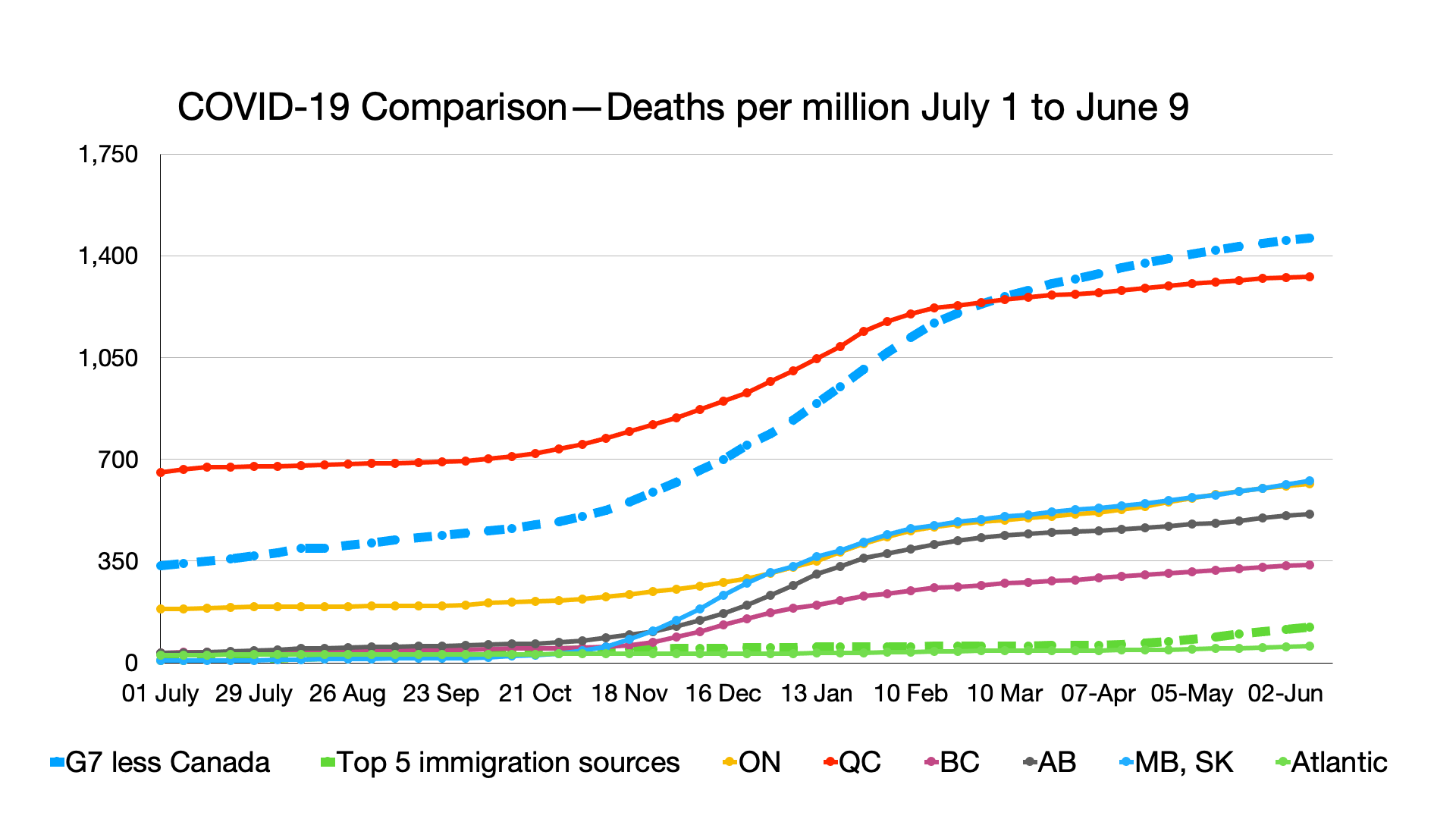
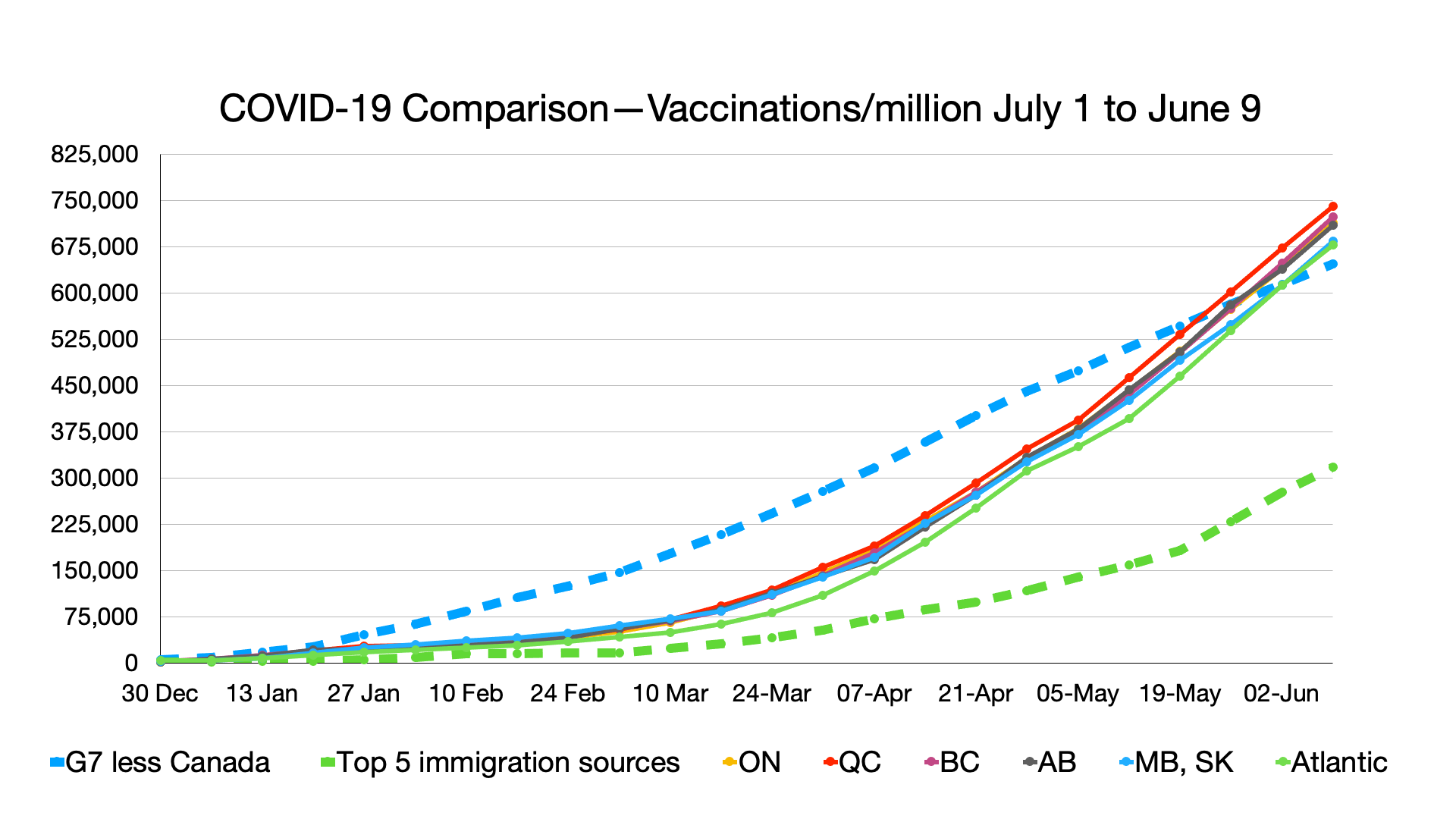
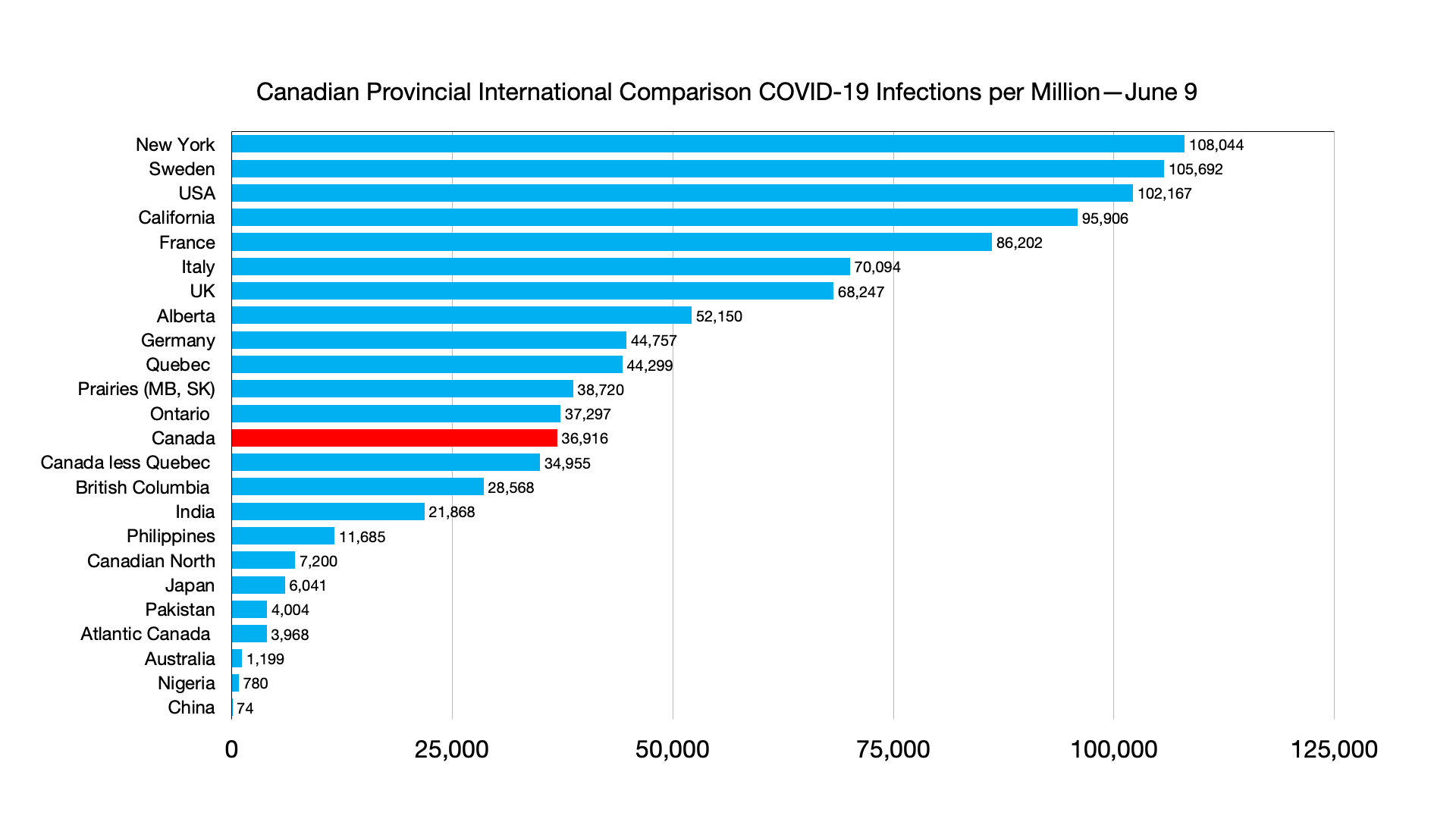
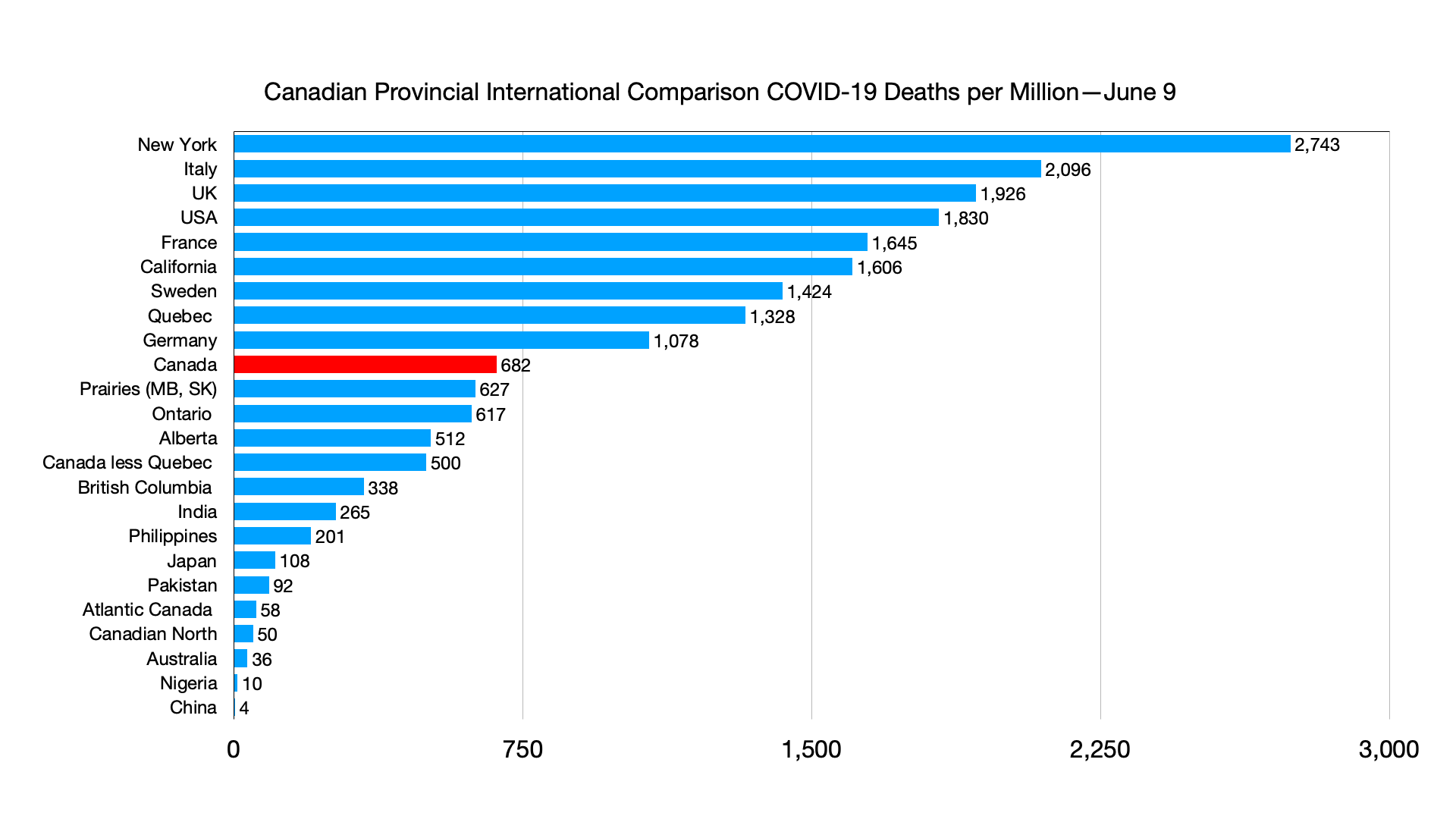
#COVID-19: Comparing provinces with other countries 9 June Update

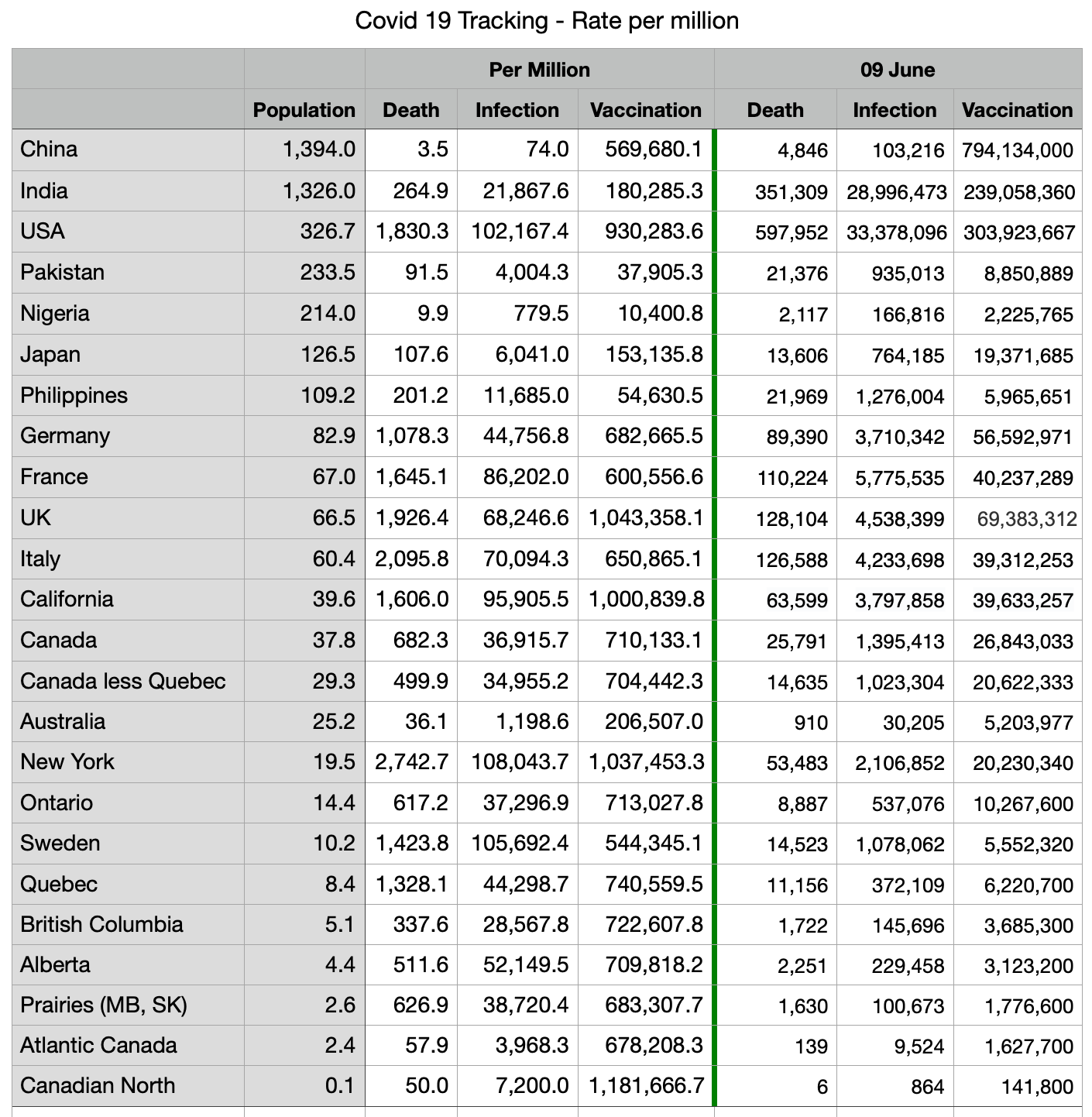
The latest charts, compiled 9 June as overall rates in Canada continue to decline along with increased vaccinations (still largely first dose, fully vaccinated less than 10 percent).

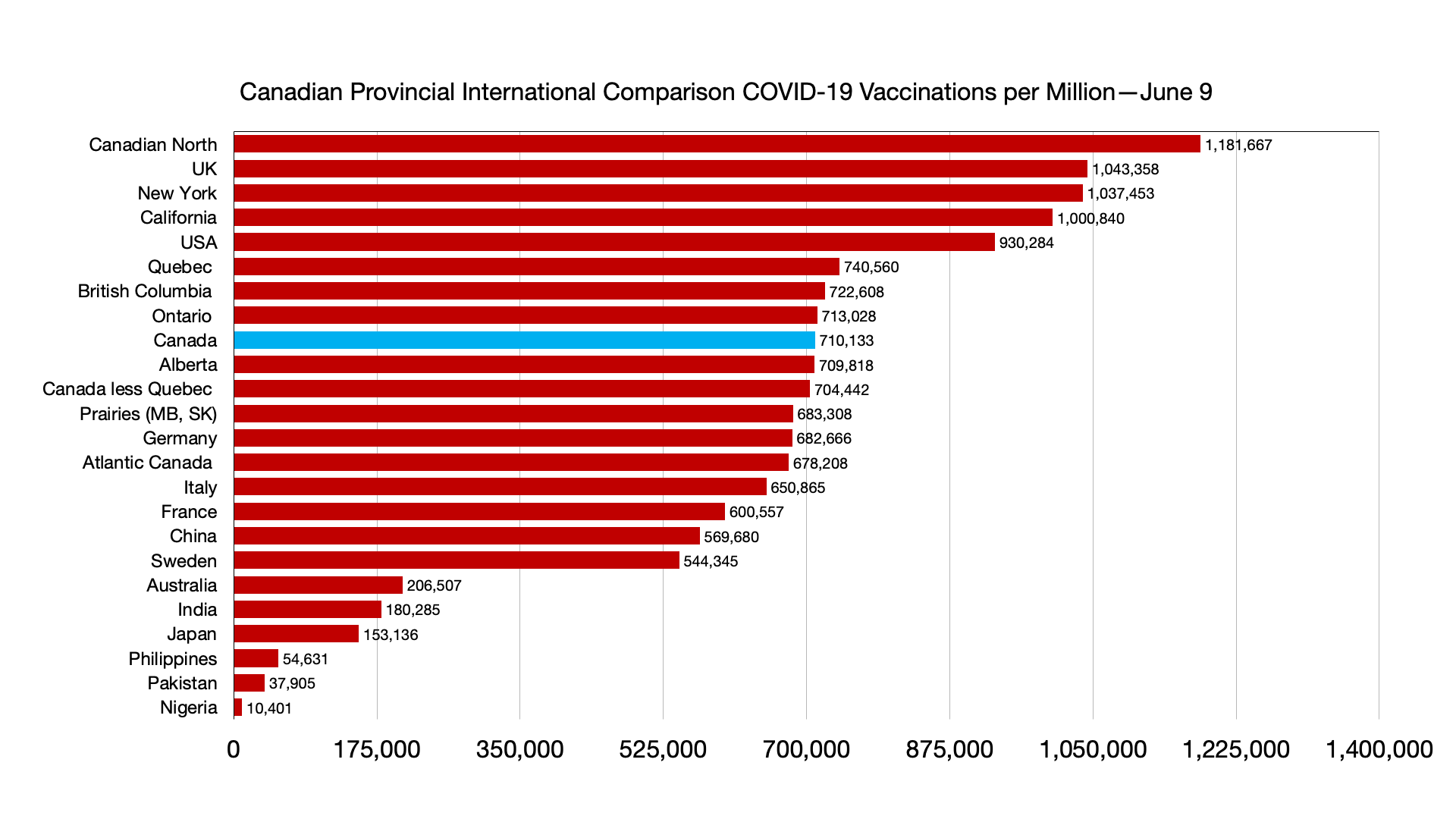
Vaccinations: Minor relative changes, Canadian provinces all ahead of EU countries save Germany.

Trendline charts

Infections per million: No major relative changes and recent surges appear to be levelling off save for the Prairies (mainly Manitoba).

Deaths per million: No significant change, Prairies slightly ahead of Ontario.

Vaccinations per million: Canadian vaccination rates now exceed G7 less Canada with Quebec. US vaccination rates continue to stall. Vaccination rate increase in immigration source countries driven mainly by China and India to a lessor extent.

Weekly

Infections per million: No relative change.

Deaths per million: Prairies ahead of Ontario, driven by Manitoba.