‘Colour-coded’ retirement security: Study finds economic marginalization and inequity follow people into old age

Not surprising but useful confirmation:

Indigenous and racialized seniors have much lower retirement incomes and higher poverty rates than their white counterparts, which a new study says reflects how economic marginalization and inequity follows people into their old age.

Overall, white Canadian seniors enjoy the most retirement security with an average yearly income at $42,800, way above the $32,200 for their peers in the Indigenous communities and $29,200 for visible minorities over the age of 65.

Based on 2016 census data, the report by the Canadian Centre for Policy Alternatives found 13.7 per cent of white seniors lived in poverty compared to 21.5 per cent among Indigenous seniors and 19.8 per cent among racialized seniors, according to the Low Income Measure After Tax or LIM-AT.

Hence, it’s not surprising that seniors from marginalized groups have to count on public pensions and benefits to make up for lagging retirement incomes, says the study, titled “Colour-coded Retirement,” released Wednesday.

“The data reveal that there are real consequences of economic marginalization and systemic racism. Elders and seniors are financially insecure in retirement, if they can retire at all, because the opportunities for saving are so limited,” says Hayden King, a report co-author and executive editor of the Yellowhead Institute, a First Nation-led research centre.

Senior white Canadians, who made up 85 per cent of the senior population in the country, have the most diverse sources of income of all groups.

About a third of their income comes from public pension sources such as the Canada and Quebec Pension Plans, Old Age Security (OAS), and the Guaranteed Income Supplement (GIS); a third from retirement contributions to work and individual pension plans; and the rest from investment and employment earnings as well as other sources.

In comparison, public pension accounts for 47 per cent of Indigenous seniors’ and 40 per cent of racialized seniors’ retirement income, respectively.

These two groups — accounting for 14.8 per cent of the population over age 65 in Canada — had less money to draw from their employers’ pension plan and own retirement savings, or investment income. They were more likely to rely on employment income.

RPPs and RRSPs account for a third of white seniors’ retirement income, versus 25 per cent for Indigenous seniors and 21 per cent for racialized seniors.

On the whole, racialized Canadian households have less spare money to contribute to those plans than white Canadian households. And when they do, their contributions are lower.

Chinese households were an exception with an average contribution of $10,000 in 2015, which was higher than the $7,600 contribution made by white households. In comparison, Black families only made a $4,600 average contribution.

“The overall low share of the racialized and Indigenous population that contribute to RPPs points to reduced retirement security for the next generation of workers,” the report warned.

Among racial minority groups, retirement incomes also vary among those who were born in Canada versus those who are immigrants.

While only 3 per cent of Chinese seniors and 1 per cent of South Asian seniors are Canadian-born, their average retirement income is higher than their immigrant peers.

In the case of Black Canadians, however, being Canadian-born offers no income advantage.

“Canadian-born Black seniors’ income is virtually identical to that of Black immigrants, with the result that Canadian-born Black seniors’ average income continues to be 25 per cent lower than Canadian-born white seniors’ income,” said the report.

“This provides us with insight into the continuing impact of anti-Black racism on seniors’ income.”

The study also shows the differences between First Nations, Métis and Inuit seniors’ income, as well as their respective contributions to RPPs and RRSPs.

First Nations seniors have the lowest average income of any Indigenous group, at $33,500 for men and $26,300 for women, followed by their Inuit ($39,900 and $32,150) and Métis ($41,765 and $28,285) counterparts. Métis seniors were most likely to contribute to private pension and retirement savings plans, while their First Nations peers had the lowest participation rate.

Researchers said there is also a consistent gender gap with senior women of all demographic backgrounds having lower retirement incomes and higher poverty rates than senior men.

The study found the overall racialized senior population’s total income averaged $33,900 for men and $25,000 for women. While visible minority male seniors’ average income is 36 per cent lower than their white male counterparts, senior racialized women’s average income is 26 per cent below their white female peers.

“It is only when the economic impacts of underlying racism and sexism are addressed that we will achieve equal access to a secure retirement for all,” said the 49-page report, funded by the Canadian Race Relations Foundation

It said the data shows that GIS and OAS pension — both adopted as anti-poverty measures — are crucial sources of income for senior women who are First Nations or racialized immigrants.

The increase in OAS by the federal Liberal government for those 75 and older in the 2021 federal budget is a step in the right direction to narrow retirement income disparities, said the study.

It recommends measures to eliminate barriers to equitable employment opportunities and increased access to workplace-based pension plans and retirement savings
Source: ‘Colour-coded’ retirement security: Study finds economic marginalization and inequity follow people into old age

Contrasting articles: New paths to permanent residency for Hong Kong students and workers not enough: advocates, Ottawa warned to not assume Hong Kongers are innocent of charges

Starting with the advocates:

UBC law student Davin Wong has many friends who are excited about two new paths to permanent residency for Hong Kong students and workers with temporary resident status in Canada.

Ottawa announced the new paths last week, saying it is “deeply concerned” by China’s imposing of a national security law and the “deteriorating” human rights situation in Hong Kong.

Source: New paths to permanent residency for Hong Kong students and workers not enough: advocates

And a note of caution from IRCC officials:

Canadian immigration officials warned the federal government in an internal memo last year against assuming protest-related charges faced by Hong Kongers seeking entry to Canada are bogus accusations fabricated by the city’s Beijing-backed authorities.

This internal caution, which was provided to The Globe and Mail, is different from the Canadian government’s public messaging on the crackdown on the former British colony. Ottawa routinely says it stands “shoulder to shoulder with the people of Hong Kong.” The consensus among human rights groups is that many of the arrests and charges laid against Hong Kong protesters have been unjustified.

A report from Immigration, Refugees and Citizenship Canada’s Hong Kong office advises Ottawa not to consider Hong Kongers innocent if they apply for visas or asylum but have protest-related charges. “It cannot be assumed that charges are politicized or trumped up by authorities; there have been shocking images of violent attacks during confrontations,” the report says.

Source: https://www.theglobeandmail.com/canada/article-morning-update-ottawa-warned-to-not-assume-hong-kongers-are-innocent/

American Samoa culture plays role in US citizenship ruling

Of interest given intersection with Indigenous-like issues:

In a decision citing American Samoa cultural traditions, those born in the U.S. territory shouldn’t have citizenship automatically forced on them, a federal appeals court ruled Wednesday.

The 10th U.S. Circuit Court of Appeals ruling reverses a lower court ruling that sided with three people from American Samoa who live in Utah and sued to be recognized as citizens. The judge ruled the Utah residents are entitled to birthright citizenship under the 14th Amendment. He then put his ruling on hold pending appeal.

U.S. Congress should play a bigger role than the courts in deciding citizenship for those in territories, the appeals court ruling said.

American Samoa is the only unincorporated territory of the United States where the inhabitants are not American citizens at birth.

Instead, those born in the cluster of islands some 2,600 miles (4,184 kilometers) southwest of Hawaii are granted “U.S. national” status, meaning they can’t vote for U.S. president, run for office outside American Samoa or apply for certain jobs. The only federal election they can cast a vote in is the race for American Samoa’s nonvoting U.S. House seat.

The ruling notes that American Samoa government leaders and others opposed the lawsuit because they are concerned automatic citizenship could disrupt cultural traditions, such as communal land ownership and social structures organized around large, extended families led by matai, those with hereditary chieftain titles.

“There is simply insufficient caselaw to conclude with certainty that citizenship will have no effect on the legal status of the fa’a Samoa,” or the American Samoan way of life, the ruling said. “The constitutional issues that would arise in the context of America Samoa’s unique culture and social structure would be unusual, if not entirely novel, and therefore unpredictable.”

Drawing on the views of the American Samoa people is one of the more gratifying aspects of the ruling, said Michael Williams, an attorney representing the American Samoa government, which intervened to oppose the lawsuit.

“It is also vindication for the principle that the people of American Samoa should determine their own status in accordance with Samoan culture and traditions,” he said.

A path toward U.S. citizenship exists for those who want it. But some say it’s costly and cumbersome. Non-citizen nationals of American Samoa are entitled to work and travel freely in the United States and receive certain advantages in the naturalization process.

Neil Weare, one of the attorneys representing the plaintiffs, said they are disappointed by the ruling, and are reviewing next steps. Options include asking a wider panel of appeals court judges to hear the case or taking it to the U.S. Supreme Court.

Weare is president of Equally American, which advocates for equality and civil rights for people in U.S. territories.

He said he was impressed with a dissenting judge’s opinion.

”When the Fourteenth Amendment was ratified, courts, dictionaries, maps, and censuses uniformly regarded territories as land ‘in the United States,’” wrote Judge Robert E. Bacharach in his dissent.

Self-determination is a highly valued principle in American Samoa, said Line-Noue Memea Kruse, adjunct faculty in Pacific islands studies at Brigham Young University-Hawaii and whose book is cited in the ruling.

“There are many foreign interests looming over these citizenship cases,” she said. “This is not the end. They will keep pushing. This to me is a form of inter-territorial hegemony.”

Source: American Samoa culture plays role in US citizenship ruling

Alberta NDP demands Jason Kenney apologize for federal niqab policy as he denies ever supporting it

Really odd (and stupid) denial given the clear public record:

There’s a push to have Alberta Premier Jason Kenney join his former federal colleagues in apologizing for a controversial niqab policy that was introduced a decade ago.

The call ties back to when the premier was the federal immigration minister. In 2011, he announced a ban on Muslim women wearing niqabs while taking the citizenship oath.

In the past week, Conservative MPs have acknowledged that the policy stoked Islamophobia.

The NDP, Alberta’s Official Opposition, wants Kenney, the “architect of the policy,” to apologize for what it calls promoting hatred towards Muslims.

“I’m calling on Jason Kenney to immediately apologize to Muslim Canadians for his racist words and actions,” said Jasvir Deol, NDP Critic for Multiculturalism, on Tuesday.

“These words and actions from a federal government minister are the first steps towards the rising anti-Muslim violence we see today.”

But Kenney says he has nothing to apologize for.

“My record on these matters could not be more clear,” he said Tuesday.

The premier argued that as a minister, he supported and welcomed Muslims to Canada.

“I’ve never supported a proposed ban. To the contrary, I’ve always said Canada is a country that protects and respects religious freedom and pluralism, and the government has no business regulating what people wear,” he said.

In a 2014 tweet, Kenney defended the policy, saying he believed people should take the citizenship oath with faces uncovered.

“This practice of face covering reflects a misogynistic view of women, which is grounded in a medieval, tribal culture,” Kenney said in 2015.

“While the government has no interest in regulating what people choose to wear in their private lives, when you come and swear a public oath, in a court, in front of a judge and your fellow citizens, we think it’s eminently reasonable to ask that for those 30 seconds, you do so openly, publicly and transparently as a proud new Canadian.”

Politicians apologize

In the days after the fatal attack on a London Muslim family on June 6, some of Kenney’s former federal colleagues are apologizing for the niqab ban.

Tim Uppal, MP for Edmonton Mill Woods and a former federal Conservative cabinet minister, said that such policies have consequences and he should have used his seat at the table to push against divisiveness.

“I regret not being a stronger voice and sincerely apologize for my role,” he wrote on Facebook Sunday.

“It does lead to casting a shadow over a community. It leads to stereotyping, and in this case, would lead to Islamophobia,” he told 630 CHED on Tuesday.

Calgary Nose Hill MP Michelle Rempel Garner also apologized.

On June 8, she wrote on her blog: “One of my biggest regrets in my public service was being silent during the 2015 general election campaign on the wrongness of the barbaric cultural practices tip line and the proposed niqab ban.”

“Those policies were wrong. To the Muslim community, I’m deeply sorry for not fighting it then. I can assure you I won’t make the same mistake again,” she said.

Source: Alberta NDP demands Jason Kenney apologize for federal niqab policy as he denies ever supporting it

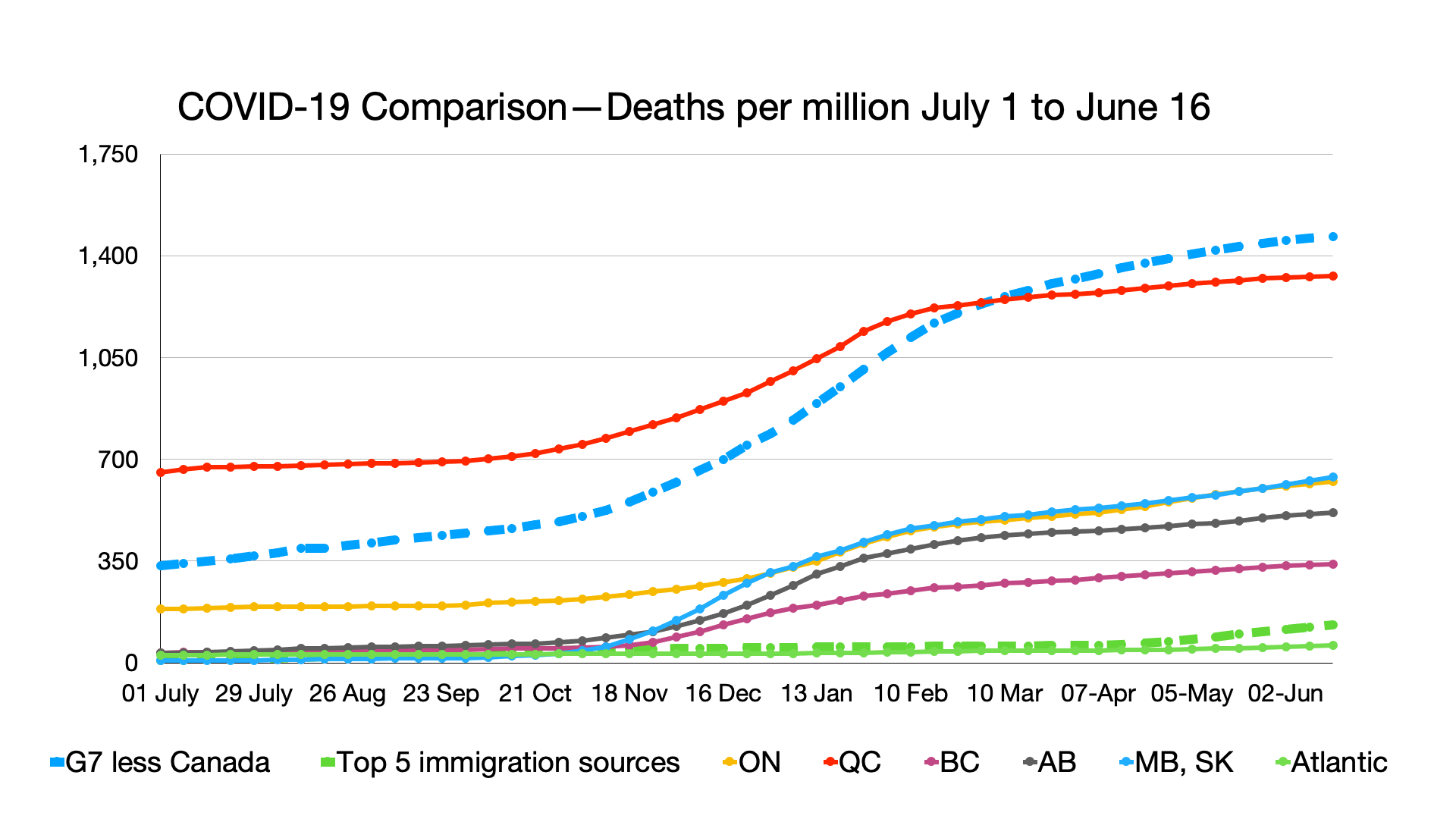
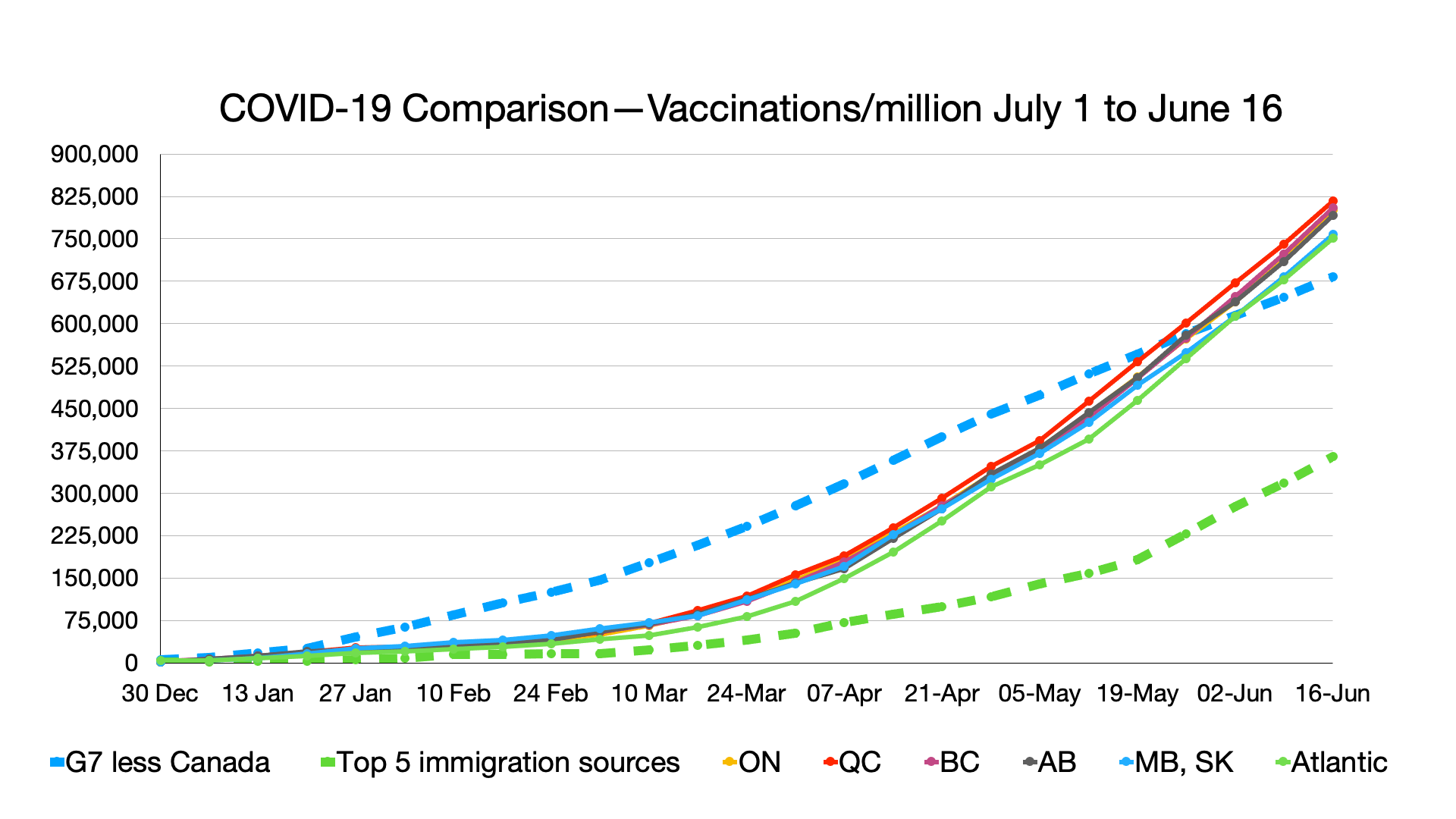
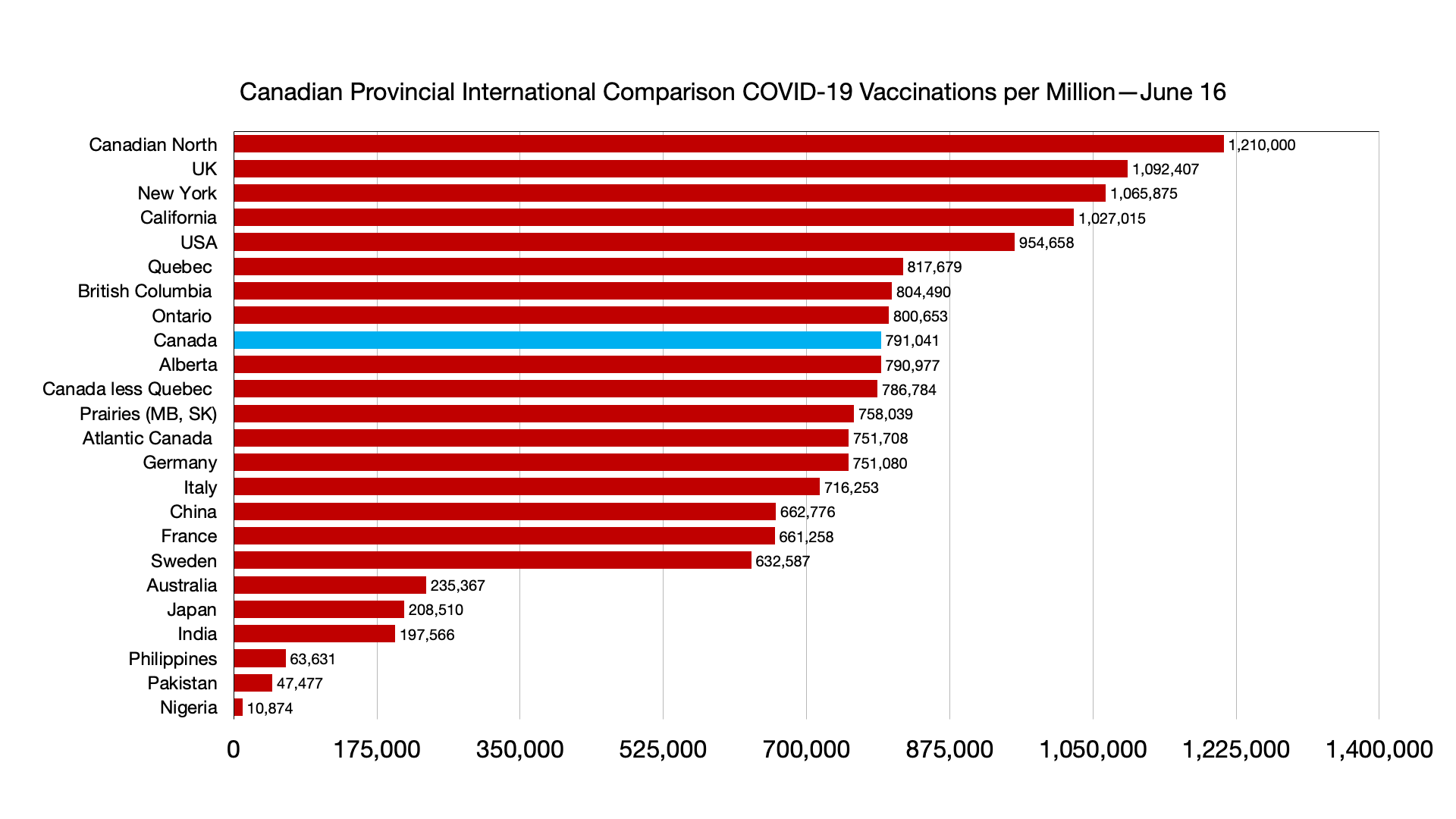
#COVID-19: Comparing provinces with other countries 16 June Update

The latest charts, compiled 16 June as overall rates in Canada continue to decline along with increased vaccinations (still largely first dose, fully vaccinated just under 14 percent).

Vaccinations: Minor relative changes. Most significant is China is now ahead of France and Sweden. Also, Atlantic Canada ahead of Germany and Japan ahead of India (pre-Olympics push?)

Trendline charts

Infections per million: No relative changes and recent surges levelling off save again for the Prairies (mainly Manitoba).

Deaths per million: No relative change.

Vaccinations per million: Canadian vaccination rates continue to exceed G7 less Canada with Quebec maintaining its slight lead. Vaccination rate increase in immigration source countries driven by China (up 16% from last week) with Indian vaccination increasing more slowly (10%).

Weekly

Infections per million: No relative change.

Deaths per million: No relative changes.

Canada: Indian-origin ex-minister ‘sorry’ for backing proposed anti-Muslim bill [Uppal]

Following Rempel Garner, another former minister reflects in the South Asian press:

A former Canadian minister of Indian origin has publicly apologised for having supported in the past a proposed bill that would have banned Muslim women in the country from wearing the niqab, a face-covering veil, while taking their citizenship oath.

Conservative Party MP Tim Uppal, a Sikh, was the minister of state for multiculturalism in the government of then PM Stephen Harper in 2015 when he had backed the controversial bill.

His apology has come at a time when terror charges have been slapped on Nathaniel Veltman, a 20-year-old who had mowed down four members of a Muslim family in the city of Hamilton in Ontario on June 6 in an act of Islamophobia.

Uppal is currently an MP from Edmonton Mill Woods.

Uppal’s mea culpa has come following the attack. In a Facebook post, he said he was the spokesperson for the proposed bill in 2015, but after his party was defeated in that year’s general election by the Justin Trudeau-led Liberals, he spoke with Canadians outside the “partisan political bubble” and realised “how this ban and other campaign announcements during the 2015 election alienated Muslim Canadians and contributed to the growing problem of Islamaphobia”.

He posted, “When it came to these policies, I should have used my seat at the table to push against divisiveness that promoted the notion of the other. I regret not being a stronger voice and sincerely apologise for my role.”

Referring to the Hamilton attack, he said it has been “a devastating week for many. We are mourning as a nation for a family that was so brutally attacked and destroyed by a terrorist”.

The apology came as a federal prosecutor imposed terror charges on Veltman, who drove his truck over the family when they had been out for an evening walk. The charges were upgraded on Monday.

Source: Canada: Indian-origin ex-minister ‘sorry’ for backing proposed anti-Muslim bill

Indigenous names can be reclaimed on passports and other immigration documents: Ottawa

Of note. Will be interesting to see take-up among Indigenous peoples:

First Nations, Inuit and Métis people can reclaim their Indigenous names on passports and other government documents, the federal government has announced.

Immigration, Refugees and Citizenship Canada (IRCC) said Monday that the change will include things such as travel documents and citizenship certificates, adding that the service will be provided free of charge for five years.

Immigration Minister Marco Mendicino said the use of traditional names is intrinsic to Indigenous languages and cultures, as well as to identity and dignity. He said the decision is in response to the Truth and Reconciliation Commission’s (TRC) call to action 17, which referenced passports.

But the department decided to go further to include a host of other documents, Mr. Mendicino said, adding that the work will be done with Indigenous leaders and communities to ensure the process is smooth.

“Our names are among the first things we receive,” he said. “They’re individualized, unique. They speak to our past, honouring those who came before us, and reflect our family’s history. Naming children is a profoundly important tradition across many different cultures and communities. The traditional names given to Indigenous children carry deep cultural meaning. Yet, for many First Nations, Inuit and Métis people, colonialism has robbed them of these sacred names.”

Indigenous children who were taken from their families and forced into the residential school system also had their names stolen from them, Mr. Mendicino said, pointing to the testimonials of survivors in the TRC’s final report.

IRCC said it is working on two other calls to action, including an update of the Citizenship Guide that will include the role Indigenous peoples played in the development of Canada and an amendment to the Oath of Canadian Citizenship that will refer to the rights of Indigenous peoples and treaties. Last week, a bill designed to amend the Citizenship Act to change the oath of citizenship passed third reading in the Senate. It is now awaiting royal assent.

In the past two weeks, Ottawa has faced pressure to further advance reconciliation in Canada after Tk’emlúps te Secwe̓pemc First Nation in B.C. said it had discovered the remains of 215 children, former students of the Kamloops Indian Residential School, in unmarked graves. The finding touched off vigils and commemorations and demands that provincial governments and the federal government do more.

On Monday, Ottawa also announced appointees to the new Office of the Commissioner of Indigenous Languages. Ronald Ignace will serve as the commissioner, with Robert Watt, Georgina Liberty and Joan Greyeyes as directors. The office will support Indigenous people to ensure their languages can be shared and spoken for years to come.

The federal government said the directors and commissioner were selected for their knowledge and understanding of Indigenous communities, cultures and languages.

“We celebrate this day where we breathe new life into all of our Indigenous languages for the future,” Dr. Ignace said. “Our languages will no longer stand in the shadow of other languages here in our land. Let us always honour our Indigenous languages.”

Source: Indigenous names can be reclaimed on passports and other immigration documents: Ottawa

New Zealand apologizes for 1970s raids on Pacific people

Of note, reflecting similar experiences of Indigenous peoples and others in many countries:

Aupito William Sio recalled the terrifying day during his childhood when police officers holding German shepherd dogs turned up at his family home before dawn and shined flashlights into their faces while his father stood there helpless.

Now the minister for Pacific peoples, Sio and Prime Minister Jacinda Ardern announced Monday the government would formally apologize for an infamous part of the nation’s history known as the Dawn Raids.

It’s when Pacific Island people were targeted for deportation in the mid-1970s during aggressive home raids by authorities to find, convict and deport overstayers. The raids often took place very early in the morning or late at night.

Sio became emotional as he and Ardern discussed the apology at a news conference.

“We felt as a community that we were invited to come to New Zealand. We responded to the call to fill the labor workforce that was needed, in the same way we responded to the call for soldiers in 1914,” Sio said.

But he said the government then turned on the Pasifika community when it felt those workers were no longer needed.

Ardern said that at the time, people who didn’t look like white New Zealanders were told they should carry identification to prove they weren’t overstayers, and were often randomly stopped in the street, or even at schools or churches. She said Pacific people were often dragged before the courts in their pajamas and without proper representation.

“Not only were they targeted, they were targeted using a process and a practice that was really dehumanizing, that really terrorized people in their homes,” Ardern said.

She said that when computerized immigration records were introduced in 1977, they showed that 40% of overstayers were either British or American, groups that were never targeted for deportation.

“The raids, and what they represented, created deep wounds,” Ardern said. “And while we cannot change our history, we can acknowledge it, and we can seek to right a wrong.”

In Sio’s case, he said his family were legal residents who owned the home but a couple of his father’s nephews from Samoa were staying with them and were taken away by the police without their clothes or belongings, and later deported.

He said the nephews had been working at a factory and their visas had expired. He said they had been preparing to go home and wanted to do a few more overtime shifts before they left. Sio said his father helped advocate for them to get back their clothes and money so they could leave New Zealand with some measure of their dignity intact.

The formal apology will be held at a commemoration event on June 26 in Auckland. The apology doesn’t come with any financial compensation or legal changes, but Sio believes it is an important first step. He said the trauma is still fresh for many and it’s good to address the issue and prevent such a situation happening in the future.

Ardern said it’s just the third time the government has made such an apology.

The previous apologies were for imposing a entry tax on Chinese immigrants in the 1880s and for introducing the deadly influenza pandemic to Samoa in 1918, which killed more than one-fifth of the population.

Source: New Zealand apologizes for 1970s raids on Pacific people

Singh’s blunt message about racism reflects mood of Canadians

Of note – one take:

Already exhausted — and, in some parts of the country, angry — from a pandemic that’s left 26,000 dead, disturbing events of recent weeks have added to Canadians’ emotional burden.

First came a groundswell of emotion when news broke that the bodies of 215 Indigenous children had been located in unmarked graves on the grounds of the now-closed Kamloops Indian Residential School. Then came an outpouring of anger and grief in response to the Islamophobic murder of four members of a family in London, Ont., and more grief later, when their flag-draped coffins arrived at their funeral.

The usual sombre speeches were made — salves to help Canadians recover from the terrible events. But not every political leader was encouraging Canadians to move on. At a community meeting in London, NDP Leader Jagmeet Singh spoke with anger.

Later, in the House of Commons, Singh forcefully added a new idea to the debate. “Some people have said, ‘This is not our Canada,’ ” Singh told MPs.

“But the reality is, this is our Canada. We can’t deny it. We can’t reject that, because it does no one any help. The reality is: Our Canada is a place of racism, of violence, of genocide of Indigenous people.”

Singh may be sensing a widespread mood. In an opinion poll Leger released last week, 57 per cent of Canadians said the Kamloops graves made them “question the whole moral foundation that Canada has been based on.”

Singh’s message probably won’t be positively received by “official Canada,” the network of government leaders and businesspeople who run the country. If this is a place of racism, violence, and genocide, they helped to create and perpetuate it.

But their dominance of Canadian identity seems to have been overtaken recently by the everyday experiences of previously ignored people.

The deaths and burials at residential schools were known by Indigenous families, but news media didn’t tell those stories. Nor is the frustration with ongoing racism, and fear of violent racists, new in Canada. Many Canadians live with both every day.

These are the experiences of what political science calls the “subaltern” classes of society — groups who have no say and no command in politics or business. And they certainly don’t decide the meaning of their country. Not usually, anyway.

Subaltern society is divided into identities, each pushed to the margins of political discourse, isolated from each other, and without the common networks, culture, or political language to tell a common and unifying story. That now seems to be changing.

“This is our Canada” isn’t just a demand to look objectively at Canada’s past; it’s a call to disparate people to find a new moral basis for their country.

A good political leader can sense and express the mood of the country. But what’s more rare is a politician who can shape it, which appears to be what Singh is doing by weaving together the everyday experiences of racism, fear, violence, and economic struggles.

If we’re re-evaluating Canada, as it seems we are, Singh may play a significant role in redefining it. It’s impossible to know if new ideas will help the electoral prospects of Singh’s New Democrats; the Liberals may well seize the momentum.

But something has changed. We know we can’t continue as if nothing happened, and it seems voices previously at the margins are now telling the story of what did.

Tom Parkin is a social democratic columnist and commentator based in Toronto who has worked for the NDP in Saskatchewan and Ontario.

Source: Singh’s blunt message about racism reflects mood of Canadians

To tackle hate-motivated crimes, Canada’s justice system needs to change

Of note even if the proposed solutions are modest and unlikely by themselves to make a significant difference although encouraging minorities and others to increase reporting would be a good step:

As Muslim chairs of police boards in Ontario, we are sadly familiar with hate-motivated crimes, and with the reality that no country is immune. Police services across Canada have been grappling with these issues for some time, and we are vividly aware that we cannot look away from the hatred that stole the lives of four fellow Canadians who died simply because they were walking while Muslim.

While the particulars of criminal investigations cannot be released, London Police Services were clear that our beloved community members were murdered and targeted for their Islamic faith. As hard as that is to hear for many Canadians, the truth is this is not a singular event. Islamophobic incidents happen all the time in Canada.

In the City of London and Peel Region, both of which are home to diverse communities with large numbers of racialized citizens, police-reported hate-crime numbers have remained consistent over the last few years. According to Statistics Canada, London’s numbers rose by more than a third from 2015 to 2019, and in four of those five years, the city’s rate per 100,000 population was higher than the national average. In 2019, London police reported that Black, Muslim, Jewish, Middle Eastern and LGBTQ2+ peoples constituted the five most targeted groups for hate crimes. In Peel, meanwhile, crimes motivated by race or nationality increased by 54 per cent from 2018 to 2020, with Black and South Asian people being the most targeted by race or ethnicity. Muslims and Jews experienced the most targeting based on faith.

Yet, despite these numbers, our justice system continues to have an incredibly high threshold for anyone to be prosecuted under hate-related laws, and as a result, it is not achieving its desired aims. There remains no specific definition of a “hate crime” in the Criminal Code as a chargeable offence, and what is laid out only provides a judge the ability to hand down harsher sentences based on his or her ruling around a given perpetrator’s motivations. In Peel, only a third of the Criminal Code offences designated by police as hate- or bias-motivated crimes resulted in Criminal Code charges in 2020.

This outdated model emboldens hateful behavior while doing little to dissuade perpetrators, which in turn normalizes their hate-filled rhetoric and actions. Perpetrators such as Alexandre Bissonnette, for instance, have reaped the benefit of loopholes such as concurrent sentences; Mr. Bissonnette murdered six people in Quebec City in 2017, yet serves time for only one murder. We cannot let this injustice continue in the case of the family killed in London, Ont.

Reporting mechanisms are also a challenge. Far too often, verbal threats and assaults are not brought to the police because victims don’t feel like they’ll be taken seriously, simply don’t want the trouble, or are concerned that their reporting will only further agitate the perpetrators, putting the victims and their families at further risk. This means that any hate-crime numbers are almost certainly underestimated, masking the magnitude of the problem.

Earlier this week, community leaders called for action at the vigil for the family killed on the streets of London, but political gesturing and posturing won’t be enough to help prevent the next hate-fueled mass murder. We must name hate for what it is, stare it down, and work with the affected communities to prioritize change over pandering for votes. All parties must work together to get tougher on hate and extremism. We must end the minimization and denial that has become commonplace in our system and in our discourse. Our politicians and legislators can get the ball rolling by changing hate-crime laws to better protect victims who do report, while holding those responsible maximally accountable.

We must also work with our communities to increase the reporting of such crimes so that we can both identify and engage the perpetrators and provide victims with a sense of safety and support. In addition, our laws must also reflect our society’s values and priorities. If hate crimes are difficult to prosecute and carry minimal odds of conviction, this sends the wrong message.

It’s time to take bolder action against anti-Muslim hate, and all other forms of hate and bigotry that continue to terrorize our communities. It’s time to arm our justice system with the necessary tools to root out hatred, and to hold accountable those who perpetrate hate crimes. It’s time to remind far-right extremists and terrorists that our country will not tolerate their hate-motivated crimes and rhetoric. The human cost of our inaction would be too great to bear.

Javeed Sukhera is the chair of the London Police Services Board and an associate professor of psychiatry and paediatrics at Western University. Ahmad Attia is the chair of the Peel Police Services Board and the CEO of Incisive Strategy.

Source: https://www.theglobeandmail.com/opinion/article-to-tackle-hate-motivated-crimes-canadas-justice-system-needs-to-change/