Trichur: Microaggressions in the workplace cause more than bruised feelings. They also create business risks

Of note. While with respect to gender, applies more broadly:

Every workplace has at least one.

That guy who excels at preening, politicking and pushing women to the sidelines: Mr. Microaggression. He is a master of subtle slights and snubs.

Microaggressions are everyday comments or actions that trample the dignity of women but also visible minorities and other equity-seeking groups. Intentional or not, these acts of bias or discrimination cause great harm.

Human resources experts say such behaviours taint workplace cultures. And in the post-#MeToo era, these routine acts of exclusion, which are too often dismissed by managers, are creating legal, regulatory and reputational risks for companies.

“In our globalized world, overt racism, sexism and other prejudices are officially unacceptable – which unquestionably marks progress – but bias still finds expression in aversive or avoidant behaviour,” states a human resources guide prepared for UKG Inc. by Vancouver-based Parris Consulting.

“Where outright violence and oppression were once rampant, prejudice expresses itself more subtly now – in the form of microaggressions.”

Sure, some colleagues deserve the benefit of the doubt if they commit a faux pas or make a clumsy remark at work. But well-meaning folks generally have the reflex to acknowledge and apologize for hurtful behaviour.

Mr. Microaggression, however, undermines his colleagues with impunity. And make no mistake, everyone in your organization knows it.

Although he is not shy about showing disdain for certain male co-workers, women – especially those who are junior to him in age, rank or tenure – make up the majority of his targets because they are less likely to fight back.

He is, of course, smart enough not to say or do anything overtly sexist. After all, plausible deniability is pivotal to his pretense of professionalism.

Instead, his behaviour is less conspicuous: leaving female colleagues off e-mails, interrupting them during meetings, passing off his grunt work, going over their heads to snatch away plum assignments, commandeering internal committee work or elbowing them out of high-profile presentations to top bosses.

Some women are also guilty of flexing their privilege by perpetrating microaggressions against their colleagues. Whether it is on the basis of race, sexual orientation, disability or some other difference, such comments or actions amount to an abuse of power because they have the effect of discrediting their intended targets.

“Even if the slights are ignored or minimized, the work environment may still be chilly,” the human resources guide states. “It’s hard to feel collegial toward people who commit microaggressions. It’s uncomfortable pretending everything is okay when it’s not.”

Equally frustrating is the inaction of managers who chalk up such incidents to misunderstandings, coincidences or personality quirks. Perhaps the biggest mistake they make is appearing more concerned about placating the perpetrators instead of doing right by employees who have suffered repeated indignities.

Diversity and inclusion have become buzz words in corporate Canada. But business leaders who wilfully ignore systemic discrimination in their workplaces, including by downplaying the harmfulness of microaggressions, will experience higher turnover of top talent and expose their companies to legal and regulatory problems.

Microaggressions aren’t just about bruised feelings – they also create business risks.

Global banking regulators, for instance, are increasing their scrutiny of culture and conduct risks after being urged to do so by the Financial Stability Board, an international body that makes recommendations to improve stability of the global financial system.

In Canada, the Office of the Superintendent of Financial Institutions (OSFI), for instance, is continuing its “work on advancing culture as a key area of focus” in its supervision of financial institutions.

OSFI has wrapped up its initial cultural reviews of banks and insurance companies, spokeswoman Carole Saindon said in an e-mailed statement. Those introductory assessments specifically probed how cultural factors affect “strategic decision making” inside financial institutions.

“These reviews have provided insights into behavioural indicators such as transparency and communication, diversity of thought, ability to provide challenge and reflective learning,” Ms. Saindon said.

Of course, microaggressions are just one facet of a problematic corporate culture. It also clear that culture and conduct risks affect more than just banks and insurers. Recent scandals involving technology, entertainment or natural-resources companies also highlight the link between human behaviour, social mores and excessive risk-taking.

That’s precisely why, as a starting point, business leaders across all sectors must be pro-active about educating their employees about microaggressions and how to respond to them.

“It’s critical to understand the current thinking on microaggressions – how they are (or should be) defined, how they may cause harm, how and why they should be called out, and what critics have to say about them,” the human resources guide adds.

“This last point is crucial because organizations and HR professionals need to make decisions about employee relations. If an accusation of committing a microaggression is levelled, they will need to understand it from all sides.”

Still, the onus shouldn’t be on women and minorities to solve the systemic discrimination they face at work. That’s the responsibility of business leaders and HR departments.

The #MeToo movement should have been a wake-up call for the business community that microaggressions can signal much deeper problems with corporate cultures. In fact, there’s even a microaggression app for women in the workplace, Variety reported earlier this year.

Managers need to stop coddling toxic employees. Mr. Microaggression isn’t misunderstood by his coworkers, he’s a menace to your company. Time to keep him in check.

Source: https://www.theglobeandmail.com/business/article-microaggressions-in-the-workplace-cause-more-than-bruised-feelings/?utm_medium=email&utm_source=Morning%20Update&utm_content=2021-9-9_7&utm_term=Morning%20Update:%20Leaders%20square%20off%20over%20child%20care,%20federal%20spending,%20in%20first%20official%20French-language%20debate&utm_campaign=newsletter&cu_id=%2BTx9qGuxCF9REU6kNldjGJtpVUGIVB3Y

European Anti-Semitism Reappears with Virulent Versions for the Covid Era

Of note:

As the coronavirus spread through Europe last year, cartoons and posts began going up on French social media that might as well have come straight from the 14th century. In one series, Agnes Buzyn, who is Jewish and was France’s health minister until February 2020, was depicted with grotesquely distorted features dropping poison into wells.

This trope of Jews poisoning wells to kill Christians has made the rounds in most European epidemics since the Middle Ages, but was particularly rife during the Black Death, when it led to pogroms and massacres of Jews throughout the continent. The vile meme is just one example of a shocking, if sadly unsurprising, surge in anti-Semitism that correlates with the pandemic. That’s the disturbing conclusion of a new report by the Institute for Strategic Dialogue, a think tank, for the European Commission.

The authors mined French and German posts on Twitter, Facebook and Telegram between January 2020 — that is, just before Covid-19 first surged in Europe — and March 2021. They looked for content that’s anti-Semitic according to a definition by the International Holocaust Remembrance Alliance. They found not just petri dishes of hatred but entire cesspools.

In both countries, anti-Semitic tropes and memes soared during the pandemic (see chart). In France, where Twitter was the preferred medium for this bigotry — at least until the social network tweaked its policies — the number of anti-Semitic posts increased seven-fold; in Germany, where Telegram appears to be the platform of choice, it went up 13-fold. The likes, shares and retweets counted in the millions, the views in the billions.

As Covid Spreads, So Does Anti-Semitism

In Germany and France, posts with anti-Jewish content have been increasing during the pandemic

While the delivery vehicles may seem whizzbang modern, the narratives are depressingly hoary. The well-poisoning theme is ancient. But it’s now morphing into storylines that try to recast SARS-CoV-2 as a “zionist bioweapon” — by fabricating Jewish links to laboratories in China, for instance.

A German channel on Telegram with more than 34,000 followers doctored videos as alleged “proof” that the virus was bio-engineered to hurt only gentiles. “Corona is not for the Jews!” the channel’s owner wrote. “Only for the goyim! That’s what they call us!” On another channel, users claimed that “Virology was invented by the Eternal Jew” — a reference to a Nazi propaganda film.

A contradictory meme is somehow circulating in parallel. It says that that SARS-CoV-2 either doesn’t exist at all or exists but is harmless, and is instead a figment invented by Jews and the gentiles they have corrupted — such as Bill Gates or the Clintons — in their quest to control entire populations and establish a “New World Order.”

This so-called NWO genre of anti-Semitism also taps into an ancient narrative, one that was most notoriously exploited by the “Protocols of the Elders of Zion.” This entirely fictional text, produced over a century ago in Russia and translated into many languages, pretended to document how Jews were making secret plans to rule the world by manipulating the media, finance and government.

In some of anti-Semitism’s current strains, vaccination is the alleged tool chosen by the conspiracy — Albert Bourla, the Jewish chief executive of Pfizer, features prominently in these libels. Some posters claim that the vaccines are meant to kill or sterilize gentiles. To get around obvious logical hurdles such as Israel’s pioneering role in mass inoculation, other users fantasize that the Israeli shots are only placebos.

On and on it goes, in never-ending loops of paranoia and delusion. As it always has in Europe, and elsewhere. The researchers had to restrict themselves to just a small sample of countries and social networks. But from that, we can extrapolate how much of this garbage is out there.

The study’s authors felt compelled, as one does, to offer thoughts on regulatory or legal tweaks to mitigate the problem. And the social networks, for their part, should certainly think harder about how to drain their cesspools of bigotry while still hosting legitimate free speech. But the sad truth is that even as human technology keeps bounding ahead, human nature and culture lag woefully behind, often literally in the Middle Ages. If only there were a vaccine against stupidity and hatred.

Source: European Anti-Semitism Reappears with Virulent Versions for the Covid Era

La censure, encore?

Of note:

La destruction, parfois par le feu, de presque 5000 livres tirés des bibliothèques du Conseil scolaire catholique Providence, en Ontario, en est l’illustration parfaite : dans la marmite de la rectitude politique, à trop vouloir lisser les rugosités de nos sociétés en redéfinition, on en vient à perdre tout sens de la mesure, toute notion de discernement essentiel. Au nom de valeurs phares nommées justice sociale et respect, on succombe à la censure. Et tout ça sous le couvert supposément bienveillant de l’école. Quelle époque confuse !

Le reportage percutant de Thomas Gerbet, publié par Radio-Canada cette semaine, dépasse tout entendement. Ce qu’il raconte et révèle de notre époque est à la fois loufoque et scandaleux. « Atroce », a utilisé le premier ministre François Legault pour parler de l’autodafé d’une trentaine de ces 4716 livres jugés discriminatoires et racistes, et véhiculant des préjugés contraires aux principes de l’inclusion. On peut souscrire à cette épithète : la destruction de livres, si noble soit l’intention derrière cette action folle, renvoie à des pratiques d’un temps révolu. La censure est une action bien lâche, en fait, voire hypocrite ; elle ne règle rien et envenime les choses.

Face au tollé, le conseil scolaire a reculé. Huit bédés de Lucky Luke et les aventures de Tintin dans L’oreille cassée auront la vie sauve, entre autres livres sauvés de la bêtise. Fiou ! La Belgique peut respirer. Cette histoire abracadabrante a commencé en 2019 dans le sud-ouest de l’Ontario, mais ne nous défaussons pas trop vite : elle aurait bien pu survenir plus près de chez nous. Sous couvert d’inclusion et d’ouverture à l’autre, les excès se multiplient au fil des mois et des années, qu’on pense seulement aux dérives comme l’affaire SLĀV ou encore la mise au ban de la professeure Verushka Lieutenant-Duval à l’Université d’Ottawa — pour avoir utilisé le mot en n dans un contexte, rappelons-le, pédagogique et respectueux des différences.

Ces histoires, et nombre d’autres, ont toutes en commun ceci de déroutant : dans le camp de la rectitude politique, de nouveaux moralisateurs dictent la marche à suivre, mais ne font pas toujours preuve de discernement.

Pour effectuer son épuration littéraire, le Conseil scolaire catholique Providence s’est adjoint les services de la « gardienne du savoir » Suzy Kies, qui a eu l’idée de brûler les livres pour fabriquer avec les cendres un engrais destiné à faire pousser des arbres, de quoi « tourner du négatif en positif ». La dame se réclamait d’une lignée autochtone finalement inventée de toutes pièces, ainsi que les reporters l’ont démontré mercredi. L’affaire rejaillit sur la campagne du chef libéral Justin Trudeau, apôtre de la réconciliation, qui a fait de cette fausse Autochtone la coprésidente de la Commission autochtone de son parti. Elle a renoncé mercredi à cette fonction. Tout ça ne s’invente pas.

On s’indigne du moyen choisi par ce conseil scolaire pour atteindre son but, mais son objectif n’était pas futile pour autant.

Il va de soi, bien sûr, que lutter contre des préjugés et stéréotypes associés aux Autochtones est de la plus haute importance. Il est aussi très noble de souhaiter raconter l’histoire autochtone sous de meilleurs auspices aujourd’hui, surtout quand on sait combien ce récit fut relaté sans respect pour la vérité et qu’on en porte le boulet encore aujourd’hui. Il est enfin absolument louable de reprendre avec les jeunes une conversation respectueuse et inclusive avec les Autochtones, et en cela, l’école est en effet une plateforme idéale pour rebâtir un dialogue. Mais détruire des livres — et avec eux des points de vue différents et des angles dignes d’une autre époque — n’est pas exactement la façon la plus efficace de développer l’esprit critique.

On ne peut s’empêcher de noter au passage la profonde hypocrisie que camoufle cette opération bidon. En s’attaquant aux livres du passé pour dénoncer le colonialisme dégoulinant de certains ouvrages datés, on oublie bien vite que les peuples autochtones sont encore soumis, ne serait-ce que sur l’enjeu crucial de la propriété de leurs terres, aux diktats des autorités en place. En dénonçant à grands cris l’utilisation du mot « indien » dans des romans jeunesse ou des bandes dessinées, on élude le fait que la grande Loi sur les Indiens, dont la première version remonte à 1876, porte toujours son libellé d’origine malgré le fait que tous s’entendent pour dire que cette référence perpétue une erreur.

Cette bêtise entérinée par des gens qu’on voudrait avisés, car nommés dans un conseil scolaire, aurait aussi reçu l’aval du ministère de l’Éducation de l’Ontario, qui a participé au projet de cérémonie de destruction des livres.

L’Éducation, le sanctuaire des écoles, le ministère dont la mission première tient à la formation des esprits, notamment par le truchement des livres ; l’Éducation, censeur d’une portion de l’histoire, comme jadis l’Église avec ses ouvrages mis à l’Index ? Cette époque produit décidément son lot d’extravagances et de reculs.

Source: La censure, encore?

Ottawa Council’s ethnocultural liaison doesn’t see strict vaccine policy as a barrier to increasing diversity at city hall

Sensible:

Council’s liaison for anti-racism and ethnocultural relations doesn’t believe a new COVID-19 vaccination policy will be a barrier to increasing the diversity of the municipal public service.

Rideau-Rockcliffe Coun. Rawlson King said he doesn’t believe the policy, which came into effect this week, will challenge the city in achieving its diversity goals.

“I don’t see that specifically it will actually detract people from joining the public service at the city. I see them as two separate issues, really,” King said Tuesday after a meeting of the finance and economic development committee, which received a new report on the diversity of the municipal workforce.

“The issue that we’re having, or at least what I think in Overbrook or areas of Manor Park, is the fact that people have a lot of life challenges that are getting in the way of them getting vaccinated.”

The City of Ottawa has made progress in diversifying its workforce over the past year, though it has a long way to go when it comes to changing the composition of management, according to the report by Suzanne Obiorah, the city’s director of gender and race equity, inclusion, Indigenous relations and social development.

Meanwhile, the City of Ottawa’s new mandatory vaccination policy requires all members of the municipal public service to be full vaccinated against COVID-19 by Nov. 1. The policy also requires a full COVID-19 vaccination to be hired by the municipal government.

The Black Opportunity Fund, African-Canadian Civic Engagement Council and Innovative Research Group released national survey results in July that suggested 33 per cent of the adult Black population showed some form of vaccine hesitancy. The rate compared to 19 per cent of adult white Canadians and 25 per cent of non-Black visible minorities who showed vaccine hesitancy.

King said the factors for people not getting vaccinated relate more to income inequality. “And, of course, who suffers disproportionately from that? Black and racialized people,” he said.

City manager Steve Kanellakos said the municipal government wants its workforce to represent the community it serves, while also advocating for high vaccination rates to help reduce the spread of COVID-19.

“The City is aware of the barriers certain residents may encounter when accessing health care and continues to work with Ottawa Public Health (OPH) to identify and remove those barriers, address questions, and make accessing a vaccine as easy and convenient as possible for our residents and our workforce,” Kanellakos said in a statement sent through the communications department.

“The City has followed OPH guidance on making the vaccination requirements uniform for all employees to reduce the spread of COVID-19 and make our workplace healthy and safe for all.”

Based on information the City of Ottawa collected in workforce surveys, the rate of visible minorities was 16.27 per cent in July 2021 compared to 12.6 per cent in September 2020. The city’s target is 20.7 per cent. When it comes to the rate of Aboriginal Peoples in the workforce, city hall improved to 1.99 per cent in July, up from 1.4 per cent (the target is 3.2 per cent).

The city has also improved its rate of employees with disabilities. The rate was seven per cent in July, up from 2.4 per cent in September 2020. The target rate is nine per cent.

The rate of women in the municipal public service was 39.16 per cent in July, with a target of 43.3 per cent.

The city has been exceeding its target for women in management (49 per cent compared to a target of 43 per cent), but its rate of visible minorities in management is 9.9 per cent compared to a target of 20.7 per cent.

King said more senior staff could be retiring in the next year or two, presenting a big opportunity to improve diversity in the management ranks.

“This, for me, will be the litmus test to whether an equity employment initiative at the city is a success,” King said.

Source: Council’s ethnocultural liaison doesn’t see strict vaccine policy as a barrier to increasing diversity at city hall

Immigration-related party platform commitments: Updated with Green Platform

I have updated the immigration party platform table to include the Green Party. Please note that this analysis is based on the published platforms only, not other public commitments.

Some general observations that supplement my earlier summary:

  • All platforms have a mix of specific commitments (e.g., LPC reduce family class processing times to under 12 months) versus non-specific commitments (e.g., NDP address backlog for refugees);
  • All platforms resort to process commitments (e.g., Foreign Credential Recognition);
  • Focus on Quebec particularly apparent in Conservative and NDP platforms. All parties save the Bloc silent on Quebec’s Bill 21;
  • All platforms contain “virtue signalling” or party base language (e.g., LPC reference to previous CPC cuts to immigration levels — not true, CPC “prepared to work hard, contribute to growth and productivity of Canada, and strengthen our democracy” for transition to permanent residency);
  • All platforms save PPC are silent on immigration levels. Surprising that Liberals didn’t mention the levels plan given all the messaging around achieving 400,000 this year;
  • Limited immigration policy innovation, save for CPC family class “point system,” expedited processing fee and replacing GARS with PSRs and Blended refugees, along with operational innovation;
  • Clear divisions on the STCA: Liberals silent, CPC and PPC would apply across the border (closing Roxham Road “loophole”), Bloc and Greens would end the agreement, with NDP surprisingly silent;
  • Relatively little attention paid to operational and administrative issues save for general reference to processing times;
  • All parties are silent on issues where either their record is mixed (Liberals on processing) or party positions may be controversial (e.g., CPC on multiculturalism and anti-racism) or unclear (e.g., NDP on economic immigration);
  • Some catering to specific groups (e.g., Liberals with respect to Blacks, Conservatives with respect to visa-free travel for Ukrainians, Bloc of course with Québécois);
  • Liberal (82 pages), Conservative (160 pages), NDP (114 pages) and Green (103 pages) platforms are lengthy, allowing them to micro-target. The Bloc (30 pages) is more concise given its focus on Quebec. PPC has not provided one complete pdf to compare length but covers most areas. Unlikely that any party could deliver on the majority of commitments.

Updated by issues

  • Levels: No reference to specific levels by CPC, NDP, Bloc and Greens.
  • Liberals are silent (save for a false claim of previous Conservative cuts) but levels are known through the immigration plan.
  • PPC platform commitment to reduce levels to between 100 and 150,000.

Economic:

  • Liberal commitments to welcome talented workers through existing Global Skills Strategy and reduce processing times to under 12 months.
  • Conservatives emphasize the priority to be given to healthcare workers and expansion of the Provincial Nominee Program in regions which retain immigrants.
  • PPC commits to increase percentage of economic and require in-person interviews with questions regarding alignment with Canadian values along with additional resources for background checks.

Family:

  • Liberals commit to electronic applications and a program to issue visas to spouses and children abroad pending full application processing.
  • Conservatives, more innovatively, propose replacing the lottery system with a point system based upon childcare and family support along with language competency, along with additional resources.
  • NDP proposes to end the caps on Parents and Grandparents, the Greens propose an increase while the PPC proposes to abolish P&Gs and limit others.
  • Greens also propose to revise adoptions procedures, including adoption bans from Muslim countries.

Refugees:

  • Liberals propose to increase the number of Afghan refugees from 20,000 to 40,000 as well as 2,000 skilled refugees through the Economic Mobility Pathways program with a healthcare focus.
  • Conservatives propose replacing Government Assisted Refugees (GARS) with Privately Sponsored (PSR) and Blended programs with no change in numbers. Priorities will be the most vulnerable, SPOs with strong track record and the introduction of a “human rights defender stream” for situations like Hong Kong as well as making the LGBTQ Rainbow Refugee program permanent. Additional capacity for the IRB along with closing the Safe Third Country Agreement (STCA) loophole (between official points of entry) and joint border patrols with the US are part of the platform.
  • NDP commits to addressing the backlog and working with Canadians to resettle refugees in communities.
  • Bloc would end the STCA and welcome French speaking refugees.
  • Greens also propose to end the STCA, and revise all CBSA practices (e.g., detention centres, family separation), address long processing times, and lower family reunification barriers for convention refugees.
  • PPC commits to fewer refugees, declaring the entire border an official port of entry (thus covered by the STCA), reliance on private sponsorship and no longer relying on UN selection of GARS with priority given to religious minorities in Muslim countries and those who reject “political Islam.”

Foreign Credential Recognition: All three major parties with continue to work with provinces and territories, with the Conservatives committed to a task force for “new strategies.” The Greens promise greater funding and collaboration with accreditation issues.

Cultural Sensitivity: In addition to the Conservative proposal on “cultural sensitivity,” the Greens propose to “address xenophobia in all aspects of settlement, including temporary visa liberalization, issuing of temporary permits …and family reunification.”

Immigration fees: The Conservatives would introduce an expedited service fee for quicker application and the Greens would provide a fee exemption for low-income immigrants.

Temporary Residents: Both Liberals and Conservatives commit to a trusted employer system to reduce the administrative burden on employers.

  • Liberals mention the Global Talent Stream focus on highly skilled workers and commit to an employer hotline to resolve issues.
  • Conservatives would introduce standards and timelines for Labour Market Information Assessments (LMIA).
  • Bloc proposes the transfer of the Temporary Foreign Workers Program to Quebec.
  • Green platform has general reference to liberalization for temporary workers and strategies for workers to report abusive employers without losing status.
  • PPC would limit the number of temporary workers and ensure that they are only filling temporary positions and not competing with Canadians.

Temporary to Permanent Transition:

  • Liberals would reform economic immigration programs to expand pathways to Permanent Residence.
  • Conservatives commit to pathways for both the “best and brightest” as well as low-skilled workers, latter based on labour market data, and those that are “prepared to work hard, contribute to growth and productivity of Canada, and strengthen our democracy”. Employers would be allowed to sponsor those wishing to transition.
  • NDP would provide a pathway to all Temporary Residents, highlighting caregivers in particular.
  • Greens would lower barriers to transition, particularly for healthcare workers.

Consultants: Only the NDP mentions consultants and commits to government regulation.

International cooperation: PPC commits to withdraw from the Global Compact on Migration.

Settlement/Integration:

  • Conservatives state they will support settlement services but with no specifics.
  • NDP states that it will work with the provinces.
  • Greens would provide greater funding for language training and employment skills.

Administration (Processing):

  • Conservatives emphasize simplification and streamlining of application and administrative processing, with technology being used to speed up application vetting. The IT infrastructure (the one currently being developed) would record all transactions and applicants would be allowed to correct “simple and honest” mistakes rather than the application being rejected. The Conservatives also commit to harmonizing FPT systems.
  • The Bloc would accelerate Permanent Resident application processing.

Citizenship:

  • Liberals recycle their 2019 commitment to eliminate citizenship fees.
  • Bloc plans to table a bill requiring knowledge of French to obtain citizenship (currently, knowledge of either official language). Ironic, given the Bloc’s persistent in respecting jurisdictional competencies as citizenship is exclusively under federal jurisdiction.
  • Greens would update the citizenship guide (already been revised, awaiting political decision to release) and exemption from citizenship fees for low income applicants
  • PPC promises to make birth tourism illegal.

Visitor visas

  • Strangely, the Conservatives commit to a five-year super-visa when they had introduced a 10-year super-visa when in government that was maintained by the Liberal government. They also commit to explore more “generous and fairer visas” by more enforceable commitments on length of stay.
  • Greens would remove visa requirements for most parents visiting children, including TRs

Multiculturalism:

  • CPC: No mention or commitments
  • Liberals commitments include: improve gender & racial equity among faculty (Canada Research Chairs $250m), reference to existing initiatives (Black Entrepreneurship, Black-led non-profits, youth), implement the Black-led Philanthropic Endowment Fund, strengthen equity targets for fed-funded scientific research, specific target for Black Canadians and Funding for promising Black graduate students $6m), support production led by equity seeking groups, creation of a Changing Narratives Fund for diverse communities, BIPOC journalists and creatives $20m), and Increase funding to multiculturalism community programs.
  • NDP commitment include preventing violent extremism through support for community-led initiatives, confronting systemic racism (few details), a national action plan to dismantle far-right extremist organizations, a national task force and roadmap to address over-representation of Blacks and Indigenous peoples in Canadian prisons and, working with the provinces, the collection of race-based data health, employment, policing.
  • Familiar Bloc commitments include placing the federally-regulated sectors (banking, communications, transport) under Quebec’s language charter, opposing Court Challenges Program funding for challenges to Quebec laws (e.g, Bill 21), a commission on prevention of “honour crimes,” and excluding Quebec from the Multiculturalism Act.
  • Greens would implement recommendations from the UN Working Group of Experts on People of African Descent, limit RCMP role and funding in municapt and reserve policy, develop a national oversight approach working with provinces, end RCMP carding and shift police resource to social and community services. 
  • PPC would repeal the Multiculturalism Act.

Anti-Racism/Hate:

  • CPC: No mention or commitments
  • Liberal commitments include: a National Action Plan on Combatting Hate, possible amendments the Criminal Code hate provisions, boosting funding to the Anti-Racism Strategy and Anti-racism Secretariat, introducing legislation to combat serious forms of hurtful online content including making social media platforms responsible for such content, strengthening the Human Rights Act and Criminal Code to more effectively combat online hate, and the creation of a National Support Fund for Survivors of Hate-Motivated Crimes.
  • NDP commitments include: ensuring all major cities too have dedicated hate crime units, establishment of national standards for recording hate crimes (beyond police-reported which already exist?) and work with non-profits to increase reporting, ban carding by the RCMP and establishing a national working group to counter online hate and protect public safety, and making sure that social media platforms are legally responsible for distributing online hate.
  • Bloc condemns hate speech but no proposed changes to the Criminal Code and denounces “Quebec bashing” assertions regarding racism in Quebec.
  • Greens commit to developing better guidelines to address weaponization of free expression, funding data collection online hate and real-world violence, improve AI solutions to detect online hate & violence and require social media to detect and prevent online hate.

Employment Equity:

  • Liberal commitments include: the creation of Diversity Fellowship for mentoring and sponsoring of under-represented groups, French language training for 3rd and 4th year university students to bridge language barriers to entry, expand recruitment to international students and Permanent Residents, and the creation of a mental health fund for Black public servants & support career advancement for Black workers.
  • NDP commitments include: a review to help close the visible minority and Indigenous peoples wage gap and ensuring diverse and equitable hiring in the public service and FRS (recent public service data indicates considerable progress).
  • Bloc proposes the use of blind cvs in public service hiring (pilot carried out in 2017 suggested little difference between existing and blind cv processes).
  • Greens welcome the review of the Employment Equity Act and call for greater working input, an extended timeline and increased resources, and broadening it application to outsourced workers.

#COVID-19: Comparing provinces with other countries 8 September Update

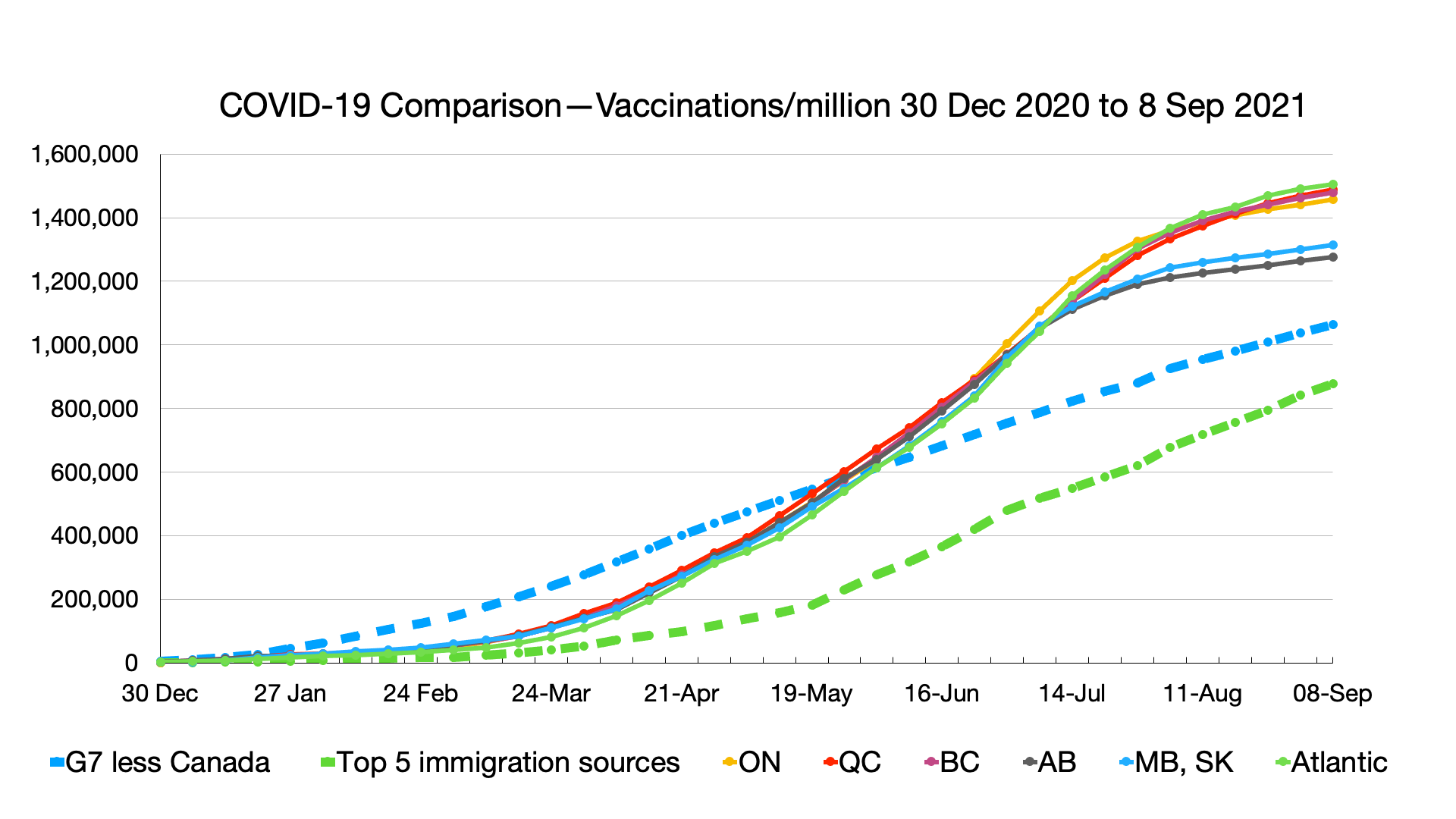
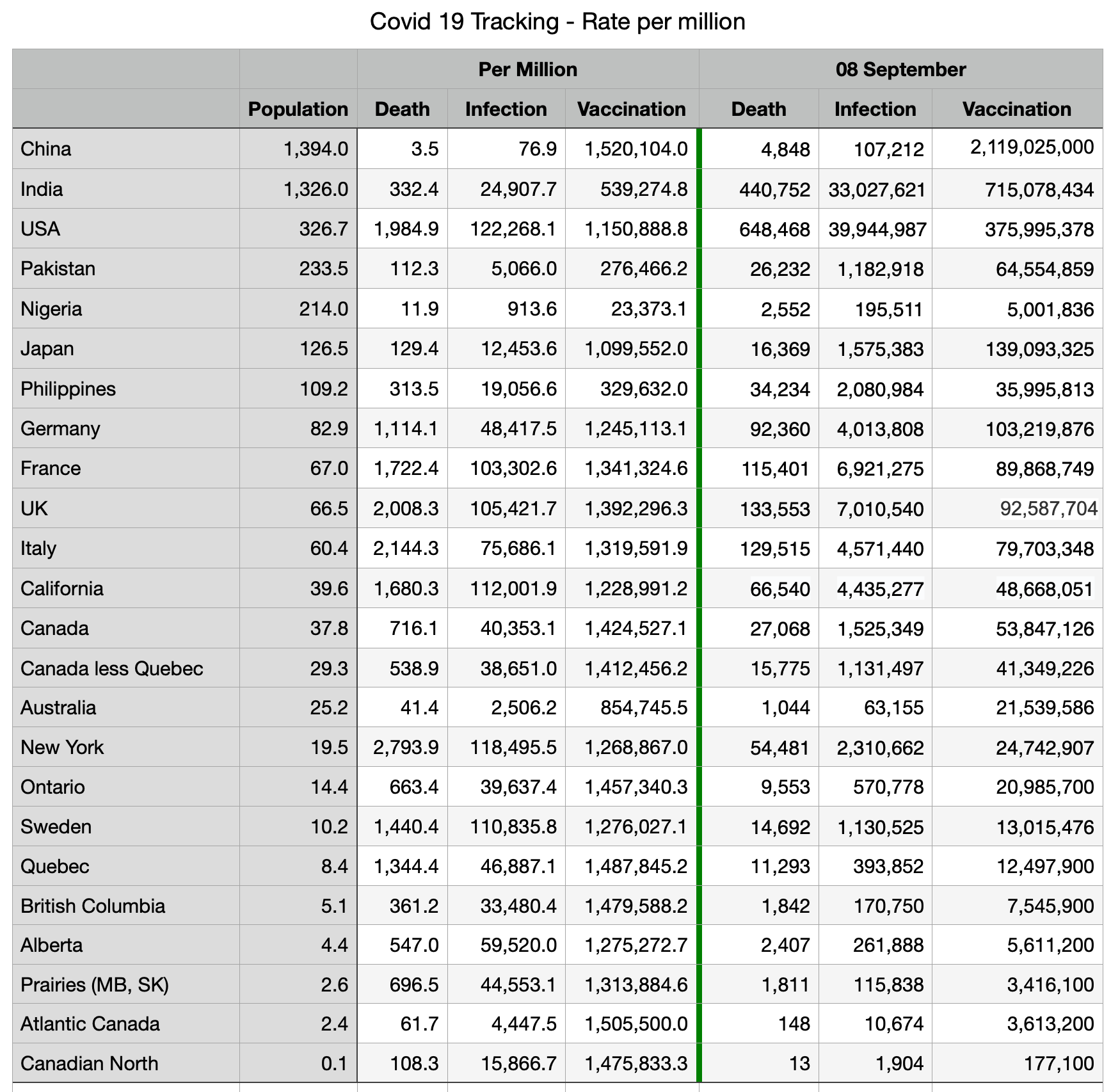
The latest charts, compiled 8 September as overall rates in Canada increase slightly due to the variant. Canadians fully vaccinated 68.6 percent, higher than USA 53.8 percent and the UK 65.1 percent) but all three countries are hitting a wall, with only minimal increases in the past week.

Vaccinations: China now has highest vaccination rate, British Columbia ahead of Canadian North, Italy ahead of Prairies, Sweden ahead of Alberta.  Chinese fully vaccinated, 63.3 percent (unchanged from last week).

Trendline charts

Infections: Same ongoing trend of pronounced uptick in G7 less Canada (driven largely by USA). While all provinces showing increased infections, Alberta and Prairies showing the highest.

Deaths: No major change but uptick G7 less Canada.

Vaccinations: Ongoing steady gap between Alberta and Prairies with lower vaccination rates than elsewhere in Canada. More rapid increase of immigration sources countries continues to be driven by China and to a lesser extent, India.

Weekly

Infections: No relative change except California slightly ahead of Sweden.

Deaths per million: No significant change.

China and the Global Economy: Sad “Business as usual” by CIGI

Hard to believe this “business as usual” approach given Chinese government repression of Uighurs, imposition of the China’s national security law on Hong Kong, and the ongoing arbitrary detention of the Michaels and other Canadians. Particularly cruel and shameful coming after 1,000 days of their detention:

CIGI is pleased to host His Excellency Cong Peiwu, China’s Ambassador to Canada, for a conversation with CIGI President Rohinton P. Medhora about China’s role in the global economy. With the upcoming G20 Heads of State and Government Summit from October 30 to 31, this conversation will explore China’s role and influence in issues preoccupying governments worldwide, such as technology, trade, investment, climate change, and cyber and data governance.

To register for the event on September 30 at 9h30: Registration

Source: https://www.cigionline.org/events/china-and-the-global-economy/?utm_source=cigi_newsletter&utm_medium=email&utm_campaign=will-the-us-congress-compel-transparency-from-facebook

Actor Nicholas Tse renouncing Canadian citizenship amid China’s ‘blacklist’

Seems to be getting a fair amount of coverage:

Hong Kong-born action film actor Nicholas Tse (謝霆鋒) was seen on Chinese TV Sunday (Sept. 5) claiming that he is in the process of renouncing his Canadian citizenship amid rumors he is among the next to be blacklisted by China’s censors.

In late August, the name and likeness of Chinese actress Zhao Wei (趙薇, Vicky Zhao) were suddenly scrubbed from Chinese online streaming sites and social media pages. Last week, rumors began to swirl on Chinese social media that seven famous Chinese actors with foreign citizenship had been placed on a “reorganization list” by the National Radio and Television Administration.

In addition to Tse, the list allegedly includes Jet Li (李連傑), Zhang Tielin (張鐵林), Crystal Liu Yifei (劉亦菲), Will Pan (潘瑋柏), Wang Lee Hom (王力宏), and Mark Chao (趙又廷). Li has Singaporean citizenship; Zhang is a British citizen; Liu, Pan, and Wang have American citizenship; and Tse and Chao have Canadian citizenship.

On Sunday, an excerpt from CCTV 6 program “Blue Feather Reception Room” (藍羽會客室) that featured Tse was posted on Weibo. When asked to expand on his drive to share Chinese culture with the world, Tse said that as he has matured, he has developed this “sense of responsibility.”

In response to netizens’ comments about his Canadian citizenship, Tse stressed, “I was born in Hong Kong, China, so I was originally Chinese.” Addressing questions about his loyalty to China, he said: “In fact, I have already begun applying to renounce my Canadian citizenship.”

Tse pledged that regardless of whether it’s food, action movies, or music, he has a “sense of responsibility to spread these great things from our motherland to the whole world.”

He was born in Hong Kong in 1980, moved to Vancouver, Canada, with his parents in 1987, and currently holds dual citizenship. He lived in Phoenix, Arizona, for one year before dropping out of high school as a sophomore and moving back to Hong Kong, where he was discovered by a talent scout in 1997, according to his IMDB profile.

Source: Actor Nicholas Tse renouncing Canadian citizenship amid China’s ‘blacklist’

Pew Research: Views of Muslims in the US, 20 years after 9/11

Of interest:

An unprecedented amount of public attention focused on Muslim Americans in the wake of the terrorist attacks of Sept. 11, 2001. The U.S. Muslim population has grown in the two decades since, but it is still the case that many Americans know little about Islam or Muslims, and views toward Muslims have become increasingly polarized along political lines.

There were about 2.35 million Muslim adults and children living in the United States in 2007 – accounting for 0.8% of the U.S. population – when Pew Research Center began measuring this group’s size, demographic characteristics and views. Since then, growth has been driven primarily by two factors: the continued flow of Muslim immigrants into the U.S., and Muslims’ tendency to have more children than Americans of other faiths.

In 2015, the Center projected that Muslims could number 3.85 million in the U.S. by 2020 – roughly 1.1% of the total population. However, Muslim population growth from immigration may have slowed recently due to changes in federal immigration policy.

The number of Muslim houses of worship in the U.S. also has increased over the last 20 years. A study conducted in 2000 by the Cooperative Congregational Studies Partnership identified 1,209 mosques in the U.S. that year. Their follow-up study in 2011 found that the number of mosques had grown to 2,106, and the 2020 version found 2,769 mosques – more than double the number from two decades earlier.

How we did this

Alongside their population growth, Muslims have gained a larger presence in the public sphere. For example, in 2007, the 110th Congress included the first Muslim member, Rep. Keith Ellison, D-Minn. Later in that term, Congress seated a second Muslim representative, Rep. Andre Carson, D-Ind. The current 117th Congress has two more Muslims alongside Carson, the first Muslim women to hold such office: Reps. Ilhan Omar, D-Minn., and Rashida Tlaib, D-Mich., first elected in 2018.

As their numbers have increased, Muslims have also reported encountering more discrimination. In 2017, during the first few months of the Trump administration, about half of Muslim American adults (48%) said they had personally experienced some form of discrimination because of their religion in the previous year. This included a range of experiences, from people acting suspicious of them to being physically threatened or attacked. In 2011, by comparison, 43% of Muslim adults said they had at least one of these experiences, and 40% said this in 2007.

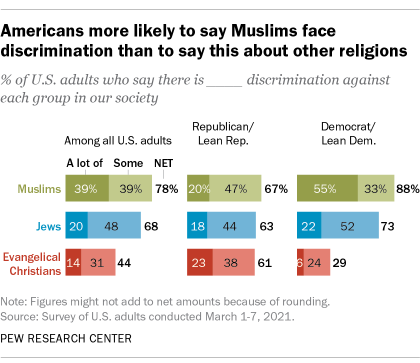
A bar chart showing that Americans are more likely to say Muslims face discrimination than to say this about other religions

In a March 2021 survey, U.S. adults were asked how much discrimination they think a number of religious groups face in society. Americans were more likely to say they believe Muslims face “a lot” of discrimination than to say the same about the other religious groups included in the survey, including Jews and evangelical Christians. A similar pattern appeared in previous surveys going back to 2009, when Americans were more likely to say that there was a lot of discrimination against Muslims than to say the same about Jews, evangelical Christians, Mormons or atheists.

A series of Pew Research Center surveys conducted in 2014, 2017, and 2019 separately asked Americans to rate religious groups on a scale ranging from 0 to 100, with 0 representing the coldest, most negative possible view and 100 representing the warmest, most positive view. In these surveys, Muslims were consistently ranked among the coolest, along with atheists.

Over the last 20 years, the American public has been divided on whether Islam is more likely than other religions to encourage violence, and a notable partisan divide on this question has emerged. When the Center first asked this question on a telephone survey in 2002, Republicans and Republican-leaning independents were only moderately more likely than Democrats and Democratic leaners to say that Islam encourages violence more than other religions – and this was a minority viewpoint in both partisan groups. Within a few years, however, Republicans began to grow more likely to believe that Islam encourages violence. Democrats, in contrast, have become more likely to say Islam does not encourage violence. Now, Republicans are far more likely than Democrats to say they believe Islam encourages violence more than other religions.

Though many Americans have negative views toward Muslims and Islam, 53% say they don’t personally know anyone who is Muslim, and a similar share (52%) say they know “not much” or “nothing at all” about Islam. Americans who are not Muslim and who personally know someone who is Muslim are more likely to have a positive view of Muslims, and they are less likely to believe that Islam encourages violence more than other religions.

Source: Views of Muslims in the US, 20 years after 9/11

25-year-old internal memo to Canada Revenue Agency predicted foreign money distorting housing market

Pretty outrageous, both the initial non-release and the five-year ATIP battle. Kudos to Ian Young of the SCMP for persisting. David Anderson and Jane Stewart were ministers at the time:

An internal Canada Revenue Agency audit concluded 25 years ago that wealthy new immigrants were buying up most of the priciest houses taken from a sample in and around Vancouver while declaring poverty on their tax returns. But the report was not made public until a five-year access-to-information battle concluded recently.

Housing and immigration academics say the study could have warned the public about the scale of foreign money being parked in Metro Vancouver’s residential real estate – decades before the provincial government began taking meaningful action to slow this trend.

During the federal election campaign, all three major parties have proposed various policies to curb international demand for real estate, which has contributed to rising unaffordability in a number of urban centres.

The Liberals and Conservatives are promising to ban foreign home buyers for at least two years. The New Democrats have pledged to tax those who aren’t Canadian citizens or permanent residents with a 20-per-cent levy – the same penalty imposed in British Columbia’s biggest cities for the past three years.

But critics say the parties need to follow B.C.’s lead to capture even more information about property owners so that they can be taxed more equitably and governments can tamp down international real estate speculation.

The CRA’s analysis from October, 1996, was shared with The Globe and Mail this week after its release to Ian Young, the South China Morning Post’s Vancouver correspondent who first requested the information in 2016 after being leaked portions of the internal memo explaining its findings.

The audit focused on 328 higher-end sales in the suburbs Burnaby and Coquitlam, but the study also analyzed a random sample of 6,060 sales from Vancouver and neighbouring Richmond and discovered “similar demographic results.”

Of the 46 houses bought in Burnaby, staff found 72 per cent were purchased by new arrivals to Vancouver who reported an average total family income of just $16,000. In contrast, the CRA’s chart from the audit showed four buyers who were long-term residents reported average family incomes that were tens of thousands of dollars higher.

This income gap between new immigrants and neighbours who had lived there longer was also observed in Coquitlam, according to the CRA’s chart released in the package of documents.

“It should be noted that an obvious large discrepancy exists between the average total family incomes for long-term Canadian residents and newer Canadian residents,” the author of the memo wrote to his CRA boss. “Furthermore, based on lifestyle and average age of these taxpayers, it is likely that many of these new Canadians still have active business activities, but are not reporting all their sources of income.”

Vancouver lawyer Richard Kurland, who has been helping international clients immigrate to B.C. for 25 years, said the analysis proves the CRA failed to catch those hiding their global income while competing for homes on Canada’s West Coast.

“They knew it was happening and did nothing, so the bleeding continued, taxes were not paid, property was subject to speculation and the end result [is] people in Vancouver are paying many more times than they have to for residential property because the CRA did nothing when it was warned by its own employees about what was going on,” he said.

David Ley, a geography professor at the University of B.C. who studies housing bubbles, said the 1996 report could have spurred politicians to address the anomaly of “apparently poor people buying very rich properties” decades earlier. He said the CRA had long maintained that they it would take too many resources to crack down on home buyers hiding wealth abroad, in large part because other countries they lived in were unlikely to release the pertinent tax information.

“It’s very difficult to pursue foreign sources of income – so they didn’t,” Dr. Ley said.

The CRA told The Globe this week that the study intentionally focused on cases where the buyer may have been underreporting their income and, thus, “was not intended to, and should not be, extrapolated to the whole population.”

But large parts of the internal communications around the release of this document were redacted because the agency said federal access-to-information law allows consultations or deliberations between government employees, a minister of the Crown or their staff to remain confidential.

The federal agency said it takes cheating its system seriously and has stepped up audits in the hot housing markets of Toronto and Vancouver in recent years. Still, the CRA said its five-year battle with Mr. Young over the release of this document is “clearly not normal, nor is it acceptable; we are continuing to take steps to improve [our] performance.”

Andy Yan, a housing analyst and director of Simon Fraser University’s city program, said the federal government has a lot of tools – such as home loan data and analysis of social demographic changes in neighbourhoods – through which it can confirm or refute how widespread these investment patterns have been. But, ultimately, he said, the CRA has not effectively enforced the country’s tax rules, helping create an unfair system where foreign capital is stored in residential real estate.

“There shouldn’t be any free parking,” said Mr. Yan.

In 2015, a Globe and Mail investigation into public data – including land titles, tax reporting and court records – revealed a similar pattern to the 1996 CRA study that suggested the typical wealthy foreign family buying Vancouver real estate pays little or no income or capital gains tax. These family homes were priced out of reach for many locals whose taxes pay for public services.

The Globe discovered that one in three multimillion-dollar homes bought in Vancouver areas popular with foreign buyers was registered to a homemaker, student or corporation – one indicator of how the identity of the person who actually paid can be hidden.

When a spouse or child sells a property that is registered in their name, the real investor can avoid capital-gains taxes – because the relative in Canada can claim it was their primary residence, therefore not an investment.

This and other Globe investigations helped increase public pressure on the provincial Liberal government to enact Canada’s first tax on foreign homebuyers. After the New Democrats were elected in 2017, in part on their pledge to further crack down on expanding real estate speculation, B.C. implemented a host of new taxes and demand-side tools.

Mr. Kurland said more provinces need to follow B.C.’s lead in requiring that homebuyers declare their country of residence for tax purposes as well as create a registry for beneficial owners – which will come into full force at the end of this year to make it tougher for people to hide real estate investments behind corporations, trusts or partnerships.

He said the CRA’s current “whack-a-mole” approach to catching scofflaws in the housing market relies on auditors digging for specific information in individual cases, but it will soon be able to use algorithms to scour all its tax information and these twin data sets to better catch those hiding wealth in B.C.

“It’s equivalent of an abacus versus a spreadsheet,” said Mr. Kurland, who added that he saw a “massive selling spree” among foreign owners in B.C. before each of those two policies became law.

Rohana Rezel, a software engineer who advocates for more affordable housing by using software and data to uncover speculators in Metro Vancouver’s market, said the most effective federal policy on this issue would be to blanket the whole country with a speculation tax on all homes.

Then, owners could offset this two-per-cent penalty against what they pay to the CRA each year, said Mr. Rezel.

“If you’re paying income taxes of a certain amount it doesn’t apply to you,” said Mr. Rezel, who immigrated to Canada from Sri Lanka in 2008.

Source: https://www.theglobeandmail.com/canada/british-columbia/article-25-year-old-internal-memo-to-canada-revenue-agency-predicted-foreign/