Can Skeletons Have a Racial Identity?A growing number of forensic researchers are questioning how the field interprets the geographic ancestry of human remains.

Interesting re-examination of past biases:

Racial reckonings were happening everywhere in the summer of 2020, after George Floyd was killed in Minneapolis by the police. The time felt right, two forensic anthropologists reasoned, to reignite a conversation about the role of race in their own field, where specialists help solve crimes by analyzing skeletons to determine who those people were and how they died.
Dr. Elizabeth DiGangi of Binghamton University and Jonathan Bethard of the University of South Florida published a letter in The Journal of Forensic Science that questioned the longstanding practice of estimating ancestry, or a person’s geographic origin, as a proxy for estimating race. Ancestry, along with height, age at death and assigned sex, is one of the key details that many forensic anthropologists try to determine.
That fall, they published a longer paper with a more ambitious call to action: “We urge all forensic anthropologists to abolish the practice of ancestry estimation.”
In recent years, a growing number of forensic anthropologists have grown critical of ancestry estimation and want to replace it with something more nuanced.

Criminal cases in which the victim’s identity is entirely unknown are rare. But in these instances, some forensic anthropologists argue, a tool like ancestry estimation can be crucial.
The assessment of race has been a part of forensic anthropology since the field’s inception a century ago. The earliest scholars were white men who studied human skulls to support racist beliefs. Ales Hrdlicka, a physical anthropologist who joined the Smithsonian Institution in 1903, was a eugenicist who looted human remains for his collections and sought to classify humans into different races based on certain appearances and traits.
An expert on skeletons, Dr. Hrdlicka helped law enforcement identify human remains, laying the blueprint for the professional field. Forensic anthropologists thereafter were expected to produce a profile with the “Big Four” — age at death, sex, height and race.
In the 1990s, as more scientists debunked the myth of biological race — the notion that the humans species is divided into distinct races — anthropologists grew sharply divided over the issue. One survey found that 50 percent of physical anthropologists accepted the idea of a biological concept of race, while 42 rejected it. At the time, some researchers still used terms like “Caucasoid,” “Mongoloid” and “Negroid” to describe skeletons, and DNA as a forensic tool was still many years away. Today in the U.S., the field of forensic anthropology is 87 percent white.

In 1992, Norman Sauer, an anthropologist at Michigan State University, suggested dropping the term “race,” which he considered loaded, and replacing it with “ancestry.” The term became universal. But some researchers contend that little changed about the practice.

When Shanna Williams, a forensic anthropologist at the University of South Carolina School of Medicine Greenville, was in graduate school around a decade ago, it was still customary to sort skeletons into one of the “Big Three” possible populations — African, Asian or European.
But Dr. Williams grew suspicious of the idea and the way ancestry was often assigned. She saw skulls designated as “Hispanic,” a term that refers to a language group and has no biological meaning. She considered how the field might try, and fail, to sort her own skull. “My mom is white, and my dad is Black,” she said. “Do I fit that mold? Am I perfectly one thing or the other?”
The body of a skeleton can provide a person’s age or height. But the question of ancestry is reserved for the skull — specifically, features of face and skull bones, known as morphoscopic traits, that vary across different groups of humans and can occur more frequently in certain populations.
One trait, called the post-bregmatic depression, is a small indentation located on top of some people’s heads. For a long time, forensic anthropologists assumed that if the skull was indented, the person may be Black.
But forensic anthropologists know little else about the post-bregmatic depression. “There’s not been any understanding as to why this trait exists, what causes it, and what it means,” Dr. Bethard said.
Moreover, the science linking the trait and African ancestry was flawed. In 2003, Joe Hefner, a forensic anthropologist at Michigan State University, used trait lists from a key textbook, “Skeletal Attribution of Race,” to examine more than 700 skulls for his masters thesis. He found that the post-bregmatic depression was present in only 40 percent of people with African ancestry, and is actually more common in many other populations.

Of the 17 morphoscopic traits typically used to estimate ancestry, only five have been studied for whether they are heritable, making it unclear why the unstudied traits would correspond with specific populations. “There’s been this use and reuse of these traits without a fundamental understanding of what they even are,” Dr. Bethard said.
Nonetheless, Dr. Hefner said, if nothing is known about a victim beyond the shape of their skull, ancestry might hold the key to their identity.
He cited a recent example in Michican in which the police had a skull that they believed belonged to a missing woman, one of two who were reported missing in the county at the time. When Dr. Hefner examined it and searched the list of missing people in the area, he concluded that the skull might have come from a missing Southeast Asian male. “They sent us his dental records over and five minutes later we had identified this person,” Dr. Hefner said.

Dr. DiGangi worries that these estimations could suggest to the police that biological race is real and increase racial bias. “When I say to the police, ‘OK, I took these measurements, I looked at these things on the skull and this person is African-American,’ of course they’re going to think it’s biological,” Dr. DiGangi said. “Why would they not?”
To what extent this concern plays out in the real world is hard to measure, however.

For the past two years, Ann Ross, a forensic anthropologist at North Carolina State University, has pushed the American Academy of Forensic Sciences Standards Board to replace ancestry estimation with something new: population affinity.
Whereas ancestry aims to trace back to a continent of origin, population affinity aims to align someone with a population, such as Panamanian. This more nuanced framework looks at how the larger history of a place or community can lead to significant differences between populations that are otherwise geographically close.

A recent paper by Dr. Ross and Dr. Williams, who are close friends, examines Panama and Colombia as a test case. An ancestry estimation might suggest people from both countries would have similarly shaped skulls. But population affinity acknowledges that the trans-Atlantic slave trade and colonization by Spain resulted in new communities living in Panama that changed the makeup of the country’s population. “Because of those historical events, individuals from Panama are very, very different from those from Colombia,” said Dr. Ross, who is Panamanian.
Dr. Ross even designed her own software, 3D-ID, in place of Fordisc, the most commonly used forensic software that categorizes skulls into inconsistent terms: White. Black. Hispanic. Guatemalan. Japanese.
Other anthropologists say that, for all practical purposes, their own ancestry estimations have become affinity estimations. Kate Spradley, a forensic anthropologist at Texas State University, works with the unidentified remains of migrants found near the U.S.-Mexico border. “When we reference data that uses local population groups, that’s really affinity, not ancestry,” Dr. Spradley said.
In her work, Dr. Spradley uses missing persons’ databases from multiple countries that do not always share DNA data. The bones are often weathered, fragmenting the DNA. Estimating affinity can “help to provide a preponderance of evidence,” Dr. Spradley said.
Still, Dr. DiGangi said that switching to affinity may not address racial biases in law enforcement. Until she sees evidence that bias does not preclude people from becoming identified, she says, she does not want a “checkbox” that gets at ancestry or affinity.
As of mid-October, Dr. Ross is waiting for the American Academy of Forensic Sciences Standards Board to set a vote to determine whether ancestry estimation should be replaced with population affinity. But the larger debate — over how to bridge the gap between a person’s bones and identity in real life — is far from settled.
“In 10 or 20 years, we might find a better way to do it,” Dr. Williams said. “I hope that’s the case.”


Source: https://www.nytimes.com/2021/10/19/science/skeletons-racism.html?action=click&module=Well&pgtype=Homepage&section=Science

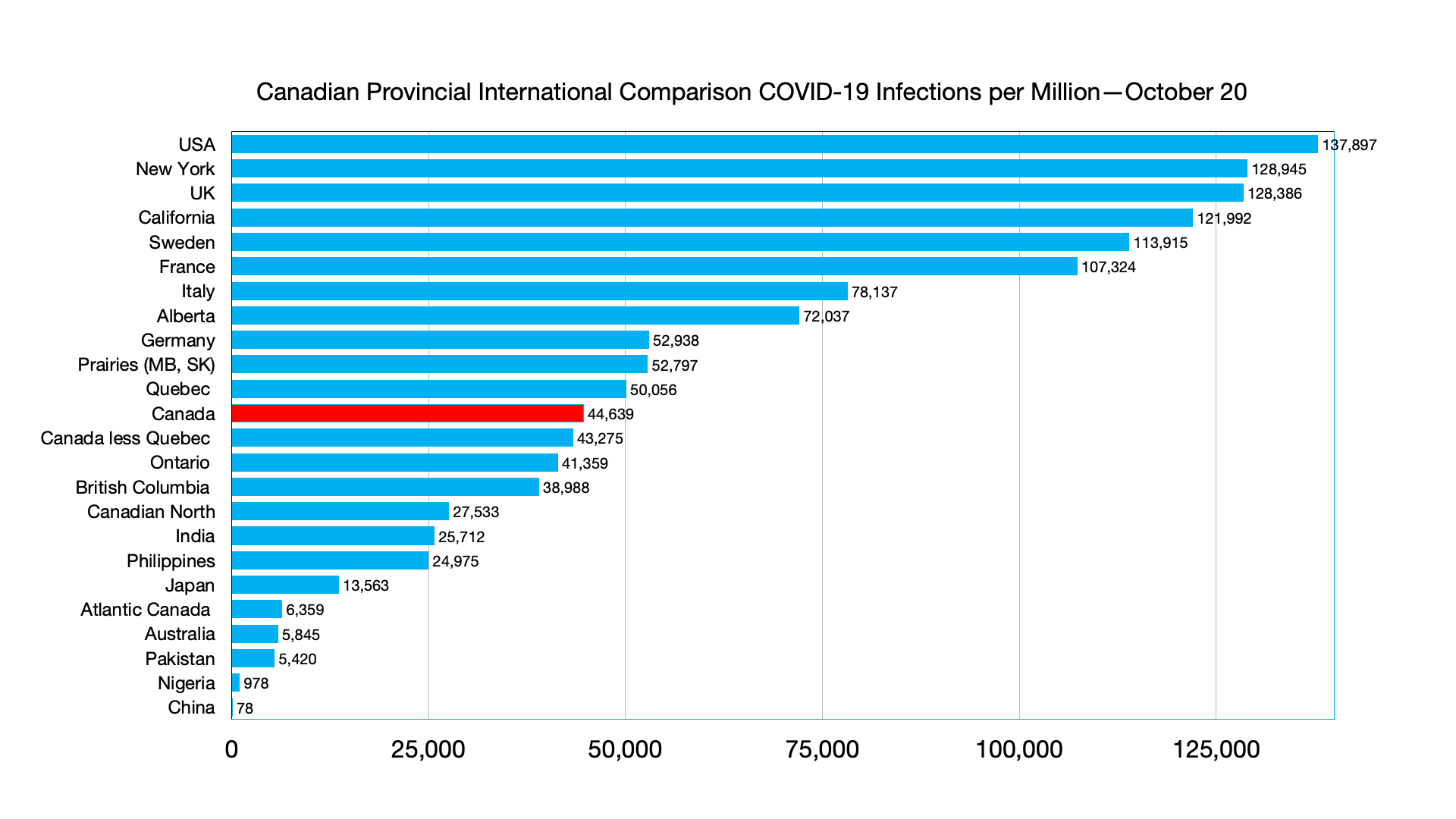
#COVID-19: Comparing provinces with other countries 20 October Update, UK rising infection rates

The latest charts, compiled 20 October. Canadians fully vaccinated 73.7 percent, higher than USA 57.6 percent and the UK 67.1 percent). But all countries have essentially plateaued, making it highly unlikely that they will reach targets 80 percent or higher.

Vaccinations: Atlantic Canada ahead of China, Canadian North ahead of Ontario, Alberta ahead of UK, California ahead of Germany.  China fully vaccinated 75 percent (unchanged), India 20.6 percent.

Trendline Charts:

Infections: The chart shows the number of infections in Alberta starting to level off unlike the Prairies or British Columbia.

Deaths: Alberta deaths, along with the Prairies albeit to a lesser extent, continue to climb.

Vaccinations: Alberta vaccinations continue to surpass the Prairies. Immigration source country vaccination rates tapering off.

Weekly

Infections: Canadian North ahead of India, Australia ahead of Pakistan.

Deaths per million: No relative change.

Meanwhile, the “UK faces calls for ‘Plan B’ with virus cases high and rising:”

Life has returned to normal for millions in Britain since coronavirus restrictions were lifted over the summer. But while the rules have vanished, the virus hasn’t.

Many scientists are now calling on the government to reimpose social restrictions and speed up booster vaccinations as coronavirus infection rates, already Europe’s highest, rise still further.

The U.K. recorded 43,738 new COVID-19 cases on Tuesday, slightly down from the 49,156 reported Monday, which was the largest number since mid-July. New infections have averaged more than 44,000 a day over the past week, a 16% increase on the week before.

Last week, the Office for National Statistics estimated that one in 60 people in England had the virus, one of the highest levels seen in Britain during the pandemic.

In July, Prime Minister Boris Johnson’s government lifted all the legal restrictions that had been imposed more than a year earlier to slow the spread of the virus, including face coverings indoors and social distancing rules. Nightclubs and other crowded venues were allowed to open at full capacity, and people were no longer advised to work from home if they could.

Some modelers feared a big spike in cases after the opening-up. That didn’t occur, but infections remained high, and recently have begun to increase — especially among children, who largely remain unvaccinated.

Also rising are hospitalizations and deaths, which have averaged 130 a day over the past week, with 223 reported Tuesday alone. That is far lower than when cases were last this high, before much of the population was vaccinated, but still too high, critics of the government say. Britain has recorded more than 138,000 coronavirus deaths, the highest total in Europe after Russia.

Against that backdrop, some feel Britons have been too quick to return to pre-pandemic behavior. Masks and social distancing have all but vanished in most settings in England, including schools, though Scotland and other parts of the U.K. remain a bit more strict. Even in shops, where masks are recommended, and on the London transit network, where they are mandatory, adherence is patchy.

A plan to require proof of vaccination to attend nightclubs, concerts and other mass events in England was dropped by the Conservative government amid opposition from lawmakers, though Scotland introduced a vaccine pass program this month.

Some scientists say a bigger factor is waning immunity. Britain’s vaccination program got off to a quick start, with shots given to the elderly and vulnerable beginning in December 2020, and so far almost 80% of eligible people have received two doses. The early start means millions of people have been vaccinated for more than six months, and studies have suggested vaccines’ protection gradually wanes over time.

Millions of people in Britain are being offered booster shots, but critics say the program is moving too slowly, at about 180,000 doses a day. More than half of the people eligible for a booster dose haven’t yet received one.

The U.K. also waited longer than the U.S. and many European nations to vaccinate children ages 12-15, and only about 15% in that age group in England have had a shot since they became eligible last month.

“It’s critical we accelerate the booster program,” said epidemiologist Neil Ferguson, a member of the government’s Scientific Advisory Group for Emergencies.

Ferguson said one factor influencing the U.K.’s high case numbers was that it has relied heavily on the AstraZeneca vaccine, “and, while that protects very well against very severe outcomes of COVID, it protects slightly less well than Pfizer against infection and transmission, particularly in the face of the delta variant.”

He also noted that “most Western European countries have kept in place more control measures, vaccine mandates, mask-wearing mandates, and tend to have lower case numbers and certainly not case numbers which are going up as fast as we’ve got.”

“But at the end of the day this is a policy decision for government to make,” he told the BBC.

Scientists in the U.K. are also keeping an eye on a new subvariant of the dominant delta strain of the virus. The mutation, known as AY4.2, accounts for a small but growing number of cases in Britain.

Francois Balloux, director of the University College London Genetics Institute, said the subvariant might be slightly more transmissible and was being “closely monitored.” But he said evidence suggested “it hasn’t been driving the recent increase in case numbers in the U.K.”

A report by lawmakers released last week concluded that the British government waited too long to impose a lockdown in the early days of the pandemic, missing a chance to contain the disease and leading to thousands of unnecessary deaths. Critics say it is repeating that mistake.

Last month, the prime minister said the country might need to move to a “Plan B” — reintroducing measures such as mandatory masks and bringing in vaccine passes — if cases rose so high in the fall and winter that the health system came under “unsustainable” strain.

For now, the government says it won’t change course, but will try to boost vaccination rates, with a new ad campaign and an increased number of sites outside of schools where kids can receive their shots.

Johnson’s spokesman, Max Blain, said “we always knew the next few months would be challenging.” But he said the government was trying to protect “both lives and livelihoods.”

“Clearly we are keeping a very close eye on rising case rates,” Blain said. “The most important message for the public to understand is the vital importance of the booster program.

But, he added: “There are no plans to move to Plan B.”

Source: UK faces calls for ‘Plan B’ with virus cases high and rising

Diversity and Education: Half of Canadian kids witness ethnic, racial bullying at their school

Interesting and useful survey. Most interesting finding for me (apart from the extent of bullying) is the correlation between greater student diversity and knowledge of racism in Canadian history. Worth reading the full survey:

As Canada grows and changes, becoming more diverse every year, new generations of children are immersed in a reality that can look far different than that of their parents or grandparents.

And while diversity in schools is largely an accepted and comfortable fact of life for Canadian children, a new study from the non-profit Angus Reid Institute in partnership with the University of British Columbia finds some – in particular those who identify as a visible minority – struggling to fit in more than children who do not identify this way.

Indeed, this conversation with 12- to 17-year-olds in Canadian schools finds that racially motivated bullying and insults are a reality in more ethnically diverse areas of the country.

While half of kids who describe their school as made up of mostly students from similar backgrounds say that these racial issues are something they have seen, this rises to two-thirds among those who say their school is more diverse. Further, visible minority students are three times as likely as white children to say that they have faced personal abuse. Indigenous children are twice as likely to say this.

That said, most Canadian children say that they have an outlet to talk about these issues. Indeed, nine-in-ten say that they talk to their parents or other family members about it. There may, however, be more for teachers and school staff to do. Three-in-ten victims of bullying or abuse say that staff in their school were either unaware of it or just ignored it.

More Key Findings:

  • Children in more diverse schools are significantly more likely to say that they have learned about racism in Canada’s history, Indigenous treaties, residential schools, and multiculturalism, than those who say their student body is made up of kids from mostly the same background.
  • Most Canadians kids are comfortable with their peers wearing different clothes, celebrating different holidays and speaking different languages than they do. Approximately two-thirds say it’s not a big deal, while one-in-ten say they enjoy it.
  • Among those who say that they have been the target of ill treatment, 43 per cent say it is something that they carry with them after it happens. More than half (57%) say it doesn’t bother them, or that they’re able to move past it.
  • Older kids, between the ages of 15 and 17, are more likely than 12- to 14-year-olds to say they talk about racism with their friends – 73 per cent to 56 per cent respectively

Link to full survey: https://angusreid.us12.list-manage.com/track/click?u=4adb83e0e056e657a62fc6d8a&id=5493b06c34&e=1e1ae5dd63

Australia: Immigration ‘character test’ bill to strengthen visa-cancellation powers to be reintroduced by government

Australia and Canada continue to diverge:

The federal government is again seeking greater discretionary powers to cancel or refuse immigration visas on character grounds after its initial proposal was defeated two years ago.

An amendment to strengthen the migration ‘character test’ — which would see visas cancelled or refused for people convicted of a serious crime — could be introduced in the Senate as early as today.

The Morrison government first attempted to pass the laws in 2019, but they failed to win the support of Labor or crossbench senators.

Under the proposed laws, a non-citizen who has been convicted of a ‘designated’ offence punishable by at least two years’ prison — such as violent or sexual assault crimes — could be refused a visa at the government’s discretion, regardless of the sentence they actually serve.

Currently, the power to cancel visas is only available in cases where a person was actually sentenced to serve more than 12 months’ prison.

The government also argues that people whose visas should have been cancelled have been allowed to stay thanks to technicalities, such as discounts to prison time for guilty pleas, or judges who reduced a sentence to avoid mandatory visa cancellation thresholds.

Immigration Minister Alex Hawke said the current laws leave a gap that allows for people who are a risk to the community to stay in the country.

“Holding an Australian visa is a privilege that dangerous and violent non-citizens do not deserve,” Mr Hawke said in a statement.

“Anthony Albanese needs to back these new laws this week for the safety of the community — or explain to all Australians why he will not.”

Labor is considering the proposed amendments.

However, Shadow Immigration Minister Kristina Keneally has previously expressed concern that low-level offenders could unintentionally be caught up in the changed laws and be deported unnecessarily.

The laws have caused tension with New Zealand, whose Prime Minister Jacinda Ardern has repeatedly pleaded with Australia to drop the practice of deporting its criminals.

Ms Keneally has previously called for retrospective offenders to be excluded from legislation, and for extra consideration to be given to New Zealanders.

Minister less likely to be overturned under new laws

The proposed laws would also make it harder for decisions to deport people to be defeated on appeal, the government has argued.

Currently, the immigration minister — or a delegate of the minister — have discretionary power to cancel a visa on character grounds, but the decision can be appealed.

In the past, ministerial decisions have been overturned by the courts, such as when former home affairs minister Peter Dutton attempted to deport murderer Frederick Chetcuti, who had lived in Australia since he was two years old.

Mr Dutton’s decision to cancel the 73-year-old Maltese man’s visa was overturned after he was unable to prove that he spent more than 11 minutes considering the case.

The government expects its bill to make those situations less common, as a more “objective” test of conviction, rather than time sentenced, would leave less room for appeal.

Mr Hawke said the amendments would be introduced in the Senate this week, and as early as today.

Source: Immigration ‘character test’ bill to strengthen visa-cancellation powers to be reintroduced by government

McWhorter: What I See in the Latest Blackface ‘Scandal’

Misguided wokeness:

At the University of Michigan recently, the music professor Bright Sheng — who’s had a superlative career as a composer, conductor and musician — wanted to share with his students how Giuseppe Verdi transformedShakespeare’s “Othello” into the acclaimed opera “Otello.” That transformation is a rich and instructive topic in music composition.
In September, Sheng showed his undergraduate composition seminar the 1965 film based on the Royal National Theatre’s stage production of “Othello,” with Laurence Olivier playing the title role in blackface makeup, in line with the custom of the era.
Some students took offense: One told The Michigan Daily that she was “shocked” and that Sheng failed to first contextualize what the class saw. Sheng apologized. Days later, the dean of Music, Theatre & Dance wrote that “Professor Sheng’s actions do not align with our school’s commitment to anti-racist action, diversity, equity and inclusion.” Sheng apologized again, and in an apparent effort to mitigate, offered examples of his professional support over the years for people of color. That drew criticism from grad students, undergrads and faculty, who, according to The Daily, called it “inflammatory” in an open letter calling for Sheng’s removal as course instructor.
In a Medium post, a writer identifying as a member of the class took Sheng’s department chair to task for, reportedly, recommending that the issue “may be something you ought to first discuss with Professor Sheng.” (The audacity.) The same post implied that Sheng’s alleged transgressions were as grave as, for instance, incidents of sexual harassment and abuse. If you want to read more, Cathy Young has provided invaluable coverage of what she correctly describes as yet another “moral panic.”
Sheng has left the class.
A common response to occurrences like this is to condemn the students involved as being overly delicate — snowflakes, in today’s parlance. However, merely leveling that charge doesn’t facilitate a constructive discussion about what fuels these sadly routine events. The underlying issue isn’t the students’ fragility, it’s that their approach illustrates the difference between radicalism and progressivism. It’s an example of a strain of thought permeating campuses (our whole society, really), one that blithely elides that difference in favor of preaching only of “social justice.”
Start here: What happened to Sheng would have been much less likely a generation ago. In the late 1990s, I showed a class of white, Black and Asian American students a scene from a film with white performers in blackface. Beforehand, I mentioned that this was a very old movie and that we were going to see a practice that nobody would venture today, but that the film was instructive for other reasons. None of the students batted an eye, at least that I could see. If anything, some of the Black students (and maybe some of the non-Black students) snickered at the performers for how ridiculous they looked.
So, here’s our query: Is the response of Sheng’s students an advance on those of my students a generation ago? Were me and my students missing something upon which our modern era is more enlightened?
Before we tackle that, there are two important points to address. First, as Young notes, Olivier’s performance does involve a degree of cartoonish swagger beyond what some blackface performances of the era entailed. But it’s reasonable to assume that Sheng’s students would have had a similar response to more restrained blackface portrayals of Othello, such as Orson Welles’s.
Second, Sheng should indeed have made clear that he was about to show his students something that would require them to put on their “history glasses,” as I sometimes put it. But the question involves degree: Should he now be barred from the class amid rhetoric that makes him sound like a pitiless bigot, unfit and out of step with an enlightened society? I’d say no.
Now: Let’s break down what the crux of objections to showing a blackface performance ever at all are.
The typical idea is that blackface is a reminder of the reign of minstrel shows, in which white performers wore blackface makeup and engaged in clownish distortion of Black speech and dance styles. Minstrel shows were core American entertainment for most of the 19th century, and well into the 20th. It was a filmic depiction of a minstrel show, in fact, that I showed my class: Al Jolson in 1930’s “Mammy.”
Minstrel shows were disgusting, all the more so in how utterly central they were in American entertainment for so very long. But is there no statute of limitations on how long a people will feel actual injury about such a thing? In 2021, there is barely a person alive who attended a minstrel show performed as mainstream, professional entertainment. Even those who may have caught ragtag amateur groups keeping the tradition alive are likely now quite elderly.
The idea seems to be that we (relatively) younger Black people and our non-Black fellow travelers are nevertheless so viscerally stung by seeing any manifestation of this bygone tradition that to show dated footage of a white British actor in blackface, as part of an academic colloquy, qualifies as a grievous insult. But I like to think of Black Americans as a people of pride and forward thinking. I miss those qualities in this submission to an insult leveled by perpetrators now very, very dead. And since no one can seriously argue that Sheng’s intent was to revive or exalt the practice of blackface — and not to teach something about the operatic adaptation of a seminal literary work — to treat him as an accessory to those dead perpetrators seems more a kind of performance in itself than a spontaneously felt insult.
Another idea would be that to imitate a Black person by trying to darken the appearance of one’s skin is, inherently, to ridicule that person. But is it impossible in the logical sense that someone might costume oneself as a Black person one admires and put on makeup to darken one’s face simply as part of seeking to look like that person? Many will heatedly object: “Impossible!” But we must attend to why. If the answer is minstrel shows, then see above.
These days, we’re expected to recoil, under any circumstances, at the idea of a white person attempting to make their skin look like the color of a nonwhite person’s, as if this were the automatic equivalent to using a racist slur, or worse. But context matters. A lot.
Is blackface being shown as part of a collegiate-level discussion, as in the Michigan case? College students shouldn’t need protection from an old film used to help them think about and debate the conversion of a classic over time. Sheng was using the film to stir and inform artistic consciousness. To read that situation otherwise is deeply anti-intellectual.
Is blackface being deployed comedically, not to make fun of Black people, but to lampoon the absurdity of racism? For example, in one episode of the sitcom “30 Rock,” Jane Krakowski’s character is made up in blackface and wears men’s clothing; Tracy Morgan’s character is made up in whiteface, a blond wig and wears women’s clothing in a “social experiment” to see who has it harder in America — white women or Black men. In another episode, Krakowski is made up in blackface and dresses as the Pittsburgh Steelers great Lynn Swann, who’s not derided in any way, the bit being a clever play on the movie title “Black Swan.”
Last year, not long after George Floyd was murdered, three “30 Rock” episodes that involved blackface, including those two, were taken out of syndication. The show’s producers, including its star, Tina Fey, may have concluded they had no choice. But we might ask why the sheer matter of the makeup was an insult to Black people. It’s not self-evident that pulling those episodes was morally necessary in 2020 because of careers like Jolson’s. The shows’ flashes of wit didn’t set Black people back in any way. It’s hard to see how a lighthearted plotline about racism and sexism, even with blackface, harms Black people — or how taking it off the air helps us. My horse sense tells me that the vast majority of us get that a joke can be a joke.
These are my own observations. They are up for debate. But those condemning Sheng seem to consider their ideas not just opinions, but truths — the predicate for an inquisition. Yet, the view that blackface makeup is so uniquely revolting that a professor should be hounded from his class for showing, in a scholarly setting, decades-old scenes of an actor wearing it is a point that many find extreme. It is a position that requires some serious lifting and a vast transformation in common modes of thought, even among people with good-faith concerns about race relations, and would look odd to time travelers from just a few decades ago. A position like that is not simply “antiracist,” but radical.
This radical proposition, like so many on race of late, is being put forth as if it were scripture that no moral actor could question. It misses the point, then, to dismiss the students as fragile. Their claim entails that people were injured by such usages of blackface before, therefore must still be now, and that we should redefine the bounds of permissibility to bar such images from general experience. They think their recoil from the very sight of decades-old racist imagery is uniquely enlightened, a resistance to abuse endemic to our society’s past, present and future. To them, their response isn’t only appropriate, it’s mandatory.
But that’s a proposition they must assert in the public square and assume as subject to discussion and dissent.
And let’s face it, in that discussion, this radical proposition would likely be voted down. Its adherents would deem this as racism winning out. But many others would see it as a victory for common sense, seeing the current fashion as a performance, a kind of, yes, virtue signaling.
Or just maybe, the people who witch-hunted Sheng could defend their position better than I am imagining. I’d be happy to observe the attempt. But from where I sit, we’re seeing a radical agenda not proposed, but imposed. Upon what authority are they allowed such primacy of influence in how we speak, think and teach in our times?
Source: https://www.nytimes.com/2021/10/15/opinion/blackface-michigan-sheng.html?searchResultPosition=2

Why social mobility is key to explaining attitudes toward multiculturalism – EUROPP

Interesting that applies to both upward and downward mobility:

What explains attitudes toward multiculturalism in Europe? And how do citizens without a migration background react when the cities they live in become more diverse? Drawing on a new study, Lisa-Marie Kraus and Stijn Daenekindt show that social mobility is a key factor in determining why some people are more optimistic about multiculturalism than others.

People without a migration background have become a numerical minority in numerous Western European cities such as London, Amsterdam, Rotterdam and Vienna. Looking at the generation of children aged 15 and younger, these numbers are increasing, indicating that this is a lasting phenomenon.

These evolutions generate various challenges. One important aspect in this regard is how people without a migration background experience their changing status and, more generally, how this influences their attitudes towards multiculturalism. Some people may respond optimistically towards living in such multicultural societies: they may support ethnic diversity, embrace the idea of a multi-ethnic city and consider it as part of everyday life. Other people are rather pessimistic: they may insist on maintaining their ‘own’ culture and reject other cultural influences. How can we understand the variation in these attitudes among people without a migration background?

Inspired by numerous studies which have demonstrated the link between educational attainment and attitudes towards ethnic diversity, we hypothesised that we can find a partial answer to this question by focusing on educational social mobility. Educationally socially mobile people either hold a higher (upward mobility) or lower (downward mobility) educational qualification than their parents.

Previous research has shown that the experience of educational social mobility is an influential factor in various domains of social life and highlights the consequences of social mobility. In particular, downward mobility has been connected to feelings of frustration, depression and failure as it entails a drop in social status. Yet, even if upward mobility entails increased social status, it can also come with negative consequences.

This is because both upward and downward mobility ultimately puts individuals in a different social environment from the one they were raised in. Hence, the socially mobile are exposed to ‘alien’ lifestyles, perspectives, attitudes and habits. Because of this, socially mobile individuals may neither feel genuinely at home in the social environment in which they were raised, nor in the one in which they end up. We believe that this experience of different contexts is related to the multicultural attitudes of the socially mobile.

To investigate the role of social mobility in the formation of multicultural attitudes, we used data from people without a migration background who live in five highly ethnically diverse Western European cities: Amsterdam, Antwerp, Malmo, Rotterdam and Vienna. Our analyses show that the experience of social mobility is related to more optimistic multicultural attitudes.

Socially mobile individuals have a more positive outlook on multicultural societies than their immobile counterparts. Both upwardly and downwardly mobile individuals demonstrate greater openness to multiculturalism. While the experience of social mobility, and in particular downward mobility, has generally been associated with rather negative inter-ethnic attitudes, our study finds no evidence for this. On the contrary, both upwardly and downwardly mobile people are more open to multiculturalism than their immobile peers.

What explains this finding? We believe that the experience of social mobility allows people to adapt more easily to ethnically diverse social contexts. The socially mobile have encountered different social environments throughout their lives. This experience involves the adaption to, and navigation of, lifestyles typical of different social environments. The exposure to different social environments may lead to a general ability to adapt to different contexts and moving between these environments may make the navigation of different contexts a ‘habit’. Mobile individuals have, so to speak, embodied the ability to adapt to diversity and this is reflected in their attitudes towards multi-ethnic cities.

Our findings provide insights into the way attitudes towards multiculturalism are developed in general. They suggest that if policymakers wish to stimulate support for multiculturalism among those without a migration background, they might achieve this through policies which focus on other forms of diversity, such as the desegregation of neighbourhoods and schools along the lines of social class.

Source: Why social mobility is key to explaining attitudes toward multiculturalism – EUROPP

The Statelessness Pandemic by Laura van Waas & Natalie Brinham

Interesting detailed analysis and observations:

Legal theorists once consigned the idea of “statelessness” to the realm of fiction, because they considered it to be impossible within the state system that emerged after World War I. Every human being was supposed to be assigned a nationality and a country to call his or her own. But the war had created many refugees, and as empires disintegrated and new nation-states adopted exclusionary nationality laws, not everyone was in fact included.

At least 15 million people today are stateless, and millions more are threatened with national exclusion. The issue of statelessness thus demands urgent attention, as do works of history that shed light on the problem.

The rise of fascism in the 1930s and 1940s further exposed the fallibility of this system and the ominous reality of the state’s power to exclude people or strip them of citizenship. Across Europe, citizenship-stripping went hand in hand with genocide for Jews and other minority groups.

Following World War II, questions about the right to nationality, state power, and the limits of sovereignty loomed large in the development of human rights and international law. Could the states that were being created out of the independence movements and diminished European empires adopt nationality laws that excluded entire population groups? Did national governments hold the power to strip their own citizens of that status? Who was responsible for the newly stateless?

These issues remain highly pertinent today. Statelessness affects at least 15 million people, and the nationality of millions more is under threat, owing to an escalation of racially discriminatory policies and rhetoric in many countries. Nationality policies remain a favored tool of authoritarians, who sometimes use them in tandem with mass atrocities, as in Myanmar, where the Rohingyas have been denied citizenship and subjected to genocide and mass deportations to Bangladesh. Making matters worse, the COVID-19 pandemic has led to even more xenophobic scapegoating and ethno-nationalism, with political leaders like former US President Donald Trump and Hungarian Prime Minister Viktor Orbán blaming migrants and refugees for spreading the coronavirus.

The pandemic also reminds us of the enduring influence that nationality has over our lives. Last May, Filippo Grandi, the United Nations High Commissioner for Refugees, warned that, “The right to a nationality is a fundamental human right and in this time of crisis it can mean the difference between life or death.” When governments prioritize their citizens over others in their public-health and economic responses, the stateless suffer. Because statelessness remains a major blind spot for the institutions charged with protecting life and livelihoods, stateless people have been left further behind than ever.

GHOSTS OF STATELESSNESS PAST

At a time when statelessness demands urgent attention, two recent books provide important lessons about the nature of state power, international responses to national acts of exclusion, and the consequences of failure. Statelessness: A Modern History, by Mira L. Siegelberg of the University of Cambridge, and Denaturalized: How Thousands Lost Their Citizenship and Lives in Vichy France, by Claire Zalc, Director of the Institute of Modern and Contemporary History at the École Normale Supérieure, underscore both the historic scale of the problem and its grim costs. Each takes a different but equally meticulous approach to researching the history of the problem. And both explore how people have had their citizenship denied and revoked against the background of some of the most violent periods in modern history. Together, they remind us that the history of statelessness is a history of crumbling empires, world wars, genocides, and the emergence of an interstate system based on the formal equality of states.

Siegelberg’s work is a sweeping survey of international legal and political thought, covering a period that includes WWI, the rise of fascism in the 1930s, the Holocaust, the postwar reconstruction of the international legal order, and the independence movements of the postwar decades. Drawing on a wide variety of archival sources – including popular fiction, case law, correspondence from stateless people to the League of Nations, works of legal and political theory, and notes from negotiations on human-rights treaties – she documents how the problem of statelessness informed theories of human rights and sovereignty.

Siegelberg is concerned with how notions of statelessness developed within, and then shaped, “the political contours of the modern interstate order.” She reminds us that the concepts of citizenship and statelessness are not static. Rather, the meanings attached to these terms are constantly being reshaped and reconstructed by historic events and shifting power relations.

While Seigelberg’s book provides a comprehensive overview of international perspectives and experiences concerning statelessness and the modern state’s power to exclude, Zalc’s work focuses on Vichy France between 1940 and 1944, when Jews and others were denaturalized in increasing numbers to serve the Nazi agenda of deportation to death camps. Her detailed investigation provides unique insights into how bureaucracies in authoritarian regimes produce and reproduce violence.

Drawing on the Vichy government’s archives, Zalc follows the life stories of some of those who were naturalized as French during the interwar years, only to be stripped of their citizenship and deported under wartime France’s collaborationist regime. In parallel, she also delves into the life stories of the civil servants and judges who presided over these denaturalizations, revealing the murky boundaries between collusion and resistance to Nazi policies.

CREATING THE “OTHER”

Siegelberg’s Statelessness shows us that the racial hierarchies that characterized early twentieth-century citizenship regimes gave way not to equal citizenship, as was envisaged, but rather to other forms of racism in Europe. At the same time, Zalc’s book demonstrates how processes of citizenship were racialized with the help of seemingly neutral and innocuous bureaucratic categories and data collection. Under the French Third Republic, Jewishness had been considered a private matter of faith and thus went largely unrecorded by the state. But as Zalc shows in fascinating detail, the categorizations of “Jew” and “Israelite” were deciphered and applied retroactively to stigmatize and discriminate. With a new racialized definition of “Jew,” and under pressure from the occupying Nazi regime to identify, count, and denaturalize Jews according to quotas, individual citizen files were scrutinized for evidence of Jewishness.

This process relied on proxy indicators. Chief among these were first and last names which were deemed, sometimes inaccurately, “Jewish.” Name changes, too, were identified as suspicious. Other proxy indicators included place of origin, profession, and family affiliation. The lack of clarity on the criteria for denationalization, and the broad scope left for discretion in decision-making, enabled “bureaucratic anti-Semitism.”

Zalc’s work provides direct evidence of how state power – and sometimes state violence – functions through the routine processes of registration, categorization, and counting. This was how discriminatory decisions by administrators and judges, on the basis of predominantly unstated racial criteria, ultimately resulted in deportation and mass murder. Denationalization, Zalc shows, does not only result from explicit discrimination in nationality laws, but also from the misuse of administrative and bureaucratic processes.

We see this today, too. National registers or citizenship-verification processes requiring excessive documentation and paperwork are used to exclude and marginalize certain groups. A case in point is the mass disenfranchisement of Muslims carried out by Indian Prime Minister Narendra Modi’s government in Assam – the biggest exercise of its kind in this century. An administrative act described by the government as “just a process” has pushed some 1.9 million people to the brink of statelessness, and many more will follow if this “process” is rolled out nationwide.

Racialized categories are also still being applied retroactively to exclude people, including through proxy indicators such as name, place of origin, or one’s status as a “dual national.” For example, according to the Inter-American Commission on Human Rights, the denial and deprivation of nationality in the Dominican Republic has “disproportionately affected people of Haitian descent, who are frequently identified as such, correctly or incorrectly, based on the national origin or migratory status of their parents, skin color (especially those with a dark-colored skin), language ability, or surnames.”

And in Myanmar, where racial hierarchies in citizenship acquisition are explicit, registration and application processes have been fully weaponized against ethnic minorities and political opposition groups. Categories such as place of birth, religion, and family affiliation are used to single out Myanmar Muslims for discrimination. Meanwhile, Rohingyas using “Burmese names” on registration documents is forbidden, not explicitly in law but in the implementation of registration procedures at the township level. Local administrative processes, including restriction of movement for those within particular geographic pockets, enable the classification of ethnic and religious “others” and sustains systems of apartheid.

UNDER COVER OF “NATIONAL SECURITY”

Siegelberg and Zalc highlight not only the potential for bureaucratic violence through the administration of citizenship, but also how this exercise of state power is put to deliberate and targeted use. The archival material examined by Zalc offers a sampling of some of the legitimizing rhetoric of the day. In Vichy France, the law on denationalization was “of primordial importance.” According to a 1941 letter by Prime Minister François Darlan, it was needed to ensure that “the morally tainted or insufficiently assimilated elements that have been allowed to infiltrate the national community be eliminated as soon as possible.”

Similarly, a recent academic symposium canvassing revocations of citizenship from the 1960s through the present (with contributions focusing on Syria, India, Nigeria, and Myanmar) identified a common thread: “those targeted for exclusion are reimagined and branded as ‘aliens’ or even ‘infiltrators,’ who the state can and must uncover.”

Zalc warns that the inherent “malleability of the notion of national interest” can easily be used to legitimize “discretionary power as being exercised in the name of the higher interests of the state.” This has become a live issue again today. The revocation of nationality is enjoying something of a renaissance even in some Western democracies, where it is framed as a counterterrorism measure. As the UN Special Rapporteur on contemporary forms of racism Tendayi Achiume noted in a 2018 report to the General Assembly:

“States all over the world continue to use national security and counterterrorism justifications to strip members of their national populations of citizenship […] which in practice [has] a disproportionate effect on marginalized racial, national, and religious groups.”

TURNING A BLIND EYE

When stateless people appealed to the League of Nations for assistance in the years following WWI, the world’s first global-governance body received so many letters that it was forced to acknowledge the issue, and to consider whether and how it could take up the refugees’ cause. But, as Siegelberg shows, the response was muted. Firm in their resolve to protect the legitimacy of states and the international state system, legal experts at the League shied away from “the messier world of politics.” They preferred to situate “the problem of statelessness within the domain of the conflict of laws and avoided addressing it as a wider international or humanitarian crisis resulting from mass denationalization or exclusionary national legislation.”

Then came the post-WWII system, which renewed the ambition to use international law to insulate the modern world against mass atrocities, statelessness, and human-rights abuses, but has proved insufficiently robust. States have maintained and adapted their powers to exclude and denationalize their own people.

This is evident even in countries that harbor no doubts about their status as liberal democracies. In 2019, the United Kingdom’s then-Home Secretary, Sajid Javid, summarily revoked the citizenship of Shamima Begum, a teenage girl who had run away from home to become the bride of an Islamic State fighter. (Since this decision had clear political motives and was taken without any judicial proceedings, a court of appeal ruled in July 2020 that Begum should be allowed to return to the UK to fight the decision, but this ruling was overturned by the UK Supreme Court.)

Siegelberg probes the sources of the current international system’s weaknesses, such as the relationship between human-rights frameworks and sovereignty. In recent decades, important strides have been made in reframing statelessness as a human-rights issue, rather than as merely a matter of conflicting laws. Solutions have shifted from a focus on technical legal assistance (which tiptoes around the elephant in the room – state power) to approaches that challenge discrimination and states’ exclusionary powers directly.

And yet, the international system still renders us powerless to temper the discretionary power of states to choose their own membership. There is no reliable, effective check against authoritarian states that set out to disenfranchise sections of their national communities.

The contemporary drivers of statelessness are eerily reminiscent of the League of Nations era. Ethno-nationalism, security-related anxiety, and economic scapegoating are all contributing to processes of “Othering” that, in the extreme, leave individuals or entire communities without citizenship. And, as was true of the post-WWI period, we have very few effective remedies to protect stateless people.

At the same time, statelessness remains a key causal factor in human-rights abuses. The international community has come under scrutiny for failing to protect Myanmar’s Rohingyas from mass atrocities. But the writing there had been on the wall since the enactment of the country’s 1982 citizenship law, which stripped them of their rights.

Willful ignorance of the problem of statelessness has provided fertile ground for official abuses historically. Today, we must not look away as xenophobia is institutionalized in citizenship laws and bureaucracies. We must put aside fears of the “messier world of politics” and call states to account for their exclusions – before it is too late for the excluded.

Source: The Statelessness Pandemic by Laura van Waas & Natalie Brinham

UK: Thousands of potential trafficking victims held in immigration centres, data shows

Of note:

More than 4,500 people have been held in immigration detention in the UK before being released into the community and only then identified as potential victims of trafficking, official figures for the past five years show.

Charities claim the figures demonstrate a “detain first, ask later” attitude that runs counter to the fight against modern slavery and suggest others are probably being deported without having been referred for support. They fear the situation will be exacerbated by the nationality and borders bill, which they say makes it harder to identify victims.

Maya Esslemont, the director of the charity After Exploitation, which obtained the data, released to coincide with anti-slavery week, said: “It is terrifying that, as hard evidence shows just how often survivors are punished rather than supported, the government would put considerable resource behind making the trafficking decision-making process even stricter.

Source: Thousands of potential trafficking victims held in immigration centres, data shows

Canadian government braces for surge in passport renewals ahead of U.S. border reopening

Some interesting data. Surprising that there is not a monthly report in IRCC’s “Operational Processing” open data sets, some 8 years after passport was moved from Global Affairs to IRCC in 2013:

Source: Canadian government braces for surge in passport renewals ahead of U.S. border reopening

New Zealand: Tertiary institutions given 10 years to end minority pass rate disparity

Of note (and the difficulty of change):

It’s the third time in the past decade the commission has set a deadline for achieving parity.

In 2012 the commission wanted to eradicate disparities in polytechnics by 2015 and in universities by 2018. But that didn’t happen. In 2018-19 the commission aimed to achieve parity within five years and fined institutions that failed to improve. But it quietly dropped that deadline and last year introduced the 10-year target.

Tertiary Education Commission deputy chief executive, Learner Success Ōritetanga Directorate, Paora Ammunson, said past attempts at tackling the disparities had failed because they were based on isolated interventions.

“One of the frustrations I guess is that our approach to equity has tended to be really well-intentioned but quite bespoke and disconnected piecemeal interventions and we’re at a stage in the TEC now where we realise that’s not going to close the gap, that’s not going to serve the learners well that we want to succeed,” he said.

Ammunson said the commission had been trialling a different approach requiring large-scale whole-of-institution changes.

“The solution is going to be about a whole-of-ecosystem approach in those institutions towards tackling the problem of attrition, really taking a holistic approach to that. Using your data intelligence, using your guidance systems, making sure that your leaders are setting the direction, making sure you’re doing it in partnership with the community groups and organisations that are important in your context,” he said.

He said the commission was confident its approach would work.

“We’ve been testing this model with tertiary partners. It will require us to work with them and it will require us to have sometimes hard conversations about parts of their delivery that aren’t achieving what they and the TEC would be expecting.”

Last year universities had a qualification completion rate of 52 percent and course completion rate of 82 percent for Māori students. For Pacific students the figures were 48 and 75 percent, while for non-Māori and non-Pacific students the figures were 66 and 90 percent.

In polytechnics Māori students had a 48 percent qualification completion rate and 70 percent course completion rate. For Pacific students the rates were 46 and 71 percent, and for non-Māori and non-Pacific students the figures were 57 and 84 percent.

The Tauira Pasifika National President of the Union of Students’ Associations, Jaistone Finau, said the time was right to tackle the disparities.

He said tertiary institutions were taking student wellbeing more seriously and were also moving to introduce a new code for pastoral care.

Finau said institutions should treat students as partners and use their insights to improve completion and retention rates.

Te Mana Akonga tumukai takirua (co-president of the Māori students’ association), Nkhaya Paulsen-More, said universities had not been doing enough to help Māori students achieve.

“University strategies seem to be aligning with Tiriti-led policies but on the ground we’re still getting complaints from students that they don’t see much of a change,” she said.

“Things like ‘my lecturer doesn’t understand me because I’m Māori and they don’t respect the fact that I’m not the person to go to automatically if they don’t understand anything that’s Māori’, so being referred to as the cultural trainer in formal settings or utilising their knowledge without reimbursing them for that knowledge.”

The organisation’s other tumuaki takirua, Renāta White, said if the commission used financial penalties against institutions that failed to make progress, it should require the institutions to spend the money on improvements.

“I would rather the funds go back into supporting the students. So if there is a fine they are fined needing to employ maybe more support and mental health or more support and peer mentorship rather than the funds going back to government,” he said.

Huhāna Wātene from the Tertiary Education Union said universities and polytechnics could make a big difference for Māori students by hiring more Māori academics and tutors.

She said students also needed more culturally-appropriate support.

“In institutes whether it be in schools, polytechnics, kohanga, kura, it’s the services that are wrapped round them [students] that really assist and allow them to flourish. If you put any students, not just Māori and Pasifika, in that kind of environment they can’t do anything but do well,” she said.

“We know for a fact that Māori students do exceedingly well when they have that support services around them or people who value and appreciate their cultural aspirations and the tikanga.”

Wātene said the commission should use incentives rather than penalties to encourage change.

Source: https://www.rnz.co.nz/news/national/453303/tertiary-institutions-given-10-years-to-end-minority-pass-rate-disparity