Facebook Employees Found a Simple Way To Tackle Misinformation. They ‘Deprioritized’ It After Meeting With Mark Zuckerberg, Documents Show

More on Facebook and Zuckerberg’s failure to act against mis- and dis-information:

In May 2019, a video purporting to show House Speaker Nancy Pelosiinebriated, slurring her words as she gave a speech at a public event, went viral on Facebook. In reality, somebody had slowed the footage down to 75% of its original speed.

On one Facebook page alone, the doctored video received more than 3 million views and 48,000 shares. Within hours it had been reuploaded to different pages and groups, and spread to other social media platforms. In thousands of Facebook comments on pro-Trump and rightwing pages sharing the video, users called Pelosi “demented,” “messed up” and “an embarrassment.”
[time-brightcove not-tgx=”true”]

Two days after the video was first uploaded, and following angry calls from Pelosi’s team, Facebook CEO Mark Zuckerberg made the final call: the video did not break his site’s rules against disinformation or deepfakes, and therefore it would not be taken down. At the time, Facebook said it would instead demote the video in people’s feeds.

Inside Facebook, employees soon discovered that the page that shared the video of Pelosi was a prime example of a type of platform manipulation that had been allowing misinformation to spread unchecked. The page—and others like it—had built up a large audience not by posting original content, but by taking content from other sources around the web that had already gone viral. Once audiences had been established, nefarious pages would often pivot to posting misinformation or financial scams to their many viewers. The tactic was similar to how the Internet Research Agency (IRA), the Russian troll farm that had meddled in the 2016 U.S. election, spread disinformation to American Facebook users. Facebook employees gave the tactic a name: “manufactured virality.”

In April 2020, a team at Facebook working on “soft actions”—solutions that stop short of removing problematic content—presented Zuckerberg with a plan to reduce the reach of pages that pursued “manufactured virality” as a tactic. The plan would down-rank these pages, making it less likely that users would see their posts in the News Feed. It would impact the pages that shared the doctored video of Pelosi, employees specifically pointed out in their presentation to Zuckerberg. They also suggested it could significantly reduce misinformation posted by pages on the platform since the pages accounted for 64% of page-related misinformation views but only 19% of total page-related views.

But in response to feedback given by Zuckerberg during the meeting, the employees “deprioritized” that line of work in order to focus on projects with a “clearer integrity impact,” internal company documents show.

This story is partially based on whistleblower Frances Haugen’s disclosures to the U.S. Securities and Exchange Commission (SEC), which were also provided to Congress in redacted form by her legal team. The redacted versions were seen by a consortium of news organizations, including TIME. Many of the documents were first reported by the Wall Street Journal. They paint a picture of a company obsessed with boosting user engagement, even as its efforts to do so incentivized divisive, angry and sensational content. They also show how the company often turned a blind eye to warnings from its own researchers about how it was contributing to societal harms.

A pitch to Zuckerberg with few visible downsides

Manufactured virality is a tactic that has been used frequently by bad actors to game the platform, according to Jeff Allen, the co-founder of the Integrity Institute and a former Facebook data scientist who worked closely on manufactured virality before he left the company in 2019. This includes a range of groups, from teenagers in Macedonia who found that targeting hyper-partisan U.S. audiences in 2016 was a lucrative business, to covert influence operations by foreign governments including the Kremlin. “Aggregating content that previously went viral is a strategy that all sorts of bad actors have used to build large audiences on platforms,” Allen told TIME. “The IRA did it, the financially motivated troll farms in the Balkans did it, and it’s not just a U.S. problem. It’s a tactic used across the world by actors who want to target various communities for their own financial or political gain.”

In the April 2020 meeting, Facebook employees working in the platform’s “integrity” division, which focuses on safety, presented a raft of suggestions to Zuckerberg about how to reduce the virality of harmful content on the platform. Several of the suggestions—titled “Big ideas to reduce prevalence of bad content”—had already been launched; some were still the subjects of experiments being run on the platform by Facebook researchers. Others —including tackling “manufactured virality”—were early concepts that employees were seeking approval from Zuckerberg to explore in more detail.

The employees noted that much “manufactured virality” content was already against Facebook’s rules. The problem, they said, was that the company inconsistently enforced those rules. “We already have a policy against pages that [pursue manufactured virality],” they wrote. “But [we] don’t consistently enforce on this policy today.”

The employees’ presentation said that further research was needed to determine the “integrity impact” of taking action against manufactured virality. But they pointed out that the tactic disproportionately contributed to the platform’s misinformation problem. They had compiled statistics showing that nearly two-thirds of page-related misinformation came from “manufactured virality” pages, compared to less than one fifth of total page-related views.

Acting against “manufactured virality” would bring few business risks, the employees added. Doing so would not reduce the number of times users logged into Facebook per day, nor the number of “likes” that they gave to other pieces of content, the presentation noted. Neither would cracking down on such content impact freedom of speech, the presentation said, since only reshares of unoriginal content—not speech—would be affected.

But Zuckerberg appeared to discourage further research. After presenting the suggestion to the CEO, employees posted an account of the meeting on Facebook’s internal employee forum, Workplace. In the post, they said that based on Zuckerberg’s feedback they would now be “deprioritizing” the plans to reduce manufactured virality, “in favor of projects that have a clearer integrity impact.” Zuckerberg approved several of the other suggestions that the team presented in the same meeting, including “personalized demotions,” or demoting content for users based on their feedback.

Andy Stone, a Facebook spokesperson, rejected suggestions that employees were discouraged from researching manufactured virality. “Researchers pursued this and, while initial results didn’t demonstrate a significant impact, they were free to continue to explore it,” Stone wrote in a statement to TIME. He said the company had nevertheless contributed significant resources to reducing bad content, including down-ranking. “These working documents from years ago show our efforts to understand these issues and don’t reflect the product and policy solutions we’ve implemented since,” he wrote. “We recently published our Content Distribution Guidelines that describe the kinds of content whose distribution we reduce in News Feed. And we’ve spent years standing up teams, developing policies and collaborating with industry peers to disrupt coordinated attempts by foreign and domestic inauthentic groups to abuse our platform.”

But even today, pages that share unoriginal viral content in order to boost engagement and drive traffic to questionable websites are still some of the most popular on the entire platform, according to a report released by Facebook in August.

Allen, the former Facebook data scientist, says Facebook and other platforms should be focused on tackling manufactured virality, because it’s a powerful way to make platforms more resilient against abuse. “Platforms need to ensure that building up large audiences in a community should require genuine work and provide genuine value for the community,” he says. “Platforms leave them themselves vulnerable and exploitable by bad actors across the globe if they allow large audiences to be built up by the extremely low-effort practice of scraping and reposting content that previously went viral.”

The internal Facebook documents show that some researchers noted that cracking down on “manufactured virality” might reduce Meaningful Social Interactions (MSI)—a statistic that Facebook began using in 2018 to help rank its News Feed. The algorithm change was meant to show users more content from their friends and family, and less from politicians and news outlets. But an internal analysis from 2018 titled “Does Facebook reward outrage” reported that the more negative comments a Facebook post elicited​​—content like the altered Pelosi video—the more likely the link in the post was to be clicked by users. “The mechanics of our platform are not neutral,” one Facebook employee wrote at the time. Since the content with more engagement was placed more highly in users’ feeds, it created a feedback loop that incentivized the posts that drew the most outrage. “Anger and hate is the easiest way to grow on Facebook,” Haugen told the British Parliament on Oct. 25.

How “manufactured virality” led to trouble in Washington

Zuckerberg’s decision in May 2019 not to remove the doctored video of Pelosi seemed to mark a turning point for many Democratic lawmakers fed up with the company’s larger failure to stem misinformation. At the time, it led Pelosi—one of the most powerful members of Congress, who represents the company’s home state of California—to deliver an unusually scathing rebuke. She blasted Facebook as “willing enablers” of political disinformation and interference, a criticism increasingly echoed by many other lawmakers. Facebook defended its decision, saying that they had “dramatically reduced the distribution of that content” as soon as its fact-checking partners flagged the video for misinformation.

Pelosi’s office did not respond to TIME’s request for comment on this story.

The circumstances surrounding the Pelosi video exemplify how Facebook’s pledge to show political disinformation to fewer users only after third-party fact-checkers flag it as misleading or manipulated—a process that can take hours or even days—does little to stop this content from going viral immediately after it is posted.

In the lead-up to the 2020 election, after Zuckerberg discouraged employees from tackling manufactured virality, hyper-partisan sites used the tactic as a winning formula to drive engagement to their pages. In August 2020, another doctored video falsely claiming to show Pelosi inebriated again went viral. Pro-Trump and rightwing Facebook pages shared thousands of similar posts, from doctored videos meant to make then-candidate Joe Biden appear lost or confused while speaking at events, to edited videos claiming to show voter fraud.

In the aftermath of the election, the same network of pages that had built up millions of followers between them using manufactured virality tactics used the reach they had built to spread the lie that the election had been stolen.

Source: Facebook Employees Found a Simple Way To Tackle Misinformation. They ‘Deprioritized’ It After Meeting With Mark Zuckerberg, Documents Show

Olympic Games are great for propagandists – how the lessons of Hitler’s Olympics loom over Beijing 2022

Canadian sports journalists to note:

On the morning of Aug. 14, 1936, two NBC employees met for breakfast at a café in Berlin. Max Jordan and Bill Slater were discussing the Olympic Games they were broadcasting back to the United States – and the Nazi propaganda machine that had made their work, and their visit to Germany, somewhat unpleasant. 

Slater complained about all the staged regimentation and the obviously forced smiles everywhere. 

“Why don’t they revolt? We wouldn’t stand for all this browbeating and bullying in America. I know that. Why do they stand for it here?” Slater asked Jordan. 

As they were talking, three armed Nazi guards sat down at the next table. The whole café quieted. “It was as though a chill had come over those present,” Jordan later recalled. “In a nutshell, there was the answer to Bill’s question.”

I included the story Max Jordan recounted in his memoir in my book on the Nazi origins of Olympic broadcasting because it perfectly encapsulated the quandary facing American sports journalists whenever the International Olympic Committee pushes them to broadcast happy images provided by repressive regimes.

It’s now less than 100 days from the opening ceremony of the 2022 Beijing Winter Olympics, and therefore it’s time for an honest discussion about the ethics of sport journalism and the morality of American media’s complicity with authoritarian regimes that hide the active repression of their citizens.

Abundant evidence

The world knows what China is doing right now. Courageous reporting has publicized the series of repressive domestic and international actions taken by the Chinese government over the past five years.

The persecution of the Uyghurs and other human rights abuses, the abrogation of the Hong Kong treaty along with the imposition of the Chinese government’s repression in that port city, and the prevention of a comprehensive and transparent investigation into the origins of COVID-19 are all well documented. 

Thus, the Chinese government now wants good press in the West. And its efforts to ensure favorable coverage have prompted new concerns about media control and censorship during the Games, with a U.S. government spokesman recently urging Chinese government officials “not to limit freedom of movement and access for journalists and to ensure that they remain safe and able to report freely, including at the Olympic and the Paralympic Games.”

But, as was clear from the experience during the 1936 Olympics, if U.S. journalists go to Beijing and emphasize the beauty of its landscape, the happiness of its citizenry and its futuristic infrastructure, and fail to cover the more controversial realities in China, that would signal compliance with – and promotion of – Chinese propaganda. 

This is American sports journalism’s Red Smith moment. 

Politics, meet sports

On Jan. 4, 1980, Walter “Red” Smith, the veteran New York Times sports columnist, surprised his readership with his endorsement of the boycott movement against that summer’s Moscow Olympic Games. Boycott advocates were protesting the Soviet Union’s invasion of Afghanistan. 

Smith’s stance was unexpected, as he had carefully sidestepped – or even ignored – many other moments he considered unhealthy political intrusion into international athletic competition. But Smith wrote that history had proved that America’s participation in the Nazi Games was a mistake – even if the great Black American runner Jesse Owens redeemed the event in public memory.

“When Americans look back to the 1936 Olympics,” Smith wrote in his famous column, “they take pleasure only in the memory of Jesse Owens’ four gold medals.” Outside of that, he admitted, “we are ashamed at having been guests at Adolf Hitler’s big party.”

Smith was an old-school sports reporter, already an old-timer in 1980 – he died in 1982. His reporting and columns reflected the influence of Grantland Rice and Paul Gallico, the giants who invented modern American sports writing in the 1920s. But there had always existed another group of sports reporters less afraid to point out obvious political unpleasantness.

For example, the great Jimmy Cannon had no problem freely peppering political references and acerbic commentary throughout his columns. Westbrook Pegler detested the Nazis and criticized them relentlessly throughout the 1936 Games. And Howard Cosell’s sharp commentaries, on such issues as Muhammad Ali’s boxing suspension in the 1960s and the political activism that erupted in 1968 in Mexico City, remain a credit to his legacy.‘The U.S. Olympic Committee … is in the main a group of pompous, arrogant and medieval-minded men who regard the games as a private social preserve,’ said Howard Cosell.

That Red Smith had spent decades remaining largely apolitical in public made his support for the boycott surprising. That he was only the second sports columnist to be awarded a Pulitzer Prize, and that his opinions were widely respected, gave his endorsement significant clout. 

‘The one lever we have’

Smith opened the gates for others to point out the incongruity and obvious hypocrisy of celebrating the Soviet Union’s peaceful intentions while the Soviet army was invading and occupying Afghanistan. In his column, Smith quoted British Member of Parliament Neville Trotter, who led the boycott movement in Great Britain. 

“This is the one lever we have to show our outrage at this naked aggression by Russia,” Trotter told Smith. “We should do all we can to reduce the Moscow Olympics to a shambles.” 

One well-known and nationally respected sports journalist has explicitly and unambiguously called for boycotting the 2022 Beijing Games: Sally Jenkins. The Washington Post’s veteran columnist – who last year was a finalist for the Pulitzer Prize for commentary – published a scorching column plainly stating that “ignorance is no longer an excuse.”

“It was a forgivable mistake to award an Olympics to Beijing in 2008,” she wrote. “It’s unforgivable to hold one there now.”

Red Smith’s boycott column remains one of his most important and lasting examples of public service. As a media historian, I believe that those who emulate his courage today, like Sally Jenkins, will likely be remembered in the same way tomorrow.

Source: https://theconversationcanada.cmail20.com/t/r-l-trtkukiy-kyldjlthkt-jj/

Poland Gets Support From Europe on Tough Borders

Good example of “weaponization” of refugees:

The migration crisis of 2015, when millions of migrants and asylum seekers surged over Europe’s borders, nearly tore apart the European Union. Many members offered asylum to the refugees; others, like Poland and Hungary, wanted no part of it.

Six years later, the current standoff at the border of Poland and Belarus has echoes of that crisis, but this time, European officials insist that member states are united when it comes to defending Europe’s borders and that uncontrolled immigration is over.

What is different, the Europeans say, is that this crisis is entirely manufactured by the dictator of Belarus, Aleksandr G. Lukashenko, as a response to sanctions that the Europeans imposed on his country in the face of a stolen election and a vicious repression of domestic dissent.

“This area between the Poland and Belarus borders is not a migration issue, but part of the aggression of Lukashenko toward Poland, Lithuania and Latvia, with the aim to destabilize the E.U.,” Ylva Johansson, the European commissioner for home affairs, said in an interview over the summer.

The crisis began in late August, when growing groups of migrants, mostly from the Middle East, began massing at the borders of Poland, Latvia and Lithuania, shepherded there by Belarus. That movement has now become much larger, with at least 4,000 or more men, women and children trapped in the freezing cold, without proper shelter or toilets, between Belarus and its neighbors.

Both Poland and Lithuania declared states of emergency and fortified their borders, while Belarusian forces have in some cases aided the migrants in breaking through. The border regions have been shut to journalists and aid workers, but upsetting videos and pictures of the migrants facing barbed wire have been distributed, often by Belarus itself.

On Wednesday, the German foreign minister, Heiko Maas, called Mr. Lukashenko’s tactics a “cynical power play” and said that blackmail must not be allowed to succeed. In Washington the president of the European Commission, Ursula von der Leyen, met President Biden and emerged to say that what was transpiring on the Belarus border is “a hybrid attack, not a migration crisis.”

Source: Poland Gets Support From Europe on Tough Borders

USA: The Rate of Successful Asylum Cases Shot Up This Year. But That’s Probably Not Due to Biden

Of note:

There’s been a significant uptick in the rate at which immigrants have been granted asylum since President Joe Biden took office, new research shows. But that likely has nothing to do with the new President’s policies.

Asylum case success rates jumped from 29% to 37% between Fiscal year 2020 and Fiscal Year 2021, during which Biden took office, according to a new report published Wednesday by the Transactional Records Access Clearinghouse (TRAC), a data and research organization at Syracuse University. Looking only at the period Biden has been in office, the success rate has been 40% — and as high as 47% in September.
[time-brightcove not-tgx=”true”]

“The obvious inference is, oh, well this is because of Biden,” says Austin Kocher, assistant professor and researcher at TRAC. But, he notes, the Biden Administration has made no major policy changes that would influence how immigration judges rule in asylum cases.

Instead, Kocher says, the higher rate of asylum grants may be due to a confluence of factors. For example, more asylum seekers this past year have had legal representation — and, historically, having a lawyer significantly increases the odds of winning asylum. (The reason for the uptick in legal representation is unclear. One possibility, the researchers say, is that attorneys representing clients with particularly strong cases may have simply succeeded in pushing their cases to the front of the line.)

Another factor may be the nationality of the people whose cases were heard. For example, Chinese applicants have more frequently won asylum cases in the past, while Haitian or Central American nationals have had lower success rates. “The country that people are from goes a long way in determining who gets asylum,” Kocher says. Geopolitics and U.S. foreign policy goals have historically played a big role in shaping asylum decisions.

The absolute number of people being granted asylum remains low, largely because courts have yet to resume their pre-pandemic decision rates after COVID-19 shut down some court activity. “The immigration courts have absolutely not recovered at all, not even a fraction really,” Kocher says. “We still have only had barely more than than 2,000 cases completed a month even right up until the end of September [2021].”

Immigrants Waiting Years for a Decision

Immigration courts are roughly 1.5 million cases behind schedule, which means thousands of people have been waiting for years for their asylum requests to be decided by a judge.

A partial shut down of immigration courts beginning in March 2020 as COVID-19 spread across the U.S. exacerbated this backlog. Before COVID-19, immigration judges were deciding approximately 10,000 asylum cases per month, according to TRAC. That number dropped after the pandemic started. In April of 2020, judges were deciding fewer than 2,000 asylum cases per month.

In Fiscal Year 2021, which ended in September, just over 23,800 asylum cases were decided in court. That’s down from 60,000 cases that were decided in Fiscal Year 2020. Roughly 8,350 people won their asylum claim in FY21, about half the number of people who won their claims in FY20, according to TRAC, which analyzed data it received through a Freedom of Information Act Request.

An additional 400 people won some type of relief from deportation in FY21 that was not asylum, the researchers note.

In the meantime, asylum seekers will likely have to continue to endure long waiting periods before their cases are heard in court. Prior to the pandemic it was not uncommon for people to wait up to four years for a case to be heard.

“The key thing here in terms of what’s driving a lot of the data is really getting past the pandemic,” Kocher says. “Until the immigration courts are fully open, and society is fully back to normal there’s just no way that the courts are ever going to be able to really get through these cases.”

Source: The Rate of Successful Asylum Cases Shot Up This Year. But That’s Probably Not Due to Biden

Ukrainian Canadians fight to save a forgotten cemetery in Quebec’s Abitibi region

Spirit Lake was one of the examples cited by Ukrainian Canadians during endowment fund negotiations over the World War I Internment Fund in 2008-9:

Beyond the crops, tucked deep in a boggy forest on a farmer’s land in the Abitibi region of Quebec, you’ll find the remnants of a cemetery, a few crosses still visible between the trees.

More than 100 years ago, at least 16 detainees from the nearby Spirit Lake internment camp were buried here.

But there’s no commemorative plaque or historical protection for the land that is slowly being swallowed up by forest.

Source: Ukrainian Canadians fight to save a forgotten cemetery in Quebec’s Abitibi region

US citizenship naturalizations are highest in more than a decade [meanwhile in Canada …]

Striking difference between the USA and Canada, the former’s citizenship program having recovered from the pandemic, while the number of new citizens in Canada remains less than half of pre-pandemic levels. Australia was also much faster than Canada in moving to online testing and ceremonies. IRCC’s priority, as usual, the number of new Permanent Residents where the department is on track to meet its expanded target of 401,000 this year, more than recovering from COVID (wise or not):

The number of people who became naturalized US citizens in fiscal year 2021 was the highest in more than a decade, according to new data, surpassing the Trump administration-era high and rebounding after the pandemic had prompted office closures and service disruptions.

Around 855,000 people were naturalized during the fiscal year, which ended September 30, compared with 625,400 people in fiscal year 2020, according to data provided by US Citizenship and Immigration Services.
In 2019, under the Trump administration, the agency reached an 11-year high of 843,593 naturalizations.
After struggles with processing and financial issues related to the Covid-19 pandemic, the agency has been able to ramp up naturalizations, USCIS Director Ur Jaddou told CNN.
“It is a tremendous value to the nation to have people that are lawful permanent residents become citizens, so we would like to encourage that,” she said, speaking at a naturalization ceremony at the agency’s headquarters on Tuesday.
In July, CNN first reported that the Biden administration planned to introduce an unprecedented effort to encourage eligible immigrants to apply for US citizenship, according to a USCIS official at the time.
The effort stems from one of President Joe Biden’s early executive orders that called on federal agencies to develop “welcoming strategies that promote integration, inclusion, and citizenship.”
“The idea is to find a whole-of-government way to reach out to people who are able to naturalize,” the USCIS official previously said, adding that there are 9 million people in the US who are lawful permanent residents who may be eligible to apply for citizenship.
Efforts, for example, could include holding naturalization ceremonies at national parks to raise awareness, partnering with the US Postal Service to display promotional posters and engaging with the Department of Veterans Affairs and veteran service organizations to find ways to educate service members and veterans on citizenship, according to the strategy, titled “Interagency Strategy for Promoting Naturalization.”
USCIS is working with 11 federal agencies to integrate and to promote naturalization, according to Jaddou, who said the agency’s role in processing applications for naturalization is only one part of the effort.
“We want to ensure that we are working together as a team to ensure that we’re promoting naturalization,” she added.
On Tuesday, Jaddou was joined by Veterans Affairs Secretary Denis McDonough and retired Army Maj. Gen. Viet Xuan Luong for a naturalization ceremony at which 12 active-duty military members became citizens in celebration of Veterans Day.
The new US citizens came from 10 countries: Cameroon, China, El Salvador, Ghana, Jamaica, Mexico, Nepal, the Philippines, Poland and Vietnam.
Another ceremony will be held Wednesday with Homeland Security Secretary Alejandro Mayorkas in Baltimore.
Asked how the Biden administration’s efforts contrast with those of the Trump administration, Jaddou said, “Number one is called public engagement.”
“That is one of the biggest things that we have changed, is to ensure that we’re working with the public in as many venues as possible,” she said.
The agency is also looking at streamlining its forms, said Jaddou. “Some of them are just too long and and too difficult to understand.”
The record for naturalizations was in 2008, with more than a million people becoming US citizens, an uptick that was attributed to upcoming fee increases and efforts to encourage eligible applicants to apply for citizenship.

Source: US citizenship naturalizations are highest in more than a decade

NZ: Productivity commission report reveals immigration is both good and bad

“On the one hand…”

Some interesting observations. Canada does not have the same degree of mismatch between temporary and permanent residents given the large number of the more highly skilled (IMP, students) who transition, but with some similar issues in relation to lower skilled:

You can now add our own Productivity Commission’s work to the global pantheon of studies looking at immigration. Like many of its predecessors it seems to conclude immigration can be both slightly good and slightly bad.

The public will have until December 24 to provide feedback on its conclusions and suggestions.

As far as these studies go, the political context around them often matters. The Productivity Commission report was initiated at a time when anti-immigrant sentiment was running high, and is coming out while the Government is trying to encourage skilled migrants to stay.

Institutions like hospitals are chronically understaffed. One Filipino nurse told Stuff recently that the renal ward she works in is more understaffed than any hospital ward she has worked at in the Philippines.

“I was so shocked, I never thought it would be this worse compared to the Philippines to be honest,” she says.

“Even if I’m on my day off my unit will call me, even if I don’t want to pick up the shift.”

Successive reports into immigration have concluded that immigration is either good for productivity, or bad for it, that it has a negative impact on wages, or enables higher wages to be paid, and this report has not come to any strong conclusions either way on most of these issues.

The Productivity Commission also adopts a better late than never approach to the Treaty of Waitangi, saying Māori should be given more of a say on immigration, decades after the country’s most significant waves of immigration have ended.

As it happens, the report notes “overall, New Zealand studies find very minor and mostly positive impacts on the average earnings and employment of local workers”. However, the report covers a much wider range of topics than wage levels.

The commission finds public sentiment is not nearly as negative towards immigration as politicians might suggest. Since 2011 less than 10 per cent of the country has harboured negative attitudes towards migrants, with support predictably lowest amongst New Zealanders “who had no friends born outside New Zealand”.

Australia has had, and is having, a similar debate. The core problem in both countries has been an almost wilful mismatch between the number of temporary migrants and the number of permanent residency places available for them.

The reasons for this have been political. Immigrants make a convenient political scapegoat, but both countries need them. As such, politicians in both Australia and New Zealand have capped permanent residency places while leaving temporary migrant visas (student and work visas) uncapped.

Noel Ballantyne moved to New Zealand in 2018 when his skills as a truck driver were in high demand. After a fruitless fight to become a resident, he has decided to leave.

Frustratingly, for politicians wanting to have it both ways, most people are only willing to up-end their lives and move countries if they think there is a realistic prospect of them being able to settle.

So, in a bid to keep the migration tap flowing Governments have had to be less than up-front with temporary migrants about their prospects of actually being able to live here long-term.

The Productivity Commission’s report, puts it this way: “This broad flexibility appears to have created expectations among some migrants of achieving residence that cannot realistically be met.”

The commission is suggesting the Government publish its intentions for temporary and long-term migration in a Waka Kotahi-esque Government Policy Statement (GPS) to avoid a similar mismatch in future. It would be revised every three years, and the public would also be able to feed into this process.

However, if the aim of the GPS is to avoid large unfair shifts in policy, between governments, it would seem an imperfect mechanism for it. Planning for the immigration GPS would presumably be separate to the infrastructure-planning process.

In the area of transport, the GPS has seen a re-allocation of funding away from roads and towards public transport, which caught the civil contracting industry off-guard. It would be significantly more unfair if the GPS were to cause similarly sudden shifts in the prospects of human beings who moved here in good faith.

The Productivity Commission also wants the Government to de-link visas from employers, which could cause problems when it comes to an incoming Government policy to strengthen the link between employers and migrant workers through an “employer-led” accreditation system.

The commission also wants better prioritisation of people in the “points” queue for residency, and to not let any immigrants through unless there is enough infrastructure for them, which includes people to staff the schools and hospitals needed for all the people we have already let in.

A change in the number of New Zealanders staying here has impacted migration flows.
SUPPLIED
A change in the number of New Zealanders staying here has impacted migration flows.

Many of the report’s suggestions would require a massive increase in the size of the immigration bureaucracy. It is unlikely many of these functions could be funded solely through the application fees paid by migrants, as was the case pre-Covid.

Prioritising applications by points filed would mean immigrants would likely file for all the points they are eligible for right from the get-go, making it easier for officers to predict how many people would be eligible for residency if a future Government wanted to cut back on residency places.

Migrants can qualify for residency through a points system where they put an application in if they meet a certain threshold – currently 160 points.

With delays piling up, a lot of migrants decided not to file for the full points they were eligible for, guided by the theory that filing for more points than needed might eat up officer time as they double-checked the authenticity of each claim.

This threw a spanner in the works when it came to Government attempts to reduce the number of people eligible for residency, because even if they increased the number of points required they couldn’t be sure it would reduce the number of people who might be eligible.

As for the report’s conclusions on the larger questions, the problem is immigration often has effects that go in both directions.

Take the report’s headline conclusions on infrastructure: immigrants place strain on housing, but they also enable better economies of scale for other types of infrastructure that would just not be very cost-efficient without large numbers of people using them.

Another problem with the whole immigration versus infrastructure debate was noted in a report from Infrastructure Australia last month: you need immigrants to build infrastructure.

The lucky country’s much-lauded infrastructure pipeline has been thrown into disarray by Covid-19 border restrictions. By mid-2023 Australia will likely be short of people for 105,000 positions needed to keep the pipeline on track: 70,000 engineers, scientists and architects, 15,000 structural and civil trades, and 19,000 project management professionals.

Annual population growth took off after 2012, far ahead of our OECD peers.
SUPPLIED
Annual population growth took off after 2012, far ahead of our OECD peers.

Like an earlier Australian Productivity Commission report into immigration, the New Zealand report focuses on the “absorptive capacity” of the economy to accommodate new arrivals, however the report notes this capacity is not fixed.

By OECD standards, a very large population increase took place between 2012 and 2020, caused by something never really forecast in many of the studies referenced in the Productivity Commission report.

In essence two things took place, more migrants came into the country and fewer New Zealanders left. The Productivity Commission says this likely caused the most recent wave of migration to exceed the country’s “absorptive capacity”.

While New Zealand lets in high numbers of migrants by international standards it also has a significant outflow of its own citizens and permanent residents, during normal times they can return at any moment.

The commission suggests restricting the unlimited right of permanent residents to return to the country could smooth out some of these flows.

“The economy could potentially accommodate more people without negative effects on housing or infrastructure if policy changes were made to ease regulatory constraints and increase investment rates … such reforms would have significant wellbeing benefits for New Zealanders and should be pursued regardless of immigration levels.”

New Zealand has a very high proportion of foreign-trained doctors and nurses.
SUPPLIED
New Zealand has a very high proportion of foreign-trained doctors and nurses.

Where productivity is concerned the report notes a number of effects. Productivity could cause firms to rely on migrant labour rather than invest in machinery. It could also stimulate non-export industries at the expense of export industries by holding up the exchange rate. However, immigration can also allow productive firms to expand.

The Productivity Commission report wants a better “feedback loop” between education and industry when it comes to skills shortages, but it is unclear whether even this will be enough to plug the gap if migration were to be cut back.

The Filipino nurse who spoke to Stuff is part of this cohort of gap-fillers. The Productivity Commission report points out that, as a percentage of our total healthcare workforce, New Zealand employs the second-highest number of foreign doctors in the OECD, and the highest number of foreign-born nurses.

The nurse wants to be anonymous, for fear it might worsen either her employment or immigration situation, and when she speaks it is clear why she thinks it might.

Her ward is chronically understaffed, filled with migrant nurses who are already overworked and have been caught in different immigration messes from MIQ capacity to residency issues.

“Every night I’m praying, is it really good that I’m here? Is this what I dreamed of before?”

Source: Productivity commission report reveals immigration is both good and bad

I see Bollywood as a connection to home. It lately sees me as a villain

Interesting observations regarding Indian film depiction of Muslims as villains, reflecting greater Hindu nationalism and xenophobia by the government and others:

I was in third grade when I first heard my Islamiyat teacher in school declare “All Hindus will go to hell.”

As a writer who has written extensively about religious minority rights in Pakistan and explored the role education can play in demonizing these minorities, I am no longer surprised by the statement.

Source: I see Bollywood as a connection to home. It lately sees me as a villain

Vienna Opens First Public Memorial Listing Holocaust Victims’ Names | World News | US News

Of note:

Austria on Tuesday opened its first public memorial listing the names of all 64,440 Austrian Jews killed in the Holocaust.

The country where Adolf Hitler was born was annexed by Nazi Germany in 1938 and Vienna was a crucible of Third Reich anti-Semitism. Yet Austria was slow to recognise its role, and for decades it called itself the first victim of Nazism.

Source: Vienna Opens First Public Memorial Listing Holocaust Victims’ Names | World News | US News

#COVID-19: Comparing provinces with other countries 10 November Update, Canadian excess deaths

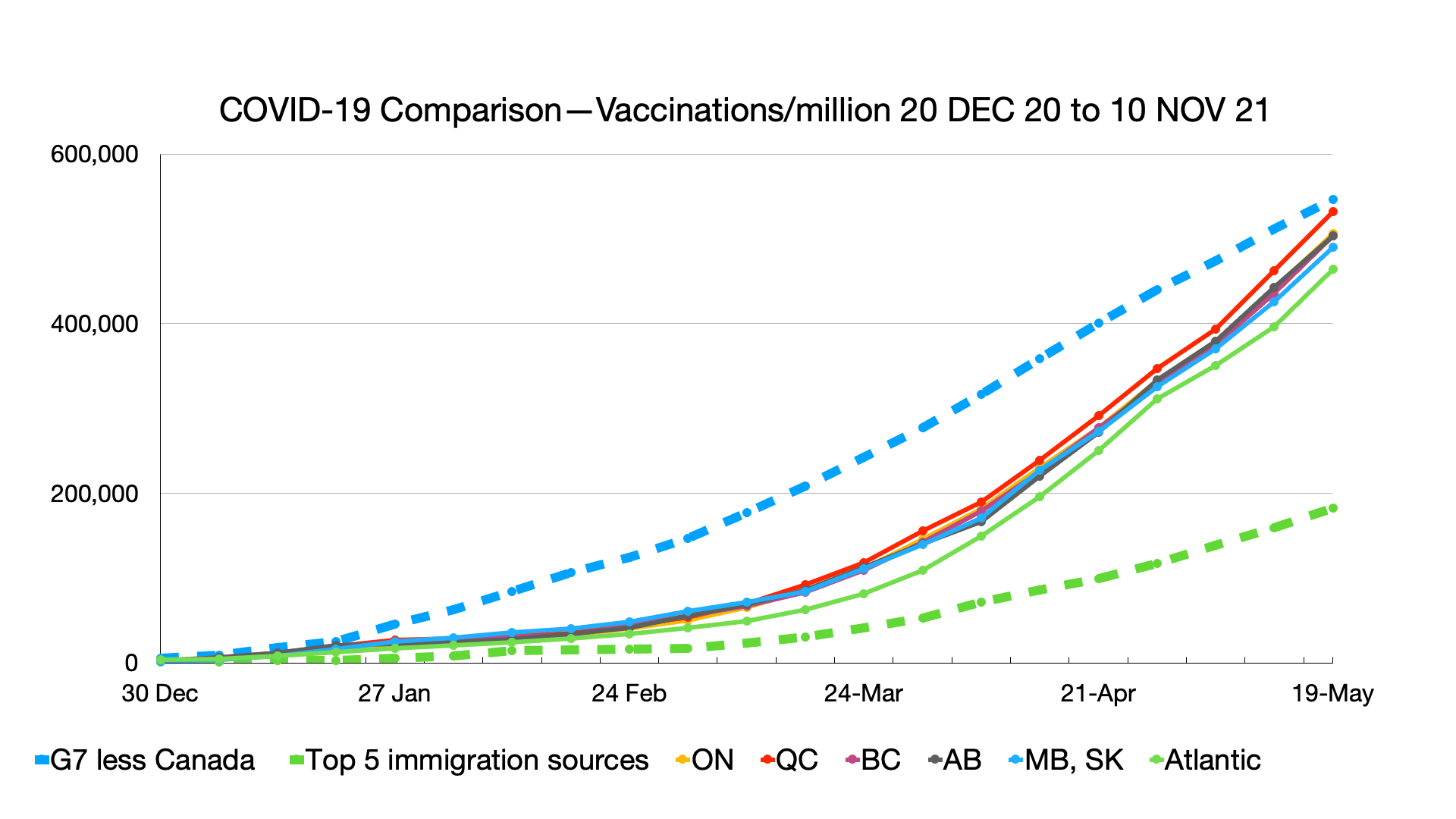
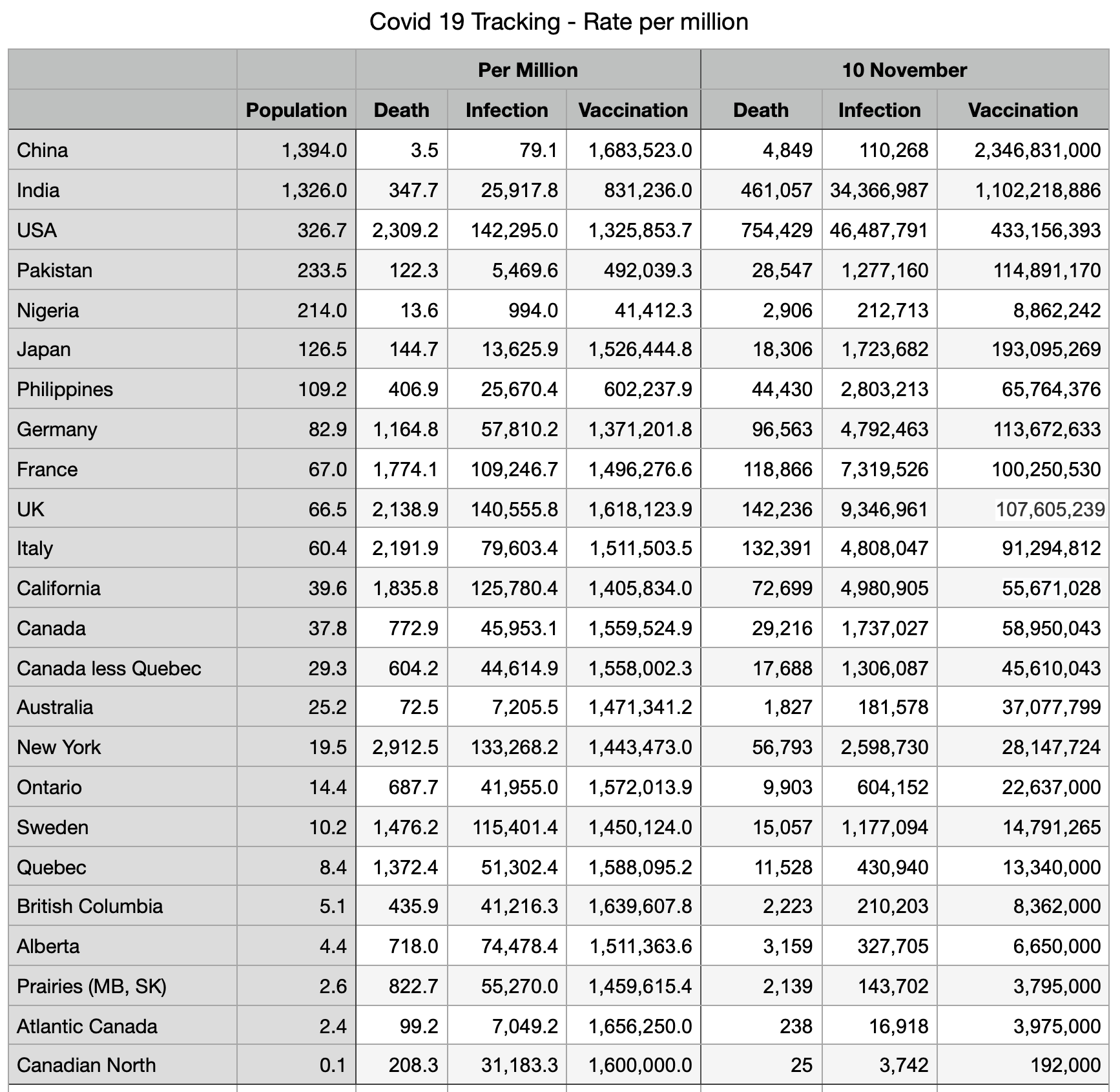
The latest charts, compiled 10 November. Canadians fully vaccinated 75.9 percent, compared to Japan 74.6 percent, UK 68.6 percent and USA 59.2 percent.

Vaccinations: China ahead of Atlantic Canada, UK and Canadian North ahead of Quebec, Australia ahead of Prairies. China fully vaccinated 76.7 percent, India 25.5 percent, Philippines 33 percent.

Trendline Charts:

Infections: Recent trends of increased infections in Europe and elsewhere not fully apparent. Canadian provincial trends showing minimal change.

Deaths: Albert, Prairie and British Columbia deaths continue to climb at comparable rate to G7 less Canada (driven mainly by USA).

Vaccinations: Ongoing convergence among provinces and G7 less Canada.

Weekly

Infections: No relative change although some shifts likely in the next few weeks given outbreaks in a number of countries and provinces.

Deaths: No relative change

Meanwhile, from Statistics Canada:

Statistics Canada says more than 19,000 Canadians lost their lives during COVID-19 than would have been expected had the pandemic never happened.

The report highlights the deadly toll COVID-19 has taken directly and indirectly on Canadian lives.

According to provisional data, approximately 19,488 more Canadians died between March 2020 and July 2021 than would have been expected.

That’s 5.2 per cent more deaths than if the pandemic never happened.

During that time frame, Statistics Canada says that while 25,465 people died as a direct consequence of contracting the virus, the pandemic also delayed medical procedures and led to a rise in substance use, which could also have contributed to the number of deaths.

On the flip side, some lives may have been spared by other causes, including public health measures that prevented influenza from spreading as usual last year.

The numbers don’t reflect all the deaths that occurred as some are still being investigated, so the data may under-represent the true number of deaths attributed to certain causes, including suicides.

They have also been adjusted to account for changes in the population, such as aging.

The highest number of deaths happened in the spring and autumn of 2020.

There was not a significant number of extra deaths between mid-January 2021 and the end of July 2021, according to the agency, despite the fact that COVID-19 claimed 6,255 lives in Canada during that time.

However, some provinces, including Ontario, Saskatchewan, Alberta and British Columbia, were an exception.

British Columbia and Alberta also saw more people dying than typically expected this past summer when a heat wave settled over both provinces.

Statistics Canada expects to release a more comprehensive picture of how many more people have died as a result of the pandemic by the end of November.

Source: More than 19K Canadian lives ended than if pandemic never happened: Stats Can