U.S. Trade And Immigration Policies Toward China Have Backfired

Of note, impact on visa restrictions on Chinese students and researchers:

When small children start playing chess they make one common mistake—they forget the other side gets to a make a move. That analogy describes U.S. policy toward China in three areas: trade, semiconductors and immigration. In all three areas, U.S. policies described by supporters as “tough” have backfired.

Innovation and International Students: Is it a good idea to let the FBI and members of the National Security Council develop innovation policies for the U.S. economy? Whether it’s a good idea or not, that is what’s happened when it comes to students, professors and researchers from China.

On May 29, 2020, Donald Trump issued presidential proclamation 10043 (PP10043) on the “Suspension of Entry as Nonimmigrants of Certain Students and Researchers from the People’s Republic of China (PRC).” The proclamation led the State Department to deny and revoke many visas for Chinese graduate students and researchers

At its core, the proclamation denies a visa to someone who studied at a particular university on a proscribed list, even if no negative information exists on the individual. The proclamation sweeps up many people who show no evidence of bad intent. Picture an American young person denied a visa to study in a foreign country because he or she attended MIT and professors at MIT have received Pentagon funds or U.S. government research grants.

At least hundreds and possibly thousands of Chinese graduate students and researchers have been refused visas under the proclamation. Exact figures are unavailable because the State Department has not been forthcoming in releasing information despite many requests. Official figures would understate the proclamation’s impact because individuals who believe they will be denied visas would not even apply.

In a June 2020 interview conducted soon after the proclamation took effect, Jeffrey Gorsky, former Chief of the Legal Advisory Opinion section of the Visa Office in the State Department and an advisor to the National Foundation for American Policy, predicted the current impact. “There is already a longstanding program in place to vet potential students based on concerns over the transfer of sensitive technologies,” he said. “This proclamation will exclude persons from the United States based on past or minor associations with PRC entities even if the individuals pass the interagency clearance process. America will lose out on a valuable talent pool and the financial and scientific contributions these students make to U.S. universities and the United States.”

The policy is costly to the United States. Every 1,000 Ph.D.’s blocked in a year from U.S. universities costs an estimated $210 billion in the expected value of patents produced at universities over 10 years and nearly $1 billion in lost tuition over a decade, according to an analysisfrom the National Foundation for American Policy. That does not include other economic costs, such as the loss of highly productive scientists and engineers prevented from working in the U.S. economy or patents and innovations produced outside university settings. Approximately 75% of graduate students in computer science and electrical engineering at U.S. universities are international students, primarily from China and India.

As with trade, the Biden administration has continued the questionable policies on Chinese graduate students started by the Trump administration. A China expert on the current National Security Council staff has written favorably of the restrictions on international students from China. Immigration policy people who favor restrictions on international students, such as Trump adviser Stephen Miller, understood the proclamation would keep out many Chinese students. It’s not clear people with expertise on China understand enough about how visa policies are implemented to appreciate the significant negative impact of these policies on U.S. innovation.

Two recent reports question FBI investigations of Chinese-born professors at U.S. universities that have resulted in few successful criminal prosecutions.

“There is insufficient evidence that academic/economic espionage by Chinese nationals is a widespread problem at U.S. universities,” writes Rory Truex, an assistant professor at Princeton University, in a 2021 paper. “After 20 months of ongoing investigations in 2019 and 2020, the ‘China Initiative’—a Department of Justice (DOJ) effort—had brought formal charges at only ten U.S. universities or research institutions, and only three cases involved any evidence of espionage, theft, or transfer of intellectual property. Given that there are about 107,000 Chinese citizens in STEM [fields] at U.S. universities at the graduate level or above, current DOJ charges imply a criminality rate in this population of .0000934, less than 1/10,000.” (Formal charges are not convictions, and DOJ has dropped several cases.)

A recent investigation by the MIT Technology Review found the Department of Justice’s China Initiative investigations have devolved primarily into finding disclosure and paperwork violations. “The initiative’s focus increasingly has moved away from economic espionage and hacking cases to ‘research integrity’ issues, such as failures to fully disclose foreign affiliations on forms.”

The MIT Technology Review concluded: “Our reporting and analysis showed that the climate of fear created by the prosecutions has already pushed some talented scientists to leave the United States and made it more difficult for others to enter or stay, endangering America’s ability to attract new talent in science and technology from China and around the world.” A former U.S. attorney who helped create DOJ’s China Initiative during the Trump administration agreed with the MIT Technology Review critique.

The Thousand Talents recruitment program started by China’s government in 2008 encourages Chinese scientists overseas to return to China and, more generally, for talented Chinese-born scientists to work in China rather than the United States. It would seem current U.S. policies have backfired and support the long-term goals of the Chinese Communist Party to bring talent back to China.

Source: U.S. Trade And Immigration Policies Toward China Have Backfired

India’s proud tradition of celebrating multiculturalism is facing a crisis

Of note:

In Saeed Akhtar Mirza’s 1995 film Naseem (streaming on Mubi), an ailing old man regales his granddaughter with anecdotes of his youth, a time when India’s Hindus and Muslims rejoiced in one another’s festivities and fought in solidarity against British colonial rule. The grandfather’s narrative of religious harmony and national integration is juxtaposed with the tensions leading up to the Babri Mosque demolition in Ayodhya, Uttar Pradesh, by Hindu extremists on December 6, 1992 — a tragic event now widely considered to be a turning point in the rise of Hindu nationalism.

The film’s fraught backdrop, as witnessed by 15-year-old Naseem (Mayuri Kango), offers a stark contrast to the pre-independence past described by her grandfather as India’s secular fabric begins to slowly erode. But what sadly makes Naseem as relevant today as it was upon its release — if not more so — is that contemporary India continues to mirror the tumultuous nation depicted in the film. In fact, now more than ever, India is consumed by hate towards the “other,” marking a shift away from the more pluralistic values historically espoused in its films, poetry, music, and even (to the ire of the conservative ruling party) its TV ads.

Naseem ultimately ends with the death of the grandfather coinciding with the demolition of the Babri Mosque, symbolically marking the fall of India’s pluralistic bastion. Actor and Urdu-language poet Kaifi Azmi, whose grandfather character is the embodiment of secularism in the film, was pained by the grinding down of his country’s secularism in real life, too. His lament found expression in the poem “Doosra Banwas” (“The Second Exile”), which imagines the Hindu deity Rama visiting his birthplace, Ayodhya, on the day of demolition and becoming despondent upon witnessing the carnage and politics played out in his name. Rama subsequently decides to go into exile again.

Fortunately for Azmi, when he recited the poem at an event in the late 1990s, the sociopolitical climate of India was a bit more tolerant than it is now. If such an act of “blasphemy” were to be attempted today, in all probability the socialist poet would have to languish in jail alongside many other artists and activists, on account of “hurting religious sentiments.”

Ever since the right-wing forces rose to power in the previous decade, a wave of religious intolerance has been sweeping over India, rendering artists and their work extremely vulnerable to attack. Stand-up comic Munawar Faruqui found himself at the receiving end of such bigoted absurdity at the beginning of the new year when he was arrested on Jan. 1 in the central Indian city of Indore for allegedly making objectionable jokes about Hindu deities, following a complaint by the son of a politician who belonged to the ruling right-wing party, BJP. Faruqui was eventually released on bail after more than a month in prison.

That witch-hunt mentality might also explain the outcry by many educated Indians over an advertisement for the jewelry brand Tanishq. The 45-second ad depicts a baby shower for a Hindu wife by her Muslim in-laws, but right-wingers criticized the clip for promoting love jihad, a term used by radical Hindu groups to accuse Muslim men of converting Hindu women by marriage. Similarly, consumer goods company Dabur recently withdrew an advertisement for a skin-bleaching cream that showed a same-sex couple celebrating Karwa Chauth — a Hindu festival where married women observe fast from sunrise to moonrise for the safety and longevity of their husbands — hours after the home minister of India’s second-largest state, Narottam Mishra, warned of legal action against the firm.

Meanwhile, the clothing company Fabindia came under fire for running a Diwali-themed advertisement for a clothing collection named “Jashn-e-Riwaaz,” an Urdu phrase meaning “celebration of tradition.” Advertising a collection by that name in connection with the Hindu festival of Diwali drew accusations of “unnecessarily uplifting secularism and Muslim ideologies” from critics who “claimed it hurt their religious sentiments,” The New Indian Express recounts. BJP leader Tejasvi Surya further slammed Fabindia for its “deliberate attempt of Abrahamanization of Hindu festivals and depicting models without traditional Hindu attire.” The message was loud and clear: The secular rhetoric of a pluralistic society needs to give way to the hegemony of Hindutva ideology. Further, any individual, entity, or even brand acting as proponents of a composite culture must be prepared to face clampdown.

But such close-mindedness flies in the face of a long history of progressivism that can easily be located in India’s art; arguably, even the narrative commercials censored by the government are an extension of this tradition. Ironically, it is the northern Indian state of Uttar Pradesh, which had a long history of religious syncretism before the Babri mayhem, that has been at the forefront of the deepening religious divide in the country. Yet long before the spread of fundamentalism in the state, Uttar Pradesh was emblematic of the “Ganga-Jamuni Tehzeeb,” a poetic phrase comparing the Hindu-Muslim camaraderie to the holy confluence of India’s major rivers, the Ganga and Yamuna. The late musician Ustad Bismillah Khan and his predecessors — who hailed from the city of Varanasi in Uttar Pradesh — stand as easy examples of this inclusive culture, since their Muslim identities never prevented them from performing at temples and Hindu festivals.

ia’s tradition of multiculturalism can be further witnessed in Niharika Popli’s documentary Rasan Piya (2015), about the life of renowned Hindustani (Indian) classical musician Ustad Abdul Rashid Khan. Belonging to a lineage of artists who performed in provinces of diverse faiths, he was appointed as a court singer to the Hindu king of Gwalior in the state of Madhya PradeshAn exemplar of polytheism and yet a devout Muslim, Rashid Khan was also a devotee of the Hindu god Lord Krishna, and would fast on Janmashtami (the birth anniversary of Krishna) every year.

It is evident that for centuries, then, the heterogeneous culture of India was capable of embracing the ethos of the Sanskrit phrase “Vasudhaiva Kutumbakam,” meaning “the world is one family.” However, any traces of “unity in diversity” that persist today stand threatened by the hijackers of culture and religion who are hellbent on ignoring the nation’s age-old multicultural narrative, otherwise so evident and celebrated in its art.

Source: India’s proud tradition of celebrating multiculturalism is facing a crisis

#COVID-19: Comparing provinces with other countries 8 December Update

The latest charts, compiled 8 December. Too early to assess the impact of omicron.

Canadians fully vaccinated 77.5 percent, compared to Japan 77.4 percent, UK 69.7 percent and USA 60.8 percent.

Vaccinations: Minor shifts: Ontario ahead of Italy and Quebec, Sweden ahead of Alberta, Australia, New York and Japan. China fully vaccinated 79.5 percent, India 35.6 percent, Nigeria 1.9 percent, Pakistan 24.5 percent, Philippines 35.8 percent.

Trendline Charts:

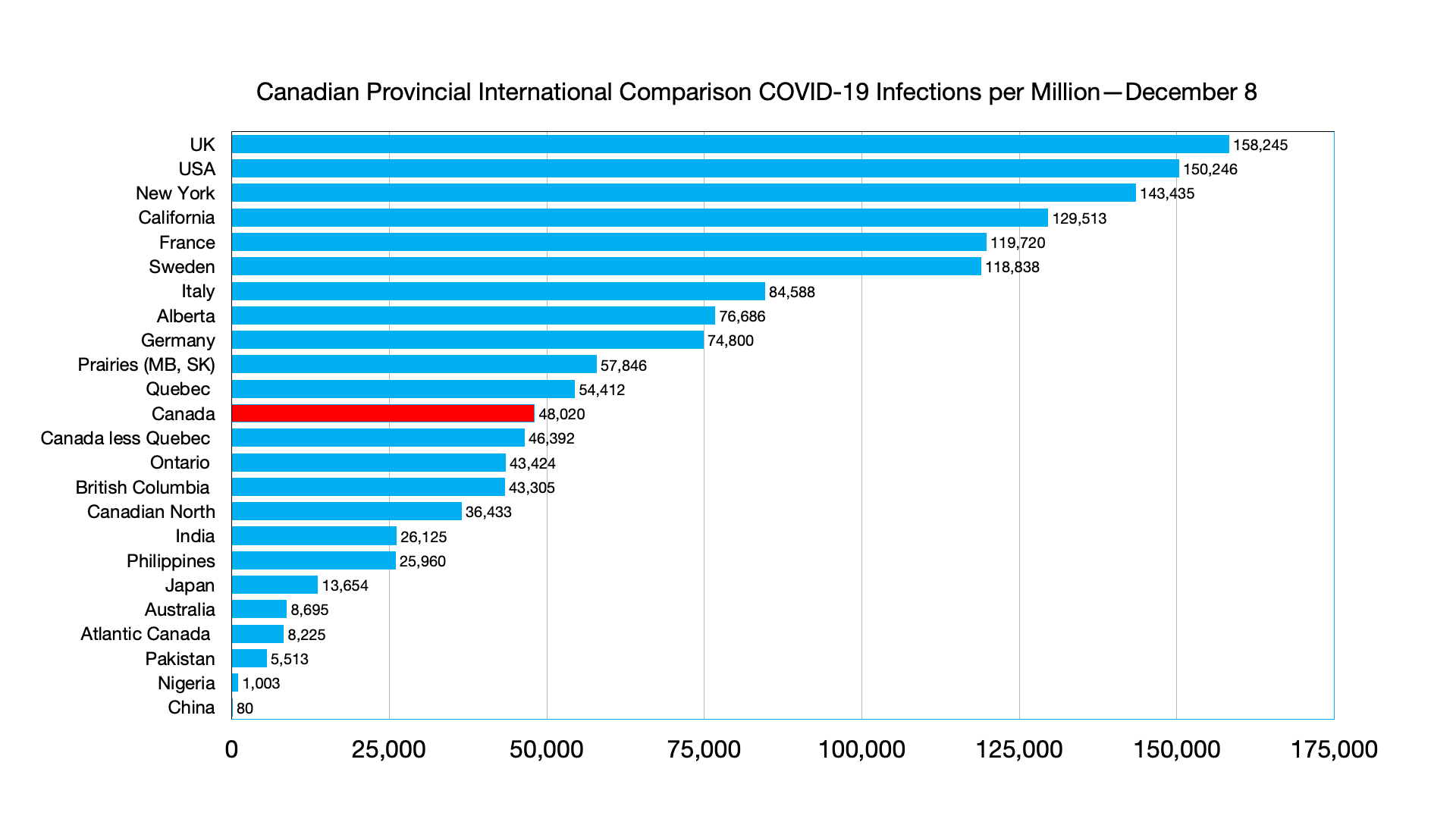
Infections: Recent trends of increased infections in Europe continues. Canadian provincial trends showing minimal change from last week, with Quebec uptick noticeable.

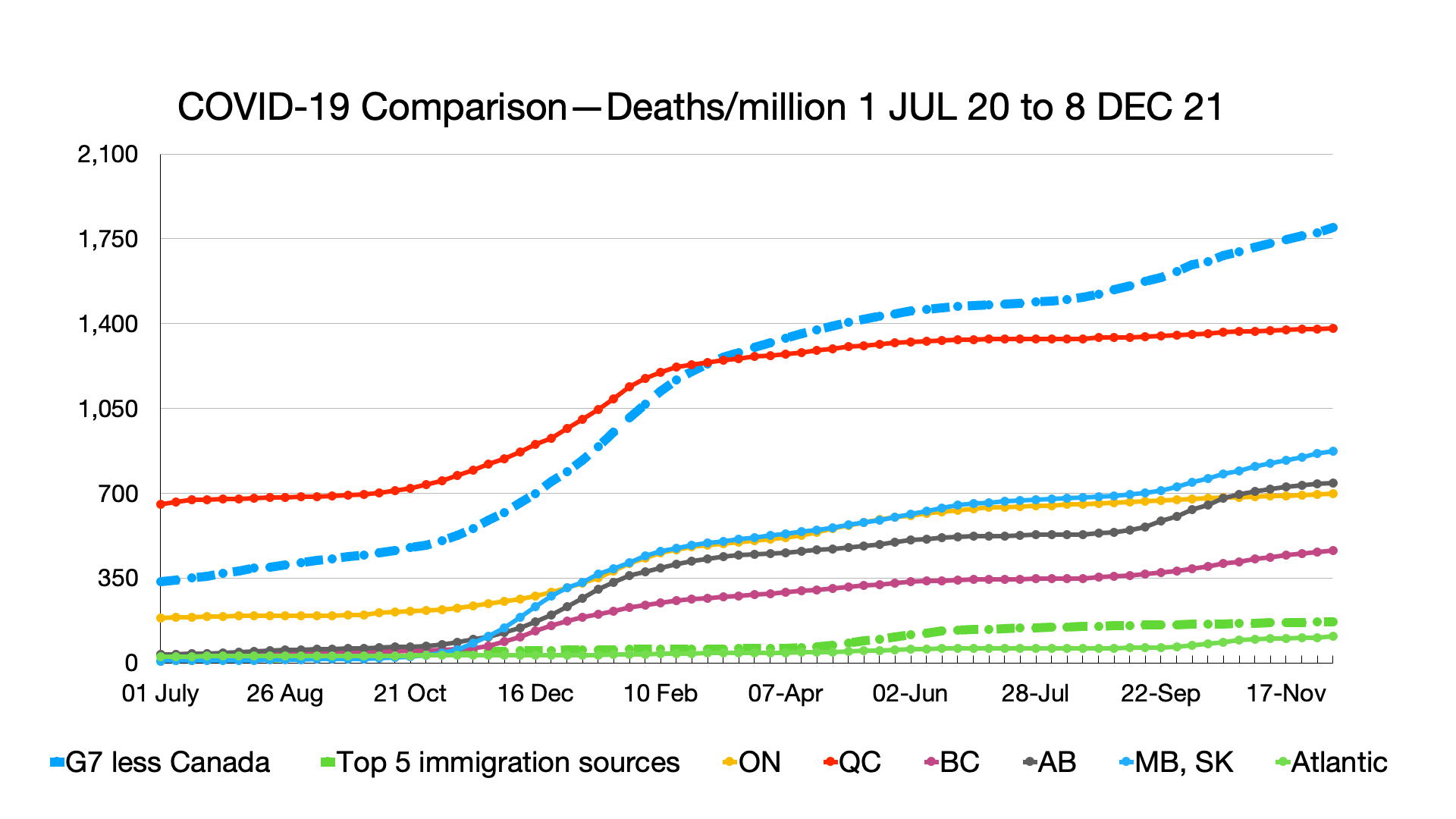
Deaths: G7 less Canada (driven mainly by USA) continue to increase, Alberta has flattened while Manitoba and Saskatchewan are still increasing more than other provinces.

Vaccinations: Ongoing convergence among provinces and G7 less Canada and narrowing gap with immigration source countries given China, and to a lessor extent, India, Pakistan and the Philippines which continue to increase vaccinations. Nigeria remains a laggard.

Weekly

Infections: France now ahead of Sweden.

Deaths: No relative change

Useful analysis of vaccine equity and other challenges for many developing countries:

While vaccine inequity among African countries has played a major role in the continent’s low COVID-19 vaccination rate, experts say capacity and logistical challenges, along with vaccine hesitancy, is also creating significant challenges.

“I’ve seen a number of articles say it’s just vaccine inequity — and that’s wrong. It’s not just vaccine inequity,” said Dr. Ron Whelan, who heads health insurer Discovery’s COVID-19 task team in South Africa.

“[It’s] one part supply, one part health-system capacity and the third part is the hesitancy component,” he said.

“It is a multi-factorial problem that’s got to be solved.”

Dr. Saad B. Omer, an epidemiologist and director of the Yale Institute for Global Health, agrees it’s a more nuanced explanation than just blaming vaccine inequity for low vaccination rates across the continent.

“We expect people to land the plane with a few doses at the airport, do a photo op, [and] people to run to the airport to get their jabs. That’s never happened,” he said.

While about 76 per cent of Canada’s total population is fully vaccinated, on the African continent — home to 1.3 billion people — it’s only about 7.5 per cent, according to Our World in Data.

Delivery expected to ramp up

In October, a report by the People’s Vaccine Alliance — a coalition which advocates for equitable and sustainable use of vaccines, and includes Oxfam, ActionAid and Amnesty International — found that only one in seven COVID-19 vaccine doses promised to low-income countries were actually delivered.

However, vaccine shipments have been on the rise over the past three months and are expected to ramp up in coming weeks and over the new year, according to the World Health Organization.

Yet despite the increases in vaccine supply, experts suggest inoculation efforts in Africa could still face hurdles.

About 40 per cent of vaccines that have arrived on the continent so far have not been used, according to data from the Tony Blair Institute for Global Change, a policy think-tank.

Some countries have been forced to destroy thousands of doses of donated vaccines from their stockpiles. Namibia, for example, announced on Monday that it had to destroy 150,000 expired doses.

“It is highly regrettable that we are forced to destroy in excess of 150,000 vaccines, which have reached expiry date, because those who are eligible are refusing to be vaccinated,” Namibia President Hage Geingob is reported to have told a news conference on Monday.

According to the Washington Post, Malawi, Mozambique, Namibia, South Africa and Zimbabwe have all asked drugmaker Pfizer in the last several months to pause vaccine shipments because of challenges with uptake.

Vaccination rates vary widely across Africa and many experts are quick to note that vaccine hesitancy is not unique to the continent; it has been an issue in other parts of the globe, including the U.S and Europe. Child vaccination campaigns for various diseases, meanwhile, have been quite successful in Africa.

“Africa is, in many instances, a well-established vaccine culture overall, ” Whelan said.

But Dr. Matshidiso Moeti, the WHO regional director for Africa, recently told the New York Times that “there’s no doubt that vaccine hesitancy is a factor in the rollout of vaccines.”

News or rumours of potential side effects, she said, “gets picked out and talked about, and some people become afraid.”

1 in 4 health workers vaccinated

Additionally, only one in four of Africa’s health-care workers has been fully vaccinated against COVID-19, according to WHO. That compares to 80 per cent of health workers vaccinated in 22 mostly high-income countries.

Many of Africa’s health-care workers, including those working in rural communities, still have “concerns over vaccine safety and adverse side effects,” Moeti recently told reporters.

Capacity has also been a major issue for many African countries, specifically their health systems’ ability to absorb and distribute vaccines, particularly in rural areas, where health resources are scarce.

“We need significant capacity to deliver those vaccines,” Whelan said.

‘Weak supply chains’

That includes the need for strengthened supply chains and temperature-controlled cold chains required to store Pfizer doses, Whelan said, together with infrastructure to actually track and deliver vaccines to hospitals, clinics and other vaccination sites.

“Many of the countries have weak supply chains, particularly weak cold chain infrastructure. And the cold chain infrastructure is not well set up for the Pfizer vaccine in particular,” he said.

Some countries, including South Sudan and Congo, have had to send some vaccines back because they could not distribute them in time.

Often, Whelan said, that’s the result of issues with health-system capacity, storage capacity and administration capacity.

But reliable capacity also cannot be built without reliable access to doses, said Omer.

“When you are the head of a public health agency or a health minister in a country, you want not only doses, but also predictability in doses,” he said.

Instead, he said, many government officials “don’t know what kind of doses are coming and when they are coming.”

“Often what would happen is that [some African countries] would receive a call saying that, ‘We have doses that we are sending your way, with a month’s expiration left. Please distribute.’ That’s an obviously challenging thing for any country,” said Omer.

Last month, African Vaccine Acquisition Trust (AVAT), the Africa Centres for Disease Control and Prevention (Africa CDC) and COVAX put out a joint statement, calling the majority of vaccination donations to date “ad hoc” and “provided with little notice and short shelf lives.”

“This has made it extremely challenging for countries to plan vaccination campaigns and increase absorptive capacity,” the statement said.

“Countries need predictable and reliable supply. Having to plan at short notice and ensure uptake of doses with short shelf lives exponentially magnifies the logistical burden on health systems that are already stretched.”

According to a recent WHO statement, since last February, Africa has received 330 million doses from the COVAX program, the African Vaccine Acquisition Task Team and bilateral agreements.

Of those, more than 80 per cent have been delivered since August alone.

And so, as vaccine supply picks up, it said, “addressing uptake bottlenecks and accelerating rollout become more critical.”

Source: Vaccine inequity only partially to blame for Africa’s low vaccination rates, experts say

Québec va aider les immigrants qui tenteront de faire reconnaître leurs compétences

Good initiative:

Québec va soutenir financièrement les immigrants qui ont besoin de suivre une formation de soutien pour faire reconnaître leurs compétences professionnelles. L’aide pourrait atteindre jusqu’à 500 $ par semaine pour les professionnels qui suivent la formation à temps plein.

Le ministre du Travail, Jean Boulet, en a fait l’annonce, mardi, lors du dévoilement d’un nouveau plan de 130 millions de dollars sur deux ans pour accélérer et faciliter la reconnaissance des compétences des immigrants.

Avec ce plan, les professionnels immigrants seront mieux accompagnés « de la sélection jusqu’à l’intégration » dans la reconnaissance de leurs compétences, affirme le ministre.

M. Boulet a donné l’exemple d’une infirmière qui voudrait faire reconnaître ses compétences. « Elle va bénéficier de formations d’appoint beaucoup plus flexibles. Il va y en avoir beaucoup plus. Elle va aussi bénéficier d’une aide financière de 500 $ par semaine. Elle va aussi profiter d’avoir un permis restrictif qui pourrait lui permettre de faire son travail sous certaines conditions ou de faire un travail qui est connexe à sa formation. »

Présente au côté du ministre, Gyslaine Desrosiers, présidente du Conseil interprofessionnel du Québec, a mentionné que le taux de décrochage était de 34 % parmi les immigrants souhaitant faire reconnaître leurs compétences. « Collectivement, on peut et on doit faire mieux. »

Pénurie de main-d’œuvre

Le plan fait partie d’une offensive de plus 2,9 milliards de dollars pour contrer la pénurie de main-d’œuvre, annoncée dans la mise à jour économique de novembre. Québec espère « former, requalifier et attirer » près de 170 000 travailleurs dans cinq secteurs ciblés : la santé et les services sociaux, l’éducation, les services de garde éducatifs à l’enfance, le génie et les technologies de l’information ainsi que la construction.

La décision de se concentrer sur les services essentiels et les secteurs « stratégiques » a fait des mécontents parmi les entreprises qui se sentent oubliées par cette intervention.

Dans le plan de reconnaissance des compétences, 12 métiers sont identifiés dans les services essentiels et les secteurs « stratégiques » comme le génie et la construction. « On va y aller selon nos besoins, a défendu M. Boulet en conférence de presse. Faut établir des priorités. »

« Ça ne veut pas dire que les autres sont exclus, nuance-t-il. On va considérer en fonction des besoins et de la société et du marché de l’emploi. »

Dans les secteurs visés, il y a environ 5000 personnes qui font chaque année des demandes de reconnaissance de leurs compétences.

Le Conseil du patronat satisfait

Au Conseil du patronat du Québec (CPQ), on estime que le plan répond à plusieurs besoins exprimés par le milieu des affaires. « Pour les entreprises, l’annonce d’aujourd’hui permettra une intégration en emploi plus rapide et adaptée aux compétences des candidats, commente Karl Blackburn, son président et chef de la direction, dans un courriel. La collaboration étroite des ordres professionnels, du gouvernement et des milieux de l’emploi est de la musique à nos oreilles. »

L’enjeu de la compétence des immigrants est soulevé depuis plusieurs années, mais le ministre Boulet a l’impression que le plan qu’il propose sera le bon. « Je pense qu’on ne peut pas manquer notre coup. »

« Oui, ça fait longtemps qu’on en discute, mais on a maintenant un plan qui est global, qui est compréhensif, qui est cohérent, qui est issu d’une concertation. Tout le monde tire dans la même direction », ajoute-t-il.

Source: Québec va aider les immigrants qui tenteront de faire reconnaître leurs compétences

Articles on #Beijing2022 and the boycott question: “The Nazis used us during the 1936 Olympics. We cannot fall for the same propaganda tactics in China next year;” “Kelly: Washington’s diplomatic boycott of Beijing Olympics is worse than meaningless;” “53% of Canadians would not send diplomats to 2022 Olympic Games; two-in-five would keep athletes home”

Starting with the obvious parallel:

In a recent telephone interview with Fox News, former President Donald Trump said he is opposed to a proposed boycott of the 2022 Olympics in China because it would “hurt the athletes.”

President Joe Biden and others have raised the idea of a potential boycott of the 2022 games to protest the Chinese government’s ongoing persecution of its Muslim Uyghur citizens and other human rights abuses, such as the oppression of Tibetans and the trampling of civil liberties in Hong Kong.

America has been through this debate before — in 1936, and again in 1980. The very different outcomes of those two earlier debates offer some useful lessons for our current controversy.

The Chinese regime is engaged in “ongoing genocide” against the Uyghurs, according to the State Department. A recent report by the United States Holocaust Memorial Museum found that “the Chinese government’s attacks on the Uyghur community are alarming in scale and severity” and constitute “crimes against humanity,” including “forced sterilization, sexual violence, enslavement, torture, forcible transfer, persecution, and imprisonment or other severe deprivation of physical liberty.”

From the Chinese perspective, the Olympic Games represent a prime public relations opportunity. They make the host country seem like an accepted part of the civilized international community.

Adolf Hitler saw the 1936 Berlin Olympics the same way. Many Americans today remember the Berlin Olympics as a victory for the good guys, because African American track star Jesse Owens won four gold medals, an implicit challenge to Hitler’s claims of “Aryan” racial superiority.

But in reality, The Games were a triumph for the Nazis in the way that mattered most — improving the Hitler regime’s image abroad.

President Franklin D. Roosevelt had ample warning that the Nazis intended to use the games for propaganda purposes. The U.S. ambassador in Germany, William Dodd, reported to Washington that the Nazis intended to use the Olympics “to rehabilitate and enhance the reputation of the ‘New Germany.’”

Foreigners will “have only the usual tourist contacts,” he wrote, and are likely to come away doubting the veracity of “the Jewish persecution which they have previously read in their home papers,” he predicted. The 2,000 translators hired by the Hitler government were also being trained at “parrying embarrassing questions and insinuating praise of National Socialism in their small talk,” Dodd wrote.

Dodd’s warnings went unheeded; the Roosevelt administration rejected the boycott as undue interference in American-German relations

But he was right: The New York Times praised the German government for its “flawless hospitality.” A Los Angeles Times correspondent wrote that “Zeus, in his golden days, never witnessed a show as grand as this.” An editorial in that newspaper even predicted that the “spirit of the Olympiads” would “save the world from another purge of blood.”

Even President Roosevelt was taken in — or perhaps he was looking for a way to justify America’s participation. Meeting with American Jewish Congress leader Rabbi Stephen S. Wise shortly after the games, the president told Wise he had learned from two tourists who had attended the Olympics “that the synagogues are crowded and apparently there is nothing very wrong in the situation [of Germany’s Jews] at present.”

Rabbi Wise wrote later that he was horrified by FDR’s comment. Wise tried to “explain to him how grave conditions were….[I] told him of some recent happenings in Germany….Cited other examples of the ruthless and continuing oppression of the Jews. He listened carefully; but I could see that the tourists (whoever they were, the Lord bless them not) had made an impression upon him.”

In 1980, the U.S. government made a different calculation: the Carter administration boycotted the 1980 Moscow Olympics as a protest against the Soviet invasion and occupation of Afghanistan. In his interview, Trump claimed that this boycott “didn’t work.”

The Trump argument, apparently, is that since the boycott did not bring about a Soviet withdrawal, it was a failure. But that view misunderstands the purpose of the 1980 boycott.

President Carter obviously didn’t expect that his gesture alone would convince the Soviets to leave Afghanistan; it was a symbolic protest. A boycott of the Chinese games likewise would be symbolic.

But symbols are important. Such foreign policy gestures help shape international opinion and establish standards for how governments respond to crises around the world.

If the Biden administration does not undertake a substantial symbolic protest, such as a boycott, it would send a message to China’s leaders that their brutal human rights abuses are of no concern to the United States. That is a dangerous message to send.

The U.S. government looked away during the Holocaust, not to mention more recent genocides in Cambodia, Rwanda, and Darfur. America’s response to ethnic cleansing in the Balkans and mass atrocities in Syria was also too little, too late. It’s time for a new kind of U.S. response.

Dr. Medoff is founding director of The David S. Wyman Institute for Holocaust Studies and author of more than 20 books about Jewish history and the Holocaust.

Source: https://links.forwardcdn.com/u/click?_t=4616583590614aeb8da9a4f87d20e5fd&_m=82a91bf047e343b9b3cb4e8d87fd1c3e&_e=0scGFp23L4VNUPFHgTznqQBWAILR5A2FqcTiEsrdG7IVqKQb2JActvbSFtCYbj2tGvYeBCqyx1oflHJeTbuca7fdCFmVxuj3D9WM8XkZp2ZYDb70zbvk5oXzLpowPM1je3aHhin5r4Yxa5afvWvH6Jaus20m8FzjzeUt1cOMYYeycDyE1IWHqbWi7QhL6zA4tfnOWB6tXzXGcy4Ml5qkL_KwJk-aSmM1gSHtrZrVdbKINuDXdMKHkl8RMs4bFeEGWFPvl5lj2ogjiYQeUCr2HqwHjnnIqZNsPUAj4Z0Ewh1zb6CPzU08_xVksP5Jp4qiTt0IqkbAcgHJ9i_A2Y3Q1r6M8loA3qfMhDHv1uMoJbQp63qkciZMu0iaTg9kF43rKv8UGfCFyGzoVCRjUpC1wwPrpQxVnYBK_NAlUtKE0oMNUUdFLe17ooHJLanothdJFfRJGAMtVKzhxJPRGcQGfQ%3D%3D

Cathal Kelly of the Globe calls out the hypocrisy and weakness of “diplomatic boycotts:”

Let’s try to imagine how a diplomatic boycott might work in your own life.

You told your neighbour that you’d go over to her house for her annual New Year’s Eve party. Then you found out that she runs a dog-fighting ring or some similarly heinous activity on her property.

You are so morally repulsed that skipping the party isn’t enough. You feel the need to get on the neighbourhood group chat and announce you’ve come to a difficult decision. After a lot of soul searching, you’ve determined that no decent person should be seen to support such a person and their party. With that in mind, you will not be attending this year. Instead, you will stay home rubbing your rosary beads. You’re not going to go so far as to call anyone else who would attend such a party lower than a serpent’s belly, but it’s implied.

Also, in unrelated news, your kids will be going to the party. They’ve been looking forward to it all year and you can’t bring yourself to let them down.

Yes, there may be dog fighting and assorted other violence going on while they are in the house. Maybe they’ll be able to hear whimpering from the garage. But you don’t want to be the ogre who ruined everyone’s night out.

You heard there’s going to be a raffle at the party. What if your kids win a bunch of stuff and bring it home? Well, what can you do? You can’t stop them from winning. As much as it pains you, you’ll have to enjoy the spoils with them.

In summation, this party is wrong and you are against it.

This isn’t exactly what Washington has done in announcing an ersatz boycott of the upcoming Beijing Olympics. What it has come up with makes less sense than that.

America’s long-rumoured halfway measure – the diplomatic boycott – was officially announced on Monday. It doesn’t amount to much. It’s a more impressive sounding way of saying you are eliminating Olympic junkets. Now all the sad, second-rate pols from North Dakota and Maine won’t get flown private to Beijing so they can take a bunch of ego shots with Auston Matthews.

In the announcement, America’s rationales for taking this action were cast by White House spokesperson Jen Psaki in Second World War terms: “ongoing genocide and crimes against humanity.” It is difficult to imagine more serious charges.

Yet elsewhere in the same remarks, Psaki sounded the executive air horn on behalf of her boss: “We will be behind [America’s Olympic athletes] 100 per cent as we cheer them on from home. We will not be contributing to the fanfare of the Games.”

That. What you did right there. That is fanfare. Fanfare’s what you call it when you root publicly for athletes. Eliminating the fanfare would mean saying nothing at all.

Fanfare is what this is about, though not the usual sort. We are speaking of political fanfare – controlling and redirecting the sporting kind so that it lands on the right politicians.

This is a leadership looking to be congratulated for doing the right thing, while getting to do what they self-evidently believe to be the wrong thing.

Take earlier comments about the proposed boycott from Robert Menendez, the senator who chairs the foreign relations committee. He called it “a necessary step to demonstrate our unwavering commitment to human rights in the face of the Chinese government’s unconscionable abuses.”

I’m sure the people suffering those abuses can discern the difference between American athletes holding up the Stars and Stripes on Beijing podiums and the American VIPs who will no longer be whooping it up in the stands behind them. Perhaps “unwavering” means something different in Menendez’s district.

You can’t be said to be taking a stand unless it involves some sort of sacrifice. What has America given up here? Nothing. Less than nothing. This move saves them on airfare.

This isn’t moral leadership. It’s outrage mitigation. Washington needs to be seen doing something, but nothing so substantive that it might interfere with everyone’s fun times. Unable to boycott and just as unable to not boycott, America has chosen a boycott that isn’t a boycott. Except it has called it a boycott. Cool trick.

Playing silly buggers with language makes it possible for everyone to oppose China as party host, while still enjoying the jingoistic boost that comes from attending China’s party.

Had America said nothing about a boycott and quietly ordered officials to stay home, its position would at least be logically consistent. That would have allowed them to give the athletes, broadcasters, corporate sponsors and voters/fans what they want, without confronting the implications of what that means. It wouldn’t be very honourable, but would at least make some sense.

Putting a name to America’s semi-absence reveals it as a hypocrite. What else would you call accusing someone of mass murder, congratulating yourself on your own bold truth-telling and then helping yourself to their hospitality?

Now we’ll see what America’s allies do, and what China does in turn. Beijing has already promised “firm countermeasures.”

Would it be possible for an Olympic host to pull out of a Games a few weeks before they start? The idea would not have even occurred to me a couple of weeks ago, but it’s beginning to feel like a lot of impossible scenarios are now possible.

For those who are still Beijing or Bust, there is good news. Despite all the hot talk, we are still in the posturing stage. No one has yet done anything to put the Games in doubt.

For those who had hoped for a moral stand on this file, there is no news at all. Just more of the same nonsense meant to obscure the fact that no one wants to take any position that might force them to tell the kids they can’t go to the globe’s most lavish and beloved circus.

Source: https://www.theglobeandmail.com/sports/olympics/article-washingtons-diplomatic-boycott-of-beijing-olympics-is-worse-than/

Lastly, a useful Angus Reid survey showing that 40 percent, higher than I expected, support a full boycott (athletes) compared to 53 percent the “virtue signalling” diplomatic boycott:

Not since the 1980 Games in Moscow has Canada declined to send athletes – or officials – to the Olympics.

But as the U.S. announces a diplomatic boycott of next February’s Winter Games in Beijing – other Western nations are being asked their intentions.

While the Canadian government contemplates who – if anyone – it will send to the Olympics, a new study from the non-profit Angus Reid Institute finds just over half of Canadians (53%) supportive of their country taking the same measure as the U.S., denying any diplomatic presence in Beijing.

Two-in-five would go further, keeping athletes home from China as a protest against human rights abuses in the host country.

Overall, four-in-five (78%) support some sort of boycott. Despite this sentiment, the vast majority are resigned to the fact that Canadian protest will have little impact on China’s domestic policy. Nearly three-quarters (73%) say it is “unrealistic” to expect actions taken by this country will change China’s behaviour.

Chart, waterfall chart Description automatically generated

More Key Findings:

  • Favourability towards China has increased since Michael Spavor and Michael Kovrig were released from prison and returned to Canada, but it is the minority view. One-in-six (16%) Canadians say they hold favourable views of the country.
  • Half (48%) of Canadians who view China positively say there should be no boycott of the Games; one-in-five (17%) of those who view the country negatively say the same.
  • Men between the ages of 18 and 34 are the most supportive of officials and fans staying home at two-thirds (63%) and half (47%) respectively.

Source: https://angusreid.us12.list-manage.com/track/click?u=4adb83e0e056e657a62fc6d8a&id=8a3a870561&e=1e1ae5dd63

Contrasting pre- and post-pandemic public service survey results

For the data nerds among you, you might this analysis of the Public Service Employee Survey organizational and harassment/discrimination indicators, broken down by visible minority and Indigenous group of interest, comparing the pre- and post-pandemic periods.

Conclusion:

There has been comparatively little change between the pre- and post-pandemic period but noteworthy that Black satisfaction with resolution of harassment and discrimination complaints is less than other visible minority groups.

While it appears that the experience of visible minorities is worse than Indigenous peoples, PSES data supports the view that the government has considerable work to improve the workplace organizational culture to reduce harassment and discrimination for both visible minority and Indigenous groups. This needs to take place at the general and the specific group levels by each department given the variances between the individual groups.

As in the case of disaggregated data with respect to employment equity groups, the increased granularity of the PSES provides a richer evidence base for managers and human resources to develop measures to improve inclusion in the public service at the departmental and organizational levels.

Full article:

Charts colour coded to show variations:

Longitudinal Immigration Database: Immigrants’ income trajectories during the initial years since admission

Usual useful analysis by StatsCan, in particular the highlighting of how two-step immigration is resulting in stronger economic outcomes for the economic class:

The COVID-19 pandemic has impacted the lives of Canadian immigrants in many ways. To assess these impacts, it is important to know where Canadian immigrants stood economically right before the outbreak of the pandemic. Based on the latest available data from the 2020 Longitudinal Immigration Database (IMDB), the present article serves this goal by focusing on immigrant wages in recent years, including 2019. This will provide a baseline for comparison once data for 2020 are available.

Immigrants admitted to Canada in 2018 had a median wage of $31,900 in 2019. This was 4.2% higher than the median entry wage of immigrants admitted in 2017 ($30,600). In fact, immigrants admitted in 2018 had the highest median entry wage, reported one year after admission, among all immigrants admitted since 1981. Despite that, their median wage was still 17.8% lower than the 2019 median wage of the total Canadian population ($38,800).

Compared with those admitted in 2017, immigrants admitted in 2018 experienced median entry wage increases in all provinces, except Alberta, and Newfoundland and Labrador. A closer look by immigration category and pre-admission experience sheds light on differences among various groups of immigrants admitted in 2018, compared with their counterparts admitted in 2017 as well as the Canadian population in corresponding years.

Median wage of economic immigrant principal applicants surpasses that of the Canadian population one year after admission 

Principal applicants of economic categories are selected for their ability to be integrated into the Canadian labour market and to contribute to the economy. Most of them have post-secondary education and knowledge of at least one official language. Immigrants admitted under those categories in 2018 had a median wage of $43,600 in 2019, 12.4% higher than the Canadian median wage in the same year ($38,800) and 3.8% higher than the median entry wage of their counterparts admitted in 2017 ($42,000).

While the median wage of economic principal applicants surpassed that of the Canadian population one year after admission, those of all other immigrants were still less than the Canadian median wage.

The median entry wage of economic immigrant dependents admitted in 2018, spouses included, was $27,600. While lower than the 2019 Canadian median wage, this number was 7.0% higher than that of their counterparts admitted in 2017 ($25,800).

There was no change in the median entry wage between family sponsored immigrants admitted in 2017 and 2018 ($24,500). The median entry wage of refugees ($19,200) was the lowest among immigrants admitted in 2018, though it was 2.7% higher compared with that of their counterparts admitted in 2017 ($18,700).

Economic principal applicants are selected on the basis of their education, specific skills and work experience. The vast majority (96.1%) of immigrant taxfilers admitted under this category in 2018 had completed some post-secondary education at the time of their admission. Economic principal applicants are also more likely to have pre-admission experience in Canada. Among those admitted under this category in 2018, almost two-thirds (64.5%) of them had pre-admission experience in Canada, in contrast with their counterparts admitted as refugees (33.3%), through family sponsorship (32.7%), or as dependents of economic immigrants (32.6%).

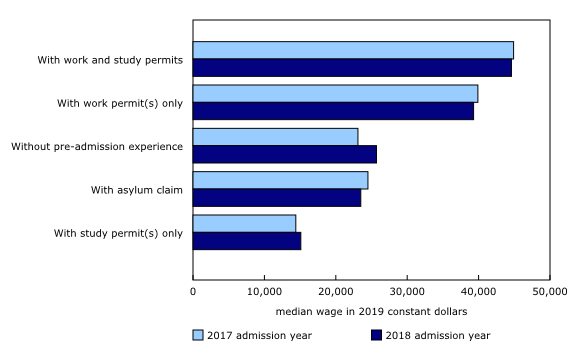
Pre-admission experience in Canada, particularly work-related, plays an important role in lifting immigrants’ wages, as it provides a pathway for immigrants to acquire language skills and knowledge of the Canadian labour market. Immigrant taxfilers having both study and work permits prior to immigration obtained the highest median wage one year after admission, both for those admitted in 2017 ($44,900) and in 2018 ($44,600). Immigrants only having work permits prior to immigration obtained the second highest median wage one year after admission ($39,900 for those admitted in 2017 and $39,300 for the 2018 admission cohort). Immigrants admitted with pre-admission work-related experience in 2017 and 2018 already had median wages higher than those of the Canadian population in 2018 ($38,200) and 2019 ($38,800), respectively.

Immigrants without pre-admission experience had lower median entry wages than immigrants with Canadian work experience prior to their admission. Their median entry wage was $23,100 for those admitted in 2017 and $25,700 for those admitted in 2018.

Among immigrants with pre-admission experience in Canada, those with study permits only prior to admission had the lowest median entry wages in 2018 ($14,400) and 2019 ($15,100). However, this group of immigrants is on average younger than their counterparts in all other groups, and therefore has a strong potential to increase their earnings as their careers unfold in the Canadian labour market. Furthermore, they are also more likely to have part-time jobs; information about whether or not their employment was full-time, full-year is unavailable.

Chart 1  
Median entry wage of immigrants admitted in 2017 and 2018, by pre-admission experience

Chart 1: Median entry wage of immigrants admitted in 2017 and 2018, by pre-admission experience

Median wages increase over time with different outcomes for men and women according to their immigration category

When tracking changes over time, a focus on immigrant men and women admitted at age 18 or older in 2009 shows that median wages increased across all immigration categories and for both men and women from 2010 to 2019. However, such increases benefited immigrant men and women differently.

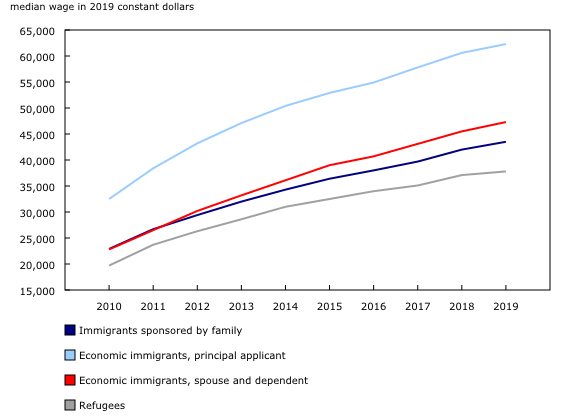
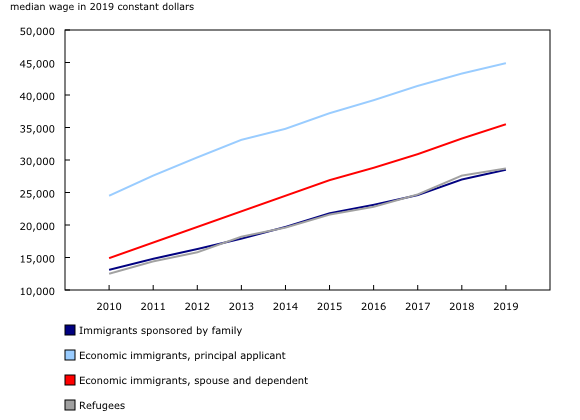
Both economic principal applicant men and women admitted in 2009 had median wages far above those of their counterparts in all other categories throughout the 10-year period. The median wage of men nearly doubled, from $32,500 in 2010 to $62,300 in 2019, with an average annual increase rate of 10.2%. The median wage of their woman counterparts nearly doubled as well, from $24,500 to $44,900 over the same period, with an average 9.3% annual increase. Among economic principal applicants, women’s median wage started lower than men’s and men’s median wage increased faster than women’s. As a result, the median wage gap widened between men and women over time in favour of men.

The opposite pattern is observed among all other immigration categories. Although women’s median wage was even lower than men’s within each of those categories, it increased faster than men’s. During the 10-year observational period, men’s median wage increased among economic dependents, refugees, and family sponsored immigrants with average annual increase rates of 11.9%, 10.2% and 10.0%, respectively. The average annual rates of increase for women were 15.4%, 14.4% and 13.1%, respectively, for economic dependents, refugees and family sponsored immigrants. With women’s higher increase rates of their median wages, the median wage gap narrowed between men and women within each of those immigration categories over time in favour of women.

Chart 2  
Median wage of immigrant men admitted in 2009 by immigration category, 2010 to 2019 

Chart 2: Median wage of immigrant men admitted in 2009 by immigration category, 2010 to 2019

Chart 3  
Median wage of immigrant women admitted in 2009 by immigration category, 2010 to 2019

Chart 3: Median wage of immigrant women admitted in 2009 by immigration category, 2010 to 2019

Pay ratio of immigrant women versus men increases over time for all immigration categories except economic principal applicants

Pay disparity between women and men is an important social, economic, and political issue. As immigration aims to respond to Canada’s need for labour supply, the gender parity and successful settlement of women in the labour market is key to achieving Canada’s objectives. To measure the median gender pay ratio, the median annual wages, salaries and commissions of women were divided by the median annual wages, salaries and commissions of men.

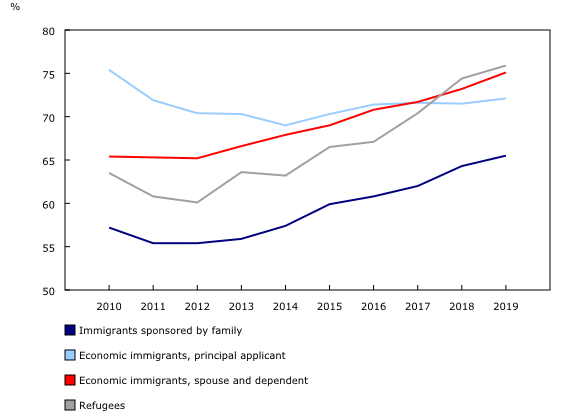
From 2010 to 2019, the gender pay ratio for Canadians increased from 67.9% to 72.6%. Among immigrants admitted as adults in 2009, the gender pay ratio followed a similar pattern: 65.5% in 2010 compared with 69.6% in 2019. The gender pay ratio, however, differed by immigration category during this period.

The increasing gender pay ratio was seen in all immigration categories, except economic principal applicants. From 2010 to 2019, the gender pay ratio increased from 57.2% to 65.5% among family sponsored immigrants, from 65.4% to 75.1% among dependents of economic immigrants, and from 63.5% to 75.9% among refugees.

For economic principal applicants, however, the gender pay ratio slightly decreased from 75.4% in 2010 to 72.1% in 2019. Further analysis would be required to understand the reasons behind this trend.

Chart 4  
Median pay ratio of immigrant women versus men admitted in 2009 by immigration category, 2010 to 2019

Chart 4: Median pay ratio of immigrant women versus men admitted in 2009 by immigration category, 2010 to 2019

Within immigration categories, the wage gap between women and men decreased overtime, except for economic principal applicants. Although the median wage of economic principal applicant women increased greatly over time, their man counterparts had a larger increase, resulting in a widening of the median wage gap between immigrant women and men.

This article is the first part of a two-part series about recent immigrants’ outcomes using data from the Longitudinal Immigration Database. The second part will discuss immigrants’ mobility.

Source: https://www150.statcan.gc.ca/n1/daily-quotidien/211206/dq211206b-eng.htm?CMP=mstatcan

Mohanty: Culture wars & claims of multiculturalism

Interesting commentary from an Indian perspective:

DESPITE the claim of universality, we are far from finding conclusive answers to the multiculturalism debates in the media, academia and the larger community today. The British philosopher C.E.M Joad once observed: “Socialism is like a hat which has lost its shape, because everybody wears it.”1 In a similar manner, Nathan Glazer’s book We are all Multiculturalists Now2 seems to suggest that multiculturalism has come of age. What began as an attempt to reform pedagogy in the Eurocentric context has acquired, over the years, the nature of a ‘culture war’ in the name of multiculturalism, which threatens to Balkanise societies the world over. What may be the answers to this crisis? Is multiculturalism a battleground or a meeting ground?

Recent scholarship at the international level has questioned the dominant paradigms of national identity. For instance, in The Politics of Culture in the Shadow of Capital,3 the critic Lisa Lowe brilliantly unmasks the contradictions between the emergence of the United States’ economy in search of cheap labour and the role of the political state that ensured “the disenfranchisement of existing labour forces to prevent accumulation, by groups of Chinese, Japanese, Filipino and South Asians”. Thus, it may be logical to conclude that “immigration has been historically a locus of racialisation and the primary site for the policing of political, cultural and economic membership in the U.S. Nation State”.4

The intersection between politics, society and culture has led to newer understandings, a welcome shift, in the U.S. for instance, from the concept of the American melting pot to that of the salad bowl or the mosaic and beyond that to the notion of hyphenated identities5 and multiculturalism that act as a beacon for a liberal order. It has significant implications for postcolonial nation states like India as well. Many issues of multiculturalism nevertheless remain unresolved. We need to make a deeper inquiry into the movement and its underlying philosophy if we are to go beyond the commonly accepted “feel-good” factor that societies and individuals often adopt as an easy palliative.

Key questions

The problems of multiculturalism could be articulated in a series of questions: How do we determine our individual and collective self-image? How to resolve our allegiance to the multiple identities—linguistic, ethnic, national and global—that participation in a democratic order entails? How is the question of our collective identities linked to our view of the past? How shall we retrieve alternative pasts and submerged memories? How much of the memories of this past shall we retain and how much of the trauma and nightmare shall we abandon? Some of the answers are being attempted by feminist projects of archival retrieval and some in the fields of Holocaust studies, for instance.

A challenge is to ask whether these seeming divergences could be harmonised by a multicultural thinking under the larger umbrella of inclusiveness. How can such inclusiveness be promoted in literary, cultural and ethnic terms in the context of embattled marginalised groups? This is easier said than done. Modern societies have not fashioned the magic tool that can harmonise rival claims.

I had an opportunity to pose some of these questions to Edward Said, one of the most distinguished thought leaders of the 20th century, at the international seminar on “History and Literature” in Cairo, Egypt, in 1994. His answers were full of insights and illuminations. We need to highlight, he said, “the face of the many dissenting traditions”, of women, of coloured people, of culturally marginalised groupings and of modern nation states. He added: “It is better to offer resistance to the bigger monolithic nation that has always usurped the state apparatus for its hegemonic role.”6

Literature and multiculturalism

We must begin the exercise by asking the most basic question: How is literature related to multiculturalism since that is the primary academic discipline where the problem appears to have originated? Literature has traditionally been defined as a body of canonised texts. To canonise is to valorise, to impose values upon texts. Shakespeare is mandatory reading in the classroom, it is argued, since his texts are viewed as transcultural and transhistorical. In other words, he has “stood the test of time”.

In recent years, however, this traditional view of the literary canon and canon making has been challenged on literary, theoretical, pedagogic, demographic and cultural grounds. The canon is seen as ahistorical; it must give way to an alternative perspective that reflects the changing literary climate in consonance with alternative theoretical paradigms and the needs of an increasingly diverse student population.

The romantic-modernist conception of literature accorded uniqueness to the text and the author. It lent singularity to the creative artist and the literary artefact. William Wordsworth spoke of the “inward eye”;7 S.T. Coleridge, in his celebrated Biographia Literaria,8 theorised about the “Primary” and “Secondary Imagination”, holding the latter to be the unique attribute of the “authentic” poet; for William Blake, the “true God was the human imagination”;9 in his Defence of Poetry(1821), P.B. Shelley defined poets as “the unacknowledged legislators of the world”; and, finally, to John Keats, who said: “If poetry comes not as naturally as leaves to a tree, it had better not come at all.”10 It was the mind of the poet that gave birth to poetry and art, and therefore, this mind and heart were held as sacred and sacrosanct. All other aspects such as the sociopolitical, ideological and contextual factors may have had a role to play, but they were invariably held as subordinate and secondary.

Radical critique of the canon

Such views of art and artist were seen as elitist, a reflection of the long-cherished Euro-American “high modernism”. Four volumes, pivotal in nature, may be cited in this context: Richard Ohmann’s English in America: A Radical View of the Profession, 1976;11 Alvin Kernan’s The Death of Literature, 1990;12 Gerald Graff’s Literature Against Itself: Literary Ideas in Modern Society, 1982;13 and Leslie Fiedler’s What Was Literature?: Class, Culture and Mass Society,1982.14 Varied groups of multiculturalists such as feminists, minorities, African Americans, Hispanics and, in India, Dalits and Adivasis attacked the view—considered axiomatic and self-evident at one time and unquestioned for long—as flawed, narrow and exclusive for excluding and marginalising the literary-cultural experience on political grounds.

Conservative backlash

In America, it led to a conservative backlash. Four books that became in due course bestsellers in the mainstream media may be mentioned here: The Closing of the American Mind by Allan Bloom (1987),15 Cultural Literacy: What Every American Needs to Know by E.D. Hirsh (1987),16 Tenured Radicals: How Politics has Corrupted Our Higher Education by Roger Kimball (1990),17 and Illiberal Education: The Politics of Race and Sex on Campus by Dinesh D’Souza (1991).18

In The Closing of the American Mind, Bloom laments how American students have fallen victim to mindless destruction by treating all traditional literature as oppressive and reactionary.19 Similarly, in his 1987 book, the conservative critic Hirsh regrets the state of academic affairs. “To be culturally literate,” he argues, “is to possess the basic information needed to thrive in the modern world.”20 Much of this knowledge, he maintains, lies in texts of European origin. Cultural relativism, he argues, is not likely to lead the American youth anywhere.

The attack against the traditional literary canon and syllabi began in America, famously in the Stanford Movement in 1985 wherein large sections of black students on the Stanford University campus protested against William Bennett, the Conservative U.S. Secretary of Education, and demanded inclusion of texts they could relate to, those that were historically denied to them by the faculty and academic administrators, dominated for long by upper-class white males.21

Inspired by this movement, protesters occupied the offices of deans, provosts and presidents in various American campuses. The protest had the desired effect: hiring policies were changed; syllabi were altered; anthologies such as The Norton Anthology and The Heath Anthology of American Literature underwent changes to reflect newer approaches to the study of works by women, minorities and the historically marginalised groups in schools and colleges; and researchers in the field produced new textbooks

The disciplines of history, literature, philosophy, sociology, anthropology and psychology found greater acceptance in the context of the emergence of identity politics. With immigrants of colour and diverse ethnic and class backgrounds around, liberal democracies in the West began to listen to the voices of multicultural thinkers such as Charles Taylor and Anthony Appiah when it came to city planning and citizenship rights. Despite such progressive measures, present-day America appears to be beset with serious problems in the classroom. For instance, a recent article entitled “Culture War, Academic Freedom, Teaching History”,22 reports: “Between January and September 2021, 24 legislatures across the United States introduced 54 separate bills intended to restrict teaching and training in K-12 schools, higher education, and state agencies and institutions. The majority of these bills target discussions of race, racism, gender and American history, banning a series of ‘prohibited’ or ‘divisive’ concepts for teachers and trainers operating in K-12 schools, public universities, and workplace settings. These bills appear designed to chill academic and educational discussions and impose government dictates on teaching and learning. In short: They are educational gag orders.”23

Lasting changes: new historicism

Despite resistance from conservative sections of the legislature and the political establishment in America, it must be admitted that the changes in the direction of multiculturalism have been deep and lasting. In Marvellous Possessions: The Wonders of the New World,24 Stephen Greenblatt, the founder of the influential school of new historicism, offers a profound meditation on Christopher Columbus’ discovery of America, redefining in the process the relationship between mainstream and marginal cultures. He makes a fundamental distinction between Columbus and Sir John Mandeville as travellers. In contrast to Mandeville, who travelled for travel’s sake, Columbus, he argues, was carrying a passport, royal letters and edicts. He was on a state-sponsored mission. He offers not an account of a battle but a series of “speech acts” and “proclamations” by which he takes “possession” of the islands, followed by the giving of names. For him, taking possession is primarily a set of “linguistic acts”, “decoding, witnessing and recording”. He is not only the medium through which the crown could take possession, he also “enacts the ritual of possession” on his own behalf and on behalf of his descendants.25

Secondly, argues Greenblatt, Columbus invokes the medieval concept of natural law, according to which “the claim to sovereignty” is by “the right to discovery”. That is to say, if you discover a land, you have the right to own it. Therefore, Columbus “empties the land” by making it uninhabitable, terra nullius. He denies the natives linguistic competence. At landfall, he decides that he has offered to serve Portuguese, English and Spanish monarchies. All “rituals of naming”, Greenblatt argues, are “the rituals of possession”. Columbus therefore goes on a naming spree: San Salvador, El Salvador, and so on. The “claim of possession” is grounded in “the power of wonder”. Columbus never gives up hope. God, he declares, “spake so clearly of these lands by the mouth of Isaiah in many places of the Book… His holy name should be spoken to them”. Here is an extraordinary manner in which Columbus’ “discovery” of America is given a multicultural reading; the lessons here are applicable to all societies and cultures that strive to go beyond inequities and injustice.

The learning and education can begin in the classroom, and therefore, the classroom becomes the primary locus for multicultural thinking and action. Properly taught, the classroom becomes not a battleground but a meeting ground. Gerald Graff’s “staging the debate” is an outstanding example of such dialogues in the classroom that promote, in a Socratic manner, critical thinking rather than rote learning and indoctrination.

Greenblatt’s project in revisionist history cannot be comprehended without a critique of the Enlightenment model of modernity (and capitalism) that logically leads to colonisation of the world.

As the historian Dilip Menon correctly states: “The term modernity comes to us masking both its origins within a distinct geographical space as well as an imagination almost entirely concerned with a description of change in Europe and America (what we refer to euphemistically as the West). It is precisely because the term modernity appears to be neither temporarily nor geographically grounded that there is increasing suspicion towards its relevance as a term for understanding historical change.”26

Multicultural education

Thus, what is valid for Europe is not necessarily applicable to the rest of the world. Each nation, community and groups of people must be allowed to shape their destiny, their systems of thought and governance. Approaches to multicultural education vary. In his seminal book, Multiculturalism and the Politics of Recognition (1992),27 the eminent Canadian theorist Charles Taylor advocates public institutions recognising particular group identities as part of multicultural education, and others like Stephen Rockefeller caution against a particular cultural identity over the universal identity of democratic citizens. Yet others, like Susan Wolf, see the need to correlate the demand for multicultural education with the American sense of who they essentially are.28

On the other hand, in his book, Identity Against Culture: Understanding of Multiculturalism (1994), Kwame Anthony Appiah, one of the leading exponents in the field, voices “the need and possibilities of maintaining a pluralistic culture of many identities and subcultures while retaining the civil and political practices that sustain national life in the classic sense”.29

The future of multiculturalism

On the basis of the above reflections, we could come up with the following tentative conclusions:

First, despite the setback in electoral politics, multiculturalism is here to stay; it addresses fundamentally and inescapably the demographic and democratic concerns of learners and the citizenry across class, caste, region and ethnicity. It must remain resilient, flexible and imaginative and respond to changing demands and times in a creative manner.

Secondly, multiculturalism must not be equated with identity politics of a narrow, sectarian and dogmatic kind that leads its acolytes and followers to a dead end. The answer to Orientalism, Edward Said tells us wisely, is not Occidentalism. Nor does it envisage revenge history, violence and annihilation of the “other” in the name of rectifying historical wrongs, both real and imaginary, through acts of revenge and reprisals. Rather, it calls for truth and reconciliation through acts of reading and acts of atonement. Lessons very relevant for contemporary India, which finds itself tragically polarised across caste, community, religious and ethnic lines.

Thirdly, multiculturalism does not envision a set of windowless boxes, erection of walls or ghettos that block communion; rather it stands for dialogues, for mutual understanding, for mutual benefit and welfare. It eschews all self-righteous acts of contempt and condemnation in favour of understanding and acceptance.

Fourthly, multiculturalism does not suggest that the answer to Eurocentrism is Afrocentrism. While all forms of anthropocentrism are abhorrent, the primacy of any systems of thought in a hegemonic manner over others leads to asymmetry in cultural transactions among communities and nations.

Next, multiculturalism entails allegiance to multiple loyalties: to the individual, the family, the commune, the province, the nation and the world in a non-hierarchical manner; that is to say, not one at the cost of the other. To realise the truth of the one, one needs to simultaneously see the truth of the others. This relationship is not based on self-interest in the narrow sense of the term. It must not be mercenary; it must encompass the deeper core of our being and seek to realise the greatest good of the largest number of the people and organisations, especially the deprived and the dispossessed.

It must accept cultures and life values of individuals, groups and communities without force or duress of any kind. Most of all, it must not look at the market or the state as the arbiter of individual or social behaviour. At the deepest level, this approach will enable us to give up the habitual binary of the modern mind and embrace the deeper core of our being, indeed our psychic and spiritual selves, as Soren Kierkegaard, Gandhi, Sri Aurobindo and other existential/spiritual thinkers have taught us.

The new culture in the academia, as I see it, believes in democratic pluralism. The main problem of democratic pluralism, as Patrick J. Hill suggests, “is less that of taking diversity seriously than that of grounding any sort of commonality. It is the problem of encouraging citizens to sustain conversations of respect with diverse others for the sake of their making public policy together, for forging over and over again a sense of shared future.”30

It is in the search for a shared future that multiculturalism will find its true meaning.

Sachidananda Mohanty is a former professor and Head of the Department of English, University of Hyderabad. Winner of many national and international awards, he has published extensively in the field of British, American, gender, translation and postcolonial studies. He is a former Vice Chancellor of the Central University of Odisha.

Source: Culture wars & claims of multiculturalism

Moving toward effective anti-racist policy analysis

Overly general and too high level IMO. And would it not make more sense to strengthen the existing GBA+ frameworks to capture the various intersectionalities, rather than creating yet another framework that further complicates analysis and possible policy measures:

Canadians continue to look to governments for policy responses that reflect the world we live in. This includes an expectation that governments will take a leadership role in addressing racial discrimination, equity and human rights in our society. For their part, Canadian governments are increasingly speaking of anti-racist policy approaches, ever aware that while transformational social and economic changes are well underway, there are still significant issues of racism and racial discrimination in our policy-making systems.

A substantial gap exists in policy literature and practice about what anti-racist policy analysis actually looks like. People who engage in it – professionally inside and outside government, as well as on a more informal basis – should be able to draw on accessible frameworks that can be applied quickly and effectively.

Anti-racist policy analysis is a crucial part of elevating Canadian policy-making. Continuing to ignore the long-standing effects of colonialism and ideas of racial hierarchy perpetuates racial discrimination, even when it is not intentional. Ideas of racial hierarchy that underpin the racialization of some groups are institutionalized in Canadian policy systems and are still finding their way into the fundamentals of policy processes. These underlying dynamics, which are at times brought to light, are undermining our collective well-being, including the effectiveness of Canadian policy-making.

Anti-racist policy analysis illuminates gaps in decision-making

Consider the federal government’s announcement in October that it would end the Canada Recovery Benefit (CRB), successor to the Canada Emergency Response Benefit (CERB). Its comments that the economy has recovered 100 per cent of the jobs lost during the pandemic represented a perspective that discounts the experiences of communities that continue to be marginalized by Canadian public policy.

It was also a key opportunity to use anti-racism policy analysis to present a fuller picture of the dynamics involved in pandemic and post-pandemic income-support policy. This analysis would have clearly shown the importance of transitioning temporary supports into longer-term policy solutions that respond to the potentially significant economic effects of the pandemic that can disproportionately affect groups that are racialized. This was the time policy leaders could have acted on promises of inclusion and equity they often speak of.

Taking an anti-racist approach would have, for example, highlighted the fact that several groups that are racialized, including Canadians who identify as Black, were still experiencing higher levels of unemployment as of September 2021 compared with groups that are not racialized (or not a visible minority).

Statistics Canada has reported that people who are categorized as visible minorities in Canada were harder hit than others by the social, economic and health impacts of the pandemic and were more likely to have received CERB. Specifically, workers who identified as West Asian (50.8 per cent), Southeast Asian (48.3 per cent), Arab (45.4 per cent), Korean (43.3 per cent), Black (43 per cent), and Latin American (41.8 per cent) were more likely to have received CERB payments, compared with 32 per cent of those who were not categorized as visible minorities. It was also reported that Indigenous workers were more likely than non-Indigenous workers to have received CERB payments in 2020.

These findings highlight the unavoidable racial dynamics involved in income-support policy-making. We know that groups that are racialized, particularly African-Canadian communities, disproportionately experience lower incomes food insecurityprecarious or inadequate housing, and challenging employment outcomes.

In a clear demonstration of the impact of racialization, a recent publication based on 2005-14 data from the Canadian Community Health Survey (CCHS) found that being racialized as Black is a major factor shaping food insecurity for people of African descent in Canada. Using 2017-18 data from the CCHS, a national analysis of food insecurity also found that the highest rates in Canada were among households that identified as Black, at 28.9 per cent, and those that identified as Indigenous, at 28.2 per cent.

We know these policy outcomes stem from centuries of racialization and racial discrimination that have become institutionalized in Canadian policy systems – these policy systems have routinely prioritized the interests and well-being of groups placed at the top of racial hierarchies, while minimizing the interests and well-being of groups that are racialized. Anti-racism policy analysis is crucial to illuminating and eradicating the effects of racialization in policy processes and systems.

Policy analysts, leaders and observers can help to enhance policy processes and improve outcomes with tools like the Anti-Racism Policy Analysis Framework that I have developed. As a guide for policy analysis, this framework takes a human-rights-driven approach to identifying specific areas where racism and racial discrimination often lurk in policy processes. Anti-racist frameworks that support elevated policy-making are essential parts of the toolkit for all individuals, groups and organizations that participate in policy systems.

Anti-racist policy analysis supports core Canadian values

Governments must accept that while their policy designers and decision-makers may not intend to perpetuate racial discrimination, a failure to respond to racism in policy systems leads to the exclusion of groups that are racialized. This is not just counter to our collective values of inclusion and equity, it also affects Canadians’ trust and confidence in the political competencies of Canadian governments.

Demonstrating anti-racism policy leadership in government requires prioritizing the elimination of racial discrimination from the earliest stages of agenda-setting and when allocating resources to policy initiatives.

Governments should openly recognize the impact of institutionalized racial discrimination, and take meaningful action to repair and rebuild relationships with affected groups. This can include statements in policy announcements acknowledging that Canadian policy legacies have led to deep disparities in socioeconomic outcomes, and affirming that healing these disparities requires focused, intentional anti-racist policy action.

Moving toward effective anti-racist policy-making also requires governments to take strategic approaches to policy development, such as tying policy initiatives to broader government objectives around equity and co-ordinating anti-racist policy approaches with other orders of government. Additionally, governments are asked to meaningfully engage groups that are racialized throughout policy design and implementation processes.

Accountability and transparency are core aspects of anti-racist policy-making. Governments are asked to ensure that there is open access to information that goes into policy decision-making, and that people have tools between elections to hold policy-makers accountable for decisions that have a significant impact on their well-being.

Envisioning Canadian public policy of the future

Anti-racist policy analysis is not only about identifying obvious instances of racial discrimination in public policy. Rather, it is most relevant in our society as a tool that shines a light on deeply entrenched policy legacies, conventions and traditions that marginalize and ignore the priorities and well-being of groups that are racialized.

Policy responses in the near future will increasingly require a high level of capacity to apply and operationalize analytical frameworks that help to eliminate racism and racial discrimination in government decision-making. Policy analysts and community members who engage in policy processes should be able to draw on accessible frameworks that can be applied quickly and effectively. Instead of addressing issues of institutionalized racism on an ad-hoc basis, policy analysts and leaders should be equipped with the tools to enable high quality, dynamic analysis through all stages of policy processes, from agenda-setting and policy formulation to policy implementation and evaluation.

Anti-racist policy analysis is also a part of how Canadian governments can work to earn the trust of groups and communities that have experienced centuries of discrimination at the hands of policy systems. Treating people with respect and love that honours their humanity is at the core of anti-racism, and that is a worthwhile priority for all Canadian governments.

Kimberly Nesbeth is a freelance policy analyst and founder of Elevate Policy, a social-purpose consulting platform that connects people with policy processes. 

Source: https://irpp.us7.list-manage.com/track/click?u=f538f283d07ef7057a628bed8&id=377dff53ca&e=86cabdc518

Canada’s health and settlement systems are failing newcomers. It’s time for a new system of care

More theoretical than practical given the fragmentation within and between sectors an the jurisdictional issues:

Last year, the federal government announced its intention to welcome over 1.2 million immigrants to Canada by the end of 2023. The truth is, however, that our care systems are not ready to adequately support those newcomers upon arrival — and here’s why.

Right now, Canada’s health care system and settlement services have operated in silos and are funded by different levels of government. This is creating large gaps in services, with newcomers falling right through them. The fact is many newcomers come to Canada in better health than the rest of the population. Yet, their health and wellness tend to rapidly decline during and after settlement. Some reasons for this could be due to not having secure housing, access to health care, and/or enough to eat. 

So, what is a solution to these problems? Two words: Integrated care.

Integrated care connects newcomers with a seamless suite of co-ordinated and holistic health and settlement services, including mental health care, employment services and access to food security. Existing integrated care programs offered by health agencies and community organizations, like WoodGreen Community Services’ Inter-Professional Care Program, offer solid proof that integrated care can improve systems of care for newcomers, predominantly in two ways. 

Firstly, integrated care can improve the efficiency, cost-effectiveness and sustainability of care systems by breaking down silos between health, settlement and other services. 

As a people-centred approach, integrated care organizes services around the needs and perspectives of newcomers. This improves continuity of care and allows newcomers to gain timely access to the services they need through any door, without the burden of system navigation. Integrated care also reduces the risk for duplication of work and may minimize high-cost services, such as hospital admissions, by diverting clients away from the emergency room and encouraging a shift to preventative care.

The second main (and particularly timely) benefit of integrated care is that it helps service providers feel less burned out.

Burnout is prevalent among care professionals, a factor which has been proven time and again throughout the course of this pandemic, and which is often linked to reduced patient satisfaction and health outcomes. Statistics Canada reported that, in early 2021, the health-care sector saw one of the largest annual increase in job vacancies compared to other sectors, with a particular increase in job postings for nurses.

By building and co-ordinating relationships and support between providers, integrated care has been found to combat burnout and improve job satisfaction and well-being.

To be clear, integrated care in Canada is not a new thing. The challenge is that an integrated approach to health care and settlement services is not being implemented at a scale that can successfully settle Canada’s incoming and recently settled migrants.

Policy-makers, in collaboration with settlement providers, community agencies, health-care organizations, and other stakeholders, can help to address this issue by:

  • Improving access to stable resources for settlement service providers and physicians to effectively implement integrated care;
  • Offering newcomers of all statuses access to services, including individuals with insecure legal status and people who have been in Canada for years; and
  • Requiring race-based and sociodemographic data collection to ensure organizations have the information they need to track health equity outcomes and evaluate program performance, among other recommendations.

If Canada hopes to achieve a successful and resilient COVID-19 recovery (where newcomers can contribute to the economy while maintaining their own socio-economic well-being), we must commit to better integrating our health and settlement care systems to ensure that newcomers don’t just come here to live — but to thrive.

Source: https://www.thestar.com/opinion/contributors/2021/12/03/canadas-health-and-settlement-systems-are-failing-newcomers-its-time-for-a-new-system-of-care.html?source=newsletter&utm_content=a02&utm_source=ts_nl&utm_medium=email&utm_email=A02AB30AB014E9AB29974E92EB3BFDCD&utm_campaign=top_90291