In Brampton, federal campaign pledges to boost immigration are creating friction among classes and generations

Good longish read, capturing some of the dynamics and different perspectives, highlighting that there is no monolithic ethnic or immigrant vote. New Canadians as well debate immigration levels, integration and the like:

There’s no better place to observe a cross-section of immigration than in a Tim Hortons in Brampton East.

Elderly women in shalwar kameezes who have been in the city for four decades order double-doubles in Punjabi from the international students, some of whom only landed in Canada months ago. Impatient construction workers, lawyers and realtors, almost all of whom are South Asian, idle in the drive-thru, some with Hindi slang on their vanity licence plates, on their way to and from work. Some came on student visas, others as permanent residents. Some were sponsored by family members, others were Canadian-born.

With such diversity, it’s easy to understand how meaningless the label of “immigrant voter” has become.

Ever since Pierre Trudeau’s Liberal government overhauled immigration policy in the mid 1970s, ushering in waves of newcomers, parties at election time have worked to capture the support of this population. And for more than a decade, they’ve taken particular interest in Brampton East and a collection of other suburban ridings near Toronto that are home to large immigrant populations. They’ve been crucial election battlegrounds, where party leaders have chosen to make major campaign announcements. Snapping up votes in the region – which has swung both Conservative and Liberal in the past – has become key to winning an election.

As Brampton East has grown into the federal riding with the largest proportion of South Asians (66 per cent), the diversity within its boundaries has grown too, along class, religious, ethnic and generational lines. There are vastly differing opinions in the riding among voters of South Asian origin on housing, jobs and – perhaps most divisive of all – immigration. Securing the so-called “immigrant vote” has become an outdated goal.

“We use these really big macro categories to talk about Canadians like ‘immigrants’ or ‘racialized’ or ‘Indigenous’ and we don’t have a lot of nuance in terms of the different priorities or preferences of the people within those,” says Erin Tolley, a political scientist at Carleton University and the Canada Research Chair in Gender, Race and Inclusive Politics. “I think the [federal] parties are a bit hamstrung when it comes to really understanding these nuances between immigrants from different backgrounds [and] immigrant streams.”


Within Jaskaran Dhillon’s household, the political divide when it comes to immigration strategy is stark. Mr. Dhillon, 22, is the Canadian-born son of parents who grew up in North India and lived in Bermuda before coming to Canada in 1997. He lives with his parents and his grandparents in a house in Brampton East, in a subdivision largely populated by Indians who immigrated in the nineties and aughts. He says he’s had “low-level debates” with family and community members about a hot-button issue throughout the riding: whether or not the high rates of immigration should be curtailed.

Since the Liberals under Justin Trudeau’s leadership came to power in the fall of 2015, winning back every Brampton riding from the Conservatives, Canada has accepted more than 330,000 permanent residents from India – and Brampton has absorbed a disproportionate number of them. Policy makers have promoted high immigration targets as the solution to Canada’s declining birth rate and labour shortage and those newcomers have come here to work in warehouses, restaurants and to drive trucks. This year, the target is landing 401,000 permanent residents, a goal immigration minister Marco Mendicino told the Globe in July his government would “make good on.” But some Indo-Canadians who came in previous waves of immigration, like Mr. Dhillon’s family, ask if this influx of immigrants – including those from India, the top source country – has been too fast.

“Immigrants when they come here kind of want to shut the door behind them,” Mr. Dhillon said of his parents’ generation. When they speak of themselves as the last great generation of immigrants, the ones who properly integrated into Canadian society, he believes they are seeking “validation from white people.”

Coming to Canada from India on a student visa is widely regarded as one of the easiest paths to permanent residency, and in the decade between the 2008-09 school year and 2018-19, the population of international students in Canada more than tripled, with India serving as the top source country for the past few years.

But Binder Singh, who immigrated to Canada in 1975 as a child, says allowing more younger arrivals on student visas or temporary work permits has brought out tensions in Brampton East. International students in particular are frequently the subject of conversation in local WhatsApp and Facebook discussion groups – blamed for the surge in COVID-19 cases in the second and third waves of the pandemic; for adding pressure to the wildly overheated housing market; even for the city’s famously high auto insurance rates.

Mr. Singh draws a distinction between immigrants who arrived in the city during his time and those who have settled in the country over the past few years. Mr. Singh says he believes there is far less integration happening now.

It’s a phenomenon that Victoria Esses, an immigration policy researcher and professor of psychology at the University of Western Ontario, has observed in many immigrant communities.

“The more established immigrants come to see themselves as prototypical Canadians,” Prof. Esses said. “These new guys who are coming in, they’re just reminding [the earlier immigrants] that they’re not that far away from them.”

Some of the established immigrants are hostile to any campaigning that might seem as though it’s targeting immigrants or even specifically their own ethnic community “if they think that immigrants aren’t being treated as well as Canadians,” she said. “So they want to dissociate [from the new immigrants].”

Catering to voters who would like to see the flow of immigration slowed could come at the cost of alienating others if it’s construed as racist or xenophobic. Prof. Esses points to the 2015 election, when Conservatives ran a campaign based on so-called “Canadian values” and proposed a tip line to report on “barbaric cultural practices.” Pundits point to this as one of the reasons why Conservatives lost every one of their 11 seats in Brampton and Mississauga that year.

In a paper published this year in the American Review of Canadian Studies, Western University political scientist Zack Taylor argued that the country’s reliance on international immigration for population growth has made it difficult for political parties “to ignore the electoral heft of ethno-cultural communities, which … are concentrated in the Greater Toronto region.”

Since the 1960s, Canadians who are foreign-born have been more likely than those who are Canadian-born to vote for the Liberal Party, but that allegiance began to erode in 2008, after major efforts by the Conservative Party to appeal to racialized immigrant voters.

Jason Kenney, the current Alberta premier who was then minister for citizenship, immigration and multiculturalism in Mr. Harper’s cabinet, was largely credited with helping the Conservatives win every seat in Brampton in 2011 by logging countless hours at gurdwaras, temples and community gatherings in the city, as well as giving interviews to media outlets run by South Asian immigrants.

The party had a strong appeal to the more established immigrants who had climbed their way into the middle class and felt they were paying more in taxes than they were benefiting.

Then came Justin Trudeau in 2015, a fresh new leader for Liberals whose charisma and platform appealed to a large swath of voters. Knowing how key the city was, Mr. Trudeau held his biggest rally of the campaign in Brampton – 5,000 people at the Powerade Centre – and with the Canada Child Benefit and a middle-income tax cut, won back the same middle-class, family-oriented voters the Conservatives had pulled in in 2011.

Mr. Singh said the importance of the individual candidates in Brampton East and surrounding ridings has greatly declined over the past few elections, and the focus is almost entirely on the party leader and platform.

In the 2021 election, the race in Brampton East is between Liberal incumbent Maninder Sidhu; Conservative Naval Bajaj (who ran an unsuccessful campaign in 2015); and the NDP’s Gail Bannister-Clarke. There are more campaign signs up for NDP Leader Jagmeet Singh – who represented this area as an Ontario MPP from 2011 to 2017 – than there are for Ms. Bannister-Clarke. On Wednesday night, in the final stretch of his campaign, Mr. Singh made a stop in Brampton.

Darshan Maharaja, a local political blogger who grew up in the Indian state of Gujarat then lived in Dubai before moving to Brampton in 2004, said many Punjabi Sikhs in Brampton see Mr. Singh (and his brother, who represents Brampton East in the provincial legislature) as one of “their own.”

“Jagmeet is their boy; he became the leader of the party so it’s vital pride for them,” Mr. Maharaja said.

Housing is another critical issue for many residents of Brampton East. When the subdivision of Castlemore was built in the 1990s, there were nothing but fields around it. Homes were still cheap in 2005, when Mr. Dhillon’s parents bought a house in the neighbourhood, but now he and his Canadian-born peers are contemplating leaving Brampton because it’s become so unaffordable.

From 2001 to 2016, the latest year for which data are available, the population in Brampton grew by 82 per cent, compared with 17 per cent for Canada as a whole, and that influx of people has driven up home prices dramatically. In July, the average price for a house or condominium in Brampton was just more than $1-million, the same as in Toronto.

The Liberals, Conservatives and NDP have all promised to increase the supply of housing in Canada through more construction, but also to help young people enter the market. In Brampton, the growing – but often invisible – population of renters wonders how those levers will do anything to improve their situation.

Most of the rental stock for newcomers is made up of apartments carved out of single-family homes – the cheapest options in an overheated market. International students and young workers often crowd into basement units. Fire inspectors have found as many as 20 occupants in a single dwelling, some sleeping on mattresses laid out on kitchen floors.

When Harjot Sarwara first arrived in Canada two years ago on a student visa from Punjab, he lived in Montreal with his wife and their daughter. He was completing a program at a career college, but the French-language barrier made it difficult for his wife to get steady work. So when it came time for Mr. Sarwara to begin his co-op, he and his wife set their sights on the city where so many people from back home had settled: Brampton. But finding a home for their family of three that wasn’t shared accommodation in a basement proved difficult.

“Every time when we ask anybody to rent a house or show a house, they asked what your status is. I said, ‘Yeah, I’m a student.’ They said, ‘No, we will not be giving a home to a student,’” he recounted.

“Due to some of the people from my community who do bad things or they don’t have a good relation with the owner, the whole community is blamed and people like me suffer,” he said.

After two months, Mr. Sarwara was able to find a three-bedroom rental for $2,350 a month. When he and his family moved in, construction was already well under way to convert the basement into a separate apartment.

In the 2019 election, the NDP improved on its previous showing and finished second behind the Liberals in Brampton East, its rise tied to Mr. Singh’s star power and a growing consciousness around worker rights among more recent arrivals and the children of established immigrants.

L6P, a neighbourhood in Brampton East that The Globe and Mail has written extensively about since the spring (the name refers to postal codes in the area), recorded the highest per capita rate of COVID-19 infections in Ontario during the second and third waves of the pandemic, much of that driven by its work force. The same essential workers who were staffing poorly ventilated warehouses and taking crowded transit to work were bringing COVID-19 home in record numbers. Some delayed seeking proper treatment or getting vaccinated because they couldn’t take time off to do so, or were unsure if they qualified, given their immigration status.

Kiran Gill, the daughter of Indian immigrants and a resident of L6P, saw first-hand the desperation of those workers, many of whom were newcomers from India.

During a job at a temp agency that staffs warehouses, Ms. Gill encountered individuals on student visas from India who spoke only Hindi or Punjabi – their English was barely functional – and some boldly asked if they could book hours beyond the 20 they were legally able to work each week, offering to receive their pay under the table.

Working at the agency helped Ms. Gill see how little opportunity there was for even the highly trained professionals who came to Canada with dreams of prosperity.

“I would see people with work permits and [permanent residents] who had great experience from other countries and couldn’t find work so they’d have to go through agencies to at least get warehousing work to make ends meet,” she said.

COVID-related job losses in the city were substantial, with 20 per cent of residents claiming the Canadian Emergency Response Benefit in 2020.

Ms. Gill said the government has to build systems that ensure these workers don’t struggle and add further strains on housing and health care.

Sparsh Sharma, a digital marketer who owns a townhouse in L6P and came to Canada as a permanent resident in 2017, says he often plays down where he lives out of concern for the stigma and stereotypes associated with Brampton and linked to the large population of newcomers. With a labour market made up mostly of low-wage, essential-services jobs, Brampton needs better employment opportunities that will attract and retain individuals like him, he says, who have professional degrees, international work experience and high scores on language proficiency exams.

At the same time, he says the students and those on temporary work permits “are the ones doing the heavy lifting” and are the biggest source of labour in the city. “We enjoy this sort of lifestyle [of greater prosperity ] because they are working behind the scenes for us.”

On Tuesday evening, in the final stretch of campaigning, the Liberal campaign bus pulled up to the Speranza Banquet Hall in Brampton East, where Mr. Trudeau and former prime minister Jean Chrétien spoke. Mr. Sidhu, the incumbent seeking re-election, warmed up the crowd of more than 400 supporters, most of them South Asian.

Though he’s been an MP for two years, Mr. Sidhu spoke little of his record, instead focusing his introduction on his identity – an attempt to connect with as many in the crowd as possible.

He referenced his parents’ backgrounds as Indian immigrants who arrived in the early eighties, toiled at warehouses for 18 hours a day to create a better life for him and his brother.

“This is not just my story, this is the story of so many in this room,” he said.
Source: https://www.theglobeandmail.com/canada/article-for-brampton-voters-campaign-pledges-to-boost-immigration-raise-hard/?utm_medium=email&utm_source=Morning%20Update&utm_content=2021-9-16_7&utm_term=Morning%20Update:%20Inflation%20hits%2018-year%20high,%20fuelled%20by%20pandemic%20factors&utm_campaign=newsletter&cu_id=%2BTx9qGuxCF9REU6kNldjGJtpVUGIVB3Y

German election: Are immigrant voters ignored?

Of interest. Sharp contrast with Canada:

Over 60 million people are eligible to vote in Germany’s general election on September 26. But one group is often overlooked by politicians and parties: voters with an immigrant background, many of whom have roots in Turkey, Syria, or the former Soviet Union. That group comprises some 7.4 million voters, a full 12% of the electorate.

Although that number is considerable, this group of voters is rarely addressed directly, says social scientist Sabrina Mayer.She is currently working on a study on people with a migration background in Duisburg, a multicultural city in North Rhine-Westphalia, Germany’s most populous state. She drives around the city a lot, she says, and is a little surprised “that in such a city, people with a migration background are so rarely addressed directly with topics on campaign posters.”

This could be one reason for the low turnout among people with a migrant background. In the last federal election in 2017, this was around 20% below the average. This  phenomenon can become a vicious cycle, says Mayer: “If a group does not feel addressed, then they vote less often, and so the incentive for the parties to take up the issues is reduced, which is why the turnout continues to fall.”

Getting people to the polls is a problem that social activist Ali Can knows very well. The initiator of the Twitter hashtag #MeTwo, which is supposed to draw attention to discrimination, was born in Turkey, is of Kurdish origin, and fled to Germany with his family in 1995. Can is also fighting for a higher electoral turnout among people with immigrant roots.

One project he launched for the parliamentary elections is a multilingual electoral assistance app. “In the 21st century, getting help to vote should not have any barriers,” he told DW. But alongside providing information about the voting procedure and the candidates, getting people to the polls calls for a multifaceted approach that appeals to people’s emotions. “We have failed to give people with a migration background the feeling that they also belong in Germany,” he said.

Little scientific data

Little is known about which migrant groups vote which party and why. Targeted studies would be necessary to gather a clearer picture, but they cost money and then often only include the largest migrant groups.

The Konrad-Adenauer-Stiftung (KAS) is a German political foundation affiliated with Merkel’s ruling Christian Democrats (CDU, which holds power with its Bavarian sister party, the Christian Social Union (CSU). The KAS foundation carried out two such studies, in 2015 and 2019, with a focus on the three largest migrant groups in Germany. These are people with Turkish (2.8 million), Russian (1.4 million), and Polish (2.2 million) migration backgrounds.

Few parties directly address immigrant voters with their election posters

In two groups, the result remained relatively constant for a long time, according to one of the studies: “Persons arriving more recently from Russia voted above averagely often for the CDU and CSU; people of Turkish origin for the Social Democrats (SPD).” For a few years now, however, “fixed patterns” have been weakening, and instead, there is a “high degree of mobility across political party lines.” The studies show that many of those who were of Russian origin and who were eligible to vote migrated from the center-right CDU/CSU to the far-right Alternative for Germany (AfD); those of Turkish origin no longer remained loyal to the center-left SPD, but instead more often voted for the CDU/CSU. When it came to Germany’s large Polish community, the Green Party benefited from the shift in voter loyalty.

A good sign for democracy

This new mobility at the ballot box should be seen as a sign of “normalization,” say the KAS foundation researchers. After all, mobility in elections has increased in general, including in the rest of the German population. Mayer also sees it this way: “Party loyalty is declining, decisions are made based on topics and what appeals to individuals is what counts, instead of people just voting as a bloc for a party that has always been associated with their own group.”

But the parties do not seem to want to take advantage of this opportunity. “People with a migration background represent a considerable electoral potential for political parties,” according to the organization “Citizens For Europe.” However, that is on the condition “that they adapt what they’re offering and their political platform to the increasingly diverse electorate.” In many cases, according to the Mediendienst Integration, a press service focusing on migration and integration issues, many of the topics that matter most to immigrants are ignored by politicians.

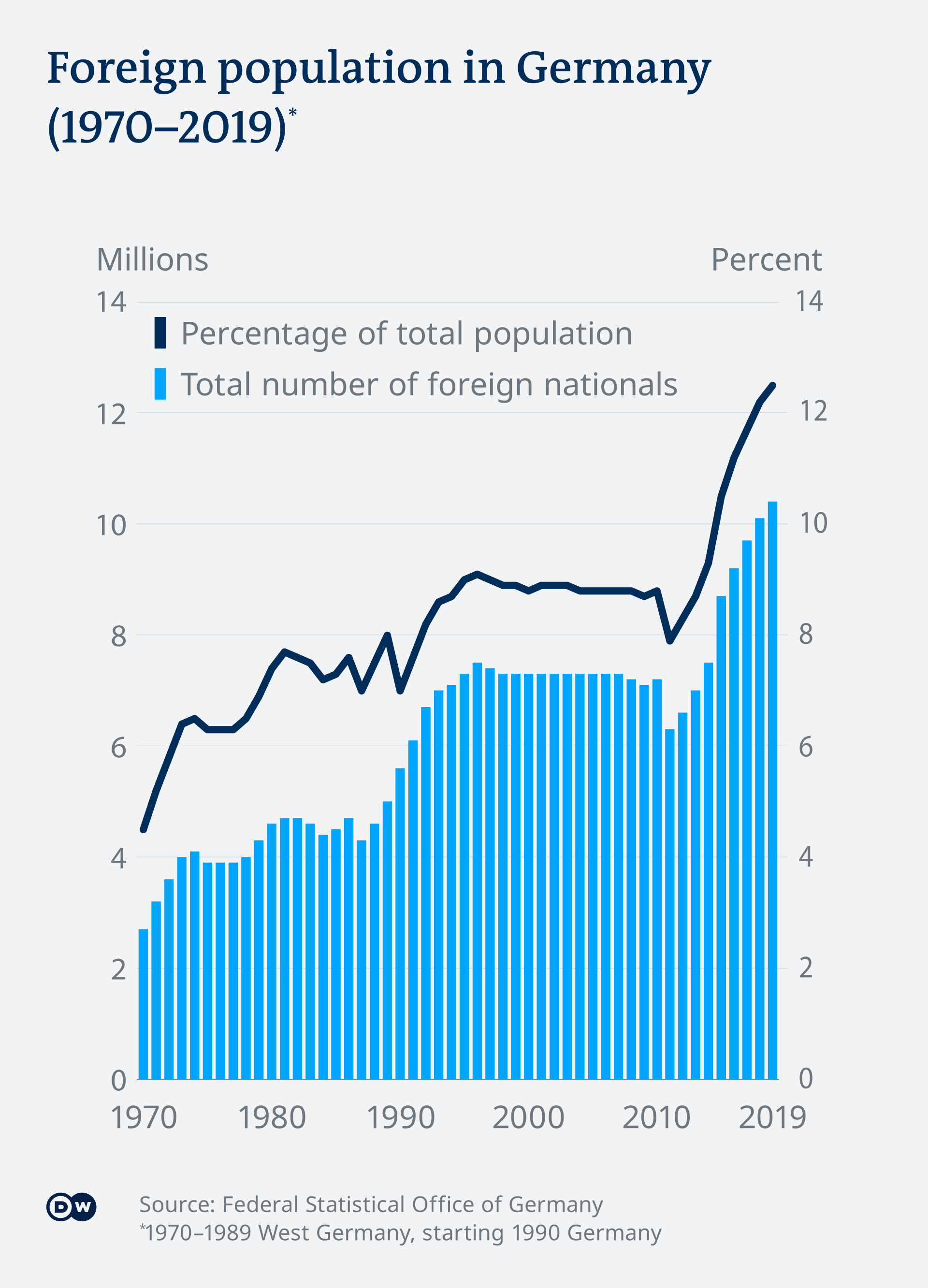
Infografik Ausländische Bevölkerung Deutschland EN

Even if eligible voters with non-German roots are taken into account, there are nearly as many people living in Germany who are of voting age but totally shut out of the electoral process: those with a foreign background who are not allowed to vote here because they do not have German citizenship. That’s 8.7 million people.

Having more representation of people with international backgrounds among the political class, for example, could counteract this. But for now they remain rare in Germany’s parliament, the Bundestag: Only 58 of its 709 members have non-German roots.

Source: German election: Are immigrant voters ignored?

Election Immigration Platforms 2021 – Podcast

Further to my party platform comparative table and analysis, Will Tao and Lou Dangzalan had me on their podcast:

In case not seen, my comparative table:

Matt Gurney: We know who the PPC voters are. Here’s what they believe

Interesting polling data on PPC supporters:

Poll after poll has shown that the People’s Party of Canada, led by former Conservative Maxime Bernier, is surging in popular support. The party, which captured only 1.6 per cent of the vote in 2019, electing zero candidates, is now polling at closer to five or six per cent, or higher. These gains have not come at any obvious loss to any major party (the hapless Green party may be an exception, but there were only so many Green voters in the first place). While there is no doubt that some voters are bolting to the PPC from traditional parties, it seems certain — and polling suggests — that they are also drawing support from the nine million Canadians who were eligible to vote in 2019 but did not. 

This is, to put it very mildly, worth watching. In a recent column here, drawing on polling information provided by John Wright, the executive vice president of Maru Public Opinion, we tried to establish what we could about a PPC supporter. They are not particularly remarkable; as noted last week, a typical PPC voter is a typical Canadian. They are fairly evenly distributed across all demographic segments and found in generally similar numbers in the various provinces. The earlier numbers were based on a fairly small sample size — the PPC’s low support on a national level has limited their numbers in any typical national-level poll. Last week, I said that more polling was necessary, to firm up the profile of who a PPC voter is and where they live. Wright has been doing that polling — the sample sizes are still modest, but a representative profile is beginning to emerge …  not just of who a PPC voter is, but what they believe.

There is a degree of background context that must be established before we can move onto the numbers. When he presented me with his latest results on Tuesday, Wright noted that polling PPC voters is a particular challenge for his industry. The very concept of “the typical PPC voter” is rapidly shifting. The PPC base of even five weeks ago was a small fringe of grumpy people loosely assembled around a handful of vaguely libertarian policies, some anti-immigration blather and a disillusionment with the political status quo. (A typical PPC billboard encapsulates this unfocused dissatisfaction: “The Other Options Suck.”) Many polling companies track the attitudes of partisans of various affiliations by creating a panel of those partisans and then polling them over and over. Polling companies trying to track the PPC’s sudden rise, if they rely on such an identified panel of PPC voters that will be repeatedly surveyed, are capturing the PPC as it existed before the mid-August influx of new supporters. This is undoubtedly skewing our understanding of what the PPC voter, as they exist right now, believes. Wright has done four waves of polling in the last 10 days to update, as best as possible, our understanding of what the PPC voter believes today. He will continue to poll several times a week for the foreseeable future. 

As to that August surge, as discussed in my column here last week, the best way to explain it is to look for something that recently changed — and something has: there are millions of Canadians who are adamantly anti-vax and anti-vaccine mandate/passport. The PPC surge began at the precise moment that vaccine mandates became a major issue in the federal campaign, and provinces began discussing their plans for certificates to verify vaccination status for domestic purposes. Pollsters needed a few weeks to notice the surge and verify it was real. 

Back to the numbers.

First, let’s briefly deal with the “who” of the PPC: the latest numbers with the larger survey generally conform with what I reported last week and is being reported elsewhere. PPC support is fairly uniform across the country, in the mid-to-high single digits; the only notable outlier is Quebec, which is below the national average of six, with four per cent. PPC support is generally stable across income groups and, in one of the only notable divergences from the earlier, smaller sample, fairly uniform across the genders, as well. PPC support is roughly double among those under age 55 relative to those over 55. The party is about half as popular among those with a university degree compared to those without. This profile is generally similar to what other pollsters are seeing in their own data 

Now let’s look at what they believe.

Wright had previously run an attitudinal survey of the Canadian electorate, polling their level of agreement with a variety of statements. The PPC voters gave answers that were wildly offside with the rest of the electorate. Wright has now run that survey again with a much larger sample of PPC voters (and will run it again for a yet larger sample) and the numbers didn’t change much. Other pollsters have been able to report in general terms the kinds of things a PPC voter might believe, or at least what they believed six weeks ago, but we can now put some actual meat on the bones of what they believe now, after the surge in support. And folks, it’s pretty eye-opening stuff.

Take immigration, something the PPC openly spoken against. The typical Canadian has about an even chance of thinking Canada is letting in too many immigrants — 47 per cent of the country feels that way, and that includes three in five Conservatives, half of Bloc voters, a third of Liberal and NPD voters — but a whopping 83 per cent of PPC voters. PPC voters are way more likely than the rest to favour a very hands-off approach to gun control and regulation; the typical Conservative is a lot closer to a Liberal or NDP voter on this issue than they are a PPC voter. 

But that’s about what you’d expect for a vaguely libertarian party that has been publicly critical of immigration. It gets weirder from here.

Roughly a third of Canadians (35 per cent) agree that the government is stripping away personal liberties; with Conservative and Green voters answering in the affirmative more often than NDP and Liberals. By comparison, 89 per cent of PPC voters believe the government is stripping away their liberty. Almost 90 per cent of PPC voters further agree that their governments are creating “tyranny” over the population. To put that in context, only about 40 per cent of Conservatives feel that way, with the other major parties way behind.

Oh, and here’s a cheerful one to chew over: Wright asked Canadians if they’d agree that “we are on the verge of a revolution in our society to take our freedom back from governments who are limiting it.” That question received 32 per cent support nationally — but an incredible 84 per cent from PPC supporters.

This sounds like the kind of thing we maybe ought to be paying attention to, eh?

It’s the attitudes on vaccination and measures to promote vaccination that show the wildest disparities between PPCers and the rest, though. Wright asked if Canadians would agree that “regardless of what society says, I will not be vaccinated.” Only 16 per cent of his national respondents agreed; this number is generally similar to what other pollsters have been tracking as their “anti-vax” hard core. 

About 20 per cent of Greens are hardcore anti-vaxxers. The mainstream parties are all within the margin of error with each other, and in the very low double or high single digits. But 60 per cent of PPCers say they will not be vaccinated.

Wright also polled party supporters on this question: “I am against vaccine passports because they exclude people from participating in society.” That view was held by only 29 per cent of Canadians. But 88 per cent of PPC voters agreed. 

This is big: fully half of PPC voters fear they will lose their jobs due to opposition to vaccines. That’s significantly greater than the national average: only a fifth of Canadians claimed to have this worry. 

There are limits to the available polling. I can’t tell you what issues PPC voters agree with the majority on. There undoubtedly are some — remember, the typical PPC voter is a fairly typical Canadian. These people are your friends, co-workers and neighbours. I also can’t tell you much about their ethnic composition — there is an assumption among many pundits that they’ll be lopsidedly white, and I confess that wouldn’t shock me, but the PPC’s age profile skewing younger rather than older might complicate that. 

The PPC vote is vastly more alarmed at the prospect of tyranny and an erosion of liberty and personal freedom than most Canadians, and that PPC supporters are wildly divergent from the typical Canadian on all issues around vaccination and efforts to boost vaccination rates. Also, the stereotype of the typical PPC voter simply being a the looniest subsection of the Conservatives doesn’t really seem to hold up. For all the criticism Erin O’Toole has faced over vaccination and related issues, Conservative voters are actually quite closely aligned with the majority; indeed, the average Conservative voter is less adamantly opposed to vaccination than the average Canadian. Tyler Dawson @tylerrdawsonMaxime Bernier has arrived at Borden Park, and a spontaneous singing of O Canada has broken out. Unsurprisingly, they’ve used the old lyrics. September 11th 20214 Retweets24 Likes

If any party other than the PPC is weirdly offside the consensus on the vaccine-related questions, it’s the Greens. Anyone who’s ever met a Green voter probably isn’t shocked by that, the party was always populated by a strange mix of genuinely smart policy wonks and cranks. The cranks have another option now.

None of this is predictive. PPC support might evaporate on election day. Broader societal support doesn’t automatically confer upon it a meaningful electoral ground game and functional get-out-the-vote effort. I believe that the polls showing surging PPC support are capturing something real, but a bunch of typically non-voting citizens falling in with a proto-party with no real organizational strength will almost certainly result in said proto-party underperforming its polling at the ballot box. 

As noted in my last column, though, the PPC surge began right as talk about vaccine passports and mandates heated up. It’s heated up more since. Half of PPC voters fear their livelihoods are in danger. Ninety per cent of them believe they’re having tyranny imposed upon them. The more vaccine mandates and passports are advocated by the major political parties and loudly and aggressively championed by prominent voices in the mainstream, the more juiced up this contingent is likely to become. Remember: Wright has PPC support at six per cent nationally, but almost a fifth of Canadians fear they’ll lose their job for opposing vaccines. The gap between those numbers is Bernier’s pool of accessible new supporters. It’s a big pool.

You don’t have to agree with the PPC and its supporters. This doubly-vaxed writer certainly does not. But these polls just aren’t another dataset for the horserace number crunchers. These are warning signs of what could possibly be a very real, persistent problem to Canadian social and political stability. Anyone who thinks that alarmist should imagine how alarmist they’d sound trying to explain the last five years to their younger selves, circa 2016. 

More polls to come. Stay tuned.

Source: https://theline.substack.com/p/matt-gurney-we-know-who-the-ppc-voters?token=eyJ1c2VyX2lkIjoxMDcxOTUwNywicG9zdF9pZCI6NDEzNDIwOTcsIl8iOiJ3SVY5SCIsImlhdCI6MTYzMTcyMjc2NSwiZXhwIjoxNjMxNzI2MzY1LCJpc3MiOiJwdWItNzAwMzIiLCJzdWIiOiJwb3N0LXJlYWN0aW9uIn0.2uw4YxAuD5mFwQp5Nrlxy3GtZ3eMACSX91sSXFeP9yk

Ibbitson: The People’s Party is far outside the mainstream of Canadian politics, but it deserves representation and Mason: Maxime Bernier’s disgraceful election campaign

Two very different takes on Bernier and his campaign, Ibbitson arguing that PPC political representation in Parliament is preferable to no representation, as better that they feel being shut-out:

Word has it that Chelsea Hillier’s campaign is gaining traction. If the votes split the right way, the People’s Party of Canada candidate for Elgin-Middlesex-London could win the Southwestern Ontario riding on Sept. 20. Here’s hoping she does.

To preserve a healthy democracy, Ms. Hillier – who is the daughter of rogue Ontario MPP Randy Hillier – along with party leader Maxime Bernier and a number of other PPC candidates should be elected to the House of Commons.

The People’s Party is far outside the mainstream of Canadian politics. Some of its more ardent supporters fuelled the protests that dogged Liberal Leader Justin Trudeau’s campaign. (Ms. Hillier’s former riding president, Shane Marshall, was dismissed and has been charged by police after he allegedly threw gravel at Mr. Trudeau.) Mr. Bernier’s rhetoric – “When tyranny becomes law, revolution becomes our duty” – can be incendiary.

It is reasonable to suspect that many, if not most, of the demonstrators harassing health care workers and patients outside hospitals will be casting a ballot for the PPC.

Nonetheless, the People’s Party of Canada is a legitimate political party that deserves representation. It reflects the views of almost two million voters. Suppressing the voices of those voters will only worsen their estrangement from the mainstream.

The PPC platform is straightforward: It would cut back on immigration by as much as 75 per cent and eliminate multiculturalism as a policy. Newcomers would be interviewed to ensure they embrace “Canadian values and societal norms,” which are “those of a contemporary Western civilization.”

Canada under a PPC government would withdraw from the Paris Agreement on climate change while lowering the bar for oil-and-gas pipeline approvals. It would direct the Bank of Canada to lower its inflation target from 2 per cent to 0 per cent; balance the budget in its first mandate; cut back on equalization payments; let provinces run their health care systems as they see fit; lift many gun restrictions; and oppose “vaccine mandates, vaccine passports, and other authoritarian measures.”

Not my cup of tea – and then some. But similar policies have been implemented at one time or another in the United States and some European countries. In other countries, populist right-wing parties are prominently represented in legislatures.

As Erin O’Toole has moved the Conservative Party toward the centre, some voters on the party’s right appear to have abandoned it for the PPC, which has the support of about 7 per cent of eligible voters, according to Tuesday’s Nanos tracking poll for The Globe and Mail and CTV News. That’s more than four times the 1.6 per cent the party polled in the last election and more support than the Bloc Québécois or Green Party command.

In a House of Commons that fairly represented the will of the electorate, there would be about two dozen PPC MPs if that level of support were translated into votes on election day. But due to the vagaries of the first-past-the-post voting system, the party could be shut out, which would further alienate right-wing voters who have already lost faith in their political institutions.

There could be plenty of reasons why so many people are drawn to the People’s Party. They have become resentful and untrusting over the loss of manufacturing jobs. They are stressed by the pandemic. Some of them resent the increasing number of non-European immigrants. This is racist, but it is how they feel. And they enjoy the self-empowerment that comes from rejecting authority.

While most of us agree that making vaccination mandatory for workplaces, public transportation and other shared spaces is essential to protect the vulnerable and defeat the pandemic, others see such restrictions as attacks on their personal freedom. And many of them distrust the scientific consensus around vaccines, just as they do when it comes to climate change.

Mr. Bernier seeks to be their voice. If their voice is silenced – if PPC members fail to break through in Parliament, just as Mr. Bernier was unfairly denied representation in the leaders’ debates last week – they will find another way to be heard.

Source: https://www.theglobeandmail.com/politics/article-the-peoples-party-is-far-outside-the-mainstream-of-canadian-politics/

Gary Mason, on the other hand, focuses on just how much Bernier has changed for the worse and the reactionary politics he preaches:

Election campaigns are bruising, generally thankless affairs, in which the mood of the candidates is inextricably linked to the proximity of the finish line.

That is, unless you have nothing to lose, then you can often enjoy the experience and get more exposure than you ever imagined – or frankly, deserved.

Welcome to Mad Max Bernier’s world.

Mr. Bernier leads the People’s Party of Canada. This is his second federal campaign as front man of a political entity he founded in the wake of a failed bid for the leadership of the Conservative Party of Canada in 2017. (He lost by a hair to Andrew Scheer.) But this time around he’s attracting far more attention than he did in the 2019 election.

The pandemic has not been good for much, except, perhaps, Mr. Bernier’s political fortunes. It’s not the kind of bump with which most people would be happy to be associated, but then, beggars can’t be choosers. Many of the deplorable anti-vaxxers who have been protesting outside hospitals and angrily confronting Liberal Leader Justin Trudeau on the campaign trail have found a home in the PPC. (A former PPC riding president was recently charged with assault with a weapon after allegedly pelting Mr. Trudeau with gravel at a campaign event.)

They have been drawn to the party’s emphasis on freedom and liberty and its “governments-have-no-right-to-tell-us-what-do” credo. A passionate, if not flakey libertarian, Maxime Bernier is capitalizing on the intersection of a pandemic and a federal election. His party has given voice to those who believe vaccine mandates and passports are an infringement of their constitutional rights.

Prior to now, Mr. Bernier and his party have mostly been an easily ignored sideshow. His questioning of human-caused climate change and his horrible mocking of climate campaigner Greta Thunberg were enough to make most normal-thinking people tune the party out long ago. The sketchy nationalists the PPC seemed to attract were a concern, but not any threat to our security. If he wanted to hold meetings and quote Ayn Rand, fine. If he wanted to be an outlet for the country’s conspiracy theorists, okay.

But what he’s been doing on the campaign trail is not kosher. Not by any measure.

Mr. Bernier recently wrapped up a three-day tour of Alberta, where, according to polls, the PPC enjoys more support than almost anywhere else in the country. He held a few well-attended events, including at a church at Spruce Grove, just outside of Edmonton. Hundreds, virtually all without masks, crammed inside the church hall to hear Mr. Bernier ramble on about how horrible it is that governments are using the pandemic as an excuse to restrict people’s rights.

“Because we know that without freedom, there’s no human dignity, equality of rights and economic prosperity,” he told his audience. “And we know that freedom is the foundation of our Western civilization.”

He pulled out a quote he uses often: “When tyranny becomes law, revolution becomes our duty.” It’s a line familiar to many far-right militia organizations.

Here’s the biggest problem: Mr. Bernier is giving cover to all those out there who are refusing to get vaccinated, not because of some underlying condition, but because they simply don’t want to. This phenomenon is stalling our pandemic recovery. Alberta, for instance, is in a crisis, with hospitals overrun with COVID-19.The province’s intensive care units are now treating a record number of patients sick with the virus, the vast majority of whom were not vaccinated. Imagine.

Meantime, Mr. Bernier is out there promoting the kind of nonsense that is fuelling anti-vaxxer rage and making the jobs of governments trying to tame the fourth wave that much harder. This will be the PPC leader’s greatest legacy and his greatest shame.

To this day, many of Mr. Bernier’s former colleagues in the Conservative party remain dumbfounded by what they are witnessing. They did not see this coming. Mr. Bernier was always a libertarian, but one who didn’t take himself too seriously. He had a playful sense of humour. He could be relied on to assume serious positions in government, if not always without incident.

But after he came up just short of winning the CPC leadership four years ago something changed, and not for the better. He seemed to become embittered and intent on doing as much damage to the CPC as he could.

There’s no question he’s sucking some support away from his old party in this election. It remains to be seen, however, if it will be enough to cost the CPC a shot at government.

Regardless, when the story of this election is written, Mr. Bernier will remain a historical footnote. And a disgraceful one at that.

Source: Maxime Bernier’s disgraceful election campaign

Pelletier: Le petit bout de la lorgnette

Interesting commentary on the English language debate controversy over the moderator calling (correctly) Quebec’s Bill 21 discriminatory and the pile-on by Quebec leaders and weak response by federal leaders):

C’est tout un rebondissement. Au 25e jour d’une campagne électorale qu’on disait inutile et ennuyante, le diable s’est mis aux vaches. Rarement aura-t-on vu François Legault aussi en colère, d’ailleurs, tremblant d’émotion face à ces « attaques » contre le Québec. «  Prétendre que de protéger le français, c’est discriminatoire ou même raciste, c’est ri-di-cule. C’est pas vrai qu’on va se faire donner des leçons là-dessus par personne ! », a-t-il répété au lendemain du dernier débat des chefs, le seul en anglais.

La voilà donc, la « question de l’urne » — du moins au Québec, car ce fameux débat est tombé sur le pays comme une guillotine, faisant rouler la tête du Québec dans un coin et le corps du ROC dans l’autre. Pour ce qui reste de cette campagne, nous n’habiterons vraisemblablement plus le même pays, les deux solitudes ayant repris leurs droits comme jamais.

Au Québec, par conséquent, la question de l’heure ne concerne plus les changements climatiques, la réconciliation avec les Autochtones, la sécurité des grandes villes, les garderies, sans parler de comment en finir avec cette pandémie. Il ne s’agit pas de mieux préparer l’avenir ; il s’agit, si on se fie aux consignes données par le premier ministre lui-même, de protéger ce que nous avons déjà, nos « compétences » et notre « autonomie ». De regarder derrière en pansant de vieilles blessures, plutôt que de regarder devant.

Petite précision avant d’expliquer pourquoi un tel combat m’apparaît une coquille vide. La question posée au chef du Bloc québécois durant le dernier débat des chefs était tout à fait méprisante, inacceptable, en plus d’être confuse et mal formulée. L’affront méritait d’être souligné, c’est clair. Mais de là à déclarer la « nation québécoise » menacée dans ses valeurs et ses compétences ? De là à prétendre que le Québec tout entier se retrouve dans ce nationalisme de pacotille ?

Si François Legault était toujours un souverainiste convaincu, alors sa colère aurait au moins une direction. Mais on s’illusionne, à mon avis, si on croit que cette manifestation émotive du premier ministre — ponctuée d’ailleurs de la célèbre formule de Robert Bourassa (un Québec libre « d’assumer son propre destin ») — annonce un possible retour au projet de pays. Le sens de tout ce théâtre était déjà inscrit dans l’appel de M. Legault à voter conservateur, lancé quelques heures seulement avant le débat disgracieux de jeudi dernier.

Faisant fi des positions conservatrices sur l’environnement, les armes à feu, les garderies, oubliant jusqu’au manque à gagner sous un éventuel gouvernement conservateur — il y aurait non seulement beaucoup moins d’argent pour les garderies, mais également moins de transferts de péréquation —, François Legault réagissait à une seule chose : la promesse de non-ingérence dans les champs de compétence du Québec.

Que le chef caquiste soit prêt à sacrifier des mesures sociales importantes simplement pour s’assurer d’avoir les coudées franches, de régner en roi et maître sur son territoire, en dit long sur son état d’esprit. Rappelant l’affirmation nationale tonitruante du « cheuf » — Maurice Duplessis a inventé le concept du fief provincial bien gardé —, M. Legault choisit une démonstration de force plutôt qu’une amélioration des conditions de vie de ses concitoyens. Comme projet de pays, il faudra repasser.

Le chant de sirène conservateur (« nous, on respecte les provinces ») est d’autant plus séduisant qu’il comporte la promesse de ne pas contester la Loi sur la laïcité de l’État. Une éventualité qui viendrait perturber le règne de François Legault, c’est sûr.

Pour l’instant, fort de cette dernière illustration de Quebec bashing devant des millions de spectateurs, le chef peut jouer au preux chevalier des « valeurs québécoises », un concept aussi flou que trompeur. D’abord, on ne trouve pas de valeurs au Québec qu’on ne trouve pas ailleurs au Canada — à une exception près : la défense de la langue française, la seule spécificité proprement québécoise. L’utilisation d’une langue différente implique aussi un sentiment de vulnérabilité et un besoin de survie. Deux choses, il est vrai, que le Canada anglais n’a jamais bien saisies. Mais peut-on parler ici de « valeurs » ?

Pour le reste, l’égalité hommes-femmes et, bien sûr, la laïcité, il ne s’agit aucunement de spécificité québécoise, mais au contraire de valeurs démocratiques fort répandues. D’ailleurs, la loi 21 traduit moins le besoin de régler un problème religieux — la séparation entre l’Église et l’État étant déjà bien établie — que la peur de revenir en arrière. Pour certains, cette hantise du passé justifie amplement la loi. On pourrait en débattre longtemps, mais une chose est claire : en interdisant à certains membres de minorités religieuses le plein exercice de leurs droits, la loi est jusqu’à preuve du contraire bel et bien « discriminatoire ». Il n’y a pas que le Canada anglais ou le juge Marc-André Blanchard qui le pensent. Pourquoi la loi serait-elle protégée par la clause dérogatoire si on ne craignait pas son annulation précisément pour cette raison ?

De prétendre, comme le fait le premier ministre, que tout le Québec s’élève aujourd’hui pour « défendre son destin », c’est tordre le cou à une réalité beaucoup plus complexe, tout en rabaissant le nationalisme au petit bout de la lorgnette.

Source: Le petit bout de la lorgnette

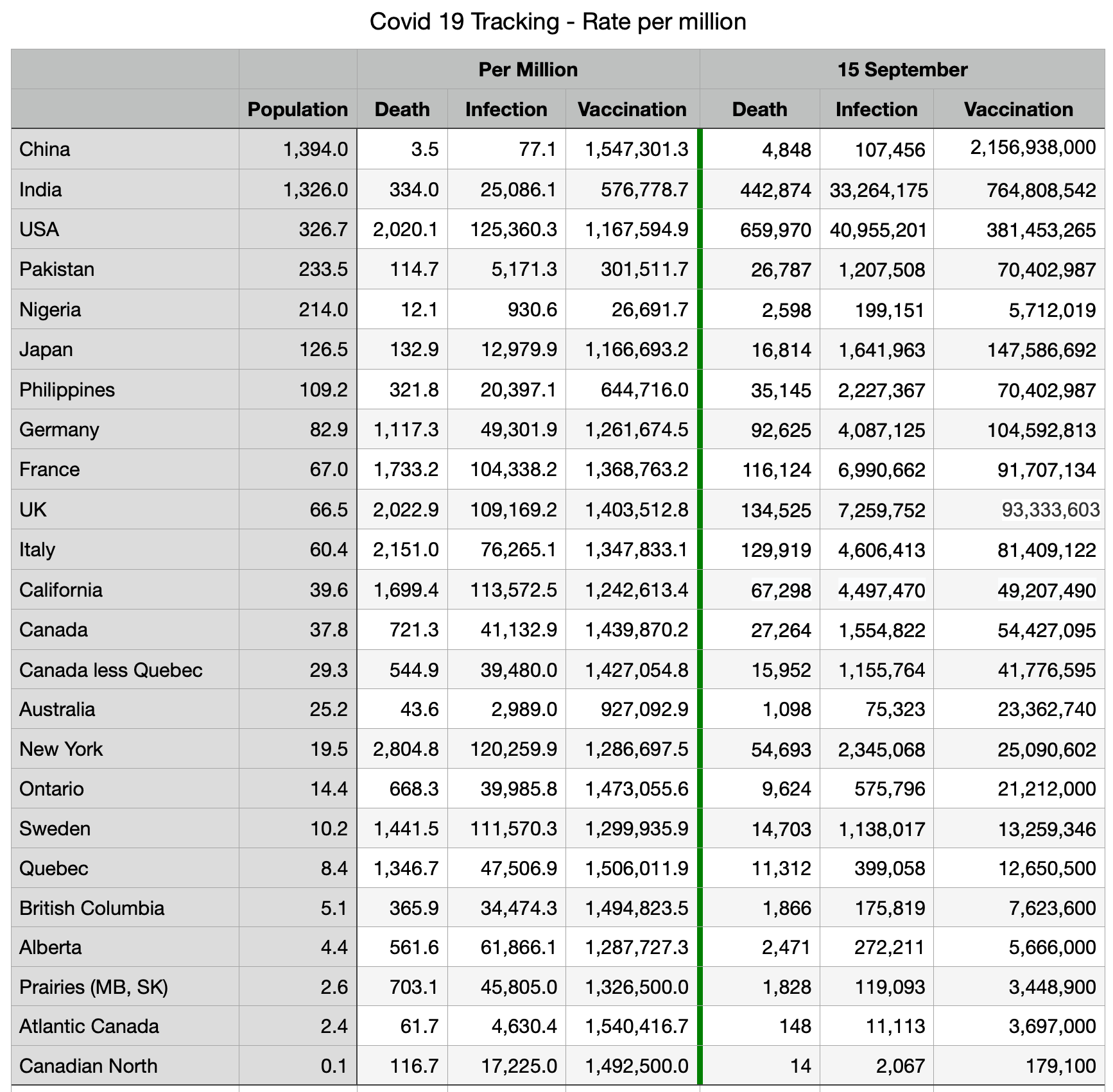
#COVID-19: Comparing provinces with other countries 15 September Update

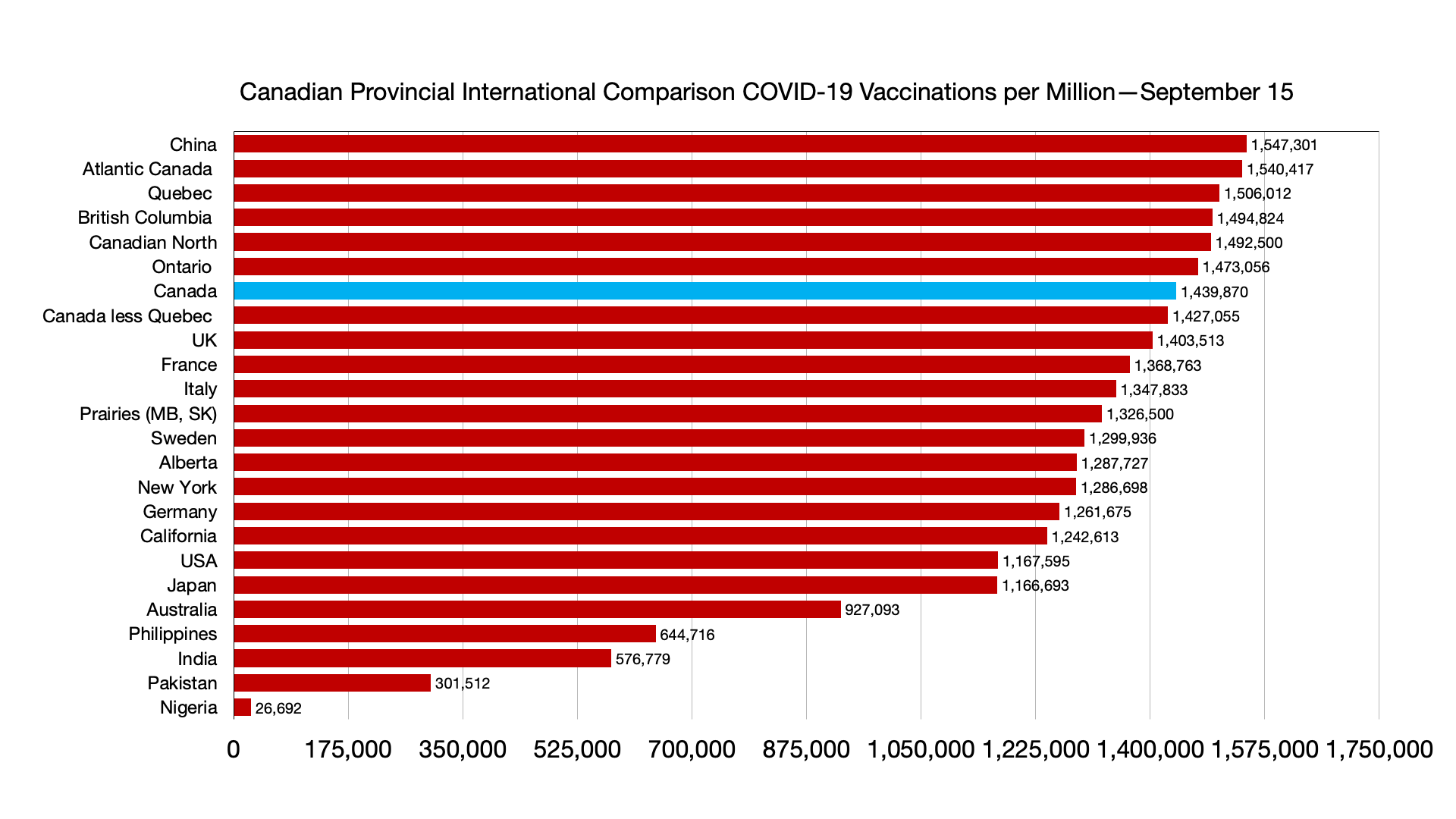
The latest charts, compiled 15 September as overall rates in Canada increase slightly due to the variant. Canadians fully vaccinated 69.3 percent, higher than USA 54.6 percent and the UK 66 percent) but all three countries are hitting a wall, with only minimal increases in the past week.

Trendline charts

Vaccinations: Philippines ahead of India. China fully vaccinated 69.4 percent, India 13.3 percent.

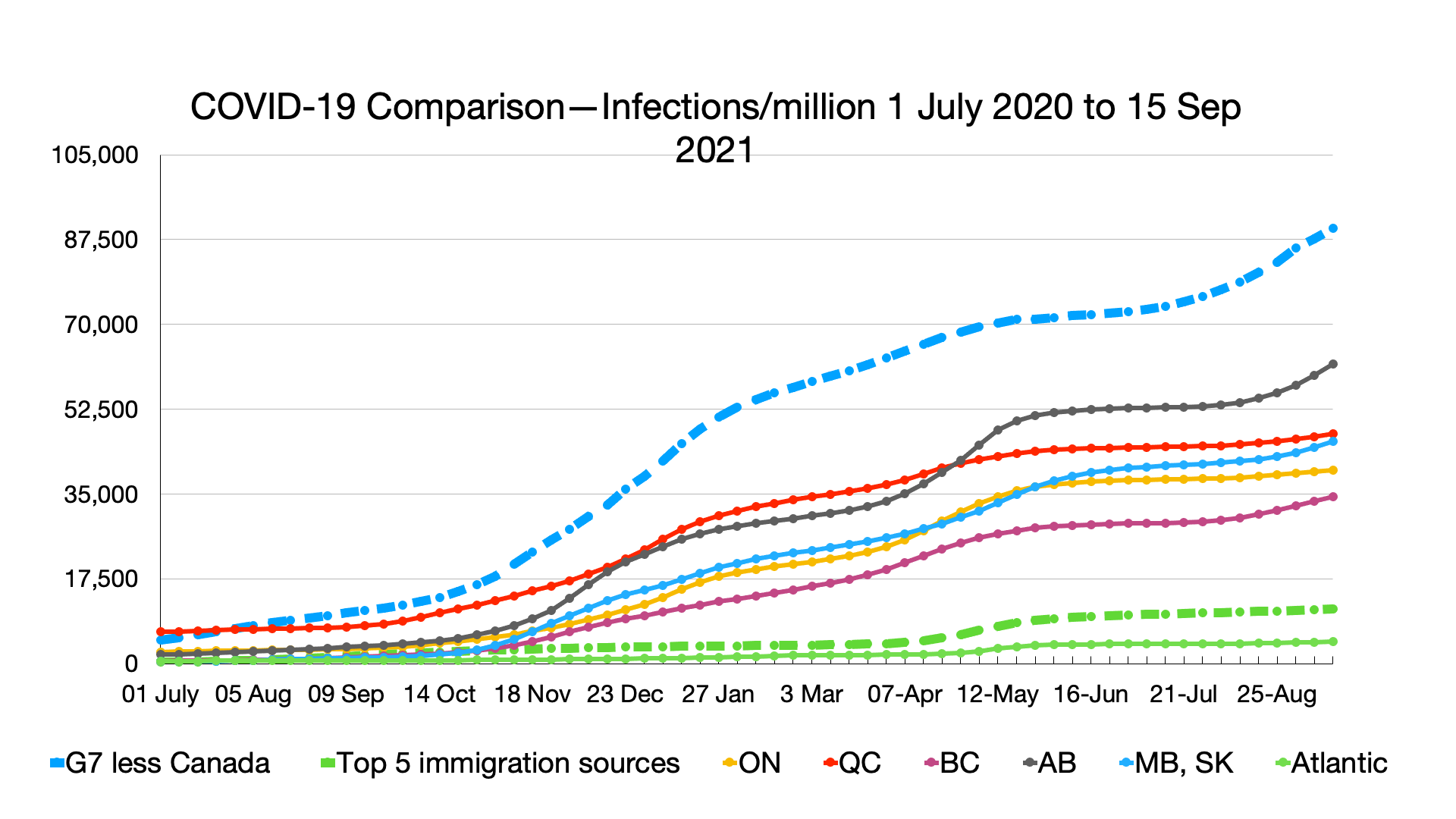
Infections: Continued trend of pronounced uptick in G7 less Canada (driven largely by USA). While all provinces showing increased infections, Alberta and Prairies showing the highest, followed by British Columbia.

Deaths: No major change but uptick G7 less Canada and in Alberta.

Vaccinations: Ongoing steady gap between Alberta and Prairies with lower vaccination rates than elsewhere in Canada. More rapid increase of immigration sources countries continues to be driven by China and to a lesser extent, India.

Weekly

Infections: No relative change.

Deaths per million: Canadian North ahead of Pakistan.

Remaking government: Here are the parties’ plans for a post-pandemic workforce

Will be interesting to see:

It’s one of the big questions in the dozen or so local campaigns in this federal election: when will government employees return to their offices, and under what conditions?

The answers, for one thing, will determine just how robust will be the economic recovery in the two downtown ridings. Ottawa Centre and Hull-Aylmer respectively account for 45 per cent and 20 per cent of the federal government’s owned and leased office space in the capital region.

The return to the office, if it happens, will also have a significant impact on commuting patterns throughout the city.

Pre-pandemic, the capital’s rush hour was defined by a small army of federal government workers who made their way, usually by public transit, from a handful of suburbs to the core. For the past 18 months, most of these office workers have been doing their jobs from home in the bedroom communities of Orléans, Barrhaven, Kanata and Aylmer.

The resistance to abandoning this new way of working is apparently strong.

The department in charge of the federal government’s massive real estate holdings — Public Services and Procurement Canada — said it does not have “a target date for the return to the workplace for all employees. We are currently exploring various possibilities.” This, essentially, is the Liberal Party position.

“Having done a lot of canvassing these past few weeks, I know that public servants in Orléans have different perspectives on returning to work in person,” said Marie-France Lalonde, the Liberal incumbent candidate for Orléans. “A majority seem to be leaning towards a hybrid model,” she added in reference to the arrangement that allows employees to work from home some of the time.

Lalonde stressed the government should not rush into potentially profound changes of the workplace. “The realities are not the same from one department to another,” she said, “and I know that each is working to determine the best way to proceed internally.”

Earlier this summer, PSPC launched its “pathfinder project” calling on volunteers to return to the office to test various configurations. In the first few weeks, a couple of hundred employees in the capital region stepped up.

At the beginning of the economic lockdown early last year, some 126,000 workers were directly employed locally by the federal government, representing nearly 17 per cent of the region’s workforce. Add in municipal and provincial government employees and you’ve got close to 24 per cent. Then include thousands of specialists working under contract and it’s easy to see why the region’s commuting and shopping patterns have been so radically upended during the past 18 months.

The politics associated with the mostly-closed offices is complicated. Consider the Ottawa Centre riding currently held by the Liberals. Hundreds of retailers and restaurant owners depend for their livelihood on the physical presence of government workers. But, says New Democratic Party candidate Angella MacEwan, the latter shouldn’t be pushed back to the office before they’re ready, and that means consulting the unions.

“Government offices should re-open when provincial and municipal health guidance has allowed it,” says MacEwan, “and when workers and their unions have come to an agreement that these workplaces are safe for workers.”

Which leaves the question of what to do for all those businesses adjacent to the federal towers. “We should also have targeted supports for our downtown small businesses,” adds MacEwan, pointing out these have been some of the hardest hit by the pandemic-inspired lockdowns.

For suburban ridings, the economic imperative to re-open government offices is less of a force. Nepean, for instance, accounts for less than eight per cent of the federal government’s office space in the region. The same is true of Ottawa South and Ottawa West. Most other ridings in the census metropolitan area of Ottawa-Gatineau have a minuscule federal government presence in terms of office infrastructure.

Most of Nepean’s 14,000 government workers pre-pandemic commuted to other ridings, including to the downtown core. Now they are pondering whether they should ever resume that sort of regular journey again.

“The NDP would continue to work closely with public sector unions, who are already consulting their members about permanent work-from-home solutions,” says Sean Devine, the NDP candidate for Nepean, adding that “our goal would be to arrive at mutually accepted options for where and how to work, so that the Canadian public can continue to benefit from the skill and dedication of public servants, while also ensuring that workers have choices for their own health and safety needs.”

The federal public sector unions have so far not been pressured by any of the major political parties to see their members return to the office.

Nevertheless, the Conservatives’ campaign platform framed the issue in a manner that has raised suspicions within the Public Service Alliance of Canada, the largest federal government union. PSAC focused on a couple of lines in the Conservatives’ campaign playbook that emphasized achieving savings “by making government more efficient.”

PSAC interpreted this to mean a Conservative government would trim employment and contract out more work to the private sector, though the context of the policy document suggests government employees would be permitted to work from home wherever possible, thus offering potential savings from reduced office space downtown.

“We have no intention of cutting the public service,” Matt Triemstra, the Progressive Conservative candidate for Nepean stressed during the riding’s first all-candidates’ debate. “We’re going to continue to let them work remotely.”

Which leads naturally to the issue of what to do with whatever empty space emerges.

This could provide an important opening for whichever party controls the next government. Roughly half of all federal properties are in poor condition, according to Public Services and Procurement Canada. Depending on location and building type, it might be more economical to convert such properties into apartments, or sell these properties to a private developer for the same purpose.

“The post-pandemic economy presents a unique opportunity to examine new ways to address our critical housing needs,” says Devine. “If we were to support a transition of these physical workspaces into living space, this might also help address how we re-vitalize our downtown core.”

The federal government also has flexibility with a portfolio that consists of owned and leased properties in roughly equal measure. Selling off owned properties in favour of leased offices would likely allow the government to better accommodate the unpredictable demands of a hybrid or work-from-home workforce. It would also generate some gains that could be deployed for other purposes.

Source: Remaking government: Here are the parties’ plans for a post-pandemic workforce

How ‘minority-majority’ ridings are influencing Canada’s election conversation

Interesting examples of community-specific issues and how they may influence some voters:

When Ally Wong recently launched her website, CCGTV.org or (Chinese-Canadians Go To Vote), her intent was to mobilize Chinese-speaking voters in her riding of Richmond Centre.

The B.C. municipality is renowned as perhaps the ultimate Canadian “minority-majority” city, with nearly three out of four Richmond residents speaking a language other than English or French at home.

This cultural diversity is the reason why the bedroom suburb is today the Asian food capital of North America, but it also seems to have contributed to making Richmond into the country’s most politically apathetic city. In the 2019 federal election, Wong’s Richmond Centre riding had the lowest voter turnout of all Canada’s ridings.

Wong is trying to do something about this state of affairs. Her site is providing Richmond constituents with Chinese-language information on how to register to vote, as well as platform details about every major party’s take on issues such as immigration, taxes and housing — topics that are typically of concern to all Canadian immigrants. 

But as she is engaging with voters, Wong has also uncovered another layer of more community-specific, hot-button topics that are not on the national radar, such as the rise in anti-Asian hate crimes, heightened China-Canada tensions, and how the Chinese community is portrayed in English media.

“There is much worry in the Chinese community about the safety of our elders. People feel more action is needed from our politicians,” she said in reference to the spike in anti-Asian hate crimes during the pandemic.

“How the Chinese community is portrayed in (English) media is also important, stories need to be more careful so it doesn’t lead to harm.”

These community-specific issues are often invisible to non-immigrant Canadians. They are certainly not the broad, stump-worthy topics such as housing affordability, climate change, and reconciliation, that one would think could — or should — swing a federal election. But they may turn out to be as impactful as any of the spending promises made in this election that seems more defined by general opposition to it than any burning policy question.

Of Canada’s 338 federal ridings, 41 now have populations in which visible minorities form the majority. While there is some evidence to indicate that South Asian and Filipino voters tend to skew to the left and Chinese voters to the right, partisan allegiances can be thin with 400,000 new immigrants arriving each year, all without any deep connection to a particular party. And given the neck-and-neck polling of this current race, the difference between a minority and majority government may come down to how candidates (along with their parties) in these key “immigrant ridings” position themselves — or posture — on what otherwise may seem to be distant matters, such as the Kashmir question, the erosion of democracy in Hong Kong and farming deregulation in India.

In Surrey—Newton, a riding in which approximately 60 per cent of voters are of South Asian descent, the “home country” issue troubling voters is the bleak future of India’s farmers. In September of last year, the Indian government hurriedly passed a series of agricultural bills that India’s farmers, unconsulted, have since vigorously protested despite vicious police crackdowns.

The Indian government argues the bills are necessary for economic reform. The farmers — the majority of whom are family-based enterprises with small holdings — argue the bills will squeeze them off their ancestral rural lands.

For the past nine months, South Asian Canadians from across the country have held numerous rallies and protests in support of their families and brethren back home. In the riding of Surrey—Newton, its current member of Parliament, Sukh Dhaliwal, tweeted in November of last year that he was “very disturbed by the treatment of Punjabi farmers in India” and that he stood “with the #PunjabFarmers”.

Justin Trudeau’s Liberal government also issued a statement last fall, supporting the rights of India’s farmers to protest. It was strongly rebuked by India’s government.

Gurmant Grewal, a former Conservative MP who represented the Surrey riding of Fleetwood-Port Kells from 2004 to 2015, believes India’s heavy-handed farming reforms could be a swing issue in these South Asian ridings.

“Here in Surrey, you are seeing candidates prioritize Canada-China tensions and the Indian farmer crisis,” said Grewal in an interview with New Canadian Media, a Canadian news outlet that focuses on immigrant coverage.

Even the Bloc Québécois which has traditionally focused its energies on Quebec’s Francophone base, has attempted this election cycle to reach out to immigrants. The party recently issued a statement condemning human rights violations in Kashmir, a predominantly Muslim populated Himalayan region to which both India and Pakistan lay claim.

In 2019, the Indian government abrogated the state’s constitution, and placed control of the region under central authority. Speaking out on behalf of Kashmiris resonates with Quebec’s Muslim voters.

Immigration patterns have continued to reshape Canada’s demographics and the cultural mix in the country’s political ridings. With each election, the diversity of representation in our House of Commons has kept pace with the overall proportion of immigrants in Canada. The total number of visible minority MPs elected increased from 47 in 2015 (14 per cent) to 51 in 2019 (15.1 per cent).

But there is also greater diversity surfacing in the issues that voters are asking about, including topics that otherwise wouldn’t play in a federal election but now do because they are relevant to the voters living in 12 per cent of Canada’s minority-majority ridings. In recent years we have witnessed how a U.S. election can come down to the concerns of voters in a handful of counties in Pennsylvania, Michigan or Florida. We may come to see in a matter of days how a functioning majority in Canada comes down to winning over Chinese or Sikh voters in places like Richmond Centre, and Surrey—Newton by addressing issues only visible in their communities. 

Source: https://www.thestar.com/opinion/2021/09/14/how-minority-majority-ridings-are-influencing-canadas-election-conversation.html

Erna Paris: The leaders’ sycophantic acceptance of Quebec’s Bill 21 is dangerous for all of Canada

Sad but true:

In his famous 14th-century work The Inferno, the Italian poet Dante Alighieri created a special abode in hell for wily flatterers. He considered sycophancy a wrongdoing against the entire community – a deceit with the potential to alter society for the worse.

Dante might have nodded knowingly had he observed Canada’s leader-courtiers line up to pay obeisance to Bloc Quebec leader Yves-François Blanchet’s defense of the indefensible during last week’s federal election debates. The quid pro quo was each leader’s personal support for Bill 21, the Quebec legislation that prohibits the display of religious symbols by public-sector workers in the workplace, in return for potential electoral support in the province.

Although Liberal Leader Justin Trudeau and NDP Leader Jagmeet Singh have previously implied that as prime minister they might challenge Bill 21, they and Conservative Leader Erin O’Toole have confirmed their support for a noxious law that discriminates against the rights of religious minorities. To back such legislation is not only hypocrisy on the part of Canadian leaders, but an affront to the fundamental commitments we espouse in this country. During the debate, it was striking to note that in the same breath as the main party leaders refused to challenge Quebec’s right to discriminate, they simultaneously mouthed their support for the Canadian shibboleths of human rights and equality.

Bill 21 is not innocuous. Some religions require a dress code as an element of orthodox worship. Think the Jewish kippathe Sikh turban and the Muslim headscarf, to name just three. This is frequently a religious obligation – which, if rejected, places the individual in contravention of his or her faith. While it is likely that everyone on the debate stage understood the true nature of the law, they succumbed to Mr. Blanchet’s assertation that they agreed, although sheepishly. Given that he would presumably be denied the right to work in Quebec’s public sector because he wears a turban, NDP leader Jagmeet Singh’s long-time acquiescence seems particularly ingratiating. “Quebec has the right to make its own determinations,” he has repeatedly said.

We are inured to degrees of pandering during election campaigns, but the collective compliance of our leaders with legal discrimination against minorities is galling. Because, as Dante understood centuries ago, there are larger consequences at play.

To understand this, let us consider that from the time of Confederation, nation-building has been the job description of Canadian governments. To keep this unlikely country from fracturing, Canadian leaders have practiced compromise, especially with Quebec, while our courts balanced civil rights using case-law precedents. This hasn’t been easy; for the first half of our history our policies were overtly racist, as the uncovering of residential school realities has laid bare. In the 1920s and 1930s, Canada’s immigration policies favoured British arrivals while denying entry to other “lesser” peoples.

These attitudes slowly changed in the years following the Second World War – culminating, in my view, with official multiculturalism, which confirmed that no group of Canadians was superior to another, and with the Charter of Rights and Freedoms. Like all social transformations, these remain controversial in many quarters, but they have become the foundation of contemporary Canada.

It is for this reason that the sycophantic acceptance of discriminatory legislation in Quebec is dangerous for Canada as a whole. When our leaders trade foundational principles for electoral purposes, they undermine the country at large.

The pushback has been so weak that the most egregious distortions of language have gone unremarked upon. During the debates, Mr. Blanchet said that Bill 21 cannot be described as discriminatory because it reflects the values of Quebec – perhaps the most specious argument for discrimination that we have heard since the pre-war years. When Catholics and Italians were undermined in an earlier Canada, was this acceptable because the “values” of Canadians were in favour? Was it acceptable for Indigenous children to be maltreated in Canada because those were the “values” of the day?

In 1995, three generations of my family travelled to Montreal to appeal to our Québécois co-citizens not to separate from our shared country, but what is even more harmful today is that Quebec no longer has to leave. By consenting to an injurious law, our federal leaders have joined the rest of Canada to that province. In doing so, they separate usfrom the underlying vision of equality of opportunity and the protection of minorities that today characterizes this country.

Source: https://www.theglobeandmail.com/opinion/article-the-leaders-sycophantic-acceptance-of-quebecs-bill-21-is-dangerous-for/