Blogging break
2021/08/19 Leave a comment
Travelling. Will resume with next COVID-19 weekly update
Working site on citizenship and multiculturalism issues.
2021/08/19 Leave a comment
Notable and significant:
Discrimination against visible and religious minorities in Canada has been hotly debated during the year leading up to this summer’s federal election, but the issue gets scant mention in the campaign platform released by the Conservative party this week.
The words “racism” and “antisemitism” do not appear anywhere in the party’s 160-page policy platform, which largely focuses on the fallout and recovery from the COVID-19 pandemic. Nor are there any references to Black Canadians.
And in the aftermath of the deadly June attack targeting a Muslim family in London, Ont. — which saw Conservative Leader Erin O’Toole calling for “urgent action” to support Canadian Muslims — the term “Islamophobia” is missing, too.
The omissions are somewhat at odds with the opening notes of the platform, in which O’Toole writes that it is “time for Conservatives to take inequality seriously, because that’s becoming more of a problem in our country,” and says that Canada is a society where “everyone can fulfil his or her potential.”
It also doesn’t address last year’s nationwide call for racial justice, sparked by a reckoning over police brutality targeting Black and Indigenous people.
Instead, the document tackles discrimination and bridge-building through the lens of international human rights and foreign policy, rather than grappling with its existence in Canada.
Among a handful of proposals, the Conservatives would establish an Office of Religious Freedom and Conscience that advises cabinet ministers “on threats to international security, engages in diplomacy to religious communities, and informs Canadian international development programs to promote freedom, pluralism, religious coexistence and tolerance.”
The Conservatives are also promising to appoint the country’s “first Muslim ambassador and first ambassador to the Organization of Islamic Cooperation” to help engage with the world’s Muslim-majority nations.
The party also wants to see the creation of an international human rights advisory committee, made up of a “broad range of cultural and religious communities in Canada” to advise the government on issues abroad.
Mustafa Farooq, CEO of the National Council of Canadian Muslims, said that while the platform is “light” on addressing domestic Islamophobia, it does offer some encouraging promises.
The Tories acknowledged, for example, their support for the Muslim minority Uyghur population in China, and said they would boost funding and expand the accessibility of the Ottawa’s security infrastructure program, which helps protect places of worship and other institutions from hate-motivated attacks.
“Certainly, I would have liked to see clear articulations about … what they’re going to be doing to challenge Islamophobia through clear policy promises and commitments,” Farooq said.
On the other hand, the New Democrats — the only other major federal party to release its policy promises — are running on a platform that has dedicated an entire plank to confronting racism and other forms of discrimination, though the details are vague.
The NDP document emphasizes the rise in hateful incidents facing Muslim, Jewish and Black Canadians, along with Indigenous people. The party is promising to enact a national action plan to “dismantle far-right extremist organizations” and address “white supremacist and neo-Nazi groups.” The NDP is also pledging to better identify and catalogue hate-related incidents and how they are handled within Canada’s justice system.
The collection of race-based data, reviewing employment discrimination and addressing the overrepresentation of Black and Indigenous people in the federal prison population also factor into the NDP plan.
Both the NDP and the Conservatives, however, have pledged to counter online hate, with the New Democrats seeking to convene a national working group on the issue and the Tories promising to criminalize statements that encourage violence against other groups while protecting non-violent forms of speech and criticism.
The two parties have also put forth specific reconciliation plans focused on addressing the injustices wrought by the residential school system, self determination, economic development and improving access to clean drinking water.
Source: The word ‘racism’ doesn’t appear anywhere in the Conservative party’s campaign platform
2021/08/19 Leave a comment
Good practical approaches us, although not easy to implement. The Winter Olympics provide an important pressure point that should be used:
The 11-year prison sentence handed to Michael Spavor is just the latest example of the ruthlessness of China’s efforts to put pressure on the Canadian government, and in turn on the U.S. administration, to return Huawei executive Meng Wanzhou. As The Washington Post’s editorial board wrote on Aug. 13: “China’s kangaroo courts operate in service to the country’s Communist Party and its leader, Xi Jinping, whose contempt for international standards of law and justice is manifest.” As Times Wang outlined in The Globe last week, Canadians should refuse to recognize China’s “justice” system.
While a short-term resolution of the case can only come from Washington, it is not clear that U.S. President Joe Biden is ready to spend the political capital necessary to let Ms. Meng return to China. Of course, an elegant solution for both Ottawa and Washington would be if the judge presiding over the case were to decide after the extradition hearings conclude that Ms. Meng’s rights were not respected when she was arrested and orders her released.
In any case, detailed negotiations will still be required to guarantee the safe return of the two Michaels to Canada and, hopefully, a decision by the Chinese supreme court to cancel the death penalty against Robert Schellenberg, who was convicted of drug smuggling. And let’s not forget that we have three other Canadians sitting on death row in China with no consular access to other Canadians, including Xiao Jianhua and Huseyin Celil, both abducted abroad by China.
Ottawa needs to adopt a more robust strategy to counter China’s attack on international law and norms, as well as its interference and spying activities in Canada. The electoral campaign offers an opportunity to ask political parties how they envisage future relations with China.
Knowing China has used hostage diplomacy with increasing frequency in the past 15 years, and following the adoption of the Declaration Against Arbitrary Detention in State-to-States Relations in February, Canada should agree with its allies on a common strategy, including sanctions, that would be applied against China if it dares to take people hostage again.
To prevent China from weaponizing trade, as it did against us after the arrest of Ms. Meng and is doing now with Australia, and since some commodities come from a limited number of countries, Canada should propose to the United States and Australia to conclude an agreement that no signatory would increase its exports to China of wheat, canola, beef, pork, metallurgical coal, iron ore and others above its historical share of the Chinese market if one of the three is victim of such sanctions.
An offer could be made to other countries to join later. China would quickly understand that it could no longer divide us by increasing its imports from another supplier.
Democratic countries should also agree to continue to protest against China’s flouting of the agreement to guarantee Hong Kong’s autonomy until 2047, and against China’s human rights abuses – including the continuing genocide in Xinjiang – by asking for a full investigation by the UN.
One important and difficult deadline is looming on us: the holding of the Winter Olympics in Beijing next February. Since the number of cases related to the Delta variant is increasing in China, Canada and allies should ask that the Games be postponed to February, 2023. They should also specify that if China does not agree to let a UN investigation team go to Xinjiang immediately, and if it continues to deny the World Health Organization complete, unrestricted access to investigate the origin of COVID-19, Canada and the United States will offer to jointly host the Olympics using existing facilities in Vancouver, Whistler and Seattle. This would also prevent China using the event for propaganda purposes.
To counter China’s influence in the developing world through its Belt and Road Initiative, which finances global infrastructure projects, Western countries need to offer an alternative with more investment and assistance. They must also demonstrate that a democratic system presents more long-term potential than the Chinese authoritarian regime.
It is important to distinguish between Chinese leaders and Chinese citizens: Chinese immigrants have made a great contribution to Canada’s development and the government should declare that Canada remains open to Chinese nationals, including students, and will provide support to all Chinese nationals seeking asylum from state persecution, including those from Hong Kong.
Let’s hope the new government elected on Sept. 20 will quickly produce a new engagement strategy with China that opposes its thuggery and meets the expectations of Canadians.
Guy Saint-Jacques served as Canada’s ambassador to China from 2012 to 2016.
2021/08/19 Leave a comment
Likely fewer disparities in Canada given medicare but some commonaliyies:
Two decades ago, only 9 percent of white Americans rated their health as fair or poor. But 14 percent of Hispanic Americans characterized their health in those terms, as did nearly 18 percent of Black Americans.
In recent years, access to care has improved in the wake of the Affordable Care Act, which reduced the number of uninsured Americans across all racial and ethnic groups. But the racial health gap has remained, according to a series of studies published on Tuesday in the journal JAMA.
A dismal picture of persistent health disparities in America was described in an issue devoted entirely to inequities in medicine. The wide-ranging issue included research on spending and patterns of care, comparative rates of gestational diabetes and the proportion of Black physicians at medical schools.
The journal’s editors committed to a sharper focus on racism in medicine after a controversy in June, in which a staff member seemed to suggest that racism was not a problem in health care. The ensuing criticism led to the resignation of the top editor and culminated with a pledge to increase staff diversity and publish a more inclusive array of papers.
“The topics of racial and ethnic disparities and inequities in medicine and health care are of critical importance,” Dr. Phil B. Fontanarosa, interim editor in chief of JAMA, said in a statement. He noted that JAMA has published more than 850 articles on racial and ethnic disparities and inequities in the past.
The new issue offers studies on disparities in the utilization of health care services and in overall health spending. Together, the findings paint a portrait of a nation still plagued by medical haves and have-nots whose ability to benefit from scientific advances varies by race and ethnicity, despite the fact that the A.C.A. greatly expanded insurance.
The racial health gap did not significantly narrow from 1999 to 2018, according to one study whose author said it was tantamount to “a comprehensive national report card.”
“We’re failing,” added Dr. Harlan Krumholz, the study’s senior author.
“If our national goals are to improve the population’s health and promote more health equity, then we have to admit that whatever we’re doing now is not doing the trick,” he said. “This should wake us up, and spark us to think of new and better approaches.”
Other studies in the journal teased apart factors that may be contributing to the gap, including different patterns of care-seeking. White Americans, for example, are more likely than members of minority groups to visit primary care physicians and specialists in the community, rather than a hospital or emergency room.
2021/08/19 1 Comment
Of note:
In the midst of the pandemic, Vanuatu’s “cash for passports” scheme is helping to keep its economy afloat.
With its tourism industry smashed, the Pacific nation last year generated $175 million — 35 per cent of total government revenue — from its “honorary citizenship programs”.
However, after a Guardian investigation discovered that recipients included a “slew of disgraced businesspeople and individuals sought by police” — including Australians — the government is facing a tough choice between potential international sanctions or domestic economic pain.
Vanuatu’s first citizenship by investment scheme, known as “cash for passports” locally, was introduced in 2014 and has had several iterations since, including one intended to raise money after Cyclone Pam caused widespread devastation in 2015.
Many countries have similar schemes, including Australia, but usually, applicants are required to become permanent residents first and then only after a number of years do they become eligible to become a citizen.
Under Vanuatu’s scheme, successful applicants can become citizens within a matter of months and there is no requirement to reside in the country or even set foot on Vanuatu soil at all.
It costs around $US150,000 ($200,000) for a single application and more for couples and families. Most of the passports, which allow free access to any EU country, are sold to people from mainland China.
It has long been controversial, but the scheme came under increased scrutiny in July after the Guardian investigation was published.
Last week, the Vanuatu government revealed that the Vanuatu citizenship of a Syrian businessman referred to in the report, Abdul Rhama Khiti, had been revoked.
Vanuatu’s Citizenship Commission chair Ronald Warsal told the ABC’s Pacific Beat program the US government had imposed sanctions against Mr Khiti’s businesses just weeks after he had made his application.
“After the article came out in The Guardian and during the course of the investigation by our Financial Intelligence Unit [FIU] it was decided to have it revoked and money he has paid to be forfeited into government coffers,” Mr Warsal said.
He said the government was investigating more of those mentioned in the article and others that were not.
“It’s an ongoing thing,” he said.
“We want to ensure that people who come to Vanuatu, who obtain Vanuatu citizenship, are not wanted abroad [and] are not fugitives.”
Transparency International Vanuatu chief executive Willie Tokon said it was worrying that the Syrian businessman was able to get approval in the first place and that his citizenship was only revoked when the matter was raised in the media.
“My worry is how come we have all these allegations but the screening by [the] Citizenship Commission and Financial Intelligence Unit didn’t come up with this allegation,” Mr Tokon said.
He said if Vanuatu did not have the capacity to thoroughly vet applicants, it should seek help from Interpol and other agencies.
“If there’s no other way to do it, do it properly. If we don’t have the capacity, we have very strong support from the Australian government in terms of the AFP, they’re providing a lot of support. It needs to be done properly,” he said.
But Mr Warsal said the government had systems in place to do character checks.
“We do [make] the final decision but … it goes through certain processes,” he said, saying it was down to teamwork between immigration, the FIU and the police.
Economics professor Stephen Howes, from the Australian National University, said mishandling of the citizenship programs could have a couple of negative consequences for Vanuatu.
Mr Howes said Vanuatu could become seen as a “risky” country for banks to operate in, or even get added to international money laundering grey or blacklists, which would threaten the country’s ability to access international finance.
“That would further isolate the country and make it harder to form international financial links,” he said.
It could also diminish the value of Vanuatu passports, making it more difficult for Vanuatu citizens to travel.
“Vanuatu citizens might suffer as well if other countries decide that they don’t trust that someone with a valid Vanuatu passport is actually a bonafide Vanuatu citizen,” he said.
On the flip side, if Vanuatu did decide to scrap the citizenship schemes, then they would lose the revenue the country needs to support the population during the pandemic-related economic crisis.
Mr Howes said it was more likely the government would bring in reforms and tighten up the application process.
He said actions like cancelling the citizenship of those like Mr Khiti would show they “won’t take just anyone”.
“If they can show [they have a serious vetting process], that will instil more confidence into the scheme,” he said.
He said abandoning the “unorthodox” source of revenue would be a “really extreme step”.
Not everyone who wanted citizenship of another country and could afford to buy it was necessarily of bad character, he said.
“Think about the uncertainties in China, some people just want a safety net,” he said.
“The world’s a very uncertain place. So I don’t think it means you’re a criminal [if you want to buy citizenship].
“I think it could also mean you’re worried about the future of your country.”
2021/08/19 Leave a comment
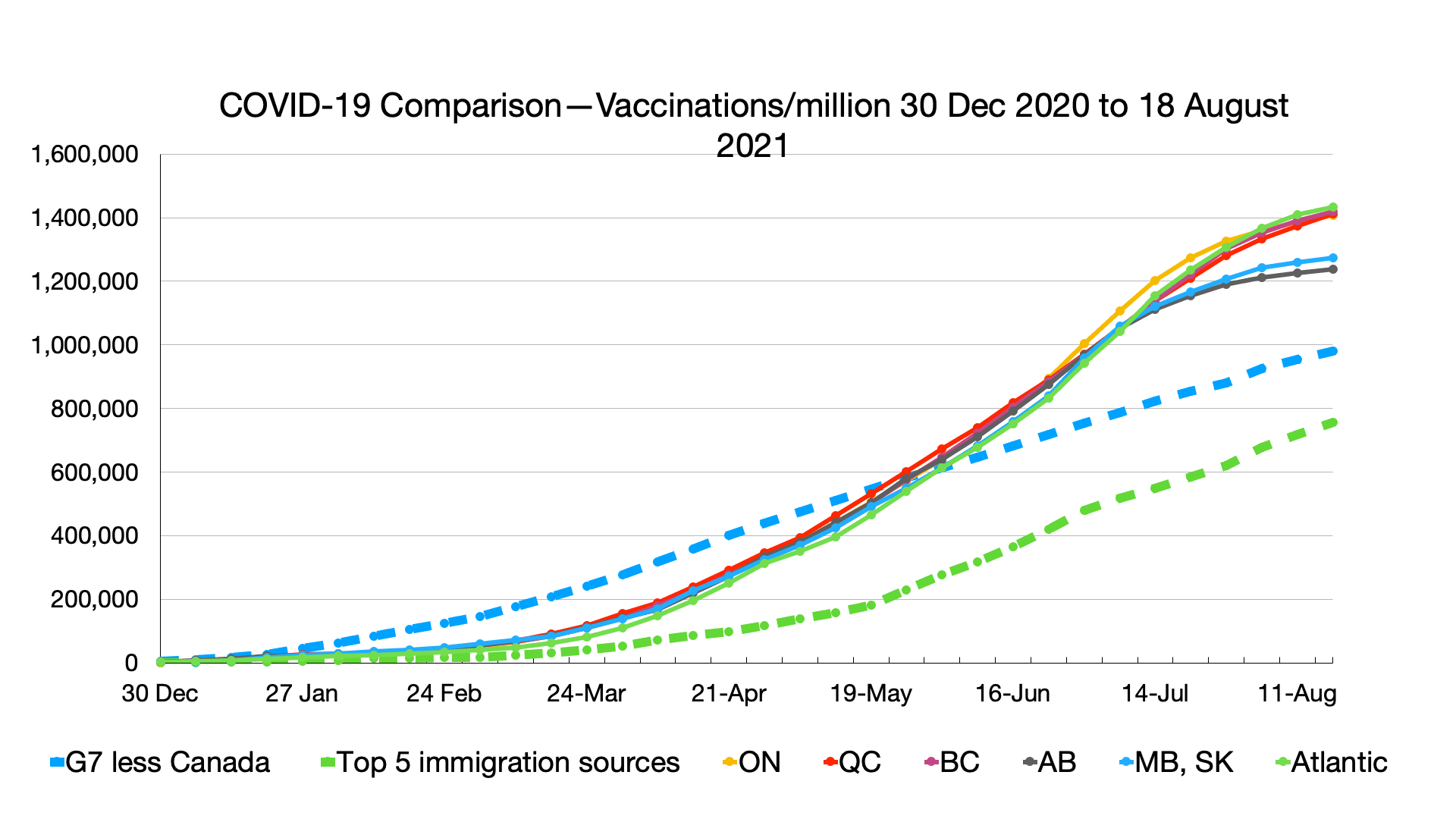
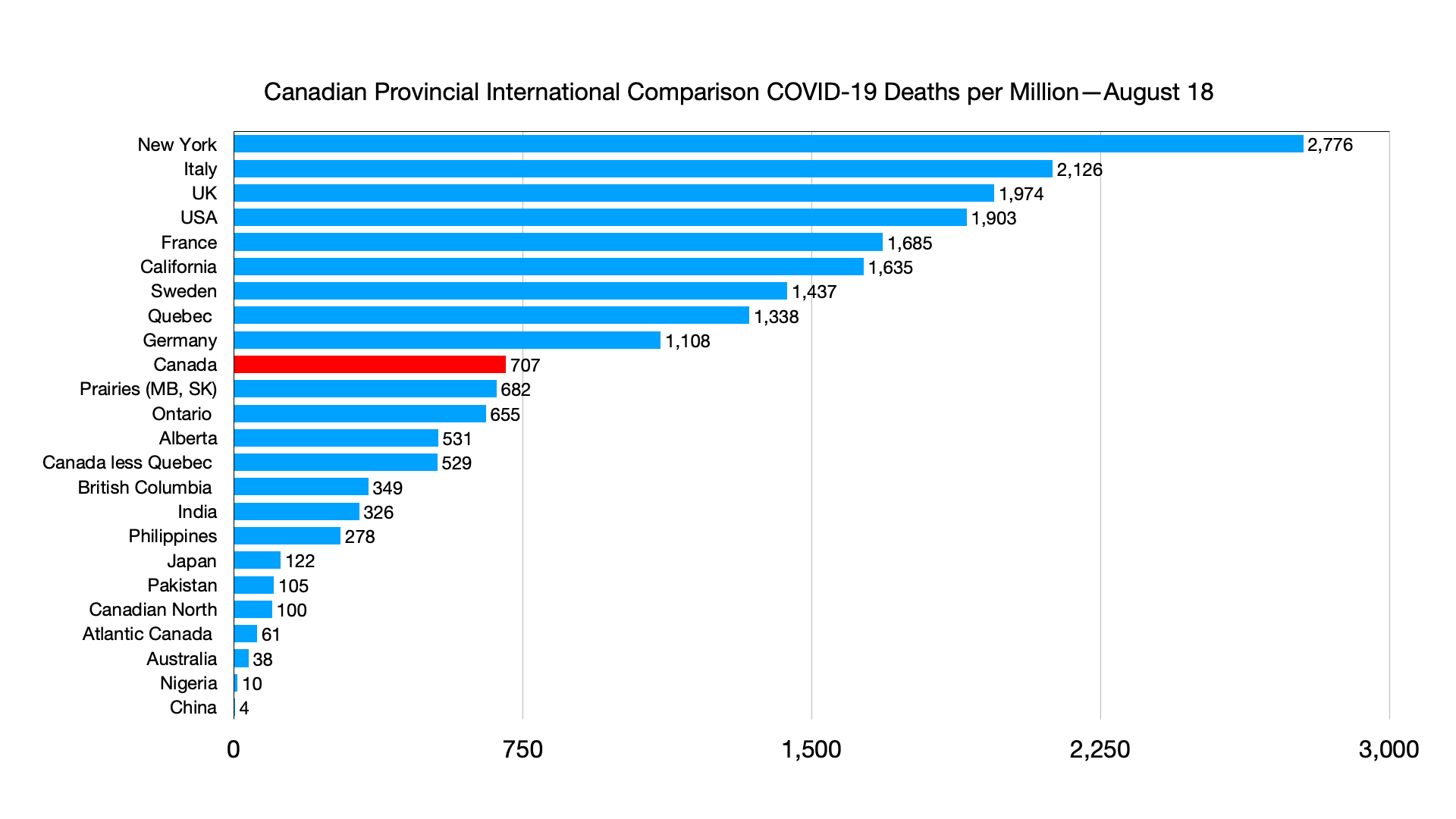
The latest charts, compiled 18 July as overall rates in Canada remain relatively stable but with slight increases due to the variant. Canadians fully vaccinated now 64.8 percent, higher than USA 51.5 percent and the UK 61.1 percent).
Vaccinations: All Canadian provinces ahead of USA and EU countries, China ahead of UK, Alberta and Prairies.

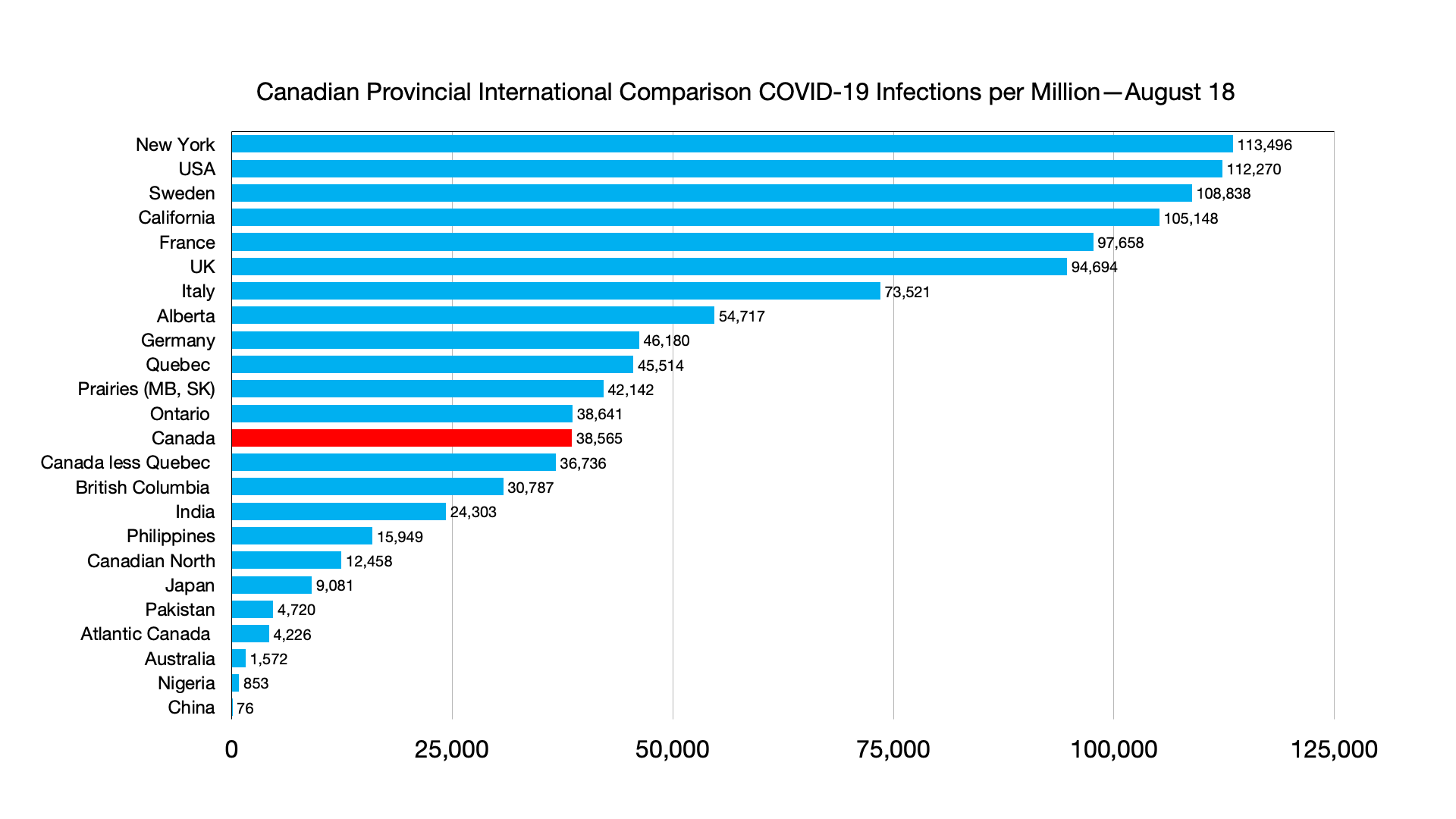
Infections: Same trends as last week: More pronounced uptick in G7 less Canada (driven largely by USA). While all provinces showing increased infections, greater upticks in Alberta, British Columbia.
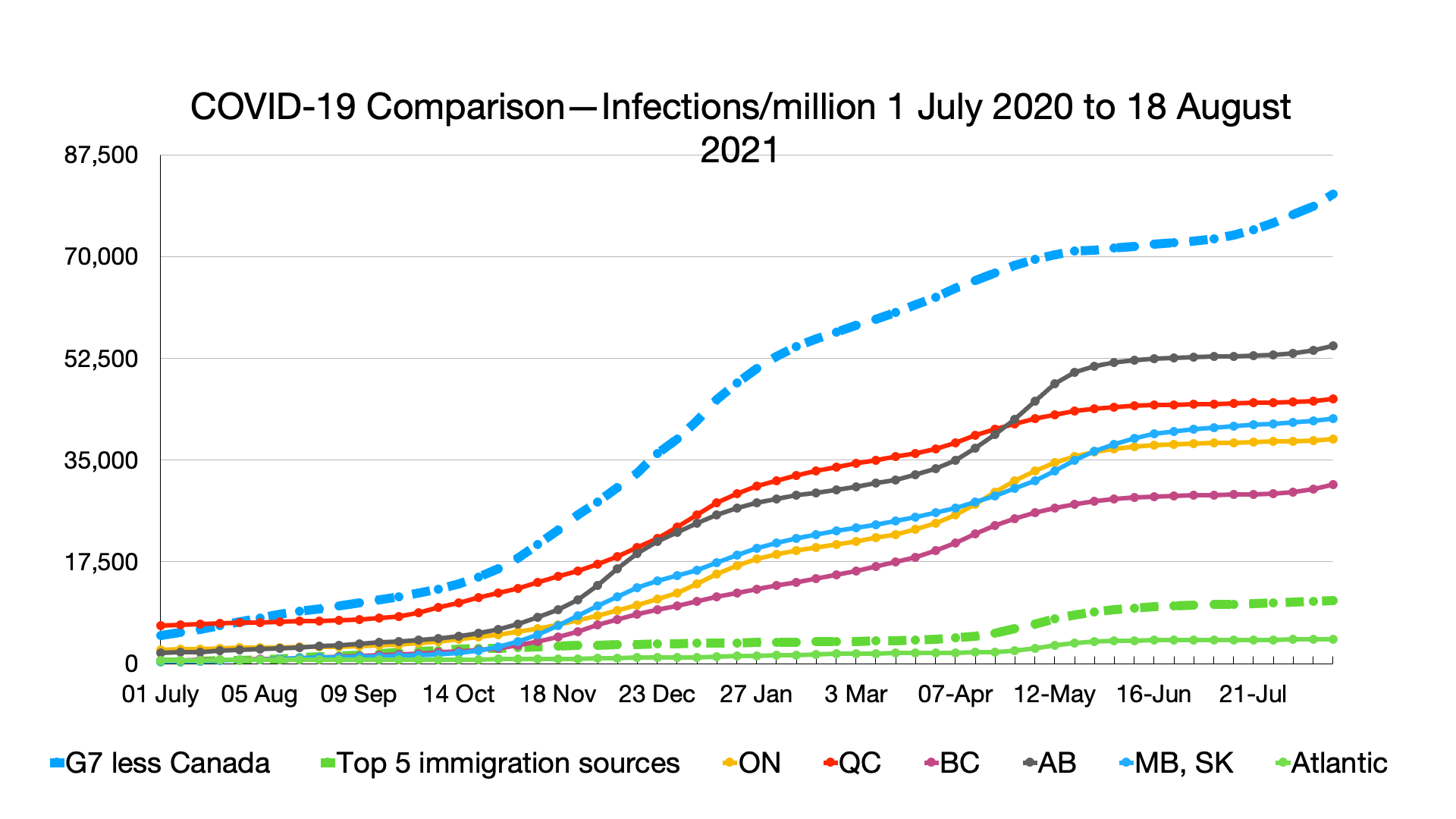
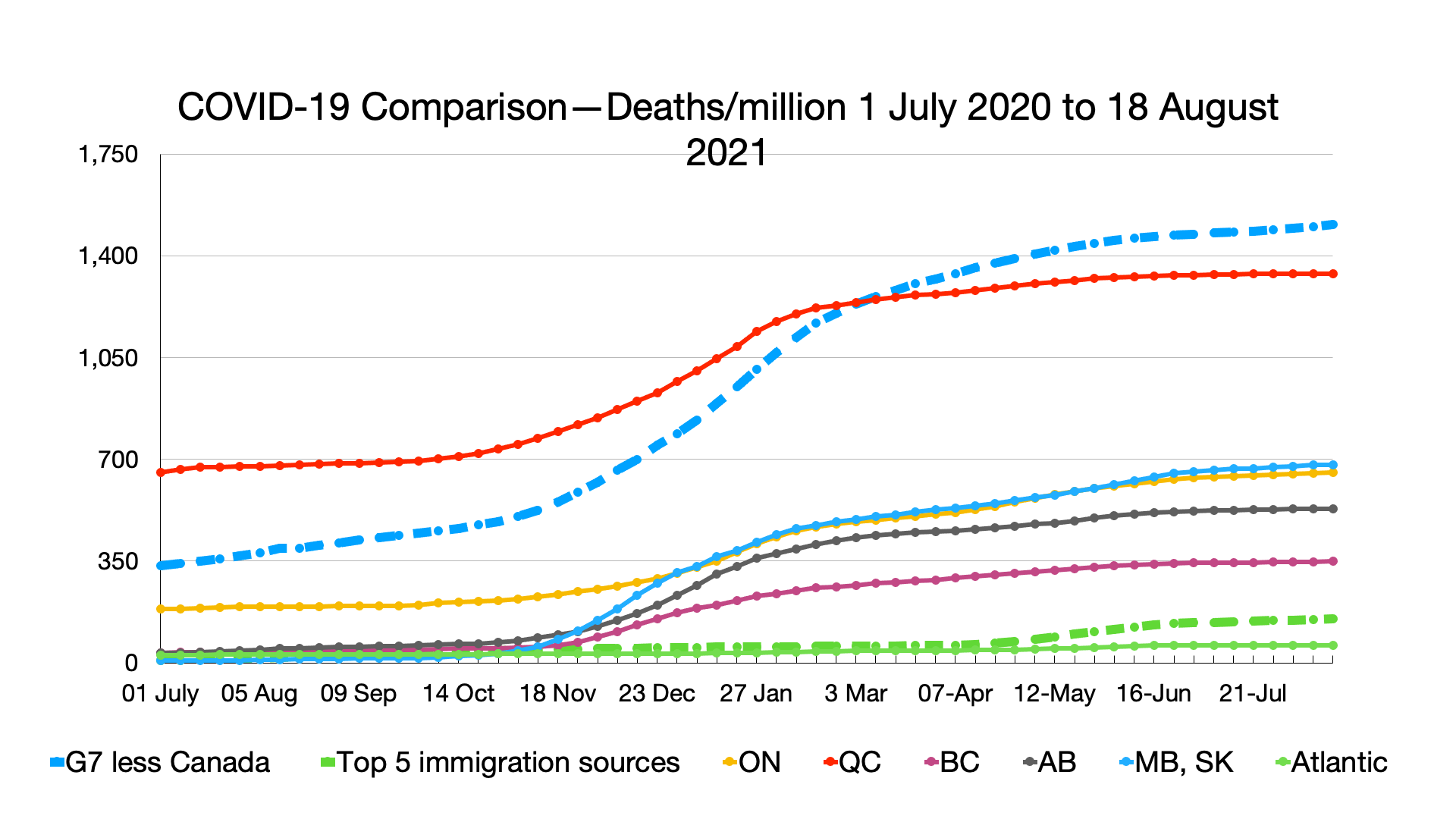
Deaths: No significant change.
Vaccinations: Ongoing steady gap between Canadian provinces and G7, immigration source country increase continues to be driven by China (fully vaccinated 55.6 percent, very steep rise since last week) and India (fully vaccinated 9 percent). Flattening of Canadian vaccination rates as reported elsewhere.
Infections: No relative change.
Deaths per million: No significant change.

2021/08/18 Leave a comment
Good commentary:
If you spend any amount of time on social media engaging about COVID-19, you will know discussions tend to get personal and ugly pretty fast.
Encourage vaccination of young people, and you’re labelled a pedophile.
Support masking in indoor settings? You’re a goose-stepping fascist.
Laud vaccination as a way out of the pandemic, and you are Joseph Goebbels and should brace yourself to be on trial for crimes against humanity at the fictional Nuremberg 2 tribunal.
Acknowledge that lockdowns are sometimes necessary to control the spread of a pandemic virus, and brace yourself for the onslaught of Hitler images.
These types of responses are predictable to a certain degree.
Godwin’s law (coined by U.S. lawyer Mike Godwin in 1990) holds that as an online discussion grows longer, the probability of a comparison involving Nazis or Hitler becomes more likely.
These days, debates go from zero to Hitler in about a nanosecond.
Some may want to dismiss this kind of over-the-top rhetoric as laughable, the work of a tiny minority of extremists and their bots.
But it’s obscene, and obscenely commonplace.
The Nazi-fication of public discourse is no longer the sole purview of pathetic man-boys holed up in their basements.
Enabled by social-media giants hiding behind freedom-of-speech arguments, trolls can now spread their misogynist, racist and anti-social views readily and mercilessly.
The goal here is to muddy the waters between fact and fiction, between truth and lies, and to undermine democratic institutions.
The grunts of a few can be turned into shouts that unfortunately have a growing audience, especially among the disgruntled and disenfranchised.
Playing the victim card appeals to them.
The ragtag collection of conspiracy theorists who gather at anti-mask, anti-vaccine, anti-lockdown rallies is fascinating – a stinking potpourri of grievances, with denunciations of everything from vaccines to “fake news,” to 5G, to the so-called “deep state.”
These rallies – which are getting bigger as pandemic frustrations grow – have more than their fair share of Hitler talk and imagery. They also include people wearing the yellow Star of David, implying that being told to wear a mask or get a jab is a level of persecution comparable to Jews who were rounded up and shipped in cattle cars to death camps.
Clearly some people have lost the plot.
Yet, they are being encouraged by politicians who embrace rhetoric suggesting that a position is invalid because the same view was held by Hitler.
A case in point is odious Ontario MPP Randy Hillier, who claims that lockdowns, mask rules and vaccine mandates are forms of Nazi-like tyranny.
His perverse version of freedom holds that individual rights are absolute, and that, for example, unvaccinated people have a God-given right to do as they please up to and including infecting others with the coronavirus.
Mr. Hillier and his acolytes have made a habit of casually tossing around Nazi analogies and Hitler images.
This mainstreaming of hateful images and thinly veiled hate speech should alarm us on a number of levels.
First of all, it betrays a profound ignorance of the Holocaust.
There can be no comparisons made between the state-sponsored mass murder of six million people and the temporary shutdown of the local mall.
Those who have the unmitigated gall to wear yellow stars to anti-mask rallies offend the memory of the victims of the Shoah and their descendants.
It is worth noting that Mr. Godwin, when he fashioned his adage, actually wanted people to think harder about the Holocaust and why Nazi comparisons should not be casually tossed into conversation.
Thinking is certainly not what’s happening here.
What we’re seeing is a lot of projection, the psychological impulse to project on other people what you’re actually feeling.
Former U.S. president Donald Trump, sometimes called the “Projection President,” was the embodiment of this phenomenon.
Mr. Trump, a chronic liar who wallowed in corruption, routinely attacked his opponents as corrupt liars. He also frequently described his opponents in a derogatory fashion, a lynchpin strategy of hate-mongers, and now a mainstay of social media.
Next time you hear the claims of Nazi-like tyranny and oppression, think about what is really being said.
Those who don’t want masks under any circumstances – those who not only want to refuse vaccines but prevent others from getting them – are actually the tyrants.
Their use of Hitler images and analogies are not a caution, but an embrace, one we should call out, not dismiss casually.
Source: https://www.theglobeandmail.com/opinion/article-the-troubling-nazi-fication-of-covid-19-discourse/
2021/08/18 Leave a comment
Of interest:
Women executives earned about 56 per cent less on average than men executives and this pay gap widened even further for racialized women, who earned about 32 per cent less than non-visible minority women, according to a new study from Statistics Canada that underscores the sweeping disparities in Corporate Canada.
Translated into dollar figures, there was a $600,000 difference between the average woman executive’s income ($495,600) and the average executive man’s ($1.1-million). The average compensation for visible minority women was $347,100, while visible minority men took home $681,900.

The research included data from the Corporations Returns Act, which collects financial and ownership information on mid-size to large corporations, and census information from 2016.
In unpacking the gender divide at the most senior levels, researchers looked at marital status, number of children, education, backgrounds, sector of work, job title and professional networks.
One of the study’s most shocking findings concerned the number of racialized women in executive roles. There were so few Indigenous executives – both men and women – that Statistics Canada was limited in what could be reported over concerns about violating the individuals’ privacy. About 1 per cent of executives were Indigenous, although this group represents about 4 per cent of the working population. Most of the women Indigenous executives worked at large corporations.
Over all, about one in 10 women executives identified as a visible minority. The most common groups represented were South Asian and Chinese, with fewer executives being Black and Filipino.
Paulette Senior, the president and CEO of the Canadian Women’s Foundation, said the report’s findings were extremely concerning.
“It’s worse than I thought,” she said. “This makes me wonder what have we been doing? What have decision makers been doing in addressing [these issues] – whether it’s a leaky pipeline, or who is sitting at tables during hiring. What has been going on that this is the picture in 2021?”
Statistics Canada’s findings are in keeping with an analysis that The Globe and Mail conducted as part of its Power Gap investigation, which has been examining gender inequities in the modern work force. The series found that among women in the top 1 per cent of earners, just 3 per cent were racialized. In general, women were found to be outnumbered, outranked and out-earned by almost every measure examined.
Elizabeth Richards, who co-authored the Statistics Canada paper, said one of the most intriguing findings concerned companies that operate in Canada but are American owned. The researchers found that visible minority women were five times more likely than non-visible minority women to work at one of these American-controlled companies. The same trend – to a lesser degree – was also found with visible minority men, she said.
“That’s a key takeaway,” Ms. Richards said. “That to me says there’s some more country-specific influences that maybe we don’t fully understand and we should dig into further in future research.”
The analysts also examined the family status of the executives. Women were less likely to be in a relationship – about 80 per cent of women executives were married or in a common-law relationship, compared with 90 per cent of men – or to have children. When they did have children, they had fewer of them. About 36 per cent of women executives had two or more children, while about 44 per cent of men did.
The report also found that women executives were, on average, younger than the men – 51 years old compared with 54 years old respectively.
Economist Marina Adshade, an assistant professor with the University of British Columbia, said the finding about age was interesting and perhaps a clue as to the cause of the pay gap. In her own research, she’s found that women are retiring early, perhaps before they can fully reach their potential on the corporate ladder.
Prof. Adshade said that, as a country, the focus has been on keeping women with young children in the work force – which is important – but there hasn’t been enough attention paid to what’s happening at the other end of the career spectrum.
“We are starting to lose women in the work force at 45, 55, 65,” she said. “Why are women leaving the work force? … They have other caregiving responsibilities: caring for parents, spouses, grandchildren, for example. Older women are so undervalued that literally no one wants to think about why they’re not in the work force.”
Prof. Adshade noted that the average age of a senior manager in the federal government is 53, so if women are starting to retire at 45, it’s not surprising they are underrepresented at the top.
Another rationale for the executive wage gap that has been suggested is that women’s networks are smaller. Ms. Richards said that she and her co-author Léa-Maude Longpré-Verret were interested in seeing whether this held true with their dataset – it didn’t.
“There is some previous research that suggests that being connected to more executives leads to higher pay,” Ms. Richards said, “but what we found is that women actually had more extensive networks of colleagues.”
The reason is that women were more likely to sit on large boards with more members. On average, women directors were found to be connected to 7.5 colleagues through their board positions, while men were connected to 6.7 colleagues. Women were also more likely to be connected to other women directors.
Ms. Richards said that in their report, the goal was to quantify the extent of the imbalances in as many ways as possible, but the root causes will be for someone else to explore.
“Hopefully this provides some valuable information for other researchers,” she said. “We wanted to leverage everything that we could from the analysis and share our findings, but it is preliminary and it is exploratory so we would recommend that the academic business community or other researchers continue to really provide more insights in this space.”
StatCan: https://www150.statcan.gc.ca/n1/pub/11f0019m/11f0019m2021005-eng.pdf
2021/08/18 Leave a comment
A recent commentary suggested that the demand for new housing directly results from the net increase in population, which is mainly driven by immigration. According to Statistics Canada, “international migration has accounted for more than three-quarters of the total population growth since 2016, reaching 85.7 per cent in 2019.”
One can argue that if immigration is the reason behind population growth, which determines the demand for shelter, perhaps Canada should reconsider the number of immigrants it admits each year to ease the pressure on housing and infrastructure.
Source: Why the argument that immigration is the sole cause of soaring home prices is flawed
2021/08/17 Leave a comment
Will be preparing a comparative table when the platforms of other parties are out. While Conservatives have five priority themes: jobs, accountability, mental health, strategic stockpile of vaccines and PPE, and economy, the platform contains a myriad of commitments across most areas.
The immigration section is also detailed, covering the following themes: “addressing administrative backlogs, fixing a broken visitor visa system, innovation efficiency and cultural sensitivity, strengthening credential recognition, family reunification, super visas, pathways to permanence, advancing Canada’s interests, reforming Canada’s broken refugee system, and securing our border.”
Striking what is missing: no reference to citizenship and multiculturalism, racism reference pertain to Diefenbaker), no substantive references to diversity and inclusion, no reference to employment equity, no reference to antisemitism or Islamophobia, discrimination references limited to the CAF and (again) to Diefenbaker. Anti-Asian hate including in section “Standing up to China’s aggression.”
The other initial observation is the platform is silent on the question of levels, likely given that any suggestion of reduced levels would provide the other parties an opportunity to paint the CPC as anti-immigrant (unfairly, IMO).
Source: https://www.conservative.ca/plan/
Paul Well’s take:
Increasingly I think detailed campaign platform documents are terrible for governance.
They shackle entire governments, struggling with the unimaginable realities of life three years from now, to the best guesses a few campaign strategists were able to make last month. They crowd out the civil service’s policy-development function, because the first thing a new PM’s transition team says to the Privy Council Clerk who greets them is, “Shush. Do all of this.” They discourage agility amid changing circumstances because everyone’s busy ticking off stale boxes so they can run for re-election on “promise made, promise kept.” They practically guarantee fiscal trouble because who’d ever campaign on an appropriately pessimistic outlook for the economy?
Fie on the whole mess. The best way to run for high office would be to say, “You know me. Meet my team. Do we seem solid? Count on us to handle whatever comes our way.”
Of course I’m outvoted. Constantly. Whatever their worth as blueprints for government, thick platforms often work a charm in campaigns, especially if the goal is to rebut widespread worry that the leader in question is a lightweight or a nutbar. Modern campaign credibility-building was invented by Jean Chrétien’s Liberals in 1992 with Creating Opportunity: The Liberal Plan for Canada, instantly dubbed the Red Book. It transformed Chrétien from a yesterday’s man without a clue to a big thinker with an eye for detail. “It’s in there. Read it,” he’d say. Ontario’s provincial Conservatives under Mike Harris won power back in 1995, after a decade of Liberal and NDP governments, with the Common Sense Revolution pamphlet. And Justin Trudeau did a lot in 2015 to parry perceptions that he was a lightweight with Real Change: A New Plan For a Strong Middle Class (.pdf here). And even though each of those documents would have occasion to cause grief for its authors, they all worked, so they’ve spawned a hundred more or less successful imitators over the years.
This year the emerging novelty is a preference for early platform launches, a repudiation of the notion that you should dribble out your announcements for weeks on end, maintaining suspense and keeping campaign reporters from getting bored. Jagmeet Singh’s NDP went for a big bang last week with the release of the party’s entire platform, Ready For Better. And on Monday Erin O’Toole did the same, releasing the entire platform (Canada’s Recovery Plan) on the campaign’s first full day. Well, all of it except the costing: since it’s up to the Parliamentary Budget Office to check costing claims, and they couldn’t do that in a timely fashion because of the snap election, the costing will come later, Conservative campaign strategists told reporters on Monday. Meanwhile, apparently everything O’Toole is promising is free! I kid.
The problem O’Toole seeks to address is that, to borrow the language I used a few paragraphs ago, lots of people worry he’s a lightweight and a nutbar. A lightweight because a lot of his public pronouncements until now have been comically low on detail—Justin Trudeau got NAFTA wrong, we need a plan, the debate is over, whatever random combination of fridge magnets you want to assemble. A nutbar because he campaigned as a “True Blue” and then discovered his party doesn’t believe the Earth is round, or some such.
Canada’s Recovery Plan (rejected title: Erin O’Toole’s Hail Mary Pass) is an attempt to answer every question anyone will ever have about O’Toole and his party. Surely a doomed attempt—it’s always easy to come up with more questions, this week often featuring the words “nasal swabs”—but ambitious in the trying nonetheless. It starts out a little pre-school (Actual quote from the first page of text: “What is Canada’s Recovery Plan? It’s a plan. A very detailed plan.” Gee thanks, Einstein). But before it’s done it sprawls across nearly twice as many pages as Trudeau’s 2015 platform. The word “detail” and its derivatives appears 54 times, often in chapter titles that read like so much grim found poetry: “A Detailed Plan to Lift Up Working Canadians/ A Detailed Plan to Support Working Families/ A Detailed Plan to Lower Prices/ A Detailed Plan to Tackle Home Prices,” and on and frickin’ on.
Another word frequently spotted in the thing is “support,” also a favourite of the Trudeau government, especially since COVID-19. In Trudeauspeak, “support” means “give money to,” and I suspect O’Toole swiped it to convey the impression this year’s Conservatives are more spendy than previous generations. “Support” and its derivatives appear 190 times in the CPC platform, including a record 23 appearances over the four pages from 108-111. What’s the beneficiary of this four-page burst of support? I was surprised to discover it’s the rest of the world, for it’s in his platform’s foreign-policy section that O’Toole feels most, um, uplifting.
Among the very many things he wants to support: “Taiwan’s participation in multilateral fora”; “a climate-conscious, clean alternative to the Belt and Road Initiative;” “regional security” across “Pakistan, Bangladesh, Nepal, Sri Lanka and beyond;” “Israel’s existence as a sovereign democratic Jewish state” and “the aspirations of the Palestinian people and a two-state solution leading to a Palestinian state;” and “East Africa with data and infrastructure development.”
So the gauntlet is thrown. If you don’t vote Conservative this year, I guess you just don’t want a digital East Africa. It’ll be interesting to see whether this brick dominates O’Toole’s campaign or whether, having dropped it, he never mentions it again. I’ve seen both happen in various campaigns. It’s a drag that the Parliamentary Budget Officer hasn’t checked the Conservatives’ math, though they swear they’ll fix that in future editions, once the PBO reports. It’s close to a sure thing that amid all these words, there’ll be something to upset Conservatives’ opponents and probably also some supporters. Whatever happens next, at least, O’Toole can tell himself he left everything on the field, and indeed that he put it out there early.
Source: https://www.macleans.ca/politics/ottawa/erin-otoole-fills-in-blanks/

Click image for book purchase
 Multicultural Meanderings