Citizenship by investment schemes – more than meets the eye?

Good overview of some of the abuses and corruption with these programs:

No longer solely related to family heritage or place of birth, citizenship has now become a tangible commodity. This is possible due to citizenship and residency by investment (CRBI) schemes. First introduced by the Caribbean island of St. Kitts and Nevis, CRBI offers citizenship or permanent residency to foreign nationals in exchange for cash investments. Dubbed “golden visas,” these investment opportunities grant foreigners legal status in these nations. For the fortunate few, they provide individuals with real estate opportunities and visa-free travel to different countries, writes Louis Auge.

Valued at approximately $25 billion (£20bn) per year in 2019, this industry is on the rise. With the ability to stimulate the local economy, many countries were quick to implement St. Kitts’ measures. From Portugal to St. Lucia to the United States, CRBI is possible in many jurisdictions across the world. However, the minimum capital requirement, timeframe for approval, and visa-free destinations provided per country vary drastically.

Based on these requirements, leading consulting companies in the CRBI industry have consolidated most of their businesses in the Caribbean. With five countries offering CRBI in this region, individuals are quick to invest due to the region’s experience with CRBI along with their secrecy laws. With an investment as low as $100,000 individuals can get citizenship in countries such as St. Lucia, Antigua and Barbuda, and Dominica.

Proponents have been quick to defend the benefits for both the investor and the host country, but the morality of these schemes are questionable. Locals in rural villages within CRBI countries have yet to see the effect of these investments. With a tolerance for corruption, there are stories across multiple jurisdictions of politicians taking a cut of each visa payment.

By placing a price tag on their citizenship, countries risk becoming a haven for criminals. CRBI schemes have been associated with hallmarks of criminality from tax evasion to money laundering. The taint of questionable activities does not stop with the clients of CRBI schemes either. Firms specializing in setting up and facilitating CRBI schemes have never been far from scandal.

The actions of CRBI consulting companies such as Henley and Partners and CS Global Partners have been questioned on multiple occasions. Recently, CS Global, established by a former senior figure at Henley and Partners, faced allegations of interfering in Dominica’s 2015 election campaign, making donations to PM Roosevelt Skerrit’s successful run for the leadership. Both sides deny the allegation.

The recent media surrounding Gurdip ‘Dev’ Bath is a case in point. As the former director of CS Global, Bath is well versed in the CRBI industry. Bath has established strong relations with government officials across the Caribbean. Indian by background and ordinarily resident in London, Bath holds a diplomatic passport from St. Kitts, in a capacity that remains unexplained.

Additionally, he has close ties with Hardip ‘Peter’ Virdee, a businessman from London who has been willing to pay bribesaccording to the United Kingdom’s National Crime Agency. These relationships have tarnished his reputation as a self-described ‘diplomat.’ Bath has also been seen and had high-level meetings with senior Indian officials including the Prime Minister. His current role  at CS Global, which specializes in CRBI in Dominica and St. Kitts, begs one to question his role in the company’s current Dominican scandal.

Unfortunately for Bath, his recent mentions across the media have taken a turn for the worse. Accused of planning and executing the recent kidnapping of Indian businessman Mehul Choksi, the scandal has the CRBI specialist caught up in alleged human rights violations.

Choksi was allegedly kidnapped from Antigua on 23 May 2021. Two days later, he was found in Dominica by local authorities. Arrested for illegally entering the country, Choksi currently awaits trial in Dominica.

Choksi and his lawyers point to evidence that he was kidnapped and taken to Dominica against his will. They have argued that Bath worked with the governments of Dominica as well as Antigua and Barbuda, possibly at the request of the Indian government, as part of a plan to bring Choksi to India, where he is wanted for charges of fraud.

In their report to the British police’s War Crimes Unit, Choksi’s defense additionally accused Bath’s associates Barbara Jarabik, Gurjit Singh Bhandal, and Gurmit Singh of being accomplices in Choksi’s kidnap and torture. Moreover, they note India’s apparent involvement, as a private charter jet containing documents regarding Choki’s extradition, was sent to Dominica from Dehli.

Bath’s case echoes that of Alireza Zibahalat Monfared, the ‘right hand’ of Iranian oil tycoon Babak Zanjani, convicted in 2016 of largest ever fraud to hit that country. After an international manhunt, Monfared was discovered and arrested in Dominica, where he too was living on a diplomatic passport. An Al-Jazeera investigation in 2019 showed how Caribbean nations offer ‘the protection or shield’ of diplomatic immunity to ‘international criminals’. The UK’s Geoffrey Robertson QC describes these programmes as an ‘international scandal’.

Henley and Partners, pioneers of CRBI schemes and closely associated with CS Global, suffered a reputational setback in 2021 when its email database was leaked to The Guardian newspaper. The leaks demonstrated how Henley helped clients to create a pretence that they were “resident” in the country for a full year by renting apartments and then leaving them empty. The company had previously come under fire in the Spectator magazine, which detailed Henley and Partners’ close links to Cambridge Analytica, as well as its involvement and potential interference in election campaigns in the Caribbean.

British MP Ben Bradshaw, speaking in Parliament in 2018, called on the UK government to support an investigation into the death of Maltese journalist Daphne Caruana Galizia. Bradshaw noted that the journalist, killed in a car bomb, was investigating Pilatus Bank, Cambridge Analytica and Henley and Partners at the time. Henley and Partners has strongly denied all of the allegations.

In response to these allegations, along with the discontent from Caribbean residents, one might question the future of CRBI. Will the industry clean up its image, dropping associations with secrecy and criminality, or will wealthier nations work to stamp out the practice? For nations like the US, UK and the Gulf states, these firms and their clients are associated with lower tax receipts, international fugitives and a constant drip of scandal. It may not be long before their patience runs out.

Source: Citizenship by investment schemes – more than meets the eye?

‘Another political extravaganza?’ Muslim academics, community members skeptical about what might be achieved at Islamophobia summit

Some merit to this reaction as summits tend to be one-time events, often more symbolic recognition of affected groups with limited ongoing impact and change. This does not make the motives for holding them insincere, just that their impact is limited.

The many meetings and conferences regarding antisemitism have not reduced the number of antisemitic incidents, for example:

A National Summit on Islamophobia will be held this month, in the wake of a deadly truck attack in London, Ont. that left multiple members of the same family dead and as violent incidents of street harassment against Muslim women have been reported in Alberta.

But with scarce details available about the virtual event, including its date, and with the history of inaction on Islamophobia at federal and provincial levels, Muslim academics and community members are skeptical about what might be achieved.

They told the Star they fear governments may be providing the same empty words and promises that emerged in years past, including after the Quebec City mosque shooting.

Discussions where governments consulted with community members about how to tackle Islamophobia and hate have happened before — and the moment for talking has passed, they say. It’s now time to dismantle policies that limit the rights of Muslim people in Canada, said Fatimah Jackson-Best, a public health researcher and lecturer at York University.

“We don’t need a summit to know [about Islamophobia], we see this happening in our news. We need action,” she said. “There are some pressing issues around safety and freedom of religion and expression that we need policy on expeditiously,” she said.

Jackson-Best cites Bill 21 in Quebec, which bans the wearing of religious symbols for public servants, as discriminatory as it disproportionately impacts Muslim women who are not able to dress the way they want and wear the hijab in jobs in the province, including as lawyers or teachers.

Along with an honest discussion about standing up against Bill 21, the summit would also need to feature a multitude of voices to reflect the vast diversity of Canada’s Muslim community. Black Muslims, refugees and those of lower income need to be spotlighted, she explained.

She’s not interested in empty discussions on topics of which the community and politicians are already aware.

“Is [the summit] going to be another political extravaganza?” she asked. “There was nearly an entire family killed in London due to Islamophobia. This is getting very dire, so I’m just anxious to hear what kind of summit it will be.”

Calls for a summit grew after the June 6 attack in London that saw Salman Afzaal, 46, Madiha Salman, 44, Yumna Afzaal, 15, Fayez Afzaal, 9, and Talat Afzaal, 74, targeted for their faith while they were out for an evening walk. Fayez was treated in hospital and was the sole survivor.

In the weeks since the murders there have been violent incidents targeting Muslim women in Edmonton, including an attack where a woman wearing a hijab was pushed to the ground and knocked unconscious, while another woman had a knife held to her throat.

The office of Canada’s Diversity and Inclusion Minister Bardish Chagger told the Star Wednesday evening that on June 11 the government committed to hosting the summit and that she “would like to assure all Canadians that work began that very day. This is an important step as we recognize that systemic action is necessary and needed.”

Chagger said the federal government has been committed to tackling Islamophobia since it took office, by passing M-103, which was a motion to condemn Islamophobia, and by developing Canada’s anti-racism strategy, creating the anti-racism secretariat along with adding white supremacist groups to Canada’s terror list.

The National Council of Canadian Muslims has put out a call for policy submissionsfor the summit that it will include in the final report it presents there.

Combating street harassment, specifically where hijab-wearing Muslim women are targeted, along with putting another 250 white supremacist groups on Canada’s list of terrorist organizations are just some of the issues the NCCM plans to raise, said spokesperson Fatema Abdalla.

A petition by the NCCM in June asking for Ottawa to convene a summit amassed more than 40,000 signatures.

Calls for a summit to address Islamophobia are not new and have been discussed since incidents of hate increased after 9/11, nearly 20 years ago, said Faisal Kutty, a lawyer and adjunct law professor at York University.

Anti-terror measures implemented at the time that have seen many innocent Muslim Canadians placed on no-fly lists, impeding their ability to work and travel, continue to be a major issue, he said.

Provincial and federal governments have portrayed the Muslim community as a threat and they have a track record of making hate towards Muslims worse, not better, Kutty explained.

“The government has played a significant role in breeding Islamophobia. The onus is on them to take the initiative to rectify the situation,” he said.

Kutty says he’s doubtful real policy that will help communities, like launching a national database on all hate crimes, will emerge from the summit.

He points to the failure by the government to pass real policy changes following the January 2017 mosque shooting in Quebec City that left six dead and five others seriously injured.

In 2017 following the attack, the House of Commons passed M-103 with a vote of 201-91, which was a non-binding motion that condemned Islamophobia. The majority of Conservative MPs voted against it.

As a result of that motion, a Heritage committee report with 30 recommendations on hate, systemic racism and Islamophobia was published and included creating a national action plan and improved data collection on hate crimes.

Other than declaring Jan. 29 a day of remembrance for the Quebec Mosque attack, not much was implemented from the report, said Kutty.

“That’s why I’m saying the track record has not been good,” he said. “The fact that people are acknowledging it and saying they want to do something about it is an improvement, but until we see action … I can’t really say we’re going to see too many improvements.”

After the June attack in London, a motion presented at Queen’s Park by Liberal MPP Mitzie Hunter called on the legislature to condemn all forms of Islamophobia and commit to a six-month plan to tackle anti-Muslim hate in the province, including dismantling hundreds of white supremacist groups. It also called for support of the national summit.

But the province ended up tabling its own version of the motion that, while including condemning Islamophobia, did not include the six-month plan commitment, Hunter told the Star.

In a statement, the Ministry of the Solicitor General told the Star the province condemns all forms of hatred including Islamophobia and cited its anti-racism strategic plan that includes working with the Muslim community to tackle hate.

On Tuesday, Ontario also pledged $300,000 to Muslim organizations to address Islamophobia in schools.

The anti-racism directorate within the anti-racism strategic plan doesn’t have the resources it needs and is another instance where current government policies aren’t working, said Amira Elghawaby, a founding member of the Canadian Anti-Hate Network, which monitors, exposes and counters hate groups.

She said she hopes at the very least the summit will symbolize that governments are finally agreeing on the urgency of the issue.

“We finally got past the point of people still denying the reality of Islamophobia. And now we are starting to move toward addressing it, but it won’t happen overnight,” said Elghawaby.

Jasmine Zine, a sociology professor at Wilfrid Laurier University, was the co-chair of the Islamophobia subcommittee under Kathleen Wynne’s Liberal government. But it was dismantled when Doug Ford’s Progressive Conservative government was elected in 2018 and there is now a lack of proactive approach to Islamophobia — with statements and funding only emerging when there is an attack, said Zine.

“There’s been a lot of lost opportunities,” she said, referring to M-103, echoing Kutty’s comments about the 30 recommendations not being implemented.

She said she is unsure whether the summit will end up being politicians posturing, especially ahead of a possible fall federal election.

“It’s hard to feel that there’s a lot of sincerity when after the last terror attack there were opportunities to do something and they were not taken,” she said.

“So here we are again. It’s like déjà vu for a lot of us.”

Source: ‘Another political extravaganza?’ Muslim academics, community members skeptical about what might be achieved at Islamophobia summit

Citizenship study guide remains outdated in its ‘simplistic’ account of Indigenous history, critics say

Ironically, a simplistic article on the citizenship guide, citing only one activist and the NDP critic, and no reference to the previous guide’s, A Look at Canada, lack of reference to residential schools, and no detailed comments from the IRCC media folks unlike other CBC articles.

And while NDP immigration critic is correct in her critique of the government’s slow progress, she should look in the mirror as by and large her focus has been on immigration and refugees, not citizenship (like most MPs given constituent pressures):

When Nazanin Moghadami started reading the Discover Canada guidebook in 2018 to prepare for her citizenship exam, she says she felt like she was being lied to about the country’s real history.

While there were paragraphs about Hudson’s Bay and hockey, she says she found nothing helpful and accurate about Indigenous history, treaties and residential schools.

“It was the most triggering text I have read in a long time,” recalls Moghadami, who said she had educated herself about Indigenous history and culture before she started preparing for her citizenship test.

She had also taken the Indigenous Canada course, which explores key issues Indigenous peoples face today, before she picked up the citizenship guidebook.

On June 22, Canada adopted a revised citizenship oath that recognizes First Nations, Inuit and Métis rights.

But a revised Discover Canada study guide has yet to be revealed, something a number of Canadians say is needed to reflect a more inclusive history of Indigenous Peoples, treaties and residential schools.

“Reading [Discover Canada] felt like a bunch of lies, a very simplistic version of history in a way that was very biased and very much favoured picturing Europeans in a good light, really whitewashing the violence. It just sounded very hypocritical,” said Moghadami, who immigrated to Canada from Iran in 2005.

‘When Europeans explored Canada …’

Discover Canada was last updated in 2012.

That’s despite two of the Truth and Reconciliation Commission’s 94 calls to action in 2015 urging the federal government to update the citizenship guide and test, as well as the oath, to reflect a more inclusive history of Indigenous Peoples and a recognition of their treaties and rights.

Source: Citizenship study guide remains outdated in its ‘simplistic’ account of Indigenous history, critics say

A digitally modernized immigration ecosystem in Canada: Reflecting on the roundtable, Strengthening Canada’s Immigration Ecosystem

Summary of roundtable discussions based upon a Deloitte study on immigration modernization (I was one of the external experts consulted in their study, not yet posted on their website):

On June 18th, 2021, the Public Policy Forum brought together over 30 experts and practitioners in the immigration space in Canada. The roundtable, Strengthening Canada’s Immigration Ecosystem, focused on a digitally enabled modernized immigration system. The consensus was clear: A modernized immigration system is necessary, and any such modernizations must be inclusive, immigrant centred, and must not perpetuate biases within the system. Katie Davey, Policy Lead at Public Policy Forum and Fatemah Ebrahim, Policy Associate at Public Policy Forum reflect on the roundtable conversation: 


For a system to work, it must work for everyone using it. Technology is not a one size fits all approach to solutions; however, modernization efforts have the potential to leverage technology and digital solutions for the benefit of all. Implemented with the right considerations, a digitally modernized immigration system has the potential to significantly reduce pain points and become more responsive, and immigrant centred while also freeing up human resources to support the most challenging case work. While a digitally enabled system is part of the solution, it is not a panacea. Digital for the sake of digital risks leaving people out in the cold, and perpetuating issues and biases that exist.  

The Government of Canada recognized the importance of immigration in post-pandemic recovery and GDP growth in Budget 2021. The budget included reforms to the Express Entry Program, enhancements to the Temporary Foreign Worker Program, and extensions to the Racialized Newcomer Women Pilot initiative. It committed to accelerating pathways for permanent residency as well as enabling Statistics Canada to address the lack of data needed to support evidence-based decision making on social and racial inequities. Budget 2021 also included $430 million to modernize information technology infrastructure to allow for improved application processing, better security, and higher levels of future foreign national arrivals. These commitments create the opportunity for much needed transformation.  

COVID-19 has accelerated the case for transformation and has propelled many governments to expedite their digital and technology capabilities to respond effectively during this crisis. As it stands, Canada’s immigration system operates on outdated technology and remains largely paper based; although the pandemic resulted in some short-term technology enabled solutions creating a good foundation to build on. At the same time, these COVID capabilities also demonstrated that flexibility within the system will be needed to avoid an unintentional rigidness that leaves people out. The competition for global talent is only increasing as mature economies grapple with stalling birth rates and labour force demands.  

Although Immigration, Refugees and Citizenship Canada (IRCC) continues to set ambitious immigration targets, most metrics are highly unpredictable, including number of newcomers who become citizens each year. Focus has been placed on the supply side of immigration while labour force demands continue to be unmet. Conversations like foreign credential recognition have been on the agenda for years — especially in the healthcare sector; however little movement has been made. Digital modernization may provide new opportunities to address these persisting policy challenges by providing information and transparency. These brief examples are only two of many that provide a foundation for the case of modernization within the immigration sector. 

The focus of a modernized system should be a process that moves towards settlement supports and pathways to citizenship. At a fundamental level, digital modernization is a mindset shift and should offer an accessible, safe, and informative tool to enhance how a newcomer moves through the system.  

Canada’s Immigration and Refugee Protection Act (IRPA) sets out three classes of migrants: those entering for economic immigration, for family reunification, and as refugees. There is a prioritization of the economic class over the family or refugee class which is one example of the underlying and at times, explicit bias built into Canada’s immigration system. Bias also exists within the technology and tools often used to enhance modernization. Further, data protection remains a concern in most areas of technology, and some may have serious and founded concerns about the potential surveillance that could be empowered by a tool holding all their immigration data in one place. These realities are risks of digital modernization. 

Another risk present in the digital government literature is the 80-20 principle often inherent in technology and policy development. It would suggest that a technology build out may serve just one part of the immigration ecosystem and leave those with more complex paths outside of the modernization journey. Consideration should be given to inclusive and equitable modernization that builds for the margins. The most common use case should be replaced with the most complex use case – if the system builds for that, it will naturally also serve the most common case. At the same time, digital modernization presents the opportunity to reorient resources to supporting those with a higher level of need. 

Attracting, welcoming, and retaining immigrants are vital if Canada is to remain competitive on the world stage. Digital modernization is a key element of a broader policy modernization landscape. Canada’s immigration system focuses heavily on the economic class, and any steps toward digital modernization has a risk of building for that class alone. A modernized system must address biases present and reinforced through technology. More needs to be done to build an anti-racist immigration ecosystem; one that supports all categories of migrants and provides equitable access and support through the application and naturalization processes. There is a tremendous opportunity for Canada’s immigration system to continue being the envy of the world. Although the Canadian immigration conversation often centres economic growth and competitiveness, newcomers to Canada are people and deserve to be treated with dignity and respect – technology is a tool to help move us toward a system that prioritizes newcomers.  

Source: https://ppforum.ca/policy-speaking/a-digitally-modernized-immigration-ecosystem-in-canada/

Using A.I. to Find Bias in A.I.

In 2018, Liz O’Sullivan and her colleagues at a prominent artificial intelligence start-up began work on a system that could automatically remove nudity and other explicit images from the internet.

They sent millions of online photos to workers in India, who spent weeks adding tags to explicit material. The data paired with the photos would be used to teach A.I. software how to recognize indecent images. But once the photos were tagged, Ms. O’Sullivan and her team noticed a problem: The Indian workers had classified all images of same-sex couples as indecent.

For Ms. O’Sullivan, the moment showed how easily — and often — bias could creep into artificial intelligence. It was a “cruel game of Whac-a-Mole,” she said.

This month, Ms. O’Sullivan, a 36-year-old New Yorker, was named chief executive of a new company, Parity. The start-up is one of many organizations, including more than a dozen start-ups and some of the biggest names in tech, offering tools and services designed to identify and remove bias from A.I. systems.

Soon, businesses may need that help. In April, the Federal Trade Commission warned against the sale of A.I. systems that were racially biased or could prevent individuals from receiving employment, housing, insurance or other benefits. A week later, the European Union unveiled draft regulations that could punish companies for offering such technology.

It is unclear how regulators might police bias. This past week, the National Institute of Standards and Technology, a government research lab whose work often informs policy, released a proposal detailing how businesses can fight bias in A.I., including changes in the way technology is conceived and built.

Many in the tech industry believe businesses must start preparing for a crackdown. “Some sort of legislation or regulation is inevitable,” said Christian Troncoso, the senior director of legal policy for the Software Alliance, a trade group that represents some of the biggest and oldest software companies. “Every time there is one of these terrible stories about A.I., it chips away at public trust and faith.”

Over the past several years, studies have shown that facial recognition services, health care systems and even talking digital assistants can be biased against women, people of color and other marginalized groups. Amid a growing chorus of complaints over the issue, some local regulators have already taken action.

In late 2019, state regulators in New York opened an investigationof UnitedHealth Group after a study found that an algorithm used by a hospital prioritized care for white patients over Black patients, even when the white patients were healthier. Last year, the state investigated the Apple Card credit service after claims it was discriminating against women. Regulators ruled that Goldman Sachs, which operated the card, did not discriminate, while the status of the UnitedHealth investigation is unclear. 

A spokesman for UnitedHealth, Tyler Mason, said the company’s algorithm had been misused by one of its partners and was not racially biased. Apple declined to comment.

More than $100 million has been invested over the past six months in companies exploring ethical issues involving artificial intelligence, after $186 million last year, according to PitchBook, a research firm that tracks financial activity.

But efforts to address the problem reached a tipping point this month when the Software Alliance offered a detailed framework for fighting bias in A.I., including the recognition that some automated technologies require regular oversight from humans. The trade group believes the document can help companies change their behavior and can show regulators and lawmakers how to control the problem.

Though they have been criticized for bias in their own systems, Amazon, IBM, Google and Microsoft also offer tools for fighting it.

Ms. O’Sullivan said there was no simple solution to bias in A.I. A thornier issue is that some in the industry question whether the problem is as widespread or as harmful as she believes it is.

“Changing mentalities does not happen overnight — and that is even more true when you’re talking about large companies,” she said. “You are trying to change not just one person’s mind but many minds.”

When she started advising businesses on A.I. bias more than two years ago, Ms. O’Sullivan was often met with skepticism. Many executives and engineers espoused what they called “fairness through unawareness,” arguing that the best way to build equitable technology was to ignore issues like race and gender.

Increasingly, companies were building systems that learned tasks by analyzing vast amounts of data, including photos, sounds, text and stats. The belief was that if a system learned from as much data as possible, fairness would follow.

But as Ms. O’Sullivan saw after the tagging done in India, bias can creep into a system when designers choose the wrong data or sort through it in the wrong way. Studies show that face-recognition services can be biased against women and people of color when they are trained on photo collections dominated by white men.

Designers can be blind to these problems. The workers in India — where gay relationships were still illegal at the time and where attitudes toward gays and lesbians were very different from those in the United States — were classifying the photos as they saw fit.

Ms. O’Sullivan saw the flaws and pitfalls of artificial intelligence while working for Clarifai, the company that ran the tagging project. She said she had left the company after realizing it was building systems for the military that she believed could eventually be used to kill. Clarifai did not respond to a request for comment. 

She now believes that after years of public complaints over bias in A.I. — not to mention the threat of regulation — attitudes are changing. In its new framework for curbing harmful bias, the Software Alliance warned against fairness through unawareness, saying the argument did not hold up.

“They are acknowledging that you need to turn over the rocks and see what is underneath,” Ms. O’Sullivan said.

Still, there is resistance. She said a recent clash at Google, where two ethics researchers were pushed out, was indicative of the situation at many companies. Efforts to fight bias often clash with corporate culture and the unceasing push to build new technology, get it out the door and start making money.

It is also still difficult to know just how serious the problem is. “We have very little data needed to model the broader societal safety issues with these systems, including bias,” said Jack Clark, one of the authors of the A.I. Index, an effort to track A.I. technology and policy across the globe. “Many of the things that the average person cares about — such as fairness — are not yet being measured in a disciplined or a large-scale way.”

Ms. O’Sullivan, a philosophy major in college and a member of the American Civil Liberties Union, is building her company around a tool designed by Rumman Chowdhury, a well-known A.I. ethics researcher who spent years at the business consultancy Accenture before joining Twitter.

While other start-ups, like Fiddler A.I. and Weights and Biases, offer tools for monitoring A.I. services and identifying potentially biased behavior, Parity’s technology aims to analyze the data, technologies and methods a business uses to build its services and then pinpoint areas of risk and suggest changes.

The tool uses artificial intelligence technology that can be biased in its own right, showing the double-edged nature of A.I. — and the difficulty of Ms. O’Sullivan’s task.

Tools that can identify bias in A.I. are imperfect, just as A.I. is imperfect. But the power of such a tool, she said, is to pinpoint potential problems — to get people looking closely at the issue.

Ultimately, she explained, the goal is to create a wider dialogue among people with a broad range of views. The trouble comes when the problem is ignored — or when those discussing the issues carry the same point of view.

“You need diverse perspectives. But can you get truly diverse perspectives at one company?” Ms. O’Sullivan asked. “It is a very important question I am not sure I can answer.”

Source: https://www.nytimes.com/2021/06/30/technology/artificial-intelligence-bias.html

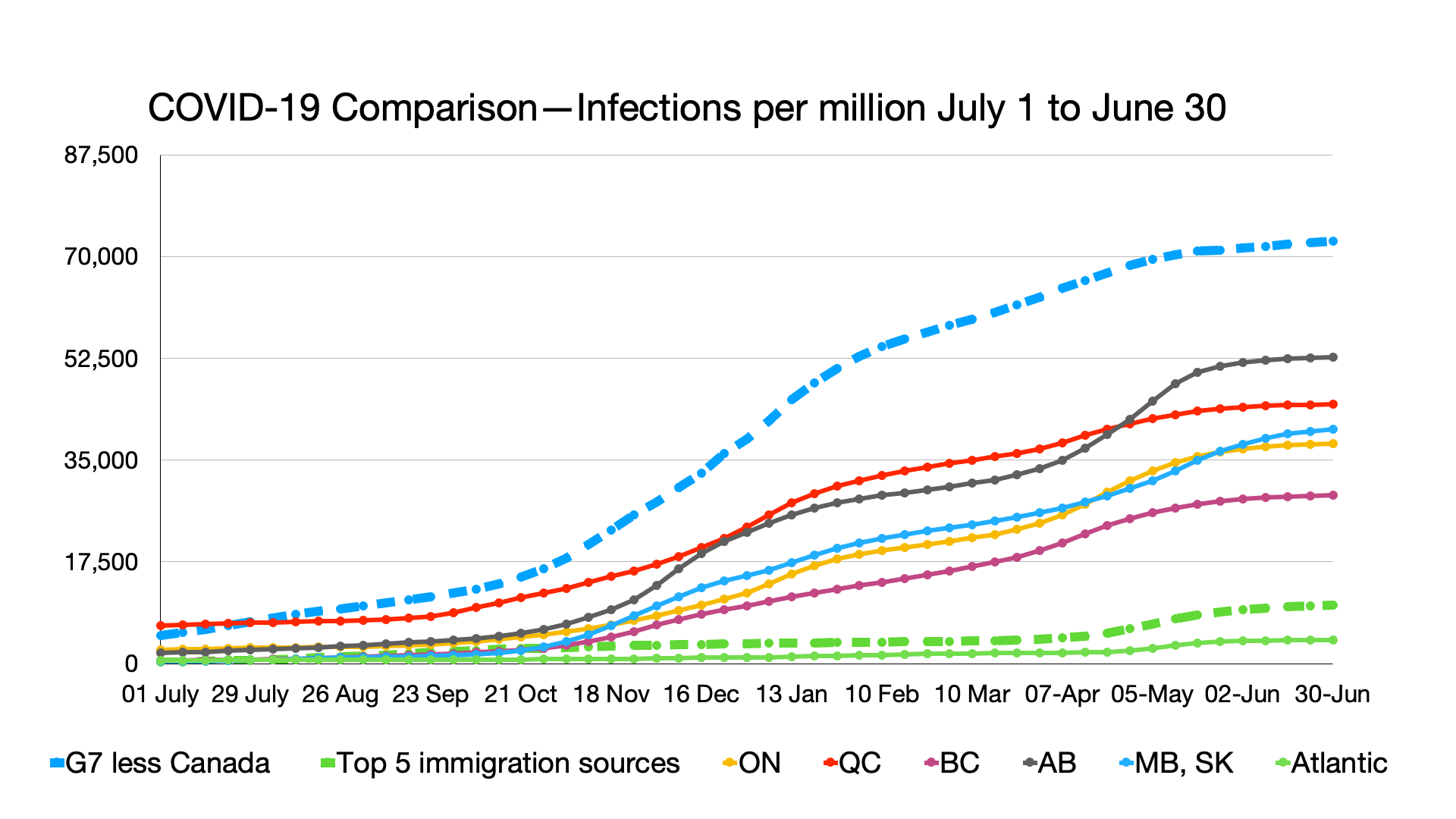
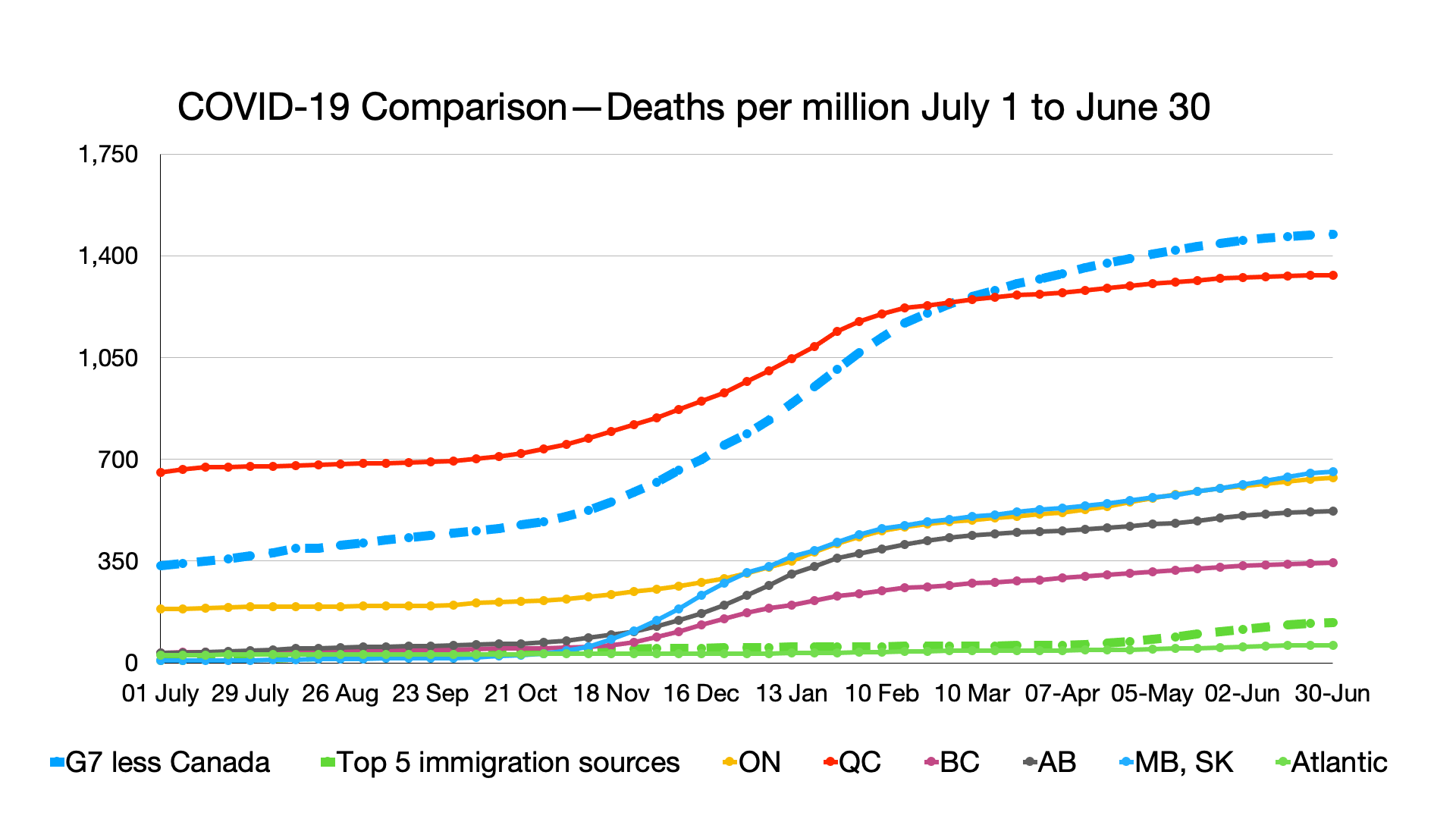
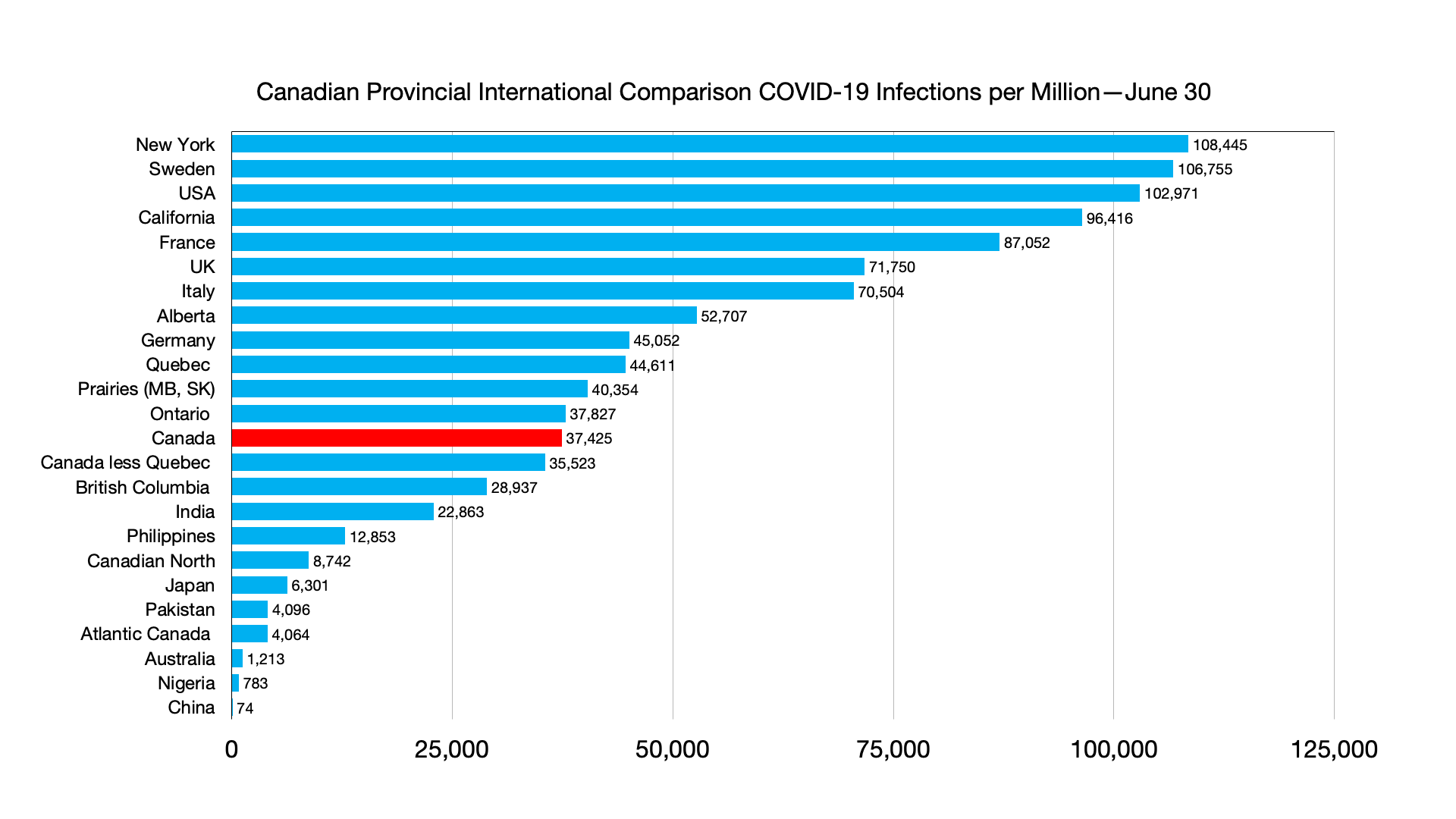
#COVID-19: Comparing provinces with other countries 30 June Update, Canadian excess deaths

The latest charts, compiled 30 June as overall rates in Canada continue to decline along with increased vaccinations (still largely first dose, fully vaccinated 30 percent, comparable to most EU countries).

Vaccinations: Ontario ahead of USA, all provinces ahead of EU countries, China ahead of Italy in total vaccinations but lower than EU countries in terms of fully vaccinated (16 percent).

Trendline charts

Infections per million: Surge in delta variant has resulted in UK moving ahead of Italy.

Deaths per million: Canadian North now ahead of Atlantic Canada.

Vaccinations per million: Gap between Canada and other G7 countries continues to grow. Gap between China and India narrows (14.4% compared to 13.0%).

Weekly

Infections per million: UK ahead of Italy

Deaths per million: Canadian North ahead of Atlantic Canada, reflecting additional death in Yukon.

And the excess deaths report, indicating that Canadian COVID mortality has been understated (not unique to Canada):

A new study suggests Canada has vastly underestimated how many people have died from COVID-19 and says the number could be two times higher than reported.

Dr. Tara Moriarty, working group lead for the study commissioned by the Royal Society of Canada, said in an interview while most accounts have put the majority of deaths in long-term care, the new data analysis suggests the toll of COVID-19 was also heavily felt outside the homes in the community.

Many of those deaths likely occurred in lower income, racialized communities and affected essential workers, new immigrants and people living in multigenerational homes, as well as clinically frail seniors living at home, the study says.

“If we’d had some sense early on of who was dying where, if we had had a sense of just how many deaths were actually occurring … maybe people would have started looking sooner or listening sooner to people in communities who were saying, ‘It’s really really bad here, people are dying,'” Moriarty said.

“It might have provided support for those claims that might have caused some kind of action that would have saved lives.”

Moriarty said seeing Canada out of step with similar high-income countries on the proportion of long-term care deaths was a red flag that inspired the analysis by the society.

The new peer-reviewed analysis casts doubt on the widely accepted assumption that 80 per cent of Canada’s deaths due to COVID-19 occurred among older adult residents of long-term care homes.

Instead, it says at least two-thirds of deaths caused by COVID-19 in communities outside of long-term care may have been missed. That would put the proportion of deaths in long-term care at around 45 per cent, much closer to the average of 40 per cent reported by peer countries in the Organization for Economic Co-operation and Development.

The conclusion is based on a review of reports of excess deaths across Canada, the pattern of COVID-19 fatalities during the pandemic and cremation data showing a significant spike in deaths at homes versus hospitals in 2020. It also relies on antibody surveillance testing that collectively unmasked the likely broad scope of undetected COVID-19 infections.

The researchers adjusted the data to account for things like increased deaths due to the drug toxicity crisis and the expected drop in deaths linked to the pandemic because of things like reduced traffic accident rates.

The extent of “likely missed” fatalities varies by province and there are major data gaps in what was available, Moriarty said.

The knowledge gap is particularly acute in British Columbia, Saskatchewan, and Manitoba where cause-of-death data is only complete into February 2020, the report says. It was less of a problem in Quebec, where the virus accounted for all excess deaths, and Ontario.

Between Feb. 1 and Nov. 28, 2020, the study found COVID-19 deaths of about 6,000 people aged 45 and older appeared to have gone undetected, unreported or unattributed to the virus.

“This suggests that if Canada has continued to miss these fatalities at the same rate since last November, the pandemic mortality burden may be two times higher than reported,” the report says.

Eemaan Kaur Thind, a public health practitioner who looked at both detected and undetected COVID-19 deaths in racialized communities, said the results weren’t a shock given previous reports linking the communities and deaths or hospitalization rates.

The study suggests it’s likely many cases in those communities were never identified, and the resulting deaths were never counted.

“We know that a high-proportion of essential workers happen to be visible minorities,” she said.

“None of that surprised me, although it never really becomes any less hard to see the official numbers when you see something like this.”

Thind said she hopes the findings push policy-makers to listen to those most affected, many of whom raised alarms about things like the role language barriers played in access to COVID-19 testing and care.

“Data is very important but I think it’s more important to also listen to people and believe them.”

About 25 per cent of likely deaths occurred in people between 45 and 64, the study said.

The researchers make several recommendations, including mandating weekly preliminary reporting of deaths due to all causes to Statistics Canada, performing COVID-19 testing on all people who die in any setting, and immediately adopting methods used by the U.S. Centers for Disease Control for estimating excess mortality during the pandemic.

The group also calls for the creation of a national COVID-19 mortality task force with the provinces and territories, and independent advisers to investigate why so many Canadian COVID-19 cases and deaths have been missed or unreported, including examining demographic and employment data for those who died.

Source: COVID-19 deaths in Canada may be two times higher than reported: Study