‘We Can’t Take Immigrants for Granted’: Minister

Bit of an odd comment by the minister – “ranking immigrants one against the other” – given that the old point system and current Express Entry application process do just that. Or maybe he was simply trying to communicate an increased focus on lower-skilled essential workers.

But perhaps the massive draw earlier this year with minimal comprehensive ranking score of 75 suggests that the government’s objective in meeting this year’s target of 400,000 makes previous merit assessment approaches less important:

Minister Marco Mendicino has emphasized the need to modernize Canada’s immigration system so that future public health crises don’t threaten the economy the way COVID-19 has, though he was scant on details about how to achieve it.

Speaking at an online event on Friday organized by First Policy Response, Mendicino said bringing immigrants into the country is critical for the Canadian economy, while also recognizing the “contributions (of immigrants) that we took for granted before the pandemic.”

“We believe that we are an open country, an inclusive country, but our system needs to be transformed, needs to be modernized, so that it can accommodate the great demands that are placed on it,” he said.

Mendicino believes the $1 billion slated in the 2021 budget to “modernize and transform” the immigration system will lead “not only to better service…but to faster outcomes” for people trying to immigrate into the country. As he sees it, it is part of a “shift in the paradigm in the way we talk about immigration,” which should include getting rid of discriminatory practices like “ranking immigrants one against the other” – namely those considered low-skill versus those with higher qualifications.

“I think the pandemic has allowed us to really understand that each and every newcomer has something to contribute to our economy, to our communities and to our country,” the Minister said.

The government has taken some steps during the pandemic to continue some level of immigration. These have included writing new laws and policies to authorize entry based on “the needs of the economy;” the digitization of permanent residence and citizenship application processes; and the extension of permanent residence to immigrants already working in the country but lacking status through programs like the Essential Workers Pathway and the Guardian Angel programs, the latter of which allowed “asylum seekers to stay in Canada thanks to their contributions in hospitals and long-term care homes,” Mendicino said.

“We prioritized the needs of the economy. Immigration will create jobs, further opportunities and strengthen our long-term prosperity.”

But other than “investing in hiring additional people, introducing new technologies and putting in place policy flexibility,” there were few, if any, details on what will be done going forward to ensure immigrants don’t fall into precarious employment. Raju Mohandoss, one of the four panelists and the director of newcomer programs and services at WoodGreen Community Services, a settlement organization in Toronto, referred to these employments as “survival jobs.”

“When newcomers come – even qualified ones – they get into survival jobs that sustain them during a period when they are putting other things together and trying to access other services to integrate,” he said after the Minister had finished speaking and left. “But all these survival jobs are in the hospitality, retail, or manufacturing sectors…all of which are completely wiped out because of the pandemic situation.”

To his credit, before leaving, Mendicino had mentioned the importance of “making sure we protect (migrant workers’) rights” and “ensure that their workplaces are safe and healthy,” but he again failed to specify how this would be done.

He also made no mention of the precarious nature of most of those so-called “survival jobs.” And while he recognized that speaking of immigration must include a discussion on how to “attract people not only for the purposes of adding to our economy…but to protect that promise of Canada” as a welcoming, safe country, he gave no details on what will happen to people whose permanent residence applications are stuck in limbo or in a backlog, other than “keep the faith” and “we hear you.”

The four-member panel that followed Mendicino’s presentation, which consisted of immigration experts from various fields, failed to find the Minister’s announcement as much more than a self-congratulatory moment.

Rupa Banerjee is the Canada Research Chair and Associate Professor at the Ted Rogers School of Management at Ryerson. She said that while she agreed with Mendicino that “a lot of news early in the pandemic really [was] quicker” than what is expected from governments, little work has been done to help newcomers integrate into society.

Mendicino “talked about selection and modernization,” she said, “but, at the end of the day, those do not exist in a vacuum…Newcomers face challenges once they arrive in Canada, and those challenges need to be integrated into the selection system as well.”

What is needed immediately in order to help newcomers, added Mohandoss, are dollars. While the $1 billion investment is “good to hear,” Mohandoss stressed that “no new dollars” have been made available for settlement agencies, which are crucial in helping newcomers find, understand and access available resources. According to him, there hasn’t been any investment in the settlement agencies sector for “more than a decade and a half.”

“We have these targets – that’s great – but what happens to (newcomers) when they’re here?” he said. “Unless we’re improving settlement services, these people are going to continue to struggle being here…So, dollar investments in digitizing and innovating stops short of investing in settlement services.”

Much of the rest of the conversation between the panelists involved discussing what they saw as Canada’s “two-tier immigration system,” referring to the premium the government puts on the Canadian Experience Class versus so-called “low-skill” immigrants. The result, said Shamira Madhany, World Education Services’ managing director, is that Canada ends up “with a lot of people who come to Canada through the two-tiered system but don’t grow our economy” as their experience abroad is discounted and thus often goes underutilized, forcing them onto precarious so-called survival jobs.

“Even with pathways to permanent residence, people still struggle greatly after transition,” added Banerjee.

Madhany suggested a three-pronged approach to help boost the economy by properly utilizing newcomers’ experiences and skills as they integrate without having to sacrifice their safety: a national strategy to enhance immigration and labour market integration; policies that are intentionally passed with those who are “impacted greatly” in mind, such as racialized women and people relegated to low-wage labour; and developing innovative tools and approaches to recognize and assess skills and experience gained abroad.

“We need to think about being intentional about leveraging the skills people bring,” she said. “This isn’t just about bringing people in and taking any job…but using people’s deep experience.”

Source: https://ca.news.yahoo.com/t-immigrants-granted-minister-185607613.html

#Citizenship for sale: fugitives, politicians and disgraced businesspeople buying Vanuatu passports

No surprises here:

A controversial “golden passports” scheme run by the Pacific nation of Vanuatu saw more than 2,000 people, including a slew of disgraced businesspeople and individuals sought by police in countries all over the world, purchase citizenship in 2020 – and with it visa-free access to the EU and UK, the Guardian can reveal.

Among those granted citizenship through the country’s development support program were a Syrian businessman with US sanctions against his businesses, a suspected North Korean politician, an Italian businessman accused of extorting the Vatican, a former member of a notorious Australian motorcycle gang, and South African brothers accused of a $3.6bn cryptocurrency heist.

The passport scheme allows foreign nationals to purchase citizenship for US$130,000 in a process that typically takes just over a month – all without ever setting foot in the country.

Marketed by agencies as one of the fastest, cheapest and most lax “golden passport” schemes anywhere in the world, the development support program grants unfettered, visa-free access to 130 countries including the UK and EU nations. Vanuatu also operates as a tax haven, with no income, corporate or wealth tax.

Experts have warned the scheme is ripe for exploitation, creating a back door for access to the EU and UK and allowing transnational criminal syndicates to establish a base in the Pacific, and Vanuatu’s taxation laws make the country an attractive site for money laundering.

A path to new identities

The passports program, which netted the Vanuatu government more than US$116m last year, has been highly controversial since its relaunch in 2017.

But until now, knowledge of who has bought passports through the scheme has been murky.

A series of internal government documents obtained by the Guardian via the country’s freedom of information scheme, details the name and nationality of every recipient of a Vanuatu passport through the country’s development support program and Vanuatu contribution program in 2020 and January 2021.

After a months-long investigation, involving searching publicly available court records, electoral rolls, death records, social media trails, and discussions with police and sources from around the world, the Guardian has been able to confirm the identities of dozens of the individuals on the list.

Vanuatu issued roughly 2,200 passports in 2020 through these programs – more than half (around 1,200) were to Chinese nationals. After Chinese, the most common nationality of recipients was Nigerian, Russian, Lebanese, Iranian, Libyan, Syrian and Afghan. Twenty people from the US, six Australians and a handful of people from Europe were also among those who applied.https://interactive.guim.co.uk/charts/embed/jul/2021-07-07T05:01:43/embed.html

The citizenship-by-investment (CBI) scheme is not illegal and many countries around the world offer CBI programs. There are many legitimate reasons for applying, including improved freedom of movement or tax-free offshore banking privileges.

However, security experts warn that the ease with which people can buy passports from the country, as well as the travel it permits, could make it an attractive scheme for members of transnational criminal syndicates, allowing them a legitimate base in the Pacific.

“It’s not just that they can travel through the EU or set up businesses … one of the issues is being able to create these networks to the Pacific, especially as the Pacific becomes more of a trafficking hub for drugs,” said Jose Sousa-Santos, a Pacific policy fellow at the Australian Pacific Security College. “And Vanuatu’s tax semi-haven laws make it very attractive for money laundering.”

The Guardian has found that a number of Vanuatu applicants are heavily implicated in a complex web of offshore business, with some owning shell companies with no discernible business activity.

Sousa-Santos added that another potential danger was people obtaining Vanuatu citizenship and then legally changing their name in Vanuatu, which effectively gave them a new identity.

“It’s one of the real risks,” he said. “If you are somebody who is a person of interest and who was able to somehow clear the Vanuatu Financial Intelligence Unit process, once you have Vanuatu citizenship, you’re able to change your name and, of course, be able to enter countries where your criminal background would not allow you to.”

In one brochure advertising the country’s development support program by a registered agent, the agency answers a question about whether passport recipients can change their name. “Once you are granted citizenship, you can change your name by sending us a letter that explains your motivation to change your name and your passport will be issued with your new name,” the brochure reads.

In response to these concerns, Ronald Warsal, the chairman of the Vanuatu Citizenship Office and Commission, said: “Vanuatu is a signatory to … most internationally sanctioned treaties and has ratified such treaties in recent years prohibiting transnational criminal syndicates to operate within its [jurisdiction] and as such, it is hard for international criminal syndicates to establish a base in Vanuatu.” He also said the country required checks before allowing a legal change of name.

EU concerns

Both the EU and the OECD have continued to express concerns regarding due diligence measures, forcing Vanuatu to promise it would step up background checks last year in an attempt to clean up the programs’ image. 

Despite this, the documents show that as recently as January 2021, Vanuatu was selling passports to individuals with links to fraud or sanctions and others who were sought by police in their home countrie

Other people granted passports by Vanuatu include:

  • Raees and Ameer Cajee, the founders of cryptocurrency investment platform Africrypt, who have been accused by lawyers for their former investors of a “crypto heist”, allegedly disappearing with bitcoin valued at roughly $3.6bn (£2.6bn), claims they deny.
  • Gianluigi Torzi, an Italian businessman accused of extorting Vatican officials of €15m (US$17.7m) during the purchase of a valuable London property. Torzi has denied wrongdoing.
  • Hayyam Garipoglu, a Turkish banking mogul imprisoned over a multimillion-dollar embezzlement scandal, and also sentenced to prison for harbouring his nephew after his nephew murdered a 17-year-old girl.
  • Ghali Belkecir, the controversial former head of Algeria’s Gendarmerie, the country’s military force in charge of law enforcement, who has four warrants out for his arrest.
  • Khaled al-Ahmad, a Syrian businessman and close advisor to President Assad, also obtained Vanuatu citizenship in June 2019, according to documents separately obtained by the Guardian.

In response to the Guardian’s inquiries about the individuals, Floyd Mera, the director of Vanuatu’s Financial Intelligence Unit, said: “Reading your list, most have allegations, pending investigations and ongoing court proceedings. A few have cases against them only after obtaining Vanuatu citizenship … If there are substantial convictions against any of these names, their citizenship may be revoked.”

He added: “Going forward, the FIU will conduct enhanced checks on the names provided in your list. If any of these persons have criminal convictions, FIU will promptly inform Citizenship Office of the updated information.”

The Guardian also believes there may be a senior North Korean politician and his wife who were granted citizenship after applying for the scheme using Chinese passports.

The names of a man and a woman who applied for passports last year match those of a well-known senior North Korean politician and his wife, though the Guardian has not been able to confirm the couple’s identity.

On paper, Vanuatu prevents citizens of Syria, Iraq, Iran, Yemen and North Korea from obtaining citizenship unless they can prove they have been a resident outside these countries for more than five years. However, the Guardian was able to identify a number of applicants from those countries who were resident within the black-listed countries at the time of applying.

A Syrian construction and real estate magnate with sanctions against a number of his businesses appears on the document. Abdul Rahman Khiti purchased Vanuatu citizenship just a few weeks after the US imposed sanctions on a number of his businesses.

Warsal, of Vanuatu’s Citizenship Office and Commission, said: “Abdul Rahman Khiti’s application was lodged prior to sanctions on a number of his business and by the time his application came before the screening committee and the FIU there was no adverse finding against him and the commission approved his application.”

Warsal said that Khiti also provided proof of his residency outside Syria for five years prior to applying. He added that the Citizenship Commission would be further investigating Khiti’s citizenship.

A source of revenue

Vanuatu is one of the poorest countries in the world, with the World Bank putting GDP per capita at US$2,780. The country is heavily in debt, in large part due to the natural disasters that have hit it. After a crippling cyclone in 2014, the country’s debt stock-to-GDP ratio climbed from 23% to 47% in 2018.

The sale of passports is the largest source of revenue for the Vanuatu government, with analysis by Investment Migration Insider finding it accounted for 42% of all government revenue in 2020.

In June 2021, the government reported a budget surplus despite the Covid-19 pandemic, largely thanks to the continued demand for citizenship, and the government has used the profits to pay down debts.

“There is merit [to the scheme],” said Ralph Regenvanu, the opposition leader of Vanuatu. “It just needs to be done a lot better than we’ve done it to date.”

Asked what advantage there is to Vanuatu, Regenvanu is blunt.

“Money. For a country with very limited resources, it’s money.”

Regenvanu said more robust processes needed to be implemented to screen applicants, in particular the enactment of an order that was issued by the former government – in which he was foreign minister – in March, which ordered an international specialist firm to be involved in due diligence checks.

“The only checks are the Financial Intelligence Unit and that’s obviously, as you found out, just totally inadequate … Our FIU obviously doesn’t have the capacity.”

Warsal said “the government is in its final stages to engage a European international reputable firm to assist the VFIU in its due diligence processes.”

But many in Vanuatu see the scheme as an affront to the sovereignty of the young country, which achieved independence from France and the UK in 1980 after almost a decade of struggle.

Ati George Sokomanu was a key figure in the country’s struggle for independence in the 1970s and was appointed as Vanuatu’s foundation president in 1980 after independence. He said the cash-for-passports scheme “tarnished” the vision of a free and proud Vanuatu they fought for during the independence movement.

“The gospel that we preached was to do with the return of the land from the hands of the foreigners – that we should have our own passport, that we would be a free people, we should have our own flag, and you know, be somebody in the face of this world,” he said.

“We struggled for our freedom and we gained it. And why should we break our sovereignty and our own dignity by making us become slaves again by selling our own passport to other people?”

Source: https://www.theguardian.com/world/2021/jul/15/citizenship-for-sale-fugitives-politicians-and-disgraced-businesspeople-buying-vanuatu-passports?CMP=Share_AndroidApp_Other

Related article: Want a new life in Vanuatu? Take the lift to the 23rd floor of a skyscraper in Hong Kong

If you wanted a new life on a tropical island and had US$130,000 to spare, you might end up visiting the 23rd floor of a nondescript building in downtown Hong Kong.

In the busy district of Wanchai, on a corner peppered with home decoration shops, car dealerships and small eateries full to the brim during lunch break, is the Tung Wai commercial building.

A bright entrance – now equipped with disinfection trappings and temperature-taking devices – leads to the fast lifts that will take you from the traffic din to what could be described as the Vanuatu floor.

Room 2303 hosts the Consulate General of the Republic of Vanuatu, with a large sticker on the glass door with Vanuatu’s coat of arms – a Melanesian warrior holding a long spear with one hand, standing against a mountain, with two crossed namale fern fronds and, behind the greenery, a curly boar’s tusk. Underneath it is Vanuatu’s national motto, Long God Yumi Stanap, which is Bislama (one of the three official languages of Vanuatu, together with English and French) for “In God we stand”.

Next to the consulate is the Vanuatu Trade Commission, which sits next to the office of Vanuatu Companies Limited, and the two offices of the PRG (Pacific Resource Group) Consulting Limited and PRG ImmiMart Limited.

The first company assists with investments and trade in Vanuatu, while PRG ImmiMart Limited has been appointed as the “Worldwide Exclusive Sole Master Marketing Agent to promote the Contribution Program” by the Vanuatu government via the company Vanuatu Glory Limited (VGK).

PRG handles all preliminary work for those who wish to purchase Vanuatu citizenship through the country’s Vanuatu Contribution Program (VCP), which costs $130,000 per person, or $180,000 for a family package.

Last year, more than 650 people were granted citizenship through the VCP. The huge majority were Chinese nationals, with just nine people applying for the scheme with nationalities other than Chinese.

The sale of passports is the largest source of revenue for the Vanuatu government, with analysis by Investment Migration Insider finding it accounted for 42% of all government revenue in 2020. The appeal of a Vanuatu passport includes that it offers visa-free travel to UK and EU countries and that Vanuatu – with no wealth, income or corporate taxes – operates as a tax haven.

PRG ImmiMart Limited is the sole agent in the world licensed to market this program, and according to one of the agents at the office, the company keeps $100,000 of the $180,000 fee for a family application, with the remaining $80,000 going to the Vanuatu government. They did not clarify what portion of the fee for an individual application went to the company.

The VCP is a separate scheme to the Development Support Program (DSP), which is managed by different agencies. The Guardian’s investigation into the identities of those who obtained citizenship of Vanuatu was focused on the DSP and not this scheme.

In the visitors’ office – an air-conditioned room with the flag of Vanuatu next to the Hong Kong SAR flag and a breath-taking view over Eastern Hong Kong island – Hin Ho, an agent, shows the brochures and the itemised table with the citizenship fees and charges, and explains how to apply for a Vanuatu passport and legally recognised citizenship.

The application process is straightforward, and shouldn’t take longer than eight weeks and does not require applicants to set foot in Vanuatu. It is such a well-established system that the brochure even specifies that the screening committee normally meets on the last Thursday of every month, while the citizenship committee meeting takes place on the last Friday of every month.

Money and no criminal record seem to be the main requirements for the “high quality new immigrants” scheme, with applicants required to provide a police clearance certificate, and asset proof of no less than $250,000 – excluding the amount that is being paid to the VCP to obtain citizenship.

Once approved, applicants can take an oath of allegiance in the building, after which they are handed a citizenship certificate and passport, and they can go down the fast lifts and exit into Gloucester Road having become a legally recognised citizen of the small Pacific Ocean archipelago.

Given the high cost, VCP may not be much help to the large numbers of people who want to leave Hong Kong for security reasons since the introduction of the National Security Law. But for wealthier passport chasers, keen for the peace of mind that may be granted by an alternative passport, the little green book of a Vanuatu passport might be just the ticket.

Source: https://www.theguardian.com/world/2021/jul/15/want-a-new-life-in-vanuatu-take-the-lift-to-the-23rd-floor-of-a-skyscraper-in-hong-kong
Climate Change Is Not a Reason to Give China a Pass on Human Rights

Indeed:

In a widely-publicized July 8 letter, four dozen American advocacy groups—including the Sunrise Movement and the Union of Concerned Scientists—demanded that President Joe Biden and Congressional Democrats reverse their “antagonistic posture” in favor of a more cooperative relationship with Beijing to “combat the climate crisis.” The signatories also attempted to frame the current administration’s China approach as a surrender to pressure on the right that’s counterproductive to global governance as well as responsible for xenophobia against individuals of East and Southeast Asian descent, and therefore “doing nothing to actually support the wellbeing of everyday people in either China or the United States.”

Alas, they seem oblivious to realities on the ground for those of us who live in the shadow of Chinese Communist Party hegemony. It’s not “progressive” to ignore a regime that opposesmulticulturalism, weakens  trade unions, regulates women’s choices through centralized population control, persecutes the LGBTQ+ community, militarizes international waters, and incarcerates ethnic minorities in concentration camps. Without shared values, solidarity is impossible.

Make no mistake: climate change is indeed an urgent, existential danger. Amid the record-breaking heatwave sweeping across the Pacific Northwest and floods that pummeled cities on the East Coast, China, too, is hit with extreme weather patterns, even as the government is more than happy to downplay that. A proposed “shift from competition to cooperation” at the state level would convey legitimacy and moral equivalence for Beijing. While the letter was correct to note that “climate change has no nationalistic solutions,” doesn’t appeasement of geopolitical expansion and well-documented atrocities precisely privilege the interests of nations over peoples?

Recent White House occupants, from Richard Nixon to Barack Obama, all embraced China’s rise, often at the expense of genuine human-rights concerns there. The abandonment of Maoism in the late 1970s produced only materialism and inequality, not (as many pundits predicted) any other form of liberalization.  Serious champions of climate justice, rather than misdirect their anger at the long-overdue bipartisan unity against Chinese crimes against humanity, should offer realistic means for Beijing to change its atrocious behavior first.

This isn’t a matter of prioritizing human rights over climate change. Practically nothing in their record suggests that Chinese leaders have any intention of honoring their end of the bargain in binding, bilateral agreements. Look no further than the 1984 Sino-British Joint Declaration on Hong Kong and 1987 Sino-Portuguese Joint Declaration on Macau, each of which promised these territories 50 years of political autonomy. Unfolding now in both, however, is the systematic dismantling of every pillar of free society, from press freedom and due process topeaceful protests and open elections. No wonder Human Rights Watch’s latest reportcharacterized this as “the darkest period for human rights in China since the 1989 massacre.”

The moral grandstanding behind opposing a so-called new Cold War—as if current tensions were solely the result of U.S. actions—fails to acknowledge that Beijing is capable of perpetuating imperialism in its own right. One case in point is the Belt and Road Initiative, a massive program of investments and infrastructure projects abroad. Designed to overcome China’s own overproduction dilemma at a time of stagnating wages and inadequate domestic demand, it targets developing countries in the region with extraterritorial legal arrangements, debt-trap diplomacy, and, unsurprisingly, environmental exploitation.

We need to deal with China as it is, not as we wish it to be. Climate solutions should be based on transnational partnership, democratic engagement, and adherence to a rules-based world.
Beijing, to this day, refuses to own up to its mistakes in the COVID-19 pandemic, not to mention its longstanding intellectual-property thievery and forced technology transfer. It’s also keen to export authoritarianism: threatening to invade Taiwan, supporting North Korea’s dictatorship, and shielding the coup d’état in Burma from condemnation.

To imagine this thuggish actor on the international stage—whose state-run media indulges in mocking Greta Thunberg—is somehow innocently waiting to advance a climate agenda (if only other countries would be nicer to it) is naive. Last year, it built more than triple the amount of new coal power capacity as the rest of the world combined and funded $474 million worth of coal-sector projects abroad. Thanks to its polluted megacities, it’s the single largest carbon-dioxide emitter that continues to increase at a higher rate despite already doubling that of the United States. Neither can we gloss over the solar panels made in Xinjiang using cheap coal-generated electricity and unfree Uyghur labor.

At the end of the day, granting Beijing blanket concessions and expecting positive outcomes constitute little more than wishful thinking. “We’re in a contest, not with China per se,” as Biden put it at the G-7 summit in England last month, “but a contest with autocrats, autocratic governments around the world.” Should Americans wish to lead, they must be willing to listen. The voices of the oppressed ought to matter more than any superpower; creating a more humane, habitable world begins with respecting everyone’s basic dignity.

Source: Climate Change Is Not a Reason to Give China a Pass on Human Rights

For the first time in decades, major changes are coming to Canada’s workplace equity laws

Of note as would also apply to federal public service (where TBS is lead). Hopefully the focus will be on the substantive issues, not just the terminology:

Federal legislation that aims to ensure equal opportunities for employees from under-represented groups is heading for its most significant overhaul since its introduction 35 years ago.

The Liberal government announced today that it has convened a new task force to review the Employment Equity Act, which the government describes as “an important tool to promote fairness, equality and diversity in federally regulated workplaces.”

The legislation states that no person should be denied employment opportunities for reasons unrelated to ability. It says that creating those conditions “requires special measures and the accommodation of differences.”

Labour Minister Filomena Tassi said the legislation has improved the standing of various groups that have been marginalized in the workplace, but that the act was overdue for an update.

“It’s about bringing the act into the 21st century,” Tassi said.

Future changes to the legislation, she added, “are absolutely going to result in more equitable workplaces.”

The 13-member task force conducting the review is being asked to come up with recommendations to “modernize” the legislation. The task force will host its first meeting on July 15 and is expected to have a final report by early 2022.

About 1.3 million people, representing about six per cent of Canada’s workforce, are employed in federally regulated industries and workplaces.

Review could result in more precise categories of marginalized workers

The existing Employment Equity Act identifies four groups that have faced additional barriers in workplaces: women, Indigenous Peoples, people with disabilities and members of visible minorities.

Those categories were defined when the act was introduced in 1986. The legislation was largely inspired by the 1984 Royal Commission on Equality in Employment, which was led by Rosalie Abella before she was appointed to the Supreme Court.

Among other things, the task force will be charged with reviewing those groups, which likely will result in the creation of more precise and varied categories of under-represented workers.

Adelle Blackett, a law professor at McGill University who was named chair of the task force, said LGBTQ people, for example, probably will need representation in the next iteration of the act.

“The time is now,” Blackett told CBC News. “We have a really important opportunity to achieve equality.”

Blackett said the national reckoning over the atrocities committed in Canada’s residential school system, and the murder of George Floyd in the United States, are driving the effort to address systemic inequalites.

“It’s hard not to be thinking about how to build a legacy of meaningful inclusion, including in our workplaces,” Blackett said.

According to the latest report on equity within federally regulated workplaces, women, Indigenous Peoples and people with disabilities remain underrepresented in federally regulated workplaces.

Representation of visible minorities is more favourable, with those workers filling slightly more jobs than expected based on their overall share of the workforce.

Unifor says existing act has ‘failed to deliver’

The launch of the review task force comes following recent efforts by the Liberal government to reduce inequities across a range of sectors — including new pay equity legislation that will go into effect at the end of August.

Critics, including the federal New Democrats, have described some of the announcements as pre-election manoeuvring.

NDP critic for women and gender equality Lindsay Mathyssen said last week’s news on pay equity follows the Liberal’s recent track record of providing “pretty words instead of substantive actions.”

Unifor, the largest union representing workers in the federally regulated private sector, said changes to the act are badly needed.

“Despite being in force for 35 years, the Employment Equity Act has failed to deliver on its promise,” Unifor national president Jerry Dias wrote on Twitter. He called on the federal government to ensure that input from workers is considered during the review.

“Updating terms, expanding inclusion and prioritizing enforcement will go a long way,” Dias added.

Source: For the first time in decades, major changes are coming to Canada’s workplace equity laws

#COVID19 Immigration Effects – May 2021

Updated data across all immigration programs. Given the travel restrictions and shutdowns spring 2021, some of the monthly percentage increases are exceedingly high, with comparisons to May 2019 more meaningful. 

Some of the highlights: 

  • 2021 Permanent Resident numbers to date remain below 2019 levels, 109,615 Jan-May 2021 compared to 125,850. To meet 2021 target of 401,000, over 40,000 new PRs per month needed over the next 7 months. Given the various measures taken to date, a stretch but not impossible. 
  • The decline in Permanent Resident admissions partially reflects decline in TR to PR transitions, perhaps suggesting limited existing “inventory,” with PR applications also down 
  • Temporary Residents relatively less affected with numbers fairly stable 
  • Slight decline in study permit applications and study permits 
  • Asylum claimants stable at low levels 
  • Citizenship slight recovery in numbers but still much lower than pre-pandemic 
  • Visitor visas remain largely shut down. 

Candidate diversity is high on the agenda as Canada’s political parties prepare for a federal election

Of note, pending a more complete analysis:

During what’s widely expected to be an election year, Canadians have been confronted with the realities of discrimination, racism and reconciliation as never before.

That’s something major federal parties are thinking about as they craft their slates of candidates, who, if elected, will need to represent the interests of a diverse electorate.

The Liberals, Conservatives, New Democrats and Greens have all made efforts to connect with under-represented communities, mostly through updated recruiting requirements and fundraising initiatives.

But they’re less forthcoming about the specific targets they’re hoping to hit, such as what proportion of racialized or LGBTQ+ candidates would indicate a successful and representative nomination process.

Women, for example, make up just over half of Canada’s population, but it took until 2020 for just 100 of its 338 MPs to come from that group. Millennials are one of the largest populations in Canada, yet most federally elected officials are much older. And visible minorities, Indigenous people, the LGBTQ+ community and disabled Canadians are all under-represented in the House of Commons.

“Parties are largely vote seeking, organizational machines,” said Erin Tolley, Canada Research Chair in Gender, Race and Inclusive Politics at Carleton University.

“So if a party is looking out into the public landscape and sees that issues related to equity or to diversity or to representativeness are something that the public is hungering for … parties will respond to that in a way that is consistent with their ideological vision.”

Here’s how four major federal parties are looking at tackling the balance this time around. (The Bloc Québécois did not reply to requests for comment.)

The Liberals

As of Tuesday, the Liberals had nominated 191 candidates, with more announcements expected throughout the week. Women make up 43 per cent of that total, with racialized Canadians accounting for more than 20 per cent of those nominated. Seven candidates are Indigenous.

Navdeep Bains, who is chairing the Liberals’ national campaign along with Economic Development Minister Mélanie Joly, has been tasked with seeking out candidates for the governing party.

One of the changes the party has made is to widen requirements within its nomination process. Previously, local riding associations needed to prove they had sought out female candidates. Now, associations must show how they’ve attempted to bring anyone from an equity-seeking group into the fold.

“You’ve got to document, and really have to engage and have a thorough search for potential candidates,” Bains said. “We’re talking about women, Black and Indigenous (candidates), people of colour, the LGBTQ community, people with disabilities.”

The party is also dipping into two pre-existing funds to assist with that work. One is the Judy LaMarsh Fund, which supports female candidates running for the federal Liberals. The other is the Indigenous Electoral Endowment Fund, which is intended to help recruit and support Indigenous candidates.

The Conservatives

The Conservatives had nominated 240 candidates as of Monday. The party did not provide a breakdown of the groups to which those candidates belong because it’s still compiling that information, but party spokesperson Cory Hann identified several as Muslim.

Hann said party supporters and staff have been asked to “work their networks and encourage people from all backgrounds to get involved” as either candidates or campaigners.

“The candidates we’ve nominated so far all have varying backgrounds both professionally and personally, ensuring that, as (Conservative Leader Erin) O’Toole has said, Canadians from all over the country see themselves in our Conservative party.”

Where representation is concerned, the party appears to be focusing most on building bridges with racialized and Indigenous communities, although the party is tight-lipped on the specifics of those plans.

Conservative MP Garnett Genuis has been leading engagement efforts with “cultural and religious minority communities,” telling the Star he is “excited about the potential that we have for growth in that area in the upcoming campaign.”

Genius would not expand on which communities he was specifically courting, or how those efforts look in practice, citing the Tories’ “inside strategy.”

The NDP

In 2019, the New Democrats led the charge when it came to candidate diversity, hovering near the gender parity benchmark and reaching or surpassing representative levels for Indigenous, racialized and LGBTQ+ groups.

For the next election, the party is trying to ensure more than 50 per cent of its candidates are women — the only specific target cited by any federal party for any equity-seeking group.

The party has nominated 97 candidates so far, half of whom are women. Racialized Canadians make up 33 per cent of that total, while six per cent are Indigenous and 18 per cent are LGBTQ+. People living with a disability account for 12 per cent of nominated candidates, and 11 per cent have been identified as “youth.”

As with the Liberals, riding associations must demonstrate how they’ve sought to recruit diverse candidates. The party is also now requiring that any outgoing incumbent is replaced with someone from an equity-seeking group. Departing MP Jack Harris, for example, will be succeeded by one such candidate.

“This is a huge priority for us. It’s part of our DNA,” NDP national director Anne McGrath told the Star.

McGrath said that because the party has more resources heading into the next election than it did in 2019, more emphasis is being placed on recruitment.

The Green party

There may be no party for which running a diverse roster of candidates is more important than the federal Greens.

While Annamie Paul is the first Black and Jewish woman to lead a major federal party, she is currently embattled within a party structure that insiders charge is perpetuating racism and sexism.

What’s more, a confidential report prepared for the Greens and obtained by the Star found the party fell short of recruiting and supporting diverse candidates in the last general election. In 2019, the party ran fewer visible minority candidates than the far-right People’s Party, according to a report by The Canadian Press.

That’s something Paul is committed to changing, despite opposition she says she’s faced from some party officials.

“There’s a tremendous amount of power in making the invitation. Just making an open invitation to say we see you, we value you, we want you,” Paul told the Star.

As of Monday, 148 applicants had been approved through the drive and other recruitment streams, though only 39 have been formally nominated. Of the approved applicants, 41 per cent are women, followed by racialized Canadians at 19 per cent and youth under 30 at 15 per cent. Six per cent of approved applicants are Indigenous, while 17 per cent belong to the LGBTQ+ community and 12 per cent are persons with disabilities.

Source: Candidate diversity is high on the agenda as Canada’s political parties prepare for a federal election

Le dossier de l’immigration au Québec va mal

Apart from the administrative issues (a natural result of distinct jurisdictional responsibilities that should be addressed administratively), the main argument is for transferring responsibility for temporary migration to Quebec. Given the Quebec government’s overall approach to immigration, hard to see that this would result in improved administration or outcomes.

And complaining that Quebec does not receive integration funds for temporary workers is cheeky, given the overly generous financial support for integration under the Quebec-Canada accord (https://vancouversun.com/business/douglas-todd-quebec-to-get-10-times-more-than-b-c-and-ontario-to-settle-immigrants):

Le 6 juillet dernier, Robert Dutrisac note que « [la] superposition des administrations canadiennes et québécoises [en matière d’immigration] cause des lourdeurs inacceptables dont il faudra bien se débarrasser ».

Il a raison d’expliquer pourquoi cela prend plus de temps pour obtenir la résidence permanente au Québec. En effet, une personne sélectionnée au Québec reçoit un Certificat de sélection du Québec (CSQ) et ensuite fait une demande de résidence permanente au fédéral. Après avoir fait les vérifications de santé et de sécurité, le fédéral est tenu d’accorder la résidence permanente selon l’Accord Canada-Québec sur l’immigration signé en 1991. Quelqu’un qui se destine à ailleurs au Canada n’a pas à passer par l’étape du CSQ.

Le Devoir a offert ces derniers mois plusieurs exemples montrant que le dossier de l’immigration au Québec va mal et combien chevauchement gouvernemental s’ajoute souvent au problème.

Des personnes sélectionnées par le Québec en attente de leur résidence permanente ne réussissent pas à faire renouveler leur permis de séjour temporaire ; des demandeurs d’asile qui contribuent à notre société attendent pour savoir si leur demande de résidence permanente sera approuvée ; sans parler des étudiantes et étudiants étrangers séduits à s’inscrire à des collèges privés avec une promesse de résidence permanente au Canada ou des travailleurs agricoles qui subissent des conditions de travail inacceptables au Québec, liés à leur employeur par un permis de travail temporaire fermé.

Les solutions proposées vont dans tous les sens. Les employeurs réclament une hausse de seuils d’immigration pour pourvoir à la pénurie de main-d’œuvre. Un parti politique réclame une baisse des seuils d’immigration pour protéger notre langue et notre culture. Un autre semble vouloir offrir la résidence permanente essentiellement à tout le monde qui veut s’installer au Québec. Le gouvernement parle de négociations qui traînent avec le fédéral pour accélérer la régularisation des personnes sélectionnées et pour plus de contrôle sur le programme des travailleurs étrangers temporaires.

Pendant ce temps, plus de 80 millions de personnes ont été déplacées sur la planète en 2020 à cause des conflits. Combien de milliers d’autres pour des raisons de catastrophes naturelles ? On ne connaît pas encore l’effet à long terme de la pandémie sur la migration économique ou pour les études.

L’immigration temporaire a pris le dessus

L’Accord Canada-Québec signé il y a 30 ans ne suffit plus à la tâche. Le gouvernement du Québec d’alors cherchait à déterminer les volumes d’arrivées et à appliquer une grille de sélection spécifique aux besoins démographiques, socio-économiques et linguistiques du Québec. Il voulait également plein contrôle des services d’intégration socioéconomiques et linguistiques. Presque tout dans l’Accord concerne l’immigration permanente. Même la compensation du fédéral prévue pour les services d’intégration ne touche que les personnes avec un statut de résidence permanente.

Aujourd’hui, c’est l’immigration temporaire qui a pris le dessus, sans planification des volumes. En 2019, l’année où le gouvernement du Québec a baissé le nombre d’admissions de 20 % pour l’établir à 40 000, il y avait près de 160 000 personnes avec un permis temporaire au Québec au 31 décembre, excluant les personnes ayant fait une demande d’asile.

L’immigration temporaire inclut les personnes de l’étranger qui étudient ou travaillent ici, avec des permis fermés ou ouverts qui comprennent leurs conjointes et conjoints et les travailleuses et travailleurs agricoles. Un grand nombre veulent rester et ils y sont même encouragés.

Ces personnes restent souvent au Québec pendant quelques années avant de faire leur demande de résidence permanente. Pendant ce temps, les seules exigences linguistiques qui s’appliquent sont celles des établissements d’enseignement supérieur ou des employeurs. Ils peuvent envoyer leurs enfants à des écoles publiques anglaises. En dépit des grands nombres, la pénurie de main-d’œuvre perdure.

C’est le gouvernement fédéral qui décide les conditions des permis de séjour temporaire et qui traite les dossiers de demande d’asile. Dans le budget fédéral de février dernier, un financement de 49,5 millions de dollars sur trois ans a été annoncé pour appuyer les organismes communautaires qui offrent des programmes et des services d’orientation aux travailleurs migrants. Puisque ces services ne visent pas les résidents permanents, ils ne seront pas couverts par l’Accord Canada-Québec. Le Québec n’aura donc plus le plein contrôle sur le message aux personnes arrivant sur le territoire, ni sur la langue de ce message.

Monsieur Robert Dutrisac affirme avec raison que « le Québec doit, pour des raisons évidentes, garder le contrôle de son immigration ». Malheureusement, il est presque trop tard. Ce ne sont pas les petits pansements ici et là dans les processus qui suffiront à remédier à la situation.

Est-ce que le Québec saurait faire bon usage d’un réel contrôle de son système d’immigration et d’intégration ? Est-ce possible un Accord modernisé ? Il est plus que temps de trouver les réponses à ces questions.

Ancienne directrice de la planification et de la reddition de comptes, ministère de l’Immigration, de la Francisation et de l’Intégration

Source: https://www.ledevoir.com/opinion/idees/617817/quebec-le-dossier-de-l-immigration-va-mal?utm_source=infolettre-2021-07-14&utm_medium=email&utm_campaign=infolettre-quotidienne

Is American Economic Freedom Determined by Ancestry, Ethnicity, and Immigrant Countries of Origin?

Interesting study and methodology by Cato Institute that counters some of the populist and academic rhetoric:

The best potential counter argument against vastly expanding legal immigration is that immigrants might bring the less-efficient economic institutions, political systems, or cultural mores of their homelands with them to the United States. Ultimately, the United States and other rich countries are prosperous because of our economic and political institutions with some variation potentially explained by culture.

Most immigrants come from poorer countries with worse economic institutions, especially as measured by the Economic Freedom of the World Index. My co-author Benjamin Powell and I investigated whether immigrants worsened domestic economic institutions in our new book Wretched Refuse? The Political Economy of Immigration and Institutions, and we found it either to be unsupported by the evidence or that the evidence suggests that more immigration can sometimes increase economic freedom and improve institutions. There’s not much worry that immigrants would kill the institutional goose that the lays golden eggs of economic growth.

Some supporters of the so-called deep roots hypothesis, that events many thousands of years ago affected culture, genes, or both in such a way that our economic outcomes were basically determined long ago, are also worried that immigrants could undermine our institutions. Proponents of this view argue that it’s impossible for immigrants to not bring support for the bad economic institutions of their ancestral homelands with them. Although economic institutions have changed substantially over time, even recently in some countries, and the deep roots theory can’t explain why economic institutions change, it’s still a thoughtful counter argument.

To test whether there is support for it, we created a predicted economic freedom index for a hypothetical United States whose economic freedom is entirely a product of the economic freedom of the countries where immigrants and their ancestors came from. In other words, a native-born American of Irish descent and a native-born American of Italian descent would each support economic freedom in the United States to the extent that economic freedom exists in Ireland and Italy, respectively. For example, if half of a country’s population were of Irish ancestry and half were of Italian ancestry then the predicted economic freedom score of that country would be 7.82 ((8.13+7.51)/2) under this theory. Thus, we created an average weight of the U.S. population by ancestry, attributed the economic freedom scores of those countries to those Americans, and then took the weighted average of economic freedom for the United States in 1980 and 2019. The former date was the first year that the U.S. Census asked about ancestry.

We obtained ancestry data from the American Community Survey (ACS). We used the Economic Freedom of the World (EFW) index to gather data on the economic freedom of the United States and other countries over time. The EFW estimates a country’s economic freedom by looking at five variables: size of government, legal system and property rights, sound money, freedom to trade internationally, and regulation.

The ACS data is reported using either demonyms, broader regional terms, or ethnic terms. As a result, we had to interpret some proportionally. For example, if an ACS respondent said that he was “Eastern European,” we calculated his inherent EFW score as coming from all Eastern European countries proportionally. Similarly, we combined some terms together. For example, both English and Scottish were combined into British. We then applied the EFW score for the United Kingdom to them, since EFW is reported by country. The biggest challenge was apportioning the ancestry of Black Americans who are the descendants of slaves. We know the general area where they came from but not the specific countries. Thus, we followed the general methods here for allocating black American ancestry. The different allocations made in this study are listed in Table 1.

In order to perform later calculations, we needed to determine which countries were relevant to the study. To be relevant, ACS and EFW data needed to both be available in each year. Some countries did not qualify, but their exclusions did not impact the final result as they were generally smaller countries with few historical immigrants to the United States. All demonyms and ethnic terms were interpreted by their national association to match the ACS and EFW data, but this was straight-forward.

To predict the ancestry-only EFW score for the United States, we multiplied the proportion of the population of ancestry by the EFW score in that country for that year. We then simply added up the results.

If ancestry alone determined the United States’ EFW score, it would have had a score of 6.32 in 1980 and 7.46 for 2019. In reality, the United States’ EFW was 8.13 in 1980 and 8.22 for 2019 – 1.8 and 0.76 points higher than what the ancestry-only score would predict. The economic freedom of the United States is substantially higher than its ancestry adjusted EFW score would predict if the deep roots theory were correct. For example, if American ancestry determined our EFW score then we should have the economic freedom score of Hungary in 2019 (7.44) rather than the much higher actual score of 8.22.

Interestingly, the average EFW score of the ancestral homelands of Americans and immigrants has increased considerably over time from 6.32 to 7.45. If deep roots really did drive our economic destiny by affecting economic freedom, we should be much less concerned today than in the recent past, as the ancestral homelands of immigrant groups are much freer today than in the past.

Ancestry and country of origin are not destiny, at least not in the United States in these two years.

Source: Is American Economic Freedom Determined by Ancestry, Ethnicity, and Immigrant Countries of Origin?

USA: Immigrants Healthier Than Native-Born, But Advantage Fades

Likely similar in Canada although medicare and a more generous social safety net likely attenuates the effect. One of the negative aspects of integration:
Immigrants to the U.S. are healthier and have better health outcomes on average than native-born Americans, according to a new study in the journal Health Affairs.But the longer that immigrants live in the U.S., the more their health profiles resemble those of the native-born.

These findings are among a wealth of details about immigrants’ self-reported health and access to health care included the study. The researchers analyzed data from two large surveys, one national and the other focused only on California. The latter survey was used because it included data on undocumented immigrants that was lacking in the national poll.

Four groups of adult immigrants were compared to native-born adults: naturalized citizens, noncitizen immigrants in the U.S. for more than 5 years, noncitizen immigrants here for 5 years or less, and undocumented immigrants.

Self-reported health status among naturalized immigrants — who, by definition, must be in the country for at least 5 years — was similar to that of citizens born in the U.S., the study found. “In contrast, a higher share of noncitizen immigrants who had been in the U.S. for more than 5 years (30.1%) and who had been in the U.S. for 5 years or less (41.6%) had ‘excellent’ health compared with U.S.-born adults (27.1%).”

Both naturalized and noncitizen immigrants had lower rates of high blood pressure, heart disease, arthritis, asthma, and mental conditions, compared with U.S.-born adults. But naturalized citizens were more likely than the native-born to have type 2 diabetes.

The story was different for undocumented people. In the California survey, twice as many undocumented immigrants (33%) reported being in fair or poor health than native-born citizens (16.5%), and only 29.3% of the undocumented said they were in very good or excellent health, compared to 54.2% of native-born Californians.

In the national survey, the noncitizen adult immigrants were considerably younger, on average, than the U.S.-born adults, which partially explains their better health status. In addition, the study notes, “Chronic conditions are likely to be underdiagnosed among underserved immigrants because of poor access to health care.”

Arturo Vargas Bustamante, PhD, a professor of health policy and management, at UCLA’s Fielding School of Public Health, and the paper’s lead author, told WebMD that a third reason for the disparity between the health status of immigrant and native- born populations is the “healthy immigrant effect.” What this means is that people who choose to face the rigors and challenges of emigrating to a foreign nation tend to be stronger, physically and mentally, than other people from their home country.

Why Health Problems Increase

The biggest reason for the narrowing of differences in health status between immigrants and native-born Americans over time, Bustamante explains, is the aging of immigrants, which is linked to the same kinds of health problems that people born in this country have as they enter middle age.

In addition, he says, exposure to the U.S. lifestyle can harm immigrants’ health. “In their native countries, they might have walked to work or used public transport; here, they drive a car,” he notes. “They get hungry at night and start eating fast food, because it’s convenient. So the process of integrating into the U.S. society also comes with the process of assuming the American lifestyle and behavior.”

Finally, he observes, many immigrants live in low-income areas where there are food deserts, environmental hazards, and poor access to health care. “The longer they live in this country, the more exposed they are to these social determinants of health,” he says.

Higher Uninsured Rate

Compared with 11.4% of U.S.-born adults who lacked health insurance, uninsured rates were 12.3% among naturalized immigrants, 43% among noncitizen immigrants in the U.S. for more than 5 years, and 36.4% among noncitizen immigrants in this country for 5 or fewer years.

Although the Affordable Care Act made more legally authorized immigrants eligible for health care and allowed more of them to have insurance coverage, it left out undocumented immigrants. Unsurprisingly, 45% of undocumented people in the California survey were uninsured.

More noncitizen immigrants who had been in the U.S. for at least 5 years (12.3%) were covered by Medicaid than noncitizen immigrants who had been here for a shorter time (7.5%) or U.S. born adults (9%). Private insurance was the main source of coverage across all immigrant groups, except for the undocumented in California, who were more likely to have public coverage.

Fewer Doctor and ER Visits

Uninsured immigrants, naturally, had less access to health care than the insured did. While 71% of U.S.-born adults reported having made a visit to a doctor, only 50.5% of noncitizen immigrants who had been in the U.S. for over 5 years and 44.2% of those in this country for 5 years or less had seen a doctor.

In addition, naturalized immigrants and both groups of noncitizen immigrants were less likely than native-born citizens to use an emergency room.The underuse of health care cannot be explained purely by the high percentage of immigrants who lack insurance, Bustamante says. Even if immigrants have insurance, they may not seek help from a doctor because they may not get paid for the time taken off from work. In addition, they may be unfamiliar with how the U.S. health care system works. If they don’t speak English, they may not even be able to make an appointment.

Aging Population

Partly due to restrictions on immigration, the immigrant population in the U.S. is aging and therefore subject to worsening health, the study notes. While only a small portion of immigrants are over 65 today, “the process of immigrant aging is going to go really fast if the population of immigrants isn’t replaced by continued flows of new immigrants,” says Bustamante.

The U.S. health care system is poorly prepared to take care of aging immigrants, according to the study. In most states, legally authorized immigrants are subject to a 5-year waiting period before they become eligible for Medicaid, and undocumented immigrants are ineligible for Medicaid and Medicare. “Aging documented immigrants may even find it challenging to qualify for Medicare because they need to account for at least 10 years of Social Security earnings to be eligible,” the study says.

Three of the states with the largest immigrant populations — Texas, Florida, and Georgia — severely restrict Medicaid coverage for immigrants, Bustamante says. In contrast, California, Illinois, and New York, which are also home to many immigrants, offer generous Medicaid coverage. In Illinois and California, there are proposals to cover some undocumented people.
What will happen to aging, uninsured immigrants when they get sick?

“That’s a big question,” says Bustamante. “A lot of the care will fall on their families, which are not necessarily high-income families. In some families, the younger people are citizens who will be called on to take care of their grandparents. This could limit the social mobility of U.S.-born family members.”

Source: Immigrants Healthier Than Native-Born, But Advantage Fades

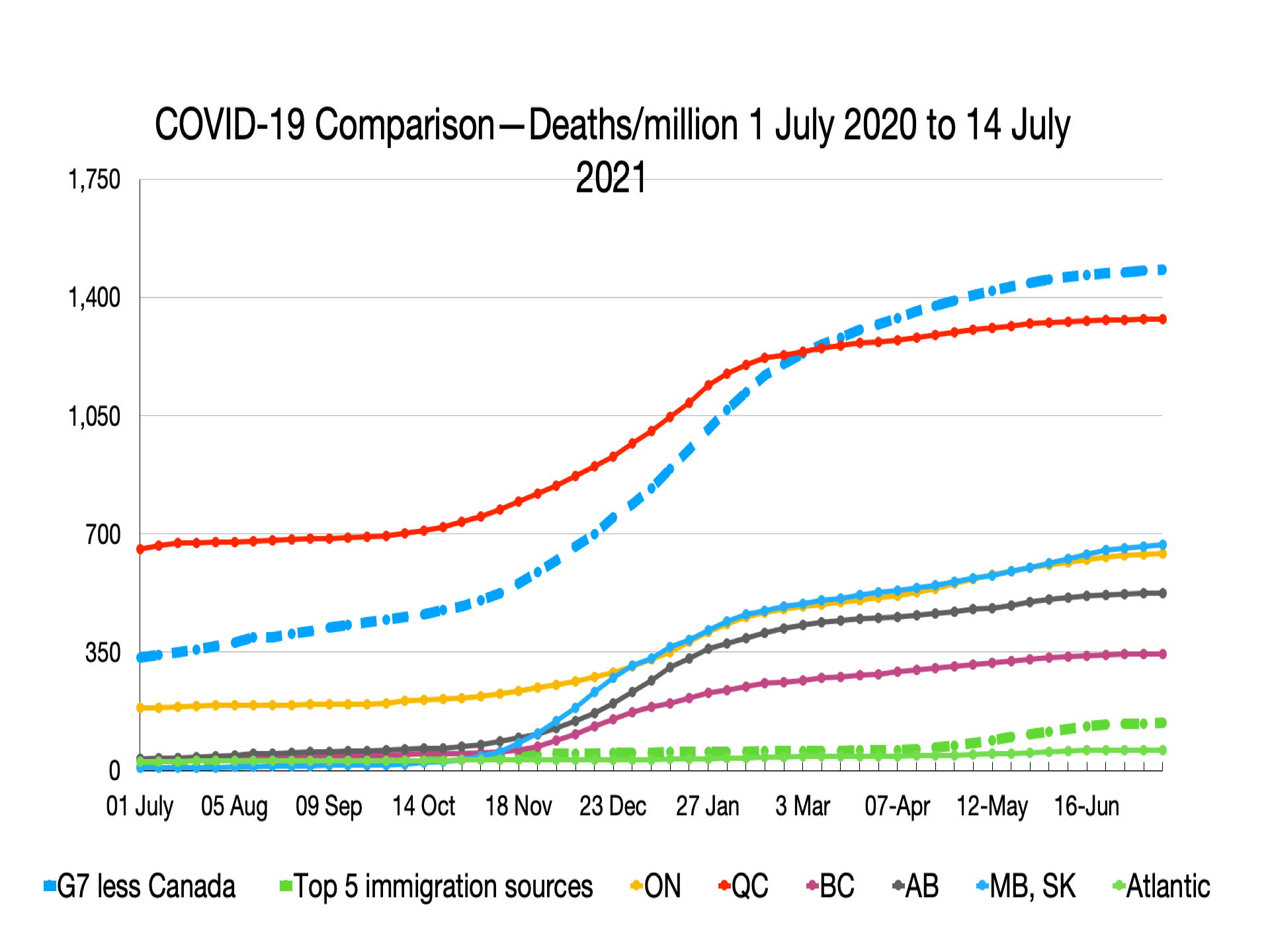
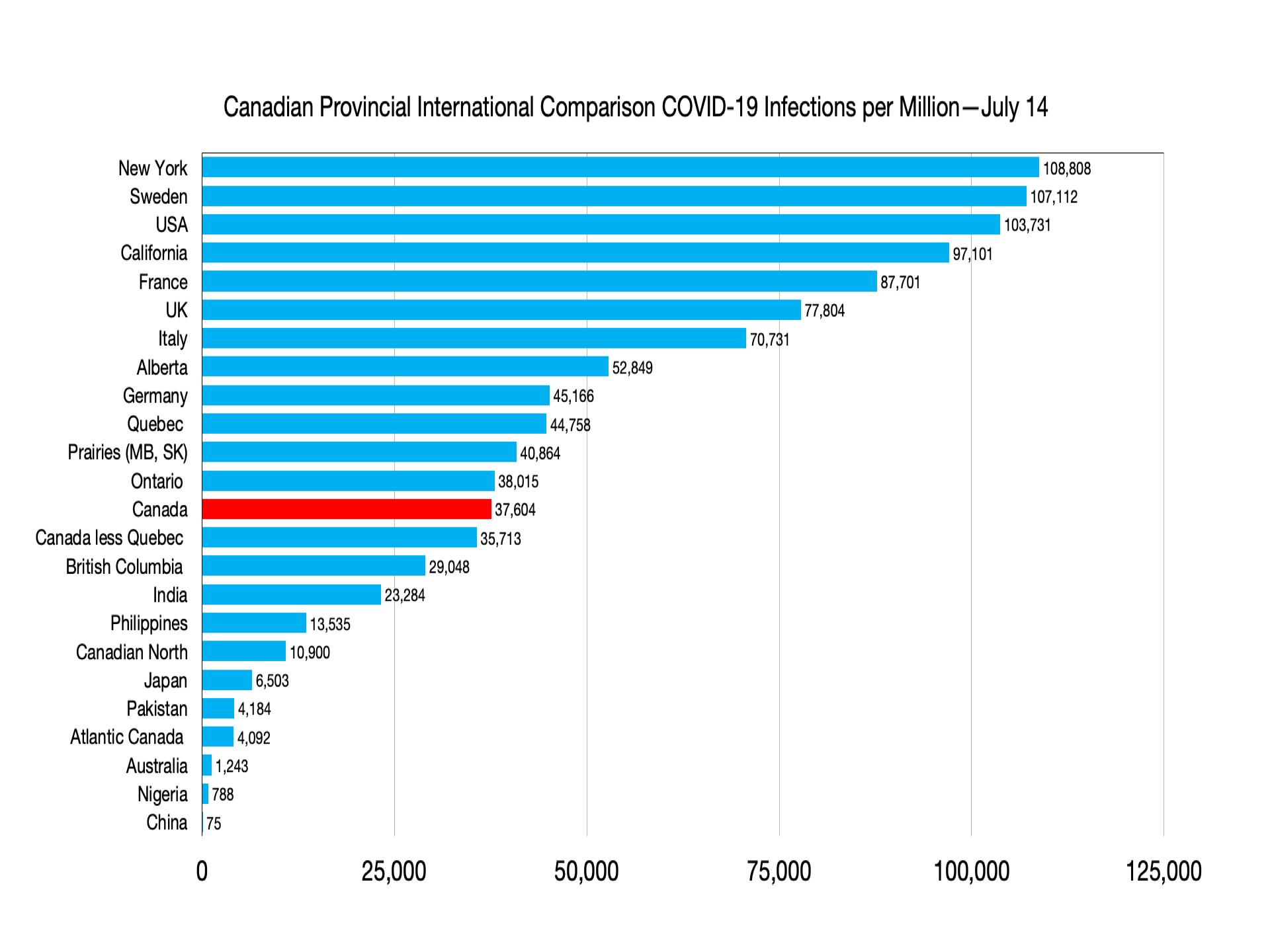
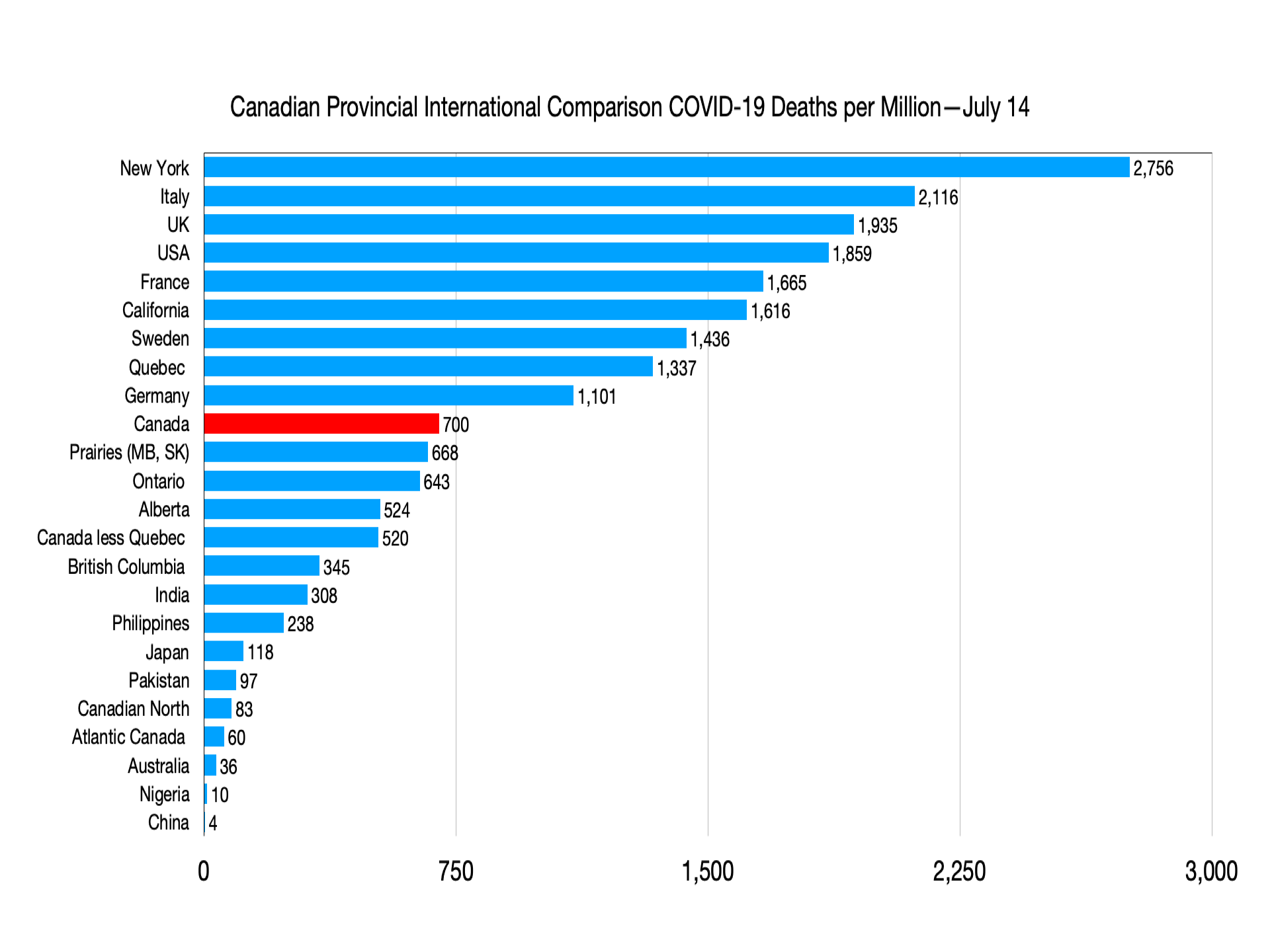
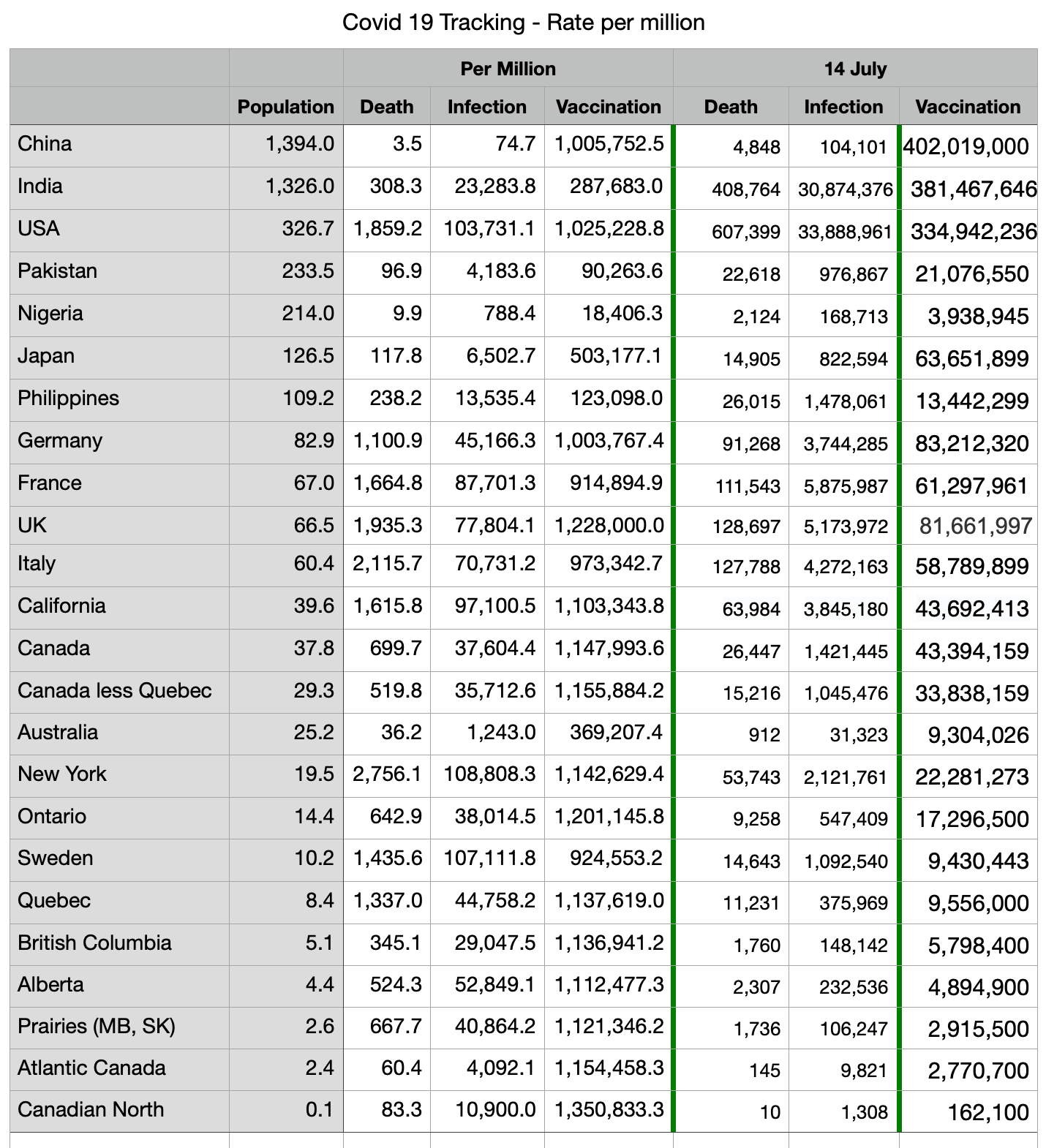
#COVID-19: Comparing provinces with other countries 14 July Update

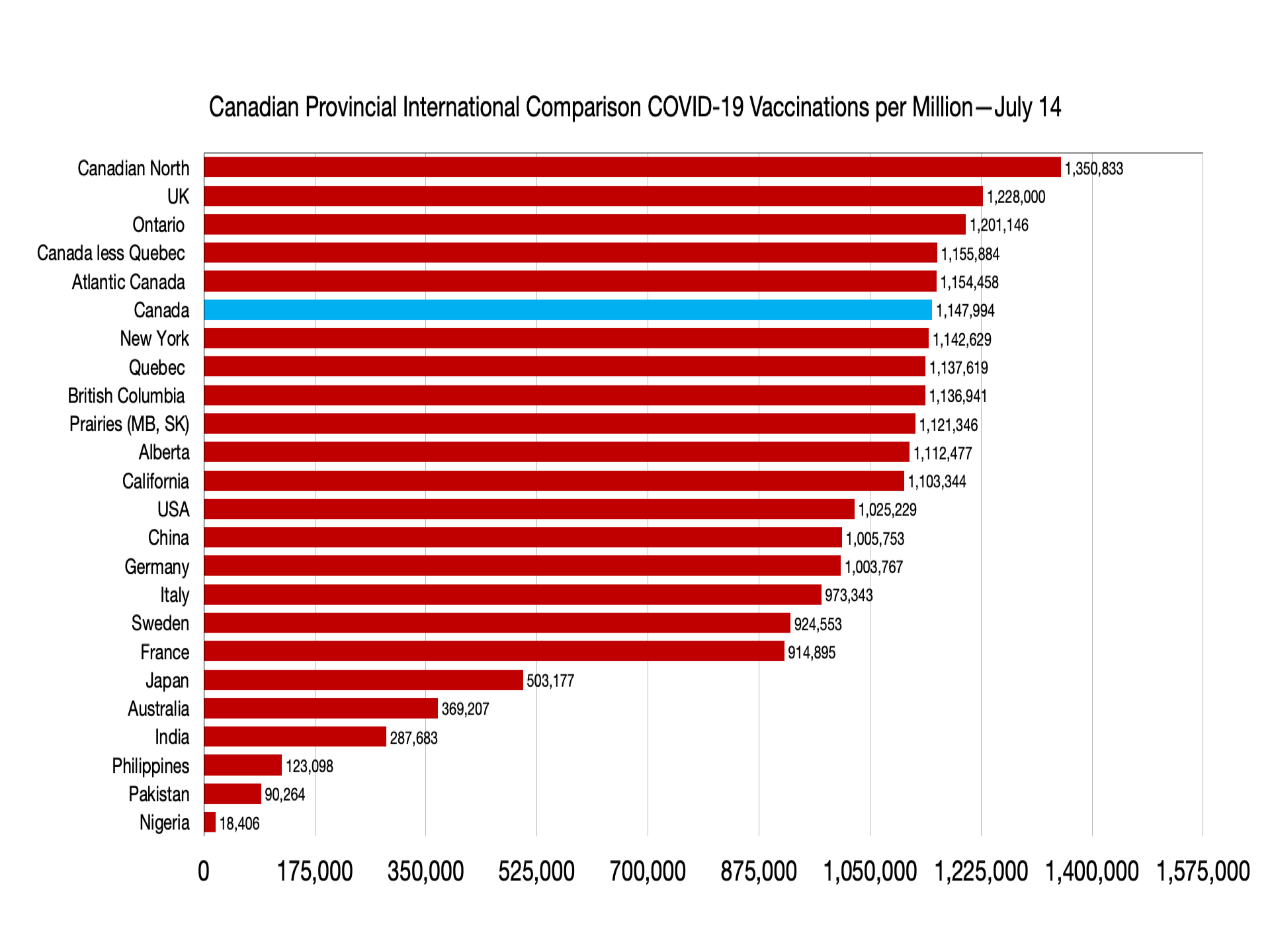
The latest charts, compiled 14 July as overall rates in Canada continue to decline along with increased vaccinations (Canadians fully vaccinated 45.6 percent, higher than EU countries, just slightly behind USA 48.6 percent and UK 52.4 percent).

Vaccinations: All Canadian provinces ahead of USA and EU countries.

Trendline charts

Infections: No significant change

Deaths: No significant change.

Vaccinations: Captured above, with increasing gap between Canadian provinces and G7.

Weekly

Infections: No relative change.

Deaths per million: No significant change.