South Korea citizenship law change proposal sparks anti-China backlash

Of note:

South Korea is trying to increase its future working population by making it easier for children of foreign residents to become citizens, but its plans have run into trouble in the face of rising anti-China sentiment.

A measure proposed by the Ministry of Justice — first made public in April — called for easing the pathway to citizenship for children born to long-term foreign residents, by simply notifying the ministry.
But a presidential petition opposing the revision has gathered over 300,000 signatures. The chatroom of an online hearing held to discuss the proposal in May was overwhelmed with expletive-laced complaints by tens of thousands of viewers.
The justice ministry has said it is still taking into account public opinion and the advice of experts before submitting the proposal to the Ministry of Government Legislation.
“Given the strong backlash, I would say the ministry has already lost much of the momentum to push ahead with the proposal,” said Jang Yun-mi, an attorney who specializes in issues related to children.
The controversy highlights the challenges South Korea faces as it seeks to ensure a robust future population in the face of declining birthrates and rapidly aging workers, and the potential policy implications of increasingly negative views of China, its biggest trading partner.
Data from last year suggests only about 3,930 people would be eligible under the rule change, but the fact that 3,725 of them were of Chinese heritage prompted much of the criticism.
South Korean views have been colored by what some see as economic bullying by Beijing, its initial poor handling of the Covid-19 crisis, and the assertion by some Chinese that dearly held aspects of Korean food and culture, such as kimchi and the traditional hanbok dress, have roots in China.
Among immigrant communities, the proposed measures are not seen as worth the backlash, said Kim Yong-phil, editor-in-chief of E Korea World, a local newspaper for Chinese-Koreans.
“Anti-Chinese people could use this issue as a pretext to attack Chinese-Koreans,” he said.

Population decline

Naturalization was rare in South Korea until the early 2000s — just 33 foreigners gained South Korean citizenship in 2000, for example — but rose to nearly 14,000 last year, immigration data show.
Of them, nearly 58% were from China, and 30% from Vietnam. The rest included people from Mongolia, Uzbekistan and Japan, Korea Immigration Service data showed.
The latest proposal is needed to encourage future workers to stay by allowing them to foster a South Korean identity from an early age and stably get assimilated into society, the justice ministry told Reuters in a statement.
Kim Yong-seon, who came from China in 2004 to study and was naturalized in 2014, said the amendment is useful as it provides more options for immigrants, but the more pressing matter is making it easier for adults to become citizens.
“Over the past few years, the requirements for permanent residency and citizenship have only gotten harder,” he said, citing changes that require high amounts of income or assets.
Like the majority of Chinese nationals residing in South Korea, Kim is ethnic Korean — his grandfather migrated to China a century ago.
More than 70% of the 865,000 Chinese nationals residing in South Korea are of Korean descent, according to immigration data.
Negative views of China among South Koreans have hit historic highs recently, with as much as 75% having an unfavorable opinion of them late last year, compared to around 37% in 2015, according to Pew Research.
“Some Chinese people are already committing a ‘cultural fraud’ against the whole world by making unreasonable claims that kimchi and hanbok are also Chinese,” opposition People’s Party chairman Ahn Cheol-soo said.
“If left as is, it will lead to a ‘cultural invasion’ in which they claim that even Korea’s priceless culture is theirs.”

Source: South Korea citizenship law change proposal sparks anti-China backlash

Rosie Abella said she’d answer questions when she turned 75

Good long interview by Paul Wells.

Money quote regarding her 1984 employment equity report:

What Abella knew was that she didn’t much like examples from American jurisprudence. “It was based on the individual. No concept of membership in groups as defining identity, as defining equality.” The more she thought about it, the more Abella decided that one concept of equality—simply treating everyone the same—constituted a dead-end path. “I thought, equality, to me, is not sameness. Civil liberties are sameness. Everyone should have the same right in their relationship with the state to be treated as well as the leaders. There is no such thing as ‘more rights,’ vis-à-vis the state, for one individual over another.

“But that’s different from human rights, where you are treated a certain way because of the groups you belong to. So if you are a woman, if you are a Muslim, if you are Jewish, if you are disabled, people treat you based on your identity. And so I thought, you can’t say, ‘Treat everyone the same.’ If you treat everyone the same, the person in a wheelchair is treated like the person who’s able-bodied, and there’s no need for a ramp, if you’re going to treat everybody the same.

“So it occurred to me that what equality really was, was acknowledging and accommodating differences. So people could be treated as an equal and not excluded arbitrarily for things that had nothing to do with whether or not they could contribute to the mainstream.”

This philosophy is encapsulated in a quote from the French poet Anatole France that opens Abella’s commission report, which she has cited frequently in her work since: “The law, in its majestic equality, forbids the rich as well as the poor to sleep under bridges, to beg in the streets and to steal bread.” She would define a different law, less majestic and more alert to nuance. She coined a new term, “employment equity,” to describe “programs of positive remedy for discrimination in the Canadian workplace.”

The first surprise was when Flora MacDonald, Brian Mulroney’s employment minister, called Abella and said the Progressive Conservative government would implement the report’s recommendations. Another surprise came when countries around the world began to adapt elements of the report to their local circumstances.

Source: Rosie Abella said she’d answer questions when she turned 75

Who’s Afraid of Big Numbers? Pretty much everyone. But it doesn’t have to be that way, two mathematicians contend.

Some interesting thoughts on how to communicate numbers. For immigration examples, 400,000 (current target) in seconds is the equivalent of 4.6 days. In terms of immigrants, just under 1,100 per day:

“Billions” and “trillions” seem to be an inescapable part of our conversations these days, whether the subject is Jeff Bezos’s net worth or President Biden’s proposed budget. Yet nearly everyone has trouble making sense of such big numbers. Is there any way to get a feel for them? As it turns out, there is. If we can relate big numbers to something familiar, they start to feel much more tangible, almost palpable.

For example, consider Senator Bernie Sanders’s signature reference to “millionaires and billionaires.” Politics aside, are these levels of wealth really comparable? Intellectually, we all know that billionaires have a lot more money than millionaires do, but intuitively it’s hard to feel the difference, because most of us haven’t experienced what it’s like to have that much money.

In contrast, everyone knows what the passage of time feels like. So consider how long it would take for a million seconds to tick by. Do the math, and you’ll find that a million seconds is about 12 days. And a billion seconds? That’s about 32 years. Suddenly the vastness of the gulf between a million and a billion becomes obvious. A million seconds is a brief vacation; a billion seconds is a major fraction of a lifetime.

Comparisons to ordinary distances provide another way to make sense of big numbers. Here in Ithaca, we have a scale model of the solar system known as the Sagan Walk, in which all the planets and the gaps between them are reduced by a factor of five billion. At that scale, the sun becomes the size of a serving plate, Earth is a small pea and Jupiter is a brussels sprout. To walk from Earth to the sun takes just a few dozen footsteps, whereas Pluto is a 15-minute hike across town. Strolling through the solar system, you gain a visceral understanding of astronomical distances that you don’t get from looking at a book or visiting a planetarium. Your body grasps it even if your mind cannot.

Likewise, vast sums of money become more comprehensible if they are reframed in terms of more familiar amounts. In a 2009 blog post, the mathematician Terry Tao rescaled the entire United States federal budget to the annual household spending for a hypothetical family of four. In Dr. Tao’s rescaling, a $100 million line item in the budget became equivalent to a $3 expenditure for the family.

Research in psychology and science education supports Dr. Tao’s strategy. In 2017, cognitive scientists found that students could grasp extremely long time periods — say, between the extinction of dinosaurs and emergence of humans — more readily if they created a personal timeline of the most significant events in their lives and rescaled it to progressively longer time spans: all of American history, all of recorded history and so on. These students were also better than controls at estimating numbers in the billions, an ability that is vital to understanding geological time, astronomical distances or the bewildering sums in the federal budget.

To that end, we thought it could be instructive to update Dr. Tao’s exercise, this time using the numbers in Mr. Biden’s proposed 2022 budget. For simplicity, the total money entering the federal budget — call it “income” — has been scaled to be $100,000. Meanwhile, as the graphic shows, this hypothetical nation-family spends about $144,000 a year, exceeding the budget by about $44,000. Most of the expenditure goes to four big-ticket items: about $29,000 to pay for Social Security, $18,000 for Medicare, the same for Defense and around $14,000 for Medicaid.

Scaling the Budget

Taken together, these four items add up to almost $80,000 in expenses for our nation-family. In addition, we must still pay off the interest on the national debt, for another $7,000, plus $36,000 on other assorted mandatory programs. So exceeding the budget by as much as Mr. Biden is proposing leaves only about $22,000 to spend on the other things we care about, the so-called nondefense discretionary spending.

When the numbers are reframed this way, the trade-offs become clearer. Want to increase funding to historically Black colleges and universities? Mr. Biden does, and he is asking the nation-family to chip in 36 cents (in these rescaled terms) to that end. What about former President Donald J. Trump’s border wall? Our nation-family spent about $388 on it in 2021. In comparison, Mr. Biden is proposing to spend $255 next year to ensure clean, safe drinking water in all communities and $5 to expand school meal programs. These choices are political ones, but at least now we can wrap our minds around how much money we’re talking about.

Why not employ a more typical diagraming strategy, like a bar chart? Well, a bar chart would reduce most items to barely visible slivers. Sometimes such large numbers are recast as percentages of the whole, but that approach suffers from the same drawback, generating confusingly small figures, like 0.01 percent. As Dr. Tao recognized, $100,000 trades on a scale with which most people are intimately familiar. Few among us, alas, will ever be a billionaire, much less a trillionaire. But we can all reasonably budget like one.

Aiyana Green is an undergraduate majoring in policy analysis and management in the College of Human Ecology at Cornell University. Steven Strogatz is a professor of mathematics at Cornell University and the author, most recently, of “Infinite Powers: How Calculus Reveals the Secrets of the Universe.”

Source: https://www.nytimes.com/2021/06/17/science/math-numbers-federal-budget-tao.html

#COVID19 impact on #immigration and related programs, April 2021 update

The latest monthly update (May for web traffic). Slide 3 has the summary numbers and changes.

Slight dip in number of Permanent Resident admissions compared to March, annualized rate now 275,000 (although likely to increase given the various policy measures announced (e.g., lowering of minimum CRS scores, special temporary program and Hong Kong measures).

Citizenship started to recover compared to earlier months but still far lower than historic levels.

Given the extremely low levels in all programs in April 2020 (travel restrictions and shutdowns), the year-over-year increases appear spectacular. Compared to April 2019, of course, changes are more modest and provide a more accurate picture of the impact.

‘Colour-coded’ retirement security: Study finds economic marginalization and inequity follow people into old age

Not surprising but useful confirmation:

Indigenous and racialized seniors have much lower retirement incomes and higher poverty rates than their white counterparts, which a new study says reflects how economic marginalization and inequity follows people into their old age.

Overall, white Canadian seniors enjoy the most retirement security with an average yearly income at $42,800, way above the $32,200 for their peers in the Indigenous communities and $29,200 for visible minorities over the age of 65.

Based on 2016 census data, the report by the Canadian Centre for Policy Alternatives found 13.7 per cent of white seniors lived in poverty compared to 21.5 per cent among Indigenous seniors and 19.8 per cent among racialized seniors, according to the Low Income Measure After Tax or LIM-AT.

Hence, it’s not surprising that seniors from marginalized groups have to count on public pensions and benefits to make up for lagging retirement incomes, says the study, titled “Colour-coded Retirement,” released Wednesday.

“The data reveal that there are real consequences of economic marginalization and systemic racism. Elders and seniors are financially insecure in retirement, if they can retire at all, because the opportunities for saving are so limited,” says Hayden King, a report co-author and executive editor of the Yellowhead Institute, a First Nation-led research centre.

Senior white Canadians, who made up 85 per cent of the senior population in the country, have the most diverse sources of income of all groups.

About a third of their income comes from public pension sources such as the Canada and Quebec Pension Plans, Old Age Security (OAS), and the Guaranteed Income Supplement (GIS); a third from retirement contributions to work and individual pension plans; and the rest from investment and employment earnings as well as other sources.

In comparison, public pension accounts for 47 per cent of Indigenous seniors’ and 40 per cent of racialized seniors’ retirement income, respectively.

These two groups — accounting for 14.8 per cent of the population over age 65 in Canada — had less money to draw from their employers’ pension plan and own retirement savings, or investment income. They were more likely to rely on employment income.

RPPs and RRSPs account for a third of white seniors’ retirement income, versus 25 per cent for Indigenous seniors and 21 per cent for racialized seniors.

On the whole, racialized Canadian households have less spare money to contribute to those plans than white Canadian households. And when they do, their contributions are lower.

Chinese households were an exception with an average contribution of $10,000 in 2015, which was higher than the $7,600 contribution made by white households. In comparison, Black families only made a $4,600 average contribution.

“The overall low share of the racialized and Indigenous population that contribute to RPPs points to reduced retirement security for the next generation of workers,” the report warned.

Among racial minority groups, retirement incomes also vary among those who were born in Canada versus those who are immigrants.

While only 3 per cent of Chinese seniors and 1 per cent of South Asian seniors are Canadian-born, their average retirement income is higher than their immigrant peers.

In the case of Black Canadians, however, being Canadian-born offers no income advantage.

“Canadian-born Black seniors’ income is virtually identical to that of Black immigrants, with the result that Canadian-born Black seniors’ average income continues to be 25 per cent lower than Canadian-born white seniors’ income,” said the report.

“This provides us with insight into the continuing impact of anti-Black racism on seniors’ income.”

The study also shows the differences between First Nations, Métis and Inuit seniors’ income, as well as their respective contributions to RPPs and RRSPs.

First Nations seniors have the lowest average income of any Indigenous group, at $33,500 for men and $26,300 for women, followed by their Inuit ($39,900 and $32,150) and Métis ($41,765 and $28,285) counterparts. Métis seniors were most likely to contribute to private pension and retirement savings plans, while their First Nations peers had the lowest participation rate.

Researchers said there is also a consistent gender gap with senior women of all demographic backgrounds having lower retirement incomes and higher poverty rates than senior men.

The study found the overall racialized senior population’s total income averaged $33,900 for men and $25,000 for women. While visible minority male seniors’ average income is 36 per cent lower than their white male counterparts, senior racialized women’s average income is 26 per cent below their white female peers.

“It is only when the economic impacts of underlying racism and sexism are addressed that we will achieve equal access to a secure retirement for all,” said the 49-page report, funded by the Canadian Race Relations Foundation

It said the data shows that GIS and OAS pension — both adopted as anti-poverty measures — are crucial sources of income for senior women who are First Nations or racialized immigrants.

The increase in OAS by the federal Liberal government for those 75 and older in the 2021 federal budget is a step in the right direction to narrow retirement income disparities, said the study.

It recommends measures to eliminate barriers to equitable employment opportunities and increased access to workplace-based pension plans and retirement savings
Source: ‘Colour-coded’ retirement security: Study finds economic marginalization and inequity follow people into old age

Contrasting articles: New paths to permanent residency for Hong Kong students and workers not enough: advocates, Ottawa warned to not assume Hong Kongers are innocent of charges

Starting with the advocates:

UBC law student Davin Wong has many friends who are excited about two new paths to permanent residency for Hong Kong students and workers with temporary resident status in Canada.

Ottawa announced the new paths last week, saying it is “deeply concerned” by China’s imposing of a national security law and the “deteriorating” human rights situation in Hong Kong.

Source: New paths to permanent residency for Hong Kong students and workers not enough: advocates

And a note of caution from IRCC officials:

Canadian immigration officials warned the federal government in an internal memo last year against assuming protest-related charges faced by Hong Kongers seeking entry to Canada are bogus accusations fabricated by the city’s Beijing-backed authorities.

This internal caution, which was provided to The Globe and Mail, is different from the Canadian government’s public messaging on the crackdown on the former British colony. Ottawa routinely says it stands “shoulder to shoulder with the people of Hong Kong.” The consensus among human rights groups is that many of the arrests and charges laid against Hong Kong protesters have been unjustified.

A report from Immigration, Refugees and Citizenship Canada’s Hong Kong office advises Ottawa not to consider Hong Kongers innocent if they apply for visas or asylum but have protest-related charges. “It cannot be assumed that charges are politicized or trumped up by authorities; there have been shocking images of violent attacks during confrontations,” the report says.

Source: https://www.theglobeandmail.com/canada/article-morning-update-ottawa-warned-to-not-assume-hong-kongers-are-innocent/

American Samoa culture plays role in US citizenship ruling

Of interest given intersection with Indigenous-like issues:

In a decision citing American Samoa cultural traditions, those born in the U.S. territory shouldn’t have citizenship automatically forced on them, a federal appeals court ruled Wednesday.

The 10th U.S. Circuit Court of Appeals ruling reverses a lower court ruling that sided with three people from American Samoa who live in Utah and sued to be recognized as citizens. The judge ruled the Utah residents are entitled to birthright citizenship under the 14th Amendment. He then put his ruling on hold pending appeal.

U.S. Congress should play a bigger role than the courts in deciding citizenship for those in territories, the appeals court ruling said.

American Samoa is the only unincorporated territory of the United States where the inhabitants are not American citizens at birth.

Instead, those born in the cluster of islands some 2,600 miles (4,184 kilometers) southwest of Hawaii are granted “U.S. national” status, meaning they can’t vote for U.S. president, run for office outside American Samoa or apply for certain jobs. The only federal election they can cast a vote in is the race for American Samoa’s nonvoting U.S. House seat.

The ruling notes that American Samoa government leaders and others opposed the lawsuit because they are concerned automatic citizenship could disrupt cultural traditions, such as communal land ownership and social structures organized around large, extended families led by matai, those with hereditary chieftain titles.

“There is simply insufficient caselaw to conclude with certainty that citizenship will have no effect on the legal status of the fa’a Samoa,” or the American Samoan way of life, the ruling said. “The constitutional issues that would arise in the context of America Samoa’s unique culture and social structure would be unusual, if not entirely novel, and therefore unpredictable.”

Drawing on the views of the American Samoa people is one of the more gratifying aspects of the ruling, said Michael Williams, an attorney representing the American Samoa government, which intervened to oppose the lawsuit.

“It is also vindication for the principle that the people of American Samoa should determine their own status in accordance with Samoan culture and traditions,” he said.

A path toward U.S. citizenship exists for those who want it. But some say it’s costly and cumbersome. Non-citizen nationals of American Samoa are entitled to work and travel freely in the United States and receive certain advantages in the naturalization process.

Neil Weare, one of the attorneys representing the plaintiffs, said they are disappointed by the ruling, and are reviewing next steps. Options include asking a wider panel of appeals court judges to hear the case or taking it to the U.S. Supreme Court.

Weare is president of Equally American, which advocates for equality and civil rights for people in U.S. territories.

He said he was impressed with a dissenting judge’s opinion.

”When the Fourteenth Amendment was ratified, courts, dictionaries, maps, and censuses uniformly regarded territories as land ‘in the United States,’” wrote Judge Robert E. Bacharach in his dissent.

Self-determination is a highly valued principle in American Samoa, said Line-Noue Memea Kruse, adjunct faculty in Pacific islands studies at Brigham Young University-Hawaii and whose book is cited in the ruling.

“There are many foreign interests looming over these citizenship cases,” she said. “This is not the end. They will keep pushing. This to me is a form of inter-territorial hegemony.”

Source: American Samoa culture plays role in US citizenship ruling

Alberta NDP demands Jason Kenney apologize for federal niqab policy as he denies ever supporting it

Really odd (and stupid) denial given the clear public record:

There’s a push to have Alberta Premier Jason Kenney join his former federal colleagues in apologizing for a controversial niqab policy that was introduced a decade ago.

The call ties back to when the premier was the federal immigration minister. In 2011, he announced a ban on Muslim women wearing niqabs while taking the citizenship oath.

In the past week, Conservative MPs have acknowledged that the policy stoked Islamophobia.

The NDP, Alberta’s Official Opposition, wants Kenney, the “architect of the policy,” to apologize for what it calls promoting hatred towards Muslims.

“I’m calling on Jason Kenney to immediately apologize to Muslim Canadians for his racist words and actions,” said Jasvir Deol, NDP Critic for Multiculturalism, on Tuesday.

“These words and actions from a federal government minister are the first steps towards the rising anti-Muslim violence we see today.”

But Kenney says he has nothing to apologize for.

“My record on these matters could not be more clear,” he said Tuesday.

The premier argued that as a minister, he supported and welcomed Muslims to Canada.

“I’ve never supported a proposed ban. To the contrary, I’ve always said Canada is a country that protects and respects religious freedom and pluralism, and the government has no business regulating what people wear,” he said.

In a 2014 tweet, Kenney defended the policy, saying he believed people should take the citizenship oath with faces uncovered.

“This practice of face covering reflects a misogynistic view of women, which is grounded in a medieval, tribal culture,” Kenney said in 2015.

“While the government has no interest in regulating what people choose to wear in their private lives, when you come and swear a public oath, in a court, in front of a judge and your fellow citizens, we think it’s eminently reasonable to ask that for those 30 seconds, you do so openly, publicly and transparently as a proud new Canadian.”

Politicians apologize

In the days after the fatal attack on a London Muslim family on June 6, some of Kenney’s former federal colleagues are apologizing for the niqab ban.

Tim Uppal, MP for Edmonton Mill Woods and a former federal Conservative cabinet minister, said that such policies have consequences and he should have used his seat at the table to push against divisiveness.

“I regret not being a stronger voice and sincerely apologize for my role,” he wrote on Facebook Sunday.

“It does lead to casting a shadow over a community. It leads to stereotyping, and in this case, would lead to Islamophobia,” he told 630 CHED on Tuesday.

Calgary Nose Hill MP Michelle Rempel Garner also apologized.

On June 8, she wrote on her blog: “One of my biggest regrets in my public service was being silent during the 2015 general election campaign on the wrongness of the barbaric cultural practices tip line and the proposed niqab ban.”

“Those policies were wrong. To the Muslim community, I’m deeply sorry for not fighting it then. I can assure you I won’t make the same mistake again,” she said.

Source: Alberta NDP demands Jason Kenney apologize for federal niqab policy as he denies ever supporting it

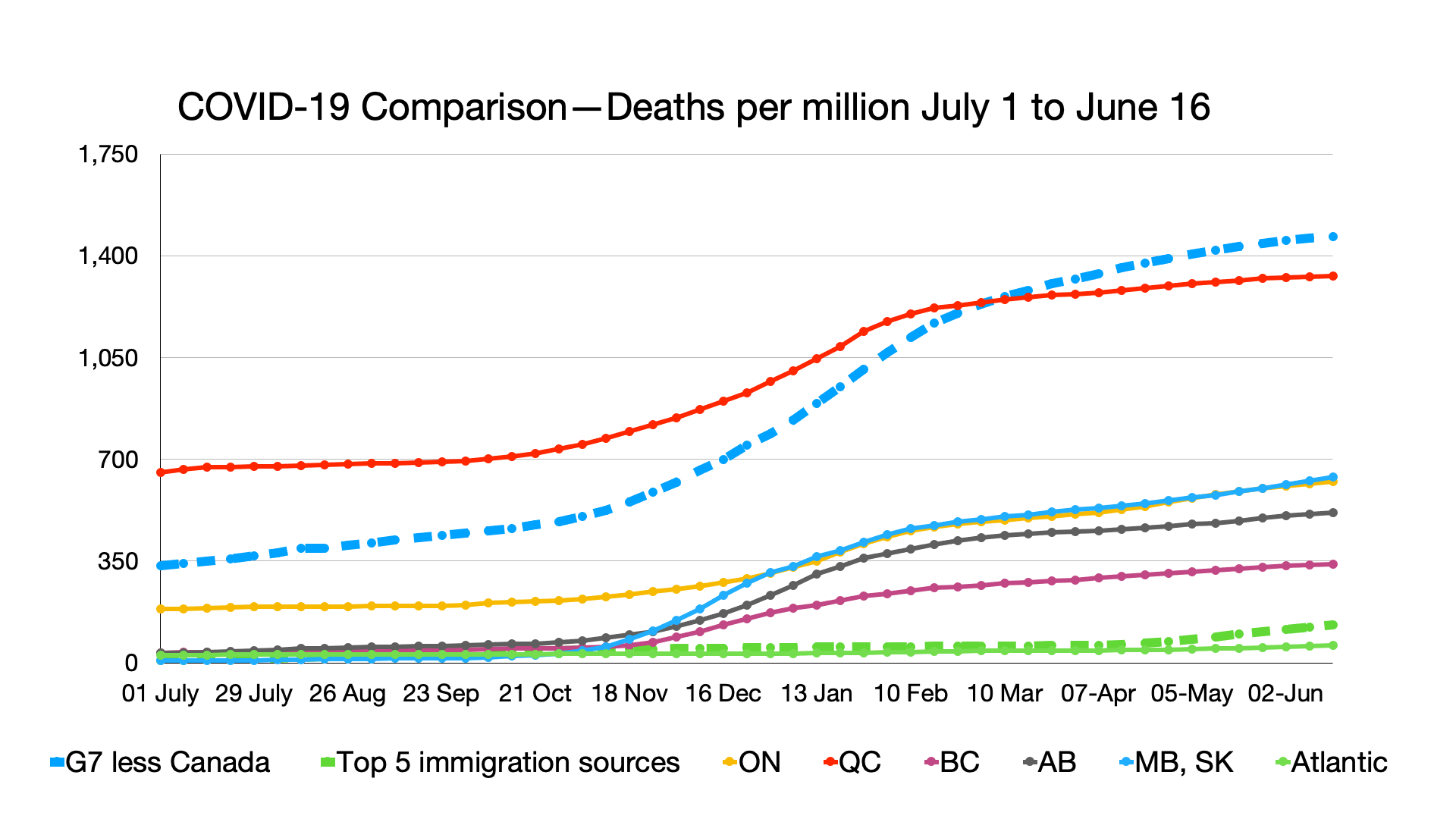
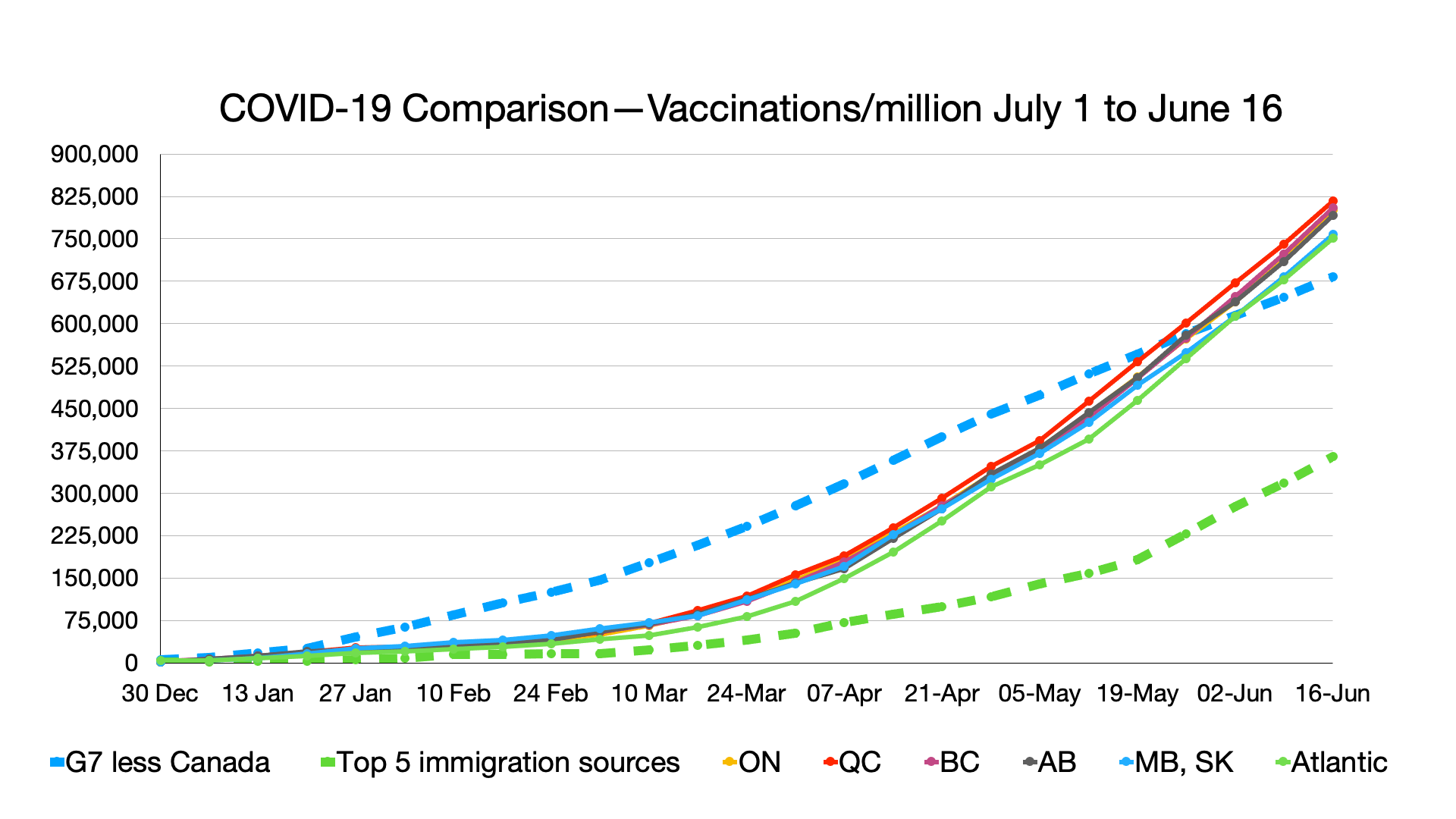
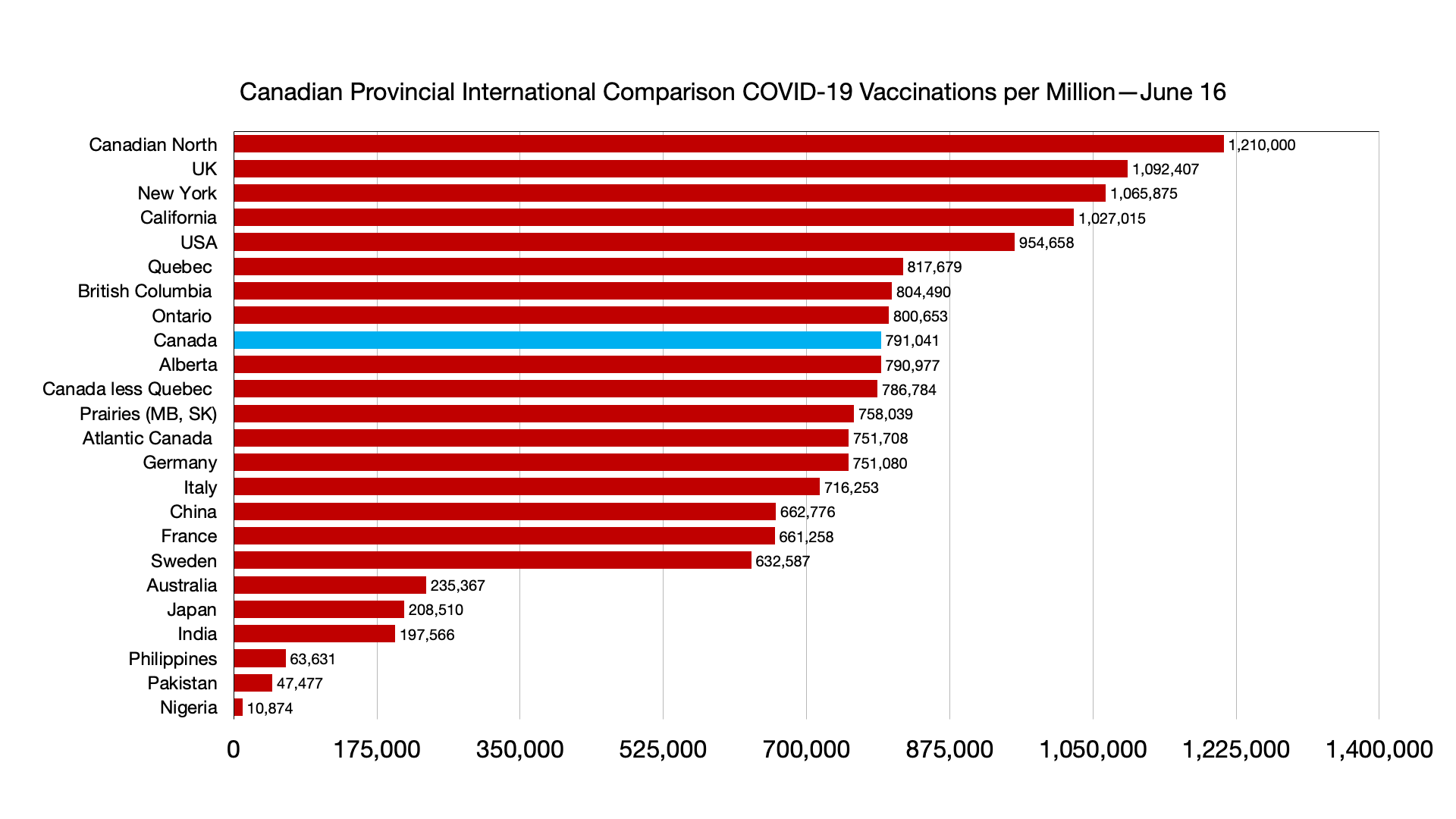
#COVID-19: Comparing provinces with other countries 16 June Update

The latest charts, compiled 16 June as overall rates in Canada continue to decline along with increased vaccinations (still largely first dose, fully vaccinated just under 14 percent).

Vaccinations: Minor relative changes. Most significant is China is now ahead of France and Sweden. Also, Atlantic Canada ahead of Germany and Japan ahead of India (pre-Olympics push?)

Trendline charts

Infections per million: No relative changes and recent surges levelling off save again for the Prairies (mainly Manitoba).

Deaths per million: No relative change.

Vaccinations per million: Canadian vaccination rates continue to exceed G7 less Canada with Quebec maintaining its slight lead. Vaccination rate increase in immigration source countries driven by China (up 16% from last week) with Indian vaccination increasing more slowly (10%).

Weekly

Infections per million: No relative change.

Deaths per million: No relative changes.

Canada: Indian-origin ex-minister ‘sorry’ for backing proposed anti-Muslim bill [Uppal]

Following Rempel Garner, another former minister reflects in the South Asian press:

A former Canadian minister of Indian origin has publicly apologised for having supported in the past a proposed bill that would have banned Muslim women in the country from wearing the niqab, a face-covering veil, while taking their citizenship oath.

Conservative Party MP Tim Uppal, a Sikh, was the minister of state for multiculturalism in the government of then PM Stephen Harper in 2015 when he had backed the controversial bill.

His apology has come at a time when terror charges have been slapped on Nathaniel Veltman, a 20-year-old who had mowed down four members of a Muslim family in the city of Hamilton in Ontario on June 6 in an act of Islamophobia.

Uppal is currently an MP from Edmonton Mill Woods.

Uppal’s mea culpa has come following the attack. In a Facebook post, he said he was the spokesperson for the proposed bill in 2015, but after his party was defeated in that year’s general election by the Justin Trudeau-led Liberals, he spoke with Canadians outside the “partisan political bubble” and realised “how this ban and other campaign announcements during the 2015 election alienated Muslim Canadians and contributed to the growing problem of Islamaphobia”.

He posted, “When it came to these policies, I should have used my seat at the table to push against divisiveness that promoted the notion of the other. I regret not being a stronger voice and sincerely apologise for my role.”

Referring to the Hamilton attack, he said it has been “a devastating week for many. We are mourning as a nation for a family that was so brutally attacked and destroyed by a terrorist”.

The apology came as a federal prosecutor imposed terror charges on Veltman, who drove his truck over the family when they had been out for an evening walk. The charges were upgraded on Monday.

Source: Canada: Indian-origin ex-minister ‘sorry’ for backing proposed anti-Muslim bill