The Cesspool That Gave Rise to Stephen Miller

More background on some of the more prominent anti-immigration advocates:

Last August, the conservative writer David Horowitz, who mentored Trump’s former senior adviser Stephen Miller, emailed me. Subject: “Your book.” He wrote, “I was more than generous with you, and you repaid me by raping me and my reputation, which I assure you will survive your malicious drivel.”

The 82-year-old former Marxist was referring to my biography, Hatemonger: Stephen Miller, Donald Trump and the White Nationalist Agenda, which drew in part from email exchanges Horowitz had forwarded to me, showing conversations with Miller between 2012 and 2017, including those with him feeding Miller talking points for some of Trump’s most incendiary campaign speeches, which the reality TV mogul regurgitated. Horowitz met Miller as a Santa Monica high school student and shaped his career, introducing him to Tea Party Minnesota congresswoman Michelle Bachman, who gave him his first job as a press secretary, and later to then-Alabama Senator Jeff Sessions, who also hired him.

Horowitz had previously told me he was trusting me with his correspondence because he read a 2018 interview in which I discussed my aversion to labeling people: “When you label someone, you do violence to them.” He said he feared being labeled a “hatemonger,” a word that had been used to describe him, and believed I was unlikely to label him or Miller. It was a strange argument given that Horowitz has dedicated much of his life to labeling entire groups, calling the National Association for the Advancement of Colored People (NAACP) “fascists” and progressives “totalitarians.” After my book was published, he featured me as the top article on his site, calling me “an anti-American racist,” and in a separate email, called me “stupid, lazy or deranged.”

Horowitz’s art is projection, which he teaches to his disciples. People fighting racism are “Nazis.” Activists fighting inequality are “oppressors.” Classified as an anti-Muslim and anti-immigrant extremist by the Southern Poverty Law Center, he has for decades groomed young conservatives to adopt an incendiary, extremist approach through his “School for Political Warfare,” and connected prominent right-wing politicians and media personalities at expensive West Coast Retreats and Restoration Weekends. “The political left has declared war on America and its constitutional system, and is willing to collaborate with America’s enemies abroad and criminals at home to bring America down,” reads the mission statement for the David Horowitz Freedom Center.

Now, two writers who have known Horowitz for half a century, Ronald Radosh and Sol Stern, have written a piece in The New Republic calling for an investigation into his nonprofit’s “potential abuse of its tax-exempt status.” Per the Internal Revenue Code: “All section 501(c)(3) organizations are absolutely prohibited from directly or indirectly participating in, intervening in, any political campaign on behalf of (or in opposition to) any candidate.” They recount Horowitz’s visits to a “psychic healer” and his “relentless drive toward the violent fringes.” As a radical leftist, they added, their former friend “celebrated the burning of a bank by a student mob. Today, he’s an intellectual pyromaniac who honors the MAGA mob that attacked the U.S. Capitol on January 6.”

In a strategy paper Horowitz emailed Miller in December 2012, as the Republican Party was publicly reckoning with its failure to appeal to communities of color, Horowitz called for Republicans to launch a campaign of fear. He later said they “must begin every confrontation by punching progressives in the mouth.” His drive to intimidate and terrorize has compelled him to threaten lawsuits against reporters, including me, accusing me of “malicious and defamatory statements” in a letter from his lawyer that closely resembled those he has sent to others. It’s an echo of how he spent the ’90s, coordinating lawyers to threaten legal action on behalf of people accused of bigotry.

Horowitz, who casts himself as colorblind, has tweeted content such as “The Most Dangerous Social Problem in America Today: Anti-White racism,” and attacks women of color in positions of power, saying of Rep. Ilhan Omar, “This witch is part of a terrorist network… should be deported now.” He denies Palestinians their national identity. “There is no Palestine, there are no Palestinians,” he has tweeted.

His tirades caught the attention of John Tanton, an influential white supremacist who published an English translation of the virulently racist French novel Camp of the Saints—which describes the destruction of the white world by brown refugee “monsters,” a book that Miller recommended to Breitbart for an article pointing out its “parallels” with real life. Tanton, who died in 2019, featuredHorowitz on his website and highlighted his work through his journal, The Social Contract. He also wrote him and his colleague Peter Collier at least one letter, which The Daily Beast is reporting on here for the first time and is housed in the partially sealed archive of Tanton’s papers at the University of Michigan. In the letter, obtained from Virginia attorney Hassan Ahmad—who is suingto unseal the entire archive—Tanton rants about gay men and HIV and muses bizarrely about the rectum as “an ideal cultural medium: it is wet; its (sic) warm, it is chock full of nutrients, and has a rich blood supply to provide oxygen for those (aerobic) organisms that need this nutrient.” Horowitz did not respond to requests for comment about Tanton or the nature of their relationship, if any.

Tanton also shared Horowitz’s work with Dan Stein, the head of the Federation for American Immigration Reform (FAIR), which Tanton created with heiress Cordelia Scaife May to restrict the flow of brown and Black immigrants into the United States. Tanton wrote separately, “As whites see their power and control over their lives declining, will they simply go quietly into the night? Or will there be an explosion?” Later, in the White House, Horowitz’s protégé Miller would implement restrictive immigration policies that echoed recommendations issued by FAIR almost verbatim, including limiting family-based legal immigration and attacking sanctuary jurisdictions.

What people like Horowitz and Miller believe, although Miller is careful to phrase it differently, is that white men make America great. White European males created “America’s unique political culture… [which] led the world in abolishing slavery and establishing the principles of ethnic and racial inclusion,” Horowitz wrote in his book Hating Whitey, ignoring the central role of racialized people in the civil rights movement. “We are a nation besieged by peoples ‘of color’ trying to immigrate to our shores to take advantage of the unparalleled opportunities and rights our society offers them.”

It’s a view that has become mainstream in the radicalized Republican Party, which has surrendered to its once-fringe white supremacists. Miller’s recently launched nonprofit, America’s First Legal (White Men First Legal), is attacking efforts to help immigrants, non-white U.S. workers and the LGBTQ community. Soon it will be women. He is Horowitz 2.0, more powerful than his mentor, leading a full-fledged assault on the teaching of critical race theory and diversity in schools through litigation and regular appearances on Fox News and other right-wing media. People must understand the man who made him, who helped forge our era’s banality of extremism.

Horowitz was right when he guessed that I would be reluctant to label him or Miller a “hatemonger.” I’ve seen firsthand the damage that labels have done to people I love, such as my father, who immigrated here from Mexico. But I also believe journalists have a responsibility to use accurate words to describe the actions of people in power. Horowitz and Miller not only made careers of hatemongering—they’ve made it a centerpiece of modern right-wing ideology.

Source: The Cesspool That Gave Rise to Stephen Miller

Immigration Minister open to raise permanent residency caps

Of note, more signs of government determination to meet 2021 levels target of 401,000 (January-March 2021, 70,425 permanent resident admissions, or an annualized rate of about 280,000). Modernization remarks also of note:

Canada’s Immigration Minister says he’s not ruling out expanding a new program that would grant permanent residency to 90,000 temporary foreign workers and international student graduates as part of the country’s annual immigration goal.

“I am open to discussing whether or not to revisit the current caps,” Marco Mendicino said in an interview Wednesday.

He made his comment after delivering a speech on modernizing immigration earlier in the day. He said in the speech to the Canadian Club that more than 50,000 people have expressed interest in the spaces since last Thursday’s opening for applications.

He said the Immigration, Refugees and Citizenship department needs to carefully assess the early results of the program, including the quality of applications, and see how quickly the department hits the 90,000 target.

“At that point, I will certainly have a much greater line of sight on whether or not there may be a need to revisit the caps.”

Asked if he could secure cabinet approval for such a shift, Mr. Mendicino said, “Well, we got this far, didn’t we? I am open to revisiting the caps.”

In mid-April, the minister announced the plan to allow 20,000 temporary foreign workers in health care, 30,000 workers in other occupations deemed essential and 40,000 international students who have graduated from a university or college to apply to become permanent residents.

However, migrant groups have criticized the program, saying program exclusions and requirements shut out many refugees, undocumented people and thousands of migrants, with caps in application streams meaning few will be able to get their applications in before spots are filled.

In a statement, NDP immigration critic Jenny Kwan said Wednesday that the rollout of the new pathways to permanent residency for the 90,000 applicants has been problematic, adding it excludes many essential workers and does not recognize those who have lost status.

Also Wednesday, Mr. Mendicino called for moving toward a paperless immigration system that would offer prospective new Canadians more opportunities to file claims online and even be sworn in virtually.

“The reality is that our immigration system is one that has been bogged down by paper. We need to change that,” Mr. Mendicino said in the speech to the Canadian Club. “The technology is behind the times.”

As Canada has raised levels of immigration – the goal is 401,000 new permanent residents this year – Mr. Mendicino said there have been challenges in capacity and processing times exacerbated by the pandemic.

“We need to retire our systems that are long past their best-before date,” he said.

Mr. Mendicino said the recent federal budget commits more than $800-million to create a new digital platform to replace the existing Global Case Management System, which the department uses to process citizenship and immigration services applications.

In the interview, Mr. Mendicino said there is an online component to immigration now. “But what I would like to do is transform the entirety of our system,” he said.

“We still have many aspects of the system that have to be done in person or through paper-based applications. Transforming the system means that every aspect of that process will be an online application process with in-person meetings being substituted and replaced by digital and virtual meetings.”

He said he expects there will be a dedicated department team to look at the issue and drive it forward. “I think it’s a safe thing to say this will be a multiyear project, but not that long,” he said.

Ms. Kwan said that while digitizing the immigration application process is “long overdue,” the Liberals have been using this as an excuse to avoid talking about current delays.

“The process to move to a new system could take years and the government has failed to present a plan or provide resources to address current backlogs in a reasonable timeline,” she said.

But Mr. Mendicino said the department is well-advanced on its goals of meeting its target of 401,000 new permanent residents this year.

Jasraj Singh Hallan, the Conservative immigration critic, echoed Ms. Kwan’s concerns, saying the Tories have long called for the modernization of the immigration system. But he said Mr. Mendicino’s announcement does nothing to address thousands of applicants caught in backlogs.

“Because of the Liberal government’s poor management of the immigration system, outdated systems, and paper applications, families who have been trying to reunite with their loved ones have been stuck in massive backlogs and delayed processing times causing hardship,” he said in a statement.

Source: https://www.theglobeandmail.com/politics/article-immigration-minister-open-to-raise-permanent-residency-caps/

FATAH: The census battle over mother tongues

Not sure to which extent the campaign mentioned by Fatah makes a difference. 2016 Census reported 502,700 Punjabi speakers, 211,995 Urdu:

There are times when one wonders if the policy of multiculturalism is a value worth enshrining as a Canadian value or whether it’s a time bomb that is slowly eroding the foundations of our country.

Where once we had to bring the Quebecois and Anglo Canadians together and bridge the Protestant-Catholic divide, today we are facilitating endless petty schisms among new Canadians, matters often seeped in the very hostility they escaped.

Source: FATAH: The census battle over mother tongues

Des problèmes de diversité à Radio-Canada

Of note:

Les employés de Radio-Canada issus des minorités visibles se sentent mis de côté et craignent d’exprimer leurs idées. Une étude commandée à une firme externe révèle de graves lacunes en matière de diversité au sein du diffuseur public, alors que ses cadres ne voient pas de problèmes.

L’étude tentait de déterminer quel est « l’ADN des Radio-Canadiens », en se basant notamment sur un sondage mené par la firme RH Sept24, en novembre, auprès de 1383 employés francophones. Elle a plutôt démontré que le racisme systémique existe à Radio-Canada, de l’aveu même du grand patron des services français, Michel Bissonnette.

« Je pense qu’il y a un racisme systémique au pays, je pense qu’il y a un racisme systémique dans la majorité des grandes institutions. […] Est-ce qu’il y a des gens dans l’organisation qui ont plus de difficulté à avoir des promotions, donc plus de difficulté à être embauchés ? Y a-t-il des commentaires et des préjugés [qui sont] inconscients ? La réponse, c’est oui », a-t-il expliqué en entrevue au Devoir.

Selon un sommaire partagé aux employés le mois dernier et dont Le Devoir a obtenu copie, « il semble y avoir beaucoup d’éléments ne respectant pas l’équité dans l’organisation ». Certains employés se sentent stigmatisés ou perçus comme étant toujours biaisés s’ils partagent leur opinion, et craignent même des conséquences lorsqu’ils s’expriment. Ce constat est qualifié de « particulièrement inquiétant ». Contrairement à leurs subalternes, les gestionnaires, eux, « sentent une bonne ouverture aux nouvelles idées ».

De plus, les employés appartenant aux « groupes d’équité », ce qui inclut les minorités visibles, mais aussi les personnes handicapées, celles issues des communautés LGBTQ+ et les Autochtones, sont significativement moins portés à recommander Radio-Canada comme employeur. Ces employés auraient typiquement été victimes ou témoins de « micro-agressions » à propos de leur différence et se sont vu refuser des possibilités d’avancement sans justification. Très peu d’entre eux ont accédé à des postes supérieurs. Un employé sur cinq aurait été victime de comportements non équitables, toutefois principalement en raison de l’âgisme ou du sexisme.

Culture d’entreprise

Trois employés actuels et un ancien employé de R.-C. issus de la diversité qui ont accepté de se confier au Devoir, sans que leur identité soit révélée, ont dressé le portrait d’une culture d’entreprise plutôt rigide, mal adaptée aux différences, mais où tout n’est pas négatif.

Une employée a confirmé avoir été la cible de commentaires laissant entendre que sa couleur de peau rendait partial son jugement pour certains sujets, comme ceux sur la communauté noire de sa province d’emploi. « Dans une réunion, on m’a dit que j’avais un parti pris. Comme si j’étais biaisée ! » Elle aurait aussi été la cible de commentaires désagréables de collègues selon lesquels des promotions lui seraient garanties par la politique de discrimination positive de l’entreprise. Elle note cependant que le problème de diversité est présent dans tous les médias québécois, et pas seulement à Radio-Canada.

« Des fois, quand tu es une minorité culturelle, tu n’as pas le goût d’aller en région éloignée et être le seul Noir », indique un ancien employé, en référence à la pratique de faire débuter les jeunes journalistes loin des grands centres. « Durant mes années en poste, je n’ai jamais eu un patron noir », conclut-il, ajoutant avoir eu globalement une expérience très positive à l’emploi de Radio-Canada.

Un employé actuel de la société d’État qui est en situation de handicap pense pour sa part qu’« il faut souvent tomber sur le bon patron pour avoir une bonne expérience de travail ». Il affirme que ses demandes d’adaptation de son espace de travail durant la pandémie de COVID-19 se sont heurtées tantôt à des refus, tantôt à beaucoup de compréhension, en fonction du gestionnaire. « On m’a déjà dit : on ne va pas changer nos façons de travailler parce que tu es arrivé.

C’est justement cette culture d’entreprise que promet de changer le vice-président principal des services français, Michel Bissonnette, selon qui le rapport a créé un « choc » à la haute direction. Très surpris d’y apprendre ces conclusions, M. Bissonnette attribue une part du retard de Radio-Canada en matière de diversité dans la différence, en général, de représentation des minorités entre le Québec et le Canada anglais. « Toronto est une ville qui est beaucoup plus multiculturelle que Montréal peut l’être. CBC à Toronto a déjà des groupes d’équités qui sont déjà structurés. […] On avait l’impression que nous, tout allait bien. »

Au moment de l’entretien avec Le Devoir, M. Bissonnette estimait que les conclusions de l’étude ADN des Radio-Canadiens ne s’appliquaient qu’au Québec. Vérification faite, l’étude inclut les services français de toutes les stations du pays, y compris celle de Toronto. Depuis sa publication, Radio-Canada a procédé à la création d’un groupe de travail et d’un nouveau poste de cadre responsable de la diversité et de l’inclusion, en plus d’avoir retenu les services d’une firme spécialisée pour l’aider à s’améliorer.

Le mal-être

Or, la haute direction aurait été mise au courant de ces problèmes d’inclusion depuis plusieurs années, affirme le Syndicat des travailleuses et travailleurs de Radio-Canada, qui regroupe les employés de la société d’État du Québec et de l’Acadie. « Historiquement, il n’y a jamais eu d’efforts de Radio-Canada et du service français pour être réceptif et ouvert. J’ai plus d’histoires d’horreur que d’histoires heureuses de la part de collègues issus de groupes minoritaires », indique son président, Pierre Tousignant. Il impute le mal-être vécu par les groupes de la diversité à un contexte plus large d’un problème de gestion « infantilisante » du diffuseur public, dans lequel « chacun vit son problème ».

Seule note positive pour la société d’État, le rapport « l’ADN des Radio-Canadiens » rapporte que ses employés sont malgré tout fiers et loyaux à l’entreprise, et considèrent que Radio-Canada a un rôle important à jouer dans la société.

Source: Des problèmes de diversité à Radio-Canada

Former Minister Marchi: Apologizing to Italian Canadians — maybe there’s a better way to make amends

Couldn’t resist posting this cartoon regarding the Harper government’s apologies:

Harper appology cartoon

That being said, there is considerable merit to Marchi’s arguments against apologies, even if the train left the station many governments before. But agree with his proposals to have broader discussions with all groups would be more integrative and inclusive than targeted apologies (and the one to Italian-Canadians is controversial as Michael Petrou’s article indicates The harm done by Justin Trudeau’s apology to Italian-Canadians might require an apology of its own:

Later this month, Prime Minister Justin Trudeau plans to issue a formal apology to the Italian-Canadian community over how some of our fellow citizens were interned during the Second World War. This would his fifth apology for past injustices since being elected prime minister in 2015.

To be fully transparent, while I was an Opposition MP, I, too, argued for apologies towards Japanese and Italian Canadians, based on how they were treated during that war. But I feel differently today.

I have since moved towards former prime minister Pierre Trudeau’s position. He argued that the obligation of a government is not to right the past. In the House of Commons, he stated, “It is our purpose to be just in our times.” He refused to play Monday morning quarterback. He instead encouraged us to learn from history, rather than apologize for it.

Source: Marchi: Apologizing to Italian Canadians — maybe there’s a better way to make amends

Controversial parade not the way to honour Ukraine’s contribution to Second World War

Sigh…

On April 28, approximately 250 people marched through the streets of Kiev, Ukraine, to commemorate the 78th anniversary of the Second World War Waffen SS Division Galicia.

That’s right folks, hundreds of people gathered, despite the threat of spreading the COVID-19 virus, to commemorate Ukrainian soldiers who took an oath of allegiance to Adolf Hitler and fought for Nazi Germany.

This parade drew an immediate backlash from Germany’s ambassador to Ukraine, Anka Feldhusen. She tweeted: “Waffen SS units participated in the worst war crimes and the Holocaust during WW2. No volunteer organizations fighting and working for Ukraine today should be associated with them.”

This blatant display of Nazi glorification was also condemned by the Israeli ambassador in Kiev and the Israeli Foreign Ministry. Sadly, there was no such reaction from the Canadian Embassy nor from the Canadian Armed Forces. Canada presently has more than 200 military trainers assisting the Ukrainian armed forces in the face of Russian aggression.

For the regime in Kiev to not only allow a tribute to Hitler’s SS to take place, but to also provide the marchers with a police escort, flies in the face of all those Canadian soldiers who fought and died in Second World War to defeat the Nazi regime.

For the record, and before the apologists claim this event was an exercise in “free speech,” Ukraine cancelled this year’s May 9 traditional public celebration of the Second World War Victory Day due to COVID-19 concerns.

Ukrainians were prevented from gathering to celebrate the defeat of Hitler, but allowed to parade in commemoration of Ukrainians who volunteered to fight for the Nazis?

The U.S. State Department did not directly condemn the parade but in a statement to The Nation they noted “We welcome [Ukraine] President Zelensky’s strong statement condemning the march.” However, they added the comment that the U.S. State Department “continues to monitor and systematically refute a longstanding Russian disinformation campaign that conflates support for Ukrainian sovereignty with support for neo-Nazi and fascist ideals.”

Here is a little bit of free advice for those concerned about Russian disinformation: just put an end to parades and events that glorify Hitler’s Waffen SS.

While I can understand that Ukrainians are proud of their heritage, I cannot fathom why young nationalists seek to glorify those who took up arms to enforce the Nazis’ ideology. Yes, I understand that Stalin imposed ruthless measures against the people of Ukraine and that they suffered horribly under the Soviet regime.

However, the fact that Ukrainian men took up arms to fight the Red Army as members of the Waffen SS does not change the reality that Hitler’s Nazis perpetrated the Holocaust.

Of all the incredible accomplishments that Ukrainians have achieved throughout history—music, literature, cuisine, art, etc.—I cannot fathom why it is a flawed military unit that fought for Hitler that these young Ukrainians have chosen to revere.

Formed in 1943, the SS Galicia Division only really fought one major engagement against the Soviets in the Battle of Brody in July 1944.

The SS Galicia was soundly defeated and it was subsequently relegated to fighting against partisans, first in Slovakia and then in Yugoslavia.

For those who would paint the SS Galicia volunteers as fighters for Ukraine’s independence, this theory cannot be justified in view of the fact they actually fought against civilian patriots in Slovakia and Slovenia to enforce Hitler’s Nazi occupation.

In the final days of the war, the SS Galicia changed its name to the 1stUkrainian Division prior to surrendering to the allies in Austria.

After a lengthy internment in Italy, many of these Ukrainian SS veterans emigrated to Canada. There is actually a memorial erected to the memory of the SS Galicia division in Oakville, Ont.

That said, it is estimated that more than 40,000 Ukrainian Canadians served in the Canadian military during the Second World War, fighting to defeat Hitler.

It is those brave, patriotic Ukrainian-Canadians that Canada needs to remember. It will make it far easier for our government to publicly denounce any future Nazi-glorification in Ukraine.

Source: Controversial parade not the way to honour Ukraine’s contribution to Second World War

Sir John A. statue in Charlottetown will stay, but he’ll have some company

Good approach, expanding our knowledge of history and historical figures, the good and the bad,  rather than removal:

The controversial statue of Sir John A. Macdonald in downtown Charlottetown will remain, but with some modifications.

Monday evening, Charlottetown city council voted 8-1 in favour of adopting five recommendations presented by the Abegweit Assembly of Councils, a joint forum that includes the councils of both Abegweit First Nation and Lennox Island First Nation.

The assembly said it had made five suggestions to the city to amend the art installation and “tell the true story of this individual and begin to address the trauma that its presence is continuing to perpetuate,” the statement said.

Source: Sir John A. statue in Charlottetown will stay, but he’ll have some company

Australia Budget 2021-22: Update on immigration program, skilled migrants and international students

Sharp contrast with Canada’s budget and immigration plan:

Taking a cautious approach amidst COVID-induced restrictions, the Morrison government announced it will maintain its planned ceiling for the 2021-22 Migration Program at 160,000 places.

“Australia’s effective management of COVID makes us an even more attractive place for the best and brightest from around the world,” Treasurer Josh Frydenberg said in Parliament while delivering this year’s Budget.

“To take advantage of this, we are streamlining visas to target highly-skilled individuals when circumstances allow.”

‘A ceiling, not a target’

These planning levels include 79,600 skill and 77,300 family stream places, a measure that the government says, is “appropriate” for the current health and economic circumstances.

“Family and Skilled stream places will be maintained at their 2020-21 planning levels, with a continued focus on onshore visa applicants, including reducing the onshore Partner visa pipeline,” the Budget document states.

The government has also decided to maintain the Humanitarian Program at 13,750 places.

“The Humanitarian Program will be maintained at 13,750 places in 2021-22 and over the forward estimates, and the size of the program will remain as a ceiling rather than a target,” the Budget document reveals.

Melbourne-based migration agent Navjot Kailay says that tonight’s announcements indicate that the government’s plans for migration in the next year are largely based on “heroic assumptions”.

“There are so many factors and parameters that need to be met, including the vaccine rollout and crucial decisions like reopening Australia’s international borders to skilled migrants,” he told SBS Punjabi.

“Everything in the next program year for migration would depend upon the success of the COVID-19 vaccination strategy, the number of new COVID cases and a safe quarantine program — one that can accommodate more returning international arrivals, including skilled migrants and international students,” Mr Kailay added.

Impact on Skilled Migration

In context of visas, the Budget document states that the government will continue to prioritise Employer-Sponsored, Global Talent, Business Innovation and Investment Program visas within the Skilled Stream.

“The priority remains the same as last year when the government had tripled the allocation of the Global Talent Independent (GTI) Program to 15,000 places, which was a massive increase from the previous program year’s planning levels, as part of which, only 5,000 places had been granted. So, overall there will be no major change in the Skilled Stream,” explained Mr Kailay.

Phased return of international students

According to Budget Paper No 1, a key assumption in its economic forecast is that international students will only be able to return to the country as part of “small phased programs” later this year and student numbers will only “gradually increase” from 2022.

Flexibility for student visa holders

In yet another important announcement impacting foreign students, the government has provided flexibility to student visa holders in the hospitality and tourism sectors to work beyond the current 40 hours-per-fortnight limit, as they have been severely impacted by COVID-19 restrictions.

This measure builds on previous changes in response to COVID-19, which allowed international students working in critical sectors, such as agriculture, health and aged care, to work more than 40 hours per fortnight.

The Budget also includes an additional $53.6 million lifeline for international education providers that have suffered monumental economic losses owing to Australia’s border closures. These measures are targeted at independent English language and non-university higher education providers.

Temporary visa holders

The federal government has removed the requirement for applicants for the Subclass 408 Temporary Activity visa to demonstrate their attempts to leave the country in order to undertake agricultural work.

The period in which a temporary visa holder can apply for the Temporary Activity visa has also been extended from 28 days prior to visa expiry to 90 days prior to visa expiry.

Parent visa validity

In a new provision, the government will extend the validity period for Sponsored Parent (Temporary) visas by 18 months for individuals who are unable to use their visas due to COVID-19 travel restrictions.

The government has allocated $0.1 million to back this announcement.

Adult Migrant English Program

The government will introduce a new delivery model for the Adult Migrant English Program (AMEP) from 1 July 2023 to improve English language, employment and social cohesion outcomes for migrants by linking provider payments to student outcomes.

The cap of 510 hours will be removed and migrants will be able to study until they have reached the level of ‘vocational’ English.

Government’s net migration plans

In a major blow to Australia’s economy that is heavily reliant on immigration, the 2021-2022 Budget estimates reveal that the country will suffer yet another year of negative net overseas migration since the Second World War.

As previously noted, the Net Overseas Migration (NOM) is expected to fall from around 154,000 persons in 2019-20 to around -72,000 persons by the end of 2020-21.

Dr Liz Allen, a demographer at the Australian National University told SBS Punjabi that this could have far-reaching consequences for the nation’s future.

“Australian governments since World War II have relied on immigration to help build, and more recently, to maintain the economy. Despite what the current government has done in reducing the permanent overseas migration ceiling, behind the scenes, the Morrison government has indicated their reliance on migrants contributing to the nation.

“Much of the post-pandemic recovery is dependent on having the necessary workforce and migrants are vital to the nation’s success, over the next 20 years especially,” Dr Allen explained.

She added that without migrants, Australia’s COVID recovery is going to be a “painfully long process”.

“Net overseas migration will take around one to two years to return to pre-pandemic numbers, once borders are properly opened. This means Australia’s recovery will be a much longer process than countries like Canada or the US.

“I fear housing affordability is going to get much worse over the next few years because the nation doesn’t have the necessary workforce to build essential infrastructure,” she added.

Dr Harminder Singh, Associate Professor of Finance at Melbourne’s Deakin University, also suggests that Australia’s road to economic recovery is heavily reliant on its migration program.

“There are many industries that are suffering from labour shortages that could only be fulfilled by skilled migrants and international students. The government understands this but would need to wait and watch how the pandemic unfolds in the rest of the world, especially in countries like India and China which are the two top sources of skilled migrants and international students,” Mr Singh says.

“At this stage, the government is in no position to commit to opening international borders – a measure which has so far protected Australia,” he adds.

Source: Budget 2021-22: Update on Australia’s immigration program, skilled migrants and international students

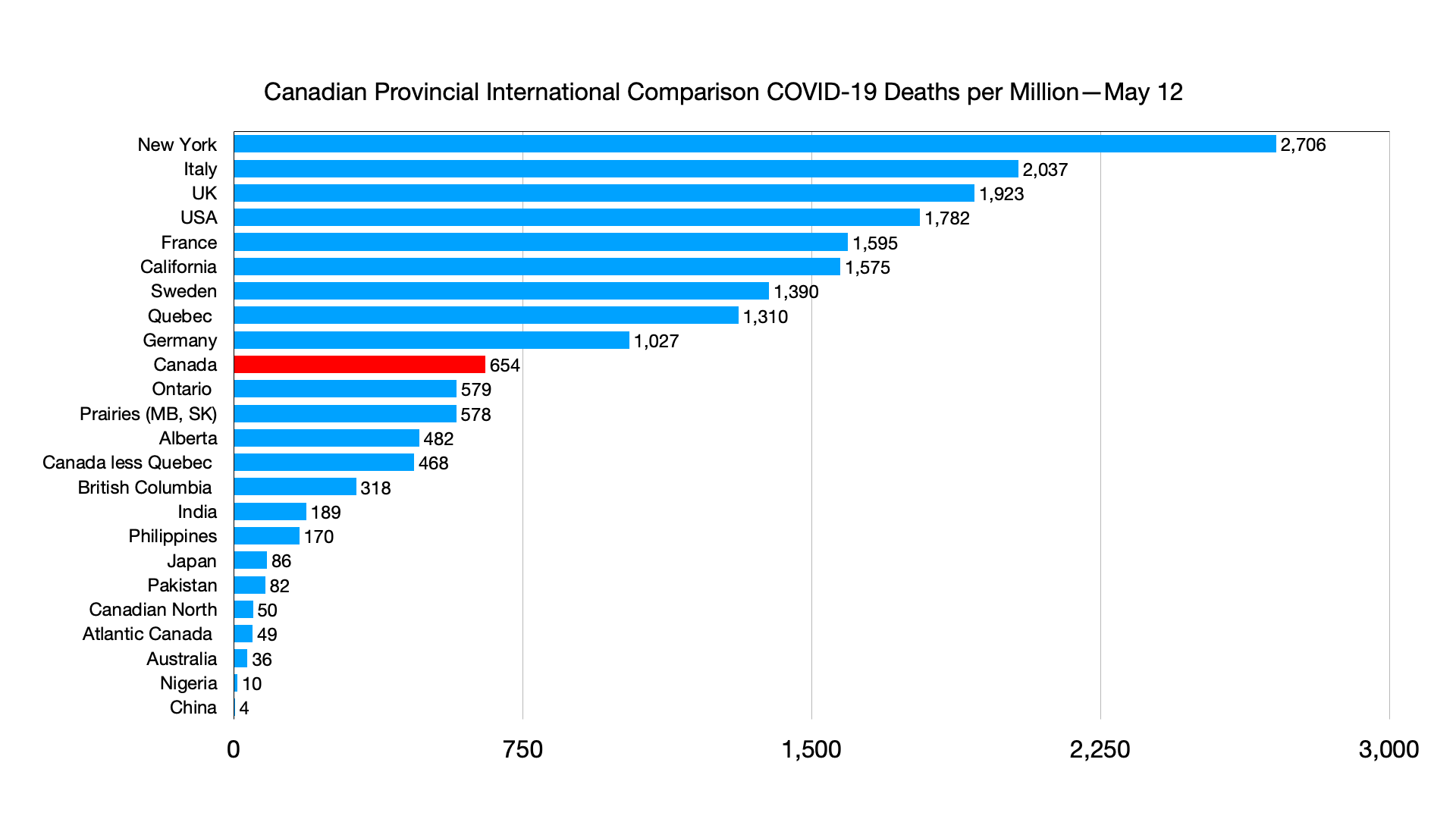
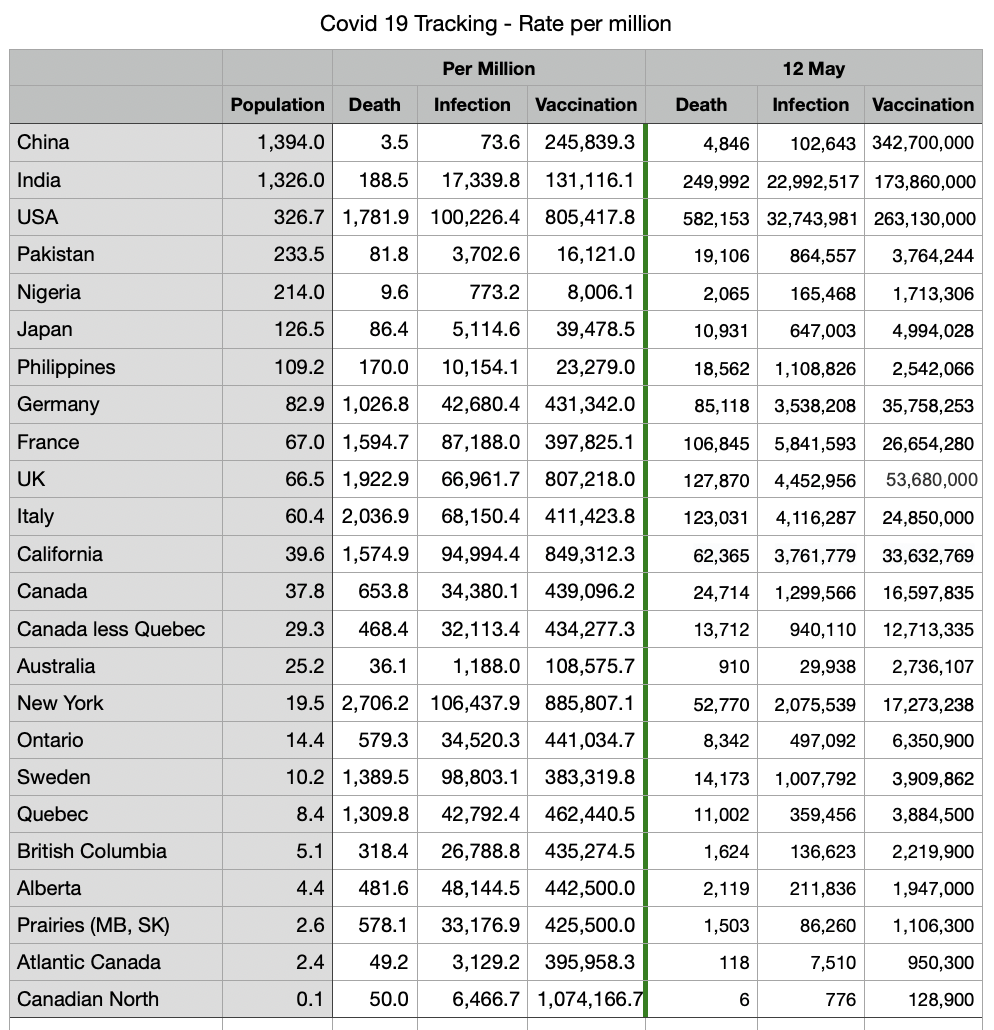
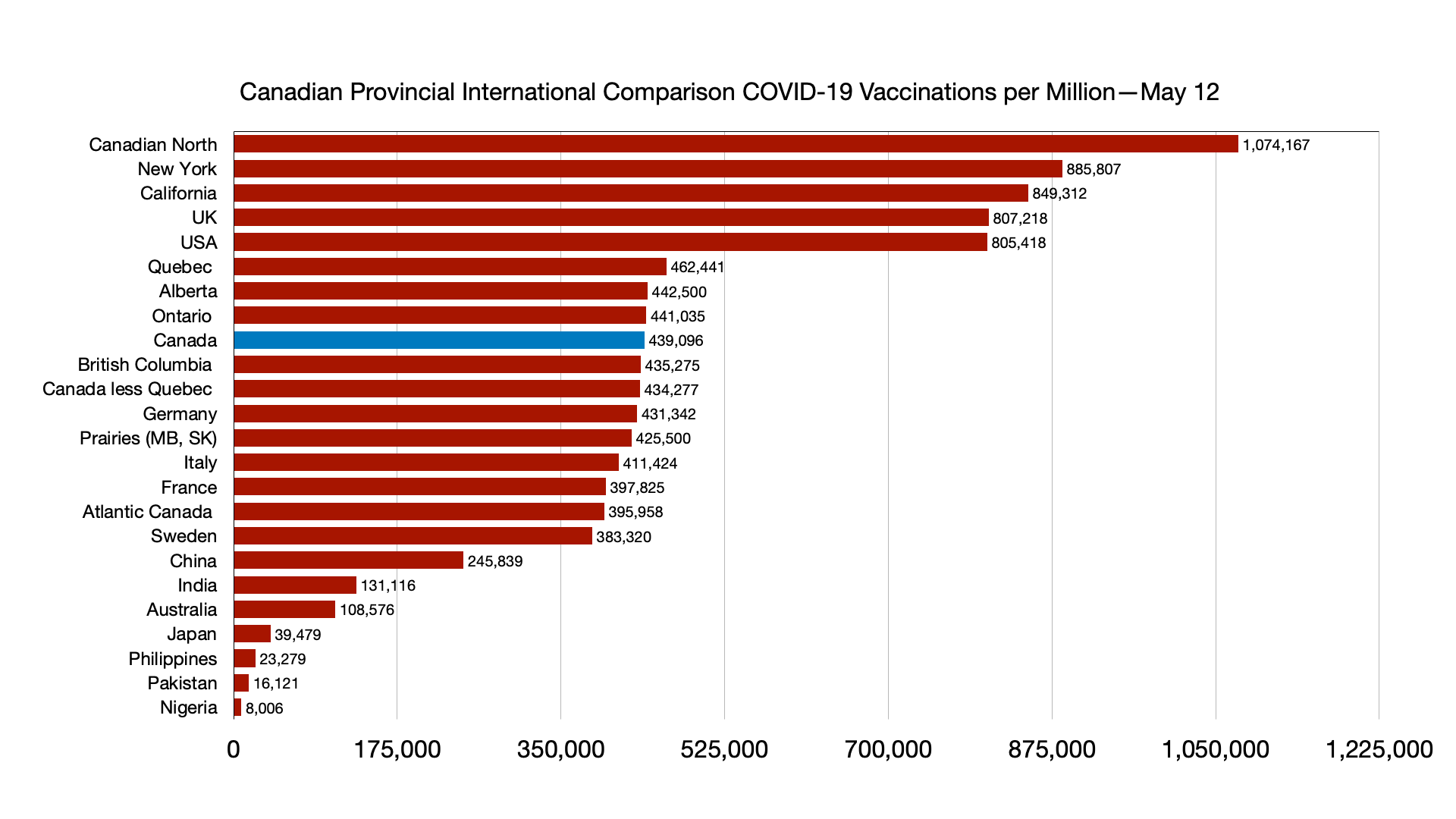
#COVID-19: Comparing provinces with other countries 12 May Update

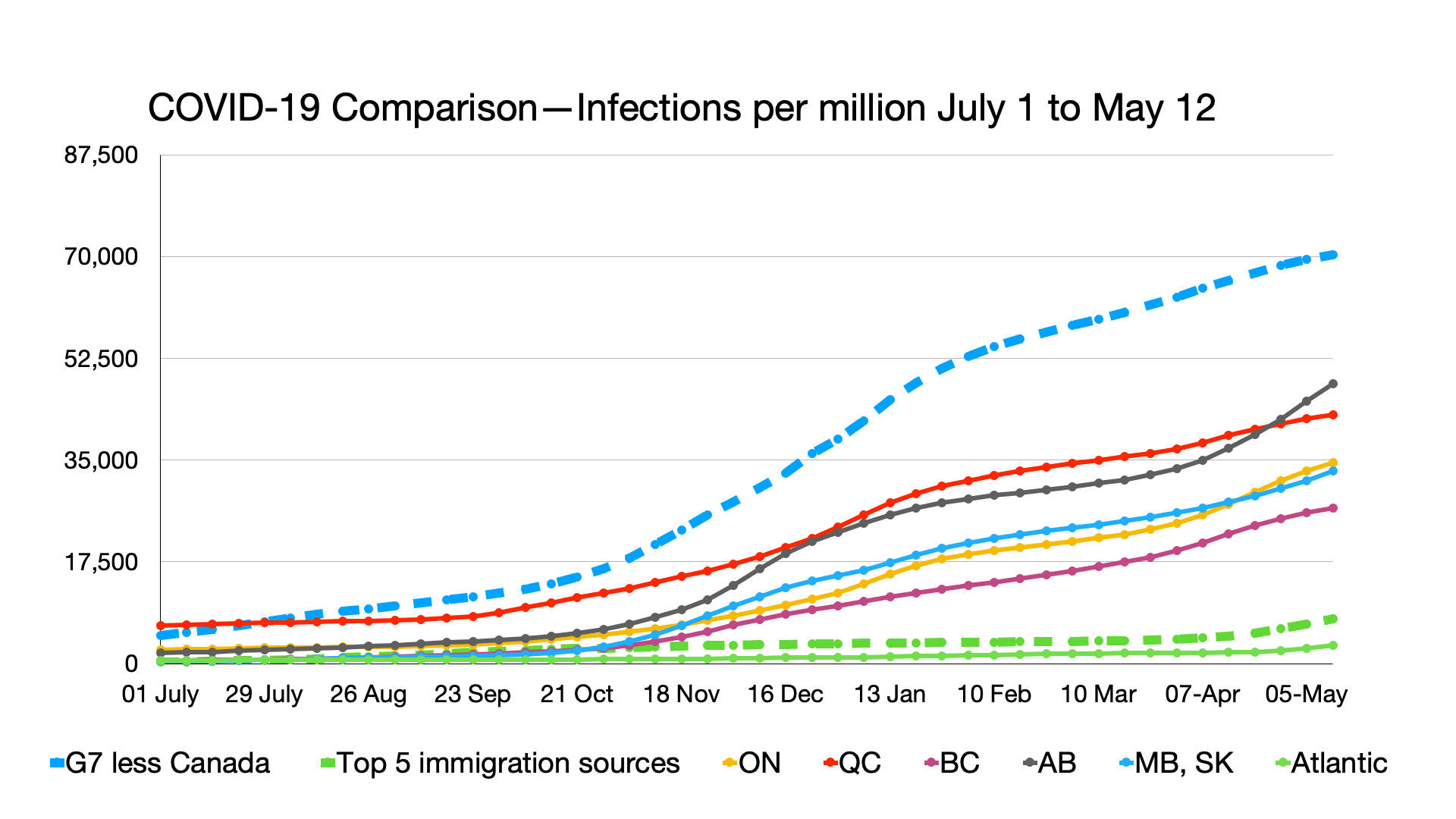
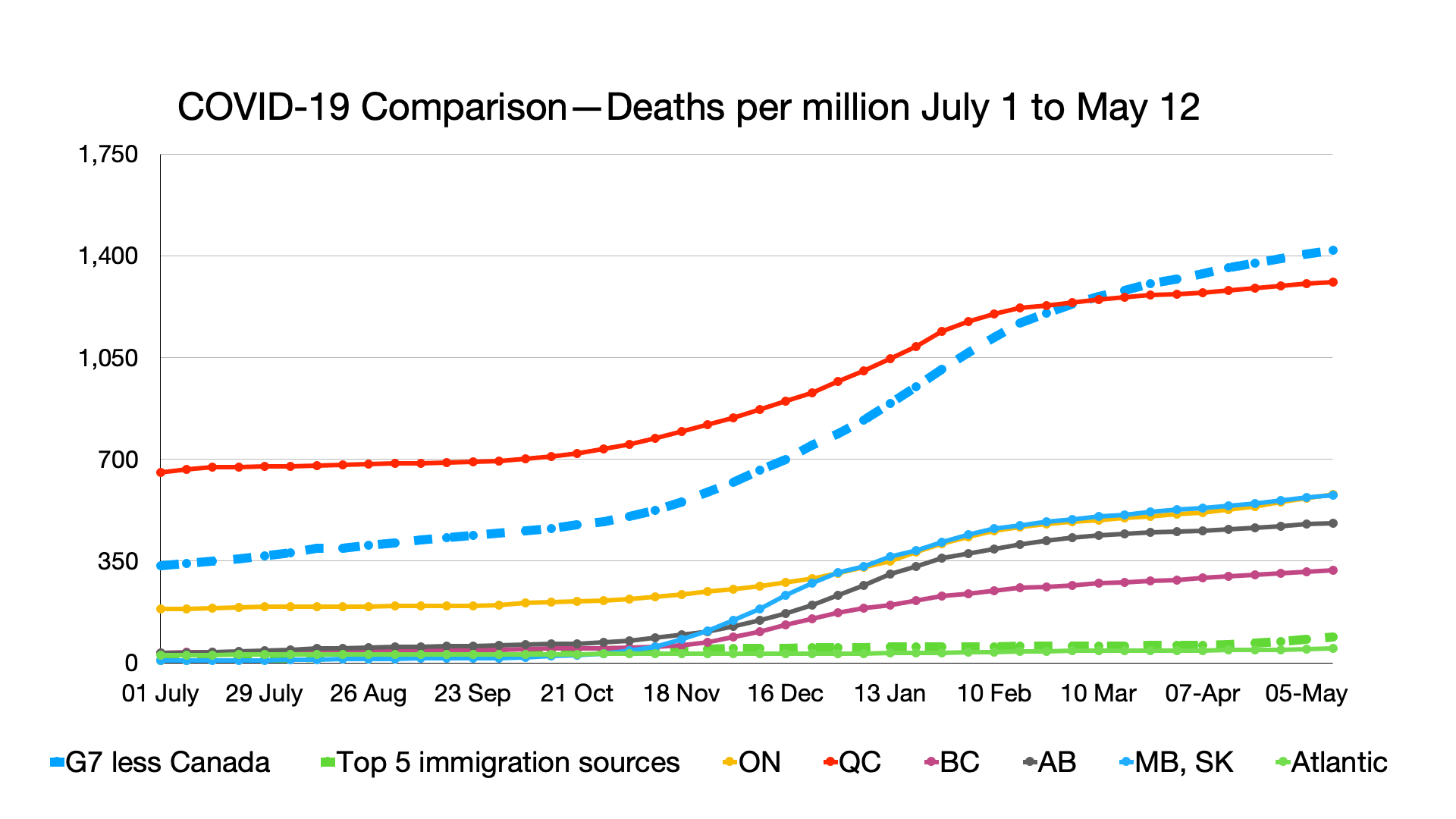
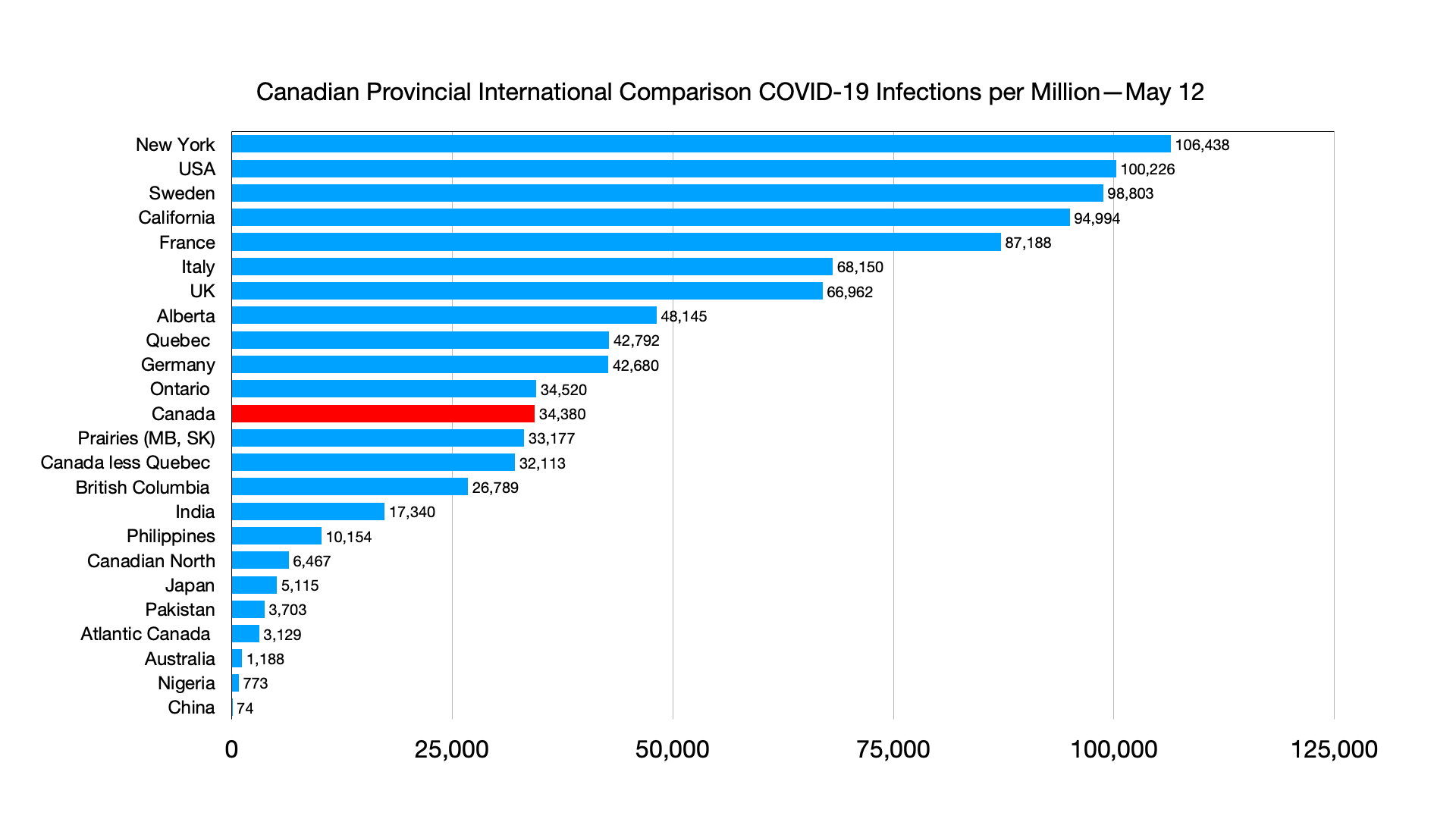
The latest charts, compiled 12 May as the third wave continues. The ongoing spike of infections and deaths in India per million still has not resulted in a change in the relative ranking given the size of India’s population.

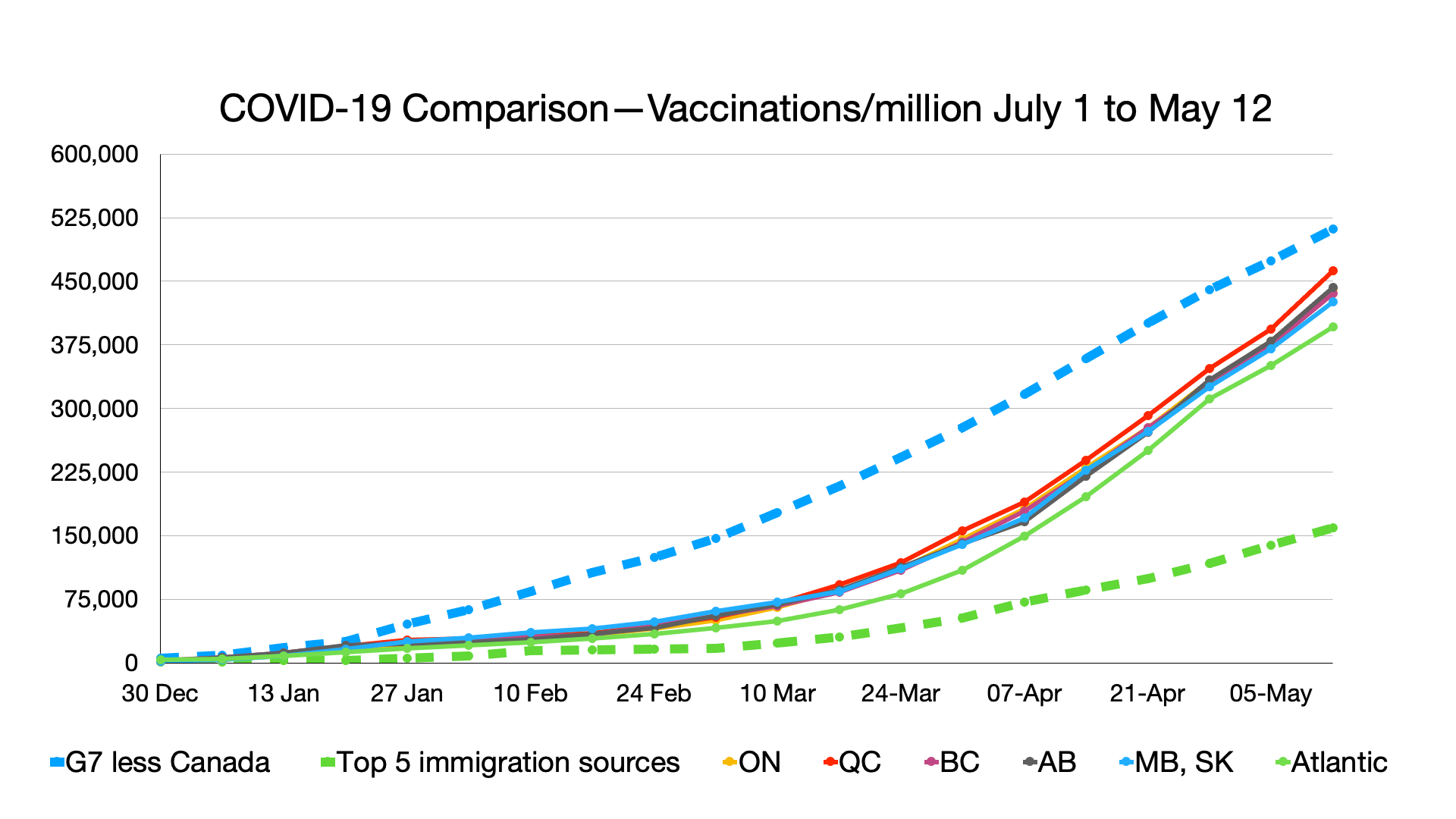
Vaccinations: Overall, vaccination rates in Canada and most provinces continue to be comparable or greater to those of EU countries.

Trendline charts

Infections per million: The ongoing spikes in Alberta and Ontario continue, with Alberta showing the highest growth rate.

Deaths per million: Gap between G7 and Canadian provinces continues to grow.

Vaccinations per million: Vaccination rates in Canadian provinces continue to increase more quickly than overall G7 less Canada countries. USA has moved ahead of the UK. Canada and the largest four provinces all ahead of Germany but Atlantic Canada behind France, while Australia and Japan have moved ahead of the Philippines. The Increases among immigration source country continue to reflect China and India mass vaccination roll-out, but at lower rates of increase compared to Canadian provinces and G7.

Weekly

Infections per million: Sweden moved ahead of California, Italy ahead of UK, and Ontario ahead of all Canada.

Deaths per million: Ontario ahead of Prairies.

Why Canada so urgently needs to update its citizenship materials

Kind of surprising that Postmedia has largely ignored these criticisms to date (unless I missed them) and that little effort appears to have to engage more than one advocate and one academic. And why pick a pharmacology professor rather than one with citizenship and immigration expertise (e.g., Ravi Pendakur, Elke Winter, Audrey Macklin to name but a few).

But at least we have a glimpse of the revised guide themes: relationships, opportunity and commitment.

No public date yet set for release, and unclear whether it will be released before an expected election later this year:

More than a decade after its publication and at least four years after it was promised, an update is coming this year to the Discover Canada: The Rights and Responsibilities of Citizenship study guide.

The current guide, created in 2009 and lightly updated in 2012, is provided to newcomers to learn about the nation’s history, culture and ethics in advance of the citizenship test they must pass to become Canadians. The study guide is, in essence, a distillation of how the government wants the nation to be seen and of the foundational touchpoints it wants immigrants to understand.

The guide has been criticized for its many misrepresentations about Canada, either by omission or part-truth, because it contains highly controversial statements that, critics say, have continued to whitewash the country’s historical treatment of First Nations and other minorities.

Source: Why Canada so urgently needs to update its citizenship materials