Public servants say they work better from home, despite stress: survey

Interesting (on my to do list, look at the survey’s disaggregated data):

During the pandemic, employees of local, provincial, and federal governments from coast to coast to coast have provided essential services while working from home.

And it would appear that federal employees are happier now about their workplace than they were before the pandemic, according to the 2020 Public Service Employee Survey released by the Treasury Board Secretariat last week.

While we don’t know the full story of the “big pivot” over a single weekend in March 2020 — when public servants started working from home — we do know many have been working over weekends and statutory holidays and forgoing annual leave.

This isn’t sustainable over the long term. If not attended to, such behaviour could result in a crash or organizational failure.

Stress has increased since 2019. A third of employees said they felt emotionally drained after their workday, up from 29 per cent in 2019. Just over a quarter said their workload was heavier, up slightly from 24 per cent in 2019.

However, new questions in the 2020 survey about work-life balance during the pandemic revealed some silver linings:

  • 39 per cent of employees had requested flexible work hours since the start of the pandemic; and
  • 83 per cent said their immediate supervisor allowed them.

Employees said the quality of their work improved, too. For example:

  • only 23 per cent of employees said their work quality suffered because their department or agency lacked stability, which was down from 30 per cent in 2019; and
  • just 24 per cent of employees said their work suffered because of high staff turnover, down from 32 per cent in 2019.

Employees’ perceptions of change management also improved in 2020, with 59 per cent saying change was managed well in their department or agency, compared to 50 per cent in 2019.

They also reported better feedback from their supervisors in 2020, compared to 2019:

  • 69 per cent said they received meaningful recognition for work well done, up from 65 per cent in 2019; and
  • 77 per cent said they got useful feedback from their immediate supervisor about their job performance, up from 74 per cent in 2019.

Overall job satisfaction improved in 2020, too:

  • 83 per cent of employees said they liked their job, up from 81 per cent in 2019;
  • 78 per cent reported getting a sense of satisfaction from their work, up from 76 per cent in 2019;
  • 75 per cent said they were satisfied with their department or agency, up from 71 per cent in 2019;
  • 75 per cent said they would recommend their department or agency as a great place to work, up from 70 per cent in 2019; and
  • 71 per cent of employees said they felt valued at work, up from 68 per cent in 2019.

Respondents also felt their workplace was “psychologically” healthier. For example:

  • 68 per cent said their workplace was psychologically healthy, up from 61 per cent in 2019; and
  • 81 per cent said their department or agency was doing a good job of raising awareness of mental health in the workplace, up from 73 per cent in 2019.

In response to a new question in 2020, 69 per cent of employees said they’d feel comfortable sharing concerns about their mental health with their immediate supervisor.

The survey included new questions about working during the pandemic:

  • 70 per cent said senior managers were taking adequate steps to support their mental health during the pandemic;
  • 84 per cent felt their department or agency was effectively communicating the mental-health services and resources available to them; and
  • 81 per cent said they were satisfied with the measures their department or agency was taking to protect their physical health and safety during the pandemic.

Employees were also asked about the information they received from their department or agency about the pandemic:

  • 78 per cent said it was clear and easy to understand;
  • 81 per cent said it was consistent with the information they got from their immediate supervisor; and
  • 92 per cent said the information was available in both official languages.

And finally, instances of harassment also fell. In 2020, 11 per cent of employees said they’d been harassed on the job in the previous 12 months, down from 14 per cent in 2019. In addition, 71 per cent said their department or agency worked hard to create a workplace that prevents harassment, up from 69 per cent in 2019.

So while the pandemic isn’t over, public servants remain engaged. It would appear that working from home and away from the office has improved their view of the workplace and of their senior managers.

Stephen Van Dine is the senior vice-president of public governance at the Institute on Governance.

Source: Public servants say they work better from home, despite stress: survey

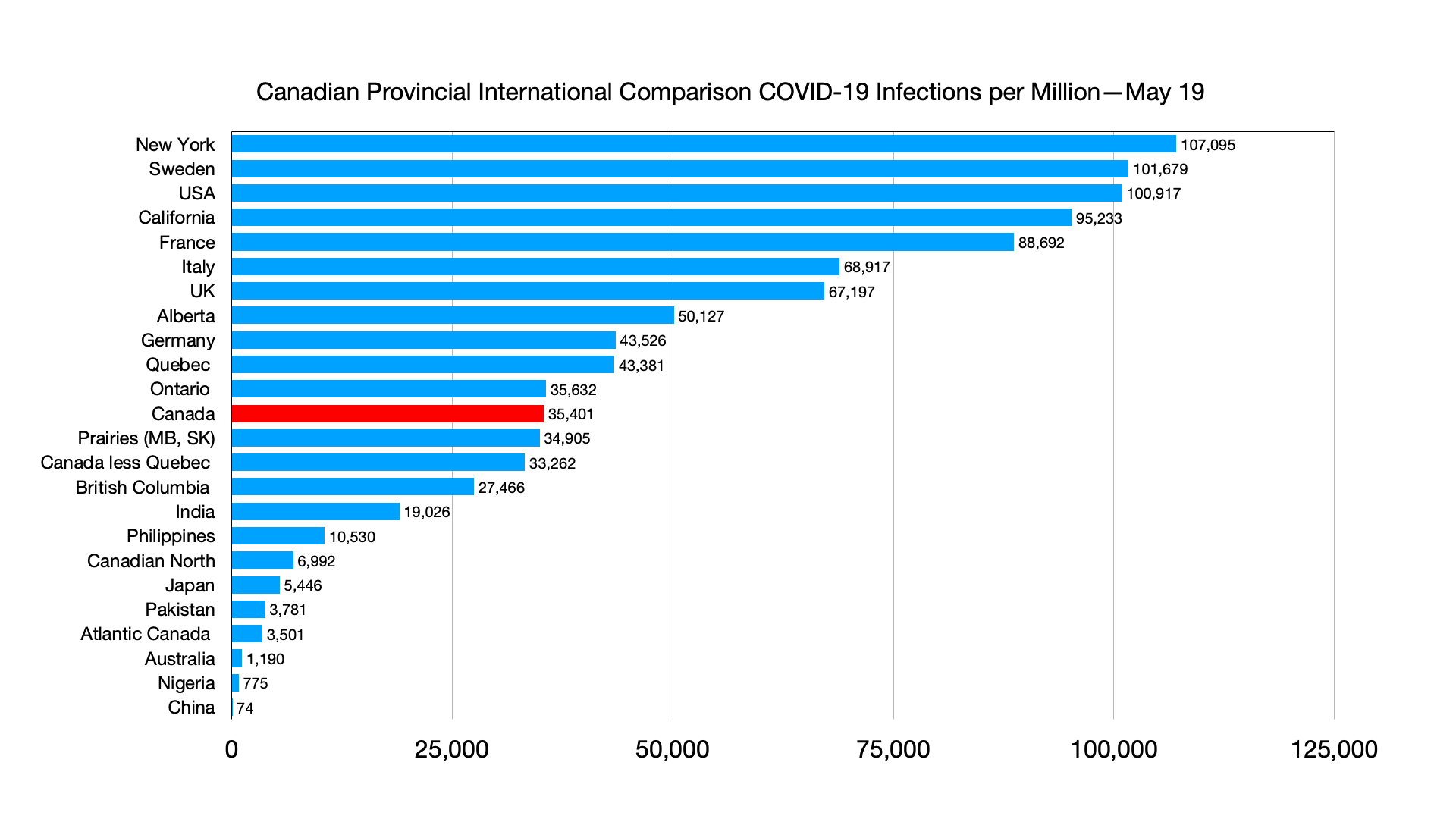
#COVID-19: Comparing provinces with other countries 19 May Update

The latest charts, compiled 19 May as the third wave continues.

Vaccinations: No significant relative changes

Trendline charts

Infections per million: Alberta spike continues and upsurge in Manitoba is driving Prairie rates closer to Ontario.

Deaths per million: Gap between G7 and Canadian provinces continues to grow.

Vaccinations per million: Canadian vaccination rates continue to catch up to G7 less Canada and are likely to exceed G7 shortly (at least in some provinces).

Weekly

Infections per million: Minor shifts between some EU countries and Canadian provinces.

Deaths per million: Atlantic Canada ahead of the North.

Krugman: Learning to Live With Low Fertility

Interesting, rather than advocating for higher levels of immigration, Krugman takes the alternate take of adapting to lower fertility and population growth. Canadian governments, policy makers and advocates would be wise to also consider this alternate scenario:

Last week the Bureau of Labor Statistics reported much higher inflation than almost anyone predicted, and inflationistas — people who always predict runaway price rises, and have always been wrong — seized on the news as proof that this time the wolf is real.

Financial markets, however, took it in stride. Stocks fell on the report, but they soon made up most of the losses.

Bond yields rose only slightly on the news, then ended the weekright where they started — namely, extremely low.

Why so little reaction to the inflation news? Part of the answer, presumably, was that once investors had time to digest the details they realized that there was little sign of a rise in underlying inflation; this was a blip reflecting what were probably one-time rises in the prices of used cars and hotel rooms.

Beyond that, however, is what I think is the realization that while we’re achieving dramatic, almost miraculous success in defeating Covid-19, once the pandemic subsides we’re likely to be in an environment of sustained low interest rates as a result of weak investment demand. And the biggest reason for that low-rate environment is plunging fertility, which implies slow or even negative growth in the number of Americans in their prime working years.

This isn’t a new issue. Last month’s census report showing the lowest U.S. population growth since the 1930s only confirmed what everyone studying the subject already knew. And America is relatively late to this party. Japan’s working-age population has been declining since the mid-1990s. The euro area has been on the downslope since 2009. Even China is starting to look like Japan, a legacy of its one-child policy.

Is stagnant or declining population a big economic problem? It doesn’t have to be. In fact, in a world of limited resources and major environmental problems there’s something to be said for a reduction in population pressure. But we need to think about policy differently in a flat-population economy than we did in the days when maturing baby boomers were rapidly swelling the potential work force.

OK, let me admit that there is one real issue: An aging population means fewer active workers per retiree, which raises some fiscal issues. But this problem is often exaggerated. Remember all the panic about how Social Security couldn’t survive the burden of retiring boomers? Well, many boomers have already retired; by 2025 most of the growth in the number of beneficiaries per worker caused by retiring baby boomers will already have occurred. Yet there’s no crisis.

There is, however, a different issue with low population growth. To maintain full employment, a market economy must persuade businesses to invest all the money households want to save. Yet a lot of investment demand is driven by population growth, as new families need newly built houses, new workers require the construction of new office buildings and factories, and so on.

So low population growth can cause persistent spending weakness, a phenomenon diagnosed in 1938 by the economist Alvin Hansen, who awkwardly dubbed it “secular stagnation.” The term and concept have been revived recently by Larry Summers, and on this issue I think he’s right.

Secular stagnation can be a problem, because if interest rates are very low even in good times there’s not much room for the Fed to cut rates during recessions. But a low-interest-rate world can also offer major policy opportunities — if we’re willing to think clearly.

For what we’re looking at here is a world awash in savings with nowhere to go: Households are eager to lend money out, but businesses don’t see enough good investment opportunities. (Bitcoin doesn’t count.) Well, why not put the money to work for the public good? Why not borrow cheaply and use the funds to rebuild our crumbling infrastructure, invest in the health and education of our children, and more? This would be good for our society, good for the future, and would also provide a cushion against future recessions.

What about the burden of debt, you ask? Well, federal debt as a percentage of G.D.P. is twice what it was in 1990, but interest payments on the debt are only about half as high. That’s what low borrowing costs — largely a byproduct of demographic stagnation — do.

So, are the Biden administration’s infrastructure and family proposals the kind of things I have in mind? They’re a gratifying step in the right direction. But they aren’t nearly as ambitious as they’re often portrayed, and to my mind they’re too fiscally responsible — the administration is excessively concerned with paying for its plans.

The fact is that, like it or not, we’re going to be living for a long time with very slow population growth. And we need to start thinking about economic policy with that reality in mind.

Source: https://www.nytimes.com/2021/05/17/opinion/low-population-growth-economy-inflation.html

How Australia can benefit from low or no immigration

A critical look, one that the Australian government appears to have largely adopted, but not going so far as “no immigration”:

For years there has been an often heated debate about the impact of high immigration on the Australian economy.

It is clear that population growth driven by some of the highest immigration levels in the world have supported bottom line GDP growth – the new Australians work, eat, live and spend.

High immigration has also fuelled strong demand for housing and was, at least in part, one of the divers of the unrelenting rise in house prices for many decades.

At the same time, population growth outpaced infrastructure capacity, most notably the transport networks in the big cities where most immigrants settled. Congestion was also seen in productivity destroying traffic chaos, overcrowded schools, hospitals and other government services.

Immigration was also a source of labour for many businesses, which has seen the government slash trade training funding, made university costs oppressive and generally undermined the skills set of many Australians.

If workers were needed to pick fruit, work as highly skilled engineers in the mines or IT gurus for businesses, the government simply granted work visas and the problem was solved.

Resources to train and upskill the 2 million Australians unemployed and underemployed – many of who do not have the skills needed in today’s economy – were hopelessly inadequate which is why, with the borders closed, there is a widespread skills shortage.

The benefits of high immigration were being offset or at least diluted by the costs.

COVID-19 and the border closures

With the onset of the COVID-19 pandemic, the government effectively closed the international borders to immigrants.

Indeed, the latest figures from the Australian Bureau of Statistics show that more people are leaving Australia permanently than are arriving. This is the first time this has happened in 100 years.

A year after net immigration turned negative, there are some economic trends emerging that might give a few insights into the sort of immigration policy that is best for Australians after the COVID-19 pandemic is over or at least when we learn to live with the virus in an orderly way.

Perhaps the most obvious issue is a skills shortages among the current workforce which is sparking up opportunities for a long overdue acceleration in wages growth. Business are reporting it difficult to find suitable workers and for obvious reasons, this cannot be fixed by working visas and immigration.

A recent RBA survey of business shows expectations for wages growth is at its highest level in over a decade. Weak wages growth, for so long a problem for the Australian economy, is poised to turn with a substantial pick up in private sector wages unfolding.

It is well understood that rising wages growth will fuel household incomes and with that, consumer spending.

And the key thing about this wages growth is that firms are able to meet this higher wages bill given there has been solid growth in bottom line profits and margins as the economy expands.

Border closures are now linked to higher wages.

With the working from home phenomenon that has been experienced due to the COVID-19 restrictions, congestion in most CDBs and on public transport is less common. Again this is good news and if sustained, will ease the pressure on State budgets for future infrastructure spending. Fewer people are using existing public transport and roads.

While it is yet to be fully tested, there is tentative evidence that low immigration has reduced demand for residential property.

The mini-boom in house prices evident over the last 8 or 9 months has been driven by favourable affordability with first home buyers using stunningly low interest rates and a raft of financial incentives to get into the market and pay-up for their home.

New immigrants have, obviously, been absent from auctions of the queues for rental properties.

Immigration an election issue?

The next Federal election is less than a year away. It could even be in October as Prime Minister Morrison works to take advantage of the favourable economic news and as some of the measures in the budget start to impact on voters.

It is possible that immigration will be an election issue particularly if one side, or other, uses the good news from low immigration as part of a platform to improve the well being of Australians with strong per capita growth.

Of course, Australia needs to maintain its humanitarian immigration program, and when health conditions permit, this should resume.

But the bigger picture immigration program, which saw 1 million people arrive in the three years prior to COVID-19, needs to be scaled back even when the borders reopen.

If we go back to huge population growth in the years ahead, get set for weaker wages, further house price gains, pressure on infrastructure and higher unemployment.

Source: How Australia can benefit from low or no immigration

La balle est dans le camp de Québec, dit le ministre Mendicino

This “blame game” has been going on for some time:

Le gouvernement fédéral a beau être celui qui a le pouvoir d’octroyer la résidence permanente, Québec a sa part de responsabilité dans les dizaines de milliers de dossiers de travailleurs qualifiés en attente, croit le ministre de l’Immigration, Marco Mendicino. En entrevue au Devoir, il s’est dit « encouragé » par le fait que Québec a légèrement augmenté ses seuils pour 2021, mais estime que la balle est toujours dans son camp.

« Il faut comprendre très clairement que Québec établit ses propres seuils d’immigration annuels, et nous recevons plus de demandes pour le PTQQ [Programme des travailleurs qualifiés du Québec] que les [places] permis [es] par Québec. C’est la raison pour laquelle il y a plus d’applications dans l’inventaire », a dit le ministre dans une entrevue accordée en français au Devoir.

Il rappelle que 50 000 travailleurs qualifiés sont en attente d’une résidence permanente, mais que les cibles du Québec ne permettent pas d’absorber toutes les demandes traitées. « Les seuils d’immigration de Québec en 2021, cette année, sont de maximum 26 000 personnes. Ça, c’est la réalité », a déclaré le ministre Mendicino, qui a succédé à Ahmed Hussen à ce poste à la fin 2019.

Il ne cache pas que cette « réalité », soit les seuils trop bas du Québec pour écouler les dossiers en attente, est à l’origine d’une demande de la ministre de l’Immigration, Nadine Girault, enjoignant au fédéral de traiter en priorité les dossiers de travailleurs qualifiés déjà ici. Or, cela n’est pas sans conséquence sur les autres catégories d’immigration, souligne M. Mendicino. « Quand nous faisons l’exercice de priorisation du PTQQ, la réalité est que les autres applications ne sont pas priorisées. […] Ça va rester comme ça tant et aussi longtemps que la demande sera plus grande que les niveaux d’immigration établis par le Québec. »

Regarder vers l’avenir

Il y a deux semaines, Le Devoir avait révélé qu’Ottawa avait reconnu avoir ralenti le traitement des dossiers de travailleurs qualifiés et que c’était attribuable « aux restrictions imposées par le gouvernement du Québec quant aux admissions en raison d’un nombre limité de places dans les niveaux annuels », pouvait-on lire dans des documents gouvernementaux. Ces déclarations avaient agacé Québec, qui a continué de rejeter la responsabilité des délais de traitement sur le gouvernement fédéral, le seul à pouvoir délivrer des résidences permanentes.

Mais le ministre canadien dit qu’il ne souhaite pas « débattre du passé », mais plutôt assainir le climat entre lui et le Québec. « Je vais me concentrer sur aujourd’hui et l’avenir, et je vais livrer tous les travailleurs dont le Québec a besoin pour appuyer sa relance économique. C’est la chose la plus importante pour moi et mon gouvernement », a-t-il dit, en ajoutant qu’Ottawa est un « partenaire de bonne foi » dans cette affaire.

Marco Mendicino rappelle que son ministère a déjà octroyé une résidence permanente à plus de 7000 travailleurs qualifiés du Québec, soit une augmentation de 54 % par rapport à l’an dernier. Il aurait également contribué à fournir au Québec plus de 7000 travailleurs temporaires.

Plus d’anges gardiens

Quant au programme des « anges gardiens », qui vise à régulariser le statut des demandeurs d’asile ayant travaillé en soins directs aux patients pendant la première vague, le ministre fédéral de l’Immigration a dit continuer de talonner son homologue québécoise pour qu’elle élargisse le programme. « J’ai répété que la porte restait ouverte de notre côté pour revisiter les paramètres de programme », a-t-il indiqué, en évoquant une rencontre avec Nadine Girault il y a exactement deux semaines. « Je pense que le Québec veut attendre un peu plus pour regarder le progrès. Mais s’[il] veut élargir le programme, nous sommes prêts. »

En date du 10 avril, seulement 3200 dossiers (représentant 7500 personnes au total) avaient été reçus dans le cadre de ce programme, dont 1400 au Québec. Soucieux d’atteindre sa cible historique de 401 000 immigrants en 2021, le gouvernement fédéral a également lancé le mois dernier un programme permettant à plus de 90 000 étudiants et travailleurs temporaires d’obtenir la résidence permanente.

Source: La balle est dans le camp de Québec, dit le ministre Mendicino

Une véritable honte!

On family reunification between refugees and their children:

Les gouvernements du Québec et du Canada ont ratifié en 1991 la Convention relative aux droits de l’enfant, un instrument juridique international adopté par l’Assemblée générale des Nations unies en novembre 1989. Cette convention internationale stipule dans son article 10 que toute demande formulée par un enfant ou un parent pour entrer dans un État à des fins de réunification familiale doit être traitée « dans un esprit positif, avec humanité et diligence ».

Humanité et diligence ? Le ministre canadien de l’Immigration, Marco Mendicino, a beau dire à notre collègue Lisa-Marie Gervais que le Canada est un chef de file mondial en matière de réinstallation des réfugiés, les statistiques racontent une histoire déshumanisante et brossent un portrait qui fait honte. Des parents acceptés comme réfugiés au Canada, et ayant même obtenu leur résidence permanente, attendent plus de trois ans avant de retrouver leurs petits, restés au bercail au moment de la séparation.

Faut-il rappeler qu’Estelle, Sophie et toutes ces femmes et ces hommes qui pleurent des enfants laissés derrière eux n’ont pas plié bagage un matin de légèreté pour le plaisir du périple et le goût de l’aventure ? Ces réfugiés politiques, reçus parfois pour motifs humanitaires, ont fui leur pays natal pour sauver leur vie, et parfois celle de leur famille. Rien ne dit que les enfants restés derrière eux, privés d’un de leurs parents ou même des deux, ne sont pas eux-mêmes soumis à quelques périls, comme c’est le cas de Sophie, qui craint pour la sécurité de quatre de ses enfants restés en Afrique. Elle a quitté un mari violent, et les nouvelles que lui acheminent ses voisines la font frémir. Elle craint que ses enfants soient eux-mêmes coincés dans le cycle de la violence.

Le fait que les enfants puissent rejoindre leurs parents au Canada après 39 mois d’attente est une véritable honte. Impossible d’invoquer la pandémie pour cette longue pénitence dans les couloirs de la bureaucratie, car voilà des lustres que l’enjeu de l’attente interminable est noté au tableau des horreurs. L’action rapide et efficace fut pourtant possible en 2015, lorsque le Canada a ouvert ses portes à 25 000 réfugiés syriens dans un temps record.

Le Conseil canadien pour les réfugiés demande au Canada de fixer une limite maximale honorable de six mois pour que parents et enfants puissent être réunis à une même table. Ces délais exceptionnellement courts ne devraient pas constituer l’extraordinaire, mais plutôt le cours normal des choses. Sans cela, inutile de même prétendre au moindre titre de chef de file mondial.

Source: https://www.ledevoir.com/opinion/editoriaux/602222/reunification-familiale-une-veritable-honte?utm_source=infolettre-2021-05-18&utm_medium=email&utm_campaign=infolettre-quotidienne

Sunshine lists have helped narrow the gender pay gap, but Ottawa won’t commit to one

While I understand the attractiveness of sunshine lists, I find this places too much emphasis on the individuals rather than systemic trends and gaps.

There is a wealth of government employment equity data for the four groups – women, visible minorities, Indigenous peoples and PwD – that can be disaggregated by occupational level. For example, an earlier analysis I did with TBS data:

While situations are different in universities, crown corporations and the like, where individual salary differences can be greater, in the federal public service it is the group and level that determine salaries, not individual negotiations. It would however, be useful for someone to request anonymized EX performance pay data to see if any significant gender and other differences:

The federal government does not release an annual “sunshine list” – a document outlining the name, compensation and often job title of its high-earning employees – unlike almost every province. And the Trudeau government has no plans to change this practice.

The Globe and Mail asked Treasury Board President Jean-Yves Duclos if the Liberals, who ran on a platform of government transparency and gender equity in 2015, would consider passing legislation on public-sector salary disclosure. Spokesman Martin Potvin replied that the board is “not currently working on any changes to how it reports” employee compensation.

This is despite years of feedback from equity advocates and researchers, who say sunshine laws have helped narrow the gender wage gap, as well as pressure from stakeholder groups concerned about a lack of transparency.

Beyond the issue of taxpayer accountability, sunshine laws around the country have revealed inequities in hiring practices, promotion and compensation.

For example, Anita Kozyrskyj, a professor in the department of pediatrics at the University of Alberta, was part of a group of female professors who used the university’s disclosure list to expose pay inequities within the faculty of medicine and dentistry. The academics found a $5,000 gender wage gap after accounting for factors such as rank and years of experience.

“[It] would not have been possible had we not had the sunshine list,” said Prof. Kozyrskyj, who learned she personally was making about $20,000 less than her equivalent male peers. (A similar report by academics at the University of Alberta used the sunshine list to reveal pay and representation gaps between men and women professors, as well as white and racialized faculty.)

Other research, such as a study from economists at the University of Toronto that examined the impact of sunshine laws on gender pay imbalances in academia, suggests disclosure leads to reduced inequities.

“The gender pay gap, in general, has been shrinking over time, and these laws have accounted for about 30 to 40 per cent of the closure since these laws were passed,” said one of the authors, Yosh Halberstam.

Universities that were unionized showed the clearest improvement, he added, suggesting progress requires both a mechanism to expose inequities, as well as a framework for staff to advocate for themselves.

Since January, The Globe has been publishing a series called the Power Gap, which looks at gender imbalances in the modern work force. By collecting sunshine lists from hundreds of employers across the country, the project produced an unprecedented look at where women stand within vital public institutions.

The data revealed how women’s careers are stalling out in mid-level management and how, on average, women made less than comparable male colleagues. But The Globe could not analyze federal employees, includingthose who work for the RCMP, public health, the Canada Revenue Agency or for federal Crown corporations – such as the Bank of Canada or Via Rail Canada – because the information is not available.

The Canadian Taxpayers Federation has been calling for Ottawa to introduce sunshine legislation for many years. “I think it’s a very simple transparency argument. There’s no reason that – if [almost] all the provinces are doing it, the federal government shouldn’t follow suit,” said Aaron Wudrick, the federal director of the organization.

The federation’s interest in the issue is centred around taxpayer accountability, which was then-premier Mike Harris’s motivation when his Progressive Conservative government passed Ontario’s sunshine law in 1996.

Other provinces followed suit over the past quarter century. Sunshine laws require government-owned or funded entities – such as schools and universities, Crown corporations, hospitals, the core public service and usually municipalities – to release data for all employees who earn more than a certain threshold, usually six figures. Today, every Canadian jurisdiction except Prince Edward Island, New Brunswick, the territories and the federal government requires some form of disclosure for top earners. (In Quebec, only senior managers are subject to compensation disclosure.)

These lists are not without controversy. Politically, they have been used to shame well-compensated civil servants. But in daily practice, they are a vital tool of information for women and other equity-seeking groups.

Lorna Turnbull, a feminist legal scholar and law professor at the University of Manitoba, has spent decades studying and writing about the legislative attempts from government to narrow the economic inequality between men and women. A common thread in her research has been that laws alone are not enough to protect against discrimination. For example, it’s been illegal for decades to pay equally qualified men and women different salaries for the same job because of their gender, but it still happens.

In 2011, she encountered her own real-life example. Prof. Turnbull competed for – and won – the position of dean in the faculty of law. She was to be the first woman to hold that position in the school’s nearly 100-year history. But when discussions turned to salary, Prof. Turnbull realized she was being offered less than her male predecessors.

“I was able to discover this because Manitoba has a sunshine list,” she said. Prof. Turnbull used intel from the disclosure list to negotiate a higher salary. She served as the university’s dean of law until 2016.

Prof. Turnbull said modern-day discrimination is very rarely the kind of overt, easy-to-spot bias that was typical decades ago when governments began passing anti-discrimination laws. Without access to the hard numbers, women and other marginalized groups might never know they’re not being properly paid.

Sarah Kaplan, director of the Institute for Gender and the Economy at the University of Toronto’s Rotman School of Management, said sunshine lists are not without drawbacks, but on the whole they are useful.

“The downside is that if you are on the sunshine list and you can see that others of your peers are paid more than you, it can be very demotivating. Often, there is little possibility to negotiate pay adjustments once you are in the job,” she said. “But over all, the transparency can increase pressure for long-term change, such as promoting more women to the higher-paying roles and paying women more fairly when they are hired.”

The most recent province to pass sunshine legislation is Newfoundland and Labrador, after efforts from former St. John’s Telegram reporter James McLeod.

In 2015, the Progressive Conservative government promised to introduce salary-disclosure legislation, but after it lost power, the Liberals were indecisive about doing the same, Mr. McLeod says.

“I thought, if the government won’t do a sunshine list, I’ll do it myself.”

Mr. McLeod filed freedom of information requests with large public agencies and the issue ultimately ended up in court. With public pressure building, the government passed sunshine legislation on its own in 2016. (Also, Mr. McLeod’s case won on appeal.)

Gordon Scott Campbell, an information and privacy lawyer at Aubry Campbell MacLean, said one advantage that Mr. McLeod’s case had is Newfoundland’s freedom of information legislation actually states the public is entitled to know a civil servant’s salary. The federal act, on the other hand, states the public is only entitled to a salary range. As a result, it would almost certainly require a legislative change to release specific salary amounts.

Mr. Campbell said there is always tension between access and privacy.

“Privacy legislation seeks to strongly protect Canadian privacy … access-to-information legislation seeks to broadly free government information,” he said. “I think most Canadians would support [both]. So it’s a balance.”

Source: https://www.theglobeandmail.com/canada/article-sunshine-lists-have-helped-narrow-the-gender-pay-gap-but-ottawa-wont/?utm_medium=email&utm_source=Morning%20Update&utm_content=2021-5-17_5&utm_term=Morning%20Update:%20Israel%20vows%20to%20continue%20attacks%20as%20ceasefire%20negotiations%20falter&utm_campaign=newsletter&cu_id=%2BTx9qGuxCF9REU6kNldjGJtpVUGIVB3Y

NZ: Covid 19 coronavirus: Government targets rich investors as part of its ‘reset’ of immigration settings

Of note. Similar shift to “two-step” immigration and focus on the more highly skilled. Not convinced by the focus on “rich investors” as the experience with these programs is decidedly mixed:

Wealthy investors and “highly-skilled workers” will be the targets of New Zealand’s Covid-19 immigration “reset” to reduce the economy’s reliance on low-wage migrants.

In a speech setting out the Government’s intentions for immigration policy, Economic Development Minister Stuart Nash said that would include making it harder for employers to take on workers from overseas, other than in areas of genuine skills shortages.

But for many in the audience, including economists and employers, the long-signalled announcement lacked much detail, some labelling it “confusing”.

Nash, who was filling in for Immigration Minister Kris Faafoi, said once the borders fully opened again, it would not be returning to previous immigration settings.

“That path is a continuation of pressures on our infrastructure, like transport, accommodation, and downward pressure on wages.

“Since the borders closed, we’ve seen a reversal in the horticulture sector – for example – where there’s been a lift in wages to bring in local workers.”

Source: Covid 19 coronavirus: Government targets rich investors as part of its ‘reset’ of immigration settings

Full-blown boycott pushed for Beijing Olympics

Of note. Right call:

Groups alleging human-rights abuses against minorities in China are calling for a full-blown boycott of the 2022 Winter Olympics in Beijing, a move likely to ratchet up pressure on the International Olympic Committee, athletes, sponsors and sports federations.

A coalition representing Uyghurs, Tibetans, residents of Hong Kong and others issued a statement Monday calling for the boycott, eschewing lesser measures that had been floated like “diplomatic boycotts” and further negotiations with the IOC or China.

“The time for talking with the IOC is over,” Lhadon Tethong of the Tibet Action Institute said in an exclusive interview with The Associated Press. “This cannot be games as usual or business as usual; not for the IOC and not for the international community.”

The Beijing Games are set to open on Feb. 4, 2022, just six months after the postponed Summer Olympics in Tokyo are to end.

Rights groups have met several times in the last year with the IOC, asking that the games be removed from China. A key member in those talks was Zumretay Arkin of the World Uyghur Congress.

Tethong, herself, was detained and deported from China in 2007 — a year before the Beijing Summer Olympics — for leading a campaign for Tibet.

“The situation where we are now is demonstrably worse that it was then,” Tethong said, pointing out that the IOC said the 2008 Olympics would improve human rights in China. “If the games go ahead, then Beijing gets the international seal of approval for what they are doing.”

The push for a boycott comes a day before a joint hearing in the U.S. Congress focusing on the Beijing Olympics and China’s human-rights record, and just days after the United States Olympic and Paralympic Committee said boycotts are ineffective and only hurt athletes.

“People have worked to engage with the IOC in good faith to have them understand the issues directly from the mouths of those most impacted — the Uyghurs at the top of that list and the Tibetans and others,” Tethong said. “It’s clear the IOC is completely uninterested in what the real impacts on the ground for people are.”

The IOC has repeatedly said it must be “neutral” and stay out of politics. The Switzerland-based body is essentially a sports business, deriving about 75% of its income from selling broadcast rights, and 18% more from sponsors. It also has observer status at the United Nations.

“We are not a super-world government,” IOC President Thomas Bach said recently.

China’s foreign ministry has criticized “the politicization of sports” and has said any boycott is “doomed to failure.” China has denied accusations of genocide against the Uyghur people.

A recent U.S. State Department report stated explicitly that “genocide and crimes against humanity” have taken place in the past year against Muslim Uyghurs and other minorities in the western region of Xinjiang.

Tethong said she knows some athletes may be opposed. But she said others, who gained traction from Black Lives Matter movement, may become allies. She acknowledged this as a “gloves-off” moment.

“There are obviously a lot of people who are concerned about the athletes and their lifelong work,” Tethong said. “But in the end it’s the IOC that has put them in this position and should be held accountable.”

American skier Mikaela Shiffrin, a two-time Olympic gold medalist, spelled out the dilemma for athletes in a recent interview on CNN.

“You certainly don’t want to be put in the position of having to choose between human rights like morality versus being able to do your job,” she said.

Tethong suggested coalition members might lobby the IOC’s top 15 sponsors, American network NBC, which generates about 40% of all IOC revenue, sports federations, civil society groups “and anyone that will listen.”

Activists have already singled out IOC sponsor Airbnb for attention.

“First is the moral question,” Tethong said. “Is it OK to host an international goodwill sporting event such as the Olympic Games while the host nation is committing genocide just beyond the stands?”

In meetings with the IOC, activists say they have asked to see documents in which China has given “assurances” about human rights conditions. Activists say the IOC has not produced the documents.

The IOC included human rights requirements several years ago in the host city contract for the 2024 Paris Olympics, but it did not include those guidelines — the United Nations Guiding Principles on Business and Human Rights — for Beijing. Paris is the first Olympics to contain the standards, long pushed for by human rights groups.

Last week, human rights groups and Western nations led by the United States, Britain and Germany accused China of massive crimes against the Uyghur minority and demanded unimpeded access for U.N. experts.

At the meeting, Britain’s U.N. Ambassador, Barbara Woodward, called the situation in Xinjiang “one of the worst human rights crises of our time.”

“The evidence points to a program of repression of specific ethnic groups,” Woodward said. “Expressions of religion have been criminalized and Uyghur language and culture are discriminated against systematically and at scale.”

Source: Full-blown boycott pushed for Beijing Olympics

Minister Mendicino marks Citizenship Week

Of note is what was not said or announced: the elimination of citizenship fees that was part of the 2019 election platform, the long delayed release of a revised citizenship study guide (Discover Canada) and the limited recovery in citizenship numbers following the program’s complete shutdown in April 2020.

Citizenship Week would have been an appropriate time for the release of the revised guide:

The Honourable Marco E. L. Mendicino, P.C., M.P., Minister of Immigration, Refugees and Citizenship, today issued the following statement to mark Citizenship Week:

“Today, Canadians celebrate the start of Citizenship Week, a time to express pride in our shared history, our diverse heritage, and our collective achievements. It is also an opportunity to highlight the tremendous contributions of immigrants to their communities and the Canadian economy.

“Canadian citizenship is both highly valued and sought after around the world. Without a doubt, one of our greatest achievements is the shared recognition that Canada is stronger and more prosperous because of its diversity.

“While we are by no means perfect, Canadians share a profound commitment to equality, inclusion, and respect for our differences – this includes our ethnicities, our gender identities and expressions, and our beliefs.

“As Canadian citizens, we all have a responsibility to help others in our communities, and that has never been more important than during the global COVID-19 pandemic we’ve faced together this past year. We will forever be grateful to the front line workers, entrepreneurs, community leaders, and all Canadians who have worked tirelessly to help Canada throughout the pandemic.’’

“The hopes, the commitment, and the energy that newcomers and new citizens bring to Canada are expressed in countless positive contributions, and that has never been truer than over the past year.”

“As Canadians, we share a profound commitment to be there for one another. It is one of our defining attributes, and time and time again, newcomers and new citizens have embraced this spirit. I encourage all Canadians to take the time to find ways to be active in your communities, to do some volunteer work, and to help welcome new Canadians in your community.

“Throughout Citizenship Week, I encourage all Canadians to reflect on what it means to be Canadian, and the many rights, freedoms, and responsibilities we all share as citizens.”

Source: https://www.canada.ca/en/immigration-refugees-citizenship/news/2021/05/minister-mendicino-marks-citizenship-week.html