In Fight Over 1619 Project and Nikole Hannah-Jones, White Ignorance Has Been Bliss—and Power

Of note, particularly the historical reminders and context:

Hell hath no fury like a white conservative confronted with the unvarnished history of slavery and racism in America.

For nearly two solid years, right-wing reactionaries have been apoplectic over the 1619 Project, a journalistic exploration of the indelible impact of Black enslavement on these United States put together by New York Times journalist Nikole Hannah-Jones. The same angry mob has also attacked a heretofore obscure, four-decades-old analytical methodology for understanding the institutionalism of white supremacy and anti-Black racism called Critical Race Theory.

The white conservative rage has been prolific, producing two House bills seeking to ban CRT and other “anti-American and racist theories” along with legislation in about a dozen states. The Trump administration put out its own 1776 Report, meant to “correct” the 1619 Project—which the American Historical Association called “simplistic” and full of “falsehoods, inaccuracies, omissions, and misleading statements.” Now the mob is vilifying Pulitzer Prize-winner Hannah-Jones, getting the University of North Carolina-Chapel Hill to cravenly retract a tenured position offer, replacing it with a five-year professor of practice contract.

All of these efforts obviously aim to re-center the white supremacist historical fable that roughly 350 years of slavery and Jim Crow were unfortunate—but inconsequential—events in an America of full equality of opportunity, where any difference between the races could only be a result of Black laziness and white superiority. That fairy tale speaks volumes about how desperately reliant white supremacy is on maintaining white ignorance. You just can’t have one without the other. It’s that embrace of ignorance that lets these racists ignore the long tradition of mandated white ignorance they’re now trying to extend into the future.

“White ignorance,” according to NYU philosopher Charles W. Mills, is an “inverted epistemology,” a deep dedication to and investment in non-knowingthat explains white supremacy’s highly curatorial (and often oppositional) approach to memory, history and the truth. While white ignorance is related to the anti-intellectualism that defines the white Republican brand, it should be regarded as yet more specific. According to Mills, white ignorance demands a purposeful misunderstanding of reality—both present and historical—and then treats that fictitious world-view as the singular, de-politicized, unbiased, “objective” truth. “One has to learn to see the world wrongly,” under the terms of white ignorance, Mills writes, “but with the assurance that this set of mistaken perceptions will be validated by white epistemic authority.”

To challenge that epistemic authority with uncomfortable but verifiable facts about race and racism guarantees the wrath of those who are otherwise quick to claim “facts don’t care about your feelings.” The 1619 Project has required tweaks and corrections. But the wholesale discounting of the initiative by white conservatives, who ignored the sloppy, error-filled 1776 Report, is more than a classic display of hypocrisy. It’s a testament to how deeply critical white ignorance is to white supremacy.

In reality—not the manicured “reality” of white supremacist historical delusion, but bonafide existence—historical fact has always hurt the feelings of white supremacists. In response, they have consistently used self-serving lies of omission to make themselves feel better. Were they less averse to historical truth, today’s white conservatives might already know this.

They’d perhaps be aware that the United Daughters of the Confederacy—the white Southern ladies group that put up most Confederate monuments, including one explicitly lauding the Ku Klux Klan—released a 1919 manifesto in all but name demanding “all authorities charged with the selection of textbooks for colleges, schools and all scholastic institutions” across the South only accept books depicting the Confederacy glowingly. Conversely, those books that correctly identified Confederate soldiers as traitors or rebels, rightly located slavery as the central cause of the Civil War, depicted the figure of the “slaveholder as cruel or unjust to his slaves,” or “glories Lincoln and vilifies Jefferson Davis,” were to be rejected. The UDC ordered school librarians to deface books that were insufficiently praiseful of the Confederacy by scrawling “Unjust to the South” on the title page. Well into the 1970s, these rules dictated the history lessons taught to Southern children, both Black and white. The group’s rewriting of history to make slavery benign, Black resistance invisible, and white terror no biggie—also known as the ahistorical Lost Cause myth—is being re-engineered for this moment.

Modern complaints about so-called “cancel culture” and political correctness are also linked to white ignorance, allowing the know-nothings who wield it to deny the harms of whiteness while turning themselves into victims of overly aggressive Black declarations of personhood. Across the 1940s and ’50s, the NAACP campaigned to purge racist language from history books, targeting passages that extolled the KKK and references to enslaved Black folks as happy “Sambos.” In response, the Washington Post dismissed their concerns as “humorless touchiness,” an old-timey way of calling them snowflakes. One WaPo editorial stated that to “insist that Negroes be given equal rights with other citizens is one thing. To insist that their particular sensibilities entitle them to exercise a kind of censorship is quite another.”

It took the longest student strike in U.S. history, held in 1968 at San Francisco State College, to finally get collegiate ethnic studies, which have been under attack ever since. To wit, in 2010, Arizona legally banned Mexican American Studies until a judge forced the state to overturn the unconstitutional policy, while the perennial fight over textbook history in Texas led to textbooks that in 2015 featured a section titled “Patterns of Immigration,” stating “the Atlantic slave trade from the 1500s to the 1800s brought millions of workers from Africa to the southern United States to work on agricultural plantations.” In addition to a bill to prohibit the teaching of the 1619 Project currently making its way through the Texas legislature, conservatives in the state are trying to ensure minimal mention of slavery or anti-Mexican discrimination in textbooks and pushing legislation to create an 1836 Project to “promote patriotic education.”

“Do you want our Texas kids to be taught that the system of government in the United States and Texas is nothing but a cover-up for white supremacy?” State legislator Steve Toth reportedly asked his Congressional colleagues.

And here, Toth is doing what white conservatives actually do with surprising frequency, which is screaming the supposedly quiet part. It’s an admission that by merely telling the whole story and including all the facts, the long and carefully maintained narrative of white innocence—a kind of perpetual white alibi—is disrupted. White ignorance is basically just a “refusal to recognize the long history of structural discrimination that has left whites with the differential resources they have today” creating a fake “equal status and a common history in which all have shared, with white privilege being conceptually erased.” The intentional know-nothingness of white ignorance “serves to neutralize demands for antidiscrimination initiatives or for a redistribution of resources.” Instead, it holds that “the real racists are the Blacks who continue to insist on the importance of race.”

So we have Florida Gov. Ron Desantis declaring the 1619 Project is “basically teaching kids to hate our country and to hate each other based on race,” and Tom Cotton, who performatively introduced a bill last year to ban the 1619 Project in schools, complaining the initiative paints the U.S. as “a systemically racist country” instead of “a great and noble country founded on the proposition that all mankind is created equal.” Earlier this month, during a press conference for the Stop Critical Race Theory Act, co-sponsor Dan Bishop called the academic theory “a smokescreen for racism” and a “divisive ideology that threatens to poison the American psyche.” Marjorie Taylor-Greene, who of course was also there added, “These are the things that we overcame in the civil rights era and I’m so proud that we did.”

White conservatives only get real into anti-racism lip service when the reality of white racism threatens to blow up their spot. That’s surely why in April, Senate Majority Leader Mitch McConnell sent a letter to Education Secretary Miguel Cardona labeling the 1619 Project “activist indoctrination that fixates solely on past flaws and splits our nation into divided camps.”

“My view—and I think most Americans think—dates like the Declaration of Independence, the Constitution, the Civil War are sort of the basic tenets of American history,” McConnell said in remarks earlier this month. “There are a lot of exotic notions about what are the most important points in American history. I simply disagree with the notion that the New York Times laid out there that the year was one of those years. I think that issue that we all are concerned about—racial discrimination—it was our original sin. We’ve been working for 200-and-some-odd years to get past it. We’re still working on it, and I just simply don’t think that’s part of the core underpinning of what American civic education ought to be about.”

That sure is a long-winded way of advising folks to stick to the white supremacist storyline. McConnell is unwittingly offering an example of how, as Charles Eagles writes, “the powerful can make decisions that actually “strive for a goal of stupidity,” rather than for genuine education. Under the guise of protecting children, imposing an engineered ignorance protects the privileged by preserving the status quo and by releasing leaders from responsibility… Too much knowledge could lead to troubling questions and a loss of control of the classroom, and the elite feared the unknown results.”

The price for not adhering to those rules is that white conservatives (give it up for The Real Kings of Cancel Culture, everybody!) will do all they can to have you blackballed, legally banned, discredited and defamed. Jay Schalin, of the James G. Martin Center for Academic Renewal, a right-wing think tank that led the charge against Hannah-Jones, maligned the 1619 Project as mere “political agitation”—inadvertently suggesting he already knows the horrors of American slavery and racism are reasons to be furious. Schalin and his co-conspirators, to protect white ignorance, went after Hannah-Jones. It all brings to mind yet more ignored history, cited by Mills, about how the terms of enslavement included that “Blacks were generally denied the right to testify against whites, because they were not seen as credible witnesses, so when the only (willing) witnesses to white crimes were Black, these crimes would not be brought to light… Moreover, in many cases, even if witnesses would have been given some kind of grudging hearing, they were terrorized into silence by the fear of white retaliation.”

Silence was the end goal then, and it’s the goal now, as a means of preserving white ignorance—which is to say plausible deniability. But the work of Hannah-Jones and folks like Kimberlé Crenshaw, an architect of CRT (and so much more) are undoing myths that are difficult to perfectly assemble without the cracks showing.

“If Black testimony could be aprioristically rejected because it was likely to be false,” Mills notes, “it could also be aprioristically rejected because it was likely to be true.”

Source: In Fight Over 1619 Project and Nikole Hannah-Jones, White Ignorance Has Been Bliss—and Power
Is it time to move Ottawa out of Ottawa?

Valid question given experience over more than a year with remote work. Some colleagues who are still working have indicated much easier to engage the regions given everyone on the same platform, rather than the Ottawa folks meeting in person and regional staff being on a telephone conference call.

And of course, the broader question of what percent of public servants, or what percentage of their time, requires physical presence compared to working remotely, along with the associated (but often overstated) management challenges:

The COVID-19 pandemic resulted in much of the federal public service shifting to remote work. Ottawa invested in telecommunications and found new ways for employees to work effectively from far-flung locations.

The transition was sufficiently successful that the federal government is considering continuing some remote work, possibly reducing its office rental spaces.

This raises the question — if work doesn’t need to be done in Ottawa-area offices, does it need to be done in Ottawa at all?

The centralization of federal jobs

Canada has more than 300,000 federal employees, with over 230,000 in core public administration (CPA) and just under 70,000 employed in separate agencies like the Canada Revenue Agency. 

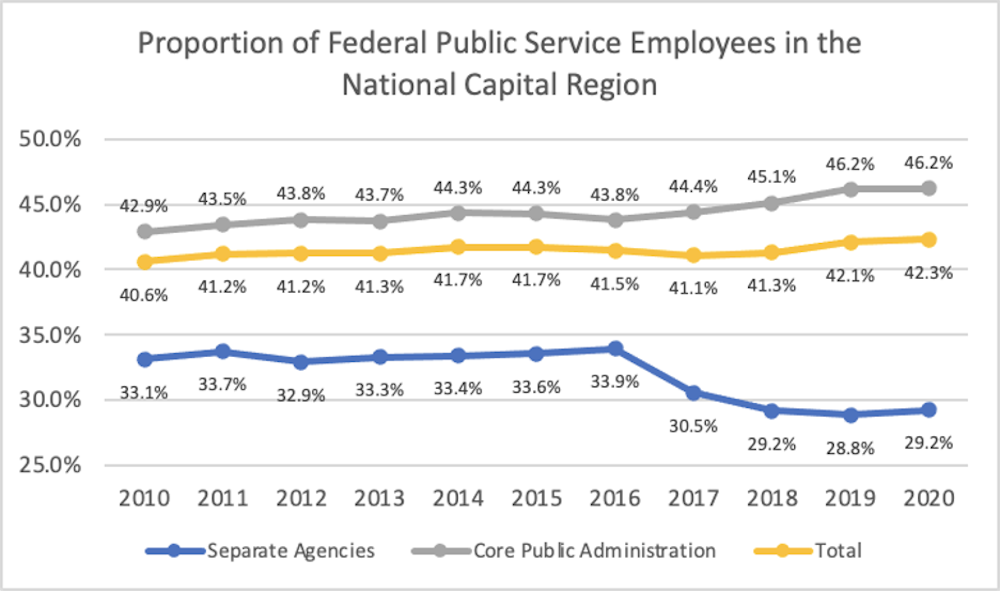
The proportion of agency jobs concentrated in the National Capital Region, which includes Ottawa-Gatineau and surrounding areas, has declined since 2016. The opposite is seen with CPA jobs. The concentration of CPA employees was only 33 per cent in 1995, but was up to 46 per cent in 2020. 

graph shows the number of federal public service jobs in the capital region
The number of federal public service jobs in the Ottawa region, according to the Government of Canada Open Data Portal. Treasury Board of Canada Secretariat, 2020

Most CPA workers are skilled knowledge workers. These are good jobs. It is time for more federal jobs, including CPA jobs, to decentralize.

The case for decentralization

Research suggests decentralizing public service jobs reduces costsstrengthens national security by spreading government functions across the country and reduces cynicism toward government

Decentralization also distributes the economic benefits of the public sector across the country. According to one 2019 British study, “the arrival of 10 civil service jobs in an area spurs the creation of about 11 jobs in the private sector,” including professional service jobs like law and consulting.

Most importantly, it gives federal governments more ability to directly engage with communities. Regional voices within government increase as career opportunities are more accessible to qualified people nationally. Advocacy and community groups across the country enjoy a more level playing field to engage in the policy process. 

This increased geographic diversity of voices working within and connecting with government can result in improved strategic policy advice. 

Creating a national strategy

Now is the perfect time to make a serious effort to decentralize Canada’s federal jobs.

The COVID-19 remote work experience demonstrates the remarkable potential of technology to overcome distance. We have learned how efficiently we can use technology to reduce unnecessary travel and connect easily across the country. We must use the disruption of the pandemic to rethink what jobs and services need to be in Ottawa at all.

We can expect growing calls for this in Canada’s economic recovery, particularly from Alberta. Just before the COVID-19 shutdown, four MPs identified the centralization of federal headquarters as an example of systemic unfairness towards Alberta. A few months later, Alberta’s Fair Deal Panel recommended western premiers request “a distribution map of federal civil servants across Canada and a list of federal government agencies and decision-making bodies that can be recommended for relocation to Western Canada.” 

Recent surveys find decentralizing jobs may be publicly popular. The 2021 Viewpoint Alberta survey, which included over 800 respondents in Alberta and Saskatchewan, found strong support for increasing federal jobs in each province.

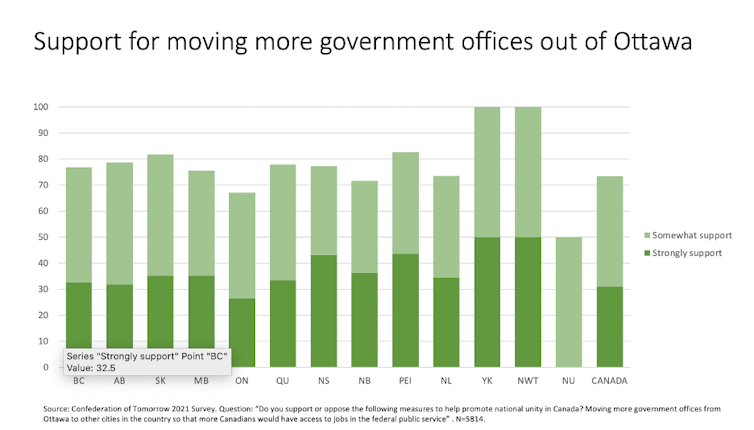
Similarly, the 2021 Confederation of Tomorrow survey of more than 5,800 Canadians found almost three-quarters (73.5 per cent) support “moving more government offices from Ottawa to other cities in the country so that more Canadians would have access to jobs in the federal public service.” 

A graph shows support for moving federal public service jobs out of the Ottawa area.
Support for moving federal public service jobs out of the Ottawa area. Confederation of Tomorrow 2021 Survey, Author provided

The time for action is now. In fact, Canada faces an immediate decision regarding the location of the new Canada Water Agency. While the decision process has yet to be announced, Regina and Sault Ste. Marie, Ont., are already vying for the agency headquarters. Other cities may also be planning to do so.

Canada already has experience in decentralizing federal jobs, including moving the National Energy Board headquarters from Ottawa to Calgary and creating regional Canada Revenue Agency tax centres. These serve as precedents for a bold new strategy.

Moving forward on a national strategy

To be sure, decentralization faces political challenges. As the benefits of job decentralization are long-term and the challenges are immediate, politicians more focused on the next election might be disinclined to take up the task.

Vested interests are loud. Strategies are needed to address relocation costs, including staff turnover and the associated loss of experience, though remote work options can reduce these.

A national strategy is required. The United Kingdom’s Places for Growth program will move thousands of London jobs, including policy advisory roles, to 13 regional hubs over the next decade and could provide ideas or a blueprint. 

Canada might also consider efforts to shift civil service work out of national capitals in Mexico, Norway, South Korea, Denmark and Malaysia

The COVID-19 remote work experience suggests that distance is not insurmountable for federal government work. No one is suggesting that public servants work from home forever, but the public’s business does not always have to be done in Ottawa. Let’s use this as an opportunity to rethink how we distribute federal work across Canada.

Source: https://theconversationcanada.cmail20.com/t/r-l-tlidhrg-kyldjlthkt-o/

Canadians of Italian origin find justice in apology for internment during WW2

Somewhat one-sided account in favour of the apology as the more authoritative and critical analysis by Roberto Perrin, Enemies Within: Italian and Other Internees in Canada and Abroad, not cited (other recent critical view by Michael Petrou, The harm done by Justin Trudeau’s apology to Italian -Canadians might require an apology of its own):

After decades of digging through archival material and talking with the relatives of people of Italian origin detained in Canada during the Second World War, Montreal historian Joyce Pillarella says Canada’s long-awaited apology gives her family and others the moral justice they have been waiting for.

Pillarella started learning more than 20 years ago about the struggles of the more than 600 people who were interned when she found a postcard sent from her grandfather who was confined at a camp near Fredericton, N.B.

She then started combing through Canada’s national archive before she started talking to the families of those affected.

“When I was starting to do cold calls to try to find families, a lot of people didn’t want to talk to me,” she said in an interview with The Canadian Press.

“What I realize now is that they didn’t want to talk because they felt insignificant, their story was insignificant. They were afraid of being judged wrongly. There was the shame of the story.”

Prime Minister Justin Trudeau is set to deliver a formal apology in the House of Commons Thursday for the internment of Canadians of Italian background during the Second World War for several years at three camps in Petawawa, Ont., Minto, N.B., and Kananaskis, Alta. The apology is not expected to come with individual compensation.

Justice Minister David Lametti, the first Canadian justice minister of Italian heritage, said the internment happened following an order-in-council that was promulgated by the then-justice minister Ernest Lapointe, and it resulted in taking hundreds of people of Italian origin from their families and declaring about 31,000 as “enemy aliens.”

“Not a single person was ever convicted, and in addition, people weren’t afforded due process,” he said in an interview.

“There wasn’t anything other than the fact that their name may have appeared on a list somewhere.”

Pillarella said the Canadian government asked the RCMP to prepare lists of Canadians of Italian heritage after Italy invaded Ethiopia in the mid-1930s.

She said Italian-Canadians had to do a lot of their business through the Italian consulates at the time.

“People had to be sympathetic with the consulate or at least appear to be, because otherwise they’re not going to get anything done,” she said.

Lametti said people were put on RCMP lists for having made donations to the Italian Red Cross or for being members of certain labour groups.

“It is true that the Fascist Party did have organizations in Canada but, in the 1930s, they were popular,” he said. “It didn’t mean that people were disloyal to Canada. In fact, Italian-Canadians generally were very much disappointed when Italy joined Germany in that war effort.”

Joan Vistarchi, whose father Salvatore Vistarchi was interned between June 1940 and March 1943, said the RCMP arrested her father in his Montreal apartment without giving him any reason.

“He was put on a train, and he didn’t know where he was going. Nobody would say where they were going, but he ended up in the Fredericton internment camp in New Brunswick,” she said.

Vistarchi noticed as a child her father would remain very silent on June 10 every year. She asked her mother what was wrong with her dad but her mother would wave it off by saying, “I just don’t think he’s feeling well today.”

When Vistarchi became a teenager, she learned that her father’s sadness on June 10 was because he was detained on that day.

“It was kept pretty silent for a long, long time, and then, only little pieces came out,” she said. “To his dying day, (my father) wondered why was he imprisoned or put in an internment camp.”

Pillarella contacted some 150 families across Canada to collect the stories of the people who were interned during the war.

She said the suffering of the women and the children left behind could be even greater than that of the men who were detained in internment camps.

“For the women in the 1940s, there were big families usually, I mean it was common (to have) six, seven, eight children. The breadwinner was gone,” she said. “Taking care of a household in the 1940s was a big, big job. … It’s not like today where we have appliances.”

She said families of Italian origin were stigmatized as “state enemies” and had to battle to survive as kids had to get pulled out of school, and women ended up finding domestic work on top of taking care of their big families.

“People didn’t want to hire Italians. They didn’t want to rent to Italians,” she said. “There were people that were afraid to help (Italian-Canadians) because they thought ‘Oh my god, the RCMP is watching. My husband’s gonna get interned also.”

Cinna Faveri said her father, Rev. Libero Sauro, was interned in September 1940 and was released in December of the same year. Four of his seven sons were serving in the Canadian military at the time.

Two of her brothers were airmen serving in England, and another one was a signalman fighting in Italy and Holland, she said.

She said her family, unlike most in the Italian community in Canada, was comfortable talking about what happened.

“Whenever I mentioned it to anybody, my close friends, my new friends, anybody, they’re shocked,” she said.

“They don’t know it. Nobody knows about it.”

Lametti said it’s critical to share the stories of these families through commemoration and education.

“We’re sorry,” he said, adding his message to families was “as your parents made sure that this stood as something that would make you better Canadians, we’re hoping to tell your story, so that all Canadians can be better.”

Faveri said the apology is necessary even if it’s too late.

“It’s far too late in coming. But, because for historical reasons, it has to come, even if it’s late.”

Vistarchi said the apology is important because the names of people who were interned are going to be cleared, and the descendants will be given some kind of closure.

“However, I really feel in my heart of hearts, as much as I really am grateful for this apology, that it would have been nice if one, at least one, of these internees had been alive to hear this. They’re all dead,” she said.

“Those are the ears that should have heard this apology.”

Source: Canadians of Italian origin find justice in apology for internment during WW2

Long Slide Looms for World Population, With Sweeping Ramifications

One of the more significant articles I have seen recently, highlighting the need for countries and societies to adapt to declining populations. While traditional immigrant receiving countries like Canada, Australia and the USA can blunt the decline somewhat, they will also feel the effects on an aging population.

Just as in climate change where adaptation and reduction strategies are both needed, relying only on immigration, as Canada largely does, to mitigate (slow down) the decline, will not address successfully the longer-term trends.

Politicians, policy makers and stakeholders need to devote more attention to other policy responses beyond simply increased immigration. After all, declining populations in most of our source countries may make Canada relatively less attractive in economic terms:

All over the world, countries are confronting population stagnation and a fertility bust, a dizzying reversal unmatched in recorded history that will make first-birthday parties a rarer sight than funerals, and empty homes a common eyesore.

Maternity wards are already shutting down in Italy. Ghost cities are appearing in northeastern China. Universities in South Korea can’t find enough students, and in Germany, hundreds of thousands of properties have been razed, with the land turned into parks.

Like an avalanche, the demographic forces — pushing toward more deaths than births — seem to be expanding and accelerating. Though some countries continue to see their populations grow, especially in Africa, fertility rates are falling nearly everywhere else. Demographers now predict that by the latter half of the century or possibly earlier, the global population will enter a sustained decline for the first time.

A planet with fewer people could ease pressure on resources, slow the destructive impact of climate change and reduce household burdens for women. But the census announcements this month from China and the United States, which showed the slowest rates of population growth in decades for both countries, also point to hard-to-fathom adjustments.

The strain of longer lives and low fertility, leading to fewer workers and more retirees, threatens to upend how societies are organized — around the notion that a surplus of young people will drive economies and help pay for the old. It may also require a reconceptualization of family and nation. Imagine entire regions where everyone is 70 or older. Imagine governments laying out huge bonuses for immigrants and mothers with lots of children. Imagine a gig economy filled with grandparents and Super Bowl ads promoting procreation.

“A paradigm shift is necessary,” said Frank Swiaczny, a German demographer who was the chief of population trends and analysis for the United Nations until last year. “Countries need to learn to live with and adapt to decline.”

The ramifications and responses have already begun to appear, especially in East Asia and Europe. From Hungary to China, from Sweden to Japan, governments are struggling to balance the demands of a swelling older cohort with the needs of young people whose most intimate decisions about childbearing are being shaped by factors both positive (more work opportunities for women) and negative (persistent gender inequality and high living costs).

The 20th century presented a very different challenge. The global population saw its greatest increase in known history, from 1.6 billion in 1900 to 6 billion in 2000, as life spans lengthened and infant mortality declined. In some countries — representing about a third of the world’s people — those growth dynamics are still in play. By the end of the century, Nigeria could surpass China in population; across sub-Saharan Africa, families are still having four or five children.

But nearly everywhere else, the era of high fertility is ending. As women have gained more access to education and contraception, and as the anxieties associated with having children continue to intensify, more parents are delaying pregnancy and fewer babies are being born. Even in countries long associated with rapid growth, such as India and Mexico, birthrates are falling toward, or are already below, the replacement rate of 2.1 children per family.

The change may take decades, but once it starts, decline (just like growth) spirals exponentially. With fewer births, fewer girls grow up to have children, and if they have smaller families than their parents did — which is happening in dozens of countries — the drop starts to look like a rock thrown off a cliff.

“It becomes a cyclical mechanism,” said Stuart Gietel Basten, an expert on Asian demographics and a professor of social science and public policy at the Hong Kong University of Science and Technology. “It’s demographic momentum.”

Some countries, like the United States, Australia and Canada, where birthrates hover between 1.5 and 2, have blunted the impact with immigrants. But in Eastern Europe, migration out of the region has compounded depopulation, and in large parts of Asia, the “demographic time bomb” that first became a subject of debate a few decades ago has finally gone off.

South Korea’s fertility rate dropped to a record low of 0.92 in 2019 — less than one child per woman, the lowest rate in the developed world. Every month for the past 59 months, the total number of babies born in the country has dropped to a record depth.

That declining birthrate, coupled with a rapid industrialization that has pushed people from rural towns to big cities, has created what can feel like a two-tiered society. While major metropolises like Seoul continue to grow, putting intense pressure on infrastructure and housing, in regional towns it’s easy to find schools shut and abandoned, their playgrounds overgrown with weeds, because there are not enough children.

Expectant mothers in many areas can no longer find obstetricians or postnatal care centers. Universities below the elite level, especially outside Seoul, find it increasingly hard to fill their ranks — the number of 18-year-olds in South Korea has fallen from about 900,000 in 1992 to 500,000 today. To attract students, some schools have offered scholarships and even iPhones.

To goose the birthrate, the government has handed out baby bonuses. It increased child allowances and medical subsidies for fertility treatments and pregnancy. Health officials have showered newborns with gifts of beef, baby clothes and toys. The government is also building kindergartens and day care centers by the hundreds. In Seoul, every bus and subway car has pink seats reserved for pregnant women.

But this month, Deputy Prime Minister Hong Nam-ki admitted that the government — which has spent more than $178 billion over the past 15 years encouraging women to have more babies — was not making enough progress. In many families, the shift feels cultural and permanent.

“My grandparents had six children, and my parents five, because their generations believed in having multiple children,” said Kim Mi-kyung, 38, a stay-at-home parent. “I have only one child. To my and younger generations, all things considered, it just doesn’t pay to have many children.”

Thousands of miles away, in Italy, the sentiment is similar, with a different backdrop.

In Capracotta, a small town in southern Italy, a sign in red letters on an 18th-century stone building looking on to the Apennine Mountains reads “Home of School Kindergarten” — but today, the building is a nursing home.

Residents eat their evening broth on waxed tablecloths in the old theater room.

“There were so many families, so many children,” said Concetta D’Andrea, 93, who was a student and a teacher at the school and is now a resident of the nursing home. “Now there is no one.”

The population in Capracotta has dramatically aged and contracted — from about 5,000 people to 800. The town’s carpentry shops have shut down. The organizers of a soccer tournament struggled to form even one team.

About a half-hour away, in the town of Agnone, the maternity ward closed a decade ago because it had fewer than 500 births a year, the national minimum to stay open. This year, six babies were born in Agnone.

“Once you could hear the babies in the nursery cry, and it was like music,” said Enrica Sciullo, a nurse who used to help with births there and now mostly takes care of older patients. “Now there is silence and a feeling of emptiness.”

In a speech last Friday during a conference on Italy’s birthrate crisis, Pope Francis said the “demographic winter” was still “cold and dark.”

More people in more countries may soon be searching for their own metaphors. Birth projections often shift based on how governments and families respond, but according to projections by an international team of scientists published last year in The Lancet, 183 countries and territories — out of 195 — will have fertility rates below replacement level by 2100.

Their model shows an especially sharp decline for China, with its population expected to fall from 1.41 billion now to about 730 million in 2100. If that happens, the population pyramid would essentially flip. Instead of a base of young workers supporting a narrower band of retirees, China would have as many 85-year-olds as 18-year-olds.

China’s rust belt, in the northeast, saw its population drop by 1.2 percent in the past decade, according to census figures released on Tuesday. In 2016, Heilongjiang Province became the first in the country to have its pension system run out of money. In Hegang, a “ghost city” in the province that has lost almost 10 percent of its population since 2010, homes cost so little that people compare them to cabbage.

Many countries are beginning to accept the need to adapt, not just resist. South Korea is pushing for universities to merge. In Japan, where adult diapers now outsell ones for babies, municipalities have been consolidated as towns age and shrink. In Sweden, some cities have shifted resources from schools to elder care. And almost everywhere, older people are being asked to keep working. Germany, which previously raised its retirement age to 67, is now considering a bump to 69.

Going further than many other nations, Germany has also worked through a program of urban contraction: Demolitions have removed around 330,000 units from the housing stock since 2002.

And if the goal is revival, a few green shoots can be found. After expanding access to affordable child care and paid parental leave, Germany’s fertility rate recently increased to 1.54, up from 1.3 in 2006. Leipzig, which once was shrinking, is now growing again after reducing its housing stock and making itself more attractive with its smaller scale.

“Growth is a challenge, as is decline,” said Mr. Swiaczny, who is now a senior research fellow at the Federal Institute for Population Research in Germany.

Demographers warn against seeing population decline as simply a cause for alarm. Many women are having fewer children because that’s what they want. Smaller populations could lead to higher wages, more equal societies, lower carbon emissions and a higher quality of life for the smaller numbers of children who are born.

But, said Professor Gietel Basten, quoting Casanova: “There is no such thing as destiny. We ourselves shape our lives.”

The challenges ahead are still a cul-de-sac — no country with a serious slowdown in population growth has managed to increase its fertility rate much beyond the minor uptick that Germany accomplished. There is little sign of wage growth in shrinking countries, and there is no guarantee that a smaller population means less stress on the environment.

Many demographers argue that the current moment may look to future historians like a period of transition or gestation, when humans either did or did not figure out how to make the world more hospitable — enough for people to build the families that they want.

Surveys in many countries show that young people would like to be having more children, but face too many obstacles.

Anna Parolini tells a common story. She left her small hometown in northern Italy to find better job opportunities. Now 37, she lives with her boyfriend in Milan and has put her desire to have children on hold.

She is afraid her salary of less than 2,000 euros a month would not be enough for a family, and her parents still live where she grew up.

“I don’t have anyone here who could help me,” she said. “Thinking of having a child now would make me gasp.”

Source: https://www.nytimes.com/2021/05/22/world/global-population-shrinking.html?action=click&module=Spotlight&pgtype=Homepage

For more conventional thinking, see the Foreign Affairs article by , which is similar to the arguments of the Century Initiative, Irving Studin and others. Only at the end does the author acknowledge that “quality” (e.g., human capital, skills etc) matter as much if not more than numbers):

The United States’ global preeminence owes a great deal to demographics. After the collapse and fragmenting of the Soviet Union, the United States became the world’s third most populous country, behind the giants China and India. By comparison to other developed countries, the United States maintained unusually high levels of fertility and immigration—a phenomenon I termed “American demographic exceptionalism” in these pages in 2019. Since the end of the Cold War, the overall American population and its number of working-age people (between the ages of 20 and 64) have grown more rapidly than those of other developed countries—and faster, too, than those of rivals China and Russia. Growing working-age populations boost national productivity in economies run by governments that can successfully develop and tap human resources. For modern welfare states, the slower aging of the population forestalls some of the fiscal burdens built into current arrangements.  

To the extent that crude demographic trends matter in world affairs, they have been running to the United States’ advantage for some time. But big changes are underway. The initial returns from the U.S. 2020 census and the reports about last year’s birth totals offered sobering news: with the slowdown of population growth and steady declines in national fertility, the United States now seems to be charting a less optimistic demographic path, one leading to a grayer and less populous future.   

The United States may be losing its advantage and becoming less exceptional as Americans choose to have fewer children. To the degree that lower birthrates signal diminished popular confidence about the future, the drop-off in fertility warrants attention and perhaps concern. Slower population growth could also have troublesome longer-term implications for Washington’s pay-as-you-go entitlements for senior citizens and other social welfare programs. But a look under the hood of the latest population data and projections suggests that there is no immediate reason to be alarmed about the country’s prospective international standing. The United States will remain in a strong demographic position with respect to its competitors for decades to come.

DECELERATION AND DECLINE

The U.S. Census Bureau’s 2020 “headline” numbers formally ratify something demographers already knew: the United States’ population growth has been decelerating steadily since 1990—and is now at the slowest recorded tempo in the country’s history, apart from the Great Depression era. Between 2010 and 2020, the U.S. population grew by an estimated 7.4 percent. That is a distinctly slower rate of growth than that of the previous decade, when the United States’ population grew by just under ten percent.

Interestingly—some would say surprisingly—immigration does not seem to have much to do with this slowdown: indirect indications suggest net immigration amounted to about a million people a year over the 2010s, roughly the same level as in the previous decade. Rather, changes in birth and death trends explain the shift. “Natural increase”—the total number of births minus deaths—averaged 1.7 million annually for the decade between 2000 and 2009 but just 1.2 million between 2010 and 2019. In 2019, the year before the COVID-19 pandemic struck, it fell below 900,000, the lowest annual sum on record since at least 1933, when the United States’ nationwide birth and death registration system was completed.

The falloff in U.S. natural increase in the 2010s was partly due to an increase in annual deaths—an entirely predictable result of the aging of the overall population. But the slump in births played a greater role. Birth totals in 2019 were down by over half a million from their all-time high of 4.3 million in 2007, just before the Great Recession.

Total fertility rates—a measure of births per woman per lifetime—tell the American childbearing story on a more human scale. For the two decades leading up to the Great Recession, the United States’ total fertility rate averaged just over two births per woman. Between 2007 and 2019, however, the U.S. rate dropped from over 2.1 (just above the level for long-term population replacement) to 1.7, below replacement level. That was the lowest rate ever recorded for the United States—until now. The provisional birth figures for 2020 indicate another four percent drop, to about 3.6 million,  implying a 2020 national total fertility rate of around 1.64—more than 20 percent below replacement level.

The available data document a substantial and remarkably widespread fertility reduction since the Great Recession. Demographers are wary of supplying definitive reasons for such changes. Economic concerns may play a part, with some blamingthe high costs of child-rearing for their reluctance to have more children or any children at all. Younger generations may also have different priorities and cultural attitudes from those of their predecessors; the rising cohort of millennials, who make up most of today’s population of childbearing ages, is decidedly less religious and also less sanguine about the future.

AN ENDURING ADVANTAGE

But the demographic future remains relatively bright for the United States. The 2020 census results seem far from harbingers of doom, especially when placed in a broader context. Take, for instance, some of the low-end projections of future U.S. population growth. The UN Population Division’s “low variant” models are instructive: these assign the United States a total fertility rate below 1.4 for the second half of the 2020s—a nationwide average lower, in other words, than that of any single U.S. state in 2019—and an even lower rate during the 2030s and 2040s. Even with this strikingly low fertility rate, the projected U.S. population would still rise for the next generation, peaking in 2047 at just under 350 million people, where it would roughly remain through 2050. The number of working-age people would likewise rise modestly during the next quarter century in this scenario—to a projected 2050 level about five percent higher than the corresponding total for 2020.

As that exercise demonstrates, the 2020 census results should not cause a “depopulationist” panic. Even with extreme and unrelenting sub-replacement fertility levels, the United States’ total population and working-age population are on course to keep growing. Continuing migration and the “population momentum” built into the United States’ current demographic structure (as rising cohorts move into age groups currently occupied by comparatively smaller cohorts) would push the overall U.S. population and working-age population to higher totals for at least another generation.

As a result, the United States will likely retain a demographic edge over other great powers. China, Japan, Russia, and the countries of the European Union have all had sub-replacement fertility rates for much longer than the United States. Their current fertility levels are all lower than that of the United States. And their populations are all older than the U.S. population today. (China has the most youthful population of those other powers, but its median age has already exceeded that of the United States.)

The United States’ most recent year of achieving replacement-level fertility was 2008. By contrast, Japan and the EU fell into sub-replacement fertility in the 1970s, China and Russia in the early 1990s. Although the United States’ surfeit of births over deaths has been steadily dwindling for over a decade, deaths have outnumbered births in the EU since about 2012, and Eurostat projects the combined population of the 27 EU member states will begin shrinking around 2025. Japan has had a surplus of deaths over births since 2007 and a continuously shrinking population since 2011. Russia has seen nearly 14 million more deaths than births since the fall of the Soviet Union.

As for China (as I noted in Foreign Affairs back in 2019 and again this year), the working-age population is already in decline; depopulation is set to commence within the coming decade—perhaps much sooner—and the country is on a path toward extremely rapid population aging, with all that implies for economic performance and domestic social need. The particulars of China’s future demographic course will become clearer when the details of China’s 2020 census are divulged—but Beijing’s unexplained month-long delay in announcing even summary findings from the count suggests official displeasure with those results. Among other unpleasant demographic surprises, the Chinese Communist Party has seen births plunge since the suspension of the regime’s harsh one-child policy in 2015. China’s still imperfect vital registration system tallied almost 18 million births in 2016, but the 2020 census reports only 12 million births in 2020. That extremely low reading may reflect the shock of the COVID-19 pandemic (a crisis the regime insists it has always had well under control)—but as demographers learn more, they may find that China’s demographic slide is progressing even more rapidly than they thought.

Of all the presumptive great powers, only India stands to see greater and more rapid total population and working-age population growth than the United States over the coming generation and to remain a more youthful society than the United States. As is well known, in just a few years India will displace China as the world’s most populous country and will surpass China in working-age population shortly after that. But India is now entering sub-replacement fertility, too: UN estimates suggest India’s under 20 population is already declining, and India’s working-age population could peak before 2050.

QUALITY, NOT JUST QUANTITY

The dip in fertility in the United States does suggest that clear-cut U.S. demographic exceptionalism may be over, at least for the time being. The United States will likely surrender its place as the third most populous country in the world to Nigeria at some point before 2050. But it will remain a fairly young and vital society, at least with respect to other developed countries and to competitors such as China and Russia.

Nevertheless, U.S. strategists and policymakers should not take too much comfort in this fact. Raw population numbers won’t on their own strengthen the United States in its competition with others. The United States must also maintain its edge over competitors in developing human capital—a lead that has been dwindling for decades. Revitalizing health, education, and other facets of the country’s human resource base is an urgent task in its own right—and will pay geopolitical dividends.

Source: https://link.foreignaffairs.com/click/23941018.88243/aHR0cHM6Ly93d3cuZm9yZWlnbmFmZmFpcnMuY29tL2FydGljbGVzL3VuaXRlZC1zdGF0ZXMvMjAyMS0wNS0yNC9hbWVyaWNhLWhhc250LWxvc3QtaXRzLWRlbW9ncmFwaGljLWFkdmFudGFnZT91dG1fbWVkaXVtPW5ld3NsZXR0ZXJzJnV0bV9zb3VyY2U9ZmF0b2RheSZ1dG1fY2FtcGFpZ249QW1lcmljYSUyMEhhc24lRTIlODAlOTl0JTIwTG9zdCUyMEl0cyUyMERlbW9ncmFwaGljJTIwQWR2YW50YWdlJnV0bV9jb250ZW50PTIwMjEwNTI0/5e19405c52ba1e34bd567ea3Cc9732586

The two pandemics of anti-Black racism and COVID-19 are tied together

Long, somewhat rambling read, stronger on the diagnostique than policy responses.

I would argue more inequality/inequity than anti-Black racism given the groups affected (see https://www.nytimes.com/2021/05/24/briefing/vaccination-class-gap-us.html with respect to vaccines but applies more generally):

It has been a year.

Almost one year ago, on May 25, 2020, Minneapolis police officer Derek Chauvin murdered George Floyd. Protests ignited in Minneapolis and then spread quickly to cities across the United States and around the world, withestimates indicating that these were the largest, most diverse and longest-lasting protests in North American history.

They heralded a massive shift in public support for Black Lives Matter, bringing the pervasiveness of anti-Black racism and calls to defund the police into broader public consciousness. Although police officers are rarely held to account for the deaths they cause while on duty, Mr. Chauvin was charged and convicted by a Minneapolis jury of second-degree murder, third-degree murder and manslaughter.

But without the viral video of Mr. Chauvin’s public killing of Mr. Floyd,recorded by a 17-year-old child who to this day has nightmares about being unable to help, the outcome would likely have been very different. The original statement by the Minneapolis police department indicated that Mr. Floyd resisted arrest and was handcuffed by officers, who then noted that he “appeared to be suffering medical distress,” without mentioning an inkling about Mr. Chauvin’s deadly use of force.

The trial revealed that Genevieve Hanson, an off-duty firefighter trained in CPR, begged the officers on the scene to let her help and was rebuffed, as were other bystanders. Law enforcement professionals, including Minneapolis police chief Medaria Arradondo, broke the usual blue wall of silence to make the case that Mr. Chauvin’s actions were excessive and unwarranted.

Throughout the trial, Mr. Chauvin was depicted as a rogue officer who disobeyed his training and disregarded established protocol. A bad apple who went too far.

It has been a year. More than a year, in fact, of living through, with, in fear of and in spite of COVID-19. The initial lockdown in March, 2020, was followed by a brief summer respite and then another, deadlier resurgence of the virus beginning in December, 2020, more contagious variants, and the imposition of stricter curfews and stay-at-home orders, depending on where in Canada you live.

The pandemic has revealed a national crisis in long-term care, initiated talk of vaccine passports, demonstrated the precarious labour conditions of low-wage, “essential” workers, generated outbreaks among vulnerable homelessand incarcerated populations, catalyzed mass evictions, forced a mass exodus of more than 200,000 women from the Canadian labour force, brought working parents and other caregivers to the brink of exhaustion, and multiplied the negative mental health effects of social isolation for school-age children.

Even as vaccinations finally roll out, we do not know what the long-term effects of this pandemic will be on our economy, our politics or our social fabric.

In all that we’ve lived and lost this past year, we cannot think of these two phenomena – anti-Black racism and COVID-19 – as separate. Both are global, though nationally textured. Both had the potential to be mitigated by decisive government action or accelerated by epic government failure. Both are simultaneously individualistic and systemic. Both have exposed the cracks in our national moral consciousness about the definition of the common good. And both are existential threats that fuel death, degradation and destruction within our sociopolitical ecosystems.

But the two pandemics are not just similar, they are interlocking, and have wrought havoc on racialized communities across the continent.

Despite the assertions by some politicians that the virus “does not discriminate,” it is now settled scientific wisdom that the burden of disease in the COVID-19 pandemic in North America disproportionately falls on racialized communities.

National data collected in the United States shows that Hispanic/Latino communities are overrepresented in COVID-19 case counts, and Black Americans are overrepresented in deaths because of the disease. It is a bitter irony that, upon his death, it was revealed that Mr. Floyd had tested positive for COVID-19.

While similar national-level data does not exist in Canada, the patchwork of local health units and provinces that have decided to track racial disparities in COVID-19 rates tell a similar story. In Toronto, Black residents are 9 per cent of the population, yet represent 14 per cent of COVID-19 cases and 16 per cent of hospitalizations. The case rates for South Asian/Indo-Caribbean communities and Latin American communities are two to three times higher than the average rate across the city, respectively.

The virus is brutal in its efficiency – it feasts on the social fissures created by the mistreatment of, and divestment from, racialized communities

We now know far more about the mechanisms of this divestment than we did a year ago. The separation of our labour forces into those whose employers provide the flexibility to work from home, and those who are “essential,” demonstrate how intertwined race and class are in deciding who lives and who may die in this pandemic. To be an “essential” worker in 2021 is counterintuitive: The products of one’s labour are invaluable, but employers and policy makers alike treat the workers themselves as disposable.

The comforts that have made urban, middle-class life bearable during this upheaval – two-day shipping from online retailerscurbside pickup from grocery stores, open daycares, and take-out delivered hot and fresh via food delivery apps – operate by exposing an underpaid and predominantly racialized work force to the virus, often without proper protection or additional compensation.

Canada’s caregiving professions are right at the heart of this distressing hierarchy. Personal support workers and nurses, many of whom are Filipino women and who are working under Canada’s Caregiver Program, have been blamed for infecting patients despite the harrowing working conditions caregivers experience on the front lines of the hardest-hit sector of our society: long-term and in-home care.

Once exposed to the virus, these workers are often forced to continue to work because most provinces do not offer paid sick leave, and the Canada Recovery Sickness Benefit offered by the federal government creates a series of barriers to accessing minimal financial support.

These contradictions and binds are evidence of what researchers have termed Canada’s colour-coded labour market on red alert. Gaps in wealth, employment rates and average employment income between racialized and white Canadians are persisting or deepening.

Beyond inaction, the two pandemics expose how politicians scapegoat certain communities to avoid taking responsibility for the social and political problems the lawmakers’ incompetence has exacerbated.

From Ontario Premier Doug Ford blaming “international students” and lax border controls for a third wave of COVID-19 that emerged, in large part, from industrial and manufacturing settings, to Alberta Premier Jason Kenney using assumptions of South Asians recklessly holding big family gatherings in Calgary to explain case bumps in the city, politicians across the country find it easier to blame the racialized “other” than to reckon with their own policy decisions.

Even leaders of the Atlantic provinces, vaunted internationally for their management of the pandemic, have leapt at the opportunity to harangue Black residents for alleged breaches in public health orders – even when they have no official basis to do so.

The rationale behind this discriminatory framing appears to be simple: It works. The public (or at least the portions of the public these leaders envision as their supporters) respond to the protective, coercive powers bestowed upon policy makers in a public-health crisis so long as there is an enemy toward whom they can direct frustration and blame for this chaos.

We see this trend taking hold in the rise of anti-Asian hate in Canada, and especially in British Columbia, where nearly one out of every two people of Asian descent experienced at least one racist action in 2020.

By making the never-ending series of lockdowns a manifestation of the personal failings of a few interlopers, these leaders direct attention away from the social, medical and political institutions we have allowed to erode. The racialized other becomes the imagined vector of disease, masking compounding policy failures that have been decades in the making.

These stigmatizing narratives are also reflected in the ways Black and Indigenous patients, in particular, are treated in our health systems. Joyce Echaquan, an Atikamekw woman, suffered racist abuse from hospital staff in Saint-Charles-Borromée, Que., as she lay dying. This atrocity emerges from the continuing violence of internal colonialism, which is premised on a racial calculus that considers the lives of Indigenous peoples to be less valuable than those of settlers.

Similarly, the death of Mireille Ndjomouo at the hands of attendants who disregarded her basic medical needs is indicative of a clinical context in which Black women are ignored and mistreated. The message sent, implicitly or explicitly, is that Black and Indigenous people are unruly and in need of control in clinical settings, lest we cause havoc as we perish.

Adding to this messaging is the choice by some jurisdictions to avoid collecting race-based health data about COVID-19 to support targeted interventions and vaccination programs in the communities hardest hit by the virus. This occurs despite demonstrable evidence to suggest that collection of race-based data prompts equity-oriented decision-making at a local level.

Instead, support for racialized communities is often left to advocates, clinicians and other professionals on the front lines of battling the virus who have long recognized that a race-conscious approach to health promotion and vaccine distribution will be key to breaking the pandemic’s hold on communities across the country.

The systematic neglect that afflicts Black communities in particular prompts a sense of distrust in public-health systems that is reflected in the much-debated “vaccination hesitancy” that Black Canadians show. One look at community-centred vaccination clinics in Upper Hammonds PlainsRexdale or Montreal-Nord shows that the work of dedicated doctors, nurses, social workers and community volunteers disrupts these facile narratives.

When people feel heard and cared for, they show up to get vaccinated in droves. Far too often, however, these community voices are disregarded to no one’s benefit.

The two pandemics have also exposed how quickly policymakers turn to policing and punitive measures as a response to any kind of challenge. Mr. Floyd’s murder, as well as the police-involved deaths of Regis Korchinski-Paquet, Rodney Levi and Chantel Moore that occurred in the subsequent months, are part of a perpetual backdrop of violence committed by police forces against Black and Indigenous people.

It is worth noting, as many have, the origins of the police in slave patrols of the 19th century and that the original purpose of the RCMP – then the North-West Mounted Police – was to remove Indigenous peoples from their traditional territories.

But the police are deadly to Black and Indigenous people in the here and now, and that alone is a solid foundation for recent calls to defund – and abolish – the police. These sustained and vigorous organizing efforts have made significant advancements across North America: from removing resource officers from schools in Peel Region and an $11-million cut over two years to the police budget in Edmonton, to a 33-per-cent cut to police budgets in Austin, Tex.

Despite these important milestones, however, policy makers have tended toward either maintaining or increasing police budgets. In Minneapolis, talk of abolishing the police force has given way to modest cuts and accusations of obstructionism by the mayor. Meanwhile, city councils in HalifaxSaskatoonand Winnipeg all increased police budgets, while Calgary’s council gave the police more money than they were seeking.

That these budget increases emerged during COVID-19 despite unforeseen opposition indicates how much the pandemic has facilitated the radical expansion of police surveillance across the country, complete with “snitch lines” that encourage citizens to report their neighbours for protocol violations.

This shift toward “policing the pandemic,” as detailed by Alexander McClelland, an assistant professor of criminology at Carleton University, and Alex Luscombe, a PhD candidate at the University of Toronto’s Centre for Criminology and Sociolegal Studies, illuminates the racialized framings that underpin the enforcement of public health emergency legislation. Using police officers to enact orders under the pretext of protecting public health has worked in Hamilton to suppress dissent in tent cities against those very same forces, while enforced curfews in Montreal have led to fines for workers who are deemed to be flouting the rules – even if they carried authorization letters with them.

This approach looks less like health promotion as outlined in the Ottawa Charter for Health Promotion, signed at an international conference organized in collaboration with the World Health Organization in 1986, and more like the deepening of a web of carceral institutions that abolitionist activists have warned us about for years.

We see a similarly troubling expansion of these carceral powers under the pretext of public health within Canada’s prisons. While some provinces wisely decided to release low-risk offenders at the behest of advocates to prevent devastating COVID-19 outbreaks in jails, prisoners in federal facilities have been subject to extended COVID-prompted “isolations” that may breach international standards for torture.

Not only have these cruelties proven ineffective to mitigate the sweeping outbreaks in many federal facilities, but they are also an outcome of the insufficient preventative measures taken in federal institutions to prevent the spread of the virus in the first place.

In times of crisis, it is intuitive for the citizenry to tacitly assent to restrictions that might otherwise seem like government overstep. A year ago, the idea of mask mandates, group size restrictions or curfews seemed ludicrous. And yet, here we are; the legitimacy of these measures is contrived from their careful design and the democratic promise that they are to be universally applied, limited in scope and temporary in nature.

But there is an acute danger to the amplification of carceral logics, punitive measures and police authority: It is far easier to expand power than it is to contract it. Even if we are able to conquer COVID-19 in the foreseeable future, it is unlikely that newfound police powers will be readily or willingly relinquished. “Power concedes nothing without a demand,” Frederick Douglass said in 1857. “It never did and it never will.”


Finally, the two pandemics raise an unavoidable moral question of how we understand social solidarity and the common good. COVID-19 has exposed not just cracks in our social fabric, but chasms.

The policy decisions that have been made during this moment of crisis were about much more than public health. They were, at base, about how we see ourselves as a collective, what we think we owe each other, who deserves to be protected, who should be shown care and concern, who must repel state violence and economic exploitation at every turn, and who must try to fend for themselves.

From the earliest days of the first wave, governments asked us for individual sacrifice for the common good. We changed our lives to protect this imagined community of people we have never seen or met. Our children didn’t go to school, we lost jobs, we didn’t get to bury our loved ones – all in the name of the common good.

And then we watched the video of George Floyd being tortured for eight minutes and 46 seconds. We collectively bore witness to a public lynching in the year 2020, committed by those sworn to protect and serve the common good.

One year ago, cities erupted as ordinary people took to the streets, in protest of the revelation, new to some, familiar to others, that the “common good” is commonly racist. For a moment, it seemed as though a racial reckoning, 400 years in the making, was at hand. For a moment, there was a spark of understanding that though public health and public safety are core functions of government, they frequently involve responses by the state that do more harm than good.

For a moment, there was wider recognition of the duplicitous treachery of a benign discourse of multicultural nationalism while vulnerable populations were immobilized or unable to shelter in place. For a moment, the reckoning seemed possible and then even likely, the public’s captivation genuine and sincere, as if the collateral damage of the pandemic wrought a collective aspiration that we might be able to substantiate a different kind of world on the other side of these entwined tragedies.

But it is now a year later, and we’ve been here before. These moments nearly always prove to be temperamental and temporary.

White American support for Black Lives Matter peaked at 43 per cent last June; that support has now dipped back down to around 37 per cent, the same level as when Mr. Floyd was still breathing. A full 50 per cent of white Americans currently oppose the movement altogether. The rebellions wrought by ordinary folks taking to the streets have been monetized and commodified.

Hollow statements against some kind of amorphous conceptualization of systemic racism have become an effective marketing strategy. Our collective memory of the uprisings has been sanitized to be more palatable to moderates, profitable to the professional class, and sanctioned by the same levels and forms of state power that continue to simultaneously ravage and neglect Black lives and communities.

Sure, steps have been taken and declarations made. Last month’s federal budget announced the government would take steps to fight systemic racism and empower communities. The same document provided an additional $75-million over the next five years to the RCMP to combat systemic racism, even as many are coming around to the idea that the police cannot be reformed, and racism cannot be extracted from the protectorate of the social order.

This is the core tension between a year of tentative and cautious optimism and the well-earned pessimism borne from decades of disappointment with just how fleeting these moments can be.

The two pandemics are interlocking, existential crises, but only one has been treated with the level of urgency required to make a real difference. The onset of COVID-19 was met with the mobilization of the scientific community, accelerated vaccine development, the advent of complicated provincial response systems and on-the-ground co-ordination of entire communities to ensure accessible testing and orderly vaccine distribution. With a little more than a year of decisive action, unprecedented investment, and individual and community sacrifice, we are turning a corner.

The same is not true of the other pandemic, 400 years in the making and still a formidable, resilient and deadly force. Anti-Black racism, and the white supremacy that underpins it, is an existential threat to us all. It fosters social, economic and ecological ruin through division and exploitation. It requires as transformative and all-encompassing an effort to disrupt it as did COVID-19.

The two pandemics were not spontaneous, or even unprecedented, really. Anti-Black racism did not “erupt” in the past year and cannot be resolved by book clubs, equity, diversity, and inclusion trainings and task forces, or good intentions. White supremacy operates at the core of our society and has done so for centuries. We’re not out of the woods; not by a long shot.

When COVID-19 strikes, individuals do not recover easily. Some have damaged organs or permanent lung problems, while others have mental-health issues that arise from the grief, loss, isolation and fatigue. Even for those who have not been ill, our lives have been forever altered.

The new variants of COVID-19 continue to mutate, transform and defy our efforts to bring an end to the pandemic. The toll on human life in this country – 25,000 dead, 1.2 million recovered and 1.3 million currently sick – weighs heavily on our collective consciousness.

The durability and long-term effects of the disease, the way it exposes the precarity and vulnerability of human life, the way it seeps into your mind, body and soul and messes with how you live, breathe, walk, act and exist in the world – this is also the delirious trickery of racism.

There will be no return to normal, after this. Besides, as the incomparable poet Dionne Brand wrote last summer, what kind of person would mourn the normalcy that killed Mr. Floyd? After a year, we are still in a moment of flux, but also a moment ripe with potential.

This is what the late sociologist Stuart Hall might have called a “politics without guarantees.” We cannot be certain that what will emerge in this reconfigured, postpandemic world will be any kinder or more egalitarian than any previous iterations.

There is nothing that guarantees the moral arc of the universe will ultimately bend toward justice. Overcoming the two pandemics will require struggle and vigilance; building the world we envision will take more than a year.

Tari Ajadi is a PhD candidate in political science at Dalhousie University.

Debra Thompson is an associate professor of political science and Canada Research Chair in Racial Inequality in Democratic Societies at McGill University and author of the forthcoming book The Long Road Home.

Source: https://www.theglobeandmail.com/opinion/article-the-two-pandemics-of-anti-black-racism-and-covid-19-are-tied-together/

A Century After The Race Massacre, Tulsa Confronts Its Bloody Past

Of note:

It’s been 100 years since the Tulsa Race Massacre — one of the worst episodes of racial violence in U.S. history. An armed white mob attacked Greenwood, a prosperous Black community in Tulsa, Okla., killing as many as 300 people. What was known as Black Wall Street was burned to the ground.

“Mother, I see men with guns,” said Florence Mary Parrish, a small child looking out the window on the evening of May 31, 1921, when the siege began.

“And my great-grandmother was shushing her, saying, ‘I’m reading now, don’t bother me,'” says Anneliese M. Bruner, a descendant of the Parrish family. But the child became more insistent.

“And so, my great-grandmother put down her reading and went to see what her daughter was talking about. And indeed, the street was populated with people with guns,” Bruner says. “Bullets were flying everywhere and they fled trying to reach safety at a friend’s home.”

Bruner is able to tell the harrowing story today because her great-grandmother Mary E. Jones Parrish, a teacher and journalist, survived and documented the massacre in her self-published memoir, Events of the Tulsa Disaster.

Sitting on her porch in Washington, D.C., Bruner flips through the pages of her family’s copy which she keeps carefully stored in a plastic bag.

“The book is a small red volume, hardcover, somewhat worn,” Bruner says. “The pages are a little brittle.”

In the book, Parrish described her heroic escape from the angry mob, and her risky return to Greenwood to document the truth of what happened. She included photographs and eyewitness accounts from others, and also recounted the myriad obstacles to rebuilding imposed by the city of Tulsa. In the appendix of the red hardcover, Parrish recorded the value of the property destroyed or taken, including her own two apartments, and the secretarial school she operated.

But the book is more than just a historical account. It’s also Parrish’s plea for America to live up to the promise of democracy.

“My soul cries for justice,” she wrote. “How long will you let mob violence reign supreme?”

Bruner believes her great-grandmother’s words are a message for the nation today amid the quest for a racial reckoning. She’s worked to get the memoir republished in conjunction with the centennial of the Tulsa Race Massacre, The Nation Must Awake.

“How do you get past the trauma, the hurt, the pain, the fear, the chaos without truth?” asks Bruner, “and that is what Mary Jones Parrish brings — the truth.”

The scene was horrific a century ago when the armed white mob, fortified by law enforcement, descended on Greenwood, an all-Black district just north of downtown Tulsa. Two days of bloodshed and destruction ensued, by land and air. Despite efforts to protect their property, Black residents were outnumbered and outpowered. Eyewitnesses recalled the specter of men carrying flaming torches through the streets to set fire to homes and businesses. Then martial law, and the arrests and internment of thousands of African-Americans.

The massacre had been sparked by reports that a 19-year-old Black man had allegedly offended a 17-year-old white female elevator attendant. The murky incident got blown out of proportion by inflammatory newspaper accounts.

While events in Oklahoma over the next few weeks will seek to examine the legacy of the Tulsa Race Massacre 100 years later, it hasn’t always been that way. Historical records were mostly destroyed, and for decades it was called the Tulsa Race Riot, implying it was somehow a two-sided battle.

Tulsa — and the nation — have been slow to acknowledge the brutal reality of what happened back in 1921, and the lasting impact it’s had on Black families.

“This actually was something that was akin to an act of war where the country turned in on its own citizens,” says Tulsa descendant Annaliese Bruner.

In addition to the loss of life, there was more than $1 million in property losses which would amount to more than $20 million today. Before the massacre, the Greenwood district was considered one of the most affluent all-Black communities in the country, a mecca for African-American culture, business and prosperity.

“It was a community of self-sufficient people,” Bruner says. “They had a great sense of themselves and their place in the world — exercising their agency and full rights and responsibilities of citizenship.”

A heritage to be proud of, yet a heritage Bruner didn’t learn about until she was in her 30s, she says, when on a visit to her father in California, he gave her the little red book and revealed this part of her family’s history.

“I was speechless, stunned, amazed, proud, sad. I was grief stricken,” she says.

It helped explain some of the trauma in her family. For instance, her grandmother who escaped the massacre as a young child struggled with alcoholism.

Bruner, an editor in her early 60s, has been on coronavirus pandemic lockdown with her grown children over the last year, so they’ve had time to consider the legacy of Tulsa and the family’s heritage.

“To be the descendent of a survivor, and then for that survivor to have the presence of mind to write that down and to have the clarity of thought for it to be so detailed, so meticulously put together, is just the source of pride,” says Kevin Hurtt, Bruner’s 33-year-old son, a biologist and science teacher.

In earlier generations the story of Tulsa was rarely passed down from victims to descendants because of fear of retribution, and Bruner suspects perhaps even some shame for having endured such abuse. Hence the long-kept secret.

Bruner’s daughter, Portia Hurtt, is a 31-year-old lawyer. She finds it hard to contemplate that not only her family, but everyone who lived in Greenwood was disinherited from what their ancestors had built there.

“Looking back now, I know how the story ends,” she says, fighting back tears. “This can be a theme in African-American families where you have to do everything right. And if something comes along and derails you, that can reverberate through generations.”

Anneliese Bruner says that the country needs to be humble and acknowledge what the Tulsa Race Massacre did to African Americans, otherwise, there is no moving forward.

“There are people whose psyche is still affected generationally, trauma after trauma, after trauma just continues to build on itself,” Bruner says. “And none of it gets resolved if you’re in a system that sometimes has the unequal application of law and or opportunity.”

Bruner sees a toxic line from Tulsa to violence against Black people today, and says the same questions apply.

“Who’s going to be held accountable?” she asks. “Are reparations going to be made? Is there going to be any official admission of responsibility?”

In 1997 the state legislature created what was called the “Oklahoma Commission to study the Tulsa Race Riot of 1921,” and it published its final report in 2001. It found that the city of Tulsa had conspired to destroy Greenwood.

“This Commission fully understands that it is neither judge nor jury. We have no binding legal authority to assign culpability, to determine damages, to establish a remedy, or to order either restitution or reparations,” commissioners wrote. Though the report also suggested that reparations to the Greenwood community “would be good public policy and do much to repair the emotional and physical scars of this terrible incident in our shared past.”

According to the commission’s report, the massacre destroyed some 40-square blocks in Greenwood. Nearly 10,000 people were left homeless as 1,256 homes were looted and burned down. And the thriving commercial district was destroyed — some of the finest Black-owned and operated businesses in the country, including hotels, restaurants, grocery stores, a theatre, a roller skating rink, hospitals and doctors’ offices, law firms, churches and realtors.

Commissioners suggested reparations such as direct payments to “riot survivors and descendants,” a scholarship fund and a memorial, among other things.

“When you talk about reparations, the challenge is that it means different things to different people,” Tulsa Mayor GT Bynum says.

“There is an acknowledgement that Black Tulsans have not had the same shot at success and a great life that white Tulsans have had over the last hundred years,” Bynum says.

Bynum, who is white, says while there’s public support for addressing disparities, resistance to cash reparations runs deep.

“Where does that come from?” he asks. “It would necessarily have to come from a tax levied on this generation of Tulsans and the idea of financially penalizing this generation of Tulsans for something criminals did 100 years ago, that’s a hard thing to ask.”

But survivors and their descendants are asking. A lawsuit against the city is seeking a host of reparations including financial compensation, tax abatement, mental health services, and restitution to include the redistribution of land to the families of Greenwood’s original landowners.

“We’re really trying to get solutions and justice that’s going to change these socio-economic statistics that we’ve been living with for the last 100 years,” says Tulsa attorney Damario Solomon-Simons.

He’s the founder of the Justice for Greenwood Foundation, and represents the three known living survivors of the Race Massacre, who testified before Congress last week. A House Judiciary subcommittee is revisiting legal and policy measures to compensate survivors, their descendants, and Tulsa’s greater Black community.

Solomon-Simmons believes the pushback on reparations is rooted in the country’s historical notion of race, and the view, dating to slavery, that Black citizens aren’t entitled to the same rights as white citizens.

“It is a remnant of a badge of slavery,” Solomon-Simmons says. “Anybody that does not believe in truth, justice and reparations for the people of Greenwood, then you don’t believe in truth, justice and equity — period.”

He says part of the difficulty in getting the white establishment on board in Tulsa is that their families directly benefited from the massacre, and in some cases participated in it.

“They don’t want to discuss the real aspects of it,” he says. “Because then they’re talking about their fathers, their grandfathers, their uncles.”

Earlier this month, in a controversial move, the 1921 Tulsa Race Massacre Centennial Commission removed Oklahoma Gov. Kevin Stitt from the panel after he signed legislation that would ban the teaching of certain concepts about race in state schools. Commission members were vocal in their opposition, arguing the law would undermine efforts to teach Oklahoma’s race history, including the truth about what happened in Tulsa.

For descendant Anneliese Bruner, coming to terms with that truth is the key to accountability. A belief she says was reinforced as she watched the Jan. 6 insurrection at the U.S. Capitol, happening just a few miles from her home.

“It was a frightening prospect,” she says. “Knowing what I know about what happened in Tulsa when, as my great grandmother called it, King Mob was in charge.”

Bruner says the nation, and in particular Black Americans, should not be living with that same fear 100 years after the Tulsa Race Massacre.

Source: A Century After The Race Massacre, Tulsa Confronts Its Bloody Past

IRCC Evaluation of Language Training Services

Of interest, particularly the differences between settlement service language training clients and non-clients, the greater effectiveness of employment-focussed language training and the overall impact of the socio-demographic profile of clients and non-clients:

This report presents the findings of the evaluation of Immigration, Refugee and Citizenship Canada’s (IRCC) Language Training Services. The evaluation was conducted to provide an in- depth assessment of this major program and considered issues of program effectiveness, covering the period from 2015 to 2018.

The Evaluation of the Settlement Program (2018) highlighted the need to further assess the different success factors and approaches to language learning. While language training is helping newcomers improve their language ability, progression was shown to vary by skill (i.e., reading, writing, listening and speaking), as well as client characteristics, which pointed to the need for a greater understanding of progression across skills. As such, the evaluation recommended an in- depth examination and thorough analysis to provide fulsome outcomes results and specific recommendations for improvements to the Department with the aim of improving language training effectiveness.

The language learning services have been evaluated, focusing on two key areas. The main focus was to better understand language skills improvement – what works for whom and under what conditions, with a view to determining the specific characteristics that influence language skills improvement. The secondary area of focus was to examine whether the language learning framework is adapted to address newcomers’ needs.

Summary of conclusions and recommendations

Based on the evidence analyzed, it was found that language learning services are designed to be flexible and effective in meeting the diverse needs of newcomers and to support their progression. The findings also show that language progression for newcomers is mostly positive, but there are differences between clients and non-clients with respect to likelihood of progression. While clients were seen to progress at the same pace as non-clients when assessed in the short term, using an objective measure, clients appeared to progress more than their non- client counterparts when assessed on a longer timeframe using a subjective measure. It was also found that some components of language training are associated with a greater likelihood of newcomers improving their language skills, such as full-time language training and multi-level classes, while others lowered chances of progression, such as continuous intake classes.

Furthermore, when assessing other settlement outcomes, the evidence indicated that:

  •   clients of general formal language training use official languages less frequently than non- clients, while formal language training focused on employment were using it significantly more than non-clients.
  •   clients of formal language training, and clients who took both formal and informal language training, are more likely to report an increase in the frequency of use of official languages.Although not a direct objective of language training, employability remains a primary concern for clients. The evaluation carefully analyzed this theme and assessed the impact of language training on various labour market outcomes. Clients of general language training used English or French at work less frequently and were less comfortable using official languages than non-clients, however taking language training focused on employment contributed to making these gaps smaller. Also, clients often had poorer labour market outcomes than non-clients on the short to medium term. The analysis showed that a large part of the difference in employment outcomes between clients and non-clients could be attributed to socio-demographic profiles of individuals (e.g., education, age, gender, year of admission). This suggests that taking language training is not necessarily a cause of poorer labour market outcomes, but rather that clients and non-clients may have different characteristics that explain their outcomes on the labour market. Furthermore, the evaluation found that employment outcomes of clients do not vary greatly based on how language training is delivered, language training focused on employment generally had a positive impact on employment outcomes, and taking language training during core hours was associated with less favourable results.

While the client progression and their labour market outcomes show mixed results, it should be noted that language learning services correspond to the diversity in clients’ need and IRCC- funded language learning services are designed in a manner to be conducive to language improvement for newcomers.

In response to the findings from the evaluation, this report has grouped the recommendations into two main themes. First, the evaluation proposes three recommendations around the topic of outcomes measurement. Second, the evaluation recommends improvements to the program to foster success. To this end, the evaluation proposes seven additional recommendations to further support clients, instructors and program stakeholders.

Source: https://www.canada.ca/content/dam/ircc/documents/pdf/english/corporate/reports-statistics/evaluations/E4-2018_LanguageTrain_Eng.pdf

When they came to power in 2015, the Trudeau Liberals promised to ‘build a government that looks like Canada.’ Now those words have slowly been transformed into actions

Nice profile of a former IRCC colleague and her leadership in anti-Black racism both within IRCC and more broadly.

The percentage of visible minority executives is incorrectly stated at 4.6%, not the 11.1% in the latest employment equity report (for the numbers, see https://policyoptions.irpp.org/magazines/october-2020/what-new-disaggregated-data-tells-us-about-federal-public-service-diversity/):

As she watched the George Floyd story and anti-Black-racism movement unfolding worldwide last summer, Farah Boisclair emailed her colleagues at Canada’s immigration department and called a town-hall meeting to talk about racism.

“I was going through a lot of emotions showing up to work. There’s a global movement and it was plastered all over the media, but no one was talking about it at work,” says Boisclair, director of the anti-racism task force at Immigration, Refugees and Citizenship Canada.

“Part of me saddened, part of me frustrated. Why isn’t anybody saying anything? That’s when I woke up and said, ‘You are a leader. You have the power. You have people who work with you, who look like you and who may be feeling a certain way, like you.”

With the blessing of her boss, she made her first presentation to more than 300 of her colleagues on topics such as experiences of microaggression, white privilege and racism.

Boisclair, whose mother is Haitian and father Guyanese, is now a member of the Federal Speakers’ Forum on Diversity and Inclusion, a platform where public servants share their lived experience with colleagues and management.

Trying to have a conversation about race and racism is tough, let alone at work in a professional setting. However, it’s one of the many initiatives the federal government is banking on in its attempts to make strides in creating and promoting a diverse and inclusive public service.

Earlier this year, with little fanfare, the Treasury Board of Canada Secretariat unveiled the government’s priorities to increase diversity in hiring and appointments within the public service — a commitment that was reaffirmed in the federal budget in April.

Collecting and breaking down its employee data by disability, ethnic backgrounds and executive roles, and ensuring the statistics are made public;

Launching the Centre for Diversity and Inclusion to lead and keep track of departments and agencies in their efforts to address systemic racism and boost diversity representation through collaboration with diverse community groups;

Revamping the government’s existing mentorship program and starting a sponsorship program to groom civil servants from under-represented groups into leadership and executive roles in their organizations; and

Setting up a speakers’ bureau, to help raise awareness about diversity and inclusion within the public service through a roster of speakers who share their experience across departments and ministries.

“There is good momentum across the government and a desire to make significant progress on diversity and inclusion,” said Paule-Anny Pierre, executive director of the new Centre for Diversity and Inclusion.

“Our actions will help ensure that decisions, initiatives and programs across the public service foster and promote a workplace that is respectful, diverse and inclusive, that represents the population it serves and that enables each employee to feel valued and contribute at their full potential.”

There’s a lot of work to be done to boost diversity in the public service, especially among those in the leadership roles. The latest government data shows visible minorities made up only 4.6 per cent of all executives and Blacks accounted for 1.6 per cent in those roles. [Note: Correct figure is 11.1 percent]

The 2020 Public Service Employee Survey, its results released in May, also added new questions to measure employees’ perceptions of anti-racism in the workplace.

Almost 80 per cent of the 188,786 respondents said they would feel free to speak about racism in the workplace without fear of reprisal and felt comfortable sharing concerns about issues related to racism in the workplace with a person of authority.

Born and raised in Ottawa, Boisclair said no one around her worked for government. However, a co-op opportunity with the federal government while studying finance at the University of Ottawa opened the door for her.

In her 13 years with the government, she has worked in various departments, including Industry Canada (now Innovation, Science and Economic Development Canada), Natural Resources Canada and Infrastructure Canada.

On many occasions, she said, she would find herself one of the few or the only person who was a visible minority in her teams.

“I felt hyperaware of myself in these environments. I was constantly like, ‘Be careful what you say, be careful what you do, be careful how you interact.’ With that, I think, I held myself back a lot (in terms of) speaking up on my ideas and my thoughts,” said Boisclair.

“It’s very much like: ‘I’m here to do a job. They’re going to tell me what to do and I’m going to do it.’ … I knew I was different from the others. You don’t want to stick out too much. You try to go along to get along.”

As a Black woman, Boisclair said, she has experienced microaggression at work many times and felt invisible in board rooms.

“I will be joined by a white colleague, a woman around the same age, same group in level, both managers from the same team. I remember the treatment of my colleague when I was working with her for three years, it was very different,” she recalled.

“When we’d go to meetings together, I felt like it’s her race and even the standard of beauty in the North American context, she got very different treatment, more eye contact, more interaction with her. It’s hard and you don’t want it to get into your head.”

The experience, she said, made her feel less important and less valued.

Although the faces in the rank and file of the federal public service are changing, she said all her managers, until now, were predominantly white.

Periodically, Boisclair would have a mentor in her department but only recently was she assigned a Black woman as her official sponsor at work.

“It’s really important to have mentors from different groups and genders, because they each offer different perspectives and each can relate to you on different levels,” she said.

“I have had mentors who professionally give you really good advice but when it came to some of those deeper conversations about race and my identity in the workplace, that’s a bit tough with the white mentors,” she noted.

Dahabo Ahmed Omer, a policy development and employment equity expert, says mentorship/sponsorship and speakers’ bureau initiatives are important tools in building understanding and trust in order to create awareness and cultural change within the organization.

A former human resources specialist with the federal government herself, Ahmed Omer said government mandates, strategies and practices are set by senior leaders who play a key role in the building of an inclusive public service.

“There’s the history of slavery, anti-Indigenous racism. You build trust by listening actively and by implementing solutions that directly come from the community,” said Ahmed Omer, now the executive director of BlackNorth Initiative, an effort led by the Canadian Council of Business Leaders Against Anti-Black Systemic Racism.

“The voices of the most marginalized have to be at the forefront.”

Organizations must pick the right mentors, give access to as many mentees as possible and make sure the under-represented groups have opportunities to apply what they’ve learned so they can seize those opportunities when they arise at work, she noted.

From reviewing staffing plans to budget priorities and resource allocations through a diversity lens, Ahmed Omer said the effort must be “deliberate” and she is liking the federal plan she has seen so far.

Boisclair said she is grateful to have a sponsor at work, who gives her pointers in her career development, sends her articles to inspire and equip her, expand her network and champion her in the immigration department, which had 8,500 employees in 2020.

Last year, after seeing her anti-racism presentation with her staff, her sponsor invited her to speak to a couple of dozen deputy ministers from different departments in October. Since then, she has done about 25 townhalls within the federal public sector to share her experience and stories.

These conversations are difficult, said Boisclair, because they are “too raw” for a lot of people.

“You are talking about deep, deep, deep emotions, trauma and, in a lot of cases, some people just don’t know how to deal with emotions in the workplace. When some of the people are sharing some of the more intimate experiences, it’s hard,” she said.

“A lot of people don’t want to deal with the feelings of guilt. People don’t like to get uncomfortable,” she said. “It doesn’t make sense for them. Why would I put myself in an uncomfortable position?”

The experience from these candid conversations has also been refreshing and empowering.

“At the time, I was feeling like, I’m just tired of putting on a filter. I need to show my lived experience as a woman, as a Black person, as a Canadian, the full essence of who I am. That doesn’t often happen at the workplace for racialized people,” said Boisclair.

“I have had these dialogues for many, many years in close circles at home. You would never, never have these conversations at work. For me, it’s time to open people’s minds up to the reality of systemic racism and the harmful impacts of it.”

While these conversations, along with the mentorship/sponsorship program, can drive awareness of racial understanding and organizational cultural change, Ryerson University professor Wendy Cukier says disaggregated data can provide the barometer to identify gaps and measure results.

“We need good data to tracking things like what works and what doesn’t work. We need to apply the same gender and diversity lens to how government spends money and who it’s serving. There’s the inward piece but also the outward reaching piece,” said Cukier, founder and academic director at Ryerson’s Diversity Institute.

“It’s not that anybody deliberately puts up bars or gates, but you need the data to see if certain segments of the population are applying for jobs in my department and what I can do to increase engagement.”

The latest statistics on employment equity populations published by the Treasury Board of Canada Secretariat provide a glimpse at the diversity representation of the federal public service:

Overall, visible minorities made up 656 or 4.6 per cent of all executives;

Black people made up 96 or 1.6 per cent of all executives;

Indigenous peoples made up 239 or 4.1 per cent of all executives;

There were 1,387 persons with disabilities working in administrative support, which was 7 per cent of all these employees; and

People who are blind or visually impaired made up 767 or 0.4 per cent of all employees.

“Leaders have to represent the people they are leading, otherwise they are not going to be very effective. When organizations have leaders who look like the people they are leading, they have higher levels of engagement,” said Cukier.

“People tend to associate with people who look like them. If you’re from a racialized population, you are less likely to have a social network that will help you understand the unspoken rules that will mentor you and promote you at work.”

Cukier said the dominant group in the workforce should not feel threatened fearing that the progress for their under-represented peers will be made at their expense, given the civil service is full of boomers, many of them will be retiring in the near future.

“There is a huge challenge in digital and technological transformation in the public sector, which has one of the most acute skill shortages. This is not a question of new people pushing the established group out, this is a question of meeting concrete need for skills and new thinking,” she said.

“It doesn’t make a lot of sense to rely on the same kind of people if your goal is to drive transformation. We know there’s a strong link between diversity and innovation.”

Quebec MP Greg Fergus, parliamentary secretary to Treasury Board President Jean-Yves Duclos, agreed.

“You don’t make this a ‘I win, you lose’ kind of equation. It’s not an ‘either or.’ It’s a ‘both and.’ We all benefit by growing the pie. We’re better together,” said Fergus. “This is not about cutting anybody’s career short. This is about building a more resilient public service.”

Source: https://www.thestar.com/news/canada/2021/05/23/when-they-came-to-power-in-2015-the-trudeau-liberals-promised-to-build-a-government-that-looks-like-canada-now-those-words-have-slowly-been-transformed-into-actions.html

Hong Kongers are jumping at the chance to immigrate to Canada

Likely to increase further:

A Canadian government program to help Hong Kongers immigrate to this country in the wake of Beijing’s crackdown on the former British colony has received more than 5,700 applications in its first three months, roughly triple the number that usually apply in a full year.

The federal initiative to help Hong Kongers study and work in Canada was opened for applicants in February. It included a three-year open work permit for recent Hong Kong graduates or those with a history of work experience in areas Canada might value, as well as a new pathway to permanent-resident status for those who end up coming here.

Since then, there have been more than 5,640 applications for work permits and 86 applications to extend existing work permits, Immigration Minister Marco Mendicino’s office announced Thursday.

The applications represent a significant jump from the interest shown in recent years from Hong Kong through other programs. Alexander Cohen, press secretary to Mr. Mendicino, said Canada typically received about 1,500 to 2,000 work-permit applications from Hong Kongers annually in recent years through other comparable immigration programs.

An exodus from Hong Kong has been expected since the Chinese government imposed a national security law on Hong Kong in June, 2020, ostensibly to target secession, subversion and terrorism, but with vaguely defined offences that critics say effectively criminalize dissent and opposition to the Chinese Communist Party’s rule.

Canada and Western allies have criticized China’s clampdown as a violation of the international treaty it signed in which Beijing had pledged to allow local autonomy and civil rights to continue for 50 years after the 1997 handover.

“Canada shares the grave concerns of the international community over China’s national security legislation and strongly supports the right to peaceful protest, freedom of expression and freedom of assembly. At this difficult moment, we stand shoulder-to-shoulder with the people of Hong Kong,” Mr. Cohen said in a statement.

Vancouver-based immigration lawyer Richard Kurland said the applications represent a big uptake from Hong Kong.

“That’s an outstanding number of work permits. Hong Kongers are beginning to vote with their feet,” he said.

He expects a steady stream of out-migration from the Asian financial hub in the years ahead.

Records show Hong Kongers have already moved billions of dollars to Canada. Last year, capital flows out of Hong Kong banks and into Canada reached the highest level on record, with about $43.6-billion in electronic funds transfers recorded by FINTRAC, Canada’s anti-money laundering agency.

The United Kingdom has announced a pathway to British citizenship for Hong Kongers who were born before the 1997 handover and qualify for British national (overseas) status. Britain is offering them the right to live, study and work in the country for five years and eventually apply for citizenship. As many as 2.6 million Hong Kongers are eligible and British authorities have estimated as many as 200,000 will embark on this path to citizenship.

A crackdown on civil rights in Hong Kong that accelerated in 2020 amid the global pandemic has steadily eroded the territory’s political and social freedoms that were unique in China, a legacy of the territory’s years under British control. Earlier this year, Chinese lawmakers approved changes to Hong Kong’s electoral system, further reducing democratic representation in the city’s institutions and introducing a mechanism to vet and screen politicians’ loyalty to Beijing.

Cherie Wong, executive director of Alliance Canada Hong Kong, said the work-permit initiative has helped resettle many Hong Kongers but she also wants Canada to offer a dedicated path for political refugees from the former British territory.

She said only a select group will qualify for the Canadian work-permit program but there is a far bigger share of the population that wants to leave Hong Kong. Ms. Wong cited a September, 2020, poll by the Chinese University of Hong Kong’s Institute of Asia-Pacific Studies that found more than 43 per cent of Hong Kongers polled said they would be inclined to emigrate if given the opportunity.

Ms. Wong noted the Hong Kong government, under direction from Beijing, has passed new regulations coming into force Aug. 1 that give authorities the right to bar people from leaving the city. This, she warned, could lead to a humanitarian crisis.

“Authorities will have the ability to issue an exit ban on anyone and that’s a great opportunity for them to close the border,” she said.

“Hong Kong is in the second year of this humanitarian crisis. Canada has done little to support Hong Kongers fleeing persecution; rather we have only offered a work-permit program targeted at postsecondary graduates. It is not humanitarian relief, we need urgent actions prior to August.”

The Canadian government has resisted creating a special refugee stream for Hong Kong, saying applicants can use existing channels.

At last count, Canada has granted asylum to 18 Hong Kong prodemocracy activists, according to the New Hong Kong Cultural Club, a group of Canadian supporters of democracy in Hong Kong that has branches in Toronto, Calgary and Vancouver. These refugees are all people who travelled to Canada before COVID-19 pandemic travel restrictions hit.

Ms. Wong said many Hong Kongers who would like to seek refuge from the crackdown in Hong Kong are prevented by COVID-19 travel restrictions from journeying here to apply for asylum.

Source: Hong Kongers are jumping at the chance to immigrate to Canada

Delacourt: Justin Trudeau isn’t fighting his father’s battles in Quebec. But maybe we should

Of note:

Justin Trudeau issued no statements on Thursday to mark the 41st anniversary of Quebec’s first referendum on sovereignty.

So the prime minister’s comments from earlier this week — on Quebec’s bid to unilaterally declare itself a nation in the Constitution — will have to stand as his remarks on how far Canada has travelled from that fateful moment on May 20, 1980.

“Our initial analysis …. (is) that it is perfectly legitimate for a province to modify the section of the Constitution that applies specifically to them and that that is something that they can do,” Trudeau told reporters on Tuesday.

There is no way to view those remarks in isolation from the signature battle of his father’s career, much as the current prime minister tends to resist the historical comparisons.

Forty-one years ago this week, Pierre Trudeau was soberly, cautiously celebrating the victory of federalism against the forces that wanted to make Quebec a separate nation, with words such as these:

“To those who may wish to recreate in this land those old nationalistic barriers between peoples — barriers of which the world has been trying to rid itself — I say, we Canadians do not have to repeat the mistakes of the past,” Pierre Trudeau said in a statement after 59.5 per cent of Quebec voted “no” to a bid to embark on separation from Canada.

“All of us have the opportunity to show the whole world that we are not the last colonials on earth, but rather among the first people to free themselves from the old world of nation-states.”

That old world has re-emerged in 2021 with a twist in the form of Quebec’s new language law, which has been presented — and disturbingly accepted by Trudeau and other political leaders — as a none-of-your-business bit of provincial housekeeping. Just keeping the French language alive, drive on, nothing to see here.

Source: Justin Trudeau isn’t fighting his father’s battles in Quebec. But maybe we should