Germany: New law eases citizenship for descendants of Nazi victims

Needed change:

The German government on Wednesday agreed to a draft law to grant citizenship to more descendants of Nazi victims.

If enacted, the law should fully close a loophole that led to many victims’ descendants being denied German citizenship, despite a long-standing policy of allowing descendants of persecuted Jews to reclaim citizenship.

Some were denied citizenship because their ancestors fled Germany and changed citizenship before Nazi Germany officially revoked their German citizenship. Others were denied because they were born before April 1, 1953, to a non-German father and a German mother in a gender-discriminating rule.

In 1941, the Nazi regime stripped citizenship from any German Jews living outside its borders, rendering Jewish refugees stateless and stranded. Jews inside the country were stripped of their rights and rendered state subjects.

Before this, many Jews and other victims of Nazi rule had their citizenship stripped of them individually by decree for political or racial reasons.

Enshrining a new rule

The government said the new law was largely symbolic but would set into law a change in rules adopted in 2019.

“This is not just about putting things right, it is about apologizing in profound shame,” said Interior Minister Horst Seehofer.

“It is a huge fortune for our country if people want to become German, despite the fact that we took everything from their ancestors,” he said in a statement.

Interior Ministry spokesman Steve Alter said formalizing the 2019 rule change was a way of strengthening the legal position of beneficiaries and giving them “the value they deserved.”

‘Injustice cannot be undone’

The president of Germany’s Central Council of Jews, Josef Schuster, said: “During the Nazi era, countless German Jews were forced to flee or were expatriated. In addition, Jews were fundamentally excluded from acquiring German citizenship due to racist legislation. This injustice cannot be undone. But it is a gesture of decency if they and their descendants are given legal opportunities to regain German citizenship.”

His organization had campaigned for the law, saying that the previous decrees had been inadequate.

The loopholes were thrust into the spotlight recently, as many Britons lodged citizenship applications due to Brexit. Many of those based their claim on the Nazi persecution of their ancestors. Numbers rose from 43 such applications in 2015 to 1,506 in 2018, according to ministry figures.

Austria changed its rules in 2019, too, allowing the children, grandchildren and great-grandchildren of those who fled the Nazis to be renaturalized. It previously only allowed Holocaust survivors themselves to obtain Austrian citizenship.

Source: Germany: New law eases citizenship for descendants of Nazi victims

Un peu d’humanité s’il vous plaît, M. Legault

More on the “gardian angels” by Quebec opposition members:

Marie (nom fictif), le téléphone dans la main droite et sa petite fille de deux ans agrippée à son bras gauche, tente désespérément de récupérer les passeports de toute la famille détenus par Citoyenneté et immigration Canada (CIC) afin d’obtenir une copie certifiée de toutes les pages des précieux carnets et de les acheminer au ministère de l’Immigration, de la Francisation et de l’Intégration (MIFI) à Québec. L’épisode est kafkaïen. La tâche de récupérer tous les documents exigés par le MIFI afin de compléter le dossier du programme des « anges gardiens » est titanesque. Peu importe, elle fera tout pour avoir accès à ce certificat de sélection du Québec (CSQ) béni qui les conduira, elle et ses enfants, à la résidence permanente.

Une résidence permanente pour Marie, veuve d’un préposé aux bénéficiaires mort de la COVID-19, lui permettra de sortir la tête des eaux troubles de la pauvreté. Ça voudra dire pouvoir envoyer ses enfants de deux et trois ans en garderie et, donc, travailler comme préposée aux bénéficiaires, métier pour lequel elle a étudié, et contribuer à la société québécoise. Ça voudra dire aussi ne plus avoir peur d’être expulsée en Haïti, qui sombre de plus en plus dans l’anarchie. L’anxiété est à son comble.

Marie a soumis sa demande en décembre, dès l’ouverture du programme des anges gardiens visant les étrangers au statut précaire qui ont prodigué des soins au printemps dernier dans le domaine de la santé. Et tout traîne toujours.

Même si ce programme est pancanadien, le gouvernement Legault, en raison d’un accord avec le gouvernement fédéral en matière d’immigration, demande une liste différente de documents à fournir. « Les exigences du MIFI sont inadaptées à la crise », nous dit Me Guillaume Cliche-Rivard, spécialiste en droit de l’immigration. Et pourtant, pour Québec, tout va bien, Madame la Marquise.

La lenteur avec laquelle la CAQ traite la régularisation des « anges gardiens » n’est pas seulement honteuse, elle nuit à la société québécoise.

Dans un article de Radio-Canada, on apprenait la semaine dernière qu’en deux mois, seulement 3 dossiers sur 721 ont été approuvés au Québec. Tandis que dans le reste du Canada, ce sont 459 dossiers sur 932. Pourquoi ? Par manque de volonté politique ou incompétence dans sa mise en œuvre ? Les questions se posent et cela n’aide personne.

Ce qui est absurde dans tout ceci, c’est que ce manque d’humanité, cette bureaucratie digne des 12 travaux d’Astérix du gouvernement de la CAQ, n’a rien de bon pour le Québec. Elle laisse des gens dévoués dans une grande précarité avec tous les dommages collatéraux que cela implique. La précarité est synonyme de pauvreté et d’exclusion sociale. Leur situation les rend vulnérables à l’exploitation de toutes sortes. L’incertitude quant à leur statut crée aussi un climat anxiogène qui se transmet à toute la famille, et la santé mentale en prend un coup énorme. Tout ce désespoir accable les ressources communautaires, qui sont déjà à bout de souffle.

Le gouvernement se doit d’accélérer le processus de traitement des demandes du programme. Il doit aussi l’élargir et l’ouvrir aux travailleurs de la santé qui ont travaillé au-delà du 14 août 2020. La guerre contre la COVID-19 n’est pas terminée. Ces gens-là donnent encore à manger aux malades, les nettoient, les aident. Certains ont même contracté le coronavirus. Il faut les considérer.

Le gouvernement doit finalement accepter la main tendue d’Ottawa qui souhaite élargir le programme à d’autres travailleurs essentiels de la santé, comme les gardiens de sécurité et les gens responsables de l’entretien, entre autres.

La ministre, Nadine Girault, doit imposer un leadership fort. Ce n’est pourtant pas le cas. Ce manque de vision nous désespère. Le sentiment d’exclusion qui est en train de se développer nous conduit tout droit vers une intégration toute croche. Mauvaise intégration, pauvreté, exclusion : les ingrédients pour un gros gâchis. C’est très mauvais pour le Québec.

Si le gouvernement a décidé d’en prendre moins, il devrait peut-être en prendre soin.

Paule Robitaille et Christine St-Pierre, Respectivement députée de Bourassa-Sauvé, porte-parole en matière de lutte contre la pauvreté ; et députée de l’Acadie, porte-parole en matière d’immigration

Source: Un peu d’humanité s’il vous plaît, M. Legault

Few Quebec ‘guardian angels’ who worked in health care during COVID granted residency

Hard to understand the reasons for the delays:

Advocates for asylum seekers who worked in health care during the pandemic’s first wave are calling on Quebec to speed up the processing of immigration applications from workers dubbed “guardian angels” by the premier.

In December, the federal government launched two special programs allowing asylum seekers who worked in the health-care sector during the early part of the health crisis to apply for permanent residency.

One program, which applies outside Quebec and is run by the federal government, has received 932 applications for permanent residency, according to the most recent data available. Of those, 459 had been approved in principle as of Feb. 20, the federal Immigration Department said in an email.

The other program is run through an agreement between Ottawa and Quebec. The federal government said it has received 721 applications — the first step in the process. Of those, just three applications for permanent residency have been approved in principle by the federal government, the Immigration Department said.

Wilner Cayo, president of Debout pour la dignite, a group that advocates for asylum seekers to be given status, said the difference shows a lack of political commitment from Quebec. “Quebec has always been very reluctant to recognize the extraordinary contribution of the ‘guardian angel’ asylum seekers,” Cayo said in an interview Tuesday.

Premier Francois Legault said Tuesday he was unaware Quebec was lagging behind other provinces, adding that the criteria for the program was decided in conjunction with the federal government. “There is no instruction given not to accelerate the acceptance of these people,” Legault told reporters in Quebec City.

“On the contrary, we want to keep our word.”

Cayo said the delays have caused people to put their lives on hold. Some “guardian angels,” he said, are waiting for permanent residency so they can earn a degree or take a training program.

Many are parents, he said, adding that without permanent residency, they don’t have access to Quebec’s public daycare program. For people with low salaries, paying for private daycare has a big impact on their quality of life, Cayo said.

“It’s a big disadvantage.”

Marjorie Villefranche, director of La Maison d’Haiti, a community group that works with newly arrived immigrants, said applicants in Quebec have an additional step compared with asylum seekers in the rest of the country. After their initial applications are approved by the federal government, they have to apply to the province to receive a Quebec selection certificate. Once that is issued, they have to apply to Ottawa for permanent residency.

Villefranche said Quebec needs to put additional resources into application processing. “I don’t think there’s any political will,” she said in a recent interview.

Flore Bouchon, a spokeswoman for Quebec Immigration Minister Nadine Girault, said the government hasn’t received any formal complaints about the program from immigration support organizations or from the affected asylum seekers.

Files are processed “within a very reasonable time frame, 21 days on average,” she wrote in a recent email. The number of applicants who have received Quebec selection certificates is a sign of the program’s success, she wrote.

As of March 19, the Quebec government had received 389 requests for Quebec selection certificates and 114 of those requests had been finalized, she said. Counting applicants and dependants, 237 people have been given Quebec certificates, Bouchon wrote.

Quebec Immigration Department spokeswoman Arianne Methot said after certificates are issued, applications become the responsibility of the federal Immigration Department.

Alexander Cohen, press secretary for federal Immigration Minister Marco Mendicino, said delays are to be expected with a new program. Ottawa’s priority, he said in a recent interview, is expanding the program to include more workers.

The two special programs are only open to people who worked at least 120 hours between March 13 and Aug. 14, 2020, and who provided direct care in a health-care establishment in Canada.

Villefanche said she would like to see the program expanded to more workers who may have been exposed to COVID-19 on the job but who didn’t provide direct care, such as cleaning staff. She said she would also like the August deadline extended because she said it’s not fair to people who provided vital care during the second wave of the pandemic.

“It’s like if there was a good wave and a bad wave,” she said. “This is ridiculous.”

Source: Few Quebec ‘guardian angels’ who worked in health care during COVID granted residency

Chris Selley: Don’t you start with the ‘Quebec-bashing’ accusations, Justin Trudeau

Of note:

Certain Quebec politicians and commentators are terribly insulted on the province’s behalf. No need to hold the front page; it’s the same basic melodrama as always.

As is his wont, University of Ottawa professor and Twitter fanatic Amir Attaran has been infuriating people. This time, he tweeted mean things about Quebec: it is “led by a white supremacist government”; it’s “the Alabama of the north”; he accused the hospital employees caught on video verbally torturing Joyce Echaquan, a 37-year-old Atikamekw woman who died in a Lanaudière hospital last year, of carrying out a “medical lynching.”

As is their wont, Quebec nationalists including Premier François Legault and Parti Québécois leader Paul St-Pierre Plamondon demand satisfaction. “I ask you to condemn publicly Mr. Attaran’s words and apologize to Quebecers,” Plamondon wrote to U of O president and vice-chancellorJacques Frémont. “I also ask you to intervene (to ensure) he stops this behaviour, and to apply proportional sanctions.”

As is its wont, U of O did what a university should not: offered an opinion. “I deplore these kinds of highly polarizing statements made in public forums,” Frémont wrote back to Plamondon.

At least Frémont declined to discipline Attaran. And his response wasn’t all bad: “Freedom of expression, we will agree, is not a buffet where one can pick and choose what kind of speech is deemed acceptable,” he wrote — a fine statement in principle, and in theory quite a good comeback. Quebec nationalists have recently adopted freedom of expression, academic and otherwise, as a major cause, lest (as Legault recently put it) “radical militants” send “censorship spilling out into our political debates and our media.”

In practice, however, Quebec’s notion of academic freedom tends to evaporate precisely at the moment it wounds the collective amour propre. Thus, many in Quebec who deplored the suspension of U of O professor Verushka Lieutenant-Duval for using the N-word in an academic context now want Attaran’s ears boxed. Four years ago, some of the same people successfully demanded Andrew Potter’s departure from McGill’s Institute for the Study of Canada for suggesting a “malaise (was) eating away at … Quebec society.”

Also in practice, Frémont, who was happy to throw Lieutenant-Duval to the wolves (she was later reinstated), is in no position to be making such pronouncements. And it did no good anyway: In a Monday press conference with Prime Minister Justin Trudeau on the topic of broadband funding, Legault said he was disappointed Frémont hadn’t condemned Attaran more harshly.

If anyone’s behaving a little differently than usual in this rote performance, it’s Trudeau. “Enough of the Quebec-bashing,” he said at the press conference, borrowing a phrase most commonly used by nationalists — including against him and his government.

When it comes to harsh allegations of racism against Canadian institutions , “Quebec bashing” is largely a misnomer. Trudeau knows very well they aren’t only directed at Quebec and Quebecers. In 2017 the co-founder of Black Lives Matter Toronto called Trudeau “a white supremacist terrorist.” Reactions to Trudeau’s blackface problem were replete with such charges. Among Indigenous activists, the terminology of structural racism is de rigueur. And Trudeau uses it himself.

“There is systemic discrimination in Canada, which means our systems treat Canadians of colour … differently than they do others,” he said last year, responding to protests over the death of George Floyd at the hands of Minneapolis police.

The real difference is that Quebec is uniquely sensitive to criticism in general, and bizarrely resistant specifically to the notion that state apparatuses might have discrimination baked into them that can manifest irrespective of any individual actor’s intentions.

“This is yet another example of systemic racism,” Trudeau said of Echaquan’s death at the time.

Legault responded with a perfect circle of logic. “My role as premier … is to bring Quebecers together, to take action … to fight racism,” he said. He didn’t want to “alienate the large number of Quebecers who think there is no systemic racism in Quebec.”

The Liberals have pulled off a neat trick throughout Quebec’s 15-year battle over minority religious rights, which has culminated (for now) in Bill 21, the ban on teachers, Crown attorneys and some other civil servants wearing hijabs and turbans and kippas: They have maintained their “party of the Charter” brand, opposing such restrictions with while not suffering much for it in Quebec.

On the issue of Bill 21, Trudeau hardly covered himself in glory during the 2019 campaign: “I am the only one on the stage who has said ‘yes: a federal government might have to intervene on this’,” he half-heartedly boasted during a leaders’ debate. But it was slightly further than Jagmeet Singh, a Sikh who wears a turban, would go, and much further than stalwart religious-rights defender Andrew Scheer would. The Conservatives lost two seats in Quebec; the NDP lost 15. Trudeau kept his job, with plenty of Quebec MPs behind him.

The Conservatives are accelerating their pitch. Erin O’Toole’s Saturday keynote speech at the Conservatives’ convention reiterated special promises to Quebec: a single tax-return (which it could have now if it just agreed to have Ottawa collect the money) and expanding French language laws into areas of federal jurisdiction, based on no compelling evidence that French (as opposed to unilingualism) is imperilled in Quebec. It’s an unsavoury and quite likely doomed endeavour.

The Liberals’ advantage here is by no means entirely earned: The party’s various Montreal fortresses aren’t impregnable for any especially good reason. But that’s all the more reason for them to stay well away from the sandbox of nationalist grievances. It’s one of the few scraps of principle any federal political party has left.

Source: https://ottawacitizen.com/opinion/chris-selley-dont-you-start-with-the-quebec-bashing-accusations-justin-trudeau/wcm/fdfea6b9-78eb-4168-9096-459a84c870ef

Boston Consulting Group: Decoding Global Talent, Onsite and Virtual

Interesting study and we will see over the next few years the extent to which intent matches action.

Also interesting is the impact of how countries handle COVID as a factor, although study, carried out between Oct-Dec 2020, is based on infection and death rates, rather than vaccination (where USA and UK have done well, and Canada less so, and thus the report’s high ranking of Canada may be over-stated):

“The number of people willing to move abroad for work has declined. The US has lost its status as the world’s most popular work destination. And just about everybody’s view of work has been reshaped, in one way or another, by the pandemic.

These are among the findings of a new survey of almost 209,000 people in 190 countries. The survey, by Boston Consulting Group and The Network, shows a very different set of attitudes toward mobility than the one that prevailed a few years ago.

Top Work Destinations

The changes to the list of top-ten destinations largely reflect different countries’ success in managing COVID-19 outbreaks. Almost all of the countries that have fallen lower on the list or disappeared from it—including the US, France, Italy, and Spain—have struggled, at some point in the last year, to “flatten the curve.” Europe’s public health struggles may have also affected Germany, a better pandemic manager whose ranking nevertheless declined.

By contrast, for countries that have managed the coronavirus effectively, there has been a popularity boost. That is true of several Asia-Pacific countries, including Japan, which jumped four places, and Singapore and New Zealand, which weren’t on the list in 2018 but are now. Strong coronavirus management has also helped Canada, which has moved ahead of the US to become the number-one work destination globally.

Besides being number one overall, Canada is also the first choice for those with master’s degrees or doctorates, for those with digital training or expertise, and for those younger than 30. These are characteristics that companies and countries prize.

Lower Overall Willingness to Relocate

When we conducted our first survey about people’s willingness to move to another country for work, in 2014, almost two-thirds of global respondents said the idea appealed to them. The proportion has declined by 13 percentage points since then and is now about 50%.

Clearly, it isn’t only the pandemic that has weakened the mobility trend. More restrictive immigration policies and social unrest are also factors. (This year’s study is being presented as a three-part series. This first report on mobility will be followed by publications on changing work models and shifting career expectations in the era of COVID-19.)

“Virtual Mobility” Is on the Rise

Even as the willingness to move abroad for a job has declined, a new model has emerged, relating to remote international work and growing out of the trend of distance work during COVID. Fifty-seven percent of respondents say they are willing to work remotely for an employer that doesn’t have a physical presence in their home country, a level that is well above the proportion who are open to physical relocation.

Indeed, when the question is about working for a foreign employer remotely versus having to move to a country where the employer has physical offices, the preferred destinations shift in some interesting ways. The US is the most desirable destination under this scenario, suggesting that American employment retains a lot of appeal if you take away the political and social risks that come with living in the country.

The overall openness to virtual work may be of particular interest to employers, especially the many employers that struggle to fill jobs in the IT and digital fields. Remote international employment does present challenges to companies, such as cultural integration and administering salaries in regions with different costs of living. But these obstacles can be overcome, as some companies are already demonstrating.

Download the full 2021 report to understand the state of virtual mobility and explore the trends that are shaping the workforce of tomorrow.”

Download or read the full report | Télécharger ou consulter le rapport (en anglais) :

·       Overviewhttps://www.bcg.com/publications/2021/virtual-mobility-in-the-global-workforce

·       Full reporthttps://web-assets.bcg.com/cf/76/00bdede345b09397d1269119e6f1/bcg-decoding-global-talent-onsite-and-virtual-mar-2021-rr.pdf

New [US] Data Highlight Disparities In Students Learning In Person

Useful study. Wonder how it compares in Canada (or at least in the largest provinces):

The U.S. Education Department has released the first in a series of school surveys intended to provide a national view of learning during the pandemic. It reveals that the percentage of students who are still attending school virtually may be higher than previously understood.

As of January and early February of this year, 44% of elementary students and 48% of middle school students in the survey remained fully remote. And the survey found large differences by race: 69% of Asian, 58% of Black and 57% of Hispanic fourth graders were learning entirely remotely, while just 27% of White students were.

Conversely, nearly half of white fourth-graders were learning full-time in person, compared with just 15% of Asian, 28% of Black and 33% of Hispanic fourth-graders. The remainder had hybrid schedules.

This disparity may be partly driven by where students live. City schools, the survey found, are less likely than rural schools to offer full-time, in-person classes. Full-time, in-person schooling dominated in the South and the Midwest, and was much less common in the West and Northeast.

The racial and ethnic gaps may also be driven in part by which families are choosing to stay remote, even where some in-person learning is offered. Three out of 4 districts around the country were offering some in-person learning as of January, the report says, with full-time, in person learning more common than hybrid schedules.

The Education Department created the survey in response to an executive action signed by President Biden on his first full day in office. To obtain results quickly, researchers used the existing infrastructure of the National Assessment of Educational Progress, the testing program also known as “The Nation’s Report Card.”

More than a year after schools around the country first switched to virtual learning, this is the first attempt at federal data collection on the progress of school reopening. Although the Trump administration pushed for school reopening, it made no such efforts. “I’m not sure there’s a role at the department to collect and compile that research,” former Education Secretary Betsy DeVos said last October.

This survey covers a nationally representative sample of around 7,000 schools, half of which were educating fourth-graders and the other half educating eighth-graders (those being grades included in The Nation’s Report Card testing).

New results will be reported monthly through at least July. The results are intended to provide context for The Nation’s Report Card in 2022, and state tests, which the Biden administration is requiring this year.

The survey is also intended to pinpoint inequities. For example, among the other key findings: More than 4 in 10 districts said they were giving priority to students with disabilities for in-person instruction. Yet in practice, 39% of elementary students with disabilities remained remote, compared with 44% overall. Many families of students with disabilities have said that their children receive limited benefit from virtual learning.

Finally, this pilot survey asked how many hours of live video instruction students were receiving when learning remotely. The majority of schools said they are offering more than three hours per day. But 10% of eighth-graders, and 5% of fourth-graders, are getting no live instruction at all when learning remotely. They may be working on other activities such as homework packets, or software, or watching pre-recorded lessons.

The response rate to this nationally representative survey varied around the country and was lowest in the Northeast. Notably, out of 27 large urban districts targeted in the survey, 16 declined to participate.

Previously, NPR has been citing school reopening data provided by an organization called Burbio. Burbio scrapes school district websites to find out whether school is being offered hybrid, full-time or all-virtual. Their data set — 1,200 school districts representing 35,000 schools and nearly half of the U.S. school population, is larger than that covered in this federal survey.

Source: New Data Highlight Disparities In Students Learning In Person

In Likely First, Chicago Suburb Of Evanston Approves Reparations For Black Residents

Interesting practical and focussed approach:

The city of Evanston, Ill., will make reparations available to eligible Black residents for what it describes as harm caused by “discriminatory housing policies and practices and inaction on the city’s part.” The program is believed to be the first of its kind in the U.S. and is seen by advocates as a potential national model.

Evanston’s City Council voted 8-1 on Monday to approve the Local Reparations Restorative Housing Program, an official confirmed to NPR over email. It will grant qualifying households up to $25,000 for down payments or home repairs, according to the city, and is the first initiative of a city reparations fund that was established in 2019.

“The Program is a step towards revitalizing, preserving, and stabilizing Black/African-American owner-occupied homes in Evanston, increasing homeownership and building the wealth of Black/African-American residents, building intergenerational equity amongst Black/African-American residents, and improving the retention rate of Black/African-American homeowners in the City of Evanston,” reads a draft of the resolution.

In November 2019, the City Council established a reparations fundto support initiatives addressing historical wealth and opportunity gaps for Black residents, to be funded by the first $10 million in revenue from the city’s tax on the sale of recreational marijuana. The housing program is initially budgeted at $400,000.

Robin Rue Simmons, an alderwoman and architect of the reparations program, told NPR in 2019 that the plan aimed to solve a pair of problems facing the community: Black residents being disproportionately arrested for infractions involving marijuana possession, as well as being priced out of their homes.

“We have a large and unfortunate gap in wealth, opportunity, education, even life expectancy,” she said. “The fact that we have a $46,000 gap between census tract 8092, which is the historically red-line neighborhood that I live in and was born in, and the average white household led me to pursue a very radical solution to a problem that we have not been able to solve: reparations.”

Housing as a top priority

City officials wrote that affordable housing and economic development were the top priorities identified in a series of meetings with community members about what those reparations should look like. Historical evidence made clear the connection between the city’s actions and the suffering they caused, the officials added.

“The strongest case for reparations by the City of Evanston is in the area of housing, where there is sufficient evidence showing the City’s part in housing discrimination as a result of early City zoning ordinances in place between 1919 and 1969, when the City banned housing discrimination,” they wrote.

As part of their fact-finding effort, officials commissioned a historical report on city policies and practices affecting Black residents from 1900 to 1960 and through the present day. The 77-page report, written by Dino Robinson Jr. of the Shorefront Legacy Center and Jenny Thompson of the Evanston History Center, detailed decades of segregationist and discriminatory practices in areas including housing, employment, education and policing.

The authors wrote that in addition to impacting the daily lives and well-being of thousands of city residents, such policies dictated their occupations, wealth, education and property in ways that shaped their families for generations.

“While the policies, practices, and patterns may have evolved over the course of these generations, their impact was cumulative and permanent,” the authors wrote. “They were the means by which legacies were limited and denied.”

To qualify for the program, eligible Black residents must either have lived in Evanston between 1919 and 1969 or be a direct descendant of someone who did. According to program guidelines, people who do not meet these criteria may apply if they can prove they faced housing discrimination due to city policies or practices after 1969.

City officials plan to implement the program in the early-to-mid summer and say more details will be made available before then.

The national conversation about reparations

The program has the endorsement of national racial justice organizations that advocate for reparations, including the National Coalition of Blacks for Reparations in America and the National African American Reparations Commission, the city said.

Advocates hope it will boost similar redress efforts in other parts of the country. Ron Daniels, the president of NAARC, told The Washington Post that “right now the whole world is looking at Evanston, Illinois.”

Dreisen Heath, a racial justice advocate and researcher with Human Rights Watch, wrote in a Twitter thread that while “local remedy is not a replacement for federal action,” it is still important given the harms inflicted on Black communities by various levels of government.

“What happened in [Evanston] today is historic & will help provide a pathway for other cities,” Heath wrote. “It should be treated as such, knowing there is a long way to go for the city of Evanston and the country at large.”

Still, the program is not without its critics.

The dissenting vote on the City Council came from Cicely Fleming, an alderwoman who is Black and who traces her Evanston lineage to the early 1900s. In a lengthy statement, she said she is fully in support of reparations but denounced the initiative as “a housing plan dressed up” as such.

She said the plan allows only limited participation and does not grant enough autonomy to the community that has been harmed — unlike cash payments, for example, which she said allow people to decide what’s best for themselves. (According to the city’s website, it does not have the authority to exempt direct payments from state or federal income taxes, meaning recipients of any such stipends would be liable for the tax burden.)

Some of Fleming’s other criticisms are that the proposal is being rushed to a vote without enough time for community members’ concerns to be voiced and resolved and that its limited scope does not do enough to lay the groundwork for longer-term efforts.

“We can talk more about the program details, but I reject the very definition of this as a ‘reparations’ program,’ ” she said in her remarks. “Until the structure and terms are in the hands of the people – we have missed the mark.”

The program’s approval comes as the topic of reparations — for the harms of slavery and ensuing generations of racial discrimination — continues to gain traction and spark debate in American society.

An opinion poll released last August, following a summer marked by nationwide protests against racial injustice, found that 80% of Black Americans believed the federal government should compensate the descendants of enslaved people, compared with 21% of white Americans.

Several places across the U.S. are considering reparations initiatives of their own, including Amherst, Mass., Asheville, N.C. and Iowa City, Iowa.

Reparations are also a topic of conversation at the federal level, where HR 40, legislation proposing the creation of a commission to study and develop reparations proposals for Black Americans, has attracted renewed interest since its introduction in 2019.

White House press secretary Jen Psaki has said that President Biden supports the idea of studying the issue but did not say whether he would sign such a bill if passed by Congress.

Source: In Likely First, Chicago Suburb Of Evanston Approves Reparations For Black Residents

Many immigration detainees fight for their freedom with no lawyer. A new Ontario program aims to change that

Of note:

People detained for immigration violations will now have better access to free legal representation to fight for their release.

Legal Aid Ontario has launched a one-year pilot program to make sure anyone in immigration detention in the province can be represented by a lawyer at their detention reviews.

No advance application is necessary as lawyers with the Immigration Detention Representation Program will be present at the beginning of each detention hearing to offer assistance.

Numerous studies have underscored the importance of legal representation in improving a detainee’s chances of getting released. However, securing a lawyer has often been a problem for those held behind bars and unfamiliar with the system.

“For decades, immigration detainees have fallen through the cracks. For decades, people have languished in immigration detention for longer than they should have because of the lack of legal representation,” said Queen’s University immigration law professor Sharry Aiken.

“You’re locked up and have limited access to the outside world. You may not even have a functional cellphone if you have been detained directly off an airplane. You may not have a local number (of a lawyer).”

According to an audit commissioned by the Immigration and Refugee Board, counsel represented a detained person at only 38 per cent of hearings held in Ontario in 2017. That compares to the 70 and 76 per cent in the regions west and east of the province, respectively.

Canadian border officials can detain inadmissible foreign nationals such as undocumented residents and failed refugee claimants awaiting removal, or permanent residents convicted of serious crime if they believe the individuals are a flight risk or a danger to the public.

According to the latest government statistics for 2019-20, a total of 8,825 people — 5,265 in Ontario alone — were held for immigration violations; 68 per cent in immigration holding centres; 19 per cent in provincial jails; and 13 per cent in other facilities.

The detainees were held for a combined 115,559 days or 13.9 days on average. About three per cent, or 241 of them, were kept for more than 99 days.

COVID-19 outbreaks in jails have put institutional detention under the spotlight, prompting authorities to urge correctional services and the parole board to release some low-risk offenders in order to slow the spread of the virus. Earlier this month, some immigration detainees in Montreal staged a third hunger strike, seeking their release because of fears around the coronavirus.

“Legal Aid Ontario is committed to serving people in detention who need our help, and to ensuring that immigration detainees have access to fair and meaningful detention reviews,” said Aviva Basman, a manager at the Refugee Law Office, which administers the project.

“This pilot program is partly a response to the unprecedented nature of the pandemic and its impact on incarcerated people, who are subject to harsh and restrictive detention conditions. … It is also a response to historically low levels of representation in Ontario and the need to increase access to counsel for this population.”

In December, Legal Aid Ontario announced an increase to the number of hours available on legal aid certificates for lawyers to prepare for detention review hearings.

Counsel may now bill as much as three hours of preparation time for each detention-review hearing, in addition to the time spent in the hearing. Previously, only one hour of preparation time was available for the second and further hearings.

While news of the immigration-detention pilot program is welcomed, Aiken of Queen’s University said it is only “a half measure” given the one-year duration of the initiative.

“I’m pleased to see the project. There’s a need for this. But I am concerned it may not be sufficient,” said Aiken. “It doesn’t appear to have any sustainable source of funding within the legal aid program.”

Source: Many immigration detainees fight for their freedom with no lawyer. A new Ontario program aims to change that

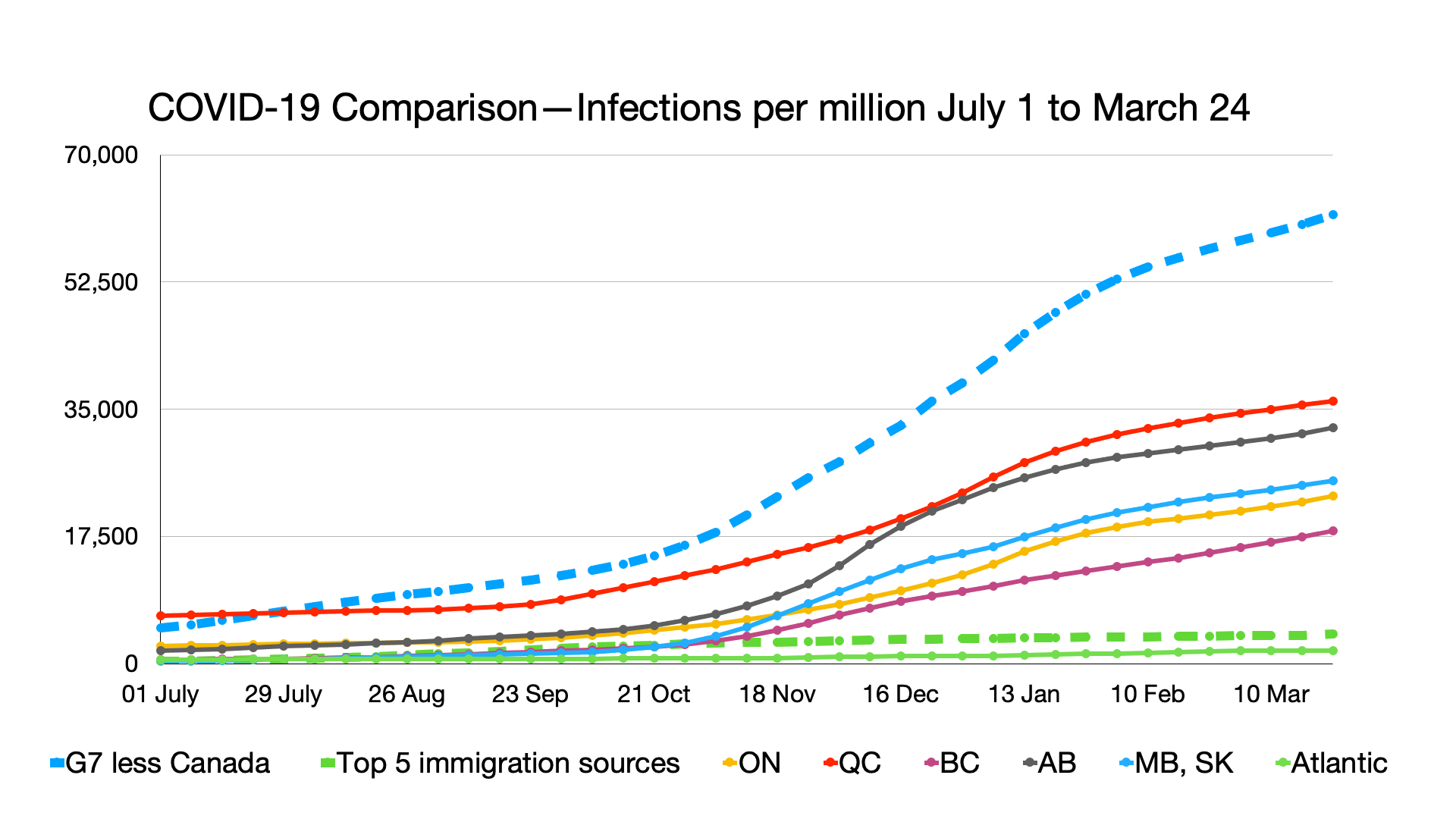
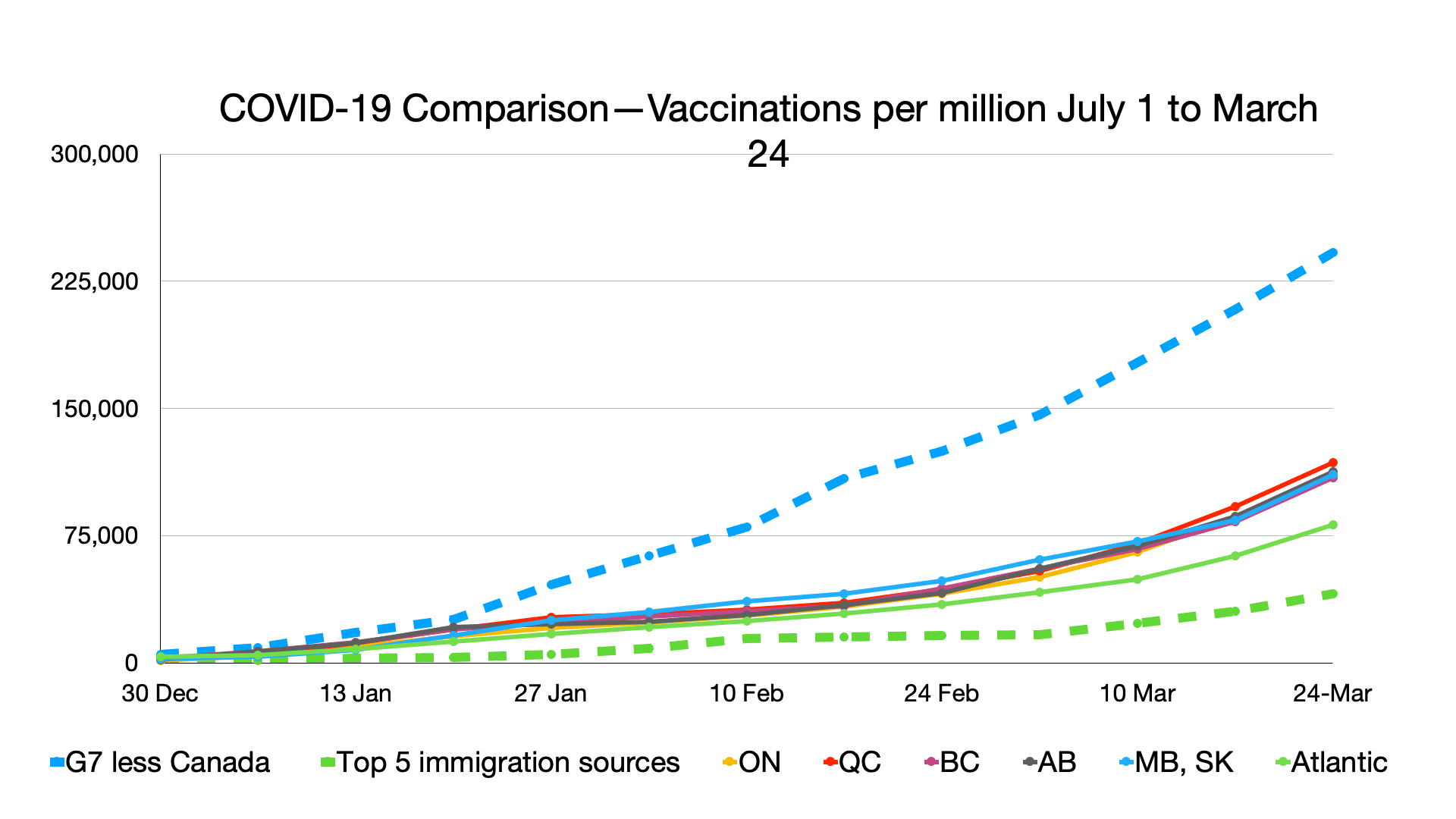
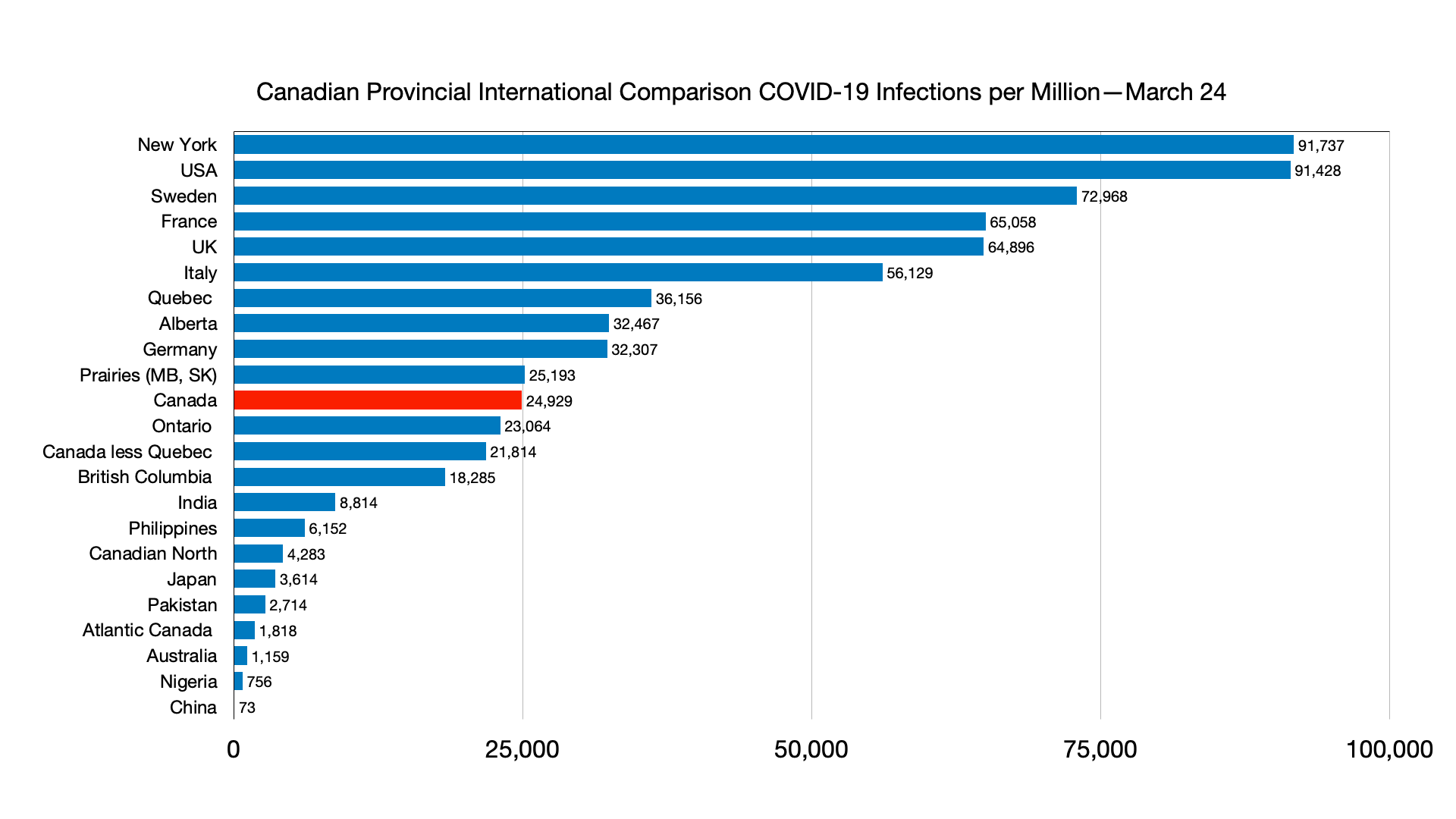
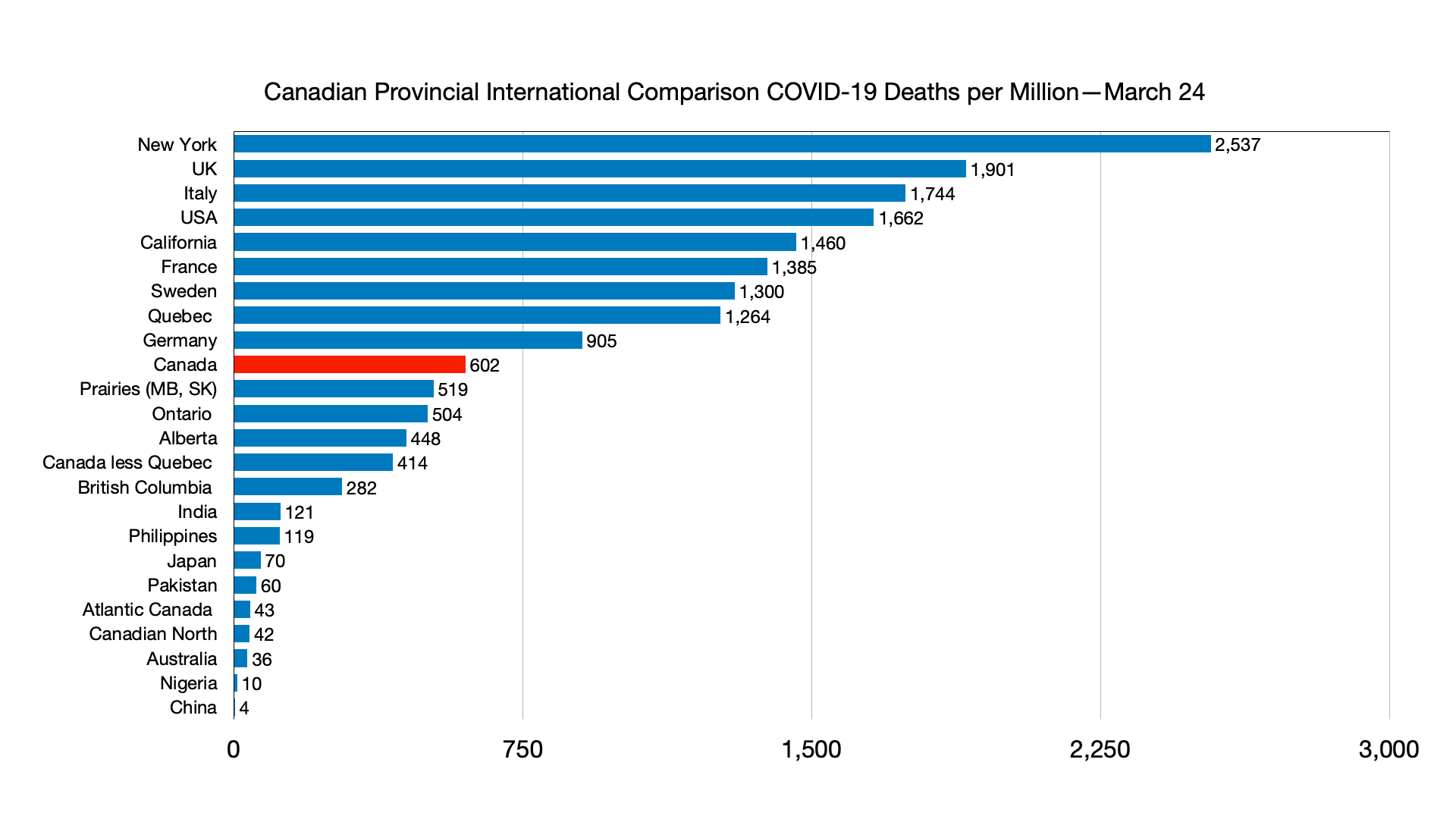
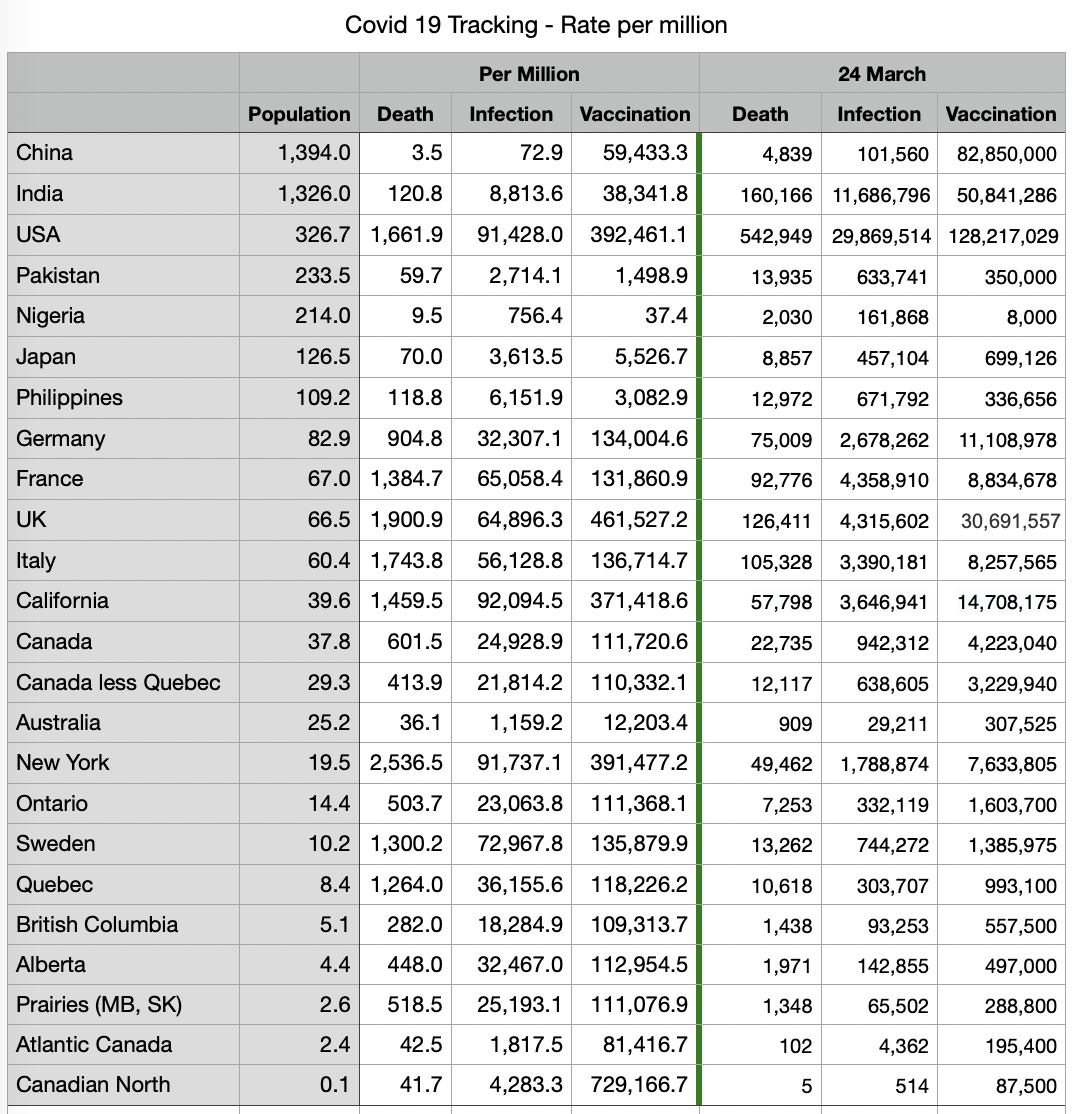
#COVID-19: Comparing provinces with other countries 17 March Update

The latest charts, compiled 24 March.

Vaccinations: The gap between all G7 countries save Japan continues to grow, all European countries ahead of Canada with no significant narrowing yet of the gap.

Trendline charts

Infections per million: The overall trend of a flattened curve is seen in G7 countries and most provinces.

Deaths per million: Most Canadian provinces continue to flatten the curve, Quebec most dramatically. Overall G7 death rate continue to surpass Quebec’s.

Vaccinations per million: While the gap between G7 and Canada remains despite the arrival of more vaccines, one can see that Canadian provinces have been ramping up.

Weekly

Infections per million: Some minor shifts: New York ahead of USA, France ahead of UK,Prairies ahead of Canada.

Deaths per million: Canadian North ahead of Australia (reflecting increase in deaths from 1 to 4 in Nunavut.

Make way! Creating space for change in Canadian politics

Former MP Caesar-Chavannes and Alex Marland make the case. IMO, a bit unrealistic in terms of solutions and no guarantees that increased diversity will necessarily reduce partisanship and “team player” conformity, or result in greater diversity of thought.

But an important reflection none the less:

There are many ways politicians and bureaucrats can show leadership in response to calls to democratize Canadian politics. Specifically, there are a lot of things men can do, particularly heterosexual white men.

As the largest demographic in Parliament, they can lead the way by stepping back or stepping aside, in order to create meaningful opportunities to engage more women, Indigenous, Black and marginalized peoples. 

Let’s face it, if we are to transform the culture of Canadian political institutions, we must take immediate, deliberate and intentional action.

As co-authors, one of us is the only Black woman MP who served in the 42nd Parliament (2015-19) and is a champion of diversity, equity and inclusivity. The other has interviewed more than 100 Canadian politicians and political staff for a book about party discipline. We met as part of that research, and share a deep concern about the need for the political elite to make room for diverse voices in the House of Commons.

Representation matters

When interacting with politicians, it becomes clear that at different points in their careers they approach politics with distinct philosophies about representation

Some elected officials take a principled stand on big picture issues. Some believe that voters trust them to figure things out, while others feel a duty to follow the wishes of constituents. Far too many Canadian politicians are guided by loyalty to their political party and leader, whereas some are motivated to champion the concerns of people who share similar identities or similar experiences.

Prioritizing the composition of legislatures and looking at public policy through the lens of gender, Indigeneity, race or other identity characteristic is sometimes known as “descriptive representation,” a term coined by American political scientist Hanna Pitkin in her landmark book The Concept of Representation. In it, Pitkin dissects what the contested concept of representation means. She makes a compelling argument that a democratic legislature must be a forum to hear from a diversity of people’s voices. This is important because otherwise these voices are excluded from political debate and from public policy decision-making.

But in what tangible ways can diversity improve democracy?

Identity and intersectionality

Diversity is necessary for citizens to see themselves represented. Since 1867, and before, generations of white, land-owning men were the beacon of political leadership. Since the Second World War, they have increasingly toed the party line, as have others, recruited into a political system that values conformity over diversity. In today’s world, it is important to remember that we are each the product of a variety of different identities that intersect to make us who we are. For some, their different identities add layers of oppression in politics.

Studies have argued that descriptive representation can fundamentally support the principles of democracy. This extends beyond reshaping the composition of legislatures: listening and receiving input from diverse voices can result in better governance and better policy. A good example is research showing that women leaders have been rated significantly more positively than men during the COVID-19 pandemic. In particular, women are thought to have exhibited better interpersonal skills in managing the crisis. 

Listening to marginalized voices is needed to help shape Parliamentary decisions. Deliberations around medical assistance in dying legislation (Bill C-7) would have benefited from improved listening to disability groups and racialized communities.

Diversify legislatures

More diverse legislatures can transform Canadian politics in a profound way: challenging the dogma of party discipline that keeps politics organized but corrodes representation. In Ottawa and the provinces, political parties have an iron grip over politicians, and group conformity is expected. 

Why is it normal in Canada that a politician jeopardizes their parliamentary career by taking a public stand different from the party leader? Don’t we want politicians who feel that they can speak truth to power? Homogeneity in party politics might work for partisans, but does it work for constituents? Even MPs become frustrated with democratic institutions when they are reduced to robots, encouraged to vote along party lines and repeat talking points.

Electing a broader array of Canadians can help break down party silos and soften polarization. In workplaces, more heterogeneity can stir internal conflict and rattle group norms. But injecting different perspectives also enriches the ability of a group to come up with creative and innovative solutions. The same is true in politics. 

The more diverse the voices that occupy seats in legislatures, the more political parties can benefit from better policy which, in turn, benefits the public. Sadly, there is little evidence that partisans are open to listening to people willing to rebuff the “team player” mentality that dominates Canadian Parliament. A good way to help change that is to change who is being elected.

This can include white men not seeking re-election in order to create space for others, encouraging people to run for political office, and also helping the newest members thrive when they get there. 

Taking proactive steps toward fewer white men in politics in order to create an opening for others has worked in British Columbia. In 2011, the B.C. NDP introduced a radical policy that when a male legislator vacates a seat, the party must nominate a woman, racialized person or someone from other underrepresented groups in Canadian politics. 

In the 2020 provincial election, the B.C. NDP won a majority of seats, and for the first time in Canadian history a governing party’s caucus has more women than men, as well as more people of colour serving than any B.C. caucus ever elected before. Diversity in Premier John Horgan’s caucus meant that he had more choices to assemble a diverse cabinet. The party’s policy of affirmative action has translated into meaningful, profound change in both the legislative and executive branches of government. Bold action like this is needed to achieve the ideals of descriptive representation.

Ensuring democracy thrives

The principles of diversity, equity and inclusivity are important, and taking action so that Canadian politics are not dominated by one segment of society is necessary to democratize our institutions. Regardless of party affiliation, or political ideology, the urgency of now demands that those with power choose to challenge the status quo. 

To ensure democracy thrives in Canada, politicians need to listen to the voices of those who are often on the margins of our political ecosystem and act accordingly. Gaining knowledge is a necessary first step, and men in positions of authority can help create a thriving democratic landscape by opening opportunities to people who are different than them. 

A good place to start is for men to listen.

Celina Caesar-Chavannes, Queen’s University, Ontario; Alex Marland, Memorial University of Newfoundland

Source: https://theconversationcanada.cmail19.com/t/r-l-tlvurhk-kyldjlthkt-b/