Canadian human rights groups among coalition calling for Beijing Olympic boycott

No sign that the Canadian Olympic Committee has any second thoughts. Opportunity for individual athletes to show leadership and a conscience:

Cheuk Kwan wants the world to remember what happened after numerous countries considered boycotting the 1936 Olympics in Berlin, but eventually agreed to participate.

“The world should take 1936 as a lesson,” said Kwan, spokesperson for the Toronto Association for Democracy in China.

“We’re confronting a very similar situation. In hindsight, we should have (boycotted the Berlin Games). It really emboldened Hitler to to go on and attack Poland and start World War II.

“So, this is where we are right now from a moral standpoint.”

The Toronto Association for Democracy in China was among a coalition of 180 rights groups, including several based in Canada, that called for a boycott Wednesday of next year’s Beijing Winter Olympics.

The Games are set to open Feb. 4, 2022, despite the global pandemic.

Wednesday’s call to boycott is around reported human rights abuses against ethnic minorities in China, and coalition is composed of groups representing Tibetans, Uighurs, Inner Mongolians, residents of Hong Kong and others.

The group issued an open letter to governments to support a boycott “to ensure they are not used to embolden the Chinese government’s appalling rights abuses and crackdowns on dissent.”

There were similar calls to boycott the 2008 Beijing Summer Games, but many believed a global spotlight would help clean up reported human rights atrocities in China. That didn’t happen, Kwan said.

“Fast forward to today, from a Canadian standpoint we are probably in a worse situation,” he said.

Among the biggest concerns to Canadians is the continued imprisonment in China of the “two Michaels” — Michael Kovrig and Michael Spavor.

Kovrig and Spavor are marking two years in separate Chinese prisons, on what Canada and dozens of its Western allies say are trumped-up espionage charges in retaliation for the RCMP’s December 2018 arrest of Chinese high-tech executive Meng Wanzhou on a U.S. extradition warrant.

Another massive human rights issue is the Uighur indoctrination camps in Northwestern China. Since 2016, China has swept a million or more Uighurs and other predominantly Muslim minorities into prisons and indoctrination camps, according to estimates by researchers and rights groups.

“They’ve put millions of people in education camps,” said Mabel Tung of the Vancouver Society in Support of Democratic Movement, one of the 180 letter signees. “Family here in Canada have been trying to contact their daughters, their sisters, their brothers that they haven’t seen or heard from in a few years, and they have no way of knowing what happened to them.

“So, it might seem like just a sports event, (but) it’s affecting so many people. We shouldn’t just ignore this fact.”

Dick Pound, one of the International Olympic Committee’s most vocal board members, told the Globe and Mail that Canada should resist calls to boycott next year’s Olympics.

The Montreal native said a boycott would achieve nothing and hurt Canadian athletes.

“Young people gathering in troubled times to compete peacefully in sport — this is a message worth sending and a channel that is worth keeping open even when the government folks are mad at each other,” Pound said.

Tung hopes people understand that “we’re not against the Olympics, we’re not against sports, and I think the Games should happen. But not in China,” she said.

Kwan said he understands arguments around the ineffectiveness of a boycott.

“And a lot of people are saying ‘What about the athletes? They’ll spend their whole lives regretting not going to Beijing,’ and so forth.

“But we have to take a stand morally when two of our citizens are languishing in jail.”

Kwan said China can use the Olympics “as a window dressing” in attempts to clean up its image on the global stage, while continuing its treatment of minorities.

Hitler’s rise in power had numerous countries considered boycotting the ’36 Games, with the U.S. being among the most vocal.

One of the Olympic principles forbids the discrimination by race or religion, Kwan pointed out. Nazi Germany forbid the participation of Jewish athletes in the Berlin Olympics.

The same principle, he said, should be applied to Beijing around the Uighur camps.

Rights group have previously asked the IOC to move the Games from China, but Olympic leaders have largely ignored the demands, saying it’s a sports body that doesn’t get involved in politics.

Pro-Tibet activists held up their flags Wednesday outside the International Olympic Committee headquarters in Lausanne, Switzerland.

Source: Canadian human rights groups among coalition calling for Beijing Olympic boycott

Toughing out Covid: how Australia’s social fabric held together during a once-in-a-century crisis

Interesting take. Generally, the Scanlon Foundations public opinion research is similar to that carried out in Canada by Environics, and thus tends to highlight some of the similarities that are lost in political discourse and debate:

Politics, and media coverage of politics, is powered by conflict and spectacle. But the social scientist Andrew Markus wants to focus on something quieter: the resilience and optimism of Australians during a crisis; a country under duress that chose not to fracture.

Markus is the principal researcher on the Scanlon Foundation’s annual Social Cohesion report – a project that has mapped a migrant nation since 2007. The report published on Thursday is a snapshot of a country managing a once-in-a-century crisis.

The research (sample size 3,090 respondents) is normally conducted in July. Given Australia was at that time about to tip into a second wave of coronavirus infections in Victoria, and had slipped into the first recession for 30 years, the Monash University emeritus professor was puzzled when many of the snapshots of community sentiment were positive.

That seemed counterintuitive.

To be certain of the findings, a second survey of 2,793 respondents was conducted in November. “In November, we again got very positive data,” he says. By positive data, this is what Markus means. Stepping through his findings, a supermajority was on board with Scott Morrison’s response to the crisis, and the level of trust in government in Australia hit the highest point in the history of the survey.

People had confidence in the public health response. More than 90% of respondents in the five mainland states said lockdowns to suppress transmission were definitely or probably required. While the Victorian premier, Daniel Andrews, endured a period of being flogged by the Murdoch media for locking down the state, 78% of respondents backed Andrews, and when they were asked whether the lockdown was required, 87% said yes.

While America and Britain battled resurgent nativism, the inward turn triggered by the global financial crisis of a decade ago, Australians, walled in behind a preemptive international border closure, and marooned periodically behind hard state borders, continued to look to the world.

Source: Toughing out Covid: how Australia’s social fabric held together during a once-in-a-century crisis

Quebec: Un manque de diversité flagrant dans une publicité gouvernementale

Not surprising, but not acceptable, given that COVID-19 has a disproportionate affect on visible minorities given their overall lower socioeconomic status and more exposed work environments:

Où sont les Siméus, Touré, Obomsawin, Reyes, Saddiqi, Mansourian, Torres, Farhat, Tran, Kpadé?

Samedi dernier, le premier ministre François Legault et son gouvernement étaient fiers de nous présenter une nouvelle publicité réalisée en partenariat avec le Canadien de Montréal. « On est tous dans la même équipe contre la COVID-19 », peut-on y lire. « Fortin, Tremblay, Joseph, Sioui, Lévesque, Bergeron, Toulouse, Sauvé, Caron, Murphy, Boucher et Vaillancourt », peut-on y entendre. Le gouvernement caquiste nous présentait un lineup qui sonnait faux aux oreilles de plusieurs Québécoises et Québécois en raison de son manque de diversité flagrant. Et non, on ne leur donnera pas une tape sur l’épaule parce qu’un Joseph a été inclus comme un bon token noir.

Ceci n’est pas un caprice de « gauchistes », que les détracteurs des mouvements anti-racistes et anti-oppressifs de ce monde aiment dépeindre comme des pleurnichards. Les médias, le divertissement et le sport, en particulier le hockey, marquent les esprits et laissent leur empreinte dans l’imaginaire collectif. Le message pas-si-subliminal que fait passer cette publicité, c’est que l’on n’est pas dans la même équipe. Ce manque de diversité est un manque de respect envers les travailleurs de la santé racisés et issus de l’immigration. En juin dernier, un rapport de Statistique Canada révélait que, lors du plus récent recensement, réalisé en 2016, 36 % des aides-infirmiers, aides-soignants et préposés aux bénéficiaires au Canada n’étaient pas des Fortin-Tremblay-Sauvé-Caron, mais bel et bien des immigrants aux noms trop exotiques pour les oreilles de certains. Il va sans dire que, depuis le début de la crise de la COVID-19, les travailleurs racisés, parfois surqualifiés, ont été au front dans les CHSLD et les services essentiels, avec peu de reconnaissance outre les encouragements du type « J’peux pas t’aider, mais tiens bon ! ».

C’est aussi dans les quartiers les plus défavorisés de Montréal et dans ceux qui accueillent un grand nombre d’immigrants que la COVID-19 a fait le plus de dégâts. Alors que l’opinion publique fait le procès des groupes minoritaires pour les éclosions dans leurs communautés, on se voile les yeux devant les déterminants socioéconomiques qui les rendent inévitables. Des inégalités systémiques font que 21 % des Noirs canadiens connaissent une personne décédée de la COVID-19, contre 8 % pour les non-Noirs, selon une étude du Boston Consulting Group. Augmentation du taux de chômage, plus grandes chances d’attraper le virus — les personnes racisées souffrent davantage des effets de la crise sanitaire, selon l’Observatoire québécois des inégalités, et ce, sans compter l’augmentation des comportements discriminatoires et du racisme anti-asiatique. Vingt-et-un pour cent des personnes issues des minorités visibles vivent et ressentent cette exacerbation des incidents de harcèlement et d’attaques racistes.

Un coup de pub qui aurait interpellé toutes les personnes concernées aurait été bien plus efficace pour rallier nos troupes et atteindre nos objectifs de santé publique, mais le gouvernement Legault a choisi de faire autrement. Il reste à voir si cette erreur, quoique très gênante, n’était que de la maladresse ou le reflet du racisme systémique nié par le gouvernement. Quoi qu’il en soit, ne nous laissons pas distraire et continuons à revendiquer l’élargissement des critères pour les anges demandeurs d’asile. Une reconnaissance et un plan d’action concret contre le racisme systémique, dont cette publicité est un exemple, s’imposent.

Source: Un manque de diversité flagrant dans une publicité gouvernementale

Express entry economic immigration timelines a ‘joke,’ say lawyers as processing times increase

Further to the IRCC departmental results report and its failure to meet its service standards (see https://multiculturalmeanderings.com/2021/01/21/immigration-program-ircc-results-highlights/ :

Canada’s “express entry” approach to key economic immigration programs isn’t working, immigration lawyers say, following a recent report showing that none of them are meeting the six-month service standard.

That failed grade was among 17 missed performance targets the Immigration, Refugees, and Citizenship Canada (IRCC) reported for the 2019-20 fiscal year, or 31 per cent of the 54 total targets. It said none of the government’s business lines for permanent residents adhere to service standards during a time period that had yet to feel the pandemic’s full impact. 

Launched in 2015, the express entry process is described by Canada as its “flagship” system for various federal skilled worker programs, and a portion of the provincial nominee program, as a pathway to permanent residence for skilled workers in Canada and overseas. IRCC has said it plans to increase permanent-resident admissions, setting a target of 341,000 for 2020 and 350,000 for 2021, with most of the uptick expected from economic immigration streams.

Evelyn Ackah, founder of Ackah Business Immigration Law in Calgary, laughed when she repeated the program’s name.

“Express entry, that’s a joke. When they first launched that program a few years ago, it was incredible. It was three months, four months,” she said, but now she warns clients it can take more than a year.

She said it’s disappointing the government hasn’t been able to keep up with the high volume of applications. To her, it’s a clear resourcing and staffing problem that doesn’t line up with Canada’s stated goals to increase immigration levels. 

“It’s not working as an express process, absolutely not. It’s the same as the old process, as far as I’m concerned, and it’s lost its credibility with people,” she said. “The trend is getting slower and slower.”

Over the last three years, and before COVID-19 interruptions, processing times have increased, and in some cases, doubled the time it takes to deal with 80 per cent of applicants. The federal skills trade stream jumped from six months in 2017 to one year for the majority of applicants, while the federal-skilled worker and provincial-nominee programs increased from six to nine months in that same time frame. The Canadian Experience Class increased from four to seven months. Across all programs, only 60 per cent of the applications met the standard by the end of 2019.

According to the department’s latest plan, its overall spending is set to increase from $1.92-billion in 2017-18 to the peak last fiscal year at $3.46-billion, before going back down this fiscal year to $2.84-billion, $2.6-billion in 2021-22, and $2.56-billion in 2022-23.

The stretching timelines reflect an increase in applications to express entry, with the 332,331 submissions in 2019 amounting to a 20 per cent jump from the number of applications in 2018. Among the 2019 profiles submitted in 2019, 72 per cent were eligible for at least one of the business programs, according to the program’s year-end report.

https://flo.uri.sh/visualisation/5180771/embed

Still, the government promises to those searching for information online about the express entry system that it “will result in fast processing times of six months or less.

“I can’t even bring up that number [to clients],” said B.C.-based  immigration lawyer Will Tao of Heron Law, saying more transparency is needed. 

It’s “misleading” and can “give the wrong impression” to applicants, he said, especially now with the pandemic posing even more of a challenge to processing times.

“I think they pretty much internally abandoned it, so from my perspective, if you’ve done that, then you probably should … let clients know,” he said, calling for better transparency so that people can get more certainty about their situations. 

Even though it’s supposed to be an automated system, based on points, both lawyers said the process gets bogged down during the authentication stage, as officials check over and verify the many documents submitted. Eligible candidates in the pool are given a score based on their skills and experience, with top-ranking candidates invited to submit an application for permanent residence. As of June 2017, IRCC added extra points to candidates with strong French-speaking skills.

Both Mr. Tao and Ms. Ackah acknowledged it can be a complicated process, but Ms. Ackah said that’s all the more reason to match up resourcing.

In IRCC’s report on performance targets, the department said “substantial efforts” have been made to reduce applications that took longer than six months to process in the express entry system.

“While service standards are being met for a higher number of applications compared to previous years, this was offset by an increase in applications and the processing of older applications,” the report said.

The department noted early results show “progression towards higher admission targets” and efforts to increase the intake are having an impact on service standards, in this case, the promise to have the majority completed within six months. The department doesn’t control intake for provincial nominee program’s paper applications and Quebec-selected skilled workers.

By email, IRCC spokesperson Lauren Sankey said the government remains committed to reducing application processing times and improving the department’s service delivery. 

IRCC misses a third of 2019-20 targets

In 2019-20, the department met 37 of 54 performance targets, and missed 17, or 31 per cent. The express-entry delay was the worst among several performance targets the department didn’t reach. Canada’s backlogged asylum system again failed to make the cut, with the department reporting only 32 per cent of asylum claims were referred to the Immigration and Refugee Board of Canada within service standards, compared to target of 97 per cent.

A couple of targets found language-development delays for people settling in Canada. In one case, only 37 per cent of IRCC’s settlement clients reported improved official language skills compared to the target of 60 per cent, while 19 per cent of people reported receiving language-training services compared to target of 25 per cent.

Ms. Sankey said every newcomer’s experience is unique, including their participation in settlement services, which is managed by IRCC and delivered by more than 500 service provider organizations across the country, outside of Quebec. Federally funded language training is “a key component” said Ms. Sankey, who noted there’s been a proportionate increase in newcomers with limited knowledge of English or French over the past few years.

In 2019-20, IRCC also reported 2.82 per cent of permanent residents outside Quebec identified as French speaking, compared to the target of 4.4 per cent. Ms. Sankey said under the Francophone Immigration Strategy, IRCC is “pursuing year-round targeted promotion and recruitment” to attract more qualified French-speaking candidates, and noted under the express entry program, the government increased invitations to French-tested candidates from 4.5 per cent in 2018 to 5.6 per cent in 2019.

These results suggest issues with respect to service standards, language training, and refugee claims, said Andrew Griffith, a fellow of the Canadian Global Affairs Institute who was once a director general at the department’s Citizenship and Multiculturalism Branch.

While many reflect perennial problems and backlogs, given these markers IRCC seems to be “systematically” missing the standards it sets to monitor how well it’s delivering its services, he said.

“So if they’re consistently their targets it says there’s either a management problem, an operational problem, a resource problem, or some combination of those,” he said. 

Even so, he noted a contrasting target the department met: a 91 per cent satisfaction rate from visitor, international students, and temporary worker applicants who reported they were satisfied overall with the services they received. While he doesn’t advocate for lowering targets, Mr. Griffith questioned why the government reports on aspirational or unrealistic goals. 

“Personally, I favour realistic standards for public departmental reports, with aspirational more appropriate for internal use,” he said. 

IRCC’s targets are based on factors like historic trends, program objectives, resourcing levels, client service goals, and evolving influences such as the impact of increasing temporary resident and permanent resident immigration levels, said Ms. Sankey.

“Targets are reviewed regularly, and in some cases, the department establishes ambitious targets that serve to stretch program vision and encourage innovation. In other cases, they are based on baselines and historic trends where achievement is more certain,” said Ms. Sankey, noting following a 2020 departmental review how IRCC tracks performance will change.

Distilling service performance down into two tracks—one for permanent residents (PR) and one for temporary residents (TR)—is not a true representation of the department’s performance, she said, given the disparate programs under the two umbrellas. Instead, IRCC will report on the service standard for each individual program, which Mr. Griffith called a “significant change” given the “overly simple” approach before.

“This change will capture more accurate service standard performance for the many lines of business which make up the temporary and permanent resident programs,” Ms. Sankey said. 

Source: https://hilltimes.us10.list-manage.com/track/click?u=a90bfb63c26a30f02131a677b&id=4ac92e0ed3&e=685e94e554

Macron’s Islamic charter is an unprecedented attack on French secularism

The best analysis I have seen to date:

Adopted last month by the French Council of the Muslim Faith at the behest of President Emmanuel Macron, a new 10-point “Charter of Principles” of French Islam will please all those who have been calling for a “progressive,” “reformed” or “enlightened”Islam – one consistent with democratic, egalitarian and liberal western values.

It also represents a significant personal victory for Macron, who for months had pressured the council to craft a document committing to a “French Republican Islam”. Non-Muslim authorities, governments, media and public intellectuals have been demanding this for years as a way to combat “Islamism” and “extremism”.

It very clearly aims to turn Islam into a quietist, ‘pacified’ religion whose practitioners remain docile and obedient to the political powers-that-be

The unprecedented charter can thus be seen as a clear assertion that Islam is indeed compatible with secular democracies in general, and with the French republic in particular. In a nutshell, the charter aligns Islam with France’s republican principles, including gender equality; non-discrimination, including sexual orientation; and freedom of conscience, including the freedom to leave Islam.

It condemns “excessive proselytism” and attests to the superiority of and obligation for all Muslims to recognise France’s laws, constitution, republican principles and “public order”.

Article two proclaims an obligation for Muslims to “conform to the common rules” of France, which “must prevail over any other rules and convictions, including those of our own faith”. Article eight recognises the French principle of laicite, or secularism.

But article six, the longest, is also the most loaded. It proclaims that no mosques or other Islamic places can have “political agendas” or engage in political and ideological discourse or activity; these are described as “an instrumentalisation” and “perversion of Islam”, whose sole and “true purpose is prayers and the transmission of values”.

It condemns “the propagation of nationalist discourses defending foreign regimes and supporting foreign policies that are hostile to France, our country”. It dissociates Islam from “political Islam” and prohibits signatories from engaging in the latter, including “Salafism (Wahhabism), the Tabligh and the Muslim Brotherhood”. This amounts to an excommunication of those Islamic trends and movements from legitimate or “true” Islam.

Crafted by the executive

There is no doubt that this charter was essentially crafted by the French executive itself – especially Macron and Interior Minister Gerald Darmanin, who for years had been calling for the assimilation of Islam strictly within the limits, laws, principles and frameworks of France’s Fifth Republic. Darmanin even wrote a book about it.

The charter is not coming from Muslims. It is the brainchild of Macron’s campaign to force the French Muslim council to craft such a text, deploying against one religion a type of pressure, intimidation, threats, ultimatums and blackmail never before seen in French post-war history.

At the end of the signing ceremony, a close adviser to Macron explicitly threatened anyone who refuses to sign and live by the charter, saying: “Those who disagree will hear from us very quickly and see their operations inspected very, very closely by our services.” This, in a context where the interior ministry is banning Islamic NGOs, closing schools and shutting down mosques by the dozen.

This operation is an integral part of Macron’s crusade against “Islamist separatism”, for which he is using the French Council of the Muslim Faith as a facade, an alibi, a cover to circumvent a constitution that forbids state interference in religious doctrines. The charter is a word-for-word synthesis of all the injunctions and demands that Macron has addressed to Muslims over the past year.

Amazingly, article nine not only declares that state racism does not exist, but also that such an expression would constitute “defamation, and as such, a crime”. Its timing coincides with the introduction of Macron’s anti-separatism bill, and the Elysee Palace has stated that the charter was drafted within the framework of “technical workshops” presided over by the interior minister.

What are we to make of this operation? Firstly, it is an attempt, which some may find timely and even necessary, to align Islamic theology with the values, laws and principles of liberal, secular western states.

Secondly, it very clearly aims to turn Islam into a quietist, “pacified” religion whose practitioners remain docile and obedient to the political powers-that-be. Macron is trying to strip Muslims of their right to engage in oppositional and critical discourse and activism.

Thirdly, this hostile takeover is an attempt by the executive to assume control over the totality of Islam in France in order to “securitise” it from A to Z: its mosques, imams, institutions, NGOs, associations – even its theology. One should also expect that the repression and persecution of any Muslim deemed “Islamist” or “Salafist” will only get worse.

Fourthly, besides the extreme violations of freedom of religion and the brutalisation of Islam, the charter is also a glaring violation of French laicite – a principle the Macron government nonetheless claims to uphold. Based on the 1905 law on the separation of church and state, French laicite includes three sacred principles that are not open to interpretation: freedom of conscience and religion, the separation of church and state, and equal treatment by the state of all religions. Macron is trampling on all three pillars.

Uncertain fate

Only Muslims, and no other religions, are being summoned to craft a “charter” and implement principles such as gender equality, acceptance of homosexuality, and the prohibition of political discourse and activity. How about requiring the same from Catholics and Jews, some of whom oppose French laws on same-sex marriage or medically assisted procreation?

The attempt to delegitimise as “political Islam” and exclude from the religion several important Islamic trends under false pretexts, along with the persecution to which these Muslim groups are increasingly subjected, represents extreme violations of freedom of religion and human rights in general.

France has finally found its grand mufti: its (non-Muslim) president himself

The direct attempt by the executive to shape from above the organisation of Islam and its theology is by far the worst violation of the separation of church and state in the entire history of the Fifth Republic. It marks the end of French laicite and a regression to a crude form of quasi-medieval Gallicanism, when the state controlled, organised and narrowly defined religion.

The fate of the charter is more than a little uncertain. It will surely be weaponised, including as a divide-and-conquer tool. In the meantime, France has finally found its grand mufti: its (non-Muslim) president himself.

Source: Macron’s Islamic charter is an unprecedented attack on French secularism

To Understand This Era, You Need to Think in Systems

Good interview and insights by Tufekci that applies in so many areas, including racism and discrimination:

As a million media theorists have argued, in a few short decades (or, at most, centuries) we’ve moved from information scarcity, the problem that defined most of human history, to information abundance, the problem that defines our present. We know too much, and it’s paralyzing. The people worth following right now are those who seem able to find the signal in the noise. Few have a better track record of that in recent years than Zeynep Tufekci.

As my colleague Ben Smith wrote in an August profile, Tufekci has “made a habit of being right on the big things.” She saw the threat of the coronavirus early and clearly. She saw that the public health community was ignoring the evidence on masking, and raised the alarm persuasively enough that she tipped the Centers for Disease Control and Prevention toward new, lifesaving guidance. Before Tufekci was being prescient about the coronavirus, she was being prescient about disinformation online, about the way social media was changing political organizing, about the rising threat of authoritarianism in America.

So I asked Tufekci — who is a sociologist at the University of North Carolina, as well as a columnist at The Atlantic and a contributor to New York Times Opinion — to come on “The Ezra Klein Show” for a conversation about how she thinks, and what the rest of us can learn from it.

Tufekci describes herself as a “systems thinker.” She tries to learn about systems, and think about how they interact with one another. For instance, she studied authoritarian systems, and one rule for understanding them is that “you want to look at what they do and not what they say,” she said. So when China, after downplaying the severity of the virus early on, locked down Wuhan, she took it seriously.

“If a country like China is closing down a city of 11 million,” she told me, “this is a big deal. It is spreading, it is deadly, and we’re going to get hit.” Even then, many public health experts in the United States thought the Chinese were wrong, or lying, when they warned that the virus was spreading through asymptomatic transmission. But Tufekci knew that authoritarian systems tend to hide internal problems from the rest of the world. Only a true emergency would force them to change their public messaging. “There’s a principle called the principle of embarrassment,” she explained. “If a story is really embarrassing to the teller, they might be telling the truth.”

Here are a few other frameworks Tufekci told me she finds helpful:

  • Herding effects. Public health experts — including figures like Dr. Anthony Fauci who are lauded today — were slow to change guidance on disruptive measures like masking and travel bans. That led to a cascade of media failures that reflected what journalists were hearing from expert sources. One reason Tufekci was willing to challenge that consensus was she saw experts as reflecting social pressure, not just empirical data. “The players in the institution look at each other to decide what the norm is,” she said. The problem is social frameworks “have a lot of inertia to them,” because everyone is waiting for others to break the norm. That cost precious time in this crisis.
  • Thinking in exponents. The difficulty of exponential growth, as in the fable of the chessboard and the wheat, is that early phases of growth are modest and manageable, and then, seemingly all of a sudden, tip into numbers that are shocking in size — or, in this case, viral spread that is catastrophic in its scale. “My original area of study is social media,” Tufekci said, and that’s another area where the math tends to be exponential. This was, she said, a reason some in Silicon Valley were quick to see the danger of the virus. “A lot of venture capitalism, the VC world and the software people, they’re looking for that next exponential effect … so they had some intuition because of the field they were in.”
  • Population versus individual. In clinical medicine, Tufekci said, “we tend to really think about individual outcomes rather than public health and what we need at the population level.” But thinking at the population level changes the situation dramatically. For instance, a test with a high rate of false positives may be a terrible diagnostic tool for a doctor’s office. But if it could be done cheaply, and repeatedly, and at home, it could be a very useful tool for a population because it would give people a bit more information at a mass scale. Thinking in individual terms versus public health terms is, Tufekci said, why the Food and Drug Administration has been so resistant to approving rapid at-home antigen testing (though that is, at last, beginning to change).

There’s much more in our full conversation, of course, including Tufekci’s systems-level view of the Republican Party, why she thinks media coverage of the vaccines is too pessimistic, why Asian countries so decisively outperformed Western Europe and the United States in containing the coronavirus, and her favorite vegetarian Turkish food. You can listen by subscribing to “The Ezra Klein Show” wherever you get your podcasts, or pressing play at the top of this post.

Source: https://www.nytimes.com/2021/02/02/opinion/ezra-klein-podcast-zeynep-tufecki.html?showTranscript=1

Canadian Olympic Committee board member rejects calls for boycott of Beijing Olympics

Of course he would. Interest trumps values and principles. Laughable “We try and keep it as apolitical as possible” when we know for the Chinese regime it is political:

One of the Canadian Olympic Committee’s most prominent board members says Canada should resist calls to boycott the 2022 Beijing Olympics over allegations of genocide in China or the imprisonment of Michael Kovrig and Michael Spavor.

Richard Pound, who was president of the Canadian Olympic Committee in 1980, the last time Canada boycotted an Olympic games, said in an interview that refusing to participate in 2022 would achieve nothing and only hurt Canadian athletes.

He said “probably 70 per cent” of Olympic athletes make it to just one Olympic games.

“Young people gathering in troubled times to compete peacefully in sport — this is a message worth sending and a channel that is worth keeping open even when the government folks are mad at each other,” Mr. Pound said.

Critics of China’s human rights record in Canada and abroad have urged Western countries to pull their athletes from the 2022 Olympics. They cite China’s crackdown on civil rights and the rule of law in Hong Kong, and its internment camps and forced sterilization for Muslim Uyghurs. U.S. Secretary of State Antony Blinken has said China’s actions constitute genocide. A Canadian House of Commons committee condemned the treatment of Uyghurs as genocide, and Arif Virani, the parliamentary secretary to Canada’s Justice Minister and Attorney-General, last fall told the Commons that “it is genocide that appears to be taking place today in China.”

Nathan Law, one of Hong Kong’s most prominent dissidents, last fall urged Canada to organize a boycott of the 2022 Olympics with other liberal democracies to show China its oppression of Hong Kongers and Uyghurs has real consequences.

Mr. Pound said Canada tried a boycott already, when the U.S. led 65 countries to skip the Moscow Olympics over the Soviet Union’s invasion of Afghanistan. He said it was devastating for Canadian athletes — “we just ripped the guts out of our Olympians” — and was ineffective.

“They were so furious with what was then the Soviet Union that they were going to teach them a lesson,” Mr. Pound recalled. “And, of course, it didn’t get the Soviets out of Afghanistan at all.”

He noted that at the same time as the boycott, Canadian wheat sales to Russia soared. The Soviet Union and Eastern Bloc countries and allies in turn boycotted the 1984 Olympics in Los Angeles.

Mr. Pound said Canadians should understand that Beijing doesn’t own the 2022 Games. “They are not Chinese games. They are the International Olympic Committee’s games and they are being held in China.”

Conservative foreign affairs critic Michael Chong said if Canada truly believes genocide is taking place, it has to be prepared to match its condemnation with action. United Nations experts have said at least one million Uyghurs and other Muslims have been detained in China’s northwestern Xinjiang region in camps the Chinese government calls vocational and education training centres. Beijing says it’s trying to stamp out terrorism and extremism.

“I think it’s pretty difficult for democracies to act as if it’s business as usual when there is evidence of a genocide going on in China, amongst other gross human rights violations,” Mr. Chong said. “I don’t see how a country like Canada, and other democracies, can turn a blind eye to that.”

He said Canada must consider a boycott not only for the mistreatment of the Uyghurs, but also for conduct such as breaching an agreement with Britain to maintain civil rights and the rule of law in Hong Kong for 50 years after the 1997 handover of the former British colony.

NDP foreign affairs critic Jack Harris said his party would like Canada to work with allies to get the host country changed.

China, he said, “is not a place we want to see our athletes encouraged to go.” He said the dispute with China is not a political issue but a humanitarian issue.

Mr. Chong said if Canada sends teams to the Beijing Olympics, the athletes should consider wearing a symbol or patch to show solidarity with Mr. Kovrig and Mr. Spavor, who have been locked up for more than 785 days by China in what Prime Minister Justin Trudeau has called “retaliation” for the arrest in Canada of a Huawei Technologies Co. Ltd. executive on a U.S. extradition warrant.

Mr. Pound said patches are not a good idea. “That’s attractive, but what if another country thinks it’s nice to wear swastikas?” he said. “We try and keep it as apolitical as possible.”

Canada’s minority Liberal government has distanced itself from the discussion.

Camille Gagné-Raynauld, press secretary for Heritage Minister Steven Guilbeault, said in a statement that the decision lies with the Canadian Olympic and Paralympic Committees, which are independent of the federal government.

Mr. Pound said China could dismiss a Canadian boycott as a dispute over Mr. Kovrig and Mr. Spavor, whom it has accused of spying.

Beijing would tell its citizens Canada is angry because the Chinese “have two Canadian criminals in custody — and that is the way it would be perceived,” he said.

Source: https://www.theglobeandmail.com/politics/article-canadian-olympic-committee-director-rejects-calls-for-boycott-of/

Future of Holocaust research in Poland hinges on libel case

Of note, ongoing disturbing trend:

Two Polish historians are facing a libel trial for a scholarly examination of Polish during World War II, a case whose outcome is expected to determine the fate of independent Holocaust research under Poland’s nationalist government.

A verdict is expected in Warsaw’s district court on Feb. 9 in the case against Barbara Engelking, a historian with the Polish Center for Holocaust Research in Warsaw, and Jan Grabowski, a professor of history at the University of Ottawa.

It is the first major legal test in the wake of a 2018 law that makes it a crime to falsely accuse the Polish nation of crimes committed by Nazi Germany. The law caused a major diplomatic spat with Israel.

Since it won power in 2015, the conservative ruling party, Law and Justice, has sought to discourage investigations into Polish wrongdoing during the wartime German occupation, preferring instead to almost exclusively stress Polish heroism and suffering. The aim is to promote national pride — but critics say the government has been whitewashing the fact that some Poles also collaborated in the German murder of Jews.

The Israeli Holocaust museum Yad Vashem said the legal effort “constitutes a serious attack on free and open research.”

A number of other historical institutions have condemned the case as the verdict nears, with the Paris-based Foundation for the Memory of the Shoah describing it Tuesday as a “witch hunt” and a “pernicious invasion into the very heart of research.”

The case on a 1,600-page, two-volume historical work in Polish, “Night Without End: The Fate of Jews in Selected Counties of Occupied Poland,” which was co-edited by Grabowski and Engelking. An abridged English version is due to be published in a few months.

Grabowski and Engelking say they see the case as an attempt to discredit them personally and to discourage other researchers from investigating the truth about the extermination of Jews in Poland.

“This is a case of the Polish state against freedom of research,” Grabowski told The Associated Press on Monday.

Grabowski, a Polish-Canadian whose father was a Polish Holocaust survivor, has faced considerable anti-Semitic harassment by nationalists, both online and at lectures in Canada, France and elsewhere.

The niece of a man in the village of Malinowo, whose wartime is briefly mentioned, is suing Grabowski and Engelking, demanding 100,000 zlotys ($27,000) in damages and an apology in newspapers.

According to evidence presented in the book, Edward Malinowski, an elder in the village, allowed a Jewish woman to survive by helping her pass as a non-Jew. But the survivor is also quoted as saying that he was an accomplice in the deaths of several dozen Jews.

The niece, Filomena Leszczynska, has been backed by a group, the Polish League Against Defamation, which receives funding from the Polish government.

That organization argued that the two scholars are guilty of “defiling the good name” of a Polish hero, whom they claim had no role in harming Jews, and by extension harming the dignity and pride of all Poles. The lawsuit was filed in court free of charge as allowed under the 2018 law.

Mark Weitzman, director of government affairs for the Simon Wiesenthal Center, called “Night Without End” a “meticulously researched and sourced book … that details thousands of cases of complicity by Poles in the murder of Jews during the Holocaust.”

“The proceedings against these two scholars of international repute are nothing more than an attempt to use the legal system to muzzle and intimidate scholarship on the Holocaust in Poland,” Weitzman said.

Germany occupied Poland in 1939, annexing part of it to Germany and directly governing the rest. Unlike other countries occupied by Germany, there was no collaborationist government in Poland. The pre-war Polish government and military fled into exile, except for an underground resistance army that fought the Nazis inside the country.

Yet some people in Poland collaborated with the Germans in hunting down and killing Jews, in many cases people who had fled ghettos and sought to hide in the countryside.

Grabowski said “Night Without End” is “multi-faceted, and it talks about Polish virtue just as much. It paints a truthful picture.”

“The Holocaust is not here to help the Polish ego and morale, it’s a drama involving the death of 6 million people — which seems to be forgotten by the nationalists,” he said.

A deputy foreign minister, Pawel Jablonski, described the case as a private matter.

“It is everyone’s legal right to seek such a remedy before (a) court if they feel that their rights have been infringed by (another) person or entity,” Jablonski told the AP in an statement Monday. “The government is not involved in the proceedings, it is a private matter to be decided by the court.”

Yet those who fear that the case could stifle independent research take a different view.

“The involvement in this trial of an organization heavily subsidized with public funds can be easily construed as a form of censorship and an attempt to frighten scholars away from publishing the results of their research out of fear of a lawsuit and the ensuing costly litigation,” said Zygmunt Stepinski, director of the POLIN Museum of the History of Polish Jews in Warsaw.

Source: Future of Holocaust research in Poland hinges on libel case

The impact of COVID may make it difficult to attract immigrants compared to other G7 countries, making it difficult to meet the targets set for 2024.

Howard Ramos, Dan Hiebert and I have been looking at COVID-19 impact on immigration (my last monthly update can be found here: https://multiculturalmeanderings.com/wp-content/uploads/2021/01/covid-19-immigration-effects-key-slides-november-2020-draft-1.pdf).

One of the research questions we have is whether or not a country’s ability to manage or control COVID-19 will impact on its relative impact to potential immigrants. Out initial analysis is below, published in Policy Options (the updated slides can be found in the previous post):

Statistics tracking infections and deaths during the COVID pandemic show that Canada is faring better than all its G7 allies, save for Japan. Yet, it is doing far worse than the top five immigration source countries that it draws newcomers from. Canada cannot assume that it looks as attractive as it once did to newcomers, suggesting that it may be time to act proactively to meet ambitious immigration targets.

In October, Refugees and Citizenship Minister Marco Mendicino made an ambitious announcement to bring 1.2 million newcomers to the Canada over the next three years. If it the country has a shot at meeting those targets, it cannot not sit back and simply expect those numbers to happen.

Immigration is driven by a complex set of push and pull factors that incentivises migration. Put simply, source countries have attributes that make life look more attractive abroad and host countries have features that attract newcomers. For instance, a weak economy or poorer quality of life at home compared to good jobs and good health abroad.

The lingering impact of the COVID-induced downturn is flipping traditional push and pull factors on their head. In past economic downturns and recessions, for example, recent immigrants suffer the most and this means we need to consider the inequalities that might get triggered by returning to recent levels (340,000 in 2019) too quickly, which the federal government’s plan largely ignores. This is not to mention how Canada’s health care system looks compared to other countries in addressing the pandemic.

The statistics may weaken the perceptions of potential immigrants of Western public health, social welfare programs and quality of life advantages. Take for instance COVID-19 infections-per-million from July to January 2021 as an example. If you look at the top-five immigrant-source countries to Canada (India, China, Philippines, Nigeria and Pakistan) all have far lower rates of infection than the G7 which are among the countries that compete with Canada for newcomers.

Although there may be undercounting of COVID infections and deaths in non-Western countries, rates would have to be five or more times higher to change the trends we report here. We do not believe such issues are significant enough to change the overall picture that rates in G7 countries are among the highest in the world.

Rates of infection can be taken as a proxy of a number of factors. They reflect the strength of a country’s social welfare system, its healthcare system and the quality of life it can offer newcomers. Polling of immigrants to Canada time and time again show that quality of life is a reason people move to the country and it is also seen in polling on specific regions, such as Nova Scotia. Rates of infection put this all into question.

The situation is even more stark when looking at deaths-per-million over the same period in 2020. Again Canada’s top immigrant source countries all have lower rates of death compared to the G7. On this front, again, Canada tends to look better than its G7 allies. But when regions of the country are examined in more depth, Quebec has worse outcomes than other immigrant destinations and has some of the highest death rates in the world.

https://e.infogram.com/3bb049d7-ee59-4cde-b209-ed8f1edbacce?parent_url=https%3A%2F%2Fpolicyoptions.irpp.org%2Fmagazines%2Ffebruary-2021%2Fwill-the-pandemic-make-canada-less-attractive-to-newcomers-2%2F&src=embed#async_embed

The degree to which Canada is to vaccinate may also become a factor, given its sluggish start compared to the UK and U.S. but higher than immigration source countries. Such statistics put into question whether traditional immigration destinations can offer the quality-of-life immigrants seek and this may change mix of the push and pull factors that drove migration before the pandemic.

https://e.infogram.com/7176996e-d1b1-406e-b337-d32fd0bf9c85?parent_url=https%3A%2F%2Fpolicyoptions.irpp.org%2Fmagazines%2Ffebruary-2021%2Fwill-the-pandemic-make-canada-less-attractive-to-newcomers-2%2F&src=embed#async_embed

The statistics put into question the ability of the West to offer strong public health and social welfare safety nets. Dampened perceptions of the West’s advantage will likely impact the speed at which countries recover from the pandemic, the pace at which they can get their economies back to speed and thus their relative attractiveness to immigrants.

In this context, the federal and provincial governments may well need to revise immigration targets downward, at least in 2021. The mix may also need to be revisited given that the economic immigration streams prioritize the higher skilled where one lesson from the pandemic is the essential nature of lower-skilled service jobs. At the same time, Canada’s attractiveness compared to the U.S. will likely decline under the Biden administration, which is of particular importance to the tech sector.

The government cannot take for granted that the push and pull factors that drove migration before COVID will remain the same in the new normal. Instead, Canada needs to act boldly and proactively if it has a chance to returning to being a key player in attracting newcomers.

Source: https://policyoptions.irpp.org/magazines/february-2021/will-the-pandemic-make-canada-less-attractive-to-newcomers-2/

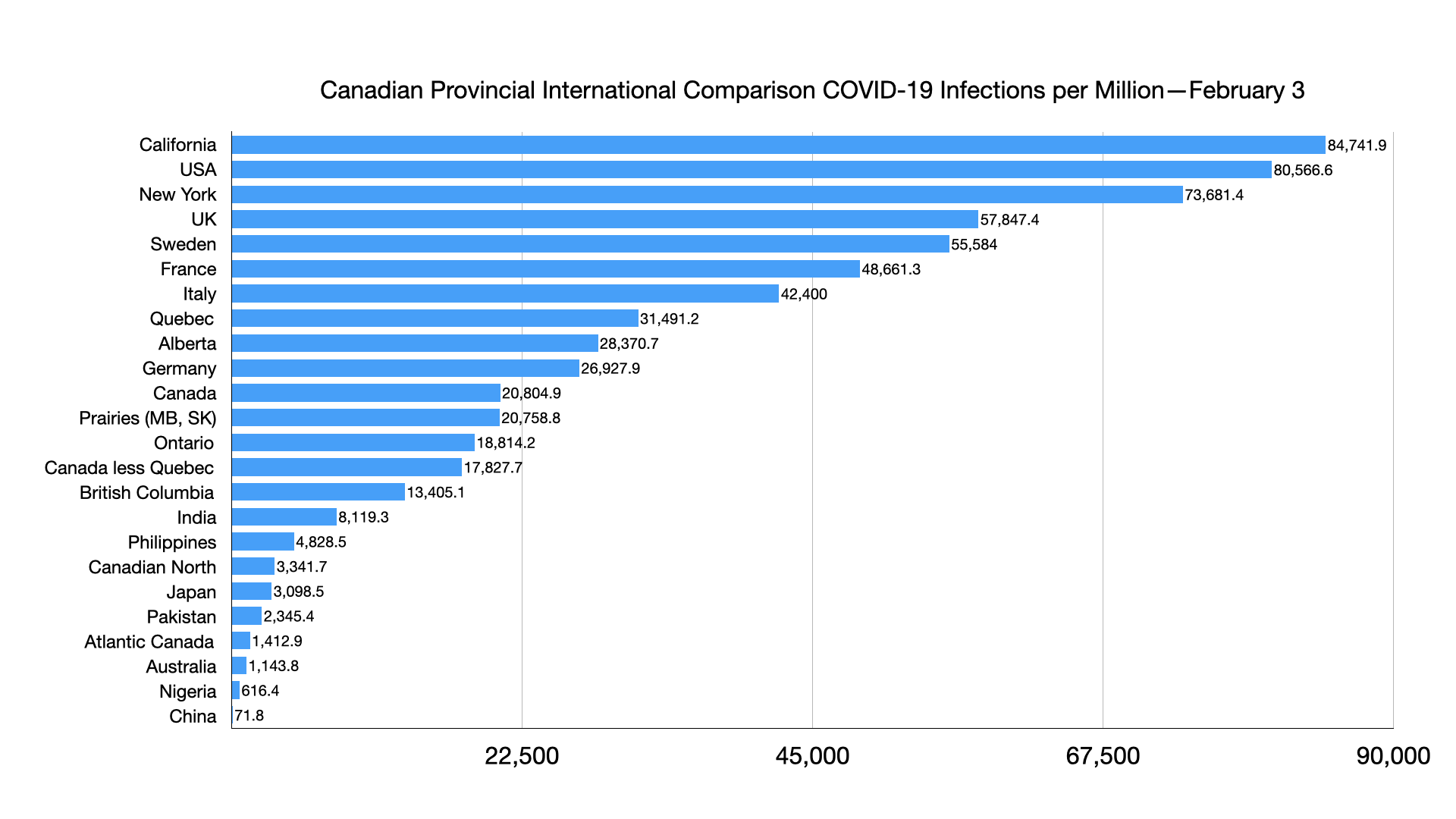
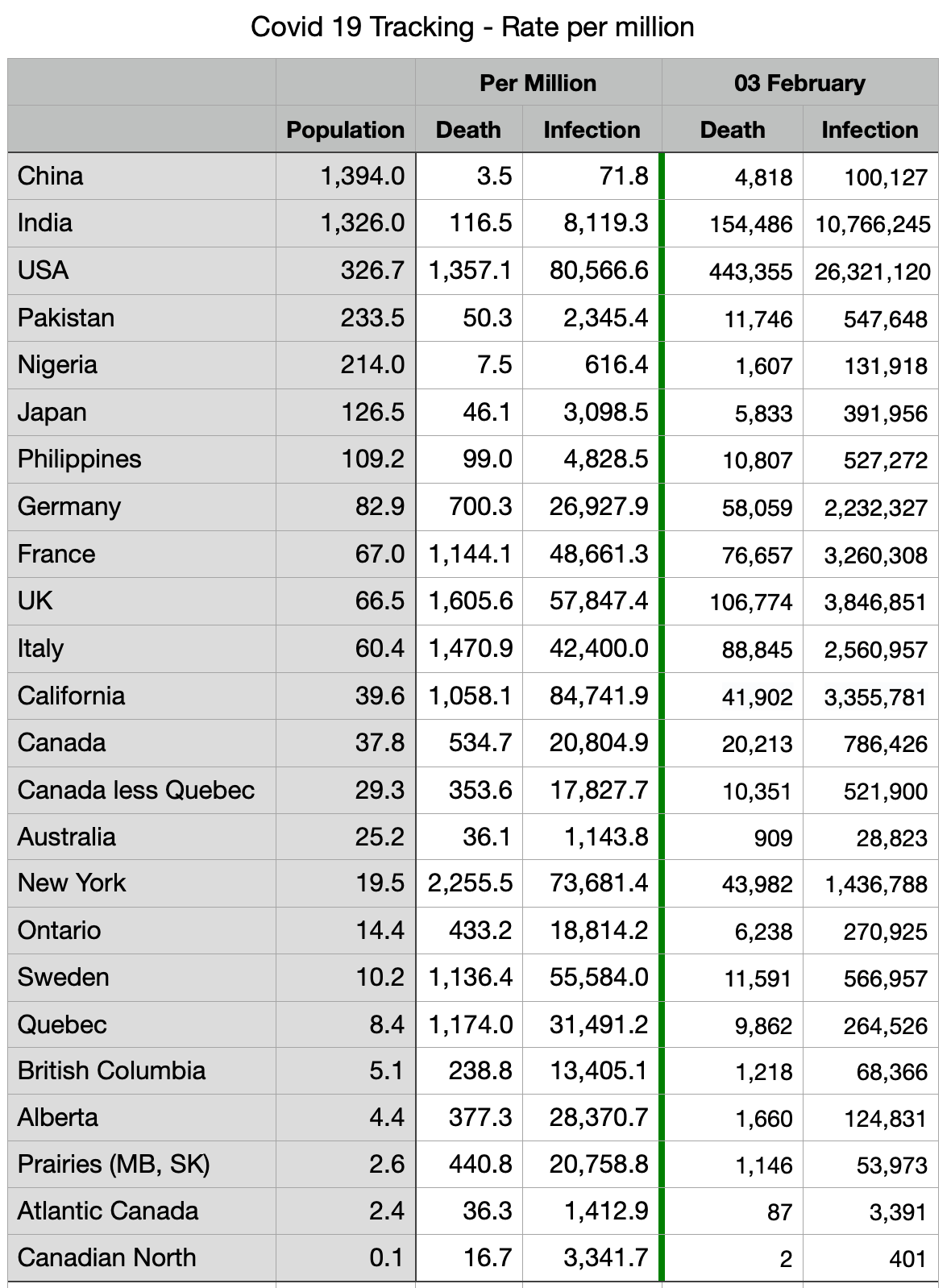
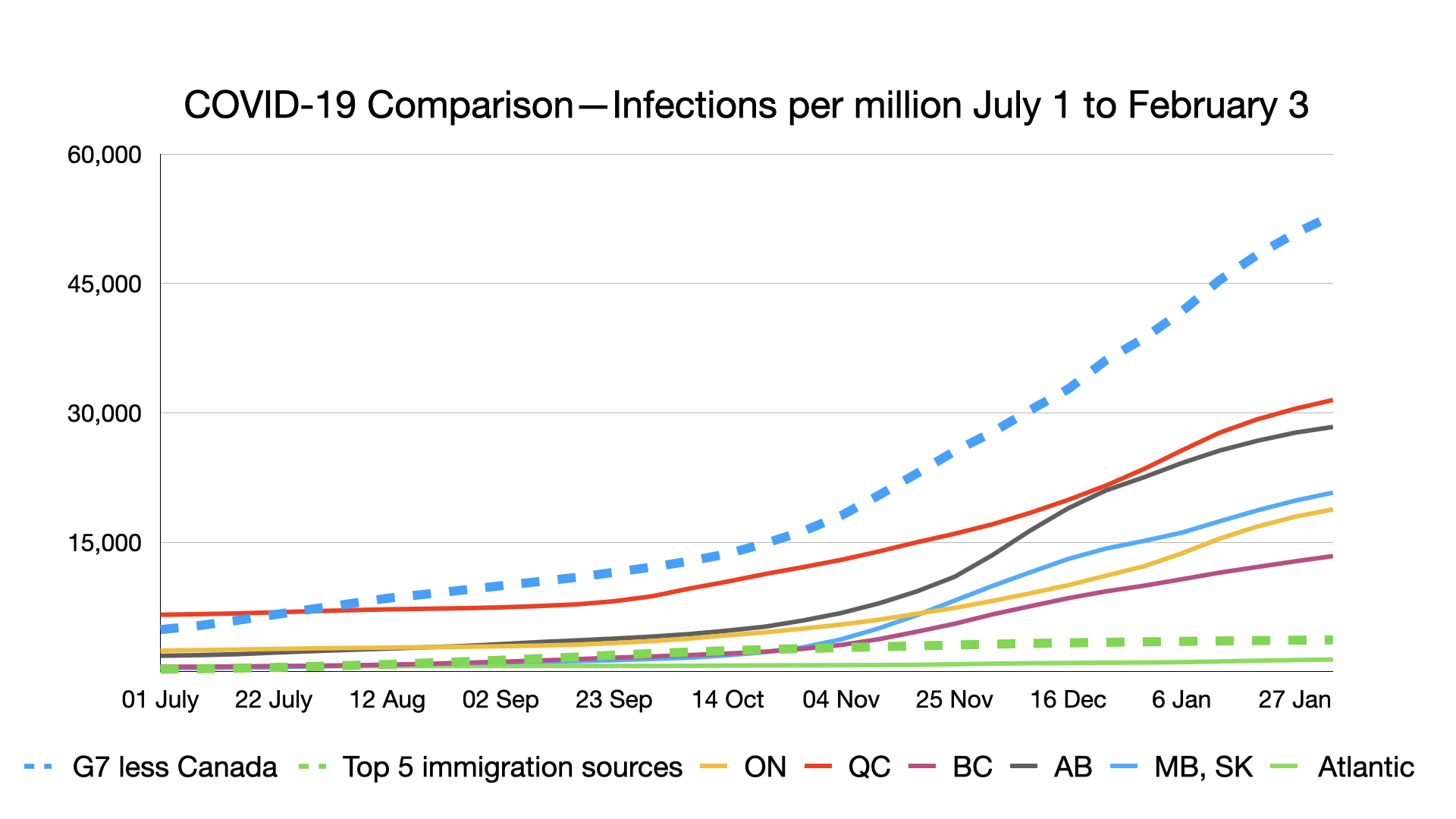
#COVID-19: Comparing provinces with other countries 3 February Update

The latest charts, compiled 3 February.

Vaccinations: The gap between the leading G7 countries (UK, USA) and other EU countries continues to grow given the pause in deliveries to Canada, with the exception of France and Sweden.

Trendline charts

Infections per million: Alberta appears too be controlling the virus better than Quebec.

Deaths per million: G7 continues to close in on Quebec, Prairies continue to have similar rates to Ontario.

Vaccinations per million: Gap between G7 and Canada, driven by UK and USA, continues to widen.

Weekly

Infections per million: No change in relative ranking from last week.

Deaths per million: Atlantic Canada now ahead of Australia.