Canada won’t lead boycott of 2022 Olympic Games in Beijing

Wrong call, as others have mentioned. Will be used as propaganda by the Chinese regime much as Hitler used the 1936 Berlin Olympics (only saved by Jesse Owen’s win).

Canadian Olympians, and the Canadian Olympic Committee, need to reflect hard on their complicity with the various aspects of Chinese repression (Uighurs, Hong Kong, arbitrary arrests etc) should they attend – even if the two Michael’s are released by then:

The Canadian government has no plans to lead the way amid growing calls for an international boycott of the 2022 Olympics in China.

Foreign Affairs Minister Francois-Philippe Champagne told the House of Commons special committee on Canada-China relations Monday that a decision on a boycott should be left to private sports bodies participating in the Winter Games in Beijing.

“I think when it comes to sports and politics … one has to be careful. That is a decision for the Canadian Olympic Committee to make and certainly we will look to see their decision when it comes to the Olympics in Beijing,” Champagne told MPs.

Conservative foreign affairs critic Michael Chong raised the issue, noting that former Privy Council clerk Michael Wernick had suggested last week that the government should start preparing the Canadian public for a boycott of the Olympic Games. The Winter Olympics are scheduled to take place in Beijing in February, 2022.

David Mulroney, a former Canadian ambassador, has called on Ottawa to boycott the Olympic Games and to impose sanctions on China for its human-rights abuses. John Higginbotham, who previously served as commissioner for Canada in Hong Kong, a role equivalent to an ambassador, has also said Canada should organize a boycott of the Games unless China “lays off Hong Kong.”

In September, more than 160 human-rights groups called on the IOC to withdraw the Games from Beijing because of gross human-rights abuses. In a letter, the organizations said China has put more than one million Uyghurs in detention camps and set up an “Orwellian surveillance network” in Tibet and crushed democratic dissent in Hong Kong.

Britain’s foreign secretary, Dominic Rabb, has refused to rule out boycotting the Beijing Games because of the treatment of Uyghurs and other ethnic minorities in China’s Xinjing region, where they have been subject to mass incarceration, forced sterilizations and forced labour.

United States Senators Rick Scott and Josh Hawley have urged NBC Universal, which owns the rights to broadcast the Beijing Olympics, to “pick human rights over profits” and refuse to air the Games.

A Canadian House of Commons committee recently accused China of committing “genocide” against its Muslim minorities and has called for Magnitsky-style sanctions against Chinese officials. The committee did not call for a boycott of the Olympics.

Beijing is set to become the first city to play host to both Summer and Winter Games.

Last week, the COC announced that two-time Olympic gold medallist speedskater Catriona Le May Doan will serve as Canada’s chef de mission for the 2022 Olympics.

In his testimony Monday evening, Champagne appeared to back off a pledge to unveil a new framework for Canada-China policy before the end of the year.

Under questioning from MPs, the minister would only say that Canada’s China policy is “evolving” and that is based on Canadian interests, values and principles on human rights and rules and partnership.

“Our foreign policy needs to evolve with an evolving China … and that is what we are already putting in motion,” he said.

Senior officials have privately played down the significance of Champagne’s talk of a new China policy. Officials told The Globe there will be no formal declaration on China but relations will be managed with the new reality that Chinese President Xi Jinping has adopted an aggressive and regressive policy within China and to the outside world.

In his opening remarks, Champagne acknowledged that the China of 2015 is not the China of today, expressing concern about its expansion policies, including in the High Arctic.

Senior officials have privately played down the significance of Champagne’s talk of a new China policy. Officials told The Globe there will be no formal declaration on China but relations will be managed with the new reality that Chinese President Xi Jinping has adopted an aggressive and regressive policy within China and to the outside world.

In his opening remarks, Champagne acknowledged that the China of 2015 is not the China of today, expressing concern about its expansion policies, including in the High Arctic.

“We see a country and leadership that is increasingly prepared to throw its weight around to expand its interests,” he said. “China’s ambition even reaches the Arctic region with aims to develop shipping lanes … this is a new reality that we need to take into account and thus engage with China with eyes wide open.”

Source: https://www.theglobeandmail.com/politics/article-canada-wont-lead-boycott-of-2022-olympic-games-in-beijing/?utm_medium=Referrer:+Social+Network+/+Media&utm_campaign=Shared+Web+Article+Links

Saskatchewan election: MLA diversity

Saskatchewan 2020 Election MLA Diversity

With the election results and new Cabinet appointments, the above chart shows the representation of women, visible minorities, and Indigenous peoples in relation to the overall population and the two parties.

Most striking to me is the significant under-representation of Indigenous peoples overall, with only the NDP having its elected MLAs largely reflecting the overall population (but not with respect to visible minorities.

Will update British Columbia once Cabinet appointed.

Ivison: Useful idiots of the world unite – and they have, with ‘Free Meng’ event

Appropriate use of the term:

The etymology of the phrase “useful idiot” is debated. Some people suggest it was coined by Lenin. Others credit Stalin, who used it to describe the confused and misguided American sympathizers who aided the Soviet agenda.

It came to mind when reading about a virtual event being held Tuesday in anticipation of the second anniversary of the arrest of Meng Wanzhou, the Huawei executive being detained in Vancouver, pending extradition to the United States.

That’s shocking.

Ashton has not only agreed to participate in the event, she has sponsored a petition in the House of Commons that calls for Meng’s immediate release; urges the government to “protect Canadian jobs” by allowing Huawei to participate in the roll-out of 5G in Canada, and encourages a foreign policy review to develop an “independent” foreign policy on China.

Yves Engler, a fellow of the Canadian Foreign Policy Institute, said he is sympathetic to the plight of the two Michaels. “But who began the process? Hostage diplomacy is a terrible idea but who started it?” he said.

Meng’s detention “upholds unilateral and illegal U.S. sanctions” against Iran, he said.

That’s not true.

U.S. authorities are seeking Meng’s extradition on fraud charges, alleging she lied to HSBC as part of a scheme to obtain financing, thereby putting the bank at risk of violating U.S. sanctions in Iran.

However, when B.C. Supreme Court judge Heather Holmes ruled that Meng can be sent to the U.S. to be prosecuted, she did so because she deemed her crime, as alleged by the U.S., is also a crime in Canada. The essence of the alleged crime was not violating U.S. sanctions but deceiving a bank to obtain financial services.

On the petition’s second demand, Engler defended the call to allow Huawei to be involved in Canada’s 5G network. “We have real concerns about surveillance…The Chinese government has its own repressive spying and intelligence apparatus. But it doesn’t come close to the power of the NSA (America’s National Security Agency) or the Five Eyes (the intelligence alliance comprising Canada, the U.S., U.K, Australia and New Zealand). Canadians should be more concerned about the NSA in Canada than the Chinese government,” he said. “I don’t think that China is a threat to most Canadians.”

While it is true that no Huawei code or hardware has been linked definitively to the Chinese state, the company is beholden to the Communist Party’s interests and instruction. Security experts believe that Huawei receives contracts from the Chinese military to develop dual use communications technology and that the threat is legitimate.

A generous interpretation is that Engler, Manly and Ashton are well-intentioned idealists who qualify for Stalin’s (or Lenin’s) depiction.

Engler admitted he has never been to China, where surveillance has been elevated to an art-form.

We can probably all agree that we do not welcome a cold war with the Chinese, far less anything warmer.

But to present, as the Canadian Peace Congress does, Meng’s detention as “an unprovoked kidnapping,” or Canada’s participation in naval operations in east Asia as an attempt to “provoke and encircle the PRC,” is to take adolescent gullibility to dangerous levels.

Ashton can have no excuses. She has been an MP for 12 years and run for her party’s leadership twice.

Does she agree with the Communist Party’s English language mouthpiece, the Global Times, that Canada has surrendered its judicial and diplomatic independence to the U.S.?

I would have asked her, if she had returned calls seeking comment.

A far less benign but more considered view of China emerged from last weekend’s Halifax Security Forum, which summarized the opinions of 250 experts in a handbook for delegates. The forum concluded that modern-day China has become the most powerful authoritarian state in history and a major challenger to the liberal world. The consensus is that China’s ambitions will not stop at its borders and that it intends to undermine democracies around the world – in particular in Hong Kong and Taiwan, which “now hang precariously in the balance.”

Even if the radical left is able to discount what is going on in Hong Kong and the South China Sea, how can it overlook the oppression in Xinjiang that all human rights organizations say is intensifying?

The explanation appears to be a reflexive contempt and loathing toward the United States that excuses any and all atrocities by other nations.

This, after all, is the same Niki Ashton who tweeted #HandsOff Venezuela last year, in support of the despicable Nicolas Maduro regime. The illegitimate president must have been gratified that the world is so packed with useful idiots.

Source: Useful idiots of the world unite – and they have, with ‘Free Meng’ event

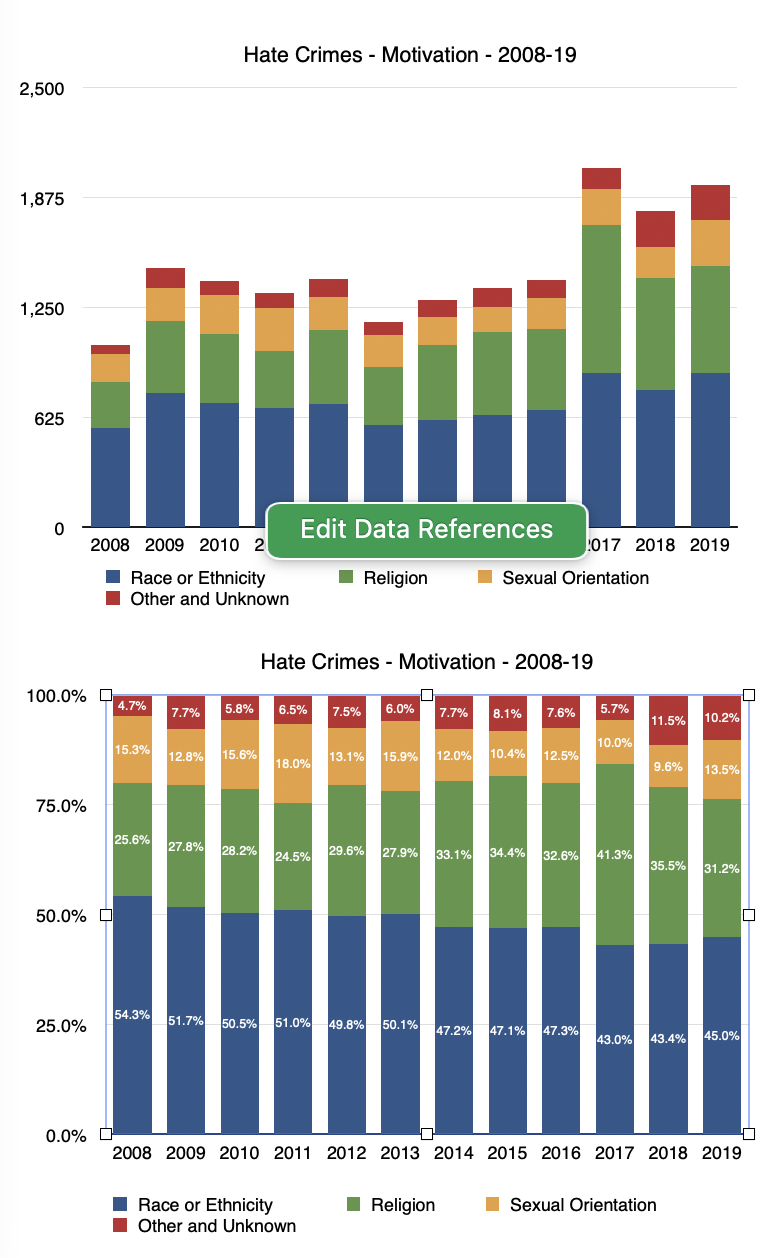
Hate Crimes: Motivation 2008-19

While the detailed breakdowns breakdowns by visible and religious minorities are not yet released, the overall numbers for 2019 by motivation are, showing relative stability in race or ethnicity hate crimes, a decline over the past three years in religion-based hate crimes, and a recent increase in other (language, disability, sex, age).

Source: https://www150.statcan.gc.ca/n1/daily-quotidien/201124/dq201124h-cansim-eng.htm

Religious minorities say Quebec’s Christmas gathering plan shows a double standard

Valid critique. I remember when Ontario’s Sunday closing laws (Lord’s Day Act, the Retail Business Holidays Act) were repealed or amended given this discriminatory impact on other religions along with general public pressure in the early 1990s:

Members of religious minority groups in Quebec are decrying the provincial government’s plan to allow Christmas-time gatherings in the midst of the COVID-19 pandemic, calling the move a sign of a double standard.

The condemnations came days after Premier Francois Legault offered Quebecers what he dubbed a “moral contract” through an offer to raise gathering limits over a four-day period starting on Christmas Eve.

“It’s disappointing,” said Yusuf Faqiri, a representative of the National Council of Canadian Muslims. “The Muslim community, the Jewish community, the Sikh community, when we had our respective holidays, we were not able to gather.”

Legault announced the terms of the Christmas repreive on Thursday, saying groups of up to 10 could gather between Dec. 24 and Dec. 27. The short-term move marks a sharp reversal from rules currently in place in much of the province, where all indoor gatherings are banned in regions classified as red zones under the province’s pandemic response plan.

Faqiri said his objections to the move aren’t rooted solely in the pandemic. His organization is one of several that is currently challenging Quebec’s secularism law in court. That law bans some public servants, including teachers, from wearing religious symbols while working, on the grounds that the state must be religiously neutral.

He said it’s “a contradiction” to defend that bill while allowing Christmas gatherings.

“All Quebecers, from all faith groups, from all respective traditions, we’re all proud participants in the society,” he said. “But in order for us to do that, we should all be treated the same and that’s where the fundamental issue lies.”

Rabbi Lisa Grushcow, of Temple Emanu-El-Beth Sholom in Montreal, said Jewish people have been left out.

“But we’ve been left out of something I wouldn’t want to be included in,” she quipped.

Grushcow said she’s worried that the allowance for gatherings will put vulnerable people and teachers at risk.

“I don’t know that the government’s following the science and the medical wisdom,” she said. “That’s the piece that worries me.”

She said she doesn’t want the government to allow people to gather for Hanukkah, noting that her congregation has already made it through more important Jewish holidays in the midst of the pandemic.

“We made it through Passover, we made it through Rosh Hashanah, we made it through Yom Kippur,” she said. “So if anything, I would hope that our experience can show that it’s possible to be creative and still be connected, even while keeping each other safe.”

Grushcow said there is an inconsistency when it comes to the Quebec government’s approach to secularism.

“You’re saying that you can rearrange the whole school calendar and put a society at risk so folks can celebrate Christmas, but you’re not going to let it teacher wear a hijab or a kippah,” she said. “It is a bit of a challenge.”

When asked about people who don’t celebrate Christmas at press conference on Thursday evening, Legault said he believes allowing for gatherings around Christmas is what most Quebecers want.

Other rabbis echoed Grushcow’s concerns.

“While we appreciate the intent of the Quebec government’s decision to accommodate families and allow them to gather for Christmas, it is unfortunate and disturbing that it does not apply to all faith communities,” Rabbi Reuben Poupko, the co-chair of Centre for Israel and Jewish Affairs-Quebec and the rabbi of the Beth Israel Beth Aaron Congregation in Montreal, said in a statement. “The elevating of one faith community over another is inappropriate, and all faith communities should be treated in an equitable manner.”

At a technical briefing on Friday morning, public health officials said they didn’t specifically choose to centre the moral contract around Christmas but selected the dates because they fell in the middle of the winter school break.

Source: https://www.nationalnewswatch.com/2020/11/22/religious-minorities-say-quebecs-christmas-gathering-plan-shows-a-double-standard/#.X7uWei3b23g

‘Always a rolling target to bring about big change’: Fergus says he’s optimistic in feds’ anti-racism strategy progress, ‘but we’re not there yet’

Would be interesting to hear the perspectives of the other parties beyond the NDP as well.

The increased funding and programming is significant, as are initiatives like breaking down visible minorities into the different groups in employment equity )What new disaggregated data tells us about federal public service …) and the Public Service Employee Survey (What the Public Service Employee Survey breakdowns of visible minority and other groups tell us about diversity and inclusion):

Nearly 18 months following the introduction of the federal government’s anti-racism strategy and nine months into the COVID-19 pandemic, Minister of Diversity, Inclusion and Youth Bardish Chagger says although the government is making progress, “there’s a lot of work to do here and it’s going to take some time.”

In an interview with The Hill Times, Ms. Chagger (Waterloo, Ont.) says “racism did not take a pause during the pandemic—on the contrary, COVID-19 has affected all Canadians and certain segments disproportionally.”

“If you look at every single minister and the work we’re doing, we are peeling these systems back in a way that we haven’t done before to ensure that the very people that are underrepresented and underserved are actually part of that decision-making and are informing our decisions” said Ms. Chagger. “There’s no minister that’s on the sidelines when it comes to this issue—[Justice] Minister David Lametti is having these conversations, [Public Safety] Minister Bill Blair is having these conversations, the prime minister is having these conversations.”

“Every single minister is consciously having these conversations and ensuring that these voices are being invited to the decision-making table and conscious about who’s not being invited, to ensure that these voices are also being heard,” said Ms. Chagger.

Liberal MP Greg Fergus (Hull-Aylmer, Que.), who chairs the cross-party Black Parliamentary Caucus that was first established in 2015, was also optimistic that progress is being made—but said that “it’s always a rolling target to bring about big change.”

“I would even go back further than a year-and-a-half ago, I’d go back to the budget of 2018, where for the first time ever in Canada’s history, you saw some investments which were directed at the Black community,” said Mr. Fergus. “With regard to mental health, with regard to, most importantly, disaggregated data, with regards to some community support and programming, as well as capital costs.”

“And the creation of course of the [Anti-Racism] Secretariat,” said Mr. Fergus, alluding to the unit established within the Heritage department in Oct. 2019 to the tune of $4.6-million.

“We had the election, and then we had the creation of the new ministry of diversity, inclusion, and youth, so that’s great” said Mr. Fergus. “We saw mandate letters, which laid out what we should be doing.”

“And then we had the pandemic hit, and then we had the brutal videos that came out from the United States,” said Mr. Fergus, alluding to the May 25 killing of 46-year-old George Floyd by a police officer in Minneapolis that was caught on video, an event that sparked outrage and mass demonstrations in the United States and in Canada, including on Parliament Hill on June 5.

“What have we seen since that time? We’ve seen a firm commitment from the prime minister to deal with this, and that was reflected in the Speech from the Throne, which delighted me to no end because it took every single one of the large subject areas that the Parliamentary Black Caucus had identified.”

In a statement release June 15, the caucus outlined a series of proposals that governments should act on to redress historic injustices in the areas of public safety, justice, representation in the federal public service, race-based data collection, as well as arts and culture.

There are some important steps which are being taken by Clerk of the Privy Council Ian Shugart and the community of deputy ministers within the federal public service to affect change as well, according to Mr. Fergus.

“All this to say—we’re making progress,” said Mr. Fergus. “Is it at the speed I want it to be? I would prefer faster. All parliamentary caucus is working on that and I daresay that the government is working on that.”

“We will get there, but it’s important to remember where we came from,” said Mr. Fergus. “When you look back at the journey, you can say there’s some pretty big progress. But if you were to compare it to where we know we should be, we’re not there yet.”

The anti-racism strategy, designed to unroll from 2019 to 2022, has a $45-million price tag.

Most recently, Liberal MP Adam van Koeverden (Milton, Ont.), who is parliamentary secretary to Ms. Chagger, along with Liberal MP Jim Carr (Winnipeg South Centre, Man.) highlighted 13 projects in Manitoba, Saskatchewan, and Alberta that are part of 85 projects coast-to-coast that have already received $15-million in funding as part of the government’s new Anti-Racism Action Program.

Addressing systemic racism played large role in Throne Speech 

“For too many Canadians, systemic racism is a lived reality,” read Governor General Julie Payette in the most recent Speech from the Throne on Sept. 23. “We know that racism did not take a pause during the pandemic. On the contrary, COVID-19 has hit racialized Canadians especially hard.”

“Many people—especially Indigenous people, and Black and racialized Canadians—have raised their voices and stood up to demand change,” she said in the speech drawn up by the government. “They are telling us we must do more. The government agrees.”

But NDP MP Matthew Green (Hamilton Centre, Ont.) said he thought most of the work that has been proposed by the Liberals have been based on announcements and aesthetics, and not tackling the actual institutional form of systemic racism.

“While it is small steps in the right direction in terms of the announcements of programs, this goes beyond buying your way out of deep organizational, cultural, and institutional racism,” said Mr. Green. “There is actual legislative work within the House of Commons under the purview of the federal government, from institutions like the RCMP, to the judiciary to their own public service sector, that still clearly suggests significant challenges around anti-Black racism.”

“And there just seems to be ongoing reluctance for this government to go beyond the aesthetics of big-ticket announcements and into the actual work of dismantling anti-Black racism and racism within their government,” said Mr. Green.

When asked about the tumultuous events of the summer and the effect the mass demonstrations had on anti-racism initiatives within governments, Mr. Green said the saddest part of that moment is that it was borne of the suffering and subjugation of Black people.

“Until we dismantle white supremacy, that suffering will continue, so the saddest part about that moment is that it will never pass and it will only ever continue,” said Mr. Green. “For every George Floyd, there are dozens and hundreds of countless, unnamed Black, Indigenous and racialized people who are brutalized by police.”

“That has not stopped—in fact, in the ensuing months, we know it to be true that the police have continued at all levels to be caught on camera brutalizing people,” said Mr. Green. “And it’s not just police—we’re seeing it in our health care systems, we’re seeing it in our long-term care homes, we’re seeing it in the way that workers are brutalized in the front lines who are essential but are not paid essentially.”

“These are the ways in which systemic and institutional racism play out in Canada, and this is a moment that will never pass,” said Mr. Green. “Tackling systemic racism is more than just announcing big dollar funding for programs.”

Ms. Chagger said she understands the call for legislation to address the matter, “but no law is going to change us.”

“We have to change us—we have to look within ourselves and in our own backyards. But this federal government under this prime minister recognizes that there is a need for federal leadership, and we will continue to display it, we will continue to act upon it, and we will continue to keep an open door and work with everyone, so that we are being inclusive in the way we are developing these policies so they work for all Canadians.”

Source: ‘Always a rolling target to bring about big change’: Fergus says he’s optimistic in feds’ anti-racism strategy progress, ‘but we’re not there yet’

Advocates calling on Canada to resolve citizenship application backlog

No surprise. The requests are largely reasonable (greater transparency on status of applications, resumption of tests but not waiving them). Given the government’s campaign commitment to abolish the fees, understandable that they request a reimbursement of the fees (to date, no sign of IRCC acting on that commitment):

Citizenship-applicants and their supporters are calling on the federal government to address the backlog that is preventing thousands from becoming Canadian citizens.

A group called Advocates for Resumption of Canadian Citizenship Tests held demonstrations in Toronto and Montreal on November 7. The group was formed in response to the backlog in citizenship applicants waiting to get approved for a test, or for a citizenship ceremony. Their next demonstration will be in Ottawa on November 28.

Canada’s immigration department, Immigration, Refugees and Citizenship Canada(IRCC), cancelled all citizenship tests, interviews, and ceremonies on March 14 in response to the pandemic. IRCC began offering online citizenship ceremonies in April, at a rate of about 2,500 to 3,000 per week, significantly down from the 4,700 they were processing per week in 2019.

Citizenship applicants must demonstrate basic knowledge of Canada, as per the Citizenship Act. Applicants now must meet this requirement by doing the citizenship test, which is currently not available online. Though some in-person retesting has resumed, this means for many that they are unable to get Canadian citizenship. As of September, there were about 85,000 people waiting to take the citizenship test.

As a result, they are unable to vote, work in certain government jobs, or get a Canadian passport.

“It worries us, when we receive several messages in our group from people describing how this is affecting their mental health, relationships, their ability to travel home, their government job prospects, the need to unnecessarily extend their PR status etc.,” wrote a spokesperson from the citizenship tests advocates in a media release.

Nael Asad is one of the co-founder of the advocacy group, and one of thousands waiting for an invitation to take the citizenship test. He has had his permanent residency since 2008, and applied for citizenship in April 2019. Before the pandemic, IRCC’s average processing time for citizenship applications was about one year, so Asad was expecting an invitation for around the time when the pandemic hit in March.

“It’s very disrespectful to leave 85,000 people or more out there in limbo without any kind of update,” Asad told CIC News. “Tell us, ‘OK we’re not going to open up until this pandemic are over,’ but for eight or nine months now they’re saying the same thing ‘We’re monitoring the situation, check our website for updates.’ So people are going every single day on the website to check for updates.”

He also described how being a citizen comes with a sense of security, especially for people who fled war zones to come to Canada.

“When you are a citizen, you are a citizen,” he said. “Nothing is gonna happen to you this is your home country, but technically it is not our home country until we become citizens.”

The advocacy group’s online petition now has over 9,000 signatures. They are making three calls to action for IRCC: transparency on what the immigration department has been doing with the applications since March; the resumption, or wavier, of citizenship tests; and the reimbursement of the citizenship application fee, which runs about $630 for adults.

CIC News reached out to IRCC on updated numbers of citizenship files processed, but did not receive a response in time for publication.

Source: Advocates calling on Canada to resolve citizenship application backlog

Korea: Immigration not the only solution to demographic change

Interesting take, reflecting under-employment of women in Korea:

From an agrarian economy in the 1960s to now one of the strongest economic forces in Asia, Korea has evidently achieved tremendous economic growth, which not only comes with fiscal and welfare improvements but also demographic changes. The United Nations predicted that Korea’s population will peak in 2024 and decrease from then on and a 2000 UN Population Division report suggests immigration as a solution to this issue.

Yet, the rate at which Korea’s population is decreasing would require a mass immigration so large that it becomes an ineffective solution. Therefore, it has to be done at a smaller scale and coupled with other solutions that rely on Korea’s existing population.

The demographic change looming over this country ― and others ― is called demographic transition, which is the decrease in fertility and infant death rate due to improved welfare and technological development. It occurs in developed countries and results in a declining and aging population. The latter is the change in age structure to one with a greater proportion of older age groups, whereas the former is the change in the total overall population.

Immigration intended to offset the decline in the population size is called replacement migration, yet it can also address the declining working-age population. Based on the UN report, Korea has to aim for an annual net immigration of 800,000 between 2035 and 2050 to maintain the ratio of a working-age individual to retiree at 3.0. To bring in that number of people annually is close to impossible considering Korea’s past trends: 156,000 in 2018, and 32,000 in 2019.

To actualize our goal of sustainable economic growth, our solution itself should be sustainable. Therefore a more direct immigration policy is suggested. An example is Japan’s 2019 immigration policy that created two new visa status types for foreigners working in sectors experiencing labor shortages. With this solution, the country with the highest proportion of people over 65 years old was able to target specific industries that require manpower.

The proposed solution above greatly reduced the UN’s recommended annual net immigration, which means we have to look within the country and utilize existing human capital ― Korean women.

Despite having the highest tertiary education rates out of 36 OECD countries for women aged 25 to 34, Korea ranked 30th in women’s employment. An Ewha Law School professor suggests in a CNN interview that such contradicting statistics are proof that discriminatory hiring is still prevalent despite anti-discriminatory laws.

The Korean judicial system needs to address this issue with stricter consequences. The initiative to change should also come from organizations, and at all levels of management. Every individual is responsible to correct old prejudices and biases that promote sexism.

Yet, encouraging female employment means more than just hiring more women. It also means hiring them for leadership positions, and jobs that are historically perceived to be more appropriate for men ― referring to labor-intensive work.

Other potential solutions are empowering the elderly and extending the work-life of workers. It’s important to mention that this solution is not simply done by increasing the retirement age. Instead, it’s done by carrying out health-related initiatives and promoting lifelong learning.

Firstly, lifelong learning. Currently, Korea already has the Lifelong Education Act. Under this statute, the Korean government can plan programs purposed for cultivating human capital potential.

One way to do that is by providing opportunities for people to learn emerging skills, similar to what the Singapore University of Social Sciences is already doing. They’re offering credits for courses in emerging skills to their alumni. This is a potential solution because technological innovations also mean a workforce that needs to be trained in utilizing said technology. This resource should also be available to people of all ages and employment status.

Secondly, concerning health, investing in preventive countermeasures is impactful. Educating the public on ways to take care of their health will be cheaper compared to subsidizing healthcare costs due to ailments.

One supporting case is the company Johnson & Johnson (J&J) that strategically planned wellness programs for their employee’s social, mental, and physical health. Their efforts resulted in $250 million in healthcare savings. For every dollar J&J spent on wellness programs, they received a return of $2.71 between 2002 and 2008. Harvard Business Review even suggests that every dollar invested in health-risk prevention saves $6 in healthcare costs.

Korea’s working population has been decreasing due to population aging and decline. Replacement immigration has been suggested as a solution to this issue.

Yet the answer to whether or not Korea should embrace more immigration to ensure sustainable growth is not a simple yes or no. Replacement migration is one solution to this, but it shouldn’t be the only one. An issue as complex as this one needs more than just one big solution. Like a pride of lions hunting their prey, so should we address this issue, with several solutions.

Maria Natasha Lintang is a student at the State University of New York, Korea.

Source: Immigration not the only solution to demographic change

Australia: If that is not who we are, then who are we?

Bitingly sharp critique of the phrase “This is not who we are,” written mainly but not exclusively from an Indigenous perspective. While over the top, more than a kernel of truth in terms of the various divisions and fault lines that apply more broadly than Australia and Indigenous issues:

After news of Australian war crimes in Afghanistan made headlines, it was only a matter of time before a politician uttered the words “This is not who we are”

Australia has been trying very hard for a very long time to have its cake and eat it too when it comes to the idea of ‘we’.

It has tried to create the impossible, or at least the grossly contradictory and hypocritical, by aggressively separating and dividing people across every imaginable line while simultaneously appealing to an idealised sense of ‘we’ whenever it is convenient or expedient.

We are separated across state lines, a fact which has never been clearer than when watching our Prime Minister first attack Victorians and then try to steal their achievement as his own.

We are separated across racial lines with racist dog whistling from media and politics, and more overt racism from everyday white supremacists.

We have simultaneously rejected Indigenous rights, rejected multiculturalism, and embraced assimilation in a way that allows racism to be framed as only a problem when someone complains about it and not when someone enacts it. The divisive act, separating we into usand them, is the acknowledgement of mistreatment rather than the mistreatment itself – “Why do they always have it to make it about race?” they ask, to an elusive ‘them’ who they like to imagine make everything about race.

We are separated across political lines with a renewed animosity and disdain aimed not just between our political parties, but from our politicians to the people they are meant to represent.

We work hard to separate ourselves with all sorts of real and imagined differences; AFL or NRL, Ford or Holden, devon or fritz, potato scollops or potato cakes, and while many of these are a bit of a laugh, some have still led to more than a few playground/pub punch ons over the years.

We also separate ourselves in ways that actively dehumanise those of us who are not we so that we are less concerned about about their human rights being denied (which is of course the point of dehumanising someone in the first instance); homeless, unemployed, incarcerated, lower income, asylum seekers, Indigenous peoples – if only they’d worked a little harder, not jumped the cue, not made it about ‘us and them’, not been mean to me once in primary school, then they’d be one of us, then they’d deserve dignity, respect and basic human rights.

And amongst all of that division there is a singular unified theory of ‘We’ that transcends time and space and all of reality.

The mythical ‘We’ who arrived on the First Fleet, even though it was not us who committed the massacres. That is not who we are!

And the we who were already here for thousands of years before we are not us but they, but only because they always make it about race by playing the race card, and they didn’t even invent the wheel so they should be thankful it was us who invaded and not some other them, not that it was even an invasion to begin with… and on it goes.

It is the We who wins gold medals at the Olympics, or beats India at the cricket, or New Zealand in the rugby, but it is not us if they refuse to sing the anthem, or if they take a knee, or dare to wear an Aboriginal flag, or throw an imaginary spear. That is divisive! That is not who we are!

It is the We who fought bravely in every war (except the frontier wars which never happened) so that we can celebrate our veterans, our beloved ANZACs, with alcoholism, gambling and sacred biscuits once a year. We forget they even exist outside our imagined dreams of past national glory even as we all mindlessly chant ‘Lest we forget’. And when they return different from when they left and in need of our support, we pass the buck yet again because it is not us who fail our returned service men and women just as it is not us who committed the war crimes – that is not who we are.

We is an impossible dream but still one that many feel is worth pursuing, personally I could take it or leave it, especially since that dream has been turned into a nightmare by those who exploit us by using we as a convenient scapegoat allowing them to pick and choose not just who is we, but when we are we. We push them away for not being we enough, we thin the ranks of we by declaring that all of us who do wrong in our name were never really we to begin with – they are unWe. They are not the real We. They are not who we are.

But either it is who we are, because we share a sense of collective identity, and accept collective responsibility for both the good and the bad, or if it is not then we, the collective embodiment of Australia, does not exist as anything other than a system of ever changing rules that benefit a select few, that denies Indigenous people justice, and that locks up brown people for trying to exercise our legal right to seek asylum.

We are the greatest nation on earth, because we only accept collective responsibility for all the good stuff while denying any responsibility for the bad stuff, though we will still happily keep the land and resources that were gained through doing the bad things that we didn’t do.

But here is the long and short of it for all of us.

If we want to have “Australia won a gold medal at the Olympics” then we also have to take “Australia committed war crimes”.

Of course we did not all individually do all the bad things anymore than we all collectively did the good things, for that is what being a collective is all about – collective responsibility.

And we do not need to stand for an anthem or salute a flag or be suitably proficient in English to do that, we just need to acknowledge problems where they exist and strive to make them better and never turn a blind eye or shirk our collective responsibilities to ourselves, to each other, or to our fellow human beings regardless of where we come from.

There is strength in the collective ‘we’, but there is a danger when we let them decide who weare and who we are not.

The modern incarnation of jingoistic, patriotic, racist as fuck, white ethnostate loving nationalism has its roots in the Howard/Hanson era, but of course is merely an adaption of the same white ethnostate ideal that Australia was built on. Once the idea of a Whites Only nation was put to bed, Australia was either going to embrace true multiculturalism or it was going begrudgingly accept that not everyone can be white while demanding that they damn sure do their best to act it anyway. This is where the origin of ‘One Nation’ comes from, for before it was a racist political party it was part of a strategy aimed at getting people to accept multiculturalism.

As Andrew Jakubowicz explains:

Multiculturalism may well be supported by 80% of Australians, but this level drops when anxiety about border security rises. So, multiculturalism’s opponents have much to gain from heightened public concern about “Muslim immigration”.

Hanson’s election has helped clarify the sides of the debate around how Australians have “imagined community” for more than 30 years, since Geoffrey Blainey first shaped the opposition arguments. There is one nation with many cultures, which was Bob Hawke’s 1989 definition of multiculturalism. And then there should be only one culture albeit followed by many races, which is Hanson’s conceptualisation – though wrongly labelled as “One Nation”.

The first sees Australia as a civic nation in which reciprocity and difference, supported by core commitments to democracy and equality, provide the architecture for creativity and cohesion.

The second sees Australia as an (Anglo-Christian) ethnic (multicoloured) monocultural nation in which assimilation into an imagined singular worldview drives calls for cohesion and claims of social strength.

We have never really reconciled which of the above ‘we’ we mean when we talk about ‘we’, and until we do we will be incapable of working out where we are heading because not only do we not know where we are, we apparently don’t even know who we are, even if some of us want to pretend to know who we aren’t.

Source: If that is not who we are, then who are we?

Canada shouldn’t go to Winter Olympics in Beijing

Agree with Raph Girard, former government colleague. Do Olympians really want to be complicit with the Chinese regime and all its human rights abuses?:

The appointment of Catriona Le May Doan as head of our 2022 Olympic delegation would have been more than appropriate had there been a reason to send a team to China in the first place. How can we possibly be thinking of sending Canadians under our flag to a country that is holding two of our citizens hostage; that has threatened Canadians in Hong Kong; and that continues to use trade as a weapon against us?

China’s repression of the Uighurs and the democratic movement in Hong Kong  should be sufficient for fair-minded countries to withdraw, as Canada did from the Moscow Games in 1980. China is a  pariah state. Let us show some backbone and demonstrate we will not be bullied by letting it know right now that there will be no Canadian team to harass in Beijing in 2022.

Raphael Girard, Ottawa

Source: https://ottawacitizen.com/opinion/todays-letters-boycott-the-beijing-winter-olympics-over-chinas-abuses

John Ivison: Boycott of Beijing Olympics is no substitute for a proper foreign policyClose sticky video

While the government is pondering over a new approach to dealing with China, the Conservative Party is urging the Liberals to consider a boycott of the 2022 Beijing Winter Olympics.

The idea was raised on social media by Canada’s former senior public servant, Michael Wernick. “Perhaps it is time to start preparing the Canadian public for a boycott of the 2022 Winter Olympics in China,” he said.

Michael Chong, the Conservative foreign affairs critic, agrees.

“China is threatening our citizens and undermining our rights and freedoms with its covert operations in Canada. Everything should be under consideration to defend Canada and Canadians – including a boycott of the 2022 Beijing Winter Olympics,” he said in an email.

Chong pointed out that it is an option where this country has some leverage. “Canada is a winter sports powerhouse. No Winter Olympics could be a success without Canada’s participation,” he said.

The idea received a tepid response from the government.

The department of Canadian Heritage professed impotence when it came to the question of a boycott. “The decision on whether or not to participate in the Olympic and Paralympic games lies with the Canadian Olympic and Paralympic Committee, as they operate independently of the government,” it said in a statement.

A boycott has pros and cons – it would send a clear message to Beijing that Canadians are incensed at their fellow citizens being jailed arbitrarily (Michael Spavor and Michael Kovrig are approaching two years in detention), while the Communist Party engages in intimidation and influence-peddling on Canadian soil.

On the other hand, it is unlikely to succeed in securing the release of the two Michaels.

The games were designed to lower international tensions and this would exacerbate them. A boycott would be a symbolic gesture unlikely to shift Chinese foreign policy, while the real victims would be the athletes.

Wernick said he is not sure it is a good idea, especially if Canada was on its own. “Did boycotting Moscow in 1980 make a difference?” he asked.

At the end of the day, a boycott is no substitute for a proper foreign policy, which is something Canada lacks when it comes to China.

Source: https://nationalpost.com/opinion/john-ivison-boycott-of-beijing-olympics-is-no-substitute-for-a-proper-foreign-policy

Burton: Canada should manage our China policy more honestly

With Global Affairs Minister François-Philippe Champagne scheduled to give evidence Monday to the House of Commons Special Committee on Canada-China relations, expect a lot of hemming and hawing over why he voted against an Opposition motion for Canada to announce a decision on Huawei 5G before Christmas.

He’ll also have to explain why Canada has not undertaken effective measures to stop covert, coercive activities by Chinese agents who seek to influence Canadian policymakers and intimidate human rights defenders in Canada’s Uighur and Tibetan communities, pro-democracy activists, campaigners for freedom in Hong Kong or practitioners of Falun Gong. Canada’s policy on this so far has been akin to the “ghosting” (that is, withdrawing without explanation) of a discarded romantic partner. Canada has broken off the 5G relationship with Huawei for very good national security reasons, but doesn’t want to incur Beijing’s wrath by telling them straight out.

The argument that “ghosting” might obtain the release of Michaels Kovrig and Spavor, or avoid further economic retaliation that punishes Canadian business and farmers, has proven wrong-headed. After 711 days, two exemplary Canadian citizens are still in prison hell in the People’s Republic of China, neither of them deserving such vulgar abuse as Beijing tries to force Canada to comply with China’s political demands. Beijing obviously does not reward passivity with gestures of goodwill, and if the federal government continues to give in to the PRC’s amoral “wolf warrior diplomacy,” expect China to be thus emboldened to demand that Canada offer successive concessions in years ahead.

In 2018, China declared itself a “near-Arctic state” and called for a “Polar Silk Road” to not only expedite shipping through our Arctic waters, but develop ports, infrastructure, military presence and extract resources in Canada’s North. The carrot for Canada would ostensibly be huge Chinese state investment and developmental benefits, but this is all simply part of Chinese leader Xi Jinping’s strategy to displace the United States as the world’s dominant political and economic power by 2050, which will be the 100th anniversary of China’s People’s Republic.

This is all consistent with the PRC’s strong insistence that Canada not only allow Huawei free rein over our telecommunications framework, but that Canada cease its “discriminatory” security review process over any PRC acquisitions of critical Canadian natural resources and infrastructure.

Where is Canada’s appeasement of China ultimately leading? If push came to shove, would we revisit the decision to keep Aecon Construction out of Chinese state control? China certainly sees precedent for this, as our current government in 2017 inexplicably reversed the Harper cabinet’s 2015 denial of Hong Kong O-Net’s application to take over ITF Technologies of Montreal, a leader in advanced fibre-laser technology with military applications. It was because CSIS reportedly had advised that O-Net is effectively controlled by the Chinese state that Canada passed up China’s generous monetary inducements to OK that acquisition, despite the lobbying of Canadians who would have benefitted richly from the sale.

Little wonder that Beijing clearly perceives that holding Kovrig and Spavor is working out well, keeping Canada from retaliating for China’s flouting of accepted norms of international diplomacy and trade. It’s time Canada did the right things: ceasing to turn a blind eye to China’s money diplomacy meant to influence Canadian policymakers; adopting zero tolerance of Chinese state harassment of people in Canada; sanctioning Chinese officials who have wealth invested here and are complicit in the Uighur genocide; offering safe harbour to all Hong Kongers at risk of arrest under the PRC’s draconian National Security Law; and stringently inspecting all Chinese shipments into Canada to stem the flow of fentanyl.

As for Huawei, we really need to make a clear and principled statement. In doing so, China will have no reason to further poison its relationship with Canada by keeping Kovrig and Spavor so brutally incarcerated.

Ghosting has not worked in this relationship. It is time to make clear our Canadian intentions.

Charles Burton is a senior fellow at the Macdonald-Laurier Institute in Ottawa, and non-resident senior fellow of the European Values Center for Security Policy in Prague. He is a former professor of political science at Brock University, and served as a diplomat at Canada’s Embassy in Beijing. Source: Burton: Canada should manage our China policy more honestly

Source: https://ottawacitizen.com/opinion/burton-canada-should-manage-our-china-policy-more-honestly