Khan: How one organization has broken the silence on abuse within Muslim institutions

Of note:

Recently, more than 95,000 claims of sexual assault were filed against the Boy Scouts of America, while a Vatican report found that Pope John Paul II facilitated the ascent of now-disgraced Cardinal Theodore McCarrick by rejecting explicit warnings of widespread sexual abuse. Tragically, the scourge of sexual abuse cuts across many communities.

Facing Abuse in Community Environments (FACE) was formed in 2017 to address abuse by religious leadership within North American Muslim institutions. It has created a rigorous framework to investigate allegations against Muslim religious leaders and hold them to account.

The organization broke new ground by publishing a series of in-depth investigations into allegations of misconduct by imams. In one case, the plaintiff (“Jane Doe”) was awarded a US$2.5-million judgment against Imam Zia ul-Haq Sheikh for sexual exploitation.

These investigations serve to notify the public about individuals with problematic records of behaviour before hiring them. In the past, an offending individual would be terminated quietly by his Muslim employer, only to reoffend again within a new, unsuspecting community. Mosque boards looking for an imam or parents seeking a private religious studies teacher would conduct minimal due diligence – if any at all.

The work of FACE has added teeth to the accountability process for religious leaders. It has also enabled the discussion of taboo topics, such as sexual abuse. This is revolutionary, for predators take full advantage of the culture of silence, knowing that many of their victims feel like they have nowhere to turn to. Most importantly, FACE has empowered victims to speak up and seek justice.

Muslims have a deferential and respectful attitude toward their religious leaders. Not surprisingly, accusations of impropriety are often disbelieved. Accusers become the object of shame, blame and ostracization. Protection of the vulnerable from harm is sacrificed for the protection of the institution. It takes tremendous courage for a victim to come forth.

Until recently, there had been few avenues to seek redress or accountability, since victims feared they would not be believed.

FACE recently announced the publication of a centralized “Historic Transgression List” of North American community leaders charged with abusive behaviour, based on court documents and media coverage of legal proceedings. These men may be living in a community, awaiting trial, incarcerated or have fled. The public can help FACE update this list by submitting documented proof, which is vetted by the organization’s lawyers before being published.

Six of the 16 men listed have ties to Canada. All six have been charged with sexual assault, including three charged with sexual offences against a minor. Two are in prison, one is awaiting trial, one is working as an imam, while the whereabouts of two are unknown.

There is the egregious case of Saadeldin Bahr, charged with sexual assault while counselling a woman at a mosque in Port Coquitlam, B.C. He was sentenced for 3<AF>1/2 years, forbidden from owning a firearm for 10 years and is on the National Sex Offender Registry for 20 years. Financial audits also show he misappropriated $127,000 in donations. He is scheduled for release by 2021.

There is also the troubling case of Abdi Hersy, who was charged with sexual assault involving two female patients in Minnesota in 2006 while working as a respiratory therapist, leading to the revocation of his licence by the Minnesota Board of Medical PracticeMr. Hersy fled to Canada before a U.S. warrant for his arrest was issued, obtaining refugee status in 2008, which was reversed after discovery of the warrant. The reversal was successfully challenged in Federal Court. Upon learning of the warrant, the Muslim Council of Calgary fired Mr. Hersy. However, Calgary’s Abu Bakr Musallah hired him in a position of trust and authority as its imam. Congregants should be demanding his dismissal.

The award-winning film Spotlight illustrated how the culture of secrecy and lack of accountability led to the destruction of so many lives by abusive clergy. As the Muslim community begins to confront this problem within its own institutions, it must remember its duty to protect the well-being of its most vulnerable members, while holding offenders to account. The spotlight of shame belongs on offenders and their enablers, not the victims.

Sheema Khan is the author of Of Hockey and Hijab: Reflections of a Canadian Muslim Woman.

Source: https://www.theglobeandmail.com/opinion/article-how-one-organization-has-broken-the-silence-on-abuse-within-muslim/

Diversity isn’t a zero-sum game

Useful look at the linkages between official languages and employment equity, indicating little conflict between two complementary goals. Given that TBS now provides breakdowns by individual groups, further analysis of OL and diversity by group would be helpful given the differences between groups (see my What new disaggregated data tells us about federal public service … and What the Public Service Employee Survey breakdowns of visible minority and other groups tell us about diversity and inclusion).

Little new, however, on the various suggestions to further improve diversity:

Fostering Canada’s rich diversity continues to be a national priority, as emphasized in the latest speech from the throne. Yet, critics often view diversity as a zero-sum game. One recent argument insisted that promoting French-language diversity and racial diversity represents “deeply contradictory goals with little introspection,” claiming that French-language requirements discriminate against racialized people. This trade-off mentality is dangerous because it pits groups against each other. In reality, French-language diversity and racial diversity can thrive in tandem, and the federal workforce is a living example of that.

French-language diversity is increasing

French-language diversity in Canada has always faced challenges but it first gained legal representation in 1969 through the Official Languages Act. Today, its preservation is reinforced by the Liberal Party modelling bilingualism in its speeches and investing a record $2.7 billion over five years starting in 2018–2019 to make bilingualism more accessible to Canadians. Additionally, non-partisan government policies, such as the Directive on Official Languages for People Management,have promoted bilingualism in the federal workplace.

Such political and administrative dynamics have helped bolster the number of government positions requiring bilingualism or French-only from 40.1 per cent in 2017 to 45.1 per cent in 2019, according to the latest data from the Treasury Board of Canada Secretariat. Interestingly, this same data set reveals a story of diversity complementarity rather than contradiction.

Racial diversity is also increasing

Two common ways of measuring diversity are (1) overall representation and (2) access to executive positions. For visible minorities (the government’s term for racialized people), both metrics have increased. Between 2017 and 2019, the number of government-employed visible minorities skyrocketed by 21.2 per cent, expanding their representation in the federal workforce from 15.1 per cent to 16.7 per cent (figure 1). Notably, Black representation increased the most, growing from 2.8 per cent to 3.2 per cent, and it did so without cannibalizing the representation of other visible minority groups (South Asian/East Indian, people of mixed origin, Chinese, and others).

Clearly, representation has improved but what about access to executive positions wielding power over decisions and resources? It has also improved. Between 2017 and 2019, the number of visible minority executives increased by 20.8 per cent, elevating their share of total executive positions from 10.2 per cent to 11.1 per cent. Again, there wasn’t any cannibalization across visible minority groups. However, this gain has been outpaced by the growth in visible minorities’ overall representation. What this means more broadly is that the pipeline of diverse candidates to fill the nation’s top bureaucratic positions has expanded quickly. Yet, more efforts to train, promote and retain these staff are required to ensure that senior leadership is more racially representative.

Promoting diversity can be inclusive

This complementary diversity is even clearer when French-language and racial data are combined. Since 2017, the federal government has added roughly 8,900 positions that require bilingualism or French-only speakers. Visible minorities have filled a whopping 28 per cent of these positions (which is almost double the percentage of working-age visible minorities in Canada who can speak French). This, in large part, is a result of greater access to language training and new initiatives to achieve departmental racial diversity goals. Simply put, visible minorities are fully capable of promoting the French language if they’re equipped with the proper resources.

Interestingly, these encouraging trends haven’t threatened many other diversity groups. For example, women’s representation and the share of Indigenous executives have both increased over the same period. This may be due to workers having intersectional identities. However, the myriad of diversity personified by top cabinet ministers signals the priority to reflect Canada’s true diversity in the government. Equally, the bureaucracy’s increasing emphasis on diversity since 2016 – through new studies, task forces, departmental diversity and inclusion councils, executive leadership development programs, and the like – has expanded diversity across multiple fronts.

A path forward for French-language diversity

French-language diversity and racial diversity in the Canadian government are increasing but more must be done to reflect Canada’s true diversity. To increase French-language diversity, the government should prioritize improving the quality of language training. Currently, departments use third-party language-training suppliers, which often entails high costs, as noted by the Treasury Board of Canada Secretariat. This decentralization across departments translates into a lack of standardization, inhibiting a high and consistent quality of education, and limited coordination, preventing departments from pooling resources and sharing best practices to teach French.

Instead, the government should offer more virtual group language lessons, workshops and resources through the Canada School of Public Service (the government’s central employee training hub). In-housing more teaching ensures greater quality control, broadens accessibility to more staff and saves on training costs in the long run. To help employees master French, the government should create short and immersive language-exchange programs – across departments and with international agencies – so that staff can work in a different official-language setting. These micro-assignments can include a language-mentoring component, which has also been suggested by the Privy Council Office. In turn, departments would benefit from these staff subsequently spurring more ideas, best practices and collaborations across departments and institutions.

A path forward for racial diversity

To increase racial representation, the government should invest in targeted recruiting programs. As the federal Joint Union/Management Task Force on Diversity and Inclusion suggests, recruiting racialized students has historically been challenging. Programs like the Indigenous Student Employment Opportunity and the Federal Internship Program for Canadians with Disabilitieselevate the importance of specific groups; a similar resource-backed program for racialized people would highlight them in recruitment. Another way to build the diversity pipeline is through sponsorship programs. In the United States, the Charles B. Rangel Graduate Fellowship Program(funded by the federal government) helps historically underrepresented U.S. minorities fund their graduate program, pairs them with mentors and places them in a full-time position at the U.S. State Department. This end-to-end program incubates talent from the start and fosters their long-term success with resources.

To boost racialized employees’ access to executive positions, the government should formalize a career mentorship program available across all departments. This government-wide approach would enable more standardization (while allowing for some departmental customization) and best-practice sharing. Additionally, departments should consider a reverse-mentorship program, whereby junior racialized staff act as mentors to senior non-racialized executives. Research and the United Kingdom Civil Service’s first-hand experiences reveal that such a program elevates a group’s visibility, unlocks more trust between groups and ultimately increases retention. These interactions also create a non-hierarchical feedback loop that enables executives to better understand lived realities and how the organizational culture interacts with those realities. Thus, they can more effectively address diversity and inclusion barriers.

Whether it’s targeted recruiting or mentorship programs, what’s crucial is that these initiatives be incremental to existing efforts and not cannibalize them. Additionally, accountability is integral to their success. For instance, this could mean factoring into executive evaluation and compensation how an organization performs based on its original diversity goals.

Diversity is just one piece of the journey

Canada’s commitments to cherish its French-language diversity and racial diversity deserve some praise. The federal workforce proves how these two can be complementary rather than a zero-sum trade-off. However, the Canadian government can’t rely on this positive trajectory because it’s far from being truly diverse and inclusive. That’s why it should standardize more official language teaching and bring it in-house, promote official language-exchange programs, invest in targeted recruiting for racialized people and institutionalize mentorship programs.

Beyond diversity, workplace inclusion equally needs attention. For example, the 2019 Public Service Employee Survey results show that visible minorities in the government are nearly twice as likely as non-visible minorities to report experiencing discrimination. This can negatively impact an individual’s sense of belonging, trust in a department, willingness to fully contribute at work and even retention.

Be it diversity challenges or inclusion challenges, resolving both is critical to reducing workplace inequities and socioeconomic disparities. Doing so is a necessary step to making diversity, inclusion and equity a reality in the Canadian government.

Source: Diversity isn’t a zero-sum game

IRCC Citizenship Evaluation: Uptake and Fees

Given my earlier work highlighting a recent decline in naturalization, a study guide and test written at more advance language levels, and the possible link with the increases in citizenship fees, found these sections of the recent evaluation of the citizenship program to be of particular interest, providing a nuanced analysis of recent trends and impact of the citizenship fee increases.

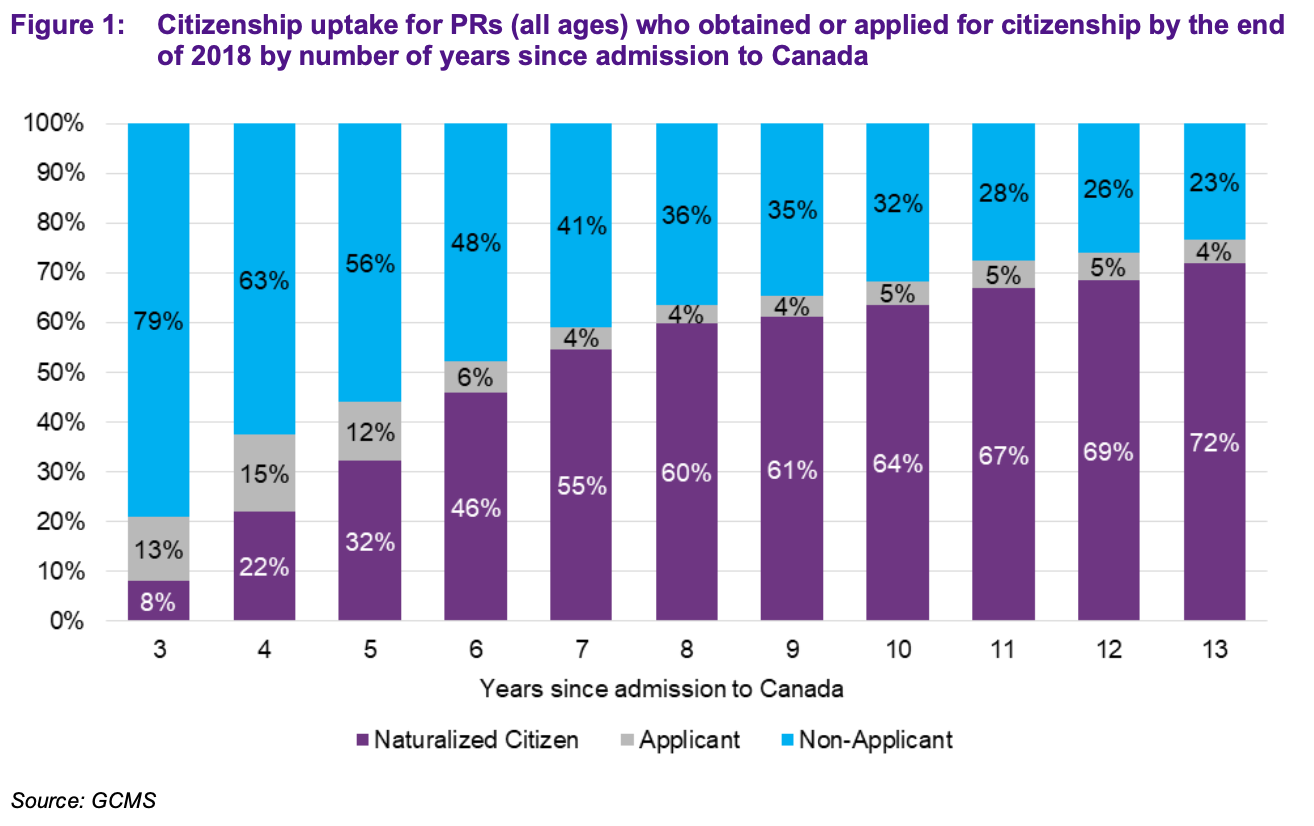
Found it somewhat amusing that the evaluation included a similar trend chart to one I shared a number of years ago to provoke some needed discussion, and one that I refined to provide a more accurate picture thanks to the advice of some former IRCC colleagues.

Interestingly, in the management response to the fee issue, no mention was made of the government’s election platform commitment to waive citizenship fees entirely but softer commitments to:

Action 1a: As part of IRCC’s review of citizenship fees, bring forward a plan to EXComm to address affordability.

Action 1b: Bring forward a plan for a free or low-cost option citizenship-specific language test based on the Canadian Language Benchmarks and work toward adding it to the list of acceptable evidence.

There is a wealth of data and analysis contained in the evaluation, including application data which is not published as part of the monthly operational statistics on opendata along with informative surveys on reasons for applying for citizenship:

4.1.1 Overall uptake

Canada has one of the highest naturalization rates among Western countries. Citizenship research based on census data shows that Canada’s naturalization rate (i.e., the proportion of PRs who become citizens) increased from about 81.6% in 1991 to 86.3% in 2016. However, the rate among more recent immigrants (five to nine years in Canada) declined, suggesting that immigrants are taking longer to become citizens.

Research based on Census data allows for the study of citizenship uptake over a longer period of time (30 or more years), but is less robust as it is based on self-reporting, and does not consider the immigrant’s decision to apply for citizenship as part of uptake process. The decision to apply is also a valid proxy of desire for citizenship. It does not exclude individuals with an interest whose applications are refused, or those who may be delayed in obtaining it due to limitations with IRCC’s application processing capacity. With this in mind, the evaluation examined citizenship uptake using administrative data from GCMS, and looked at the initial uptake of PRs admitted to Canada between 2005 and 2015, who had obtained or applied for citizenship by the end of 2018.

Overall, the analysis found that citizenship uptake was 57% for this population, with 50% of PRs having become citizens, and 7% having applied. The analysis also showed that the more years in Canada, the greater the percentage of PRs who had obtained or applied for citizenship (Figure 1). Citizenship uptake ranged from 21% after 3 years in Canada as a PR (2015 cohort) to 76.5% after 13 years in Canada as a PR (2005 cohort).

4.1.2 Challenges related to fees

Finding: The citizenship application fee is a common challenge for permanent residents, particularly refugees, families and those with lower income.

Sections 31 and 32 of the Citizenship Regulations deal with the structure of two fees related to citizenship: the Fee for Right to be a Citizen, and the Fee for Application to be a citizen. The Fee for Right to be a Citizen is payable only by applicants aged 18 years or older, at a cost of $100. The Fee for Application varies from $100 for minor grant applications, to $530 for adult grant applications.Of note, these fees do not account for extraneous costs related to applying for citizenship that applicants may incur.

The adult grant application fee increased twice during the evaluation period.A review of citizenship grant application data did not reveal a significant decrease in the volume of applications received after these changes were implemented.Interviews also suggested little to no impact of these changes overall, but pointed to possible challenges for vulnerable people, like refugees.

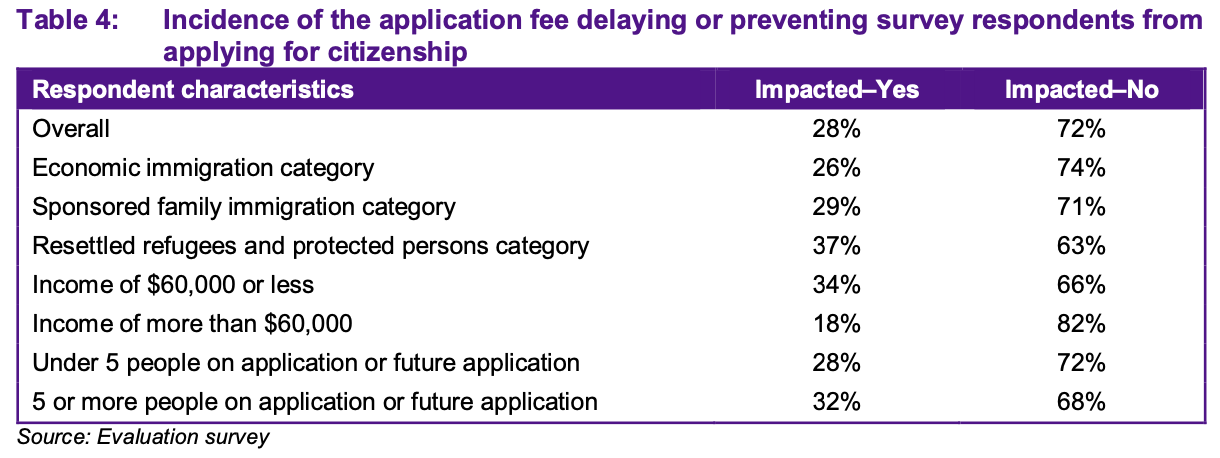
Evaluation survey results were consistent with interview findings. While many respondents did not indicate a problem with the application fee, 28% indicated that it had delayed or was preventing them from applying for citizenship at the time of the survey. This percentage was greater for resettled refugees and protected persons, respondents with a personal income of $60,000 or less, and those with 5 or more people on their application (or future application) (Table 4). Moreover, about half of evaluation survey respondents who had not applied for citizenship felt a lower application fee would encourage them to apply.

Census-based research also showed evidence of a more pronounced decline in naturalization among recent immigrants (5 to 9 years in Canada) with low family income. Findings from the interviews and focus groups with PRs suggested that economically disadvantaged newcomers, such as those who are unemployed, are not able to afford the costs associated with applying (e.g., costs associated with third-party language testing). Moreover, the fear of being unsuccessful in an application (e.g., not passing the knowledge test) and losing the applications fees (or paying to reapply) was also noted in the focus groups with PRs and program-led consultations on Discover Canada.  The impact of the fees was also thought to be amplified for larger families with multiple applications.

Citizenship test and study guide:

Interviews generally noted that the test is efficient, easy-to-grade, and objectively scored. However, the language level of the test and study guide was viewed as higher than the language requirement. Moreover, the evaluation observed that the two requirements involve different skills. The official language criteria are based on oral communication skills (speaking and listening), while the knowledge test is generally written and requires reading skills. Although applicants can access an audio version of the study guide and an oral knowledge hearing, this does not address comprehension challenges related to language level.

Program-led consultations on Discover Canada (to update the study guide) also found that the language level can be difficult for many newcomers. Similarly, research findings suggested challenges with the approach, as the knowledge test pass rate dropped sharply for applicants (18- 54) after the Discover Canada study guide was introduced – from about 96% to 83.5% in 2011. Consultation findings highlighted a need for the wording and tone to be more inclusive and easier to understand, and included suggestions for the use of plain language and definitions, having less text and more visuals, and providing additional tools and support to increase accessibility and effectively communicate the information in the study guide. As a result of these consultations, a new approach, including a new guide and additional tools, is being developed to help address these concerns, but it had not yet been implemented at the time of the evaluation.

Source: https://www.canada.ca/content/dam/ircc/documents/pdf/english/corporate/reports-statistics/evaluations/e1-2018-citizenshipprogram-eng.pdf

Green: Canada should revive the investor immigrant program and fix its past failures

Not aware of any studies that show meaningful benefits from investor immigration programs in OECD countries. Green is notably vague with respect to how he proposes to “fix its past failures” beyond increasing the investment threshold. The IRCC evaluation was devastating (https://www.google.com/url?sa=t&rct=j&q=&esrc=s&source=web&cd=&cad=rja&uact=8&ved=2ahUKEwjN2Z6D2qDtAhX8GFkFHWXyCD4QFjAAegQIAxAC&url=https%3A%2F%2Fwww.canada.ca%2Fcontent%2Fdam%2Fircc%2Fmigration%2Fircc%2Fenglish%2Fpdf%2Fpub%2Fe2-2013_fbip.pdf&usg=AOvVaw2KiDUWqxbDR2xBXtujZnYm) and census data indicates the median incomes based on tax data to be minimal and lower than refugees. Quebec’s comparable program largely serves as a backdoor entry to other parts of the country:

From the earliest days of Confederation, immigration has been essential to Canada’s evolution and identity as a country. The labour – and tax dollars – of successive waves of people from around the world have supported universal health care, pension plans, education, national infrastructure, and the creation of small businesses and employment.

The economic stress caused by a global pandemic, on top of the dual realities of an aging population and a slow-growing population, make immigration more important than ever. It is also an opportune time for Canada to revive the investor immigrant program that was terminated in 2014, with a view to integrating it into our long-term economic strategy.

The federal government has clearly flagged that expediting immigration to Canada is a priority over the next several years.

In addition to setting a target to welcome 401,000 permanent residents in 2021, Ottawa recently made it easier for Hong Kong students and youth to quickly come to Canada on work and study permits, as well as offering new ways to stay permanently. The new permanent residence rules will also benefit people from Hong Kong already in Canada under existing work and study permits.

Then there’s the 300,000 Canadian citizens living in Hong Kong, many of whom, in light of recent political developments there, may be contemplating a return.

Also consider that although many applications were delayed by COVID-19, most are already well down the approval pipe and will proceed quickly once embassies and visa agencies fully reopen. Ottawa has already flagged that it will work to fast-track increased admission to Canada in 2021.

For all of that, there is much more that can be done for both prospective immigrants and Canada. At the top of that list is a practical reassessment of the investor immigrant class.

In 2020, the practical benefits of reviving the program far outweigh any misplaced concern about those “buying” Canadian citizenship.

Let’s not be hypocritical: Those of us already fortunate enough to live here stand to benefit as much as anyone who is new to the country.

The key to making it work this time around is to be clear-eyed about past failures, to refine the tax structure and better manage the five-year deposits required by these immigrant investors. It does not seem excessive to increase the $800,000 fee that was required before the Harper government cancelled the program. But in the past, those deposits were directed to provinces to foster the growth of small and medium-sized enterprises – a well-intentioned initiative that never took shape.

By learning from that disappointing experience, Canada can win on several counts.

It can seize opportunity to create a COVID-19 fund to help offset the economic cost of the coronavirus and attract immigrants who have the means to make a big difference in short order.

It can also attract a group of educated and financially secure immigrants who, along with their families, will make a lasting contribution to our economy. It is also an opportunity to bring regional and local governments into the process to ensure the funds are put to the best use.

Nowhere would that difference be felt more immediately than in the stabilization of the domestic residential real estate market, small business and employment, something of great importance to all Canadians and their families.

For some time now, there have been claims that housing markets, especially condominiums in urban centres, are threatened by an imbalance of supply and demand.

That’s a tough prospect for municipalities and provinces that have already been economically ravaged by the effect of the coronavirus.

Higher immigration levels – especially in the economic class – address this on a number of levels.

Furthermore, while much has been made of the pandemic-driven urban exodus, new Canadians tend to gravitate to and revitalize our cities.

Immigration is an important way for Canada to build long-term economic, social and cultural bridges around the world. Does anyone think it will be anything but beneficial to our relations with Washington that vice-president-elect Kamala Harris had such a positive experience as a student in Montreal?

We have always been justifiably proud of being a country of immigrants. Clearing the 2020 backlog, expediting new permanent residency applications and reinstating the investor immigrant class is both timely and strategic at a time when we need to reinforce our country as seldom before, and to ensure the long-term prosperity of all Canadians.

Green is a Managing Partner at Green and Spiegel and past chair of the Canadian Bar Association, National Section, Citizenship and Immigration

Source: https://www.theglobeandmail.com/business/commentary/article-canada-should-revive-the-investor-immigrant-program-and-fix-its-past/

Krauss: Why Is Scientific Illiteracy So Acceptable?

Good question and discussion:

In the mid-1980s, when I taught a Physics for Poets class at Yale University, I was dumbstruck when I gave the students a quiz problem to estimate the total amount of water flushed in all the toilets in the US in one 24-hour period and I started to grade the quiz. In order to estimate this, you have to first estimate the population of the US. I discovered that 35 percent of my Yale students, many of whom were history or American studies majors, thought the population of the US was less than 10 million! I went around campus interrogating students I met, asking them what they thought the population of the US was. Again, about one-third of the students thought it was less than 10 million and a few even thought it was greater than a few billion.

How was such ignorance so common in a community commonly felt to contain the cream of the crop of young US college students?

Then it dawned on me. It wasn’t that these students were ignorant about US society. It was that they were rather “innumerate,” as the mathematician John Allen Paulos had labeled it in a book he wrote in the 1980s. They had no concept whatsoever of what a million actually represented. For them, a million and a billion were merely both too large to comprehend.

It remains a badge of honor for many who like to describe themselves as highly cultured or artistic to describe themselves as mathematically challenged, or to say that their brains aren’t wired for mathematics. Because many of those they hold in high esteem have made similar claims, there is no real social penalty to them for doing so.

When it comes to science rather than mathematics, it isn’t so simple. Proudly proclaiming scientific illiteracy is not de rigueur. Instead another refrain has recently become popular among politicians and public figures: “I am not a scientist, but…” Equally prominent, is the statement “I believe in science” (as if there is a choice) which is then followed by some scientific gibberish.

Science fiction writer Philip K. Dick once said, “Reality is that which continues to exist even when you stop believing in it.” The line between being scientifically or empirically controversial vs being politically controversial has been blurred to the point of erasure. In Washington, and many other seats of government throughout the world, belief trumps reality.

Different aspects of the problem were on display recently during the confirmation hearings of Amy Coney Barrett. When asked by Louisiana Sen. John Kennedy about her views on climate change, she said: “You know, I’m certainly not a scientist,” and added, “I have read things about climate change—I would not say I have firm views on it.” Later, following questions from Kamala Harris about whether she acknowledged a relationship between smoking and cancer, and whether the coronavirus is infectious, both of which she answered in the affirmative, she was asked, “And do you believe that climate change is happening and is threatening the air we breathe and the water we drink?” Coney Barrett responded, “I will not do that. I will not express a view on a matter of public policy, especially one that is politically controversial…”

It would have been appropriate for Justice Coney Barrett to argue in both cases that the confirmation hearing was not an appropriate place to discuss her scientific expertise but rather her legal expertise. However, that is different than claiming, as she did, to have insufficient knowledge of the issue to possess any viewpoint at all.

In this, and all areas where scientific evidence is both public and sufficiently overwhelming, public figures who even feign ignorance for reasons of political expediency should be called out. In her second exchange, having established her bona fides regarding the science of smoking or the coronavirus, an appropriate response from Justice Coney Barrett to Harris’s last question might have been to answer that yes, climate change is a scientifically established fact, but that she was not going to be roped into commenting on related controversial public policy questions.

By the same token Senator Harris’s last question reflects a pseudo-religious “I believe in science but I don’t need to think about what it actually means” mantra. Climate change, which is happening, presents numerous potential threats, but not to the air we breathe, as if it were akin to industrial pollutants.

I raise this point, which may seem like mere semantics, because we have to encourage intelligent and literate discourse from both sides of the aisle. Inappropriate claims like this by politicians who want to be on the right side of science but who can’t be bothered to think about what it implies don’t help. Rather they encourage rational skeptics and irrational deniers alike to reject the actual science by dismissing the statements of those who claim to defend it. Similarly, it also helps encourage a distrust of scientists.

I wrote my new book, which presents the fundamental science behind climate change, in part to specifically respond to this sorry state of affairs. Outrageous denials, or outrageous doom and gloom predictions equally subvert the ultimate goal, which is to develop rational public policy. Gaining a perspective of the fundamental science, which I would argue is not beyond the grasp of a Supreme Court Justice, or a United States Senator soon to be Vice-President, is a precursor to proposing rational policies to address one of the most significant global challenges of the 21st century.

I should underscore that when I discuss scientific illiteracy, I am not focusing on how many scientific facts people may remember. I rather mean the process of science: empirical testing and retesting, logical analysis, and drawing conclusions derived from facts and not hopes. The impact of increased CO2 on heat absorption in the atmosphere is something that can be tested, as can the expansion coefficient of water as heat is added, one of the key factors affecting measured sea level rise. Accepting the reality of these is not something that should disqualify you from, or assure you of, a government appointment.

An equally pernicious misunderstanding of the scientific process involves confusions about uncertainty, as we are witnessing with the current pandemic. Epidemiology is a very difficult part of science because it often relies on sparse data that is very hard to accumulate. Like all aspects of science, the conclusions one draws are only as good as the data one has. Yet, politicians and the public alike have often accepted sweeping claims about the perceived lethality or transmissibility of COVID-19 well before appropriate data has been available. Donald Trump was at one extreme, but others who exploited for political reasons early predictions that millions would die usually did not qualify their remarks with either a reasonable estimate of uncertainties, or with the proviso that this dire prediction was for a world where no ameliorative actions were taken.

It is possible, and indeed I expect likely, that we will not have firm knowledge about the details of its lethality or transmissibility for years, or at least until after the current pandemic is over. And even then, uncertainties will remain. This issue has recently taken on a more personal aspect for me, as I write this while convalescing from what appears to be COVID-19. (Thanks to the vagaries of the US healthcare system, and the recent surge of cases, the results of my test will take seven days to arrive, by which time I am hoping to be well on the way to recovery.)

When it comes to public perceptions of medical or scientific prowess, I blame in part science fiction programs on television or in feature films that give the illusion that faced with a technical problem, sufficiently talented scientists and engineers can both ascertain the cause and create a solution in hours instead of years or decades. That is just not the way science often works. Most important scientific developments are not revolutionary. More often than not they are baby steps taken along a long road of discovery. The recent announcement of two new COVID vaccine efficacies has been remarkable, so that perhaps by the end of 2021 most people will be vaccinated. But while two years is lightning speed in this area, many people remain surprised that it has taken this long.

Fewer people may proudly proclaim their scientific illiteracy than their innumeracy, but our cultural role models nevertheless often openly express their lack of comfort with questions that you shouldn’t have to be a scientist to understand or appreciate. I saw it when I taught at Yale, and I saw it in the Senate confirmation room. It is considered quaint to say something like, “my mind just doesn’t work that way” when it comes to science, as an excuse to stop thinking. But we wouldn’t accept that statement so easily if the question related to Shakespeare’s contributions to literature, or the historical impact of the Holocaust.

The Enlightenment was well-named because it led to a greater understanding of ourselves, our society, and our environment, and was accompanied by the rise of the scientific method. Acting for the common good requires subjecting our own ideas to empirical scrutiny, being open to considering and empirically testing the ideas of others, and letting empirical data be the arbiter of reality. The most compelling reason that all of us, most importantly our public figures, should take science seriously, and honestly, was expressed best by Jacob Bronowski, a personal hero who exemplified the union of the two cultures of science and humanities:

Dream or nightmare, we have to live our experience as it is, and we have to live it awake. We live in a world which is penetrated through and through by science and which is both whole and real. We cannot turn it into a game simple by taking sides.

Lawrence M. Krauss is a theoretical physicist and president of The Origins Project Foundation. He was Chair of the Board of Sponsors of the Bulletin of the Atomic Scientists from 2007–2018. His newest book, due out in January, is The Physics of Climate Change. 

Source: Why Is Scientific Illiteracy So Acceptable?

Apex Capital Partners Launches Discounted Citizenship by Investment Program for Concerned Citizens Following Flood of Inquiries from Conservative Americans Looking to Relocate Abroad After Biden’s Presidential Victory

Almost funny but reflects a certain mindset (don’t recall any similar pitches from citizenship-by-investment firms targeted at Democrats following Trump’s election (the Cape Breton site encouraging Americans was more a welcome site):

 Apex Capital Partners, a boutique financial advisory firm specializing in advising international individuals and governments on Citizenship by Investment Programs (CIPs), today announced the availability of its “American Second Passport Program,” a new option intended for US citizens who are concerned with the country’s direction under President-Elect Joe Biden, and are now serious about moving abroad. Ultimately, CIPs provide individuals and their families with the legal means for acquiring second citizenships, passports and permanent residency in other countries, often in the Caribbean or Europe.

Apex Capital Partners typically receives approximately five inquiries from American citizens per year but is now hearing from numerous concerned citizens on a daily basis, experiencing a 650% increase in interest since the November 3rd election alone, when compared to 2019. This comes as no surprise, as leading up to the election the team has been inundated with requests from high net worth individuals, particularly conservatives, seeking to relocate abroad should now President-Elect Biden emerge victorious. Now, the Company is offering 35% off its American Second Passport Program until January 20, 2020 – Inauguration Day.

Many Americans are now very concerned about proposed significant increases to their income tax payments, as well as continued social unrest. Further, this year’s “American nightmare” fueled by COVID-19 has resulted in very restricted travel for Americans, limiting recreational or business trips for anyone possessing just a US passport. For these reasons, citizenship by investment in other parts of the world is widely considered a safe, financially secure passport diversification option.

Americans concerned by a Biden administration are turning to Apex Capital Partners, a leading, internationally recognized Company that works directly with both international governments and those pursuing citizenship abroad to implement strategies needed to acquire foreign citizenships. These alternative citizenship opportunities are made possible through CIPs, a legal transaction in the form of a real estate or infrastructure investment in exchange for citizenship, in countries such as the Caribbean and Europe – with popular examples such as St. Kitts and Nevis, Saint Lucia, Dominica, Grenada and Montenegro.

“CIPs are especially valuable now for three key reasons. One, with an alternative to a US passport, travelers and business executives can bypass the current travel COVID 19 restrictions in place. Two, people can reside in a safe, unthreatened place amid shaky US social and political conditions that they perceive are dangerous. Lastly and right now the most popular reason, is that citizenship abroad enables for more financial security and often reduced taxes – a concern felt by many conservatives and HNWI,” said Nuri Katz, Founder of Apex Capital Partners.

Interest to leave the country after Biden’s victory has also been expressed publicly to the nation by none other than President Trump himself, who recently suggested “maybe I’ll have to leave the country.” Prior to the outcome of the 2016 Election, many liberal individuals and families across the country threatened to leave if Trump was elected. Some people left, while many more turned to social media to state their displeasure with Trump’s administration. Four years later, the same trend came during the first 2020 presidential debate, when Google searches for “move to Canada” greatly spiked.

“Talk about leaving the country after an election outcome is certainly not new, but we’re now seeing it become a reality after such a difficult year. In 2017, around 5,000 people internationally obtained CIPs, but this year I estimate it to be 25,000,” said Katz. “Despite all the potential and personal reasons for wanting to leave the United States, it is still a very difficult decision and should be conducted with an experienced team of migration advisors as well as tax and legal professionals. Using a network of legal advisors, our team informs investors on viable options to seek citizenship and evaluate all financial consequences. Throughout this process, we’re here to help answer any and all questions.”

About Apex Capital Partners

Apex Capital Partners is a full-service advisory firm specializing in investment consulting and wealth management for a multinational, high-net-worth clientele. APEX provides services with end-to-end execution in areas such as second citizenship and immigration, wealth and asset management, financial services, and international real estate sale and development.

For more than two decades, APEX consultants have guided affluent individuals and their families through the complexities of foreign investing, and of obtaining second citizenship and residency. The APEX team also advises governments in establishing Citizenship by Investment programs, and provides support services to financial institutions, law firms, and family offices representing the interests of high-net-worth investors. For those interested in pursuing a citizenship by investment opportunity, please contact Apex Capital Partners by visiting http://apexcapital.partners/

Source: Apex Capital Partners Launches Discounted Citizenship by Investment Program for Concerned Citizens Following Flood of Inquiries from Conservative Americans Looking to Relocate Abroad After Biden’s Presidential Victory

Australian Multiculturalism in 2020

Based upon the speech by Acting Minister for Immigration, Citizenship, Migrant Services and Multiculturalism Alan Tudge. Surprising no mention of racial disparities in terms of economic outcomes and COVID-19, as well as more explicit anti-immigration and anti-multiculturalism rhetoric:

There are few government policies that have survived, despite numerous challenges, for 40 years. Australian multiculturalism is, fortunately, one of them.

A speech delivered in August by Acting Minister for Immigration, Citizenship, Migrant Services and Multiculturalism Alan Tudge, was a solid restatement of Australia’s long-term commitment to multiculturalism. 

This commitment promotes the same values that have held multiculturalism strong under both Coalition and Labor governments, including the insistence that all Australians uphold responsibilities to the state and society, such as respect for the rule of law and mutual tolerance. These commitments are coupled with the rights of individuals to maintain ties to their faith, language or national group. Australian multiculturalism also focuses on spreading core values of democratic participation, free speech and free association, and gender equality, as well as a commitment to learning the English language. This combination has seen Australia described by many as “the most successful multicultural country in the world.”

“Our social cohesion is particularly remarkable given the size and diversity of our migrant intake. There are people from every single country on earth living here,” Tudge emphasised during his National Press Club address.

Nonetheless, as Tudge acknowledged, it is also true that Australia’s multiculturalism has been facing significant challenges. Some of those challenges have been overcome, others are being addressed, still others are emerging. 

What has been common to all these challenges so far is a willingness by government, not-for-profit groups, academics and community leaders to recommit to multiculturalism, while working towards its improvement. This willingness must continue.

Tudge outlined four significant contemporary challenges to Australian multiculturalism: coronavirus, foreign interference, lower levels of English language adoption by some migrants, and technology.

For some commentators, these challenges are too significant to overcome. Some have charged that Victoria, in particular, is crumbling under “toxic multiculturalism” and that this has somehow caused the spread of coronavirus. 

This can lead to charges that Australia should be trying harder to assimilate migrants. But the idea of assimilation, where, as Tudge said in 2018, “we must abandon our cultural and religious heritage and all become the same,” is illiberal and impinges on people’s freedom to express their identity. Australian multiculturalism has always favoured an approach based on integration – whereby Australians are encouraged to maintain cultural and religious traditions associated with their heritage, if they wish, but also expected to adapt to and seek to be a part of mainstream Australian economic, social and occupational life. 

Other critics argue multiculturalism has not gone far enough. Despite being official policy for so many decades, multicultural Australia is not yet reflected in the media and leadership positions, they argue. For example, all of Australia’s prime ministers have been of Western European, Christian background. These critics sometimes advocate affirmative action or similar policies.

While there are certainly challenges, Australian multiculturalism has absorbed the impacts of significant global challenges. It has previously dealt with foreign interference, albeit on a smaller scale, while the challenges of migrants learning English and participating in the economy are long term ones. Technology is a modern minefield, but can provide solutions as well as challenges.

Coronavirus 

As a result of coronavirus, lockdown measures have restricted participation in important community rituals – such as collective religious worship or meetings of volunteer groups. The economic hit caused by coronavirus and its effect on employment have also affected Australia’s social fabric. As Tudge said, “we know that when unemployment rises, sentiment towards migrants can deteriorate.”

But this is not the first global event to impact Australia’s robust multiculturalism. Take the 9/11 terror attacks and the world they created once many populations realised they were a target of fanatical Islamists. 

In the 2000s and into the 2010s, Australians worried about the likelihood of a large-scale terrorist attack in Australia. This was felt acutely by many groups, including Australian Muslims.

Research conducted by Anne Aly (then an academic and now a Member of Parliament) and Mark Balnaves in 2007 showed Muslim Australians had even higher levels of anxiety than other Australians about the impact of terrorism. The researchers wrote “Muslim participants expressed that they felt they were being targeted by the media and by politicians and that the media frequently identified them as terrorists.”

Fast forward to 2020, and the origins of COVID-19 in the Chinese city of Wuhan led to reports of racism and threats against people of Chinese origin in Australia and elsewhere. A report by Human Rights Watch in May noted that there was a rise in both racist rhetoric and racist attacks against Asian people. 

In the months and years following the September 11 attacks, in Australia at least, the Government focussed on protecting the entire community from terrorism, Australian Muslims included. Civil society responded with many attempts at interfaith outreach in Australia.

During 2020, the Government has responded promptly to challenges to multiculturalism brought on by coronavirus. Tudge publicly condemned anti-Chinese racism, saying “racist attacks have no place in Australia. It is not the Australian way.”

His opposition counterpart Andrew Giles called for an anti-racism campaign and Tudge and Giles then co-sponsored a motion in the House of Representatives condemning attacks on Chinese Australians. 

“Racism threatens this and it undermines our social cohesion,” Giles told Parliament. “It was the Chinese-Australian community that first felt the waves of this coronavirus crisis. They felt it affecting their communities before it affected the wider community. The leadership that they have shown is something that I am deeply appreciative of, and I’m sure all members who represent Chinese-Australian communities would share that sentiment.”

The Government also responded with an advertising campaign, in Tudge’s words, “to call out racism, to reinforce the Government’s support to the Chinese and indeed the Asian Australian community.”

While none of these measures address the potential weakening of community cohesion that has taken place due to the necessary closure of places of worship, communal institutions and meeting rooms, there have been serious attempts by Australian leaders to address challenges to multiculturalism during the coronavirus pandemic.

Foreign interference

Foreign interference is not a new phenomenon in Australia – in fact Australia’s intelligence agency, ASIO, was founded in 1949 in response to Soviet espionage activities. The idea that foreign interference is a potential threat to Australian multiculturalism is, however, a contemporary development, as is the source of interference. Informed commentators accuse China of significant interference, with Russia and Iran also reported to have infiltrated Australian institutions, public and private. 

Once again drawing on the post-September 11 comparison, Lowy Institute non-resident fellow Anthony Bubalo wrote, “In the same way that al-Qaeda wants Muslims to doubt they will ever be accepted by non-Muslims, the CCP [Chinese Community Party] wants the Chinese diaspora to owe its first loyalty to Beijing.”

Bubalo reported that some Australians of Chinese origin believed that the Government’s focus on Chinese foreign interference felt menacing. In response, he suggested the Government might focus on taking lessons from the post-September 11 experience in managing social cohesion; using “precise language” to differentiate between Chinese people and the CCP; and for leaders to attempt to “define the boundaries of acceptable debate.”

The Government’s approach to dealing with this challenge has been a practical one. Under previous prime minister Malcolm Turnbull, foreign interference legislation was passed and a foreign influence register introduced. 

While expressing sympathy to those in diaspora communities who have been exploited, threatened or intimidated by the government or loyalists of their former homeland, Tudge linked more free English language tuition to the challenge of foreign interference. 

“Malign information or propaganda can be spread through multicultural media, including foreign language media controlled or funded by state players. This can be particularly influential if local residents’ English is poor and hence they are more reliant on foreign-language sources,” Tudge said.

Whether this dual approach, of more English tuition on one side and enhanced law enforcement on the other, is sufficient to tackle the CCP’s reach into diaspora communities in Sydney and Melbourne, or to prevent intervention from other state-based actors, very much remains to be seen. 

English language

The centrality of the English language in ensuring the success of Australian multiculturalism has been stressed from the beginning.

There have been no recent attempts by any official body or major opinion-leader to discourage Australians using their mother tongue – a stroll through any one of Australia’s multicultural suburbs will indicate that. In fact, the bilingualism of so many Australians is a key economic advantage and according to Australia’s most recent multicultural statement, “our multilingual workforce is broadening business horizons and boosting Australia’s competitive edge in an increasingly globalised economy.” However, the primacy of learning the English language has always been emphasised in Australian multiculturalism.

Knowledge of the English language helps new Australians navigate education, employment and essential services. All Australians should be able to respond to a local job advertisement, report a crime to police, or respond to public health messages. Without knowledge of English, these simple tasks can become insurmountable challenges.

The extension of more English language classes to migrants who need additional help is a positive move by the Morrison Government and one which should strengthen multiculturalism. But in a move that attracted some criticism, the Morrison Government went one step further, announcing that people applying to stay in Australia on a partner visa will be required to either have a functional level of English, or have attended up to 500 hours of English classes. 

Again, Tudge emphasised the importance of speaking English to properly participate in Australian society – he also noted that those who did not speak English were vulnerable to family violence and other exploitation and struggled to report abuses to law enforcement authorities. Critics, including Human Rights Watch, opposed the new announcement because it would “disproportionately affect families from certain nationalities – predominantly non-Western, non-English speaking countries – and those who find learning a new language difficult”.

Technology

In his speech to the National Press Club, Tudge quoted former chief Rabbi of the Commonwealth Lord Jonathan Sacks – who passed away in November – on the influence of technology in spreading what would have previously been local tensions far beyond local shores. 

The challenge to multiculturalism posed by Australians playing out historic enmities in their new home is not new – consider the ethnic-based fan violence at Australian soccer matches in past decades. However, technology – including, but not confined to, social media – has supercharged this effect.

The most extreme example of this is the role technology is playing in the recruitment of terrorist sympathisers, and even terrorists themselves. These terrorists and their supporters – whether they are Islamist or from the far-right – are a threat not just to national security, but to multiculturalism.

Home Affairs Minister Peter Dutton said that since the Christchurch attack, when an Australian man apparently radicalised online committed and broadcast a massacre at two mosques in New Zealand, “the Australian Government has taken a number of steps to limit Australians’ and our exposure to terrorist and extreme violent material online.”

At the less violent, but still dangerous, end of the spectrum, technology is fragmenting media audiences. Where once the broadcast news on the radio or TV was the main source of mass communication, now a University of Canberra report indicates that one in five Australians prefer news that confirms their own worldview. This type of content is readily found on social media, the preferred source of news for 52% of Australians, according to the Digital News Report: 2020.

Why is this a problem? There is no gatekeeper for the publication of news on the internet: no editorial guidelines, no Press Council guidelines, no Australian Communication and Media Authority oversight. People can – and do – publish what they want online and those with low levels of media literacy may not be able to distinguish between real and fake news. In addition, social media algorithms tend to reward scandalous or controversial content – often allowing it to reach more people, than fact-based, considered reporting.

Viewing only news that is consistent with one’s own worldview and being effectively led by social media platforms to consume salacious news content ahead of fact-based reporting create an ongoing threat to multiculturalism. These phenomena deny us the chance to learn about those different from ourselves in a positive way. They prioritise dominant stories over the marginalised, and can create enmity toward disfavoured groups by presenting news about them in a distorted and unbalanced way. And they may relegate fact-based reporting to the history books. 

There is no easy fix. However, there are important things everyone can do. First, pressure social media organisations to review their algorithms to promote credible sources over “fake news”. Second, lobby these same companies to remove content that incites hate or violence. Finally, choose reporting by organisations that are bound by an editorial code of conduct or oversight authorities, such as the Press Council or Australian Communications and Media Authority in Australia.

Conclusion

These four fundamental challenges to multiculturalism are currently being addressed in Australia. It will be some years before we can judge the success of the relevant strategies. 

There are certainly signs of stress on Australian multiculturalism. The 2019 Scanlon Foundation Mapping Social Cohesion study found that there has been a decline by about 10% in the number of Australians who feel a “sense of belonging” over the past 10 years. That same study reported that more than one in four Muslim and Hindu Australians reported they had been discriminated against because of their skin colour over the previous 12 months. On the whole though, the Scanlon Foundation research found evidence of stability in Australia’s social cohesion.

With a Government and Opposition committed to the value and integrity of Australian multiculturalism, and with support from the community, the multicultural values that have set Australians on a largely successful path over the past 40 years can continue. 

The size and scope of these challenges should not be underestimated. Work will need to continue at all levels – from the suburban multicultural food festival that helps us get to know our neighbours, to stronger nationwide cyber-security defences.
Source: Australian Multiculturalism in 2020

Muslims have visualized Prophet Muhammad in words and calligraphic art for centuries

Of note;

The republication of caricatures depicting the Prophet Muhammad by French satirical magazine Charlie Hebdo in September 2020 led to protests in several Muslim-majority countries. It also resulted in disturbing acts of violence: In the weeks that followed, two people were stabbed near the former headquarters of the magazine and a teacher was beheaded after he showed the cartoons during a classroom lesson.

Visual depiction of Muhammad is a sensitive issue for a number of reasons: Islam’s early stance against idolatry led to a general disapproval for images of living beings throughout Islamic history. Muslims seldom produced or circulated images of Muhammad or other notable early Muslims. The recent caricatures have offended many Muslims around the world.

This focus on the reactions to the images of Muhammad drowns out an important question: How did Muslims imagine him for centuries in the near total absence of icons and images?

Picturing Muhammad without images

In my courses on early Islam and the life of Muhammad, I teach to the amazement of my students that there are few pre-modern historical figures that we know more about than we do about Muhammad.

The respect and devotion that the first generations of Muslims accorded to him led to an abundance of textual materials that provided rich details about every aspect of his life.

The prophet’s earliest surviving biography, written a century after his death, runs into hundreds of pages in English. His final 10 years are so well-documented that some episodes of his life during this period can be tracked day by day.

Even more detailed are books from the early Islamic period dedicated specifically to the description of Muhammad’s body, character and manners. From a very popular ninth-century book on the subject titled “Shama’il al-Muhammadiyya” or The Sublime Qualities of Muhammad, Muslims learned everything from Muhammad’s height and body hair to his sleep habits, clothing preferences and favorite food.

No single piece of information was seen too mundane or irrelevant when it concerned the prophet. The way he walked and sat is recorded in this book alongside the approximate amount of white hair on his temples in old age.

These meticulous textual descriptions have functioned for Muslims throughout centuries as an alternative for visual representations.

Most Muslims pictured Muhammad as described by his cousin and son-in-law Ali in a famous passage contained in the Shama’il al-Muhammadiyya: a broad-shouldered man of medium height, with black, wavy hair and a rosy complexion, walking with a slight downward lean. The second half of the description focused on his character: a humble man that inspired awe and respect in everyone that met him.

Textual portraits of Muhammad

An early image showing Prophet Mohammed appointing his cousin and son-in-law Ali as his successor in an an Islamic miniature from A.D. 1307. The work is attributed to Rashid al-din Fadlallah. Photo by Archiv Gerstenberg/ullstein bild via Getty Images

That said, figurative portrayals of Muhammad were not entirely unheard of in the Islamic world. In fact, manuscripts from the 13th century onward did contain scenes from the prophet’s life, showing him in full figure initially and with a veiled face later on.

The majority of Muslims, however, would not have access to the manuscripts that contained these images of the prophet. For those who wanted to visualize Muhammad, there were nonpictorial, textual alternatives.

There was an artistic tradition that was particularly popular among Turkish- and Persian-speaking Muslims.

Ornamented and gilded edgings on a single page were filled with a masterfully calligraphed text of Muhammad’s description by Ali in the Shama’il. The center of the page featured a famous verse from the Quran: “We only sent you (Muhammad) as a mercy to the worlds.”

The Hilye-i Serif, by Hafiz Osman, 17th century. A calligraphic verbal description of Mohammed. Topkapi Palace Library, Istanbul. Hafiz Osman (1642–1698), via Wikimedia Commons

These textual portraits, called “hilya” in Arabic, were the closest that one would get to an “image” of Muhammad in most of the Muslim world. Some hilyas were strictly without any figural representation, while others contained a drawing of the Kaaba, the holy shrine in Mecca, or a rose that symbolized the beauty of the prophet.

Framed hilyas graced mosques and private houses well into the 20th century. Smaller specimens were carried in bottles or the pockets of those who believed in the spiritual power of the prophet’s description for good health and against evil. Hilyas kept the memory of Muhammad fresh for those who wanted to imagine him from mere words.

Different interpretations

The Islamic legal basis for banning images, including Muhammad’s, is less than straightforward and there are variations across denominations and legal schools.

It appears, for instance, that Shiite communities have been more accepting of visual representations for devotional purposes than Sunni ones. Pictures of Muhammad, Ali and other family members of the prophet have some circulation in the popular religious culture of Shiite-majority countries, such as Iran. Sunni Islam, on the other hand, has largely shunned religious iconography.

Outside the Islamic world, Muhammad was regularly fictionalized in literature and was depicted in images in medieval and early modern Christendom. But this was often in less than sympathetic forms. Dante’s “Inferno,” most famously, had the prophet and Ali suffering in hell, and the scene inspired many drawings.

These depictions, however, hardly ever received any attention from the Muslim world, as they were produced for and consumed within the Christian world.

Offensive caricatures and colonial past

Providing historical precedents for the visual depictions of Muhammad adds much-needed nuance to a complex and potentially incendiary issue, but it helps explain only part of the picture.

Equally important for understanding the reactions to the images of Muhammad are developments from more recent history. Europe now has a large Muslim minority, and fictionalized depictions of Muhammad, visual or otherwise, do not go unnoticed.

With advances in mass communication and social media, the spread of the images is swift, and so is the mobilization for reactions to them.

Most importantly, many Muslims find the caricatures offensive for its Islamophobic content. Some of the caricatures draw a coarse equation of Islam with violence or debauchery through Muhammad’s image, a pervasive theme in the colonial European scholarship on Muhammad.

Anthropologist Saba Mahmood has argued that such depictions can cause “moral injury” for Muslims, an emotional pain due to the special relation that they have with the prophet. Political scientist Andrew March sees the caricatures as “a political act” that could cause harm to the efforts of creating a “public space where Muslims feel safe, valued, and equal.”

Even without images, Muslims have cultivated a vivid mental picture of Muhammad, not just of his appearance but of his entire persona. The crudeness of some of the caricatures of Muhammad is worth a moment of thought.

Source: Muslims have visualized Prophet Muhammad in words and calligraphic art for centuries

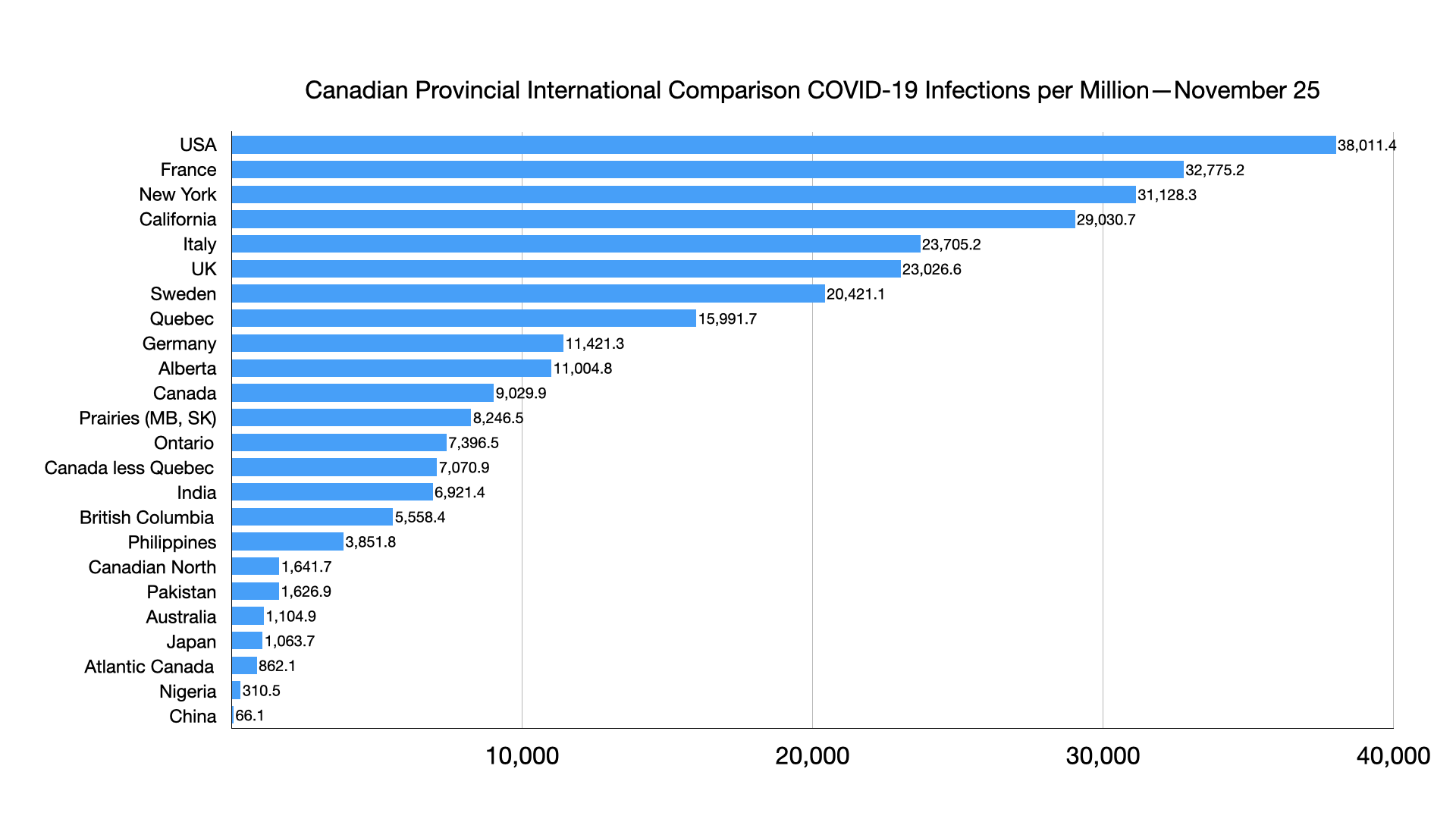
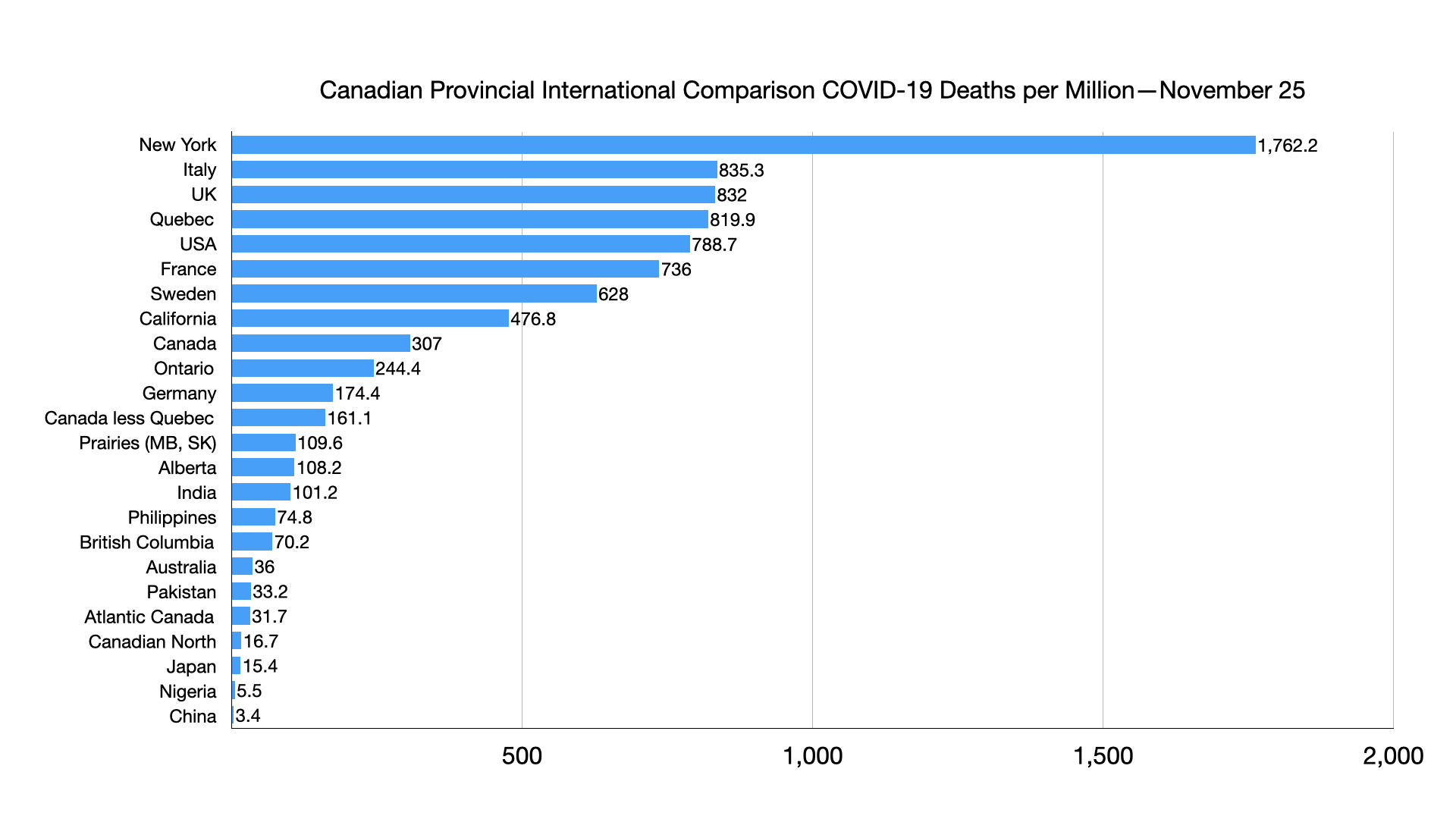
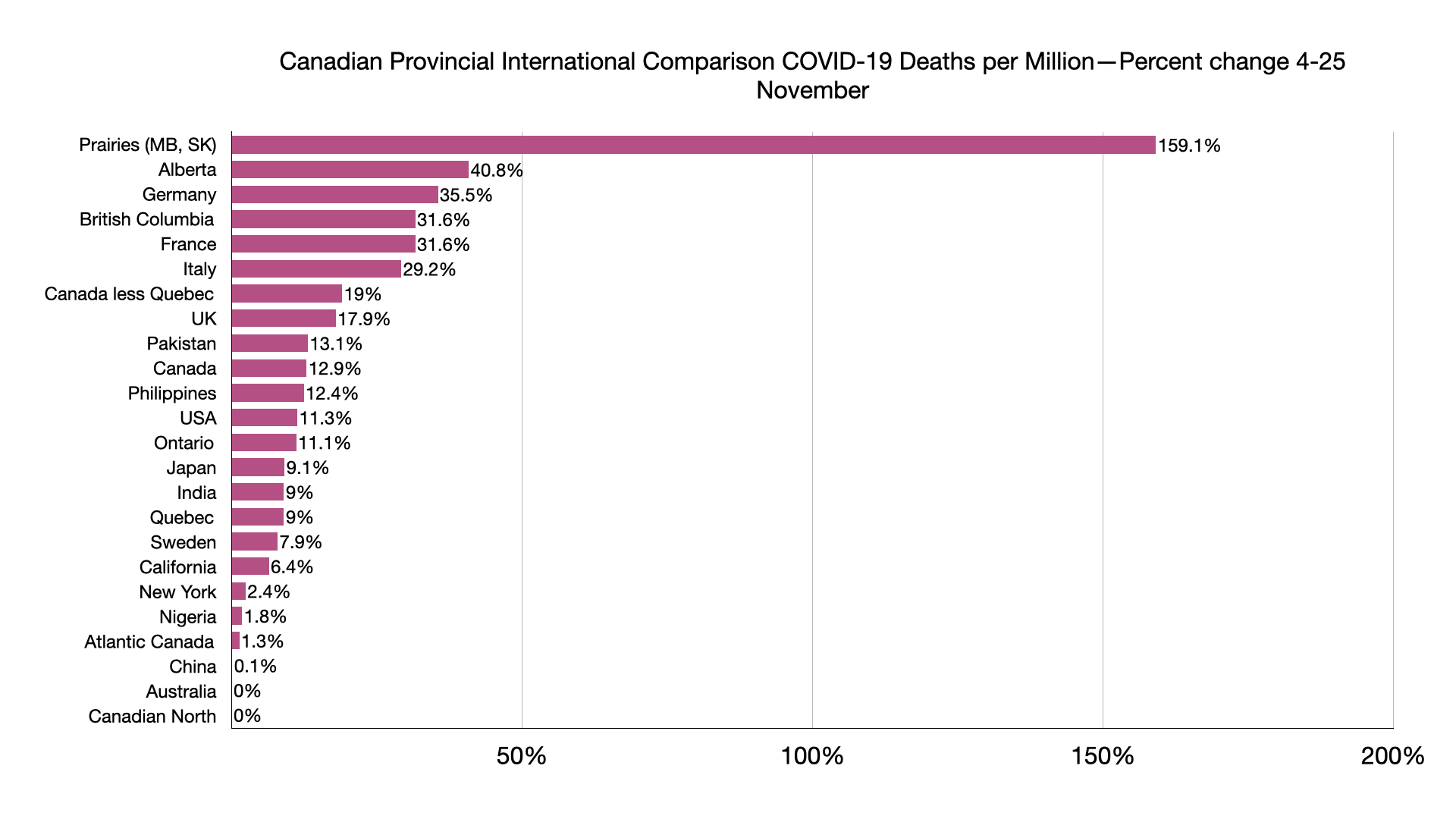
#COVID-19: Comparing provinces with other countries 25 November Update, Picard on Alberta

Main news continues to be with respect ongoing sharp spike in infections along with death rate increases:
 
Weekly:
 
Infections per million: Italy ahead of UK, Prairies ahead of Ontario, Canada less Quebec ahead of India, Canadian North ahead of Pakistan
 
Deaths per million: Italy and UK now ahead of Quebec, Prairies and Alberta ahead of India, Pakistan ahead of Atlantic Canada, Canadian North ahead of Japan
 
November 4-25 increase:
 
Infections per million: Greatest increase in Canadian North and Western provinces, moving ahead of many European countries
 
Deaths per million: Similar pattern with respect to deaths


André Picard’s critique of Premier Kenney and his government’s response to the pandemic:

Feckless.

That’s the only way to describe Alberta’s “tough” new measures.

In response to the soaring number of COVID-19 cases in the province, Premier Jason Kenney declared a “state of public health emergency” on Tuesday.

He started out with a little muscle flex, saying “no indoor social gatherings will be permitted, period.” Outdoor gatherings will be limited to 10 people.

But then we learned that restaurants will be open for in-person dining, bars will remain open, and so will casinos, gyms, stores, primary schools (Grades 7-12 are going to remote learning).

Heck you would be hard-pressed to find anything that will be closed.

Places of worship are allowed to hold services with one-third of capacity, just as they are now but “we are moving from recommendations to rules.”

Mr. Kenney also earnestly announced that masks would now be mandatory in the province’s two big cities, Calgary and Edmonton. But they already are mandatory because municipal governments have been a lot more pro-active and sensible than the province.

What we saw Tuesday was inaction posing as action, a quasi-libertarian Premier bending over backward to do nothing while pretending otherwise.

But Mr. Kenney’s true nature was revealed when he began prattling on about how he has resisted a lockdown because it would be an “unprecedented violation of constitutional rights.” He once again heralded the importance of “personal responsibility” while, at the same time, announcing rules that clearly suggest people don’t have to be very responsible.

Acting forcefully to protect citizens from the ravages of a global pandemic is not a violation of their rights. Quite the opposite.

Just hours before Mr. Kenney spoke, Nova Scotia Premier Stephen McNeil announced the closing of all restaurants, fitness and recreational facilities, libraries, museums, casinos and more for at least two weeks.

Why? Because the province had a “surge” of 37 cases. Thirty-seven. Business owners actually demanded the lockdown, saying severe rules are the only way to retain consumer confidence.

Alberta recorded 1,115 coronavirus cases on Tuesday, along with 16 deaths. And that was the lowest rate in a while, because testing is way down. In recent days, Alberta has had more cases than Ontario, which has more than three times the population.

The testing system is overwhelmed. The contact tracing system has collapsed. Hospital beds, and all-important intensive care beds in particular, are filling up fast. There are dozens of outbreaks in hospitals and care homes and schools.

Alberta’s pandemic response was great for many months – the Premier was right to underline that fact. But the harsh reality today is that public health and hospitals alike are dangerously close to losing control of the situation.

Mr. Kenney said it himself: “If we don’t slow the ER and ICU admissions, it will threaten our health system.”

But then, in the next breath, he was back to talking about how it’s essential to keep businesses open.

Who knows what the public will make of this Jekyll and Hyde discourse? The between-the-line message seems to be: It’s business as usual.

Yes, the pandemic is a blow to the economy; yes, it’s taking a toll on our mental health; yes, there is a lot of collateral damage.

But if there’s one thing we have learned – or should have learned – is that all that will continue, along with the harm of COVID-19, unless you go all-in to slow the spread of the virus.

Mr. Kenney said the “balanced approach” he has chosen will ensure that the spread of the coronavirus is interrupted while allowing businesses to remain open. But you can’t have it both ways.

The evidence from around the world is crystal clear: This approach is a fast-track to failure. Not only will the virus continue to spread, but the economy won’t flourish because people will still be scared.

Quebec has been in lockdown for more than two months – with rules that are way more strict that what Alberta is imposing – and it’s barely able to keep its COVID-19 numbers static, never mind lower them.

Does anyone seriously believe Alberta will be able to do better by essentially doing nothing?

Albertans should brace themselves because they’re in for a world of hurt in the coming weeks.

Source: https://www.theglobeandmail.com/canada/article-jason-kenneys-balanced-approach-is-a-fast-track-to-failure/

Canada has turned back 4,400 asylum seekers in 5 years

Of note. A bit less than the 55,000 or so that crossed the border:

Canada has turned away at least 4,400 asylum seekers at the U.S. border since 2016 — including some who were hoping to find refuge here at the height of the global pandemic — according to newly released government figures.

Nearly half of those trying to enter Canada over that five-year period made the attempt in the year after U.S. President Donald Trump took office, according to figures released in response to a parliamentary request from NDP MP Jenny Kwan.

Under the Safe Third Country Agreement (STCA), which has been in effect since 2004, Canada and the U.S. consider each other to be “safe countries” for refugees and require them to make their claims in the country they arrive in first.

The agreement has long faced criticism and legal challenges from refugee advocacy groups, who say the agreement is an inhumane way to limit the number of people Canada accepts as refugees. They say the U.S. is not a safe country for all refugees and that the dangers they face have increased under the Trump administration.

The federal government is appealing a Federal Court ruling earlier this year that found the STCA infringed Charter rights.

The figures provided to Kwan show there was a spike in the number of asylum seekers turned back at the border after Trump was elected in 2016 and took office in 2017.

In 2016 there were 742 people turned back at the border. That figure jumped to 1,992 in 2017. There were 744 denied entry in 2018 and 663 in 2019.

Between Jan. 1 and Sept. 23 this year — a period which captures the height of the first wave of COVID-19 — 259 people were turned back at the border.

‘Even more precarious’

Kwan called that “really disturbing.”

“In the face of a pandemic, things are even more precarious for people who need to get to safety and Canada actually did not hesitate to turn people back,” she said.Kwan said the Trump administration imposed detention and deportation policies that violated international human rights and provoked widespread fear among refugees. By turning away asylum seekers, Canada is “complicit” in the violation of their rights, she said.

Kwan said Canada should immediately suspend the STCA and work to negotiate a new agreement with U.S. president-elect Joe Biden that addresses human rights issues. But she said the “aggressive and intense” detention policies could linger.

“I think even with the Biden administration, that policy may still continue to exist, and even if the Biden administration wants to make changes, it’s not going to happen overnight,” she said.

Mary-Liz Power, a spokesperson for Public Safety Minister Bill Blair, said the government appealed the Federal Court ruling because it believes there were errors in key findings of fact and law.

She said the decision mistakenly suggests that all asylum claimants who are ineligible under the STCA and turned back to the U.S. are automatically detained as a penalty. She also noted that the U.S. remains a party to the UN Refugee Convention.

Refugee pact ‘fair, compassionate’: Blair spokesperson

“The STCA, which has served Canada well for 16 years, ensures that those whose lives are in danger are able to claim asylum at the very first opportunity in a safe country,” she said.

“We are in continuous discussions with the U.S. government on issues related to our shared border. We believe that the STCA remains a comprehensive vehicle for the fair, compassionate and orderly handling of asylum claims in our two countries.”

As for the spike in numbers in 2017, Power said that 2017-2018 recorded the highest number of globally displaced individuals since the Second World War.

Justin Mohammed, human rights law and policy campaigner for Amnesty International Canada, said a number of factors could have driven that sharp increase, including global patterns and Trump’s policies.

He said Canada should be fulfilling its international obligations under international refugee law at all times — even during a pandemic, when safety concerns are heightened.

Mohammed pointed to exemptions made for students, family reunification and other immigration classes that allow people to arrive in Canada despite travel restrictions.

“Why are refugees being excluded from that? They’re able to quarantine or be required to have a quarantine plan just like anyone else … so why is there not the ability to be able to provide protection?” he said.

Partial picture

Janet Dench, executive director of the Canadian Council for Refugees, said the 2020 figures represent only a partial picture of the people turned back to the U.S. because of added restrictions after the border closed March 20.

At that time, refugee claimants were denied entry on public health grounds whether they arrived at an official point of entry or at another crossing — such as Roxham Road in Quebec — where the STCA does not normally apply.

Despite assurances the Canadian government says it received from the U.S. that refugee claimants directed back would not be subject to enforcement such as detention or removal, Dench said refugee advocates in Canada know of at least two people who were detained in the U.S. after being directed back.

Conservative immigration critic Raquel Dancho said the Liberal record on administering the refugee and asylum system was one of “mismanagement, years-long backlogs and failure,” even before the pandemic.

“Conservatives have long been calling on the government to close illegal border crossings and work with their American counterparts to close the longstanding loopholes in the Safe Third Country Agreement so that refugee and asylum seekers have a fair, compassionate and effective pathway to come to Canada,” she said in a statement.

Source: Canada has turned back 4,400 asylum seekers in 5 years