Shame on the Globe and Mail for running Chinese government propaganda

DiManno nails it. For a paper that justifiably calls out conflicts of interest by politicians and others, some deep self-reflection in order:

This is when the Globe and Mail got it right. From the paper’s July 30 lead editorial, headlined: “The continued imprisonment of the two Michaels is an act of pointless cruelty.”

“We keep hearing that Michael Spavor and Michael Kovrig are suffering in conditions ‘akin’ to torture, but there is no such thing. Their false arrest and unjustified incarceration amount to torture, period.”

This is when the Globe and Mail got it wrong. The double-truck spread, smack in the middle of the glorified Report on Business section, on Sept. 19 — last Saturday.

Headlines include: “Tree fellers turn into tree lovers.” “University’s admissions offer out of this world.” “A chain of celestial lights to celebrate inclusiveness.”

Which, inclusivity, doesn’t include the ethnic minority Uighurs, a million interned since 2017 in at least 87 camps surrounded by watch towers and barbed wire fences within Xinjiang region — camps the Chinese government denied existed until satellite imagery put the lie to those claims.

I won’t go into details about the content of the cheerful stories published in the Globe’s prime real estate pages — I’m not the one being paid to shill — under the “CHINA WATCH” banner. Suffice to say that “CHINA WATCH” is the international propaganda arm of state-run English-language newspaper China Daily.

Only in tiny letters at the bottom of each page does it state: Content produced by China Daily and distributed in the Globe and Mail.

I’m not in the habit of calling out other newspapers, particularly since the Star has a policy of not calling out our own selves when we deserve to be boxed about the ears. But the Globe brands itself “Canada’s National Newspaper” and fancies itself the paper of record.

Now, everybody knows these are trying times for the newspaper industry. But of all the papers in Canada, the Globe and Mail is least threatened by economic hardship, owned by the Thomson family — its chairman, David Thomson, wealthiest Canadian, as per Forbes, with a net worth of $32.5 billion, as of last year. If the Globe splashes around in the red, the Thomson clan can just sell off one of its Group of Seven paintings. Not that it would ever come to that.

Further, the Globe was the first signatory in this country to The Trust Project, a global coalition of media organizations with the intent of promoting truthful, accurate, fair and transparent journalism — because journalism is under siege everywhere, lacerated as purveyors of fake news.

China Daily is fake news. China Watch is fake news. At the very least, the Globe should have made that clearer. I put the matter to the Globe brain-trust in emailed queries.

“As you point out in your questions, the China Daily pages are indeed paid advertisements,” acknowledged Phillip Crawley, Globe publisher and CEO, in his emailed response. “The content is visually distinct and had been labelled as produced by a third party (China Daily). However, we believe the pages should have been more clearly marked to reflect that it was a paid advertisement for our readers. We will explore how to make this more clear in the future.”

Crawley added: “We have run these ads occasionally for years and like all advertising, they have no impact on our editorial coverage. You can see this in our daily reporting of China, our editorials” — he cited an opinion piece regarding the arrest of Jimmy Lai — “and the excellent investigative work put out by our Asia correspondent, Nathan VanderKlippe, who is based in Beijing.”

(Lai is a long-time champion of the Hong Kong pro-democracy movement.)

Indisputably, excellent coverage of China — the Globe was the first Western newspaper to open a bureau in what was then called Peking, more than six decades ago.

But readers won’t learn the truth about Tiananmen Square in the China Daily (or China Watch), won’t be told about the horrors inflicted and ethnic cleaning inflicted on the mostly Muslim Uighurs, won’t be enlightening on the regime’s crackdown throttling of Hong Kong and certainly won’t be provided with an accurate representation of why the two Michaels were thrown in prison.

That was the China version of tit-for-tat — the regime’s ham-fisted response two years ago, scooping up the Canadian businessmen shortly after the arrest of Meng Wanzhou on a warrant from the United States. America accuses Meng, chief financial officer of Huawei, of fraud, alleging she misled the bank HSBC about Huawei’s business dealings in Iran. Meng is under house arrest in Vancouver, fighting extradition to the U.S.

On Tuesday, China again urged Canada to immediately release Meng and let her return home so as to “safely bring bilateral relations back to the right track,” according to Chinese media reports. At the daily news briefing, a government spokesperson asserted: “Under the pretext of ‘at the request of the United States,’ Canada arbitrarily took compulsory measures on a Chinese citizen, which severely violated her legitimate rights and interests.”

Prime Minister Justin Trudeau has been able to do nothing — that we know of — to secure the release of the two Michaels, after nearly two years of detention. In June, Kovrig and Spavor were charged with espionage-related offences, which is bollocks.

A whole bunch of boldface Canadians have since signed a letter urging this country to knock off the extradition proceedings against Meng, so that the Michaels can be sprung. This is hostage diplomacy — a prisoner swap, the stuff of despots and unethical governments.

And we won’t even get into the further strong-arm squabbling between China and the U.S. over China-owned TikTok and China’s pressuring of Canada to integrate Huawei technology into our 5G network.

China has invested colossally and with sophistication in propaganda supplements that have appeared in respected publications such as the New York Times, the Washington Post and the Wall Street Journal, as well as opening scores of state TV satellite bureaus around the world — all pegged to “reporting the news from a Chinese perspective.” Which means gerrymandered and self-serving. All while literally ripping out international coverage within China: foreign magazines censored, the BBC flickering to black when carrying stories on such sensitive topics as Taiwan and Tibet and foreign correspondents booted out of the country.

Because the Red Dragon can. The Globe and Mail has, under the rubric of provided content, become a party to that.

China is a bully and the Globe, alas, is a pimp.

Night Images Reveal Many New Detention Sites in China’s Xinjiang Region

Seems like every week if not more, new details regarding Chinese government repression emerge:

As China faced rising international censure last year over its mass internment of Muslim minorities, officials asserted that the indoctrination camps in the western region of Xinjiang had shrunk as former camp inmates rejoined society as reformed citizens.

Researchers at the Australian Strategic Policy Institute on Thursday challenged those claims with an investigation that found that the Xinjiang authorities had been expanding a variety of detention sites since last year.

Rather than being released, many detainees were likely being sent to prisons and perhaps other facilities, the investigation found, citing satellite images of new and expanded incarceration sites.

Nathan Ruser, a researcher who led the project at the institute, also called ASPI, said the findings undercut Chinese officials’ claims that inmates from the camps — which the government calls vocational training centers — had “graduated.”

“Evidence suggests that many extrajudicial detainees in Xinjiang’s vast ‘re-education’ network are now being formally charged and locked up in higher security facilities, including newly built or expanded prisons,” Mr. Ruser wrote in the report.

The Chinese government has created formidable barriers to investigating conditions in Xinjiang. Officials tail and harass foreign journalists, making it impossible to safely conduct interviews. Access to camps is limited to selected visitors, who are taken on choreographed tours where inmates are shown singing and dancing.

The researchers for the new report overcame those barriers with long-distance sleuthing. They pored over satellite images of Xinjiang at night to find telltale clusters of new lights, especially in barely habited areas, which often proved to be new detention sites. A closer examination of such images sometimes revealed hulking buildings, surrounded by high walls, watchtowers and barbed-wire internal fencing — features that distinguished detention facilities from other large public compounds like schools or hospitals.

“I don’t believe this timing is merely coincidental,” Timothy Grose, an associate professor of China studies at the Rose-Hulman Institute of Technology, who was not involved in the ASPI project, said of the accumulating evidence of expanding incarceration sites.

“In my opinion, we are witnessing a new stage in the crisis,” he said. “Some detainees have been released, others have been placed in factories, while others still have been sentenced.”

China has repeatedly refused to disclose the number of detention sites and detainees in Xinjiang and elsewhere. The ASPI researchers found and examined some 380 suspected detention sites in Xinjiang. At least 61 of them had expanded in area between July 2019 and July of this year, and of those, 14 were still growing, according to the latest-available satellite images.

The researchers divided the sites into four security levels, and they said that about half of the expanding sites were higher-security facilities.

The researchers found signs that some re-education camps were being rolled back, partially confirming government claims of a shift. At least 70 sites had seen the removal of security infrastructure such as internal fencing or perimeter walls, and eight camps appeared to be undergoing decommissioning, they wrote. The facilities apparently being scaled back were largely lower-security camps, they said.

Under Xi Jinping, the Chinese leader, the authorities have carried out a sweeping crackdown in Xinjiang, with as many as one million or more people incarcerated in recent years, according to scholars’ estimates. The ASPI report was issued one day after the sixth anniversary of a key moment in the increasingly harsh campaign, the sentencing of Ilham Tohti, a prominent Uighur scholar, to life in prison.

Late last year, Shohrat Zakir, the chairman of the Xinjiang government, told reporters in Beijing that the re-education sites were now housing only people who were there voluntarily, and that others who had been in the facilities had “graduated.” Where to, he did not say.

The ASPI report builds on previous investigations that also pointed to explosive growth in the prison population in Xinjiang over recent years, even as the building of indoctrination camps appeared to peak.

Last month, BuzzFeed News found 268 detention compounds in Xinjiang built since 2017. The news organization identified the compounds with the help of spots blanked out of the online mapping service from Baidu, the Chinese technology company.

An investigation by The New York Times last year found that courts in Xinjiang — where Uighurs and other largely Muslim minorities make up more than half of the population of 25 million — sentenced 230,000 people to prison or other punishments in 2017 and 2018, far more than in any other period on record for the region.

Official sentencing statistics for 2019 have not been released. But a report released by the authorities in Xinjiang early this year said that prosecutors indicted 96,596 people for criminal trial in 2019, suggesting that the flow of trials — which almost always lead to convictions — was lower than in the previous two years, but still much higher than in the years before the crackdown took off.

“Even though the internment camps are obviously the most headline-grabbing aspect of what’s happening, there’s been a much broader effort from the beginning that has also included significant incarceration” in prisons, said Sean R. Roberts, an associate professor at George Washington University and author of “The War on the Uyghurs: China’s Campaign Against Xinjiang’s Muslims.” (Uyghur is another spelling for Uighur.)

Uighurs who have left China often struggle to find out what has happened to family members who were detained, and possibly tried and imprisoned.

Still, growing numbers of Uighurs abroad report having learned of relatives being sentenced to prison terms of five, 10 or even 15 years on sweeping charges like “separatism,” said Elise Anderson, a senior program officer for research and advocacy with the Uyghur Human Rights Project, a group based in Washington, who is involved in an unfinished study of incarceration in Xinjiang.

“In some cases, people don’t even know what’s happened and have to guess,” Ms. Anderson said.

Sayyara Arkin, a Uighur woman living in the United States, said she waited years for news of her brother, Hursan Hasan, a well-known actor in Xinjiang who was taken into a re-education camp in 2018. Earlier this month, her family in Xinjiang told her that Mr. Hasan had been sentenced to 15 years in prison on charges of separatism, Ms. Arkin said by telephone.

“I felt shocked,” Ms. Arkin said. “He’s an actor who focused on his work, an intellectual who had the acceptance of the government, and I never imagined this would happen.”

The United States has begun to take a more confrontational stance toward China over the repression in Xinjiang. This year, the Trump administration has imposed sanctions on officials responsible for policy in the region, as well as the Xinjiang Production and Construction Corps, which is both a farm conglomerate and a quasi-military security institution. It has also imposed restrictions on imports of clothing, hair products and technological goods from Xinjiang, but stopped short of banning all cotton and tomatoes, two of the region’s key exports.

This week, the House of Representatives passed legislation that would bar any imports from Xinjiang unless they were proven not to have been produced using forced labor.

The Chinese government initially denied reports of mass detention in Xinjiang, and later defended the indoctrination camps, describing them as benign places that provide job training and counter religious extremism and terrorism. In a white paper released last week, Beijing defended its labor policies in the region, saying that it observed international labor and human rights standards and that its work was a successful example of governance in “underdeveloped areas with large populations of ethnic minorities.”

The Chinese authorities have also sharply criticized the Australian Strategic Policy Institute. Zhao Lijian, a spokesman for China’s Ministry of Foreign Affairs, called its earlier report on forced labora “fabricated and biased accusation.” Mr. Zhao also attacked the institute’s backers, which include the State Department. ASPI says that its research is independent and not influenced by its funding sources.

Some Uighur exiles have argued that the Chinese government’s crackdown in their homeland amounts to genocide. Earlier this month, a group of watchdog groups and experts issued a joint letter that said China’s policies in Xinjiang “meet the threshold of acts constitutive of genocide,” a crime brought into international law after World War II, as well as other possible crimes against humanity.

The Chinese government has angrily rejected such claims. And the continued growth of detention sites across Xinjiang suggests that the authorities are determined to transform and subdue Uighur society for generations to come.

“The Chinese government potentially could keep up this regime of intense repression for a significant amount of time,” said Professor Roberts of George Washington University. “It could essentially destroy the Uighur identity as we know it inside China.”

Source: nytimes.com/2020/09/24/wor…

Big Data has allowed ICE to dramatically expand its deportation efforts.

Of note (Palantir hired former Canadian Ambassador to Washington to lead its Canadian operations):

A New Mexico man gets a call from federal child welfare officials. His teenage brother has arrived alone at the border after traveling 2,000 miles to escape a violent uncle in Guatemala. The officials ask him to take custody of the boy. He hesitates; he is himself undocumented. The officials say not to worry. He agrees and gives the officials his information. Seven months later, ICE agents arrest him at his house and start deportation proceedings.

A family in suburban Maryland gets a knock at their door. A child opens it. ICE agents enter and take away a man as his children watch. In the decades that he lived in this country as an unauthorized immigrant, the man never had a run-in with law enforcement. No, the agents explain as they walk him to their car: They found him because of the information he gave the Maryland DMV when he got a driver’s license.

For the past decade, ICE often found its targets in the interior of the U.S. by analyzing booking fingerprints from state and local jails. But the New Mexico and Maryland stories demonstrate a new trend: Increasingly, ICE is tapping much deeper wells of data to identify people for deportation. That’s possible in large part due to Palantir Technologies, a Silicon Valley start-up poised to go public Sept. 29 in the biggest tech stock listing since Uber. Palantir’s case management software, data analysis and visualization software, and mobile app are the final layer of ICE’s vast surveillance and data sharing network.

I have worked in technology policy for more than a decade. In most meetings, I am the only Latino in the room. I’m almost always the only Latinx immigrant. Much of my work focuses on how surveillance affects immigrants and people of color. Yet, even for me, it is hard to see the technology behind ICE’s brutality. Palantir’s public offering forces us to reckon with that dinfrastructure. As authorities separated thousands of children from their parents, used reunification interviews to track down and deport children’s relatives, and warehoused immigrants in fetid facilities where six children died in less than a year, they also consolidated a powerful and dangerous domestic surveillance dragnet.

For a long time, mass deportations were a small-data affair, driven by tips, one-off investigations, or animus-driven hunches. But beginning under George W. Bush, and expanding under Barack Obama, ICE leadership started to reap the benefits of Big Data. The centerpiece of that shift was the “Secure Communities” program, which gathered the fingerprints of arrestees at local and state jails across the nation and compared them with immigration records. That program quickly became a major driver for interior deportations. But ICE wanted more data. The agency had long tapped into driver address records through law enforcement networks. Eyeing the breadth of DMV databases, agents began to ask state officials to run face recognition searches on driver photos against the photos of undocumented people. In Utah, for example, ICE officers requested hundreds of face searches starting in late 2015. Many immigrants avoid contact with any government agency, even the DMV, but they can’t go without heat, electricity, or water; ICE aimed to find them, too. So, that same year, ICE paid for access to a private database that includes the addresses of customers from 80 national and regional electric, cable, gas, and telephone companies.

Amid this bonanza, at least, the Obama administration still acknowledged red lines. Some data were too invasive, some uses too immoral. Under Donald Trump, these limits fell away.

In 2017, breaking with prior practice, ICE started to use data from interviews with scared, detained kids and their relatives to find and arrest more than 500 sponsors who stepped forward to take in the children. At the same time, ICE announced a plan for a social media monitoring program that would use artificial intelligence to automatically flag 10,000 people per month for deportation investigations. (It was scuttled only when computer scientists helpfully indicated that the proposed system was impossible.) The next year, ICE secured access to 5 billion license plate scans from public parking lots and roadways, a hoard that tracks the drives of 60 percent of Americans—an initiative blocked by Department of Homeland Security leadership four years earlier. In August, the agency cut a deal with Clearview AI, whose technology identifies people by comparing their faces not to millions of driver photos, but to 3 billion images from social media and other sites. This is a new era of immigrant surveillance: ICE has transformed from an agency that tracks some people sometimes to an agency that can track anyone at any time.

This is where Palantir’s work for ICE comes into focus. A panoply of companies collect the data.
Palantir connects the dots. The firm helps agents access different databases, build profiles from disparate sources, from commercial data brokers to driver’s license records, and see how targets interrelate to each other. The company’s software appears to be part of the agency’s largest and most aggressive enforcement actions.

Indeed, the plan for the 2017 operation that first targeted the sponsors of unaccompanied immigrant kids, obtained by the immigrant rights group Mijente, reveals a complex web of interlocking agencies, including Health and Human Services, Customs and Border Protection, and two branches of ICE. To track the moving pieces, the paper repeatedly tells officials to enter data into “ICM,” ICE’s custom-built Investigative Case Management software. Who wrote that code? Palantir.

In its recent 310-page securities filing, Palantir makes no express mention of ICE, immigrants, deportations, or the controversy that its work for ICE has generated. Instead, in his letter to investors, CEO Alex Karp repeatedly touts Palantir’s commitment to the military and the intelligence community: “Our software is used to target terrorists and to keep soldiers safe,” he writes. When criticized, Karp has described Palantir’s work for ICE as “limited,” “a de minimis part of our work”—strange things for American contractor to say about its secondlargest U.S. government client.

There is another way to read Palantir’s silence: Its leadership has decided that the cost of its work for ICE is de minimis, that in the eyes of its clients and the investing public it simply does not matter. As a Latino and an immigrant, I worry that on this point they will be right.

Source: Big Data has allowed ICE to dramatically expand its deportation efforts.

Cost Of Racism: U.S. Economy Lost $16 Trillion Because Of Discrimination, Bank Says

From Citigroup:

Nationwide protests have cast a spotlight on racism and inequality in the United States. Now a major bank has put a price tag on how much the economy has lost as a result of discrimination against African Americans: $16 trillion.

Since 2000, U.S. gross domestic product lost that much as a result of discriminatory practices in a range of areas, including in education and access to business loans, according to a new study by Citigroup. It’s not an insignificant number: By comparison, U.S. GDP totaled $19.5 trillion last year.

And not acting to reverse discriminatory practices will continue to exact a cost. Citigroup estimates the economy would see a $5 trillion boost over the next five years if the U.S. were to tackle key areas of discrimination against African Americans.

“We believe we have a responsibility to address current events and to frame them with an economic lens in order to highlight the real costs of longstanding discrimination against minority groups, especially against Black people and particularly in the U.S.,” wrote Raymond J. McGuire, a vice chairman at the bank and the chairman of its banking, capital markets and advisory team.

Wall Street itself has also faced accusations for years of discriminatory practices against African Americans, such as limiting approval for mortgages or not providing enough banking options in minority neighborhoods, which are among the damaging actions identified by Citigroup researchers.

Specifically, the study came up with $16 trillion in lost GDP by noting four key racial gaps between African Americans and whites:

  • $13 trillion lost in potential business revenue because of discriminatory lending to African American entrepreneurs, with an estimated 6.1 million jobs not generated as a result
  • $2.7 trillion in income lost because of disparities in wages suffered by African Americans
  • $218 billion lost over the past two decades because of discrimination in providing housing credit
  • And $90 billion to $113 billion in lifetime income lost from discrimination in accessing higher education

As a result, Citigroup urges a slew of actions to reverse discriminatory practices and boost GDP over the next five years, including addressing the wage gap suffered by African Americans and promoting diversity at the top within banks and companies.

Citigroup’s recommendations aren’t new: Various studies have shown similar findings, and experts have called for similar action for years, though so far progress has been slow.

Source: Cost Of Racism: U.S. Economy Lost $16 Trillion Because Of Discrimination, Bank Says

EU immigration: two fifths of firms won’t reallocate roles to Britons

Yet more aftereffects from Brexit:

Nine out of 10 UK businesses believe the recruitment of EU nationals plays an important role in their UK operations, but despite potential losses of EU employees, two fifths of businesses do not plan on reallocating roles to Britons.

According to a report released today by immigration law firm Fragomen, 41% of respondents said they would not replace low-skilled workers with new hires, opting instead to move work overseas, scale down production, do less business in the UK or to automate more. And 39% of employers plan to do the same for high-skilled roles that may be lost to the new immigration system.

Following the UK’s departure from the EU, the UK government is set to overhaul the UK immigration system on 1 January 2021, ending the free movement for European citizens.

Fragomen, which surveyed 502 UK businesses, found that 70% of employers have concerns about the prospect of new immigration policies coming into effect. Only 20% of UK employers fully understand how the new policies will impact their recruitment and less than 60% have offered support to employees in applying for settled status in the UK.

Ian Robinson, partner at Fragomen, said: “We are rapidly moving closer to a new immigration system which will mean huge changes for businesses across the UK, but it is clear that a vast majority of employers are not prepared. The end of free movement for EU citizens is a fundamental change to the UK’s relationship with the EU and businesses will need to rethink how they staff their organisation and run their operations”.

“The report clearly demonstrates businesses are unprepared for the changes, with the IT, hospitality and construction sectors most concerned about new policies. Understandably, the global pandemic has made long-term planning difficult but all business with EU employees need to take immediate steps to assess their business to understand how the new immigration policies will impact their staffing and what the associated costs of the new system will be to your company. There is still time, but employers must act now.”

Despite government efforts to promote the scheme, 22% of UK employers do not know where to find information in order to support their EU employees ahead of the deadline, while three in 10 did not fully understand the cost of the new immigration system.

Fragomen surveyed 502 people working in human resources and global mobility across a range of sectors and company sizes.

There has been some discussion about the UK introducing a Displaced Talent Mobility programme to enable UK employers to sponsor skilled people who are forcibly displaced. Asked what business would do if such a visa was introduced, 73% of employers said they would actively look for or consider opportunities to sponsor candidates from this talent pool.

Marina Brizar, UK director of Talent Beyond Boundaries, which helps displaced people move internationally for work by leveraging their professional, said: “Talent shortages will affect the future of the UK’s economy and society, so developing new and creative solutions to address shortages is essential.

“The globally forcibly displaced population should be part of the solution through Displaced Talent Mobility. It is encouraging that this model is being seriously considered and enthusiastically embraced by the policymakers and the business community.”

Source: EU immigration: two fifths of firms won’t reallocate roles to Britons

SFT: Anti-racism and immigration language

While the “addressing systemic racism” is reasonably specific and focussed, the section on immigration appears deliberately vague given the uncertainty due to COVID:

Addressing systemic racism

For too many Canadians, systemic racism is a lived reality. We know that racism did not take a pause during the pandemic. On the contrary, COVID-19 has hit racialized Canadians especially hard.

Many people – especially Indigenous people, and Black and racialized Canadians – have raised their voices and stood up to demand change.

They are telling us we must do more. The Government agrees.

The Government pledged to address systemic racism, and committed to do so in a way informed by the lived experiences of racialized communities and Indigenous Peoples.

The Government has invested in economic empowerment through the Black Entrepreneurship Program, while working to close the gaps in services for Indigenous communities. Important steps were taken with the release of Canada’s Anti-Racism Strategy for 2019-2022, the creation of an anti-racism secretariat, and the appointment of the first-ever Minister focused specifically on diversity and inclusion. This is all good, but much more needs to be done for permanent, transformative change to take shape.

The Government will redouble its efforts by:

  • Taking action on online hate;
  • Going further on economic empowerment for specific communities, and increasing diversity on procurement;
  • Building a whole-of-federal-government approach around better collection of disaggregated data;
  • Implementing an action plan to increase representation in hiring and appointments, and leadership development within the Public Service;
  • And taking new steps to support the artistic and economic contributions of Black Canadian culture and heritage.

Progress must also be made throughout the policing and justice systems. All Canadians must have the confidence that the justice system is there to protect them, not to harm them. Black Canadians and Indigenous Peoples are overrepresented in the criminal justice system. That has to change.

The Government will take steps to ensure that the strong hand of criminal justice is used where it is needed to keep people safe, but not where it would be discriminatory or counterproductive.

The Government will:

  • Introduce legislation and make investments that take action to address the systemic inequities in all phases of the criminal justice system, from diversion to sentencing, from rehabilitation to records;
  • Move forward on enhanced civilian oversight of our law enforcement agencies, including the RCMP;
  • Modernize training for police and law enforcement, including addressing standards around the use of force;
  • Move forward on RCMP reforms, with a shift toward community-led policing;
  • And accelerate work to co-develop a legislative framework for First Nations policing as an essential service.

A welcoming Canada

Immigration remains a driver of Canada’s economic growth.

With other countries rejecting global talent that could help their economy, Canada has an opportunity as we recover to become the world’s top destination for talent, capital, and jobs. When people choose Canada, help build Canada, and make sacrifices in support of Canada, we should make it easier for them to formally become Canadian.

Earlier this year, the Government announced measures to grant permanent residency to people who, although not Canadian citizens, had cared for the most vulnerable in long-term care homes and other medical facilities.

The Government will continue to bring in newcomers and support family reunification. We know that there is an economic and human advantage to having families together.

As part of both the short-term economic recovery and a long-term plan for growth, the Government will leverage the advantage we have on immigration to keep Canada competitive on the world stage.

Source: https://www.canada.ca/en/privy-council/campaigns/speech-throne/2020/stronger-resilient-canada.html

Black business owners win against racism in Ontario Superior Court decision

Of note:

Lassie Charles was almost ready to give up.

She told her husband that they would have to close down the successful restaurant they had started eight years ago in order to find another location. Their new landlord was deliberately making it difficult for the couple to renew their lease agreement, even though they were ideal tenants.

Ideal in almost every way — except that they, and many of their customers, were Black.

That was the essence of a conclusion that an Ontario Superior Court judge came to in the case between Elias Restaurant and Keele Sheppard Plaza Inc. and Castlehill Properties Inc. in a judgement released earlier this month.

The case centered on the fact that the landlord and manager wanted a new tenant who “would somehow be more suitable to the shopping plaza.” They did everything they could to avoid responding to the Charles family’s efforts to renew their lease, using a technicality to try to evict them from their bustling location at Keele Street and Sheppard Avenue. Such a move would cut them off from a diverse customer base that had remained loyal, even throughout the pandemic. The couple had continued to pay their monthly rent on time, despite a 125 per cent rental increase.

During the trial, various statements by representatives for the landlord were indicative of “racial stereotyping,” wrote Justice Ed Morgan in his September 11 judgement.

“Identifying a family-run restaurant as not family-friendly, and impugning a restaurant-bar for serving ‘liquor’ and having smokers stand outside the premises, all point to a mindset that condemns the minority population for what is considered normal behaviour for the majority population,” he wrote.

“This was racism,” agreed Lassie in an interview. “I was insulted on the phone and was told my place was undesirable and that they were going to renovate it to their liking. My husband deserves the credit for this because he said ‘let’s fight them.’”

The couple, originally from Saint Vincent and the Grenadines, have lived in Canada for over 30 years. It was her husband’s exceptional cooking skills (passed down from his mother) that led the couple to invest in a restaurant and bar that employ their 31-year-old son and two other servers. Over the years, they had invested $150,000 in the 1,500-square-foot space.

“I told Lassie that I could win this case,” said Clebirth Charles in an interview, speaking from the restaurant’s kitchen where he and his son prepare popular Afro-Caribbean cultural foods including curry goat, oxtail, and jerk chicken.

Their lawyer Miguna Miguna agreed, and argued they were being forced out because of anti-Black racism.

“Over the years, the courts have not focused as much attention at the outright racism of commercial landlords,” said Miguna in an interview from his office in Toronto, pointing out that the racism involving people of colour looking to rent or purchase property to live in is much more widely acknowledged than the ghettoization of Black-owned commerce. “No one has ever interrogated through litigation the issue of racism and how it impacts negatively on African Canadians in business. I was hopeful that the judge would not turn the other way and he didn’t.”

Citing case law to support his conclusions, Justice Morgan described the landlord’s suggestions that the restaurant owners were “unattractive” tenants as a form of “‘Othering’ of minority people . . . in the guise of a legal method.” The lawyer for the landlord objected to the suggestion of racial bias, but Justice Morgan pointed out that it wasn’t up to the justice system to determine whether someone is aware of their bias, only whether or not their statements and actions point to its existence.

“For the judge to make such accurate and warranted remarks, is a testament to what the Black community endures in all aspects of life,” said Earlan Charles, the couple’s son and the restaurant’s head chef.

“To be honest, although we were the victims, I wonder if we would have gotten the same outcome if the attention and momentum around systemic racism wasn’t on our side,” he wondered.

We’ll never know, but this case demonstrates progress — and a much needed win.

Canada No. 1 for Migrants, U.S. in Sixth Place

Given the contrast in media coverage and political discourse in both countries, would have expected a larger gap:

Canada and the U.S. remained among the most-accepting countries in the world for migrants in 2019. In fact, with a score of 8.46 (out of a possible 9.0) on Gallup’s second administration of its Migrant Acceptance Index, Canada, for the first time, led the rest of the world. The U.S. ranked sixth, with a score of 7.95.

Most-Accepting Countries for Migrants
Migrant Acceptance Index
Canada 8.46
Iceland 8.41
New Zealand 8.32
Australia 8.28
Sierra Leone 8.14
United States 7.95
Burkina Faso* 7.93
Sweden 7.92
Chad* 7.91
Ireland* 7.88
Rwanda 7.88
*Country not on the list in 2016-2017
GALLUP WORLD POLL, 2019

The index is based on three questions that Gallup asked in 140 countries in 2016 and 2017 and updated again in 145 countries in 2019. The questions ask whether people think migrants living in their country, becoming their neighbors and marrying into their families are good things or bad things.

The index is a sum of the points across the three questions, with a maximum possible score of 9.0 (all three are good things) and a minimum possible score of zero (all three are bad things). The higher the score, the more accepting the population is of migrants.

Both Canada and the U.S., which have long histories as receiving countries for migrants, made the most-accepting list in 2017 as well. Migration policies in each country have taken different paths since then, with Prime Minister Justin Trudeau opening Canada’s doors even wider, as President Donald Trump has tried to shut doors in the U.S. However, the acceptance of migrants among residents in each country has remained resolute and relatively unchanged from where they stood three years ago.

In Canada, residents almost universally saw migrants living in their country (94%) and being in their neighborhoods (95%) as good things, while more than nine in 10 (91%) said a migrant marrying into their family would be a good thing. Most Americans said the same, although not nearly to the same degree as Canadians. Nine in 10 (90%) said a migrant living in their neighborhood would be a good thing, and similar percentages said migrants living in their country (87%) and marrying into their families (85%) would be good things.

Migrant Acceptance Continues to Follow Political Fault Lines

As in 2017, migrant acceptance in both countries continues to be polarized. In the U.S., those who approved of Trump’s job performance scored a 7.10 out of a possible 9.0 on the Migrant Acceptance Index, while those who disapproved scored an 8.59 on the index. In Canada, those who approved of Trudeau’s job performance scored an 8.73, while the score was 8.21 among those who disapproved.

The same relationships persist, although not to the same degree, looking at approval of the country’s leadership in general.

Political Divides on Migration in Canada, U.S.
Migrant Acceptance Index
Americans
Approve of Trump 7.10
Disapprove of Trump 8.59
Approve of country’s leadership 7.10
Disapprove of country’s leadership 8.49
Canadians
Approve of Trudeau 8.73
Disapprove of Trudeau 8.21
Approve of country’s leadership 8.59
Disapprove of country’s leadership 8.31
GALLUP WORLD POLL, 2019

In the U.S., interestingly, there are differences in migrant acceptance among those who personally identified most with their city and country where they live (8.16) compared with those who identified most with their race or religion (7.69). In Canada, there were no differences in migrant acceptance based on how people identified themselves.

Most Educated in Each Country Are Most Accepting

For the most part, as it did in 2017, people’s acceptance of migrants follow the same patterns in both Canada and the U.S.: Acceptance is higher among those with the most education and among those living in urban areas.

Interestingly, the patterns by age in the two countries are different. In the U.S., acceptance was highest among the youngest Americans and then declined with age. Among Americans between the ages of 15 and 29, the index score was 8.34; it measured nearly a full point lower among those aged 65 and older (7.37). In Canada, there were no real statistical differences by age group.

Migrant Acceptance by Age in the U.S., Canada
Migrant Acceptance Index
Americans
15-29 8.34
30-44 8.11
45-54 8.04
55-64 7.79
65+ 7.37
Canadians
15-29* 8.32
30-44 8.54
45-54 8.53
55-64 8.41
65+ 8.51
*Difference not significant because of smaller sample sizes
GALLUP WORLD POLL, 2019

Bottom Line

Both Canada and the U.S. have long histories as receiving countries, but over the past several years, policies in each country have moved in opposite directions. Until the pandemic forced Canada to slow immigration to a trickle, the country was poised to admit more than 1 million permanent residents between 2019 and 2021, with targets increasing every year. In the U.S., the Trump administration is estimated to have cut legal immigration by almost half since taking office.

However, it appears that these changes in policies haven’t drastically changed most people’s acceptance of migrants. Residents in each country, and particularly in Canada, are accepting of the migrants who will continue to play a huge role in shaping their country’s future.

Source: https://news.gallup.com/poll/320669/canada-migrants-sixth-place.aspx

And for a broader take:

Global tolerance of migrants declined between 2016 and 2019, Gallup’s Migrant Acceptance Indexrevealed on Wednesday.

The survey showed that several of the least tolerant countries were from the EU. Member states met Wednesday to discuss a new joint migration policy.

The report gave countries scores based on the attitudes of respondents to the idea of migrants living in their country, moving into their neighborhood and marrying into their family. The average score globally fell from 5.34 in 2016 to 5.21 in 2019. Nne was the highest possible result.

The largest drop in tolerant attitudes towards migrants was seen in South America, where several countries have experienced a large influx of refugees from Venezuela. In Colombia, which bore the brunt of the exodus, the percentage of respondents with a positive view of migrants living in the country plummeted from 61% to 29%.

Belgium and Switzerland had some of the largest decreases in tolerant attitudes. Belgium, home to the European Parliament, saw its score fall by 1.33.

EU member states Hungary, Croatia, Latvia and Slovakia were among the top ten least accepting countries according to the poll, with a further four Balkan countries making it onto the list.

Another country which has played a significant role in the EU’s immigration policy was also revealed to have largely negative attitudes towards immigration. Turkey, which became home to some 4 million refugees as part of a deal with the European bloc, was the 10th least accepting country for migrants according to the data collected by Gallup.

However, one eastern European country with a traditionally low tolerance of immigration saw an increase in positive and tolerant attitudes. A share of 42% of Polish respondents said that they considered migrants living in the country as something good, up from 29% three years prior.

Which countries are most tolerant of immigration?

Canada topped the list for the countries most accepting of immigration — 94% of respondents had positive views of immigrants living in their country, followed by Iceland and New Zealand. Within the EU, only Sweden and Ireland made it into the top 10.

Despite a series of anti-immigration policies by President Donald Trump’s administration in the US, the country came in sixth place for its generally pro-immigration attitudes. When asked about immigrants moving into their neighborhood, 90% of US respondents said this was a good thing.

Among those who supported Trump, the average score was 7.1 out of nine. The biggest difference was between the younger and older generations with 16- to 29-year-olds scoring 8.34 and those older than 65 scoring around one point less, at 7.37.

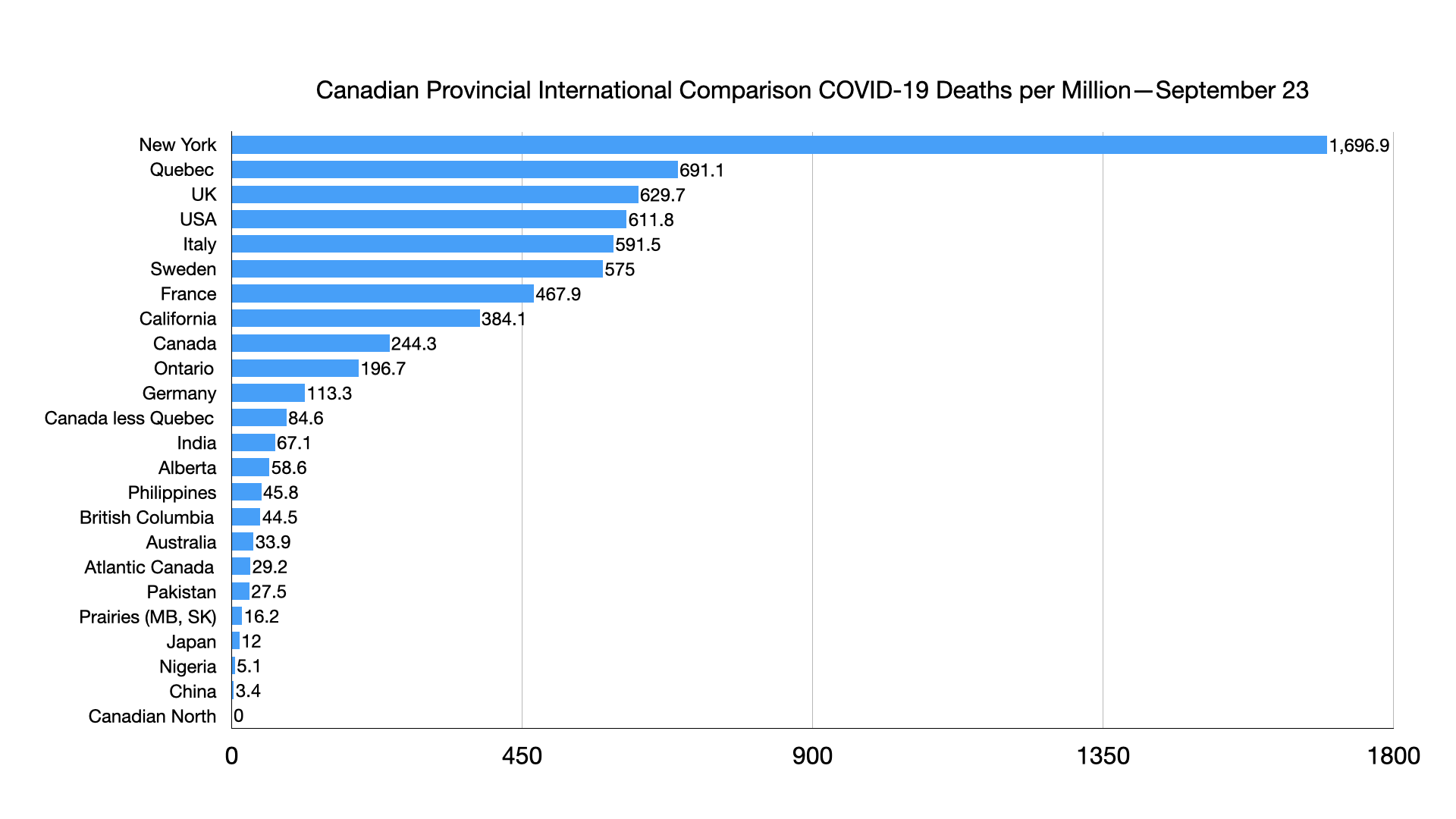
#COVID-19: Comparing provinces with other countries 23 September Update

Highlights:

Deaths per million: Philippines ahead of British Columbia

Infections per millionIndia ahead of  Canada, Prairies ahead of Pakistan

Immigration services to reopen gradually after pandemic shut down many programs

Useful overview:

Immigration officials are beginning gradually to resume in-person services after the pandemic forced many programs to shut down, frustrating immigrants whose lives were put on hold.

Immigration, Refugees and Citizenship Canada (IRCC) shut down immigration tests and citizenship ceremonies in March to protect the health and safety of staff and clients. The department started offering some virtual services over the last few months. Starting this week, it is opening in-person services by appointment only.

“This testing phase will allow us to assess our protocols and procedures and ensure the safety of our staff and our clients. The lessons learned will help us plan for reopening services more widely in the future,” says the IRCC’s website.

Limited services being offered at specific locations include citizenship, services related to permanent residence, asylum claims and biometrics.

Clients must wait for government officials to schedule appointments before visiting an IRCC site and should not call IRCC to try to arrange a date themselves, the department says.

William Ojeda and his family have waited an agonizing three years to renew their permanent residency, a time frame he said is unreasonable. They are now unable to re-enter Canada from Mexico.

“Being unable to be in Canada, and the uncertainty and anxiety of almost three years checking the IRCC website pretty much daily after the initial reasonable delay, and worrying for the well-being of my kids has been really, really hard,” he wrote in an email from Guadalajara.

Odeja, his wife and their eldest daughter were born in Mexico, while his two younger daughters were born in Canada and are citizens.

‘Three years lost’

“We have never broken a law … we live, by choice, by Canadian written and social laws and yet we feel treated as second class immigrants,” he said.

“If the decision is favourable, of course, it would be a happy ending and all the uncertainty, anxiety and fear will blur over time. If negative, it would be all for nothing, with three years lost on our life plan, which is in Canada.”Ojeda said the delay in processing his file predated the pandemic. COVID-19 has created a bigger backlog in many cases, however.

Conservative immigration critic Raquel Dancho said she’s heard from countless families affected by what she calls the “administrative ineptness” of IRCC.

“The lack of a plan throughout the pandemic has failed refugees and immigrants who wish to come to Canada,” she said.

“The Liberals have failed to ensure a fair and compassionate immigration process for the world’s most vulnerable. Frankly, it’s unacceptable and those that depend on the immigration system deserve better.”

NDP MP Jenny Kwan said MP offices have been “inundated” with immigration applicants’ desperate pleas for help. She said several of her MP colleagues have reported that immigration cases consume up to 90 per cent of their constituency casework.

“It’s apparent that there has been little to no movement on IRCC offices resuming their work up to now. The limited capacity of the restart will still mean that too many people are still just going to be stuck in the system with ongoing delays,” she said.”People are still being asked to continue to put their lives on hold. Is it a wonder that families desperate to reunite with their loved ones feel that their cries for help are just falling on deaf ears? The problems with the backlog are so deep that this limited restart will do little to reassure those stuck in the system.”

Efforts to speed up processing

Mathieu Genest, spokesperson for Immigration Minister Marco Mendicino, said the department has been adapting its systems to speed up the processing of applications while protecting the health and safety of staff, clients and Canadians. IRCC has prioritized applications from Canadians and permanent residents returning to Canada, as well as people performing essential services.

Staff now have more resources and streamlined processes for working remotely, he said.

“The expansion of the resumption of in-person services will depend on the results of and lessons learned during this pilot, as well as regional health guidelines, available capacity and virtual alternatives, among other considerations,” he said.

IRCC has introduced safety measures at its locations — including a self-assessment questionnaire that must be completed before an appointment and again before entering the premises.

All employees and clients are required to wear masks, maintain physical distance and follow signs directing the flow of foot traffic. People who appear ill will have to reschedule their appointments.

Source: Immigration services to reopen gradually after pandemic shut down many programs