The one problem with Philip Roth’s tour de force 2004 novel, “The Plot Against America,” is that it’s too feel-good.
I know this is a strange accusation to make about an alternative history about a fascist United States. In Roth’s version of the 1940 presidential election, Americans choose the Nazi-sympathizing aviator Charles Lindbergh, who goes on to institute insidious and then overt programs of authoritarianism and anti-Semitism. The nation is riven and people are killed.
But in the end, everything is set right. In 1942, Lindbergh goes missing while flying his airplane, a special election is called, and Franklin D. Roosevelt is re-elected against Lindbergh’s vice president, Burton K. Wheeler. The United States enters the war against the Axis, and history continues, more or less, on the track that we know.
It’s a sober, unsettling story, but it ends on a note of optimism in America’s ability to right itself — too easily, I would argue, given everything we saw before it.
Earlier this year, HBO aired “Plot” as a six-part series, adapted by David Simon, who is not known as one of TV’s great optimists. His best-known series, “The Wire,” was a five-season lament for American cities. His website is titled “The Audacity of Despair.”
Simon’s confident, chilling adaptation stuck largely to Roth’s story, with few changes. The biggest was to that ending, which he reimagined in ways that get more unsettling and relevant as our own election season goes on.
The final sequence begins on Election Day, 1942, which, because history has a sense of humor, was Nov. 3, just like this year’s. On the soundtrack, Frank Sinatra croons “The House I Live In (That’s America to Me).” Citizens line up in the Weequahic High School gym in Newark. They go into the booths and cast their ballots. The citizenry is turning out. America is showing its best side.
As Old Blue Eyes keeps singing (“A certain word / Democracy”), a few discordant notes begin to sound. A man with an F.D.R. pin is told he is “not on the list” at the precinct where he has voted for 20 years and is hustled out by police. More officers wheel away a voting machine, telling puzzled onlookers, “It’s broken.” In a country field, men open a car trunk, unload ballot boxes — marked with the number of an election district in which we just saw lines of Black voters — and burn the contents.
We cut to that evening, in the living room of the Levins, the Jewish family the story was told through. A host on the radio reports on the first returns from precincts on the East Coast. Herman Levin (Morgan Spector) — a mainstream F.D.R. supporter who believes the system is ultimately good and self-correcting — leans in toward the set. “We are seeing some conflicting results early on,” the announcer says.
These are perilous times to have been a monumental historical figure from the 19th century. The list of names of those under reconsideration is long and growing, with the country’s first prime minister, Sir John Alexander Macdonald, regularly at the top of it.
The latest disgrace to be inflicted upon Macdonald – a leader without whom the very existence of this country may be questioned – occurred on Saturday when protesters in Montreal disdainfully toppled a statue of our first prime minister. A debate quickly ensued around Macdonald and his legacy. In predictable fashion, there has been no middle ground.
That legacy is currently subject to the death of a thousand cuts. Just last month, Queen’s University – an institution from Macdonald’s own hometown – wrote to its community to ask for input on a consultation process about the name of Sir John A. Macdonald Hall on its Kingston campus. Et tu, Brute?
The continued targeting of Macdonald is really as much about our own times as his. But that has always been the case with history. As renowned University of Toronto historian Margaret MacMillan – a continuing voice of reason in our challenged times – once wrote: “We argue over history in part because it can have real significance in the present.”
Canada’s continuing work toward reconciliation with Indigenous peoples, as well as the systemic racism and violence in all its forms that has been a part of the lived experience of many Canadians, are the issues of our times. But defacing and vandalizing statues of a former prime minister is not going to advance any of those causes. Nor is it justified by history – although it may make some feel better.
“For those who do not have power or who feel they do not have enough,” Prof. MacMillan wrote in The Uses and Abuses of History, “history can be a way of protesting against their marginalization.”
The debate over statues in general, and of Macdonald in particular, also reveals the polarity of 2020 writ large. There are only extremes. In the place of dialogue and tolerance, there is more shouting at each other and less listening. This is not the Canadian way. Nor is tearing down a statue – which, by the way, is illegal.
Critics of Macdonald act as though his regrettable actions against Indigenous peoples in the West were happening now. But his policies, which we rightly chafe against today, took place primarily in the 1880s. “Quite unlike Canadians of today,” wrote the late Richard Gwyn in his two-volume biography of one of this country’s greatest prime ministers, “nineteenth-century Canadians felt no guilt about their country’s treatment of Indians.”
The real historical vandalism is not so much the destruction of public property, but in the singular and contemporary lens with which people are trying to judge actors from the past such as Macdonald. Unlike statues of Confederate “heroes” in the United States, which were raised in homage to the South’s support for slavery and to remind people of it, the statues of Macdonald were not put up in celebration of his genuine and ugly mistakes but for his larger legacy: his undeniable contribution to creating the Dominion of Canada.
It is ahistorical to take Macdonald out of his times and thrust our causes and our fights for justice onto him. “Macdonald has been unfairly abused for being a man of the 19th century,” University of Toronto historian Robert Bothwell told Maclean’s magazine in 2016. “He had moral failings, and was sometimes indifferent to or negligent of serious problems. He did not have our sensibilities, and had many of the characteristics of his period that at the time passed without comment because they were so widely held.”
So, where does that leave us in 2020 as these debates continue? For starters, let’s agree there are complexities to history and this issue – significant ones when you are evaluating someone who was prime minister from 1867 to 1891, save for four years from 1874-78.
Let’s continue to be sure we educate ourselves about not only historical legacies, but also about the nature of history itself. Let’s not cherry-pick the unsavoury parts, but rather add contextual plaques to statues that explain the many facets to readers.
The world is not black or white. And history is as grey as a late November sky.
J.D.M. Stewart is a Canadian history teacher and the author of Being Prime Minister.
Good discussion of the risks involved, although not convinced that a judicial enquiry is the best way to address the many policy issues involved:
The Canadian Charter of Rights and Freedoms guarantees the right to equal protection under the law. It is a beautiful thing and a hallmark of a free democracy. Unfortunately, the freedom to live without discrimination remains an unrealized dream for many in Canada. Worsening this problem, the growing use of algorithmic policing technology in Canada poses a fast-approaching threat to equality rights that our justice system is ill-equipped to confront.
Systemic bias in Canada’s criminal justice system is so notorious that Canadian courts no longer require proof of its existence. Indigenous and Black communities are among the worst affected. The critical question is: what can be done? The right to equality under section 15 of Canada’s Charter, a largely forgotten right in the justice system, should serve to remind governments and law enforcement services that bold change is not merely an option. It is a constitutional imperative.
Most often, courts respond to discrimination in the justice system by granting remedies such as compensation, or exclusion of evidence from court proceedings. But these case-specific remedies seem to operate as pyrrhic victories, while systemic change remains elusive. A case-by-case approach to remedying rights violations is also costly for the public and burdensome to the very individuals wronged.
Making matters worse, Canadian police services are beginning to explore the use of algorithmic technologies that may exacerbate systemic discrimination.
As described in a recent report jointly published by the University of Toronto’s Citizen Lab and International Human Rights Program (co-authored by myself), the widespread use of algorithmic policing technology would be deeply problematic. Predictive policing technology is used to attempt to forecast individuals or locations that are most likely to be involved in crimes that have not yet occurred (and may well never occur). Data sets (including data sets created by police) are fed into algorithms that are then supposed to produce “predictions” through machine-learning methods.
Given the continuing over-representation of Black and Indigenous individuals in policing data caused by over-policing and discrimination in the justice system, using such data to forecast potential crime risks perpetuating or amplifying existing inequality. As scholar Virginia Eubanks describes, policing algorithms can operate as “feedback loops of injustice.”
In the report, we call for moratoriums on these controversial technologies, and urge Ottawa to convene a judicial inquiry on the legality of repurposing police data for use in algorithms. Section 15 may well prohibit police decision-making that is guided by algorithmic predictions that are rooted in biased data.
A judicial inquiry is important because section 15 is under-utilized and rarely applied in Canadian courts. Its scope is not well understood. There are substantial costs and legal hurdles that must be overcome to bring a discrimination claim in court. Despite some recent signs of hope, in-court litigation is slow and has not ended the cyclical harm experienced by vulnerable groups.
In theory, the public does not need to wait for courts to painstakingly deliberate these problems over decades. Section 15 prohibits all government action taken in the criminal law enforcement system that has the adverse effect of disproportionately disadvantaging racialized and Indigenous communities (or other groups protected by section 15). The constitutional prohibition operates automatically and is in effect right now.
Section 15 also requires governments and police services to move beyond circular debates as to whether the justice system’s damage is caused by overt racism, historic racism, institutional bias, poverty, or depleted mental health-care systems. It is all of the above. But section 15 prohibits much more than overt racism. It prohibits all government activity that has the purpose or effect of disproportionately disadvantaging protected groups.
When the Charter was enacted in 1982, governments were given a three-year grace period to comply with section 15 in particular — a concession granted in recognition of the hard work and substantial legal reform that would be required by governments to fulfil their new obligations. Nearly 40 years later, it is time for the burden of that hard work to be taken up and completed.
The Central Council of Jews in Germany has warned of increased anti-Semitism due to the protests against coronavirus measures.
“For months, conspiracy theories with anti-Semitic tendencies have been deliberately stirred up in the coronavirus debate,” Council President Josef Schuster told German daily newspaper Bild.
“If, for example, the Rothschilds are blamed for the pandemic, then this is a synonym for Jews,” said Shuster.
He added that not everyone who protested in Berlin in August was anti-Semitic or racist, “but they walked among them.”
Two recent protests have drawn tens of thousands from across the country to Berlin. The demonstrations were mainly peaceful, but at one point, hundreds of demonstrators broke through a blockade in an attempt to storm the Reichstag building.
Police also see uptick
The police trade union, the GdP, said it has also seen a rise in radicalization of protesters against coronavirus protective measures.
“Since the first demonstrations, right-wing groups have influenced the corona protest movement,” GdP vice-chairman Jörg Radek told newspapers of the Funke Media Group. “The right-wingers are there and are about to completely take over the movement.”
Some protesters have used signs and flags associated with far-right politics, from the Reichskriegsflagge (Imperial War Flag) to costumes comparing themselves to Holocaust victims.
“Nobody can say they are just a follower now. Anyone who stays with the movement must ask themselves whether they want to join forces with right-wing extremists and combine personal concerns in the coronavirus crisis with the extremists’ anti-democratic goals,” said Radek.
One of the (intended) effects of Trump administration policies:
On a Wednesday morning in late February, Annie Johnson Benifield was already through the doors of the M.O. Campbell Education Center, in Houston by 5:30 a.m.
The occasion was a once-a-month naturalization ceremony, where anywhere between 1,700 to 2,600 legal permanent residents swear a 140-word oath in order to become U.S. citizens. The ceremony wouldn’t begin until later in the morning, but Benifield and the 40 or so volunteers from the League of Women Voters (LWV) had arrived early to set up.
The League is the official registration partner for many naturalization ceremonies across the country. And before the pandemic, these events happened frequently, taking place once, or sometimes twice, each month at U.S. Citizenship and Immigration Services (USCIS) field offices as well as some federal courthouses. The League had predicted that, in 2020, it would interact with up to 200,000 new citizens and their family members in 1,000 events across the country.
The Houston chapter specifically had an 85 to 90 percent success rate in new voter registrations, for an annual average of 30,000 new voters, according to Benifield. But this year, with the widespread interest in the presidential elections, she thought registrations might crack 40,000.
“I was getting excited and feeling giddy about it,” she told FiveThirtyEight, “but COVID-19 had a different plan.”
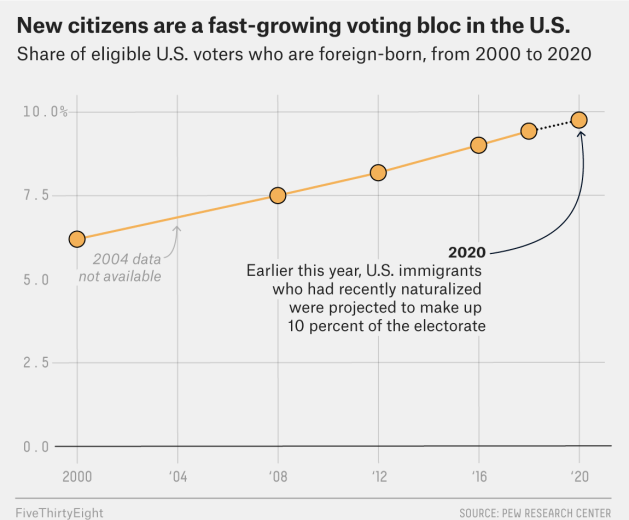
Newly naturalized citizens are one of the fastest-growing voting groups in the United States. In February, the Pew Research Center published a report that found that 23.2 million naturalized citizens would be eligible to vote in November’s presidential elections, making up a record 10 percent of the total electorate. And according to a February analysis by the National Partnership for New Americans (NPNA), a coalition of immigrant advocacy organizations, 860,000 new Americans were expected to have naturalized by November before the pandemic brought things to a halt.
But not all eligible voters actually vote, and naturalized Americans have historically trailed native-born Americans at the polls.1 In 2016, for example, 54 percent of naturalized citizens voted in the general election compared with 62 percent of native-born citizens. According to studies, one explanation is an element that could be missing again this year: voter registration. It’s not a lack of desire to participate, the study finds, but rather it’s an unfamiliarity with how or where to register, registration deadlines, and language issues. Once these barriers are overcome and new Americans are registered, they tend to vote at the same rates as native-born members of their demographic group.
Take someone like Raz Ahmadi, a new U.S. citizen from Afghanistan. For the past five years, he has worked as an organizer registering voters and advocating for progressive environmental policies in Virginia. And this year, after completing the naturalization process, which had been interrupted by COVID-19, in mid-July, Ahmadi will finally be able to cast his own ballot.
Though he has already been involved in politics, Ahmadi says that being able to actually participate is a whole new feeling for him. Being “empowered to vote, mentally, it gives you a lot of power,” he says. “It just personalizes a lot of things. Now you’re more involved in the community.”
But even before COVID-19, the wait time for citizenship applications had hit new highs under the Trump administration. According to USCIS numbers, the naturalization process averaged 8.8 months in 2020, compared with 5.6 months in 2016 and a peak of 10.3 months in 2018,2 though in some cases, it could take up to three years.
COVID-19 exacerbated this delay. On March 18, USCIS temporarily shut down all public-facing activities, including interviews for visas, asylum and naturalization as well as oath ceremonies. The agency did not make plans for virtual alternatives, bringing much of U.S. immigration to a halt.
For each day that USCIS remained closed, 2,100 potential new voters would be disenfranchised, according to a frequently cited report by Boundless, an immigration-services company co-founded by an Obama administration official.
USCIS field offices reopened on June 4 and prioritized in-person oath-swearing ceremonies. Some field offices held drive-through ceremonies, while others held more frequent, but smaller, indoor or outdoor ceremonies. By the end of July, the agency says that it has cleared the backlog of 110,000 oath ceremonies delayed by its closures, as well as an additional 7,905 oath ceremonies not scheduled before the pandemic.
Still, these 7,905 new naturalizations in July represent a twelve-fold decrease than the typical 95,850 naturalizations completed each month. So even though in-person oath ceremonies are continuing, “the fact of the matter was that there was already a backlog of people waiting to be naturalized,” says Jeanette Senecal, who oversees voter-engagement programs at the League of Women Voters, “so unless USCIS is both increasing the number of people who are getting naturalized at each one and offering more ceremonies, there’s really no way they can make that up.”
From the outset of USCIS’s closure, a diverse group of bipartisan policymakers, immigration lawyers, community advocates, and third-party voter-registration organizations like the League of Women Voters have called on USCIS to follow in the footsteps of other federal government agencies in moving activities online. In June, the USCIS Ombudsman’s Office, a small, independent office in the Department of Homeland Security that appeals specific immigration cases and suggests improvements for USCIS, weighed in, calling remote oath ceremonies, held via video teleconferencing, “a legally permissible and operationally feasible solution” for the agency in the short term and a potential long-term solution to “increase efficiencies” in its annual report to Congress.
But still, the USCIS rejected a virtual option. Spokespeople told FiveThirtyEight repeatedly, both before and after the Ombudsman’s report, that “the statutory language mandated by Congress contains certain requirements that are logistically difficult for USCIS to administer naturalization oaths virtually or telephonically.”
USCIS says that they’ve taken steps to clear the backlog in oath ceremonies, but these ceremonies are not the only steps in the naturalization process that are delayed.
Sarah Pierce, a policy analyst with the Migration Policy Institute, calls USCIS’s emphasis on clearing the backlog in oath ceremonies “really misleading” because it wasn’t just oath ceremonies that were paused during this time. “It was also interviews, which meant that naturalization applications weren’t being processed,” said Pierce. She added that unless USCIS was also trying to expedite processing of naturalization applications, there was “no way” the agency was going to be able to naturalize the same number of people by the election.
Dan Hetlage, a USCIS spokesperson, told FiveThirtyEight that the agency has also “prioritized rescheduling interviews for naturalization and adjustment of status that were postponed,” but as of early August, immigration lawyers I spoke with said that their clients had not been contacted to schedule naturalization interviews.
There are currently 315,000 naturalization applicants awaiting their interviews, which on average occur two months before an oath ceremony, according to a Boundless analysis. In two months it will be October, which is the deadline for voter registration in many states. That means an unknown but likely significant number of those 315,000 applicants will not naturalize soon enough to register by October and vote in November.
It’s not just USCIS that has changed as a result of the pandemic. A recent report from the Migration Policy Institute cataloged 63 executive actions undertaken by the Trump administration since March that have further restricted immigration.
Pierce, who co-authored the report, says that these changes represented some of the Trump administration’s “boldest actions on immigration to date” that, in some cases, they had long been pushing but had been unable to achieve. This includes a travel ban on 31 countries, the end of asylum at the southern border, and the suspension of immigration for many family- and employment-based categories as well as four temporary-worker programs.
“During an unprecedented pandemic, which includes both public health and economic crises, you would expect immigration to take a backseat,” says Pierce, “but rather, the opposite has been true.”
When USCIS offices reopened on June 4, organizations like the League of Women Voters scrambled to help with voter-registration efforts. Benifield, from LWV-Houston, recalls reaching out multiple times to the local field office. “We were prepared to go and set up in the parking lot … if they allowed us,” she said.
In the end, her persistence paid off. “The branch chief … agreed that we could actually bring cards” for officials administering the naturalization ceremony to give out. The League cannot be on-site to register applicants directly because of the continued threat the pandemic poses, but they can drop off folders containing voter-registration packets to the local field office to be distributed at the socially distant ceremonies. USCIS is legally mandated to provide, at a minimum, voter-registration forms at each naturalization ceremony.
Benifiled said she was glad they could distribute materials, but she remained unsure how effective this form of voter registration would be. “Clearly, it will not be 30,000 like … last year.”
This is affecting the League’s activities across the country. “Spring and summer are usually really busy seasons for voter registration, but especially in presidential years, we usually see massive increases… [in] naturalization ceremonies,” says Senecal, from the League’s national office.
Volunteers understand the public health prerogatives that prevent them from conducting registrations in person, especially since many are older and at higher risk for COVID-19, but many, like Benifield, are concerned about the effect on registration numbers and broader civic engagement.
“The opportunity cost is not just registration,” adds Senecal, “it’s also voter education.”
At a basic level, in-person voter registration provides necessary information in native languages, says Nancy Xiong, the communications director for Hmong Innovating Politics, a California-based nonprofit that aims to increase civic participation among Southeast Asian Americans.
Native language materials are essential, since many new citizens, especially in already marginalized communities, have challenges with English. Even when they are provided with translated voting materials, Xiong adds, these materials “may not always be helpful because county/state offices do a word-to-word translation, without much context.”
This can create the perception that these communities are uninterested in politics, leading to “big campaigns never or rarely contact[ing] the Southeast Asian community,” Xiong says, even though 92 percent of the 310,000 Hmong Americans are citizens, one of the highest rates among Asian Americans, and 45 percent are eligible to vote. And this perpetuates a cycle of disenfranchisement, at the very moment when immigrant voters might be especially incentivized to vote, if previous elections in which immigration was a hot topic are any indication. In 2008, presidential candidate Mitt Romney’s suggestion that immigrants should “self-deport” and hardline views on DACA, for example, have been linked to a jump in voter registrations between 2008 to 2012.
Sundrop Carter, the executive director of the Pennsylvania Immigration and Citizenship Coalition (PICC), which partners with the Philadelphia USCIS field office as its official third-party registration organization for naturalization ceremonies, told me part of the problem is that: “[B]y definition new Americans have no voter history.” As a result, she said, they’re often bypassed by most get-out-the-vote efforts. “New voters … they’re just invisible.”
This is despite the fact that in many battleground states, like Pennsylvania, where Carter is based, as well as Michigan, Florida and Nevada, the number of new Americans who are eligible to vote now is larger than the margin of victory in the 2016 elections, according to the June 2020 report from the NPNA. “Newly naturalized citizens could help to sway the outcome of national elections,” says Diego Iñiguez-López, the NPNA’s policy and campaigns manager. But more importantly, he adds, “what’s at stake is the political empowerment of newly naturalized citizens … and for the democratic ideals of this country to be fully realized and exercised.”
Community organizations have always tried to fill in the gap — and this year, just as the need for their services ramp up, COVID-19 has made them more difficult to deliver.
Hmong Innovating Politics (HIP), in California, and the nonprofit Bonding Against Adversity in Houston, which works mostly with Latin American immigrants, are doing their best to adapt by moving their activities online. HIP has switched to a text-messaging platform, which uses current friends-and-family circles to encourage contacts to register to vote. Bonding Against Adversity, meanwhile, has expanded another SMS-based communications platform to provide real-time immigration application help, and plans to restart an online version of their 14-session “citizenship college” civic-education program and application workshops in August.
Meanwhile, LWV-Houston members have paid for a QR code that brings up voter-registration information, which it is sharing on signs and, for a while, in person at public libraries, community and faith-based organizations, protests and even a taco chain restaurant.
But still, many organizations are afraid that some of the most vulnerable communities, who already feel left out of the political process, will fall through the gaps. “A lot of the communities that we work with have elementary education, are not computer-savvy, and don’t speak good English,” says Mariana Sanchez, a co-founder of Bonding Against Adversity. That’s why she says in-person registration and education is essential.
But the pandemic has put these in-person services on pause, and as a result, the applicants who need the most support are unable to access it.
COVID-19 shows little evidence of slowing down. By June, hospitals in states like Texas that had avoided the early wave of infections were warning that hospital beds were close to full, and in-person voter-registration activities, which the League of Women Voters had just restarted alongside USCIS’s reopenings, were put on indefinite pause.
In the meantime, smaller oath ceremonies continue, with USCIS spokespeople emphasizing their adherence during the ceremonies to public-health guidelines, including masks and social distancing. But it is not clear if USCIS has any contingency plans in place for alternatives to in-person activities.
The potential of more stay-at-home orders at a local level is also a possibility, which would affect which activities USCIS could continue. Guam’s USCIS office, for example, was shut down for a week as the territory’s COVID-19 case count led the governor to issue orders to shelter in place. Hetlage, the USCIS representative, did not respond to a specific question on contingency plans but reiterated that virtual oath ceremonies weren’t possible.
This has many immigration advocates perplexed. “Almost every business, school district, university and government agency across the country has made adjustments to keep their organizations — and the country — moving,” says Eric Cohen, the executive director of the Immigrant Legal Resource Center, an advocacy group. “Why should USCIS be any different?”
The question represents an ongoing frustration: Yes, there is an unprecedented public-health crisis, but there is also a human-made immigration crisis stemming from the administration’s policies and USCIS’s decision-making during the pandemic.
“It’s hard to look at the actions the administration has taken that result in decreased immigration, and not think that there was some intent there, especially when you’re talking about an administration that is historic in its stance on legal immigration.” says Pierce, of MPI, on whether the immigration agency’s decision-making could be political. Beyond the 63 actions taken during the pandemic, Pierce’s report identified over 400 executive actions by the Trump administration taken in the past four years that have shifted the immigration system toward removing suspected undocumented immigrants, and away from processing applications for naturalization and legal immigration.
It stands in stark contrast with the second night of the Republican National Convention, when Trump naturalized five new citizens at the White House in a prerecorded video. The president welcomed them to “a family comprised of every race, color, religion and creed united by the bonds of love,” as he said in his concluding remarks. “We are one people sharing one home, saluting one great American flag.”
USCIS representatives did not respond to a request for comment on whether the five were given voter-registration forms, as required by law.
Since early summer, USCIS has warned that if it does not receive $1.2 billion in emergency funding, the agency would furlough 13,000 workers – 70 percent of its workforce — and slow or pause many immigration processes. On August 25, after months of back-and-forth, Congress and USCIS reached an agreement that would avoid the furlough.
That agreement would not, however, avoid further delays in processing, as Joseph Edlow, deputy director for policy at USCIS, told The Washington Post: “Averting this furlough comes at a severe operational cost that will increase backlogs and wait times across the board, with no guarantee we can avoid future furloughs.”
In an effort to increase its financial sustainability, USCIS will increase fees by an average of 20 percent across the board, and more than 80 percent for naturalization applications. For groups like Bonding Against Adversity and Hmong Innovating Politics, which were already under-resourced before the pandemic, these changes will only add to their immediate workload.
Sanchez says she’s already received more inquiries from people who want to apply for citizenship before application fees for naturalization increase. “The immigration laws are so difficult,” says Sanchez, that “the only way, for some of the people we serve to help their families is through citizenship…and voting.”
But USCIS is making the process more difficult. That’s why the NPNA sees naturalization delays as an issue of voting rights.
“It’s part of the larger anti-immigrant agenda that the Trump administration has pursued over the last few years,” says Iñiguez-López. “Keep immigrants feeling unwelcome, keep them afraid, keep them intimidated, and keep them away from knowing and asserting their rights, including their right to vote.”
In other words, while these would-be citizens are trying to follow the rules of the U.S. immigration system to naturalize and effect change through the established democratic processes, the system has itself become the barrier.
More coverage of the latest non-resident birth numbers, including MA graduate Yousif Samarrai’s proposal to use SIN as a gatekeeper for those on visitor visas (in contrast to students and temporary residents who are issued SIN).
Those without a SIN would not be issued a birth certificate by the provincial vital statistics agencies (hospitals would still issue attestations of birth).
Like all proposals, there would be a number of complications, operational, jurisdictional and legal, but if doable, it would be a targeted approach that would reduce collateral impact.
Three hundred more non-resident women gave birth at a handful of Canadian hospitals in 2019 compared with the year prior, with the largest increases occurring at two Toronto-area hospitals and one within Vancouver.
The statistics from the Canadian Institute for Health Information show that Richmond, B.C., still registers the highest number of these births in the country, with 502, or one out of every four babies born last year involving women who are not Canadian residents.
The national tally of births from non-resident mothers represents only 1.6 per cent of all births across Canada last year, save Quebec, but locals in and around Richmond have denounced the practice of “birth tourism” – where women travel to Canada to deliver a baby who will then gain Canadian citizenship.
While municipal, provincial and federal politicians want the practice banned, Andrew Griffith said the data he obtained from the Crown corporation captures those women, as well as students studying in Canada and women who live here but who have not completed the citizenship process.
Mr. Griffith, an Ottawa-based fellow at the Canadian Global Affairs Institute and a former high-level federal bureaucrat, said because of the lack of precise data, the long-term impact of any birth tourists remains unclear.
It is legal for non-residents to give birth in Canada, which then grants the baby citizenship, but Mr. Griffith said changing birthright citizenship probably isn’t worth the effort at this time given the numbers.
“And if you assume that roughly half of those numbers are pure birth tourists, you’re still talking about less than 1 per cent of the total number of live births in Canada, and you’re still talking about less than 1 per cent of the total number of immigrants to Canada,” Mr. Griffith said.
“Are you going to penalize the 99 per cent to address a problem that affects the 1 per cent?”
The data show that after Richmond Hospital, North York’s Humber River Hospital had the next-highest number of these births last year at 329, followed by Mackenzie Health’s facility in Richmond Hill, Ont., with 287. Vancouver’s St. Paul’s Hospital recorded 203 during the 2019 fiscal year, more than double the number recorded five years earlier.
Spokespeople for these various hospitals told The Globe and Mail on Monday they never deny or delay care to anyone based on their residency status, but they do seek compensation for this care from patients without medical coverage, with these fees covering the treatment.
Richmond Mayor Malcolm Brodie said steps need to be taken to prohibit birth tourism, which he said is creating pressure on resources of the city’s lone hospital.
“It is fundamentally not right that people would adopt a strategy to come here and have their babies and then go back without contributing in any meaningful way to the local economy or paying taxes here or any other form of support,” he said in an interview.
In February, Richmond City Council wrote letters to Prime Minister Justin Trudeau and other federal and provincial politicians requesting a change to immigration laws to end “this strategic opportunity taken by people who have no official connection to Canada.”
A year ago, Joe Peschisolido, Liberal MP for Steveston-Richmond East, called on his government to end the practice of birth tourism, telling The Globe that he had spoken with then-minister of immigration, refugees and citizenship minister Ahmed Hussen about the issue.
On Monday, the federal Immigration Minister’s head spokesperson said Ottawa is focused on cracking down on immigration fraud and while “birth tourism is not widespread” the department is researching the extent of the practice to see how many of these non-resident mothers are tourists.
Yousif Samarrai, who recently wrote his master’s thesis in public policy on the issue at Simon Fraser University, said “birth tourism” has become so controversial in B.C. because unlicensed hotel companies in Richmond have been caught marketing packages to expectant Chinese mothers.
He said a simple fix to this issue would be to require a new parent to submit their own social insurance number in order to get a birth certificate – and the resulting citizenship – for their child. Every class of visitor to Canada receives a SIN except tourists, he said.
“The whole idea of changing these laws is you don’t want to impact anybody that’s coming here through legitimate means,” Mr. Samarrai said. “However, if we change the administrative way that people attain a birth certificate, that’s a little more practical.”
In the spring, teenagers started showing up at doctors’ offices in droves with angry red and purple blisters on their fingers and toes. The latest unexpected feature of the coronavirus infection fascinated the public, and suddenly photographs of so-called Covid toes were everywhere on social media.
But almost all of the images depicted glossy pink lesions on white skin. Though people of color have been affected disproportionately by the pandemic, pictures of Covid toes on dark skin were curiously hard to find.
The problem isn’t unique to Covid toes or to social media. Dermatology, the medical specialty devoted to treating diseases of the skin, has a problem with brown and black skin. Though progress has been made in recent years, most textbooks that serve as road maps for diagnosing skin disorders often don’t include images of skin conditions as they appear on people of color.
That’s a glaring omission that can lead to misdiagnoses and unnecessary suffering, because many key characteristics of skin disorders — like red patches and purple blotches — may appear differently on people with different complexions, experts say.
“Pattern recognition is central to dermatology, and a lot of the pattern recognition is training your eye to recognize certain colors that trigger you to think of certain diseases,” said Dr. Jenna Lester, director of the skin of color program at the University of California, San Francisco.
“But the color in question is impacted by the surrounding color,” she said. “It can look different in darker skin. If you’re only trained to look at something in one color, you won’t recognize it in another color.”
Dr. Lester recently reviewed 130 images of coronavirus skin disorders published in medical journals and found they were overwhelmingly of white people.
As the coronavirus spread, dermatologists started an international registry to catalog examples of skin manifestations of Covid-19. The registry compiled more than 700 cases, but only 34 of disorders in Hispanic patients and 13 in Black patients were submitted.
It wasn’t until July that Dr. Roxana Daneshjou and her colleagues at Stanford University published some of the first pictures of Covid toes in nonwhite patients in the Journal of the American Academy of Dermatology.
“We know for certain that if dark skin images are not well represented, skin doctors — but also other doctors who are not skin experts — are at a disadvantage for making a proper diagnosis,” said Dr. Hao Feng, an assistant professor of dermatology at the University of Connecticut.
Dr. Feng reported recently that the omissions are still pervasive in textbooks, where only 10 percent of images illustrate dermatologic diseases in dark skin. When pictures of Black patients were available, they most often described syphilis. He found that one digital resource, VisualDx, had a more diverse display of images: 28.5 percent represented dark skin.
“If you have no experience with this in people of color, it’s like saying you don’t know how to examine the lungs or the heart,” said Dr. Art Papier, a dermatologist who co-founded VisualDX.
All doctors observe the skin for clues to disease. Changes in the skin can be the first indication of life-threatening conditions like sepsis, cellulitis or severe drug reactions to medications.
Encouraging but will see how implementation works. The Gulf States were built on this abusive system:
New labor rules in the energy-rich nation of Qatar “effectively dismantles” the country’s long-criticized “kafala” employment system, a U.N. labor body said Sunday.
The International Labor Organization said as of now, migrant workers can change jobs before the end of their contracts without obtaining the permission of their current employers.
Qatar also has adopted a minimum monthly wage of 1,000 Qatari riyals ($275) for workers, which will take effect some six months after the law is published in the country’s official gazette, the ILO said. The minimum wage rule requires employers to pay allowances for housing and food as well if they don’t provide those for their workers.
Amnesty International praised the move as “an encouraging sign that Qatar may finally be heading in the right direction,” although employers still can file criminal charges against “absconding” employees, meaning those who left their jobs without permission.
“We call on Qatar to go further with these reforms, including removing the charge of absconding, to make sure that the rights of all workers are fully protected,” Amnesty official Steve Cockburn said in a statement.
Qatar, whose citizens enjoy one of the world’s highest per-capita incomes due to its natural gas reserves, partially ended the “kafala” system in 2018. That system ties workers to their employers, who had say over whether they could leave their jobs or even the country.
Qatar is being transformed by a building boom fueled by its vast oil and natural gas wealth. Like other energy-rich Gulf nations with relatively small local populations, Qatar relies on well over a million guest workers, many of them drawn from South Asian nations including India and Nepal. Rights activists long have criticized the “kafala” system as allowing abuses of those foreign workers.
This comes as Qatar will host the 2022 FIFA World Cup in the Arabian Peninsula nation. Having the winning bid for the soccer tournament brought renewed attention to laborers’ rights in Qatar.
Meanwhile Sunday, the United Arab Emirates announced it now requires private employers to grant new fathers five paid days off after the birth of a child.
Some good commentary by Malinda Smith, Afua Cooper and Carl James. My one note to Afua Cooper’s comment about Canadian Blacks being a voting block is that the very diversity of the Black community, more so than other communities, combined with their relative distribution across ridings, make it less simple than that:
Data released by Statistics Canada over the past year and a half could help to dispel the myth of a single, uniform Black population in Canada, and will be “indispensable” for researchers studying systemic racism in the country, say professors from three universities across the country.
Statistics Canada has released a spate of data on the Black population in Canada in stages since February, 2019, to honour the International Decade of Peoples of African Descent, which runs from 2015 to 2024. The studies span a 15-year period beginning in 2001 and use data from the census, the general social survey, academic studies, and more.
The data shows the diversity of the Black population is often “obscured” by anti-Black racism and stereotypes that lead to a view of a “single” Black community in Canada. That belief exacerbates the effects of systemic racism, and leads to policies and practices that fail to account for the unequal effect of certain policies or practices, say Canadian researchers.
“This data…is really important for us to see the implications of racism and stereotypes on the life chances and outcomes for the Black Canadian population. Regardless of background, educational achievement, who they are, the stereotype prevails,” said Malinda Smith, professor of political science at the University of Calgary and the vice-provost of equity, diversity, and inclusion at the school.
Prof. Smith served on an advisory council created by Statistics Canada to help interpret the data. The data, Prof. Smith continued, “is indispensable for understanding systemic racism. What it helps you to see is the disproportionate impact of a certain practice on specific groups.”
Both the “breadth” and “depth” of the Statistics Canada studies make them particularly valuable, said Afua Cooper, an historian, sociology professor at Dalhousie University, and the coauthor of the university’s report on Lord Dalhousie’s history on slavery and race. Prof. Cooper also served on the Statistics Canada advisory panel.
“I’m going ‘wow’ all the time,” Prof. Cooper said, adding that the studies have been incorporated into her teachings
The breadth of the new data allows for change, or lack of change, to be accurately observed over a longer period of time, said Carl James, professor of education and senior advisor on equity and representation at York University.
“It would be good to look at this again five years from now, so we can see if there have been changes. What accounts for those changes if there are changes? How can we know the extent to which issues we identify now have been addressed? We can only know that if the data exists,” said Prof. James, who was also a member of the panel.
Statistics Canada began releasing the first set of data during Black History Month in February 2019. Titled “Diversity of the Black population in Canada: An overview,” the study focused primarily on demographic characteristics and sought to “highlight the diversity of the Black population in terms of their ethnic and cultural origins, places of birth and languages,” the document reads.
The studies collected data from people who self-identified as Black on Statistics Canada surveys.
The first study shows that the Black population in Canada doubled in size between 1996 and 2016, to 1.2-million people—roughly 3.5 per cent of the population. The Black population is about a decade younger, on average, than the population as a whole, with a median age of 30. It also showed that just more than half of Black adults in Canada were born in another country—170 different countries in total.
The second release came a year later, also during Black History Month, on Feb. 25, 2020, a few weeks before COVID-19 lockdowns were imposed. It included two studies, both focused more on socioeconomic factors such as education, employment, and income.
The first study, titled “Canada’s Black population: Education, labour and resilience” said that “compared to the rest of the population, employment rates remain low and the prevalence of low-income is more common among the Black population.
“Despite these challenges, Black individuals have high rates of job satisfaction and high rates of resilience,” the study reads.
The study showed that from 2001 to 2016, the Black population had unemployment rates about four percentage points higher than the rest of the population. The finding was consistent for both men and women. Even when an individual had postsecondary education, in 2016 the rate for the Black population was 9.2 per cent compared to 5.3 per cent in the rest of the population.
Prof. Smith wrote on Twitter that the resilience finding “does not surprise me. It might surprise those inclined toward deficit stereotypes. There’s a fierce optimism among the Black community in Canada.”
“There’s a lot of negative stereotypes of Black people as angry or violent. The findings of the resilience study was that Black people were more likely to be optimistic about the future. They thought about the potential for change,” Prof. Smith told The Hill Times.
“Black youth have desires to get into university, however they didn’t think it was going to happen because of discrimination and bias. But they have the highest aspirations. I don’t think many Canadians think of Black youth as having high aspirations for education,” she continued.
The study also said that “challenges facing the Black population may present themselves differently within specific groups” such as differences between immigrants and non-immigrants in terms of postsecondary education. Black women born in Canada were more likely than women in the rest of the population to get at least a bachelor’s degree, but Black immigrant women were significantly less likely than women in the rest of the population to get a postsecondary degree.
The second study focused on the socioeconomic outcomes for Black youth. It found that Black youth were as likely as other youth in the rest of the population to have a high school diploma, but that Black youth were less likely to have a postsecondary diplomas or degrees. It also found second- and third-generation Black youth were less likely than a first-generation Black child to have a postsecondary degree.
“The gap between postsecondary graduation rates for Black youth and other youth remained after accounting for differences in socioeconomic and family characteristics. Other factors not measured by the Census of Population could be the source of these differences,” the study reads.
“The education system was designed for particular kinds of students in particular ways. It was not designed in a way that would address, welcome, and make inclusive the experiences of Black students,” Prof. James said.
For Prof. James, the explanation lies in the fact that Black youth tend to have worse educational outcomes the longer their family has been in Canada.
“That means those who have gone through the education system and have been socialized in Canadian society do not do as well. That tells us something must be dealt if we’re going to address the issues of Black students,” he said.
The most recent Statistics Canada release came on Aug. 13, and looked at the changes in socioeconomic outcomes of the Black population by generation, immigrant status, sex, and country of origin compared to the rest of the Canadian population between 2001 and 2016. It provided many of the same findings as the previous studies but was disaggregated to include more information, such as immigrant status, on the same questions.
Taken together, Prof. Cooper said, these studies send a message to Canadian political leaders and gives them a base of evidence to work from.
“The 2016 census tells us that there’s 1.2-million Black people. That’s a voting bloc. In terms of political survival, you have to take the Black population seriously,” she said.
Despite the clear political incentive, Prof. Cooper said these data sets show that Canadian politicians and other institutions have a duty to “ensure that Black people may be brought into the Charter.”
“How are we going to make this data work and matter? It has to matter in the day-to-day material life of Black people in this country. [Statistics Canada] has built a wonderful document. What kind of commitments do the federal government or other Canadian institutions [have] to ensure that Black people may be brought into the Charter? In criminal justice, in health, in education, [which] we have not experienced,” she said.
“Is this just going to be another report that sits on the shelf? It has to matter in the lives of Black people,” said Prof. Cooper.
Five years ago, as more and more refugees crossed into Europe, Germany’s chancellor proclaimed, ‘We’ll manage this.’ Critics said it was her great mistake – but she has been proved right
Mohammad Hallak found the key to unlock the mysteries of his new homeland when he realised you could switch the subtitles on your Netflix account to German. The 21-year-old Syrian from Aleppo jotted down words he didn’t know, increased his vocabulary and quickly became fluent. Last year, he passed his end of high school exams with a grade of 1.5, the top mark in his year group.
Five years to the month after arriving in Germany as an unaccompanied minor, Hallak is now in his third term studying computer science at the Westphalian University of Applied Sciences and harbours an aspiration to become an IT entrepreneur. “Germany was always my goal”, he says, in the mumbled sing-song of the Ruhr valley dialect. “I’ve always had a funny feeling that I belong here.”
Hallak, an exceptionally motivated student with high social aptitude, is not representative of all the 1.7 million people who applied for asylum in Germany between 2015 and 2019, making it the country with the fifth highest population of refugees in the world. Some of those with whom he trekked through Turkey and across the Mediterranean, he says, haven’t picked up more than a few words and “just chill”.
But Hallak is not a complete outlier either. More than 10,000 people who arrived in Germany as refugees since 2015 have mastered the language sufficiently to enrol at a German university. More than half of those who came are in work and pay taxes. Among refugee children and teenagers, more than 80% say they have a strong sense of belonging to their German schools and feel liked by their peers.
Success stories like Hallak’s partially redeem the optimism expressed by Angela Merkel in a sentence she spoke five years ago this week, at the peak of one of the most tumultuous years in recent European history – a sentence that nearly cost her her job and that she herself has partially retreated from.
“I put it simply, Germany is a strong country,” the German chancellor told the media at a press conference in central Berlin on 31 August 2015, trying to address concerns about the steeply rising number of people – mostly from Syria, Iraq and Afghanistan – applying for asylum in Germany that summer.
“The motive with which we approach these matters must be: we have already managed so much, we’ll manage this.” During the German TV broadcast of her interview, headlines flashed up to report that Hungary was sending trainloads of people to the German border, 20,000 of whom turned up at Munich central station the following week alone.
The German phrase Merkel used, Wir schaffen das, became so memorable mainly because it would in the weeks and months that followed be endlessly quoted back at her by those who believed that the German chancellor’s optimistic message had encouraged millions more migrants to embark on a dangerous odyssey across the Med. “Merkel’s actions, now, will be hard to correct: her words cannot be unsaid,” wrote the Spectator. “She has exacerbated a problem that will be with us for years, perhaps decades.”
Asylum applications
The Alternative für Deutschland party, founded two years previously on a more narrowly anti-euro ticket, discovered a new populist stride: when Merkel said “We will manage”, the rightwing party claimed, she really meant “You will manage”, asking the German public to cope with rising levels of crime, terrorism and public disorder.
“We don’t want to manage this!” the AfD politician Alexander Gauland proclaimed at a party rally in October 2015. Over the coming months and years – in the wake of the New Year’s Eve sexual assaults in Cologne, the Bataclan terror attack in Paris and the truck rampage on Berlin’s Breitscheidtplatz Christmas market – that sentiment seemed to gain traction with a growing part of the German population, even when the crimes were not carried out by people who had arrived in 2015.
By 2017, there was a prevalent view that Wir schaffen das would be Merkel’s undoing, a “catastrophic mistake” as Donald Trump said in January that year. “The worst decision a European leader has made in modern times,” Nigel Farage told Fox News. “She’s finished.”
Yet today Merkel still sits at the top of Europe’s largest economy, her personal approval ratings back to where they were at the start of 2015 and the polling of her party, the Christian Democratic Union (CDU), buoyed to record levels by the global pandemic. When Merkel steps down ahead of federal elections in 2021, as is expected, her party’s successor currently looks more likely to be a centrist in her mould than a hardliner promising a symbolic break with her stance on immigration.
The AfD, meanwhile, never reached the point “when it will be the country’s second-largest party”, as historian Niall Fergusonpredicted in February 2018. The party has established a steady presence in local parliaments across Germany, especially in the states of the formerly socialist east. But at federal level the AfD has dropped to fourth in the polls, down from its third place and 12.6% at elections in 2017, and has been stricken with infighting since immigration has dropped off the top of the political agenda.
The spectre of jihadist terrorism, which some feared the refugee crisis would usher into the heart of central Europe, has faded from view in recent years. After a spate of seven attacks with an Islamist motive in Germany in 2016, culminating with a truck driven into a Berlin Christmas market that December, the country has seen no further attacks for the last three years.
Peter Neumann, a terrorism expert at King’s College London’s Department of War Studies, recalls being invited onto a German TV programme at the height of the crisis in 2015. “I gave my optimistic best back then, but deep down I was worried,” he says. “Will this work out? With nearly a million people about whom we know so little? In the end, those fears were misplaced.
“We know that some of the men involved in the Bataclan attack had exploited the chaos to smuggle themselves into Europe, in some cases posing as Syrian refugees. We also knew that the vast majority of people who arrived were young men, the very demographic is most susceptible to radicalisation. And yet, we can now say that the worst fears haven’t come true.
“In hindsight, Isis’s collapse happened quicker than we expected. It’s now clear that what made them so attractive for a while is less their ideology than their success. And when Isis stopped being successful, it stopped being attractive.”
However, Neumann says this was also due to the increasing efficiency of German intelligence agencies. According to data collected by Petter Nesser, a senior research fellow with the Norwegian Defence Research Establishment, 16 terror plots with a jihadist motive have been foiled on German soil since the start of 2015, more than in France or the UK over the same period.
Countries of origin
The events of the summer of 2015 did evidently mobilise and further radicalise Germany’s rightwing extremist circles, who targeted asylum shelters with arson attacks or assassinated politicians with pro-immigration views, such as the CDU’s Walter Lübcke. No other country in Europe saw as much severe and fatal rightwing violence in 2019 as Germany.
Germany’s Federal Office of Criminal Investigations records a rise of criminal offences, including violent crime, in the years between 2014 and 2016, linking the trend to the influx of migration. The percentage of asylum seekers found guilty of such crimes also doubled in the same period. However, the majority of these offences were within the refugee shelters where new arrivals were initially housed. By 2017, when Trump claimed that “crime in Germany is way up” because it had taken in “all of those illegals”, the number of overall recorded crimes was decreasing. Last year, crime in Germany sank to an 18-year low.
What about the organised crime on Europe’s borders, where human traffickers prey on those willing to risk it all in the hope of a better life? In a 2017 book on reforming asylum policy, British economist Paul Collier argued that “while the industry was already well-established in the Mediterranean, the massive rise in demand triggered by the invitation from Germany further increased demand for smuggling by criminal syndicates.”
Gerald Knaus, chairman of the European Stability Initiative, a thinktank that advises EU member-states on migration policy, disagrees vehemently: “The thesis that Merkel created the refugee crisis was absurd in 2015, and it’s even more absurd in retrospect,” he says.
Empirical studies have failed to find data proving that Merkel’s Wir schaffen das significantly intensified the movement of refugees into Europe, although it is likely that the attention drawn towards Germany’s liberal stance on asylum influenced the decisions of those who were already in Europe at the time.
“The question is: what could she have done differently?” says Knaus. “Reintroduce borders and try what France did after the Bataclan attacks in November 2015, sending all irregular migrants back to Italy? That proved futile: France received twice as many asylum applications in 2019 as in 2015. You can’t seal a wide-open border with rhetoric and a few more border guards, while brutality was fortunately ruled out in Germany.”
Germany’s stance in 2015 did prove too optimistic in the sense that Merkel’s government seemed to believe that the tumultuous events of that summer would lead to a quick reform of the Dublin Regulation, the mechanism that determines which state is responsible for examining an asylum application. Knaus says: “The Germans thought everyone would sign up to a quota system because it was ‘fair’, but they couldn’t explain how this would work in practice.”
Instead, Merkel’s government took unilateral steps to slow down the rate of new arrivals to a trickle. An agreement between Turkey and the EU to stop irregular migration and replace it with a resettlement scheme, developed by Knaus’s thinktank, drastically stemmed the flow of migrants to Europe in 2016. Merkel’s government later tried to limit asylum applications from north Africa by adding Algeria, Morocco and Tunisia to its list of countries considered safe, though the proposal was later rejected by the upper chamber of Germany’s parliament.
In March this year, Germany launched a social media campaign to deter Syrian refugees from embarking on a journey to central Europe, and Merkel’s “grand coalition” with the centre-left Social Democratic party voted against taking in even just 5,000 vulnerable refugees stranded in Greek camps.
Merkel never recanted her words of August 2015, as many even in her own party insisted she should. But she did ensure a situation like the one that followed won’t be repeated on German soil during her tenure.
Approval rating
On a sweltering afternoon in Berlin’s suburban south, preparations are afoot for the annual summer fete at the Marienfelde transit centre, a sprawling concrete camp that used to be the first port of call for many East Germans who fled to the west during the cold war, and now houses asylum seekers from around the world. While volunteers erect socially distanced benches and hang up garlands in the courtyard, a group of men and women from Syria, Afghanistan and Iraq have gathered inside to meet the Berlin senate’s integration officer, to ask for advice and air grievances.
A 44-year-old Syrian is concerned that he might fail next month’s language exam, even though he will need a pass in order to start working. German classes have been cancelled because of the pandemic, and the wireless signal inside the camp is too weak for online learning. “Berlin, on our doorstep, that is Europe,” says the man, who doesn’t want to give his name for fear of getting into trouble with the Syrian embassy. “But this shelter is like a little Syria: everyone speaks Arabic.”
Germany was not the destination of choice for the father of three, who arrived in the country via the resettlement programme of the United Nations’ refugee agency, the UNHCR, in 2018. He is grateful that Merkel’s government took him in, but the wait for a work permit is starting to exasperate him. Before Berlin, he worked for six years as a pastry chef in Izmit, Turkey, but German bakers won’t accept his qualifications – he would need to do another two-year apprenticeship first. “It’s very frustrating.”
The integration officer assures him she empathises with his plight: Katarina Niewiedzial, who has been in the post since 2019, was once a migrant herself, having arrived in Germany from Poland as a 12-year-old. She knows from personal experience the areas of public life where Germany is ill-equipped for the task of integrating newcomers.
German employers are often still reluctant to recognise foreign qualifications. If migrants lack the certificates to prove they are qualified enough to do a job, they can apply to prove their skills in an interview, but they need fluent German to do so – a bigger challenge for adults in their 40s than teenagers like Hallak. Last year, the German Chamber of Commerce only carried out 80 such “qualification analysis” processes in the whole of Germany.
Often refugees end up in jobs they are overqualified for, such as catering, which in turn are more precarious and have cut staff during the pandemic: in May this year, the number of unemployed Berliners without a German passport was up by 40% compared to the same period in 2019.
Many experts think that the integration classes that have been mandatory for refugees in Germany since 2005 are no longer fit for purpose, holding back those with academic qualifications while failing to offer real help for those who arrive without being able to read or write. The percentage of those failing the all-important B1 language test has risen rather than fallen over the last five years. And yet, Niewiedzial is optimistic. “Germany can be a very sluggish country, full of tiresome bureaucracy,” she says. “But it’s also able to learn from its mistakes and draw consequences from them.”
Since 2015, she says, the state had massively expanded its asylum authority, created thousands of posts to coordinate volunteers, turned shelters into permanent homes and trained specialist teachers. Germany has managed. “It’s a success story, even if no one quite has the confidence to say that yet.”

 Multicultural Meanderings