Tracking Missing Yazidis Increasingly Harder Six Years After IS Genocide

Of note:

The Yazidi minority this week marked six years since the Islamic State (IS) attacked their homeland in northern Iraq. Their nightmare continues.

Even after their territories were recaptured and IS was defeated, activists of the religious community say they are still looking for thousands of their members who went missing during the genocidal campaign that began on August 3, 2014.

One of the activists, Ali Hussein al-Khansouri, told VOA that many of the missing Yazidis must be “bought” from their kidnappers who demand amounts that continue to increase. He said that locating and smuggling out the missing Yazidis is becoming more difficult, especially as they seem to be scattered across conflict areas of Syria to as far as Turkey.

Al-Khansouri, 34, who survived IS captivity, has rescued 43 kidnapped Yazidis across Iraq and Syria. His first mission in 2017 involved freeing an 8-year-old Yazidi girl from northwestern Syria under the al-Qaida offshoot the Hayat Tahrir al-Sham (HTS) group.

“I never imagined that I will be engaged in finding the missing Yazidis,” said al-Khansouri, who in his quest is also hoping to track 46 people from his extended family and relatives.

“As time passed by and thousands of Yazidis remained missing, and because of the network of people I know, I was compelled to take action,” he said.

According to the Kidnapped Yazidis Rescue Office in Duhok, Kurdistan Region, 3,543 kidnapped Yazidis have been rescued, with 2,800 still missing.

IS rampaged across Iraq and Syria in 2014 to establish its so-called Islamic caliphate. In August of that year, the jihadist group attacked Iraq’s Sinjar town and district where about 400,000 Yazidis lived. It killed thousands of Yazidi men and kidnapped the women and young boys. The women and young girls were reportedly used as sex slaves while the young boys were trained to become IS fighters and suicide bombers.

The United Nations has called the attacks a campaign of genocide.

Al-Khansouri was a Kurdish language teacher and a wedding photographer in Khana Sor village, north of Sinjar Mountain, when IS attacked. He was hiding with 34 members of his family at his uncle’s house when the terror group found them and transferred them with other captured Yazidis to Tal al-Shaer school near al-Shaddadi in Deir el-Zour governorate in eastern Syria.

“They told us that they were waiting for the Caliph orders to determine our fate. After a few days, they told us that the orders came and they will not kill us if we convert to Islam and perform the Islamic worship and rituals. We agreed because we wanted to live,” he said.

After spending one week in Syria, he was taken with a group of Yazidi men and boys over 9 years old in a bus back to Iraq where they were placed in Tal Banat village near Sinjar, close to an IS training camp. While at the training site, he and four other men escaped when a fighter jet targeted the group.

“We reached Kabara village in southern Sinjar where hundreds of Yazidis had fled to. There was a force of armed Yazidis defending the fleeing families,” he said.

Now in safety at Sharia camp in Kurdistan Region’s Duhok province, al-Khansouri said his community lives with the trauma they experienced during the IS conflict.

“Yazidi families just want to know if their loved ones are still alive or dead,” he said.

Finding closure    

Iraqi and Kurdish officials say they are doing their best to help the Yazidi community reunite with their missing members.

Nineveh governorate authorities say they have found 83 mass graves, consisting mostly of Yazidis in Sinjar.

The search for mass graves and the exhumation of victims’ remains comes as part of a joint effort between a national team of Iraqi officials and the United Nations Investigative Team to promote accountability for crimes committed by IS in Iraq and Syria.

But some Yazidis say that the efforts to identify the victims must be accelerated.

“More than 70 mass graves were discovered, and until now these graves are open, and documenting the identities of the victims is going in a very slow pace,” Tahsen Shikh Kalo, a Yazidi journalist, told VOA.

Kalo lost his 32-year-old sister, Sarah, when IS attacked their village of al-Adnaniah in 2014.

He said his sister and her 6-year-old daughter were separated from the Kalo family and fled IS with neighbors. They were caught by the militants when the neighbor’s car broke down in the middle of the road to safety.

A few months into the kidnapping of Sarah and her daughter, the Kalos in a phone call were informed she was killed. Her daughter was rescued in April 2015 by another fleeing Yazidi family in Tal Afar, Iraq.

“Till now we don’t know where my sister is buried. My sister has no grave,” lamented Kalo.

Persistent insecurity  

Tracking the missing family members and identifying bodies in mass graves are not the only causes of anguish for the religious minority, however.

Tens of thousands of Yazidis in Iraq are living under harsh conditions in refugee camps where they lack access to basic services. Those who wish to return to their homes in Sinjar are unable to because of mass destruction from war and persistent insecurity.

Kalo said that his village is contaminated by improvised explosive devices (IEDs) planted by IS. The struggle of demining teams to clear the village, the existence of different armed militias who are competing to control the area after IS, and Turkish ongoing airstrikes mean the locals have no hope they could return in months to come.

“We need protection, and we want to live in peace. Sinjar is free now, but till now Sinjar is considered a disputed area under article 140 of the Iraqi constitution, which makes life hard for the Yazidis living there,” Kalo said.

Disputed areas in northern Iraq are defined by article 140 of the Iraqi constitution as regions inhabited by a mix of religions and ethnicities that went through demographic change and Arabization under the Baath regime. Both the central government in Baghdad and the Kurdistan regional government in Erbil claim those lands.

Supporting Yazidi community    

While Iraqi and Kurdish authorities continue to bicker over who should rule in the area, Yazidi representatives are questioning how long it will take before they can see some progress in the reconstruction of their areas and the provision of services.

“Yazidis are part of the Iraqi nation, and the Iraqi government must allocate funds to support local projects, rebuild the infrastructure in Sinjar, and compensate the families who lost their homes and businesses,” Dawood Jundi Shikh-Kalo, a Yazidi leader and member of the leadership council of the Patriotic Union of Kurdistan, told VOA.

Shikh-Kalo, who led Sinjar Protection Units during the battle against IS, said different parties in the country need to support local initiatives from the Yazidi community to help it stand on its feet.

Iraqi President Barham Salih in March 2019 referred the Yazidi Female Survivors Bill to the Iraqi parliament, which could address many social issues agonizing the Yazidis, including helping them find their missing members. The law is still waiting an approval vote by the Iraqi parliament.

Source: Tracking Missing Yazidis Increasingly Harder Six Years After IS Genocide
Children Can Get Severe COVID-19, CDC Says — Especially Black And Hispanic Children

Another example of racial disparities. While the study did not include socioeconomic factors, these likely explain part of the differences:

While most children who catch the coronavirus have either no symptoms or mild ones, they are still at risk of developing “severe” symptoms requiring admission to an intensive care unit, the Centers for Disease Control and Prevention said in a new report released Friday.

Hispanic and Black children in particular were much more likely to require hospitalization for COVID-19, with Hispanic children about eight times as likely as white children to be hospitalized, while Black children were five times as likely.

Despite persistent rumors that children are “almost immune” from the virus, the analysis of 576 children hospitalized for the virus across 14 states found that one out of three was admitted to the ICU — similar to the rate among adults. Almost 1 in 5 of those were infants younger than 3 months. The most common symptoms included fever and chills, inability to eat, nausea and vomiting.

The findings come as school districts across the country are figuring out how to educate the nation’s children while still protecting kids, teachers and family members from the ravages of the virus. The American Federation of Teachers has said it considers in-person schooling to be safe only when fewer than 5% of coronavirus tests in an area are positive.

Researchers don’t fully understand why some racial groups are hospitalized at higher rates than others. But the CDC’s findings are consistent with other studies, the authors of the report said, citing a recent analysis from the Baltimore-District of Columbia region that found that Hispanics had more COVID-19 infections than other groups.

“It has been hypothesized that Hispanic adults might be at increased risk for SARS-CoV-2 infection because they are overrepresented in frontline (e.g., essential and direct-service) occupations with decreased opportunities for social distancing, which might also affect children living in those households,” the CDC researchers wrote.

Underlying medical conditions might have contributed to the children’s hospitalization, researchers wrote, noting that Hispanic and Black children are more likely to suffer from conditions like obesity.

If there’s any good news, it’s that even among children hospitalized with severe COVID-19 complications, the fatality rate remains low, researchers said.

A separate study in the journal Pediatrics also found racial and socioeconomic disparities in children and young adults tested for COVID-19 in Washington, D.C. Hispanic children were more than six times as likely as white children to test positive for the virus; Black children were over four times as likely.

Ultimately, the CDC concluded, it’s crucial to continue prevention efforts wherever children gather, specifically citing schools and child care centers.

Source: Children Can Get Severe COVID-19, CDC Says — Especially Black And Hispanic Children

Sullivan: The Cascading Complexity Of Diversity And why the New York Times still doesn’t get it.

Sullivan has a point. While measuring and tracking representation is essential, there is also a need to recognize the complexities involved, not least of which are the intersectionalities among race, gender, LGTBQ, education, place of birth etc.

So while in a broad sense organizations and institutions should broadly reflect the diversity of society and diversity, an exact match is virtually impossible and tracking over time can assess progress.

Representation gaps are useful indicators of systemic barriers and racism. But like many indicators, they should be used to further understanding of the nature and time period that influence those indicators. For example, underrepresentation of Blacks in government policy positions may reflect a lower percentage of Black university graduates which in turn reflect systemic racism in streaming Black kids away from academic programs:

In a fascinating series of tweets, and a memo, the News Guild of New York — the union that represents 1200 New York Times employees — recently set out its goals for the newspaper, especially with respect to its employees of color. Money quote: “Our workforce should reflect our home. The Times should set a goal to have its workforce demographics reflect the make-up of the city — 24 percent Black, and over 50 percent people of color — by 2025.” It also recommends “sensitivity reads” at the beginning of any story process, and wants a pipeline for jobs with a minimum of 50 percent people of color at every stage of recruitment.

It’s a very thorough attempt to ensure that antiracism, as it is currently understood, is embedded into every individual’s job, every story, every department, every decision in the paper of record. But what I want to focus on is the core test the Guild uses to judge whether the Times is itself a racist institution. This is what I’ll call the Kendi test: does the staff reflect the demographics of New York City as a whole?

I’m naming this after Ibram X. Kendi because his core contribution to the current debate on race is the notion that “any measure that produces or sustains racial inequity between racial groups” is racist. Intent is irrelevant. I don’t think many sane people believe A.G. Sulzberger or Dean Baquet are closet bigots. But systemic racism, according to Kendi, exists in any institution if there is simply any outcome that isn’t directly reflective of the relevant racial demographics of the surrounding area.

The appeal of this argument is its simplicity. You can tell if a place is enabling systemic racism merely by counting the people of color in it; and you can tell if a place isn’t by the same rubric. The drawback, of course, is that the world isn’t nearly as simple. Take the actual demographics of New York City. On some measures, the NYT is already a mirror of NYC. Its staff is basically 50 – 50 on sex (with women a slight majority of all staff on the business side, and slight minority in editorial). And it’s 15 percent Asian on the business side, 10 percent in editorial, compared with 13.9 percent of NYC’s population.

But its black percentage of staff — 10 percent in business, 9 percent in editorial — needs more than doubling to reflect demographics. Its Hispanic/Latino staff amount to only 8 percent in business and 5 percent in editorial, compared with 29 percent of New York City’s demographics, the worst discrepancy for any group. NYT’s Newsroom Fellowship, bringing in the very next generation, is 80 percent female, 60 percent people of color (including Asians), and, so far as I can tell, one lone white man. And it’s why NYT’s new hires are 43 percent people of color, a definition that includes Asian-Americans.

But notice how this new goal obviously doesn’t reflect New York City’s demographics in many other ways. It draws overwhelmingly from the college educated, who account for only 37 percent of New Yorkers, leaving more than 60 percent of the city completed unreflected in the staffing. It cannot include the nearly 19 percent of New Yorkers in poverty, because a NYT salary would end that. It would also have to restrict itself to the literate, and, according to Literacy New York, 25 percent of people in Manhattan “lack basic prose literary skills” along with 37 percent in Brooklyn and 41 percent in the Bronx. And obviously, it cannot reflect the 14 percent of New Yorkers who are of retirement age, or the 21 percent who have yet to reach 18. For that matter, I have no idea what the median age of a NYT employee is — but I bet it isn’t the same as all of New York City.

Around 10 percent of staffers would have to be Republicans (and if the paper of record nationally were to reflect the country as a whole, and not just NYC, around 40 percent would have to be). Some 6 percent of the newsroom would also have to be Haredi or Orthodox Jews — a community you rarely hear about in diversity debates, but one horribly hit by a hate crime surge. 48 percent of NYT employees would have to agree that religion is “very important” in their lives; and 33 percent would be Catholic. And the logic of these demographic quotas is that if a group begins to exceed its quota — say Jews, 13 percent — a Jewish journalist would have to retire for any new one to be hired. Taking this proposal seriously, then, really does require explicit use of race in hiring, which is illegal, which is why the News Guild tweet and memo might end up causing some trouble if the policy is enforced.

And all this leaves the category of “white” completely without nuance. We have no idea whether “white” people are Irish or Italian or Russian or Polish or Canadians in origin. Similarly, we do not know if “black” means African immigrants, or native black New Yorkers, or people from the Caribbean. 37 percent of New Yorkers are foreign-born. How does the Guild propose to mirror that? Ditto where staffers live in NYC. How many are from Staten Island, for example, or the Bronx, two places of extremely different ethnic populations? These categories, in other words, are incredibly crude if the goal really is to reflect the actual demographics of New York City. But it isn’t, of course.

My point is that any attempt to make a specific institution entirely representative of the demographics of its location will founder on the sheer complexity of America’s demographic story and the nature of the institution itself. Journalism, for example, is not a profession sought by most people; it’s self-selecting for curious, trouble-making, querulous assholes who enjoy engaging with others and tracking down the truth (at least it used to be). There’s no reason this skillset or attitude will be spread evenly across populations. It seems, for example, that disproportionate numbers of Jews are drawn to it, from a culture of high literacy, intellectualism, and social activism. So why on earth shouldn’t they be over-represented?

And that’s true of other institutions too: are we to police Broadway to make sure that gays constitute only 4 percent of the employees? Or, say, nursing, to ensure that the sex balance is 50-50? Or a construction company for gender parity? Or a bike messenger company’s staff to be reflective of the age demographics of the city? Just take publishing — an industry not far off what the New York Times does. 74 percent of its employees are women. Should there be a hiring freeze until the men catch up?

The more you think about it, the more absurdly utopian the Kendi project turns out to be. That’s because its core assumption is that any demographic discrepancies between a profession or institution and its locale are entirely a function of oppression. That’s how Kendi explains racial inequality in America, and specifically denies any alternative explanation. So how is it that a white supremacist country has whites earning considerably less on average than Asian-Americans? How does Kendi explain the fact that the most successful minority group in America are Indian-Americans — with a median income nearly twice that of the national median? Here’s a partial list of the national origins of US citizens whose median earnings are higher than that of white people in America: Indian, Chinese, Japanese, Pakistani, Iranian, Lebanese, Sri Lankan, Armenian, Hmong, Vietnamese. One group earning less: British-American.

You can argue that these groups are immigrants and self-selecting for those with higher IQs, education, motivation, and drive. It’s true. But notice that this argument cannot be deployed under the Kendi test: any inequality is a result of racism, remember? Cultural differences between groups, class, education, IQ, family structure: all these are irrelevant. So how is it that immigrant Nigerian-Americans have a slightly higher median household income than British-Americans in the US? The crudeness of the model proposed for hiring and firing at the New York Times can make no sense of this at all.

It’s true, of course, that historical injustices have deeply hurt African-Americans in particular in hobbling opportunity, which is why African-Americans who are descendants of slaves should be treated as an entirely separate case from all other racial categories. No other group has experienced anything like the toll of slavery, segregation and brutality that African-Americans have. This discrimination was enforced by the state and so the state has an obligation to make things right.

But it is absurd to argue that racism is the sole reason for every racial difference in outcome in the extraordinarily diverse and constantly shifting racial demographics of New York City or the US. And it’s ludicrously reductionist to argue that oppression is the exclusive cause of differing outcomes for various groups, including women. America is too complex to be fit into these tidy, unifactorial boxes. It has far too many unpredictable individuals, defying odds, redefining identity, combining races and cultures, exercising agency, and complicating every simple narrative you want to impose on it. In fact, to reduce all this complexity to a quick, crude check of race and sex to identify your fellow American is a kind of new racism itself. It has taken off because we find it so easy to slip back into crude generalizations.

America is also a much more hopeful place than the woke left would have you believe — a country with a nearly unique mix of races, religions, and identities, in which whites are just one part of a kaleidoscopic whole, and not the most successful. And for all those reasons, attempting to categorize people in the crudest racial terms, and social engineering them into a just society where every institution looks like every other one, is such a nightmare waiting to happen. It’s a brutal, toxic, racist template being imposed on a dazzling varied and constantly shifting country.

But of course, this explicit reintroduction of crude racism under the guise of antiracism is already happening. How many institutions will it tear apart, and how much racial resentment will it foment, before it’s done?

Source: https://andrewsullivan.substack.com/p/the-cascading-complexity-of-diversity?token=eyJ1c2VyX2lkIjoxMDcxOTUwNywicG9zdF9pZCI6ODA0NTU3LCJfIjoid0lWOUgiLCJpYXQiOjE1OTY5NzY1NjMsImV4cCI6MTU5Njk4MDE2MywiaXNzIjoicHViLTYxMzcxIiwic3ViIjoicG9zdC1yZWFjdGlvbiJ9.R0S5B8Yo3I3cBh8mi46svTpPqnIf3PxeWEntMqATRiA

East Asians have Toronto’s lowest coronavirus infection rate. But other Asian groups are suffering badly

Good article and analysis of the Toronto race-based COVID-19 data

  • Toronto’s ethnic Chinese are weathering the epidemic well – yet it’s a much different story for Filipinos, South Asians and all other non-whites

  • Wide disparities are also reflected according to income, with experts suggesting socio-economic factors like racism and poverty are likely at play, not genetics

North American Covid-19 statistics that group Asian communities together have suggested they are experiencing relatively low infection rates – but new data out of Toronto indicates sharp differences among Chinese, Filipino and other Asian groups in the city.

Toronto’s large East Asian population, which overwhelmingly consists of ethnic Chinese, has the lowest rate of infection among all ethnicities.

But all other Asian groups have been hit hard. Southeast Asians, consisting mostly of ethnic Filipinos, have an infection rate more than eight times higher than that of East Asians; the rate for South Asian Torontonians is more than five times East Asians’.

In fact, all other non-white groups have infection rates that exceed the East Asian rate by huge margins.

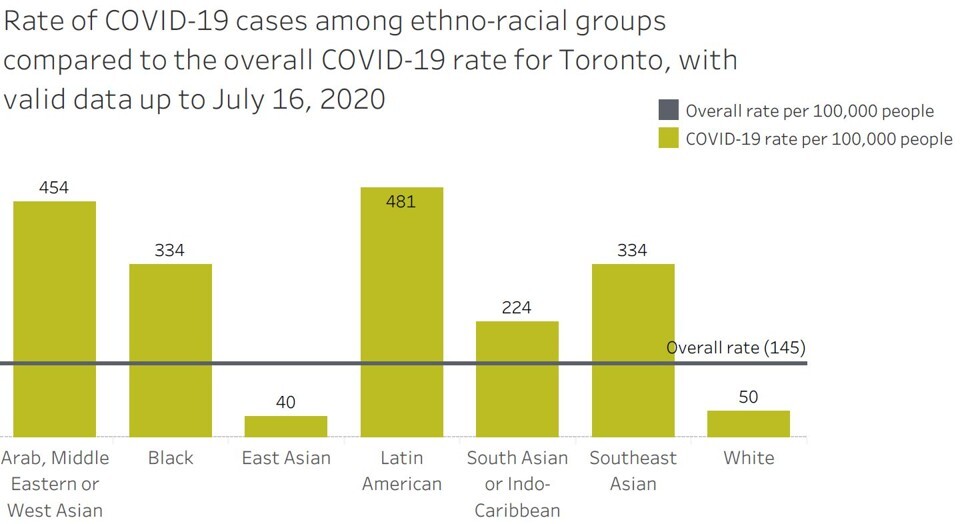
This chart shows the wide disparities in Covid-19 infection rates in Toronto, according to ethnicity, with East Asians experiencing the lowest rate and Latin Americans the highest. Graphic: Toronto Public Health

White Torontonians, meanwhile, have an infection rate that is a more modest 25 per cent higher than East Asians’ – still much lower than the rate for the whole of this diverse city.

Experts suspect that a combination of racism, behaviour and circumstance explains the stark differences among various ethnicities. The fact that wide disparities are also reflected in income-based infection rates suggests that socio-economic reasons are at play, not genetics, they say.

Widespread and early mask usage among East Asians could be a factor, said Dr Jason Kindrachuk, a University of Manitoba virologist who is studying Covid-19.
Covid-19 rate in Canada’s most Chinese city isn’t what racists might expect

But teasing apart causality would take time. “Is it as straightforward as income? Could this relate back to earlier community acceptance of things like masks or social distancing?” he asked.

Either way, the data is crucial to identifying communities that bear the greatest burden in the pandemic, said Kindrachuk.

“In Canada we talk about being a multi-ethnicity community, but we’re starting to identify just how different our communities are, how different the vulnerabilities are … so we need to think about how we provide services to those most in need.”

The Toronto data likely reflected the higher risks of certain jobs, those that relied heavily on non-white employees and were ill-suited to social distancing, Kindrachuk said.

Canada’s care industry has high numbers of Filipino workers, for example, while its meat processing and seasonal agricultural sectors employ many foreign workers from Mexico.

As well as suggesting communities most at risk, the ethnic data also stood in sharp contrast to what Kindrachuk called “shocking” racist rhetoric about “the ‘China virus’ [and the] implicit targeting of the East Asian, the Chinese communities, as being to blame for the virus”.

Poverty, racism and risk in Toronto

Previous data from New York and Los Angeles suggested that Asian residents of those cities had the lowest infection rates among various racial groups. But those US statistics lumped all Asians together, disguising any disparities within the group.

The Toronto data, presented by the city’s Medical Officer of Health Dr Eileen de Villa last Thursday and current to July 16, split up East Asians, Southeast Asians and South Asians. West Asians were grouped with Arab and Middle East people.

Separate census figures show that Toronto’s East Asian population is 84 per cent Chinese; ethnic Filipinos similarly dominate the Southeast Asian category, representing 79 per cent of the grouping.

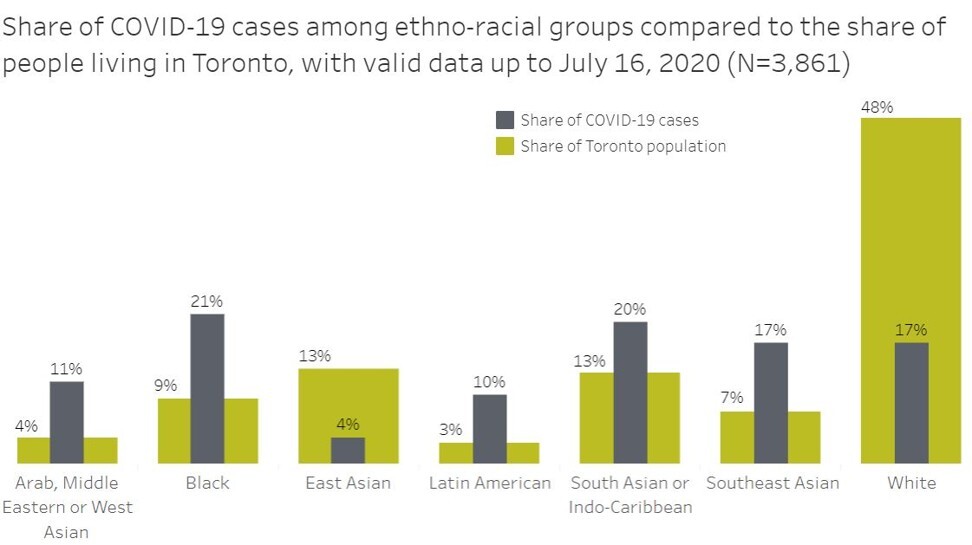
East Asians had a Covid-19 rate of 40 infections per 100,000, far below the citywide rate of 145. They make up 13 per cent of the City of Toronto’s population of about 2.7 million – but less than 4 per cent of all infections.

This chart shows the wide disparities in Covid-19 infection rates in Toronto according to ethnicity, illustrated as percentages of total population and total infections. Graphic: Toronto Public Health

The second-lowest infection rate (50 per 100,000) was among whites, who make up 48 per cent of the city’s population, and 17 per cent of infections.

Every other ethnic group has fared much worse.

The highest rates are among Latin Americans (481 per 100,000) and Arab/Middle Eastern/West Asians (454 per 100,000). Those communities are relatively small, at less than 3 and 4 per cent of the city respectively – but they suffered 10 per cent and 11 per cent of all Covid cases.

The larger populations of black Torontonians and Southeast Asians had identical infection rates of 334 per 100,000 people. Blacks make up about 9 per cent of the city, and Southeast Asians about 7 per cent, but experienced 21 and 17 per cent of all infections respectively.

South Asians (grouped with Indo-Caribbeans), had an infection rate of about 224 per 100,000. They make up about 13 per cent of Toronto, but have suffered 20 per cent of infections.

Canada has not been releasing race-based Covid-19 data on a national level, something critics call a blind spot.

But the Toronto data echoes previous geographical data from British Columbia, where the rate of Covid-19 infection in Richmond – the most ethnically Chinese city in the world outside Asia – has been the lowest in the metro Vancouver region.

In her presentation last week, Dr de Villa said there was “growing evidence … that racialised people and people living in lower-income households are more likely to be affected by COVID-19“.

“While the exact reasons for this have yet to be fully understood, we believe it is related to both poverty and racism,” she said.

She noted that 83 per cent of reported COVID-19 cases in Toronto involved a patient who identified as a member of a racialised group, compared to 52 per cent among the general population.

The race-based data from Toronto showed that “risk distribution was very unequal”, said Dr David Fisman, a professor of epidemiology at the University of Toronto. But this could be an overlapping function of wealth and income, he said.

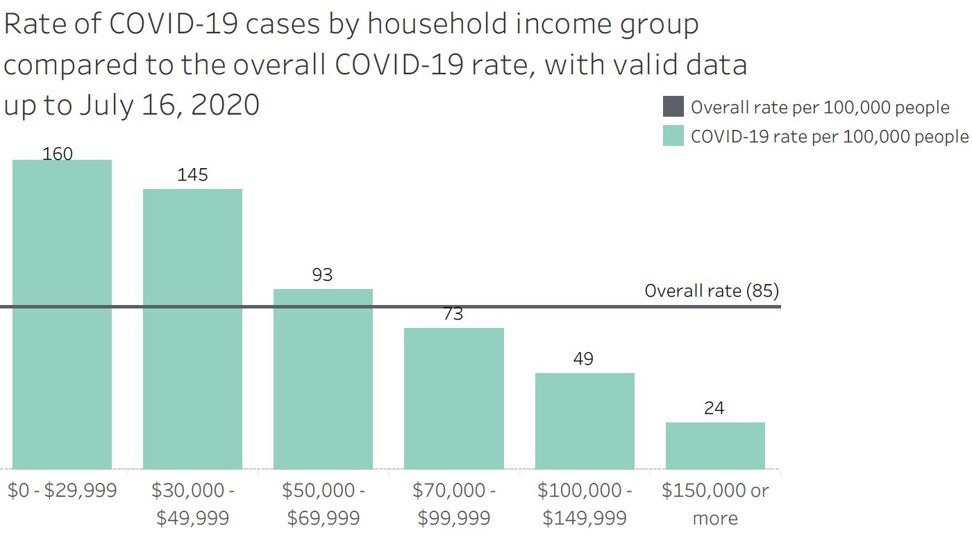
There were dramatic differences between infection rates depending on income, with the rate steeply declining as incomes rose. The infection rate among residents of households earning C$150,000 (US$113,000) or more was 24 per 100,000 – less than one-sixth the rate suffered by the lowest earners, on less than C$30,000 per year, at 160 infections per 100,000.

The risk of Covid-19 in Toronto declines steeply as income increases, this chart shows. Graphic: Toronto Public Health

“We were seeing this anecdotally in hospitals; the lockdown extinguished spread [of Covid-19] in higher-income areas, as a lot of professionals with service jobs got to go online,” he said.

“Lower-income folks are more likely to be people of colour and more likely to be in essential in-person work,” such as jobs in factories, food processing or care facilities, Fisman said.

“We can see that the epidemic split off in Toronto into two epidemics: one for wealthier Torontonians, and another, more prolonged, epidemic for those of lesser economic means.”

Kindrachuk agreed – the income divide was “eye-opening”, he said. “If you have a high income, you likely are going to be able to weather the storm … there is a complete disparity between how the burden of this disease looks between high and low income brackets.”

As for genetics, Kindrachuk said he doubted that it explained the stark disparities among ethnicities. “I haven’t seen evidence that there is a difference” on a genetic basis, he said.

Racial disparity in Vancouver drug charges revealed by new data

Nuanced analysis of the data and disparities:

Black and Indigenous people are dramatically overrepresented in drug charges recommended by Vancouver police, an analysis of new data shows.

The police say, and some experts agree, that these findings are not evidence of racial bias in the Vancouver Police Department, but instead reflect inequalities and failings in broader Canadian society. Others say those wider problems don’t absolve police in Vancouver or elsewhere of a need to confront racism within their own institutions.

These findings emerge from data obtained from the VPD and provided to Postmedia by a University of B.C. PhD student, Ryan Moyer, who said he filed the FOI request “to better investigate the disproportionate impacts of punitive drug policy.”

“While we cannot infer that the overrepresentation of Indigenous and Black communities in drug-related crimes is due to racism specifically,” Moyer said, the “disproportionately frequent interactions” with these populations is concerning and shows the need for more cultural training and more dialogue with leaders of these communities.

In B.C., police do not decide on charges. Instead they make recommendations to Crown counsels, who then decide whether to approve charges. Moyer’s FOI records include 1,268 files where VPD recommended a range of drug charges, 76 per cent of which were approved and went to court, 17 per cent were pending or unknown and seven per cent were not approved by Crown.

In mid-June, Vancouver Police Chief Adam Palmer talked to Postmedia about racism and policing. Palmer said that while he believes systemic racism doesn’t exist in Canadian policing, racism is still a problem in Canada.

VPD officers undergo more extensive training than other B.C. police agencies on issues including implicit bias, cultural competency and sensitivity, and Indigenous culture, Palmer said then.

Palmer also pointed to broader societal problems that can precede the point in a person’s life when they encounter a cop: “The police officer (is) sometimes dealing with the end result of 20 years of trouble that that person has gone through.”

Palmer is not wrong there, said University of Toronto criminologist Akwasi Owusu-Bempah.

“The chief makes a great point: The police are left to deal with many of society’s failures, and if those societal failures have racially disparate outcomes, then policing is going to have racially disparate outcomes as well,” said Owusu-Bempah.

However, he was surprised Palmer so forcefully denied systemic racism in Canadian policing, considering “the police are a microcosm of society.”

The stakes are high, Owusu-Bempah said, because drug charges, even those resulting in acquittals, can have long-lasting affects on a person’s prospects for employment, education and housing. This adds urgency, he said, to calls to decriminalize, or as he’d prefer, fully legalize all drugs in Canada.

On that point, the data show drug possession charges in Vancouver have fallen sharply in recent years: VPD recommended 142 possession charges in 2015 but only 36 last year, a 75 per cent reduction. In the first half of this year, only 10 possession charges recommended.

“I think (the VPD) should be commended for that approach. But it raises questions of who doesn’t benefit from that?” Owusu-Bempah said. “It seems like decriminalization’s in practice for some, but not for others.”

It’s a good thing this data has now been made public through Moyer’s FOI request, Owusu-Bempah said, “because if they don’t make it public, we can’t identify problems.”

The public should be careful of drawing the wrong conclusions from this data, said VPD spokeswoman Simi Heer.

“It’s simplistic to compare the percentages related to the data in the spreadsheet based on ethnicity,” without taking into account several “long-standing, complex issues,” Heer said.

“Canada has a troubling history of systemic discrimination against Indigenous Peoples,” Heer said. “We recognize that this discrimination continues to perpetuate significant problems today, including overrepresentation in all aspects of the criminal justice system, the homeless population, and more recently, the number of overdoses during the fentanyl crisis.”

“The VPD’s approach on drug issues has been to target the most serious harms to society, as the number of deaths in our communities related to the fentanyl crisis have reached crisis proportions,” Heer said. “This means we’ve been targeting drug trafficking, drug production and organized crime.”

Heer also pointed to the preliminary findings of Metro Vancouver’s homeless count released this week, showing Black and Indigenous people were significantly overrepresented in the region’s homeless population.

The overrepresentation of Black and Indigenous people in both drug charges and homeless populations are “totally connected,” said Neil Boyd, a lawyer and Simon Fraser University professor of criminology.

Boyd said he can’t say racism definitely doesn’t exist in the VPD, but these statistics don’t definitively prove that it does.

“The disproportionate numbers, there might be people who would want to argue that reflects a kind of racism, but I think if it’s racism, it’s not racism within the police department, it’s the racism of our culture, in which we see such an overrepresentation of Indigenous and Black people on the street,” said Boyd.

People from all walks of Canadian society buy, sell, and use drugs, but the police are more likely to come into contact with people with fewer resources, and especially less access to private space, Boyd said. In other words, officers are far more likely to come across a homeless person selling opioids to support his own addiction than an affluent person in a Yaletown condo buying cocaine for a night out.

Others say these racial disparities underscore how much work remains to be done to combat racism and oppression in Canada.

“What we’re seeing is a continuation of oppression,” said Patricia Vickers, a psychotherapist and the First Nations Health Authority’s former director of mental health and wellness services. “Nothing has really changed all that much, as far as our relationships go. When we look at reconciliation, we’re not really seeing what that means in society.”

“The incarceration of Indigenous people is just another symptom of this continuation of domination, control, oppression,” Vickers said. “This is just one of the pieces of evidence we have.”

Harsha Walia, executive director of the B.C. Civil Liberties Association, said these numbers are “not surprising, but it’s still deeply disturbing.”

Racial inequalities exist in many aspects of Canadian society, including the economy, education, health care and more, Walia said. “It’s also not accurate that somehow the armed institutions of the state … are somehow immune from this either.”

“We have study after study that shows over-criminalization and over-incarceration of Black and Indigenous people is absolutely both a symptom and a cause of systemic racism in other institutions,” Walia said. “It’s not a linear A leads to B, it’s a cyclical process.”

In June, B.C. Public Safety Minister Mike Farnworth announced the NDP government plans to modernize the province’s Police Act, “with a specific focus on systemic racism.”

Source: Racial disparity in Vancouver drug charges revealed by new data

Under Cover of the Pandemic, the Modi Administration Has Removed Chapters on Democracy, Secularism, and Citizenship From Textbooks

Of note:

As students across India logged in to their virtual classrooms last month, many of them no doubt felt their prayers had been answered.

The Central Board of Secondary Education (CBSE), India’s largesteducation board, announced in July that it had cut this year’s syllabus by 30 percent. It hopes that the move will relieve stressed-out students who have lost valuable hours in the classroom to COVID-19 and are trying to adapt to online learning.

But not everyone is pleased. The move has fueled controversy over the fact that government-run schools no longer have to teach chapters on democratic rights, secularism, federalism, and citizenship, among other topics. These concepts lie at the core of the Indian Constitution but have at times come into conflict with the Hindu-majoritarian ideology of the ruling right-wing Bharatiya Janata Party (BJP). The party’s well-established interest in using the education system to spread its own unitary brand of Indian identity has further raised concerns that the omissions are politically motivated.


After a victory in last year’s general elections, Prime Minister Narendra Modi’s BJP began rolling out a set of controversial citizenship policies that critics have called unconstitutional and anti-Muslim and that have been condemned for promoting an ethnoreligious idea of India. The country has since witnessed a series of large-scale national protests against the measures, including the Citizenship Amendment Act—a law designed to aid refugees from neighboring countries but which excludes Muslims—and a new National Register of Citizens. When combined, the two measures could end up disenfranchising large numbers of India’s Muslim population. (That’s the point, Home Minister Amit Shah, has admitted.) The protests were the largest public challenge to Modi’s rule since he first came to power in 2014.

When chapters like “Popular Struggles and Movements” and “Democracy and Diversity” were removed from the Class 10 political science syllabus, stakeholders and opposition groups were quick to frame the cuts as being in line with the other steps for which Modi has been  criticized. The move advances the vision of an “exclusivist, theocratic, intolerant, fascistic nation,” Sitaram Yechury, the leader of Communist Party of India (Marxist), wrote on Facebook in July. His party later called for the cuts to be rescinded, saying they hurt “secular democratic India’s future.”

The Education Ministry has denied any political motives behind the move, which it said was backed by a consensus of policymakers. It also issued a clarification on July 8 calling the cuts a “one-time measure only.”

It is hard to separate the syllabus cuts from the current political climate.

For practitioners, though, it is hard to separate the syllabus cuts from the current political climate. “It’s clear that this was a very selective exercise,” Anita Rampal, a professor and former dean of the education department at Delhi University, told me in July. “The deleted chapters relate directly to policies that are currently being questioned in the public sphere—and that’s important because not many issues usually are. These are topics the government finds inconvenient.”

Adding weight to such interpretations are other activities the government has undertaken during the pandemic. According to Human Rights Watch, New Delhi has stifled dissent and arrested protesters. The government has also come under fire for refusing to release academics and social activists from jail, including the 80-year-old poet Varavara Rao, who was kept in cramped prison conditions on charges of inciting caste-based violenceunder India’s draconian Unlawful Activities Act. He ended up contracting the coronavirus.

Meanwhile requests from opposition leaders to resume parliament or allow for videoconferencing have fallen on deaf ears. In turn, the Indian National Congress, the main opposition party, has accused the government of trying to avoid parliamentary scrutiny. Add to this a distracted mainstream media with little interest in covering education policy minutiae and educators like Rampal have little to be hopeful about. “It’s a populist move that few people have the time or inclination to question,” she said. “Once deleted, I can’t see these chapters coming back in any meaningful way.”

The Education Ministry maintains that the recent move is in students’ best interests. Before the pandemic, too, ministry officials spoke about the need to “rationalize” the syllabus and unburden students from the lengthy slog. But if that is the goal, the cuts have undermined it. In an op-ed, Krishna Kumar, a former director of the National Council of Education Research and Training (the organization responsible for designing the curriculum), argued that the cuts have left some remaining topics “incomprehensible.” He points out that students will now learn about the constitution without learning about India’s federal structure.

The deleted chapters were also among those that offered relief from the rote learning and factual regurgitation that are endemic to the Indian education system.

 “These chapters allowed students to raise questions about social justice and engage in critical analysis,” Rampal said. “Removing these chapters sends a clear signal about what they believe is right for children to be learning.”

The CBSE has said teachers can still teach these topics if they wish. But that is unlikely to happen. “Teachers are evaluated on how well their students score in the board exams and are penalized if they finish the syllabus late,” a New Delhi secondary-school teacher told me. “When you’re already under so much pressure, there’s no incentive to be creative or deviate from the highly centralized teaching calendar.” This system has bred a culture of survival and removed any space for teachers to “really think and talk about educating children’s minds,” the teacher said. “It’s why so many great teachers have left.”

Policymakers must know that topics that are not going to be tested in board exams are unlikely to be covered in class, said Pradyumna Jairam, a former CBSE board social sciences teacher and researcher at King’s College London. “That’s why it is crucial to look at which chapters have been deleted and to ask why they don’t want these chapters to be taught,” he added.

Jairam’s answer is that the deleted chapters dealt with uncomfortable periods of Indian history, like the partition of the subcontinent in 1947 and lower-caste struggles for emancipation. The chapter on popular movements, for example, drew a strong parallel between the assertion of Dalit rights and the civil rights movement in 1960s America, he said. “I taught this chapter, so I know how effective it was. It encouraged students to reflect on how privilege still operates in society, as well as on their own privilege, which may have sheltered them from these uncomfortable truths.”


But Jairam’s interpretation begs the question of why the BJP might have a problem with students learning about human rights, democracy, local government, and civil liberties.

The answer lies in the ruling party’s ties to the Rashtriya Swayamsevak Sangh (RSS), a volunteer paramilitary organization, and its deeply embedded Hindutva ideology. “The individualistic values promoted by liberal democracy is anathema to their view of Hindu traditions,” said Christophe Jaffrelot, a political scientist specializing in South Asia. He noted that Shah, Modi’s home minister, “argued that India should not follow the Western notion of human rights. Nor does the RSS allow for any room for elections or public debate within the organization.”

Education reform has long been a priority of the RSS. The organization itself operates a network of schools through its education wing, the Vidya Bharati. It views changing curriculum content in particular as a key component of nation building and erasing foreign elements from India’s Nehruvian teaching methods. When the BJP was last in power in the early 2000s, it appointed RSS members to top education positions and launched a national curriculum framework under the slogan “Indianize, nationalize, and spiritualize.”

The way history textbooks have already been rewritten in BJP-ruled states can provide clues to the kind of agenda the current administration is pursuing. In Rajasthan, for example, the state board removed all mentions of Jawaharlal Nehru, India’s first prime minister and champion of a diverse and secular India, while adding multiple references to V.D. Savarkar, the father of Hindutva ideology. Meanwhile B.R. Ambedkar is labeled as a “Hindu social reformer” despite his later conversion to Buddhism. Critics claim his seminal key role in fighting for Dalit emancipation was also minimized.

Given this background, “it’s actually surprising that central board textbooks were not rewritten sooner,” Jaffrelot said. In 1999, the last time the BJP was in power and when Murli Manohar Joshi was the minister for human resources development, “this was a priority of the party, and they began making changes straight away.”

In that way, there is a feeling among some political observers that the BJP has left its most divisive policies for its second term in power. With the Supreme Court’s independence under question, a brutal crackdown on dissenting voices from academic and civil society, and a feeble opposition, the path has been cleared for the government to pursue its most controversial objectives, starting with the revocation of Kashmir’s special status a year ago and leading, most recently, to reconfiguring textbooks.

“Now is the time for them to do whatever they want, because who can say anything against them?” Jaffrelot said.

Source: Under Cover of the Pandemic, the Modi Administration Has Removed Chapters on Democracy, Secularism, and Citizenship From Textbooks

Omidvar and Khanna: Seven deadly sins to avoid on the path to anti-racism

Great commentary:

Canada has a long history of racism: colonization, slavery, the residential school system, the Chinese head tax, the SS Komagata Maru, the Japanese internment and the demolition of Africville. Although Canada became the first country in the world to adopt multiculturalism as an official policy in 1971, Black, Indigenous, and people of colour have continued to face racism from our past to our present.

As a nation, we have realized that we cannot live up to our promise of an equitable society if we continue to uphold overt and covert forms of racism. Race scholar Ibram X. Kendi says we are either racist or actively anti-racist, and there is no in-between. The work we are talking about is not just a necessary change, but one that is long overdue. However, even the best of intentions, strategies and plans can fail if they are not cognizant of the pitfalls ahead of them.

Here are the pitfalls to avoid. Let’s call them the seven deadly sins.

The first is the sin of empty words and a singular action. Some call this diversity theatre or performative ally-ship. We must collectively commit to changing behaviours and policies with timelines and resources. This is not passion, it is work. It is not trendy, it is ongoing. It is not aspirational, it is grounded in practice, unlearning and re-learning.

The second is the sin of ignoring or failing to gather evidence. Anti-racism work is not an opinion sport. It must be grounded in intersectional qualitative and quantitative data and analysis, so that the progress can be benchmarked against evidence.

The third is punting responsibility away from leadership. Anti-racism work needs an ongoing commitment from those in positions of influence, not just when it is convenient. Leaders have the power and resources to create cultural change, to centre Black and Indigenous experiences, and to address systemic racism. The worst thing we can do is underestimate the need for support from the top.

The fourth is the sin of ignoring whom you have influence over and do business with. Organizations often forget that this is, in fact, their most important lever. By using an anti-racist lens on procurement, for instance, it is possible to extend the reach of strategies to a wider circle.

The fifth is the sin of overlooking privilege. This cements access for some and denies it to others. Anti-racism work is about looking inward and looking outward, not from a mindset of “helping” others but helping ourselves understand our own privilege. We can no longer support the idea of meritocracy: that those who work hardest get the furthest without understanding the role that privilege plays.

The sixth is the sin of tokenism. It is never acceptable to invite someone into a role for the sole purpose of ticking off a box. This is insincerity and shallowness of the worst kind. A thoughtful, sincere response can never simply start with a knee-jerk appointment that may salve some consciences, but will do little to embed anti-racism, inclusion and belonging into the culture of an organization.

The seventh and final deadly sin is the sin of centring the dominant group. Anti-racism work is not reaching for comfort but actively seeking discomfort. It is about understanding the importance of continually measuring impact over intent, the idea that how our actions are received is more important than the action itself. We should continue to centre Black, Indigenous, and people of colour. It is up to those experiencing racism to let us know if racism has been eradicated.

As we embark on our anti-racism journey, it is important to remember that this commitment is hard but necessary. We are not free until we are all free. Let’s roll up our sleeves and truly get to work. Our country will be better tomorrow for what we do today.

Sen. Ratna Omidvar is an Independent senator from Ontario. Diya Khanna is a diversity, equity and inclusion manager with Amazon and was appointed to the Seattle Women’s Commission in 2018.

Source: Seven deadly sins to avoid on the path to anti-racism

Justin Trudeau promised action ‘very soon’ to tackle systemic racism. Seven weeks later, where is it?

Very soon is a relative concept to politicians. For the opposition, the shorter the better, even if largely symbolic.

For government, which actually has the responsibility to develop, implement and manage policies and programs, a longer timeframe is involved except under exceptional circumstances such as the various COVID support measures.

The symbolic is easy and can often be meaningful. But tackling long-term structural issues is hard and requires longer-term commitment and effort:

It has been seven weeks since Prime Minister Justin Trudeau promised action “very soon” to address systemic racism in Canadian policing and other institutions.

For Matthew Green, an NDP MP and member of the cross-party Parliamentary Black Caucus, “very soon” is now long past due — and can’t come soon enough.

That’s especially the case, he says, after more than 100 Liberal MPs and half of Trudeau’s cabinet signed a declaration from the Black caucus in mid-June that called for a wide range of reforms.

“If these ministers are not serious, then they ought not have signed on,” Green told the Star by phone on Wednesday.

“What we’re asking for is not radical. It is actually basic justice principles of applying policy and the legal system in an equitable way,” he said.

Responding to questions from the Star on Wednesday, Trudeau spokesperson Alex Wellstead provided a quote from the prime minister after the Liberal cabinet retreat in early July. Trudeau pledged at the time that his ministers would craft a “work plan” for the summer to build “strong policies” to tackle racism. This would include reforms to police and the justice system, improved protections for temporary foreign workers and legislation to expand First Nations policing of their own communities, Trudeau said.

In 2019, the Liberal government unveiled a $45-million strategy to tackle racism in the public service and federal policies. The party also promised during the election last year to increase funding for the strategy.

But in mid-June of this year, Trudeau pledged further action on systemic racism would come “very soon.” At the time, much of the Western world was roiling from widespread demonstrations denouncing police brutality and racism against Black, Indigenous and other racialized people.

In Canada, demonstrations were fuelled by a series of incidents in which people died during interactions with police. These included Chantel Moore, a 26-year-old First Nations woman shot and killed on June 4 during a wellness check at her apartment in Edmunston, N.B., and 29-year-old Regis Korchinski-Paquet, an Afro-Indigenous woman who died in Toronto after falling from an apartment balcony during a police visit.

On June 16, the Parliamentary Black Caucus released its declaration that called on governments to “act immediately” on a wide range of demands to address systemic racism in Canada. The document called for Ottawa to end mandatory minimum jail sentences, create programs to support businesses owned by Black Canadians and improve the collection and release of race-based data. It also called for more Black and Indigenous judges, and to shift money from police budgets to health and social services.

The document was signed by at least 25 cabinet ministers, including Deputy Prime Minister Chrystia Freeland and Justice Minister David Lametti.

Greg Fergus, a Liberal MP from Quebec who is a member of the Black caucus, said Black Canadians have been waiting for decades for reforms and that he is confident the Trudeau government will take significant steps to address racism. He said he has spoken with Trudeau directly about the issue and that he has been assured actions are going to be taken — though he declined to discuss specific plans because he doesn’t want to “scoop” his own government.

“I know that everybody would like this to be done yesterday, but I’m glad they’re taking the time to get it right,” he said.

“For the first time in my life I actually really feel that, Wow, we’re going to get at this, we’re really going to give this a real say — because Canadians will want things to be done.”

Green was less optimistic, and said he believes the Liberal government has already missed opportunities to implement change. He said several demands in the Black caucus declaration could have been pursued immediately, including the elimination of mandatory minimum jail sentencing and amnesty for people convicted for cannabis-related crimes before it was legalized.

The federal government was also criticized this spring for delaying its promisedresponse to the National Inquiry Into Missing and Murdered Indigenous Women and Girls, which probed the systemic causes of disproportionate violence against these groups and concluded in June 2019 with a list of demands for change.

Green said he will be looking to Aug. 12, when the House of Commons is next scheduled to sit, as the next chance for the Liberals to follow up with the action they promised.

“This government can move immediately — immediately — within weeks to award their insiders and their friends a contract that would have resulted in the benefit of $43 million,” Green said, referring to the controversy over the Liberal government’s decision to outsource a student grant program to WE Charity.

“They did that without any drawn out or protracted incremental approach. So why can’t they make those same investments in the Black community?” he said.

Source: Justin Trudeau promised action ‘very soon’ to tackle systemic racism. Seven weeks later, where is it?

Black and racialized Canadians lacking on boards, new study finds

Of note:

A new study from Ryerson University’s Diversity Institute says Black and racialized people are under-represented and sometimes non-existent on boards in eight major cities across Canada.

The institute found few members of those groups on the boards of large companies, agencies, hospitals, educational institutions and in the voluntary sector in cities including Toronto, Montreal, Vancouver, Calgary, Halifax, Hamilton, London and Ottawa.

The study of almost 9,500 people found Black Canadians occupy just 2 per cent of board positions, despite making up 5.6 per cent of the population of those cities.

Racialized people, defined in the study as all non-Caucasians were found to have only one in 10 board positions, though they represent 28.4 per cent of the population.

The institute’s methodology included analyzing photographs of boards and interviewing members of underrepresented communities.

The study also found women are under-represented boards, but fare much better because they hold 40.8 per cent of board positions.

Source: Black and racialized Canadians lacking on boards, new study finds

Full report: Diverse Representation in Leadership: A Review of Eight Canadian Cities

Timmy Wong: Chinese-Canadian groups that support Hong Kong’s National Security Law do not represent all Chinese-Canadians

Of note:

As Hong Kong-Canadians residing in Metro Vancouver, we are shocked and saddened by local groups supporting Hong Kong’s National Security Law who claim to represent all Chinese- and Hong Kong-Canadians. The National Congress of Chinese Canadians (NCCC), along with the Chinese Benevolent Association of Vancouver, have both publicly supported this law, which was unilaterally imposed on Hong Kong by Beijing on June 30. They ignore the diversity of opinions among the 1.7 million Hong Kong- and Chinese-Canadians, many of whom chose to immigrate to Canada for freedoms and rights that do not exist under the authoritarian rule of the Chinese Communist Party (CCP).

NCCC chairperson David Choi has made a video statement claiming that the majority of Hong Kong- and Chinese-Canadians support the National Security Law. Furthermore, he condones the atrocities committed by Chief Executive of Hong Kong Carrie Lam and the brutality of Hong Kong police in the name of “National Security.”

Choi further provoked the sensitive issue of Quebec separatism and terrorism, purposely misreading Canadian history to justify his support of this draconian law. NCCC has not been authorized by Hong Kong- or Chinese-Canadians to represent their view or voice since it has not received any mandate to do so from either of these communities.

What is more worrying is that the Beijing government — not any Hong Kong judicial or policy body — will have the ultimate power over how the law should be interpreted. If the law conflicts with any Hong Kong law, the Beijing law prevails. By supporting the National Security Law as Canadians, NCCC is persuading Canadians to support authoritarian rule in Hong Kong and beyond.

This legislation has effectively ended the “One Country, Two Systems” constitutional principle that guided the CCP’s rule of Hong Kong during the 50-year period of handover from Britain. Overnight, Hong Kong has become “just another Chinese city” under the dictatorial CCP. It has also turned into a police state with the establishment of the National Security Bureau, where protesting is essentially prohibited, social media posts are closely monitored, and any slogans supporting Hong Kong’s freedom are outlawed. Any speech that criticizes the CCP could lead to conviction under the charge of subversion. Even the investigation into the Hong Kong Police Force’s brutality against protesters for freedom could lead to charges against people in education institutes or religious and non-profit organizations who are engaged in the exchange of ideas and information. Also their foreign counterparts could be convicted under “Collusion with External or Foreign Forces” provisions in the new law.

Under the new National Security Law, anyone from any quarter in the world who is critical of China could be arrested and tried in secrecy and extradited from Hong Kong to Communist China without any opportunity to appeal. Crimes of “secession, subversion, terrorism and collusion” with foreign forces are punishable by a maximum sentence of life in prison. The impact is so serious that the Canadian government has issued a travel warning to Canadians that they could be arbitrarily arrested by the Hong Kong government under this draconian law. Yet NCCC still endorses the National Security Law, betraying the core Canadian values of free speech and human rights.

Hong Kongers are looking to the free world for refuge and protection from China’s state-sponsored terrorism, but the members of NCCC ignore their pleas for help. Instead, they endorse the totalitarian policy of CCP for Hong Kong and echo the CCP’s need to “defend National Security.” They do not and must not represent the voices of 1.7 million Canadians.

We, a group of Hong Kong-Canadians, have been protesting and advocating in solidarity with our fellow Hong Kongers in Hong Kong since June 2019. The world has seen the atrocities of how Hong Kong and Beijing governments treat the Hong Kongers and, one by one, countries are making a stand for freedom with Hong Kongers.

Unlike the NCCC, there are many Chinese- and Hong Kong-Canadians who are deeply aware of the privilege they have as settlers, and who are aware of the long history they have had in this nation fighting for political agency. Chinese-Canadians (who include Hong Kong-Canadians) were finally given the vote in 1947 after many of them served the country bravely and proudly in the Second World War. Their right to vote was a sign that Chinese-Canadians were finally accepted as full Canadians and given access to democracy, freedom, equality and human rights.

Unfortunately, the NCCC, the Chinese Benevolent Association, and many Chinese-Canadians appear to have now forgotten the hard-fought battle for their rights and freedoms in Canada. They enjoy the rights and privileges as protected by the Canadian Charter of Rights and Freedoms and use their free speech to deny others the same freedom by propping up an authoritarian, power-hungry regime.

Many Hong Kongers who first moved to Canada moved here out of their fear of the CCP when the handover from the U.K. to China was first announced in 1984. On June 4, 1989, the Tiananmen Massacre hit the souls of many Hong Kongers and it triggered another wave of migration to Canada.

Many of us Hong Kong-Canadians are forever grateful to Canada for allowing us to settle and prosper in this free land. It is a duty as Canadians to stand on guard for freedom. It means that we will defend freedom of speech for the oppressed through our political agency. Many Hong Kong-Canadians have voiced their concerns over the deteriorating situation in Hong Kong through petitions, letter-writing campaigns, protest, and other forms of advocacy. The Canadian government has taken a clear stand by calling out Beijing’s crackdown as illegal and a violation of human rights, to the extent of suspending the extradition treaty with Hong Kong indefinitely. What NCCC claimed is in fact a direct contradiction to what many Canadians believe.

Source: Timmy Wong: Chinese-Canadian groups that support Hong Kong’s National Security Law do not represent all Chinese-Canadians