After coronavirus delays, Australian citizenship processing resumes in capital cities

After completely shutting the Canadian citizenship program in late March, June saw a resumption with almost 1,700 new citizens in June (down 92 percent compared to June 2019). Australia had a much smaller decline as this article attests:

The suspension of processing had caused widespread concern among pending applicants, who were worried about their cases being put on hold.

The federal government says the appointments have started in Brisbane, Sydney, Adelaide and Perth and will also resume in Canberra, Hobart and Darwin later this month.

The suspension of processing had caused widespread concern among pending applicants, who were worried about a growing backlog.

Acting Immigration Minister Alan Tudge said the resumption of testing would allow more migrants to progress towards making the pledge of allegiance.

“The interview and tests are important steps in the process of applying for Australian citizenship, ensuring the integrity of our citizenship decisions,” he said.

A record 204,000 people became Australian citizens last financial year despite the coronavirus disruption, while 73,000 online ceremonies were conducted during the pandemic.

There remains a further 150,00 people who have applications pending, including those awaiting citizenship testing and interviews, according to government figures.

Yash-Sanjiv Rungta, who lives in Sarina in Queensland’s Mackay region, said he and his wife are yet to hear back about the status of their application since applying for citizenship in December last year.

The Indian national migrated to Australia six years ago – a decision motivated by his passion for cricket and the country’s “amazing” weather.

“To get Aussie citizenship is a matter of pride and honour,” he told SBS News.

“We are really excited about the prospect of becoming citizens of this country soon… it might take time but definitely we will become citizens one day.”

The government says citizenship appointments will return in capital cities in line with state and territory health restrictions with the safety of staff and applicants to be made a priority.

More than 1,150 people have attended one of these citizenship appointments since they resumed in July.

Mr Rungta said he remains uncertain about when he will get his opportunity, with interviews and testing yet to become available in his regional area.

“If they ask me to attend an interview or test in Brisbane – I don’t mind,” he said.

“(But) I fail to understand why they can’t start it in regional towns – where there is no instance of coronavirus left now.”

A spokesperson for the Department of Home Affairs said that Services Australia conducts citizenship tests on the department’s behalf for clients in regional Australia.

“The department is working closely with Services Australia to resume citizenship testing arrangements in regional Australia as restrictions ease in states and territories, and in accordance with health advice,” the spokesperson said.

In Melbourne, citizenship tests and interviews are yet to be resumed because of the city’s resurgence in coronavirus cases.

Melbourne-based Amul Jani is among those in the city facing the prospect of their citizenship application being further delayed by the COVID outbreak.

“That’s a big test of patience and it is really disappointing – we would have really loved for this to have happened sooner than what it looks like now,” he told SBS News.

Mr Jani migrated from India with his wife Mosiqi six years ago and along with their seven-year-old son Reyansh made their applications to become citizens in March this year.

He said the government should consider introducing virtual options for citizenship processing where face-to-face appointments can’t resume.

“In all sense we consider ourselves as part of this country … we just hope for the best and wait for it to happen,” he said.

Sydney-based Abhijeet Sen, his wife, and six-year-old son are also waiting to undertake the citizenship test and receive an interview invitation.

Almost 1,600 people signed his petition calling for the government to gradually resume the procedures as coronavirus health concerns ease.

Mr Sen said the resumption of the citizenship interviews and testing is welcome.

“That makes me excited … I am really looking forward to it,” he told SBS News.

But he remains wary of a potential backlog of applications because of the coronavirus disruption.

“COVID is not going away anytime soon so even if test is resumed it will be conducted at fairly low levels,” he said.

Face-to-face citizenship ceremonies returned in June.

There are currently around 35,000 people who have their application approved and are awaiting a ceremony, down from 85,000 in April.

Source: After coronavirus delays, Australian citizenship processing resumes in capital cities

Why Is It Not the Least Bit Surprising That Everyone Ignores Kamala Harris’ Multiculturalism?

While I think Harris’ biracial background has been well covered, found this commentary of interest given that the writer found it under-covered along with the implications for others with mixed identities:

On Tuesday, Joe Biden, presumptive Democratic nominee for president of the United States, announced he had chosen Senator Kamala Harris as his running mate. The excitement was swift. The backlash was even swifter. President Trump wasted little time calling Harris “nasty” and “disrespectful”—the man is nothing if not predictable. As was the Democratic talking heads’ praise of Biden for picking Kamala as a means of “securing the Black vote,”as if Black people are a monolith and Biden didn’t tell Charlamagne tha God on The Breakfast Club, “If you have a problem figuring out whether you’re for me or Trump, then you ain’t Black.” Many also claimed Harris’ potential vice presidency will change “the way we view and treat women in politics forever,” as if a number of Democrats didn’t consider Harris “too ambitious” to be Biden’s running mate.

But amid the sexist, racist backlash and Democratic congratulator back-slapping, history was made. Not only was Harris the first African American and first woman to serve as California’s Attorney General and the second Black woman to become a sitting U.S. senator, she is now the first Black woman to join a major party ticket (civil rights activist Charlotta Bass became the first Black woman to ever run for office as vice president in 1952, when she joined the Progressive Party ticket). If Biden is elected president, Harris will become the first African American and first woman to hold the office of the vice presidency.

She’ll also become the first South-Asian American to become vice president. Just as she is the first South-Asian American to join a major party ticket, just like she was the first South-Asian American to join the Senate. But Harris’ multiculturalism and South Asian identity is often overlooked by a society that continues to rely on a binary way of thinking. Like former President Barack Obama, Harris’ multiculturalism is, most often, only acknowledged in a racist attempt to invalidate her Blackness. Obama isn’t really Black, Rush Limbaugh argued. He is “half white.” Harris isn’t reallyAfrican American, right-wing talking heads say. She is Jamaican. She is “half” South-Asian. She is “half” Black. She is a half, they say. She is not whole.

For those of us who are bi- or multiracial, watching Harris’ entire identity be whittled away to “this” or “that” is as painful as it is familiar. As a Puerto Rican and Norwegian woman who grew up in Eagle River, Alaska, and now lives in Bed-Stuy, Brooklyn, New York, I know what it’s like for people to assume the entirety of your identity based on how you look. I know how your identity can be white-washed, invalidated, categorized, and in Harris’ case, used to devalue who you are and the community you represent. As Americans, we often lack the ability to establish and maintain nuanced conversations about race and heritage, ethnicity and culture. And in this country, bi- or multiracial people are often described in halves—“half black,” “half white,” “half Puerto Rican,” “half Asian”—as if the rich multiplicities that embody our identity do not make us whole but fractured. It is no wonder that multiracial people often feel both within and without—for me, not Puerto Rican enough but not white enough either.

But to acknowledge Harris’ Black and South Asian identities simultaneously is to give bi- and multiracial kids who feel like they have to be all of one thing or risk being seen as nothing at all a chance to be reminded of their inherent value—that we are not fragments of our ancestries but a dream realized by those who live in a country that didn’t legalize biracial marriage until 1967.

All of Harris’ firsts have given and continue to give us an opportunity to see ourselves not as a collection of halves or a myriad of contradictions or parts to be dissected and criticized and used against us when we ascent to positions of power but as whole people worthy of respect, a seat at the table, and if given the opportunity, a shot at the vice presidency of the United States.

Source: Why Is It Not the Least Bit Surprising That Everyone Ignores Kamala Harris’ Multiculturalism?

China’s Confucius Institutes confronting US demand to register

While no fan of the Trump administration, Canada should consider a similar measure:

The Trump administration is increasing scrutiny of a long-established Chinese-government funded programme that’s dedicated to teaching Chinese language and culture in the US and other nations, the latest escalation of tensions with Beijing.

The State Department plans to announce as soon as Thursday (Aug 13) that Confucius Institutes in the US – many of which are based on college campuses – will need to register as “foreign missions,” according to people familiar with the matter who asked not to be identified.

The designation would amount to a conclusion that Confucius Institutes are “substantially owned or effectively controlled” by a foreign government. That would subject them to administrative requirements similar to those for embassies and consulates.

The State Department, which didn’t immediately respond to a request for comment, took similar action toward several Chinese media outlets earlier this year.

The institutes have long been a target of China hawks, with lawmakers including Senator Marco Rubio, a Florida Republican, urging schools in his state to terminate their agreements with them.

He called them “Chinese government-run programmes that use the teaching of Chinese language and culture as a tool to expand the political influence” of the government.

The move is likely to further stoke tensions with Beijing as the two countries clash over everything from the governance of Hong Kong to 5G technology.

This week, Health and Human Services Secretary Alex Azar became the highest-ranking American official to visit Taiwan in more than 40 years, while Secretary of State Michael Pompeo used a speech in Prague to blast the Chinese Communist Party’s “campaigns of coercion and control.”

Of some 550 Confucius Institutes around the world, 80 are based at US colleges, including Stanford University and Savannah State University in Georgia, according to the National Association of Scholars, a non-partisan research group that has studied them.

Although the institutes generally steer clear of history, politics and current affairs, critics say they are vehicles for Chinese influence on campuses, providing the government in Beijing leverage to censor teaching materials and academic events by threatening to withdraw funding for the institutes.

The National Association of Scholars opposes them because it says their funding lacks transparency and topics sensitive to China’s government are off limits.

Source: https://www.straitstimes.com/world/united-states/chinas-confucius-institutes-confronting-us-demand-to-register

Some Questions for Kamala Harris About Eligibility | Opinion

Elegant birtherism, presented in formal legal reasoning. And his rhetorical question, “how else could we possibly expect the candidates, if elected, to honor their oaths to “faithfully execute the Office of President of the United States, and…to the best of [their] Ability, preserve, protect and defend the Constitution of the United States?” is just that, one designed to raise doubts when none are warranted:

The fact that Senator Kamala Harris has just been named the vice presidential running mate for presumptive Democratic presidential nominee Joe Biden has some questioning her eligibility for the position. The 12th Amendment provides that “no person constitutionally ineligible to the office of President shall be eligible to that of Vice-President of the United States.” And Article II of the Constitution specifies that “[n]o person except a natural born citizen…shall be eligible to the office of President.” Her father was (and is) a Jamaican national, her mother was from India, and neither was a naturalized U.S. citizen at the time of Harris’ birth in 1964. That, according to these commentators, makes her not a “natural born citizen”—and therefore ineligible for the office of the president and, hence, ineligible for the office of the vice president.

“Nonsense,” runs the counter-commentary. Indeed, PolitiFact rated the claim of ineligibility as “Pants on Fire” false, Snopes rated it simply “False,” and from the other side of the political spectrum, Conservative Daily News likewise rated it “False.” All three (and numerous others) simply assert that Harris is eligible because she was born in Oakland—and is therefore a natural-born citizen from location of birth. The 14th Amendment says so, they all claim, and the Supreme Court so held in the 1898 case of U.S. v. Wong Kim Ark.

But those claims are erroneous, at least as the Citizenship Clause of the 14th Amendment was originally understood—an error to which even my good friend, renowned UCLA School of Law professor Eugene Volokh, has fallen prey.

The language of Article II is that one must be a natural-born citizen. The original Constitution did not define citizenship, but the 14th Amendment does—and it provides that “all persons born…in the United States, and subject to the jurisdiction thereof, are citizens.” Those who claim that birth alone is sufficient overlook the second phrase. The person must also be “subject to the jurisdiction” of the United States, and that meant subject to the complete jurisdiction, not merely a partial jurisdiction such as that which applies to anyone temporarily sojourning in the United States (whether lawfully or unlawfully). Such was the view of those who authored the 14th Amendment’s Citizenship Clause; of the Supreme Court of the United States in the 1872 Slaughter-House Cases and the 1884 case of Elk v. Wilkins; of Thomas Cooley, the leading constitutional treatise writer of the day; and of the State Department, which, in the 1880s, issued directives to U.S. embassies to that effect.

The Supreme Court’s subsequent decision in Wong Kim Ark is not to the contrary. At issue there was a child born to Chinese immigrants who had become lawful, permanent residents in the United States—”domiciled” was the legally significant word used by the Court. But that was the extent of the Court’s holding (as opposed to broader language that was dicta, and therefore not binding). Indeed, the Supreme Court has never heldthat anyone born on U.S. soil, no matter the circumstances of the parents, is automatically a U.S. citizen.

Granted, our government’s view of the Constitution’s citizenship mandate has morphed over the decades to what is now an absolute “birth on the soil no matter the circumstances” view—but that morphing does not appear to have begun until the late 1960s, after Kamala Harris’ birth in 1964. The children born on U.S. soil to guest workers from Mexico during the Roaring 1920s were not viewed as citizens, for example, when, in the wake of the Great Depression, their families were repatriated to Mexico. Nor were the children born on U.S. soil to guest workers in the bracero program of the 1950s and early 1960s deemed citizens when that program ended, and their families emigrated back to their home countries.

So before we so cavalierly accept Senator Harris’ eligibility for the office of vice president, we should ask her a few questions about the status of her parents at the time of her birth.

Were Harris’ parents lawful permanent residents at the time of her birth? If so, then under the actual holding of Wong Kim Ark, she should be deemed a citizen at birth—that is, a natural-born citizen—and hence eligible. Or were they instead, as seems to be the case, merely temporary visitors, perhaps on student visas issued pursuant to Section 101(15)(F) of Title I of the 1952 Immigration Act? If the latter were indeed the case, then derivatively from her parents, Harris was not subject to the complete jurisdiction of the United States at birth, but instead owed her allegiance to a foreign power or powers—Jamaica, in the case of her father, and India, in the case of her mother—and was therefore not entitled to birthright citizenship under the 14th Amendment as originally understood.

Interestingly, this recitation of the original meaning of the 14th Amendment Citizenship Clause might also call into question Harris’ eligibility for her current position as a United States senator. Article I, Section 3 of the Constitution specifies that to be eligible for the office of senator, one must have been “nine Years a Citizen of the United States.” If Harris was not a citizen at birth, we would need to know when (if ever) she became a citizen. Her father’s biographical page at Stanford University identifies his citizenship status as follows: “Jamaica (by birth); U.S. (by naturalization).” But there is some dispute over whether he was in fact ever naturalized, and it is also unclear whether Harris’ mother ever became a naturalized citizen. If neither was ever naturalized, or at least not naturalized before Harris’ 16th birthday (which would have allowed her to obtain citizenship derived from their naturalization under the immigration law, at the time), then she would have had to become naturalized herself in order to be a citizen. That does not appear to have ever happened, yet without it, she could not have been “nine Years a Citizen of the United States” before her election to the U.S. Senate.

I have no doubt that this significant challenge to Harris’ constitutional eligibility to the second-highest office in the land will be dismissed out of hand as so much antiquated constitutional tripe. But the concerns about divided allegiance that led our nation’s Founders to include the “natural-born citizen” requirement for the office of president and commander-in-chief remain important; indeed, with persistent threats from Russia, China and others to our sovereignty and electoral process, those concerns are perhaps even more important today. It would be an inauspicious start for any campaign for the highest offices in the land to ignore the Constitution’s eligibility requirements; how else could we possibly expect the candidates, if elected, to honor their oaths to “faithfully execute the Office of President of the United States, and…to the best of [their] Ability, preserve, protect and defend the Constitution of the United States?”

Dr. John C. Eastman is the Henry Salvatori professor of law & community service and former dean at Chapman University’s Fowler School of Law. He is also the 2020-21 visitor scholar in conservative thought and policy at the Benson Center for the Study of Western Civilization, University of Colorado Boulder. Dr. Eastman is also a senior fellow at the Claremont Institute and founding Director of the Institute’s Center for Constitutional Jurisprudence.

Source: Some Questions for Kamala Harris About Eligibility | Opinion

And no surprise, President Trump’s reaction:

U.S. President Donald Trump said he would have to look into claims that Sen. Kamala Harris, who is the 2020 Democratic vice-presidential nominee as Joe Biden’s running mate, may not be eligible to run for office after Newsweek published an opinion article questioning her citizenship.

‘Hispanic,’ ‘Latino,’ or ‘Latinx’? Survey Says…

Interesting survey and differences in use:

We’ve been using the term “Latinx” on NPR’s Code Switch podcast regularly. But new research shows it hasn’t really caught on among Latino adults in the U.S.: While one in four have heard of the term, only 3% use it.

The Pew Research Center’s national survey of Latinos queried more than 3,000 respondents about the term Latinx, and I spoke with their director of global migration and demography research, Mark Hugo Lopez, about their findings. Our conversation has been condensed and edited for clarity.

In Pew’s latest survey of Latinx adults living in the United States, you found that only three percent self-identify as Latinx. What’s being used instead?

a pie chart showing that most Latino adults have not heard of the term "Latinx" and that fewer use it

What we found is that “Hispanic” is preferred by far. Then, Latino, and finally, as you noted, a very small share say that they prefer Latinx. But there’s another important finding in the report, which is about awareness of the term. Latinx is a relatively new umbrella term on the scene. It’s been around for about 20 years, but it’s only recently — in the last five or six years— really begun to be used widely in the news media, in pop culture and by corporations. Universities have been using it for a while, but only about a quarter of people in this population say they’ve actually heard the term. So the term is relatively unknown to the population it’s meant to describe.

You say it’s been around for 20 years. That’s longer than I thought. Where did it originate?

There’s actually been Google searches all the way back to 2004, the beginning of Google Trends’ search data. However, in the ’90s, there were a lot of changes at universities. For example – Chicano studies programs were renamed Chicana/o studies, to better represent the experiences of both men and women, to be gender inclusive.

As people were searching for a way to be inclusive, Latinx emerged sometime in the late’ 90s. That’s the earliest reference that I found as we were doing this study. But it did start to rise in use, especially after the Pulse nightclub shooting. Latinx is a term that is gender inclusive and inclusive of LGBT adults. That’s where you started to see it in headlines and in news coverage. And that may have led to more Google searches. There have been other events, like when Elizabeth Warren used it. But we saw the highest level of searches in June of 2020, more than we’ve ever seen relative to the past, so we’re actually at a high point right now. But just because there are more Google searches, that doesn’t mean that’s the term people want to use to describe themselves.

So, who are the 3% your survey says self-identify as Latinx?

It is young people, people ages 18 to 29 who are most likely to be aware of the term. Forty-two percent of them, for example, say that they’ve heard the term Latinx. Interestingly, only seven percent of that group actually use the term to describe themselves. Another group that uses it more than others are college-educated people. U.S.-born English speakers are also more likely to use it.

a graph showing that one-third of Latinos who are aware of the term "Latinx" say it should be used as a pan-ethnic term

And interestingly, the one group that uses it the most is young Hispanic women ages 18 to 29. About 14 percent of Hispanic women say that they use the term to describe themselves. That’s almost one in seven people, and that’s one of the highest shares of use that we see among the data that we collected.

We’ve done stories on the Code Switch podcast about the birth of the pan-ethnic label to refer to people in the U.S. who trace their roots to Latin America. And we know how hard-won those labels were, whether it’s Hispanic or Latino. But, based on your research, people would still rather identify based on country of origin, not based on these broad umbrella terms.

That’s right. We found over the years, over 15 years of surveys, that when it comes to the labels that people want to use to describe themselves, more often than not, they prefer their country of origin. That’s true particularly of immigrants, but it’s also true even of U.S.-born Hispanics or Latinos who are the children of U.S.-born parents. Into the third generation, oftentimes the most common term used references the country of origin, like Mexican, Dominican, Cuban or Puerto Rican. And that’s something that’s been pretty strong over the years.

In your research over the last two decades, specifically on this issue, do you feel like the adoption of pan-ethnic labels is becoming more popular?

That’s a really great question, because there are a number of demographic trends underway that are impacting the way in which this population that we’re talking about sees itself. About a quarter of all newlyweds who are Latino have a spouse who’s non-Latino. And that’s been true for about 30 years. But, an inflow of new immigrants during the 1980s, ’90s and into the 2000s softened the impact of that of intermarriage in terms of identity. But now it’s US births that are the biggest source of growth of the Latino population.

What does this mean in terms of self-identification? You’ll find that, for example, among immigrants, nearly 90% will say they’re Hispanic. Among U.S.-born children of immigrant parents of this heritage, you’ll also find about 90%will self-identify as Hispanic. But by the third generation that falls to about 75%. And then by the fourth generation, only half of them self-identify as Hispanic.

So what happens to the identity and self-identifying with this group over the course of several decades with high rates of intermarriage and without a new inflow of immigrants? What would that mean for this population in terms of how they identify?

What pan-ethnic label do you use? I heard you say Hispanic and Latino a lot.

The Pew Research Center uses them interchangeably in our reports, as does the U.S. Census Bureau. For me personally, it varies depending on where I’m at, because it does matter who asks. For example, I might say I’m Hispanic in a certain part of the country. I’m here in Southern California right now, here I tend to use Chicano, because my dad had been in the Chicano movement in the ’60s and ’70s locally, and so it was important to identify as such. And when I travel abroad, for example, I might actually say that I’m American because most people in Europe, for example, may not be aware of the distinctions between Hispanic, Latino, etc. And if I am in other parts of the country, I might use Latino. It depends how I feel that day. I think that’s really important here, what people use can change depending on the circumstances, who’s asking and how and where they are.

Source: ‘Hispanic,’ ‘Latino,’ or ‘Latinx’? Survey Says…

Major Chinese-language newspaper rejects group’s ad criticizing Hong Kong security law

Of note (worrisome):

Canada’s largest-circulation Chinese-language newspaper recently rejected a full-page ad criticizing the new Hong Kong national security law and one of the law’s Canadian supporters, raising new concerns about a pro-Beijing slant in Chinese-Canadian media.

A loose collection of 40 or so pro-democracy activists had been willing to spend $3,000 to purchase the spot in Sing Tao , a newspaper half-owned by Torstar, the Toronto Star’s parent company, said two of the activists.

As well as being condemned by Western governments and human-rights organizations, the security law imposed by China on Hong Kong last month has alarmed many Canadians with ties to the city.

But the activists said the paper refused to run the statement, partly because it criticized David Choi, chair of the National Congress of Chinese Canadians and a booster of the controversial legislation.

The Congress has a long history of pro-China advocacy.

The activist group re-submitted the ad without mentioning Choi by name. A saleswoman said it had been rejected again because “our senior management do not feel comfortable posting it,” said one member of the group.

“They’re not allowing us to practice our freedom of speech,” complained another of the activists, who asked to be identified only by his surname, Wong, citing the security law’s apparently global reach. “This is scandalous.”

After submitting the advertisement to Sing Tao July 17 and having it rejected first on July 19, then again on July 21, the B.C. group took it to rival Ming Pao . That newspaper agreed to run the version of the statement that did not mention Choi or the NCCC, said Wong.

The incident adds to longstanding complaints that many of Canada’s Chinese-language media outlets eschew negative content about China’s Communist Party-led regime.

But a Sing Tao manager dismissed any suggestion his organization was trying to censor China critics.

The newspaper reviews all ad submissions for “libelous contents, good taste and other legal issues,” said Andrew Lai, general manager of Sing Tao Daily .

“After carefully reviewing the said advertisement (under) the anonymous name of ‘a group of Canadian Hong Kongers,’ we declined the said advertisement,” he said.

The paper has not shied from reporting on both sides of the Hong Kong conflict, argued Lai. He cited a recent story on a protest by Canadians of Hong Kong background in Vancouver against Choi’s support for the security law and his claim that he speaks for most Chinese Canadians.

Lai also pointed to three letters it printed on one day in June that criticized the initiative.

“Sing Tao Daily’s basic aim as a newspaper serving the Canadian Chinese community is to engage in the full and frank dissemination of news and opinion.”

Advocates for human rights in China do not agree.

Both Sing Tao and Ming Pao have for the last ten years refused to run ads from the Toronto association for democracy in China to commemorate the 1989 Tienanmen Square massacre, said association spokesman Cheuk Kwan.

“This rejection of an ad critical of Choi and the NCCC is par for the course,” Kwan said. “Another case of Chinese (government) influence in our civic society and politics. In this case, media self-censorship by the Chinese-language media.”

He charges that the Chinese embassy and consulates exert influence on ethnic media here either directly, through owners tied to Beijing, or via the leverage of advertising by China-friendly businesses.

In a high-profile 2009 episode, a senior Sing Tao editor altered a Toronto Stararticle on Tibet to remove criticism of China before publishing it in his own paper. The editor was eventually fired.

The National Congress itself has often appeared in line with Beijing. Last year, a congress leader echoed Beijing’s calls for the federal government to drop extradition proceedings against Meng Wanzhou, the Huawei CFO. The NCCC has backed installing the Chinese government’s controversial Confucius Institute at the Toronto public school board and allowing state-run CCTV onto Canadian cable. In 2003, the Chinese ambassador offered the congress “our highest compliment” for co-hosting an exhibit at Toronto City Hall that promoted China’s narrative on Tibet.

On a visit to Canada in 2007, Chinese diplomatic defector Chen Yonglin charged that the NCCC was in effect a front for the People’s Republic, a charge the group strongly denied.

Choi could not be reached for comment.

Beijing says the national security law is designed to quell violent demonstrations and restore order in Hong Kong. But critics warn it will crush the limited freedoms that set the city apart from mainland China, criminalizing subversion of government power, support for separatism, collusion with foreign forces and using violence in protests.

In Canada, the alleged self-censorship by Chinese-language media seems to have worsened amid China’s Hong Kong crackdown, said Cherie Wong of Alliance Canada Hong Kong.

Wong mentioned a recent, uncritical radio interview in Vancouver with Beijing’s consul general there, in which the diplomat lambasted Chinese-Canadian critics of the security law.

“There were no follow up questions from the journalist, it was very scripted,” said Wong. With the misleading news and this kind of misleading information circulating in ethnic media, our communities are at risk.”

The B.C. activists say they plan to write to Torstar, which owns about 50 per cent of Sing Tao , to complain about the ad rejection.

Source: Major Chinese-language newspaper rejects group’s ad criticizing Hong Kong security law

CCG: Canada should drop Meng Wanzhou case, shaking free of US coattails

As readers may recall, Howard Ramos and I launched an ultimately successful petition against the holding of the International Metropolis Conference in Beijing, given the Chinese regimes ongoing violation of human rights, the ongoing ethnic cleansing if not genocide of the Uighurs, the arbitrary detention people like the two Michaels and, to add to the list, the imposition of the national security law on Hong Kong, ending the one country two systems agreement.

The host of the Beijing conference was the Center for China and Globalization (CCG), which bills itself as an “independent think tank” while parroting the CCP line on Canada-China relations, as this column by Dr. Huiyao (Henry) Wang, the President attests:

Canada has the right to halt the case, and strong reasons to do so, given the legal questions around the arrest and Trump’s political motivations. A resolution would help repair damaged ties with China.

In October 1970, Canadian prime minister Pierre Trudeau took a momentous step to establish relations with the People’s Republic of China. It was a bold move – Nixon’s famous visit to China was still two years off, and only a handful of Western countries had embassies in Beijing at the time.

Trudeau’s outreach proved to be a breakthrough. Canada went on to build deep ties with China and many other countries soon followed in recognising Beijing.

Fifty years later, an unfortunate turn of events has left Trudeau’s son – Canadian Prime Minister Justin Trudeau – in a rather more difficult position.

A legal drama has unfolded since December 2018, when Huawei chief financial officer Meng Wanzhou was arrested on a US warrant during a stopover in Vancouver. The episode has entangled Ottawa in President Donald Trump’s crusade against Huawei, to the detriment of Canada’s interests and its relations with China.

New developments have opened a window for Canada to extricate itself from this awkward position. In recent days, Meng’s lawyers have raised serious questions over the circumstances of her arrest. This follows an application last month to halt proceedings to extradite Meng to the US on accusations of misleading HSBC over Huawei’s links to a company operating in Iran.

Previously, Ottawa held that it has no legal authority to intervene in the case. However, following the release of a legal opinion by a leading Toronto-based lawyer, a consensus is forming that Canada’s justice minister can terminate the US extradition request at any time. This point was argued in a recent letter by 19 prominent Canadian figures, including senior politicians and diplomats.

Not only does Ottawa have the right to halt Meng’s extradition. There are also strong legal and pragmatic reasons for doing so.

First, it is clear to most that Meng’s arrest was politically motivated, part of a multipronged US attack on Huawei amid trade negotiations with China. Indeed, just 10 days after the arrest, Trump himself acknowledged the case was political, saying he would “certainly intervene” if it would serve US interests or help close a trade deal with China.

Furthermore, Meng’s arrest diverged from standard practice. Typically, the US deals with firms that contravene sanctions by fining the company involved – not by prosecuting an individual. For example, in 2012, HSBC was found guilty of failing to stop money laundering by criminals and several countries facing sanctions, including Iran. The bank paid a large settlement, but no individuals were charged.

Experience shows Trump is quite willing to intervene in prosecutions when it suits him. He did so twice in the case of his ally Roger Stone. Canada is by no means “doing the right thing” by simply going along with Trump’s self-serving agenda and handing over Meng.

There are also legal questions around the extradition. For starters, the evidence provided by HSBC for her arrest appears thin, amounting to little more than just one presentation deck, and also misleading, according to new claims by Meng’s lawyers.

The process of Meng’s arrest has also come under scrutiny. Lawyers argue Meng was questioned for hours without knowing what she was accused of, during which time Canadian Border Services Agency officers gathered evidence for the US. If true, this was a violation of her rights and an abuse of due process.

Taken together, the political motivation and legal questions surrounding the case are strong grounds to halt the extradition.

There are also good pragmatic reasons for Ottawa to act in its own interests and resolve this legal bind that has become a prime cause of strained ties between Canada and China.

Settling Meng’s case would help boost commercial relations with China amid headwinds from Covid-19. S&P Global Economics expects Canada’s real GDP to contract by 5.9 per cent this year. Trade with China – in particular, Chinese purchases of natural resources – was key in helping Canada out of the 2008 global financial crisis.

Repairing ties with China, which is the only major economy the World Bank expects to grow this year, could unlock new business opportunities and cushion some of the blow from the pandemic.

Strategically, it is in Canada’s interests to pursue an independent foreign policy and conduct relations with other countries as it sees fit, rather than blindly following the US.

Canada’s southern neighbour will always be its most important partner. But in a fast-changing, increasingly multipolar post-pandemic world, Ottawa would do well to diversify its geopolitical relationships rather than hew to Washington’s playbook.

Canada is home to almost two million Chinese Canadians – the highest share of the Chinese diaspora among the G7 countries – and many may be sympathetic to Meng. A friendly resolution to this case will benefit both Canada and China.

Canadians have a reputation for being nice and above board. Under normal circumstances, Ottawa’s refusal to intervene in this judicial matter might be seen as admirable. But these are not normal circumstances.

It would benefit all parties involved if Trudeau drew on the independent pragmatism of his father and moved decisively to end this legal dilemma once and for all.

Source: https://www.scmp.com/comment/opinion/article/3095870/canada-should-drop-meng-wanzhou-case-shaking-free-us-coat-tails

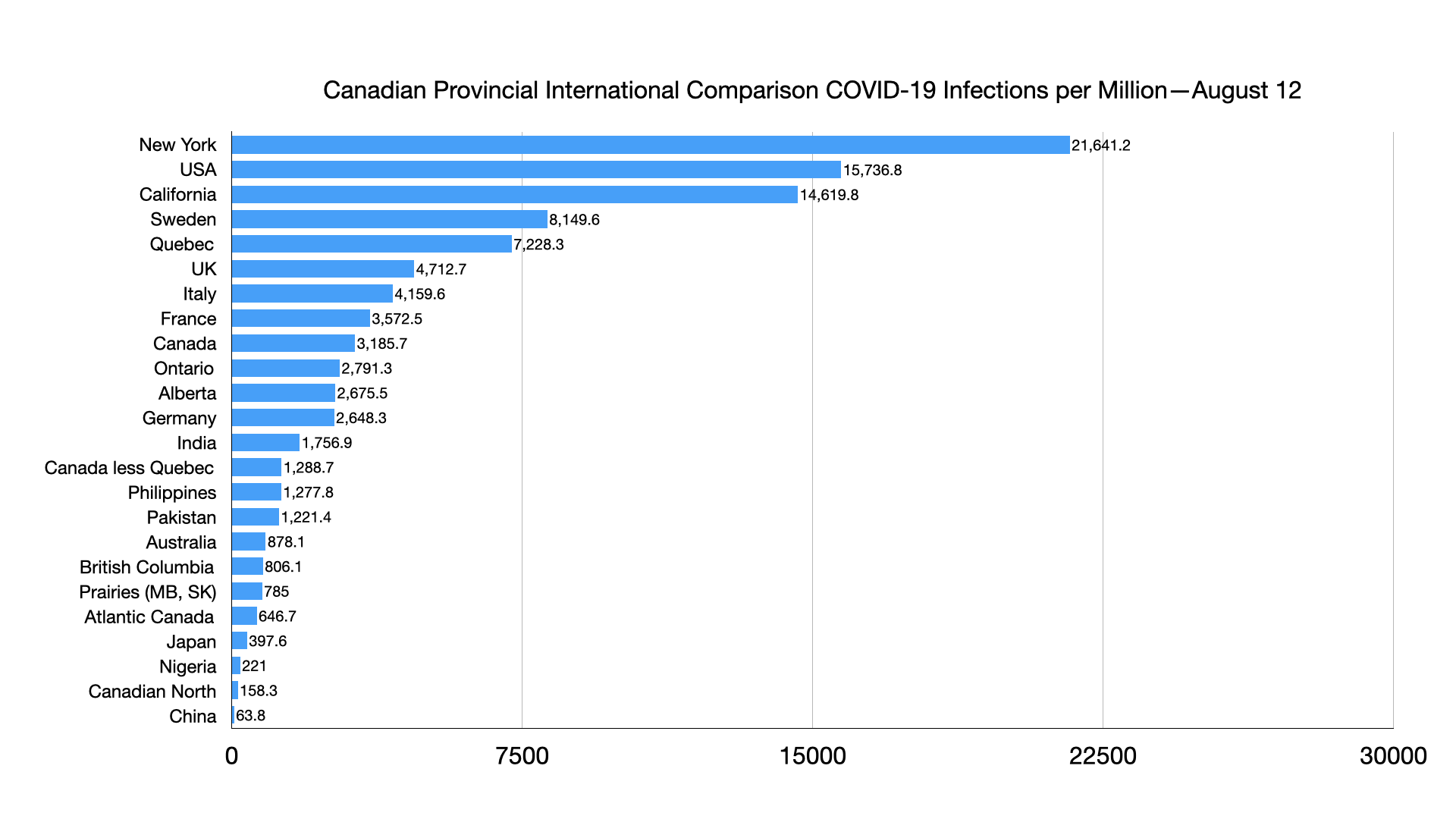
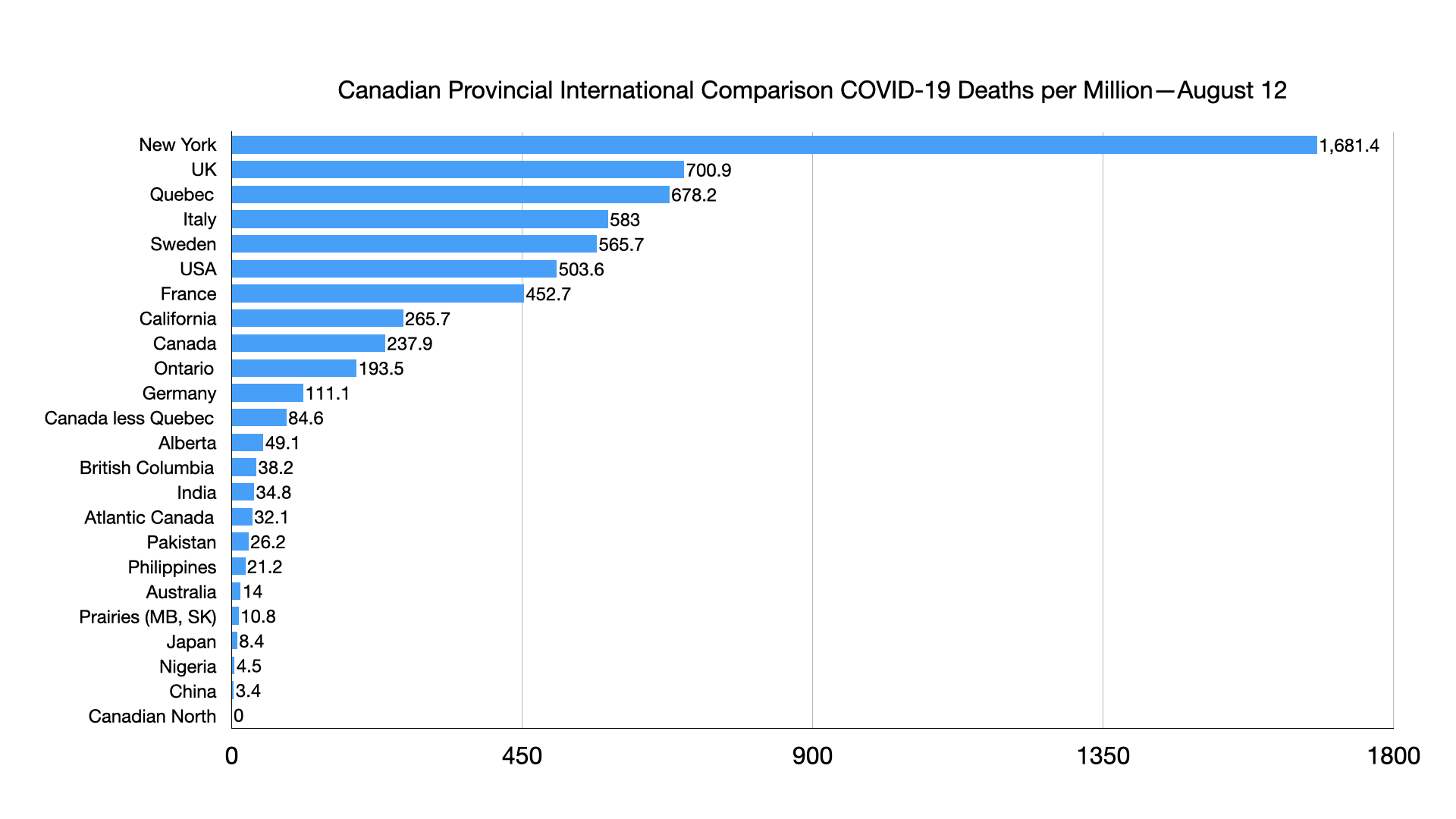
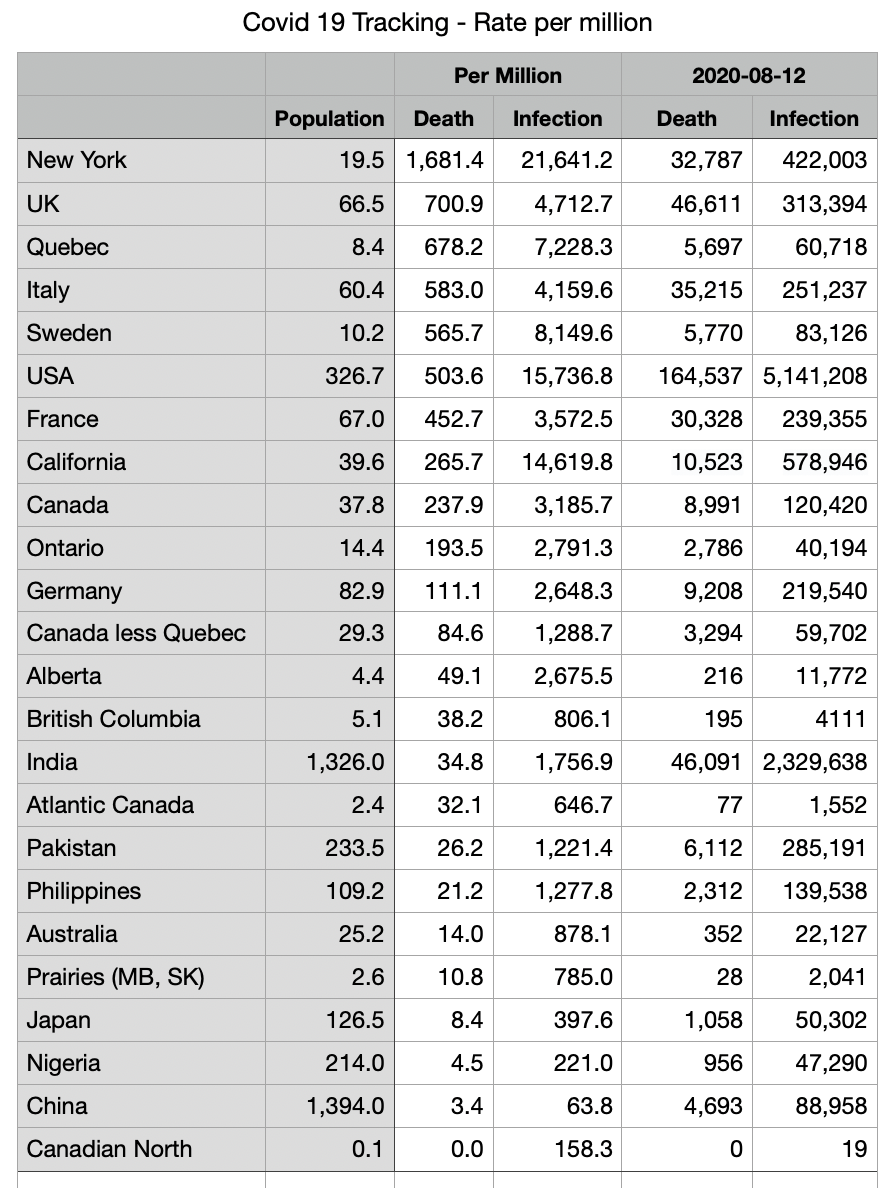
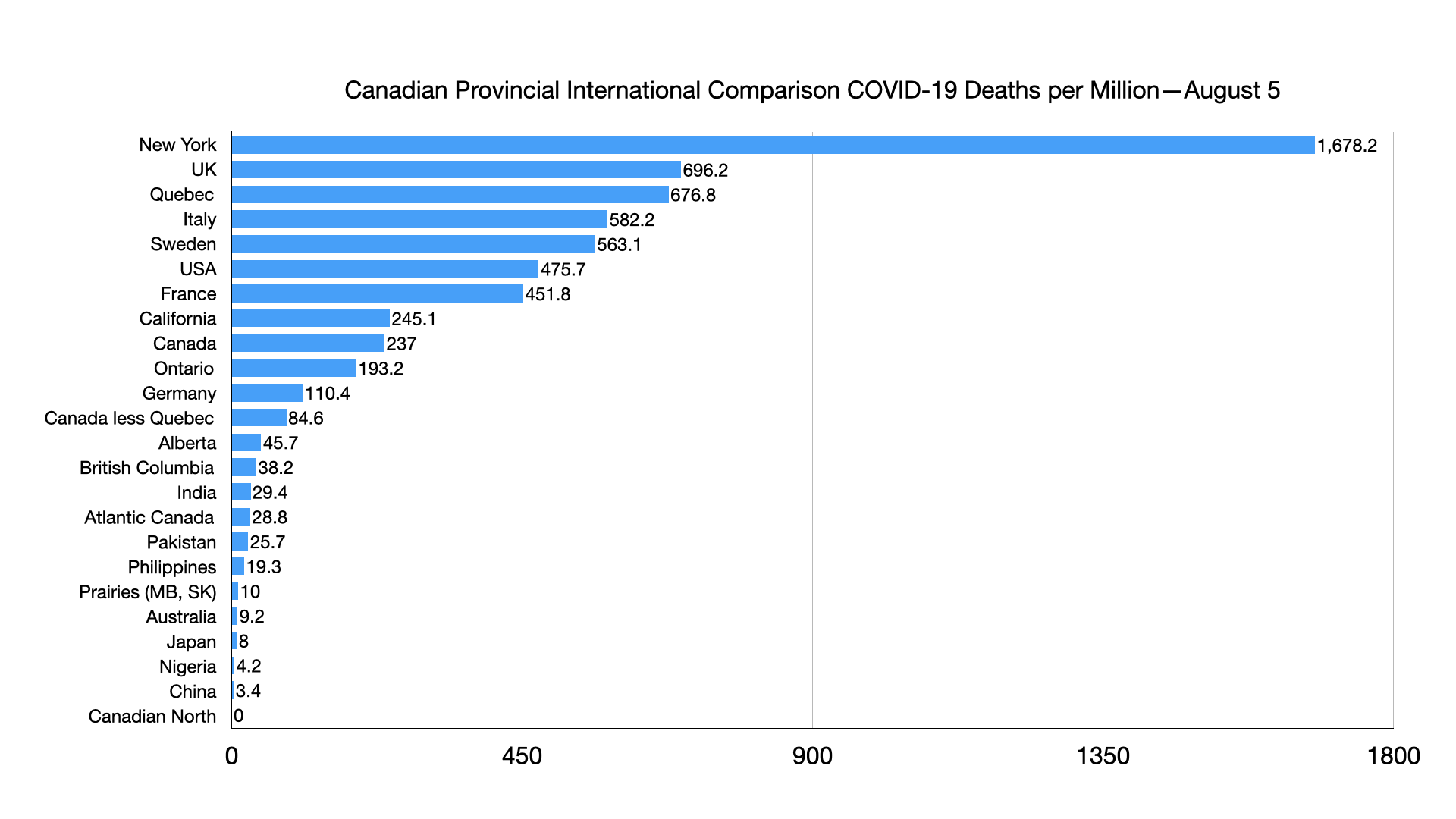
#COVID-19: Comparing provinces with other countries 12 August Update

Latest update. No major change in ranking although numbers in some of the hardest hit countries continue to increase.


Patrick Luciani: If we’re cancelling historical villains, why not Norman Bethune?

Valid question:

The Western world is toppling statues of historical villains at a furious pace. Tributes to everyone from Christopher Columbus, U.S. presidents, colonizers, Confederates, or really, anyone suspected of being on the wrong side of the current political times, are falling around the world.

But the process of eliminating bad guys tends to inevitably get out of hand. Winston Churchill’s statue in London, for instance, had to be covered up for a recent anti-racism rally before the vandals got to it; apparently, helping to defeat the Nazis no longer qualifies as being on the right side of history.

It’s even open season on Christian symbols and statues of saints. That’s reminiscent of the French Revolution, when the Robespierre-led mobs defaced and destroyed such statues as they sought to turn Notre Dame into a “temple of reason.”

Not to be left out, we in Canada are on the way to taking Sir John A. Macdonald’s name off schools and getting rid of his statues, and are now moving on to other historical figures. The alteration and return of a monument to Samuel de Champlain in Orillia, Ont., has been delayed, but statues to Giovanni Caboto will probably be spared given that few recognize his name (hint: Canada’s Columbus). In the case of educator and legislator Egerton Ryerson, who wrote a report recommending special schools for Indigenous boys, an idea that helped lay the ground for the residential school system, I suspect taking down a statue would not be enough; the name of Toronto’s Ryerson University is surely not long for this world. And petitions are out to rename the streets that honour British politician Henry Dundas, because of his weak anti-slavery position. In short, we’re doing anything to rid ourselves of anyone with the taint of past sins.

But apparently, not all history is vulnerable.

One statue that remains unmolested is the one of Norman Bethune that sits peacefully on the campus of the University of Toronto. Yet, if ever there was a statue associated with the evils of a political idea, it is the good doctor’s. While his defenders will remind us of his courageous work saving lives during the war between Japan and China through his battlefield medical innovations, a complete story tells of a nasty and reckless surgeon who never quite earned the respect of his Canadian colleagues, and who sternly defended Joseph Stalin and Mao Zedong, whose regimes starved and killed millions.

The mythology surrounding Bethune didn’t originate in Canada; it was created by Mao himself in a famous essay read by schoolchildren throughout China. Today, we use Bethune’s memory to attract thousands of Chinese tourists to his birthplace in Gravenhurst, Ont.

The Chinese Communist system he believed in has gone on to cause atrocities – not just during the Cultural Revolution, but also in the 1989 slaughter at Tiananmen Square, in the disastrous one-child policy, and in the continuing oppression and internment of thousands of Uyghurs. And let’s not forget that the government that emerged from that system has illegally imprisoned two Canadians on trumped-up charges to blackmail our government over the Huawei affair. One would think this might merit some reaction by the cancelling community.

There might be a reason that Bethune has been left off the list of political targets: he was a Marxist supporter, and thus a philosophical friend of the modern left. It’s the same reason others on the left, from Tommy Douglas to suffragette Nellie McClung – who both supported eugenics as a solution to extreme mental illness and poverty – are often given a free ride.

But the worm is turning on this cancel culture. In the United States, the name of feminist hero Margaret Sanger is being erased from American history because of her defence of eugenics in the 1920s, despite her position on women’s rights and her founding of Planned Parenthood. Can Nellie McClung and Tommy Douglas be far behind?

Shakespeare was right when he wrote that whatever good people do will be buried with their bones, while their sins live on forever. In a world that loses its historical memory, you’ll find no understanding, no forgiveness and no mercy.

So leave Norman Bethune’s statue in peace and let it stand, warts and all – but let’s also leave the statues of Sir John A., and the memories of Nellie McClung and Tommy Douglas. Otherwise we risk entering a brave new world where history disappears, and all ideas merely favour the present.

Source: https://www.theglobeandmail.com/opinion/article-if-were-cancelling-historical-villains-why-not-norman-bethune/

As Korean content goes global, cultural sensitivity becomes key issue

Of interest:

When students from Uijeongbu High School parodied Ghana’s famous dancing pallbearers, South Korea-based Ghanaian television personality Sam Okyere took to social media to criticize the students for painting their faces brown.

A few days later, Okyere apologized after people said it was inappropriate to post a photo of the students without permission. They also took exception to his use of the hashtag “#teakpop,” which is typically used in a derogatory way about K-pop.

Many Koreans criticized Okyere online, calling him overly sensitive and inconsiderate. However, Korean songs, dramas and TV programs have also faced allegations of racism this summer.

When K-pop group Mamamoo member Hwasa appeared in an online livestream of a spinoff of MBC’s “I Live Alone” on July 15, some global fans said the clothes the singer wore were racially offensive and that she was making fun of traditional Nigerian clothing.

“We received unfriendly messages concerning Hwasa’s clothes,” posted “I Live Alone” on its YouTube page July 25 after the controversy raged on the internet. “We want to clarify that the clothes, which Hwasa often wears, were inspired by (what is worn in a) Korean sauna.’ We had no intention of comically showing traditional clothing of certain countries.”
Last month, singer Zo Bin of Norazo apologized for his 2011 song “Curry” after K-pop group Seventeen sang the song on V Live on July 13. Seventeen fans, mostly from abroad, criticized the song for its lyrics associating love of curry with yoga, the Taj Mahal and not eating beef. They accused the band of stereotyping Indians and Indian culture.

“I just wanted to sing in a joyful way that curry is tasty in any way to everyone. I did not make the song with the intention to offend someone or diminish the culture and tradition of a country,” said Zo Bin on Instagram. “I apologize to all South Asians and people in India hurt by this.”

Korean dramas also couldn’t avoid allegations of racial discrimination.
Actor Ji Chang-wook of SBS’ “Backstreet Rookie” became mired in controversy when he uploaded a video on social media with another actor, SIC, wearing dreadlocks and performing a comical dance. Some international viewers accused the two actors of appropriating black culture and said their movements were racially offensive.

“Acceptance of multiculturalism and cultural sensitivity levels of many Koreans are very low,” said Yoon In-jin, a sociology professor at Korea University.

“We have lived as monoethnic people and in monoethnic culture for a long time, so we lack in understanding and respecting other cultures,” Yoon said. “We are insensitive as to how our actions can be seen by others. On the other hand, we react angrily if foreigners belittle Korean culture or people.”

In order to prevent racial discrimination controversies, many entertainment agencies educate their artists on racial and gender discrimination, and artists are banned from giving personal opinions on political, social and historical matters.

Furthermore, major K-pop idol agencies have manuals containing cultural taboos and politically sensitive topics in specific countries for artists to review when they go on world tours.

Some people defended Okyere, saying the criticism against him was two-faced. The hashtag “#I_Stand_with_Sam_Okyere” started trending Friday after Okyere apologized, and many international viewers expressed their disappointment with the attacks against him.

“Hallyu will eventually fall off if Koreans do not educate themselves on other cultures,” said one tweet.

“Through education and trial and error, we need to learn from these controversies and learn to think from the other person’s shoes,” said Yoon.

Source: As Korean content goes global, cultural sensitivity becomes key issue