Canada will have to rely on immigration as global fertility rate plummets: study

More on demographic trends, without asking whether there are policy alternatives to increased immigration or accounting for the likely impact of increased automation and AI:

Canada’s current openness to immigration must continue if the country wants to maintain one of the world’s largest economies for the rest of the century, according to a new study projecting global population and economic trends between now and 2100.

The study, which was published Tuesday in The Lancet, primarily focuses on an anticipated decline in the world population as fertility rates fall in the second half of the 21st century.

It forecasts that the global population will peak in 2064 at 9.73 billion people. By 2100 – less than two generations later – that number will be nearly one billion lower, and nearly three-quarters of the 195 nations included in the study will not be producing enough children to maintain their workforces.

“Once global population decline begins, it will probably continue inexorably,” the researchers behind the study wrote.

The study predicts that Canada’s population will peak later in the century, at nearly 45.2 million in 2078, and fall slightly to 44.1 million by 2100.

According to the researchers, a declining population is “potentially good news” for the battle against climate change, but not enough on its own to save the planet from serious environmental effects.

Shrinking populations can also cause economic damage, as fewer people are available to work. One way to offset this is by accepting large numbers of immigrants to make up the difference, as Canada has been doing for decades.

The researchers expect Canada to become an even more prominent immigration hub over the next 80 years, forecasting us to have the world’s highest net migration rate – immigrants minus emigrants – by 2100, ahead of Turkey and Sweden. This would happen despite the current “steady stream” of migrants drying up somewhat, as developing nations improve their education systems and quality of life.

All that immigration would see Canada replacing Russia as the world 10th-largest economy by 2030 and remaining there for the rest of the century, even as Nigeria and Australia bump Brazil and Italy out of the top 10, according to the forecast.

“As long as these immigration policies continue, our reference scenario showed sustained population growth and workforce expansion … with concomitant economic growth,” the researchers wrote.

“The optimal strategy for economic growth, fiscal stability, and geopolitical security is liberal immigration with effective assimilation into these societies.”

In countries where immigration is not used to maintain the workforce and GDP, the researchers wrote, governments may instead look to create incentives for parents to have more children, such as baby bonuses and paid parental leave. They warned that there is also a “very real danger” that “some states might consider adopting policies that restrict female reproductive health rights.”

Not taking any action to maintain the size of the workforce could leave countries in a position where they have to significantly increase taxes or run the risk that health insurance and social security programs could collapse, the researchers said.

The study was funded by the Bill and Melinda Gates Foundation and carried out by researchers at the University of Washington.

NOT SET IN STONE

In addition to their overall projections, the researchers looked at what would happen if the worldsped up or slowed down its progress on meeting the United Nations’ sustainable development goals (SDG) regarding female educational attainment and contraceptive need. “Many countries are not on track” to achieve those goals, they said.

These factors make a significant difference in the forecasts. Slower movement toward those goals would result in a global population of 13.6 billion and still rising in 2100, the researchers found, while the pace required to fully meet the SDGs by 2100 would see the world’s population peak in 2046 and fall to 6.29 billion by the end of the century as fertility rates plummet.

The differences are less stark in Canada, where migration is expected to have a much larger impact than global fertility patterns on population trends. The study forecasts that with slower progress toward SDGs, Canada’s population would peak in 2086 at just over 46.1 million – less than one million more than the projection based on the current pace. Meeting the SDGs by 2100 would have a bigger impact, with the population peaking around 42 million in the mid-2050s and dropping to 37 million by 2100.

The researchers say these large variations show the effect political policies can have on long-term population and economic outcomes.

“Understanding potential patterns in future population levels is crucial for anticipating and planning for changing age structures, resource and health-care needs, and environmental and economic landscapes,” they wrote.

Other highlights from the study’s projections of the world in 2100 include:

  • The five largest countries, by population, will be India, Nigeria, China, the U.S. and Pakistan

  • China will have barely half of its current population, while India’s will be down by roughly 300 million and the American population will be relatively unchanged

  • Japan, Spain, Italy and 20 other nations will lose half or more of their 2017 population

  • Nearly half of the world’s population will be in Africa as the population of the sub-Saharan part of the continent triples

  • Life expectancies will continue to rise, albeit slowly, nearing 89 years in the most advanced countries

  • The mean age of a human, which was 32.6 in 2017, will be at 46.2

  • There will be more than six times as many people over the age of 80 as there were in 2017

  • The number of children under the age of five will be 41 per cent lower than it was in 2017

  • Although China will eclipse the U.S. as the world’s largest economic power by 2035, the U.S. will retake that title in 2098

Source: Canada will have to rely on immigration as global fertility rate plummets: study

US Military: Esper order aims to expand diversity, skirts major decisions

While avoiding the political questions, some practical initiatives (the US military has played a significant role in integration of African Americans):

Secretary Mark Esper took steps Wednesday to expand diversity within the military and reduce prejudice, but he skirted several major decisions, including whether to ban the Confederate flag at installations.

In a four-page memo, Esper ordered all military services to stop providing service members’ photos for promotion boards, directed a review of hairstyle and grooming policies, and called for improved training and data collection on diversity. Absent from the memo was any mention of the issues that have roiled the nation — efforts to ban the Confederate flag and a growing movement to remove Confederate statutes and rename military bases Confederate leaders.

Confederate flags, monuments and military base names have become a national flashpoint in the weeks since the death of George Floyd. Protesters decrying racism have targeted Confederate monuments in multiple cities. Some state officials are considering taking them down, but they face vehement opposition in some areas.

A draft policy circulated by Pentagon leaders more than a week ago would have banned the display of the Confederate flag in Department workplaces or public areas by service members and civilian personnel. It said a ban would preserve “the morale of our personnel, good order and discipline within the military ranks and unit cohesion.” That policy was never finalized or signed, and instead officials say it is now being revised.

President Donald Trump has flatly rejected any notion of changing base names, and has defended the flying of the Confederate flag, saying it’s a freedom of speech issue. Esper spent last Friday with Trump in Florida, but it’s unclear if they talked about the flag ban.

The Marine Corps and U.S. commands in Korea and Japan have already banned display of the Confederate flag, saying it can inflame division and weaken unit cohesion. The Navy, Air Force and Army were all ready to do the same, but their progress was halted when Esper made it known he wanted to develop one consistent policy.

Some of the orders in Esper’s memo released Wednesday are already in effect by the military services, but his directive is a move to also make those policies more consistent.

For example, he ordered the military to no longer include photos of service members when they are being considered by a promotion board. This would mark a change for the Navy and Marine Corps. But, the Air Force removed photos from promotion boards more than a decade ago, and Army Secretary Ryan McCarthy announced last month that beginning in August his service would no longer include them.

The Navy eliminated the photos in 2016, then added them back in 2018 after members of promotion boards complained. They said the photos aided their ability to assess a service member’s “ability to perform the duties of the next higher grade,” according to the 2018 memo. The Marines have always included photos.

Army officials last month said they were eliminating the photos because a study showed they could make a difference in some promotion boards. The study suggested that when the photo is not included, it took board members less time to vote, their scores were more closely aligned and “the outcomes for minorities and women improved.”

Esper’s memo, however, left other promotion board issues unresolved and subject to further review, including whether the services should redact the box on the form that identifies a person’s race or whether a person’s name — which in some cases could indicate race or gender — should also be removed.

He also ordered a review of hairstyle and grooming policies, which all the military services have done multiple times in recent years. They have all loosened restrictions, particularly on women’s hair, to allow for more ethnic hairstyles, including various braids and larger buns.

Esper also has asked that every time he receives a promotion list from one of the services, it includes a review that shows the racial make-up of the pool of candidates and also of the group getting promoted.

The services have historically compiled that data, and it is always provided to the secretary with promotion results for higher ranks — one star and above. For years, it was also provided for lower ranks, but in 2009, the department switched to an annual report, and stopped providing it to the chief for each promotion list.

A senior official said giving the secretary the review for every list is meant to identify any potential problems or lack of diversity and wasn’t expected to affect the promotion results. The official spoke on condition of anonymity to describe a personnel issue.

Esper also met Wednesday with his newly formed Board on Diversity and Inclusion, which is expected to identify potential policy changes over the coming months. It will deliver a final report in December, and then be replaced by a permanent commission.

Source: Esper order aims to expand diversity, skirts major decisions

Senator Omidvar: No longer business as usual [diversity and governance]

Good arguments by Senator Omidvar:

Over the last month Canadians have taken to the streets to protest against racism, calling for justice, truth and an appropriate reflection of diversity in all aspects of Canadian life, in particular in places of power and influence.

In this context, those who are appointed or elected to the nation’s public and private boards as directors deserve special attention.  They include the directors of publicly listed corporations, public agencies, boards and commissions at the federal, provincial and local levels, as well as those who govern Canada’s private foundations and charities.

For the most part, these corridors of power are a reflection of the old Canada and the privileges accrued to one demographic: mainly white and mainly male. There has been almost no real movement for visible minorities (including Black Canadians), Indigenous Peoples and the disabled as they stand on the bottom rungs of governance, even though their share of the population is 27.2 per cent for Indigenous and visible minorities and 22 per cent for the disabled.

If we are serious about going beyond mouthing platitudes on diversity, then we must become more intentional about it — first by grounding change based on evidence and next by charting a way forward.

Typically, change comes in one of two ways: either we are legislated by our governments to behave a certain way or we choose to do so willingly. Both can be propelled by events. The events and the mood of the day call for a combination of both, but with an underlining imperative of urgency.

Just as the corporate sector has been intentional about bringing more women on to their boards, they can and must turn their eyes now to both men and women who are Black and Indigenous. Business understands this. The Canadian technology sector has come together to launch a new effort to eliminate racism and bring diversity into its fold. Earlier, through the leadership of Wes Hall, and Bay Street influencers like Victor Dodig, Prem Watsa and Rola Dagher announced the launch of the Canadian Council of Business Leaders against Anti-Black Racism. If they are successful and demonstrate results, they will transform not just how they do business, but who they are.

In turn, the federal government should rethink its approach to corporate reporting on diversity. A few years ago, the government passed Bill C-25 which requires federally listed corporations to develop diversity plans, and to either “comply or explain” their progress on an annual basis. The first such reports are trickling in and if there is progress, it is in terms of gender.  The opposite is true of racial and ethnic minorities, the disabled and Indigenous peoples.

With the hindsight and wisdom of today, the government needs to make every effort to go beyond “diversity planning” to “governance equity.”  They should amend the law to include employment equity definitions (EE) since EE laws have changed the face of the workforce in this country. A similar approach is needed in governance.

Further, the search for truth should take us into the hazy world of public agencies, boards, commissions and crown corporations. These include big nation-building institutions at the federal level, like the CBC but also hundreds of provincial and municipal agencies boards and commissions. Data at the federal level is scarce, and what exists isn’t fulsome, aggregated amongst groups, nor is it regularly disclosed. This is a missed opportunity because as we know, what gets measured, gets reported and gets actioned. Statistics Canada should be given the mandate to gather and report this data on an annual basis.

The search for truth also includes Canada’s 175,000 charities, foundations and not for profits. They hold our country together —whether in small towns, or large urban centres. They touch every aspect of our society, from sport to religion, from seniors to youth. Philosophically, they are more likely to embrace values and principles of inclusion and voluntarily begin to gather data on governance through their large and powerful industry associations.  They should begin to do at the earliest possible opportunity, thus leading the way for other sectors to follow.

This voluntary resolve must be further strengthened by government action.  The CRA should amend the T3010 and the T1044 forms that charities and not for profits file annually to include a simple question on diversity representation on boards of directors based on existing EE guidelines.   In this way the country’s vast network of charities and not for profits may well be the first sector to have a fulsome picture of governance, inclusion and diversity.

It is easy to be aspirational, but it is imperative to move from aspiration to concrete action.   Gathering the evidence on governance in a thoughtful and sustained way will lead us from symbolic discussions about diversity to the real expression of inclusion.

The only option not on the governance table is simply governance as usual.

Source: ipolitics.ca/2020/07/15/no-…

MPI Report: A Rockier Road to U.S. Citizenship? Findings of a Survey on Changing Naturalization Procedures

Another good and informative report by MPI:

The 9 million immigrants who are eligible for U.S. citizenship face growing obstacles to naturalization as the result of changed U.S. Citizenship and Immigration Services (USCIS) adjudications standards and a recasting of the agency’s mission to prioritize fraud detection over customer service, a Migration Policy Institute (MPI) analysis of a survey of 110 naturalization assistance providers across the United States finds.

While USCIS continues to approve the vast majority of naturalization applications it receives, the agency took nearly twice as long to process the average case in fiscal 2019 than was the case three years earlier, with case backlogs increasing as applications have been kicked back more frequently with requests for more information and English and civics tests have been administered more strictly. This increased vetting of applications was happening before a trio of new developments could significantly reduce citizenship acquisition for qualified immigrants in the months and years ahead:

  • COVID-19-related delays that shut down USCIS in-person interviews for three months, delaying the citizenship oath-taking for more than 100,000 would-be Americans,
  • the imminent furlough of two-thirds of the agency’s staff in early August unless Congress provides emergency funding to address a $1.2 billion budget shortfall, and
  • a citizenship fee increase from $640 to up to $1,170 that is scheduled to go into effect in September, alongside a restriction in eligibility for fee waivers for low-income applicants.

“The seeds of the current budget crisis were sown before the pandemic when USCIS put more intensive vetting and fraud detection in place, along with other policies that have reduced application levels,” said Randy Capps, who is director for research for U.S. programs at MPI. “Now the pandemic and anticipated furlough threaten to further slow application processing at the same time that the fee is set to increase substantially, creating much higher hurdles and potentially deterring people from applying for citizenship.”

In its latest report, MPI examines the effects of changing USCIS standards and procedures during the Trump administration, drawing from a survey of 110 naturalization assistance providers in 34 metro areas administered by the Immigrant Legal Resource Center (ILRC) between March – September 2019. These groups are among more than 200 providers in the ILRC’s New Americans Campaign, which has assisted more than 470,000 people in completing their citizenship applications.

The report, A Rockier Road to U.S. Citizenship? Findings of a Survey on Changing Naturalization Procedures, finds:

  • About one-quarter of survey respondents reported their clients missed interviews when USCIS sent notices to incorrect addresses, sent them too late or sent them to the attorney, not the applicant.
  • More than one-third reported USCIS more often issued requests for evidence (RFEs) to support applications, especially for documents related to tax compliance and income, continuous residency and physical presence, marriage and child support, and criminal history, with one-quarter reporting substantially more documents being required.
  • USCIS officers asked detailed questions not directly related to citizenship eligibility, and administered the English and civics tests differently, often more strictly, according to 10 percent of respondents.

Most of these changes were common among the 52 USCIS offices across the country covered by the survey, suggesting these shifts in adjudication practice likely represent changes in USCIS policy or broad-based agency culture, rather than being limited to individual office or adjudicator practices.

The report underscores the importance of oversight of naturalization procedures to ensure that the country reserves citizenship for those who fully meet its requirements and preserves the lawful claims of legal permanent residents to the full civic and political rights that citizenship brings. Yet even as USCIS has shifted its mission to increased vetting and fraud detection, studies have shown little to no evidence of naturalization fraud.

“USCIS’ stricter adjudicating processes have accomplished nothing aside from increasing the time and costs associated with completing the naturalization process,” said Eric Cohen, executive director of the ILRC. “Increased obstacles to citizenship prevent qualified U.S. residents from voting, running for public office, traveling without visas to many other countries, sponsoring family for immigration and many other benefits. They have no demonstrated impact on fraud prevention, which is nearly non-existent to begin with.”

Read the report here: www.migrationpolicy.org/research/changing-uscis-naturalization-procedures.

Canada is not the regionally divided country it’s made out to be

The latest from Environics who conducted the 2020 Confederation of Tomorrow survey:

The one thing that the October 2019 federal election appeared to make clear was just how regionally divided the country had become. The Liberals were shut out of Alberta and Saskatchewan, the Conservatives fared almost as poorly in Toronto and Montreal, and the sovereigntist Bloc Québécois rebounded to form the third largest party in the House of Commons. With no party having an overall majority, none of the issues that drove the campaign, such as how to mitigate climate change, were settled.

An in-depth look at public opinion, however, casts doubt on the conclusion Canada is more regionally divided than ever. Certainly, Canadians are divided on how best to balance the environment and the economy. But the 2020 edition of the Confederation of Tomorrow survey shows that this division of opinion does not pit one region against another. It exists within every part of the country.

At the start of 2020, a slight majority of Canadians (52 per cent) agreed that protecting the environment is more important than protecting jobs. But what is most striking is that, across the country, agreement was either just below or just above 50 per cent, rather than heavily weighted to one side or the other. Alberta is no different: the province is split right down the middle, with almost as many agreeing as disagreeing with the proposition.

About one in two Canadians (48 per cent) also favour a gradual phase-out of the use of fossil fuels so that we can move to more renewable sources of energy without suddenly putting people who work in the oil and gas industry out of work. The remainder are split between an accelerated or delayed phase-out.

But again, Canadians are less regionally divided than might be expected. In every jurisdiction, a plurality favours a gradual phase-out of fossils fuels. Agreement with this compromise option ranges from 41 per cent in P.E.I. to 54 per cent in B.C. In Alberta, 44 per cent favour this option, which is only slightly lower than the national average.

Where differences emerge is on the second-place choice. Twenty-eight percent of Quebecers favour a more rapid phase-out, even at the cost of jobs in the oil-and-gas sector, compared to only 10 per cent in Alberta. Conversely, 37 per cent of Albertans, say we should delay any phase-out and focus on protecting the jobs of people who work in industries like oil and gas, compared with only 10 per cent in Quebec.

To put these figures in perspective, imagine putting 100 Albertans and 100 Quebecers in a room together and asking them to discuss how quickly we should phase out the use of fossil fuels in order to address climate change. Sixty-four people from each province could find someone from the other province who held the same opinion as them. Another nine on each side could find a partner who, like them, was undecided. That leaves 54 people out of 200 who would be left facing someone who disagrees with them, perhaps strongly, on whether we need to speed up or slow down the transition to renewable source of energy.

(Environics, Confederation of Tomorrow partnership)

These differences are important. But just as they should not be swept under the carpet, they should not obscure the fact that 146 of the 200 people in the room (73 per cent) would have no quarrel with their partner from the other province.

There are good reasons why our regional differences tend to be exaggerated. The electoral system is one—by painting whole regions of the country in one colour, it obscures the diversity of opinions that lies underneath. Entrepreneurial political leaders are also adept at mobilizing those differences that do exist to their electoral advantage. And first ministers like to present themselves as championing the positions of their entire constituency, when in fact a significant portion of the citizens they represent disagree with their approach.

These political manoeuvres are understandable, but the public and the media should look beyond them. The conclusion of the Confederation of Tomorrow survey is not that we are all on the same page. It is simply that divisions on key issues like how to fight climate change exist right across the country. This may sound like a strange way to think about national unity. But acknowledging the diversity of views in every region is a good first step to defusing the political tensions that sometime threaten to tear us apart.

Source: Canada is not the regionally divided country it’s made out to be

Sidelined: How diversity in Canada’s sports leadership falls short

Good investigative reporting and data analysis:

For 14 years Clayton Pottinger had tremendous success as a basketball coach, his teams winning nearly 80 per cent of their games.

But an opportunity to coach at the next level never came.

As a Black head coach, he often wondered why.

“I don’t know a 100 per cent the reasons behind it. I don’t know that it was race related but I don’t discount that,” Pottinger told CBC Sports. “I was interviewed for three positions but overlooked — not even granted an interview dozens of times. It got to the point where I didn’t think it was going to happen.”

Pottinger’s story may sound like a tale often told south of the border, but his is a Canadian story.

Last March, he finally broke through and landed his first job at the Canadian university level when UBC-Okanagan named him head coach of its men’s basketball team.

Pottinger, 49, joined a small group of Black coaches who have reached the highest leadership positions in Canadian university sports.

For decades, North American professional sports leagues have been castigated for the dearth of Black and people of colour employed in key leadership and coaching positions.

An investigation by CBC Sports reveals that the issue is prevalent across Canadian sports.

A visual audit conducted by CBC Sports examined hundreds of key positions at all 56 Canadian universities that compete under the umbrella of national governing body U Sports, including the school’s athletic director and head coach of football, men’s and women’s basketball, hockey and soccer, and track.

Of the nearly 400 positions examined, only about 10 per cent were held by Black, Indigenous or persons of colour (BIPOC). Only one of the 56 schools has a non-white athletic director.

“You could go to any website at any university and you’d see one of the five principles or objectives is diversity and inclusion, yet you see the numbers in our studies, you see the [CBC’s] numbers,” said Dr. Richard Lapchick, founder and director of the Institute For Diversity and Ethics and Sport. The institute, based at the University of Central Florida, was the first to begin compiling racial breakdowns of hiring practices in the United States.

Lapchick said filling athletic leadership positions on North American college campuses is not always a result of overt racism, but rather a persistent old boys’ network.

“If you have a white athletic director and a white [university] president and they’re making the key hires in your athletic department, the people they know are more than likely to be white,” Lapchick said. “So they’re going to turn to them in that selection process as opposed to who [else] might be out there.”

The recent killing of George Floyd by police in Minneapolis in May has refocused the lens on racial inequality in everyday North American life. Hundreds of thousands of people have filled city streets demanding an end to systemic racism.

Many companies and organizations, including the CBC, have been forced to acknowledge both a lack of diversity among senior leadership, while addressing systemic racism in the way they conduct business both internally and externally.

The world of sports has not escaped this scrutiny.

Leagues condemn racism

In wake of Floyd’s death, professional leagues across North America issued statements condemning racism and promised to do better. Players demanded change. Leagues like the NFL, where 70 per cent of the players are Black or persons of colour, promised more would be done to reflect that in its coaching staffs and leadership. And after years discouraging outward signs of protest, like kneeling during the U.S. national anthem, NFL commissioner Roger Goodell came full circle and encouraged players to express themselves.

In Canada, the recently hired Pottinger says there is still a long way to go. UBC-Okanagan is one of only three universities in Canada to employ both a Black men’s and women’s head coach. He points to an undercurrent of bias when it comes to how leadership positions are filled.

“People of colour aren’t necessarily looked at as people with those abilities. We can shoot hoops, we can make baskets, we can make defensive plays,” Pottinger said. “But if you ask us to lead a team, then I think there’s always some question marks around whether or not you can do it.”

CBC Sports presented its findings to officials at U Sports and the four conferences that govern Canada’s university sports system.

None of the groups rejected or disputed the findings. But at the same time, it appears little has been done to formally track who is being hired and why.

The NCAA, governing body of college sports in the U.S., does maintain a database that tracks demographics for student-athletes, coaches and administrators. U Sports does not.

Most of the responses pointed to strides made in the area of gender equity but acknowledged little has been done to promote and encourage more BIPOC candidates and hirings.

Everyone involved in the upper reaches of Canadian university sport acknowledged there’s work to do when it comes to diversity in leadership positions.

At the same time, U Sports officials contend that, for the most part, they are powerless to change things.

“One of our key principles is institutional freedom and as such hiring is based on member universities’ human resource policies in compliance with provincial labour laws,” the organization said in its statement.

Balancing act

Atlantic University Sport (AUS) executive director Phil Currie called it a balancing act.

“The hiring of athletics directors or sport coaches/assistant coaches is done under the policies and practices of our member institutions and as such the AUS has no direct control of that process,” said Currie, who oversees athletics in the Atlantic provinces.

“CBC’s summary on the number of BIPOC head coaches demonstrates that, and we acknowledge that those numbers are not where they need to be,” he said.

The lack of diversity in leadership is equally stark among Canada’s key Olympic institutions. CBC Sports looked at the board of directors at the Canadian Olympic Committee and seven among the country’s largest national sport organizations: swimming, athletics, hockey, skating, basketball, volleyball and soccer.

Across them, around 100 board members are tasked with representing thousands of athletes. Only seven of these key positions are held by BIPOC. For example, the COC’s 17-member board is composed of 16 white directors and only one BIPOC.

“Our reflection following the events of the past month has reinforced that while we have made important strides in diversity and inclusion, we need to do more,” the COC said in a statement to CBC Sports.

“Though our board of directors reflects diversity in a number of important measures, including gender, LGBTQ+, language, etc., there’s no denying that we have considerable work to do in addressing BIPOC diversity on our board.”

The COC vowed to change the makeup of its board by instituting a number of measures, including no longer simply relying on a public call for board nominations.

Across the board, national sports organizations contacted by CBC Sports acknowledge major shortcomings in the racial makeup of their key leadership positions.

Athletics Canada said it’s “probably the most inclusive sport in Canada in terms of racialized participation,” but said its board must “better represent what the sport looks like on the field of play.”

Basketball Canada also acknowledged a large gap between players and decision makers.

“Our Canadian national basketball teams are some of the most ethnically diverse in our country. However, we acknowledge that, off the court, our organization still has some work to do at a leadership level,” it said in a statement.

For some, change has been elusive. Hockey Canada said it’s been “working at various stages over the past few years to address areas of diversity,” but its 11-member board was comprised of 11 white males as of July 1.

CBC Sports also looked into 500 leadership positions across professional ranks and found that for the most part, they mirror the above findings.

CBC Sports compiled data that included team ownership, team president, general manager and head coach across seven major leagues: NFL, MLB, NHL, NBA, CFL, WNBA and the NWSL.

Only the NBA, where more than 80 per cent of players are BIPOC, according to research by the Institute for Diversity and Ethics in Sports, approached close to 25 per cent of leadership positions filled by people who look like the majority of its athletes.

In MLB, where 41 per cent of players are BIPOC, only seven of 100 leadership positions looked at are filled by people of colour.

In the CFL, only about 10 per cent of the league’s key leadership positions are filled by people who aren’t white, a sharp departure from the league’s on-field racial makeup.

One of the league’s two Black head coaches is former quarterback Khari Jones, who has been head coach in Montreal since June 2019.

After a stellar career in the CFL, he worked as assistant coach for a decade in Hamilton, B.C and Saskatchewan.

Jones said he doubted whether he would ever be a head coach.

“You see so many African-American people play the game but not having the chance to coach and have lead roles,” he told CBC Sports. “It’s never deterred me. It’s just a sad thing, even when I knew I wanted to get into coaching and I knew my goal was to be a head coach.”

Jones says until more BIPOC people own teams or fill leadership roles with authority to hire, change will be difficult.

“All the owners are white, so you tend to go that route when hiring,” Jones said.

“It becomes really disheartening when you don’t think you have a real chance, or you don’t have an opportunity to get a job that other people seem to be getting.”

Source: Sidelined: How diversity in Canada’s sports leadership falls short

Buckingham Palace feared increasing ‘non-British’ immigrants would doom the monarchy in Australia

Wonder whether they had similar fears for Canada (but Canada never had referendums on the monarchy):

Buckingham Palace feared the monarchy would collapse in Australia because of an influx of postwar ‘non-British’ immigrants, newly released correspondence reveals.

Letters exchanged between Governor-General Sir John Kerr and the Queen’s private secretary Sir Martin Charteris were finally released today after four decades.

Along with providing bombshell revelations on Sir John’s decision to dismiss Gough Whitlam’s government in 1975, they reveal how the Palace saw Australia.

Sir Martin believed that without more frequent visits from The Queen and other royals, a more multicultural country would ditch the monarchy.

A year after the dismissal, Sir John wrote to Sir Martin – by then his frequent pen pal – to voice his concerns about the monarchy’s future in Australia.

‘I have been musing about the monarchy as an institution in our part of the world’, he wrote on December 19, 1976.

‘In 1947, 98 per cent [of Australians] were of British stock. By the 1971 census only 88 per cent were so derived.’

Sir John noted that most of these non-British immigrants were Italians, Greeks, Yugoslavs and Germans – but there were many other nationalities.

‘Our immigrants come from over one hundred countries including, for example, Egypt and Turkey, Lebanon and other Arab countries.

‘Increasingly, but not yet significantly, we have Asians. Most of these, and most who have come from Europe are from republics and are not directly acquainted with monarchy.’

A year after the dismissal, Sir John wrote to Sir Martin - by now his frequent penpal - with concerns about the monarchy's future in Australia

A year after the dismissal, Sir John wrote to Sir Martin – by now his frequent penpal – with concerns about the monarchy’s future in Australia

Sir Martin replied that the 'increasing non-British element in Australia’s ethnic make up' had 'significant ramifications for the monarchy

Sir Martin replied that the ‘increasing non-British element in Australia’s ethnic make up’ had ‘significant ramifications for the monarchy

Sir Martin replied that the ‘increasing non-British element in Australia’s ethnic make up’ had ‘significant’ ramifications for the monarchy.

‘It is one of the reasons why the monarchy in Australia could not, I believe, long remain a reality without more frequent visits by the Sovereign than was customary in the first half of this century,’ he wrote.

‘The days when The Sovereign of Australia could remain in London, and still remain acceptable are, I think, long past; new immigrants, changing values… would all make this impossible, as well, of course as being wholly undesirable.’

In other letters, the pair discussed movements campaigning for an Australian republic but believed they were formed by a small number of ‘left-wing’ rabble rousers.

Australia held a referendum in November 1999 on whether the country should become a republic, but it was comfortably defeated.

The 211 letters, thousands of pages in all, contain many revelations about the lead-up to and aftermath of the dismissal as Sir John wrestled with what to do.

Also revealed is Mr Whitlam’s ‘rage’ at being ousted and the extent of the backlash against Sir John.

The letters finally showed that the Queen did not order Sir John to dismiss Mr Whitlam.

It has long been speculated that Her Majesty may have undermined Australia’s independence by trying to influence Sir John’s decision.

The letters appear to indicate that the Queen and Sir John did not communicate, at least not directly, and Kerr’s correspondence was only with Sir Martin.

Palace allies battled for decades to keep the documents – which also include correspondence from Her Majesty’s then-private secretary, Martin Charteris – secret, with the National Archives of Australia refusing to release them to the public.

The letters had been deemed personal communication by both the National Archives of Australia and the Federal Court, which meant the earliest they could be released was 2027, and only then with the Queen’s permission.

But the High Court bench earlier this year ruled the letters were property of the Commonwealth and part of the public record, and so must be released.

Source: Buckingham Palace feared increasing ‘non-British’ immigrants would doom the monarchy in Australia

Trump administration rescinds rule barring foreign students from taking all classes online

A rare but welcome reversal of the Trump administration’s anti-immigration policies:

Facing eight federal lawsuits and opposition from hundreds of universities, the Trump administration on Tuesday rescinded a rule that would have required international students to transfer or leave the country if their schools held classes entirely online because of the pandemic.

The decision was announced at the start of a hearing in a federal lawsuit in Boston brought by Harvard University and the Massachusetts Institute of Technology. U.S. District Judge Allison Burroughs said federal immigration authorities agreed to pull the July 6 directive and “return to the status quo.”

A lawyer representing the Department of Homeland Security and U.S. Immigration and Customs Enforcement said only that the judge’s characterization was correct.

The announcement brings relief to thousands of foreign students who had been at risk of being deported from the country, along with hundreds of universities that were scrambling to reassess their plans for the fall in light of the policy.

Under the policy, international students in the U.S. would have been forbidden from taking all their courses online this fall. New visas would not have been issued to students at schools planning to provide all classes online, which includes Harvard. Students already in the U.S. would have faced deportation if they didn’t transfer schools or leave the country voluntarily.

Immigration officials issued the policy last week, reversing earlier guidance from March 13 telling colleges that limits around online education would be suspended during the pandemic. University leaders believed the rule was part of President Donald Trump’s effort to pressure the nation’s schools and colleges to reopen this fall even as new virus cases rise.

The policy drew sharp backlash from higher education institutions, with more than 200 signing court briefs supporting the challenge by Harvard and MIT. Colleges said the policy would put students’ safety at risk and hurt schools financially. Many schools rely on tuition from international students, and some stood to lose millions of dollars in revenue if the rule had taken hold.

Harvard and MIT were the first to contest the policy, but at least seven other federal suits had been filed by universities and states opposing the rule.

Harvard and MIT argued that immigration officials violated procedural rules by issuing the guidance without justification and without allowing the public to respond. They also argued that the policy contradicted ICE’s March 13 directive telling schools that existing limits on online education would be suspended “for the duration of the emergency.”

The suit noted that Trump’s national emergency declaration has not been rescinded and that virus cases are spiking in some regions.

Immigration officials, however, argued that they told colleges all along that any guidance prompted by the pandemic was subject to change. They said the rule was consistent with existing law barring international students from taking classes entirely online. Federal officials said they were providing leniency by allowing students to keep their visas even if they study online from abroad.

Source: Trump administration rescinds rule barring foreign students from taking all classes online

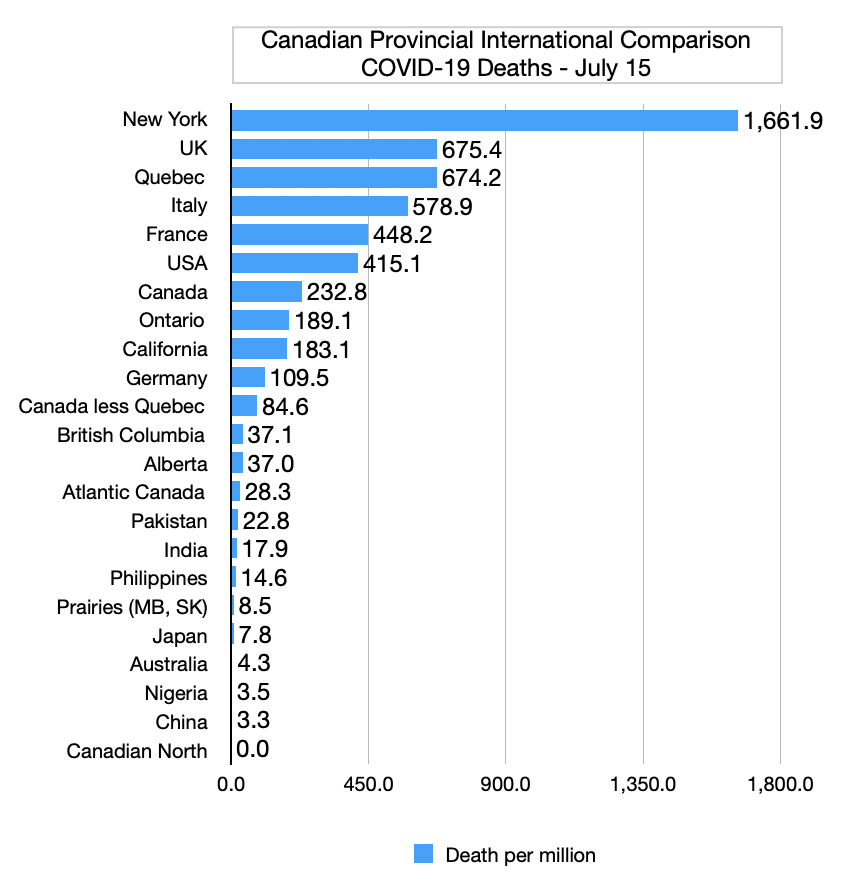
#COVID-19: Comparing provinces with other countries 15 July Update

The latest weekly stats showing no major changes from last week in terms of relative ranking, although the USA can be expected to surpass the harder hit European countries in deaths per million over the next few weeks given current trends:

Kingwell: The science of denial

Good commentary on ignorance and denial, the importance of expertise over ignorance, and that free speech should not give license or credibility to “Hate speech, plagiarism, pseudoscience, cynical falsehood, and self-serving nonsense:”

Peter denied his association with Jesus three times before the cock crowed, at least as Luke tells it, but nowadays denials are a lot easier. Just one will do, and you can make it at any time of day on Twitter or Facebook, or some other dependency-creating interface. Deny science, deny experts, deny social and legal norms, and above all deny responsibility for any ethics scandals, cronyism or accusations of bad governance.

Denial does feel life-affirming. It places me against the man, or the mob, or the whoever. But it is also the first of Elisabeth Kübler-Ross’s five stages for dealing with grief. You have some work to do. Denial ain’t just a river, as Mark Twain probably did not say.

Sure, you can always adopt some Trump-era version of “never apologize, never explain,” and thus secure your membership in the current version of the 19th century know nothing party. Insincere performative apology is another attractive option.

Lots of people know nothing. Some of them know that they know nothing, and make that a guiding principle in life. This is the good kind of ignorance.

The record indicates that Socrates, directed to the Oracle at Delphi, was told that his fate was to be the wisest of Athenians. Since he, a simple soldier and cobbler, knew that he was ignorant, it seemed clear that wisdom might reside in knowing that he knew nothing. Michel de Montaigne struck a medal with the sceptical slogan: Que sais-je?—what do I know?  In philosophy class, we sometimes call this de doctrina ignorantia. We start from a lack of knowledge, but with lots of questions, especially for those who claim to know.

Things get tricky when knowledge becomes increasingly complex, however, demanding individuals who devote their lives to one special subfield in order to advance it. Non-experts in turn resent and fear these individuals, who sometimes tell them what to do or correct their errors. So people refuse to wear masks even months now into a global pandemic; they won’t take a state-sponsored vaccine even when it becomes available, because it may be infected with government software; and they are led by a president who says he “disagrees” with Anthony Fauci, a doctor who actually knows what he’s talking about. Trump disagrees, from his vast knowledge of medicine?

Sure, why not. I disagree when my doctor tells me I should stop smoking cigars and ordering Manhattans, but I also believe he is correct. That’s on me.

Denial is a deeply human act, hardwired into our feeble brains, and actually not a function of ignorance. Fauci was recently chided by one writer for neglecting, as a scientist, the science that illustrates how prevalent denial is in the species. This seems, at the least, extremely unfair. Fauci’s specialty is epidemiology. He’s not a social psychologist. And even if denial is common in us, does that make it okay? Hate is rampant in human affairs, and violence, and torture, and irrational prejudice of all kinds, and host of other behaviours that are “natural” yet abhorrent. We don’t, at least in our better moments, simply give them a free pass.

But the criticism does highlight two salient features of current COVID-dominated political culture. The first is that expertise, always a fragile property, has become suspect. The old saying has it that an expert is a person who has read one book; these days, you don’t even have to do that much work. A few hours on websites and you are surely the smartest person in the roomeven if the room is just your basement office.

The second is that calling people stupid is not the best way to make them act smart. You don’t rehabilitate an addict by calling him or her names. You need structure and therapy and support; also nudges, incentive schemes and social scaffolding. And more information will mostly not help.

Trust in experts has been eroded for good reasons and bad. There good include fake science journals, institutional arrogance and aggressive scientism wielded as moron-bashing ideology (yes, I mean Richard Dawkins and Daniel Dennett and their fellow “Brights”). But reflexive and comprehensive suspicion of elites, East Coast elites, Laurentian elites, or whatever is the going version right now, is just doubling down on dumb. That denial tactic may workit may even get you elected to high officebut it is harmful, immoral, and sells short the stocks on the human-potential market.

In the best case, expertise represents a preponderance of evidence and accumulated scholarship, rather than simply flashing credentials or invoking institutional heft. That’s good scientific method: this is the universal truth, the best explanation so far. Sane people can work with that. But other people will still deny because of confirmation bias, motivated reasoning, fear of cognitive dissonance, the pleasures of solidarity, sheer contrarianism, and maybe a misplaced, harmful belief in “individual freedom” over community safety.

So then what? Well, how about large doses humility, more education and a great deal of open discourse? John Stuart Mill was rightin the marketplace of ideas, good ones can eventually drive out bad, but this is painful, costly and bloody. It’s not me or you or some other person with an M.D. or a Ph.D. who matters, it’s good arguments that should prevail. This is creative destruction. If science teaches us anything, it’s that previous thinking never lasts. Philosopher of science Karl Popper influentially argued that every scientific proposition must be falsifiable—not wrong, rather open to being shown wrong on its own terms. Otherwise it is faith, ideology or madness.

Falsifiability is a baseline standard of all good discourse, yet it’s often misunderstood or distorted by media positioning and political posturing. For example, take note, in this political moment, that determining the meaning of “free speech” has become its own species of luxury good. A lot of hefty, credentialed, big-platform people (most of them experts in nothing except sounding off) are squawking about cancel culture and ideological targeting, not really on principle but because their special privileges feel threatened. But using “freedom of speech” as a conceptual cudgel in your ideological battles against “mobs” is not classical liberal thinking. It’s just a dog whistle in the culture wars. Denial is as denial does.

Hate speech, plagiarism, pseudoscience, cynical falsehood, and self-serving nonsense are not free speech. They are toxins to be eliminated by the clean air and sunshine of reason. At the same time, a lot of what is called censorship these days is actually vigorous disagreement, calling out bulls–t, and speaking truth to power. (We have to leave room for self-serving nonsense, since without it there would be mostly silence.)

There will always be deniers, of anything and everything, just like there are conspiracists, demagogues and witch-hunters in every historical moment. They can’t be eliminated, they can only be made outliers. Maybe at some point, like all responsible people, they will admit that they were wrong. The willingness to acknowledge error is, rather than our top-of-the-food-chain smarts, what makes us homo sapiens.

I might be wrong about that, or dishing up some self-serving nonsense. What do I know? I’m sure lots of smart people will now tell me.

Source: The science of denial