‘Without early warning you can’t have early response’: How Canada’s world-class pandemic alert system failed

This has to be considered a significant fail: disbanding the PHAC Global Public Health Intelligence Network, or GPHIN a few years before COVID-19.

Kudos to the Globe for good investigative reporting and analysis.

Given that resource reductions and reallocations are normally executed at the bureaucratic level (with political sign-off), one would hope that PHAC is revisiting this decision and the relative importance within PHAC of senior bureaucratic decision-makers vs scientific advice and expertise. Savoie’s comments on senior public servants as courtiers comes to mind when reading about these differences so well captured in the Globe report.

Some form of enquiry (preferably external) is needed  to assess how this short-sighted decision took place and the related accountabilities.

While there is no excuse for the ethical violations of the PM and Finance Minister regarding WE, it would be a far better use of Parliament to investigate this decision and its impact, given that it contributed to Canada’s missing the opportunity for an early and thus likely more effective response, with fewer deaths of Canadians:

On the morning of Dec. 31, as word of a troubling new outbreak in China began to reverberate around the world, in news reports and on social media, a group of analysts inside the federal government and their bosses were caught completely off guard.

The virus had been festering in China for weeks, possibly months, but the Public Health Agency of Canada appeared to know nothing about it – which was unusual because the government had a team of highly specialized doctors and epidemiologists whose job was to scour the world for advance warning of major health threats. And their track record was impressive.

Some of the earliest signs of past international outbreaks, including H1N1, MERS and Ebola, were detected by this Canadian early warning system, which helped countries around the world prepare.

Known as the Global Public Health Intelligence Network, or GPHIN, the unit was among Canada’s contributions to the World Health Organization, and it operated as a kind of medical Amber Alert system. Its job was to gather intelligence and spot pandemics early, before they began, giving the government and other countries a head start to respond and – hopefully – prevent a catastrophe. And the results often spoke for themselves.

Russia once accused Canada of spying, after GPHIN analysts determined that a rash of strange illnesses in Chechnya were the result of a chemical release the Kremlin tried to keep quiet. Impressed by GPHIN’s data-mining capabilities, Google offered to buy it from the federal government in 2008. And two years ago, the WHO praised the operation as “the foundation” of a global pandemic early warning system.

So, when it came to the outbreak in Wuhan, the Canadian government had a team of experts capable of spotting the hidden signs of a problem, even at its most nascent stages.

But last year, a key part of that function was effectively switched off.

In May, 2019, less than seven months before COVID-19 would begin wreaking havoc on the world, Canada’s pandemic alert system effectively went dark.

Amid shifting priorities inside Public Health, GPHIN’s analysts were assigned other tasks within the department, which pulled them away from their international surveillance duties.

With no pandemic scares in recent memory, the government felt GPHIN was too internationally focused, and therefore not a good use of funding. The doctors and epidemiologists were told to focus on domestic matters that were deemed a higher priority.

The analysts’ capacity to issue alerts about international health threats was halted. All such warnings now required approval from senior government officials. Soon, with no green light to sound an alarm, those alerts stopped altogether.

So, on May 24 last year, after issuing an international warning of an unexplained outbreak in Uganda that left two people dead, the system went silent.

And in the months leading up to the emergence of COVID-19, as one of the biggest pandemics in a century lurked, Canada’s early warning system was no longer watching closely.

When the novel coronavirus finally emerged on the international radar, amid evidence the Chinese government had been withholding information about the severity of the outbreak, Canada was conspicuously unaware and ultimately ill-prepared.

But according to current and former staff, it was just one of several problems brewing inside Public Health when the virus struck. Experienced scientists say their voices were no longer being heard within the bureaucracy as department priorities changed, while critical information gathered in the first few weeks of the outbreak never made it up the chain of command in Ottawa.

‘WE NEED EARLY DETECTION’

The Globe and Mail obtained 10 years of internal GPHIN records showing how abruptly Canada’s pandemic alert system went silent last spring.

Between 2009 and 2019, the team of roughly 12 doctors and epidemiologists, fluent in multiple languages, were a prolific operation. During that span, GPHIN issued 1,587 international alerts about potential outbreak threats around the world, from South America to Siberia.

Those alerts were sent to top officials in the Canadian government and throughout the international medical community, including the WHO. Countries across Europe, Latin America, Asia and Africa also relied on the system.

On average, GPHIN issued more than a dozen international alerts a month, according to the records. But its purpose wasn’t to cry wolf. Only special situations that required monitoring, closer inspection or frank discussions with a foreign government were flagged.

GPHIN’s role was reconnaissance – detect an outbreak early so that the government could prepare. Could the virus be contained before it got to Canada? Should hospitals brace for a crisis? Was there enough personal protective equipment on hand? Should surveillance at airports be increased, flights stopped, or borders closed?

This need for early detection sprang from a climate of distrust in the 1990s, when it was believed some countries were increasingly reluctant to disclose major health problems, fearing economic or reputational damage. This left everyone at a disadvantage.

For Canada, the wake-up call came in 1994 when a sudden outbreak of pneumonic plague in Surat, India, sparked panic. Official information was sparse, but rumours promulgated faster. As citizens fled the city of millions, many on foot, others boarded planes.

Public Health officials in Ottawa were soon alerted to an urgent problem: Staff at Toronto’s Pearson International Airport, fearing exposure to the plague, threatened to walk off the job if a plane arriving from India was allowed to land. The government scrambled to put quarantine measures in place.

“We were caught flat-footed,” said Ronald St. John, who headed up the federal Centre for Emergency Preparedness at the time. The panic demonstrated the need for advance warning and better planning.

“We said, we’ve got to have early alerts. So how do we get early alerts?”

Waiting for official word from governments was often slow – and unreliable. Dr. St. John and his team of epidemiologists didn’t want to wait. They began building computer systems that could scan the internet – still in its infancy back then – at lightning speed, aggregating local news, health data, discussion boards, independent blogs and whatever else they could find. They looked for anything unusual, which would then be investigated by trained doctors who were experts in spotting diseases.

It was a mix of science and detective work. A report of dead birds in one country, or a sudden outbreak of flu symptoms at the wrong time of year in another, could be clues to something worse – what the analysts call indirect signals.

Find those signals early enough, and you can contain the outbreak before it becomes a global pandemic.

“We wanted to detect an event, we didn’t want a full epidemiological analysis,” Dr. St. John said. “We just wanted to know if there was an outbreak.” …

Source for remainder: https://www.theglobeandmail.com/canada/article-without-early-warning-you-cant-have-early-response-how-canadas/
Australian citizenship up by 60 per cent this year despite COVID-19 with highest number on record

One has to ask why Australia was able to maintain its citizenship program through virtual ceremonies (60,000) and Canada was not, despite recent ramping up in June and July (about 1,000).

Given that COVID restrictions on larger groups are likely to remain for some time, IRCC needs to continue to ramp up its capacity for online ceremonies even if they are not ideal and less meaningful than in-person events:

More than 200,000 people have pledged their allegiance to Australia and become new citizens in the past 12 months.

In the 2019-20 financial year, 204,817 people were conferred Australian citizenship – a 60 per cent increase on the previous financial year and the highest number on record.

Acting Minister for Immigration, Citizenship, Migrant Services and Multicultural Affairs Alan Tudge said citizenship was an important part of Australia’s success as a socially cohesive, multicultural nation.

“Becoming an Australian citizen means more than just living and working here – it’s a pledge of allegiance to our nation, our people and our values,” Mr Tudge said.

“When someone becomes a citizen, they make a pledge to uphold Australia’s rights, liberties, laws and democratic values. It represents a willingness to integrate into our successful multicultural nation.”

“Being an Australian citizen is an immense privilege, which brings both rights and responsibilities. I congratulate all those who have taken this important step.”

The Government moved quickly to start online ceremonies when COVID-19 restrictions forced in-person ceremonies to stop, and to date more than 60,000 people have been conferred citizenship this way.

Small in-person ceremonies resumed on 3 June. Online ceremonies will also continue for the foreseeable future for councils unable to host in-person ceremonies in a COVID-safe way.

The Department of Home Affairs has also resumed citizenship interviews and testing, in line with COVID-19 health advice. Small numbers of appointments have begun in Perth and Sydney and more will be rolled out in other locations as soon as possible.

Source: Australian citizenship up by 60 per cent this year despite COVID-19 with highest number on record

How 20th Century Camera Film Captured a Snapshot of American Bias

Fascinating example of systemic racism:

In the 1960s, African American mothers noticed something wrong in their children’s seemingly innocent class photos. Every year, youngsters tidied up in their Sunday best for their school picture, which captured a milestone of childhood. But, after the Supreme Court desegregated schools with the Brown v. Board of Educationdecision in 1954, these Black mothers saw something when their children brought these treasured images home: color photos of schoolmates sitting elbow-to-elbow didn’t capture Black and white children equally.

White children were rendered as they look in everyday life, while African American children lost features of their faces and turned into ink blots. The film could not simultaneously capture both dark and light skin, since an undetected bias was swirled into the film’s formulation. For decades, this flaw of the film remained out of sight, when schools were segregated and Black boys and girls and white boys and girls were photographed separately. But with the integration of schools, Black mothers witnessed that color film left their Black children in the shadows.

In 2015, two London-based photographers, Adam Broomberg and Oliver Chanarin, excavated this old color film to find out why the film could not capture the likeness of children of all races in a school photograph. When these photographers tested the film, they found that “the film wasn’t calibrated to deal with that kind of range of exposure,” said Chanarin. The film was optimized for white skin. The chemicals to dutifully pick up a range of colors had long existed, ever since the Periodic Table of Elements had become a standard item in most chemistry books. But there was a secret partiality in the combination of these elements used for the film’s chemistries, favoring one range of color over another. It was this film’s hidden history that was the reason faces in a class photo came out so differently.

Kodak executives interviewed decades later reported that their company, the primary producer of color film, was made aware of its film’s flaw, but dismissed it. Addressing complaints from Black mothers in the 1950s and 1960s might have been prescient, since this was the dawn of the civil rights era. Black was beautiful, but the status quo was more. All that changed, however, when large corporations made a fuss about Kodak’s film, which they bought in bulk for advertising. A team of two unlikely businesses—furniture makers and chocolate manufacturers—protested against Kodak’s films for discriminating against dark hues.

Both industries needed not only for dark browns to come out, but for the details to be obvious and beautifully displayed. A customer needed to be tantalized by milk chocolate, or semisweet chocolate, or dark chocolate that were differentiated in a photo. Newlyweds needed to be enticed by elm or walnut or oak tables plainly shown for their dream home. Kodak employees worked hard to fix the film, making new film formulations and testing them by taking photos, sometimes gaining weight from all the chocolate they photographed. While the complaints from Black mothers could not change Kodak, those from these companies could. By the late 1970s, new—and more inclusive—formulations of color film were in the works, and the new and improved Kodak Gold film was on the market by the following decade.

To advertise this new product, Kodak did not want to bring attention to their initial film’s bias, so they announced that the new film had the ability to take a picture of a “dark horse in low light.” This poetic phrase was code to signal that darker human skin could now be registered with this new film. This time Kodak distilled the bias out of their chemical formulation, making it possible that dark woods, dark chocolates and dark skin were able to be captured.

Technologies, such as photographic film, sometimes capture the issues and beliefs and values of the times. This bias built into technology has echoes today. Today, silicon pixels in digital photography are not optimized to register dark skin well. Additionally, some web cameras, following instructions from algorithms, are unable to recognize and follow a dark face, but do so easily for a white one. Even interracial couples, who might struggle with awkward family dynamics at Thanksgiving, struggle with getting a great photo together, too. When lovebirds of light and dark complexions want to take a selfie, they will find that one will come out, but the other will be a ghost; or that one will come out and the other will be a shadow.

What the makers of film and cameras and other technologies have experienced is a tacit subscription to a belief of a standard. In other words, they have gotten on the escalator of “this is how we do things” without asking why. Scholars would describe this type of bias as one that implicitly and uncritically accepts norms and it pervades the cellphones in our pockets. But it isn’t the cameras’ fault; they are only doing what the lines of code written by humans tell them to do. These devices capture the biases that exist in our world and, in turn, speak to whom a culture values. As our technologies become more pervasive in our lives, whom they were built for and optimized for will be an important discussion. The goal is to make sure that, moving forward, technology captures what we really want captured about ourselves.

Source: How 20th Century Camera Film Captured a Snapshot of American Bias

Harald Bauder: Indigenous input vital to a just immigration policy

While the characterization of colonization and the lack of consultation with Indigenous peoples regarding immigration, Bauder is unclear on what that would mean in concrete terms.

The TRC immigration-related recommendations are relatively straightforward to implement, but he fails to provide specifics regarding the objectives  and impact of a greater Indigenous role in immigration policy and programs:

The outrage against systemic racism following the death of George Floyd in Minneapolis has once again brought into sharp focus the violence experienced by Indigenous people in Canada.

A key responsibility of Canadian settler society is to address a root problem of centuries of colonialization that underlies this violence: the settling of the land through immigration without Indigenous consent or consultation.

Last year, the National Inquiry into Missing and Murdered Indigenous Women and Girls concluded that colonial structures continue to be a source of violence and genocide.

Earlier, in 2015, the Truth and Reconciliation Commission had drawn attention to immigration. The Commission’s Calls to Action contained 94 recommendations, the final two of which covered the topic “Newcomers to Canada:”

Recommendation No. 93 calls “upon the federal government, in collaboration with the national Aboriginal organizations, to revise the information kit for newcomers to Canada and its citizenship test to reflect a more inclusive history of the diverse Aboriginal Peoples of Canada, including information about the Treaties and the history of residential schools.”

And Recommendation No. 94 asks “to replace the Oath of Citizenship” with a new one that acknowledges Canada’s “Treaties with Indigenous Peoples” and the responsibility of new Canadians to honour these treaties.

Although the current federal government is working on implementing these two recommendations, they fail to address the ongoing colonialism ingrained in Canada’s immigration system.

When I reflect on my own immigration experience as a setter in Canada, I become painfully aware of how colonialism continues to work through our immigration system.

After I left my native Germany in the early 1990s and began university studies in Canada, I received a student visa because the Canadian government deemed me a desirable student. While I completed doctoral studies at Wilfrid Laurier University, I had enough education to qualify under Canada’s points system to immigrate.

A few years later, I met the residency and other requirements to become a Canadian citizen. The terms of qualifying for a student visa, receiving immigration status, and eventually being naturalized were entirely those of the Canadian settler state. Indigenous communities had no say in the process.

Had I come to Turtle Island on the invitation of Indigenous peoples and became a settler on Indigenous terms, I suspect the conditions for immigration and naturalization would have been very different.

Would I have been required to speak English or French? Would it have mattered that I was an advanced student in an educational system that was responsible for the horrors of residential schools? Would I have been required to swear allegiance to Queen Elizabeth II and her heirs and successors? I don’t think so.

Indigenous people are sidelined when it comes to deciding who settles on this land. The entire immigration system — from initial entry to naturalization — remains steeped in colonialism. This system fails to foster a setter community that affirms the rights of Indigenous people as the original occupants of the land and that honours the treaties Indigenous people have made with the settlers.

Instead, current immigration policies disproportionately emphasize the value of newcomers to Canada’s economy, which does not counteract the ongoing colonialization and environmental degradation of the land.

Canadian immigration policy must be decolonized. Including Indigenous voices in the decisions about who is invited to immigrate and under what terms they are allowed to settle on Turtle Island would be a significant step toward demolishing underlying structures of colonialism in Canada.

Coyne: If the United States was ever a ‘Safe Third Country,’ it is no longer

Likely the best commentary to date on the Federal Court decision.

Will be interesting to see the commentaries and reactions by those who have roundly criticized the STCA loophole, the Roxham Road asylum seekers and the government’s handling over the next few days:

One of the things on which Canadians like to congratulate themselves is our generous treatment of refugees. And it’s true, up to a point. The protections afforded asylum applicants in Canada not only meet the standards set by the 1951 United Nations Convention Relating to the Status of Refugees, but also exceed them.

Certainly if you compare Canadian refugee policy with that of the United States, it looks considerably more liberal. But here’s the thing: For particular types of refugee claimants, Canadian refugee policy is U.S. policy. For the better part of two decades, since the 2004 Safe Third Country Agreement between the two countries went into effect, asylum seekers arriving at land-based ports of entry on the border have been routinely turned back, without a hearing.

The premise: As each country deems the other to be “safe” in terms of its treatment of refugees (defined, under the UN convention, as those with a “well-founded fear of persecution” in their country of origin), so asylum seekers may be obliged to apply in whichever of the two they first arrive in. In practice, this means the U.S. agrees to take back those applicants Canada refuses to admit; the flow is almost never in the other direction.

That, indeed, was the point. The agreement was struck at Canada’s request in the aftermath of the Sept. 11, 2001, attacks, when it was feared a flood of applicants, fleeing north from the suddenly less hospitable U.S., would overwhelm the Canadian refugee system. It was vintage Canadian hypocrisy: We would preserve our more generous system by offloading much of its work onto their less generous system.

Well, now our bluff has been called. A Federal Court judge has ruled the legislation implementing the treaty is a violation of the Charter of Rights and Freedoms, specifically its guarantees of the right to “life, liberty and security of the person.” The unspoken premise of the agreement, that the Americans’ treatment of refugee claimants may be a little rough and ready, but not so bad as to be intolerable – at least to those not forced to endure it – has been held up to the light of actual experience, and found bogus.

The histories of those who brought the case make harrowing reading: a woman from El Salvador who was raped by gang members, who threatened to kill her and her daughters if she went to the police; a Muslim woman from Ethiopia, a member of its Oromo minority, who had come to the United States as a child but now faced deportation; a family from Syria, also Muslims, fleeing that country’s civil war, only to find themselves in the America of President Donald Trump’s “Muslim ban.”

Yet in all three cases, Canadian border authorities were prepared to hand them back to their U.S. counterparts. Two of the three were spared this fate only because they were able to find a lawyer in time to file emergency stays of removal. The experience of the third, Ethiopian national Nedira Mustefa, is instructive. She was thrown in prison, held in solitary confinement for a week, and detained for a month in appalling conditions: without proper food, in freezing cold, in the same cells as criminals. She told the court she “did not know when [she] would be released, if at all.”

This is not unusual. Evidence before the court showed that those turned back at the border are “immediately and automatically imprisoned” by U.S. authorities, for weeks or even months – as an explicit penalty for having applied for refugee status. They may often find themselves without lawyers, without translators, even without access to a phone. And awaiting them at the end of their ordeal is the very real prospect of deportation, with far fewer legal safeguards than the Canadian refugee determination system provides.

There is no use pretending Canada is not responsible for their treatment, though government lawyers tried. In many cases, they are physically handed over to the Americans by the Canadian authorities whose protection they had sought. Yet there can be little doubt what awaits them on the other side, and little doubt that Canadian authorities know it. It is not the right to live in Canada they are thereby denied. It is the right not to be arbitrarily detained, or to be deported to face death or persecution in their countries of origin. It is, at the very least, the right to have their cases heard fairly, which one part of our laws loudly proclaims while another quietly denies.

As a practical matter, the Safe Third Country Agreement was already imploding under the weight of its many loopholes and anomalies: Applicants who arrived “irregularly,” between ports of entry, were not turned back, even as those who entered by the normal channels were. But now its very premise has been exposed as a lie. Whatever case there may have been for designating the United States as a safe third country while George W. Bush or Barack Obama were president, it no longer exists. Outsourcing Canadian refugee policy was always a morally dicey proposition. In present circumstances, it is untenable.

That isn’t to say that the concerns that gave rise to it are entirely unfounded. The differences between U.S. and Canadian refugee policies are bound to encourage claimants to head from one to the other. Once it is known that Canadian authorities no longer have the legal power to reject their claims out of hand, they may arrive in numbers that our offices are not equipped to handle. But the alternative can no longer be just to turn them back and hope for the best – even assuming we could. Not if we wish to live up to our own lofty ideals.

This was a decision of the Federal Court, not the Supreme Court. The judge has suspended its application by six months. The government may appeal. Or it can use the time to try to come up with a solution. Six months from now there may well be a new administration in Washington. Perhaps it may adopt a less draconian position toward refugee claimants. Perhaps the agreement might even be renegotiated, in a way that gave claimants more incentive to work within the system, because they were less fearful of the result.

But whatever happens, there can be no more pretense. The United States is not a safe third country, and we know it. We have no blind eye left to turn.

Source: If the United States was ever a ‘Safe Third Country,’ it is no longer

Also, a good history and analysis by Richard Warnica:

Lise Thibault slept in the front room, with the window open, so the winter air could slip in and keep her cool. And as she slept, she dreamed. In the distance, outside the field of her sleeping sight, a baby cried. It wasn’t her baby. She knew that, even in her dreams. She was 80 years old then. Her children were grown. They had grown children of their own.

On the baby cried, and Thibault stirred, but she didn’t wake. It was the kind of cry you hear through walls — thin and high and hiccupping. The kind of cry that perks a parent’s ears, no matter how old their children are — the kind of cry you wouldn’t normally hear on a wide, wooded lot in the Quebec countryside, just over the border from Roxham Road.

Thibault opened her eyes and her dream cut short. But the crying didn’t end. It was the middle of the night in late February. Her nearest neighbours were out of earshot. But still the cries carried on. So Thibault rose from her bed. She walked to the window. She looked out into the dark road.

It was late February 2017. Donald Trump had just become president and Justin Trudeau had just told the world, via Twitter, that Canada still welcomed the persecuted and afraid. On Chemin Roxham, where Thibault has lived with her husband since 1968, the border seemed to be fading away. People were walking across — in ones and twos and 10s. They came in families and alone. They walked up a dead-end road in nowhere New York. They crossed a deep ditch and entered Canada, where for a time they became the biggest political story in the country — a lightning rod for debates over border control, loopholes, populism, racism and who is and isn’t a legitimate refugee.

Standing in the snow that night, beneath the amber streetlight, dressed for a different, much warmer world, Thibault saw a young woman holding a baby. A second child, a toddler, stood by her side. “She was so obviously cold,” Thibault said, “and so were the children.” Soon a border control official drove by. He phoned the police, and an officer followed. The mother tried to give him some money, Thibault said, but he refused. Instead, he put the children in the car. “Don’t cry,” he told them. And he drove them all away.

On Wednesday, a federal court judge in Toronto declared that the Safe Third Country Agreement, the border pact that made Roxham Road a thing, violates the Canadian Charter of Rights and Freedoms. The ruling validated decades of arguments made by refugee groups, lawyers and advocates for the displaced and stateless. At the most basic level, it also affirmed what activists on both sides of the border have been saying for almost four years, that the United States, under Donald Trump, is not a safe place for asylum seekers and refugees.

As is often the case with legal rulings of sweeping effect, Wednesday’s judgement actually turned on something quite human and narrow. The case was brought by a coalition of advocacy groups, including the Canadian Council for Refugees and Amnesty International, on behalf of several test plaintiffs. Among those was Nedira Jemal Mustefa, an Ethiopian woman who had lived in the United States since she was 11 years old.

In April 2017, Mustefa tried to cross the border at Saint-Bernard-de-Lacolle, a few kilometres from Roxham Road. After she told border guards she intended to apply for asylum, she was questioned for 30 hours, denied entry then delivered back into the hands of U.S. authorities. She spent the next 30 days in a maximum-security prison in upstate New York sometimes known as “Little Siberia” for its freezing conditions.

For the first seven days in Little Siberia, Mustefa was locked in solitary confinement, an experience she described as “terrifying, isolating and psychologically traumatic.” It was that experience that Federal Court Justice Ann Marie McDonald leaned on in her ruling. The Canadian officials, she wrote, had handed Mustefa over to the U.S. knowing she would be imprisoned, knowing, in other words, that she would be deprived of her fundamental rights under Canadian law.

“The evidence clearly demonstrates that those returned to the U.S. by Canadian officials are detained as a penalty,” she wrote. “The penalization of the simple act of making a refugee claim is not in keeping with the spirit or the intention of the (Safe Third Country Agreement) or the foundational Conventions upon which it was built. … For these reasons, I conclude that the Applicants have established a breach of section 7 of the Charter.”

Ironically, had Mustefa tried to cross the Canadian border a few kilometres away, at Roxham Rd., she would have been allowed in, permitted to make her claim and never would have become a test case. That’s what has long driven critics of the Safe Third Country Agreement, on the left and the right, mad.

The deal, hatched in the aftermath of September 11, 2001, was both incredibly broad and extremely porous. With few exceptions, it meant that anyone crossing into Canada from the U.S., by land, was prevented from making a refugee claim. It worked the other way too. The idea was that both Canada and the U.S. were supposed to be safe, and that would-be refugees should be making their claims in whichever “safe” country they arrived in first.

But it never totally worked that way. Critics on the left argued that the United States was not, in fact, safe. Critics on the right, meanwhile, hammered on the fact that the deal only ever applied at official border crossings. For a long time, those arguments weren’t academic. But they weren’t totally mainstream, either. People crossed irregularly. But never in great numbers. When Donald Trump was elected, the levees broke and the floods began.

Beginning almost immediately after Trump’s election, people starting walking over the border in serious numbers. They crossed in the winter, at great peril, into Manitoba and Saskatchewan. They crossed outside Vancouver and near Niagara Falls. But most of them, tens of thousands of them, crossed at Roxham Road, a dead-end street in upstate New York that ended in a tiny ditch in the Canadian woods.

So many of them crossed, so regularly, that Canadian officials eventually filled in a path over the creek so asylum seekers could roll their luggage across. They hauled in trailers and port-o-potties and built a semi-permanent reception centre on the other side of the border. Mounties would stand and sternly warn asylum seekers they’d be arrested if they crossed, then, once they crossed, help them with their bags.

It was a strange and contradictory thing to witness. And it represented, with each crossing, the strange and contradictory nature of asylum policy under Justin Trudeau. He wanted Canada to look welcoming. It was good for the brand. But he didn’t love dealing with what it meant to welcome so many, so fast.

For months, Roxham Road was the biggest story in Canada. It carried on as a political lightning rod for more than a year. And then, the issue just faded away. The traffic at the border never really stopped. People kept on crossing. But Canadians and Canadian politicians mostly stopped talking about it. The Liberals didn’t love getting painted as soft on border security. The Conservatives weren’t fond of getting lumped in with the angry, anti-outsider right. In any case, when the election came last year, Safe Third Country, asylum seekers, and Roxham Road barely made a ripple.

All the while, in the background, lawyers kept working away at the case that ended Wednesday. And that case means that now, whether they like it or not, the Liberals have to deal with the issues underlying Roxham Road. It is patently clear that the United States under Donald Trump is not a safe country for asylum seekers. Indeed, the Trump administration doesn’t want it to be. That’s their border plan: Make things so inhospitable in the U.S. that asylum seekers never even bother to try. That the Liberal government went to court to argue otherwise was absurd. That they lost was something of a surprise.

What happens next though, isn’t clear. Justice McDonald gave the government a six-month grace period before her ruling comes into effect. In six months, the world could be a different place. Joe Biden could be the U.S. president. The conditions for asylum seekers in the U.S. could be different than they are today. The government could amend the law, appeal the ruling or find another way to punt the issue down the road. Until then, in theory, asylum seekers could still get turned away at a border crossing and welcomed at a border ditch. A system that never totally made sense, one that is now officially, legally, in violation of the Charter, could remain in place.

Whatever comes next, the government should be careful. This country has an obligation to treat people who come here, by any route, as human beings. That obligation doesn’t go away just because our closest neighbour has decided it doesn’t apply to them anymore.

Source: Canadian federal court ruling could mean the end of Roxham Road border crossings

Asylum claims being filed in Canada continue to rise slightly despite pandemic

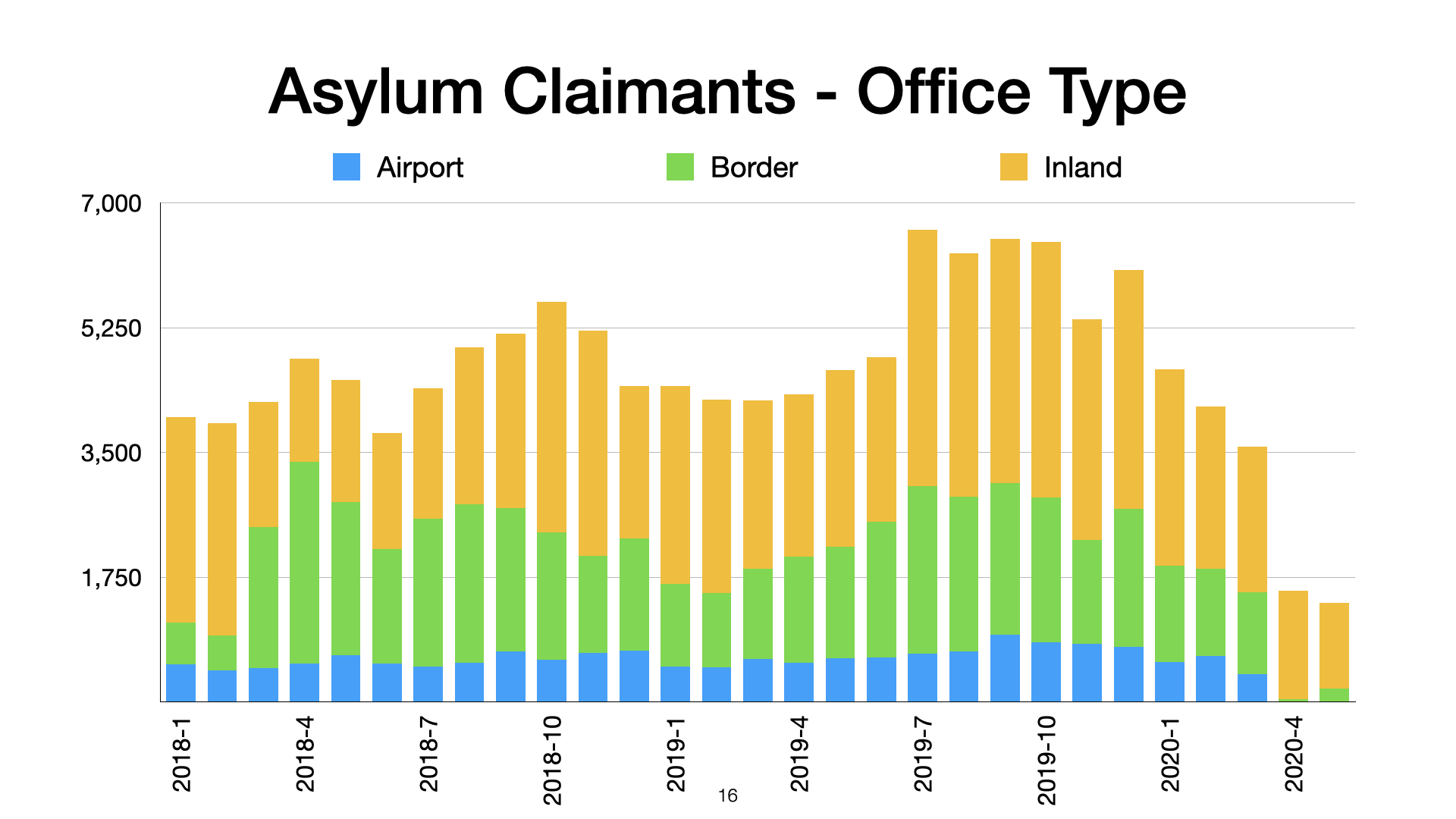
The overall trend, however, is overwhelming lower than pre-COVID as shown in the chart above (June data to be added):

The number of asylum claims being filed in Canada continues to rise slightly despite ongoing global travel restrictions.

The latest figures from the Immigration Department show 1,500 claims for refugee status were filed in Canada in June, up from 1,400 in May.

For the first time since April — the first full month of major travel restrictions designed to slow the spread of COVID-19 —  refugee claims were filed at airports. There were also multiple claims at marine ports.

Also slightly on the rise were the number of people stopped by the RCMP trying to cross irregularly into Canada: 32 in June, up from 21 in May.

Currently, Canada is turning back those who show up at unmarked border crossings, one of several measures being taken at the border in response to the pandemic.

How many people will continue to attempt to enter Canada irregularly may change in the coming months, in the wake of a Federal Court decision Wednesday that the Safe Third Country Agreement between Canada and the U.S. violates the charter.

The agreement is the reason just over 3,000 people this year have tried to cross irregularly into Canada in order to file for asylum. Under the deal, they would be turned away at formal border points.

They can still, however, lodge a claim once they are inside Canada.

But Federal Court Justice Ann Marie McDonald said Wednesday that elements of the law underpinning the agreement violate the constitutional guarantee of life, liberty and security.

Under the agreement, which took effect in 2004, Canada and the U.S. recognize each other as safe places to seek protection.

That means Canada can turn away those who arrive at land ports of entry along the Canada-U.S. border on the basis they must pursue asylum in the U.S., the country where they first arrived.

In the long-running court case, the applicants, who are citizens of El Salvador, Ethiopia and Syria, arrived at a Canadian land entry port from the U.S. and sought refugee protection but were refused.

They had argued in court that when returning ineligible refugee claimants to the U.S., Canada exposes them to risks in the form of detention and other rights violations.

In her decision, McDonald concluded the consequences ineligible claimants may face upon return to the U.S. are “inconsistent with the spirit and objective” of the refugee agreement and amount to a violation of the rights guaranteed by Section 7 of the charter.

The judgement, however, was suspended for six months to allow the government to find a solution.

Talks between Canada and the U.S. to update the Safe Third Country Agreement have been underway for a while, and rights advocates in both countries have urged Canada to use the ruling as opportunity to push them forward.

“Human Rights First notes that the Trump administration’s treatment of asylum seekers is now even worse than it was at the time evidence was submitted in this case,” the non-partisan American group said in a statement.

“In light of the court’s decision and this ongoing deterioration, Human Rights First urges the Canadian government to take this opportunity to withdraw from the ‘safe third country’ agreement.'”

The government can’t sit on its hands and do nothing, said Queen’s University professor and immigration law expert Sharry Aiken.

She said the agreement should be suspended immediately, as the while the court was only dealing with the legality of the deal, it continues to impact refugee claims.

“In my view the Canadian government has a responsibility to act immediately to prevent further violations of our constitution and the international human rights commitments to which Canada has agreed to be bound,” she said.

“It also means that it would be unconscionable for the government to appeal this ruling and seek a stay of the ruling.”

Current travel restrictions in place to slow the spread of COVID-19 appear to have placed downward pressure overall on asylum claims.

By the end of June 2019, 26,725 claims were filed, compared with 16,865 asylum claims filed so far this year.

The rise in June of this year was due to an increase in people already in Canada making claims at government offices, as opposed to those requesting asylum immediately upon arrival in Canada.

Source: Asylum claims being filed in Canada continue to rise slightly despite pandemic

‘Why don’t they just work harder?’ This kind of anti-Blackness is prevalent in Chinese-Canadian communities. It’s time to address it

A good reminder that racism, discrimination and prejudice exist among all communities.

One of the positive changes under former Minister Jason Kenney was to broaden the discussion from a white/visible minority quasi-dichotomy to an understanding and appreciation of tensions and issues between visible minority groups, not just with the white majority. Shree Paradkar’s makes comparable points (Star ColumnistsDear brown people: I’m about to wash some dirty linen in public. Consider this an overdue act of tough loveJun. 28, 2020):

The idea that we live in a happy multicultural mosaic is one of Canada’s boldest lies.

Vote-thirsty politicians constantly dog-whistle at emboldened white supremacists on the Canadian fringe. Institutions across the board are being exposed for mistreatment and neglect of racialized voices. Not even Parliament escapes scrutiny as Canadians saw footage of Jagmeet Singh, the NDP’s brown and turbaned leader, getting kicked out of the House for calling out racism.

But the problem doesn’t lie exclusively with white people. Rather, it has long metastasized into communities of colour that internalize discrimination in order to spew it at groups they see as inferior — usually Black Canadians.

Nowhere is this more apparent than in parts of the Chinese Canadian community, of which I’m a proud member. While covering the election last fall, I ventured into neighbourhoods in Toronto filled with individuals of Chinese descent who, aside from the usual headaches over money, health care, or employment, were worried about “illegal border crossers” making their way onto their streets. They were clearly being fed that language by right-wing campaigners, but the pervasive fear showed how easy it is to capture people of colour with narratives that, though often rooted in racist untruths, galvanize a sense of superiority vis-à-vis those who “don’t belong.”

Which brings us to the question of anti-Blackness in communities of colour. I think it’d be hard to find a young person of Chinese descent in Canada who can’t recount at least one instance of hearing an older member of their family repeat a well-worn anti-Black trope. It might not be routine dinner conversation, but it happens all the time. Slogans of underclass ideology are robotically repeated: “Why don’t they just work harder?” “Black parents have a problem raising their kids the right way.” Or the popular, “I came to this country with [insert small dollar amount]; don’t talk to me about discrimination!” And so on.

Part of the problem is internalizing an implicit hierarchy based on race that only gets reinforced by “model minority” ideals in a country that operates on white normality.

This leads to envious worship of those above you in the arbitrary ethnoracial hierarchy, along with contempt or fearful hatred of those who you think can’t get to your level. The latter have always tended to have darker skin.

More optimistic activists may suggest that common experiences of discrimination should lead to people of different races (and from all walks of life) to automatically form political and social solidarity. Or that they naturally amount to a tangible political constituency because they all faced racism at some point. This is a naive assumption, even for people within the same race, which makes the current Black Lives Matter moment — spurred by the death of George Floyd — a valuable wake-up call.

Now more than ever is an opportunity for communities of colour, including the Chinese community, to question how their racist bias affects the world around them and why there’s such widespread anger among the Black community. It’s an uphill battle for progressive community organizations like the Chinese Canadian National Council (CCNC), which have a history of advocacy against racism that extends into the COVID-19 era of anti-East Asian discrimination.

Their battle today will have to be led by youth, who have an opportunity to extend the broader conversation of racial and social justice into their neighbourhoods and, perhaps more importantly, into their homes.

Much of this comes down to genuine progressive engagement with newcomers — a task that, in contrast to years-long forays by Canada’s conservative right, the political left is only beginning. The current opening to speak candidly about race and racism can help fill that vacuum, but only if civil society steps in on the ground level. Young people will, again, likely have to do the work of communicating, and even translating, to those who are unfamiliar with progressive narratives or vocabulary in an intelligible fashion.

In any case, the current hold of right-wing tropes and politics on significant swathes of the Chinese Canadian community (some of which have bled into alt-right territory) is not inevitable. The stereotype of wealthy, apolitical Chinese buying up land and condos can be challenged by engagement on universal issues of racial justice, among other progressive concerns.

It is necessary work for any era, but our time is one of fascist revanchism compounded by a pandemic and economic stagnation. More understanding between communities can be one of the few antidotes if collective solidarity leads to tangible successes in creating more equity in our institutions and accountability in our centres of power toward racialized people.

Canada’s travel rules unfair to first-year foreign students, U.S. parents say

Given the ongoing and unfolding disastrous handling of COVID-19, no surprise that the border remains largely closed. And no surprise that US parents are pressing their case for more flexibility:

Parents of students in the United States who hoped to begin their university studies in Canada this fall are frantically trying to convince the federal government to relax rules that make it next to impossible for their kids to enter the country.

Immigration, Refugees and Citizenship Canada has closed the door to students with study permits granted after March 18, the day Canada and the U.S. announced a ban on non-essential cross-border travel, while students with pre-existing valid permits will be allowed in.

Some parents say that discriminates against first-year students, most of whom didn’t have time to get their permits approved before the deadline after receiving an offer of acceptance from Canadian schools.

“The way things are right now, the only ones that are not able to come into Canada are the freshmen, and that makes no sense to anyone,” said Anna Marti, a resident of New York whose daughter was expecting to launch her post-secondary career in September at McGill University in Montreal.

“They’re the ones that are going to get their study permits after March 18.”

The total number of COVID-19 cases in the U.S. passed the 4 million mark Thursday, with nearly 144,000 deaths to date. Premature reopenings, an uneven and cavalier approach to physical distancing in parts of the country and a partisan divide over mask requirements have helped to fuel a surge in cases. Some experts are projecting a death toll in excess of 200,000 by November.

Canada, by comparison, has reported 112,000 total cases and 8,870 fatalities so far.

“There are no measures in place to provide for expedited processing of study permit applications,” Canada’s immigration department said in an update posted late last week.

“Foreign nationals who had a study permit application approved after March 18, 2020 … may not be exempt from the travel restrictions (and) they should not make any plans to travel to Canada until the travel restrictions are lifted, as they will not be allowed to travel to or enter Canada.”

Marti and others have signed an online petition urging Ottawa to reconsider the study-permit rule, arguing that it’s unfair to only allow foreign students with older permits — many of whom spent the summer in the U.S., where the severity of the COVID-19 pandemic has been escalating in recent weeks — into the country.

The rule also unfairly punishes students in those parts of the country where the virus is less severe, such as Marti’s home in the tri-state area of New York, New Jersey and Connecticut, she said.

New York City was a major epicentre for the initial U.S. outbreak back in April, prompting an aggressive response led by Gov. Mario Cuomo that helped to beat back the virus. People in the state have taken the threat more seriously as a result, Marti said.

“We’ve all been through hell,” she said.

“My daughter has not seen her friends in months. To quote Gov. Cuomo, she’s New York smart — she’s out there with her mask, always keeping social distance, and she’s telling me all the time, ‘I don’t understand this. There’s zero chance that we could be a risk.'”

Immigration Minister Marco Mendicino announced last week the government would prioritize study permits for students who have submitted a complete application online. Students will also be able to apply time spent studying online toward their eligibility for a work permit in Canada, provided at least 50 per cent of the program is completed in Canada.

The March 18 threshold for study permits has been in place since the border restrictions were originally imposed, said Kevin Lemkay, a spokesman for Mendicino. Since then, Ottawa has introduced “more flexibility” for students, Lemkay said, including priority processing and a two-stage process for students who are unable to obtain all the necessary documentation.

“Our government knows that international students bring tremendous economic, cultural and social benefits to Canada,” he said.

“We understand that students and post-secondary institutions were eager for certainty, and these measures were taken with that in mind. We hope to have more to say soon.”

The Change.org petition, which has more than 3,000 signatures, calls on the federal government to define all international students as essential travellers. It says students unable to enter Canada will lose access to vital educational resources, research facilities and income opportunities, and may not feel safe remaining in their home countries.

Some McGill employees who expect to be in proximity with students from the U.S. next month have raised concerns about why the school is permitting any international students on campus when the bulk of the course work can be handled online.

The university says the changes to course delivery are strictly temporary and that there will be an on-campus experience for students who are able to attend in person.

“Although the fall semester may look somewhat different than usual, the university is working with faculties to develop on-campus student life and learning activities, respecting careful safety protocols, for students who will be in Montreal in the fall term,” spokeswoman Shirley Cardenas said in a statement.

Those activities will be “replicated” for students who remain outside of Canada, she added.

“All international students entering Canada are required to quarantine for 14 days and are subject to monitoring, verification and enforcement by public health authorities. Individual accommodations will be available for any student needing to self-isolate.”

Source: Canada’s travel rules unfair to first-year foreign students, U.S. parents say

New Wharton Business Dean Says Lack Of Diversity Stems From A Lack Of Prioritizing

Of note:

One of the country’s leading business schools — the Wharton School of the University of Pennsylvania — has never had a woman or a person of color as its dean since it was founded nearly 140 years ago.

Until now.

Erika James was named as Wharton’s 15th dean in February and officially started the job earlier this month.

The business world has been slow to reflect the gender and racial makeup of America today, but James says that’s not due to a lack of ability to make it happen.

“I think if we can create social media platforms, if we can put people on the moon and if we can have self-driving cars, there’s very little that we can’t do,” James said during an interview on All Things Considered. “So the fact that we have not yet created a more diverse work environment means that we simply haven’t prioritized it.”

In these excerpts from her interview, she discusses obstacles that women and people of color face in climbing the executive ladder and a future in which “inclusivity is just the order of the day.”

Clearly there are structures in place that make it difficult for women and people of color to have exposure to opportunities within the organization. Folks of color generally have less access to mentors. Sponsoring relationships are important, but folks of color generally aren’t sponsored in the same way.

What I personally have also found was the need for me to take responsibility for my own success and progress within an organization. And for me, what that has meant was I needed to imagine that I had everything it took to be successful in a job or an assignment that might have been a stretch assignment, and take the risk that we see oftentimes so many men take, even if they don’t have all the right experiences. And I think oftentimes women are more reluctant to take on new roles unless all the Is are dotted and Ts are crossed.

What’s your message to incoming students at Wharton about their responsibilities to not just build successful companies but to build inclusive ones?

I don’t know how much more of a message that we need to deliver, because as I see it, each generation is becoming more and more, not even cognizant or aware, but the expectation that they have is that inclusivity is just the order of the day. And they are looking and demanding of their current workforce or school to be inclusive. And that is happening from white students, from students of color, from women, from men. I just see they’re a growing force, where the expectation is that the organization they enter will be diverse and inclusive.

Source: New Wharton Business Dean Says Lack Of Diversity Stems From A Lack Of Prioritizing

ICYMI: Black Children Are More Likely to Die After Surgery Than White Peers, Study Shows

Yet another study showing racial disparities in healthcare:

Black children are more than three times as likely to die within a month of surgery as white children, according to a study published in the journal Pediatrics on Monday.

Disparities in surgical outcomes between Black and white patients have been well established, with researchers attributing some of the difference to higher rates of chronic conditions among Black people. But this study, which looked at data on 172,549 children, highlights the racial disparities in health outcomes even when comparing healthy children.

Researchers found that Black children were 3.4 times as likely to die within a month after surgery and were 1.2 times as likely to develop postoperative complications. The authors performed a retrospective study based on data on children who underwent surgery from 2012 through 2017.

Olubukola Nafiu, the lead author of the study and a pediatric anesthesiologist at Nationwide Children’s Hospital in Columbus, Ohio, said the authors were not surprised to find that healthy children, across the board, had extremely low rates of mortality and rates of complications after surgery. But what surprised them was the magnitude of the difference in mortality and complication rates by race.

“The hypothesis we had when we started was that if you studied a relatively healthy cohort of patients, there shouldn’t be any difference in outcomes,” Dr. Nafiu said.

The authors, in their paper, acknowledged limitations of the study: They did not explore the site of care where patients received their treatments or the insurance status of patients, which can be used as a proxy for socioeconomic status. This meant they could not account for differences in the quality of care that patients received or the economic backgrounds of the patients.

Another limitation was that because mortality and postoperative complications are so uncommon among healthy children, it is possible that most of the cases came from a few hospitals, Dr. Nafiu said.

But while Black people are more likely to receive care in low-performing hospitals, that may not be the main factor driving the gap this study found, Dr. Nafiu said. The hospitals examined in the study were all part of the National Surgical Quality Improvement Program, a voluntary program, meaning they had the resources to be part of the program and the belief that quality improvement is important.

Adil Haider, dean of the medical college at Aga Khan University, who was not involved with the study, said that it told a key piece of the story about racial disparities in surgical outcomes, but that there were still many questions about what drives disparities.