Australia’s Economic Slump Threatens Openness to Immigration

Will continue to watch how this plays out and whether it influences Canadian debates and discussion (not seeing many signs it is to date). Canada has also largely been dependent on immigration for economic growth and the drop this year will have a comparable impact:

Australia’s immigration program, a key factor in the economy’s record stretch without recession, is under threat amid calls for the nation to turn inward while it recovers from the coronavirus pandemic.

Skills-based immigration has helped fill roles in industries experiencing high demand, slowing the aging of the country’s workforce. Crucially, the swelling population has delivered about 1.5 percentage points to annual GDP growth, allowing the economy to defy the business cycle.

Harry Triguboff personifies the program. The billionaire octogenarian fled to Sydney from China in 1948 ahead of Mao Zedong’s takeover, eventually becoming Australia’s fifth-richest man. His wealth was generated by building apartments to house the multitudes who followed in his footsteps.

“Australia was always built on migrants. We are the most successful with it,” Triguboff said in an interview with Bloomberg News. “Migrants are important because they work and build, and migrants of course need housing.”

Yet Australia’s bipartisan openness toward immigration is fraying amid a pandemic-induced recession. With the virus forcing the closing of borders, Prime Minister Scott Morrison anticipates an 85% drop in permanent arrivals this fiscal year.

Bill Evans, chief economist at Westpac Banking Corp., estimates that such a reduction could limit overall population growth to about 0.75%. The population could even contract if the number of Australians leaving the country doesn’t change, he said.

This has “profound implications for the nature of the job market, from the perspective of supply, the future and structure of the dwelling construction cycle and Australia’s potential growth rate,” Evans said. “Supporting Australia’s population growth is paramount. Australia should not accept the prospect of a collapse in net migration.”

Australia has been hailed for running the world’s best immigration program. In 2016, just under half of all Australians were either born overseas or had a parent who was. It ranks highly even among developed-world counterparts: 29% of Australians were born overseas, compared with 23% in New Zealand, 21% in Canada and around 14% in the U.S.

Immigration played a central role in helping Australia avoid recession for 28 years — until coronavirus hit. In per capita terms, however, the expansion halted temporarily in 2013 following the mining investment boom, and again in late 2018 as residential dwelling construction slowed.

“The post-COVID-19 question we must ask now is this: when we restart our migration program, do we want migrants to return to Australia in the same numbers and in the same composition as before the crisis?” said Kristina Kenneally, the opposition Labor party spokesperson for immigration.

“Our answer should be no,” she wrote in a May opinion article. “Our economic recovery must help all Australians get back on their feet, and to do that we need a migration program that puts Australian workers first.”

What Bloomberg’s Economists Say

“Migration has been a key driver of Australia’s growth story over the past decade, bolstering demand – particularly for housing – and easing labor market and demographic pressures through a strong supply of younger skilled workers. A migration-led slowdown in population growth risks exposing several underlying weaknesses in the economy, dampening demand, and revealing shortcomings in the training of skilled workers.”

James McIntyre, economist

Australia’s Treasury department said in a 2018 research report that migration is typically attacked because it adds to existing problems. The department noted that from 1996 to 2016 Australia’s population rose by more than 6 million people, with 75% of the growth in the states’ capital cities.

“Issues such as congestion and pollution are not new. These issues have concerned policy makers for decades and are the result of a range of legacy issues, such as environmental practices or town planning decisions, in addition to population growth,” the Treasury report said. “However, population growth tends to heighten existing challenges.”

Veronica Sparagis, business manager and co-owner of Ultima Building Group in Sydney’s western suburbs, warned that scaling back migration would hurt home building. It could erode demand for new homes and deprive the industry of specialist knowledge from offshore, she said.

Net immigration creates demand for an additional 80,000-100,000 homes per year, responsible for around two-thirds of underlying property demand, based on a calculation of net arrivals and average persons per household. Almost 10% of Australians work in construction, which accounts for about 9% of GDP.

“The industry most impacted by a cut in immigration is construction,” Sparagis said. “The building industry may be forced into a standstill.”

Source: Australia’s Economic Slump Threatens Openness to Immigration
Why do Muslim states stay silent over China’s abuse of the Uighurs? Nick Cohen

As in the case in the past:

When China imposed trade sanctions on Norway in 2010 for honouring the imprisoned dissident Liu Xiaobo with the Nobel peace prize, it spat out a word we weren’t used to hearing from propagandists for an atheist communist regime, but should get used to today. “It’s a blasphemy,” a party mouthpiece said.

Once, blasphemy was damning the faithful’s gods and sacred books. Now, criticism of the world’s largest dictatorship has become sacrilegious. You shouldn’t be surprised. As some of us tried to say in the 1990s and 2000s, the gap between the sacred and the profane was never as wide as religious sentimentalists and liberal multiculturalists believed.

They went along with the argument that it was bad taste at best and racism at worst to offend believers. You were “punching down” at largely poor and largely Muslim communities. We thought they were being wilfully blind. They did not understand how men with real power and malice were manipulating religious outrage to consolidate their rule over their wretched population. Iran issued a death sentence on Salman Rushdie in 1989 for satirising Islam’s foundation myths in The Satanic Verses. Its theocratic dictator, Ayatollah Khomeini, was augmenting his powers by claiming to speak for the Muslim world, as well as taking aim at novelists. When the Danish newspaper Jyllands-Posten published largely innocuous cartoons of Muhammad in 2005, to assert the right to mock religion, the Egyptian and Syrian dictators, Hosni Mubarak and Bashar al-Assad, turned a local argument into a global campaign against Denmark. The cries of rage usefully distracted from their corruption and misrule. I could add further examples but they tell the same story. Authoritarian politics and authoritarian religion are just two sides of the same debased coin.

ICYMI: The Demographics of Automation in Canada: Who Is at Risk?

The executive summary, highlighting that the most vulnerable share the same characteristics as those having poor economic outcomes in the past. I wonder, however, whether the discovery of who are truly essential workers during COVID-19, would affect their conclusions:

The COVID-19 pandemic has exposed a new vulnerability among firms that rely on human labour. In order to comply with public health directives on physical distancing, many businesses have had to completely shut down their operations for months. Others remained functional thanks to teleworking, which many intend to prolong and even adopt permanently. As experts contemplate the long-term repercussions of the pandemic on the economy, many expect firms to ramp up their adoption of new technologies to better weather the post-pandemic recession and insulate themselves from future health crises.

Just a few years ago, policy-makers became concerned about the prospect of many job-related tasks being automated using advances in robotics and artificial intelligence and in particular about the projected job losses at the time. While we no longer expect entire jobs to disappear, new technologies may substantially transform jobs, forcing workers to adjust to new requirements and prompting governments to assist them in this process.

In this study, Statistics Canada researchers Marc Frenette and Kristyn Frank are breaking new ground by examining the demographic and employment characteristics of workers facing a high risk of job transformation due to automation. To assess the potential impact of a new wave of automation on vulnerable workers, policy-makers need to know not only what jobs are at risk but also who holds these jobs. For instance, while we know that previous waves of robotization replaced low-skilled workers and enhanced the work of those with high skills, this time around there are fears it is high-skilled workers who are at risk, given the rise of new algorithms that are increasingly proficient at accomplishing complex cognitive tasks.

Consistent with the findings of previous research, Frenette and Frank show that, overall, more than 10 percent of Canadian workers face a high risk of seeing their jobs transformed through automation – high risk being defined as a probability of 70 percent and higher. And close to 30 percent of workers face a 50-to-70 percent risk. What the authors underscore, however, is that the extent to which the automation risk varies is based on certain worker characteristics. For instance, more than a third of workers without a certificate, diploma or degree face a high risk of job transformation, compared with fewer than 4 percent for those with degrees. The probability of being at high risk also decreases significantly as employment income increases. Over a quarter of workers in the bottom decile of the income distribution are at high risk, whereas only 2 percent of workers in the top decile are. Also among the groups most exposed to job transformation are older workers (aged 55 and over), those with low literacy or numeracy proficiency, the part-time employed,  those working in small firms, and in manufacturing, where about 27 percent workers are at high risk. The authors find no significant differences in the risk of job transformation on the basis of gender, immigration status, having a disability or being unionized.

The results from this study stand in sharp contrast with many observers’ expectations that the new technologies could adversely affect workers previously seen as immune to automation. It suggests that the workers at high risk of job transformation due to automation, by and large, share the same characteristics as workers who have been susceptible to poor labour market outcomes in the past. Frenette and Frank say that more research is needed to better understand which characteristics can be interpreted as risk factors. Nevertheless, by shedding light on the differential effects of automation on particular segments of the workforce, their study contributes to labour market policy development going forward.

Source: https://irpp.org/research-studies/the-demographics-of-automation-in-canada-who-is-at-risk/

MacDougall: Imperfect Canada can afford to give itself a break

Good and needed balance and perspective (from another white guy but with two half-Persian adult children):

Can we give ourselves a break?

I ask, because the country is still under tremendous stress from the novel coronavirus. Millions are out of work, the economy is tanking, and parents are going insane trying to “work” from home. Is now really the time to beat ourselves up for being one of the most progressive, tolerant and accommodating societies ever constructed?

We are failing on some fronts, however, as many Black, Indigenous or minority Canadians are busy pointing out. But why are disclaimers being placed on the Canadian flag only now? Why the loss of confidence in what’s gotten us so far? Hasn’t the country always been riven by faults and tainted by failings? Indigenous versus the European settlers; the French versus the English; Catholic versus Protestant; “old stock” versus the wave of post-First and Second World War immigrants; men versus women; and so on. Some of these faults – particularly the oldest – remain painfully unresolved.

Thankfully, the country is still learning. Pace the most fervent “anti-racists,” we aren’t in need of a mass societal reset, nor are we in need of the mother of all guilt trips for white people, including any forced readings of huckster texts such as Robin DiAngelo’s White Fragility. Putting people into boxes only blinds them further. Besides, guilt or moral panic is rarely constructive; it’s better to rediscover the liberal fundamentals that underpin our free society and use them as guideposts for strengthening and renewing our (admittedly sclerotic) institutions.

We certainly won’t get further along by focusing on our differences, not when there are so many now thanks to years of profound and beneficial change. The shorter path is to focus on what’s the same. My school pictures were lily white, whereas those of modern city classrooms are not. That’s different, and good, but they’re all still children. And while it’s true the upper echelons of our institutions don’t yet reflect this diversity, give them another generation or two and they will. They’ll have to.

And while the urge to shove the process along more quickly than it goes on its own is understandable, provoking a bitter cultural backlash will only delay the inevitable. Renaming every Dundas Street in the country feels like a victory, but it’s a symbolic one. Even worse, it urges others to aim for similar low-hanging fruit, instead of focusing on the bigger problems.

Reckon with our past, sure, but focus more on our future. And be constructive. So let’s make CVs “blind.” Let’s push governments and corporations to actively seek minority hires. Most importantly, give people the space to have difficult conversations and show them charity if they stumble along the way. We’re not always going to get it right.

Easy for me to say as a white guy, I know. But I have two small children who are half-Arab. Their maternal grandparents came to Canada with little money and a funny surname, but their mother is now a national television reporter (initially hired in local news through a diversity hire program) and their futures will be brighter still.

If, that is, we give ourselves a break.

Remember: perfect is the enemy of the good. Don’t throw the baby out with the bathwater. The English lexicon is full of expressions urging caution in the face of mania. We need to rediscover that corner of our language because, right now, things are hard enough without looking for any extra trouble.

Source: MacDougall: Imperfect Canada can afford to give itself a break

In Canada, Homegrown Islamophobia Gets a Boost from Modi’s Supporters in India

The traditional concern regarding Indo-Canadians has focused more of Sikh extremism than the Hindu extremism covered in this commentary. Liberal Brampton Centre MP Ramesh Sangha had made the following accusation: Brampton Liberal MP says his party ‘pandering’ to Sikh separatists.

Canadian “mainstream” media coverage has been limited, safe for the call to prayer (azan) controversy during Ramadan.

The PM’s disastrous 2018 India trip may also contribute to Canada’s relative reluctance to comment on Indian government abuses:

Indian Prime Minister Narendra Modi’s administration has long been criticized for discriminating against India’s estimated 200 million Muslims. Tensions between this large minority and the Hindu nationalists who support Modi’s ruling Bharatiya Janata Party (BJP) have been mounting in recent years, resulting in worrying laws, dangerous harassment, and deadly mob violence in India. Now, the hostility has moved outside of India’s borders. Thanks to social media and a dedicated diaspora, antagonism toward Muslims by supporters of India’s right-wing, Hindu nationalist government has gone global. And the international spread of domestic prejudices is causing diplomatic ripple effects for India’s allies.

This has been particularly apparent in the Persian Gulf region, home to millions of Indian expatriates. Modi’s carefully cultivated ties to the Gulf regimes are now threatened by instances of ultra-nationalist Indian expats spewing Islamophobic rhetoric online. While much of the vitriol has been aimed at the Muslim population back home in India, it has also taken the form of social media posts that denigrated Islam more generally, as well as the Prophet Mohammed. The situation has led to rare criticism of Modi by Gulf elites. In April, the government of Kuwait, along with a member of the Sharjah royal family in the United Arab Emirates, criticized widespread Islamophobic social media posts in India accusing the country’s Muslims of deliberately spreading the coronavirus and engaging in a “corona jihad.” Modi eventually responded by tweeting that the virus “does not see race [or] religion,” although his government’s rhetoric says otherwise. A month later, the UAE Federal Public Prosecution issued a public warning against discrimination after scores of Indian expats were fired from their jobs for anti-Muslim social media posts. This and similar incidents led the Dubai-based Gulf News to run an editorial in May calling for India to stop “exporting hate” to the Gulf.

In the West, the BJP’s brand of Islamophobia has found an eager partner among the far-right, as recent developments in famously multicultural Canada demonstrate.

In April, city councils across Canada voted to allow the Islamic call to prayer, the azan, to be broadcasted for a few minutes a day during the holy month of Ramadan. The government hoped to foster a sense of inclusion as mosques and other places of worship were closed for the COVID-19 lockdown. The decision elicited a major backlash, including mass petitions and online hate, with the far-right suggesting “Islamism” had infiltrated Canadian society and politics.

Some members of Canada’s Indian diaspora echoed such sentiments, tweeting comments about how the prayer call broadcasts are part of an Islamist “strategical campaign through out the world” or that “blaring loudspeakers” can never be “peaceful.” Several of the tweeters have quietly lost their jobs since then, amid pressure from anti-hate groups.

But few cases have garnered much attention. The exception is that of Ravi Hooda, who sat on a regional school board in the Toronto area and tweeted that allowing the prayer calls to be broadcast opens the door for “Separate lanes for camel & goat riders” or laws “requiring all women to cover themselves from head to toe in tents.” When Hooda’s tweet was called out by the Canadian Anti-Hate Network, a Twitter war ensued. Dozens of pro-Indian accounts, often with usernames containing an eight-digit string of numbers—a common indicator of a bot account—came to Hooda’s defense. A local controversy instantly took on an international character.

Hooda, for his part, is a volunteer for the local branch of the Hindu Swayamsevak Sangh, which represents the overseas interests of the Rashtriya Swayamsevak Sangh (RSS), the right-wing Hindu nationalist organization that promotes the Hindutva (literally, “Hindu-ness”) ideology that India is a purely Hindu nation at its core. Modi himself is a lifelong RSS member, and a majority of his ministers have a background in the organization. The Hindu Swayamsevak Sangh opened its first chapter in 1947, in Kenya, and today has more than 500 branches in 39 countries. The group’s chapters are called shakhas(branches) and, in addition to offering community services, help organize the diaspora through lectures, camps, and other organizational sessions that are aligned with the RSS’s ideological outlook.

The spread of right-wing Hindu nationalism in Canada has allegedly dovetailed with efforts by Indian intelligence agencies to “covertly influence” Canadian politicians to support Indian government positions through disinformation and money, according to documents obtained by Global News. There’s no proof of how successful this lobbying has been, but it’s clear that New Delhi is stretching its global reach at the same time that the BJP’s rhetoric and actions have politicized a new generation of Indian expats.

A glimpse of this global reach was provided by the EU DisinfoLab last fall in a report detailing a network of over 260 pro-India “fake local media outlets” spanning 65 countries, including throughout the West. The media organizations bear the names of local towns and cities, but none of them has any real connection with the localities they purport to represent, and all feature pro-India and anti-Pakistan content. Every news site was registered by the Srivastava Group, an Indian corporation that last year took right-wing European politicians on a trip to Kashmir, where they met with Modi.

Such reach can also be seen in the efforts of Indian expats and Indian Americans in the United States who organized last fall’s “Howdy, Modi!” event in Houston attended by 50,000 people, including U.S. President Donald Trump and other Republican and Democratic politicians. Indian American volunteers did the heavy lifting and funded the event, which turned a meeting between heads of state into a public spectacle. The event was meant to cement Trump-Modi relations as well as to rally the U.S.-based diaspora around the BJP, thus bolstering the prime minister’s popularity back home.

An organized, RSS-minded, pro-BJP diaspora in the West and beyond would obviously be a great asset for Modi’s government.

 Elected officials would think twice before criticizing India, already a rising and influential power, for fear of angering their constituents. There are already hints that such calculations are being made by leaders. After an anti-Muslim pogrom broke out in Delhi in February, resulting in more than 50 deaths—the worst sectarian violence India has seen in years—Canada kept almost silent. While speaking to his Indian counterpart after the riots, the Canadian foreign minister offered a note of vague concern, roundly criticized in Canadian media. Prime Minister Justin Trudeau made no statement, and the four Indian Canadian members of Trudeau’s Liberal caucus showed a similar reluctance to comment, drawing criticism from community organizations.

Similarly, foreign governments remained largely silent last summer when Modi stripped Muslim-majority Jammu and Kashmir of its special status and placed it under a brutal military lockdown. This had observers wondering whether “Hindutva-inspired lobbies in the West,” as the researcher Fareeha Shamim labeled them, succeeded in their goals of building global influence from the ground up. Liberal politicians now hold an uncomfortable position, reluctant to criticize Modi lest they be attacked by his supporters in the diaspora.

Source: In Canada, Homegrown Islamophobia Gets a Boost from Modi’s Supporters in India

How to build a better Canada after COVID-19: Rethinking immigration can boost the economy

Good overview of some of the challenges and options facing Canada post-COVID. The idea of “digital work permits” is innovative but not sure about how the practicalities of implementation would be that simple:

The coronavirus pandemic hasn’t stopped the flow of goods coming into Canada. That’s because countries around the world worked together to keep trade markets open for business. But Canada faces a potential crisis if its borders remain closed to people for a prolonged period of time.

Canadian governments, regardless of the party in power, have traditionally increased immigration numbers as a strategy to offset the country’s declining domestic birthrate. A continual flow of immigrants is essential for economic stability and growth.

How then can you maintain economic growth if no new immigrants are allowed into the country?

Every crisis can lead to new opportunities. And we’ve already seen challenges that emerged during the pandemic lead to innovative government programs. The same should happen with Canada’s immigration policy.

While the pandemic has temporarily closed the territorial borders to all foreigners for non-essential travel, there’s an opportunity to keep our “virtual” borders open to the best and brightest workers who want to come to Canada.

One million new immigrants by 2021

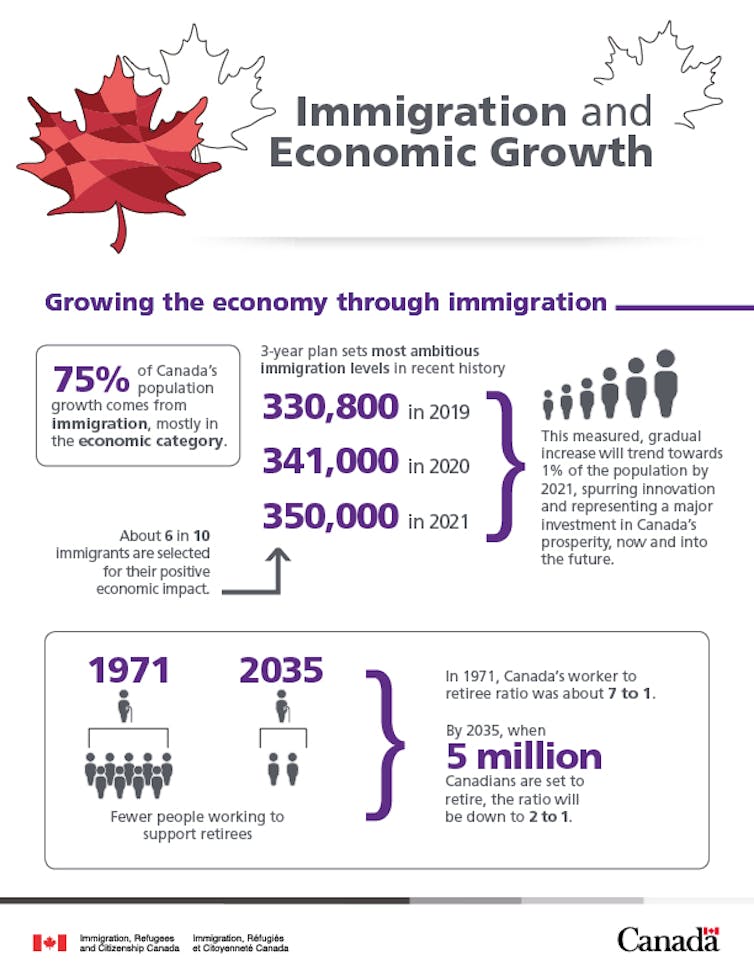
The current immigration plan calls for more than one million new permanent residents between 2019 and 2021. Of these newcomers, the majority will be economic migrants, coming through various provincial and federal programs such as the Federal Skilled Worker Class and the Provincial Nominee Program.

Illustrating the vital role of immigration for Canada, with emphasis on economic gain and global competitiveness, Canada’s then minister of immigration, Ahmed Hussen, stated in 2018: “The new multi-year immigration levels plan supports Canadian employers and businesses by ensuring they have the skilled labour they need to spur innovation and help to keep our country at the forefront of the global economy.”

This graphic from the government of Canada explains how immigration policy is linked to economic growth. (Immigration, Refugees and Citizenship Canada)

Some of the dilemmas that Canada will face in the post-pandemic recovery period will involve how to continue attracting the best and brightest, what sectors of the economy should be prioritized and how to deal with essential work like agriculture.

Unprecedented challenges

I have studied highly skilled and lower-skilled migration in Europe and internationally for over 20 years, with a special interest in how migration policy interacts with other sectors such as agriculture, the care industry and the competition for talent. But the COVID-19 pandemic poses unprecedented challenges for Canada’s immigration policy because of the level of uncertaintythat the whole world is facing.

What’s happened to the government’s plans to attract “the best and brightest from around the world” — people who will be fundamental to the country’s economic future?

For more than three months, Canada has temporarily stopped processing work permit or permanent residency applications. This presents many challenges for businesses and for workers and their families.

While working remotely is a possibility for most highly skilled workers in Canada who are in non-essential sectors, that’s not an option for those who have a job offer but are still abroad. They cannot receive a work permit, a Social Insurance Number unless they enter the country. They also can’t be paid without a SIN number. There are important consequences for organizations that seek workarounds and do not respect labour laws.

Digital work permits

Technology can offer a solution to this impasse. A security-proof digital work permit and a social identification number could be assigned remotely to allow these “virtual immigrants” to start working remotely with their Canadian employers while they wait for the entry ban to be lifted.

The permit could be for three or six months and would automatically be replaced by the regular work permit and SIN if the ban is lifted and the worker moves to Canada. The worker and employer would commit to honouring their contract by coming to Canada within 90 days of lifting the entry restrictions.

This would give everyone — government, employers, workers and their families — both the necessary guarantees and flexibility to deal with this unexpected disruption.

But are those workers truly needed now — especially given the country’s record unemployment rate since the outbreak of the pandemic?

Canadian immigration policy involves long-term planning related to the country’s demographic composition, growth (or rather decline, without immigration), key industries and efforts to attract new immigrants to the smaller regional centres across this vast country.

In February, just before the pandemic was declared, Minister of Immigration, Refugees and Citizenship Marco Mendicino told the Canadian Club in Toronto that Canada welcomed 341,000 new immigrants last year. He then added: “In 2020, the future of Canada hinges on immigration.” But the current situations means it seems unlikely Canada will be able to meet its immigration targets this year or next.

Not a job competition

Unemployment and underemployment data from April show temporary workers, those with less than one year at their last job or people not covered by a union or collective agreement, were hit the hardest by COVID-19. While it is imperative to provide for these workers and their families, these newly unemployed workers are not in competition for the same jobs as those to be filled by the highly skilled newcomers attracted by the Express Entry or Global Talent immigration streams.

As we go through and hopefully leave behind the pandemic, Canada needs to build a stronger health sector including industries that produce gowns, masks and gloves or health-care equipment like ventilators. The medical and pharmaceutical research sector should also remain a top priority. Transnational co-operation is key to Canadian entrepreneurship. Such sectors can only gain from highly skilled migrants who bring to the country innovative ideas, much needed skills and connections to other countries and continents.

New ideas needed

While rethinking policies about bringing highly skilled immigrants to Canada, new ideas are also needed for lower-skilled workers who are essential to the economy.

The deaths of Mexican farm workers in southern Ontario have raised an important debate about the responsibility of employers, but also the need for monitoring the health and the working conditions of those we bring to Canada to do jobs that are essential. There has been a growing awareness that the temporary foreign worker program in agriculture needs both a short- and long-term overhaul.

We need to consider how agricultural policy and migration policy can work hand in hand to promote better working and living conditions for migrant farm workers. One idea could be the expansion of a pilot project launched in May that will allow a small number of migrant agriculture workers to apply for permanent residency.

The many challenges that both highly skilled and low skilled migrants face during the pandemic can be turned into an opportunity that would help Canada’s post-COVID-19 economic recovery.

Mulcair: Jagmeet Singh calls MP ‘racist’, but has he forgotten about Bill 21?

Valid question:

In 2016, when I first prepared a House of Commons motion condemning islamophobia, we couldn’t get it past a handful of Conservatives who’d denied unanimous consent. We worked hard for all-party agreement, drew a big chalk circle around the stain of Conservative opposition and were able to present the motion again. This time it was accepted and passed unanimously.

Those events in Parliament immediately came to mind when Jagmeet Singh chose to call Bloc House Leader Alain Thérrien a racist. Thérrien had communicated the Bloc’s refusal of unanimous consent for the introduction of Singh’s motion, which called for the recognition of systemic racism within the RCMP. Singh confirmed that he had indeed called Thérrien a racist, but refused to withdraw the word when asked to do so by the Speaker. The Speaker, Anthony Rota, proceeded to expel Singh for refusing to respect his decision.

In subsequent interviews, Singh affirmed that Thérrien had to be a racist because of the subject matter. He also said that he would not apologize for the personal insult, explaining that doing so would be like apologizing for being against systemic racism. As of Jun. 30, Bloc Leader Yves-Francois Blanchet was threatening a robust reaction when the House returns July 8, if Rota maintains the decision of expelling Singh for just one day. Blanchet went so far as to call Singh’s reaction “orchestrated.”

Rota has had to defend his credentials in his home riding of Nipissing—Timiskaming, after a local group called on the MP to demonstrate “stronger anti-racism leadership”. There is now little hope that the grave and urgent issue of systemic racism in the RCMP will ever be the object of the unanimous denunciation of the House of Commons.

In the case of that vote against Islamophobia, it had also been no small feat to get the Bloc Québécois onside. Beginning with my 2007 by-election for the NDP in Outremont, the Bloc rode anti-Muslim sentiment hard. I recall a thoughtful, soul-searching meeting with Alexa McDonough, Ed Broadbent, Jack Layton and our key organizers in the basement of our campaign headquarters where we struggled to find the right words to push back. In that particular by-election, the Bloc was decrying Muslim women’s right to vote with a face covering. We came out four square against the Bloc’s toxic position but personal name-calling wasn’t part of the game plan. We won handily and the Bloc lost two-thirds of it’s vote, finishing third.

In the 2015 general election, of course, the issue came to a head. My support for a woman’s right to wear a niqab at a citizenship ceremony cost us dearly. I remember my campaign director, who’d flown in from Ottawa, imploring me to change my position because it was causing a precipitous drop in Quebec that was playing into our national numbers. Many voters, she said, were just waiting to see whether the NDP or the Liberals, could defeat Harper to make their final choice. She was concerned it could cost us the election. A publication forthcoming in the prestigious Journal of Politics, has confirmed that the NDP got clobbered over the issue of niqabs in Quebec; it was pivotal in deciding the outcome of the election.

In France, even socialist governments have banned certain outward expressions of the Muslim faith. Other religions, such as Sikhism and Judaism have not been spared. Under the guise of separation of church and state, Muslim moms have even been denied the right to accompany their kids on school field trips, because of their headscarves. Outside every school in France is a poster explaining the rules against religious symbols.

Astonishingly, even the European Court of Human Rights has upheld the ban. Public French intellectuals like Michel Houellebecq and Élisabeth Badinter write openly about the threat religious symbols pose to French society.

For those of us who support Canada’s multicultural traditions, such views are an anathema. From our perspective, it’s easy to view them as racist, which I do. In Europe, they are widely shared and accepted as being part of public debate and have gained some currency here amongst those who find fault with multiculturalism.

When Quebec Premier François Legault is asked about systemic racism in Quebec, he too restates the question: “Ah, you’re saying all Quebecers are racist, and I’m saying some Quebecers are racist but that Quebecers are not systematically racist.” It’s a rhetorical trick where politicians repeat the issue in terms that suit their purpose while answering their own question.

Systemic racism doesn’t mean everyone is systematically racist. It means the dice are loaded against some members of our society because of their ethnic, religious or cultural origin. The result of that racism within the system can be proven by looking at results, measuring and comparing outcomes. Legault is too well-informed not to know that, but he also knows his base. Like the crafty populist politician he is, he’s talking to that base bysaying, “I won’t let them call you a racist!”

Legault seems to have in part, at least, won his point. In the aftermath of the dispute between Singh and the Bloc a “premiers’ statement” issued by Justin Trudeau and all of the provincial premiers, on Jun. 26, talks several times of racism and discrimination but never uses the word “systemic”.

I made my first appearance in a parliamentary commission in Quebec City on the subject in the mid-80s and it’s an issue I’ve felt passionately about since. Government reports showed a huge, systemic under-representation of minorities in the Quebec civil service back then. We worked hard to change that. It began by making people understand the problem. The situation has indeed improved considerably, but just this month, the Quebec Human Rights Commission released a study showing that there are fewer than half the number of visible minorities in the Quebec civil service than their proportion of the overall population. Historically, this situation is also a reflection of another old divide: there was much discrimination against French-Canadians in the business sector in the past and good civil service jobs were seen as a way of levelling the economic playing field.

These issues are complex and Jagmeet Singh knows that. He has proven it in the past, notably when confrontedby a voter who told him to remove his turban in order to “look more Canadian”. Singh was almost spiritual in his calm reaction. He knew he was dealing with someone who just didn’t get it and it became a teachable moment. Many people called that man a racist, but Singh never did.

Right now Québec has a law on the books, Bill 21, which openly discriminates against religious minorities, in particular against observant Muslims, Sikhs and Jews. Thus far, no opposition party in Parliament, including the NDP, has dared challenge that law for what it is. They all, including Mr. Singh, say Quebec has a right to adopt it. Trudeau is still refusing to refer the case to the Supreme Court and instead, the victims of Bill 21 who  are being denied the right to teach, become cops or government lawyers, will have to fight for years as the issue slowly wends its way through the courts.

Singh could choose to use all of his credibility and deep personal experience with this issue to persuade Trudeau to finally do the right thing and challenge the discriminatory Bill 21 immediately by referring it without delay to the Supreme Court. That would be helpful.

Source: Jagmeet Singh calls MP ‘racist’, but has he forgotten about Bill 21?

A touchstone for troubled times, Leonard Cohen’s Anthem took its own sweet time to happen

Of all the Cohen songs, Anthem spoke to me the most, whether during my cancer treatments, dealing with professional issues for the current pandemic:

Embroiled in a civil rights case connected to violence in the Indian village of Koregaon Bhima, the journalist and human-rights activist Gautam Navlakha had his bail plea rejected by India’s Supreme Court this past March. Afterward, he issued a public statement that ended with a plea to listen to Leonard Cohen’s Anthem, with special attention paid to the song’s chorus:

Ring the bell which still can ringForget your perfect offeringThere is a crack, a crack in everythingThat’s how the light gets in

Released as the beacon centrepiece to Cohen’s The Future in 1992, Anthem is particularly alive in 2020. In a shattered, calamitous time, the song’s spoken-word solace serves as go-to quote material for social-media philosophers and embattled social-rights activists alike. Swelling and almost optimistic, the redemptive hymn from the Poet of Brokenness resonates universally.

The Future was birthed in an especially turbulent time. The album’s Democracyreferenced Tiananmen Square and was “occasioned,” according to Cohen, by fall of the Berlin Wall. Closer to home, when the Los Angeles-based Cohen looked out his window, he noticed riots and earthquakes. “I’ve seen the future, brother,” he foretold on the title track. “It is murder.”

Oddly, early reviews of The Future often failed to even mention Anthem. The album’s unlikely hit ended up being Closing Time, with its boozy swing. Anthem eventually earned an iconic status, but its progress came in fits.

Inspired by Kabbalistic mysticism, the song preaches the acceptance of imperfection. Yet, after an earlier version of Anthem was mistakenly erased in the studio in 1983, Cohen reworked it laboriously. “Anthem took a decade to write,” Cohen told author and musician Paul Zollo in 1992. “And I’ve recorded it three times. More.”

In the end? “There’s not a line in it that I couldn’t defend,” Cohen said in another interview.

In tribute to the song, The Globe and Mail has collaborated with arts organizations across the country on a video of dance pieces set to an original arrangement of Anthem by the Toronto Symphony Orchestra.

What follows below is an oral history of the song, culled from Cohen’s own words and from the recollections of those who spoke to The Globe. In short, a breakdown of how the light finally got in.


What became Anthem first appeared during the recording of Cohen’s 1984 album Various Positions. Leanne Ungar was the engineer for those sessions, and for the recording of The Future at Village Recorders and Capital Studios in Los Angeles.

Leanne Ungar: “I don’t think it was originally called Anthem when we recorded it for Various Positions. It may have been called Ring the Bell, but I’m not sure. The intro was erased in error by a studio technician. Of course I was devastated and wanted to repair it. But Leonard said, “No, it’s a sign. It’s not meant to be. I’m going to put it away and look at it later.”

Leonard Cohen, in 1992: “I listened to it … there was a lie somewhere in there, there was a disclosure that I was refusing to make. There was a solemnity that I hadn’t achieved. There was something wrong with the damn thing. All I knew is that I couldn’t sing it. You could hear it in the vocal, that the guy was putting you on.”

Producer Yoav Goren specializes in soundtracks for film and television. In the early 1990s, he was working in a small music shop in Santa Monica when a famous songwriter walked in.

Yoav Goren: “Leonard was shopping for a keyboard. He was fond of a certain kind made by Technics, a less-sophisticated version of a synthesizer. Leonard loved that kind of stuff. He bought one and asked me to deliver it to his house.”

Behind Cohen’s house in Los Angeles was a smaller two-story building used as a home studio for song ideas. Unable to grasp the nuances of the computer-recording software, Cohen asked Goren to help lay down the demos for The Future.

Goren: “I remember asking him [if] he would mind me taking a shot at arranging Anthem for him. He said, ‘Go for it.’ I came up with a medley and an arrangement. Ultimately none [of] it was used.”

Credited as the song’s co-producer is actor Rebecca De Mornay, Cohen’s companion at the time. Her role in Anthem was cited in Sylvie Simmons’s biography I’m Your Man.

Cohen: “I had played many versions of Anthem to her – fully completed versions and overdubs, and none of them seemed to nail it – and while I was revising it for the 100th time, at a certain point she stopped me and said, ‘That’s the one.’ It was quite late at night and we managed to find a studio … we produced the session that night. The basic track and the basic vocal.”

The new version was different than the discarded one from years earlier.

Ungar: “The verses were similar and the chorus still began with, ‘Ring the bell.’ But the line about the light getting in was new.”

In charge of the song’s string section and the L.A. Mass Choir was David Campbell, the Winnipeg-born arranger (and father of musician Beck), who has his credits listed on hundreds of gold and platinum albums.

David Campbell: “It could be frustrating. Producer Steve Lindsey would try to get Leonard to forget about the stuff he did on the keyboard and start again. Leonard’s tendency was to strip things down. You kind of had to because he had such a low voice. You needed to make room for it.”

The people who helped Cohen create Anthem were struck by its wisdom and gravitas.

Back-up singer Julie Christensen: “I was about four years into recovery at the time. The reprieve in Anthem wasn’t lost on me. I could have been lost to the world. But there I was in the studio, singing that song.”

Campbell: “It had an optimism, but in a tarnished way. It seemed like the most realistic view.”

The last word goes to the songwriter himself.

Cohen: “I think it is one of the best songs I have written, maybe the best,” the songwriter told music critic Robert Hilburn in 1995. “I knew that song was everything that my whole work and life had somehow gathered around. It is absolutely true to me.”

Americans Want More, Not Less, Immigration for First Time

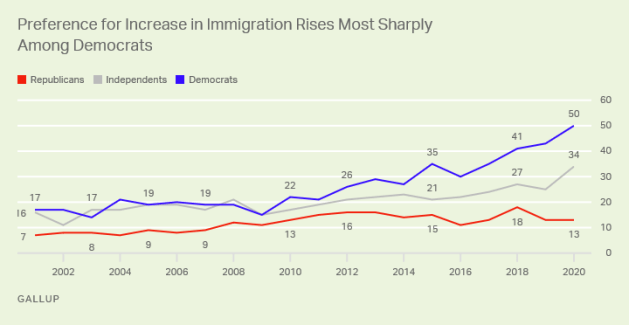
Behind all the extreme partisanship and polarization, and political gridlock, a significant finding from Gallup, coming closer to mirroring the Canadian pattern of thirds (one third for more, one third for less, one third for about the same), with of course the Republicans not having changed their anti-immigration beliefs:

Thirty-four percent of Americans, up from 27% a year ago, would prefer to see immigration to the U.S. increased. This is the highest support for expanding immigration Gallup has found in its trend since 1965. Meanwhile, the percentage favoring decreased immigration has fallen to a new low of 28%, while 36% think it should stay at the present level.

This marks the first time in Gallup’s trend that the percentage wanting increased immigration has exceeded the percentage who want decreased immigration.

Immigration1

Line graph. The rate of those who want immigration increase reaches historic high of 34%. 28% of Americans want immigration decrease, and 36% want immigration kept at current levels.

These results are from a Gallup poll conducted May 28-June 4 and predate the Donald Trump administration’s recent decision to halt issuing any new H-1B and other worker visas through the end of the year. It also preceded the Supreme Court’s recent ruling that invalidated the Trump administration’s action to end the Deferred Action for Childhood Arrivals Act, which offers legal protection for undocumented immigrants who came to the U.S. as children. In terms of a public focus, the topic of immigration may have currently taken a sideline to issues of race relations, but just two years ago, Americans cited it as the most important problem facing the country.

Desire for More Immigrants Rises Among Democrats and Independents

Support for increased immigration is at historic highs this year among both Democrats and political independents. Republicans’ views on increasing immigration have not changed much over the past decade. The rise among Democrats and independents coincides with a period of time when Republican leadership has attempted to limit immigration via physical barriers or changes to visa restrictions and de jure bans of immigrants from over 10 countries.

Immigration2

Line graph. Half of Democrats prefer to see immigration increased in US; 13% of Republicans agree. 34% of independents also favor higher levels of immigration.

Most Say Immigration Is Good for America

Nearly 8 in ten (77%) Americans think immigration is a good thing for their country. When measured in this more general sense, public support for immigration shows far less of a partisan divide, and both parties express a more generally positive view of immigration.

Immigration3

Line graph. Nearly 8 in 10 Americans say immigration is a good thing for America. This is virtually unchanged since 2018.

Bottom Line

Gallup’s 2020 update on Americans’ views about immigration finds that public attitudes toward immigration remain mostly positive overall, and support for expanding it is rising noticeably among Democrats and independents.

Immigration has been a key topic for President Trump since he arrived on the political scene. Yet many of his efforts, such as building a physical barrier across the border and opposing a path to citizenship for DACA immigrants, have failed to garner widespread support beyond his political base. But Trump may not be as concerned with getting majority support for his policies as he is in using the issue to energize his political base.

Trump’s policies and rhetoric on the issue are likely accomplishing that goal but may also be serving to make people outside his base more positive toward immigration.

Source: Americans Want More, Not Less, Immigration for First Time

What if we treated Confederate symbols the way we treated the defeated Nazis?

Good contrast that points out the thoughtlessness of defending Confederate symbols and statues:

Earlier this month, amid America’s confrontation with its racist legacy – which has seen monuments to Jefferson Davis toppled, the Mississippi state flag lowered, Gone With the Wind pulled from HBO’s streaming service, and music groups such as Lady Antebellum and the Dixie Chicks rebranding in an effort to distance themselves from memory of the Confederacy – I came across a tweet that put these headline-grabbing goings-on, and the backlash to them, in perspective: “Trying to imagine a version of WW2 where the Nazis just get pushed into Bavaria and surrender, but keep the swastika on the state flag, slap it on their cars and say stuff like ‘The Third Reich is my heritage.’”

The tweet, by the popular history YouTuber Three Arrows, was tagged with “lol” – as if to drive home just how absurd it would be to see the grandkids of former Nazis puttering around Munich in VWs adorned with swastika bumper stickers, like something out of a pulpy alt-history novel. It’s an idea so sinister as to seem cartoonish, and laughable. But something similar goes on in America all of the time.

In Germany, you won’t hear debates about Nazi statues. As the moral philosopher Susan Neiman, author of Learning from the Germans: Race and the Memory of Evil, notes, there’s a good reason for that: there aren’t any Nazi statues. The program of denazification began almost immediately after the second world war, established as one of “Four Ds” (along with demilitarization, decentralization and democratization) outlined in the Potsdam agreement of 1945. An Allied order in 1946 declared illegal “any monument, memorial, poster, statue, edifice, street or highway name marker, emblem, tablet, or insignia which tends to preserve and keep alive the German military tradition, to revive militarism or to commemorate the Nazi Party”.