#COVID-19: Comparing provinces with other countries, Quebec similar to worst hit European countries: June 3 Update

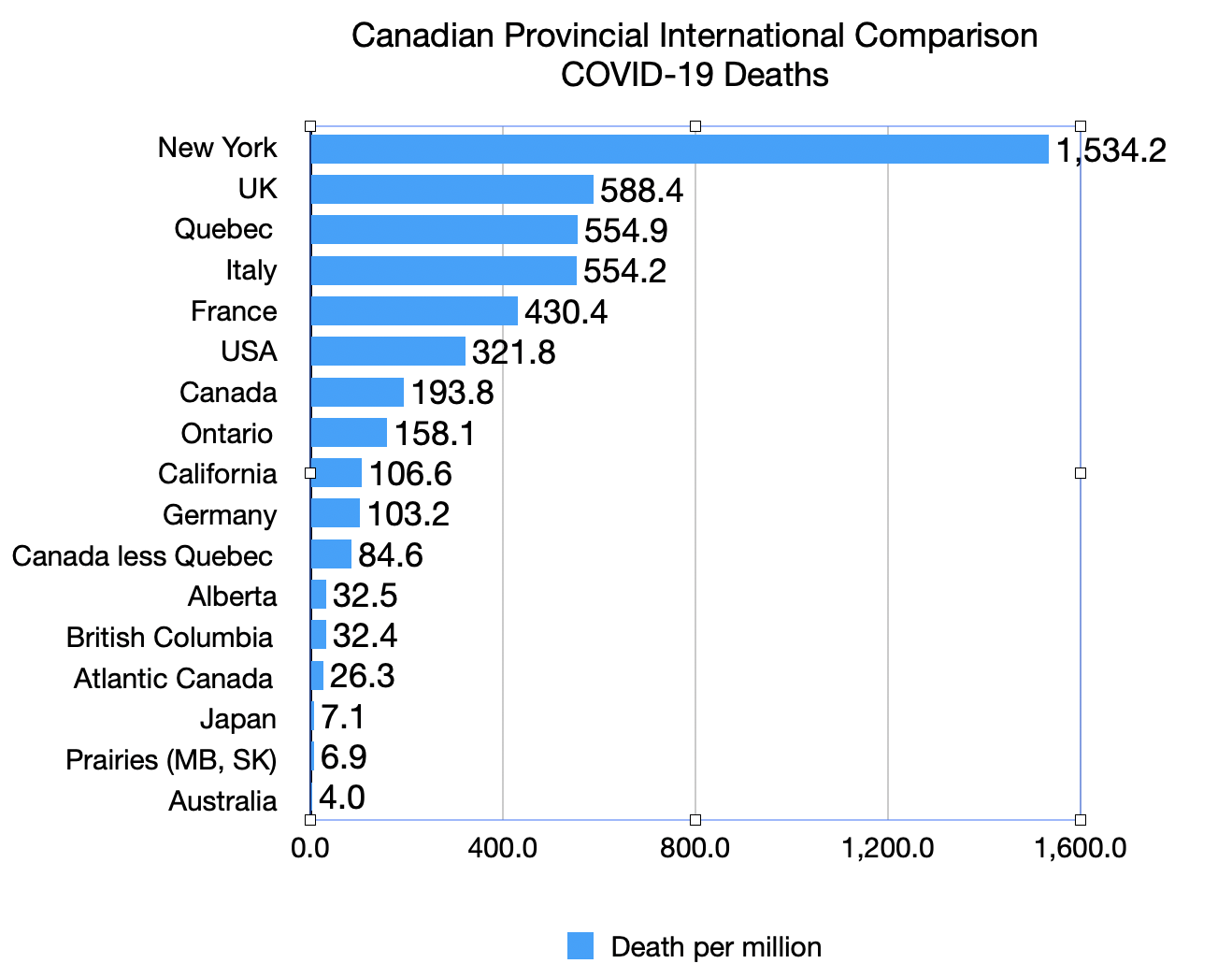
Quebec now has the third highest death rate per million:

Per Million

Jun 3

Population

Death

Infection

Death

Infection

New York 19.5 1,534.2 19,062.1

29,917

371,711

UK 66.5 588.4 4,176.5

39,127

277,738

Quebec 8.4 554.9 6,113.6

4,661

51,354

Italy 60.4 554.2 3,860.9

33,475

233,197

France 67.0 430.4 2,826.1

28,836

189,348

USA 326.7 321.8 5,544.2

105,147

1,811,277

Canada 37.8 193.8 2,426.1

7,326

91,705

Ontario 14.4 158.1 1,962.7

2,276

28,263

California 39.6 106.6 2,903.9

4,220

114,993

Germany 82.9 103.2 2,214.6

8,555

183,594

Canada less Quebec 29.3 84.6 1,288.7

2,665

40,351

Alberta 4.4 32.5 1,600.9

143

7,044

British Columbia 5.1 32.4 509.2

165

2,597

Atlantic Canada 2.4 26.3 612.9

63

1,471

Japan 126.5 7.1 133.1

900

16,834

Prairies (MB, SK) 2.6 6.9 361.9

18

941

Australia 25.2 4.0 286.5

102

7,221

‘Non-advertising’ hiring up due to feds’ new appointments policy, data shows

My latest – links below:

The new appointments policy allowing for greater flexibility in the hiring of federal public servants came into effect in April 2016, resulting in a greater number of “non-advertised” hiring compared to formal publicly advertised hiring processes and competitions.

The Public Service Commission has reported on an overall increase in non-advertised appointments to 34 per cent of hires in 2017-18 compared to 25 per cent in the previous fiscal year, reflecting the attractiveness of this easier way to staff. 2018-19 data shows a further increase to 35 per cent. Greater use of non-advertised staffing raises the potential risk of the “who you know” factor playing a greater role in hiring and this analysis aims to assess this potential risk.

Source: ‘Non-advertising’ hiring up due to feds’ new appointments policy, data shows (Hill Times)

pdf: TBS New Appointments Policy Impact, New Appointments Policy: Annex A Departmental Comparisons (clearer table than in the HT piece)

Quebec should reconsider immigration changes

On the non-competitiveness of recent Quebec changes to PEQ:

Recently announced reforms to the Quebec Experience Program should be reconsidered.

Since 2010, the Quebec Experience Program (or “PEQ” in French) has offered a fast-track to permanent residence for temporary foreign workers and international students that lived in Quebec. Such individuals could often get their Quebec Selection Certificate in around 20 business days, and then go ahead and submit their permanent residence application to the federal government.

This was excellent policy by Quebec.

Government research shows that such individuals integrate quickly into Canada’s economy and society since they are young, well-educated, speak English and French and have Canadian work experience.

In addition, it made sense for Quebec to fast-track their applications since unlike immigration candidates outside of Canada, such individuals are already here. It would be very inconvenient to have them leave Quebec when they have already established themselves in the province and are contributing to the economy as workers and consumers.

Problems with Quebec’s new work experience requirements

The province is increasing the work experience requirements that future applicants will need to obtain to become eligible for the PEQ.

Currently, a temporary foreign worker (TFW) needs 12 months of eligible Quebec work experience within the preceding 24 months of submitting their application to meet the PEQ’s criteria. Students do not need Quebec work experience to be eligible.

Quebec will now require 36 months of work experience from TFWs and between 12-24 months of work experience from foreign students (depending on their program of study in Quebec).

A benefit of the stricter PEQ criteria is it will help more Quebec Skilled Worker Program (QSWP) candidates immigrate to the province through its Arrima Portal.

Currently, highly-qualified QSWP candidates are not able to obtain permanent residence under what is a more competitive process than what PEQ applicants need to go through.

However, Quebec is now introducing stricter work experience requirements for the PEQ than what is currently in place nationally. This means it will become more difficult for foreign workers and students to obtain permanent residence in Quebec.

One may argue that this is a good thing, since those that do become immigrants (whether through the QSWP or QEP) are more likely to succeed in the province.

But, many of the foreign workers and students who are poised to succeed will be unlikely to meet the high bar that Quebec has set.

It is quite normal across Canada for federal and provincial programs to have work experience requirements in place for existing TFWs and international students that want to transition to permanent residence. However, typically, the Canadian work experience requirement is set at 12 months. Whether Quebec likes it or not, it is in competition with other provinces to attract and retain global talent.

If I am a province that is offering the same product (in this case, Canadian permanent resident status), what is the incentive for a prospective immigrant to go through more hurdles when neighbouring provinces offer that product at a much lower cost? (i.e., only 12 months of work experience required versus 24-36 months for TFWs and some international students in Quebec).

Quebec’s higher standards will disincentivize TFWs and students from choosing Quebec.

Such individuals will either choose to go to other provinces at the start of their Canadian immigration journey, or will leave Quebec and move to another province when they are ready to apply for permanent residence.

Even if an individual is motivated to remain in Quebec, it may prove difficult for them to obtain the work experience they may need to be eligible for the PEQ.

For instance, some TFWs such as International Exchange Canada participants have work permits that are valid for no more than two years. Employers may not be willing spend the time and money required to petition the government to provide such individuals with one or more work permits (e.g., a work permit that requires a Labour Market Impact Assessment or “LMIA”).

One other point on this front: in the short run, it will become even more challenging for candidates to meet the new work experience requirements due to the economic damage that is being caused by the coronavirus pandemic. 

New processing standard is also problematic

Quebec indicated that it will now seek to process PEQ applications within 6 months, rather than 20 business days, in order to harmonize its processing standard with the Quebec Skilled Worker Program.

Once again, Quebec is hurting its competitiveness since the quicker processing standard was one of the PEQ’s major selling points. Now, prospective immigration candidates may look to options outside of the province given that there will no longer be a significant advantage to applying to the PEQ.

Keep in mind that it was already taking nearly 23 months for PEQ candidates to obtain permanent residence (20 business days to get a Quebec Selection Certificate plus another 22 months for the federal government to process permanent residence applications).

Adding another fives months on top of that is unwise on its own, and even more so when you consider that successful Express Entry candidates are usually able to get permanent residence within six months.

A better solution would have been to identify how to reduce the length of time it takes Quebec to issue CSQs to QSWP candidates.

Changes come at a time when Quebec will need more immigration

No immigration program is perfect, and it is a good practice for Canada’s federal and provincial governments to seek reforms to their programs to help meet the country’s evolving economic and social needs.

However, not all reforms end up being beneficial.

In this case, time will likely prove that Quebec’s reforms are misplaced. By discouraging workers and students from remaining in the province due to uncompetitive work experience requirements and processing times, Quebec may end up with even lower immigration levels at a time when it will need higher immigration in the years to come due to its aging population and low birth rate.

This may be hard to fathom at the moment due to the COVID-19 crisis.

But, the crisis will eventually pass and Quebec will soon need more immigrants to complement its Quebec-born work force.

What better way of doing so, then by providing a fast-track to immigration for the workers and students that have already resided in Quebec and contributed for several years?

Source: Quebec should reconsider immigration changes

Facebook Employees Revolt Over Zuckerberg’s Hands-Off Approach To Trump, Twitter contrast

Needed backlash at what can only be described as business-motivated collusion, one that becomes harder and harder to justify from any perspective:

Facebook is facing an unusually public backlash from its employees over the company’s handling of President Trump’s inflammatory posts about protests in the police killing of George Floyd, an unarmed black man in Minneapolis.

At least a dozen employees, some in senior positions, have openly condemned Facebook’s lack of action on the president’s posts and CEO Mark Zuckerberg’s defense of that decision. Some employees staged a virtual walkout Monday.

“Mark is wrong, and I will endeavor in the loudest possible way to change his mind,” tweeted Ryan Freitas, director of product design for Facebook’s news feed.

“I work at Facebook and I am not proud of how we’re showing up,” tweeted Jason Toff, director of product management. “The majority of coworkers I’ve spoken to feel the same way. We are making our voice heard.”

The social network also is under intense pressure from civil rights groups, Democrats and the public over its decision to leave up posts from the president that critics say violate Facebook’s rules against inciting violence. These included a post last week about the protests in which the president said, “when the looting starts, the shooting starts.

Twitter, in contrast, put a warning label on a tweet in which the president said the same thing, saying it violated rules against glorifying violence.

The move escalated a feud with the president that started when the company put fact-checking labels on two of his tweets earlier in the week. Trump retaliated by signing an executive order that attempts to strip online platforms of long-held legal protections.

Zuckerberg has long said he believes the company should not police what politicians say on its platform, arguing that political speech is already highly scrutinized. In a postFriday, the Facebook CEO said he had “been struggling with how to respond” to Trump’s posts.

“Personally, I have a visceral negative reaction to this kind of divisive and inflammatory rhetoric,” he wrote. “I know many people are upset that we’ve left the President’s posts up, but our position is that we should enable as much expression as possible unless it will cause imminent risk of specific harms or dangers spelled out in clear policies.”

Zuckerberg said Facebook had examined the post and decided to leave it up because “we think people need to know if the government is planning to deploy force.” He added that the company had been in touch with the White House to explain its policies. Zuckerberg spoke with Trump by phone Friday, according to a report published by Axios.

While Facebook’s 48,000 employees often debate policies and actions within the company, it is unusual for staff to take that criticism public. But the decision not to remove Trump’s posts has caused significant distress within the company, which is spilling over into public view.

“Censoring information that might help people see the complete picture *is* wrong. But giving a platform to incite violence and spread disinformation is unacceptable, regardless who you are or if it’s newsworthy,” tweeted Andrew Crow, head of design for the company’s Portal devices. “I disagree with Mark’s position and will work to make change happen.”

Several employees said on Twitter they were joining Monday’s walkout.

“Facebook’s recent decision to not act on posts that incite violence ignores other options to keep our community safe,” tweeted Sara Zhang, a product designer.

In a statement, Facebook spokesman Joe Osborne said: “We recognize the pain many of our people are feeling right now, especially our Black community. We encourage employees to speak openly when they disagree with leadership. As we face additional difficult decisions around content ahead, we’ll continue seeking their honest feedback.”

Less than 4% of Facebook’s U.S.-based staff are African American, according to the company’s most recent diversity report.

Facebook will not make employees participating in the walkout use paid time off, and it will not discipline those who participate.

On Sunday, Zuckerberg said the company would commit $10 million to groups working on racial justice. “I know Facebook needs to do more to support equality and safety for the Black community through our platforms,” he wrote.

Source: Facebook Employees Revolt Over Zuckerberg’s Hands-Off Approach To Trump

And Kara Swisher’s call for Twitter to take Trump off the platform:

C’mon, @Jack. You can do it.

Throw on some Kendrick Lamar and get your head in the right space. Pour yourself a big old glass of salt juice. Draw an ice bath and fire up the cryotherapy pod and the infrared sauna. Then just pull the plug on him. You know you want to.

You could answer the existential question of whether @realDonaldTrump even exists if he doesn’t exist on Twitter. I tweet, therefore I am. Dorsey meets Descartes.

All it would take is one sweet click to force the greatest troll in the history of the internet to meet his maker. Maybe he just disappears in an orange cloud of smoke, screaming, “I’m melllllllting.”

Do Trump — and the world — a favor and send him back into the void whence he came. And then go have some fun: Meditate and fast for days on end!

Our country is going through biological, economic and societal convulsions. We can’t trust the powerful forces in this nation to tell us the truth or do the right thing. In fact, not only can we not trust them. We have every reason to believe they’re gunning for us.

In Washington, the Trump administration’s deception about the virus was lethal. On Wall Street and in Silicon Valley, the fat cats who carved up the country, drained us dry and left us with no safety net profiteered off the virus. In Minneapolis, the barbaric death of George Floyd after a police officer knelt on him for almost nine minutes showed yet again that black Americans have everything to fear from some who are charged with protecting them.

As if that weren’t enough, from the slough of our despond, we have to watch Donald Trump duke it out with the lords of the cloud in a contest to see who can destroy our democracy faster.

I wish I could go along with those who say this dark period of American life will ultimately make us nicer and simpler and more contemplative. How can that happen when the whole culture has been re-engineered to put us at each other’s throats?

Trump constantly torques up the tribal friction and cruelty, even as Twitter and Facebook refine their systems to ratchet up rage. It is amazing that a septuagenarian became the greatest exploiter of social media. Trump and Twitter were a match made in hell.

The Wall Street Journal had a chilling report a few days ago that Facebook’s own research in 2018 revealed that “our algorithms exploit the human brain’s attraction to divisiveness. If left unchecked,” Facebook would feed users “more and more divisive content in an effort to gain user attention & increase time on the platform.”

Mark Zuckerberg shelved the research.

Why not just let all the bots trying to undermine our elections and spreading false information about the coronavirus and right-wing conspiracy theories and smear campaigns run amok? Sure, we’re weakening our society, but the weird, infantile maniacs running Silicon Valley must be allowed to rake in more billions and finish their mission of creating a giant cyberorganism of people, one huge and lucrative ball of rage.

“The shareholders of Facebook decided, ‘If you can increase my stock tenfold, we can put up with a lot of rage and hate,’” says Scott Galloway, professor of marketing at New York University’s Stern School of Business.

“These platforms have very dangerous profit motives. When you monetize rage at such an exponential rate, it’s bad for the world. These guys don’t look left or right; they just look down. They’re willing to promote white nationalism if there’s money in it. The rise of social media will be seen as directly correlating to the decline of Western civilization.”

Dorsey, who has more leeway because his stock isn’t as valuable as Facebook’s, made some mild moves against the president who has been spewing lies and inciting violence on Twitter for years. He added footnotes clarifying false Trump tweets about mail-in ballots and put a warning label on the president’s tweet about the Minneapolis riots that echo the language of a Miami police chief in 1967 and segregationist George Wallace: “When the looting starts, the shooting starts.”

“Jack is really sincerely trying to find something to make it better,” said one friend of the Twitter chief’s. “He’s like somebody trapped in a maze, going down every hallway and turning every corner.”

Zuckerberg, on the other hand, went on Fox to report that he was happy to continue enabling the Emperor of Chaos, noting that he did not think Facebook should be “the arbiter of truth of everything that people say online.”

It was a sickening display that made even some loyal Facebook staffers queasy. As The Verge’s Casey Newton reported, some employees objected to the company’s rationale in internal posts.

“I have to say I am finding the contortions we have to go through incredibly hard to stomach,” one wrote. “All this points to a very high risk of a violent escalation and civil unrest in November and if we fail the test case here, history will not judge us kindly.”

Trump, furious that Dorsey would attempt to rein him in on the very platform that catapulted him into the White House, immediately decided to try to rein in Dorsey.

He signed an executive order that might strip liability protection from social media sites, which would mean they would have to more assiduously police false and defamatory posts. Now that social media sites are behemoths, Galloway thinks that the removal of the Communications Decency Act makes a lot of sense even if the president is trying to do it for the wrong reasons.

Trump does not seem to realize, however, that he’s removing his own protection. He huffs and puffs about freedom of speech when he really wants the freedom to be vile. “It’s the mother of all cutting-off-your-nose-to-spite-your-face moves,” says Galloway.

The president wants to say things on Twitter that he will not be allowed to say if he exerts this control over Twitter. In a sense, it’s Trump versus his own brain. If Twitter can be sued for what people say on it, how can Trump continue to torment? Wouldn’t thousands of his own tweets have to be deleted?

“He’d be the equivalent of a slippery floor at a store that sells equipment for hip replacements,” says Galloway, who also posits that, in our hyper-politicized world, this will turn Twitter into a Democratic site and Facebook into a Republican one.

Nancy Pelosi, whose district encompasses Twitter, said that it did little good for Dorsey to put up a few fact-checks while letting Trump’s rants about murder and other “misrepresentations” stay up.

“Facebook, all of them, they are all about making money,” the speaker said. “Their business model is to make money at the expense of the truth and the facts.” She crisply concluded that “all they want is to not pay taxes; they got their tax break in 2017” and “they don’t want to be regulated, so they pander to the White House.”

C’mon, Jack. Make @realDonaldTrump melt to help end our meltdown.

Source: Think Outside the Box, Jack


China could keep dual citizenship Canadians from leaving Hong Kong amid protests: lawyer

Legitimate worry:

A Canadian legal activist is warning the federal government to grant asylum to democracy activists in Hong Kong and expanded settlement to those with links to Canada before China prevents them from leaving.

The warning came Monday from Avvy Go, the director of the Chinese and Southeast Asian Legal Clinic, which has already helped bring Hong Kong pro-democracy activists to Canada.

There are 300,000 Canadians of Hong Kong descent in China, and Go says if Ottawa doesn’t act now to accommodate those who want to leave, Beijing will prevent them from leaving in the future.

“The time to act is now. As China continues to crack down on the democracy movement in Hong Kong, it may soon find ways to prohibit Hong Kong activists from leaving that city, period,” Go said Monday at a joint video press conference hosted by Amnesty International.

“Even with those who are Canadian citizens, China may refuse to recognize their dual citizenship status and deny their exit from Hong Kong.”

MPs from the four major Canadian political parties and one independent senator stood in solidarity with the proposals Go put forward at a virtual press conference convened by Amnesty International.

Canada, along with the United States, Britain and Australia, have condemned Beijing’s imposition of a new national security law that they say violates Hong Kong’s freedom from Chinese communist interference.

“This is the Beijing government’s most breathtaking, threatening and callous attack yet … discarding any pretence of fulfilling China’s international promises made when Hong Kong was handed over in 1997,” said Alex Neve, the secretary general of Amnesty’s Canadian branch.

Go called on the federal government to implement several immigration and asylum measures, to help people get out of Hong Kong before it is too late. They are:

— Expediting family sponsorship applications by Canadians with spouses and parents in Hong Kong.

— Expanding family-reunification sponsorship programs beyond parents and spouses.

— Issuing more temporary-resident permits, work visas and student visas.

— Granting refugee status to democracy advocates, and offering them stepped-up resettlement options.

Last year, Hong Kong residents took to the streets in mass protests against a proposed extradition law from Beijing that was eventually abandoned.

During that unrest, Go’s clinic received requests from Canadians of Hong Kong descent whose relatives participated in pro-democracy protests, she said.

Since Beijing announced the new security law, the clinic is getting calls from Canadians who are worried about their families even though they may not have been involved with the democracy movement, said Go.

“These are our people. And as parliamentarians dedicated to promoting and protecting democracy, we cannot stand by silently. I endorse all of the actions,” said Independent Sen. Marilou McPhedran.

McPhedran said she has travelled across Africa and seen the effect of China’s massive development spending, an influence-buying effort that many analysts say is a power play by Beijing’s ruling communist party.

“The weaponization of economic support is something that we need to understand better as we look at what is happening in Hong Kong,” said McPhedran.

“The violation of the Hong Kong Basic Law, which is the essence of what China is saying it is going to do, is in fact a precursor to threats to democracies in many other countries as well.”

Conservative MP Kenny Chiu, who was born in Hong Kong, said the people of his homeland respect human rights and the rule of law, and they are prepared to commemorate Thursday’s anniversary of the Tiananmen Square massacre that saw the Chinese army kill scores of pro-democracy student protesters in 1989.

“We’re witnessing in Hong Kong basic dictatorship in disguise, exerting its power out of fear for these values,” said Chiu.

Source: China could keep dual citizenship Canadians from leaving Hong Kong amid protests: lawyer

NDP calls for race-based data collection to combat racism, spur change

Valid call. Will see whether the government’s Centre for Gender, Diversity and Inclusion Statistics within Statistics Canada starts to generate results and in which areas:

NDP Leader Jagmeet Singh says the federal government must start collecting race-based data in order to make policy changes that will start to turn the tide on what the United Nations has called the “deplorable” treatment of African Canadians.

Protests against the police-killing of George Floyd in the U.S. spilled into Canada last weekend and Toronto was seized by the death of Regis Korchinski-Paquet, who fell from a 24th-floor Toronto apartment while police were in the home. Her death is under investigation by the province’s police watchdog.

On Monday, Canada’s political leaders tried to address the growing outrage. Mr. Singh proposed firm steps to address anti-black racism in Canada, while Prime Minister Justin Trudeau promised his government would do more but didn’t outline specific steps or a timeline to act. Conservative Leader Andrew Scheer proposed no new policies but said all levels of government have “much more to do.”

In contrast to protests south of the border, violence at Canadian demonstrations was limited to Montreal, where 11 people were arrested after dozens of businesses were damaged at the tail end of the formal march, which took place without incident.

Mr. Trudeau promised to “keep taking meaningful action to fight racism and discrimination in every form.” That progress in Canada has been too slow though, according to a 2017 United Nations Human Rights Council report on anti-black racism.

Across Canada, the report found disproportionately high unemployment rates for African Canadians, leading to more precarious and low-paid work, and worse health outcomes, where people in black communities are less likely to access health care services and more likely to suffer from chronic health conditions. In Nova Scotia, it found “deplorable” socioeconomic conditions and no change in educational inequities, 30 years after schools were integrated.

While federal leaders acknowledged the persistence of racism and systemic discrimination in Canada, Quebec Premier François Legault denied that it stems from structural problems.

“All humans are equal, are all the same, regardless of the colour of their skin,” Mr. Legault said. The UN report found African Canadians in Montreal have the highest poverty rates among visible minorities in the city.

The UN report recommended a mandatory nationwide policy on the collection of data disaggregated by race, colour, ethnic background, national origin and other identities “to determine if and where racial disparities exist for African Canadians so as to address them accordingly.”

That hasn’t yet happened and without it Canada is missing critical information that countries like the United States have readily available, said Arjumand Siddiqi, Canada Research Chair in population health equity. For example, Canada does not have information about how employment statistics break down along racial lines, making it difficult to know if some groups are being excluded from the suite of financial aid the Liberals have rolled out in the wake of the economic shutdown sparked by COVID-19.

While race-based data is collected in the census every five years, there is no routine collection of data, and on top of that, the data that is collected is not readily available, said Prof. Siddiqi, who is also an associate professor at the University of Toronto’s Dalla Lana School of Public Health.

The difference between the data available in the U.S. and Canada is “night and day,” she said. Without that data, evidence-based policy changes are stymied and it’s harder to hold governments to account.

The failure to collect the valuable data comes even as the impact of having the information is clear, Mr. Singh said, noting that changes to police carding were only made when numbers laid bare that the practice disproportionately targeted black and Indigenous people.

He said the data collection would help spur systemic changes in policing, the justice system and to inequities in health care, education, housing and employment, which “perpetuates the undervaluing of black life, of racialized people’s lives.”

The Liberals funded a new Centre for Gender, Diversity and Inclusion Statistics within Statistics Canada in 2018. A spokesperson for Innovation, Science and Industry Minister Navdeep Bains did not explain why a separate centre was created rather than integrating it with all of the work done by the federal agency.

Evidence from other countries and small pockets of information in Canada show that poorer people and people of colour are being hit harder by the novel coronavirus. But the Prime Minister acknowledged that collecting that information widely in Canada is an uphill battle, given that at the moment the government doesn’t even have the age data for a “large portion” of the people diagnosed with COVID-19.

Mr. Singh also said he supported the use of body cameras for police officers to ensure accountability and said police need more training in how to de-escalate incidents.

The UN report released a long list of recommendations to the federal government, which included apologizing for Canada’s history of slavery and other historical injustices, as well as considering paying reparations. The federal government on Monday did not say whether it was going to accept either of those recommendations.

Source:    NDP calls for race-based data collection to combat racism, spur change NDP Leader Jagmeet Singh echoed the call made in a 2017 UN Human Rights Council report on anti-black racism in Canada <img src=”https://www.theglobeandmail.com/resizer/06BMxG3XANkkpiQPUyh4FRZLZTY=/0x0:3600×2400/740×0/filters:quality(80)/cloudfront-us-east-1.images.arcpublishing.com/tgam/OV42UZ73E5JO7BMPP6YND6GQ3I.jpg” alt=””>     

Chris Cooper Is My Brother. Here’s Why I Posted His Video and Masai Ujiri: To overcome racism, we must raise our voices

There are so many thoughtful commentaries on anti-black racism given the number of violent and potentially violent incidents. Two of my favourites are this one, by Melanie Cooper the sister of Chris Cooper who was threatened in Central Park and the one below by Masai Ujiri, President of the Toronto Raptors

I grew up in a family of activists and my parents were teachers. They raised me and my brother, Chris, to never shy from fighting injustice. From police brutality, to the war in Iraq, to climate change, we’ve lifted our voices in protest. So when I saw Chris’s video of his recent encounter with a white woman named Amy Cooper (no relation) in New York’s Central Park, it was surreal that he had captured on his cellphone the kind of racism we had always railed against. All of a sudden, I became one of the hundreds of black women who have watched a video of a loved one being accosted.

Fortunately for Chris, the situation remained verbal. For far too many black families, the result has been fatal; I do not watch those videos. I consider them an extended form of terrorism against the black community. I refuse to subject myself to the psychic, spiritual and emotional pain of watching them. With my brother, I got to see a black man survive what could have become a deadly situation. That was a relief and a cause for celebration for millions of people.

But as I replayed the video several times, I felt more and more uneasy and angry, until an overwhelming fear swept over me. My mind conjured up rapid images of police officers arriving and shooting first, or throwing Chris down and then beating and choking him. My brother. When I posted the video on Twitter, I didn’t yet know about George Floyd, whose killing last Monday by a police officer has prompted protests across the country, but I knew about Emmett Till. I knew I wanted to make sure that Amy Cooper would not have the chance to weaponize her racism against anyone else. She could have gotten my brother hurt or killed. I wanted my brother’s calm bravery, in the face of a threatening and cowardly act, to be seen. I wanted to shine a light not just on one person, but on the systemic problem of deep racism in this country that encourages her kind of behavior.

Racism affects all black people — men, women, boys, girls, gay, straight, nonbinary — no matter their state of employment or where or if they went to college. I have no doubt that if the police had showed up in the Ramble, a wooded area of the park where Chris had gone bird watching, my brother’s Ivy League degree and impressive résumé would not have protected him. Yet the Good Negro narrative has long allowed white people to feel comfortable speaking out against the mistreatment of particular black people: “He is just like us.” “She is a good one.” Every black person subjected to this kind of hatred needs recognition, justice and support.

I asked my brother for permission to post the video on Twitter, and I didn’t expect more than 100 responses since it was Memorial Day. I was shocked it struck such a chord. The post has now garnered more than 40 million views and hundreds of thousands of likes from all over the world. In the responses, I saw anger and calls for social action, as well as expressions of joy that my brother had not been harmed, at least not physically.

When I’ve checked in with him over the past few days as we’ve fielded interviews and messages, I’ve asked “Are you, OK? How are you feeling?” Because even though he walked away, and even though I’m relieved, there still has been a toll. We felt it even before the incident with Amy Cooper. Every time we walk out of our door, we have cause to worry. My brother worries when he sneaks through the trees to catch a glimpse of a beautiful warbler. I worry when I check in late to an Airbnb, and every time my son gets in the car. Others wonder if a trip to the corner store or gas station might result in a phone call that will end their lives. So many of us in cities and towns across America are done with having to wonder if we’ll be put at risk by our mere existence.

While my brother and I condemn the death threats that have been made against Amy Cooper, demanding some form of accountability is one of the few ways we can create a deterrent that can lead to real change.

We live in a country where a white person breaking rules feels confident and comfortable calling the police to threaten a black person doing nothing wrong. This has to stop, whether through more discussion to raise awareness of the issue, or better enforcement of laws against false 911 reports.

Lots of people keep asking me what they can do. We all have a chance to step off the sidelines, to speak up, to take action and to shine a blinding light on the racism lurking in so many corners of our society. We need to fight together wisely, boldly and unflinchingly, while staying aware that our passion and actions can and will be used against us. But we must not stop. This is the time. It will not be easy. It will often be messy, but it must be done.

Australia’s stalled migrant boom derails golden economic run

Although there are important differences between the two countries there are also some uncomfortable similarities with Canada, as we have also relied on immigration for continued economic growth, overall GDP not necessarily GDP per capita;

Australia’s three decades of uninterrupted prosperity are coming to an abrupt end as the global coronavirus pandemic crashes one of its most lucrative sources of income – immigration.

The country has been successful in managing the outbreak and reopening its A$2 trillion (US$1.33 trillion) economy, thanks in part to an early closure of its borders.

But the policy has led to a halt in mass immigration – a key source of consumer demand, labour and growth – in an economy which is facing its first recession since the early 1990s.

Net immigration, including international students and those on skilled worker visas, is expected to fall 85 per cent in the fiscal year to June 2021, curbing demand for everything from cars and property to education and wedding rings.

Gurmeet Tuli, who owns a jewellery store in the Sydney suburb of Parramatta, said his business is already hurting in a neighbourhood which is home to tens of thousands of migrants.

“My main clientele is young people who come here to study, they find work here and settle down, fall in love and want to get married,” Tuli said.

“I have not sold a single diamond ring in the past two months,” he added, noting business is down about 40 per cent so far this year.

So critical is migration to Australia that analysts reckon the economy would have slipped into a recession last year without new arrivals to boost population growth.

AMP Capital Chief Economist Shane Oliver estimates that population growth in recent years has boosted the economy by about one percentage point per year.

But as migration stalls, education, housing and tourism sectors are seen among the worst hit.

The drought in international student arrivals, who in recent years made up about 40 per cent of the migrant intake, is expected to hit the A$37 billion education sector, Australia’s second largest services export after tourism.

A fall in new arrivals could also dampen the construction boom in Australia’s all important housing sector, which has been fuelled by migrants in big cities like Sydney and Melbourne.

“REAL IMPACT”

Even though immigration is a politically divisive topic in Australia, there is a broad recognition that the country needs its 200,000 to 300,000 annual intake to grow consumption demand and fill skills shortages in various sectors.

While a large share of these migrants arrive on what are considered “temporary” visas, many later gain permanent residency and employment, adding to long-term population growth.

Australia’s population would grow an average 1.6 per cent annually over the decade to 2027, according to the latest official projections from 2018. Without immigration, it was forecast to grow only 0.5 per cent.

“During a slowdown and when the unemployment rate is high there is popular pressure to slow down migration,” said AMP Capital’s Oliver. “But if we want the economy working back again, we need migration to return.”

Concerns over immigration range from sustainability and housing affordability to more populist complaints about social integration and foreigners taking local jobs.

Prime Minister Scott Morrison said last week Australia needed 160,000 to 210,000 arrivals to sustain GDP per capita growth, and acknowledged the great uncertainty current restrictions cast over the outlook.

“It’s going to be one of the real impacts of this crisis because our borders aren’t opening anytime soon,” he said.

SAFE BUBBLE

That has prompted urgent calls for solutions from some businesses and political leaders.

The premier of New South Wales, Gladys Berejiklian, is lobbying her federal counterparts to allow international students in to rescue universities, which contribute A$13 billion to the economy of the country’s most populous state.

Australia’s government is also working with New Zealand to establish a “Trans-Tasman bubble” that would re-open the movement of people between the two closely integrated economies.

New Zealand is a large source of labour for Australia, home to about 600,000 kiwi expatriates.

To be sure, Australia still enjoys its “lucky country” status, benefiting from resilient global demand for some commodities and having been able to re-open large parts of the economy sooner than many other advanced economies..

But even though Australia’s central bank expects the economy to expand 6 per cent next year after a projected 6 per cent contraction in 2020, analysts and businesses warn a sustained recovery is unlikely without the full resumption of immigration.

Over the years, immigration has helped transform Australia’s retail and urban landscape, reviving down-at-heel suburban high streets, spurring swanky commercial property development and creating new consumer markets.

Gotcha Fresh Tea is one of a host of bubble tea franchises that has expanded rapidly in Australia, with demand fuelled in large part by international students but also by growing interest for the Asian tapioca beverage from the wider community.

Orlando Sanpo, business development manager at EFC Group Australia, the chain’s franchisor, said the student freeze has hit sales by up to 80 per cent in some downtown stores and even closed an outlet at a Sydney campus.

“We need people to come back to the country,” Sanpo said.

Source: Australia’s stalled migrant boom derails golden economic run

Munich bans use of Nazi ‘Jewish star’ at coronavirus protests

Sad that it has had to come to this:

The city of Munich banned the use of Nazi-era Stars of David at coronavirus protests on Sunday after participants were seen wearing them in recent weeks.

Several protesters in cities across Germany have started wearing six pointed, yellow stars with the word “unvaccinated” emblazoned on them. From the color to the font, they’re nearly identical to the badges Jewish people were forced to wear across Nazi-occupied territories during the Holocaust.

Read moreHow are Germany’s coronavirus protests different?

Other anti-lockdown protesters have also dressed up in stripped prisoner uniforms — drawing comparison to concentration camp prisoners — and held up signs reading: “Masks will set you free” or “Vaccination will set you free.”

The slogans reference the “Arbeit macht frei” (“Work will set you free”) signs that hung above several concentration camps, where millions of Jews were killed during the Holocaust.

Demonstrators are using the highly questionable protest tactics to voice their opposition to mandatory coronavirus vaccines — despite the fact that the German government has repeatedly said it will not implement such a program.

Politicians slam anti-Semitic tactic

Felix Klein, Germany’s commissioner for the fight against anti-Semitism, said that wearing the altered Jewish stars was a “calculated breaking of a taboo,” reported local public broadcaster Bayerische Rundfunk.

The tactic has been used increasingly in protests in Germany, Klein said. In using symbols of the Holocaust to provoke at protests, he added, the demonstrators downplay the victims and their suffering.

Other politicians have called for more cities and states to also ban the use of Nazi-era stars at protests and to label them as a form of incitement.

Rüdiger Erben, a Social Democrat lawmaker in the state parliament of Saxony-Anhalt, said that the symbols have also appeared at protests in his state and that they have nothing to do with freedom of speech or freedom of assembly.

Whoever puts on one of the stars is acting “as an anti-Semite of the most repulsive kind,” Erben told news agency epd.

Protesters have been gathering for weeks in cities across Germany to demonstrate against the government’s restrictions to stem the spread of COVID-19.

Although participant numbers are starting to dwindle, politicians and analysts have grown increasingly concerned about right-wing extremist radicalization at the demonstrations.

Source: Munich bans use of Nazi ‘Jewish star’ at coronavirus protests

Inside Trump’s Immigration Order To Restrict Chinese Students

Reading this interview, one has the impression that this is more virtue signalling to the base rather than addressing legitimate security concerns, like so many of the Miller/Trump immigration policies:

On May 29, 2020, Donald Trump issued a presidential proclamation aimed at restricting the entry of graduate students and researchers from China. It is the latest immigration action to make it more difficult for foreign-born individuals to live, work or study in the United States.

In the 2018-19 academic year, there were 272,470 undergraduate and graduate students from China enrolled at U.S. universities, 84,480 of whom were in a graduate-level science and engineering program, according to the Department of Homeland Security. China is the number one source of international students to the United States.

To better understand the new policy and its implications, I interviewed Jeffrey Gorsky, senior counsel at Berry Appleman & Leiden LLP and former Chief of the Legal Advisory Opinion section of the Visa Office in the U.S. Department of State.

Jeffrey Gorsky: The proclamation bars the entry of or the issuance of visas to Chinese students to the United States who are in “F” or “J” status in graduate-level programs and who are or had been associated with PRC (People’s Republic of China) entities involved with the PRC’s “military-civil fusion strategy.” The proclamation defines that strategy as “actions by or at the behest of the PRC to acquire and divert foreign technologies, specifically critical and emerging technologies, to incorporate into and advance the PRC’s military capabilities.”

The proclamation also calls on the State Department to consider using its visa revocation authority to revoke previously issued visas in this category and directs the State Department and Department of Homeland Security (DHS) in the next 60 days to review possible immigration measures for other immigrant and non-immigrant visa classifications to deal with this issue.

The proclamation, which applies to persons in graduate-level programs, does not indicate whether the restrictions will apply to students seeking to enter the United States to work under post-graduation Optional Practical Training (OPT).

The most significant portion of this proclamation may be the part calling on the State Department to consider revoking visas. The State Department has practically unlimited legal authority to revoke a visa – the law says the Secretary of State may revoke a visa in his discretion at any time. The State Department will often revoke a visa if there is any concern about immigration eligibility, requiring the affected person to reapply so that the case can be fully vetted. The State Department may now follow up with widespread revocation notices, which will not affect people in the U.S. but would bar students outside the U.S. from returning until they receive a new visa.

Anderson: What should a Chinese student inside the United States do if they or their institution receive a notice that a visa has been revoked?

Gorsky: A visa revocation will prevent the student from traveling into the United States but will not have any effect on the student’s legal immigration status in the U.S. When students are admitted into the United States, they are given at the border a legal authorization to remain so long as they properly maintain their student status. Students are normally admitted at a port of entry for “duration of status.”

A visa is a travel document – it allows them to travel and apply to enter the United States, and is only for travel. If an individual’s visa is revoked, then he or she cannot travel back to the United States, but the authorization the individual received when first entering the country is not affected by the visa revocation as long as the person maintains student status. Although in theory a visa revocation can be used as the basis to put someone in removal proceedings, that authority is rarely used because it can be challenged in court.

Anderson: What is the best advice for current Chinese students and researchers who are already in the United States?

Gorsky: As long as the students remain in the U.S. in valid student status they should not be affected by the revocation even if the student receives a revocation notice.

Anderson: What do you think will be the practical impact of this policy on Chinese graduate students who apply for visas?

Gorsky: For students in valid status in the United States this will have little practical impact if they do not leave the country, for the reasons discussed earlier related to duration of status.

For those outside the country, if you are a graduate student from China currently not in the United States, at present (and this is not related to the new proclamation) you cannot apply for a visa now because visa processing has been suspended worldwide due to Covid-19 concerns.

Anderson: Once visa processing resumes, if the presidential proclamation remains in effect, what could a graduate student from China attempting to obtain a new visa to study in a science or engineering program in the United States expect?

Gorsky: The State Department has not issued guidance on how it will implement the new restrictions. It is likely consular officers will deny at the time of the interview those applications they determine meet the criteria cited in the proclamation and put any other questionable but not clearly deniable case into “administrative processing” while the case is sent for interagency clearance.

This will likely result in a significantly higher denial rate as well as more processing delays as the additional cases sent in for clearance clog up the interagency clearance system. Given the strict time frames of academic semesters, even delays in processing could effectively preclude students from beginning (or continuing) an academic program.

Anderson: In June 2018, the State Department started limiting the validity of student visas for Chinese nationals in graduate programs in what the department defined as sensitive subjects to one year, as opposed to the normal five-year validity. How does this new proclamation differ from existing U.S. visa policy?

Gorsky: This will be a much blunter tool than the current policy. There has been a longstanding procedure in place to vet and screen out students who present concerns about the transfer of sensitive technology.

U.S. immigration law contains a provision that renders ineligible for a visa or admission to the United States any alien who a consular or immigration officer knows or has reason to believe seeks to enter the United States to engage solely, principally or incidentally in any activity that violates or evades any law prohibiting the export from the United States of goods, technology or sensitive information. The State Department has an interagency clearance program in place called the “MANTIS” clearance process to determine whether students are involved in programs related to the Technology Alert List (TAL).

The broader language of the proclamation, which applies even to students who had minor and decades-old associations with PRC entities, could affect students who would otherwise be cleared in the MANTIS process and unnecessarily restrict access to the United States of talented students who make important contributions to U.S. academic institutions and America as a whole.

Anderson: What authority did the president use to issue the proclamation?

Gorsky: The president relied on his authority under section 212(f) of the Immigration and Nationality Act (INA), which authorizes him to bar the entry of foreign nationals by proclamation upon a finding that their entry would be detrimental to U.S. interests, and similar authority under INA section 215(a). It is the same authority that he has used for multiple travel bans. This administration’s extensive use of the 212(f) authority, which has existed since 1952 (similar authorities date back to the Alien Enemies Act of 1798), is unprecedented.

Anderson: Do you expect the proclamation to have an impact on U.S. universities and employers?

Gorsky: The impact will be somewhat limited in that it will not affect current students. The worldwide suspension of visa processing remains in effect, and it is not clear whether the State Department will resume processing in time to bring in new students in general. If visa processing is resumed, this will have a significant impact on the entry of new graduate students from China.

Anderson: Do you think by blocking some number of Chinese graduate students this proclamation will protect U.S.-made technology or, as some critics say, be more likely to harm efforts in America to innovate and produce important research?

Gorsky: There is already a longstanding program in place to vet potential students based on concerns over the transfer of sensitive technologies. This proclamation will exclude persons from the United States based on past or minor associations with PRC entities even if the individuals pass the interagency clearance process.

The proclamation will damage the exchange of knowledge and talent. It may inhibit the ability of the PRC to access some technology that may have military implications but the Chinese military will have other sources in other countries. America will lose out on a valuable talent pool and the financial and scientific contributions these students make to U.S. universities and the United States.
Source: Inside Trump’s Immigration Order To Restrict Chinese Students