Has Brexit affected the way Britons think about immigrants? The recent ‘national mood’ on immigration

Interesting analysis of immigration-related public opinion data and Brexit:

Back in 2018, I wrote a piece showing how British public opinion on immigration had changed since the 1980s by analysing responses across waves of repeated, high-quality research surveys carried out in Britain. Then, the research showed that British opinions toward immigrants and immigration had been softening dramatically over the last decade since a peak in public hostility around 2010.

Recently I was able to update this information with a plethora of new results from the British Election Study (BES), the British Social Attitudes (BSA) survey, and the European Social Survey (ESS) which were fielded over the past two years. Figure 1 below shows what has changed since then, and how the new information has impacted the model’s estimation of the ‘national mood’ about immigration.

The line represents the proportion of survey respondents in each year answering negatively when faced with questions regarding their views on immigrants and immigration. The grey line running through the middle of the plot cuts the y-axis at 50% – half of the population having negative feelings toward immigration, with the other 50% holding a more positive perspective. The aggregation is carried out using Jim Stimson’s dyad-ratios calculator, which is able to standardise different survey measurements on the same topic. From this, individual survey items can be ‘blended together’ into a single series, such as above. (The code to run Stimson’s calculator in R can be found on my GitHub repository).

What the updated data shows is that the dramatic decline in anti-immigrant sentiments, which had reached a peak (in the study) around 2010, has continued up to the conclusion of the decade. According to the data analysed in this study, a majority of the British public now have positive views toward immigrants and immigration.

When I posted these results on Twitter, they became the subject of quite some discussion among various Brexit tribes (bot supporting and against), with much conversation surrounding the impact that Brexit (and specifically, the campaign) may or may not have had on feelings toward immigrants in this country. It is toward this debate that I wish to turn the rest of the article – namely, did Brexit cause an increase in anti-immigrant hostility in Britain?

Firstly, the evidence is quite clear that neither the Brexit campaign nor Brexit itself has caused any increase in negativity or hostility toward immigrants or immigration in the aggregate sense. There is nothing in the public opinion data, presented here or indeed elsewhere, that I have seen which would support the hypothesis that Brexit has unleashed some kind of wave of anti-immigrant hostility when we look at the nation as a whole.

However, the emphasis above is intended and important. There is nothing to say that just because aggregate levels of hostility toward immigration among the British public have declined, that there could not have been a simultaneous hardening or strengthening of negativity since Brexit among those with deep-rooted, very hostile opinions about foreigners in Britain. Both of these things could be true. Similarly, this measurement is not one of racism, or individual experiences/incidents of racism or indeed discrimination on the grounds of immigrant (origin) status.

Finally, Brexit might not have caused a rise in aggregate anti-immigrant hostility, but there is also little evidence to suggest that it caused this drop. For one, attitudes have been softening since 2010, and Brexit comes right in the middle of this near-linear decline. That said, the rate of decline has clearly accelerated since 2016, so perhaps there is some merit in the suggestion the Brexit vote may have ‘released some frustration’ regarding policy/control over matters of immigration among the population.

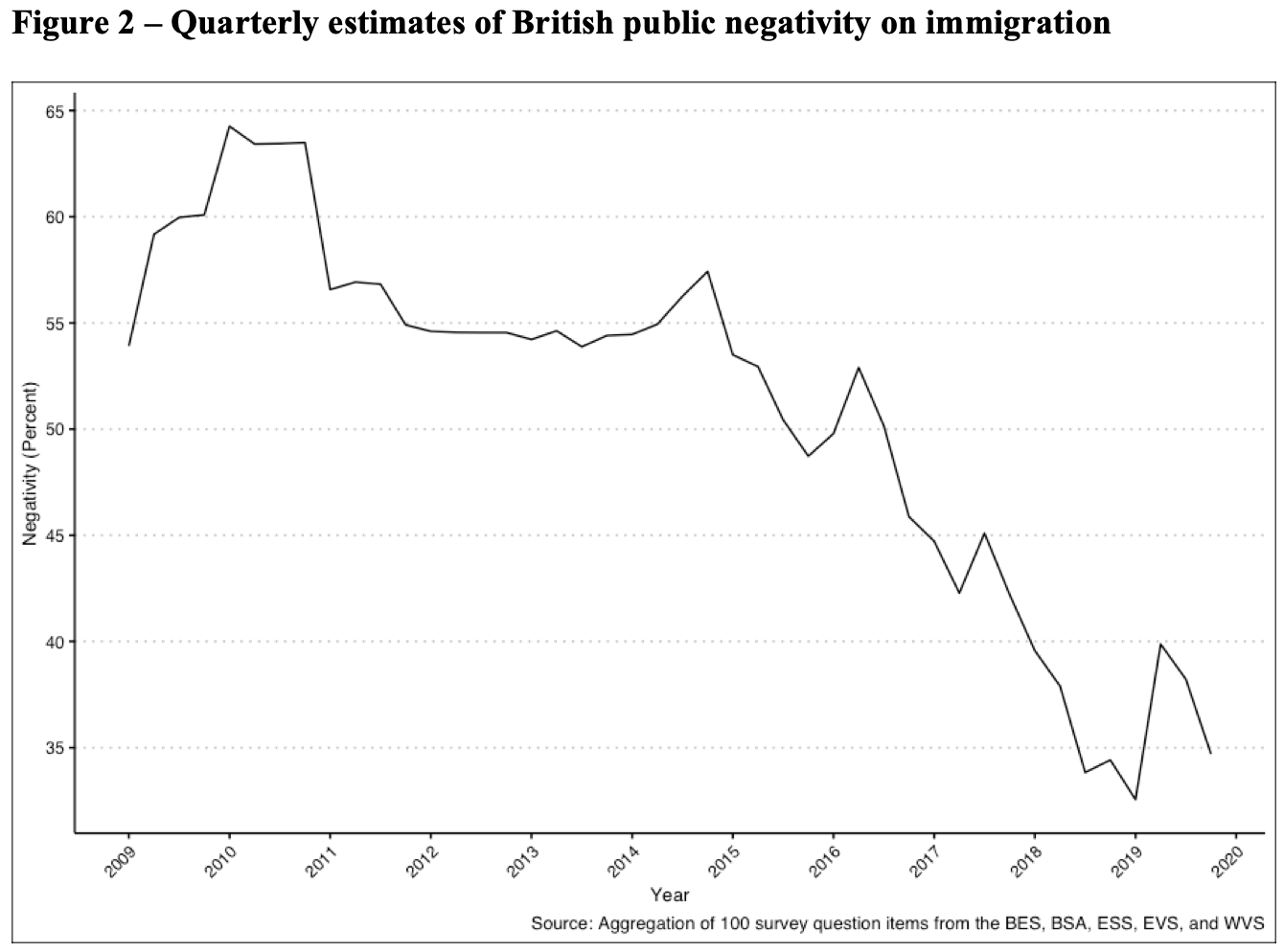
Inspecting the quarterly data also gives us some further, more nuanced insight into what the various narratives around Brexit might have done to attitudes surrounding immigrants and immigration. Figure 2 shows a more detailed snapshot of Figure 1, with 100 survey items analysed from 2009 to 2019.

Note: the mean level of sentiment here has shifted downward from in Figure 1, where the series included here and other series stretching back further into time anchor the overall trend line around 5-10% higher.

Here we see in greater detail the average decline in negativity from the turn of the last decade, with the peak around 2010 followed by something more resembling a jagged mountain face than a cliff edge. The sharp, short-term peaks in anti-immigrant mood as we travel down the ten-year slope are seemingly clustered around important electoral events surrounding Brexit: the 2014 European Elections won by UKIP, the build-up to the referendum itself in 2016, the General Election in 2017 where Theresa May sought a parliamentary majority for her Brexit plan, and then the 2019 election campaign featuring Boris Johnson’s pledge to “get Brexit done”.

Are these moments of intense scrutiny and pressure on Brexit producing these little sparks of negativity among the British public? It seems reasonable to think so – around these moments, media coverage and political commentary around immigration (specifically in relation to the EU) intensifies, parties actively campaign against the current immigration regime, and voters may be connecting immigration closer to their voting intention than they otherwise might, and respond to survey questions accordingly.

Whatever the case, what is certain is that these moments of upturn in the data do not last long. Once the moment passes, the decline in negativity continues – and even arguably picks up pace. Furthermore, given that margins of error apply to these aggregated figures just as much as they do to individual polls, the various quarterly spikes within the last ten years could just be statistical noise.

So, did Brexit cause an increase in anti-immigrant hostility in Britain? There is little evidence in the public opinion data analysed here to suggest that it did – particularly in the medium term. Did it, on the other hand, cause a big increase in positivity? Again, I would argue that it did not. Brexit has coincided with a plummet in British negativity about immigration, the start of which proceeded Boris Johnson’s successful attempt to pass a Brexit deal through the Commons, the referendum itself, and Nigel Farage’s electoral successes in the early 2010s.

In short, I would say that Brexit has not much at all to do with what Britons think about immigration.

Source: Has Brexit affected the way Britons think about immigrants? The recent ‘national mood’ on immigration

Coronavirus takes a toll in Sweden’s immigrant community

Like elsewhere:

The flight from Italy was one of the last arrivals that day at the Stockholm airport. A Swedish couple in their 50s walked up and loaded their skis into Razzak Khalaf’s taxi.

It was early March and concerns over the coronavirus were already present, but the couple, both coughing for the entire 45-minute journey, assured Khalaf they were healthy and just suffering from a change in the weather. Four days later, the Iraqi immigrant got seriously ill with COVID-19.

Still not able to return to work, Khalaf is part of the growing evidence that those in immigrant communities in the Nordic nations are being hit harder by the pandemic than the general population.

Sweden took a relatively soft approach to fighting the coronavirus, one that attracted international attention. Large gatherings were banned but restaurants and schools for younger children have stayed open. The government has urged social distancing, and Swedes have largely complied.

The country has paid a heavy price, with 2,769 fatalities from COVID-19. That’s more than 26 deaths per 100,000 population, compared with about 8 per 100,000 in neighboring Denmark, which imposed a strict lockdown early on that is only now being slowly lifted.

Inside Sweden’s immigrant communities, anecdotal evidence emerged early in the outbreak that suggested that some — particularly those from Somalia and Iraq — were hit harder than others. Last month, data from Sweden’s Public Health Agency confirmed that Somali Swedes made up almost 5 percent of the country’s COVID-19 cases, yet represented less than 1 percent of its 10 million people.

Many in these communities are more likely to live in crowded, multigeneration households and are unable to work remotely.

“No one cares for taxi drivers in Sweden,” said Khalaf, who tested positive and was admitted to a hospital when his condition deteriorated. Despite difficulties breathing, the 49-year-old says he was sent home after six hours and told his body was strong enough to “fight it off.”

In Finland, Helsinki authorities warned of a similar over-representation among Somali immigrants in the capital — some 200 cases, or about 14%, of all confirmed infections. In Norway, where immigrants make up nearly 15% of the general population, they represent about 25% of confirmed coronavirus cases.

“I think a pandemic like this one, or any crisis will hit the most vulnerable people in society the most wherever in the world, and we see this in many many countries,” said Isabella Lovin, Sweden’s deputy prime minister, in an interview with The Associated Press.

Noting that the virus was spreading faster in some crowded Stockholm suburbs, Lovin said said the city is providing short-term accommodation to some people whose relatives are vulnerable.

Sweden, Norway and Finland recognized early failings in community outreach in minority languages and are seeking to fix this. The town of Jarfalla, outside Stockholm, has had high school students hand out leaflets in Somali, Persian, French and other languages, urging people to wash their hands and stay home if sick.

With Sweden’s relatively low-key approach to fighting the virus that relies mainly on voluntary social distancing, there are concerns the message has not reached everyone in immigrant neighborhoods.

“It’s important that everyone living here who has a different mother tongue gets the right information,” said Warda Addallah, a 17-year-old Somali Swede.

Anders Wallensten, Sweden’s deputy state epidemiologist, said officials have worked harder on communicating with such groups “to make sure they have the knowledge to protect themselves and avoid spreading the disease to others.”

But teacher and community activist Rashid Musa says the problem runs much deeper.

“I wish it were that easy — that you needed to just translate a few papers,” he said. “We need to look at the more fundamental issue, which is class, which is racism, which is social status, which is income.”

“The rich have the opportunity to put themselves into quarantine, they can go to their summer houses,” Musa said.

A key government recommendation for individuals to work from home if possible is harder in marginalized areas where many have jobs in the service sector.

“How can a bus driver or a taxi driver work from home?” Musa asked.

Evidence of this disparity can be found in anonymous data aggregated by mobile phone operator Telia, which has given the Swedish Health Authority information about population mobility. By comparing the number of people in an area early in the morning with those who traveled to another area for at least an hour later in the day, Telia estimates how many go to work and how many stay home.

“We do see certain areas that are maybe more affluent with a bigger number of people working from home,” said Kristofer Agren, the head of data insights for Telia. Data shows a 12 percentage point difference between Danderyd, one of Stockholm’s most affluent suburbs, and Botkryka, one with the highest percentage of first- and second-generation immigrants.

“Many of our members have contracted the coronavirus,” said Akil Zahiri, who helps administer the mosque on the outskirts of Stockholm. “But you do the best you can.”

Zahiri spoke to the AP as he sat alone in Sweden’s largest Shiite mosque coordinating a video call with the congregation to pray for a member who died of COVID-19. The sound of prayer crackled through the computer, breaking the silence in the empty hall.

During Ramadan, the month when Muslims fast during the day, the mosque canceled all public events. Zahiri reminded the congregation to take part in social distancing, urging them to stay home for the Iftar, the daily breaking of the fast after sunset, and to avoid sharing food with friends.

Source: Coronavirus takes a toll in Sweden’s immigrant community

Quebec relies on hundreds of asylum seekers in long-term care battle against COVID-19

The irony given all the Quebec (and elsewhere) rhetoric regarding irregular asylum seekers:

Sarah watches her four-year-old daughter jump around a play structure she’s not allowed on because of the pandemic.

They’re just happy to be outside.

For eight days, Sarah — an asylum seeker from Haiti who crossed the U.S. border into Quebec at Roxham Road three years ago — was bedridden in their small Montréal-Nord apartment, her body feverish and aching.

It had started with some coughing and a slight fever she had tried to brush off at first. Her manager at the private long-term care residence in Ahuntsic where she works as an orderly wasn’t happy when she’d asked to stop working, for fear of bringing the infection home to her asthmatic daughter.

Then more symptoms appeared. She was nauseous, and the cough and fever got worse. A test a couple days later confirmed she had COVID-19.

Now on the mend, three weeks after testing positive, Sarah says: “I’m proud. I was on the battlefield.”

Sarah’s refugee claim was rejected after her first hearing, then again on appeal. Her only hope at staying in the country now is to be granted residency on humanitarian grounds, a process for which she began the application before the pandemic.

Given her precarious immigration status, CBC has agreed not to identify her by her real name.

Sarah is far from the only asylum seeker working on the front lines of the COVID-19 pandemic.

Many ‘guardian angels’ are asylum seekers

Marjorie Villefranche, executive director of Maison d’Haiti in Montreal’s Saint-Michel district, estimates that about 1,200 of the 5,000 Haitian asylum seekers the organization has helped since 2017 have become orderlies.

Frantz André, who helped found the Action Committee for People without Status, an advocacy group that helps asylum seekers settle in Montreal, says there are many more who’ve flown under the radar.

Asylum seekers make up a large portion of the “guardian angels” Quebec Premier François Legault has praised in his daily briefings — the orderlies, or préposées aux bénéficiaires (PABs), working in long-term care homes — who have no guarantee they’ll be allowed to stay in Canada.

“As quickly as they can, they want to find a job — and they’re being directed to jobs that no one else wants to do: the caregivers, PABs, security agents,” André said.

Without status, on the front lines

He and other refugee advocates have been calling on the Canadian government to allow asylum seekers already in the country to stay.

Many of them are hired by temp agencies, which offer people eager to work easy access to the labour market. For seniors’ homes desperately short of staff, the agencies are a source of cheap labour, but they operate with little government oversight.

The workers are often shuffled from facility to facility — a practice Quebec’s public health director, Dr. Horacio Arruda, has acknowledged is contributing to the spread of COVID-19 in long-term care centres, known in the province as CHSLDs.

André says the long hours they put in make the workers more prone to catching the virus and spreading it to their families.

He says it explains why Montréal-Nord, a low-income neighbourhood filled with newcomers, has the highest number of cases in the city.

“When you’re tired, you don’t eat well. You will go back home, and there’s four, five, six and sometimes seven people living in a [one-bedroom]. The chances of the people catching it, the family catching COVID-19, is greater than anywhere else,” André said.

It is also difficult for orderlies working for agencies to adhere to the province’s request that they work in only one long-term care residence, because accepting shifts wherever they’re asked to go is the only way to cobble together full-time work.

Another woman CBC spoke with works part time for a private residence and part time for an agency providing home care. Bouncing between visits to patients’ homes and shifts at the long-term care residence increases the risk of spread, but the woman said she feels she has no choice.

Problematic use of agencies predates pandemic

Long-term care homes have long been reliant on temp agencies to fill staffing holes — and the people the agencies sign on are most often women and newcomers to Quebec.

“Even before the pandemic, they had a lot of trouble finding people to do the orderly work,” said Prof. Nicolas Fernandez, a specialist in the relationship between health-care workers and patients who teaches family and emergency medicine at Université de Montréal.

“The short-term solution is to go to agencies.”

The reliance on temp agencies puts additional stress on CHSLDs struggling to contain outbreaks, said Fernandez, who has also served as a translator for asylum seekers.

CBC reached out to both federal and provincial departments requesting statistics on PABs, including how many are asylum seekers. Quebec’s Labour and Immigration ministries said they did not collect that information.

The Health Ministry didn’t provide a breakdown either, but offered up figures showing the vast majority of PABs are women — 34,821 of 42,340 in both private and public facilities. The average salary in 2019 was $40,551.

Fernandez says the job of a PAB is gruelling and crucial: they are the backbone of CHSLDs.

From the moment they wake up, most residents require extensive care — at least three hours a day — to have qualified for a bed.

“In order for the person to feel cared for, and not just a number, you need someone who is going to be there every day,” he said.

‘There’s no stability’

Sarah worked for two agencies to gain work experience after she finished her PAB course last year. She hated it — travelling as far away from Montreal as Saint-Jean-sur-Richelieu, in the Montérégie, a 50-minute commute made longer by the stops the agency’s van made to pick up other workers.

“There’s no stability. Every time, you’re sent to a different place. It gets really stressful,” she said.

For the past couple of months, Sarah has worked in the same private long-term care facility in Ahuntsic.

She loves her work. She likes helping and caring for people. It’s a far cry from the job she had in Haiti, working with a sports organization, but she hopes to be able to stay in Canada and work her way up in the health-care field, possibly becoming a nurse.

In the midst of this crisis, Sarah hopes the federal government recognizes how much asylum seekers have contributed to Canadian society and finds a way for them to stay.

“I hope the government will hear our calls, hear our voices.”

Group wants special immigration program

Those calls grew louder on Thursday, with a community group devoted to the rights of Haitians who crossed into Canada in 2017 asking the provincial and federal governments to implement a special immigration program for those working in CHSLDs.

“We find it hard to believe that these guardian angels may be expelled from the country once the battle is won,” the Concertation haïtienne pour les migrant.es said in an open letter.

“We are counting on your leadership to make a humanitarian gesture to these citizens who are fighting alongside us every day.”

Immigration, Refugees and Citizenship Canada responded to a CBC inquiry about whether the federal government was considering giving asylum seekers already in Quebec special status.

A spokesperson said in an emailed statement that the government would stick with the current process.

“Our immigration system continues to be based on compassion, efficiency and economic opportunity for all, while protecting the health, safety and security of Canadians,” spokesperson Shannon Ker wrote.

Source: Quebec relies on hundreds of asylum seekers in long-term care battle against COVID-19

Police Data Reveals Stark Racial Discrepancies in Social Distancing Enforcement Across New York City

Of note:

On Friday, the New York City Police Department (NYPD) released six weeks worth of data related to social distancing enforcement, following New York Gov. Andrew Cuomo’s March order mandating people stay inside and avoid congregating in large groups. The release comes amid mounting criticism of racial disparities in police enforcement of Cuomo’s orders, and just a day after Brooklyn District Attorney Eric Gonzalez released social distancing arrest data for his borough.

Both data sets reveal that minority communities have been impacted to a far greater extent by police enforcement during the coronavirus pandemic.

According to the NYPD data, 374 summons “for violations of emergency procedures and acts liable to spread disease” were handed out by police between March 16 and May 5. A summons is a ticket that is usually issued to someone by a police officer for a court appearance after violating a law.

Of that 374 summons, 304 were handed out to black and Hispanic people.

Related information from the Brooklyn DA’s office confirmed that 40 people were arrested from March 17 to May 4 for not following social distancing measures. 35 of those people were black, four of them were Hispanic and one was white.

DA Gonzalez said that his office is reviewing allegations of excessive force in Brooklyn arrest incidents, adding that arrests should be a last resort.

“Simply stated, we cannot police ourselves out of this pandemic. Instead, we need to give people the knowledge and ability to keep safe,” Gonzalez said in a statement.

According to the New York Times, the NYPD has made at least 120 arrests for social distancing between March 16 and May 5 across New York City as a whole. Of these arrests, 68% of those detained were black and 24% of them were Hispanic.

These numbers have become a point of mounting criticism for the police department and the mayor’s office. Police reform activists, community advocates and even the New York City Police Benevolent Association (NYC PBA) have said that police officers should not be enforcing social distancing at all.

New York City Mayor Bill de Blasio defended the NYPD’s role in social distancing enforcement during a Thursday press conference, after being questioned about whether it had become comparable to stop-and-frisk, the policing practice of stopping someone and searching them for weapons or other illegal items that disproportionately impacted black and Latino men during its height.

“What happened with stop and frisk was a systematic, oppressive, unconstitutional strategy that created a new problem much bigger than anything it purported to solve,” de Blasio said. “This is the farthest thing from that. This is addressing a pandemic.”

After the release of the arrest data from Brooklyn, he tweeted that the racial “disparity” apparent did not reflect the NYPD’s larger work. However, “We HAVE TO do better and WE WILL,” he wrote.

“That disparity, I don’t like, I don’t accept,” de Blasio continued during a Friday press conference. ” I want to see every community treated fairly, but I want a resolute approach where it’s really clear we got to follow these rules.”

De Blasio also announced Friday that, in response to “consistent overcrowding” in parks across the city, a cap would be placed on the number of people allowed, and that “extra enforcement” would be seen to that effect.

Source: Police Data Reveals Stark Racial Discrepancies in Social Distancing Enforcement Across New York City

They hoped for jobs and to immigrate to Canada. For international students, the pandemic has dimmed that hope

Will be interesting if the government relaxes the one-year requirement given COVID-19 and if so, how and under what conditions:

The dream of becoming a Canadian was within reach for Joyce de Paula until COVID-19 hit in March. All she needed was four more months.

Instead, that dream is now shattered after she was laid off as a marketing analyst, just four months shy of the one year of Canadian work experience she required to be eligible for permanent residence in Canada.

The Brazilian woman is among tens of thousands of former international students whose immigration plans are now in limbo because they are running out of time to secure a job in the midst of massive layoffs and an economic slowdown due to the coronavirus pandemic.

“There are hundreds and hundreds of us, but there is nothing we can do,” lamented de Paula, 28, who graduated from Centennial College with a postgraduate certificate in market research and analytics last May before landing a 12-month contract with Dufflet Pastries in July.

Studying in Canada has become a shortcut to immigration in recent years, with Ottawa putting more emphasis on Canadian education and work experience in the selection process.

Those who graduate from a Canadian college or university are granted a postgraduate work permit that lasts between one and three years, depending on the duration of their academic programs.

Immigration candidates must have at least one year of Canadian work experience before their work permits expire in order to get the bonus points for their applications. Anything short of that threshold won’t count.

Attaining the coveted permanent residence status should have been smooth sailing for de Paula, who would’ve had her 12-month experience under her belt when her work permit expires in August.

“It’s so hard to get any job now. Who is going to hire someone with a work permit expiring in four months?” asked de Paula, who has started an online petition urging Ottawa to extend the postgrad work permits of international graduates affected by COVID-19. The petition has already collected more than 1,270 signatures.

Phil Lao, who just finished the one-year construction project management postgrad program at London’s Fanshawe College in April, said the window for getting a relevant job in his field is narrowing.

“For many of the international students, our end goal is permanent residence. This is very disconcerting and we need more time to wait out the storm,” said the 29-year-old, who has an undergrad degree in architecture from the Philippines and earlier this month started working in a factory assembling respiratory equipment like nebulizers and inhalers. “This is so stressful.”

The pandemic has also wreaked havoc for international students seeking internship opportunities, which many had hoped could lead to jobs upon graduation.

Ashton Samson, also from the Philippines, was supposed to start a placement at a visual effects studio in Toronto in late March, but it was cancelled. Now, he has finished the visual effects and editing for contemporary media program at Fanshawe without any Canadian experience.

He said most productions have shut down their offices and there are few job openings even in graphic design, something he used to do in the Philippines.

Some graduating international students have chosen to take more courses or enrol in another program to buy time to delay applying for a postgrad work permit, but Samson said he has already spent $28,000 studying here — including $17,000 in tuition — and has no money left.

“The pressure is immense,” said the 24-year-old. “We have invested so much in this country that we hope Canada can see our effort and help us in any way it can. We just need to buy more time.”

Marcelo Moraes, who completed his postgrad certificate in digital media content strategy at Humber College in April, was fortunate enough to secure a paid co-op placement at the school, but said trying to find a job will be a tall order even after the pandemic is over, let alone for someone on a work permit.

“I have sent out more than 70 resumes. Everyone is putting their hirings on hold,” said the 46-year-old Brazilian, who has years of experience in assessing, implementing and managing media content strategies. “It’s a challenging job market. COVID just makes everything that much more difficult.”

For Meenal Devgan, going back to school is not an option because she is already on her work permit, which is only given out to an international student once.

The 28-year-old, who has a degree in legal studies from India, enrolled in the human resources management program at Conestoga College in Kitchener in 2018 and started a job as a restaurant supervisor last August before her layoff on March 22. She has since applied to 100 jobs, but is still unemployed.

“This is a big deal for our future. It is not our fault that businesses are closed,” said Devgan, whose work permit expires in August. “A lot of people are in the same boat. We have no options. I just hope immigration (officials) can count our layoff time toward our permanent residence applications.”

Source: They hoped for jobs and to immigrate to Canada. For international students, the pandemic has dimmed that hope

Fisher: The Liberals promised more immigration by 2021. Can that still happen?

Starting to see more articles like this although Fisher isobviously not familiar with the available data or with the immigration program in general although his call for a discussion is a reasonable one.

However, his suggestion that the COVID-19 aftermath may lead to a 90 percent drop is fanciful as no major Canadian political party, federally or provincially, would support such major drop.

(IRCC has been releasing monthly data for a number of years now so we should start to see emerging trends in a few months, the monthly data is typically released after two months):

Justin Trudeau‘s government has not yet told Canadians whether or how it intends to keep its long list of pre-COVID-19 promises.

One signature pledge was to take in 350,000 immigrants a year by 2021, or about one per cent of the population annually. That commitment was made in October 2018. At that time Canada was welcoming 310,000 newcomers a year.

Where does that major undertaking on immigration stand now, given that virtually nobody who is not already a citizen or resident of Canada has been allowed into the country for nearly two months? Or that Canadian embassies and immigration offices have almost all been closed or placed on greatly-reduced hours with much smaller staffs since sometime in February with little likelihood of much about that changing soon?

Official figures about immigration don’t tend to be released until one or two years after the fact, so it is guesswork trying to figure out how many newcomers Canada has welcomed this year or how many are in the pipeline. Surely, though, given that there are far fewer flights from overseas and that the required interviews and medical and security checks are clearly not taking place with most of the world shut down, there will be far fewer of these folks arriving this year. Because the immigration process is chronically slow and a maze for most potential immigrants, it is possible that there will be even fewer of them next year, too.

There is little public information available to help puzzle out the future of immigration to Canada during and after troubling times. But charts showing historical immigration numbers that were published by Statistics Canada five years ago may be instructive.

Whatever the boasts of the Harper and Trudeau governments about their openness to immigration, the fact is that immigration to Canada reached a peak of just over 400,000 people a year more than a century ago under then prime minister Sir Robert Borden. It then dropped to less than 40,000 a year for 15 years from the beginning of the Depression until the end of the Second World War under the Conservative and Liberal prime ministers, R.B. Bennett and Mackenzie King.

Considering this data and the grave current economic and logistical complications, if the current pattern mirrors the experience of the Depression, it is not too much of a stretch to suggest that what looms is a drastic drop — as much as 90 per cent — in immigration for several years.

There is no argument here about the merits of immigration, which I strongly support. It is about how many newcomers Ottawa now envisages Canada accepting and whether the public, faced with serious personal economic distress caused by unemployment and savings that have been wiped out, will be as supportive of immigration today or in, say, 2022 or 2023, as it was before the coronavirus pandemic disrupted lives and created so much uncertainty about the future.

It was the Mulroney government that decided to greatly increase the number of foreigners let into Canada. The policy was subsequently embraced by the Martin, Chrétien and Harper governments and expanded a bit further by the Trudeau government.

Recent immigrants, like generations of immigrants before them, have almost always been good for Canada. It is a generalization, but most of these settlers — if I may use a not so fashionable 19th and 20th-century term — have a reputation for working hard, often at jobs that those already lucky enough to be Canadians won’t do.

The newcomers help the economy by paying federal, provincial and municipal taxes. Their need for housing has pushed up the value of real estate, especially in the immigrant-magnet cities of Vancouver and Toronto (although a case can be made that this has sometimes been a mixed blessing).

The presence of so many immigrants can only be good for a country where the spectre of depopulation has become real since many couples who can trace their Canadian roots back decades or centuries have become famously uninterested in having more than one or two kids.

Besides, the points system used to decide who qualifies to come to Canada has attracted many highly educated, highly motivated immigrants. The longstanding family sponsorship program has been a boon to, well, families. The legal refugees that Canada has taken in have helped people otherwise trapped in hellish situations. It has also given a little relief to poor countries such as Jordan and Lebanon that have unfairly had to bear far too much of the refugee burden.

But as during the Depression, Canada’s economic landscape has shifted dramatically in the past couple of months. The federal deficit for this year alone could be $252 billion. Similarly, big deficits are a prospect for 2021 and 2022. And the books of several provinces are worse than those of Ottawa.

The federal government has been very busy with the coronavirus. It is, after all, an epochal event.

But increased immigration was a strong theme as well as a firm promise of Trudeau’s government. The current pandemic should not prevent the immigration minister and senior department officials — who have lots of time on their hands since few new immigration applicants are being processed — from sharing their thoughts with Parliament and Canadians about how the COVID-19 shock has informed and affected their thinking and planning.

It is not too soon to start a national discussion about how many immigrants Canadians, their elected leaders and various business and ethnic communities think the economy and job market can digest.

Source: COMMENTARY: The Liberals promised more immigration by 2021: Can that still happen?

US Congress Reincarnates Discrimination Against American Citizens Because of Who They Marry

Sigh…:

In 1907, Congress passed a law that punished US citizen women for marrying “foreigners.” In March of 1931, Congress rejected this discrimination. But in March of 2020, Congress reincarnated it by passing a law that punishes both US citizen men and women who are married to non-citizens. The March 2020 CARES Act was designed to help support American families during the coronavirus crisis by providing payment through the Internal Revenue Service (IRS). But it punishes US citizens because they have non-citizen spouses, even when they have correctly filed income tax forms. This gives new life to the legally rejected historical animosity against US citizens who married non-citizens. This reversion conflicts with modern law that recognizes the agency and authority of married women and men, respects an individual’s choice about marriage, and supports a fundamental right to family. Further, it undermines American citizens’ statutory right to request that their non-citizen spouses live with them in the United States.

The CARES Act denies stimulus checks to US citizens who have filed their income tax forms with their social security numbers and the Individual Taxpayer Identification Numbers (ITIN) of their non-citizen spouses. Other citizens who filed their joint family tax returns for 2018 and or 2019 are eligible to receive desperately needed aid to support their families during the coronavirus crisis.

The CARES Act reverts back to the prior century’s hostility to citizens, particularly women, who married non-citizens. In 1915, the US Supreme Court in Mackenzie v. Hare upheld the constitutionality of the 1907 law that resulted in the involuntary loss of a woman’s US citizenship if she married a “foreigner.” Ethel Mackenzie was a life-long resident of California married to a British citizen living with her in California. She lost her citizenship because of her marriage when she attempted to fulfill another civic responsibility: voting. The 1907 law was grounded in the concept of coverture that removed a married women’s rights on the premise that she was subordinate to and controlled by her “foreign” husband. In 1931, Congress rejected punishment against citizens married to non-citizens by passing a law that prevented the loss of citizenship through marriage to a “foreigner.” Married women, as well as men, were then legally respected as persons with agency and authority in their choice of spouses and family life.

Further, in 1965, Congress established family unity as a predominant basis for migration. The legislation rejected prior discriminatory criteria based on nationality, race, and gender. It afforded a statutory right to US citizens wishing to live in the US with their non-citizen immediate relatives, including spouses. The right to family unity as a spouse belongs to the US citizen. The citizen must file a petition for her spouse, and only if that petition is approved may the non-citizen spouse apply for permanent residency that then allows application for a social security number. But this already lengthy process was subject to delays by the Trump administration before the coronavirus crisis and has now been blocked by the United States Citizen and Immigration Services’ (USCIS) processing suspensions.

The Migration Policy Institute states that over 1.2 million citizens are married to non-citizens who are not yet permanent residents. The Department of Homeland Security reported that in 2018 about 268,000 spouses of US citizens became permanent residents. The six female and male US citizen plaintiffs in a lawsuit challenging this CARES Act provision have been married to their non-citizen spouses between two and six years. Additionally, each family has between one and five US citizen children.

Denying US citizens needed support in the face of a crisis because they file taxes with a spouse’s ITIN number undermines their right to marriage and family. This is especially harsh when the USCIS’s reaction to the coronavirus crisis prevents citizens from moving forward in the process to obtain their spouses’ legal residencies and social security numbers.

The CARES Act reverts to an irrational hostility against Americans married to “foreigners.” It discriminates against male and female citizens even though they have made an extra effort to correctly file income taxes. Non-citizens without social security numbers are required to file and pay taxes by applying for individual taxpayer identification numbers. Citizens and their spouses who went through the trouble of obtaining an ITIN number to file taxes were doing their best to meet their civic responsibility.

It makes no sense to punish anyone for trying to correctly file income taxes. But the CARES legislation is egregious as it reestablishes an irrational antagonism to “the foreign” that historically harmed Americans because of their choice of marriage.  Such a premise was rightfully rejected almost 90 years ago. It should not have been reincarnated now.

Source: Congress Reincarnates Discrimination Against American Citizens Because of Who They Marry

Douglas Todd: COVID-19 lockdown triggers foreign-student flight from Canada

Good article by Todd and likely more realistic than the overly optimistic International students determined to study in Canada despite coronavirus, with some initial data highlighting the difficulties facing the current business models of universities:

Jenny Kwak, an international student from South Korea, remembers in March how four of five young people in her university dorm packed their luggage and just disappeared.

“They went home to China, India, the Philippines, Brazil, the U.S. — you name it,” said Kwak, a 21-year-old arts student interviewed on the large empty campus of the University of B.C., which last year enrolled more than 17,000 international students.

It’s hard to forecast how many international students will return, either to Canada or other nations. But the mass exodus of foreign students is brewing into a crisis for colleges and universities in the West that rely on their high fees to hire faculty and staff and construct new edifices.There were 642,000 foreign students in Canada at the end of 2019, double the number of five years earlier. International students account for 20 per cent of post-secondary enrolment in Canada, where many politicians view them as essential to the country’s economic expansion.

Foreign-students programs around the Western world will take “a massive hit” from the coronavirus, says Oxford University professor Simon Marginson, director of the Centre for Global Higher Education.

Post-secondary schools can expect at least 12 months of “abnormal conditions” from the COVID-19 pandemic, with at least five years before global student mobility recovers, says Marginson, whose centre is a partnership of 14 major universities.

Many smaller private colleges, especially those that rely almost entirely on foreign-student fees, will likely collapse, predict higher education specialists Philip Altbach, of Boston College, and Hans de Wit, from the Netherlands. Large respected universities, many of which continue to draw taxpayers’ dollars, will likely survive.

Even though the state of affairs will be different for each nation, Altbach and de Wit say global competition will become fiercer for what will remain of what was until last year the 5.2 million students studying abroad, the largest cohort coming from China.

There are lessons to be culled from the contrasting ways the leaders of Canada and Australia — which take in the most foreign students per capita, including from China — are responding to the dramatic exit of so many.While Canada’s immigration department and schools are not providing much information on how many foreign students have left or may not come back because of the pandemic, Australia’s politicians are more frank. They say many of the 720,000 foreign students in the country have left, in droves.Australia’s acting immigration minister says 300,000 people on study visas (and temporary work visas) departed since January. And a former senior immigration official in Australia, Abul Rizvi, predicts one-quarter more foreign students and workers will depart by year’s end.

It’s not surprising. Australian Prime Minister Scott Morrison told non-Australians to return to their home countries if they could not financially support themselves during the coronavirus crisis. Like most nations, he did not offer wage subsidies to foreign nationals.Politicians in Australia and elsewhere are worried international students will compete for jobs with the millions of citizens who have been frozen out of work due to COVID-19. And a segment of Australians appreciate the departure of many could lead to reduced house and rental costs.In contrast, Canada is more generous to foreign students.

Prime Minister Justin Trudeau’s government has quietly confirmed foreign students with a SIN number can apply for the Canadian Emergency Response Benefit (CERB), which gives up to $2,000 a month to residents of Canada who have lost their jobs because of COVID-19.The government also removed the 20-hour-per-week limit on how much international students could work during their term. Ottawa will now allow them to work unlimited hours if it is with an essential service. In B.C., foreign students also receive subsidized government medical care.Unfortunately, in Canada it’s almost impossible to obtain solid data on how many students have left Canada or don’t intend to return. Immigration, Refugees and Citizenship Canada told Postmedia it doesn’t keep “exit” information. And media officials from both UBC and Simon Fraser University said their numbers don’t indicate any change, adding they won’t speculate about the fall.

Canada stopped issuing study visas on March 18, but will let anyone who had a visa before then return. The only data the immigration department offered about how COVID-19 has affected study visa holders comes from before Canada locked down.That data shows, during January and February, when COVID-19 was exploding out of Wuhan in China, the number of students from China applying for Canadian study visas dropped by almost half — to 5,164 from 9,495, compared to the same period a year earlier. Applications from South Korean also fell sharply.The decline in study visa applications is a sign of a more permanent trend for the next five years, according to Marginson. He warned student movement patterns will shift for East Asians, with fewer opting for North America, Western Europe, the U.K. and Australia — and more deciding to stay closer to home and study in Japan, South Korea or China.

How Canada and Australia will handle their foreign-student relationship with East Asian countries, especially China, will be telling. At the end of 2019, Australia had 212,000 students from China and Canada had 142,000.But while Australia is not afraid to talk bluntly to China, including about wanting an international investigation into how COVID-19 broke out in Wuhan, Canada’s Liberal government stays silent about China’s transgressions.Ottawa goes out of its way to encourage international students because its aim, rarely discussed, is to give them preferential treatment as future permanent residents, moving into Canadian jobs and housing.

Since the impact of foreign students on Canada’s cities is profound, one would hope the country’s public officials would be more transparent about a strategy that is now seriously in jeopardy.

Source: Douglas Todd: COVID-19 lockdown triggers foreign-student flight from Canada

Appreciating the politics of the pandemic

Good discussion of the interface between public health science and politics:

The pandemic is political. While COVID-19 is essentially a public health crisis with massive economic effects, political decisions facilitated the spread of the virus, and politics guides how governments are working to keep it at bay. Appreciating the politics of the pandemic is vital to understanding how we got here, what we are doing about it and what the post-pandemic world may look like.

While there has been some analysis on the political aspects of the pandemic, it merits further attention. Contemporary political science is a strange creature in many ways. It is quite derivative, drawing on other fields such as psychology, economics and sociology. Although this borrowing can be viewed as a weakness, it also can be a seen as a significant strength because it gives the field the ability to analyse the individual, societal, governmental and international aspects of events.

In that spirit, we offer a political science perspective on events and debates surrounding the pandemic and potential considerations for moving forward as Canada ponders an end to confinement and scenarios for recovery.

The novel coronavirus originated in China, and that country’s handling of COVID-19 has been the subject of significant debate. The Chinese government began by silencing whistleblowers in the early days of the epidemic and then took drastic measures to control the spread of the virus. China has now reinvented itself as a global champion in the fight against the pandemic through generous public and private transfers of personal protection equipment abroad.

China deceived and used coercive measures initially to control information and distort COVID-19 statistics, on which we relied for modelling other countries’ pandemic trajectories. With questions raised about its handling of the virus, China also tried to demonstrate international leadership and benevolence to compensate.

This is the contradictory universe of authoritarianism, where the projection of power and influence at home and abroad is built on image. Authoritarian states have always relied on their image as an essential part of how they govern and legitimate themselves. At home, image management is not just about the dictator masquerading as the enlightened despot, it is also often a reminder of what the state stands for and expects from its citizens.

Image management in foreign affairs is just as important, particularly for a burgeoning regional hegemon such as China. Authoritarian states regularly mask the ugly to promote their shiny brand. In China’s case, early signals that hinted at failings, including the failure to anticipate the danger of COVID-19 and to react, were replaced by stories of its effective responses and its ability to prove itself as a global leader in the fight against the pandemic.

China’s handling of the crisis has also led to a series of questions about the World Health Organization (WHO). The organization’s approach to COVID-19 highlights the pressures and limits that international organizations face. While these organizations are essential for fostering global cooperation, providing guidance and leading international initiatives, they remain subordinate to states and the contentious nature of international politics.

Notably, international organizations are not only dependent on states for financial contributions, but for information, access and goodwill. In the absence of these, international organizations can achieve only so much, and their ability to perform their advising and coordinating functions is hampered.

In the context of the current pandemic, the twin pressures of information denial from China in the early months and the upcoming financial punishment from the United States will weaken the WHO. It will complicate efforts to build back a reputation that has arguably been tarnished, whether justified or not, by its handling of the pandemic. For all their internal flaws, international organizations like the WHO are only as effective as states and the international environment allow them to be.

On the other hand, Canada’s relationship with the WHO since the first months of 2020 reminds us that certain states are heavily invested in international organizations, not only for the coordination and guidance they offer, but also for what they represent and provide as hallmarks of the liberal international order. The Canadian government’s determination to follow WHOguidance was in part a reflection of the fact that no one state has the capacity to handle the pandemic alone.

Multilateralism involves the sharing of information and pooling efforts together to do more while enjoying economies of scale, giving groups of states far greater reach with more effectiveness than they could achieve alone. Other smaller countries chose to follow a more independent and prudent approach regarding WHO advice when the first signs of a possible pandemic emerged. In theory, Ottawa might have been able to do the same. But Canada’s determination to follow WHO guidance equally reflects a larger commitment to multilateralism and the global order that the country helped build after the Second World War.

An interesting aspect of the Canadian response has been the placing of public health expertise at the forefront of decision-making.

Working with the WHO, rather than going it alone, is a form of good international citizenship for Canada and an expression of the fact that global problems require global solutions. While this has led to questions about the efficacy of Canada’s initial response to the pandemic, appreciating the multilateral dimension of the Canadian approach sheds light on why Ottawa stuck by the WHO and why it likely will continue to do so.

Within Canada, the debate is turning toward decisions made by governments, federal and provincial, and the information and advice they have been providing citizens. An interesting aspect of the Canadian response has been the placing of public health expertise at the forefront of decision-making.

Public health officials have been providing daily briefings and ministers have been steadfast in assuring citizens that the measures and policies that have been put in place reflect expert advice and the best available evidence. This approach has been met by expressions of significant trust in government, as observed by various polls.

As Canada begins to contemplate a loosening of restrictions, experts in public finance will likely join their public health counterparts in providing critical advice to ministers. This expert advice has been vital to Canada’s response and will be as important for the country’s recovery.

Yet expertise will not be enough. Political decisions will still need to be made, as studies of evidence-based policy tell us. This will involve weighing the evidence provided to ministers from different competing sources, managing the uncertainty that necessarily accompanies advice about the future and balancing trade-offs between public health considerations, economic concerns and citizens’ tolerance for restrictions over the long-term.

No one field of expertise can provide complete advice on these trade-offs. But these decisions will require political judgment, an attribute that belongs with politicians and their political advisors.

Finally, when political judgement begins to take on greater importance, the risks associated with having experts as the public face of the government’s response will increase. Canada’s Chief Public Health Officer Theresa Tam has already become a political and media target, including in the form of inexcusable racist attacks on her loyalty to Canada. This is no fault of Tam’s. It is an unfortunate consequence of her public profile. If decision-making around the lifting of restrictions becomes more contentious, ministers will need to increasingly emphasize that they are responsible for the government’s actions.

Indeed, as the field of policy studies indicates, giving expert officials visibility increases trust, but it can also create confusion about who is accountable for decisions. Although they may have an interest in fostering this confusion, responsible ministers should leave no doubt that “the buck stops with them.” Politics must come back to the forefront, where it belongs.

Source: Appreciating the politics of the pandemic

Douglas Todd: Time to end ‘honour system’ in Quebec’s immigrant-investor scheme

Good reminder of the scam that is the Quebec immigrant investor program and good for Richard Kurland for obtaining and analyzing the data that highlights just how much it is a scam.

Just as Quebec unduly benefits from the 1991 immigration accord that provides Quebec with greater funding per immigrant than other provinces, one that remains a fixed percentage of total settlement funding, irrespective of Quebec immigration levels, meaning that as Quebec decreases its immigration intake under the Legault government, the imbalance increases.

And good for the Conservatives under Jason Kenney for cancelling the federal program. When I analyzed citizenship data by immigration category, the lowest incomes (LICO prevalence) were reported by business immigrants as shown in the chart below (grouped under “Entrepreneur etc):

It’s time for Ottawa to end the honour system that allows nine of 10 wealthy immigrants to renege on their promise to live in Quebec.

Federal immigration officials have released information showing 91 per cent of the tens of thousands of applicants approved by Quebec’s Immigrant Investor Program in recent years have been exploiting a loophole in the plan, which critics consider a “cash-for-passport” scheme.

The Quebec program’s glaring flaw also illustrates a wider problem for the country and its provinces, says Vancouver immigration lawyer Richard Kurland.That is, Ottawa does not seem interested in trying to make all would-be immigrants to Canada follow through on residing in their declared “intended province of destination.” There are taxation measures that could be introduced, Kurland said, that could ensure more immigrants follow through on their stated commitments.

Even though Quebec’s immigrant-investor program is set to re-open this summer, after being temporarily suspended to deal with a backlog of more than 5,000 applications, critics don’t want to see it start up again under the same rules.

“There are two reasons Quebec’s program has been a failure, leading to abuse of the system,” says Burnaby immigration lawyer George Lee, whose clientele is predominantly from China.“It’s freezing cold in Quebec in the winter, so (many) people from Asia find the weather intolerable,” said Lee.

“Secondly, language-wise, there’s a problem. Most people in China learn English rather than French. As a result, many of Quebec’s investor immigrants don’t ever even fly into Montreal or Quebec City. They just use the Quebec program as a bridge to get to English-speaking cities in Canada.”

Kurland, who obtained six years of recent data on the more than 25,000 investor immigrants and family members who have never fulfilled their stated promise to reside in Quebec, said a simple new tax measure would likely stop the exploitation.

All Ottawa has to do is delay granting permanent resident status to newcomers to Quebec (or any other province) until they file an income tax return as a resident of their declared province of destination, said Kurland, who has frequently travelled to Ottawa to advise Parliament on immigration policy.For his part, Lee realizes that residents of Canada have mobility rights under the Charter of Rights and Freedoms. But, like Kurland, he believes Ottawa could find ways to go further to ensure compliance to regional residency commitments than a misused honour system.

Lee worries Quebec doesn’t want to reform its immigrant-investor program.

“Quebec’s happy with the scheme,” he says, because the province gets substantial amounts of money injected into its coffers without having to provide new arrivals and their families with taxpayer-funded medical care, social services and education.The data obtained by Kurland under an access to information request shows that in 2017 only 342 of the 5,015 people approved under Quebec’s investor category actually had a primary residence in the province.

In 2018, just 518 of the 6,064 people approved were found to be living in Quebec. And up until October of last year, only 528 of the 4,136 approved were residing in the that province.


This chart shows over six years how nine of 10 applicants and their dependents approved as permanent residents under Quebec’s immigrant-investor program did not reside in Quebec. (Source: Immigration, Refugees and Citizenship Canada, via Richard Kurland)

The investor scheme has not been the only immigration program that provides unusually large financial benefits to Quebec. Because of a 1991 funding accord, Ottawa also provides Quebec with roughly four times as many taxpayer dollars to settle each of its immigrants as B.C., Ontario and several other provinces receive.

Meanwhile, an internal federal immigration document, also obtained by Kurland, acknowledges growing criticism of “golden-passport” schemes such as the one that remains in Quebec, the only Canadian province ever granted separate immigration powers.

The Immigrant, Refugees and Citizenship Canada report from 2019 reveals that four of five of the foreign investors who give or loan various amounts of money to a Pacific Rim country (or its regional jurisdictions) in return for a visa or passport are from China.

Most such investors simply want “peace of mind, a way out when the home country is experiencing turmoil,” says the IRCC report, which grew out of an international conference in Miami on “citizenship-by-investment programs.”

The immigration report refers to how the federal Conservatives cancelled Canada’s long-running national investor-immigrant program in 2014. The government of the day found few of the wealthy applicants ever invested in businesses in Canada or paid a significant amount of federal income tax.

Source: Douglas Todd: Time to end ‘honour system’ in Quebec’s immigrant-investor scheme