12 New Immigration Ideas for the 21st Century

Compiled by the libertarian Cato Institute, a range of ideas ranging from the practical to the more ideological.

On the more practical side:

  • Chapter 1: Automatic Adjustment of the H-1B Visas and Employment‐ Based Green Cards Caps
  • Chapter 2: Reducing Long Wait Times for Family‐​Sponsored and Employment‐​Based Immigrants
  • Chapter 3: Shared Border, Shared Future: A US-Mexican Bilateral Worker Agreement
  • Chapter 5: State-Sponsored Visas (similar to the Provincial Nominee Program)
  • Chapter 6: The Community Visa: A Local Solution to America’s Immigration Deadlock

    Chapter 8: Immigration Moneyball (variant of points system/express entry)

On the more wish list and/or ideological side:

  • Chapter 3: Shared Border, Shared Future: A U.S.-Mexican Bilateral Worker Agreement
  • Chapter 4: Constructing a US-Canadian Bilateral Labor Agreement
  • Chapter 7: Building a Congressional Constituency for Immigration through “Earmarks”
  • Chapter 9: Immigration Designed to Enhance American Lives (IDEAL)
  • Chapter 10: Don’t Restrict Immigration, Tax It
  • Chapter 11: Choosing Immigrants through Prediction Markets
  • Chapter 12: Transferable Citizenship (citizenship as a traceable good)

Congress has repeatedly considered and rejected comprehensive immigration reform legislation over the past few decades. The most bitter debates were in 2006, 2007, and 2013 when comprehensive bills passed one house of Congress and not the other. Those reforms each failed for particular reasons—groundswells of populist opposition, Democratic senators working with Republicans to remove guest worker provisions, or Republican failure to bring it to the floor in the House of Representatives—but the bills were all basically identical.


Those failed immigration reforms all included three policies: legalize illegal immigrants currently living in the United States, increase border and interior enforcement of the immigration laws, and liberalize legal permanent immigration and temporary migration through an expanded guest worker visa program for lower‐​skilled workers. A domestic amnesty for illegal immigrants was supposed to clear the black market and allow those who have made a life here to settle permanently; extra enforcement was supposed to reduce the potential for illegal immigrants to come in the future; liberalized immigration was supposed to boost U.S. economic prosperity and drive future would‐​be illegal immigrants into the legal market.

In theory, this comprehensive approach was supposed to make future amnesties unnecessary by fixing the laws that encouraged illegal immigration in the first place. The bill Congress considered in 2013, the last attempt at comprehensive immigration reform, followed the same model, which is a major reason the bill failed. For instance, the guest worker provisions for lower‐​skilled workers were all clones and the result of negotiations between the same stakeholders.

Liberalizing legal immigration is the most important component of workable, long‐​term reform. The legal immigration system sets and regulates numbers, procedures, and the types of foreigners who can come to the United States from abroad to work, live, and in some cases eventually naturalize. Providing legal paths for more immigrants, either for temporary work or permanent citizenship, is the best way to secure the border and would help provide for the future prosperity of the United States. The government cannot regulate a black market of illegal immigrants, but it can regulate legal immigrants.

Expanding legal immigration is a worthy goal, but there are many ways to accomplish it. The mission of this collection of essays from policy analysts, economists, political scientists, journalists, and advocates from around the world is to provide new policy suggestions that future Congresses could use to liberalize the legal immigration system. We intentionally avoided seeking proposals from the usual stakeholders and included many original ideas that could increase legal immigration or improve the selection of legal immigrants. The essays fall into four broad categories based on how much they would transform the current legal immigration system. The first category includes proposed rule changes that would substantially improve the current system. In one essay, Daniel Griswold of the Mercatus Center proposes that Congress abolish the static numerical caps on certain visas and instead create a built‐​in numerical escalator that automatically grows the number of visas as employment grows. For example, the number of H‐​1Bs issued would increase as employment in certain hightechnology sectors increases. Similarly, Stuart Anderson of the National Foundation for American Policy recommends addressing the extreme wait times that skilled immigrants currently face by guaranteeing them legal permanent residence within five years, essentially replacing numerical quotas with a specific wait time.

The second category of essays includes discussions of adding visa categories to the current system. Many of the ideas in this category are based on older visa programs that have been discontinued, visa programs in other countries, logical extensions to the current U.S. system, or admissions policies in other public institutions, such as military academies.

Michael Clemens of the Center for Global Development proposes a jointly regulated migration system with Mexico based on lessons learned from the past and best practices from other bilateral migration programs enacted around the world. Michelangelo Landgrave, a political science doctoral candidate at the University of California, Riverside, proposes a similar policy for Canada based on the principles of reciprocity in work authorization and limited access to welfare, of which, according to survey data, Americans and Canadians alike approve.

David Bier of the Cato Institute proposes state‐​based visas that would allow state governments to accept immigrants based on their diverse economic conditions. In a similar vein, coauthors Jack Graham and Rebekah Smith propose a system whereby local governments would work with private sponsors to bring immigrants into their communities. Both essays highlight the importance of engaging state governments to implement important reforms.

Grover Norquist of Americans for Tax Reform offers a proposal inspired by the acceptance policies of U.S. military academies. It would allow each member of Congress to sponsor 100 immigrants for legal permanent residence— similar to how they nominate recruits for U.S. military academies.

The third category includes proposed changes that would transform how the current U.S. immigration system works.

George Mason University professor Justin Gest envisions a major overhaul of the selection process for immigrants. Under his system, the government would collect much better data on various immigrant outcomes and track immigrants over time to see how they integrate. It would then assign points for immigrants with certain characteristics that the data show correlate with immigrant success.

Steve Kuhn of IDEAL Immigration proposes selling visas to employers, provided they’ve made job offers to foreign workers and paid the workers premiums that match the cost. Nathan Smith’s proposal would increase the number of immigrants admitted but charge them an extra 20 percent tax on their incomes so long as they reside and work in the United States.

The fourth category and the last two fundamental policy reform ideas come from Robin Hanson, associate professor of economics at George Mason University. His reforms would increase immigration, cause more Americans to profit directly from the immigration system, and provide a way to select immigrants that are more beneficial to the United States.

Hanson’s first essay is similar to Gest’s proposal but relies on a more decentralized decisionmaking process to select immigrants using prediction markets. Under this proposal, the public would place cash bets in an open market on which immigrants would succeed based on objectively measurable criteria such as net‐​fiscal impact. The immigration system would then select those priced the highest. In his second essay, Hanson suggests letting U.S. citizens sell or lease their citizenship to noncitizens abroad in exchange for leaving the country. This would monetize the value of American citizenship and create an asset held by every American.

These proposed reforms are just a few of the new and interesting ideas out there. Hopefully, some will be incorporated into future bills; others could spark new and more creative ways of how to change immigration laws. We don’t endorse every essay in this paper, but the stagnant state of the current debate shows the need for bold new ideas and out‐​of‐​the‐​box thinking that will better prepare us for the next immigration reform debate.


Chapter 1: Automatic Adjustment of the H-1B Visas and Employment‐ Based Green Cards Caps

By Daniel Griswold

Congress should tie the growth of employment‐ based visas to growth in the most relevant sectors of the U.S. labor force to assure that the annual number of visas available more closely matches the demands of the U.S. economy over time. Two of the most important visas for foreign‐​born workers are the H-1B visa and the employment‐​based green card, both for more‐​skilled and more‐​educated foreign born workers. Yet the number of such visas available has not changed significantly in almost three decades despite transformational growth in the U.S. labor market.


Chapter 2: Reducing Long Wait Times for Family‐​Sponsored and Employment‐​Based Immigrants

By Stuart Anderson

Congress should tie the growth of employment‐ based visas to growth in the most relevant sectors of the U.S. labor force to assure that the annual number of visas available more closely matches the demands of the U.S. economy over time. Two of the most important visas for foreign‐​born workers are the H-1B visa and the employment‐​based green card, both for more‐​skilled and more‐​educated foreign born workers. Yet the number of such visas available has not changed significantly in almost three decades despite transformational growth in the U.S. labor market.


Chapter 3: Shared Border, Shared Future: A U.S.-Mexican Bilateral Worker Agreement

By Michael Clemens

The U.S. government has mismanaged labor mobility and failed to cooperate meaningfully with migrant countries of origin for the past half‐​century. Foreign workers have come for fundamental jobs, which are those that are critical to the U.S. economy and that do not require formal higher education, such as personal care, construction, warehousing, and others. They have come almost exclusively via family‐​based green cards, “low‐​skill” temporary guest worker visas for seasonal jobs tied to a single employer, or through a vast black market in labor. Many of the ills associated with migration arise from this regulatory system, not from migration itself. The United States needs a bilateral system of labor mobility for fundamental jobs that should begin


Chapter 4: Constructing a U.S.- Canadian Bilateral Labor Agreement

By Michelangelo Landgrave

The U.S. government has mismanaged labor mobility and failed to cooperate meaningfully with migrant countries of origin for the past half‐​century. Foreign workers have come for fundamental jobs, which are those that are critical to the U.S. economy and that do not require formal higher education, such as personal care, construction, warehousing, and others. They have come almost exclusively via family‐​based green cards, “low‐​skill” temporary guest worker visas for seasonal jobs tied to a single employer, or through a vast black market in labor. Many of the ills associated with migration arise from this regulatory system, not from migration itself. The United States needs a bilateral system of labor mobility for fundamental jobs that should begin


Chapter 5: State‐​Sponsored Visas

By David J. Bier

The federal government has maintained a near monopoly on the criteria for the admission of foreigners to the United States since the late 19th century. This centralization makes little sense in such an economically diverse country. Every state and locality have specific social and economic circumstances that the current centralized immigration system ignores. This centralization has ultimately polarized and paralyzed the national immigration debate and directly led to a threedecades‐ long delay of major reforms to a system that most agree desperately needs it. For this reason, Congress should allow state governments to sponsor migrants based on their own criteria under federal supervision.50


Chapter 6: The Community Visa: A Local Solution to America’s Immigration Deadlock

By Jack Graham and Rebekah Smith

Immigration is one of the most significant drivers of prosperity, but its potential is suppressed by restrictionist politics, centralized bureaucracies, and out‐​of‐​date policies. Furthermore, its benefits are concentrated in a few regions. Communities with the greatest need for immigrants, especially in rural areas and the Rust Belt, are receiving few immigrants as the majority move to big coastal cities. Rural areas also tend to have the highest levels of anti‐​immigrant sentiment, in part because they do not benefit from migration the same way that people in big coastal cities do.77 The United States needs a new approach to help businesses of all sizes get the workers they need, to renew communities threatened by demographic decline, and to build local support for more liberalized immigration.


Chapter 7: Building a Congressional Constituency for Immigration through “Earmarks”

By Grover Norquist

For many years, U.S. presidents have had significant discretion to make immigration policy, liberalizing or restricting rules on entry and setting deportation priorities. Congress has enacted little legislation of its own because it lacks the overwhelming national consensus required to pass reforms on the issue. But giving individual members of Congress more authority to select immigrants for permanent residence could overcome this stalemate.


Chapter 8: Immigration Moneyball

By Justin Gest

President Trump wants to overhaul the U.S. immigration system so that it stops favoring visa applicants with U.S. family ties and instead gives priority to highly skilled applicants and those with job offers.94 His proposal is based on the assumption that immigrants’ educational credentials—what the administration calls “merit”—will lead to increased U.S. wages and immigrants who better integrate into U.S. culture.


Chapter 9: Immigration Designed to Enhance American Lives (IDEAL)

By Steve Kuhn

The immigration reform proposals most likely to succeed are those that create benefits for Americans and immigrants and that garner bipartisan support. The Immigration Designed to Enhance American Lives (IDEAL) proposal strikes a balance between competing interests by allowing more legal immigrants to work in the United States by paying the federal government for the opportunity. That revenue could then be used to reduce the tax burden or otherwise benefit native‐​born Americans. This essay and planks are based on the IDEAL Immigration Policy.100


Chapter 10: Don’t Restrict Immigration, Tax It

By Nathan Smith

Many economists—including Nobel laureate Gary Becker—favor taxing immigration because charging a “price” can produce a more efficient result than restricting it with government‐​established caps or quotas. Good immigration policy ought to bring the greatest good to the greatest number, subject to the constraints of being compatible with human rights and incentives and of making many people better off without making others worse off. Consistent with those principles is a proposed policy called “Don’t Restrict Immigration, Tax It.”


Chapter 11: Choosing Immigrants through Prediction Markets

By Robin Hanson

On immigration, the big political camps are in a tug of war. One side favors more immigrants; the other side wants fewer immigrants. But when faced with such a struggle, policymakers who care more about influence than about feeling solidarity should consider tugging the rope sideways, where fewer might oppose their efforts. To tug the rope sideways on immigration, policymakers should take a policy position that is perpendicular to the axis of more versus fewer immigrants. One sideways‐​pull policy would be to reform immigration laws to use prediction markets to admit different immigrants, without increasing the total number.


Chapter 12: Transferable Citizenship

By Robin Hanson

Governments have long worked hard to create strong feelings of solidarity between citizens. National leaders often appeal to a common history of mutual aid, sacrifice, and even ethnic and cultural ties to garner support for government actions. All of this has helped create a relatively sacred and exclusive aura regarding citizenship that, in the words of Abraham Lincoln, is “the mystic chords of memory, stretching from every battle‐​field, and patriot grave, to every living heart and hearthstone, all over this broad land.”112 According to long‐​standing human norms, such associations are not to be created lightly and are debased when they are mixed with material motives such as money or other expressions of self‐​interest.

Source: 12 New Immigration Ideas for the 21st Century

Immigration Policies Threaten American Competitiveness

Interesting Harvard Business School alumni survey regarding perceived undermining of US competitiveness by Trump administration policies:

It is no secret that immigration has reshaped American innovation. Immigrants are the backbone of America’s most innovative industries, provide a quarter of our patent applications, and are numerous among our science and engineering superstars.

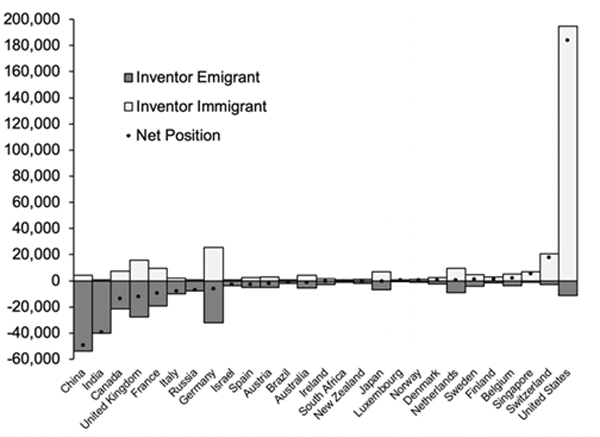
Taken from World Intellectual Property Organization data (Miguelez and Fink, 2013), Figure 1 shows that America received more than half of migrating inventors from 2000-2010.

Figure 1: Migration of inventors, 2000-2010


Immigrants can be found in times of success and times of crisis. Examples include:

  • Among the American companies leading the race toward a vaccine to end the COVID-19 pandemic is Moderna, a Cambridge company with an immigrant co-founder and an immigrant CEO.
  • Another firm already conducting vaccine trials is Inovio Pharmaceuticals of Plymouth Meeting, Pennsylvania, led by cofounder J. Joseph Kim. Kim, who came to the United States from South Korea at age 11 without speaking English, was among the pharmaceutical leaders who briefed President Trump on vaccine development in March.

The flow of global talent responsible for bringing these innovators to American shores has been a substantial driver of business creation. As I discuss in my book The Gift of Global Talent, skilled immigration is the world’s most precious resource.

Talent flows to where it’s needed

But talent is movable, and the United States must cherish and protect its prized position at the center of the global talent flow. At a time of crisis when fear is used to shift blame onto outsiders, America is at risk of signaling to global innovators and entrepreneurs, and the promising students who will one day become them, that they cannot have a future here.

Talent flows to where it is most productively utilized and welcome, and while the destination of choice has long been the United States, other countries are increasingly challenging America’s dominance.

“TALENT IS MOVABLE, AND THE UNITED STATES MUST CHERISH AND PROTECT ITS PRIZED POSITION AT THE CENTER OF THE GLOBAL TALENT FLOW.”

By some metrics, their efforts are succeeding. Between 1990 and 2010, America’s share of college-educated migrants within the Organisation for Economic Cooperation and Development nations fell from about 50 percent to 40 percent.

Our recent research captures business leaders’ rising anxiety about America’s complacency in competing for this talent and the negative impact on America’s competitiveness that could result. We surveyed(pdf) thousands of Harvard Business School alumni for their views on immigration.

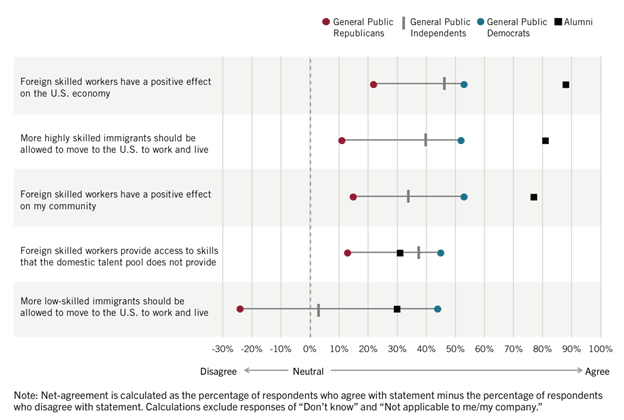
Our alumni were overwhelmingly supportive of skilled immigration. Over 90 percent said that foreign skilled workers have a positive effect on the US economy, and 87 percent believe that the United States should allow more highly skilled immigrants to move here to work and live (see Figures 2 and 3).

Figure 2: Net agreement for belief statements about immigration


Figure 3: Alumni views of immigration system and politics

Alumni also confirmed the importance of foreign skilled workers to their companies’ ability to compete. Nearly one in four said that at least 15 percent of their companies’ US-based skilled workforce was foreign born. Alumni expressed that immigrants were critical for developing better products and services, increasing the quality of innovation, and reaching international customers.

Our alumni warned us, however, that this important competitive advantage is at risk. A majority believe the current political rhetoric around immigration is harming their organization’s ability to attract foreign skilled workers. Nearly 60 percent blamed the US immigration system for causing project delays. And over two-thirds reported that their companies’ operations would be harmed if denied access to foreign skilled workers.

Because immigration is often a political third rail, there are many reasons to be skeptical that the United States will soon find a broad solution. In fact, when it comes to skilled immigration, our research shows more support for minor changes to the current system than for more fundamental reforms. Over two-thirds of alumni supported increasing the number of new H-1B visas issued each year by at least 50 percent. For much of the past decade, H-1B visas have run out within a single week (see Figure 4). Despite even the COVID-19 pandemic, the government received 275,000 applications in March of this year for the 85,000 slots in fiscal year 2021.

Figure 4: Months to reach H-1B visa cap by fiscal year

Structural changes, such as adopting wage ranking for awarding H-1B visas in place of today’s lottery system, did not achieve much support among our alumni. The gap between alumni believing the existing immigration system is harming their businesses and alumni only supporting incremental change is surprising to us. It is unclear whether this reveals a lack of knowledge or actual uneasiness about the policies themselves.

American competitiveness at risk

Either way, the stakes get higher in times of crisis: the recent H-1B visa lottery would have given the same chances to a critical researcher being recruited by Moderna and Inovio (or J&J and GlaxoSmithKline) as it would have to a software code tester working at an outsourcing company.

“WHILE WE MAY TEMPORARILY CLOSE BORDERS AS WE FIGHT COVID-19, BUSINESS MUST ARTICULATE JUST HOW DISASTROUS CLOSING OUR BORDERS LONG-TERM WOULD BE.”

One striking finding was that our alumni were in broad agreement over increasing the allocation of employment-based immigrants within the overall US immigration pool. When asked what share of total immigration to the United States should be employment-based, alumni on average proposed to quadruple today’s 12 percent share. When we surveyed a representative sample of the general public on this same question, we found a similar result—they proposed to triple the share of employment-based immigrants. That result held across all political affiliations, with both Democrats and Republicans proposing to increase the employment-based allotment.

Implementing such a shift could be quite politically controversial depending upon technique, especially if policies shifted visas from family-based channels and diversity programs rather than creating new employment-based visas. But we believe there is a path forward. We can build momentum by getting started with simpler actions like wage ranking H-1B applicants and creating immigrant entrepreneur visas. These quick wins can be stepping-stones towards further reform by proving that we can change our system for the better, despite decades of intransigence.

Most importantly, business leaders should get involved and share the burden with policymakers and academics to educate voters and build support for these policies that ultimately benefit America’s business community.

While we may temporarily close borders as we fight COVID-19, business must articulate just how disastrous closing our borders long-term would be. Some of the recent political rhetoric to halt all immigration, even if later scaled back in practice, endangers the image of America as a welcoming beacon to the next generation of scientists and entrepreneurs. Other countries are creating innovative new programs to attract talent and threaten our competitive advantage, while our government issues executive orders and espouses rhetoric that undermine our promise to the world’s brightest.

Our position at the center of global talent flows is now at risk. Business has both the pressing need, and the capacity, to accept this responsibility. It should.

About the Author

William R. Kerr William Kerr is the D’Arbeloff Professor of Business Administration at Harvard Business School.

Source: Immigration Policies Threaten American Competitiveness

Americans Giving Up Citizenship Faster Than Ever Before Reports Bambridge Accountants New York

Significant increase.

As for the Canadian angle, ApCPC leader Andrew Scheer has not yet renounced his American citizenship (Stephen Lautens on Twitter: “Still no sign of Still no sign of Andrew Scheer in the US’s Quarterly Publication of Individuals Who Have Chosen To Expatriate (lose United States citizenship) …twitter.com › stephenlautens › status).:

Americans are renouncing their citizenship at the highest levels on record, according to research by the Enrolled Agents and accountants Bambridge Accountants New York.

  • 2,909 Americans gave up their citizenship in the first 3 months of 2020
  • Showing a 1,104% increase on the prior 3 months to December 2019where only 261 cases were recorded
  • 2,072 Americans gave up their citizenship in 2019 in total
  • This is the highest quarter on record, the previous record was 2,365 cases for the fourth quarter of 2016
  • It seems that the pandemic has motivated U.S. expats to cut ties and avoid the onerous tax reporting

Americans must pay a $2,350 government fee to renounce their citizenship, and those based overseas must do so in person at the U.S. Embassy in their country.

There are an estimated 9 million U.S. expats. The trend has been that there has been a steep decline over the last few years for U.S. citizens expatriating – the first 3 months of 2020 is a huge increase in the number of Americans renouncing their citizenship.

Under the IRS rules (section 6039g), every three months the U.S. Government publishes the names of all Americans who give up their citizenship. The first 3 months for 2020 had 2,909 Americans renouncing their citizenship, far more than the total of the four quarters for 2019 (2,072 Americans renounced).

Alistair Bambridge, partner at Bambridge Accountants New York, explains: “There has been a huge turnaround of U.S. expats renouncing, where the figures have been in steep decline since 2017.”

“The surge in U.S. expats renouncing from our experience is that the current pandemic has allowed individuals to get their affairs in order and deal with an issue they may have been putting off for a while.”

“For U.S. citizens living abroad, they are still required to file U.S. tax returns, potentially pay U.S. tax and report all their foreign bank accounts, investments and pensions held outside the U.S. For many Americans this intrusion is too much and they make the serious step of renouncing their citizenship as they do not plan to return to live in the U.S.”

“There has been a silver lining for U.S. expats that they have been able to claim the Economic Impact Payment of $1,200, but for some this is too little, too late.”

Source: Americans Giving Up Citizenship Faster Than Ever Before Reports Bambridge Accountants New York

USA: Minority-Owned Small Businesses Were Supposed To Get Priority. They May Not Have

Of note. Will be interesting to see eventual analysis of take-up by immigrants and visible minorities of the various COVID-19 support programs in Canada:

The first time Rosemary Ugboajah applied for a small-business relief loan, it didn’t go well. She needed the money for her small Minneapolis-based company, which has created ad campaigns for brands like the NCAA Final Four.

So she went to her credit union.

“They were hard to reach, but eventually I got through to someone and they emailed me back saying they can’t process the loan because they don’t process SBA loans,” she said. “I wasn’t aware of that.”

Lawmakers did set aside $30 billion for smaller lenders, in part with the aim of helping business owners of color — like Ugboajah.

But a new report from the Small Business Administration’s inspector general found that businesses owned by people of color may not have received loans as intended under the Paycheck Protection Program. There was no evidence, the report said, that the SBA told lenders to prioritize business owners in “underserved” markets, including business owners of color — something the CARES Act had specifically instructed the SBA to do.

The report also recommends that the agency start collecting demographic information. Without that information for past loans, it will be hard to know how well the program served business owners of color.

Some businesses owned by one person — such as some sole proprietorships, like Ugboajah’s Neka Creative — were only allowed to apply for funds one week after other businesses. That put them in the back of the line to get the money, which ran out quickly during the first round.

After trying and failing at two other banks, Ugboajah managed to find one that was accepting applications from new customers, and she quickly applied. But that also went poorly.

“The next week, I got an email from them saying, you know, the money’s running out. And they’re now just going to prioritize their clients that have borrowed before,” she said with a weary laugh.

Ugboajah has applied there again during this second round of funding but hasn’t heard back yet.

But she could use the money, and fast — her team is currently working through the pandemic without pay.

“We had a healthy pipeline coming into this year. And as soon as this came down, everything went on hold and then disappeared,” she said.

An additional problem for these owners is that their businesses are more likely to be sole proprietorships, according to Ashley Harrington, senior policy counsel at the Center for Responsible Lending.

“When we’re talking about businesses of color, most of them are very small businesses. So they’re sole proprietorships or they have less than 10 employees or in fact more likely to be a sole proprietorship than any of the other small businesses,” Harrington said.

Ugboajah has six people on her team — and they’re all contractors — making her business one of those one-person sole proprietorships. African American-owned businesses are particularly likely to be one-person firms.

And relationships with banks matter, according to Michael Roth, managing partner at Next Street, which works with local governments on small-business policy.

“Black- and Hispanic-owned businesses, because of their lack of access to capital from banks and financial institutions and friends and family, are far more likely to use personal funds to finance their businesses,” he said. “And generally, that’s run out of personal checking accounts.”

That could be a problem for some businesses in the program, because some banks would loan only to people with business accounts. So owners without those — who were, for example, running their businesses out of their personal accounts — were shut out.

Ugboajah says that if she doesn’t get the funding, it won’t take her business down completely, but it could make life harder.

“The main thing that we’re on the verge of losing is our office space. But, yeah, we won’t go out of business,” she said.

But it has already hurt the contractors who rely on her for income, she added: “One of my team members has taken a job with Amazon, for example. But we’re still pushing to get business in.”

For now, she says, they’re working on a new project: to make sure health information about the coronavirus can reach poor and immigrant communities, as well as communities of color.

Source: Minority-Owned Small Businesses Were Supposed To Get Priority. They May Not Have

Leveraging international education for a globally connected and prosperous Canada

The education industry view. Will need a major rethink of their business model’s dependence on international students. Their business case would benefit from more rigorous evaluations of the longer-term contributions, not just the more short-term contributions while at college or university:

Canadians understand the importance of welcoming individuals from all around the world to our country. Canada is a desirable destination for trade, travel, study and immigration. We know that our prosperity and international competitiveness rely on being open to people and opportunity from every corner of the world.

The COVID-19 pandemic is a global crisis without modern equivalent. The actions Canada takes post-emergency can set the foundation for a sustainable growth and recovery with global opportunity in mind.

We believe that Canada’s colleges and universities– and the network of business and community leaders who came to Canada as international students– can play an essential role in responding to this crisis, and in helping Canada recover and thrive in a post-COVID-19 world.

Universities and colleges are already key drivers of Canada’s international agenda. In 2019 alone, international students contributed over $21.6 billion to the Canadian economy, more than the value of automotive parts, lumber, or aircraft exports. These contributions are made in communities all across the country, and support employment and innovation in every province and territory.

The more than 600,000 international students at the postsecondary level also bring new perspectives, ideas, and valuable networks abroad. International students become highly trained individuals who contribute to their local Canadian economies, and then either immigrate to Canada and join our labour market or return home with an appreciation for what Canada has to offer as a business partner.

Canada’s response to the economic impact of the crisis to date has been commendable. Still, we need to ensure international students feel welcome and supported so that Canadian PSE remains competitive in these uncertain times and we can continue to be leaders in a global marketplace.

Canada needs:

Responsive and informed study permit processing — Ease of obtaining a study permit is a key factor in international student decision making. Immigration, Refugees and Citizenship Canada (IRCC) has already shown a lot of flexibility in responding to the pandemic. To remain competitive, we need IRCC to be nimble and to allow, on an exceptional basis, international students to start programs online this fall without jeopardizing their eligibility for a post-graduate work permit.

Strengthening IRCC’s capacity to facilitate business resumption — Once health and travel restrictions start to be lifted in Canada and around the world, we must ensure that there is capacity to address large volumes of new study permit applications, quickly. Measures must be put in place now to ensure that disruptions to processing for the fall intake will be minimized.

Two-way mobility and international cooperation — As part of comprehensive federal government support to the Canadian postsecondary education sector, it is also imperative to maintain our commitment to a national outbound mobility program for Canadian postsecondary students to support Canada’s goals around trade diversification, skills development and the future of work.

We’ve seen colleges and universities across Canada stepping up and supporting their communities in this time of need, donating medical equipment and retooling processes to manufacture more. We’ve seen our students, recent graduates, in medical fields rushing to be of service in support of our health care systems. With the right investments, universities and colleges can also continue to play a critical role in building skills and increasing global competitiveness, helping Canada thrive in a post-COVID-19 world. Education opens doors, for students and for Canadian companies — across all sectors — looking to do business internationally. Leveraging international education, and the people-to-people ties it generates is a sound investment towards a more globally connected and prosperous Canada.

Source: Leveraging international education for a globally connected and prosperous Canada

Feds hint at scaling back immigration due to pandemic fallout

Preliminary signals but we will only know when. the immigration plan is released in the fall:

The COVID-19 pandemic and resulting unemployment could lead to immigration to Canada being cut for the first time in a decade.

Immigration Minister Marco Mendicino hinted as much in testimony to the Commons human resources committee, according to Blacklock’s Reporter.

Mendicino said cabinet will be “taking a look at our levels and what is our operational capacity.”

The review “is of course going to be driven by the context,” he said. “As we all know, we are in the midst of a pandemic,” he said.

In an Immigration Levels Plan tabled in the Commons on March 12, cabinet proposed raising immigration by about 1% of the population a year, from 331,000 immigrants in 2019 to 341,000 in 2020 and 351,000 in 2021.

But since then, Canada’s unemployment rate has risen to 13%.

“Given Canada’s massive unemployment for the foreseeable future, what is the government’s scale-back planning for economic migrants and refugees for the next two years?” asked Conservative MP Peter Kent.

“Given that the economic crisis will linger after the health crisis has passed, can Canada accommodate an additional 1% of immigrants and refugees added to our population in the foreseeable future?”

Mendicino said the feds will continue to look “at the circumstances including the surrounding context of Canada’s response to COVID-19 as we plan for the future,” and will provide an update in the fall.

Source: Feds hint at scaling back immigration due to pandemic fallout

Tung Chan: Recent increase in hate crimes toward Asian-Canadians is a shock and a shame

One of the better opinion pieces on anti-Asian-Canadian hate crimes:

Canada is a multicultural society. The majority of us are welcoming and accepting of new Canadians, no matter where they are from or what race they are. This positive attribute of Canadian society is universally appreciated by new arrivals and admired by people around the world. This is why the recent increase in hate crimes toward Asian-Canadians is a shock to all of us.

Some of my Chinese-Canadian friends are taking extra precautions when they are out in public, looking over their shoulders when they are walking alone on empty streets. Many Chinese-Canadian organizations are banding together to fight the rise in racism.

It is no wonder then that a national survey conducted for the Chinese Canadian National Council for Social Justice found that as many as one in five respondents do not think it is safe to sit on the bus next to an Asian or Chinese person who isn’t wearing a face mask.

The same poll, conducted in the week of April 24 with a sample size of 1,130 adults randomly drawn from Toronto, Montreal and Vancouver, also found that nearly 13 per cent, or one in eight respondents, were aware of incidents of racial bias in their neighbourhoods since COVID-19.

One member of Parliament, Derek Sloan, took advantage of this latent hostility and questioned the loyalty of our chief medical officer, Dr. Theresa Tam, who, like me, is an immigrant from Hong Kong. To the political base where his dogwhistle was directed, a Chinese person is a Chinese person — chief medical officer or not, naturalized Canadian or not.

A television outlet went further with a story that painted a picture of the Chinese diaspora, including Canadian citizens, obeying orders from the People’s Republic of China and secretly buying up personal protection equipment and shipping it back to China.

The unfortunate perception left with viewers is that Chinese-Canadians cannot be trusted because they may be members of a fifth column, ready and willing to follow the People’s Republic of China’s orders against the interest of Canada.

The point is that the actions of a few should never be generalized to a group. Yes, there is an increase of assaults on Asian-Canadians, but the actions of those few should not generate fear of all.

Yes, some Asian-Canadians sent care packages to China to protect loved ones prior to COVID-19 reaching Canada. But it was also done in hopes of preventing the virus from spreading and reaching Canada.

Everyone is afraid of COVID-19, of losing family, of being without an income, of what tomorrow will bring. But we know the fabric of Canada is sewn with kindness and compassion.

Our civic leaders and elected politicians need to continue speaking up to condemn those who physically attack to cause bodily harm or those who verbally attack to create doubt about the loyalty of Chinese-Canadians. The perpetrators of these malicious acts must be made to understand that their actions and their words are not acceptable in our society.

For the sake of our country, let’s focus our energy on fighting the virus, not each other.

Source: Tung Chan: Recent increase in hate crimes toward Asian-Canadians is a shock and a shame

Dual Canadian-U.S. citizens qualify for Trump’s COVID-19 emergency payments

And vice-versa (provided Canadians resident in Canada) but interesting analysis on how they could benefit more than American “mono-nationals”:

Millions of dollars in U.S. pandemic stimulus payments could find their way into Canada in the coming weeks and months.

Canadians with U.S. citizenship, who may not have paid taxes in the U.S. for decades, still qualify for the Trump administration’s one-time pandemic support payment.

In order to get the payment, Canadians with dual U.S. citizenship and U.S. citizens living and working in Canada must have filed a tax return with the Internal Revenue Service for 2018 or 2019 reporting their global income.

In some cases, people who qualify for the payment can also get the full U.S. COVID-19 benefit payment while earning substantially more per year than they would if they lived in the United States because of special tax exemptions only available to American ex-pats.

Democrats Abroad, a Canadian-based group that helps Americans vote, file taxes and stay informed while living abroad, held a seminar last month explaining how its members could apply for the payment.

“Most of them are surprised, really surprised about it, because … there are people who’ve been here 40 years and they’ve never gotten a cent from the U.S. government, except some who get U.S. social security cheques, and they aren’t many — and now all of a sudden they are getting $1,600,” said Ed Ungar, co-vice chair of Democrats Abroad.

“They are really happy to get it, but it wasn’t something they counted on.”

Ungar said he does not know of anyone who has received the payment but said most of the people he’s spoken to are convinced the payment will arrive within six months.

In the U.S., many Americans who have their banking details on file with the IRS already have received their payments. Many of those who don’t are still waiting for their cheques.

The problem for many dual citizens in Canada is that while many have been filing their taxes with the IRS for years, there is no bank account attached to their filings because they have not had to pay penalties or receive payments.

Without a U.S.-based bank account, Canadians with dual citizenship and Americans living and working here don’t have a way to receive an electronic payment. They have to wait for cheques to be sent out to the addresses on their last income tax filings.

Filing worldwide income to the IRS

U.S. citizens living abroad who wish to retain their American citizenship are required to file a U.S. tax return every year detailing their worldwide income.

If it’s determined that the U.S. citizen paid lower taxes abroad than they would have if they had earned the same income in the U.S., they are required to pay the difference to the IRS.

The IRS’s economic impact payment, EIP, is similar to the Canada emergency response benefit, CERB — a cash payment offered to citizens across the country who are struggling financially because of the pandemic.

Canadians who qualify for the CERB can claim it for a maximum of four four-week periods. The EIP is a one-time payment.

To qualify for the full EIP of $1,200 US, ($1,687 Cdn), plus an additional $500 US ($702) for each qualifying child, U.S. citizens can earn a maximum of $75,000 US ($105,400) as an individual, or $112,500 US ($158,100) if they are the head of a single-income family.

Married couples with joint earnings of no more than $150,000 US ($210,800) qualify for a joint benefit of $2,400 UD ($3,374).

A major difference between the Canadian and American pandemic benefits is that in Canada, people must apply to receive it, but in the U.S. the payment is automatically dispersed, providing the person filed a tax return in 2018 or 2019.

The U.S. EIP maximum payment is gradually reduced after people reach their maximum amount of earned income until the benefit is cut off at $99,000 US ($139,200) for individuals, at $136,500 US ($192,000) for single-income families and $198,000 US ($278,300) for families with two incomes.

Earning more in Canada

The major difference when it comes to U.S. citizens living abroad is that they are allowed to exempt up to $103,900 US ($146,000) of income from their 2018 tax filing, or $105,900 US ($149,000) of income from their 2019 return.

“Somebody living outside the U.S. would actually … earn more income than somebody living in the U.S. and be eligible to receive that benefit because of this Foreign Earned Income Exclusion,” said Kevin Kirkpatrick, a U.S. tax lawyer with the international firm Moody’s.

In some cases, the Foreign Earned Income Exclusion can effectively lower a person’s income to the level where they can still receive the benefit.

For example, in 2018 an individual U.S. citizen living in Canada could have earned $250,000 Cdn while still qualifying for the full EIP — but if they lived in the U.S. they could have earned a maximum of about $105,000 while getting the same benefit.

CBC has requested information from the IRS and the U.S. embassy in Ottawa on how many U.S. citizens live in Canada and file U.S. tax returns, but neither agency was able to provide that information.

Several follow up questions to both the embassy and the IRS were not returned by the time of publication.

According to the 2016 census, 377,410 people in Canada identified themselves as being either fully or partly of American origin.

Source: Dual Canadian-U.S. citizens qualify for Trump’s COVID-19 emergency payments

Germany: No let-up in anti-Jewish crimes

Official police-reported statistics:

Germany’s annual report on politically motivated crimes will detail more than 41,000 crimes last year attributed to far-right and far-left individuals, with anti-Semitic acts amounting to 2,000 offenses, the Welt am Sonntag newspaper reported on Sunday.

Citing data to be published next week by the Federal Criminal Police Office, the paper said experts blamed the upward trend of politically motivated crime on an increasing belief by perpetrators that the behavior is socially acceptable..

The 41,000 cases overall represented a 14% increase on the level in 2018, with 22,000 crimes classed as extreme right and 10,000 crimes as extreme left — often so-called “propaganda” acts such as smearing graffiti, with some far more serious.

These categories had grown by 9 and 24% respectively, Welt am Sonntag reported.

Particularly alarming were politically motivated crimes in Germany’s eastern states of Thuringia and Brandenburg, where such cases had jumped by 40 and 52% respectively.

The data “unfortunately” shows a “massive problem” at both ends of the spectrum, said Thorsten Frei, deputy parliamentary leader of Chancellor Merkel’s conservative Christian Democrats (CDU).

Politicians, journalists targeted

“Hate” tirades on the Internet were often aired “unrestrained” against communal politicians or journalists, said Frei, and some even included murder threats.

“Where ever the concept of “the enemy” [Feinbild] became entrenched in minds this sometimes quickly led to [threats] being acted out, said Frei while calling for the “swamp” of contemptuous language to be stamped out.

“People’s reticence to resort to violence has fallen,” Jörg Radek, deputy GdP police trade union leader told the paper. “People become violent more quickly because they are increasingly confident that their acts are socially accepted, said Radek.

“All violence from the right and left must be outlawed,” he said, “whether it’s directed at a camera crew, emergency workers, or the crew of a police patrol car.”

Hate-motivated sprees

In recent decades, Germany has witnessed a string of far-right racist crimes, including fatal shooting sprees in Halle in October and in Hanau in February.

Seehofer subsequently declared far-right extremism the “biggest security threat facing Germany,” promising a beefed-up security response.

Source: Germany: No let-up in anti-Jewish crimes

A study urged better standards for migrant workers’ housing. Nothing was done. Now COVID-19 has struck

One can just imagine the lobbying that occurred, given the likely competitiveness impact on the sector, with the health and pandemic consequences that have now become more widely apparent.

The same pattern of greater risk to temporary workers living and working in crowded conditions is seen everywhere, whether pristine Singapore or the Gulf countries:

Across Ontario, nursing homes are the province’s deadliest epicentres for the COVID-19 pandemic. But in Chatham-Kent, the county’s largest outbreak of the virus is on a farm — where 49 migrant workers have fallen ill.

Labour advocates warn that living conditions are hastening the virus’s spread on farms across the country, where bunkhouses often make it impossible for temporary foreign workers to social distance.

Those workers are essential to the country’s food supply, leading agricultural groups to push for their exclusion from Canada’s COVID-19 travel ban.

But prior to the pandemic, many of these groups also lobbied against the creation of a national housing standard that a government study recommended “to reduce the risk of negligence and possibly of harm” to migrant workers, documents obtained by the Star show.

The national standard for migrant worker housing has not been implemented — despite a study commissioned by the federal government that found “gaps in the housing inspection process” and an “extremely wide variation of what is deemed an acceptable housing standard.”

Substandard, overcrowded housing for migrant farm workers is an issue that workers have raised literally “literally for decades,” said Fay Faraday, a Toronto-based lawyer and York University professor who has written numerous studies of migrant workers’ conditions.

“From the very beginning of the outbreak the first concern that workers were raising was whether they would have housing facilities that would be safe.”

In consultations initiated by the federal government in 2018 on updating migrant worker programs, agricultural groups including Canadian Federation of Agriculture and the Ontario Federation of Agriculture pushed back against stricter auditing of living and working conditions, according to submissions obtained by the Star.

The groups argued that the process treats employers “like they are guilty of an infraction before proven innocent” and represented an “excessive” administrative burden.

“The approach from government has caused a great deal of concern, stress, and anxiety,” says one submission.

Employers’ eligibility to hire workers through Canada’s temporary foreign worker schemes is contingent on submitting housing inspection reports to the federal government. But the 2018 study conducted by the National Home Inspector Certification Council found no “uniformity” in housing standards and confusion over who enforces them: “complex jurisdictional roles and responsibilities can make it unclear what housing standards applies,” and whether housing makes the grade.

The study recommended updating and standardizing guidelines across the country, and letting inspections include a “broader scope” of issues — including bunkhouses’ electrical systems, and the age of smoke and carbon monoxide detectors.

In response to questions from the Star, a spokesperson for Employment and Social Development Canada said the government’s review of its temporary foreign worker program “identified some opportunities to improve housing for foreign workers” that would be addressed with the provinces.

“Because of the urgencies related to the COVID-19 pandemic, this work has been delayed.”

Workers say the delay comes with a price tag that is now more costly than ever.


As the tomato capital of Canada, Leamington runs on farm labour, provided mostly by migrant workers who plant, pick, and pack the fruit and vegetables the country relies on.

Some come for eight months a year; others have work permits for up to two years. None can gain permanent residence through the country’s temporary foreign worker streams.

Leamington has always been a town of immigrants, its evolution tied to successive waves of workers who powered its economy.

This year, as the COVID-19 crisis deepened, the town transformed once more.

Local hotels became self-isolation quarters for workers just in from Mexico and the Caribbean. The community health centre launched an education campaign, urging migrant workers to practice social distancing. Police circulated videos in Spanish, warning of the penalties for failing to do so.

For some workers, the rules seemed impossible to heed.

One Mexican worker here on a two-year permit said he shares a house with 10 other workers; he is picked up by a bus full of other workers to get to his job at a mushroom farm’s packing plant, where there are some 200 other employees.

“We cannot social distance because we have to work very close,” he told the Star. In April, several workers across his employer’s facilities were diagnosed with COVID-19.

In Ontario, housing inspections for migrant workers are usually done by local public health units. In Leamington, the Windsor-Essex County unit conducted 121 bunkhouse inspections between the beginning of March and mid-April, a spokesperson told the Star. Around 100 were for housing permits or licensing; the rest were reinspections or responses to complaints.

In many regions, Faraday says, the inspection process has long been flawed. In Ontario, for example, health units can’t fine employers for shoddy or unsafe housing because there are no legislated standards for worker accommodation.

Inspections “have typically been done before any workers arrive,” said Faraday. “So they are seen in a pristine condition without the workers there and without necessarily a realistic assessment of how many workers will be in that space.”

According to the 2018 housing study, where provincial standards exist, “enforcement is only done on an ad hoc, complaints based basis.”

For some migrant workers, the pandemic now prompts other concerns.

One worker, originally from Guatemala, said he has not been allowed to leave his bunkhouse since the pandemic started, other than to go to work. Even shopping for groceries is off limits — instead, he said, the farm’s secretary brings a weekly supply.

His bed is in a large open space shared by 12 workers, he said. He usually works nine-hour days, Mondays to Saturday. Sunday is a half day, leaving hours, pre-pandemic, that were the only time that felt like his own. Often he would go for walks, or visit Leamington’s scenic lakefront.

“It’s really nice for us to go out, to do other things, and stop thinking about work,” he said. “That’s how we were able to relax.” Now leaving the bunkhouse could be grounds for suspension, he said.

He understands the need to social distance, he said. But Canadians, he noted, can still go out occasionally — “We feel like prisoners.”

One county over at Greenhill Produce, site of 51 of the region’s 89 COVID-19 cases, one migrant worker said he shared a room with six others before the outbreak. In total, 24 workers lived in his bunkhouse.

“I feel like I want to cry,” the worker said.

Chatham-Kent’s public health unit said the workers are believed to have been exposed to the virus by a local farmhand. The unit’s spokesperson Caress Lee Carpenter said the bunkhouses received routine inspections prior to the outbreak, and said living arrangements make it “easy to transmit this kind of infection.”

That risk, she added, was “similar to if someone in your own household had the virus but did not yet know. The chances of other household members contracting the virus is likely.”

But few Canadians live in conditions like migrant workers, said Faraday, where “it is completely normal to have eight people living in a two-bedroom space.

“It’s so common to have workers in storage sheds or tool sheds that have been repurposed into dormlike housing with dozens of workers separated only by hanging sheets.”

The worker at Greenhill said the quality of his bunkhouse was good, other than the number of people who shared it.

By the end of April, Greenhill workers were rehoused to separate those who tested positive and negative, he said. “I think they could have moved us much much earlier.”

The public health unit said it has provided support to workers on a daily basis and the company has followed “all public health measures directed at them.”

In a statement posted to its website, Greenhill said it cared “deeply for our employees and takes all steps to protect their health and safety … we are proud to provide some of the best quality living quarters for our workers, meeting and greatly exceeding federal government regulations.

“Examples of amenities we provide in all residences is free Wi-Fi, telephone, satellite TV in each bedroom, extremely high quality furnishings, kitchen and sanitary amenities, fire alarm system, in floor heating and air conditioning.”


After authorities in British Columbia began investigating a COVID-19 outbreak amongst migrant workers in Kelowna in March, advocates warned that more would follow. Since then, agricultural employers such as Greenhill have been hit; so too have food processing facilities that rely heavily on temporary foreign workers, such as a Cargill meat-packing plant in Alberta.

Responses have varied from employer to employer. But to Faraday, the structural issues remain.

Migrant workers’ precarious immigration status and fear of reprisal makes it difficult to voice concern about conditions, Faraday said: “There is also the undeniable racism” behind employers providing conditions for migrant workers that locals wouldn’t accept.

And while employers’ responses to COVID-19 have varied, their submissions to the consultations that addressed housing concerns two years ago were consistent: stronger enforcement is not necessary.

“We urge the government to not only consider the rights of the workers but also the right of the employer to due process as they deliver these inspections,” said one submission from the Ontario Greenhouse Vegetable Growers.

Noting the “importance of ensuring that our (temporary foreign worker) workforce is treated fairly,” the submission added that “fairness is only one aspect of what individuals need to feel included and secure” and suggests that the federal government reallocate “funds from compliance activities to initiatives that support the inclusion and acceptance of our TFW workforce in rural communities across Canada.”

Last year, a Star investigation exposed thousands of complaints that migrant workers made to Mexican authorities. Housing was the biggest concern, with allegations of overcrowding, unsanitary conditions, and pest infestations. Only a small number of the complaints are ever shared with Canada’s government.

Now, the pandemic has brought the enforcement issue into sharper focus. Canada announced a $50-million program last month to help farms modify accommodation and subsidize migrants’ wages when they are in self-isolation.

Accessing the money, said Agriculture Minister Marie-Claude Bibeau, is dependent on employers following public health guidelines and will be accompanied by targeted inspections from federal ministries and local health units.

In a statement to the Star, Employment and Social Development Canada said it had “ceased conducting proactive inspections” in mid-March so it could “abide by local travel restrictions” and protect the health of communities and departmental staff. .”

The ministry said it expected to resume proactive inspections “in the coming days” by video and other means.

In Ontario, advocacy group Justice for Migrant Workers wants the provincial Ministry of Labour to include housing in health and safety inspections.

Farm employers get subsidies, grants and regulatory exemptions, and “It is time that the workers receive the benefits that are due to them,” the group said in a recent letter to Premier Doug Ford.

Faraday said the pandemic has also brought migrant workers’ value into sharper relief.

“These are essential workers,” she said. “We would not eat without them.”

Source: Star ExclusiveA study urged better standards for migrant workers’ housing. Nothing was done. Now COVID-19 has struckA study urged better standards for migrant workers’ housing. Employers objected and nothing was done. Now the virus has struck.