Australia: Liberal politician accuses first female Muslim MP of thinking ‘her diversity is better than others’

Sigh:

A debate in the House of Representatives on the importance of multiculturalism in Australia turned sour on Thursday after Assistant Defence Minister Alex Hawke attacked Labor MP Anne Aly for thinking her diversity is “something better than other people’s diversity”.

Egyptian-born Dr Aly was the first Muslim woman to be elected to Federal Parliament after she won the West Australian seat of Cowan in 2016.

The controversial comments came after Dr Aly disputed claims by Mr Hawke that “most” of the politicians in the room were either born overseas or had a parent that was, as part of a speech on the success of multiculturalism in Australia.

“When the member opposite likes to cite her diversity as something better than other people’s diversity she ignores reality,” he said, resulting in shouts of “shame” from Labor MPs.

“The member for Cowan should reflect that people have come from all parts of the world to Australia, over many years. Just because you’re a migrant from one country doesn’t make you better than another.”

Mr Hawke, the Member for Mitchell, was responding to calls by Labor MP Andrew Giles for urgent action from politicians on the rise of racism and anti-Semitism in Australia.

Citing the attack of a heavily pregnant Muslim woman in Parramatta in November last year, he said Australia was “witnessing a creeping normalisation of hate”.

“Let me be clear: the vast majority of Australians abhor racism, but we need national leadership, setting the standard and leading by example. This has been sadly missing in this place,” Mr Giles said.

Mr Hawke defended the comments on Friday morning, accusing Labor of “feigning outrage and falsely claiming racism” in order to shut down debate.

“Labor under Anthony Albanese appears fixated on identity politics and appears constantly triggered by anything and everything,” he said in a statement to SBS News.

“Every MP has the right to engage in robust debate – certainly Labor members did in this discussion.”

Mr Hawke clarified that he was trying to make the point that Labor was misrepresenting the reality of multiculturalism in Australia, which he said is a “free, fair and tolerant place and the greatest multicultural success story in the world”.

“This constant erosion of debate threatens our freedom,” he said.

During the 2019 federal election, Ms Aly was the target of “racist” flyers which used her full Egyptian name, Azza Mahmoud Fawzi Hosseini Ali el Serougi, and accused her of proposing “blasphemy” laws to ban any criticism of Islam.

Dr Aly’s office has been contacted for comment.

Source: Liberal politician accuses first female Muslim MP of thinking ‘her diversity is better than others’

Concerns raised after facial recognition software found to have racial bias

Legitimate concerns:

In 2015, two undercover police officers in Jacksonville, Fla., bought $50 worth of crack cocaine from a man on the street. One of the cops surreptitiously snapped a cellphone photo of the man and sent it to a crime analyst, who ran the photo through facial recognition software.

The facial recognition algorithm produced several matches, and the analyst chose the first one: a mug shot of a man named Willie Allen Lynch. Lynch was convicted of selling drugs and sentenced to eight years in prison.

Civil liberties lawyers jumped on the case, flagging a litany of concerns to fight the conviction. Matches of other possible perpetrators generated by the tool were never disclosed to Lynch, hampering his ability to argue for his innocence. The use of the technology statewide had been poorly regulated and shrouded in secrecy.

But also, Willie Allen Lynch is a Black man.

Multiple studies have shown facial recognition technology makes more errors on Black faces. For mug shots in particular, researchers have found that algorithms generate the highest rates of false matches for African American, Asian and Indigenous people.

After more than two dozen police services, government agencies and private businesses across Canada recently admitted to testing the divisive facial recognition app Clearview AI, experts and advocates say it’s vital that lawmakers and politicians understand how the emerging technology could impact racialized citizens.

“Technologies have their bias as well,” said Nasma Ahmed, director of Toronto-based non-profit Digital Justice Lab, who is advocating for a pause on the use of facial recognition technology until proper oversight is established.

“If they don’t wake up, they’re just going to be on the wrong side of trying to fight this battle … because they didn’t realize how significant the threat or the danger of this technology is,” says Toronto-born Toni Morgan, managing director of the Center for Law, Innovation and Creativity at Northeastern University School of Law in Boston.

“It feels like Toronto is a little bit behind the curve in understanding the implications of what it means for law enforcement to access this technology.”

Last month, the Star revealed that officers at more than 20 police forces across Canada have used Clearview AI, a facial recognition tool that has been described as “dystopian” and “reckless” for its broad search powers. It relies on what the U.S. company has said is a database of three billion photos scraped from the web, including social media.

Almost all police forces that confirmed use of the tool said officers had accessed a free trial version without the knowledge or authorization of police leadership and have been told to stop; the RCMP is the only police service that has paid to access the technology.

Multiple forces say the tool was used by investigators within child exploitation units, but it was also used to probe lesser crimes, including in an auto theft investigation and by a Rexall employee seeking to stop shoplifters.

While a handful of American cities and states have moved to limit or outright ban police use of facial recognition technology, the response from Canadian lawmakers has been muted.

According to client data obtained by BuzzFeed News and shared exclusively with the Star, the Toronto Police Service was the most prolific user of Clearview AI in Canada. (Clearview AI has not responded to multiple requests for comment from the Star but told BuzzFeed there are “numerous inaccuracies” in the client data information, which they allege was “illegally obtained.”)

Toronto police ran more than 3,400 searches since October, according to the BuzzFeed data.

A Toronto police spokesperson has said officers were “informally testing” the technology, but said the force could not verify the Star’s data about officers’ use or “comment on it with any certainty.” Toronto police Chief Mark Saunders directed officers to stop using the tool after he became aware they were using it, and a review is underway.

But Toronto police are still using a different facial recognition tool, one made by NEC Corp. of America and purchased in 2018. The NEC facial recognition tool searches the Toronto police database of approximately 1.5 million mug shot photos.

The National Institute of Standards and Technology (NIST), a division of the U.S. Department of Commerce, has been testing the accuracy of facial recognition technology since 2002. Companies that sell the tools voluntarily submit their algorithms to be tested to NIST; government agencies sponsor the research to help inform policy.

In a report released in December that tested 189 algorithms from 99 developers, NIST found dramatic variations in accuracy across different demographic groups. For one type of matching, the team discovered the systems had error rates between 10 and 100 times higher for African American and Asian faces compared to images of white faces.

For the type of facial recognition matching most likely to be used by law enforcement, African American women had higher error rates.

“Law enforcement, they probably have one of the most difficult cases. Because if they miss someone … and that person commits a crime, they’re going to look bad. If they finger the wrong person, they’re going to look bad,” said Craig Watson, manager of the group that runs NIST’s testing program.

Clearview AI has not been tested by NIST. The company has claimed its tool is “100% accurate” in a report written by an “independent review panel.” The panel said it relied on the same methodology the American Civil Liberties Union used to assess a facial recognition algorithm sold by Amazon.

The American Civil Liberties Union slammed the report, calling the claim “misleading” and the tool “dystopian.”

Clearview AI did not respond to a request for comment about its accuracy claims.

Before purchasing the NEC facial recognition technology, Toronto police conducted a privacy impact assessment. Asked if this examined potential racial bias within the NEC’s algorithms, spokesperson Meaghan Gray said in an email the contents of the report are not public.

But she said TPS “has not experienced racial or gender bias when utilizing the NEC Facial Recognition System.”

“While not a means of undisputable positive identification like fingerprint identification, this technology provides ‘potential candidates’ as investigative leads,” she said. “Consequently, one race or gender has not been disproportionally identified nor has the TPS made any false identifications.”

The revelations about Toronto police’s use of Clearview AI have coincided with the planned installation of additional CCTV cameras in communities across the city, including in the Jane Street and Finch Avenue West area. The provincially funded additional cameras come after the Toronto police board approved increasing the number placed around the city.

The combination of facial recognition technology and additional CCTV cameras in a neighbourhood home to many racialized Torontonians is a “recipe for disaster,” said Sam Tecle, a community worker with Jane and Finch’s Success Beyond Limits youth support program.

“One technology feeds the other,” Tecle said. “Together, I don’t know how that doesn’t result in surveillance — more intensified surveillance — of Black and racialized folks.”

Tecle said the plan to install more cameras was asking for a lot of trust from a community that already has a fraught relationship with the police. That’s in large part due to the legacy of carding, he said — when police stop, question and document people not suspected of a crime, a practice that disproportionately impacts Black and brown men.

“This is just a digital form of doing the same thing,” Tecle told the Star. “If we’re misrecognized and misidentified through these facial recognition algorithms, then I’m very apprehensive about them using any kind of facial recognition software.”

Others pointed out that false positives — incorrect matches — could have particularly grave consequences in the context of police use of force: Black people are “grossly over-represented” in cases where Toronto police used force, according to a 2018 report by the Ontario Human Rights Commission.

Saunders has said residents in high-crime areas have repeatedly asked for more CCTV cameras in public spaces. At last month’s Toronto police board meeting, Mayor John Tory passed a motion requiring that police engage in a public community consultation process before installing more cameras.

Gray said many residents and business owners want increased safety measures, and this feedback alongside an analysis of crime trends led the force to identify “selected areas that are most susceptible to firearm-related offences.”

“The cameras are not used for surveillance. The cameras will be used for investigation purposes, post-reported offences or incidents, to help identify potential suspects, and if needed during major events to aid in public safety,” Gray said.

Akwasi Owusu-Bempah, an assistant professor of criminology at the University of Toronto, said when cameras are placed in neighbourhoods with high proportions of racialized people, then used in tandem with facial recognition technology, “it could be problematic, because of false positives and false negatives.”

“What this gets at is the need for continued discussion, debate, and certainly oversight,” Owusu-Bempah said.

Source: Concerns raised after facial recognition software found to have racial bias

Chinese government’s Confucius Institute holds sway on Canadian campuses, contracts indicate

Of note:

Sonia Zhao had to lie, in effect, when she left China to teach Mandarin at an Ontario university.

The contract she signed with the Beijing-run Confucius Institute indicated that Falun Gong practitioners – people like her – were barred from the job. But she kept her beliefs secret and hoped she could find more freedom in Canada. It was not to be.

She says she was trained beforehand to spin Beijing’s line if students asked about Tibet and other taboo topics, while Chinese staff at McMaster University’s branch of the institute made clear Falun Gong was poison. After a year, she quit and sought asylum here, becoming perhaps the world’s first Confucius Institute whistle-blower.

“I think they’re aiming to build a really beautiful, healthy image (of China) among those students,” Zhao said about the institute’s ultimate purpose. She believes Canada should have nothing to do with the agency. “It isn’t worth it to give up your freedom of speech or freedom even of thinking just to learn about a different language or culture.”

Her experience in 2011 did lead McMaster to end its relationship with the institute, a division of China’s education ministry that pays for Mandarin-language and cultural programs worldwide – and has long been embroiled in controversy. Advocates call the organization a generously funded cultural bridge, critics decry it as a “Trojan horse” for Chinese propaganda and influence.

But 10 other universities, colleges and boards of education across Canada still host their own Confucius outlets. And a National Post survey of the closely guarded contracts they signed found little in them that might prevent the kind of censorship and discriminatory hiring highlighted by Zhao.

Only one of seven agreements obtained by the Post includes any protection for academic freedom.

Several of the contracts indicate the local institutes must accept the agency headquarters’ assessment of “teaching quality.” One at the University of Waterloo-affiliated Renison College says any disagreements about running the institute should be referred to the Beijing headquarters, called Hanban.

Almost all bar the institutes from contravening Canadian or Chinese law, the latter routinely excoriated for its abuse of basic human rights. They also require compliance with the institute’s own constitution and bylaws. To this day, Hanban’s website says overseas teachers must have “no record of participation in Falun Gong and other illegal organizations,” a clear violation of Canadian constitutional and rights law.

Brock University in St. Catharines, Ont., even pledged to find a “prominent location” to erect a statue of Confucius to advertise the institute’s presence.

“I would say (Confucius headquarters) have absolute control,” said lawyer Clive Ansley  after reviewing some of the contracts. The former China studies professor practiced for several years in the country. “Any decision on what they call teaching quality, teaching materials, it’s all going to be made by Hanban.”

Ivy Li of the group Canadian Friends of Hong Kong said she was struck by the different roles set out in the contracts she perused at the Post’s request.

The Canadian hosts agree to provide office and classroom space and a steady supply of students, and in some cases to promote the program. Most of the contracts also say the Canadian school will provide funding, directly or in kind, at least equal to what the Chinese government contributes.

Hanban, the contracts stipulate, supplies the content – Mandarin teachers, textbooks, course software and other educational materials, which Li said come with Beijing’s particular spin.

“Even purely from a business point of view, it’s a very bad deal,” she charged. “Our universities are being used as a platform to promote (China’s) message, and that message is disinformation.”

But administrators here argue that despite what the contracts suggest, China does not actually interfere in the arrangements – arrangements they argue are an important conduit between the two nations. Meanwhile, they say, political issues never arise in the type of activities – from language training to Tai Chi – the institutes oversee.

“We have not had any pressure from China to do anything other than enhance cultural understanding,” said Lorne Parker, an assistant superintendent with the Edmonton public school division. “We are looking at our relationship with (Confucius Institute) as building a cultural bridge and not a wall. You can have more influence … by having those bridges.”

Launched in 2004, Confucius has opened 540 branches around the world. Unlike Alliance Francaise, the Goethe Institute and other cultural-outreach groups funded by some European states, it is an actual department of government and embeds itself, uniquely, inside foreign educational bodies.

The organization is hosted in Canada by two school boards – Coquitlam, B.C., and Edmonton – plus two colleges – Montreal’s Dawson and Toronto’s Seneca – and six universities – Saint Mary’s, Carleton, Waterloo, Brock, Regina and Saskatchewan.

The official stated goal is to teach Mandarin and spread the good word about Chinese culture and traditions. But even Xu Lin, Hanban’s director general, has said Confucius Institutes are “an important part of our soft power.”

“We want to expand China’s influence. This relies on our instructors, Confucius Institutes and language,” she told a conference in Beijing.

After a burst of expansion in Canada, there has been some retrenchment in recent years. Both McMaster and Quebec’s Sherbrooke University shut down their institutes amid controversy, while New Brunswick is in the process of closing the Confucius program run through one of its school districts. Toronto’s board killed the institute in 2014 just as it was about to launch. The B.C. Institute of Technology’s branch has been suspended.

But the program appears to be going strong elsewhere. To understand what the remaining hosts agreed to in exchange for Beijing’s largesse, the Post asked all for copies of the contracts they signed.

Three refused. Carleton University and Seneca College offered no reason for the denial; St. Mary’s University in Halifax said its contract is “with an external organization, and is a record that is not publicly available.” A university spokesman suggested the Post file a freedom of information request, a process that typically takes months, with no guarantee of success.

In fact, several of the Confucius contracts contain non-disclosure clauses.

Other schools said they had secured Hanban’s permission to release their agreements, or the documents had already been disclosed to local media after freedom of information applications.

All set up an arrangement between the Canadian educational facility and a partner college in China, with a director appointed from each side and a board to oversee the institute. In almost every case, Hanban agrees to supply Mandarin teachers, as many as 3,000 textbooks and other teaching material. Some mention start-up funding from Beijing of $150,000 to $250,000.

China provides about 15 teachers at a time to the Edmonton school district, though they act as “supports” in Mandarin classes that are led by the board’s own staff, said Parker.

“We received about a million dollars’ worth of books and materials from Hanban,” Bob Lajoie of the Coquitlam School District enthused to filmmaker Doris Liu in her documentary In the name of Confucius.

The nature of those books is a concern for some institute critics. Terry Russell, a senior scholar in China studies at the University of Manitoba, said institute texts he’s seen talk of Tibet being “liberated” by China and Taiwan forming part of the country.

“The perspective that is set out in the teaching materials is very much the Chinese perspective,” he said.

Most of the contracts also contain a clause that says “the institute must accept the assessment of the headquarters (Hanban) on the teaching quality.”

It suggests a degree of control by Beijing that director general Xu spelled out openly in an interview previously posted on the organization’s website.

“We haven’t lost education sovereignty,” Xu said. “It’s like the foreign universities work for us.”

Zhao said training before she left China was clear: never mention sensitive topics and if asked about them, offer Beijing’s standard line, that “Tibet is part of China and the government is treating them nicely, that Taiwan is part of China.”

When she and other Confucius teachers at McMaster watched and discussed the Hollywood movie Seven Years in Tibet – a critical look at China’s treatment of the region – their Chinese director said “if we kept talking about those things or watching those things, we need to write a report about our thinking because our minds, our thoughts are not following the Communist party.Institute staff immediately tossed in the garbage a Falun Gong pamphlet brought in by a student, she said.

But Edmonton’s Parker said Hanban does not assess the teaching work there, and suggested the clause was included only to ensure the agency’s teachers provide good-quality instruction.

A Coquitlam spokesman said that its Confucius staff are hired locally, without the agency’s input, and Hanban has never visited the district to perform assessments.

Institute administrators in Canada also deny having to abide by any aspect of Chinese law or Hanban rules, despite what the contracts say.

“I’m not aware of any of those restrictions,” Parker said when asked about the Falun Gong teacher ban.

But if some Canadian Confucius partners dismiss any suggestion of undue influence from China, and their contracts erect limited firewalls against potential Beijing meddling, there is at least one exception.

When the University of Saskatchewan renewed its agreement with Hanban in 2016, it managed to include a provision that said the institute’s activities “will respect academic freedom and transparency, as well as University of Saskatchewan institutional values, priorities and policies.”

Without that caveat, the contract would not have been extended, Karen Chad, the university’s vice-president research, said in a statement.

But critics of the Confucius Institute question whether it will have much impact. To achieve its goals, they say, the institute has never needed to overtly propagate Chinese propaganda. It has taught Mandarin and presented Chinese culture in a way that simply avoids mention of religious persecution, censorship and other topics unflattering to the Communist regime.

“The Canadians get duped as they most often do when they deal with the government of China. They get duped into thinking these things are just cultural institutions and ‘Hey it’s a good idea to have a lot of Canadians learning Mandarin,’ ” said Ansley. “That’s not the Chinese goal at all … The goal is soft power, to promote a favourable image of China in the minds of Canadians.”

Source: Chinese government’s Confucius Institute holds sway on Canadian campuses, contracts indicate

Sudbury region needs more immigrants, new report advises

More interest from smaller and more remote urban centres:

A new report suggests employers and the broader public need to embrace immigration as one of the best ways to fill critical skilled labour shortages in the region.

It’s one of the findings of the report, published by Workforce Planning for Sudbury & Manitoulin.

The report highlights labour shortages and changing attitudes towards work as key challenges that should be addressed.

While each region experienced growth in the number of businesses in their areas last year, a shrinking labour pool continues to be exacerbated by issues like changing demographics, out-migration, an increase in the number of people who fall into the NEET (not in education, employment or training) category, and employers who are unwilling to adapt, change, and train apprentices.

To survive and thrive in the future, the report suggests that communities should recognize the value of immigrants and remain adaptable and flexible as labour market realities continue to change.

“One interesting thing we look at was immigrant data,” said Reggie Caverson, executive director of Workforce Planning for Sudbury & Manitoulin.

“What we saw was that the majority of the immigrants living in the region actually arrived before 1981. From 1981 to 2016, we didn’t even manage to double that number.”

Before 1981, 5,335 immigrants were residing in Greater Sudbury; 500 in the Manitoulin District; and 790 in the Sudbury District.

From 2011 to 2016, 1,005 immigrants arrived in Greater Sudbury; 45 in the Manitoulin District; and 60 in the Sudbury District.

The report observed that over the last several decades, the number of immigrants arriving in the area has been increasing.

Caverson predicts that the data from the 2021 census will see that number increase further.

There have been several businesses in Greater Sudbury that have been turning to immigration to fill job vacancies, especially for skilled labour positions they are having trouble filling locally.

For example, Carriere Industrial Supply, located in Lively, recently hired 12 welders from Mexico, working with immigration and international recruiting agency IVEY Group to facilitate the process.

But there has been some public reluctance to accept immigration as a viable solution to the labour shortage issue.

Michael Addison, general manager of the LaCloche Manitoulin Business Assistance Corporation (LAMBAC) said that this reluctance is often due to misunderstanding.

“There is some resistance to the idea in small Northern communities,” he said. “But many people don’t understand that there just aren’t enough people to fill the jobs.”

Rural areas are seeing a greater increase in out-migration.

“Young families are choosing to move to bigger cities for the opportunities whether it be in terms of education, work, or experiences for their families.”

Addison, who is currently working with the City of Espanola to develop a five-year strategic plan, also said that before rural communities can hope to attract more people, certain issues have to be addressed.

In Espanola, for example, there is a lack of affordable housing, which jeopardizes the community’s ability to keep people there.

Immigrants might also find the transition into the community difficult because they may not have adequate access to food, places of worship, or community organizations that address their needs.

Developing regional strategies for everything from workforce planning to economic development is also difficult in rural areas that are often made up of numerous municipalities.

Organizations like LAMBAC are trying to develop strategies to get communities working together.

To address labour shortages, the report also looks at the barriers local residents might face when trying to enter the labor market.

Employment service providers in the region report an increase in international students, newcomers, refugees, immigrants, women and highly-barriered individuals who access their services.

They identified significant mental health issues (including mental illness, addiction, criminal records, and learning disabilities), youth with unrealistic wage expectations, poor working conditions, high employer expectations, and a lack of transportation or affordable healthcare as significant barriers to employment.

WPSM’s labour market plan also analyzes data about NEET youth that has not been reported before. NEET youth includes anyone who is not currently in education, employment or training.

This data is significant because it represents a portion of the working-age population that does not seem to be ready, willing, or able to work.

The data shows that the number or percentage of NEET youth aged 20 to 24 gets progressively higher with progressively lower levels of education.

The report recommends improvements to the apprenticeship system to avoid labour shortages in the skilled trades.

These improvements could include financial incentives for employers to hire apprentices, reducing red tape and introducing trades to children at a younger age.

Employers are still falling short when it comes to offering equitable opportunities for women, Indigenous people and persons with disabilities.

These underrepresented populations could benefit from increased opportunities to enter the workforce, the report also found.

It’s impossible to predict exactly what will happen in the labour market in the next 10 to 15 years, but the report ultimately identifies the need to remain flexible and adaptable in the face of change.

The 2019-2020 Local Labour Market Plan, published in February, aims to provide insight into what is happening with local industries, local jobs, and the local economy in Greater Sudbury, the Sudbury District, and the Manitoulin District.

As of June 2019, Greater Sudbury had 11,498 businesses; Manitoulin District had 1,088 businesses; and Sudbury District had 1,484 businesses.

While each of these areas has seen growth, 62% of those businesses have zero employees.

There were 9,804 jobs posted online in 2019 for Greater Sudbury; 420 for the Manitoulin District; and 316 for the Sudbury District.

In Greater Sudbury, there has been an increase in employment in various sectors, including construction, finance and insurance, real estate, and healthcare.

Source: Sudbury region needs more immigrants, new report advises

Why celebrating women’s rights without an intersectional lens is meaningless

I wouldn’t go as far as meaningless, and I find intersectionality is too jargony to my taste but of course, one should not celebrate or discuss any group, whether men, women, specific religious or ethnic groups, without consideration and acknowledgement of that diversity.

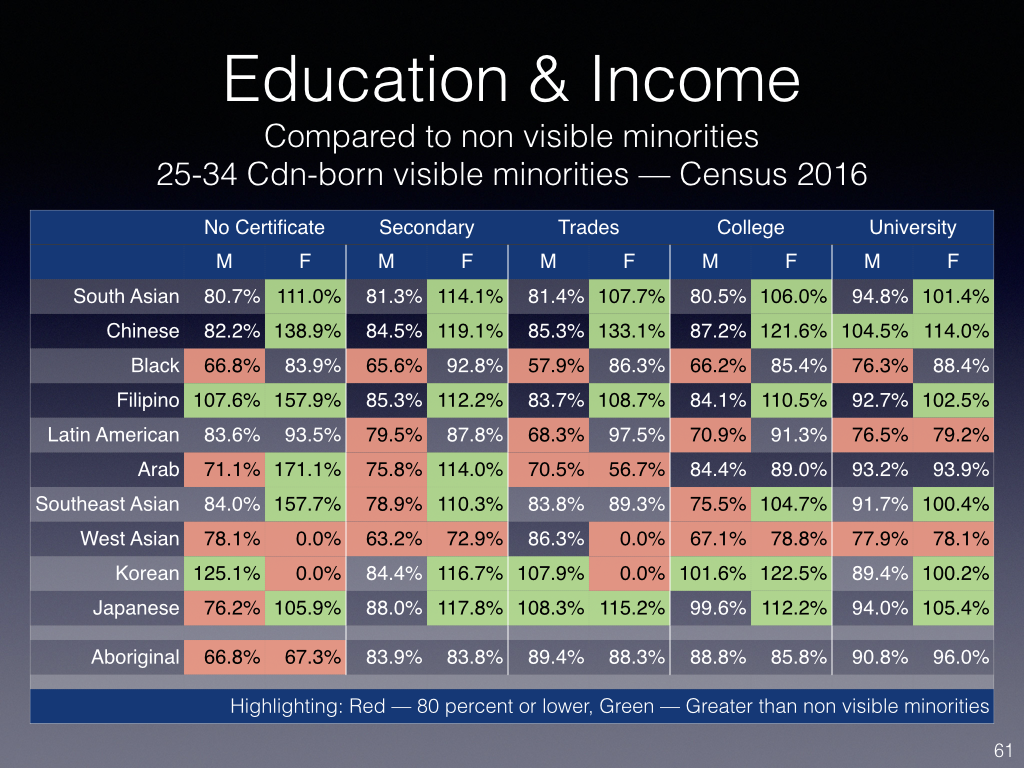
Ironically, when I analyse economic outcomes of visible minorities compared to not visible minorities, the gaps are larger between visible minority men and not visible minority men than is the case for women as the example looking at second generation 25-34 year olds below illustrates (similar pattern for first generation):

Not that many years ago, four to be precise, a senior journalist was sincerely trying to explain how his newsroom was attempting to diversify its staff.

Job applicants could check one of four boxes, he said. Gender, race, disability and sexual orientation. What box would I check, I wondered out loud.

“Race,” he said. And just like that, he erased major parts of my identity, rendering everything beyond my brown skin invisible.

This was about 25 years after civil rights advocate and scholar Kimberlé Crenshaw coined the term intersectionality to describe how people’s identities interact with power to create new forms of discrimination (specifically around Black women) when they overlap, and a few years after it had become a mainstream buzzword.

March 8 was International Women’s Day, a day that sprung from the women’s labour movement and began to be celebrated in many countries since the United Nations’ adoption of it in 1975. It gained a higher profile in recent years following important movements such as #MeToo.

But every day is every woman’s day. Celebrating the fierceness of the suffragettes who helped women win the right to vote doesn’t mean we forget that it was white women who won that right for themselves in Canada, Asians came decades later and that First Nations men and women didn’t have the right to vote until 1960.

If second-wave feminism looked at expanding rights beyond voting, I don’t know how we can celebrate representation in boardrooms and courtrooms without acknowledging that “diversity” initiatives have allowed white patriarchy to bend just enough to accommodate white women.

I don’t know how we can celebrate a narrowing gender wage gap without acknowledging that jobs traditionally done by women, often racialized women — health-care workers, daycare workers, nannies — are undervalued and underpaid. If full-time working women earned on average 75 cents to every dollar earned by a man, racialized and Indigenous full-time working women earned approximately 65 cents.

Women can use their own bodies however they choose, but I don’t know how we can celebrate Femen-type feminists and their topless protests without acknowledging that feminism is often reduced to sexual liberation or that sexual liberation is often reduced to the acreage of skin women expose.

For that matter, I don’t know how we think we’ve got anything close to liberation when women in the richest corporations are most valued when they show up to work looking thin, wearing tight clothes, tall heels and warpaint on their faces. And yeah, not in overly bright colours (too loud), not in overly short skirts (too slutty) or overly long ones (too daggy). Hair is ideally straight with a few waves permitted to flounce up at the bottom. While we’re at it, slow down those promotions if you must keep your hair grey, keep a ’fro or dreadlock or twist it, and heaven forbid you go home every time your kids are sick.

In other words, I don’t know how any reflection on the fight for women’s rights can be authentic unless it is intersectional. By that I don’t mean that we just include the voices of women who continue to be oppressed by identities of race, culture, caste, sexuality and disability.

To hell with “inclusion” and the paternalism inherent in it.

Inclusion is inviting a Black woman at a rally to speak about her experiences in a let’s-expand-our-minds sort of way. In this scenario, her experience — seen as a deviation from the norm rather than central to it — is still in service of non-Black women.

This kind of “inclusion” then allows organizations like the Toronto Public Library to claim diversity of thought and platform voices of those who reject trans women from the fold of womanhood.

On the other hand, true intersectional feminism means radically changing societal structures to put the most marginalized at the centre, making their concerns the first priority.

In this scenario, a discussion around sexual safety would yield not to more policing but less. In her book Invisible No More, Andrea Ritchie outlines how for white women, the concern around sexual assault and domestic violence is around police non-response. For women of colour, that police response is the problem, with too many experiences of officers responding to domestic violence calls sexually assaulting or otherwise violating the person who called for help.

The cases of the Missing and Murdered Indigenous Women and Girlsare not a sideshow from “mainstream” women’s issues, but central to it.

Prioritize those voices and support structures around sexual assault might start to look more like transformative education for all genders at schools and highly trained, legally empowered social workers might be brought to the front line.

On reproductive rights, if issues such as the forced sterilization of Indigenous women or the dignity of the poorest women were at the centre, the discussion would go beyond condoms and abortion rights. It would lead to a revolutionary battle to keep governments away from our bodies, a fight for free services including legal and medical support, among other solutions.

Trevor Phillips suspended from Labour over Islamophobia allegations

Never been a fan of some of the statements of Phillips, including the examples cited in the article. But expulsion only draws further attention to some of the weaknesses of Labour:

The former UK equality watchdog chief, Trevor Phillips, has been suspended from the Labour Party over allegations of Islamophobia.

The Times newspaper reported the anti-racism campaigner is being investigated over past comments dating back years.

Mr Phillips, ex-chairman of the Equality and Human Rights Commission, said Labour was in danger of collapsing into a “brutish, authoritarian cult”.

Labour said it takes complaints about Islamophobia “extremely seriously”.

A spokeswoman added: “[The complaints] are fully investigated in line with our rules and procedures, and any appropriate disciplinary action is taken.”

Mr Phillips was among 24 public figures who wrote to the Guardian last year declaring their refusal to vote for Labour because of its association with anti-Semitism.

He could be expelled from the party for alleged prejudice against Muslims.

Mr Phillips has been suspended pending investigation over remarks, including expressing concerns about Pakistani Muslim men sexually abusing children in northern British towns, according to the Times.

It says the complaint also covers his comments about the failure of some Muslims to wear poppies for Remembrance Sunday and the sympathy shown by some in an opinion poll towards the “motives” of the Charlie Hebdo attackers.

The paper said many of his statements are years-old but that Labour’s general secretary Jennie Formby suspended him as a matter of urgency to “protect the party’s reputation”.

‘A kind of racism’

Speaking to BBC Radio 4’s Today programme, Mr Phillips stood by his previous assertions that Muslims were “different”, adding: “Well, actually, that’s true. The point is Muslims are different and in many ways I think that is admirable.”

But he criticised the party for taking offence, saying: “I am kind of surprised that what is and always has been an open and democratic party decides that its members cannot have healthy debate about how we address differences of values and outlooks.”

Mr Phillips went on to describe the decision by Labour to adopt the definition of Islamophobia agreed by an all-party parliamentary group on British Muslims as “nonsense”, as Muslims were “not a race”.

He added: “My objection is very simple. That definition said…that Islamophobia is rooted in a kind of racism – expressions of hostility towards Muslimness.

“First of all, Muslims are not a race. My personal hero was Muhammad Ali, before that Malcolm X.

“They became Muslims largely because it is a pan-racial faith. This is not a racial grouping, so describing hostility to them as racial is nonsense.”

Mr Phillips was the founding chair of the EHRC, which is currently investigating anti-Semitism in the Labour Party, when it launched in 2006.

He has previously made documentaries about race and multiculturalism, and now chairs Index on Censorship – a group that campaigns for freedom of expression.

Asked if he would change his language as a result of the suspension, Mr Phillips pointed to this new role, adding: “Frankly, it would be a bit odd if I suddenly decided because I had been kicked out of the club, I couldn’t express my beliefs.”

Source: Trevor Phillips suspended from Labour over Islamophobia allegations

Yakabuski: Trudeau government’s deliverology experiment ends with a whimper

While all governments have both bureaucratic and political level tracking systems, deliverology being just one approach, the success or failure is often determined more on the lower priority files than the high profile screwups that Yakabuski highlights.

And execution has been the Achilles heel of many governments:

One of the great ironies of Prime Minister Justin Trudeau’s government is that it has proved so ineffective in the one area where it so emphatically promised to outdo its predecessors.

It was always presumptuous on the part of Mr. Trudeau and his former principal secretary, Gerald Butts, to suggest they would run a more effective government than any of those that came before them. But by dropping the ball so spectacularly on so many key files, Mr. Trudeau’s Prime Minister’s Office set itself up for the failure that has now befallen it.

There were self-satisfied chuckles of schadenfreude across the civil service this week as Mr. Trudeau announced the departure of Matthew Mendelsohn as the deputy secretary to the federal cabinet heading up the government’s “results and delivery” unit. With Mr. Mendelsohn’s return to academia, the Trudeau government’s much-hyped experiment in “deliverology” has ended in a whimper.

Mr. Trudeau thanked Mr. Mendelsohn for his “service to Canadians,” but cited not a single accomplishment made by the results and delivery unit that he and Mr. Butts had so championed. Nor did he name an immediate successor to Mr. Mendelsohn, a top official in former Ontario premier Dalton McGuinty’s government who is joining Ryerson University in Toronto.

Mr. Mendelsohn, in Twitter posts, tried to put a positive spin on his tenure, insisting that the “new governance, processes and routines we established helped the government overcome implementation obstacles and hit most of the key targets it identified four years ago.”

Still, the Prime Minister’s silence on the successes (or lack thereof) of the unit Mr. Mendelsohn headed contrasted sharply with the hubris that spewed out of the Butts-led PMO in 2015, which promised to revolutionize policy making and implementation in the federal capital.

Mr. Trudeau’s government spent at least $200,000 to pick the brain of Sir Michael Barber, flying the British consultant and “deliverology” guru to cabinet retreats at resorts in New Brunswick, Alberta and Ontario. Sir Michael was handed a mandate from the Privy Council Office to “provide ongoing information, recommendations and advice on a tailored program to guide departments to meet commitments and deliver on priorities.”

Unfortunately, Sir Michael’s services did not come with a money-back guarantee. And in the end, they may have bought only grief for Mr. Trudeau and Mr. Butts, who resigned last year in the wake of the scandal involving alleged pressure from the PMO on former attorney-general Jody Wilson-Raybould to offer SNC-Lavalin a deferred prosecution agreement.

To anyone who has worked in government, the whole concept of “deliverology” smacked of warmed-over administration theory repackaged by former bureaucrats-turned-consultants seeking to monetize their insider knowledge of the public service. And career bureaucrats do not take kindly to know-it-all political appointees telling them how to do their jobs.

The Trudeau PMO “imposed another layer of administration on some public servants. Their departments had been abiding by evaluation and performance policies for more than 40 years,” former Ottawa Citizen reporter Kathryn May wrote last year in Policy Options. “With deliverology, the public service still did all that work, and now they also had to report the progress on all the government’s goals to a ‘delivery unit,’ which, along with ministers and the Prime Minister, monitored and tracked these priorities.”

The Trudeau PMO has never seemed clear on its own priorities. So how could it expect the senior bureaucracy to be clear on them? At both the micro-policy level (electoral reform, balancing the budget by 2019) and macro-policy level (reconciliation with Indigenous peoples, supporting economic growth while fighting climate change), the Trudeau government has continually sent mixed signals to the bureaucracy about how seriously it takes its own promises.

When it has sprung into action, the Trudeau PMO has typically made a mess of it. The SNC-Lavalin affair, which started out with a straightforward move to bring Canadian law on deferred prosecution agreements in line with that of other developed countries, nearly destroyed Mr. Trudeau’s government all because the PMO failed to abide by its own deliverology credo.

It is perhaps no coincidence that the Trudeau government’s most notable successes – the implementation of the Canada Child Benefit and medical aid in dying, and the negotiation of new health-care funding agreements with the provinces – were overseen by low-key ministers who kept their eyes on the ball rather than their Twitter feeds. Social Development Minister Jean- Yves Duclos and Jane Philpott, Mr. Trudeau’s first health minister, were focused on results, not retweets.

Overall, however, execution has proved to be the Achilles heel of this government. It has proved inept at buying fighter planes or fixing the Phoenix pay system. It promised a bigger role for Canada in global affairs but has earned a reputation abroad for being fickle and stingy. The Canada Infrastructure Bank extends its record for overpromising and underdelivering.

Indeed, the scariest words in Canadian English may have become: “I’m from the Trudeau government, and I’m here to help.”

Source: Trudeau government’s deliverology experiment ends with a whimper

ICYMI: A Quebec ban on religious symbols upends lives and careers

Raises visibility of Quebec not in a good way:

A Muslim lawyer who wears a head scarf has put aside her aspiration to become a public prosecutor.

A Sikh teacher with a turban moved about 2,800 miles from Quebec to Vancouver, calling herself a “refugee in her own country.”

And an Orthodox Jewish teacher who wears a head kerchief is worried that she could be blocked from a promotion.

Since the Quebec government in June banned schoolteachers, police officers, prosecutors and other public sector employees from wearing religious symbols while at work, people like these three women have been grappling with the consequences.

François Legault, the right-leaning Quebec premier, says the law — which applies to Muslim head scarves, Sikh turbans, Jewish skullcaps, Catholic crosses and other religious symbols — upholds the separation between religion and state, and maintains the neutrality of public sector workers. The government has stressed that the vast majority of Quebecers support the ban.

“I would not feel comfortable being faced with a judge or lawyer in court wearing a head scarf here, because I would worry about their neutrality,” said Radhia Ben Amor, a research coordinator at the University of Montreal, who is Muslim and said she moved from Tunisia to live in a more secular country.

But the law has prompted vocal protests and legal challenges, as well as condemnation by Prime Minister Justin Trudeau.

Critics say it flouts freedom of religion, breaches constitutional protections and excludes minorities who choose to wear symbols of faith from vital professions. They also say implementing the law will be fraught because it can be hard to discern a religious symbolfrom a fashion accessory or nonreligious garb.

The English Montreal School Board said the law was forcing it to turn away qualified teachers. It said at least one teacher had removed her head scarf while at work to keep her job.

The Coalition Inclusion Québec — a group that includes Roman Catholics, Jews, Sikhs and Muslims — is challenging the law in court, along with three teachers, including two Muslims and a Roman Catholic.

Perri Ravon, a lawyer who has worked on two of the lawsuits against the ban, said that at least for now, “the law is disproportionately affecting Muslim women because the hijab is an outwardly visible religious symbol.” She noted that a Catholic cross was less conspicuous since it could be concealed in a blouse or a shirt while at work.

Nonetheless, the Catholic teacher named in one of the suits, Andréa Lauzon, who wears a visible cross and medallion of the Virgin Mary, said in court papers that her faith and identity were inextricably bound, and that her constitutional right to freedom of religion was being breached.

The ban has its roots in Quebec’s historic evolution into an abidingly secular society with a visceral distrust of religion, stemming from the so-called Quiet Revolution in the 1960s, when Quebecers revolted against dominance of the Roman Catholic Church.

Jean Duhaime, emeritus professor of religion at the University of Montreal, said that even before the recent law, the wearing of crosses in the public sector was stigmatized and discouraged in Quebec society.

He said Catholic opponents to the ban were in solidarity with other religious groups, adding that many proponents of the law saw Muslims wearing head scarves as “the phantom of religion reappearing in Quebec while viewing the hijab as an instrument of patriarchal domination.”

Here are four women whose lives and careers have been affected by the ban (see article).

Opposition MPs question purpose of Canadian consulate in Chandigarh, India, that sends work to New Delhi

Don’t see what the fuss is about. Distinction between front and back office functions fairly common. Decision to open Chandigarh was political as reported in article and, if I recall correctly, Global Affairs was not happy with the decision.

The office had a wall highlighting some of the fraudulent practices when then IRCC Minister Kenney visited it:

Opposition MPs on the House Immigration Committee are accusing the government of “deception” and “lack of transparency” after learning by “happenstance” two weeks ago that visa applications filed in the Canadian Consulate in Chandigarh, India, are processed in New Delhi, raising questions about the need for the consulate office when that work is done in the capital city.

In a House Citizenship and Immigration Committee meeting on Feb. 27, Conservative MP Kyle Seeback (Dufferin-Caledon, Ont.) asked departmental officials if they had any statistics on how many visa applications the Chandigarh office receives and the success rate of those processed there, compared to the New Delhi office. He said he asked this question because he had received numerous complaints from his Indo-Canadian constituents about the low success rate in getting visas in Chandigarh.

Mr. Seeback cited a specific example in which a visitor visa application was denied because the applicant had no travel history, when the applicant’s passport clearly showed that the same individual had a U.S. visa and had a travel history.

“Is there any review that takes place with respect to visa officers that are clearly making mistakes when they are rejecting a temporary resident visa, and there’s a procedure for a Member of Parliament or individual to raise that issue and see if there is any redress that would happen in the department?” Mr. Seeback asked, according to the transcript of the meeting.

In response, a senior departmental official told the committee that “for the last couple of years,” visa applications filed with the Chandigarh office were being processed in the New Delhi office. This was a surprise to many committee members; the idea behind opening the full service consulate office in Chandigarh in 2003 was to help Indians in the Punjab province and the neighbouring area to get service without having to travel eight or nine hours to get to the capital, where they often had to queue at 4 or 5 a.m. to get in.

In addition to the residents of Punjab, the residents of neighbouring province Haryana also visit the consulate office in Chandigarh, as it’s a shorter commute than New Delhi.

“So, I was absolutely shocked by that answer,” Mr. Seeback told The Hill Times. “I’ve spoken to other Liberal Members of Parliament who did not know that this was the case, and they were shocked that this was the answer given. As far as I know, this was not announced, and no one is aware of the fact that people in Punjab who go to Chandigarh to apply for a visitor’s visa, … they are effectively going to [be processed in New Delhi].”

In his response to Mr. Seeback’s question, the immigration official also said the decision making has been “shifted to Delhi,” but did not provide any specifics as to when the change happened, whose decision it was, who was consulted, and why this information was not publicly shared. He said only “complex” cases are handled in Chandigarh, but it was unclear what he meant by “complex” cases.

It’s not clear whether residents of Punjab and neighbouring areas are being forced to travel to New Delhi again for interviews as part of the application process.

“I do want to mention quickly that we do not process visa applications in Chandigarh, everything is now done in Delhi,” Harpreet Kochhar, assistant deputy minister of Citizenship and Immigration Canada, told the committee. “That has been happening for a couple of years. The decision making has shifted from Chandigarh to Delhi. [Only] complex cases are done in Chandigarh, but most of the decision making has shifted to Delhi,” Mr. Kochhar told the committee, according to the meeting transcript.

He conceded that sometimes officials make mistakes in their application reviews. But Mr. Kochhar added that sometimes individuals have visas for the U.S. or other countries such as Australia, New Zealand, and the United Kingdom, but have not actually travelled, which means they do not have travel history. Also, he said, the department has its internal quality control processes in place to evaluate how officers are processing applications. Mr. Kochhar said the unsuccessful applicants have the option to reapply.

“I do accept that at times there are mistakes. We regularly do a quality control check on our applications. We have an internal system of doing that, as well as the clients are more than welcome to reapply. We will reconsider if they reapply,” he said.

Mr. Seeback, who in the past represented the riding of Brampton West, said he was planning on questioning Immigration Minister Marco Mendicino (Eglinton-Lawrence, Ont.) on this subject in the coming weeks.

In an emailed response to written questions, a spokesman for Mr. Mendicino said the change to process visa applications from Chandigarh in New Delhi was made to speed up the processing times. He said the department is transitioning to a more centralized system to expedite the application review system.

“Immigration, Refugees and Citizenship Canada has been moving towards a more integrated, modernized and centralized system in order to speed up application processing and to improve client service,” wrote Kevin Lemkay, press secretary to Mr. Mendicino, in his email. “The department moves applications around its global network to ensure they are processed as efficiently as possible, which means applications may not be processed at or decided upon by decision makers at the office closest to where a client lives, or where an application is submitted.”

Mr. Lemkay also said that regardless of where the applications are filed, all applications are processed under the Immigration and Refugee Protection Act. He wrote that in 2018, 393,000 visas were issued to Indian nationals, an increase of more than 50 per cent compared to 2017.

“Applications may be distributed throughout IRCC’s networks to provide optimal processing times and to improve client service. Regardless of geography, all decisions are made in accordance with the Immigration and Refugee Protection Act and Regulations,” he said.

Neither Mr. Lemkay nor the department would say where the personal interviews for visa applications are done, or what is the precise role of the Chandigarh office. They also did not say what Mr. Kochhar meant by “complex” cases” that are processed there. The Hill Timesreached out to Mr. Kochhar for an interview request, but his office referred all questions to the departmental communications office.

“While the majority of temporary resident applications are processed in New Delhi, many are also processed in Chandigarh,” Mr. Lemkay said in his email. “Clients can submit their temporary resident applications to the nearest Visa Application Centre.”

Former Liberal cabinet minister Herb Dhaliwal—who played an instrumental role in opening up the Chandigarh office while in Jean Chrétien’s cabinet—questioned why Canada still has its office there if applications are being handled in New Delhi, in an interview with The Hill Times. He also said if the interviews are done in New Delhi, then it defeats the purpose of establishing the consulate office.

Mr. Dhaliwal said he was lobbied by members of the Punjabi community while a B.C. MP and cabinet minister to ask the government to set up an office in Chandigarh, as it was a long and expensive commute for their relatives and friends to apply for visas in New Delhi. The Punjabi community is an influential part of the Liberal Party’s voter base.

In 2003, Mr. Dhaliwal accompanied Mr. Chrétien to inaugurate the office.

“What exactly does the Chandigarh office do now?” questioned Mr. Dhaliwal.

None of the Liberal MPs from the Immigration Committee responded to interview requests from The Hill Times.

NDP MP Jenny Kwan (Vancouver East, B.C.) said that it was news to her that applications filed at the Chandigarh office are processed in the capital city. She said she looked up the Immigration Canada website after the committee meeting to see if there’s any indication as to where the applications filed with the Chandigarh office are processed, but didn’t find any information. Ms. Kwan said the government should be more transparent about this information, as an applicant has the right to know where his or her application would be reviewed.

“The government, with this change in not informing the public or anyone else for that matter, and the way in which they’ve set up the website to make you believe that things are still business as usual, is deceptive at best,” said Ms. Kwan, who is also a member of the Citizenship and Immigration Committee.

“The government, you know, in going forward with this without sharing basic information to the public about it, I think, is inappropriate. What are they [Chandigarh office] doing? It seems according to their website, the only thing they’re doing is to accept applications. Is that the only thing they’re doing? I have no idea, we don’t know. And there’s no transparency from the government on this.”

She said the lack of information leaves unanswered questions as to what does the change means for an applicant.

“In the very minimum, they should make it clear on their website, like people should know, right, and you cannot find that information out,” said Ms. Kwan. “And then more to the point, you will not know what it means.”

Source: Opposition MPs question purpose of Canadian consulate in Chandigarh, India, that sends work to New Delhi

It’s not a competition: Scotland’s skills and the post-Brexit immigration system

More on UK government’s immigration plans and the worries about the impact on caregivers:

In her policy statement to the House of Commons in February, the Home Secretary, Priti Patel, described the UK’s new immigration system as one that “prioritises those who come to our country based on the skills they have to offer, not on the country they come from”.The new points-based approach will be “fair” but “firm”, she said, and give top priority to highly skilled workers – “the brightest and the best” – to come here and drive innovation, grow the economy and, where necessary, support our public services.

Through this new system, Patel said, the UK will develop “a true meritocracy where anyone with the skills who wants to come here will have the ability to do so”.

The question for businesses in Scotland, though, is, which skills?

Representatives of the social care and hospitality sectors were quick to express their significant concerns about the impact that a restriction of so-called ‘low-skilled’ EU migrants could have on their businesses and the wider Scottish economy.

The Federation of Small Businesses Scotland, for example, has warned that around one in five small businesses could close or be forced to radically change their business models in order to survive.

But beyond economics, the immigration debate has also sparked a more fundamental discussion on the nature of skills and their relationship with pay and qualifications: who gets labelled ‘high’ or ‘low’ skilled and what type of skills does Scotland really need right now?

“The whole sector was extremely dismayed at the continued equation of low skill being of low value and of the equating of low skill with social care activity,” Dr Donald Macaskill, the CEO of Scottish Care, told Holyrood.

“My concern is that both some of our politicians but also the wider public think of the job of caring as something which anybody could do,” he said.

“That is simply not the case.”

Scotland’s care sector has particular reason to be concerned about the changes being proposed by the Home Office because it’s a sector that is already facing a skills and employment crisis.

Independent care providers are reporting significant vacancy rates. Skills Development Scotland (SDS) estimates there were 12,346 vacancies across the sector in 2018 and a ‘density of skills shortages’ of 28 per cent.

Shortages in rural areas, where the effects of an ageing population are most pronounced, have put care provisions under “unprecedented” strain. The Western Isles Health and Social Care Partnership is reporting that one in six frontline adult social care positions is vacant.

While this is already the case, the new immigration policy could stand to exacerbate these problems. Between six and eight per cent of frontline care home workers are from outside of Scotland. Up to 16.5 per cent of agency nurses, who often work in care homes, come from EU countries.

And whether by pay or by skill, many of these workers stand to fall short of the new system that aims to reduce the number of “cut-price EU workers”.

Prospective migrants would have to negotiate on a set of criteria including a salary threshold, language abilities, academic qualifications and, crucially, the points value attached to their particular set of skills.

The general salary threshold will be set at £25,600, which is down from the initial £30,000 suggested by the Conservatives a few months ago, after the Migration Advisory Committee (MAC) warned that such a high bar would make it difficult to recruit new teachers and NHS workers from abroad.

Such a salary threshold represents far too high a bar for many of the most critically required jobs in adult social care, where the average salary of a frontline worker is £17,500.

But with the right skills, the threshold could drop – as long as the skillset or industry qualify for a “tradeable points” mechanism in the system.

“For example,” Patel said, “a PhD in a relevant subject will earn extra points, with double the number of points for specialists in science, technology, engineering and mathematics.”

The emphasis on STEM disciplines reflects the government’s desire to sell the UK as a nation that is at the “cutting edge of life-changing innovation and technology”, somewhere the “finest international minds” would be attracted to live.

There will be concessions made to the system to reflect the need for workers in certain areas, such as a special visa tier for NHS workers. A separate scheme for seasonal agricultural workers will also be introduced.

And shortages for very specific roles included on the MAC Shortage Occupation List, like nuclear scientists and Gaelic-medium teachers, will continue to get easier access.

But care workers are set to fall short of all of these standards, for pay and, seemingly, for skill level.

This is the thing that Macaskill takes most exception to.

“In order to be a frontline social carer, you have to be registered with the Scottish Social Services Council (SSSC),” he says.

“You have to be qualified and that qualification has to be at SVQ level and over a period of time, you have to demonstrate that you are continuing in your professional development.

“And you have to have the necessary core skills. What are those core skills?

“They are the ‘softer skills’ and I suppose some of my critiques of the political statements and the immigration proposals is that they are very much based on what are called ‘hard, cognitive and technical skills’. They’re related to the earnings level that some of those skills attract.”

Care workers in Scotland are paid at least the Scottish Living Wage, unlike other parts of the UK, but the industry is still considered low paid. Still, the contribution of the care sector to the wider Scottish economy is hard to underestimate: the SSSC estimates the sector to be worth £3.4bn to the economy, and that’s before taking into account how adult social care alleviates the care burden and allows people to continue working in other sectors.

This is not a competition, it’s about validating skills and abilities which are of paramount significance to the wellbeing of a nation

The Scottish Government’s proposals for a Scottish visa to allow a tailored migration approach that would “[welcome] people with the range of skills we need to work” was rejected out of hand by the UK Government hours after it was published.

The First Minister has since offered to lead a delegation, made up of business and care sector representatives, to Westminster, to put the case for greater flexibility to the Prime Minister personally, but there has so far been no response. The Scottish Conservative party is continuing to meet with stakeholders before announcing a position on immigration that is likely to clash with the UK Government’s as well.

In the meantime, the discussion around the definition of low and high skills continues.

“What I’ve been calling for is a reorientation for what we mean by skills,” Macaskill said.

“And skills of compassion, empathy, communication, the ability to relate and the ability to deal with the various challenges, the ability to enable and encourage – all those that we have traditionally thought of as softer skills are, I think, as valuable to any society as technical skills and higher academic skills.

“This is not a competition, it’s about validating skills and abilities which are of paramount significance to the wellbeing of a nation,” he said.

The Future Skills Action Plan was launched in September 2019 following a commitment announced by the First Minister in the 2018-19 programme for government (PfG) to recognise “the importance of skills to improving Scotland’s productivity and economic growth”.

In the ministerial foreword to the plan Jamie Hepburn, Minister for Business, Fair Work and Skills, described Scotland’s need for a skills system that is “characterised by agility and flexibility”. The core vision of the plan is for a future where “Scotland’s highly skilled workforce ensures we are an ambitious, productive and competitive nation”.

The plan discusses the need to respond to the challenges associated with Brexit as well as climate change, including the need to develop a specific Climate Emergency Skills Action Plan to turn the existing skills across industries in Scotland toward creating an environmentally sustainable economy.

SDS and the Scottish Funding Council (SFC) are currently working on this plan. Both bodies have received a funding boost in the 2020-21 Scottish budget, with a 4.7 per cent raise for SDS to a total £224.8m and a £40m increase for SFC to £1.88bn.

Further measures to this end include £10m of additional funding for those already in work, through doubling the Flexible Workforce Development Fund and a £2m fund for innovation and skills in the transition to offshore wind power.

The limit to the potential of Scotland’s tech economy continues to be a digital skills shortage that runs all the way through from education to the present workforce.

“We need about 12,500 people every year and we produce about 5,000 from the usual sources,” Polly Purvis, the former head of ScotlandIS warned last year. Her successor, Jane Morrison-Ross, has said there are currently 13,000 vacancies across the sector.

In high schools, there has been a long-term decline in both the number of pupils taking computing as a subject and in the number of computing teachers – both still well below the levels of a decade ago.

For the current workforce, the Scottish Government launched the £1m Digital Start Fund to reskill workers, particularly those returning to work or who join from disadvantaged backgrounds, with skills like software development and cyber security much in demand.

Launching the scheme, then minister for digital economy Kate Forbes said: “Technology is forecast to be the fastest growing sector in Scotland by 2024, but success is dependent on skills. This is a big opportunity not only for tech businesses, but also to future employees.”

The Scottish Government also sees upskilling as a means for tackling issues such as child poverty. The 2019-20 PfG announced a £500,000 Family Learning Scotland Programme to help parents gain new skills and take up learning and training. The programme is designed to be integrated with the expansion of early learning and childcare to “allow parents to build on their skills and gain better work”.

And for young people, the apprenticeship route into careers is expanding. The Scottish Government says that over 37,000 apprenticeships were in training in 2018-19 with an expected 30,000 new starts projected for 2020-21.

With Scottish Apprenticeship Week running last week, from 2-6 March, SDS was encouraging councils, schools and employers to take part in raising awareness of apprenticeships as a more practical alternative to further education, leading to a wide range of careers, from technology to care.

SDS Director of National Training Programmes Katie Hutton said: “Scottish apprenticeships are increasingly becoming a vital means for industry to shape its workforce.

“More and more individuals are recognising the benefits of work-based learning, with opportunities to gain skills in careers for the future.

“Scottish Apprenticeship Week shines a light on the major contribution apprenticeships make across all business sectors and the difference they make to the lives of thousands of people across the country.
Source: It’s not a competition: Scotland’s skills and the post-Brexit immigration system