Donald Trump’s latest travel bans are cruel and senseless – and an opportunity for Justin Trudeau

Of the African countries included in the ban, immigration to Canada has increased for all of them 2015-19 (till November): Nigeria (4,090 to 11,175), Eritrea (2,210 to 6,555), Sudan (335 to 1,200) and Tanzania (150 to 200). So hard to see Kusmu’s case for “measures to directly increase immigration to Canada from those countries” given that it is already happening.

I am not sure about whether this would actually play a positive role in gaining African support for the Canadian Security Council bid, given that this is essentially a brain drain from Africa to Canada:

Understanding the news that came from the White House on Jan. 31 was an exercise in cognitive dissonance.

Earlier that day, President Donald Trump proclaimed February as National African-American History month. “Through bravery, perseverance, faith and resolve – often in the face of incredible prejudice and hardship – African-Americans have enhanced and advanced every aspect of American life,” he said.

But just a few hours later, his administration announced the latest round of travel bans, which will affect four African countries – Nigeria, Eritrea, Sudan and Tanzania – that contain nearly a quarter of the continent’s entire population (a continent he previously referred to as containing “shithole” countries). The various restrictions – the suspension of visas for people sponsored by family members and, for some, green card (i.e. diversity visa program) applications – go into effect on Feb. 22.

The Trump administration cites national-security concerns for those bans, including potential slips of aging identity-management systems and overall “elevated risk and threat environments”; past White House officials and current legislators have called the bans nonsensical and cruel. Indeed, those issues offer the government thin cover to arbitrarily target potential immigrants, most of whom are free to apply for a temporary visitor visa (which would theoretically nullify any security precautions) but are barred from the labour-intensive process of applying for an immigration visa that often requires years of intense vetting.

So if security seems like an unlikely motive for the administration’s latest move, what is? While there is some speculation it may be a play for diplomatic bargaining chips with those countries, the more probable motivator is Mr. Trump’s anti-immigration base as a presidential election looms. Unlike the 2017 Muslim ban, which garnered widespread condemnation and scrutiny, a craftier approach – targeting mostly African nations under the pretense of national security – has been adopted. (Myanmar and Kyrgyzstan were also included in this round of bans.)

What Mr. Trump and his supporters may not realize (or, more likely, care about) are the economic and moral consequences of this decision. Banning immigration from Nigeria, one of Africa’s fastest-growing and most dynamic economies, would essentially close America off to a demographic that has proven to be some of its most educated and, with it, direct access to what Newsweek named a growing global “economic superpower” – ironically, on the same day the bans were announced.

The graver implication is that this policy will bring ruin to the lives of the more than 12,000 potential immigrants expected to apply next year and the thousands more relatives and loved ones. The fact that families who are awaiting to permanently reunite with their aging parents or their distant partners on American soil will know that this is impossible, at least for now, is heart-wrenching. To make matters worse, Eritrea and Myanmar (where the Rohingya population is under threat of genocide) are experiencing outsize refugee crises, demonstrating yet again the cruelty of this measure.

Countries continue to erect walls against migrants, from the United States to Greece, which recently announced a (widely ridiculed) plan to create a floating barrier to block refugees on boats. Leaders continue to employ racist rhetoric; Mr. Trump, for instance, previously cited concerns that Nigerians visiting the U.S. would never “go back to their huts” in Africa. And this represents an opportunity for Canada and Prime Minister Justin Trudeau.

Canada will likely witness a large increase of immigration applications from the countries affected by Mr. Trump’s ban. As a country, we will be all the better for such waves, particularly since the infusion of new Canadians can help us offset the challenges that come with our increasingly aging population. And so Mr. Trudeau can counter Mr. Trump’s rhetoric and policies by announcing measures to directly increase immigration to Canada from those countries. If nothing else, it could serve as a last-minute rallying point to bolster his government’s campaign for a seat on the United Nations Security Council, especially as he embarks on an outreach tour of Africa this month.

But perhaps, more poignantly, this move could serve as a much-needed act of atonement to Canadians of African descent, for whom the memories of Mr. Trudeau’s blackface scandal from the 2019 federal election campaign are still fresh. Just as Mr. Trump’s Black History Month actions were telling about his government’s approach, there might be few better ways for Mr. Trudeau to signal his support of Black History Month in Canada this year.
Source: Donald Trump’s latest travel bans are cruel and senseless – and an opportunity for Justin Trudeau: Petros Kusmu

U.S. Could Actually Use More Nigerian Immigrants

By way of comparison, there are about 52,000 persons of Nigerian ethnic ancestry in Canada (Census 2016), about 71 percent first generation. In the last 5 years (January 2015 to November 2019, about 37,000 new Nigerian permanent residents have been admitted (IRCC, open data). Average and median incomes are lower than the overall Canadian numbers. While participation levels are stronger, unemployment levels are higher. Like most recent immigrant groups, Nigerians are more highly educated than the Canadian average.

See article for the charts regarding Nigerians in the USA:

This column will not render a verdict on whether the White House decision last week to suspend immigration from Nigeria — the world’s seventh most-populous nation — and five other countries was mainly an expression of bigotry from an administration led by a man who once likened African nations to latrines, or if it was a legitimate reaction to security concerns. It will, however, tell you some things you might not know about Nigerian immigrants in the U.S.

To start, there’s a fair number of them (which is why I’m focusing on Nigeria and not Eritrea, Kyrgyzstan, Myanmar, Sudan or Tanzania, the other five countries hit by the new ban). An estimated 374,311 Nigerian-born people were living in the U.S. in 2018, which put the country in 27th place as a source of foreign-born Americans, behind Pakistan and ahead of Japan. These and a lot of the numbers to follow are based on the American Community Survey that the U.S. Census Bureau sends out to 3.5 million households every year, so they’re subject to margins of error (19,648 for the number cited above), plus the inevitable strengths and limitations of self-reported statistics.

For example, the Census Bureau says there were an estimated 462,708 people of Nigerian ancestry in the U.S. in the 2018, but that’s based on what people put on the survey, not the sort of genealogical investigation that would surely reveal that there are millions of Americans whose forebears were brought across the Atlantic against their will in past centuries from the region of West Africa that is now Nigeria. Still, for our purposes the census survey is probably better, in that it restricts the scope mostly to recent immigrants and their kids. The members of this group have more than doubled in number since 2007, and they are for the most part doing quite well.

Source: U.S. Could Actually Use More Nigerian Immigrants

How John Legend’s Get Lifted Became a Major Production House for Multicultural Storytelling

Given the overall lack of diversity in the industry as exemplified in the various awards, worth noting:

In the eight years since Get Lifted Film Co.’s start, the partnership launched by John Legend, Mike Jackson and Ty Stiklorius has grown to become an industry player. Launched in 2012, Get Lifted has delivered one thunderclap after another, from WGN America’s record-setting sensation “Underground,” to the Oscar winning “La La Land,” for which the company served as executive producer. On the stage, Get Lifted produced a 2017 Broadway production of August Wilson’s “Jitney,” for which its founders won the Tony Award for Best Revival of a Play.

The trio has built a successful and influential independent production house without much fanfare, and have largely avoided any vanity press. They have more recently started to discuss the company, and all three founders sat with IndieWire last month for a lengthy and candid conversation about the origins of the company and its vision for the future.

“Hollywood has changed over the years, for women and people of color, because it was hard when we started,” Jackson said. “’12 Years a Slave’ hadn’t won an Oscar. And so we would pitch projects like a black historic biopic for example, and executives would scoff. So it’s been revealing to have been there before, and then to now see so much more openness and interest in the kind of stories we wanted to tell, but couldn’t.”

For many, Get Lifted is principally known as Legend’s company, but the company’s aspirations go far beyond his own musical and acting ambitions. (Its catchphrase: “Smart, Elevated, Commercial.”) The company’s most groundbreaking project to date is “Underground.” A critical success that also broke viewership records for WGN America in its first season in 2016, the series was a bold, refreshing take on the slave narrative, unfolding more like a fast-paced action-drama, than anything TV audiences had seen before it. And it caught on quickly: Slave narratives weren’t quite the same again after that, with last year’s Harriet Tubman biopic, “Harriet,” taking a similar approach.

“That really represented who we are and the types of chance-taking stories we wanted to be at the forefront of,” said Jackson. The project was a real breakthrough for the company. “It was something that came to us already pretty much baked, but we ensured that our DNA was in the show.”

They also tout the critical success of their new sketch series “Sherman’s Showcase,” which premiered on IFC last fall to raves. Created by Bashir Salahuddin and Diallo Riddle, the series is hosted by Sherman McDaniel (Salahuddin) as he takes viewers through time via music and comedy drawn from the 40-year library of a legendary (but fictitious) musical variety show.

“It’s very smart, probably the best-reviewed thing I’ve ever been part of in my life,” said Legend. “There’s been this assumption that there isn’t an audience for intelligent black content, but we’re proving that it’s obviously not true.” The series will return with a one-hour “Black History Month Spectacular,” this summer, not in February.

Get Lifted’s latest offering, the Netflix hip-hop competition series “Rhythm + Flow,” was released in October 2019, also to raves.  In the series, which the company developed internally, hip hop artists Cardi B, Chance The Rapper, and Tip “T.I.” Harris critique and judge unsigned rappers, who are competing to win a $250,000 prize.

As usual, Netflix hasn’t released viewership data on the series, but its contestants have become stars virtually overnight, with the winner, a 34-year-old rapper named D Smoke, seeing his Instagram follower count skyrocket from around 7,000 to over 1.3 million in a matter weeks.

“Rhythm + Flow” is the first original music competition program for Netflix, which was the most sensible home for it, Legend said. “It was hard to try to make it at a regular network because of the language,” he said. “And there’s so many things that would sand off the edge of the show if it were sanitized, and hip hop needs edge. And we’re so happy to partner with Netflix because they allowed us to do exactly what we wanted to do.”

It’s a long way from when they first launched Get Lifted, and had to prove themselves. Some didn’t take them seriously: Legend’s celebrity was seen as a handicap, and they were treated like a vanity company. However, the founders that only made them more inclined to take risks.

“We had almost nothing to lose at that point,” Stiklorius said. “And so, looking back on those years when a lot of people were saying things like, ‘You’ll never make it in this town,’ it’s great that we’ve built a strong reputation for having great taste and great work ethic.”

As the company has grown, they haven’t lost that nerve — whether it’s with a wholly original program like an IFC sketch variety show that’s unlike anything before it, or NBC’s “Jesus Christ Superstar Live in Concert,” which Legend starred in.

A lot of people balked at that last one. “The three of us talked and decided, John being the black Jesus? We’ve got to do this,” Stiklorius said. “We exec produced it, and then we won the Emmy for it. But everything about how we live our lives, and what we’ve done to get to this point, is about going against the norm, doing the work and believing in ourselves.”

The three founders have been friends for many years. Stiklorius and Jackson grew up together in Philadelphia. Legend met Stiklorius in college, at the University of Pennsylvania, in the mid-1990s, where they sang in an a capella group. She would eventually introduce Legend to Jackson, who became the singer’s first manager, after graduating from Penn in 1999.

Legend’s music career took off when his debut studio album, “Get Lifted,” was released in 2004 by Columbia Records. Music eventually brought him into the world of film and television, and he never looked back, becoming increasingly more influential as his celebrity grew. Get Lifted Film Co. was born not long after that. They sold over two dozen shows almost immediately, but quickly realized that getting those projects on the air was a whole separate challenge.

“We would pitch and they would buy it in the room, and we were thinking, ‘This is easy’,” Stiklorius said. “The frustrating part was getting all the way to the finish line with any project. But we knew that we had really great ideas, because they were at least buying into them.”

Get Lifted landed its first overall deal from Universal about nine months after it launched, which kept the company afloat as its ambitions grew. It took another three to four years before its first TV show actually made it to series — “Underground,” in 2016 — and it was a big year for the company, which had a hit TV series and two feature film releases: the young Obama romance, “Southside with You,” and “La La Land.” Following its Sundance premiere, “Southside With You” was praised by critics, and was a mild box office hit; and “La La Land” received a record-tying 14 nominations at the 89th Academy Awards, winning in six categories.

More deals would come, including a multi-year overall production pact signed in early 2017 with independent studio Critical Content to create unscripted television and digital media content. A few months later, the company inked a first-look deal with Sony Pictures Television, and in 2019, signed a three-year overall deal with ABC Studios after a multiple-studio bidding war.

Now, Get Lifted is benefited from changes to the industry climate, from the rise of streamers to increased pressure to diversify. The founders said they have more outlets for their projects, but like anyone else, faced more competition than ever before. One advantage: Legend’s starpower and social media reach, which includes over 13 million followers on Twitter, and close to 12 million on Instagram.

The company has a lot in the pipeline, but the project they expressed particular enthusiasm for upcoming Netflix musical “Jingle Jangle,” written and directed by David E. Talbert. Get Lifted’s biggest and most expensive project to date, it stars Forest Whitaker and Madalen Mills in the story of a toymaker and his granddaughter who construct a magical invention which, if they can get it to work in time for the holidays, could change their lives forever. Jackson called it “black ‘Willy Wonka.’”

Talbert had been trying to get off the ground for nearly two decades when Netflix bought the pitch in 2017, and Get Lifted came onboard as producers the following year. “It’s amazing to be part of something that’s really this huge, with this budget, for original content by a black writer and director, with an all black cast, and black producers,” said Legend. (Netflix is targeting a fall release.)

So what does Get Lifted envision for the future? “World domination,” Jackson joked, but noted the company has developed an international footprint with unscripted shows like “Rhythm + Flow.” The team is are also having broader conversations about how to expand the brand, and the potential of owning their own distribution channels so they can operate on multiple platforms.

“We’re pretty ambitious and have smartly taken our time and built our business slowly and systematically,” Legend said. “Now we’re at that point where we can expand it globally, and really make a dent, without ever losing our identity and without compromise.”

Source: How John Legend’s Get Lifted Became a Major Production House for Multicultural Storytelling

Ripple effect on Canadian immigration likely from Trump’s new visa restrictions

We shall see but agree with Falconer that it could go either way:

U.S. President Donald Trump’s decision to slap visa restrictions on six new countries could affect immigration flows to Canada.

Past moves by his administration on immigration policy for Haiti and Iran saw asylum claims and student visa applications in Canada jump.

Trump is now targeting visas granted to citizens of Nigeria, Sudan and Eritrea, among the largest sources of refugee claims lodged by people crossing irregularly into Canada from the U.S.

Immigration policy researcher Robert Falconer says Trump’s move could have both positive and negative impacts on the Canadian immigration system.

He says the number of asylum seekers could rise, as people from those countries already in the U.S. realize they won’t be able to stay permanently and so follow others who’ve already come to seek refugee status here.

But on the other hand, he says Nigeria’s booming middle class could be the source of many new economic or student immigrants to Canada, now that the door to the U.S. is harder to get through.

Source: Ripple effect on Canadian immigration likely from Trump’s new visa restrictions

Non-citizen parents allowed to return home with Canadian children from Wuhan

Good:

The Liberal government insisted China let the primary caregivers of Canadian children return to the country with those children after leaving Wuhan, the epicentre of an outbreak of the novel coronavirus, even if they are not citizens themselves.

“We insisted on the concept of family unity,” Foreign Affairs Minister Francois-Philippe Champagne said Monday in Ottawa.

A chartered plane will soon be in Hanoi, Vietnam, where it will wait to pick up Canadian citizens — and some permanent residents accompanying their children — from Wuhan, the city of 11 million people in the central Hubei province that is currently under quarantine in response to the outbreak.

The federal government is awaiting final approval from the Chinese government to fly through the restricted airspace and land at the closed airport in Wuhan, but Champagne said other preparations are already well underway.

“We will be in touch with Canadians in Wuhan later this afternoon to provide them all the necessary details,” Champagne said.

Federal Health Minister Patty Hajdu said 304 Canadians have asked for assistance to return home but only 280 have Canadian passports.

The numbers remain fluid and Canada has secured a second flight, as well as seats on other flights, should they be needed.

China is allowing only foreign nationals from all countries to board repatriation flights, but Champagne said Canada insisted that children be able to fly with their primary caregivers, even if they are permanent residents, and China agreed to let this happen.

That will not apply to families where no minors are involved.

Hajdu says China will not allow anyone who is showing symptoms of coronavirus to board a flight to leave the country, even if they are Canadian citizens, as part of that country’s efforts to control the spread of the coronavirus.

“I don’t anticipate we will be able to get the Chinese to concede on that point,” Hajdu said.

Those who remain will be offered consular services from the rapid deployment team already on the ground in Wuhan.

Passengers will be screened twice — once by Chinese authorities and then again before they board — and will be monitored during the flight for possible symptoms of the virus.

If any fall ill, they will be transported to a health facility in British Columbia while the plane refuels. Otherwise, passengers will not be allowed to leave the plane until they arrive at Canadian Forces Base Trenton, where they will be held in isolation for 14 days.

The Ontario base was chosen because it has the space to allow large numbers of people to be processed quickly, and a facility where people can be housed with dignity, said Hajdu.

“I want to remind people that these are Canadians who have been through a very traumatic experience over the past couple of months and in many cases will have significant stressors,” Hajdu said.

The repatriated Canadians will be housed at the nearby Yukon Lodge until they are cleared to return home.

“Part of the reason we’re offering social support is they will also be isolated from one another,” Hajdu said. “So if one person falls ill, that won’t necessitate the start of an entire other quarantine for all of the passengers.”

Source: Non-citizen parents allowed to return home with Canadian children from Wuhan

The Limits Of Nudging: Why Can’t California Get People To Take Free Money?

Interesting study and analysis. Wasn’t able to find comparable take up data to the Canadian equivalent (Working Income Tax Benefit rebranded as the Canada Workers Benefit) but about 5 percent of tax filers claim the benefit.

Given the number of benefits delivered through the tax system, expect Canada has a higher filing rate than the US:

The Earned Income Tax Credit supplements incomes through the tax code, awarding thousands of dollars each year primarily to low-wage workers with kids. But there’s a problem: a huge population of eligible workers fails to file their taxes and get the money each year.

Several years ago, the state of California established their own state EITC (CalEITC) on top of the federal one. Depending on how many kids they have and how much they earn, a Californian who files for both the state and federal credit can get upwards of $6,000. For the poorest households with kids, those tax credits could almost double their household income. There’s a lot of money on the table to help the most at-risk families in the state, and California policymakers have grown concerned about the large number of eligible workers failing to file taxes and claim their credits.

In 2018, the state of California and the California Policy Lab, an interdisciplinary think tank of scholars from various University of California schools, started trying to solve this problem, and they commissioned one of the most fascinating experiments in “nudging” we’ve seen in a while.

Nudge Experiments

Nudges are simple, low-cost interventions aimed at gently guiding people to make better decisions. For example, making retirement plans the default option when you join a job, which has been shown to significantly increase the likelihood you save more for retirement. The California Policy Lab and its partners decided it would try and nudge workers to claim the EITC by sending them letters and text messages. The solution seemed like a no brainer: inform people how they can get free money, and they’ll get that free money! If only it were that simple.

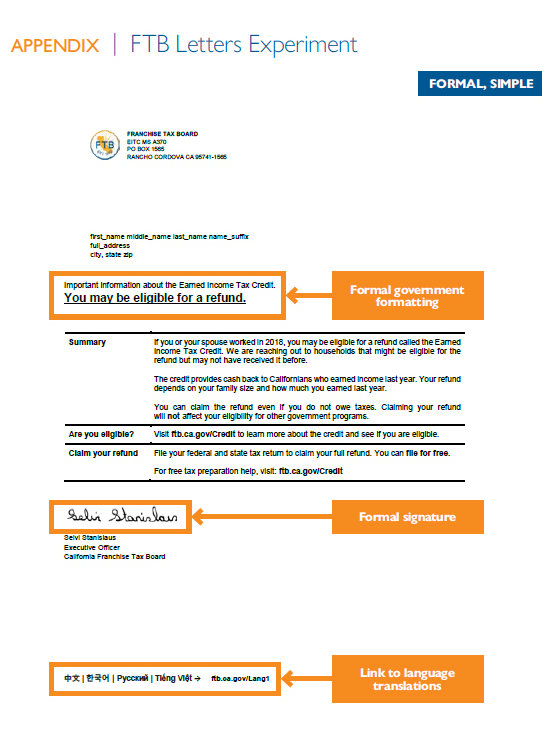
The researchers conducted field experiments for two years on over a million Californians. They randomly divided them into treatment groups, which received various types of messages, and a control group, which received no message. “We were trying lots of different ways of reaching people, lots of different messages you could give people, but to try to test what would be most effective,” says Jesse Rothstein, a labor economist at UC Berkeley who co-directs the California Policy Lab. The researchers tried to make sure these letters and text messages didn’t look like a scam. Below is an example of one letter they sent:

An example of a letter sent in the EITC experiment

California Policy Lab

“We found a very precise zero effect,” says Elizabeth Linos, a behavioral scientist at UC Berkeley who was also behind the study. Many of those who received the messages, she says, did visit the website advertised in the messages to help them sign up for the EITC. But in the end, they didn’t fill out the forms to receive their credit. They turned down free money. “We weren’t able to increase the rate at which people file for taxes and we weren’t able to increase the number of households that claim the EITC,” Linos says.

This experiment might seem like a gigantic failure for behavioral economics and the theory of nudging. But both researchers believe their findings support the broader idea that people aren’t the perfectly calculating, error-free creatures of traditional economic models. They’re turning down free money — even after they’re informed they can get free money.

The researchers don’t have a solid answer for why the nudges failed. They believe, however, a big part of the problem has to do with tax forms. “Those of us who file taxes know that it’s not so easy to file taxes,” Rothstein says. “And so we’ve gotten people to understand that it’s there and to want it. But we haven’t really given them the tools that it would take to make it easy for them to claim it.”

Linos and Rothstein believe our tax system is too complicated, and that we should make claiming the EITC, and filing for taxes more generally, much simpler. Linos says the good news is that other countries provide examples of systems that don’t require mind-numbing paperwork to file for taxes or receive government benefits. “In a lot of countries, the government uses information they already have on you to pre-populate your tax forms,” she says. In other words, they tell you what you owe. Or are owed. Then you can just look it over and click send.

But we’re not other countries. We’re the USA, where filing for taxes is still stupidly hard. The IRS estimates that about 20 percent of eligible taxpayers fail to file and claim the EITC. Rothstein believes the solution to getting more people signed up for the EITC has to be a mixture of nudging them to sign up and “structural changes that make it easier to file taxes.” This could include an expansion of programs aimed at giving people assistance with taxes, including software designed to make filing easier.

A dark view of the findings might write off this population as doomed to poverty because of bad decision-making and self-destructive behavior. But psychologist Eldar Shafir and economist Sendhil Mullainathan suggest a more charitable lens, which they call the “psychology of scarcity .” Their research suggests the poor bear a unique cognitive burden that hurts their decision-making. They work long hours. They have higher stress. They’re consumed with thinking about paying their rent, getting their kids medical care, and putting food on the table. Shafir and Mullainathan find these stresses lower their “mental bandwidth,” and it might help explain why so many low-income Californians are turning down free money.

Source: The Limits Of Nudging: Why Can’t California Get People To Take Free Money?

Cole: What Canada’s public service employee survey is really telling us

The one time that I found the Survey particularly helpful was when I was managing the merger then CIC citizenship and multiculturalism divisions following the 2008 decision to move multiculturalism from Canadian Heritage (reversed in 2015 under the Liberals).

The survey indicated much higher satisfaction from the citizenship side than multiculturalism, a sober reminder of just how hard and how long it takes to integrate different diversions from different departmental cultures.

And of course, like all government surveys and publications, there is a certain amount of sugar coating (we rely on the OAG for more candour!) but the survey nevertheless serves a useful function in providing an opportunity for departments, down to the DG-level in my day, to get an absolute and relative sense of employee views:

Here’s my take on the 2019 Public Service Employee Survey, which was recently made public:

• The published results are unduly positive and actually misleading;

• Meaningful results are not published;

• There is no acknowledgement of good or bad results;

• No one seems to be accountable for the results; and

• No apparent effort is being made to improve on the results.

I have been involved in and reporting on the PSES since it was first implemented in 1999. Here’s the clear message coming out from employees in this survey: “We’re mostly not a happy bunch.”

Yes, the official results overall look fairly good. Look closer. Reports state that 62 per cent have confidence in their senior management. What is not stated is that only 29 per cent have a lot of such confidence. Isn’t this misleading? Results for many other questions are similarly skewed.

Here are some other meaningful responses to some specific questions:

• Only 24 per cent feel their agency does a great job supporting career development;

• Only 21 per cent seriously feel that any good idea they presented would be supported;

• Only 25 per cent think their workplace is very healthy;

• Only 15 per cent think that change is handled very well in their agency;

• Only 27 per cent feel the agency does a great job of explaining what it does; and

• 38 per cent gave their implicit opinion: They did not return the survey.

It’s fairly easy to score the results and rank the agencies on a “best agencies to work for” basis. That list effectively acknowledges the top federal agencies while establishing target benchmarks for the rest.

Agency heads do not appear accountable to achieve positive results nor to take any specific action responding to negative results. Based on my own experience and hearing from a few current employees, there’s a little buzz created with the survey but things rapidly return to the status quo. It’s like the French expression, “Plus ça change, plus c’est pareil.”

There is no evident major effort made to act on the PSES results by improving the workplace. Certainly nothing like that shows up on the Treasury Board website. There used to be a very telling question in the survey asking employees if they thought senior management was going to do much with the results. In 2014, the response to that question showed that just 17 per cent of employees were much convinced. That question has since been removed.

Here are a few suggestions to act positively in response to the survey:

• Give the straight goods when reporting the results. No sugar-coating;

• Officially publish a “best” list. Reward agency heads or not, according to their placement on the list. Heck, put their names on the list too:

• Ensure that agency heads demonstrate care and compassion for employees as a mandatory requirement to being hired;

• Celebrate the top-rated agencies on the list, such as Western Economic Diversification Canada, number one on my list. Tell their story. Reveal their secret to success.

• Publicly describe what the other agencies are doing to improve: what’s working, what isn’t.

• In future surveys, offer employees the chance to suggest ways to improve their workplace, their work or the whole public service. Review all suggestions, pick the best ones, implement them, reward the contributors.

• Add a bit to the survey so employees can confidentially answer a few key questions and get a sense of their health risks with pointers to improve their health. Such tools are already used and available in Canada.

These are just a few strategies that can fire up and empower the 300,000-some public service employees to better use their creativity, knowledge and experience to improve their workplace and, consequently, better serve all Canadians.

That’s what I want to see.

Jake Cole spent 34 years in Canada’s public service working in six different agencies. For his “best” list of all 66 major PS agencies, contact: colejster@gmail.com

Source: Cole: What Canada’s public service employee survey is really telling us

Albert Speer, the Hitler Henchman Who Enabled the Holocaust, Bears Another Look Today

A good look back on Speer and some general points on complicity:

The last of the Auschwitz survivors to revisit the extermination machine in Poland have left. Now very old men and women, they returned to mark the 75th anniversary of the infamous death camp’s liberation last Monday.

Memory inflicts no greater pain than is theirs. The day they were freed in 1945 was both an end and a beginning: the end of terror and the beginning of remembering.

And one of the things to remember is not just the vast horror of the Holocaust but the fact that it was conducted as an industrial enterprise by managers and bureaucrats with a chillingly impersonal attention to detail. Adolf Hitler’s demonic program of genocide would have come to nothing without his enablers.

On Feb. 6, 1944, SS Obergruppenfuhrer Oswald Pohl, who headed the part of the Nazi terror machine given the bland name Office of Economic Administration, wrote a report with the title “Utilization of Textiles: Used Clothes from the Jewish Resettlement.”

He complained about the condition of “material so far obtained from the Jewish resettlement in the camps in the Lublin area, and Auschwitz.” Much of it, “particularly for men, is much diminished by the fact that many clothes are rags…”

Speer’s story reminds us in a timely way that it’s not only the knowingly depraved who gather around a tyrant.
The SS controlled the distribution of the clothes and possessions taken from the Jews as they arrived at the death camps. Every train delivering prisoners left on its return journey loaded with those possessions. Items of value, like jewelry, gold, including gold teeth, and foreign currency mostly ended up in the Reichsbank in Berlin, their worth carefully noted in ledgers. The clothes, if at all serviceable, went to the “foreign workers” who were part of a gigantic program of forced labor producing weapons and munitions.

That program was designed and overseen with clinical efficiency by Albert Speer, the Reichsminister for Armaments and Munitions,

Five days later he wrote to Heinrich Himmler, the head of the SS, complaining that he needed all the steel, wood and manpower he could get for building arms factories: “We must therefore carry out a new planning program for construction within the concentration camps… [that] will require a minimum of material and labor. The answer is an immediate switch to primitive construction methods.”

Pohl, not Himmler, replied with a furious reminder that Speer had himself signed off on all the plans for building the camps and said a switch to primitive materials was “unrealistic.” He continued: “…we have 160,000 prisoners and are constantly battling against epidemics and a disproportionately high death rate, both largely due to impossible sanitary conditions.”

Of all those involved in the Nazi terror machine, Albert Speer was, literally, the most elusive—elusive because he escaped a death sentence at the Nuremberg trials of Nazi war criminals, and elusive because until the end of his life (he died in 1981) he was never able to display any guilt about his role as an accomplice to genocide.

Late in 1943, when Speer had brought about a dramatic revival of German arms production, the issue of Hitler’s succession was being discussed quietly by his generals and some lower level ministers.

At this point they were not talking about a coup, but a planned succession with Hitler’s consent. They ruled out the founding Nazi psychopaths, Himmler, Goebbels, Bormann and Goering. One minister told Speer he thought Hitler himself favored Speer—nobody else had such a close relationship with him. Speer did not disagree, but the moment never came.

Speer’s story reminds us in a timely way that it’s not only the knowingly depraved who gather around a tyrant. Equally dangerous are those, like Speer, who provide the system with their intellect while in denial about the consequences. Some people do this because the tyrant helps them to advance their own agendas; others do it just because being in the same room delivers the craved-for embrace of power.

Once Speer fell within Hitler’s spell he enjoyed his proximity to absolute power, no matter how vile its actions.

Speer had first endeared himself to Hitler as an architect.  They shared a taste for the Greco-Roman style of triumphal buildings. This culminated in Speer’s plan to replace Berlin with a new capital city called Germania for the thousand-year Reich. At its center—roughly where Berlin’s Reichstag now sits—there was to be a Great Hall with a massive dome nearly 1,000 feet high (the U.S. Capitol dome is 284 feet high).

Speer was always resistant to self-doubt. Once he fell within Hitler’s spell he enjoyed his proximity to absolute power, no matter how vile its actions. And Hitler clearly enjoyed his frequent communion with Speer. In these moments of spiritual kinship, talking of art and architecture, Hitler was flattered by Speer into thinking that he was an aesthete at the head of an Aryan empire purged of all racial impurities.

He claimed that he had not been present at a conference in 1943 when Himmler spoke of ‘wiping Jews from the face of the earth.’

On the night of Oct. 16-17, 1946, ten of Hitler’s closest associates were hanged in the gymnasium of Nuremberg prison, having been found guilty of war crimes. Speer was there and heard their names being called out. But he was spared, given a 20-year sentence to be served in Spandau. (Oswald Pohl was executed in June 1951.)

Afterward it emerged that the principal American judge, Francis Biddle, and the Soviet Union’s judge, General Iona Nikitchenko, had voted to sentence Speer to death, but another American judge, John Parker, and a British judge, Norman Birkett, argued for clemency, apparently because he seemed to them too refined to be a mass murderer. Also taken into consideration was his cooperation with Allied intelligence. The jail sentence was a compromise reached after a two-day argument among the judges.

Speer was released in 1966. He published a self-serving best-selling version of history, Inside the Third Reich, and became wealthy, considered by many as the rare “Good Nazi” who had done what he could to curb the worst of Hitler’s instincts. He had always acknowledged that his industrial plan had depended on slave labor, including many Jews, working under appalling conditions, often dying on the job, but denied any knowledge of the scale of the Holocaust.

He claimed that he had not been present at a conference in 1943 when Himmler spoke of “wiping Jews from the face of the earth.” But 25 years after his death a newly discovered cache of letters revealed that he had, indeed, been present. The master dissembler was finally exposed as the monster he was.

It’s always questionable to introduce the Nazi regime as a caution when looking at our own present carelessness with the values of our republic. The Holocaust was a crime of such enormity and singularity that we can too easily trivialize it by invoking any historical comparison.

Nonetheless the message from Auschwitz was reinforced by its anniversary: Ronald Lauder, head of the World Jewish Congress, said he was worried that the lessons were being forgotten: “Auschwitz is a beacon of where anti-Semitism can lead, we can’t rewrite history but we can be much more forceful today.”

A wave of anti-Semitic attacks and hate crimes in the U.S. has followed the massacre of 11 people in a Pittsburgh synagogue in October 2018. Three people were killed last December in a shooting at a kosher grocery in Jersey City and at least 10 anti-Semitic incidents took place in the New York area over Hanukkah.

One issue raised by several of the Holocaust survivors at Auschwitz was how such a barbaric crime could happen in a country that, until then, was regarded as both civilized and an intellectual powerhouse. It seemed all too easy for the Nazis to operate with the silent consent of a majority of the German people.

Speer addressed this in an interview with the British journalist Gitta Sereny, who spent 10 years studying his life for a riveting book, Albert Speer: His Battle With Truth. He was responding to a charge that he tried to present himself as the prototype of the new technological man while he had conveniently overlooked the connection between technology and a program of mass extermination. He argued that the machinery of murder had nothing to do with technology, it was too primitive. And then he said:

“Eighty million people were not persuaded to follow Hitler because they knew he was going to murder people in lime ditches and gas chambers; they did not follow him because he seemed evil, but because he seemed extraordinarily good. And what convinced them of this was Goebbels’ brilliant propaganda, his unprecedented use of modern means of mass communication.”

It’s terrifying to think what Goebbels could have done using today’s means of mass communication. But perhaps we already know

Source: Albert Speer, the Hitler Henchman Who Enabled the Holocaust, Bears Another Look Today

‘We Are Canada project’ showcases diverse Canadian stories of resilience, tenacity and tolerance

Nice initiative by the CRRF:

Whether they were born here or came from somewhere else, they all share the same resilience and drive to thrive in this land of opportunity and make Canada a stronger country.

Through civic engagement, social activism and volunteering, community leaders and activists featured in the Canadian Race Relations Foundation’s new project showcase personal stories that reflect the values Canadians share in spite of diverse backgrounds.

In light of the rise of nationalism and nativism around the world, Lilian Ma, the foundation’s executive director, said the “We Are Canada project” profiles ordinary Canadians who fight for social justice and contribute to the country in their respective ways.

“They are community heroes who make a difference in Canada. We want to make their stories known to other Canadians,” Ma said.

The idea of the virtual storybook came from photographer and writer Jean-François Bergeron, who grew up in a “secluded and closed” community in Quebec and was inspired by people he met while travelling across Canada over the years.

“I grew up in a very homogeneous city. There’s no exposure to foreign languages and other skin colour. Then I came across all these people from different faiths and cultures. I was impressed by how they all have shared values and common visions,” said Bergeron, who spent months travelling from coast to coast to photograph and interview dozens of people referred through his community and professional networks.

“They all have this strong desire to contribute to Canada. Their stories share the themes of resilience, tenacity, tolerance and hard work.”

Born in Toronto, Kristin Kobayashi was thrilled when she was approached to share her story. Her ancestors came to Canada from Japan as early as 1906 and went through displacement and internment here during the Second World War. Unlike her parents who grew up being pushed to be “more Canadian and less Japanese,” Kobayashi was raised to acknowledge her heritage and not be ashamed of her roots.

To her, Canada embodies open-mindedness, inclusiveness, the respect of diversity and cultural traditions, freedom of expression and equal opportunities.

“These are the values I was raised with and am trying to promote,” said Kobayashi, an investment adviser, who has been involved in the Japanese Canadian Cultural Centre, Canadian Multicultural Council and the Toronto Police Service Asia Pacific Community Consultative Committee.

“It does not matter where people came from. It doesn’t make them less Canadian. We all came here at some point and we are all Canadian at the end of the day.”

Frantz Brent-Harris fled violence against the LGBTQ community in Jamaica for asylum in Canada in 2003 after he witnessed the murder of his friends. He was grateful to be here but it didn’t take him long to realize the subtlety of racism in Canada, from the person who stands up and leaves when he sits down on a bus to the lady who holds her handbag tight as he approaches.

The Toronto artist, sculptor and graphic designer also quickly recognized the lack of representation of Black people in the art scene that he says is still heavily influenced by colonialism. Through his art work, including his signature handcrafted Black dolls, he tries to reclaim that space.

“Attitudes and racism are taught to people. You can have some really nice people who have racist ideas due to ignorance. They are not malicious, but they just don’t have the exposure,” explained Brent-Harris, who believes the “We Are Canada” stories can serve as that bridge.

Pardeep Singh Nagra, a human rights advocate and Sikh community leader, hopes the narratives of different Canadians like him can inspire others, like he was once inspired by those profiled by Mehfil Magazine that served the South Asian community in Canada between 1993 and 2010.

“It featured people who looked like me. It spoke to me,” recalled Nagra, who endured racism while growing up in Malton and was trying to find his own identity as a Canadian.

Inspired by Baltej Singh Dhillon, who successfully lobbied the RCMP to allow Mounties to serve with a beard and turban in the late 1980s, Nagra, a trained boxer, twice took Canadian amateur boxing officials to court over their beard ban, and won.

Nagra said Canada has been built by pioneers of all backgrounds and an understanding and appreciation of that diverse history is what’s needed today when hate is spread through social media, and a law such as Quebec’s Bill 21 is passed to prohibit public sector workers such as teachers and police officers from wearing religious symbols at on the job.

“That’s alarming,” noted Nagra. “We are not others. We are all Canadians.”

Source: ‘We Are Canada project’ showcases diverse Canadian stories of resilience, tenacity and tolerance

Australia: Do we need to ‘reboot’ our policy of multiculturalism?

Of note (as the same time the small grants program for community languages call for proposals launched):

Labor MP Dr Anne Aly, in a media report on 25 January, called for a ‘reboot of multiculturalism’.

The Labor MP recounted how when attending a medical appointment in her Perth electorate of Cowan she was asked by reception staff: “Where are you from? Because you’re not from Australia.”

This question is a perhaps more common in Perth than Melbourne or Sydney. It is doubtful that medical reception staff in Coburg, Victoria, or Liverpool, NSW, would ask such a question. More likely they would be of non Anglo background themselves. Also, we can only assume that “the woman behind the desk”, as that Dr Aly refers to her is Anglo – we don’t know.

Nevertheless, Dr Aly makes a salient point. How often have we, as Greek Australians, been told, “I won’t try to pronounce that name”, after we give our surnames to staff, or have been asked “What nationality are you?” When they mean what is your cultural background.

Often these types of questions are benign, if irritating. They reflect an implicit understanding that Australians – with the exception of Indigenous Australians – come from somewhere. Equally, they may reveal more about one’s class and education rather than hardwired racism.

In Dr Aly’s desire to reboot multiculturalism she refers to reports that outline the experiences of racism by Victorian high school students, and the reality of highly-skilled migrants being forced to do menial or less qualified jobs.

There is of course the other side. Poorly skilled migrants, like many post-war Greek and Italian migrants began their life in Australia in menial factory jobs and over the years developed businesses, bought property, created wealth, and their children have attended university and become professionals.

Dr Aly herself is a great model of the success of multiculturalism as the first Muslim woman elected to Federal Parliament from Western Australia. And, for those that know Western Australia, it is not exactly a poster child for diversity, not as much as NSW or Victoria.

In contrast to most modern nations Australia’s multiculturalism has done well. We do not have significant inter-ethnic conflicts, no violent racially-born street brawls and there are no sectarian conflicts. Egypt, where Dr Aly’s family migrated from, has suffered horrific racial and faith-based violence in recent years as members of the Muslim Brotherhood burn Orthodox Churches and kill scores of Egyptian Christians. In Burma we have seen the forcible displacement and mass killing of Myanmar nationals of Muslim faith, and Rohingya ethnicity. In China we see the imprisonment in re-education camps of Muslim Uyghur, who are Chinese citizens. Egypt, Myanmar, nor China, can claim to have democratic credentials, however citizenship is no guarantee of cultural safety in those states.

However, much of Europe, (especially Eastern Europe), has experienced spikes of violence against refugees, immigrants, Roma, and religious minorities. France has seen a disturbing rise of anti-Semitism. Anti-Muslim attitudes are rife in Poland, Hungary, and Russia. Attaining citizenship as a foreigner in Europe is difficult and cultural assimilation is a prerequisite, especially in Nordic nations. Greece, at the height of its financial crisis saw the rise of the violent Nazi affiliated Golden Dawn and anti-refugee sentiment remains high. Anti African racism has become common in football marches in Italy and other nations. Interestingly, Britain which is leaving the EU, has the most formed multicultural policies and even under the populist new PM Boris Johnston one of the most culturally diverse cabinets.

Yet, Dr Aly’s call to reboot multiculturalism has credit. We may have become complacent. While we accept the reality on the street of multiculturalism, we see the development of less purposeful policy architecture since the mid 90s. What once made Australia’s policy of multiculturalism unique under Gough Whitlam, then Malcolm Fraser and later Bob Hawke, were the rejection of assimilation, and equally the rejection of colour as a basis of determining diversity.

The anaemic responses to multicultural policy by Labor and Coalition since the mid-90s, that Dr Aly alludes to, has allowed race and new identity politics, born in the US, to colonise our very distinctive policy. Our multicultural policy was exceptional in determining language as a key aspect of diversity.

Once we talked of non-English-speaking-background not of ‘white’ people, or people of colour. In that context policies were developed that allowed migrants access to services and programs based on their English language skills. We see a diminishing focus on Languages Other Than English, (LOTE). We once had clear policy directions on a Federal and State government level to teach community-based languages be they, Arabic, Greek, Mandarin, Vietnamese, Italian and so on, as well as commercially based LOTE. The diminishing programs in language learning can not augur well for multiculturalism or Australia.

Finally, the reality that Labor’s catastrophic loss last year to the Coalition had much to do with Labor’s focus on new identity politics. Labor once led in communication efforts with culturally diverse constituents, not this time. Many Chinese Australians, Indians, Greeks, Italians and others voted for the Coalition.

Greeks, even if once lock step with Labor, saw danger in Mr Bill Shorten’s anti-aspiration messaging. The fear that negative gearing would be abolished did little to enhance Labor’s credentials among migrants who see it as a way of building for their future and their children.

Racism exists, there is no doubt, but Australians on the whole are far less racist and much more accommodating than people in other nations. Migrants feel more confident here than say in Sweden, Greece or Italy. Dr Aly is correct, we do need to reboot multiculturalism but to do so we need to make it a policy as it was once – broad, bipartisan, language focused and overall, unifying.

Source: Do we need to ‘reboot’ our policy of multiculturalism?