Chandrima Chakraborty: National mourning of Tehran crash is a sign Canada has matured

One of the better commentaries:

We now know that the Ukrainian International Airlines plane PS752 that crashed last week was mistakenly shot down by Iran. It will take time for the investigations to provide us with more answers, but one thing is clear: what happened in Tehran is something that happened to Canada.

Now it is up to all of us to make sure we continue to see it that way.

Our country’s reaction to the loss of 57 Canadians on Flight PS752 is critically important to our evolving national culture and to the healing of those left to mourn their deaths, here at home and elsewhere.

In the immediate aftermath of this tragedy, it might seem certain that this event will be permanently inscribed in Canada’s ongoing history, but an all-too-painful episode proves we must remain mindful.

On June 23, 1985, a bomb detonated on Air India Flight 182, en route from Toronto to New Delhi via Montreal. The mid-air explosion in Irish airspace killed all 329 passengers and crew. The majority were Canadians of Indian heritage, including 82 children under 13.

The Canadian government treated the attack as a foreign tragedy, pushing the bombing to the margins of the national consciousness, and limiting the opportunity for public mourning and collective recognition. Canada’s failure to internalize the loss as a tragedy affecting Canadians complicated the grief of mourning families and deepened their isolation from the nation they called their own.

Will all Canadians take the Tehran tragedy into their hearts and memories and view it as something that belongs to them – something that has hurt us all? Early indications suggest we are heading in the right direction.

In public remarks shortly after the tragedy, Prime Minister Justin Trudeau took care to address the families and friends of the victims. “While no words will erase your pain, I want you to know that an entire country is with you. We share your grief,” he said.

Those were powerful words, especially for those who needed to hear them most.

In another heartening sign that our country has matured since 1985, the Canadian news media have been covering the Tehran crash not just as an international news event, but as one with deep personal consequences. Bringing news of vigils and memorial services being held across Canada and gathering personal stories for readers, viewers and listeners makes a public record of the loss. These stories compel Canadians to see those who perished on Flight PS752 as breathing, living humans whose lives were unfairly cut short.

Many of the stories are reminding Canadians of the Air India crash. Seeing this will bring belated validation to the Air India families, who know this kind of pain all too well. They have been waiting 35 years to have their stories stitched into Canada’s family album.

The difference in government, media and public response to the Tehran crash makes me hopeful that we have learned from the Air India bombing. Innocent lives were cut short by an act of premeditated violence on June 23, 1985, but the victims were not only those who died in the plane crash, but also those who had to live with this loss and, in addition, struggle to claim their place as Canadians. Air India families worked tirelessly for years demanding a public inquiry into the bombing. A public inquiry was finally established in 2006, and in its final report in 2010 (25 years after the airplane crash), the inquiry named the Air India bombing as “a Canadian tragedy.”

The recognition that Canada and Canadians once failed to give Air India victims justice should make the current government more vigilant in seeking answers, accountability and responsibility. A long, drawn-out investigation, as was the case with the Air India crash, can exacerbate the pain experienced by loved ones. Even in 2015, the RCMP claimed that the criminal investigations into Air India were “active and ongoing.” Botched investigations and the failure of the justice system to charge those involved in perpetuating the act of terror has left Air India families still waiting for justice.

Trudeau has promised to make certain the Tehran crash is thoroughly investigated in the hope that a transparent investigation will provide answers and bring some sense of closure for the families. The rising tensions between United States and Iran and the absence of Canadian consular services in Iran might pose some complications as we look for answers.

Canada is a popular destination for international students, for refugees and for immigrants. Many Iranian students came to Canada because of the US travel ban imposed in the wake of Donald Trump’s election as president. Canada is also seeking to greatly increase its foreign-student enrollment by 2022 to bolster its competitiveness in the global economy and add billions to the domestic economy.

Dozens of students and faculty members from Canadian universities – including two PhD students from McMaster, where I am a professor – died in the crash. It was heartening to learn that more than 300 members of my school’s community attended a vigil to support one another.

As a nation of communities, it will be important to create permanent and official ways to commemorate the lives lost in Iran, through monuments, parks, scholarships and other forms of recognition that celebrate the valuable contributions the victims have made to Canadian life. As individuals, this is a time to reach out to grieving friends, neighbours, schoolmates and others in our circles to show we care, and to offer them the opportunity to share their memories and experiences.

With this fresh tragedy so cruelly visited upon another set of families, this is a time for all to embrace the mourners collectively and individually, and from the beginning to demonstrate in all ways that this is a Canadian tragedy – to do better than we did before.

Source: National mourning of Tehran crash is a sign Canada has matured

Angela Failler: Will Flight PS752 victims be remembered differently than those killed in the Air India bombing?

Yet another take. Sharp contrast with initial reactions but we shall see over the next 10 years or so how these tragedies are remembered and commemorated:

There’s been an incredible outpouring of grief across Canada since Ukraine International Airlines Flight PS752 was shot down by Iran, killing all 176 passengers and crew on board.

We have learned that among the 57 Canadians killed, there were beloved students, professors, doctors and engineers. Children, newlyweds and entire families perished. Many of them have been described by Canadian news media and leaders as “exceptional.” They belonged to Canada’s vibrant Iranian communities and are being remembered as such in tributes and memorial services across the nation.

“Your entire country stands with you tonight, tomorrow, and in all the years to come,” Prime Minister Justin Trudeau told about 2,300 people who attended a memorial service in Edmonton on Sunday. “We share your grief,” he said on the day of the crash.

Trudeau called it a “moment of national pain” and recounted stories he’d heard from impacted families over the past few days, including one of a 10-year-old “who was confident he’d one day be prime minister of this country he loved so much.”

I’ve spent more than a dozen years researching public memory of another air disaster that resulted in an even greater number of Canadian casualties — the Air India tragedy.

Indeed, news of PS752 is triggering memories of June 23, 1985, when Air India Flight 182 fell into the Atlantic Ocean near Cork, Ireland, after a bomb hidden among the luggage exploded. All 329 passengers and crew on board that flight were killed. Among them were 280 Canadians, the majority from Indian-Canadian families, as reported by the official inquiry by Public Safety Canada.

‘I felt gutted’

Winnipeg resident Nicky Mehta was 13 at the time that her uncle, aunt and two young cousins were killed on the Air India flight. On the day after Flight PS752 crashed, she woke up to an abbreviated list of “deadly plane crashes that killed Canadians” published in the Winnipeg Free Press that did not include Air India. “I felt gutted,” she told me. “It was re-traumatizing to see that Air India was not even worth a mention here.” The article has since been removed.

Back in 1985, there was no collective outpouring of grief or statement of national solidarity for the victims of Air India Flight 182. Were these victims not “exceptional” enough? In fact, they too were beloved students, professors, doctors and engineers, as well as homemakers, teachers, civil servants and more.

Notoriously, Canadian Prime Minister Brian Mulroney offered his condolences to Prime Minister of India Rajiv Gandhi for India’s loss instead of addressing his own citizens.

It is clear that for many Canadians (not just Mulroney) the Air India bombing was unthinkable — and thus unmemorable — as a tragedy of national consequence due to the dominant assumption that Canadian identity is synonymous with whiteness. Indeed, critics as well as relatives of the dead have raised the obvious question: would there have been such trouble recognizing the bombing as a national tragedy if the majority of those killed were white rather than brown Canadians?

Crucial evidence lost

Now well-documented as the result of criminal trial proceedings and a long-awaited federally appointed Commission of Inquiry into the Investigation of the Bombing of Air India 182 are repeated instances where government officials, the Canadian Security Intelligence Service (CSIS), the RCMP and Canadian airport authorities ignored, disbelieved, erased and lost crucial evidence — including surveillance tapes of eventually acquitted suspects and warnings by the Indian government and Air India officials of an attack on the airline.

Relatives of those killed in the bombing of Flight 182 also testified to how the government failed to provide them with the most basic, practical supports in the days, months and years following the deaths of their loved ones, many citing compounded grief as a result of being treated like second-class citizens for their “Indian-ness.”

Sociologist Sherene Razack has said that although “there is evidence that some Canadian officials acted heroically,” systemic racism played a role in Canada’s pre- and post-bombing response or lack thereof. In her expert witness report for the inquiry, she observed:

“When police, political and media elites all consistently treated the Air India bombings as a foreign event, it is not surprising that Canadians do not recall June 23, 1985. As a nation, we were not shaken, transformed and moved to change our own institutional practices for a tragedy we considered had little to do with us.”

It would take 25 years of lobbying by Air India families before the government of Canada would publicly claim their loved ones, as well as the suspected perpetrators, as Canada’s own.

Has Canada changed?

Does the national mourning as a result of the tragedy of PS752 mean then that Canada has since changed? Are we befittingly shaken this time around? Other news reports are citing diversity and multiculturalism experts who think so, some claiming that there has been a “180-degree shift.” [Note: Reference to my quote in the CBC article Canada’s response to Iran crash a ‘180-degree shift’ from Air India disaster, experts say] But I am curious to see how the victims of this tragedy (and those of the Air India bombings, for that matter) continue to be remembered in time.

Despite the fact that the Air India bombing is now referred to by public authorities as “the worst encounter with terrorism Canada has experienced,” or even “Canada’s 9/11,” most of my undergraduate university students have never heard of the incident.

The 35th anniversary of the Air India bombings approaches this coming June. It remains to be seen how long it will take for the Flight PS752 victims to be forgotten.

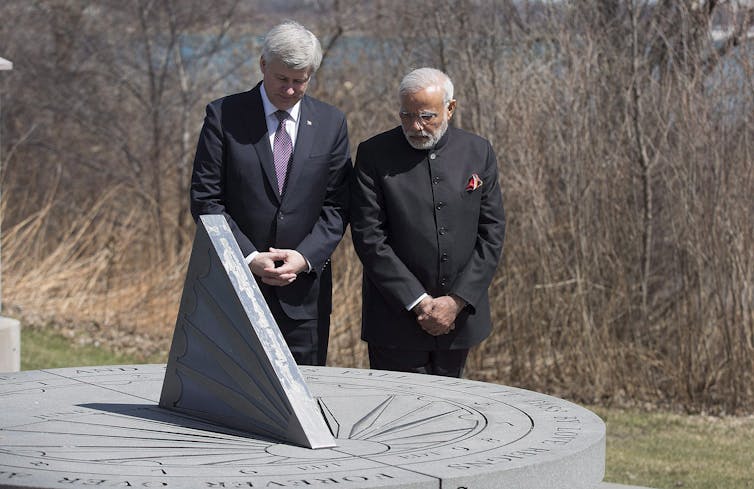
Canadian Prime Minister Stephen Harper and Indian Prime Minister Narendra Modi visit the memorial honouring victims of the 1985 Air India bombing at a ceremony in Toronto in 2015. THE CANADIAN PRESS/Michelle Siu

It also remains to be seen if the deaths of these passengers will be mobilized in the interests of increased western military involvement in the Middle East. Again I can’t help but think of the Air India bombings, and the ways in which the government of Stephen Harper strategically used the memory of its victims to bolster support for conservative anti-terrorist legislation; or more recently, conservative pundits who invoked the bombingsover and over again to bait NDP Leader Jagmeet Singh before last fall’s federal election.

Nor am I convinced that Canada’s response to this recent air tragedy and the loss of so many Iranian-Canadian lives means racist reactions won’t still emerge.

Often during times of national crises and heightened political tensions, race-based fears and anxieties about foreign and/or domestic terrorism result in the intensified stereotyping of particular people and places as inherently threatening — as exemplified in President Donald Trump’s latest characterization of Iran as a “rough neighborhood.” To be sure, the potential for rising anti-Iranian sentiment in Canada also exists.

And so as further details of the tragedy in Tehran unfold and political players in and beyond Canada negotiate their stakes, I expect that public memory will shift along with it, including how the incident and its casualties are remembered and understood.

This is how public memory works: when new information and investments become present, we tend to revise how we make sense of the past.

The best we can hope for is that our practice of collective remembrance might become the grounds upon which those of us who were not immediately affected by the downing of PS752 — or the Air India bombings — join in memory and mourning with those who were. In doing so, we learn to live alongside one another in the aftermath of loss with renewed connection.

Source: Will Flight PS752 victims be remembered differently than those killed in the Air India bombing?

Shree Paradkar: Will the Iran crash prompt Canadians to at last acknowledge our shameful response to the Air India tragedy?

More Air India/Ukraine International plane crash characterization and reaction comparisons:

It was the end of the school year in June 1985. Montreal-based Vipin Bery dropped his wife, Neelam, and children — Priya, 8, and Aditya, 4 — at the Mirabel Airport and said goodbye. They were off to India on their summer holidays. He would never see them again.

Toronto-based Lata Pada had flown to India in advance, and was waiting for her husband, Vishnu, and teenage daughters, Brinda and Arti, to arrive. They were to fly onward to Bangalore.

“And then to hear the plane was not going to land,” she said over the phone this weekend.

Last week’s shattering deaths of 176 people aboard Ukraine Flight 752, including 57 Canadians, has brought memories flooding back to families of those who perished in the Air India 182 bombing that blew up the plane off the coast of Ireland, killing all 329 people on board.

“In a way you never get over it,” Bery, now based in Toronto, said. Bery eventually “found the strength to try again” and has a wife and children who are now in their 20s. “I’ve tried to move on the best I could.”

Last week, within hours of the Iran plane crash, Prime Minister Justin Trudeau said, “While no words will erase your pain, I want you to know that an entire country is with you. We share your grief.” His words had the effect of gathering Canadians together in an act of national mourning.

In 1985, following the deaths of about 268 Canadians, then-prime minister Brian Mulroney called his Indian counterpart, the late Rajiv Gandhi, and offered his condolences. We should never let him live this down.

“Every family I speak to tells me this,” says Chandrima Chakraborty, an English and cultural studies professor at McMaster University. “This is something the Air India families have neither forgotten nor forgiven.”

“Their loss is irreparable. Here you had these families at their worst moment of crisis having to prove their Canadianness,” she says.

Cork, on the southwest coast of Ireland, became the site for bodies that were being recovered to be brought back for identification, and families rushed there from all over the world.

“I was grieving there in Cork,” Pada says. “Not a single Canadian official was there. Not a single representative from the Canadian government. Nobody from the Canadian embassy even came to even inquire and comfort us.

“It was such a contrast to the Irish who were so completely compassionate, taking us into their homes and to welcome us with love.”

Years after the bombing, she testified in a public inquiry, “They (the Irish) took this tragedy upon themselves as if they had suffered.”

Of how the Iranian-Canadians are being treated now, Pada says, “I’m truly glad that even though they may be hyphenated Canadians they are still considered Canadian. Thank goodness this time Trudeau has made a strong presence of his compassion and strong condemnation of what happened and strong commitment to investigate it.”

However, Canadians looking to turn this into a “look how far we’ve come” moment are missing the point if they’re converting the Air India tragedy into an occasion for self-congratulations. Even today, in the long aftermath of the 35-year-old terrorist atrocity, this is not a disaster that registers on the Canadian conscience. (I say this while acknowledging the local communities who have paid tributes.)

How many of us take a moment on June 23 to reflect on that tragedy? We (rightly) do so annually for the 1989 Montreal massacre of 14 women. When 16 people including 10 players of the Humboldt Broncos team died in a road accident in 2018, Canadians placed hockey sticks on our porches in solidarity, supported a quick investigation and trial so the families could find closure, and even crowdsourced $15 million.

Eighty-two children were killed in the Air India bombing. How have we mourned them?

Chakraborty, who has no personal connection to the tragedy, has made it her mission since 2010 to bring it into public consciousness. She began teaching about the bombing and its aftermath in 2010 and is now creating an Air India archive at the McMaster library. Last year, she along with two colleagues published an anthology, Remembering Air India: The Art of Public Mourning.

The bombs, as we now know, were made in Canada, planted in Canada and killed Canadians.

But, dear god, it took forever for even that to be clear.

It took years of the RCMP and CSIS pointing fingers at each other, years for the case to go to the country’s most expensive trial with botched evidence.

It took 20 years of advocacy by the families themselves for Canada to declare June 23 a national day of remembrance for victims of terrorism.

It took 22 years for the federal government to fund memorials in Toronto, Vancouver, Montreal and Ottawa.

How many of us have visited them?

One politician who shows up at the Humber Bay Park East memorial in Etobicoke unannounced and without fanfare is former Ontario premier Bob Rae, says Chakraborty. Rae wrote a public report on the disaster. It’s instructive that when Trudeau turned to Rae for advice on handling the Iran plane crash, Rae’s advice was staying in close touch with the families.

It took 23 years for a public inquiry into the investigation of the bombing to be published. “Almost to a witness, the family members told the Commission of feeling left out from the beginning of their painful experience,” it said.

Now, 35 years later, a similar unfathomable tragedy is urging us, the Canadian public, to come to a collective reckoning and connect with the Canadian tragedy.

Will we? June 23 this year will provide us with a mirror.

Source: Shree Paradkar: Will the Iran crash prompt Canadians to at last acknowledge our shameful response to the Air India tragedy?Even today, in the long aftermath of the 35-year-old terrorist atrocity, Air India is not a disaster that registers on the Canadian conscience, Shree Paradkar writes. 

UK immigration rules are unworkable, says Law Commission

Curious to hear whether any similar issues with respect to Canadian immigration rules, given their complexity. Over to you immigration lawyers and practitioners!

Immigration rules are “overly complex and unworkable” according to the Law Commission, which recommends simplifying them in order to save the government £70m over the next decade.

The regulations have quadrupled in length since 2010 and are “comprehensively criticised for being poorly drafted”, says the body, which advises ministers on updating the law.

When introduced in 1973, immigration rules ran to 40 pages; they now extend across 1,100. Making them more prescriptive was intended to produce more transparent outcomes but instead rendered them harder to follow, the study observes.

Nicholas Paines QC, the public law commissioner, said: “For both applicants and case workers, the drafting of the immigration rules and frequent updates makes them too difficult to follow. This has resulted in mistakes that waste time and cost taxpayer money.

Source: UK immigration rules are unworkable, says Law Commission

Ai Weiwei: Capitalism and ‘Culturecide’ The idea of ‘cultural differences’ has been used as a justification for some of humanity’s worst crimes.

Well worth reading and reflecting upon the nexus between Western firms and Chinese repression:

Lu Xun, the greatest Chinese writer of the 20th century, created a character named Ah Q who became both adored and feared among Chinese for his wicked display of flaws in China’s “national character.” When Ah Q grew scabies on his head, he forbade people in his presence from pronouncing the word “scabies” — or any other word that sounded like it might conjure it. Such words were taboo. “Verboten.”

A few weeks ago, here in Berlin, I received notice of a lawsuit that had been filed against me by a casino clerk. The complaint said I had called him a Nazi and a racist without any factual basis. I had two weeks to present a written response, failing which I would be subject to punishment. The notice came as I was about to set out for England. I passed the matter to a lawyer and departed.

But the complaint led me to prod my memory. Yes, about a year ago I had played cards at the Berlin Casino in Potsdamer Platz and at the end of play had put my chips on the counter of the cashier’s window for redemption. The clerk, who may have been in his 50s, was leaning back in his chair. He looked at me but made no move. Then, enunciating each word distinctly, he said in English, “You should say please.”

I was put off. “What happens if I don’t?”

“You’re in Europe, you know,” the clerk said. “You should learn some manners.”

I found the comment irritating but not wholly strange. Immigrants to Germany do hear such things.

I pressed on: “Fine, but you’re not a person who can teach me manners.”

That caused him to lean forward. He fixed me with a gaze and said, “Don’t forget that I’m feeding you!”

The ante was raised. Behind his almost comical facade, I sensed a truly powerful disdain and resentment.

“That’s a Nazi attitude,” I said, “and a racist comment.”

I gave up arguing and went to the casino manager. After a bit of investigating, the manager offered me a detailed apology, and that was that — or so I thought until the notice of the lawsuit arrived. I don’t know what will come of that complaint, but it is a small matter compared with the issue that I now want to raise.

The casino clerk had cloaked his ethnic prejudice as a question of culture: Immigrants (whom we Germans are “saving”) should be learning European civilization. This made me reflect on where else “cultural difference” has been a euphemism under which bias, slavery and genocide have all had their ways. Hitler’s Germany? Apartheid? Bosnia? The American South? Too often! But indeed these are cultural matters. Is Nazi thinking merely a tumor that can be cut from the body politic and discarded? I doubt it. For good or ill, cultures last for years.

In today’s world, authoritarian politics and predatory commerce cooperate to exploit “cultural differences.” Nowhere is this point clearer than in the symbiosis in recent decades between Western corporations and the Communist elite in China. The West offers capital and much-needed technology, while China’s rulers supply a vast, captive, hard-working, low-paid and unprotected labor force. Western politicians, as if trying to justify the unholy collusion, for years argued that rising living standards in China would produce a middle class who would demand freedom and democracy. It is clear by now that that has not happened. The Chinese elite, now far wealthier than before and as in control as ever, can laugh up its sleeve at the Westerners and their visions of inevitable democracy. Instead the West’s own hard-won democracy has become vulnerable.

But does the West know it? Look at Hong Kong. Courageous protesters have persisted for more than six months in confronting the world’s mightiest dictatorship, a regime with a record of ironclad rejection of both reason and compromise when it deals with protesters or rivals. Hong Kong’s young democrats have looked for support from the world’s democracies. They stand at today’s edge of what may well be the greatest confrontation of the 21st century. Can the Western world see that helping them is not charity but self-defense?

When protesters in Hong Kong look to the vast northwest area in China called Xinjiang, they can see what happens when Beijing-engineered change reaches full throttle. In recent years (at first barely noted in the West), an annihilation of the language, religion and culture of Muslim Uighurs has proceeded systematically. About a million people have been sent to “re-education camps,” where they have been forced to denounce their religion and to swear fealty to the Communist Party of China.

When The New York Times published 400 pages of internal government documents on the rationale and techniques of this culturecide, an irate Beijing flatly denied the existence of the camps. But it did not (it could not) claim that the documents were inauthentic. It announced that the “trainees” in its re-education centers had all “graduated.” But the following facts were not announced: the number of graduates, where they are now living and whether they have been reunited with family.

I feel a personal bond with that distant, rustic Xinjiang, because I lived there from the early 1960s until 1977 with my father, the poet Ai Qing, who was banished there for nearly 20 years. He had expressed himself too freely through his poetry.

Westerners may think of Xinjiang as a distant and mysterious place, but in some ways it is not very exotic. Multinational corporations including Volkswagen, Siemens, Unilever and Nestlé have factories there. Supply chains for Muji and Uniqlo depend on Xinjiang, and companies such as H & M, Esprit and Adidas use Xinjiang cotton. We might ask: What is it about this remote place, to which the emperors of old banished criminals in lieu of sending them to prison, that makes it so attractive?

Might a “culturally different” nonwhite labor force play a role? People in no need of control because a harsh Communist government is already doing that work? In Xinjiang, as elsewhere in China, bosses from East and West have exchanged benefits, formed common interests and have even come to share some values. The chief executive of Volkswagen, which leads China in car sales, was recently asked for the company’s comment on the concentration camps in Xinjiang. He answered that VW knew nothing of such things, but the recent Xinjiang papers show otherwise. VW not only knew of the camps but signaled its readiness to go along. International diplomacy has facilitated the partnering of foreign business and Chinese Communism, and the German government has done especially well in that role.

We need to remember that extraction of profit from slave labor is not new to Germany. The Nazis used corvée labor. The main difference today is that the extraction is happening in distant countries. The scale, if anything, is larger. VW builds its cars in China, including the Audi, SEAT, Skoda, Bentley and Lamborghini brands under its umbrella. It has shown that it sees the future of German industry to be in China. Piggybacking on “cultural difference” is still viable there.

China and Russia have shown how legacies of Communist authoritarianism can combine with predatory capitalism to build new political structures of daunting power. The world’s democracies have not figured out what to do about this even as they sense themselves falling behind or, worse, beginning to fit in. Traditional democratic values have begun to slip away. Economic and political trends reach beyond national borders, seem large and unstoppable, and are destroying values and ideals that human societies have evolved over centuries.

I am well aware that the word “Nazi” is taboo in Germany, but when I used it with the casino clerk, I meant it not as an expletive but as a general analytic term: A culture asserts its superiority, an ethnicity its purity, and the horde below is not only different but inferior, in need of being guided and, if necessary, ruled by force. Hence slavery is justified. Hence it is all right that hundreds of thousands of people are pulled from their homes. Rulers and slave masters get halos.

In the 1930s and 1940s this was called Nazism. Today in Germany, the taboo on the term is electric — stronger by far than Ah Q’s rejection of “scabies.” Could German supersensitivity be rooted in awareness, deep down, that the idea does remain alive?

The great challenge facing German and other Western governments is whether they can find a way to exit the carnival of profit making with their moral integrity intact. So far we have seen little on this score other than craven diffidence. The crux of the matter is not ignorance of the moral alternatives but a failure of will. Pursue greed? Do what is right? We shyly select the former. When Western governments come to realize that liberal democracy itself is at stake, this balance might tip the other way.

Translated from the Chinese by Perry Link.

Race and Medicine: The Harm That Comes From Mistrust: Racial bias still affects many aspects of health care.

Good overview of the data and issues:

Racial discrimination has shaped so many American institutions that perhaps it should be no surprise that health care is among them. Put simply, people of color receive less care — and often worse care — than white Americans.

Reasons includes lower rates of health coverage; communication barriers; and racial stereotyping based on false beliefs.

Predictably, their health outcomes are worse than those of whites.

African-American patients tend to receive lower-quality health services, including for cancer, H.I.V., prenatal care and preventive care, vast research shows. They are also less likely to receive treatment for cardiovascular disease, and they are more likely to have unnecessary limb amputations.

As part of “The 1619 Project,” Evelynn Hammonds, a historian of science at Harvard, told Jeneen Interlandi of The New York Times: “There has never been any period in American history where the health of blacks was equal to that of whites. Disparity is built into the system.”

African-American men, in particular, have the worst health outcomes of any major demographic group. In part, research shows, this is a result of mistrust from a legacy of discrimination.

At age 45, the life expectancy of black men is more than three years less than that of non-Hispanic Caucasian men. According to a study in the Quarterly Journal of Economics, part of the historical black-white mortality difference can be attributed to a 40-year experiment by the U.S. Public Health Service that shook African-Americans’ confidence in the nation’s health system.

From 1932 to 1972, the Public Health Service tracked about 600 hundred low-income African-American men in Tuskegee, Ala., about 400 of whom had syphilis. The stated purpose was to better understand the natural course of the disease. To do so, the men were lied to about the study and provided sham treatments. Many needlessly passed the disease on to family members, suffered and died.

As one scholar put it, the Tuskegee study “revealed more about the pathology of racism than it did about the pathology of syphilis.” In fact, the natural course of syphilis was already largely understood.

The study was publicized in 1972 and immediately halted. To this day, it is frequently cited as a driver of documented distrust in the health system by African-Americans. That distrust has helped compromise many public health efforts — including those to slow the spread of H.I.V., contain tuberculosis outbreaks and broadenprovision of preventive care.

According to work by the economists Marcella Alsan and Marianne Wanamaker, black men are less likely than white men to seek health care and more likely to die at younger ages. Their analysis suggests that one-third of the black-white gap in male life expectancy in the immediate aftermath of the study could be attributed to the legacy of distrust connected to the Tuskegee study.

Their study relies on interpreting observational data, not a randomized trial, so there is room for skepticism about the specific findings and interpretation. Nevertheless, the findings are consistent with lots of other work that reveals African-Americans’ distrust of the health system, their receipt of less care, and their worse health outcomes.

The Tuskegee study is far from the only unjust treatment of nonwhite groups in health care. Thousands of nonwhite women have been sterilized without consent. For instance, between the 1930s and 1970s, one-third of Puerto Rican women of childbearing age were sterilized, many under coercion.

Likewise, in the 1960s and 1970s, thousands of Native American women were sterilized without consent, and a California eugenics law forced or coerced thousands of sterilizations of women (and men) of Mexican descent in the 20th century. (Thirty-two other states have had such laws, which were applied disproportionatelyto people of color.)

For decades, sickle cell disease, which mostly affects African-Americans, received less attention than other diseases, raisingquestions about the role of race in how medical research priorities are established.

A ‘Rare Case Where Racial Biases’ Protected African-Americans

Outside of research, routine medical practice continues to treat black and white patients differently. This has been documented in countless ways, including how practitioners view pain. Racial bias in health care and over-prescription of opioid painkillers accidentally spared some African-Americans from the level of mortality from opioid medications observed in white populations.

“While African-Americans may not have died at similar rates from opioid misuse, we can be sure needless suffering and, perhaps even death, occurred because provider racism prevented them from receiving appropriate care and pain medication,” said Linda Goler Blount, president and chief executive of the Black Women’s Health Imperative.

Of course, health outcomes are a result of much more than health care. The health of people of color is also unequal to that of whites because of differences in health behaviors, education and income, to name a few factors. But there is no doubt that the health system plays a role, too. Nor is there question that a history of discrimination and structural racism underlies racial differences in all these drivers of health.

Reinforcing the fact of racial bias in health care, a recent studyfound that care for black patients is better when they see black doctors. The study randomly assigned 1,300 African-Americans to black or nonblack primary care physicians. Those who saw black doctors received 34 percent more preventive services. One reason for this, supported by the study, is increased trust and communication.

The study findings are large. If all black men received the same increase in preventive services as those in the study (and received appropriate follow-up care), it would reduce the black-white cardiovascular mortality rate by 19 percent and shrink the total black-white male life expectancy gap by 8 percent, the researchers said.

But it is unlikely all black men could see black doctors even if they wished to. Although African-Americans make up 13 percent of the U.S. population, only 4 percent of current physicians — and less than 7 percent of recent medical school graduates — are black.

This study does not stand alone. A systematic review found that racially matched pairs of patients and doctors achieved better communication. Other studies found that many nonwhite patientsprefer practitioners who share their racial identity and that they receive better care from them. They view them as better than white physicians in communicating, providing respectful treatment and being available.

Racial bias in health care, as in other American institutions, is as old or older than the republic itself.

Title VI of the 1964 Civil Rights Act stipulates that neither race, color nor national origin may be used as a means of denying the “benefits of, or be subjected to discrimination under any program or activity receiving federal financial assistance.” As nearly every facet of the American health system receives federal financing and support, well-documented and present-day discrimination in health care suggests the law has not yet had its intended effect.

Source: Race and Medicine: The Harm That Comes From Mistrust

‘We Saw There Is Disparity.’ Italian Fashion World Adopts Diversity Agenda

Better late than never:

The Italian National Fashion Chamber is promoting a diversity agenda among Milan’s major fashion houses, a year after several top Italian brands faced criticism for designs and remarks seen as culturally and racially insensitive.

Its manifesto backed by major Italian fashion brands aims to increase racial and gender diversity in key roles in Milan’s fashion houses, which fashion chamber president Carlo Capasa acknowledged was lagging in a recent interview with The Associated Press ahead of Milan Fashion Week.

‘’We have been speaking for many years against discrimination based on gender, religion, skin color and physical ability. But we must acknowledge that this has not been truly implemented,’’ Capasa said. ‘’We looked at our industry and we saw there is disparity. We saw that a disparity of gender persists, that there are conditions not favorable to women in the workplace and in some cases there is discrimination.’’

While Capasa resisted framing the manifesto as a direct reaction to the scandals involving blackface designs by Gucci and Prada, and a Chinese backlash that forced fashion house Dolce&Gabbana to cancel a major Shanghai show, the incidents show the cultural blind spots that can arise when a fashion house is too homogeneous.

Capasa said the Milan fashion world must work harder to attract people of color. “If global companies want to represent the world they are targeting, they must welcome diversity and look beyond their own borders,’’ he said, citing the relative homogeneity of Italian society.

Milan has lagged the other main fashion cities of Paris, New York and London in racial diversity on the runway, according to season diversity reporting by the Fashion Spot. Capasa said the stories that fashion houses want to tell are often linked to their Italian roots, and that runway choices are linked to model agencies’ offerings since not all models come to Milan.

While many Milan fashion houses take their creative direction from women — including Miuccia Prada, Donatella Versace, Silvia Venturini Fendi and Angela Missoni — and more women than men work in the fashion industry, Capasa said efforts are needed to get more women into decision-making roles.

‘’If we look at the boards, at the CEOs, at other key roles, there might be an advantage for men,’’ Capasa said. ‘’But we don’t want to introduce quotas obligating companies to promote women. We want to create the conditions so that women can have the same chances.’’

The chamber’s manifesto does not include hard commitments. Instead, it presents concepts that ‘’will serve as a model for a radical reform in terms of diversity and inclusion.’’

They were adopted by the chamber’s more than 100 members, which include most major Milan fashion houses with the notable exception of Dolce&Gabbana, and will be monitored every year for progress.

They call for changing representations of the standards of beauty on runways and in magazine campaigns, acknowledging that ‘’canons of physical beauty and harmful psychological models have spread throughout the industry.’’ They also present inclusion as a business opportunity that can boost financial results while improving trust with clients.

Gucci and Prada have independently made efforts to address the scandals. Gucci’s efforts include launching a scholarship program to reach students who have been underrepresented in the fashion industry, while Prada announced a diversity council headed by two Americans, artist Theaster Gates and film director Ava DuVernay.

Capasa put the fashion chamber’s initiatives in the context of an ever more globalized industry where 2.5 billion people follow the fashion world on social media accounts and can, with a single post, shift a fashion company’s fortunes.

Meanwhile the center of fashion’s commercial gravity has shifted to Asia, with Chinese consumers accounting for 90% of luxury sales growth last year, according to a study by the consultancy Bain & Co.

“The push to speak about diversity of inclusion comes directly from the fact that globalization made us understand that you cannot speak in the same way that you spoke before,” Capasa said. “The audience has become much bigger.’’

Source: ‘We Saw There Is Disparity.’ Italian Fashion World Adopts Diversity Agenda

Two States. Eight Textbooks. Two American Stories.

Would be interesting to see a Quebec and Ontario comparison, and an Alberta and Ontario one, although the small size of the Canadian market likely means less variation in texts for English Canada:

The textbooks cover the same sweeping story, from the brutality of slavery to the struggle for civil rights. The self-evident truths of the founding documents to the waves of immigration that reshaped the nation.

The books have the same publisher. They credit the same authors. But they are customized for students in different states, and their contents sometimes diverge in ways that reflect the nation’s deepest partisan divides.

Hundreds of differences — some subtle, others extensive — emerged in a New York Times analysis of eight commonly used American history textbooks in California and Texas, two of the nation’s largest markets.

In a country that cannot come to a consensus on fundamental questions — how restricted capitalism should be, whether immigrants are a burden or a boon, to what extent the legacy of slavery continues to shape American life — textbook publishers are caught in the middle. On these questions and others, classroom materials are not only shaded by politics, but are also helping to shape a generation of future voters.

Conservatives have fought for schools to promote patriotism, highlight the influence of Christianity and celebrate the founding fathers. In a September speech, President Trump warned against a “radical left” that wants to “erase American history, crush religious liberty, indoctrinate our students with left-wing ideology.”

The left has pushed for students to encounter history more from the ground up than from the top down, with a focus on the experiences of marginalized groups such as enslaved people, women and Native Americans.

The books The Times analyzed were published in 2016 or later and have been widely adopted for eighth and 11th graders, though publishers declined to share sales figures. Each text has editions for Texas and California, among other states, customized to satisfy policymakers with different priorities.

“At the end of the day, it’s a political process,” said Jesús F. de la Teja, an emeritus professor of history at Texas State University who has worked for the state of Texas and for publishers in reviewing standards and textbooks.

The differences between state editions can be traced back to several sources: state social studies standards; state laws; and feedback from panels of appointees that huddle, in Sacramento and Austin hotel conference rooms, to review drafts.

Requests from textbook review panels, submitted in painstaking detail to publishers, show the sometimes granular ways that ideology can influence the writing of history.

A California panel asked the publisher McGraw-Hill to avoid the use of the word “massacre” when describing 19th-century Native American attacks on white people. A Texas panel asked Pearson to point out the number of clergy who signed the Declaration of Independence, and to state that the nation’s founders were inspired by the Protestant Great Awakening.

All the members of the California panel were educators selected by the State Board of Education, whose members were appointed by former Gov. Jerry Brown, a Democrat. The Texas panel, appointed by the Republican-dominated State Board of Education, was made up of educators, parents, business representatives and a Christian pastor and politician.

McGraw-Hill, the publisher whose annotated Bill of Rights appears differently in the two states, said it had created the additional wording on the Second Amendment and gun control for the California textbook. A national version of the pages is similar to the Texas edition, which does not call attention to gun rights, the company said in a written statement.

Pearson, the publisher whose Texas textbook raises questions about the quality of Harlem Renaissance literature, said such language “adds more depth and nuance.”

Critical language about nonwhite cultural movements also appears in a Texas book from McGraw-Hill. It is partly a result of debates, in 2010, between conservative and liberal members of the Texas Board of Education over whether state standards should mention cultural movements like hip-hop and country music. Their compromise was to ask teachers and textbook publishers to address “both the positive and negative impacts” of artistic movements.

Texas struck that requirement in 2018, but its most recent textbooks, published in 2016, will reflect it for years to come.

Publishers are eager to please state policymakers of both parties, during a challenging time for the business. Schools are transitioning to digital materials. And with the ease of internet research, many teachers say they prefer to curate their own primary-source materials online.

How Textbooks are Produced
1Authors, often academics, write a national version of each text.
2Publishers customize the books for states and large districts to meet local standards, often without input from the original authors.
3State or district textbook reviewers go over each book and ask publishers for further changes.
4Publishers revise their books and sell them to districts and schools.

Still, recent textbooks have come a long way from what was published in past decades. Both Texas and California volumes deal more bluntly with the cruelty of the slave trade, eschewing several myths that were common in textbooks for generations: that some slave owners treated enslaved people kindly and that African-Americans were better off enslaved than free. The books also devote more space to the women’s movement and balance the narrative of European immigration with stories of Latino and Asian immigrants.

“American history is not anymore the story of great white men,” said Albert S. Broussard, a history professor at Texas A&M University and an author of both the Texas and California editions of McGraw-Hill’s textbooks.

Here is how the politics of American history play out in California and Texas textbooks, on subjects like race, immigration, gender, sexuality and the economy.

White resistance to black progress is covered differently in the two states.

McGraw-Hill, “United States History & Geography: Continuity and Change,” California, P. 505

California notes the suburban dream of the 1950s was inaccessible to many African-Americans.

McGraw-Hill, “United States History Since 1877,” Texas, P. 436

Texas does not.

California and Texas textbooks sometimes offer different explanations for white backlash to black advancement after the Civil War, from Reconstruction to housing discrimination in the 20th century.

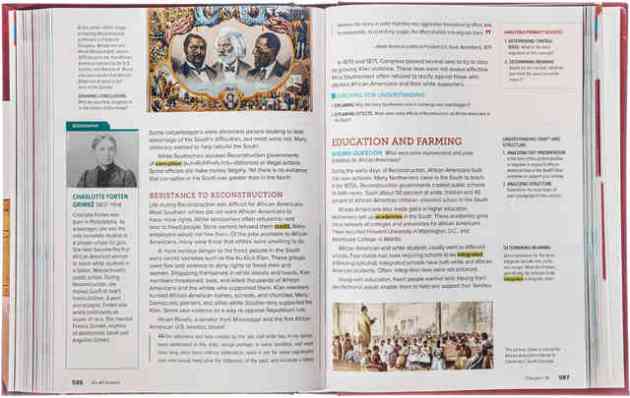
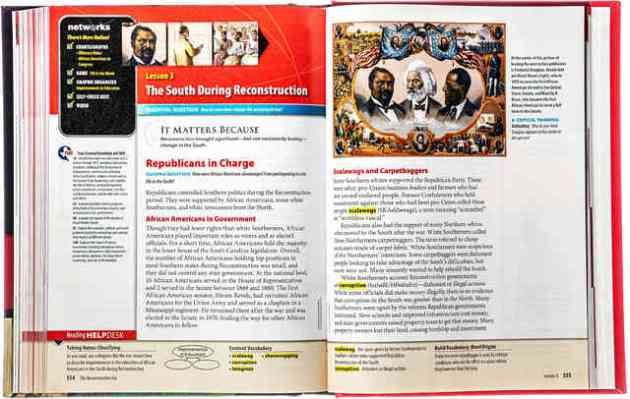
Southern whites resisted Reconstruction, according to a McGraw-Hill textbook, because they “did not want African-Americans to have more rights.” But the Texas edition offers an additional reason: Reforms cost money, and that meant higher taxes.

Whole paragraphs on redlining and restrictive deeds appear only in the California editions of textbooks, partly as a result of different state standards. Texas’ social studies guidelines do not mention housing discrimination at all.

CALIFORNIA
TEXAS
TAKEAWAY

Texas says that white Southerners opposed Reconstruction because of tax increases as well as racial resentment. California instead includes primary-source quotations from black historical figures about white resistance to civil rights.

McGraw-Hill, “United States History & Geography: Growth & Conflict,” California, P. 586; McGraw-Hill, “United States History to 1877,” Texas, P. 555

Both states say that breaches of “racial etiquette” led to lynchings after Reconstruction. But only California, whose edition was written more recently, makes clear that the perpetrators of lynchings also hoped to discourage black political and economic power.

HMH, “American History: Reconstruction to the Present,” California, P. 245; HMH, “The Americans: United States History Since 1877,” Texas, P. 288

Nevertheless, Kerry Green, a high school social studies teacher in Sunnyvale, Tex., a small town east of Dallas, said she discussed redlining with her 11th graders, adding it as a counterpoint to lessons about postwar prosperity — the optimistic story of consumerism, television and the Baby Boom that is emphasized by her state’s standards.

Ms. Green said she preferred to assign primary sources that “encourage students to explore history on their own.” But she said she would welcome textbooks that contain more historical documents and a greater diversity of voices and themes from the past.

“The textbook companies are not gearing their textbooks toward teachers; they’re gearing their textbooks toward states,” she said.

On gender and sexuality, California textbooks include history that is not in Texas editions.

McGraw-Hill, “United States History & Geography: Growth & Conflict,” California, P. 624

California states that the federal government failed to recognize nonbinary gender identities and female leaders in its early relations with Native Americans.

McGraw-Hill, “United States History Since 1877,” Texas, P. 111

Texas does not mention gender roles or gender identity in its discussion of efforts to “Americanize” Native Americans.

In Texas textbooks, mentions of L.G.B.T.Q. issues tend to be restricted to coverage of events in recent decades, such as the Stonewall uprising, the AIDS crisis and debates over marriage rights.

But for recent California editions, publishers wrote thousands of words of new text in response to the FAIR Education Act, a law signed by Governor Brown in 2011. It requires schools to teach the contributions of lesbian, gay, bisexual, transgender and disabled Americans.

Peppered throughout California books are passages on topics like same-sex families under slavery and early sex reassignment surgery in the 1950s — text that does not appear in Texas versions.

CALIFORNIA
TEXAS
TAKEAWAY

California states that enslaved women faced sexual violence from owners and overseers.

McGraw-Hill, “United States History & Geography: Growth & Conflict,” California, P. 449; McGraw-Hill, “United States History to 1877,” Texas, P. 443

California mentions the “lavender scare” that targeted thousands of gay men and lesbians.

Pearson, “United States History: The Twentieth Century,” California, P. 486; Pearson, “United States History: 1877 to Present,” Texas, P. 456.

California states that Alfred Kinsey’s research and early sex reassignment surgeries challenged “the postwar ideal” on gender.

Pearson, “United States History: The Twentieth Century,” California, P. 498; Pearson, “United States History: 1877 to Present,” Texas, P. 470.

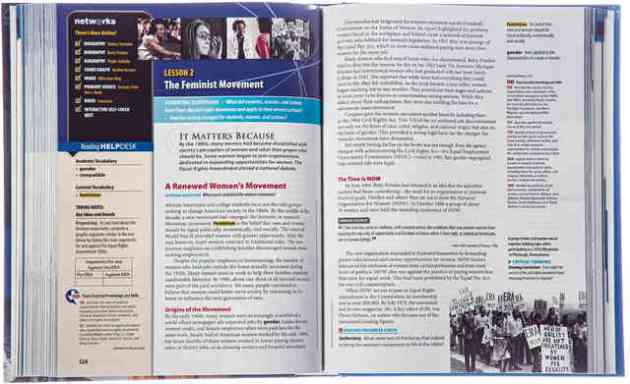
Both states focus on women’s fight against discrimination in the workplace. Only California says birth control played a role, by “allowing women to exert greater control over their sexuality and family planning.”

McGraw-Hill, “United States History & Geography: Continuity and Change,” California, P. 627; McGraw-Hill, “United States History Since 1877,” Texas, P. 525.

Stephanie Kugler, an eighth-grade history teacher in West Sacramento, Calif., said she had expanded an idea mentioned briefly in her classroom’s textbook, about women who dressed as men to fight in the Civil War and continued to live as men, into an entire lesson on troops who today would be considered transgender. The students read accounts of those soldiers’ lives alongside more traditional sources, such as letters written by a black Union soldier and a Confederate soldier.

Her goal, Ms. Kugler said, was to “make it really authentic” to talk about diversity in the context of each historical period.

While both states devote many pages to the women’s movement, Texas books, in general, avoid discussions of sex or sexuality.

Immigration and nativism are major themes in American history textbooks.

McGraw-Hill, “United States History & Geography: Continuity and Change,” California, P. 736

California includes an excerpt from a novel about a Dominican-American family.

McGraw-Hill, “United States History Since 1877,” Texas, P. 609

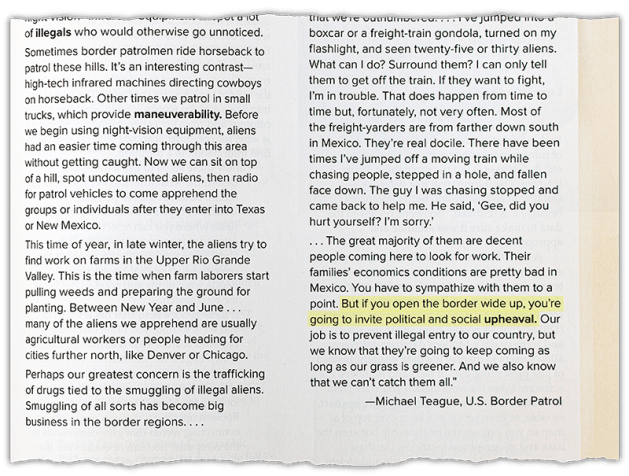
In the same place, Texas highlights the voice of a Border Patrol agent.

Michael Teague, a Border Patrol agent, is featured in the Texas edition of McGraw-Hill’s 11th grade textbook. He discusses his concerns about drug trafficking and says, “if you open the border wide up, you’re going to invite political and social upheaval.”

Mr. Teague’s story is featured at the end of a chapter on recent immigration, alongside accounts from a Vietnamese immigrant and a second-generation Mexican-American.

That section in the California edition of the same book is devoted to a long excerpt from the novel “How the García Girls Lost Their Accents,” by Julia Alvarez. It deals with intergenerational tensions in a Dominican-American family.

In a written statement, McGraw-Hill said the full-page Border Patrol narrative was not included in the California edition because it would not fit beside the literary excerpt. And at the time the Texas edition was produced, six years ago, state standards called for students to analyze both “legal and illegal immigration to the United States.”

In contrast, California textbooks are more likely to note when a historical figure was an immigrant. And they include more detail on the role immigrants such as Japanese and Filipino farmworkers played in labor movements.

California is one of many states to ask teachers and textbooks in recent years to cover the contributions of specific immigrant groups, including Asian-Americans, Pacific Islanders, European-Americans and Mexican-Americans.

CALIFORNIA
TEXAS
TAKEAWAY

Only California states that Levi Strauss was a German Jewish immigrant.

McGraw-Hill, “United States History & Geography: Growth & Conflict,” California, P. 416; McGraw-Hill, “United States History Since 1877,” Texas, P. 417

California tells the story of Wong Kim Ark, whose 1898 Supreme Court case established birthright citizenship for the children of immigrants; Texas’s edition, which is older, does not mention this case, but does cover the Chinese Exclusion Act.

HMH, “American History: Reconstruction to the Present,” California, P. 247; HMH, “The Americans: United States History Since 1877,” Texas, P. 289

These additions are part of the reason California books are almost always longer than their Texas counterparts.

California’s Board of Education adopted an expansive 842-page social studies framework in 2016. Two years later, Texas’ school board streamlined its social studies standards, which are now laid out in 78 tightly compressed pages.

Critics of California’s approach say that making state standards and textbooks longer and more inclusive can be overwhelming to teachers trying to move quickly through hundreds of years of material.

Both states emphasize the role of big businessfrom the Gilded Age to the present.

HMH, “American History: Reconstruction to the Present,” California, P. 160

California is critical of wealth inequality and the impact of companies like Standard Oil on the environment.

HMH, “The Americans: United States History Since 1877,” Texas, P. 235

Texas is more likely to celebrate free enterprise and entrepreneurs like Andrew Carnegie.

Texas policymakers feel strongly about giving students a positive view of the American economy; since 1995, state law has required that high school economics courses offer an “emphasis on the free enterprise system and its benefits.” That emphasis seems to have made its way into the history curriculum as well.

California’s curriculum materials, by contrast, sometimes read like a brief from a Bernie Sanders rally. “The yawning gap between the haves and have-nots and what is to be done about it is one of the great questions of this time,” says the state’s 2016 social studies framework.

As a result, California textbooks are more likely to celebrate unionism, critique the concentration of wealth and focus on how industry pollutes the environment.

CALIFORNIA
TEXAS
TAKEAWAY

California refers to “the income gap” and explains that “changes in tax structures and safety-net programs” and “higher costs for education, child care, and housing” played a role. Both state editions discuss economic inequality in reference to the Occupy Wall Street movement and the decline of labor unions.

Pearson, “United States History: The Twentieth Century,” California, P. 728; Pearson, “United States History: 1877 to Present,” Texas, P. 687.

The older Texas edition highlights additional Republican critiques of President Barack Obama’s environmental policies, while the California book discusses the threat of rising sea levels.

Pearson, “United States History: The Twentieth Century,” California, P. 749; Pearson, “United States History: 1877 to Present,” Texas, P. 709.

Both the California and Texas 11th-grade textbooks from Pearson state, “The main argument against environmental legislation is that it hurts the economy and the nation’s industries.”

The Texas edition goes further to highlight criticism of federal efforts to subsidize the green energy industry: “Republicans accuse the government of wasting taxpayers’ money, for example by supporting the failed solar manufacturer Solyndra.” The Solyndra controversy was a fixation for conservatives in 2011, when the company went bankrupt after accepting half a billion dollars in federally guaranteed loans.

The Texas book also states that American action on global warming may not make a difference if China, India, Russia and Brazil do not also act.

The California edition does not mention Solyndra or the other nations. However, it does include a section on the threat to American states and cities from rising sea levels, noting that the impact on tourism in Florida could hurt that state’s economy, and that transportation networks and buildings could be threatened.

Pearson said in a written statement that the differences between the books could be attributed mostly to the fact that the California book was published several years later, and that concerns over coastal flooding have become “more heightened in recent years.”
StatsCan Study: The long-term economic outcomes of refugee private sponsorship

Of note how the economic outcomes of privately and government-sponsored refugees become similar over time after an initially wide gap:

Canada was the first country to introduce private sponsorship for refugee resettlement. The program has played a key role in the country’s responses to international refugee crises over the last four decades. Private sponsors are responsible for providing financial, material and personal support to refugees during their first year in Canada.

A new Statistics Canada study compares the employment rate and earnings between privately sponsored refugees and government-assisted refugees who were admitted to Canada from 1980 to 2009.

This study is based on the Longitudinal Immigration Database and focuses on refugees who arrived between the ages of 20 and 54 under the two programs (privately sponsored refugees and government-assisted refugees). The analysis follows refugees up to 15 years after they first arrived in Canada.

Refugees are a diverse population with varying degrees of human capital and pre-migration circumstances. Privately sponsored refugees and government-assisted refugees differ in some key socio-demographic characteristics. Over the study period, privately sponsored refugees came more predominantly from Eastern Europe, whereas government-assisted refugees came more often from South and Central America and the Caribbean. Privately sponsored refugees had a higher level of education and tended to be more concentrated in Toronto than government-assisted refugees.

This study compares labour market outcomes of these two groups of refugees, while taking these socio-economic characteristics into account and recognizing that other possible unmeasured differences between the two groups of refugees—such as exposure to violence, duration of displacement, physical and mental health, and ethnic and family networks—could impact their economic outcomes.

This study found that privately sponsored refugees had much higher employment rates and earnings than government-assisted refugees in the initial years after arrival, but this difference diminished over time with government-assisted refugees steadily catching up.

In the first full year after arrival, privately sponsored refugees had higher employment rates than government-assisted refugees, by about 17 percentage points among men and 24 percentage points among women. Fifteen years after arrival, these differences decreased to 3 percentage points among men and 2 percentage points among women.

Similarly, privately sponsored refugees earned 28% more than government-assisted refugees among men and 34% more among women in the first full year after arrival. This gap narrowed to about 5% for both men and women 15 years after arrival.

Furthermore, the employment and earnings advantage of privately sponsored refugees over government-assisted refugees was greater among refugees with less than a high school education than among refugees with higher educational levels. Over half of refugees in the study had less than a high school education.

Source: PDF

Canada’s response to Iran crash a ‘180-degree shift’ from Air India disaster, experts say

More on the contrast between Canadian reactions to the Air India bombing and the shooting down of Ukraine International in Tehran:

Canada’s response to the Ukrainian air crash tragedy is very different from the way Canadians reacted to the Air India disaster 35 years ago, experts say.

News of Ukraine International Airlines Flight PS752’s destruction and the deaths of all 176 people on board — including 57 Canadians, a number revised downward from 63 on Friday — touched off a nationwide period of public mourning.

On Parliament Hill, provincial legislatures and municipal sites across the country, the Canadian flag was lowered to half-mast. Vigils and memorials are being planned in communities from coast to coast.

That collective outpouring of grief is quite unlike the public’s reaction to the Air India disaster 35 years ago, when Flight 182, carrying 329 people — most of them Canadian citizens or permanent residents — was brought down by a bomb attack on June 23, 1985.

Chandrima Chakraborty, a cultural studies professor at McMaster University, said the Air India crash was dismissed as a “foreign tragedy” and met with widespread indifference by the Canadian public. Despite the scale of the tragedy — 82 children were killed — the event did not resonate as deeply with Canadians as PS752’s crash in Iran seems to be now, she said.

“It was an Air India plane, (thought to be) primarily Indians, so it must be an Indian tragedy,” she said. “That hasn’t happened this time.”

Chakraborty said this week’s crash is being framed as a Canadian tragedy in the media and by the federal government, and Canadians themselves are mourning the victims as fellow citizens.

Brian Mulroney, prime minister at the time of the Air India crash, was criticized for offering condolences to the Indian government rather than to the Canadian families of victims after the disaster.

“Once the government has that kind of gut response, it pushed the bombing to the margins of Canadian public consciousness. It did not result in the outpouring of grief or public mourning that we’re seeing now,” Chakraborty said.

“Canada’s lack of acknowledgement of the Air India loss as Canadian, I think, exacerbated the family’s grief of losing family members.”

Public understanding ‘hazy’

Today, scholarly research on the Air India tragedy remains relatively scarce and public understanding of the event is “hazy” in the minds of most Canadians, she said.

The Air India disaster led to a public inquiry and lengthy criminal trials. In 2010, a quarter century after the disaster, then-prime minister Stephen Harper delivered a formal apology to the families of the victims for Canada’s failure to prevent the tragedy and for mistreating the families in the aftermath.

“Your pain is our pain. As you grieve, so we grieve. And, as the years have deepened your grief, so has the understanding of our country grown,” he said on June 23, 2010.

“Canadians who sadly did not at first accept that this outrage was made in Canada accept it now. Let me just speak directly to this perception, for it is wrong and it must be laid to rest. This was not an act of foreign violence. This atrocity was conceived in Canada, executed in Canada, by Canadian citizens, and its victims were themselves mostly citizens of Canada.”

Jack Major, a former Supreme Court justice who presided over the Air India public inquiry, said the circumstances of that disaster are vastly different from those of the PS752 crash. The recent event, he said, drew immediate global attention due to the increasing volatility of the security climate in the Middle East and what he called the “world fright” about what might happen next in the U.S-Iran conflict.The news cycle and the media landscape also have changed in the decades since Air India, he said.

“It became an international story immediately because of the relationships in the Middle East, which had absolutely nothing to do with Air India,” he said. “I don’t know you can draw much of a parallel.”

Major said there’s “no doubt” the Air India victims were treated differently because they were considered Indian, or “late-come Canadians,” but he said Canada’s mishandling of the disaster had more to do with government authorities passing the buck.

‘India’s problem’

“Their first reaction was that it’s India’s problem, not ours,” he said.

Sociologist Sherene Razack, who provided expert testimony during the Air India inquiry on whether racism played a role in the government’s response to the bombing, said it was a “positive moment” to hear the federal government claim those who died in this week’s crash as Canada’s own.

“Few in the media even did the usual hyphenation and simply said Canadians died in the crash,” said Razack, now a professor at UCLA. “This was a remarkable difference from the response to Air India and I can only hope that it signals some progress on the racism front …

“Is it possible that the nation has begun to change? I can only hope so.”

Andrew Griffith, a former senior immigration official who now researches diversity and multiculturalism, said he regards Canada’s current response as an “encouraging reminder” of how Canadians have evolved in terms of how they see, accept and embrace fellow citizens who are immigrants or members of visible minorities.

“What really struck me, as these horrific stories came out, was the reference is ‘Canadian.’ It wasn’t even Iranian-Canadian. It was simply these are Canadians, this is a Canadian issue and tragedy,” he said.

“I don’t think any of that really happened in the early years following Air India.”

Griffith suggested one possible reason for the change is the fact that Canada is now far more diverse than it was at the time of Air India, when visible minorities represented a smaller, newer share of the population.

“Now it is part of the Canadian reality,” he said. “That’s a sea-change, in my view.”

After Air India, the Indo-Canadian community was bitterly resentful of the authorities they believed failed to take the investigation seriously.

Canadians’ reaction to the Ukrainian airline crash represents a “180-degree shift,” Griffith said.

“It means that Iranian-Canadians will feel more accepted, more welcome, more integrated, more part of society, whereas with Indo-Canadians it dragged on and on,” he said.

For the family members of Air India victims, the pain remains fresh.

Eisha Marjara, who lost her mother and sister in the bombing, said she sees a difference in the response to the two disasters.

“The response for the Air India tragedy was disappointing and heartbreaking,” she said. “We were left in the dark for a long time.

“So seeing the way the prime minister and the media [have] swiftly and transparently handled the crash and prioritized the well being of the families of the victims is very encouraging.”

Source: cbc.ca/news/politics/…