Negative attitudes about Muslims in Australia remain high, survey finds

Good overview of the Scanlon Foundations latest annual survey:

The vast majority of Australians agree multiculturalism has been good for Australia, but a significant minority still express negativity towards Muslims, according to a report released on Tuesday.

The findings come in the 12th annual Scanlon Foundation report into social cohesion which also found a major increase in the percentage of people concerned about climate change.

The 2019 Mapping Social Cohesion survey, an annual report produced by Monash University researchers, shows support for multiculturalism remains high at 85 per cent, and over 90 per cent of respondents also said they feel a sense of belonging in Australia.

But despite the optimism about multiculturalism, ‘negative’ or ‘very negative’ attitudes towards Muslims remain high with a stark contrast between respondents who were interviewed over the phone and those who self-completed an online survey.

When people were asked about negative attitudes towards different faith groups, 21 to 25 per cent of those interviewed said they held negative views about Muslims, but the rate in the self-completion survey was almost double at 40 per cent.

In 2018, asked whether they felt positive, negative or neutral towards Muslims, 23 per cent of those polled said they felt ‘very negative’ or ‘somewhat negative’, increasing to 39 per cent when answering anonymously. Results were similar in 2017.

Professor Andrew Markus from Monash University in Melbourne is the report’s author.

“The finding on Muslim Australians and that big difference was not a surprise the first time we did it. But we have now done it three times at 2017, 2018, 2019 and basically obtained the same result. So that level of difference is quite unusual,” he told SBS News.

“If I look at the self-completion survey for the other groups, Christians, Buddhists, Hindus, it’s in the range of five to 10 per cent … but the Muslim figure is four times that level at 40 per cent.”

There were a total of 3,500 respondents to the survey – 1,500 via telephone interviews and 2,000 via the self-completion survey, which asks some 90 questions. All participants are anonymous.

Professor Markus said the result around attitudes towards Muslims indicated an underlying concern with some topics that people are reluctant to disclose if they are talking to an interviewer.

Increasing rates of discrimination

On the question ‘have you experienced discrimination over the last 12 months on the basis of your skin colour, ethnicity or religion?’ rates have consistently increased since the first survey in 2007 from about 10 per cent to 19 per cent in more recent surveys.

People who identify as Muslim or Hindu reported much higher rates of discrimination at 42 per cent for Muslims and 38 per cent for Hindus.

Between 2006 and 2016, the number of people identifying as Muslim in Australia increased from 340,400 to 604,200.

Mohammad Al-Khafaji, CEO of the Federation of The Federation of Ethnic Communities’ Councils of Australia, said anti-Muslim sentiment is an issue the government needs to address.

“That should be a warning sign for all of us, and especially for our political leaders, to make sure that we address this issue before it becomes a bigger problem,” he said.

“We know that there was a recent study released by the Islamophobia Register that has quantified some of those complaints and some of those attacks on people from Muslim backgrounds.

“We need to make sure that there are policies and social cohesion programs in place that facilitate a meeting between people so they understand each other’s differences, each other’s faiths, each other’s cultures.”

Climate change concern almost doubles

Since 2011, the survey has also sought to determine the issues that are of greatest concern in the community, asking the open-ended question: ‘What do you think is the most important problem facing Australia today?’

While concerns about the economy and unemployment have consistently topped the list, concern about environmental issues was the biggest change recorded from one year to the next, up from 10 per cent to 19 per cent in the telephone administered survey and from five per cent to 17 per cent in the self-completion survey.

Professor Markus said the movement of an issue from quite far down in the middle of the list to ranking second is unusual in the history of the survey.

He added other findings also highlight changing public perceptions about environmental issues.

“In the past, 2010 to 2011, there were a lot of people indicating that what they were concerned about was that people talking about climate change was overblown. There was too much of it, they didn’t believe it, they were sceptical,” he said.

“And 2019, almost no one is indicating that they are concerned because the issue is being overblown.”

Nearly half of those aged 18-24 reported being the most concerned about climate change, with much smaller rates seen in those over 65.

….

Immigration good for the economy

Professor Markus said the survey shows high, positive results on questions about the economic benefits of immigration and whether it is good that immigrants bring new ideas and cultures, with between 75 and 85 per cent agreeing it’s a good thing for Australia to have immigration.

But, he said, the results are less favourable on other immigration-related issues.

“When we ask people ‘do you think that the government is managing population growth well and are you concerned that immigration has got an impact of quality of life on overcrowding, on house prices, on the environment?’ … What we’re picking up is in the self-completion survey is 60 per cent or more of people are indicating concern,” he said.

The survey found concern about the level of immigration marginally declined from 43 per cent in 2018 to 41 per cent this year, with 53 per cent saying the intake is about right or too low.

The Scanlon Foundation said less concern about immigration levels has been found in three other 2019 surveys with a similarly worded question, including a Lowy Institute poll finding those of the view that the intake was ‘too high’ fell from 54 per cent in 2018 to 47 per cent this year.

Hass Dellal, the executive director of the Multicultural Foundation and the chairman of SBS, said the discussion around immigration had become better informed.

“I think there has been some excellent research, particularly the Deloitte one with SBSwhere we actually showed the economic benefits of social cohesion. I think people get a better understanding of the values of not only the economic contributions and factors around immigration but also the benefits into social cohesion,” he said.

“A lot of the media are now being able to tell the stories of families and narratives of migrants and the contributions they make. I think there is a much more informed sense of understanding of immigration and I think that helps with that acceptance.”

On the issue of happiness, 84 per cent of respondents said they had been ‘very happy’ or ‘happy’ over the past year, but there has been a steady increase in levels of pessimism since the survey began with youngest people reporting the highest rates, increasing 10 per cent since 2007.

Source: Negative attitudes about Muslims in Australia remain high, survey finds

Report: View report
Immigration New Zealand accused of slowing down applications

Would be nice to have some hard data rather than just anecdotes:

The immigration industry says officials are using what one lawyer described as Trump-style “extreme vetting” to limit immigration numbers.

Immigration representatives say bureaucratic tactics are being used to slow down residence processing, a claim Immigration New Zealand (INZ) denies.

New residents fell to the lowest levels since the turn of the century this year despite a sharp increase in applications.

Restaurant owner blasts Immigration NZ over delays

An Auckland restaurant owner feels helpless and ignored by Immigration New Zealand as he tries to sort out visas problems for his foreign workers.

The number of residence applications rose sharply from a low of 15,000 in April last year to 35,000 last month, according to figures from the INZ website.

The body that represents immigration lawyers and advisers, the Association for Migration and Investment, said it was concerned at the visa process slowdown and whether there were ulterior motives for it.

“When a case officer can come back and ask for any additional information, you’d think they’d come back and ask for all the things extra they need,” its chair June Ranson said.

“The problem is, you give them that, and then it’s almost as if they invent another question. Rather than wrapping it all in together, they go backwards and forwards – it’s almost like you’ve got a new penpal, and they want to keep in touch with you.

“That is totally inefficient, but it is happening, and it just drags out the application so you wonder if there’s ulterior motives to it.”

Immigration lawyer Richard Small said there was a growing culture of ‘extreme vetting’ alongside a decrease in discretion in decision-making.

US President Donald Trump took office promising to enact an “extreme vetting” immigration system. American academics say having been blocked on building a wall with Mexico to limit immigration numbers, the administration is using the ‘invisible walls’ of long processing times and administrative changes to make it harder for immigrants to work, settle and visit family there.

Case officers in New Zealand were asking for information they did not usually request and which were sometimes not contained in immigration instructions, said immigration adviser Toni Alexander.

“I had to remind an officer over and over that a medical was cleared, for instance, now when there should be no further obstacles, she has decided to submit a request for an NZ police clearance, a request which should have been made a very long time ago. A police clearance can take six weeks – so it is just a delaying tactic.

“We’re frequently told [by case officers] ‘oh well, my technical advisor told me to ask for this’. So they’re being instructed from above and it’s a process of slowing down applications because technical advisers are senior people, and they know the instructions very well, as well as we do.”

Immigrants had been waiting so long that even their extended temporary visas were now expiring, she said, adding expense and inconvenience.

They were being asked to resubmit evidence that had become out-dated because of the delays.

INZBorder and Visa Operations general manager Nicola Hogg said in a statement there had been no attempt to slow visa processing.

“New Zealand continues to be an attractive destination and application volumes have been increasing steadily across all categories,” she said.

“We are also seeing an increase in the level of risk and complexity in applications.

“Certain applications are always going to take longer to process because of the risk factors present.”

There were two main stages when applicants were asked for additional information: when the application was first received and after it was allocated to a case officer.

“However, sometimes when we receive information, we need to make an additional request for further information – for example, if the information supplied is insufficient to demonstrate immigration requirements are met,” she added.

Source: Immigration New Zealand accused of slowing down applications

Conservative author Douglas Murray on immigration, Islam and why he doesn’t want to talk about Trump

I think the only points I agree with is the need to read widely, particularly those one disagrees with or who challenge us, and the need to travel outside one’s area:

…This particular Mr. Murray, 40 years old, is both a man who is read (his newly released book is The Madness of the Crowds: Gender, Race and Identity) and one who reads, and so the conversation this late afternoon almost inevitably begins with an inquiry about what is on his night table these days. It turns out that he’s dipping back into The Mandibles by Lionel Shriver (‘’I thought I finished it weeks ago but I hadn’t’’) and is deep into The Faber Book of Utopias(edited by John Carey, the Oxford literary critic and sworn enemy of elitism).

His journalistic inquisitor and tablemate this late afternoon has been making his way through the massive biography of Napoleon by Andrew Roberts, a British historian and – who knew? – a friend of Murray’s. “I pretended to him that I’ve read it, but I haven’t,” he said. “I bluffed.”

Ordinarily Murray is no bluffer, though he prefers not to talk about Donald J. Trump. But like everyone else in Great Britain and Canada, he can’t help himself, and in this case he is talking about why he doesn’t want to talk about Trump.

“I never talk about Trump because everyone does,” he begins. “I never talk about Brexit either. I don’t think they’re as interesting as everybody thinks they are. I’m sad everyone is shouting hopelessly into the wind about these topics. I just don’t think it is useful for everyone to devote themselves to these two subjects. No one’s opinion on either of them is all that interesting, and basically no one can change anyone’s views on either.”

So much for that. Murray – here in Montreal on a flying visit, just two days, in part to promote his latest book, at this moment understated in a cranberry sweater with a metal zipper at the neck – would rather talk about Canada. (You’d perhaps rather hear what he says about that anyway.)

“You’ve become one of those nations where you had one story and are moving to another story,” he says, and his listener (and perhaps you readers) begins to sense that maybe we are onto an interesting riff. “The sense of what Canada was is different from the sense of what Canada is….The interesting way to get through this is to say that Canada [now wants] to be a welcoming, pluralistic, multicultural place, open and tolerant, while you talk up LGBTQ and women and ethnic minorities.”

There’s no way this conversation can go in any direction but…immigration.

So here we go. “People know immigration has different consequences depending on the numbers, the speed and the identity of the immigrants. Any one of these is explosive. All three together is dangerous. Everyone knows this.”

We are not remotely finished with this topic.

“The interesting question is: Who don’t we want,” he goes on. “We’re very bad at this question. We should be able to answer it. The problem with immigration that makes it very difficult – and I’ve gone to a lot more refugee camps than my critics have – is that it is very hard for first-world countries to say why we have such luck and others don’t.”

“Such luck” meaning the bon chance to live in Canada, or America, or any one of the industrial countries with freedoms and prosperity.

Do we dare bring up climate change? Do we dare not? (It’s not his “thing,” as he puts it, which is the thing that could make this so interesting.)

“I have only one thought,” he says, and suddenly his inquisitor breathes a sigh of relief. “It’s the obvious, undisguisable way that it has become clear that this is a replacement in the West for religion for fairly well-off, white, educated people. I don’t know the science, but it has all the manifestations of a new religion.”

What can he possibly mean by that?

“It has every single component of religion – original sin, guilt, the need for atonement. But it also has the mechanism for getting out of the [problem]. The answer is to never drive or fly again, to never buy new clothes and to live your life carefully so that you’ll save this planet, having harmed nothing. Tell your children to seek to be harmless! If it weren’t for them the moss and the trees would be getting on fine!”

Murray is an atheist, though one who did not come by that creed – the Ontario Human Rights Tribunal ruled in 2013 that the term “creed” applies to it – naturally. It was (and here we go) Islam that made him an atheist, not that that was his religion to start with. Now he’s talking a bit about the subject that has put him into perhaps the most trouble: “Canada and America were not founded by Muslims. If they had been, we’d have a better way of understanding where the crazies emerge from. We are less literate in that religion. The second problem is that there are problems in Islam that we haven’t seen in Christianity in a long time: There’s a church/state problem. There’s a problem with extremist groups. …Where exactly is [Islam’s] cutoff line on extremism? Do the fanatics become fanatics from absolutely nowhere? It’s a very lively debate about where it comes from.”

Then this, and likely his critics will agree with at least the first sentence: “My stupidity is to tell what I think on this. I can’t pretend the Koran is a social-justice document.”

Murray has been flayed for saying that Hungarian tyrant Viktor Orban was a better representative of European values than the financier George Soros. He may be the only person outside the cabinet room in Budapest with that view. A New York Times reviewer scorched Mr. Murray’s lament for the Europe of the past for being “as fundamentally incoherent as its late-19th-century originals,” adding, “It never strikes him, or other secondhand vendors of fixed and singular identities, that nowhere in the world have individuals been the exclusive heirs of a single culture or civilization.”

Back to books before we close. What should Canadians be reading?

“My own books, obviously.”’ Well, of course. But what else should be on the Canadian bookshelf?

“People should read as widely as possible in authors they know they will disagree with,” he says, surely hoping to widen his own book sales among readers – you know who you are – who find his views contemptible. “I hate people who read by tribe. In America both political parties have their own libraries. The aim of this is to prove that your political party is always right, to say that your party got anti-Nazism, the Civil War and civil rights correct and the other side had got it wrong. That’s a danger. History is a mess for everyone.”

Just one more. Murray is a persistent and peripatetic traveler. Where should we mere middlebrows visit? “Any place in the world you haven’t visited is interesting,” he says, “even if nothing happens there.” He is not, he wants to assure you, talking about Canada.

Source:                         Conservative author Douglas Murray on immigration, Islam and why he doesn’t want to talk about Trump Subscriber content                                                

In wake of blackface scandal, actual Black Canadians left in out-of-cabinet cold

Along the lines of the previous post, just phrased more sharply but more rhetorical and easier than reviewing the record and making specific criticisms or proposals:

Justin Trudeau doesn’t care about Black people.

In a post-blackface Canada, with a post-blackface prime minister, Black representation in the House of Commons, the Senate, and the judiciary—much less cabinet—remains abysmal, with only a smattering of chocolate in a sea of mayonnaise. After all of the ostensibly remorse-filled, Lena Dunham-esque apologies, peppered with activist language such as “intersectionality” and “privilege,” one would think Justin Trudeau would’ve learned something. He did not. It was all a ruse to get Black votes, only to shut them out of the important decision-making positions.

He continues to perform in blackface.

The 2015 election seated the most ethnically diverse House of Commons in Canada’s history: five Black MPs were elected, all Liberals, three of whom were newly elected. This election held the total steady, but with four Liberals and one New Democrat. Given that the Liberals usually elect the most Black candidates, and they were the ones caught in blackface, it is more incumbent upon them to practice what they preach. And preach they do. Like Kanye at Joel Osteen’s bible study.

After Time Magazine revealed who our prime minister was, the need to put this behind them was paramount. So what does one do when faced with the revelation of such racially heinous act? You call your Black friend. Enter Greg Fergus.

In the last Parliament, MP Fergus twice held the position of parliamentary secretary, first to the to the innovation minister and then to the Treasury Board president. In the wake of the blackface scandal, Fergus was called upon to do his duty and he did so with alacrity; his was the most prominent Black face imploring Canadians to forgive and move on. He even had the support of prominent cabinet minister Catherine McKenna, who stood by his side, nodding, at a press conference. It was a grotesque display of whiteness, to have a Black man tell other Black people how they should feel about the PM committing such a racist act, flanked by a white woman.

In that moment Greg Fergus made himself an agent of colonialism and allowed himself to be used as window-dressing, or the Black face of a scandal involving blackface.

And what did he get for it? Why wasn’t Fergus awarded a cabinet position like his white counterparts for his unwavering loyalty, especially as someone who has been in the Liberal trenches since he was a tyke (he was president of the Young Liberals of Canada from 1994 to1996)? Tap dancing for whiteness never brings prosperity, especially in the ignominious position Fergus put himself in.

But here is where Black people must take some responsibility.

After Trudeau was caught with his face singed, a private meeting was held between the PM and a myriad of “Black leaders” (whoever they are) to enact Part 2 of the apology tour. While it is not known all of what happened at this meeting, what we do know is that apologies were given, Trudeau was forgiven (by them), and Black people in the 905 and 416 subsequently came out to vote Liberal. Like Greg Fergus, these “leaders” allowed themselves to be used. And that is the problem with Black leadership in this day and age: they are too happy with the crumbs from Massa’s table and are too quick to give up the currency of political power—the vote. And what did these old wise men (and I do mean men) negotiate for the Black community in exchange for their continued votes? Not a damn thing.

And this is where Black people are: no currency, no power, no payoff. We sold out our negotiating power—along with our souls—by keeping that meeting private. The lack of transparency gave Trudeau an out. Since he didn’t have to be accountable to anyone, they got played, meaning the entire community got played.

However, all is not lost. Many of the strides made by the Liberal government came about due to an extraordinary amount of advocacy work done by Black organizations, and not because Trudeau cares about the plight of Black people. Within a minority Parliament situation, Black Canadians have more power and it’s time to toss out these old dudes who can’t figure out the cloud and add younger, more diverse leadership in the Black community—including women, LGBTQ, disabled, poor, and working-class people. We can lift others up instead of the few in Black “leadership” who only act as gatekeepers to power, while rewarding themselves.

Black organizations need to start seeing other people. Every party should be lobbied by Black advocates (except the PPC, because screw them) because loyalty to the Liberal Party has just gotten Black people to the back of the bus.

There needs to be a targeted lobbying plan to address the ministries who have a hand in policies that primarily affect Black people. These ministries need to be diversified and adjusted to benefit Black needs, Black aspirations, and Black dreams. And once these dusty Black leaders finally find the exit, the community may get somewhere because not all skinfolk is kinfolk.

Source: In wake of blackface scandal, actual Black Canadians left in out-of-cabinet cold

‘Disappointing’ cabinet picks show Trudeau still needs to address diversity ‘blind spot’, say advocates

It is always interesting to listen to the advocates. In 2015, if I recall correctly, the complaint was over representation of South Asians (four) and no Black Canadians. In 2019, the complaint is only one Black Canadian without really acknowledging the lack of representation of other groups (e.g., Filipino Canadians, Arab Canadians).

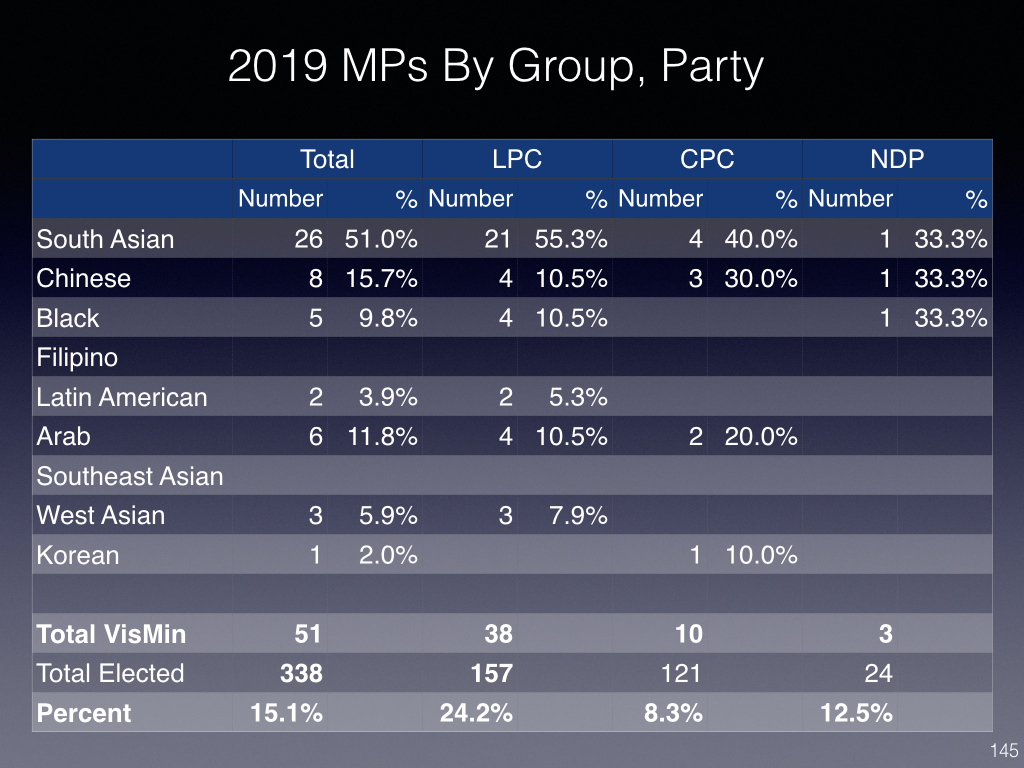
By my count, the current cabinet has four South Asians, one Chinese, one Black, one West Asian and one Latin American (formally speaking, Argentine origins are not classified as visible minorities but nevertheless are perceived as such by the Latin American ethnic media).

The above chart provides a breakdown of MPs by visible minority groups and party (no visible minority Bloc or Green MPs). South Asians form over half of Liberal visible minority MPs.

However, Caesar-Chavannes does acknowledge the geographic, gender and other constraints that are intrinsic in cabinet making.

Aziz, on the other hand, ignores the increased diversity among judges and GiC appointments which is more reflective of the government’s record.

And while I would. be the last to maintain that Cabinet representation is unimportant, I think it is more important to focus on the government’s accomplishments and commitments where the government has a decent record to build upon (e.g., appointments, the increased funding for multiculturalism and anti-black racism and associated initiatives).

Lastly, in terms of benchmarks, the percentage of visible minorities who are also citizens, and thus able to vote and run for office, is 17.2 percent, arguably a better benchmark to use than the total number of visible minorities (:

The latest cabinet picks were disappointing for some advocates of better representation for racialized Canadians in positions of power, including former Liberal MP Celina Caesar-Chavannes who offered a plea to Prime Minister Justin Trudeau to demonstrate he is correcting an admitted blind spot.

She said that didn’t happen during the Nov. 20 cabinet shuffle, which saw one Black minister named among the seven visible-minority cabinet members, and one Indigenous MP receive a post after a seven-month gap since former justice minister-turned Independent MP Jody Wilson-Raybould (Vancouver Granville, B.C.) left cabinet in February last year.

Though Ms. Caesar-Chavannes said she understands it’s sometimes “a numbers game” with few elected to pick from—in this case four Black MPs in the Liberal caucus—she said Mr. Trudeau (Papineau, Que.) missed an opportunity and has yet to demonstrate through his actions that he’s addressing the damage caused in the wake of the racist images of him that emerged during the campaign.

Perhaps he thought naming a second Black MP to cabinet would have been “too obvious” or “fake,” but it would have “symbolized an understanding of the tremendous barriers that still exist within these communities,” she said, invoking Mr. Trudeau’s own assessment of his past decisions to don blackface and brownface, including as a 29-year-old teacher.

Former Liberal MP Celina Caesar-Chavannes says the prime minister has yet to demonstrate he’s learned from his past, but she’s still hopeful the government will address issues that affect racialized communities and address representation in positions of power. The Hill Times photograph by Andrew Meade

“Please pay attention to the blind spot that you said was created by your privilege and do something to correct it,” she said.

During his second attempt addressing the scandal on Sept. 19, Mr. Trudeau (Papineau, Que.) acknowledged “a massive blind spot” he said was born from his upbringing in “a place of privilege.”

Cabinet is only one area to address that, she said, and she still has hope the government will “do things differently.” That includes appointing more persons of colour to senior positions in the public service, and considering who is staffed in the inner circle. It’s “nonsense,” for example, that the government had only one Black chief of staff, Marjorie Michel, who was named in 2019.

Former Liberal foreign policy adviser Omer Aziz, who wasn’t available for a phone interview, offered a blunt assessment of the cabinet over email.

“White men at Finance, Foreign Affairs, and Justice. White men in the inner circle. An overwhelmingly white political staffer class. But there’s not even a pretence of genuine diversity anymore, which I suppose is a positive development since we can all stop pretending,” he wrote, noting it’s “sobering” to think that the Conservatives “would be even worse, but I still believe we can do a lot better.”

Mr. Aziz has been critical of the Liberal government since leaving in January 2018, saying he constantly felt “sidelined” in discussions during his time, and that minority staff voices in government, in general, were not being empowered and listened to.

Former U.S. President Barack Obama’s late-campaign endorsement “was determinative to Trudeau’s victory,” added Mr. Aziz, but the former president also had a Black attorney general, national security adviser, and homeland security secretary. “Perhaps [Mr.] Trudeau could learn something from the former president about representation and power.”

While this cabinet wasn’t a repeat of 2015, when no Black MPs were named, Black Vote Canada’s Velma Morgan said she was “extremely disappointed” that Families, Children, and Social Development Minister Ahmed Hussen (York South–Weston, Ont.) remains the only Black minister.

The United Nations Decade for People of African Descent (UNDPAD) Push Coalition, which advocates for Black people living in Canada and was created to push for budget commitments to that effect, has said the cabinet choices leaves it questioning the Liberal government’s commitment to improving the lives of Black Canadians.

“Our community is not monolithic. We can’t have just one person speaking on behalf of us,” said Ms. Morgan, echoing the call for better representation to occur in the federal service and political staffer class.

Proportionality is not enough to address inclusion: LeMay 

In 2015, Mr. Trudeau declared the creation of “a cabinet that looks like Canada,” but several who spoke with The Hill Times said that’s still not the case. The seven visible-minority MPs represent 19.4 per cent of the cabinet, compared with 22.3 per cent of the Canadian population that identifies that way. He also named one Indigenous person, or 2.7 per cent of cabinet. The Indigenous population of Canada is closer to five per cent. Over Mr. Trudeau’s first four years in office, he appointed seven racialized and two Indigenous MPs to his cabinet. Under former prime minister Stephen Harper’s nearly 10 years, he appointed five visible minority and three Indigenous cabinet ministers.

Of the 61 visible minority and Indigenous MPs elected on Oct. 21, 44 are in the Liberal caucus and the only demographic (of those elected in the Liberal caucus) not represented in cabinet are MPs of Arabic descent.

The cabinet includes four women of colour: Minister of Small Business, Export Promotion, and International Trade Mary Ng (Markham–Thornhill, Ont.), Minister of Diversity and Inclusion and Youth Bardish Chagger (Waterloo, Ont.), Minister of Public Services and Procurement Anita Anand (Oakville, Ont.), who became Canada’s first Hindu minister, and Minister for Women and Gender Equality and Rural Economic Development Maryam Monsef (Peterborough–Kawartha. Ont.), who became Canada’s first Muslim minister in 2015. Cabinet veterans Families Minister Ahmed Hussen  (York South–Weston, Ont.), Defence Minister Harjit Sajjan (Vancouver South, B.C.), and Innovation Minister Navdeep Bains (Mississauga–Malton, Ont.) were also reappointed.

All but Northern Affairs Minister Dan Vandal (Saint Boniface-Saint Vital, Man.)—who is Métis and the lone Indigenous person in cabinet—and Mr. Sajjan are from Ontario in a cabinet that is skewed toward Canada’s biggest provinces, with 11 in Quebec, and 17 in Ontario.

“Our politics suffers from the lack of proportional representation and this cabinet is an example of that,” said Anita Singh, a Canadian political analyst and expert in Indian diaspora politics, noting the one Asian, one Black, and one Indigenous minister, though all three communities “are much larger and much more diverse than the cabinet shows.”

From an inclusion standpoint, one is never enough, said Rose LeMay, CEO of the Indigenous Reconciliation Group, who also writes a column for The Hill Times.

“Too often, in an inclusion debate, when there’s only one person of colour or a different culture, that person unfortunately becomes just becomes a token,” she said. “We will need more than just proportional around the table. We need our voice to be heard strongly and that will not occur even if we have a similar number around the table—we actually would need more to make the change that we need to see.”

That only one of the six Liberal Indigenous MPs were named to cabinet is concerning, but not surprising, she said, especially after a campaign that “hardly touched on reconciliation.”

Given Ms. Wilson-Raybould’s experience and journey trying to “maintain her credibility,” both with First Nations across Canada and in cabinet, Ms. LeMay suggested a role representing the Crown carries “a significant risk” for First Nations, Métis, and Inuit MPs.

“I wonder how difficult that would be for an Indigenous [person] in cabinet, how to maintain, with integrity, both of those roles,” she said.

‘Top-tier’ posts not given to people of colour

The most frustrating part of this cabinet for Ms. Singh is the posts persons of colour take on, she said, echoing Mr. Aziz’s issues.

All but one of the “top-tier” posts—finance, foreign affairs, trade, environment, justice, defence—remain with a white minister. Some contended Mr. Sajjan at defence, though a big file, isn’t as high-profile.

Similarly, there are gaps in portfolios that control the purse strings and involve “high-profile policy making,” like health, transport, and infrastructure, she said.

“We also see that Trudeau continues the tradition of putting inexperienced visible minority MPs in some of the toughest files and under-appreciated files,” she said pointing to rookie Ms. Anand, where she will oversee the Phoenix pay debacle and fighter jets procurement file, in concert with National Defence. Ms. Monsef, initially in charge of democratic reform in the last Parliament, was an example of that in Mr. Trudeau’s first cabinet, she said.

Others, like Ms. Morgan, don’t see it that way, saying a seat at the table is what’s most important.

Though some have viewed Mr. Hussen’s move from Immigration to Families as a demotion (an assessment he disagreed with at the swearing-in), Ms. Caesar-Chavannes pushed back and said she sees it as a high-impact post that directly affects racialized communities.

Angela Wright, a political analyst and former Conservative staffer, saw the move as a red flag and said she’s “not very optimistic” with the cabinet choices, especially given the Immigration and Public Safety portfolios—two files that disproportionately affect racialized people—are overseen by white men.

It was “shocking” to see Bill Blair (Scarborough Southwest, Ont.) elevated to Public Safety Minister, added Ms. Wright, given his reputation in the community from his time as Toronto’s police chief, where he defended the service’s use of carding.

“That’s a very odd choice,” she said, while Ms. Singh said it’s “continually frustrating that his cabinet does not reflect the actual needs of the communities that require them the most—immigration, Indigenous services, even international trade—continue to be held by MPs that do not come from communities of colour.”

Ms. Singh also noted the regional breakdown, saying it suggests the Liberals are “playing from a 1990s playbook,” targeting “ethnic neighbourhoods” to recruit candidates, but not giving the successful MPs a voice in leadership positions, she said, pointing to Brampton and Scarborough in Ontario, and Surrey, B.C. Compare that to Toronto city ridings “as a microcosm,” where she said there were no people of colour on the Liberal roster, with white MPs in Davenport, Danforth, Spadina–Fort York, Toronto Centre, Beaches–East York, and Toronto–St. Paul’s in a city where 50 per cent of all people are visible minorities.

Source: ‘Disappointing’ cabinet picks show Trudeau still needs to address diversity ‘blind spot’, say advocates

Sacha Baron Cohen: Facebook would have let Hitler buy anti-Semitic ads

For the record:

British comedian Sacha Baron Cohen has said if Facebook had existed in the 1930s it would have allowed Hitler a platform for his anti-Semitic beliefs.

The Ali G star singled out the social media company in a speech in New York.

He also criticised Google, Twitter and YouTube for pushing “absurdities to billions of people”.

Social media giants and internet companies are under growing pressure to curb the spread of misinformation around political campaigns.

Twitter announced in late October that it would ban all political advertising globally from 22 November.

Earlier this week Google said it would not allow political advertisers to target voters using “microtargeting” based on browsing data or other factors.

Analysts say Facebook has come under increasing pressure to follow suit.

The company said in a statement that Baron Cohen had misrepresented its policies and that hate speech was banned on its platforms.

“We ban people who advocate for violence and we remove anyone who praises or supports it. Nobody – including politicians – can advocate or advertise hate, violence or mass murder on Facebook,” it added.

What did Baron Cohen say?

Addressing the Anti-Defamation League’s Never is Now summit, Baron Cohen took aim at Facebook boss Mark Zuckerberg who in October defended his company’s position not to ban political adverts that contain falsehoods.

“If you pay them, Facebook will run any ‘political’ ad you want, even if it’s a lie. And they’ll even help you micro-target those lies to their users for maximum effect,” he said.

“Under this twisted logic, if Facebook were around in the 1930s, it would have allowed Hitler to post 30-second ads on his ‘solution’ to the ‘Jewish problem’.”

Baron Cohen said it was time “for a fundamental rethink of social media and how it spreads hate, conspiracies and lies”. He also questioned Mr Zuckerberg’s characterisation of Facebook as a bastion of “free expression”.

“I think we could all agree that we should not be giving bigots and paedophiles a free platform to amplify their views and target their victims,” he added.

Earlier this month, an international group of lawmakers called for targeted political adverts on social media to be suspended until they are properly regulated.

The International Committee on Disinformation and Fake News was told that the business model adopted by social networks made “manipulation profitable”.

A BBC investigation into political ads for next month’s UK election suggested they were being targeted towards key constituencies and certain age groups.

Source: Sacha Baron Cohen: Facebook would have let Hitler buy anti-Semitic ads

It’s the climate, not immigration, that keeps Australians awake at night

Good detailed report on the latest annual survey by the Scanlon Foundation, showing some similarities with Canadian public opinion and divisions:

Something happened in 2017. Australia is second only to Canada in welcoming immigration on a large scale. Our faith in the benefits of accepting newcomers of all faiths and races is rock solid. But a couple of years ago we began to grow impatient about the government’s management of the immigration program, impatient in particular about overcrowding in our cities.

This is the verdict of the Scanlon Foundation’s 2019 Mapping Social Cohesion report, published on Tuesday. The mission of the foundation for the past decade or so has been to measure how this migrant nation hangs together. In that time an extraordinary 50,000 of us have been polled to track the hopes and fears that sweep Australia – and not just about immigration.

The author of the reports, Prof Andrew Markus of Monash University, finds most Australians now share “an underlying concern about the government not properly managing the situation – the impact on overcrowding, house prices, environment”.

But in 2019 Markus fears impatience with government management might imperil majority support for Australia’s immigration program. “This has not yet occurred, but the potential is evident.”

We are not Europe. Asked every year to name the most important problem facing their countries, Europeans have lately nominated immigration. “It’s sort of cooled down a bit now,” says Markus, “but even to the present day when people are asked what’s the main issue for the EU, they still nominate controlling population movement and immigration.”

Not in Australia. We always put the economy at the top of the list. Immigration came in fourth in 2019, nominated by 6% of us. In second place on the list, after an abrupt rise, is the environment and climate change.

Source: It’s the climate, not immigration, that keeps Australians awake at night

Those who toil in low-wage jobs in the GTA more likely to be visible minorities

Of note:

The swelling ranks of Greater Toronto workers who pour coffee, clean offices and toil in other low-wage jobs are more likely to be visible minorities, according to a new report.

Although visible minorities make up just 46 per cent of the Toronto region’s workforce, they account for more than 63 per cent of the working poor, says the report being released Tuesday by the Metcalf Foundation.

Within each of the area’s four largest visible minority groups — Chinese, Black, South Asian and Filipino — the Black community has the highest percentage of working poor, at 10.5 per cent, says the report written by social policy expert John Stapleton, who used the latest census and Statistics Canada income data.

Second- and third-generation Black Canadians are especially vulnerable and often earn less than recent Black immigrants, according to the report.

Working poverty is lowest in the Filipino community, at 5.3 per cent, just above white residents at 4.8 per cent.

“It is striking and concerning that the Black population has the highest percentage of working poverty among both the immigrant population and those born in Canada,” says the report.

The growth in working poverty among and second- and third-generation Black Canadians is “particulary pronounced” among Black Canadian-born females, who saw an increase from 9.7 per cent in 2006 to 12.2 per cent in 2016, the report says.

As highlighted in a recent United Way report, the Toronto region is “coming to the uncomfortable realization that our increasing economic inequality is also highly racialized,” says University of Toronto professor David Hulchanski.

“We knew this, but now we have solid data and evidence,” says Hulchanski, who has been tracking disappearing middle-class neighbourhoods in the GTA and other Canadian cities for almost 50 years.

The report reflects “facts and trends that cannot continue if we want a productive, prosperous and harmonious Toronto region,” he adds.

The report is the second update of Stapleton’s groundbreaking 2012 analysis, which found working poverty in the Toronto region spiked by an alarming 46 per cent between 2001 and 2006, largely due to the demand for entry-level service workers to support the burgeoning high-paid knowledge sector. This includes lawyers, business and finance professionals.

Over the past decade, working poverty grew by another 27 per cent, Tuesday’s report shows.

“Although this slower growth is a welcome trend, the continued growth is troubling,” Stapleton says.

High rates of working poverty along with data that points to “the racialization” of working poverty is a serious public policy concern, he says.

“These trends ought to be considered unacceptable anywhere, and definitely in the wealthiest and most diverse metropolitan area of an affluent nation,” Stapleton says. “We all lose out when a significant part of our labour force cannot make ends meet.”

Black community scholars Carl James and Kofi Hope, who independently analyzed the report’s race-based data, say the findings have to be seen in the context of “the reality of anti-Black racism, and the reluctance of Canadians to acknowledge that this phenomenon has existed in our nation for hundreds of years.”

“This report shows why it is important to collect disaggregated data,” says James, who holds the Jean Augustine chair in education, community and diaspora at York University’s faculty of education. “And it also shows why it is important to disaggregate the visible minority category.”

Soha Mohamed, 29, a decent work project facilitator at the Victoria Park Hub in Scarborough, says the Metcalf report paints a “disappointing” portrait of the experience of Black workers.

“But it doesn’t come as a shock, especially for me, personally, and my own relationship to precarious work,” adds Mohamed, a Black woman whose part-time contract, with no benefits, expires next March.

“Even though my work is to promote stable employment and opportunities for job advancement, health and pension benefits, equality and rights at work for women, it’s also something that I aspire to achieve,” she says.

Mohamed, who has two young daughters, immigrated to Canada with her parents from Sudan when she was 5. Combined with child benefits and her partner’s meagre income as an upholsterer, their household income falls below Canada’s Low-Income Measure of about $47,000 after taxes for a family of four in 2017.

“I am already looking for work because I know my current contract won’t be extended,” she said. “There is always that level of uncertainty. What happens next? How will I pay the rent?”

The report defines the working poor as people between the ages of 18 and 64 who are not students, are living independently and have an annual after-tax income between $3,000 and the Low-Income Measure of $22,133 in 2015, the year the most recent census was taken.

By this measure, 7 per cent of Toronto workers — almost 170,000 — are “working poor.”

The working poor tend to be younger and less educated than the overall working population. And they are more likely to be men, a reflection of the loss of manufacturing jobs in the area that tended to be dominated by male workers.

Although the data doesn’t show why the growth in working poverty has slowed in the past decade, increases to the minimum wage and new and increased income supplements for people living in poverty likely helped, Stapleton says.

“These interventions, which continue to moderate the incidence of working poverty, illustrate that governments have a crucial role to play in assuring adequate incomes for residents,” says the report by the Metcalf Foundation, which is dedicated to equity, sustainability and the arts.

Strategies to reduce working poverty also need to address systemic and structural issues that continue to marginalize the Black community, the report adds.

Society needs to value work done by those in lower-paying jobs and find a way to turn them into full-time, less precarious employment.

“We believe that through higher wages, better job stability, anti-racism strategies, and more effective support programs, Toronto could reduce and even eradicate working poverty,” Stapleton says in the report.

Many of the factors driving working poverty among all GTA residents — including being a young worker, having no post-secondary education, and living outside the downtown core — are common among Black Canadians, say York University’s James and Hope, a senior policy adviser at the Wellesley Institute.

A February 2019 Statistics Canada report says 26.6 per cent of the Black population was under age 15, while only 16.7 per cent of the overall Canadian population was in that age group.

According to the Toronto District School Board, Black students — particularly males — are more likely than other students to be suspended or expelled from school and have a higher dropout rate.

And Black people in Toronto are also disproportionately watched, stopped and “carded” by police, leading to higher rates of criminalization, they add.

As far as intergenerational working poverty, James and Hope say it appears the longer Black families live in Canada and interact with Canadian institutions, “the more difficult it becomes for them to overcome entrenched barriers.”

“Further research is needed to look more closely at the ways anti-Black racism manifests to produce barriers to Black people’s success in the labour market,” they say. “This research is critical to moving forward if we are to get a full picture of what is happening within Black communities, and what policy and community responses are necessary to change this situation.”

Source: Those who toil in low-wage jobs in the GTA more likely to be visible minorities

Ramos and Griffith: Human rights defenders should boycott immigration conference in Beijing

Our op-ed in the Ottawa Citizen (part of the national Postmedia chain for those outside of Canada):

The number of international events being hosted by China is on the rise. At first glance, one might argue that global exchange is a mechanism for the West to normalize democratic values and open science. However, the world is increasingly witnessing repressive regimes, such as that in China, rise in influence at the cost of human rights and democracy. This then raises the question: Does participating in events hosted by such regimes promote engagement or complicity?

The Chinese regime has created a number of quasi-independent groups, such as the Center for China and Globalization (CCG), which bills itself as “China’s leading global non-governmental think tank with more than 10 branches and overseas representatives.” The CCG is in fact part of the United Front Work Department, a branch of the Chinese Communist Party that aims to exert Chinese government influence around the world. Both organizations are key pillars in attracting conferences to China, which means that their events will most likely legitimize the regime on the international stage, rather than curb it through engagement.

One example of how this plays out can be seen through the International Metropolis Conference, which involves government policy makers, academics and non-governmental sector organizations and is set to be held in Beijing this coming June. The CCG was a key stakeholder in wooing the conference’s secretariat and bringing it to China. The conference focuses on immigration and refugee issues and is widely known for promoting multiculturalism, diversity and inclusion. It was founded in 1996 with Canadian government funding and with strong links with Immigration, Refugees and Citizenship Canada which hosted last year’s conference. Its secretariat is currently based at Carleton University. The conference and the “Metropolis” brand are almost synonymous with Canadian immigration.

Does participating in events hosted by such regimes promote engagement or complicity?Holding such a conference in China under the current regime can only legitimize Beijing’s human rights abuses. Both the United Nations and Amnesty International have issued reports warning that China is actively suppressing its ethnic minority populations. Up to one million  Muslim Uighur are being held in “re-education centres,” which are essentially prison camps. It is ironic to hold a conference on refugees in a country that produced them, and doing so is an act of complicity.

Based on past practices of the regime, it is almost certain that Chinese authorities will not permit a free and open exchange of ideas on relevant Chinese policy and practice. Foreign speakers will likely be discouraged from talking about issues that might “offend” the government, or will censor themselves. Chinese participants will be prohibited from doing so. It is also very likely that minders will be present to monitor and intervene in the event of any real or perceived criticism.

Some might argue that participating in the conference is a means to change the regime and that all countries have blemishes. Canada, for instance, still wrestles with ongoing colonialism. But, there is a major difference between countries that have entrenched human rights in their legislation and those, such as China, who do not. It is naïve to think that hosting an event in China will change its practices.

For this reason, more than 150 academics and representatives of non-governmental groups from across Canada and 11 countries signed a petition against both holding and attending the International Metropolis Conference in Beijing. They recognize that it is not too late to do something about the message Canada and other democratic countries send when they fund and participate in events in China, and that it is not too late for individual Canadians to make a difference.

It is time for Canada and other Western countries to recognize they cannot assume that policy and academic exchange will change repressive regimes. Rather it could potentially legitimate them or send the signal that the international community is willing to turn a blind eye. For these reasons it is time to rethink when it is appropriate to participate in events held by repressive regimes. Failing to do so risks compromising Canadian and international human rights values.

Source: https://ottawacitizen.com/opinion/columnists/ramos-and-griffith-human-rights-defenders-should-boycott-immigration-conference-in-beijing

How Racial Bias May Have Saved 14,000 Black Lives

Really interesting study on one of the rare positive impacts of implicit bias and discrimination:

When the opioid crisis began to escalate some 20 years ago, many African-Americans had a layer of protection against it.

But that protection didn’t come from the effectiveness of the American medical system. Instead, researchers believe, it came from racial stereotypes embedded within that system.

As unlikely as it may seem, these negative stereotypes appear to have shielded many African-Americans from fatal prescription opioid overdoses. This is not a new finding. But for the first time an analysis has put a number behind it, projecting that around 14,000 black Americans would have died had their mortality rates related to prescription opioids been equivalent to that of white Americans.

Starting in the 1990s, new prescription opioids were marketed more aggressively in white rural areas, where pain drug prescriptions were already high. African-Americans received fewer opioid prescriptions, some researchers think, because doctors believed, contrary to fact, that black people 1) were more likely to become addicted to the drugs 2) would be more likely to sell the drugs and 3) had a higher pain threshold than white people because they were biologically different.

A fourth possibility is that some white doctors were more empathetic to the pain of people who were like them, and less empathetic to those who weren’t. Some of this bias “can be unconscious,” said Dr. Andrew Kolodny, a director of opioid policy research at Brandeis University.

This accidental benefit for African-Americans is far outweighed by the long history of harm they have endured from inferior health care, including infamous episodes like the Tuskegee study. And it doesn’t remedy the way damaging stereotypes continue to influence aspects of medical practice today. “The reason to study this further is twofold,” Dr. Kolodny said. “It’s easy to imagine the harm that could come to blacks in the future, and we need to know what went wrong with whites, and how they were left exposed” to overprescribing.

The prescription-opioid-related mortality rates of black and white Americans were relatively similar two decades ago, but researchers found that by 2010, the rate was two times higher for whites than for African-Americans.

Because African-Americans were less likely to receive those prescriptions, they were less likely to become addicted (though they were more likely to endure unnecessary and excruciating pain for illnesses like cancer).

The researchers, Monica Alexander, a statistician with the University of Toronto; Mathew Kiang, an epidemiologist at Stanford; and Magali Barbieri, a demographer at the University of California, Berkeley; published their study in the journal Epidemiology.

With additional analysis at The Upshot’s request, Mr. Kiang calculated that had the African-American population’s mortality rates caused by prescription opioids been equivalent to those of whites, black Americans would have experienced 14,124 additional deaths from 1999 to 2017.

It’s a counterfactual analysis that relies on some large assumptions. Among other things, the projection assumes that the public health and medical response to the epidemic would have remained the same even if the African-American mortality rate had been higher. And it doesn’t take into consideration any potential changes in overdoses from heroin and fentanyl had African-Americans had greater access to prescription opioids. Still, Mr. Kiang found the results “fairly remarkable in at least two ways.”

“First, it’s a good example of how more medical care is not necessarily a good thing,” he said. “Second, it’s an extremely rare case where racial biases actually protected the population being discriminated against.”

A crackdown in recent years has reduced opioid prescribing over all, “and the racial/ethnic gap in opioid prescribing has narrowed,” said Mr. Kiang, but he said it was unclear whether the gap had closed entirely.

In recent years, drug overdoses have risen sharply among black Americans, particularly among older heroin users in places where fentanyl has become widespread. One reason that the death rates from heroin and fentanyl have converged between black and white people may be simple: Heroin and fentanyl are readily available outside the health system, so they’re less affected by bias within it.

The public response to drug epidemics also tends to diverge along racial lines. During the crack epidemic, there was a greater emphasis on punishment and incarceration. With the opioid crisis primarily affecting white people, there has been more emphasis on empathy and rehabilitation. (This same disparity was seen in crack versus powder cocaine.) Race played an obvious role in the policy response, Dr. Kolodny said: “From ‘Arrest our way out of it’ to, ‘It’s a disease.’”