The Woke Will Always Break Your Heart [on Trudeau and the left]

Good column. What struck me with the various commentaries on Trudeau’s blackface, was just how few of them, on the right or particularly the left, completely ignored any discussion or analysis of the Liberal record on “diversity and inclusion.” (See, for example, my Taking stock of Ottawa’s diversity promises):

The 2019 election is a test for Canadian progressives: style or substance. The Liberal government of Justin Trudeau is the most successful progressive government in the world. It instituted a carbon tax and legalized marijuana. Last year, for the first time, Canada settled more refugees than any other country. Because of higher government benefits, child poverty is at its lowest level in history. Economic growth this year reached 3 percent. That is what Trudeau has done. He also appeared in brownface at an Aladdin-themed costume party in 2001 at the age of 29.

Canadian progressives, like progressives all over the world, must decide whether they care more about the pursuit of social and cultural change, through the eradication of racist and sexist imagery, or the pursuit of transformative policies. In 2015, Trudeau promised both. He was the shining ideal of maximum wokeness, imposing a gender-equal cabinet and offering as the explanation, “Because it’s 2015.” Well, it’s 2019 now.

How racist Trudeau’s appearance in brownface was, and therefore how forgivable, is subject to debate. People of color in Canada—by no means a contiguous body or voting bloc—have differences of opinion about the gravity of Trudeau’s browning up. Sunny Khurana, a Sikh man who appears in one of Trudeau’s photos from the “Arabian Nights” theme party at West Point Grey Academy, did not find his appearance there racist in the slightest. “He wasn’t trying to demean anybody who was a person of color, and from what I can recall from that function, it never came across as that, not at all,” he said recently. “I mean, I didn’t even think twice of it. It was a good party. We had fun.”

Others read the costume as symptomatic of Canada’s racist history generally, and in particular its history with minstrel shows, which is more extensive than you might think. (The composer of Canada’s national anthem performed in blackface.) Others, such as the society gossip columnist Shinan Govani, have acknowledged personal conflicts: “It is the season of moral gymnastics, here in Canada,” he wrote in the Daily Beast.

Needless to say, dispassionate debate about the significance of Trudeau’s costume—parsing his intentions and the context—is not possible, given that we’re in the middle of an election. The picture went viral; that’s what counts. Liberal Party candidates have been struggling. “It was wrong then, and it’s wrong now,” Harjit Sajjan, the defense minister, told the CBC. “But I’m also here to talk about the person I know, in terms of how much he is standing up for people.”

Whatever Canadians may think about the photograph itself, it closes off a major line of attack for Trudeau. Live by the sword of political correctness, die by the sword of political correctness. You can’t argue that your opponents are a bunch of embarrassing antiquities living in the political past—by, say, replaying the Conservative leader’s 2005 speech opposing gay marriage, which the Liberals were doing right up until this story broke—when the internet is rife with your face in brown makeup.

The Trudeau scandal points to a larger problem: The woke will always break your heart. It’s not just that nobody’s perfect, and it’s not just that times change, and it’s not even that the instinct to punish that defines so much of the left is inherently self-defeating. If people want to sell you morality, of any kind, they always have something to hide.

The main criticism from Trudeau’s opponents on the right has usually been that he’s a spoiled brat—a son of privilege—not up to running the country. A faker. The brownface debacle has now become, on the left, a symbol of his lack of real commitment to progressive values. But the cross-party consensus that Trudeau is slight and phony doesn’t survive even a cursory examination of his record. An independent assessment by two dozen Canadian academics found that Trudeau has kept 92 percent of his campaign promises, fully or partially, the most by any Canadian government in 35 years. He is measurably, demonstrably the most sincere and effective prime minister in living memory. He is the rare case of a man whose virtue-signaling has distracted from his real virtues.

Only the left struggles with these standards of style. Right-wing political opponents in Canada and elsewhere have a completely different understanding of acceptable behavior. In the United States, President Donald Trump’s supporters take his brand of nastiness, his aggressive rejection of even the most basic social norms, as a sign of authenticity. Meanwhile, Senator Elizabeth Warren is still apologizing for her Cherokee-ancestry claim.

This imbalance matters, because the left’s aesthetic vulnerability comes at a moment of real threat for progressives. Multiculturalism as a project is dying globally, and not because of a sudden outbreak of brownface performances. The “Howdy Modi” event in Houston revealed how the world is turning: populism, xenophobia, the bragging stupidity of ethnic pride. During the last election, Trudeau’s main opponent, the Conservatives, promised “barbaric cultural practices” hotlines and “Canadian values tests” alongside a two-tiered citizenship system under which dual citizens and immigrants could have their citizenship revoked while natural-born Canadians could not. If voters who believe in multiculturalism cannot forgive face paint, the multicultural project as policy may not survive.

In this context, it’s unclear whether the extreme blandness of Trudeau’s main opponent, Andrew Scheer, helps or hurts the prime minister’s chances for reelection. Scheer does not bother with costumes. He’s not photogenic enough. He, too, is embroiled in a scandal, however—about whether he was properly accredited to claim he worked as an insurance broker for a few months. This may be not just the most boring scandal in this election, and or in Canadian history, but the most boring scandal imaginable. I cannot imagine a duller one. Nobody thinks about Scheer much. But perhaps Canadians want a prime minister they don’t have to think about much.

“The fact of the matter is that I’ve always—and you’ll know this—been more enthusiastic about costumes than is sometimes appropriate,” Trudeau acknowledged in the first of a seemingly endless series of apologies. Progressives loved Trudeau’s best costume: Captain Woke. We’ll find out in October whether they were with him for his policies or his poses. They can’t have both. But they can have neither.

Source: https://www.theatlantic.com/ideas/archive/2019/10/trudeaus-progressive-style/599203/

Liberals step up attacks with 2 weeks left, but Conservative campaign most negative, data shows

Nice to see this kind of social media analysis. But depressing the reliance on negative attacks by both major parties:

The Conservatives lead other major federal parties in the amount of negative attacks on Twitter and in press releases this campaign, but at the midpoint of a close race the Liberals are increasingly turning negative, an analysis by CBC News shows.

CBC News analyzed more than 1,800 press releases and tweets from official party and party leader accounts since the start of the campaign. We categorized them as either positive, negative, both positive and negative or neutral. (See methodology below.)

Overall, the Conservatives have put out the highest volume of negative communications to date, the analysis revealed. The party tends to put out communications attacking the Liberals about as often as they promote their own policies.

That doesn’t mean the Conservatives were the only party to go negative early on. At the outset of the campaign, the Liberals went after Conservative Leader Andrew Scheer on Twitter for his 2005 stance on same-sex marriage and other Conservative candidates for anti-abortion views or past social media missteps.

But almost half (47 per cent) of Conservative communications have been negative or partly negative. The share of negative messages is 37 per cent for the NDP, 26 per cent for the Liberals, 18 per cent for the Greens and 13 per cent for the Bloc Quebecois, which has run the most positive campaign.

Liberals, NDP step up attacks

While the Conservatives have been consistently negative since the start of the campaign, other parties have become markedly more so in the last two weeks.

The uptick in attacks appears to be driven by two factors: the climate marches across the country on Sept. 20 and 27 and the French-language debate hosted by TVA on Oct. 2.

The NDP and Greens took aim at the Liberals’ environmental record around the time of the climate marches. It was also during the last week of September that the Liberals announced a number of environmental policies they would enact if re-elected, which were promptly criticized by the NDP and Greens.

The tone of Liberal communications turned markedly critical during the TVA French-language debate on Oct. 2. This was the first debate Liberal Leader Justin Trudeau took part in, and the Liberal war room put out press releases and tweets countering statements made during the debate by Scheer and the Bloc Quebecois’ Yves-Francois Blanchet.

The TVA debate also marked the first instance during the campaign of the Liberals targeting a party other than the Conservatives with critical tweets and press releases. The party took the Bloc leader to task over his environmental record, among other things.

Liberals the target of most attacks

The Liberals were the target of more than two-thirds (70 per cent) of negative or partly negative communications.

The Conservatives have yet to target a party other than the Liberals with a critical press release or tweet.

The Liberals also have been the primary target of the NDP and, to a lesser extent, the Greens.

While these two parties may be closer ideologically to the Liberals than to the Conservatives, the NDP and Greens are focused on stopping progressive voters from rallying around the Liberals. University of B.C. political science professor Gerald Baier said this reflects a coordination problem on the centre-left.

“The NDP and Greens, I think, would presumably prefer the Liberal record on the environment to what the Conservatives would do, but at the same time their main points are against the existing government,” he said.

The lack of Liberal attacks on the NDP and the Greens is telling, Baier said.

“It suggests that they know that their path to a majority to some degree is to appeal to some of those NDP and Green voters,” he said.

It also could be because the Liberals may need the support of those parties to govern in a minority Parliament, Baier added.

NDP and Green attacks against the Liberals have focused largely on the environment, while the Conservatives have zeroed in on themes of accountability, taxes and spending.

Environment, taxes the two biggest themes

Much of the official party communications focus on the campaign trail, specific candidates and where the party leaders are.

The two policy exceptions are the environment — a popular subject for all parties except the Conservatives — and tax policy, on which the Conservatives have focused. Affordability and housing are also common themes.

Methodology

CBC News analyzed every press release and tweet from official party and party leader accounts since the start of the campaign. We categorized each communication as positive (if the focus was promoting a party’s own policies or candidates), negative (if the focus was criticizing another party), both positive and negative (if the communication was equally split between the two) or neutral (leader itineraries, event announcements). We also kept track of the topics of communications and who, if anyone, was targeted.

We did not include retweets and treated identical tweets in English and French as one communication.

To keep the project’s scope manageable, the methodology excludes other platforms such as Facebook, YouTube, radio, television and print ads.

Source: Liberals step up attacks with 2 weeks left, but Conservative campaign most negative, data shows

Liberals keeping Cape Breton candidate despite past racist, sexist remarks on social media

Hard to defend keeping this candidate apart from the need to save a safe Liberal seat.

In contrast, the Conservative decision to dump their candidate in Burnaby North-Seymour was easier, as the Conservatives ran third, albeit with 28 percent of the vote in 2015:

Justin Trudeau says past racist and sexist social-media posts from a Liberal candidate in Cape Breton were “unacceptable,” but the party is not dropping Jaime Battiste from its election campaign roster.

Sunday marked the first time Mr. Trudeau has publicly commented on Mr. Battiste’s remarks since Friday, when the Toronto Sun revealed past Facebook and Twitter posts in which the Liberal candidate for Sydney-Victoria made offensive remarks about women, Indigenous girls, gay men and Chinese people with accents. Mr. Battiste has since apologized for the posts, which date back as far as 2011, saying he wrote the posts during “difficult times” in his life.

Speaking to reporters in Plainfield, Ont., Sunday, Mr. Trudeau was asked if he felt he was limited in the action he could take against other Liberal candidates because of past photos of him in blackface and brownface, but he didn’t answer the question directly.

“We recognize that Jaime Battiste … took responsibility for his actions and has apologized,” Mr. Trudeau said.

In response to an interview request for Mr. Battiste, the Liberal Party referred to his apology instead.

Conservative Leader Andrew Scheer had the day off on Sunday, but his party took to Twitter to ask if Mr. Trudeau needs to “see more before he finally fires him.”

Meanwhile, the Conservatives were dealing with another controversial candidate of their own. The party dropped Heather Leung as its candidate for Burnaby North-Seymour on Friday over offensive comments she made about the LGBTQ community.

However, video posted by CityNews in Vancouver on Saturday showed Ms. Leung’s team still putting up Conservative campaign signs with her name on them.

In a statement on Sunday, Conservative spokesperson Simon Jefferies said Ms. Leung has been told she cannot use the party’s name or logo, or represent herself as the Tory candidate.

All of the major parties have had candidate troubles. Cameron Ogilvie stepped down as Conservative candidate in Winnipeg last month over discriminatory social-media posts.

Source: Liberals keeping Cape Breton candidate despite past racist, sexist remarks on social media

Un candidat bloquiste dénonce la discrimination de l’« homme blanc »

Not surprising, given their ethno-centrism:

Dominique Mougin, qui brigue les suffrages dans Saint-Léonard–Saint-Michel, a partagé au cours de la dernière année deux articles du média ultraconservateur Le Peuple. Ces billets dénonçaient la Ville de Montréal et Québec solidaire pour avoir établi des critères d’embauche qui favorisent le recrutement de femmes et de personnes issues des minorités ethniques.

Dans les deux cas, les textes se désolaient que les critères de diversité défavorisent les « hommes blancs », à plus forte raison ceux qui sont « hétérosexuels » dans le cas de l’administration Plante.

M. Mougin n’était pas l’auteur de ces textes, mais en plus de les partager, il a fourni des commentaires pour les appuyer. Le 8 janvier 2019, sous le texte intitulé « Hommes blancs, abstenez-vous de postuler pour Québec solidaire ! », il a écrit que « si on veut commencer à se faire respecter, il va falloir répondre coup pour coup ».

Il est plus que temps que les députés du PQ et du Bloc québécois dénoncent le racisme dont font preuve QS et Projet Montréal.

Dominique Mougin, le 8 janvier 2019

Quelques semaines plus tôt, en novembre 2018, sous le texte « L’homme blanc hétéro est écarté par l’administration municipale », le candidat bloquiste décrivait Valérie Plante comme « notre petite mairesse », en plus d’ajouter : « et je ne parle pas seulement de sa taille ».

La Presse a laissé des messages vendredi et dimanche sur la boîte vocale de Dominique Mougin, mais celui-ci n’a pas rappelé. Les deux publications ont toutefois été retirées de son fil Facebook dans l’intervalle.

Avant qu’il annonce la fin de ses activités en août dernier, le média Le Peuple se décrivait comme « un journal qui vise à donner un point de vue différent sur l’actualité québécoise et canadienne ». Il défendait notamment des positions masculinistes, climatosceptiques et antimigratoires.

Invité à réagir au comportement en ligne de son candidat, le Bloc québécois nous a fourni une courte déclaration dans laquelle il indique que « M. Mougin s’est engagé à défendre exclusivement le programme » du parti.

Peur de la drague

Dans un registre moins draconien, un autre candidat bloquiste a lui aussi déploré la condition de l’homme québécois au cours des dernières années.

Claude André, qui se présente dans Rosemont–La Petite-Patrie, a travaillé comme journaliste pigiste et chroniqueur d’humeur dans les années 2000 et 2010. À l’époque, il a alimenté une page personnelle, puis un blogue hébergé par le Huffington Post.

Sur sa page personnelle, en mars 2007, il a signé un « édito » adressé « strictement aux mecs » dans lequel il disait remarquer que les hommes d’ici étaient effrayés par l’idée de draguer des femmes.

« Serait-ce parce que les gars, depuis la garderie au secondaire, ont été élevés par des femmes que l’homo quebecencis molluscus est angoissé à l’idée d’en affronter une sur le terrain de la séduction ? […] Ou encore parce qu’elles ont connu des pères du divorce qui, par remords de ne pas leur donner une vraie famille, les traitent comme des reines que les filles d’ici sont si altières ? », a-t-il écrit.

Joint par La Presse vendredi dernier, Claude André a soutenu que ses textes « d’humour » s’inscrivaient dans « l’esprit de ces années-là ». Il affirme qu’il ne cautionne plus ces idées. « De vieux sketches de Rock et Belles Oreilles, ça ne passerait plus aujourd’hui », illustre-t-il.

« Bashing »

Dans un passé plus récent, M. André a signé un billet intitulé « Le bashing du mâle québécois : ça suffit ! » sur le site du Huffington Post. Dans ce texte daté d’août 2013, il affirmait notamment en avoir « ras le pompon » du « mépris » dont faisaient l’objet, selon lui, les hommes de la province.

Il réagissait alors à un texte publié par la journaliste Judith Lussier dans lequel elle racontait avoir cessé de porter une robe d’été car elle en avait marre de recevoir des remarques déplacées. Son usage de l’expression « violer du regard » avait mis M. André hors de lui.

Déjà que les hommes de ma génération étaient parfois perçus comme des assassins possibles, après les événements de Polytechnique commis par un meurtrier nommé Marc Lépine, faudrait pas non plus que l’on fasse maintenant des Québécois des éventuels violeurs en puissance parce qu’ils répondent – parfois maladroitement, je n’en disconviens pas –, à une impulsion séductrice.

Claude André, dans un texte de 2013

Judith Lussier a dit à La Presse avoir déjà signifié que « si c’était à refaire », elle écrirait sa chronique « autrement ».

« Je crois toutefois que ce texte nous aura permis d’entamer une discussion sur le harcèlement de rue, qui n’était pas vraiment un sujet de discussion à l’époque », a-t-elle ajouté, estimant par contre que la lecture de M. André « extrapolait d’une manière exagérée » et « faisait preuve de susceptibilité et s’inscrivait un peu dans l’idée passive-agressive du “not all men” ».

En entrevue, Claude André a fait valoir que « c’était avant #metoo, avant tout ce qu’on sait sur la culture du viol. Évidemment que je n’écrirais pas quelque chose comme ça aujourd’hui ».

Quant à l’idée du « mâle bashing », elle faisait « partie de la discussion politique de l’époque », selon lui.

Le Bloc québécois s’est dit « satisfait » des explications de son candidat et a souligné que « M. André défend l’égalité entre les femmes et les hommes ».

Source: Un candidat bloquiste dénonce la discrimination de l’« homme blanc »

Douglas Todd: How the election is playing out in local Chinese-language media

More in-depth look at Chinese-language media election and related coverage:

The conflict between Hong Kong and China. The pros and cons of immigration and refugees. Beliefs on abortion and same-sex issues. The tension between paying taxes and benefiting from social services.

Specialists who monitor Canada’s roughly 290 Chinese-language newspapers, websites, radio stations and TV channels say the political coverage not only echoes the mainstream media, it also reveals the distinct concerns of people with origins in East Asia.

Immigration and refugee issues garner more attention in the Chinese-language media than they do among the general Canadian public, say professional observers.

And even though Chinese-Canadians with roots in Hong Kong, Taiwan and China show a complex range of political opinions, Andrew Griffith, a former senior director in Ottawa’s immigration department, has concluded: “There is more of a conservative trend among Chinese-Canadians than, for example, South Asians.”

Like other Canadians, the 1.3 million people of Chinese origin switch party allegiances according to broader political patterns, said Griffith, who works with Diversityvotes.ca, a website highlighting political coverage in the country’s ethnic media. But their votes could make a crucial difference in dozens of urban swing ridings with large immigrant and visible-minority populations.

Roughly three out of four Chinese-Canadians live in either Greater Toronto, where they make up 11 per cent of voters, or Metro Vancouver, where they account for 20 per cent of voters. In the Vancouver suburb of Richmond, which has two federal ridings, 54 per cent of the population is ethnic Chinese.

Andres Malchaski, president of MIREMS International, which monitors the ethnic-language media and helped create Diversityvotes.ca, says that, while a large portion of Canadians tell pollsters the environment is their top election issue, that issue is far outweighed in the Chinese-language media by debates over immigration and refugees.

Chinese-Canadian media outlets, including their discussion forums, contain frequent criticism of Liberal leader Justin Trudeau for bringing in more than 60,000 Syrian refugees since 2015, said Machalski, who has analyzed Canada’s ethnic media for three decades.

Media outlets that target Canadians from China are often wary of refugees from Muslim countries, Machalski said, an attitude that reflects the way China’s authoritarian leaders have restricted the religious freedom of millions of Uighur Muslims.

“The feelings expressed by some of the calls and comments on phone-in shows and in newspaper columns (in Canada) certainly support the idea there will be segments of Chinese voters that might even go so far as to support the People’s Party of Canada,” which is calling for reducing immigration and refugee levels, Machalski said.

Still, Machalski emphasized that the views expressed in the Chinese-language outlets in Canada offer a “kaleidoscope” of perspectives, which often reflect whether their respective audiences are connected to Hong Kong, Taiwan, Hanoi or Beijing.

That is especially so in regards to the recent anti-Beijing protests in the financial centre of Hong Kong.

More than 300,000 people living in Hong Kong hold Canadian passports — and Oct. 21 marks the first Canadian election in which they can cast a ballot, says a Diversityvotes.ca article by Blythe Irwin.

The Chinese media is picking up on everything Canadian politicians are saying about the special administrative region of China. Ethnic-Chinese media commentators, she says, are both approving and sceptical of the way Trudeau says he is “extremely concerned” about Hong Kong, while Conservative leader Andrew Scheer went further by declaring in a tweet: “We are all Hong Kongers.”

Fenella Sung, a former Chinese-language radio show host, said that Chinese-media perspectives about the conflict largely reflect whether the Canadian-based outlets are aimed at audiences rooted in Hong Kong or China.

It’s not surprising that readers of media directed at the large mainland-Chinese population in Canada “would think the Hong Kong issue is China’s internal affair and that it would not be appropriate for Canadian politicians to comment,” said Sung, who is a member of Canadian Friends of Hong Kong.

Long-time immigrants from Hong Kong, Taiwan and other parts of East Asia, Sung said, tend to have political concerns that are in line with Canadians at large, such as jobs, housing and protecting the environment.

“But newer and younger immigrants, mostly from mainland China, are very consistent and focussed on economic growth, expansion of trade, less government bureaucracy, and lower taxation. They don’t like social spending.”

Prior to the B.C. election in 2016, some opinion polls suggested that, even while the province’s more than 500,000 ethnic Chinese voters held diverse views, they generally leaned to the centre-right B.C. Liberals, and had almost no interest in the Greens.

In an article on politics and Canada’s ethnic media published Wednesday in Policy Options magazine, Griffith said Liberal and Conservative party approaches to same-sex marriage and abortion have been widely commented upon, suggesting so-called “family values” are important to many recent immigrants and people of colour.

“While the Liberals and Conservatives get widespread coverage of their electoral promises and commitments, the NDP and Green Party are under-covered,” Griffith added, after reviewing 1,200 recent articles in the ethnic media.

“In contrast, the People’s Party of Canada, given its focus on restricting immigration and its initial exclusion from the leaders’ debate, received more than twice as much substantive coverage as the NDP and Greens combined.”

Chinese-language and other ethnic media outlets in Canada don’t necessarily reinforce cultural silos, Griffith says. But it’s clear they also offer a special window into political discussions of particular concern to certain ethnic groups.

Source: Douglas Todd: How the election is playing out in local Chinese-language media

Ethnic media election coverage 29 September to 5 October

Latest weekly analysis of ethnic media coverage. For the analytical narrative, go to Ethnic media election coverage 29 September to 5 October: UPDATE

Andrew Coyne: You can’t be leader of one country and pledge allegiance to another

Apart from the hypocrisy (which many politicians are guilty), it is the sheer obliviousness.

It is not like the situation in Australia, where a number of politicians found out inadvertently there were considered dual citizens. Andrew Scheer filed annual US tax returns as required by US law.

On the second part of Coyne’s commentary, his questioning the concept of dual citizenship is more theoretical than practical. One can make his arguments but one has to be aware of the practical implications, not to mention the political impracticalities.

For some immigrant groups, travel back to their country of origin to visit family or for business can only be done on the country of origin, Iran being an example. So ending dual citizenship would have a real impact on those who immigrated from such countries.

While largely not an issue for MPs and Ministers, I agree with Coyne’s arguments that leaders should not be dual citizenship for symbolic and practical reasons.

In Andrew Scheer’s case, would the public be comfortable with a dual American-Canadian negotiating NAFTA or other bilateral agreements? Even if only from a perception perspective?

If hypocrisy is the tribute vice pays to virtue, virtue must be feeling awfully flattered of late.

Hardly had we digested the news that Justin Trudeau, for all his attempts to tar opponents as racially insensitive troglodytes — certainly next to his own exquisitely sensitive self — had made something of a hobby of dressing up as a black or brown person, when we learned that Andrew Scheer, though he and his party had been quick to criticize other party leaders for being dual citizens, was guilty of the same offence himself.

Well, no, the two situations are not quite the same, are they? For while everyone agrees that wearing blackface is deeply wrong, everyone seems equally agreed that there’s nothing wrong with someone being a citizen of two countries — not even a prime minister. “Over a million Canadians hold dual citizenships,” a Liberal spokesperson began in response. “It’s part of what makes Canada great.”

The problem, rather, was that Scheer had failed to make public that he was one of those over a million Canadians, had indeed been “caught hiding” his involvement in part of what makes Canada great, “even as he was ridiculing others for holding dual citizenship.” The issue, then, was not that he had done something inherently shameful — like, say, dressing in blackface — or even that he had hidden this wholly unshameful fact. The issue was that he was a hypocrite.

And so he is — a flaming one. If he has not made quite the same career out of his personal opposition to dual citizens that Trudeau has made of his opposition to racism, he and his party certainly made hay out of the dual French and Canadian citizenship of former governor general Michaelle Jean, former Liberal leader Stephane Dion, and former NDP leader Thomas Mulcair. Just on a level of basic competence: how on earth did he imagine this would not come out?

So all right, he’s a hypocrite — as are those who shrugged at their cases but seem very exercised about his. But beyond the hypocrisy, what is the substance of the issue? Are we right to assume there is nothing wrong with dual citizenship, only with hypocrisy? I don’t think so — as I said then, and as I repeat now.

It’s not wrong on a personal level: none of these leaders have done anything wrong, nor have their million semi-compatriates. It’s the law that’s wrong. It is wrong that Canada values its citizenship so cheaply that it allows it to be held simultaneously with another (or indeed any number of others: the arguments for dual citizenship apply equally to treble or quadruple citizenship). And it’s more wrong that it cannot bring itself even to ask of those who seek to lead it that, at a minimum, they should renounce all other allegiances.

To be a citizen of a nation is not like being a subscriber to a magazine, something you can collect or discard at will. It implies a reciprocal relationship, not only a set of privileges (like the right to vote) but also of obligations — to obey the law, to pay your taxes, even in some cases to serve in war. Mostly, it implies membership in a community — the obligations it entails are not what we owe the state, but what we owe each other.

We agree, as citizens, to throw in our lot with each other, to make sacrifices for each other, to put each other first. It is not possible to maintain an equal obligation to another national community — to put both “first” is a contradiction in terms. Elsewhere this is well understood. In countries as diverse as Denmark and Japan, the condition of acquiring a second citizenship is that you give up your first.

Dual citizenship should not be mistaken for pluralism, or openness. It is to Canada’s great credit and advantage that we welcome so many to join us, from all over the world, as it is that we do not expect them to conform to some rigid official identity. We should do everything we can to make it possible for newcomers to acquire Canadian citizenship. All we should ask in return is that it be their only one.

Or if that seems too much, can we at least ask that of those who would lead us? For as much as dual citizenship raises questions about what it means to be a citizen, it does so even more at the level of leadership — at least, if leadership means anything more than mere administration. In any political community, especially in a crisis, a leader must be able to rally the people to his side, to inspire them to make difficult choices, take necessary risks, sometimes to make painful sacrifices.

If they are to do that, if they are to follow where he leads, they must believe he is loyal to them, and to them only. They are unlikely to be willing to make the sacrifices he demands of them if he cannot himself make so elemental a sacrifice as to cast his lot with them — if not irrevocably, then at least exclusively. The notion that a prime minister, in particular, might make laws for one country while being subject to the laws of another — to the point, in Scheer’s case, of being eligible for the draft — is frankly bizarre.

Membership in a community should have meaning. The parties know this: you cannot be a member of one political party if you are a member of another. Why do they treat Canadian citizenship less seriously? Why do we?

The spirit of eugenics is still with us, as immigrants know to their cost

Useful reminder of relatively recent history and its contemporary echoes:

Birth control. Intelligence tests. Town planning. Immigration controls. It’s striking how much of contemporary life has been shaped, at least in part, by the eugenics movement, as Eugenics: Science’s Greatest Scandal, a two-part BBC documentary by science writer Angela Saini and disability campaigner Adam Pearson, which began last week, usefully reminds us.

Source: The spirit of eugenics is still with us, as immigrants know to their cost

Hong Kong democracy advocates angry after Ottawa-funded group buys ad backing China’s side

Understandably so:

A Chinese Canadian group that has received more than $130,000 in federal funding published a newspaper advertisement that condemned democracy protesters in Hong Kong and closely mirrored Beijing’s stance on unrest in the city.

Critics of the regime say they’re appalled that Canadian taxpayers are backing an organization that would pay to intervene on China’s side in the Hong Kong turmoil, likely at the behest of Chinese officials.

But it’s not the only recent example of federal funding linked to activities that support Beijing, as the two countries remain locked in a tense diplomatic standoff.

The ad placed by the “non-political” Council of Newcomer Organizations appeared weeks before a festival co-organized by China’s consulate general in Toronto, designed in part to celebrate the 70 th anniversary of the founding of the People’s Republic.

Our government is using taxpayers’ money to enable CCP influence and infiltration into our society and politics

Heritage Canada gave a multiculturalism grant of $62,000 to last month’s “Dragon Festival” through the event’s other organizer, the Canadian Association of Chinese Performing Arts.

Meanwhile, the Chinese government invited the heads of both the newcomer council — which was founded by Liberal MP Geng Tan — and the performing arts group to attend this week’s anniversary celebrations in Beijing.

Council executive chairman Zhu Jiang was quoted as saying he wept as he witnessed the military parade through Tiananmen Square Tuesday, realizing how much he “loved the motherland.”

“Our taxpayers’ money should have never been used to fund such organizations and activities,” said Ivy Li, a spokeswoman for the group Canadian Friends of Hong Kong. “By doing so, our government is using taxpayers’ money to enable CCP (Chinese Communist Party) influence and infiltration into our society and politics. This is a total betrayal of Canadian voters.”

It is “very troubling” that Ottawa helped pay for an event — the Dragon Festival — that marked a totalitarian state’s anniversary, added Cheuk Kwan of the Toronto Association for Democracy in China. The consulate “should be funding the whole thing, and then they can make whatever speech they want,” he said.

Heritage Canada, the main funder of the newcomer council, was unable to comment by deadline.

Neither the newcomer council nor Dragon Festival organizers could be reached for comment.

Critics say the incidents are just the latest examples of China’s long soft-power reach into Canadian society, with the added wrinkle of financial support from Ottawa.

Beijing has reportedly poured increasing resources into such efforts in recent years, the influence campaigns spearheaded by a party branch called the United Front Work Department (which reportedly invited Zhu to the anniversary gala). Its actions have come under newfound scrutiny in Canada as the feud with China unfolds.

The arrest in January of Huawei Technologies executive Meng Wanzhou under an extradition treaty with the U.S. touched off an angry response from Beijing. China imprisoned two Canadians on ill-defined espionage charges, abruptly increased a Canadian’s drug-trafficking sentence to death from 15 years in jail, and imposed trade barriers on billions in Canadian agricultural imports.

The Council of Newcomer Organizations placed its ad in the Chinese Canadian Times — a free, Chinese-language newspaper that claims a “vast distribution network across Ontario” — in early August.

At that point, the Hong Kong demonstrations had been mostly peaceful, bringing a million or more people to the streets some days to oppose a now-defunct extradition law, decry alleged police brutality and call for more democracy.

The council’s ad dismissed the protests as a foreign-incited assault on the city’s stability, much as the strife has been characterized by China itself.

“Recently, certain self-serving political actors who do not hesitate to collude with foreign anti-Chinese powers, luring young extremist activists to be their cannon fodder, have continuously violated the peace of Hong Kong,” it said in part.

Heritage Canada said it has funded the council to the tune of $99,760 over the past several years. Employment and Social Development Canada granted it $38,000 in 2016.

The council’s own website — which describes the group as non-political — suggests an orientation toward China.

Much of the site is devoted to sports events, essay contests and other activities for local young people. But one of five sections in the English version – headed “legislation” – lists summaries of several Chinese laws, including one outlining restrictions on religious activities by foreigners. And there are several articles about “roots-seeking” trips for youth to China, organized by Beijing’s Overseas Chinese Affairs Office, part of the United Front.

Last month’s Dragon Festival outside Toronto’s City Hall involved booths and performances highlighting Chinese arts, food and culture.

But at its launch, one master of ceremonies said in Mandarin it was also an early celebration of “the 70th birthday of our motherland.” In his speech, Consul General Han Tao said the festival should help increase understanding and friendship between peoples, and then referenced the 70 th anniversary on Oct. 1 and China’s rise from a “poor and weak” nation to the world’s second-largest economy.

A consulate press release on the festival said in Chinese it would include events to “celebrate the (ancestral) homeland” on the occasion of the anniversary.

Source: Hong Kong democracy advocates angry after Ottawa-funded group buys ad backing China’s side

Ridings to watch: My picks

With the election about two weeks away, virtually every media outlet has  articles and analyses of ridings to watch. with largely the same lists, based upon a mix of electoral margins and prominent candidates (i.e., Jody Wilson-Raybault).

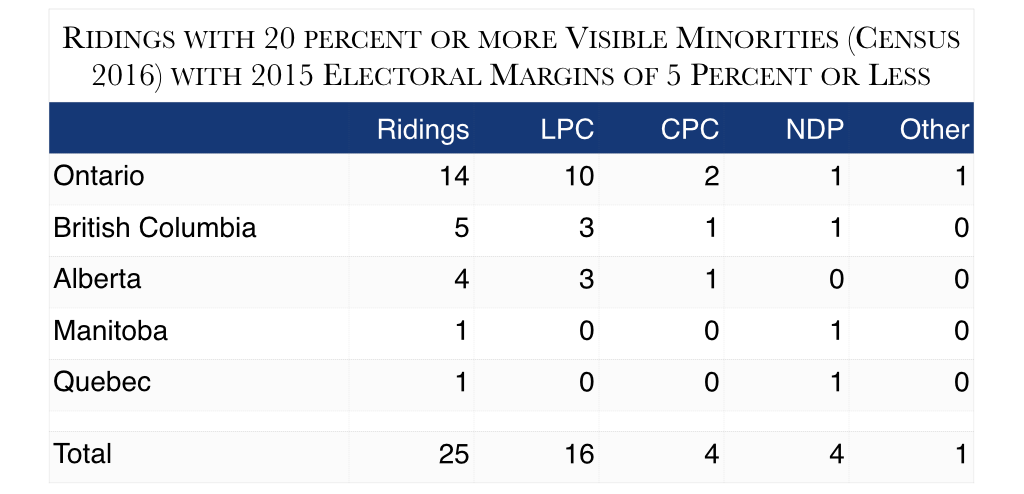
I took a somewhat different tack, taking a look at ridings where visible minorities form 20 percent or more of the population and where the electoral margin was less than 5 percent.

This provides a different perspective than simply looking at ridings that are visible minority majority (only four of these 25 ridings). Most are in Ontario, followed by British Columbia and Alberta, with only one riding in Manitoba and Quebec.

All are urban as one would expect and there is some overlap with the various lists of the media.


The full list can be found here, along with the relevant demographics and 2015 margins.

Ridings with 20 percent vismin and margins 5 percent 2015

For my series looking at those ridings with significant numbers of visible minority, European ancestry (non British or French), religious minority and Indigenous peoples, check out these data tables:

Top ridings by group