Ethnic media election coverage 1-7 September
2019/09/09 Leave a comment
Latest weekly analysis of ethnic media coverage. For the analytical narrative, go to Ethnic media election coverage 1-7 September

Working site on citizenship and multiculturalism issues.
2019/09/09 Leave a comment
Latest weekly analysis of ethnic media coverage. For the analytical narrative, go to Ethnic media election coverage 1-7 September
2019/09/09 Leave a comment
Sigh. Quebec already receives about 40 percent of settlement funding and only received about 16 percent of immigrants in 2018:
NDP Leader Jagmeet Singh says his government would give a boost to Quebec’s immigration funding to help prepare immigrants to fill the province’s labour shortage.
At an announcement in Drummondville, Que., on Saturday, Singh promised to increase the federal immigration transfer payment to Quebec by $73 million per year to improve settlement services for newcomers, if he is elected prime minister.
The province has been dealing with a labour shortage, with more than four per cent of all jobs in Quebec left vacant for four months or longer, according to a Canadian Federation of Independent Business report. That’s roughly 120,000 jobs.
“Quebec is dealing with a serious labour shortage, and needs immigration to help meet the challenge,” said Singh.
“It’s a critical issue.”
The NDP’s platform also commits to bolstering immigration settlement in rural areas of Quebec. Many immigrants arrive in Quebec with no French language skills, which affects their ability to work in the province. Singh said that a funding increase from an NDP government would help to target those language barriers.
Quebec will already receive $25.5 billion from Ottawa this fiscal year in the form equalization payments and health and social transfers. In the 2017-2018 fiscal year, $490 million was allocated for immigration supports.
But the provincial government isn’t completely sold on the idea of increasing immigration.
Leaning on temporary foreign workers
The CAQ government intends to accept around 20 per cent fewer immigrants this year, or 40,000 instead of the nearly 52,000 accepted last year.
However, Premier François Legault said temporary foreign workers can counter the shortage.
His government recently launched a $21-million plan to make it simpler for smaller businesses to recruit foreigners. It includes subsidizing recruitment missions by Quebec companies overseas and offering to cover $1,000 in moving expenses for the workers.
The province also announced $34 million for measures aimed at better integrating immigrants into the workforce.
Source: Singh promises bump to Quebec’s immigration funds to address labour shortage
2019/09/09 Leave a comment
Good response to the pulled back op-ed “Ethnic diversity harms a country’s social trust, economic well-being, argues professor.”
The world is experiencing the largest displacement and movement of people of any period since the Second World War.
Canada is not immune to these flows. Almost one in four people living here were born outside Canada, with one million more arriving in the next three years.
We recently passed our neighbour to the south in resettling more refugees than any other country in the world, mostly due to vast reductions in refugee admissions under the Trump Administration, but also in part due to increased resettlement under Prime Minister Justin Trudeau.
Since 2017, approximately 150,000 asylum seekers have claimed protection in Canada, many of whom crossed the border to do so. Under these conditions, questions by Canadians are to be expected.
Some questions will be raised by bad actors. These individuals will not be satisfied by reasonable answers or potential solutions on the issue of immigration or asylum in Canada.
A few of these may stoke fears or unfounded claims about newcomers. Many more Canadians, however, have genuine concerns, worries, or fears about the arrival of newcomers to their communities.
They do not have animosity toward individual immigrants, but they may have concerns regarding border security, the integrity of Canada’s immigration system, or the values and beliefs immigrants bring with them to Canada.
It is this group that policy-makers, academics and journalists should address with open ears, facts, and ideas. Some of these include addressing the following on immigrant integration and social cohesion.
Defining integration is difficult, but some common measures include immigrant official language capability, sense of belonging to Canada, and the adoption of Canadian norms and values. By these measures, Canada is wildly successful at integrating its newcomer population.
The 2016 census showed that approximately 93 per cent of all immigrants in Canada can speak English or French. The census also showed that the majority of immigrants choose to speak English or French in the home.
This high number might surprise some, but it should be noted that official language capability is one of the selection criteria for immigrants seeking to move to Canada.
Official language capability is also one of the citizenship requirements — with the exception of the very old and the very young. Even more fundamentally, there is a workplace advantage that comes with speaking either language.
Official language capability and citizenship requirements may not be relevant if only a few immigrants became citizens, but at approximately 85 per cent Canada has one of the highest naturalizations rates in the world. The United States sits in the mid-40 per cent range.
This means the vast majority of immigrants will, at some point, pass a language test and successfully answer questions on Canadian history, culture and values, culminating in the oath of citizenship to Canada’s Queen, its laws, and the duties associated with citizenship.
Immigrants also tend to show high levels of belonging and civic pride in Canada. Researchers at Statistics Canada found that 93 per cent of newcomers have a strong or very strong sense of belonging to Canada. Some of these (24 per cent) show an affinity only for Canada, while more feel a sense of belonging to Canada and their home country (69 per cent). Only three per cent feel a higher level of attachment to their home country.
When broken down by pride in specific symbols or institutions, such as the Canadian flag, Parliament, or even hockey, immigrants placed greater or equal importance in these than natural born Canadians.
This makes intuitive sense when considering why immigrants choose Canada. Alex Nowrasteh of the Cato Institute has pointed out that most immigrants self-select, meaning that those who are most dissatisfied with Chinese communism, the Ayatollah, or Venezuelan socialism are the most likely to leave, and the least likely to bring those values with them. They choose Canada because they identify with the norms and values that make Canada.
That is not to say there aren’t issues. Canada is struggling to process a backlog of 75,000 plus asylum seekers, many of whom will have less than well-founded claims of persecution. That speaks to a processing issue at the federal level, rather than an issue with immigrant integration in Canada.
A backed-up system is more likely to attract those with unfounded fears of persecution. The solution is not to stigmatize newcomers, but to ensure that our immigration and asylum systems remain “fast, fair and final,” able to process claims in a timelier manner.
For those who are already here, Canada’s best tool for integrating them is open access to our political system and jobs market.
Some have cited Alberto Alesina’s work on fragmentation, the idea that greater population diversity is associated with social strife. This is true in countries with weak democracies and restricted labour markets, where the political and economic systems favour a select few.
Alesina’s subsequent works have shown that diverse populations reap economic benefits and remain relatively cohesive when everyone has a fair shot at becoming an MP or getting a job. Open societies enjoy strong trade relationships with other countries, a diversity in goods and services, and stronger workforces. Under these settings the work of integration takes care of itself, with newcomers and their children identifying with Canada and its values.
In that light, the work of integrating newcomers within the fabric of Canada is less about exclusion, and more about maintaining, celebrating, and safeguarding Canadian institutions, entrepreneurship, and our open society.
Source: Robert Falconer: The open society, Canada’s best response to immigration
2019/09/09 Leave a comment
Unlikely many will for social and economic reasons:
Members of Sudan’s Jewish community who had left the country in previous years were free to return and “enjoy citizenship” like other ethnic groups, Minister of Religious Affairs Nasr-Eddin Mofarah said on Friday.
Speaking to Al Arabiya TV, the newly appointed minister said Sudan was welcoming of diverse ideas, values, cultures and “intellectual persuasions.”
He even added that the Muslim-majority country was welcoming of other religions, citing the number of Christians and Jews who still lived in the country and those who might have left.
“I urge them (Jews) from this platform to return to Sudan and recover their right to naturalization and citizenship because Sudan is a civil state where citizenship is the source of all rights and duties. We also have other religions and faiths embraced by different people,” he said.
The announcement came after Sudan’s Prime Minister Abdalla Hamdok announced his Cabinet on Thursday, the first since former President Omar Bashir was ousted in April.
The Cabinet includes Asmaa Abdalla, Sudan’s first woman foreign minister, and a former World Bank economist. Hamdok also picked women to lead the Sports and Youth Ministry, the High Education Ministry, and the Labor and Social Development Ministry.
The new Cabinet has come about as part of a power-sharing agreement between the military and pro-democracy demonstrators, following pressure from the US and its Arab allies amid growing concerns the political crisis could ignite a new civil war.
Mofarah said Islam had been a peaceful part of Sudanese life for centuries, and had not been introduced through violence or conflict.
He also stressed the importance of religious tolerance in the post-Bashir era.
“Religious tolerance has also been given a significant importance in the Holy Qur’an, in which Muslims have been urged to accept and respect other religions and live in peace with them,” Mofarah said.
“This constitutes a clear call for the Sudanese to live according to the saying ‘you have your religion and I have mine,’ as long as there is no infighting, sedition or wars and as long as people interact,” the minister added.
“The issue of peace, tolerance, loyalty and resilience is one of the indicators that will allow us to build this nation on new foundations, centered around freedom, justice, equality and noble moral values,” he said.
Sudan’s power-sharing deal calls for the government to reach a peace agreement with the rebels within six months.
Source: Sudan Invites Jews Back To Country To ‘Enjoy Citizenship’
2019/09/09 Leave a comment
The ongoing effects of the Modi government’s citizenship registry in Assam, India:
Across a river in a remote part of India’s northeast, laborers have cleared dense forest in an area equivalent to about seven soccer fields and are building the first mass detention center for illegal immigrants.
Shefali Hajong, a labourer whose name is excluded from the final list of the National Register of Citizens (NRC), poses for a picture at the site of an under-construction detention centre for illegal immigrants at a village in Goalpara district in the northeastern state of Assam, India, September 1, 2019. REUTERS/Anuwar Hazarika
The camp in the lush, tea-growing state of Assam is intended for at least 3,000 detainees. It will also have a school, a hospital, a recreation area and quarters for security forces – as well as a high boundary wall and watchtowers, according to Reuters interviews with workers and contractors at the site and a review of copies of its layout plans.
Some of the workers building the camp said they were not on a citizenship list Assam released last week as part of a drive to detect illegal immigrants. That means the workers could themselves end up in detention.
Shefali Hajong, a gaunt tribal woman from a nearby village, said she was not on the list and will join nearly two million people who need to prove they are Indian citizens by producing documents such as birth and land ownership certificates dating back decades.
If they fail to do so, they risk being taken to detention camps like the one being built. The government says there are hundreds of thousands of illegal immigrants in Assam from neighboring Muslim-majority Bangladesh, but Dhaka has refused to accept anyone declared an illegal immigrant in India.
Shefali, who belongs to the indigenous Hajong tribe, said she was tense because of the situation.
“But I need to fill my stomach,” she said in the local Assamese dialect as she used a hoe to feed stones into a concrete mixer. She and other workers make about $4 a day, which is considered a decent wage in the impoverished area.
She said she didn’t know her exact age and believed it was about 26, adding that she did not know why she wasn’t on the citizenship list. “We don’t have birth certificates,” said her mother, Malati Hajong, also working at the site.
The camp, near the town of Goalpara, is the first of at least ten detention centers Assam has planned, according to local media reports.
“People have been coming here every other day from nearby villages asking for work,” said Shafikul Haq, a contractor in charge of building a large cooking area in the camp.
The mammoth Supreme Court-ordered exercise to document Assam’s citizens has been strongly backed by Prime Minister Narendra Modi’s Hindu nationalist government that came to power in New Delhi five years ago. Critics say the campaign is aimed at Muslims, even those who have lived legally in India for decades.
Many Hindus, mostly poor and ill-educated, are also not on the citizenship list released last week.
BRINK OF CRISIS
“Assam is on the brink of a crisis which would not only lead to a loss of nationality and liberty of a large group of people but also erosion of their basic rights – severely affecting the lives of generations to come,” Amnesty said in a statement.
India’s foreign minister has called the citizenship verification exercise an “internal matter”. An Indian foreign ministry spokesman said those not in Assam’s citizenship roster “will not be detained and will continue to enjoy all the rights as before till they have exhausted all the remedies available under the law.”
The federal government and the local Assam government did not respond to questions about the camps.
From Goalpara town, the camp being built is reached by a leafy, narrow road dotted with coconut trees. A shaky wooden bridge takes vehicles across a small river to the site, overlooked by a cluster of rubber trees.
Government guidelines for detention camps released earlier this year include building a boundary wall at least 10 feet (3 meters) high and ringed with barbed wire, local media reports said.
A red-painted boundary wall encircles the new camp at Goalpara, and green fields and mountains are visible beyond two watchtowers and quarters for security forces built behind it.
The camp will have separate living facilities for men and women, according to workers and contractors.
A.K. Rashid, another contractor, said he is building six of what would be around 17 buildings with detention rooms of around 350 square feet (32.5 square meters) each. Each of the buildings he is making will have 24 rooms, he said, adding drains for sewage were being built along the boundary walls of the center.
G. Kishan Reddy, a federal government official, told parliament in July that the government had published guidelines for detention centers which stipulate the construction of basic amenities like electricity, drinking water, hygiene, accommodation with beds, sufficient toilets with running water, communication facilities and kitchens.
“Special attention is to be given to women/nursing mothers, children,” he said. “Children lodged in detention centers are to be provided educational facilities in nearby local schools.”
WORSE THAN PRISONERS
A senior police officer who declined to be named said the camp would initially be used to house the roughly 900 illegal immigrants who are held at detention facilities in Assam jails.
A group from India’s National Human Rights Commission that visited two of those facilities last year said the immigrant detainees there were in some ways “deprived even of the rights of convicted prisoners”.
India’s top court is hearing a petition for their release.
At the camp site, another woman laborer, 35-year-old Sarojini Hajong, said she wasn’t on the citizenship list either and didn’t have a birth certificate.
“Of course we are scared about what will happen,” she said.
“But what can we do? I need the money.”
Source: As they build India’s first camp for illegals, some workers fear detention there
2019/09/07 Leave a comment
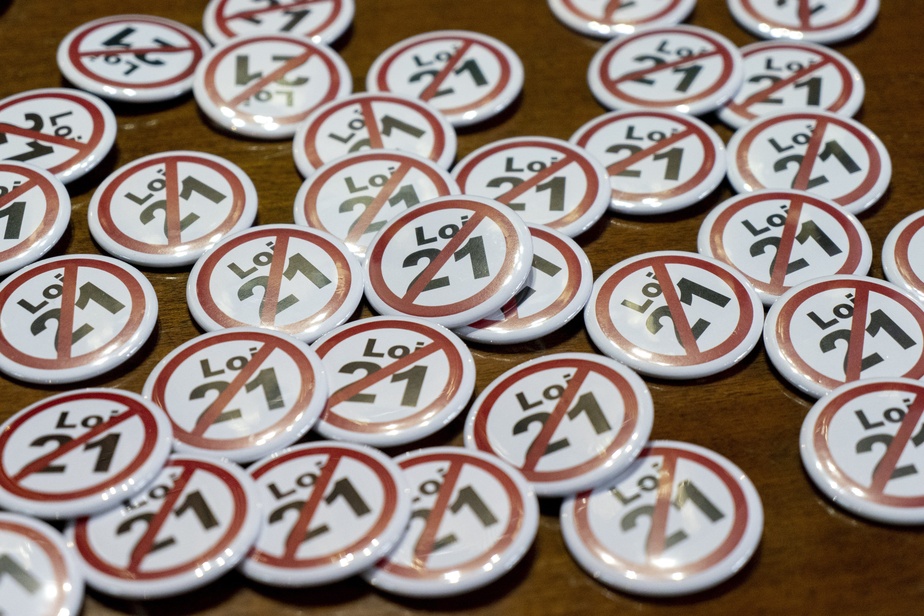
Of note:
Le lancement a eu lieu à Montréal dans un lieu de culte protestant, soit l’église unie Saint-James.
Ehab Lotayef, l’un des coordonnateurs de la campagne, qui est de confession musulmane, avait une kippa sur la tête, une calotte portée traditionnellement par les juifs.
« Je vais la porter tout le mois de septembre », a-t-il affirmé.
Cette loi a peut-être été adoptée, mais c’est une loi injuste, a-t-il lancé près de l’autel de l’église. Pour les opposants, elle viole la Charte des droits et libertés et limite les possibilités d’emploi de personnes sur la base de leur religion. « On ne va pas juste l’accepter. »
La Loi sur la laïcité de l’État — connue avant son adoption comme le projet de loi 21 — interdit le port de signes religieux à certains employés de l’État lorsqu’ils sont dans l’exercice de leurs fonctions, dont les policiers, procureurs de la Couronne et gardiens de prison, ainsi qu’aux enseignants des écoles publiques du primaire et du secondaire.
Une enseignante d’origine tunisienne portant le voile, qui n’a révélé que son prénom, Ola, a témoigné qu’après une année extraordinaire dans une école primaire publique de Montréal, elle a frappé un mur pour l’année scolaire en cours. Comme elle n’est pas une employée permanente, si elle accepte un contrat pour cette année, elle devra signer une clause selon laquelle elle s’engage à ne pas porter de signe religieux dans la salle de classe, a-t-elle déclaré. Pour elle, cela signifie enlever son voile.
« Cette loi vient me priver de mes droits, d’être une femme libre, capable de décider où travailler, que porter. Personnellement, je ne vois pas ce que cette loi va apporter de plus ou de mieux à la société québécoise », a-t-elle dit.
« Sauf la tension sociale que je sens et que je vois. Et que je vis. »
Elle a souligné qu’il lui a été difficile de témoigner, se disant déstabilisée par les commentaires « inacceptables » qu’elle voit sur les réseaux sociaux.
Selon le rabbin Michael Whitman, « les effets négatifs de cette loi iront bien au-delà des personnes qui sont directement touchées […]. Elle a donné la permission à l’incivilité. »
Les membres du groupe de citoyens invitent les Québécois à porter les macarons qu’ils ont fait produire en grande quantité et qu’ils distribuent librement. Sur ceux-ci, on peut voir les mots « Loi 21 », barrés d’une ligne rouge. Porter le macaron montre publiquement son opposition à la mesure législative du gouvernement caquiste et le soutien à ceux « dont les droits sont niés par cette loi discriminatoire », font-ils valoir.
Leur but est de rassembler d’ici le 6 octobre quelque 50 000 personnes portant le macaron et le signe religieux de leur choix, qui participeront ce jour-là à une journée d’action publique. Ils veulent aussi générer une discussion sur la loi et changer l’avis de ceux qui la soutiennent.
Lors du lancement jeudi, des représentants de différentes communautés religieuses étaient présents.
La Loi sur la laïcité de l’État a été adoptée en juin dernier par l’Assemblée nationale.
Ce fut un jour très triste, selon Manjit Singh, de confession sikhe, qui a été dans le passé l’aumônier de l’Université McGill à Montréal.
« Nous sommes venus ici légalement, et soudainement, parce que nous avons quelque chose sur la tête, ce n’est plus acceptable désormais », a-t-il déploré.
Et cela ruine la vie des gens, a ajouté l’homme.
Leur opposition civile à la loi se fait de façon parallèle à la contestation judiciaire qui est en cours, ont-ils affirmé.
À la mi-juillet, un juge de la Cour supérieure a rejeté la demande de groupes de défense des libertés civiles et religieuses qui réclamaient la suspension de la Loi sur la laïcité de l’État. Le juge Michel Yergeau avait alors tranché que la loi continuerait de s’appliquer jusqu’à ce qu’un tribunal se prononce sur le fond de l’affaire. Car le but ultime de ces groupes est de faire invalider cette mesure législative. En août, la Cour d’appel du Québec a accepté de se pencher sur la demande d’injonction.
2019/09/07 Leave a comment
Depressing reality, encouraging response:
Pop stars have announced a boycott. Air Tanzania has suspended flights to Johannesburg. Madagascar and Zambia are refusing to send their soccer teams. Nigeria has recalled its ambassador and pulled out of a major economic forum.
South Africa is facing a backlash after rioters in and around Johannesburg targeted immigrants from other African countries this week, torching their shops and leading to at least 10 deaths. Now, angry citizens and governments across the continent are lashing out at South Africa and its businesses, denouncing what they call “xenophobia.”
Africans across the continent once rallied behind South Africans in their struggle to defeat the apartheid government, which was finally replaced in elections held 25 years ago. Now, some Africans find themselves in the unfamiliar position of protesting the actions of the same communities in South Africa that they once stood with in solidarity.
“The only time we’ve seen this type of cooperation of African countries in terms of backlash,” said Tunde Leye, a partner at the Nigerian political research firm SBM Intelligence, “was in terms of support of the anti-apartheid movement.”
The current level of political solidarity on the continent, he said, was “almost unprecedented.”
The riots, and the retaliatory measures, could not come at a more inopportune time for regional cooperation. This week, African leaders are meeting in Cape Town, South Africa, to discuss the African Continental Free Trade Area, an agreement made this year that sets the stage for the creation of the largest free-trade area in the world. It would join Africa’s more than one billion consumers into a single market.
The conflict, while not likely to imperil the free trade agreement, could at least slow its implementation, which is expected to take years, African analysts said.
Nigeria’s government, angry that its citizens have been victimized in the South African riots, has pulled out of the Cape Town meeting.
Nigeria is the continent’s largest economy, and South Africa is the second-largest. Both countries were already reluctant participants in the accord, which is supposed to help knock down the many barriers to trade among African countries.
Anti-immigrant sentiment is a longstanding issue in South Africa, where the legacies of colonialism and apartheid run deep, and a political shift has not delivered meaningful change to many poor South Africans. Immigrants from countries like Nigeria, Mozambique, Somalia and Zimbabwe are often regarded by South Africans as competitors for jobs and social services.
In South Africa, attacks on foreigners have become common, and they surged beginning Sunday when rioters stormed neighborhoods in and around Johannesburg, lighting fires and breaking into shops.
At least 10 people have died in the riots, President Cyril Ramaphosa said in a video address on Thursday, in which he also condemned the violence.
“There can be no excuse for the attacks on the homes and businesses of foreign nationals,” he said. “Equally, there is no justification for the looting and destruction of businesses owned by South Africans.”
In Gauteng, the province that includes Johannesburg, authorities have arrested at least 423 people, said Colonel Lungelo Dlamini, a police spokesman. On Thursday, he said that many shops owned by foreigners remained closed and that more shopping centers in the eastern part of the province “are being targeted.”
Police seized guns, he said, not just from South Africans, but also from at least two foreign nationals.
The rolling backlash has united broad swaths of the continent. Two popular Nigerian musicians, Burna Boy and Tiwa Savage, said they were boycotting South Africa. Burna Boy was set to headline the Afropunk festival in Johannesburg in December, alongside artists like Solange Knowles. Tiwa Savage had an appearance in South Africa scheduled for mid-September.
On Tuesday and Wednesday, protesters rushed and sometimes looted South African-owned businesses in Nigeria and Zambia, including Shoprite supermarkets. The company closed stores. The South African telecommunications giant MTN did the same.
On Thursday, the protests spread to the Democratic Republic of Congo, where demonstrators outside of the South African Embassy in Kinshasa held signs that read “Don’t kill our brothers” and “No xenophobia.” In Lubumbashi, they broke windows at the South African Consulate.
Nigeria recalled its ambassador to South Africa. South Africa has shuttered its diplomatic missions in Nigeria, citing threats.
The clashes cast a cloud over the World Economic Forum in Africa, which began in Cape Town on Wednesday. Leaders were set to discuss the free trade pact, an agreement signed by 54 countries that supporters have said could reshape economic relationships on the continent.
The accord has the potential to bolster intra-African trade by 52 percent by 2022, according to the United Nations. Right now, intra-African trade accounts for just 16 percent of the continent’s trade volume. It can be cheaper to ship something from Nigeria to Europe, and then to Senegal, rather than directly from Nigeria to Senegal. This is a major barrier to regional development, economists say.
Still, a host of challenges await before the pact is put in place.
African analysts differed on whether Nigeria’s decision to skip the Cape Town meeting would have any effect in the long term.
Gilbert Khadiagala, a Kenyan professor of international relations at the University of Witwatersrand in Johannesburg, said Nigeria’s move was little more than “grandstanding,” and that would not impede the trade agreement.
But Mr. Leye, of SBM Intelligence in Nigeria, said that in his view, Nigeria’s boycott of the Forum “will have an impact in terms of the pace of implementation.”
2019/09/07 1 Comment
Let’s not kid ourselves by denying that racist attitudes don’t exist and that the comments by Richardson were more in that line than himself endorsing those views.
The question is more whether the “undertone” is more on the discomfort side or more xenophobic and racist.
Green Party Leader Elizabeth May issued a statement Wednesday saying “there is no room for any kind of racism” in her party after a recent convert made comments about NDP Leader Jagmeet Singh.
On Tuesday, more than a dozen former New Brunswick NDP candidates threw their support behind the provincial and federal Greens. One of the defectors — Jonathan Richardson, the former federal NDP executive member for Atlantic Canada — said racism was one of the reasons for the party’s lack of success in finding candidates with an election call imminent.
He said he travelled around the province to meet NDP members and found there’s “a bit of racism undertone,” particularly in the northern part of the province.
“From when I was up in the [Acadian] peninsula, I would say that a lot of that region that most people would be a bit worried about somebody who wasn’t, you know, wasn’t Caucasian, and that’s going to take some time to show people that, you know, Canadians come in all cultures and diversities,” he said. “But for right now I think that that racism still exists.”
Singh is a practising Sikh and wears a turban.
Singh said all national party leaders should be celebrating Canadian diversity and that May needs to explain why she has let the former New Democrats into her party.
“She’s taking in candidates that have kind of openly expressed their concern around someone looking differently and that being a challenge,” Singh said in Toronto on Wednesday evening. “If she is accepting people that are suggesting things that are not accepting of people’s diversity, then the Green Party has a lot to answer for.”
“I think our political leaders should embrace the diversity of our country and should be willing to say you can look like whatever you are as long as you share the values and beliefs that are going to make peoples’ lives better.”
NDP MP Charlie Angus tweeted that “the fact that some N.B. NDP jumped ship because they wouldn’t run under a progressive leader who comes from another religion is sickening.”
Karl Belanger, a former national director of the NDP, also weighed in, tweeting that it’s “not a good look, New Greens.”
May issued a statement Wednesday saying Richardson’s comments “were taken out of context and have led to accusations of racism against the party.”
“One of the core values of Greens around the world is respect for diversity and human rights,” she said.
“There is absolutely no room for any form of discrimination in the Green Party. We have zero tolerance for sexism, Islamophobia, misogyny, homophobia or hate speech of any kind. Canada’s strength lies in its diversity.”
New Brunswick Green Party Leader David Coon said he hasn’t had a chance to speak to Richardson since he made the comments, but he contends they’ve been “overblown” and “exploited” by people trying to “blunt the impact” of 14 NDP candidates joining the Greens all at once.
“What I heard him say basically was he ran into some people who had ignorant attitudes and held prejudices against people of colour or people of different religions,” he said.
“It’s not a news flash racism and prejudice exists in Canada, and it’s abhorrent and we need to work to stand up to it and stamp it out.”
Coon said he travels the province regularly and, in his experience, “most” New Brunswickers are “very accepting.”
The NDP hasn’t held a seat in the New Brunswick legislature since 2005. Its last MP in the province was Acadie-Bathurst’s Yvon Godin, who retired in 2015.
Richardson told CBC News Tuesday there are other factors behind NDP’s diminished standing in New Brunswick — including the fact that Singh hasn’t set foot in the province since winning the leadership in 2017, the election planning committee’s focus on “urban areas that are diverse,” and a lack of staffing.
Coon said he doesn’t believe racism has played a role in the NDP’s troubles in the province. He contends the NDP has been struggling in New Brunswick since Elizabeth Weir stepped down as provincial party leader in the mid-2000s.
“So it’s been a long process where they’ve found significant challenges in resonating with the people of our province. And so I think that it’s not just one issue,” he said.
New Brunswick Liberal Leader Kevin Vickers said he “couldn’t disagree more” with Richardson’s comments, which he said imply that New Brunswickers are “inherently racist.”
“The New Brunswick I know welcomes and embraces people of all backgrounds,” he said in a statement.
“These comments are wrong, embarrassing for the province and should be embarrassing for Green Party Leader David Coon.”
Coon, whose Green Party is enjoying a boom in support, securing three seats in the 2018 provincial election, said Richardson will have to take responsibility for his words. “It’s his point of view and he’s the one who’s going to have to defend that.”
Late Wednesday, Richardson posted the text of his speech on Facebook, “for those out there who are wondering and asking questions.”
Richardson said he will not be answering questions from the general public or media, but would be “happy to have a conversation” with any of his friends.
Source: Elizabeth May says there’s ‘no room’ for racism in Green Party after NDP defector’s comments
2019/09/07 Leave a comment
Pretty weak argument on its own. I think the large number of irregular or illegal immigrants in the USA, given its southern border, is a much larger factor in popular discourse, along with our selection system which priories more highly skilled immigrants:
In recent years the world has been rocked by the movement of tens of millions of people fleeing war, disaster and other forms of conflict. Canada has helped relieve some of the pressures that come from such large movements of people by accepting refugees, asylum-seekers and also ordinary immigrants. Far from conflict zones, surrounded by oceans, and sharing its only border with a country that is not usually a significant source of refugees, Canada has been able to be very deliberate in its calculation of how many people it chooses to admit as citizens. In general, the choices made have served the Canadian economy well by reversing what would otherwise have been a steady decline in our population and our prospects for economic growth.
So far at least, and unlike the U.S. experience, Canadian immigration policy has not become very political. One reason the two countries’ politics on this issue have differed may be their differing national fertility rates. The figure shows the fertility rate in Canada and the United States for each year from 1920 to 2018. The fertility rate measures the average number of children that would be born to each woman over her child-bearing years given prevailing age-specific fertility rates. Also shown, as the horizontal dashed line, is the population replacement rate — the fertility rate required for the population to replace itself. The replacement rate varies over time and by country due to changes and differences in mortality rates. It probably has fallen in both countries since 1920 but it is currently judged to be roughly 2.1 children per woman.
The large swings in fertility rates between 1920 and 1960 strongly suggest economic conditions affect the decision to have children. The onset of the Great Depression in 1930 coincided with a significant drop in the fertility rate in Canada, a drop that started much earlier in the U.S. The post-war baby boom saw fertility rates in both countries increase by nearly 1.5 children. Peaking in 1960, the fertility rate plummeted across North America for the next 15 years before levelling off — by the mid-1970s in the U.S. and the mid-1980s in Canada. U.S. fertility rates have since risen and now hover near the replacement rate. In this country, however, they remain well below the replacement rate.
That U.S. fertility rates are higher than ours may surprise many Canadians. Families here have greater access to supports and benefits in the form of parental leave provisions, extended employment insurance benefits, and full health-care coverage. Continuing low fertility rates in Canada suggest other influences must also be important.
But whatever the reason for it, our low fertility rate highlights the need for high levels of immigration to maintain and grow the population. After the dramatic fall in fertility rates in the 1960s, the federal government introduced a number of reforms to immigration policy, beginning in the mid to late 1970s. Since the early 1990s, Canada has settled between 200,000 and 300,000 immigrants each year. The government recently announced annual targets over the next three years that average 340,000 new immigrants per year. This level of immigration will enable Canada’s population to grow despite our low fertility rate.
The data presented in the figure may help explain why in recent years the debate over immigration hasn’t been as sharp or divisive here as in the United States. For Canada, maintaining a significant level of immigration and also a high level of trust in the process by which we invite foreigners to apply for citizenship is crucial for maintaining our economic growth.
Source: There’s a good reason the immigration debate in Canada is calmer than in the U.S.
2019/09/07 Leave a comment
Sigh. Not one or the other. Policies to assist families with the costs of having and raising children by themselves will not fully address demographic pressures:
Procreate or face extinction: that’s the message from central European leaders to their shrinking populations, as across the region rightwing governments implement so-called “family first” policies to incentivise childbearing.
Hungary’s government is holding an international summit on demography in Budapest this week, being attended by several regional leaders and delegations from dozens of countries in an attempt to trumpet their investment in family policies.
The country’s nativist prime minister, Viktor Orbán, said it was conceivable that Hungary, with a population of just under 10 million that is shrinking due to low birthrates and emigration of Hungarians to EU states further west, could simply disappear.
“It’s not hard to imagine that there would be one single last man who has to turn the lights out,” he said at the opening of the conference on Thursday.
Orbán, who has based his political campaigns in recent years on anti-refugee and anti-migration sentiment, said other European politicians saw immigration as the solution, but he firmly rejected this, tapping into the far-right “great replacement” theory.
“If Europe is not going to be populated by Europeans in the future and we take this as given, then we are speaking about an exchange of populations, to replace the population of Europeans with others,” said Orbán. “There are political forces in Europe who want a replacement of population for ideological or other reasons.”
Orbán’s words were backed up by one of the guests of honour at the summit, the former Australian prime minister Tony Abbott, who saluted the Hungarian leader for having “the political courage to defy political correctness”.
Abbott said dying populations, not climate change, were the biggest threat to western civilisation, and lashed out at Prince Harry and Meghan Markle for recent remarks that they would not have more than two children due to the effects on the environment. “Having fewer children in western countries will hardly make the climate better when so many children are being born elsewhere,” said Abbott.
A fear of rising populations in other parts of the world was the dominant theme during the opening morning of the Budapest summit, despite the presence of delegations from many developing countries. The tone was set by an artistic performance that opened the forum, portraying hordes of people from the south and east advancing on Europe.
“Europe has become the continent of the empty crib whereas in Asia and Africa they face demographic challenges of the opposite type,” said Katalin Novák, Hungary’s minister of state for family, youth and international affairs.
The two-day summit was also attended by Czech prime minister, Andrej Babiš, and Serbia’s president, Aleksandar Vučić, who both said boosting birthrates was a priority for the long-term development of their countries. Vučić said his country was losing the equivalent of the population of a medium-sized town each year. “Serbian people have one expression for negative population growth: the white flag,” he said.
Source: Viktor Orbán trumpets Hungary’s ‘procreation, not immigration’ policy

Click image for book purchase
 Multicultural Meanderings