The Fairness for High-Skilled Immigrants Act is anything but fair | TheHill

How the removal of country caps may impact on other groups:

Much of our community, the Iranian-American community, owes its citizenship to the green card process. However, a bill moving through Congress would slam shut that pathway for countless Iranians and communities like ours, shifting outrageous backlogs onto nationals from Iran and other smaller countries.

Unfortunately, the House of Representatives recently passed a bill, known as the Fairness for High-Skilled Immigrants Act of 2019 (H.R. 1044/S. 386) which would eliminate caps that prevent any one country from receiving more than 7 percent of green cards for highly-skilled workers. These caps were put in place, according to the State Department, to guard against the monopolization of the green card process by a few larger countries. While eliminating the caps would reduce the backlog for nationals from large countries, like India and China, it would shift that backlog onto nationals from smaller countries—adding years of delays. For Iranian nationals, who are already separated from loved ones due to the president’s cruel travel ban, this would extend their separation by up to a decade.

Why is this legislation moving so fast? At a time when Congress has been unable to pass any meaningful reforms to address the multitude of crises in our immigration system, how are lawmakers on the verge of passing such a fundamental overhaul of the immigration system with almost zero debate on the unanticipated consequences? Because nationals who would benefit from the bill are vocal and backed by corporate interests who would also benefit, while the many who would be affected negatively by the change have been quiet by comparison. That needs to change if we want to safeguard the green card process for all nationalities.

In working with our community, NIAC has heard from many Iranian high-skilled workers in the U.S. who would be affected by this legislation. Their very future, and the American dream, is at stake. Worse yet, the vast majority of these individuals are also impacted by Donald Trump’s Muslim travel ban—unable to have their family secure a visa to visit, and unable to return home to visit family without jeopardizing their future in the United States.

Despite its name, the Fairness for High-Skilled Immigrants Act is not a fair way to deal with backlogs. Congress must consider a solution that actually addresses the problem instead of shifting the backlog from one group to another. One option would be to increase the number of green cards issued, which recent legislation introduced by Sen. Rand Paul (R-Ky.) would accomplish. Paul’s BELIEVE Act would quadruple the number of employment-based visas to address the backlog problem that particularly affects nationals from large countries. Additional measures proposed by this bill would exempt dependents and certain categories of specialists from the cap altogether.

As an Iranian-American organization, NIAC is tasked with the responsibility to not just advocate for our community and protect their civil rights, but also to protect the American dream that allowed our community to be built here in the first place. That means we must fight to keep the path to green cards open to all and ensure Congress passes a solution to the green card backlog that actually is fair.

Jamal Abdi is the president of the National Iranian American Council.

Source: The Fairness for High-Skilled Immigrants Act is anything but fair | TheHill
FATAH: It is time to stamp out immigrant-bashing

The consumer argument for large-scale immigration (based on larger GDP than increasing per capita GDP):

The word “immigrant” is slowly emerging as a slur among the fringes of Canada’s right-wing. This creeping phenomenon reminds me of the term “Paki-bashing” that was still in vogue in 1976 when I first visited Canada as a young TV reporter covering the Montreal Olympics.

Those dark days are well-documented by Tanya Sabena Khan in her 2012 PhD thesis at McGill University. She documents an article in the Globe and Mail on Oct. 7, 1976, headlined: “Unprovoked Racial Attack.”

It was a story by Stan Oziewicz who reported: “Two youths shoved a Pakistani fellow over the lip of the Islington subway platform.”

The victim, Shamshudin Kanji, was actually a 49-year-old Tanzanian immigrant.

Kanji was beaten and kicked on the platform by Steven Ingram, 22, and Thomas Allan Grimsdale, 19, while a third young man shouted “push the Paki.” Ingram responded by pushing Kanji off the platform onto the wood cover on the electrified third rail.

The attack left Kanji hospitalized for months and according to doctors “crippled for life.”

Fortunately, Canada stamped out such racism, thanks to outrage by decent mainstream white Canadians — from left-wing New Democrats to right-wing Conservatives as well as the domineering Liberals.

Xenophobia (fear of foreigners) is alas common among people around the globe whether it is faced by Kurds in Turkey or Darfuris in Sudan and Poles in Britain. It’s a sign of our collective insecurity compounded by self-righteousness that gives us comfort in our inner suspicion of fellow humans.

But once political parties of the left descend into playing politics with ethno-religious communities, using them as vote banks, it is only natural that there will be an opposite reaction from those who feel, they are “real” Canadians and the “immigrants” are free-loaders.

To those who are convinced Canada should shut its doors to immigrants, imagine for a moment the scenario in just two sectors of the Canadian economy if immigrants went on a strike and refused to come to Canada in 2020.

  1. 200,000 fewer mattresses will be sold along with countless unsold pillows and bedsheets.
  2. The housing industry will slip into a freeze with a downward spiral in rents and a dip in tax revenues at every level of government.

Across our economy, revenues in business income taxes and the GST will plunge, not just in a quarterly recession, but a possible long-term economic slowdown that will do serious damage. A lack of consumers can stifle economic progress.

Henry Hazlitt, the best-selling author of Economics in One Lesson, wrote: “U.S. consumers account for approximately 70% of the national economy. Spending is an important role of consumers. Free market economies rely on consumer demand to gauge the allocation and distribution of economic resources.”

Canada imported US$458.9 billion worth of goods from foreign suppliers in 2018 to keep its economy running. This included steel products, automobiles and a host of other goods and services. Missing from this economics equation are the 300,000 immigrants that Canada got for free, without whom the economy would have stuttered.

According to the financial management magazine Money Sense, it costs over $250,000 to raise a single Canadian 18-year-old adult “consumer” who drives our economy. Shouldn’t Canada pay for this immigrant? Or at the least say thank you?

How many of you realize that under one category of “skilled immigrants,” a family of four needs to bring with them a bank draft of $23,542 on landing in Canada. Imagine if this family has to put up with slogans of “welfare cheats” (as was heard in one Mississauga political rally recently).

Someone better teach the new breed of anti-immigrant hatemongers this lesson. Or else another Shamshudin Kanji may have to pay the price.

Source: FATAH: It is time to stamp out immigrant-bashing

Holocaust survivors have home ransacked as antisemitic incidents hit new record in UK

Of particular note “Where a perpetrator’s ethnic appearance was recorded, over two thirds were described as white, 12 per cent Asian, 11 per cent black and 8 per cent Arab or north African”:

Holocaust survivors had their home ransacked and sprayed with graffiti in one of a record number of antisemitic incidents reported in the UK.

The Community Security Trust (CST) said the elderly couple returned from holiday in April to find the house “ransacked and desecrated” with “c*** Jews” scrawled in large letters across their living room wall.

Other incidents saw Jewish victims punched, kicked or pelted with stones, bottles and eggs, while swastikas and slogans including “gas the Jews” were sprayed on buildings.

The CST, which monitors antisemitism and provides security for Jewish communities, recorded a total of 892 incidents in the first six months of this year – a 10 per cent increase on last year and a new record.

It named discussions around antisemitism in the Labour Party as one cause of spikes in reports, as well as wider divisions in British society.

CST chief executive David Delew said: “This is the third year in a row that CST has seen an increase in reports of antisemitic incidents.

“The problem is spreading across the country and online, it reflects deepening divisions in our society and it is causing increasing anxiety in the Jewish community.

“It will take people of all communities and backgrounds standing together to turn this tide of hate around.”

The highest monthly totals were February and March, when antisemitism was prominent in news and politics because of the continuing controversy over antisemitism in the Labour Party.

The period saw MPs including Luciana Berger, Chris Leslie and Chukka Umunna, leave the party as some cited antisemitism as a reason for their decision.

The CST recorded 25 antisemitic incidents in February and 30 in March that were related to arguments over the Labour Party, while the debate is also believed to have increased online abuse against Jewish organisations and public figures who commented on the issue.

“Many of these antisemitic reactions were in the wider context of ‘smear’ accusations, spoke of conspiracy and attempted to delegitimise clear evidence of antisemitism,” the report said.

“It is hard to precisely disaggregate the impact of the continuing Labour antisemitism controversy upon CST’s statistics: but it clearly has an important bearing.

“The trend for monthly totals above the 100 figure began in April 2016 following controversial comments by Ken Livingstone and it has only fallen below 100 twice since then.

“In this context, the dynamics of antisemitism are similar to other forms of racism or political violence: expressions of hatred worsen when perpetrators feel motivated or emboldened to act.”

The CST recorded 145 cases involving antisemitic conspiracy theories, 67 with a “far-right political motivation”, nine linked to Islamist extremism and 12 to other religions, and five related to Brexit.

The charity does not consider criticism of Israel or Zionism “inherently antisemitic” but 203 antisemitic incidents alluded to the Middle East, including those equating the Israeli government with Nazis.

More than a third of recorded incidents involved social media, which the CST called an “essential and convenient vessel” for antisemites to harass, abuse and threaten Jews.

The CST said it does not trawl for online incidents and only records those reported by the public and involving an offender or victim in the UK.

The report found the most common kind of offline incident was the “random, spontaneous, verbal abuse of strangers who are believed for whatever reason to be Jewish, as they go about their lives in public spaces”.

Antisemitic assaults rose by 37 per cent to 62 in the six-month period, while there were also 38 incidents of damage and desecration.

Jewish individuals in public, under half of whom were wearing religious symbols or clothing, were targeted in 225 incidents, many involving antisemitic abuse or threatening language.

Other incidents targetted Jewish organisations, communal events, commercial premises, synagogues and schools.

Almost two thirds were recorded in London and Manchester, the two largest Jewish communities in the UK, followed by Hertfordshire, Merseyside, Gateshead and Leeds.

Where a perpetrator’s ethnic appearance was recorded, over two thirds were described as white, 12 per cent Asian, 11 per cent black and 8 per cent Arab or north African.

The National Police Chiefs’ Council said it would analyse data to establish whether increases recorded by the CST “reflect a greater incidence of hate crime or further improvements in reporting levels”.

Assistant chief constable Mark Hamilton, the lead for hate crime, said: “It can never be acceptable to abuse someone because of their ethnicity or religion, but we see that there are still far too many in our society who are prepared to act illegally, fuelled by global events, divisions in our own society or by bigoted ideologies.

“The police will continue to improve our services to victims and to help bring offenders to justice.”

The European Jewish Congress said the trend of “spiralling antisemitism” was being mirrored in other countries around the world.

President Moshe Kantor said he was “deeply concerned” at the CST’s report, adding: “We once again note the correlation between incidents on the ground and escalating antisemitism in the Labour Party, which shows that the failure of political leaders to address antisemitic discourse from within has emboldened perpetrators to commit hateful acts.

“We call on our political leaders, teachers and community leaders alike to take a stand in calling out antisemitism and all forms of hatred.”

Andrew Gwynne MP, Labour’s shadow local government and communities secretary said: “It is deeply distressing to see antisemitism rising in our society and many other countries. Earlier this year it was revealed that as many as one in 20 people in the UK do not believe the Holocaust took place. That is a staggering statistic.

“This report, detailing the rise in antisemitic abuse, including the desecration of Jewish property, demonstrates how much further we have to go to root this ancient prejudice out of our society. We thank the Community Security Trust for the vital work it does highlighting and confronting antisemitism and in providing support and security for Jewish communities.

“The Labour Party is committed to challenging and campaigning against antisemitism in all its forms. Our Party has taken swift and decisive action in response to antisemitism complaints, with a more than four-fold increase in the rate at which antisemitism cases are dealt with, and we recently launched an education programme to deepen understanding about antisemitic stereotypes and conspiracy theories.”

Source: Holocaust survivors have home ransacked as antisemitic incidents hit new record in UK

Countries Must “Future-Proof” Their Immigrant Selection Systems to Stay Competitive in a Changing World of Work

Another good report from the Transatlantic Council on Migration. Excerpt below:

The economic trends discussed in the previous section have important implications for immigrant selection systems:

  • ƒAdvanced skills, which will experience unprecedented demand, remain difficult forselection systems to assess. Labor-market analyses suggest there is likely to be a premium placed on identifying people with more advanced technical skills in areas such as data science and software development, and with the soft skills valued by the knowledge economy. The latter skillset ranges from strong social and interpersonal skills (including the ability to work collaboratively), to creativity and communication skills, to higher-level cognitive capabilities (including abstract and systems thinking). Because such traits can be applied across occupations, they can help equip workers to navigate fast-paced labor-market changes. However, evaluating advanced expertise and even more so, intangible qualities, poses a conundrum for selection systems that are used to assessing formal education and work experience (and which can even struggle with that task). Moreover, systems that rely on points to select economic immigrants may be able to prioritize these more intangible qualities, but they can ultimately only pick from the available pool of applicants—which limits the search for the “best” to the “best available.”
  • As jobs increasingly become decoupled from physical locations, demand for some skills-based mobility may change. Remote work and digital collaboration are reducing the importance of physical location to work, especially in sectors such as technology, giving firms more flexibility to decide where to create jobs. But location will remain important in many sectors, especially when it comes to business clusters and cities, and their “soft” infrastructure (such as universities and cultural activities), which provides the intellectual backbone ofinnovation.  At a lower-wage level, robotics may facilitate outsourcing, as cheaper workers abroad will be able to operate robots performing routine tasks in the high-income world, such as using drones to clean hotel rooms. While these trends could ultimately reduce some skills- based mobility, a more immediate result will be greater interdependence between immigration policies and firm location decisions; barriers to bringing people into the country could encourage companies to outsource jobs or open offices in other countries.
  • ƒIncreased freelancing and “gig” work at all skill levels may make the traditional employer sponsorship model less suitable for some forms of economic migration. The growth ofmore flexible and informal types of work points to a world where fewer people hold full-time, permanent contracts and instead work on a more short-term basis, potentially for more than one employer at a time (and even for employers in multiple countries). Immigration, employment, tax, and social security systems are not well-adapted to such non-traditionalworkers. Some countries are experimenting with ways to admit people on a more flexible basis, for example for short-term employment assignments or for freelance work. But moving away from systems built around the traditional employer-employee relationship would require a rethinking of how to enforce compliance with immigration rules, tax obligations, and employment standards, and how to evaluate the skills and experience of applicants in the absence of an employer sponsor.
  • As global competition for skilled workers heats up, countries will need to think strategically about how to attract and retain talent. Traditional destination countries arelikely to face growing competition for skilled workers from emerging economies and other new destinations, some of which have introduced their own points-based admission systems inspired by those of traditional immigrant destinations. For example, China introduced a new selection system for economic migrants in 2017 that uses a points system to evaluate candidates with a job offer, drawing on the experiences of Canada, New Zealand, the United Kingdom, andothers, while South Korea introduced a similar “hybrid” program in 2017 to select skilled workers for the manufacturing, agriculture, and fishing industries. Emerging economies such as Chile, India, Mexico, and Taiwan are actively recruiting foreign entrepreneurs either with start-up visas or supportive infrastructure such as investment incentives, incubators, andaccelerators. And many large companies are establishing outposts in flourishing new tech clusters. In India, for instance, Gurgaon near New Delhi is a hub for Google, Facebook, booking. com, and TripAdvisor; and Pune near Mumbai is becoming an emerging fintech hub, with Western Union and the Technology Engineering Centre. Against this backdrop, governments will need to think carefully about how their selection policies and the rights they afford to immigrants will give their country the “edge” in both selecting and retaining immigrants.
  • Economic migration channels are just one piece of the broader immigration-policy puzzle. Ongoing mixed migration in many regions has reshaped the broader context for reforms to economic migration channels. Policymakers will need to balance efforts to bring in new skilled workers with continued investments in these recent arrivals. For many destination countries, especially in Europe, spontaneous mixed migration has transformed the conversation around immigration policy, fostering increasing skepticism among publics about the merits of immigration writ large and making dialogue over labor migration and selection (especially at the low-skilled level) increasingly complex.

Ultimately, efforts to rethink selection systems will increase the emphasis on the long-term goal of upskilling a country’s workforce. Since this project sits at the nexus of education, employment, social protection, and immigration policy, selection policies must be part of a whole-of-government approach that constantly adapts education and training systems to realize the potential of both existing and new workers (including spouses and immediate family members of selected migrants). It must also provide realistic options for people displaced by automation to retrain. Using these policy tools to build and maintain a workforce that gives an economy a competitive edge is not an exact science, since it depends both on what is economically needed and what is politically feasible. Governments must acknowledge growing unease about immigration and clearly communicating to their publics why some economic migration is still needed, even as they invest in integrating recent arrivals and helping them enter the workforce.

Source: Equipping Immigrant Selection Systems for a Changing World of Work

Statistique Canada revoit sa question sur l’origine ethnique (count of Canadian Jews)

Not a bad solution. We will see how effective it is in the 2021 Census:

Des responsables de Statistique Canada estiment que deux fois plus de personnes auraient pu s’identifier comme juives dans le cadre du recensement de 2016 si le questionnaire avait été formulé d’une manière légèrement différente.

Le nombre de personnes s’identifiant comme ethniquement juives est en baisse depuis 2001, mais la dégringolade de 53,6 % observée entre 2011 et 2016 a largement excédé les baisses enregistrées entre les cycles de recensement précédents.

Si les tendances en matière de réponse s’étaient maintenues, le recensement aurait permis d’identifier entre 270 000 et 298 000 personnes juives au pays en 2016, au lieu des quelque 144 000 personnes juives recensées, indique un récent rapport technique de Statistique Canada.

L’agence fédérale fait valoir que le déclin enregistré ne peut pas être expliqué par les décès, l’émigration ou encore des erreurs dans la compilation des données.

Le déclin serait plutôt imputable à la reformulation de la question sur les origines ethniques et culturelles, estime-t-on.

La mention « juif » avait été retirée de la liste d’exemples accompagnant cette question, ce qui pourrait avoir porté certains répondants à croire qu’elle concernait seulement les origines liées à un pays particulier.

Des groupes ethniques et culturels se fient au recensement pour obtenir un portrait aussi précis que possible du nombre de membres de leur communauté, mais les données servent à plusieurs autres fins.

Élections Canada, par exemple, a évoqué le recensement lundi pour expliquer sa décision de ne pas changer la date du scrutin fédéral cet automne, même si elle coïncide avec une fête observée par les juifs pratiquants qui ne pourront ni voter ni participer à des campagnes ce jour-là.

Une nouvelle version de la question

En vue du prochain recensement prévu en 2021, Statistique Canada a décidé de mettre à l’épreuve une nouvelle version de la question, qui consiste à fournir non pas des exemples d’origine ethniques, mais bien une brève description de leurs différents types, en plus d’un lien vers « une liste exhaustive de plus de 400 origines » pour les répondants ayant besoin d’une aide supplémentaire.

« Cette approche pourrait mitiger l’effet de suggestion proposé par des exemples spécifiques », fait-on valoir dans le rapport technique.

Le retrait complet des exemples n’est toutefois pas une option, puisqu’il pourrait entraîner d’autres risques comme le fait que des répondants ne comprennent pas l’essence de la question.

« Nous sommes un pays qui accommode des identités multiples, mais mesurer ces identités multiples devient de plus en plus complexe », souligne le directeur de l’Association d’études canadiennes, Jack Jedwab.

Les données sur les diverses origines ethniques au sein de la population canadienne risquent selon lui de fluctuer encore davantage dans les années à venir en raison, entre autres, de l’« évolution de la manière que les gens comprennent la notion d’ethnicité » ainsi que l’intérêt grandissant envers les services de généalogie en ligne.

Source: Statistique Canada revoit sa question sur l’origine ethnique

Sign of the times: China’s capital orders Arabic, Muslim symbols taken down

More evidence of Chinese repression of minorities. Another great backdrop for the 2020 International Metropolis Conference in Beijing:

Authorities in the Chinese capital have ordered halal restaurants and food stalls to remove Arabic script and symbols associated with Islam from their signs, part of an expanding national effort to “Sinicize” its Muslim population.

Employees at 11 restaurants and shops in Beijing selling halal products and visited by Reuters in recent days said officials had told them to remove images associated with Islam, such as the crescent moon and the word “halal” written in Arabic, from signs.

Government workers from various offices told one manager of a Beijing noodle shop to cover up the “halal” in Arabic on his shop’s sign, and then watched him do it.

“They said this is foreign culture and you should use more Chinese culture,” said the manager, who, like all restaurant owners and employees who spoke to Reuters, declined to give his name due to the sensitivity of the issue.

The campaign against Arabic script and Islamic images marks a new phase of a drive that has gained momentum since 2016, aimed at ensuring religions conform with mainstream Chinese culture.

The campaign has included the removal of Middle Eastern-style domes on many mosques around the country in favor of Chinese-style pagodas.

China, home to 20 million Muslims, officially guarantees freedom of religion, but the government has campaigned to bring the faithful into line with Communist Party ideology.

It’s not just Muslims who have come under scrutiny. Authorities have shut down many underground Christian churches, and torn down crosses of some churches deemed illegal by the government.

But Muslims have come in for particular attention since a riot in 2009 between mostly Muslim Uighur people and majority Han Chinese in the far western region of Xinjiang, home to the Uighur minority.

Spasms of ethnic violence followed, and some Uighurs, chafing at government controls, carried out knife and crude bomb attacks in public areas and against the police and other authorities.

In response, China launched what it described as a crackdown on terrorism in Xinjiang.

Now, it is facing intense criticism from Western nations and rights groups over its policies, in particular mass detentions and surveillance of Uighurs and other Muslims there.

The government says its actions in Xinjiang are necessary to stamp out religious extremism. Officials have warned about creeping Islamisation, and have extended tighter controls over other Muslim minorities.

‘NEW NORMAL’

Analysts say the ruling Communist Party is concerned that foreign influences can make religious groups difficult to control.

“Arabic is seen as a foreign language and knowledge of it is now seen as something outside of the control of the state,” said Darren Byler, an anthropologist at the University of Washington who studies Xinjiang.

“It is also seen as connected to international forms of piety, or in the eyes of state authorities, religious extremism. They want Islam in China to operate primarily through Chinese language,” he said.

Kelly Hammond, an assistant professor at the University of Arkansas who studies Muslims of the Hui minority in China, said the measures were part of a “drive to create a new normal”.

Beijing is home to at least 1,000 halal shops and restaurants, according to the Meituan Dianping food delivery app, spread across the city’s historic Muslim quarter as well as in other neighborhoods.

It was not clear if every such restaurant in Beijing has been told to cover Arabic script and Muslim symbols. One manager at a restaurant still displaying Arabic said he’d been ordered to remove it but was waiting for his new signs.

Several bigger shops visited by Reuters replaced their signs with the Chinese term for halal – “qing zhen” – while others merely covered up the Arabic and Islamic imagery with tape or stickers.

The Beijing government’s Committee on Ethnicity and Religious affairs declined to comment, saying the order regarding halal restaurants was a national directive.

The National Ethnic Affairs Commission did not respond to a faxed request for comment.

While most shopkeepers interviewed by Reuters said they did not mind replacing their signs, some said it confused their customers and an employee at a halal butcher shop accused authorities of “erasing” Muslim culture.

“They are always talking about national unity, they’re always talking about China being international. Is this national unity?”

Source: Sign of the times: China’s capital orders Arabic, Muslim symbols taken down

Groin-waxing human rights complainant has history of anti-immigrant comments

How does the intersectionality approach issues like this?

New anti-immigrant comments from self-identified transwoman Jessica Yaniv — who has complaints against female immigrant estheticians before the B.C. Human Rights Tribunal for refusing to wax her male genitalia — have surfaced, shedding more light on the complainant whose lawsuits have made international headlines.

“lol i cant stand asians (sic),” wrote Yaniv in one Facebook conversation, according to a report this weekfrom Montreal-based news outlet The Post Millennial.

In the conversation, Yaniv described to a former online friend how she got an Asian e-commerce seller penalized on eBay.

In another conversation there’s both audio and a written message where Yaniv refers to Sikhs disparagingly.

“Can’t stand them turban f–kers,” she wrote in one message.

“Like, I was just having a joke with one of my friends on Snapchat. I was like ‘Okay, this guy is a turban f–ker.’ And the media decided to take this and make it into a whole big spiel over a three-second audio clip,” explained Yaniv to the Sun in a phone interview.

“And my defence for that is that I was pissed and the the guy literally rejected me for a massage after I mentioned I’m transgender.”

In another social media conversation — which the defence presented at the B.C. Human Rights Tribunal as evidence of Yaniv having a history of bigotry towards different minority groups — she sounds off on immigrants in B.C. generally.

“We have a lot of immigrants here who gawk and judge and aren’t exactly the cleanest people. They’re also verbally and physically abusive… They lie about s–t, they’ll do anything to support their miserable kind and make things miserable for everyone else.”

Critics such as Calgary Herald columnist Licia Corbella argued that getting one’s groin waxed is not a human right.

“Inherently, the right of a woman not to wax a man or a woman’s genitals has to be as fundamental a human right as one can find,” said employment lawyer Howard Levitt.

“I think that now that the public is looking at [Yaniv’s human rights claims,] and realize how outrageous it is, the B.C. Tribunal, fearful for keeping their jobs — will find a way to dismiss these cases. …The public glare is a wonderful thing sometimes.”

Yaniv told the Sun she was only discriminated against and rejected from getting a Brazilian wax once she disclosed she is transgender to 16 salons.

“These estheticians do male waxing,” claims Yaniv. “All of these waxing treatments were under the name Jonathan. It was only after I mentioned that I’m transgender that they ended up [declining] me service.

Calgary constitutional lawyer Jay Cameron is providing pro bono legal representation to five of the 13 respondents, some minority women, that Yaniv is suing and disputes Yaniv’s claims.

“The idea that the state would compel or punish a woman who is not trained and who is not comfortable to wax male genitals and fine her for refusing on the basis of gender identity or expression is just beyond the pale,” said Cameron

The Post Millennial also reported on sexually inappropriate conversations Yaniv allegedly had with then-underage girls.

“From speaking to five victims, three of which I profiled for The Post Millennial, I learned Yaniv demonstrated patterns of clearly disturbing sexual and emotionally abusive behaviour, specifically towards young girls,” said journalist Anna Slatz.

“Of the three girls I profiled, two had been subjected to vastly inappropriate and unwanted attentions from Yaniv when they were just 14 years old. The attentions surrounded sex, menstruation, and access to various women’s washrooms where Yaniv seemed to believe nude young girls would be present.”

Yaniv told the Sun “It’s a bunch of crap,”

“Yaniv’s assertion that the victims I profiled provided fake or photoshopped is demonstrably untrue,” says Slatz.

Levitt says the Human Rights Tribunals in Canada tend to “go on messianic, ideological missions… They attract as their judges or as their supposedly neutral chairs radical zealots in lots of cases. And they interpret the law to enhance their own power and jurisdiction, and pursue the standards of political correctness that are anathema to most Canadians.”

Source: Groin-waxing human rights complainant has history of anti-immigrant comments

Andrew Sullivan provides his perspective on what considerations should apply in such cases and the need for more nuance:

If Jessica Yaniv did not exist, the religious right and Fox News would have to invent her. Yaniv is a trans woman in Canada who has been suing multiple businesses for abuse of her human rights under British Columbia’s laws. She booked various appointments online with local female-only beauticians to get a Brazilian wax, and was refused when she showed up. The reason is that Yaniv has male genitalia.

Many of the beauticians worked out of their own homes with children present, most were immigrant women, one with Sikh religious strictures against touching male genitals other than her husband’s. The notion that women can have male genitalia hadn’t dawned on these obvious bigots when they decided to open up beauty shops, and they felt humiliated and exploited by the request. The cases have not yet been decided, but the women are already feeling the repercussions on both a personal and professional level. A lawyer representing some of the women says that one has been unable to sleep for months, racked with depression and anxiety: she eventually closed down her business; others think they might follow suit soon. And even if the cases don’t succeed, and their businesses stay open, the stigma of being associated with bigotry will linger.

In Ricky Gervais’s words: “How did we get to the point where women are having to fight for the right to choose whether they wax some big old hairy cock and balls or not? It is not a human right to have your meat and 2 veg polished.” But, according to British Columbia’s definition of human rights, it is, if you are a woman. Female-only salons have to accept every woman, including those with balls. And according to the proposed Equality Act, the gay lobby’s chief legislative goal, backed by every Democratic candidate, it would be a human right in America as well. Yaniv has described the beauticians’ refusals as “hate crimes.” And technically, they might be.

The case, of course, is a very, very rare one in its grotesquerie. Yaniv is an obviously somewhat disturbed troll. She has allegedly made creepy overturesto underage girls online, has been cited by a 14-year-old for alleged “child exploitation,” and she is now applying for a permit to host a topless swimming-pool party for “LGBTQ2S” individuals, 12 and above, without their parents being present. She has long seemed obsessed with tampons, says she has heavy periods, has publicly inveighed against immigrants, and has exulted when she has forced businesses to close down. She’s an extreme outlier in many ways — and terrible PR for other trans people who are not seeking this kind of pointless, offensive conflict. No serious trans groups support her. They rightly see her as a threat to the trans movement, confirming the worst allegations against trans people made by the hard right. Largely ignored by the mainstream American press, she has even inspired a hashtag worthy of Eric Cartman: #waxmyballs.

The trouble is, the way this issue is currently being understood, it’s hard to think of how you prevent trolls or fanatics like Yaniv from gaming the system. If your gender is determined entirely by self-definition, needs no further support or evidence, and always trumps genital biology, it’s a legal regime ripe for abuse. The current insistence that a trans woman is a woman in every single respect also ends in the absurdity of talking about a woman’s scrotum. It should be possible to defend trans women and trans men from discrimination without being forced into a surreal world, where a penis is a female organ and a vagina is a male one.

The truth is that trans people have the body of one sex and the mind and psyche of another. The mind is a much more central part of human identity than the genitals, and that is what ultimately should determine gender. But respecting this — and those who form this part of humanity — need not deny the physiological reality that trans women are not women in every single way. Trans women should be treated as women, but not conflated entirely with them. If they were simply women, in the brain and in the body, they would not be trans, would they?

I’m not sure how you quite pull this off, but subsuming sex into gender, making gender entirely a subjective choice for anyone, and placing this understanding of human sex into core civil-rights law is what makes Yaniv’s case possible. More nuanced laws that define gender identity as something more than mere subjectivity, protects trans people from discrimination, but allows for exceptions in nonmedical physically intimate interactions, seems a pretty good compromise. Imposing a very new ideology by force of law, rather than making pragmatic adjustments that will actually help the vast majority of trans people, is rife with unintended consequences.

If Yaniv’s case helps us recognize that, it may yet turn out for the good.

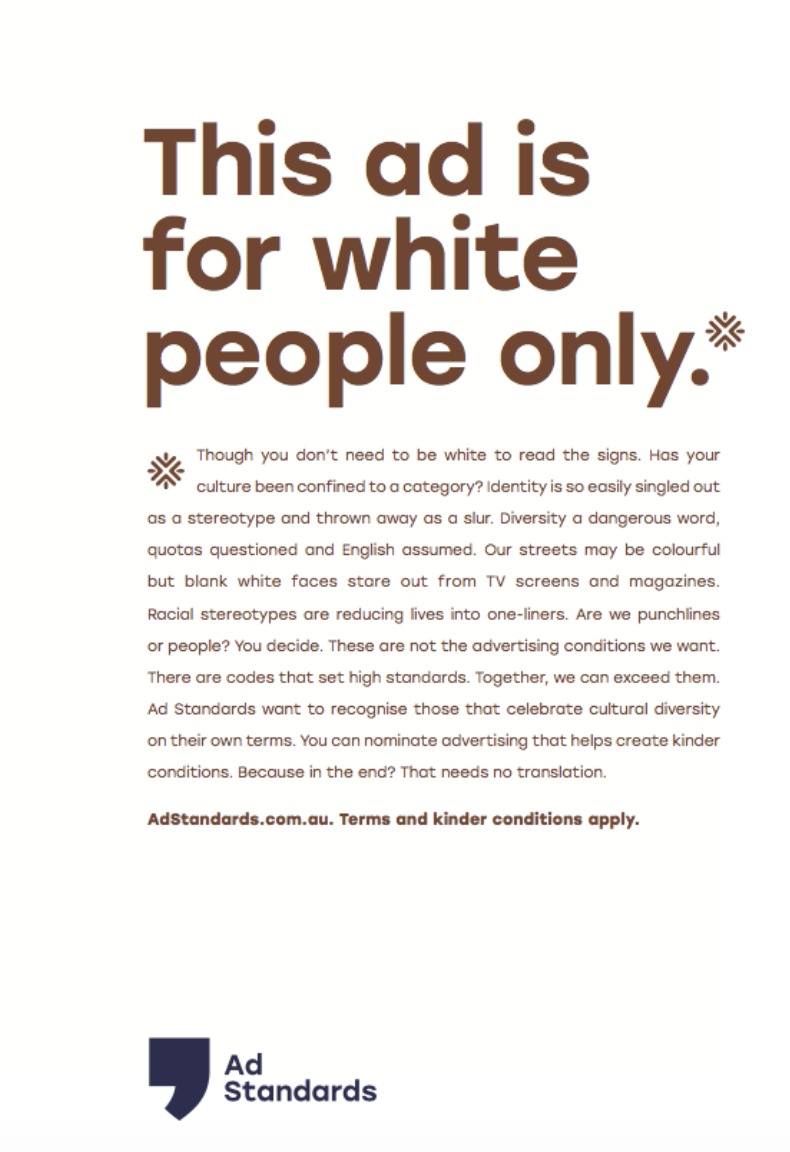
Australian advertising body targets ‘white people’ to highlight ad codes

Good ad:

Australia’s advertising industry watchdog, Ad Standards, has launched a “provocative” campaign to draw attention to sexism, racism and other issues in advertising.

The campaign, which is running across TV, newspapers, radio and outdoor aims to generate awareness of the advertising codes while showcasing how the majority of marketing messages portray sexist gender stereotypes and fail to reflect the multicultural population.

The ‘Kinder Conditions’ ads feature lines such as “This ad is for white people only”, “If you’re a woman don’t bother reading this ad” and “This ad is brainwashing your children”.

Fiona Jolly, CEO of Ad Standards, said the campaign aims to remind Australians that discriminatory and offensive advertising is prohibited while advocating for positive social messaging in advertising.

“The advertising Codes are in place to achieve a greater good for everyone, protecting the nation with standards that reflect society’s values across wide-ranging social issues”.

“Australians may not be aware that certain codes exist which is why we have set about bringing them to the forefront – it’s not because we get a lot of complaints about them. If the public has concerns about these issues, they can raise them and Ad Standards will act on behalf of their concerns.

“The fact is, while the advertising Codes set high standards, we can encourage brands to exceed these to create positive change in the world. The public should be aware of the standards in place and be encouraged to value socially progressive advertising,” said Jolly.

As part of the campaign, Ad Standards is encouraging the public to nominate ads which promote social good by breaking gender stereotypes, increasing diversity and social inclusion, promoting healthy food, safe driving, responsible marketing to children and transparency in advertising.

The campaign was created by Loud Communications.

Source: Australian advertising body targets ‘white people’ to highlight ad codes

Immigrant PPC candidate Winnipeg-South supports party plan to cut immigration, People’s Party of Canada candidate in Sask. slammed over call for more ‘hate speech’

Particularly interesting given he has worked in settlement services (but he favours multiculturalism):

A Muslim immigrant from Afghanistan whose job is helping resettle newcomers says he’s running for the People’s Party of Canada because he likes its stance on curbing immigration.

“It’s a very clear platform,” said Mirwais Nasiri, candidate in Winnipeg South for the fringe federal party.

The 39-year-old came to Canada more than a decade ago, to join his wife, who arrived as a privately sponsored refugee in 2004. He works as a settlement facilitator at the Immigrant Centre in downtown Winnipeg.

Nasiri said he’s in favour of PPC Leader Maxime Bernier’s pledge to cut Canada’s annual immigration targets by more than half, from roughly 350,000 people in 2018.

“For me, it makes sense,” said Nasiri. “If you bring immigrants to this country, we have to make sure we find them housing and they settle down. If we have less immigrants — 100,000 or 150,000 — at least we can take care of them.

“Employment is a big issue,” said the man whose first job was at Welcome Place as a life skills trainer, helping newcomers learn the basics of living in Canada. He said he knows physicians and engineers who cannot find jobs in their fields. “They’re struggling… Many people coming here to Winnipeg can’t find jobs, so they go to Toronto because they think they can find more opportunity.”

However, in December, Statistics Canada reported the employment rate for core working-age immigrants rose to 78.9 per cent in 2017, the highest since 2006, when comparable data became available. Employment rates among immigrants tend to increase the longer they have been in the country, StatsCan said.

Meanwhile, the corresponding employment rate for the Canadian-born population was 84 per cent.

Nasiri said he’s still waiting for several family members in Afghanistan to join him Canada, after sponsoring them in 2011. He’s not keeping his fingers crossed they’ll arrive any time soon, thanks to immigration policy he called unfair.

When asked about immigration being required to boost Canada’s aging population and declining birth rates, Nasiri was dismissive.

“We have enough people,” said the PPC candidate. “We have many young people who are getting married and just establishing a life.”

Statistics released in March show more than six millions Canadians are 65 and older; by 2030, seniors will number more than 9.5 million and make up 23 per cent of the population.

“We’ll still take care of our own people,” Nasiri said. “We’ll have more population in the future.”

Even though Bernier has said he wants to repeal the Multiculturalism Act, and promised to “reject immigrants that do not share Canadian values,” Nasiri said he doesn’t think the party is opposed to multiculturalism.

“The beauty of Canada is the multiculturalism,” he said. “As a multicultural country, you can practice your religion, you can practice your language, your culture… No one is stopping you. Canada is a great country.”

No one has ever questioned his values or his loyalty to Canada, Nasiri said.

“When I came in 2009, the first thing I got when I landed in Toronto at the port of entry, was the immigration officer told me, ‘Welcome home.’ This was a great shock. I was so happy. Since I got here, I never feel that I’m just a stranger, an immigrant, a refugee. I feel always like a proud Canadian.”

He said he’s proud of his party, especially its opposition to the federal carbon tax. Nasiri said he thinks a PPC government could be convinced to raise the minimum wage — even though Bernier is an adherent of libertarianism, believing supply and demand should set wages and prices.

Meanwhile, the board the Elmwood-Transcona PPC riding association publicly quit earlier this month because, it said, too many supporters are “racists, bigots, anti-Semites, and conspiracy theorists.” In Winnipeg Centre, the riding association doxxed a critic who convinced a gallery owner not to rent space to the PPC for an event.

“I haven’t seen anything of this issue in our People’s Party of Canada,” Nasiri said, adding his wife and some co-workers at the Immigrant Centre have offered encouraging words.

“‘We’re proud you stand for something,'” is what he’s been told, Nasiri said. “I stand for this party to help my people in South Winnipeg — immigrants and non-immigrants.”

Source: Immigrant PPC candidate supports party plan to cut immigration

On the other hand:

A Saskatchewan People’s Party of Canada (PPC) candidate is defending comments in support of the use of “hate speech” he made recently on social media.

Some groups say they fear the comments could incite violence.

“Our country could use more hate speech, more offensive comments, more ‘micro-aggressions’, more violation of safe spaces with words and more critical thinking,” Cody Payant wrote on his Facebook page and Twitter account on July 16.

“Words are not violence and when we don’t have them to debate and articulate our thoughts when communicating, then all we have left is guns,” he added.

A confirmed candidate

Payant was nominated in May to run under the PPC banner in Saskatchewan’s Carlton Trail-Eagle Creek riding. He is listed on the party’s website as an official candidate.

Payant said he wrote the post partly in defence of Lindsay Shepherd, a former Ontario teaching assistant who was briefly barred from Twitter following an acrimonious online exchange with Jessica Yaniv, a transgender activist.

But Payant’s broader comments about hate speech and violence were noticed by Yellow Vests Canada Exposed. The Twitter group has monitored comments made by representatives of former federal cabinet minister Maxime Bernier’s People’s Party of Canada since the party’s launch in 2018.

An administrator for the Yellow Vests Canada Exposed said the group saw Payant’s post as encouraging violence.

The Canadian Anti-Hate Network agreed.

“It is a threat of sorts,” said Evan Balgord, the network’s executive director.

The comments hardly came as a surprise, Balgord added.

“It is a fairly common argument, actually, pushed by often right-wing extremists,” Balgord said. “Their conception is if you don’t let me say my hateful things then, oh, I won’t do it, but maybe some people I know or those other more crazy people, if you silence them, then they’re going to get violent.”

‘Hate speech is best said out loud’

In an interview with CBC News on Tuesday, Payant said he stood by his post and expanded on his intended message.

“Words are a tool,” he said. “Words are what we use to resolve conflicts in our society, so that suppression of free speech or suppression of expression is kind of an authoritarian tool.

“So if I had the choice between free speech and the alternative [violence], the alternative is always much worse.”

It’s better to have people voice their hate and face criticism for it than to have their feelings lead to violence, Payant said.

“Hate speech is best said out loud in the public square so it can be criticized and then broadly rejected by reasonable people in society,” Payant said. “It’s part of how we become well-adjusted people and how we communicate effectively as a society and how we resolve conflicts, and when we don’t have those words then all we have left is guns.

“Words are used to resolve conflicts without resorting to physical violence.”

Bernier will be in Saskatoon Wednesday to confirm the slate of northern Saskatchewan PPC candidates for this fall’s federal election.

Source: People’s Party of Canada candidate in Sask. slammed over call for more ‘hate speech’