Immigrants are moving to smaller U.S. cities

Also happening in Canada to a certain extent:

As young Americans stream to coastal cities, immigrants are seizing opportunities in the midwest and south where mid-sized cities are struggling to maintain a younger, working-age population.

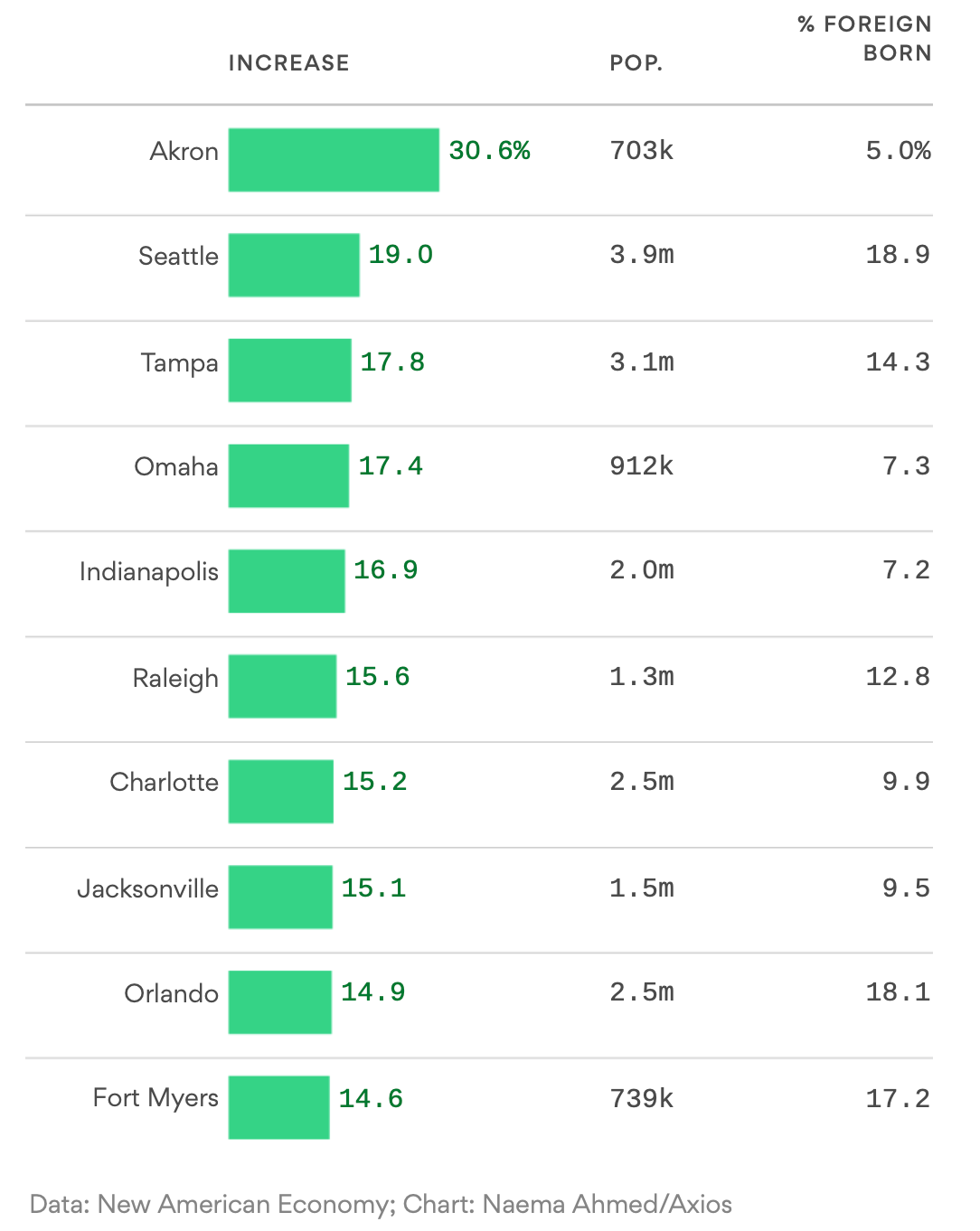
Why it matters: From 2014-2017, immigrants contributed nearly 33% of the total population growth in the top 100 U.S. metro areas — and they’re settling in smaller cities that aren’t typically considered immigration hubs, according to new research from New American Economy.

“Immigrants — very similar to other Americans — are looking for less crowded, more affordable cities that have dynamic job markets,” said Andrew Lim, research director at the bipartisan research and advocacy organization.

Details: Foreign-born migration helped reverse population decline in several metros, such as Detroit, Memphis, Dayton and St. Louis.

  • In 2017, immigrants were responsible for 98% of the population growth in metro Cincinnati, 88% of the growth in metro Birmingham, and 87% of growth in metro Miami.
  • Four of the top 10 cities seeing the most population growth from immigrants are in Florida — a state seeing a disproportionate growth of aging residents.

What’s happening: Many of the top destinations are grappling with a demographic double whammy: a growing aging population on one hand, and a dwindling young population on the other.

  • Immigrants to the U.S. are more likely to be of working age — between 25 and 64 — than the native-born population. Meanwhile, 98 of the top 100 metros saw an increase in population above the age of 65 between 2014 and 2017.
  • Healthcare is a popular job area as demands grow in caring for aging residents. In El Paso, for example, immigrants made up a third of healthcare workers in 2017. In the Minneapolis-St. Paul area, that number was 20%.

The big picture: Immigration is a national flashpoint right now, with controversies around poor conditions in detention centers along the Mexico border and political fights over whether the 2020 Census will include a citizenship question.

The research highlights the economic upsides of immigration.

  • Immigrant entrepreneurs grew by 7.7% in the top 100 metro areas between 2014 and 2017. The number more than doubled in Baton Rouge, and grew by more than 60% in Tulsa.
  • Immigrant homeownership increased by 9.5%, with Nashville, Oklahoma City and Charlotte seeing the fastest growth.
  • Despite growth in smaller cities, the more traditional metros (New York, Los Angeles, San Francisco) still saw the highest levels of spending power and taxes paid by immigrants.

Go deeper:

Source: Immigrants are moving to smaller U.S. cities

Is Australia headed for another citizenship saga?

Appears not, despite the heade questionr:

Bill Shorten, Jacqui Lambie and Chris Bowen are among a list of more than two dozen politicians who may not be eligible to sit in the Australian parliament.

Legal academics in Western Australia have put the constitution under the microscope and concluded that 26 MPs and senators may fall foul of the nightmarish Section 44(i).

The section disqualifies anyone who holds allegiance to a foreign country from sitting in the federal parliament.

While much of the attention during the 2017-2018 political crisis that claimed 15 scalps centred on the section’s second criteria -which covers the issue of dual citizenship – the third criteria went largely unnoticed.

‘Right of abode’ in UK

This disqualifies anyone from sitting in parliament if they are entitled to the rights and privileges of citizens of a foreign power.

This means that Australians born before January 1, 1983, to a British parent, probably still hold a ‘right of abode’ in the United Kingdom – which confers almost all the rights and privileges of a full British citizen.

‘We seem to have only scratched the surface.’

“While many Australians perhaps hoped that multiple High Court decisions and resulting by-elections would mean that the country could put the parliamentary eligibility crisis behind it, instead we seem to have only scratched the surface,” says legal academic Lorraine Finlay.

Finlay is co-author of the paper But Wait…There’s More: The Ongoing Complexities of Section 44(I), published in the University of Western Australia Law Review.

At the very least, says Finlay, the third criteria is “significantly more ambiguous” than the second.

Allegiance

And she says it would be up to the High Court to determine if the rights conferred on an Australian holding a right of abode in the UK are significant enough to create an “imputed sense of allegiance”.

Any member of a Commonwealth nation, who holds the right of abode in the UK, is free to enter and exit the UK “without hindrance”, as well as to work, study, apply for welfare, vote and stand for public office in the country.

Finlay says it is interesting to note that the rights afforded to European Union citizens in the UK are “distinct” and lesser than those afforded to Commonwealth Citizens with the right of abode in the UK.

After examining the parliamentary citizenship register, Finlay concludes there are at least 26 current parliamentarians who potentially could have the right of abode in the UK, based on the information they have provided on their British family history.

Australian politicians dual citizenship list

LABOR (14)

  • Bill Shorten (Vic), Chris Bowen (NSW), Mark Butler (SA), Nick Champion (SA), Lisa Chesters (Vic), Pat Conroy (NSW), Alexander Gallacher (SA), Katy Gallagher (ACT), Andrew Giles (Vic), Madeleine King (WA), Susan Lines (WA), Brian Mitchell (Tas), Louise Pratt (WA) and Glenn Sterle (WA).

LIBERAL (5)

  • John Alexander (NSW), Angie Bell (Qld), Ben Morton (WA), Dean Smith (WA) and Alan Tudge (Vic).

NATIONAL (3)

  • George Christensen (Qld), Patrick Conaghan (NSW) and Perin Davey (NSW).

GREENS (2)

  • Adam Bandt (Vic) and Rachel Siewart (WA).

OTHER (2)

  • One Nation’s Malcolm Roberts (Qld) and independent Tasmanian senator Jacqui Lambie.

Challenge unlikely

For any of the above to be ruled ineligible, they would have to be challenged in the parliament and referred to the High Court.

With 14 under a cloud, it’s safe to assume Labor will let sleeping dogs lie.

And while a challenge could be to the coalition’s advantage, the Liberals and Nationals might feel the brunt of a backlash if it forces voters back to the polls for another slew of by-elections.

Finlay concludes that an examination of eligibility in light of the Commonwealth right of abode is therefore unlikely to go any further.

“(But) it demonstrates that there may still be a significant number of current Australian parliamentarians who are not actually eligible to sit in the parliament,” she says.

“Clarifying the scope and reach of section 44(i) is essential to maintain public confidence in the legitimacy of the current Australia Parliament, and also to avoid uncertainty with regards to future elections.”

Source: Is Australia headed for another citizenship saga?

Immigration: les étudiants étrangers diplômés au Québec expulsés de la voie rapide

Not a great way to communicate the change, nor explain it:

Sans faire de bruit, le gouvernement de François Legault vient de suspendre un programme qui permettait aux étudiants étrangers diplômés d’une université québécoise d’immigrer par la voie rapide.

L’annonce a été faite par le truchement de la Gazette officielle du Québec, publiée hier. On apprend dans ce document hautement technique la suspension temporaire immédiate du programme qui permet depuis 2010 aux nouveaux diplômés d’obtenir en quelques semaines seulement un certificat de sélection du Québec, premier pas vers l’obtention de la résidence permanente au pays.

Interrogée par La Presse, l’attachée du ministre de l’Immigration, de la Diversité et de l’Inclusion a expliqué que la suspension se terminera le 1er novembre et fait partie de la refonte du système d’immigration par le gouvernement de la Coalition avenir Québec.

Un autre volet du Programme de l’expérience québécoise (PEQ) – nom donné au processus d’immigration accéléré -, qui vise les travailleurs étrangers occupant un emploi au Québec depuis plus d’un an, est maintenu.

« Étant donné la pénurie de main-d’oeuvre, le gouvernement a décidé de donner la priorité aux travailleurs qui occupent déjà un emploi au Québec. Ils répondent rapidement à nos besoins », affirme Élisabeth Gosselin.

Lorsque La Presse a demandé comment des travailleurs déjà embauchés pouvaient avoir un plus grand impact sur les 120 000 postes à pourvoir au Québec que des étudiants fraîchement diplômés, l’attachée de presse de Simon Jolin-Barrette a affirmé que la pénurie de main-d’oeuvre serait « pire si ces travailleurs [déjà en poste] quittent » le Québec.

Mme Gosselin ajoute que malgré la suspension, ceux qui ont obtenu un diplôme récemment n’ont pas nécessairement à déménager hors du Québec. Ces derniers peuvent demander un permis de travail temporaire, fait-elle valoir.

« En catimini »

L’annonce de la suspension du programme a fait bondir l’opposition officielle à Québec. « Le gouvernement a fait ça en catimini. Il y a eu des annonces la semaine dernière sur l’immigration : pourquoi ne pas avoir parlé de la suspension d’une partie du Programme de l’expérience québécoise, un programme qui fonctionne très bien ? », tonnait hier Dominique Anglade, députée de Saint-Henri-Sainte-Anne et candidate à la direction du Parti libéral. « C’est un gouvernement qui pense à court terme, sans vision. Cette annonce va être dommageable pour l’image du Québec à l’international à long terme », dit celle qui a été présidente et directrice générale de Montréal international avant de faire le saut en politique.

Président de l’Association québécoise des avocats et avocates en droit de l’immigration (AQAADI), Guillaume Cliche-Rivard était incrédule hier. « Tout ça est une conséquence des seuils d’immigration revus à la baisse par le gouvernement. Couper dans le programme destiné aux étudiants étrangers avec un diplôme du Québec et qui parlent français n’a aucun sens, se désolait hier l’avocat. Toutes les sociétés occidentales veulent que les étudiants formés chez eux restent. On envoie vraiment le mauvais message à ceux qui veulent venir étudier au Québec. »

Selon lui, la suspension du programme rendra les universités québécoises – qui recherchent sans cesse de nouveaux étudiants étrangers – moins attrayantes.

À Montréal international, l’une des organisations mises à profit par le gouvernement précédent pour convaincre un plus grand nombre d’étudiants étrangers de rester et de travailler au Québec après leurs études, on disait ne pas s’inquiéter de l’annonce gouvernementale. « Ce qui a été annoncé nous réjouit. Les étudiants étrangers peuvent toujours obtenir un visa de travail. Ce qui est important pour nous, c’est que les travailleurs et les étudiants étrangers qui viennent au Québec ne soient pas freinés lorsqu’il est temps d’obtenir un permis temporaire », a dit hier Christian Bernard, vice-président aux affaires économiques et aux communications.

Un programme populaire

C’est le gouvernement de Jean Charest qui avait mis sur pied le Programme de l’expérience québécoise en 2010 afin de donner rapidement un statut d’immigration permanent aux travailleurs qualifiés temporaires et aux étudiants étrangers qui ont terminé leurs études dans la province. Pour y être admissibles, les demandeurs doivent avoir une bonne connaissance du français.

Depuis 2015, le gouvernement du Québec a déployé des programmes spéciaux pour convaincre davantage d’étudiants étrangers de s’installer au Québec après leurs études, notant un retard important sur la rétention des diplômés par rapport à d’autres provinces, dont l’Ontario, ou encore en se comparant à d’autres pays d’immigration, dont l’Australie et les États-Unis.

En 2018, 10 711 personnes ont été sélectionnées pour l’immigration par le Québec grâce au PEQ, soit près du cinquième des 55 000 immigrants reçus dans la province l’an dernier. De ce nombre, la moitié – soit 5146 – était composée de récents diplômés. En 2019, 8052 personnes ont déjà reçu le feu vert du Québec par le truchement du PEQ, dont 3226 diplômés. Or, le gouvernement de la CAQ a abaissé à 40 000 le seuil d’immigration du Québec pour 2019.

***

Deux fois plus d’étudiants étrangers

De 2009 à 2018, le nombre de permis d’études délivrés à des étrangers a doublé au Québec. En 2018, ils étaient 70 060. De ce nombre, 5146 ont fait une demande d’immigration auprès du gouvernement du Québec. En général, le Québec retient environ 20 % des étudiants étrangers après l’obtention d’un diplôme. Le gouvernement libéral voulait doubler ce pourcentage.

« Par leur expérience préalable au Québec, [les diplômés et les travailleurs qualifiés temporaires] ont déjà amorcé leur processus d’intégration au marché du travail et à la société québécoise, ce qui en fait des candidats de choix à l’immigration permanente. »

– Extrait du document Planification de l’immigration au Québec pour la période 2020-2022 produit en 2019 par le ministère de l’Immigration, de la Diversité et de l’Inclusion

UK’s Labour Party spars with BBC over charges of anti-Semitism

Ongoing train wreck (the Conservatives have the same problem with anti-Muslim attitudes):

British opposition leader Jeremy Corbyn’s office interfered in independent party discipline processes aimed at rooting out anti-Semitism, the BBC said on Wednesday, a claim that the Labour Party sharply rejected.

A BBC investigation spoke to former Labour officials who said top party figures, including Corbyn’s communications director Seumas Milne and general secretary Jennie Formby, had minimized complaints of anti-Semitism against party members.

Labour said the accusations were “deliberate and malicious misrepresentations designed to mislead the public”.

Labour has battled accusations of anti-Semitism since 2016 and Corbyn – a veteran campaigner for Palestinian rights – as well as other senior party officials have been criticized for failing to take decisive action to deal with it.

British Jewish groups have accused Labour of becoming institutionally anti-Semitic, and the issue has played a part in Labour’s failure to take electoral advantage of the Conservative government’s turmoil over Brexit.

The BBC quoted an email from Milne telling Labour’s internal complaints team that “something’s going wrong, and we’re muddling up political disputes with racism”.

Labour said this misrepresented Milne’s email, which referred to a dispute between Jewish Labour members with Zionist and anti-Zionist views. A fuller extract of the email read: “If we’re more than very occasionally using disciplinary action against Jewish members for anti-Semitism, something’s going wrong, and we’re muddling up political disputes with racism.”

The BBC investigation also quoted former party members who felt a hostile atmosphere toward Jews within the party in recent years, who were sometimes challenged over Israeli government actions by other party members.

Nine lawmakers quit the party this year, citing the leadership’s handling of anti-Semitism as well as its stance on Brexit as reasons for leaving.

British foreign secretary Jeremy Hunt said the BBC investigation showed that Corbyn was either “wilfully blind to anti-Semitism or anti-Semitic himself”.

Labour’s deputy leader, Tom Watson, who is frequently critical of Corbyn, said he was “shocked, chilled and appalled” by the allegations in the BBC report.

Labour’s press office said the party was “implacably opposed to anti-Semitism,” and that some of the former officials quoted by the BBC had “personal and political axes to grind” against Corbyn.

Britain’s Conservatives face regular accusations of hostility toward Muslims. On Monday broadcaster Channel 4 published a survey of 892 Conservative Party members by pollsters YouGov which showed that 56% believed Islam was a general threat to Britain’s way of life.

Source: UK’s Labour Party spars with BBC over charges of anti-Semitism

Facial Expression Analysis Can Help Overcome Racial Bias In The Assessment Of Advertising Effectiveness

Interesting. The advertisers are always ahead of the rest of us….:

There has been significant coverage of bias problems in the use of machine learning in the analysis of people. There has also been pushback against the use of facial recognition because of both bias and inaccuracy. However, a more narrow approach to recognition, one focused on recognition emotions rather than identification, can address marketing challenges. Sentiment analysis by survey is one thing, but tracking human facial responses can significantly improve accuracy of the analysis.

The Brookings Institute points to a projection that the US will become a majority-minority nation by 2045. That means that the non-white population will be over 50% of the population. Even before then, the growing demographic shift means that the non-white population has become a significant part of the consumer market. In this multicultural society, it’s important to know if messages work across those cultures. Today’s marketing needs are much more detailed and subtle than the famous example of the Chevy Nova not selling in Latin America because “no va” means “no go” in Spanish.

It’s also important to understand not only the growth of the multicultural markets, but also what they mean in pure dollars. The following chart from the Collage Group shows that the 2017 revenues from the three largest minority segments are similar to the revenues of entire nations.

It would be foolish for companies to ignore these already large and continually growing segments. While there’s the obvious need to be more inclusive in the images, in particular the people, appearing in ads, the picture is only part of the equation. The right words must also be used to interest different demographics. Of course, that a marketing team thinks it has been more inclusive doesn’t make it so. Just as with other aspects of marketing, these messages must be tested.

Companies have begun to look at vision AI for more than the much reported on facial recognition, that of identifying people. While social media and surveys can catch some sentiment, analysis of facial features is even more detailed. That identification is also an easier AI problem than that of full facial identification. Identifying basic facial features such as the mouth and the eyes, then tracking changes based on watching or reading an advertisement can catch not only a smile, but the “strength” of that smile. Other types of sentiment capture can also be scaled.

Then, without having to identify the individual people, information about their demographics can build a picture of how sentiment varies between groups of people. For instance, the same ad can easily get a different typical reaction from white, middle aged women, then from older black men, and from that of East Asian teenagers. With social media polarizing and fragmenting many attitudes, it’s important to understand how marketing messages are received through the target audiences.

The use of AI to rapidly provide feedback on sentiment analysis will help advertisers to better tune messages, whether aiming at a general message that attracts an audience across the US marketing landscape, or finding appropriate focused messages to attract specific demographics. One example of marketers leveraging AI in this arena is Collage Group. They are a market research firm which has helped companies to better understand and improve messaging to minority communities. Collage Group has recently rolled out AdRate, a process for evaluating ads that integrates AI vision to analysis sentiment of the viewers.

“Companies have come to understand the growing multicultural nature of the US consumer market,” said David Wellisch, CEO, Collage Group. “Artificial intelligence is improving Collage Group’s ability to help B2C companies understand the different reactions in varied communities and then adapt their to the best effect.”

While questions of accuracy and ethics in the use of facial recognition will continue in many areas of business, the opportunity to better message to the diversity of the market is a clear benefit. Visual AI to enhance the accuracy of sentiment analysis is clearly a segment that will grow.

Source: Facial Expression Analysis Can Help Overcome Racial Bias In The Assessment Of Advertising Effectiveness

Open letter from Chinese-Canadian groups boosts Hong Kong government, blasts protesters

Expect we will see more of these debates emerge, some legitimate, some bots, some home-grown, some planted:

As protesters in Hong Kong continue to rally against Beijing’s tightening grip on the city, dozens of Chinese-Canadian groups have delivered a different message, voicing support for the enclave’s China-backed government and singling out violent “extremists” among the demonstrators.

The open letter published recently in Vancouver and Toronto Chinese-language newspapers is raising questions about who was behind the statement, with some fingers pointing at the Chinese government and its influence machine.

The authors of the message deny any outside involvement.

The advertisement, signed by over 200 organizations across the country, complained about radicals causing violence, defended China’s “inalienable” right to control Hong Kong, and appealed to Chinese Canadians’ ethnic identity.

“We support the rule of law and stability in Hong Kong, oppose the violent acts of a small number of extremists, oppose any Hong Kong independence movement … and support the Hong Kong government maintaining law and order,” the letter in Ming Pao newspaper said. “Hong Kong is China’s inalienable sovereign territory; Hong Kong’s affairs are China’s internal affairs; and we oppose any foreign interference.”

The ad marks a contrast to what happened on the streets of Hong Kong itself, where hundreds of thousands of people demonstrated against a law that would have allowed extradition of alleged criminals to mainland China. Critics feared the legislation could be used to dispatch enemies of Beijing to a legal system controlled by the Communist Party. Some observers view the mass protests also as a general pushback against China’s growing control of the city since the U.K. gave up control of it in 1997.

The movement shows little sign of ending soon. Even as Carry Lam, the Beijing-backed chief executive of the Hong Kong government, announced Tuesday the extradition law is now is dead and work on it was a “total failure,” critics expressed skepticism about the government’s intentions.

Why would groups purporting to represent the Chinese diaspora in democratic Canada take sides against such demonstrators?

Many of those signatories are shell groups beholden to Beijing, and the message was likely dictated by China’s representatives here, charges Cheuk Kwan of the Toronto Association for Democracy in China.

“These are basically fake organizations … They are what I call the mouthpieces of the Chinese consulate,” he said. “This is a very clearly United Front effort by the Chinese government … If it’s not instituted directly, then indirectly.”

Kwan was referring to the United Front Work Department, the Chinese Communist Party offshoot that works to influence ethnic Chinese and political and economic elites in other countries. Its role has expanded greatly under current Chinese leader Xi Jinping.

Still, he admitted that Chinese Canadians are divided on the Hong Kong protests, with some supporting the demonstrators, and others wishing for a return to civil order.

Fenella Sung, spokesman for Vancouver’s Friends of Hong Kong, agreed that the “linguistic craftiness” of the letter seems typical of the United Front. She pointed especially to its appeal to ethnic nationalism, with statements that Chinese Canadians are “all sons of China and members of the Chinese people,” and “blood is thicker than water.”

There is “not a word about being Canadians, as if they have nothing to do with Canada,” said Sung. “The text of the ad could be used anywhere in the world.”

She also said it blatantly distorted the facts, suggesting protesters caused scores of injuries one day early in the event, when independent human rights groups blamed police action.

Yu Zhuowen of the Chinese Freemasons group in Toronto and one of the organizers of the statement, denied any government was involved, calling the letter a heartfelt appeal to restore peace in Hong Kong, his own hometown.

Yu said protesters misunderstand the extradition legislation — which he argued would protect the city from mainland-based criminals — and faced the same kind of police response they would have in Canada.

“We don’t want to see Hong Kong like this. I have my family in Hong Kong, too, I don’t want them to get hurt,” he said about the demonstrations. “In Canada or America, when the protesters come out, the police get them away right away, they use a lot of violence, too.”

Ethnic diversity makes Britain’s culture great. It would be a disaster if we lost it

A reminder and a more positive picture:

A couple of weeks ago, a young black man from south London stood up in front of tens of thousands of people and delivered one of the most celebrated performances in the history of Glastonbury. A few days later, an England cricket squad – almost half of whom were born abroad or are from an ethnic minority background – made it into the semi-finals of the World Cup. Meanwhile over at Tate Modern, a British artist of Nigerian origin is displaying an artwork made up of thousands of booksimprinted with the names of migrants who have made significant contributions to British culture.

Today, some of our most brilliant prospects in art and culture are from minority ethnic or migrant backgrounds. We present a gloriously multicultural face to the world. And that is important not just for the story we tell to others, but for the stories we tell ourselves. Think of the cultural power of the first Asian families on EastEnders, the breakthrough of Soul II Soul in the 1980s, or the nation-defining literary output of Zadie Smith.

The British actor Riz Ahmed refers to this as “stretching the flag, so it’s big enough to embrace all of us”. He is talking about how art can remould how we see ourselves and the country that we live in. The Pakistani-British heritage of his youth is just as much a part of our modern national story as the playing fields of Eton, remote Shetland communities or the multi-ethnic melting pots of Leicester, Birmingham and London. But it is only through the representation of that experience in our national culture that those truths are cemented across the whole country.

Source: Ethnic diversity makes Britain’s culture great. It would be a disaster if we lost it

The anti-Semitic theology behind the Christian Zionist lobby

Of note:

This week, the largest Israel lobby group in the United States, Christians United for Israel, will hold a two-day “summit” in Washington, D.C., featuring high-profile speakers such as Vice President Mike Pence and Secretary of State Mike Pompeo. Many of the event’s attendees and featured guests will profess their abiding love and support for Israel and Jewish people.

In reality, right-wing Christian supporters of Israel like CUFI pose a grave danger to the safety and well-being of both Jews and Palestinians, as well as to hopes for a true and lasting peace in the Holy Land. Anyone who actually listens to CUFI’s leader, the Rev. John Hagee, will be horrified at the meeting’s toxic blend of anti-Semitism, racism, homophobia, Islamophobia and sexism.

Hagee and his more than 5 million followers believe that the establishment of Israel in 1948 and its subsequent military occupation and colonization of Palestinian and other Arab lands are the fulfillment of biblical prophecy and the necessary precursors to the return of Jesus Christ and the coming of the apocalypse.

Source: The anti-Semitic theology behind the Christian Zionist lobby

John Ivison: Prioritizing romanticism over realism: Where Trudeau went wrong in Canada’s foreign policy – Anonymous former diplomats

While I agree with many of the criticisms (e.g., oversized role of diaspora politics), some less so (e.g., overly focussed on the US, the main Canadian national interest), a good survey of former ambassador assessments.

But what I find hard to understand is why former ambassadors refuse to make these statements on the record, hiding behind anonymity.

Being retired gives one the freedom to express one’s opinions publicly. There are good examples: Paul Heinbecker, David Mulroney, Dennis Horak, Ferry de Kerckhove and Mike Malloy have all played, and continue to play, an important role in public discussion on foreign policy.

Making anonymous comments, whether on social media or in interviews, has less impact and, I would argue, less credibility.

So to my former colleagues at DFAIT/GAC, if you have something to say, say it but with the personal and professional accountability that comes with being named.

Welcome any contrary opinions, of course:

Rhetoric is no substitute for reality, as the American social theorist Thomas Sowell said. It is the besetting sin of the Trudeau government that it has not lived up to its promises in so many fields of endeavour.

In foreign affairs, this week gave us another reminder of the gap between what Justin Trudeau said he would do — a “new era of Canadian international engagement” — and the state of affairs in the real world.

The Hindustan Times reported that India has informed Canada that there is little prospect of warming the frosty bilateral relationship unless Ottawa takes action on the burgeoning activities of groups seeking an independent Sikh homeland in the Punjab region.

The relationship with India has cooled since Trudeau’s disastrous visit last year, largely because the Indians believe the Liberal government is taking a position that is deliberately ambiguous for domestic political reasons (the Sikh population being a particularly coveted voting bloc at the next election).

The problem is not specifically Trudeau’s lack of credibility with Narendra Modi’s government, though India is an important Commonwealth partner.

The larger issue is that it is just one example of Canada’s continuing evisceration of its foreign service, its subjugation of relations with regional powers to domestic politics and of the millenarian belief that Canada should be regarded as a moral superpower.

Policy has been diaspora-driven in the case of the Sikhs, Tamils and Ukrainians. “We are trying to win votes in Surrey, B.C. That’s not adult. It’s not G7 behaviour,” said one former ambassador.

Another senior diplomat, with two decades of experience in Asia, said the Liberals seems to believe that foreign governments will buy their progressive talking points just as its political base does.

“I spent decades working with these highly educated and sophisticated people and I would be embarrassed to be defending current policies. We have never before had strained relations with all three of the world’s strongest powers,” he said.

The Post spoke with a handful of former senior diplomats, all of whom lamented the current state of Canada’s foreign relations.

They talked about a missed opportunity after the Harper years, when the Conservative government turned away from multilateralism and refused to “go along just to get along.” Trudeau tried to rebrand Canada as a more sympathetic, co-operative country, and said he wanted to share a “positive Canadian vision.”

When he visited the renamed Global Affairs Department in Ottawa’s Lester B. Pearson building he was greeted like a rock star by staff who were open in their jubilation at the demise of the Conservative government.

“Harper made no secret of his open disdain for the bureaucracy, which he thought was staffed by a bunch of Liberals,” said one former ambassador. “That wasn’t true — people had served previous Conservative governments loyally.”

There were high hopes that Trudeau would revive the foreign service but by all accounts, that has not happened.

“For a government that evinced such appreciation of bureaucrats at the beginning — which was embarrassingly reciprocated — Trudeau’s government has shown little appreciation for the actual institution of Canada foreign policy. Was this because the institution didn’t deliver, after the years of Harper starvation; because the Harper model was there and was so easy to fall back on; because of the press of crises; or because of personality?” asked another former ambassador.

The answer is probably a combination of the above. But what can be said with confidence is that allowing the foreign service to atrophy further has had real world consequences.

Naiveté, myopia and bad advice contributed to the debacle in Beijing in late 2017, when Trudeau arrived in China expecting to launch talks on a free trade deal and left empty-handed. Old Foreign Affairs hands shake their heads at the expectation that China would change its labour laws to accommodate Canada’s progressive trade agenda, blaming former ambassador John McCallum (one of a number of political appointees in key embassies) for not warning the visiting prime minister. “The Liberal establishment is in bed with the Chinese and they were slow to see that Xi is different and the romantic vision of China is no longer true,” said a former ambassador.

The consensus on Trudeau’s trip to India is that foreign service advice was either ignored or overruled. The logic appears to have been that dressing up in flamboyant costumes for pictures that would appear in constituency mail-outs at election time should take precedence over fostering more harmonious relations with the world’s largest democracy.

On relations with the U.S., there is a sense that Trudeau has performed more adroitly. “I’m careful not to carp about the swimming stroke of a guy caught in a white water cascade,” said one former ambassador, referring to the problem for any Canadian government dealing with Donald Trump.

The main criticism was that the renegotiation of the North American Free Trade Agreement has dominated the agenda, leaving little time for the rest of the world.

Chrystia Freeland, the global affairs minister, is given credit by foreign policy veterans for getting the free trade deal with the European Union across the finish line.

She is also commended for backing the Lima Group, a collection of 12 countries intent on creating a peaceful solution to the crisis in Venezuela. “It’s one of the best initiatives to come out of this government,” said a former ambassador with experience in Latin America. “It’s flexible, not the usual suspects and pragmatic.”

But Freeland and Trudeau are given more failing marks than passes for prioritizing romanticism over realism in Canada’s foreign policy.

The Trudeau government’s idealistic crusade to promote democracy and reduce inequities has blinded it to the realpolitik that puts national interest ahead of all other considerations.

An example would be the tweet by Freeland calling for the release of two women’s rights activists, including Samar Badawi, sister of imprisoned writer Raif Badawi, which provoked an angry response from the peevish Saudi Arabian crown prince, Mohammed bin Salman. The prince called the intervention “blatant interference in the Kingdom’s domestic affairs,” expelled the Canadian ambassador, froze bilateral trade, and dumped Canadian assets. For their part, the Trudeau Liberals were able to engage in their particular brand of pulpit diplomacy. But it came at a cost and Canada’s former Saudi envoy, Dennis Horak, was quoted as saying Freeland’s tweet was a “serious overreaction” and “went too far.”

One of the former ambassadors interviewed concurred. “If we confine relations to like-minded countries, we’ll have ever fewer relations,” he said.

Freeland could claim to being on the side of the angels when the Saudis murdered journalist Jamal Khashoggi in their consulate in Turkey in October 2018. But Samar Badawi is still in detention and is less likely to be released after Canada’s involvement than she was before. The incident revealed that Canada is impotent when it comes to transforming the behaviour of other states, yet retains an unrealistic sense of utopianism that offers the mirage of power and influence.

Meanwhile, Canada’s foreign affairs department continues to disintegrate — quite literally. There has been no ambassador in Moscow for over a year and the roof of the embassy is falling in, such that staff are set to move into the basement and backrooms of the British embassy.

Canada promised to be “back” but the re-emergence on the multilateral stage has fizzled. On arms control, aid, peacekeeping and security, the Trudeau government has disappointed. The government took a long time to commit to a year-long engagement in Mali and the eight helicopters and 250 personnel are due to come home at the end of this month — nearly three months before their Romanian replacements are in theatre.

None of this bodes well for Canada’s attempt to win a seat on the UN Security Council next year, against strong opposition from Ireland and Norway.

Failure would bring uncomfortable comparisons with the prime minister’s father, who was in power when Canada held a non-permanent security council seat in 1977.

“Justin has a domestic focus to his foreign policy, compared to his father, who was a factor on the world stage,” said one eminent former ambassador, who spent 35 years working on four continents.

I asked him if he thought Trudeau, who travelled extensively with his father as a boy, was a student of geo-politics. “I don’t think so. When engaging with world leaders, he’s not talking about Middle East peace or Iran, I’d suggest he is engaging on issues like income inequality, women in leadership roles and the environment,” he said.

The consequence of these skewed priorities, according to my informal panel of ambassadors, is that in many areas of foreign policy, not only is Canada not back, it is positively AWOL.
ANDREW COYNE: Why Conservatives have more at stake than Liberals in Canada’s class war

Coyne, as often happens, nails it. A plague on both houses, but more so for Conservatives:

Liberals, it is true, need to find a way to reach out to less educated voters, but not as badly as Conservatives need to make their peace with the eggheads

Democracy, in G. K. Chesterton’s careful definition, means government by the uneducated, “while aristocracy means government by the badly educated.”

The enduring value of this distinction was suggested by the ruckus stirred up over the weekend by Amir Attaran, professor of law at University of Ottawa. Responding to a recent Abacus Data poll finding the Tories leading the Liberals by a wide margin among Canadians with a high school diploma or less, with the Liberals ahead among those with bachelor degrees or higher, the professor tweeted: “The party of the uneducated. Every poll says this.”

In the ensuing furor, Attaran tried to protest that he was just stating a fact, but the disdain in the tweet was clear enough to most. For their part, while some Tories quibbled with the data (just one poll, within the margin of error, misplaced correlation etc), most seemed less offended by the sentiment — every poll does show the less formal education a voter has, the more likely they are to support the Conservatives — than by the suggestion there was something shameful about it.

It was, in short, another skirmish in the continuing class war: class, now defined not by occupation or birth, as in Chesterton’s time, but by education. Conservatives, true to form, professed outrage at this arrogant display of Liberal elitism, while Liberal partisans protested that they were not snobs, it’s just that Conservatives are such ignorant boobs (I paraphrase).

The professor compounded matters by objecting, not only that he is not a Liberal, but that he is not an elite, since his parents were immigrants. And everyone did their best to be as exquisitely sensitive (“let us respect the inherent dignity of labour”) as they could while still being viciously hurtful (“not uneducated, just unintelligent”).

There is, of course, much to object to in Attaran’s remark. Not all or even most wisdom is to be found in higher education. Lots of people who go to university don’t learn a thing, while much of what they do learn is tendentious rubbish. A society that sneers at tradespeople is a society on its way to the poorhouse.

Today’s populist conservative is prone to dismiss the analysis of experts, on everything from sex education to climate change, not in spite of their expertise but because of it.

But Conservative rhetoric too often seems to go beyond attacking snobbery to attacking education itself: expertise, knowledge, the whole notion that people who know more about a subject than the rest of us ought to be listened to with respect.

There is a rich tradition, to be sure, of conservative skepticism of intellectuals — recall William F. Buckley’s crack about preferring to be governed by “the first two thousand names in the Boston telephone directory” than the faculty of Harvard. But the target then was the hubris of intellectuals, convinced they could plan an entire economy or overturn the accumulated wisdom of centuries of tradition, not intellectualism itself: scientism, not science.

Today’s populist conservative, by contrast, is prone to dismiss the analysis of experts, on everything from sex education to climate change, not in spite of their expertise but because of it. A society that sneers at “so-called experts” is a society on its way to the madhouse.

As in most wars, there is fault on both sides. If Trump and Ford voters brim with resentment at “liberal elites” looking down their noses at them, it is not entirely without cause.

And yet we should beware of drawing the class lines too starkly. Graduates of apprenticeships and community colleges are themselves relative elites — 46 per cent of adult Canadians have no post-secondary education — and earn more accordingly: a premium of 12 and 18 per cent, respectively, over those with only a high school diploma.

At the same time, universities are for the most part glorified trade schools. Only 12 per cent of today’s university students graduate in the humanities, the object of so much (deserved) conservative ridicule. The rest are there to learn a trade — only trades of a tonier kind, like doctoring and lawyering.

It isn’t so much about the level of education, then, as the kind of education. (Trump, as he likes to boast, is a graduate of Wharton.) There is a high degree of overlap between “liberal elites” and “symbolic analysts” (in Robert Reich’s term) — people who make their living manipulating words, numbers, images, code.

It is Conservatives who have played the class card more heavily, and with more destructive results.

What is common to all those doctors and lawyers, academics and bureaucrats, designers, artists, and, yes, media people is that they deal in ideas — with the abstract versus the physical, representation versus reality — and are typically good at communicating these to others. Not for nothing are they sometimes called the “chattering classes.”

The ability to do so earns not only income, but social and cultural “capital,” at least among their fellow class members, clustered in the centres of our major cities. That there should be some degree of estrangement between them and those outside is not surprising, but one wishes political leaders would seek to bridge these divides rather than exacerbate them.

There is fault, as I say, on either side for this; but there is not equal fault. Liberal “virtue-signalling” may flatter the moral vanity of the educated classes, but it is Conservatives who have played the class card more heavily, and with more destructive results. Class wars are always toxic, but class wars organized around “is education a good thing” are suicidal.

And not only for society. Here’s the thing: the numbers of the higher educated are growing. The 2016 census was the first to show more than half the adult population — 54 per cent — with some kind of postsecondary degree, college or university, up from 48 per cent a decade before. And it is only going to continue: younger Canadians are more likely to have a degree than their parents, and their children will be more likely still.

Liberals, it is true, need to find a way to reach out to less educated voters, but not as badly as Conservatives need to make their peace with the eggheads.

Source: ANDREW COYNE: Why Conservatives have more at stake than Liberals in Canada’s class war