Austrian State Plans 10 Commandments for Immigrants, Demands Refugees ‘Show Gratitude’ and Adopt ‘Austrian Values’

While some of the rules are normal (e.g., adhere to laws, learn German), others are less so (e.g., adhere to Austrian values however defined, show gratitude to Austria):

A state government in Austria is planning to introduce a new set of rules for immigrants to follow upon arrival in the country, which have become known as the “Ten Commandments of Immigration.”

According to Deutsche Welle, the list of demands will be issued to new immigrants—including refugees—as soon as they arrive in Lower Austria, the country’s largest and second most populous state.

According to German newspaper Welt, the project is being headed by Gottfried Waldhäusl, a member of the far-right Freedom Party of Austria (FPÖ) and the state minister responsible for asylum policy. The FPÖ, which governs as a junior coalition partner with the center-right Austrian People’s Party (ÖVP), is well-known for its anti-migration stance.

The new rules will require migrants to learn German, adhere to all Austrian laws and adopt “Austrian values” in raising their children. It will also commit new arrivals to resolve conflicts nonviolently, respect religious freedom, prevent unnecessary suffering to animals—an implicit challenge to traditional halal or kosher slaughter—and show gratitude to Austria.

The commandments will be combined with integration classes, offered in 15 different languages, for foreigners applying for asylum. All those wishing to stay in Austria will be required to sign an agreement to follow the rules.

Waldhäusl told Welt the commandments would be issued to refugees alongside official asylum application documents. The minister did not specify when the new policy would come into force, but said it would do so “soon.”

Waldhäusl is known for his hard stance on immigration, which is in line with his party’s policies. He is the only FPÖ representative in the Lower Austria state government, which is controlled by the ÖVP and led by Johanna Mikl-Leitner.

Last year, Waldhäusl was criticized after establishing a fenced-off refugee center in the town of Drasenhofen close to the Czech border. The facility was designed to hold young “notorious troublemakers,” who were guarded by security staff and only allowed to leave their accommodation if accompanied by said guards.

Waldhäusl was also accused of prejudice last year when he proposed forcing Jews to apply for permits to purchase kosher meat. Though he argued that plan made sense “from an animal welfare point of view,” opponents said such a system would require a list of Jewish people to be drawn up, as under Adolf Hitler’s Nazi government in the 1930s and 1940s.

The FPÖ has regularly been accused of promoting and facilitating anti-Semitic, Islamophobic and xenophobic ideology, though its leaders have consistently attempted to distance the party from racism and predujice exhibited by some of its members.

The party was founded in the 1950s by former Nazi SS soldiers, and rose to prominence in the 2017 parliamentary election, becoming the third biggest party. It has since become a standard-bearer for resurgent right-wing politics in Europe, with hard-line anti-immigration views and demands for tighter border controls.

‘Language matters’: Goodale defends changed wording in terror report

It does, but both in being sensitive to groups and being precise enough to be meaningful. Removal of the terms fails the latter test.

Nobody (well as least most people) wants to label entire groups but it is valid to identify extremists elements within groups.

Just as we can use the term “white supremacy” without implying all whites are supremicists, we can use Islamist or Sikh-inspired extremism without labelling all Muslims or Sikhs as extremists:

Public Safety Minister Ralph Goodale defended his government’s decision to update the most recent report on the terrorism threat facing Canada with what many might call “politically correct” language.

When Goodale’s department released the December 2018 Public Report on the Terrorism Threat to Canada, it was criticized by some groups for using such phrases as “Sikh extremism.” The most recent report avoids such direct references to cultural or religious groups; instead of “Sikh extremism,” for example, it refers to “extremists who support violent means to establish an independent state within India.”

Goodale said the language in the report was changed, not to appease individual groups, but to be more accurate and to discourage the recent rise in hate crimes across the country.

“It is neither accurate nor fair to equate any one community, or an entire religion, to extremist violence or terror. To do so is simply wrong or inaccurate.”

By using terms such as “Sikh extremism” or “Sunni extremism,” Goodale said, the report failed to properly zero in on the dangerous actions of a small number of people. As a result, it spread the stigma over an entire religion or community.

Public Safety has updated or changed the titles of individual terrorist groups or movements cited in the report in order to make them more specific and less likely to be confused with other groups.

Goodale said that in 2017, 47 per cent more hate crimes were reported to police in Canada, and that social-media platforms are making it easier for racists to find and support one another online.

He said that encouraging hate by denigrating an entire religion only ends with violence, citing the mosque shootings in Christchurch, New Zealand, in March that killed 51 Muslims and injured dozens more.

“Language matters, and just because something has often been phrased in a certain way does not mean that it should be phrased in that way, now or in the future,” Goodale said.

‘Playing political games’

Conservative MP Pierre Paul-Hus pushed back against Goodale’s explanation, saying he was “playing politics” with matters of security, because everyone understands that a term such as “Sikh extremism” refers to those of that faith who are extremists, and to no one else.

“When you have reports that have been drawn up by our security bodies that communicate information, well, that’s what it is. So to what extent should politics enter into play just to avoid insulting anyone?” Paul-Hus said.

“The information was accurate. It was pretty clear about existing threats, and now you changed it just to lighten, change some words, basically playing politics here, making sure you don’t displease anyone.”

Goodale said other political parties were consulted about the changes, as were community and faith groups, and that the decision was not about being partisan, but about being accurate.

NDP MP Matthew Dube — who, along with his party leader Jagmeet Singh (a Sikh himself), had asked for a language review — said he welcomed the changes in the report.

“Words do matter,” he said. “There is a rise in hate crimes, and there is another form of terrorism that is happening in communities, not just here in Canada, but in the world. I think these changes are welcome and, certainly, I hope the work will continue.

Source: ‘Language matters’: Goodale defends changed wording in terror report

Qatar Arbitrarily Revoked a Dissident Qatari Clan’s Citizenship

More on citizenship stripping in Qatar:

A bombshell report from Human Rights Watch (HRW) alleges that Qatar arbitrarily stripped the citizenship of thousands of members of the large Ghufran clan, and that though citizenship has been restored to many, dozens are left stateless with no clear recourse.

Qatar’s move to revoke the citizenship of members of the Ghufran clan came after members of that clan, itself a small part of the larger, semi-nomadic al-Murrah tribe, backed a botched coup attempt in 1996. In the years since, Ghufran members’ citizenship were steadily stripped from them. HRW has found 28 former Qatari citizens who remain stateless and unable to access basic services or see their rights protected.

Throughout the Middle East, states have granted and revoked citizenship status for political reasons.

Israel offered citizenship to Syrian Druze living in the dospited Golan Heights after Israel invaded and claimed the region from Syria during the 1967 war. In April 2019, Bahrain stripped the citizenship of over 130 people alleged to have taken part in 2011 protests. In 2014, Kuwait revoked dozens of dissidents’ citizenships in several waves, reinstating only ten in 2018.

The opaque process under which Qatar decides who gains and loses citizenship has come under fire by HRW, who call it ‘arbitrary.’

An Arbitrary Process

“I have no property in my name, no house, no income, no health card, I can’t even open a bank account, it’s like I don’t even exist.”

Emir Sheikh Tamim bin Hamad al-Thani (AFP/FILE)

“The restoration of citizenship appears to be taking place in as arbitrary a manner as the revocation of citizenship,” Hiba Zayadin, a HRW researcher focused on the Gulf, told Al Bawaba.

“In the 20 years since the state of Qatar began to target families from the Ghufran clan, it has not provided any comprehensive or transparent information on how many people it arbitrarily stripped of citizenship, how that process was carried out, or how people could go about seeking to restore their citizenship,” she said, adding that nobody knows with any certainty how many people remain stateless as a result of Qatar’s decision.

Though Qatar has not publicly stated its motivations behind the mass move to revoke Ghufran clansmen’s citizenships, members of the clan suspect it is linked to their involvement in the failed 1996 coup attempt.

In Feb 1996, an internal plan by members of Qatar’s ruling al-Thani party, to overthrow Hamad bin Khalifa al-Thani was stopped before it could get underway. Almost immediately, members of the Ghufran clan were suspected to have taken part in the conspiracy, and Qatar began revoking their citizenship en masse. The process appears to have continued well into the 2000s, leaving thousands of Ghufran clansmen stateless; many were forced to acquire citizenship in neighboring countries.

Most citizenship claims have since been restored, but HRW documented dozens of former Qatari Ghufran members who remain in a virtual limbo, without access to basic rights protections or services.

“I have no property in my name, no house, no income, no health card, I can’t even open a bank account, it’s like I don’t even exist,” a 56 year-old man, whose citizenship was revoked in 2004, told HRW.

“When I get sick [instead of going to a doctor or hospital] I take Panadol [a non-prescription painkiller] and hope for the best.” According to the report, his five children’s citizenships were also revoked.

Another interviewee described that in a world where one’s well-being is entirely determined by citizenship status, being stateless means he has had to rely on others’ charity for over 20 years. “We live in suffering because we are stateless,” he said. “If we remain this way, we will have no future.”

Without a legal claim to citizenship within Qatar, those interviewed have no access to Qatar’s public or private schools and universities. They cannot legally work and have had difficulty accessing Qatar’s health care system.

Many cannot leave the country and are routinely stopped by police. Once stopped, they cannot provide a valid Qatari identity card, so they are detained and have to be bailed out. One 58 year-old interviewed has been stuck in Saudi Arabia as she waits to get a Saudi passport. Until then, she cannot even travel anywhere within Saudi.

“The most difficult thing for me is that I can’t visit my family in Qatar. I miss visiting home, I miss al-Wakrah, al-Rayyan, the corniche, the sea. I missed my nephew’s wedding and many other family events. There are some loved ones that I haven’t seen since the day I was stripped of citizenship,” she said.

No Clear Path Forward 

“Interviewees said they never received any formal or written communication informing them of the decision.”

A delegation from the Ghufran clan at the U.N. (Ghufran clan/Arab News)

Though Bahrain and Kuwait stripped some of their dissidents’ citizenship in a similar manner to Qatar, Hiba Zayadin of HRW said Qatar’s handling of the manner stands out. In both Bahrain and Kuwait’s case, “often the government either announces the citizenship revocations or formally informs those being targeted and refers to court decisions, decrees, or executive orders calling for the stripping of citizenship.”

“In the case of members of the Ghufran,” she said, “the Qatari government did not make public any decree mandating the stripping of citizenship and in the cases Human Rights Watch documented, interviewees said they never received any formal or written communication informing them of the decision.”

Because the process has been kept from public view, there are no clear venues for the stateless to appeal the revocation. For the time being, they are stuck without citizenship.

The report itself details the futile attempts of the stateless members of the Ghufran clan to reach out to Qatar’s Interior Ministry only to be met with radio silence.

When asked if there was any feasible way those stateless could regain their Qatari citizenship, Zayadin of HRW recommended that the international community step in and speak on their behalf in order to try and pressure Qatar to re-integrate them.

In other words, the fate of the remaining stateless Ghufran clanspeople rests in the hands of external state delegations who may simply forgo pressuring Qatar if it is deemed too politically risky or extraneous.

In Sep 2018, members of the Ghufran clan staged a sit-in outside the U.N.’s headquarters in Geneva to demand the reinstatement of clansmen’s’ citizenships.

Source: Qatar Arbitrarily Revoked a Dissident Qatari Clan’s Citizenship

Richmond Hospital leads the way as birth tourism continues to rise

No new data in this report:

The number of pregnant foreigners coming to B.C. hospitals so their newborns can get automatic Canadian citizenship continues to rise.

Births by non-residents of B.C. increased 24 per cent from the 2016-17 fiscal year to 2017-18, from 676 babies to 837 the following year, according to records obtained through freedom of information requests.

About two per cent of all births in B.C. hospitals are now by non-residents, just as the birthrate among B.C. residents is dropping.

Richmond hospital continues to be at the forefront of the phenomenon, with the total number of babies born to non-residents of B.C. at the hospital rising from 337 in the 2014-15 fiscal year to 474 by 2017-18. Four years ago babies born to non-residents accounted for 15.4 per cent of all births at Richmond Hospital, compared to 22.1 per cent in the last fiscal year.

By comparison, St. Paul’s Hospital and Mount Saint Joseph Hospital — both operated by Providence Health Care — had a combined 132 babies born to non-residents of B.C. in the 2017/18 fiscal year.

While non-resident births account for about two per cent of all babies delivered in B.C., at Richmond Hospital, that proportion is 10 times higher. Indeed, as a New York Times article reported, the hospital is now perceived around the world as a coveted destination for so-called anchor babies, a term to describe children born here to non-residents to gain citizenship.

Health minister Adrian Dix is concerned by the numbers.

“The immigration issues are in federal jurisdiction. This is where concerns must be addressed, not by turning health professionals and skilled health care workers into immigration officers. That is not their role,” said Dix.

Richmond Mayor Malcolm Brodie agreed with Dix that birth tourism is a federal issue but said there are significant local impacts as well.

“As a city council, we haven’t discussed this but there are individuals who have concerns about the impacts on our already crowded hospital resources,” said Brodie, referring to the aging facilities and to situations when local women are diverted to other hospitals when Richmond Hospital is full.

Brodie said he supports a change to federal laws because he doesn’t believe anchor babies should get automatic citizenship.

“The practice of birth tourism should be curtailed,” he said.

Birth tourism is not illegal and a report by the Institute for Research and Public Policy showed that the numbers are climbing year after year. In 2017, there were at least 3,628 births, mainly in B.C., Alberta, and Ontario, by mothers who live outside Canada.

In 2016, Postmedia reported 295 of the 1,938 babies born at Richmond Hospital for the year ended March 31 were delivered, largely to foreign Chinese mothers. And dozens of birth houses were cropping up across the municipality, catering to women who need housing, meals, transportation and help with documents like birth certificates and passports.

As Dix has said, the provincial government has taken the approach that it doesn’t endorse the marketing and provision of birth tourism services but at the same time, patients needing urgent care can’t be turned away. 

While hospital staff cannot refuse care when women in labour arrive at the front door, Dix said measures have been put in place to help ensure taxpayers aren’t subsidizing the costs of non-resident hospital care.

For instance, late last year the ministry and Vancouver Coastal Health decided to raise fees charged to non-residents when they go to the Richmond Hospital. The cost for a vaginal birth increased to $8,200 from $7,200 and the cost of a caesarean section rose by $300 to $13,300. If their medical care becomes more complicated patients are assessed higher fees.

In 2017, Vancouver Coastal Health billed non-residents of B.C. about $6.22 million for maternity services at Richmond Hospital.

For maternity cases at Richmond Hospital … the majority of non-residents pay their bills in full,” said Vancouver Coastal Health spokesperson Carrie Stefanson. Approximately 80 per cent of billing to non-residents is recovered, she added.

But sometimes, as in the case of Yan Xia, a birth tourist from China, patients leave Canada after giving birth and leave behind a healthy bill.

Vancouver Coast Health has filed a lawsuit against Xia, who gave birth at Richmond Hospital in 2012. The bill for an extended stay in hospital due to complications totalled $313,000.

The case remains in legal limbo as Xia’s exact whereabouts are unknown and the bill may eventually have to be written off by Vancouver Coast Health.

Stefanson said the Xia case is believed to be VCH’s only maternity debt lawsuit over $100,000.

Richmond Liberal MP Joe Peschisolido has sponsored a petition calling on the federal government to end birth tourism. The petition garnered 11,000 signatures and denounces the practice as “abusive and exploitative” for “debasing” the value of Canadian citizenship. The Peschisolido petition was presented to Parliament last fall.

“The Government of Canada is committed to protecting the public from fraud and unethical consulting practices and protecting the integrity of Canada’s immigration and citizenship programs,” said Ahmed Hussen, minister of immigration, refugees and citizenship in response to the Peschisolido petition.

“To this end, (we) are currently undertaking a comprehensive review, with a view to developing additional information and strengthened measures to address the practices of unscrupulous consultants and exploitation of our programs through misrepresentation.”

Birth tourism will likely be an issue in the upcoming federal election as the Conservatives have vowed to withhold citizenship unless one parent is a Canadian or a permanent resident.

Source: https://vancouversun.com/news/local-news/richmond-hospital-leads-the-way-as-birth-tourism-continues-to-rise

The Intersection of Race and Blood

A reminder of the complexities of the human body and race, and the need to encourage more minority groups to donate blood and stem cells:

“We need black blood.”

I didn’t know what to say to this, not least because it had been said by the head of donor services at England’s National Health Service Blood and Transplant. The interview was for a book I was writing on blood, a topic I knew a little about by then, but the baldness of his statement still shocked me. Surely we’re all the same under the skin?

I knew the history of race and blood was an ugly one. America’s earliest blood bank, founded in 1937 at Cook County Hospital in Chicago, noted race on donor forms and other blood banks followed suit. During World War II, African-American blood was labeled N for Negro (and some centers refused African-American donors outright) and given only to African-American soldiers. Writing to Eleanor Roosevelt, the chairman of the American Red Cross, Norman H. Davis, admitted that segregating blood was “a matter of tradition and sentiment rather than of science,” but didn’t stop doing it until 1950. Louisiana banned the segregation of blood only in 1972.

But the Red Cross was wrong: While no one is suggesting forced segregation of blood bags, it’s now scientifically established that blood can be racially or ethnically specific.

Most people know about the eight major blood groups: A, B, AB and O, each of which can be positive or negative (the Rh factor). These are determined by genes, and what group you are depends on what combination of proteins and sugars — antigens — are on the outside of your red blood cells. The International Society of Blood Transfusion lists 360 known antigens, but the combinations are infinitely more. Many have no bearing on routine blood transfusion, though all were discovered because they caused a problem with compatibility.

A successful blood transfusion relies on sameness. If incoming blood has an antigen that you lack, your body can react badly to it. In extremely rare cases, the reaction can be fatal; and even if not, it can tax the immune system in people who are already weakened by their condition. Also, you will make an antibody, a sort of immune storm trooper, to better recognize the same antigen next time. Patients who need regular blood transfusions — those who have sickle cell disease, thalassemia or leukemia, for example — may face an ever decreasing pool of suitable blood because they keep creating antibodies.

Wouldn’t it be easier if all our blood was the same? Blame bugs. Much of the variance “has been driven by evolutionary selection by bacteria, malaria and parasites,” says Connie Westhoff, executive scientific director at the National Center for Blood Group Genomics at the New York Blood Center. If malaria finds its way into the bloodstream via a particular antigen, that antigen may change to defend itself, leading to different blood types. Cholera thrives better on intestinal cells derived from O-type stem cells, but O is also more protective against malaria. For many complicated reasons, only 27 percent of Asians have type A, but 40 percent of Caucasians do. Type B is found more commonly in Asia than Europe.

This works not just with blood types. Sickle cell trait is now known to protect against malaria, which is why sickle cell, a painful and debilitating disease caused by malformed blood cells, is found frequently — but not only — in people with African heritage, because malaria thrives in Africa.

This past winter, the case of a little girl named Zainab Mughal in South Florida illustrated all this complexity perfectly. Zainab, who is now 3, has neuroblastoma, an aggressive cancer, and her treatment — chemotherapy and stem cell transplants — means she will need blood.

But she also has rare blood. She belongs to the fewer than 1 percent of the population missing an antigen that the other 99 percent have, making her blood some of the rarest in the world. In her case, she lacks both the antigens Indian B and Big E. Via appeals to the American Rare Donor Program, and then the International Rare Donor Panel in England, Zainab’s local blood banker, One Blood, found five donors with the same extremely rare type.

It was a tall order: the Indian B antigen is known to be lacking in the blood of Iranians, Pakistanis and Indians, so donors had to have both parents from these populations. Two donors live in the United States, two in Britain and one in Australia. Most people, says Susan Forbes of One Blood, “don’t understand the need for a diverse blood supply.”

Publicity about Zainab’s case, though it was extreme in its rarity, helped raise awareness.

Yet it is a difficult message: that our blood is different, red and white cells both. When it comes to finding stem cells for bone marrow transplants, the search has to be equally discriminatory. This time the issue is HLA, the human leukocyte antigens present in white blood cells.

“The reason why ethnicity comes into the picture,” says Dr. Abeer Madbouly, a senior scientist at Be the Match, a program run by the National Marrow Donor Program, the largest stem cell donor registry in the world, “is that HLA encodes the immune system, and the immune system goes through particular conditions based on where you are.” Depending on the threat, each population will develop particular sets of HLA types. In a diverse population like that of the United States, finding a matched donor becomes more challenging for a patient with a mixed ethnic background.

“Let’s say you have someone with African roots and someone from Asian descent coming together, and then they have an offspring of mixed ethnicities,” Dr. Madbouly said. “You have an African HLA and an HLA type common in Asian areas coming together to form a new type of HLA that is not common in either.” Though Be the Match added nearly two million donors to its registry last year, only 30 percent were what Dr. Madbouly calls “diverse.” That’s not enough.

Zainab’s blood is rare, and so is her situation. What concerns blood bankers on a daily basis is a more common condition caused by uncommon blood. Sickle cell disease is predominantly found in African-Americans, and thalassemia among South Asians, and both conditions require precisely matched blood. But there is a shortfall between ethnic minority patients who need blood, and ethnic minority donors. In New York, Caucasians are 35 percent of the population but 58 percent of donors. Twenty-eight percent of New Yorkers are African-American but only eight percent of donors, and that’s after five years of hard work and outreach by the New York Blood Center with its PreciseMatch campaign.

Even so, there was trouble when the Blood Center began in 2009 to offer the option to “self-declare” ethnicity on its donor forms. This was efficient: without a budget to precisely screen every donation, they could home in on antigens known to be specific to certain populations. At first there were problems, when staff members were initially upset by this apparent division of blood by ethnicity. “We didn’t educate the staff,” says Dr. Westhoff, “to know that we weren’t segregating the blood just to be segregating. We were doing it to send all the African-American units to the sickle program children because they were doing much better with blood that came from this same ethnic group.”

Laws that limit religious rights emboldens racists, particularly Islamophobia

Not surprising, but useful confirmation from this latest study on the impact of the ongoing toxic religious symbols debates:

Last week, parliamentary hearings began on Quebec’s Bill 21, which would ban public employees in “positions of authority” from wearing religious symbols. In his testimony, the philosopher Charles Taylor stated that he and Gérard Bouchard were wrong to propose restrictions on religious symbols in their 2008 report on reasonable accommodation.

Taylor affirmed he had been “very naïve” for not foreseeing that such proposals would stigmatize religious minorities and feed intolerance. “The very fact that we were talking about this kind of a plan started to stimulate hate incidents, not just in Quebec but all over,” Taylor said. He added: “I really changed my mind when I saw the consequences of such policies.”

Taylor’s remarks summarize rather well the findings of a research project we recently conducted at McGill University. Our research shows that laws like Bill 21 can have much graver consequences for religious minorities than the specific provisions they entail. Such laws also embolden those who harbour deep-seated xenophobia — specifically Islamophobia — and they therefore intensify minorities’ encounters of hostility and mistreatment.

For our research, we conducted dozens of biographical interviews with Muslim Montrealers to learn about their views and experiences. We asked them how their religion matters in everyday life, and how they evaluate their opportunities in Quebec. Muslims are a diverse group, so we included those who are secular and pious, young and old, professional and working-class.

But despite this diversity, our findings were stunningly cohesive. Virtually all of our interviewees emphasized political campaigns seeking to restrict religious rights — the aftermath of the Bouchard-Taylor Commission, the Charter of Values debate in 2013-14, and Bill 62 in 2017 — as major turning points in their lives.

For example, young Muslims born and raised in Quebec report growing up without any strong sense of exclusion — until they experienced the controversy over the Charter of Values as adolescents or young adults. As one young woman put it, “The true colours come out. I think people felt like they were entitled to do things that they wouldn’t normally do because the government was supporting it.”

During her work at a bank, she said, “People were openly telling me to go home, to go back to my country, refusing that I help them at the bank, because I was wearing a hijab.”

Many of the people we spoke with reported similar incidents, which left them shocked, confused, and ultimately alienated. Suddenly, these men and women had to re-evaluate their relationships, consider what an angry look on the subway might mean, and what that passing pedestrian might have muttered under his breath. The young woman tersely summed it up: “It kind of left a bitter feeling.”

Such experiences fundamentally change people. We spoke to a woman who stopped wearing the hijab in public after an irate woman told her, “You just know how to bring kids into the world, but you are like cows” as she was out for a walk with her baby daughter.

We spoke to a man who converted to Islam, but who keeps his religion a secret so that it does not endanger his professional career.

Others responded in the opposite fashion — proudly proclaiming their religious identities even in the face of adversity. But their lives, too, were negatively affected insofar as they now felt they had to be ready, at a moment’s notice, to defend their religion.

Just like prior laws that aimed to limit religious rights, Bill 21 emboldens those who hate or fear Muslims. There may not be many such people, but it seems that there are enough to make life miserable for Muslims and sometimes even endanger them.

According to Statistics Canada, this is not an issue confined to Quebec. Latest figures suggest that police-reported hate crimes reached an all-time high across the country in 2017, with those against Muslims demonstrating the greatest increase compared to the previous year.

In this social context, politicians have to recognize that their campaigns and policies, even beyond the letter of the law, have broad and immediate consequences for how religious minorities are viewed and treated. Political campaigns can indeed “create a really frightful climate,” as Taylor cautioned in his parliamentary address.

Source: Laws that limit religious rights emboldens racists, particularly Islamophobia

Immigration Form Denials Rise Every Quarter Except One Under Trump, Up 80% Overall

Source: Immigration Form Denials Rise Every Quarter Except One Under Trump, Up 80% Overall

Despite falling numbers, immigration remains divisive EU issue

Easier to continue campaigning even if the numbers are falling, than address more substantial and complex issues:

Migrant arrivals to Italy have almost dried up, new asylum requests across the European Union have more than halved in three years and at the end of 2018, Hungary’s reception centers housed just three refugees.

On the face of it, Europe’s migrant crisis appears over, but the shockwaves still resound around the continent ahead of this month’s European Parliament election, and nationalist politicians are looking to capitalize on the continued tumult.

“The most important thing is that leaders are elected who oppose immigration so that Europe will be in a position to defend itself,” Hungarian Prime Minister Viktor Orban said on the sidelines of an EU summit in Romania last week.

Opponents accuse far-right and populist parties of grossly exaggerating the problem, but the issue still resonates, with a YouGov poll published on Monday showing that immigration was currently the voters’ top concern, followed by climate change.

The survey, carried out in eight EU states, showed just 3% of respondents thought “all is well” on the migration front, YouGov said. Only 14% believed the European Union had done a good job handling the emergency.

Once consigned to the fringes of European politics, anti-immigrant parties saw support surge in 2015 when more than a million refugees and migrants flowed out of the Middle East and Africa in search of a safer, better life in Europe.

The influx caught EU governments by surprise, stretching both social and security services, and revealing the inability of Brussels to find a way of sharing the immigration burden in the face of wildly conflicting national interests.

Perhaps unsurprisingly, nationalist and eurosceptic parties are expected to chalk up their best ever result in the May 23-26 EU vote, putting them in a strong position to shape policy in the 28-nation bloc over the coming five years.

LOSING MOMENTUM

In all, some 4.57 million people have requested asylum here in the European Union since the last EU vote in 2014, a threefold increase over the prior five-year period, according to EU statistics agency Eurostat. But the numbers are receding.

Thanks partly to much tighter controls, often put in place by newly empowered anti-immigrant parties such as the League in Italy, new arrivals to Europe fell to under 150,000 last year here, U.N. data shows, with even fewer expected in 2019.

Headed by Deputy Prime Minister Matteo Salvini, the League looks set to emerge as Italy’s largest party in the May ballot, with polls suggesting it will win around 30% against 6% at the last EU election in 2014 and 17% at a 2018 national ballot.

Since taking office last June, Salvini has effectively closed ports to migrants rescued in the Mediterranean, helping cut new arrivals here to around 1,100 so far in 2019 here, down some 90% on 2018 levels and 98% on the same period in 2017.

But latest polls suggest momentum for the League might be slowing, with the focus on immigration starting to fade – at least in Italy, where concerns about the economy and corruption are pushing to the fore.

“Salvini hopes immigration will remain a central issue because it is one that generates most support for him,” said Lorenzo Pregliasco, head of political analysis firm YouTrend.

“But is hard for him to say ‘we have reduced migrant arrivals by 98 percent’ and then keep saying immigration is a threat. This is creating a problem for him,” Pregliasco told Reuters.

Looking to keep migration in the spotlight, the League and its political allies in Europe have been quick to portray the newcomers as a security threat, pointing to deadly jihadist attacks over the past five years, including assaults in Paris, Brussels, Berlin, London and Barcelona.

A poll by the European Council on Foreign Relations said there was a clear majority in every country for better protection of Europe’s borders, while Europeans saw Islamic radicalism as the biggest threat facing the continent.

“There is a creeping Islamisation, a population change, or a population displacement,” said Heinz-Christian Strache, the head of Austria’s far-right Freedom (FPO) party, a junior coalition partner.

PLAYING ON FEARS

Mainstream parties accuse the populists of playing on base emotions and say they are not interested in finding a comprehensive solution to the refugee question, which could include quotas for redistributing new arrivals around the bloc, and better integrating migrants into European society.

“The danger I see is that there are politicians in Europe who have a reason to keep this problem alive,” Manfred Weber, the German lead candidate for the EU center-right, told Reuters.

Germany took in more than a million asylum-seekers in 2015 – a decision welcomed by human rights groups, but that also stoked support for the anti-migrant, far-right Alternative for Germany (AfD).

Tapping into discontent amongst part of the electorate, AfD entered the national parliament for the first time in 2017 and is the only German party that is putting an emphasis on immigration in campaigning for the EU vote.

“Refugees are bringing crime into our towns,” the AfD has said in Tweets and leaflets ahead of the ballot – an assertion rejected by its opponents.

Mainstream German parties are focusing on other issues and hoping immigration will fall off the radar screen. It is a similar story in France, where President Emmanuel Macron’s party has listed immigration as only its number 5 priority, with the environment in the top spot.

Gerald Knaus, chairman of the Berlin-based European Stability Initiative think-tank, believes that by relegating the question, moderate parties will allow extremist rivals to frame the debate and let the anti-immigrant narrative predominate.

“What is lacking from mainstream parties is a coherent, convincing message that they can control arrivals without violating human rights,” he told Reuters.

“The majority of people want migration control but they also have empathy for refugees. As things stand, these voters have no-one to turn to (in this election).”

Employment Equity Promotion Rate Study

Summary from the Public Service Commission’s report on promotion rates of employment equity groups, showing women have greater promotion rates than men, comparable promotion rates of visible minorities compared to not visible minorities, and lower rates among Indigenous peoples and persons with disabilities.

Curious to see if and how the government implements recommendation 2 to breakdown the data into sub-groups such as visible minority without either asking public servants to self-identify or using name recognition technology to approximate the groups:

Part 1: Analysis of recent employment equity promotion rates

Part 1 of the study is based on 172 125 promotions from 230 310 indeterminate employees. Our findings present a mixed picture in terms of promotion rates across employment equity groups. Our public service-wide results indicate that women have a higher promotion rate when compared to men. This contrasts with Indigenous people and with persons with disabilities, who both experienced lower promotion rates than their respective counterparts. We found no appreciable difference between members of visible minorities and their counterparts.

Results also show variations for some employment equity groups across occupational categories. For example, despite having a higher overall promotion rate when compared to men, women have a lower promotion rate in the Scientific and Professional and the Technical categories. These lower promotion rates are offset by higher relative promotion rates for women in the Administrative Support and Administrative and Foreign Service occupational categories.

Part 2: Analysis of promotion rates of employment equity new hires across 2 time periods

Part 2 of the study relied on 74 762 promotions from 112 667 indeterminate employees and 97 856 promotions from 141 836 indeterminate employees for the first and second time periods respectively. Our results on the promotion rates of new hires across time periods (from April 1991 to March 2005 and from April 2005 to March 2018) suggest an improvement over time in the relative promotion rates of women, Indigenous people and persons with disabilities. However, promotion rates for Indigenous people and persons with disabilities remain below those of their counterparts. For members of visible minorities, there are no appreciable differences in promotion rates relative to their counterparts in either of the 2 time periods.

Part 3: Employment equity applicant representation and shares of promotions

Our analysis suggests that women and members of visible minorities apply at a higher rate than their rate of representation in the federal public service. Women’s share of promotions is roughly equivalent to their representation as applicants, while members of visible minorities exhibit a share of promotions that is lower than their representation as applicants.

A different pattern emerges for Indigenous people and persons with disabilities, whose representation as applicants is below their representation rates in the federal public service, while their share of promotions is on par or above their representation as applicants. This may, in part, explain differences in the promotion rates of these 2 employment equity groups as compared to their counterparts.

In response to these findings, we are recommending that, in consultation with stakeholders and employment equity community members:

  • Recommendation 1: further research be conducted to better understand underlying barriers that contribute to lower promotion rates for some employment equity groups
    • for example, the upcoming Staffing and Non-Partisanship Survey (Spring 2020) should be leveraged to gain insight into employment equity group views on barriers to career progression
  • Recommendation 2: work be undertaken to break down employment equity category data by sub-groups to allow for a more comprehensive and accurate identification of barriers that are unique to individual sub-groups, including their intersectionality
  • Recommendation 3: further outreach be provided to federal departments and agencies in order to increase awareness of the range of policy, service and program options aimed at supporting a diverse workplace
  • Recommendation 4: public service-wide approaches to career progression be explored including broadening access to existing successful programs and services such as the Aboriginal Leadership Development Initiative and the Accommodation and Adaptive Computer Technology Program at Shared Services Canada
  • Recommendation 5: concerted efforts across central agencies be undertaken to explore how we can learn from the Aboriginal Leadership Development Initiative and extend similarly targeted services and development opportunities to all employment equity groups, including development programs and career support services that are specifically designed with, and for, employment equity groups

We extend our thanks to Professor Marcel Voia and Statistics Canada who have reviewed this study and provided insightful suggestions, comments and feedback.

Prague TV tower under fire as dark reminder of city’s antisemitic past

Another Holocaust legacy a government having difficulty addressing:

It has been called one of the world’s ugliest structures, pointing above Prague like a jabbing metallic finger while offering visitors panoramic views of the Czech capital’s more aesthetically pleasing sites.

Now the city’s looming 216-metre (709ft) television tower – one of the most distinctive architectural legacies of communism – is the subject of renewed complaints from the Prague Jewish community, which says it is a brooding reminder of the antisemitism of the regime that ruled the former Czechoslovakia for more than 40 years and whose dark history needs to be officially recognised.

“Part of our community is still present under the ground here and people should know about it,” said Pavel Vesely, a history and tourism coordinator with the Prague Jewish community. “It reflects our history in the second half of the 20th century, when there was pressure – part state-organised antisemitism, part anti-religion – to erase the remnants of a Jewish presence in Prague. And the communists did a thorough job, because if you speak to people visiting the tower, they have no idea a Jewish cemetery was here.”

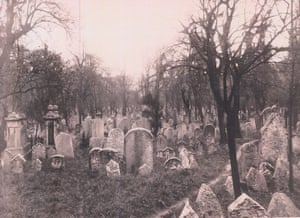
The ancient Prague Jewish cemetery as it was before it was turned into a tower. Also shows the site when the tower’s foundations were being dug.. Sent by Robert Tait.
Pinterest
The ancient Prague Jewish cemetery before the tower was built over it, involving the disinterment of human remains. Photograph: Archive of the City of Prague

Local officials are calling for a memorial acknowledging that the tower, believed to have been conceived partly as a cold-war gambit to block western TV and radio broadcasts, stands on what was once Prague’s biggest Jewish cemetery, where rabbis, distinguished scholars and leading industrialists, among others, were laid to rest.

Graves in the former cemetery in the Žižkov neighbourhood were disturbed after workers began drilling in 1985 to lay the tower’s foundations. While some remains were reburied in other cemeteries, others were reportedly dumped in a landfill site outside Prague, in violation of Jewish law forbidding the disinterment of buried bodies.

The Jewish community sold the site, under pressure from the communist authorities, to the state broadcaster after it was deemed the ideal location for the tower. Most of the headstones in the once sprawling cemetery – first established in 1680 and the burial place for about 40,000 people – had previously been flattened and grassed over in the early 1960s to convert it into a park, also at the demand of the communist regime.

By the time the tower was completed in 1992, the cold war had ended after communist regimes in Czechoslovakia and other eastern bloc countries lost power. It is now marketed as a tourist attraction, boasting an observatory, a restaurant and even a one-bedroom hotel.

It stands at the centre of a square hosting a restaurant, an underground parking facility and a mini-golf course, part of which is said to be sited where the grandest tombstones once stood. There is also an ice rink in winter.

The cemetery’s oldest section survived the developments and remains in relative obscurity at one end of the square, Jewish community leaders having spent heavily to rescue it from the decay it had fallen into during the communist period.

However, they say a memorial is needed out of respect for the much larger, disappeared part of the cemetery, and as a reminder of what is seen as a state-sponsored effort to erase the last vestiges of Jewish identity after the Holocaust.

Some local schools have taken pupils on tours of the site to raise awareness. Magdalena Novotná, a teacher leading a group of nine-year-olds around the cemetery as part of a class project, said: “The communist regime was not sensitive to spirituality or religious traditions. What touches me is that we know the Jewish belief that we cannot move bodies once they are in the soil, but they moved them completely. This is what we teach the children in the project.”

Anna Tumova, a spokesperson for České Radiokomunikace, the tower’s owners, said the company had not been approached, but that it would consider any proposal for a memorial. A plaque on the body of the tower itself would need permission from its architect, Václav Aulický.

The structure already carries the figures of several sculpted “babies” designed by a Czech artist, David Černý, copies of which were refitted earlier this year after the originals were removed.

The tower is the latest focal point of the Jewish community’s drive to restore scores of cemeteries, synagogues and other cultural sites destroyed or allowed to fall into ruin under communism. Some 105 synagogues were demolished during the communists’ reign – compared with 70 during the Nazi occupation.

Stonework for many abandoned sites was sold and later reused for private gardens, car parks or pedestrianised streets. Prague city council recently agreed to allow Jewish community leaders to examine cobbled paving stones dug up for a forthcoming redevelopment of Wenceslas Square. Some stones are believed to have been taken from Jewish cemeteries and repurposed for the pedestrianisation of the area carried out by the communist regime in the 1980s.

Source: Prague TV tower under fire as dark reminder of city’s antisemitic past