Seventy-five Years Later, Hungary Still Hasn’t Come to Terms with its Role in the Holocaust

Good long and disturbing read by Anna Porter:

On the 75th anniversary of the extermination of most of Hungary’s Jews—including the Auschwitz deportations, which began in May, 1944—we should also take note of the Hungarian government’s apparent determination to distort the country’s historical record. In some circles, this effort includes even the rehabilitation of Miklós Horthy, the longtime Hungarian Regent who governed Hungary during the Holocaust.

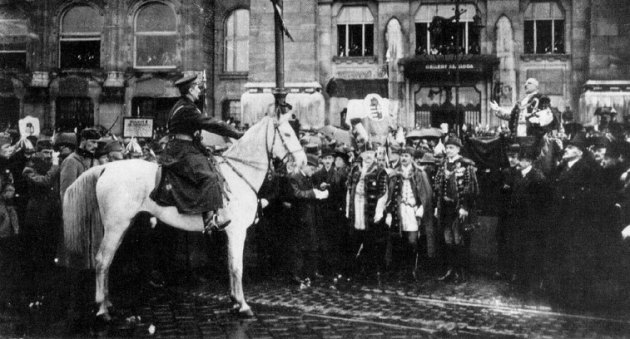
A former admiral and adjutant to the Habsburg Emperor-King, Horthy entered Budapest in dramatic style with his army on November 16, 1919, astride a white horse. His army defeated the ragtag Bolshevik forces that had imposed 133 days of “Red Terror” upon the country, but also inflicted its own “White Terror,” in some ways more brutal than its communist predecessor. Early during Horthy’s rule, Hungary enacted some of Europe’s first 20th-century anti-Jewish laws. Jews were capped at 6% of university admissions, and subsequent measures limited Jewish participation in elite professions to the same benchmark.

Jews also were prohibited from working in the public service and judiciary, or as high school teachers. During World War II, an additional law was passed prohibiting marriage or sex between Christians and Jews, on the grounds that such unions were harmful to the “national soul.”

Horthy arrives in Budapest, 1919

Even before Hungary actively rallied to the German war effort, most of Hungary’s young Jewish men had been dispatched to so-called labour battalions, serving unarmed near the front, where they were as likely to be killed by their commandants as by enemy fire. In 1941, the Hungarian army rounded up about 17,000 Jews who couldn’t prove they were citizens, and dumped them across the border into Ukraine, where they were systematically massacred by German death squads. By 1942, labour service had been extended to all Jewish men under the age of 45. All this happened while Horthy—an “exceptional statesman,” according to current Hungarian Prime Minister Viktor Orbán—ran the country.

Meanwhile, Hungary’s participation in the invasion of the USSR led to the extermination of the flower of Hungarian youth. At the 1942 battle of Voronezh and subsequent operations, the underequipped Hungarian 2nd Army was practically wiped out as it launched itself against Russian defences in support of the ultimately disastrous German thrust toward Stalingrad. By late 1944, Russian troops got to the outskirts of Budapest, which suffered through a 50-day siege before Axis forces surrendered on February 13, 1945. Almost 40,000 civilians died during this period, and much of the city was destroyed.

By this time, most of the country’s Jews already had been deported to concentration camps. In all, an estimated 565,000 Hungarian Jews were murdered during the Holocaust. Historical documents show that even some Germans were amazed by the speed and efficiency of the Hungarian government’s co-operation, and by the cruelty of its gendarmerie.

Horthy and Hitler, in 1938

Some of the few elderly Hungarian Jews who survived in the Budapest ghetto can still remember scenes of rats feasting on the unburied dead in Klauzal Square, and the trigger-happy young men guarding the gates. I have spoken to many survivors, including Max Eisen, a Canadian Holocaust educator, who was a young teenager when his family was rounded up and sent to Auschwitz. He still remembers the terror of being crammed into a boxcar, standing-room only, a hundred to a car, with no water, food or sunlight. To this day, Eisen has nightmares about his mother holding his nine-month-old sister during that three-day journey. Most of his family was murdered mere hours after arriving on the platform at Birkenau. His father’s last words to him were: “If you survive, you must tell the world what happened”—which is what Eisen did with his devastating 2016 book, By Chance Alone.

But Horthy, who survived the war and lived till 1957, had different memories to relate. In his Memoirs, he pompously declared of the mid-1930s that “though times had changed considerably since I had been aide-de-camp to His Majesty Emperor Francis Joseph, my concepts of honour, law and justice…had not altered.” Of meeting Hitler in 1936, he wrote: “It was not my task to stand in judgment upon the man who, since he had come to power, had shown nothing but goodwill towards Hungary, and who had sent me an extremely friendly telegram on the 15th anniversary of my entry into Budapest. I decided, therefore, to avail myself of an Austrian invitation to a chamois [goat-antelope] shoot in August, 1936, to seize the opportunity of paying a personal visit to Herr Hitler. The Austrian Chancellor Schuschnigg had offered me the choice between three hunting preserves; I chose Hinterriss, which is famous for its chamois and to which Bavaria affords the only access.”

In concrete terms, the German “goodwill” consisted of allowing Hungary to reclaim parts of historical territories it had lost after throwing in with the losing side in World War I. Horthy’s primary concern was to restore Hungary’s former borders, even if that meant joining the Nazi war effort. As such, his strong nationalism has a certain appeal to modern populists such as Orbán.

In his Memoirs, Horthy uses terms such as “regrettable excesses” to describe massacres of Jews. He claims that he told Hitler, in early 1944, that “a violent solution [to Hungarian Jews] would be contrary to humanity and morals would not only undermine law and order but would have a deleterious effect on production.” He also claimed that in mid-1944—after he had been marginalized by the Germans, who by now were taking direct control of the country—that he did what he could to save the Jews who remained.

On October 15, 1944, Horthy announced over the radio that he had decided to sign a separate peace treaty with the Allies and withdraw Hungary from the conflict. He talked of the grave injustices inflicted by the 1920 Treaty of Trianon, which had set the fate of Hungary following the First World War. He blamed everyone except himself for the tragedies that had unfolded. His one passing reference to the slaughter of his nation’s Jews was contained in this sentence: “In the shelter of German occupation, the Gestapo tackled the Jewish question in a manner incompatible with the demands of humanity, applying methods it had already employed elsewhere.” It was lost on no one that Horthy was changing sides in the war only after it had become obvious that the Nazis would lose.

Many Jewish survivors recall the forced marches to the Austrian border that began in November, 1944. There were women and children, grandmothers and toddlers. It took more than three days to cover the distance from Budapest. A woman named Aviva told me that those who could not move were shot, and the ditches were lined with bodies. There was no food or shelter. Young Hungarian men stood guard along the route. These were members of the Arrow Cross Party, the far-right Hungarian movement that would run the country from late 1944 to March, 1945.

Near the border, Aviva’s group was joined by a rag-tag group of labour-service men who had been force-marched from the Bor copper mines—more than 300 of them having already been killed. One of the survivors was the young Hungarian poet Mikos Radnoti. He was murdered near Gyor in Western Hungary. When his body was found in a mass grave, his pockets were filled with scraps of paper—his last poems.

Memorial at Liberty Square

Hungary does not deny the fate of its Jews. Indeed, 2014 was declared to be a year of official Holocaust remembrance. But a memorial commissioned by Viktor Orbán’s ruling Fidesz party and erected in Budapest’s Liberty Square has provoked controversy, and even outrage. It presents Hungary in the guise of a thin, languid Archangel Gabriel-like figure being seized upon by a nasty-looking German bronze eagle with outstretched wings and terrifying claws—a symbol plainly meant to suggest Hungary was an innocent party that had been preyed upon by an evil outside force. Historian Krisztian Ungvary has called it a “living horror,” and it has attracted regular protests. But the message is consistent with the larger agenda of Orbán, who wants to promote a new, whitewashed form of national history, according to which the suffering of the Jews was no more nor less brutal than that endured by the entire country under Nazi and then Soviet rule.

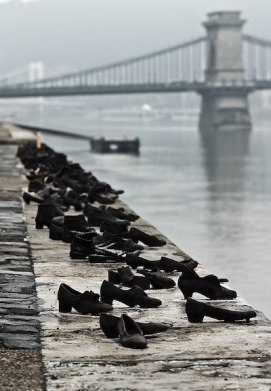
Not far from the monument, there is a bronze bust of Horthy at the entrance to a Hungarian Reformed church: At the 2013 unveiling ceremony, leading members of Orbán’s government were in attendance. But also nearby is a monument commemorating the orgy of killing by Hungarian cadres, even as German troops retreated from Budapest under Soviet bombardment in the last months of the war. This year, Hungary’s Jewish community was given permission to bury bones found in the river during the 2016 reconstruction of the Margaret Bridge across the Danube.

During this final spasm of senseless slaughter, thousands of Jews were marched to the Danube and shot, or just pushed into the icy waters to die. It’s important to remember that the killers weren’t German soldiers, but members of Hungary’s own Arrow Cross movement. During my research, I interviewed a survivor—a 4-year old-child at the time—who remembers being taken to the river with his mother. To this day, he thinks it was his childish voice that saved his family when he asked, “Mr. Arrow Cross, when can we go home?” he and his relatives were then ushered out of the line of fire, and he survived to tell the story.

“Shoes on the Danube” memorial

Orbán’s favorite historian, Maria Schmidt, is in charge of the museum known as House of Terror, at 60 Andrassy Boulevard in Budapest. It commemorates both the Nazi terror and the Communist terror, and includes material about Hungarian victims of the Holocaust. Five of the museum’s 17 rooms contain exhibits relating to this subject. But the same historian is also in charge of another, more controversial museum—the House of Fates, which originally had been set to open its doors five years ago. Its initial mandate had been to commemorate the Hungarian experience of the Holocaust. Israel’s Yad Vashem, Washington’s Holocaust Memorial Museum, and the distinguished Hungarian-American professor Randolph Braham (1922-2018) were invited to collaborate. But almost from the beginning, the government’s local appointees reportedly began to push for a new version of the narrative, one by which Hungarians were largely blameless victims of German and Soviet aggression. The whole project fell into limbo, seemingly hostage to opposing historical voices. A Yad Vashem official declared that, from what he’d seen, “visitors to the House of Fates are to be shown and taught that, except for a tiny, criminal and fanatic minority, the citizens of Hungary were essentially blameless for what was inflicted upon their Jewish neighbors.”

As someone who grew up under Hungary’s communist dictatorship, I have a complicated relationship with the past—as my memories of family and friends are intermingled with the fears of saying the wrong thing in a country where judges, schools, the judiciary and the education system were all controlled by the government. And I can see why the country itself also has a complicated relationship with the horrors that its citizens witnessed, endured—and inflicted. But the only way to start healing from these crimes is to acknowledge how they happened.
Source: Seventy-five Years Later, Hungary Still Hasn’t Come to Terms with its Role in the Holocaust
Chantal Hébert: Trudeau has a choice to make about Quebec’s secularism debate

Indeed:

It is not only on the pipeline front that Prime Minister Justin Trudeau has a politically critical call to make in the lead-up to the upcoming federal campaign.

At some point in the not-so-distant future, he will have to decide whether to become more actively involved in Quebec’s ongoing secularism debate. That time is almost upon his government.

On Thursday, a Quebec parliamentary commission held its final day of public hearings on Bill 21. By all indications, the law that would forbid public sector workers in so-called positions of authority from wearing religious symbols will be on the books before the National Assembly adjourns for the summer next month.

Under the legislation, it will become a condition of employment for future police officers, prison guards, judges, Crown prosecutors and public schoolteachers to abstain from wearing religious symbols in their workplaces.

On the day Premier François Legault introduced the bill, Trudeau came out swinging. The prime minister has consistently argued that it is wrong and unnecessary to curtail the freedoms of religious minorities in the name of ensuring the secular character of Quebec’s public institutions.

Since then, a cone of silence has fallen on the federal capital.

Conservative Leader Andrew Scheer and his NDP counterpart Jagmeet Singh both say they disapprove Quebec’s state-enforced approach to secularism.

But inasmuch as they do not reflect the views of all their Quebec MPs, neither is eager to prod Trudeau into more forceful action.

According to sources in the Quebec government, the prime minister is reserving his definitive decision as to the federal way forward until Bill 21 has been passed into law.

One option could see Trudeau turn to some rarely used sections of the Constitution to block the legislation. He could also refer the bill to the Supreme Court for an opinion, or have the federal government intervene in support of the groups that are already lining up to fight it in court.

Although Legault has pre-emptively used the notwithstanding clause of the Constitution to shelter Bill 21 from a Charter challenge, there remain a number of legal avenues open to its opponents.

Meanwhile, appeals for a forceful federal intervention — from both within and outside Quebec — have been few and far between

By comparison to the vocal debate that attended the Parti Québécois attempt to legislate on the same issue only six years ago, the discussion of Bill 21 has been, if not serene, at least less acrimonious than the previous instalment.

There are reasons for this difference.

The PQ charter covered every single public service worker — from child care workers to hospital orderlies.

Bill 21 only applies to a handful of groups, and mostly to future hires. It grandfathers the right of existing employees to wear religious symbols for as long as they continue to hold their current positions.

The 2013 charter was introduced by a minority Parti Québécois government looking for a springboard to a majority.

Between the time that charter was introduced and the election that ended in defeat for the PQ half a year later, the secularism issue remained at centre stage at the expense of all other provincial initiatives.

Legault, by comparison, is in the first months of a four-year term. He has time on his side.

Even as it has been steering Bill 21 through the National Assembly, the Coalition Avenir Québec government has not allowed it to come across as a raison d’être.

And then battle fatigue has set in. Quebecers have been discussing the place of religious symbols in the public space for more than a decade.

By now, everyone has had his or her say and most have chosen a side, with little middle ground between the two camps.

On that basis, the committee hearings on Bill 21 — even as they allowed for an airing of contrary views — featured few if any surprises.

Seven of the 36 organizations initially invited to testify declined to participate.

For different reasons, Charles Taylor and Gérard Bouchard, the two leading Quebec public intellectuals whose commission report a decade ago set off the debate over the banning of religious symbols, both profoundly dislike Bill 21.

Taylor has come to feel no legislation is the better option. Bouchard argues that expanding the religious symbols ban to teachers goes much too far.

But by now, the genie will not be put back in the bottle, at least not by those who initially let it out.

If one had to single out one takeaway from the committee hearings, it is that the political ship of Bill 21 — at least in the eye of both its fans and its detractors — has already sailed.

If Trudeau has been keeping his finger on the Quebec pulse since the debate that has polarized his home province for a decade resumed, he will allow that ship’s next port of call to be a court of law and not the federal campaign trail.

Source: Chantal Hébert: Trudeau has a choice to make about Quebec’s secularism debate

Liberals end ‘unfair’ policy that penalized refugees from so-called ‘safe countries’

Not much left of these measures between court decisions and Liberal policy changes, will see what Andrew Scheer says in his forthcoming policy speech on immigration:

The Liberal government has killed a controversial Harper-era initiative that did not afford all refugees the same rights and instead penalized those who came from so-called “safe countries” like the United States.

Starting immediately, Canada will remove the tight timeframe for their claims to be heard and let them appeal possible rejections, as well as grant them the right to work immediately and receive health care — benefits previously bestowed only on asylum seekers fleeing from war-torn countries and corrupt regimes.

“The system is unfair and treats people differently based on nationality,” Immigration Minister Ahmed Hussen told the Star in a phone interview Thursday. “The policy hasn’t worked. It was meant to introduce efficiency, but it has created the opposite effects. It’s time to go.”

The move by Ottawa follows several Federal Court decisions over the years that have chipped away at the core provisions of the so-called “safe country” policy introduced in 2012 by Stephen Harper’s Conservative government to target rising asylum claims from Eastern Europe and Mexico. The government established a list of safe countries and created a faster processing and removal system for claimants from these nations.

The Liberals’ decision to eliminate the safe country list, to be made public Friday, officially strikes down the last remaining planks of their predecessor’s controversial revamp of the refugee asylum system.

The original reforms aimed to deter “bogus claimants” whose lives weren’t in danger, but who came to Canada for economic opportunities. However, the changes failed to stem the flow of migrants and the Conservatives did not invest the necessary resources to manage the new system.

Refugee claims from these countries were not being processed any faster, said Hussen, and added additional burden to the asylum system that was further stretched over the past two years as a result of a surge of claimants crossing into Canada from the U.S.

“We are getting rid of the last piece of the policy that is responsible for creating the legacy backlog,” said Hussen. Under the safe country regimen, refugees from the list were given limited time for claims to be heard, had restricted access to appeals and health coverage, and faced quick deportation — which the court has ruled violated the Charter of Rights and Freedoms.

Critics have long noted that people from so-called safe countries can still face persecution at home due to sexual orientation, ethnicity and religion, and for a variety of reasons their countries can fail to protect them. They also complained the statutory timelines to process safe country claims were unreasonable and created chaos and further backlogs because the previous government did not put in enough resources to let the refugee board do its job.

The safe country list initially included 23 countries and has since been expanded to 42, including the United States, Czech Republic, Hungary and Mexico.

Hussen said improving the efficiency of the asylum system has always been part of his mandate since being appointed immigration minister in 2017. Under his watch, an independent review of the system was completed, an asylum management board was established to oversee the system, the legacy backlog was cleared and additional resources were pumped in to boost the refugee board’s processing capacity.

The removal of the safe country list, however, has no impact on the bilateral Safe Third Country Agreement with the U.S., which bans refugees from third countries coming through the United States and seeking asylum in Canada at the official ports of entry. These so-called irregular migrants can still seek asylum in Canada if they manage to sneak in and meet exemption requirements — and be processed like all refugees.

In 2018, the federal government invested $74 million over two years to hire 64 refugee judges and 185 support staff to handle the ballooning backlog, which reached 74,000 cases as of the end of March. As part of the 2019 federal budget, Ottawa has added more resources to boost the board’s operation to allow it to process up to 50,000 asylum claims and 13,500 appeals a year by 2021.

Immigration officials said only 12 per cent of asylum claims submitted from Jan. 1, 2013 to March 31, 2019 were from citizens of the designated safe countries.

Source: Liberals end ‘unfair’ policy that penalized refugees from so-called ‘safe countries’

Laïcité: «On est en train de légiférer un plafond de verre», dénonce la FFQ

Bill 21 gender based analysis concerns:

La Fédération des femmes du Québec (FFQ) dénonce le caractère « sexiste » du projet de loi sur la laïcité de l’État, qui est selon elle « une forme d’oppression envers les femmes » qui se traduit par l’instauration d’un « plafond de verre ».

« On est en train de légiférer un nouveau plafond de verre qui empêcheront [certaines] femmes musulmanes d’atteindre des postes d’autorité ou d’enseignantes », a dénoncé jeudi Idil Issa, une jeune Québécoise noire de confession musulmane qui porte le voile.

« J’ai l’intention de briser ce plafond de verre que vous êtes en train de construire. […] J’aurai une position d’autorité et je serai plus juste que vous. Je ne nuirai pas aux intérêts d’une minorité déjà vulnérable dans l’exercice de mes fonctions », a-t-elle ajouté en regardant le ministre Simon Jolin-Barrette.

Mme Issa était accompagnée jeudi de la présidente de la FFQ, Gabrielle Bouchard, en cette dernière journée de consultations du projet de loi 21 à l’Assemblée nationale. Dans son mémoire, publié sur son site internet, la Fédération affirme que le projet de loi du gouvernement Legault est « discriminatoire » et qu’il repose sur « une série de confusions ».

Selon la FFQ, « l’État n’a pas à émanciper de force les femmes ».

« Au Québec, il y a des féministes croyantes, tout comme il y a des athées réactionnaires. Combien de féministes croyantes ont activement participé aux mouvements féministes au Québec ? Pensons par exemple à ces féministes chrétiennes qui luttent pour le droit à l’avortement libre et gratuit. Pensons à toutes ces féministes musulmanes qui, en tant que membres de la FFQ, se battent avec nous pour les droits de toutes les femmes au quotidien », affirme la Fédération des femmes.

« Il n’y a aucune raison de croire que de réprimer une femme croyante est un acte féministe et émancipatoire », poursuit-on.

Beaucoup d’autres batailles

Pour la FFQ, « il reste beaucoup de batailles à mener pour garantir l’égalité entre les femmes et les hommes » au Québec, bien avant les restrictions prévues par le projet de loi 21 pour interdire le port de signes religieux à certaines catégories d’emploi.

« Salaire minimum à 15  $, accès aux services obstétricaux, réinvestissement massif dans les services publics, lutte au racisme systémique, accès au logement, accueil des femmes migrantes, lutte contre les violences sexuelles et domestiques, proximité des services en régions rurales et dans les petits centres, fin du temps supplémentaire obligatoire, conditions de travail des aides domestiques, enjeux socio-économiques liés à un capitalisme sauvage : voilà quelques-unes des batailles qui touchent les femmes dans leur quotidien », écrit notamment la Fédération dans son mémoire.

Les consultations du projet de loi 21 sur la laïcité de l’État prendront fin jeudi après deux semaines de travaux. En plus de la FFQ, la Coalition Inclusion Québec, la Ligue des droits et libertés de même que le Rassemblement pour la laïcité seront entendus en cours de journée par les parlementaires.

Québec utilisera-t-il le bâillon ?

Le gouvernement Legault procédera ensuite à l’étude détaillée du projet de loi en commission parlementaire au cours des prochaines semaines. Depuis son dépôt au Salon bleu, Québec a toujours répété qu’il souhaitait l’adopter avant l’ajournement des travaux parlementaires, le vendredi 14 juin prochain.

Lors de la période des questions, jeudi, le Parti libéral a dénoncé que le gouvernement de la Coalition avenir Québec (CAQ) utiliserait le bâillon pour adopter son projet de loi avant la fin de la session, même si l’étude celui-ci n’est pas terminé.

« Je crois qu’on est arrivé à une situation de consensus », a répondu le ministre Simon Jolin-Barrette.

Le député libéral Marc Tanguay a pour sa part lancé un « avis de recherche » afin que la ministre de la Justice, Sonia LeBel, se prononce sur l’utilisation d’une clause de dérogation pour protéger le projet de loi 21 de certaines contestations judiciaires.

Lorsqu’elle était questionnée en chambre, jeudi, c’est plutôt Simon Jolin-Barrette qui se levait pour répondre aux questions.

Source: Laïcité: «On est en train de légiférer un plafond de verre», dénonce la FFQ

Le Conseil du statut de la femme (CSF) demande au gouvernement Legault de réaliser des études afin de « convenir collectivement de la pertinence [d’interdire le port de signes religieux aux] personnes qui participent à l’éducation des enfants » dans le cadre du projet de loi sur la laïcité de l’État.

Contrairement à la Fédération des femmes du Québec (FFQ), qui a dénoncé jeudi que Québec créait « un plafond de verre » aux femmes mulsumanes qui portent le voile, le CSF appuie sans réserve l’interdiction du port de signes religieux pour les employés de l’État ayant un pouvoir coercitif (comme le recommandait en 2008 le rapport Bouchard-Taylor).

Mais le Conseil – dont le mandat est de conseiller le gouvernement « sur tout sujet lié à l’égalité, au respect des droits et au statut de la femme » – considère qu’il manque de données pour appuyer avec le même enthousiasme les dispositions du projet de loi 21 qui visent les enseignantes.

« Aux yeux du Conseil, s’il s’avérait que le port d’un signe religieux par le personnel enseignant véhicule une conception des femmes comme étant inférieures ou soumises aux hommes, son interdiction serait impérieuse. Il en irait de même s’il s’avérait que ce port brime la liberté de conscience des élèves et nuit à leur épanouissement ou encore porte atteinte au respect des convictions des parents », écrit le CSF dans son mémoire qui a été remis aux députés.

« Par souci de cohérence, l’interdiction devrait alors être étendue à toutes les catégories de personnel que côtoient les enfants à l’école », ajoute-t-on.

« Il [est donc] impératif que soient menées des études et consultations afin de mieux comprendre les effets du port de signes religieux par le personnel scolaire. De tels travaux permettraient […] de convenir collectivement de la pertinence de l’interdire ou non pour l’ensemble des personnes qui participent à l’éducation des enfants au sein des écoles ou dans d’autres milieux éducatifs », poursuit enfin le Conseil.

Plus tôt en journée, la Ligue des droits et libertés a pour sa part dénoncé le projet de loi 21 en affirmant que l’argumentaire élaboré par le ministre Simon Jolin-Barrette était basé sur des préjugés. Les consultations du projet de loi 21 se terminent jeudi.

Irregular asylum claims in Canada drop nearly 50% from last year

Ironic, given the government’s plan to close the STCA loophole for those entering Canada outside regular border posts. And of course, still too early to see if this trend continues for the balance of the year:

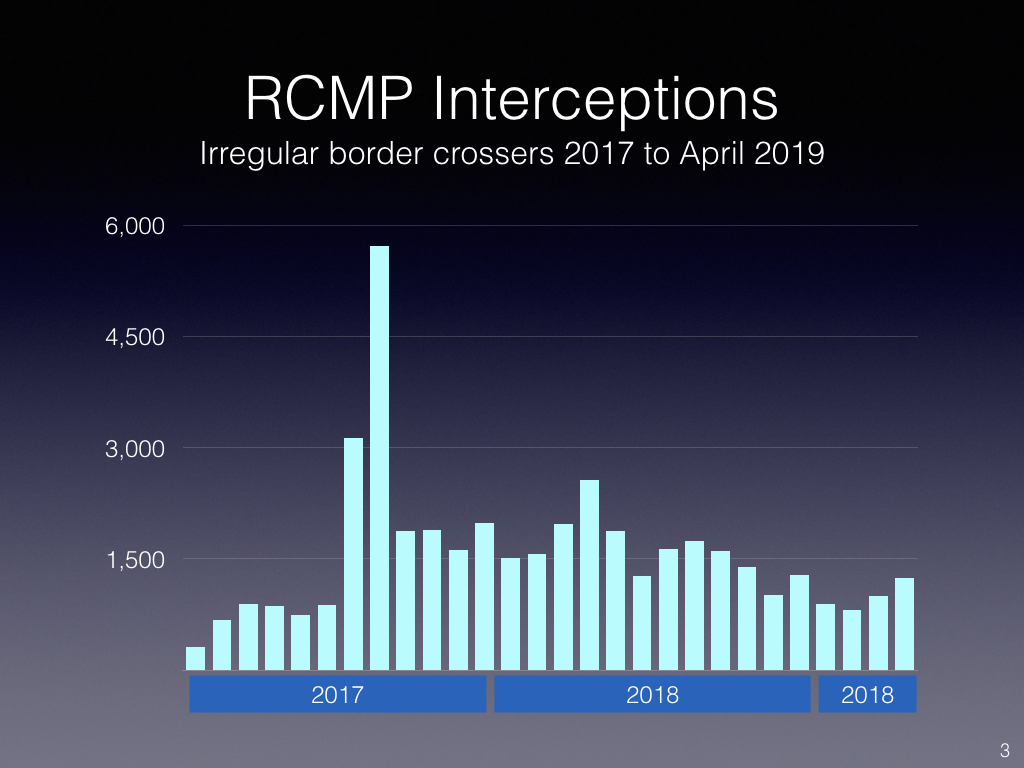
The number of asylum-seekers crossing the border “irregularly” into Canada has slowed compared to early last year.

Statistics published by the federal government show the RCMP apprehended 3,944 irregular migrants between official border crossings in the first third of this year.

That’s a 48-per-cent decline compared to the more than 7,600 irregular border crossers intercepted between January and April 2018.

Despite this, Darrell Bricker of the polling firm Ipsos Public Affairs says data shows Canadians are increasingly concerned over immigration levels in Canada, due in large part to the influx of irregular migrants.

He and other experts who took part in an immigration summit in Ottawa last week are warning against rising populist sentiments that could harden Canadian attitudes against newcomers.

Fen Hampson, executive director of the World Refugee Council, says a key concern is that the public doesn’t differentiate between refugees and economic immigrants — and that Canadians may not realize Canada’s refugee influx is nothing compared to the migrant crises facing other countries.

Source: Irregular asylum claims in Canada drop nearly 50% from last year

Opinion: Quebec’s religious-symbol bill hearings have gone exactly as François Legault’s CAQ planned

Konrad Yakabuski’s take although I don’t share his conclusion that it made the CAQ proposals appear reasonable:

Eleven years ago this month, Quebec wise men Gérard Bouchard and Charles Taylor tabled their report on religious accommodation in Canada’s once “priest-ridden province.”

The two intellectual giants chosen by then-premier Jean Charest to extricate his Liberal government from the quagmire in which it found itself – it had been reduced to a slim minority after an election campaign that largely focused on religious accommodation – went to great lengths to insist that secular Quebec was not experiencing a clash of values. The apparent “crisis” involving the demands of religious minorities for recognition was largely, to use a term now in vogue, fake news. Some media organizations, they concluded, had been making mountains out of molehills, creating a false sense of urgency and collective insecurity.

And yet, Prof. Bouchard and Prof. Taylor went on to lay out in 310 dense pages how Quebec was different from the rest of Canada and North America, and how it was incumbent upon the provincial government to lay down the parameters for secularism. Rejecting the Canadian policy of multiculturalism as “poorly adapted to Quebec’s reality,” their report called for legislation establishing “interculturalism” as the model for managing diversity in the province.

”It is in the interests of any community to maintain a minimum of cohesion,” the Bouchard-Taylor report concluded. “For a small nation like Quebec, always preoccupied with its future as a cultural minority, integration represents a condition of its development, indeed its survival.”

The report presented its ideas for how to help an insecure minority – in this case, French-speaking Quebeckers – feel more secure. After spending decades seeking to eliminate the pervasive influence of the Catholic Church in public institutions, they sympathized with the desire of Quebeckers to prevent other religions from taking its place.

It was hence that Prof. Bouchard and Prof. Taylor recommended that state employees exercising “coercive powers” – such as police officers, prison guards, Crown prosecutors and judges – be prohibited from wearing conspicuous religious symbols. It was not a recommendation they made lightly; their report makes clear that such a prohibition would deprive some religious minorities of the ability to exercise certain state functions. But they concluded that it nevertheless constituted the “right balance for Quebec society today.”

It was obvious then that, in implementing such a ban, Quebec would put itself on a collision course with the rest of Canada. Indeed, by 2008, it had already been 18 years since the RCMP first began allowing Sikh officers to wear turbans as part of their official uniform. Whether they intended it to or not, their recommendation soon took on a life of its own, as proponents of Quebec secularism seized on the imprimatur of Bouchard-Taylor to legitimize their cause.

Appearing last week before the National Assembly commission studying Bill 21, Prof. Taylor, now 85, pleaded that he had been “naive” about the monster he helped create in tabling this recommendation. “Just promoting this kind of program starts to provoke incidents of hate,” he insisted, explaining why he no longer supports a recommendation he previously defended.

In Saturday’s Journal de Montréal, Quebec’s most-read newspaper, three columns were devoted to discrediting the McGill University philosopher. One compared him to the washed-up drunk Calvero in Charlie Chaplin’s 1952 film Limelight. “There is only one word to qualify this 180-degree turn – pathetic,” former Parti Québécois minister Joseph Facal wrote.

It might be going too far to say Prof. Taylor had been set up by Quebec Immigration Minister Simon Jolin-Barrette, who has meticulously stage-managed the parliamentary hearings on Bill 21, which end on Thursday. But the distinguished professor did not do himself any favours by effectively likening supporters of the bill that would implement the principal recommendation from his report (while adding teachers into the mix of state employees prohibited from wearing religious symbols) to hatemongers. He played into caricatures of himself.

That’s exactly how Mr. Jolin-Barrette wanted the hearings to unfold. “In the course of the past 15 years, previous governments have not succeeded in translating and implementing the will of the Quebec people to establish a secular framework for the state,” the minister said. “Quebeckers can be proud of this bill because it allows us to turn the page on this issue.”

By giving so much airtime to those who hold extreme opinions – former Liberal senator Céline Hervieux-Payette warned that “behind” the Islamic veil lay genital mutilation and forced marriages, while several intervenors called on the government to extend the religious-symbols ban to all state employees – the hearings aimed to ensure that the Coalition Avenir Québec’s Bill 21 came out looking like a reasonable compromise.

For Mr. Jolin-Barrette and his boss, Premier François Legault, it was mission accomplished.

Source: Opinion: Quebec’s religious-symbol bill hearings have gone exactly as François Legault’s CAQ planned

USA: White Supremacy Beyond a White Majority

Quite a contrast with Canadian judicial appointments, currently over 50 percent women under the current government, about one-third under the previous Conservative government and the 80 percent males judges appointed under Trump.

Can only foreshadow further divergence between Canadian and US jurisprudence and representation:

The white male racist patriarchy will not be denied. It is having a moment. It has its own president.

According to a Pew Research Center analysis of race/ethnicity and sex among validated voters in the 2016 presidential election, white men were the only group in which a majority voted for Donald Trump — 62 percent — although a plurality of white women did also — 47 percent.

We are living through a flagrant display of a white male exertion of power, authority and privilege, a demonstration meant to underscore that they will forcefully fight any momentum toward demographic displacement, no matter how inevitable the math.

The fear of white male displacement is a powerful psychological motivator and keeps Trump’s base animated and active.

It keeps farmers holding out hope and making excuses for him, even as his trade war devastates their operations. It keeps coal country loyal, even as the promises of a revitalized coal industry ring hollow. It keeps white voters in the rust belt on the edge of their seats, waiting for the day that he will magically bring back manufacturing. It keeps white voters in the South heated over the issue of immigration and an “invasion” or “infestation” of Latin Americans.

Trump’s central promise as a politician has been the elevation, protection and promotion of whiteness, particularly white men who fear demographic changes and loss of status and privilege.

As Vox reported in 2017, white people of all ideologies, including liberals, become more conservative when confronted with the reality that a rising minority population means a loss of white dominance.

As the psychologist Jonathan Haidt recently told Vox:

“As multiculturalism is emphasized more and more, there emerges a reaction against it on the right, which is attractive to the authoritarian mind and also appeals to other conservatives. And this, I think, is what has happened, this is what Trump is about — not entirely, of course, but certainly this is a big factor.”

It is about stacking the courts, controlling the bodies of women (look no further than the raft of state abortion restrictions recently passed, including the outrageous new abortion law in Alabama), fighting the redefinition of gender as personified by the advances in liberty among people who are transgender, restricting the voting of nonwhite, less conservative groups, and controlling the flow of migrants into the country who do not bolster the white population.

While much of the country tries to contend with the unending stream of outrages in the White House, the Senate majority leader is pushing through a steady stream of Trump’s far-right federal judges, often breaking precedent and allowing for their confirmations over their home state’s senators’ objection.

The recent confirmation of Joseph Bianco to the U.S. Court of Appeals for the Second Circuit, based in New York, was Trump’s 38th confirmed circuit court judge, HuffPost reported last week, adding:

“That’s more circuit judges than any president has gotten by this point in a first term, and means that one in every six seats on the nation’s circuit courts is now filled by a Trump nominee.”

These are lifetime appointments. Even if demographics change over one’s lifetime, these judges will not.

As a recent Congressional Research Service report pointed out, 90 percent of Trump’s circuit court nominees have been white and 92 percent of those confirmed have been white. Among recent presidents, only Ronald Reagan — who opposed making Martin Luther King Jr. Day a federal holiday, but eventually reversed himself, and who vetoedthe Comprehensive Apartheid Act, which, with a congressional override, leveled sanctions against South Africa for its oppressive racist social architecture — appointed and confirmed a higher percentage of white judges.

Eighty percent of Trump’s judicial nominees have been men, and men have been 74 percent of those confirmed.

None of this can fully prevent change, but it can slow it.

The strategy is to find a way to maintain white supremacy, white dominance, without the necessity of a white majority in the U.S. population.

The point is that once white people become a minority in America, the country itself will move from a majority rule ideal to a minority rule one.

Immigrant service members are now denied US citizenship at a higher rate than civilians

Another illustration of the effects of the Trump administration hard-line immigration policies and practices:

Immigrants serving in the U.S. military are being denied citizenship at a higher rate than foreign-born civilians, according to new government data that has revealed the impact of stricter Trump administration immigration policies on service members.

According to the same data, the actual number of service members even applying for U.S. citizenship has also plummeted since President Donald Trump took office, the U.S. Citizenship and Immigration Services reported in its quarterly naturalization statistics.

“The U.S. has had a long-standing tradition of immigrants come to the U.S. and have military service provide a path to citizenship,” said retired U.S. Army Maj. Gen. Paul Eaton, a senior adviser to the liberal veterans advocacy group VoteVets.org. “To have this turnaround, where they are actually taking a back seat to the civilian population, strikes me as a bizarre turn of events.”

According to the most recent USCIS data available, the agency denied 16.6% of military applications for citizenship, compared to an 11.2% civilian denial rate in the first quarter of fiscal year 2019, a period that covers October to December 2018.

The fiscal year 2019 data is the eighth quarterly report of military naturalization rates since Trump took office. In six of the last eight reports, civilians had a higher rate of approval for citizenship than military applicants did, reversing the previous trend.

Attorneys for service members seeking to become citizens said new military immigration policies announced by the administration in 2017 and Trump’s overall anti-immigrant rhetoric are to blame.

“I think people are disheartened right now by the immigration climate,” said Elizabeth Ricci, an attorney who is representing immigrant service members. “We talk about a wall all the time. This is an invisible wall.”

Overall, the number of service members who apply to become naturalized citizens is just a fraction of the civilian applications, but both pools have shrunk over the last two years. In the first quarter of the Trump administration, January to March 2017 — which is the second quarter of fiscal year 2017 — there were 3,069 foreign-born members of the military who applied to become naturalized citizens. That same quarter, 286,892 foreign-born civilians applied.

In the first quarter of fiscal year 2019, USCIS reported it received only 648 military applications for citizenship, a 79% drop. For comparison, the agency received 189,410 civilian applications, a 34% drop.

The Defense Department was repeatedly asked for comment by McClatchy, but did not provide a response.

USCIS officials said the drop in applications is not due to any action by their agency, which processes the applications as it receives them.

“The fall in military naturalization applications is likely attributable in significant part to the Department of Defense’s decision not to renew the Military Accessions Vital to the National Interest (MAVNI) program after its expiration at the end of FY17,” USCIS said in a statement.

Deported To Mexico, US Veterans Are Pressed Into Service By Drug Cartels

Immigrants who wish to join the U.S. military fall into three categories: legal permanent U.S. residents, commonly known as “green card” holders; foreign-born recruits with key medical or language skills who came to the United States under student, work or asylum visas and enlisted through MAVNI; and special status non-immigrant enlistees, who are residents of the Federated States of Micronesia, Republic of the Marshall Islands, and Palau.

The Trump administration in 2017 announced major changes to the way the Pentagon would vet and clear foreign-born recruits and other overall changes to when a service member would qualify for naturalization.

Immigrant enlistees previously could join basic training once a background investigation had been initiated, and they could become eligible to start seeking citizenship after one day of military service. Under the new policy, enlistees do not go to basic training until their background investigation is complete, and they have to complete basic training and 180 days of service before they can seek citizenship.

In the months that followed, the Defense Department shut down naturalization offices at some of its basic training locations, citing the new policy.

7 Immigrant Service Members Who Perfectly Capture The Spirit Of Military Service

Other changes appeared procedural but had deep impact, such as the change that only higher-ranking officers, at colonel or above, were authorized to sign key USCIS forms verifying that an enlistee had served honorably. The signatures had to be original, too, which made it much more difficult for troops in outlier areas where the nearest colonel or higher-ranking officer may be hundreds of miles away, Stock said.

The new rules had a chilling effect, military immigration attorneys said. Unit leaders who previously would have shepherded naturalization paperwork through for their service members have stopped doing so, the attorneys said.

“People are telling them ‘wait until you get to your first unit.’ When they get to the unit they are told, ‘we don’t know anything about this anymore,'” Stock said.

The lack of guidance in units for immigrant soldiers “is all intentional,” Ricci said. “It’s part of this overall culture of ‘No.'”

The new rules have left some recruits waiting for years to serve.

Army recruit Ajay Kumar Jaina, 33, came to the United States from India in 2012 on an H-1B visa to work for Veritas Healthcare Solutions. He has a master’s degree in pharmaceutical analysis and wanted to become a military pharmacist. In May 2016 he enlisted under MAVNI for his medical skills.

He’s been in a holding pattern ever since. In the almost three years he’s waited to go to basic training, he’s reported for duty for more than 20 weekends with the 445th Quartermaster Company in Trenton, New Jersey.

He goes to New Jersey knowing that he will be unable to drill with the rest of the unit because he has not yet undergone basic training since the Defense Department has not completed his background check.

So his activities on base are limited to administration and inventory roles.

“When I registered in the Army, at that time I was told my basic training location. I was told within six months my background check would be verified, and then I could go to basic and then (advanced individual training) then I could be come apply for citizenship,” Jaina said.

Jaina said no determination has been made on his background check yet. “Which is actually good!” he said. “I can wait. I can keep my hopes high.”

Jaina’s H-1B visa expires next month and he said he may have to go back to India in order to be able to return to the United States under a new visa as he continues to wait.

Eaton questioned why the Defense Department would make it more difficult to pull from eligible immigrant recruits, particularly in light of the recruiting challenges the military faces overall.

“Only 25% of the U.S. population is eligible to serve, due to academic, health or behavioral issues,” Eaton said.

Last year the Army missed its annual recruiting goal by more than 6,500 personnel. In a statement, the Army would not say whether the immigration policies had impacted its ability to recruit last year.

“Our leaders remain confident that we have laid the foundation to improve recruiting for the Army while maintaining an emphasis on quality over quantity,” the Army said.

Source: Immigrant service members are now denied US citizenship at a higher rate than civilians

San Francisco Is Right: Facial Recognition Must Be Put On Hold

Good analysis by Manjoo:

What are we going to do about all the cameras? The question keeps me up at night, in something like terror.

Cameras are the defining technological advance of our age. They are the keys to our smartphones, the eyes of tomorrow’s autonomous drones and the FOMO engines that drive Facebook, Instagram, TikTok, Snapchat and Pornhub. Cheap, ubiquitous, viral photography has fed social movements like Black Lives Matter, but cameras are already prompting more problems than we know what to do with — revenge porn, live-streamed terrorism, YouTube reactionaries and other photographic ills.

And cameras aren’t done. They keep getting cheaper and — in ways both amazing and alarming — they are getting smarter. Advances in computer vision are giving machines the ability to distinguish and track faces, to make guesses about people’s behaviors and intentions, and to comprehend and navigate threats in the physical environment. In China, smart cameras sit at the foundation of an all-encompassing surveillance totalitarianism unprecedented in human history. In the West, intelligent cameras are now being sold as cheap solutions to nearly every private and public woe, from catching cheating spouses and package thieves to preventing school shootings and immigration violations. I suspect these and more uses will take off, because in my years of covering tech, I’ve gleaned one ironclad axiom about society: If you put a camera in it, it will sell.

That’s why I worry that we’re stumbling dumbly into a surveillance state. And it’s why I think the only reasonable thing to do about smart cameras now is to put a stop to them.

This week, San Francisco’s board of supervisors voted to ban the use of facial-recognition technology by the city’s police and other agencies. Oakland and Berkeley are also considering bans, as is the city of Somerville, Mass. I’m hoping for a cascade. States, cities and the federal government should impose an immediate moratorium on facial recognition, especially its use by law-enforcement agencies. We might still decide, at a later time, to give ourselves over to cameras everywhere. But let’s not jump into an all-seeing future without understanding the risks at hand.

What are the risks? Two new reports by Clare Garvie, a researcher who studies facial recognition at Georgetown Law, brought the dangers home for me. In one report — written with Laura Moy, executive director of Georgetown Law’s Center on Privacy & Technology — Ms. Garvie uncovered municipal contracts indicating that law enforcement agencies in Chicago, Detroit and several other cities are moving quickly, and with little public notice, to install Chinese-style “real time” facial recognition systems.

In Detroit, the researchers discovered that the city signed a $1 million deal with DataWorks Plus, a facial recognition vendor, for software that allows for continuous screening of hundreds of private and public cameras set up around the city — in gas stations, fast-food restaurants, churches, hotels, clinics, addiction treatment centers, affordable-housing apartments and schools. Faces caught by the cameras can be searched against Michigan’s driver’s license photo database. Researchers also obtained the Detroit Police Department’s rules governing how officers can use the system. The rules are broad, allowing police to scan faces “on live or recorded video” for a wide variety of reasons, including to “investigate and/or corroborate tips and leads.” In a letter to Ms. Garvie, James E. Craig, Detroit’s police chief, disputed any “Orwellian activities,” adding that he took “great umbrage” at the suggestion that the police would “violate the rights of law-abiding citizens.”

I’m less optimistic, and so is Ms. Garvie. “Face recognition gives law enforcement a unique ability that they’ve never had before,” Ms. Garvie told me. “That’s the ability to conduct biometric surveillance — the ability to see not just what is happening on the ground but who is doing it. This has never been possible before. We’ve never been able to take mass fingerprint scans of a group of people in secret. We’ve never been able to do that with DNA. Now we can with face scans.”

That ability alters how we should think about privacy in public spaces. It has chilling implications for speech and assembly protected by the First Amendment; it means that the police can watch who participates in protests against the police and keep tabs on them afterward.

In fact, this is already happening. In 2015, when protests erupted in Baltimore over the death of Freddie Gray while in police custody, the Baltimore County Police Department used facial recognition softwareto find people in the crowd who had outstanding warrants — arresting them immediately, in the name of public safety.

Eyes On Detroit

Detroit’s facial recognition operation taps into high-definition cameras set up around the city under a program called Project Green Light Detroit. Participating businesses send the Detroit Police Department a live feed from their indoor and outdoor cameras. In exchange, they receive “special police attention,” according to the initiative’s website.

Source: Detroit Police Department; Open Street Map | By The New York Times

But there’s another wrinkle in the debate over facial recognition. In a second report, Ms. Garvie found that for all their alleged power, face-scanning systems are being used by the police in a rushed, sloppy way that should call into question their results.

Here’s one of the many crazy stories in Ms. Garvie’s report: In the spring of 2017, a man was caught on a security camera stealing beer from a CVS store in New York. But the camera didn’t get a good shot of the man, and the city’s face-scanning system returned no match.

The police, however, were undeterred. A detective in the New York Police Department’s facial recognition department thought the man in the pixelated CVS video looked like the actor Woody Harrelson. So the detective went to Google Images, got a picture of the actor and ran hisface through the face scanner. That produced a match, and the law made its move. A man was arrested for the crime not because he looked like the guy caught on tape but because Woody Harrelson did.

What ever happened to deliverology?

Good article by Kathryn May. May reflect in part an excessive number of commitments in the 2015 election platform as the critical voices cited have suggested. Agree that the release of Ministerial mandate letters may be the most significant achievement but paring down of the number of priorities would have liked improved implementation:

Mention “deliverology” to a public servant working on the policy frontlines, and you’ll get either a shrug or a grumble. The trendy management theory that took the federal bureaucracy by storm three years ago has struggled to live up to the initial hype.

Still, the person responsible for the public management approach believes it is changing the way policy is implemented in Canada.

Justin Trudeau’s Liberals came to power in 2015 hailing the governing theories of British political adviser Sir Michael Barber. Barber’s principles on how to achieve results on promised actions had been pioneered in Prime Minister Tony Blair’s government 15 years earlier, with the establishment of the important “delivery unit” in the prime minister’s office. The approach became known as deliverology; its goal was to get ministers and public servants to keep a laser-like focus on the government’s priorities and deliver what was promised to voters.

Trudeau invited Barber to three cabinet retreats. He also visited Ottawa, where copies of his presentation to cabinet circulated around departments and were devoured by bureaucrats wanting to see what deliverology was all about. They bought Barber’s book, How to Run a Government: So that Citizens Benefit and Taxpayers Don’t Go Crazy, and signed up for courses on the essentials that popped up around town.

In Canada, the Results and Delivery Unit was created, to be housed in Canada’s Privy Council Office (PCO).  Matthew Mendelsohn, a former Ontario deputy minister and think tank founder, became the new deputy minister who would head the office. Departments appointed “delivery officers,” and a cabinet committee was created — headed by Trudeau himself — to monitor the results.

The buzz fades

Fast forward to 2019, and the buzz has faded out to a murmur. In conversations with senior bureaucrats, management consultants, politicians, and other public administration watchers – none of whom would go on the record criticizing the government’s efforts – the word is they barely hear about deliverology anymore.

“It was such a big deal at the beginning, but it drifted. It’s just not top-of-mind now; no one talks about it anymore. They laugh about it,” said one long-time senior bureaucrat.

“There was all this anxiety and disruption over what it meant. Departments were busy setting up delivery officers and delivery units,” said public management consultant Mark Schacter.

“New performance measures had to be developed and approved. Everyone was trying to figure out what it meant. Then the wave of activity passed and things seemed to be back to business as usual.”

Another senior bureaucrat shrugged. “Is deliverology still a thing? I know the office is still there, but no one talks about it.”

The new approach imposed another layer of administration on some public servants. Their departments had been abiding by evaluation and performance policies for more than 40 years. They were already obliged to report findings to the Treasury Board Secretariat. With deliverology, the public service still did all that work, and now they also had to report the progress on all the government’s goals to a “delivery unit,” which, along with ministers and the prime minister, monitored and tracked these priorities.

Other public servants grumbled that all the resources and attention had gone to bureaucrats working on priorities, at the expense of other day-to-day operations.

Deliverology’s chief steward in Ottawa

Was the approach a total failure?

In a recent interview, Mendelsohn insisted the version adapted in this country works, and much of the criticism is misguided because Canada “never intended to do deliverology from A to Z as articulated in Barber’s book.”

He said the federal government borrowed four core principles from the UK model: to focus on policy implementation, establish routines around all aspects of the delivery process, identify obstacles to progress and remove them, and report publicly on progress in reaching the promised results.

When measured against those standards, Mendelsohn said, the system is working. He argued that the big “unappreciated” shift has been a culture change in the public service. Public servants are now trained to think about results and how to measure them at the front end of policy development, before proposals are ever brought to cabinet.

He said that shift is now baked into all reporting ─ including memoranda ─ to cabinet. The expected outcomes of a new policy or program, how they will be measured and tracked, must be incorporated.

“What we have done is we have brought greater focus on implementation into the initial policy-making choices, so cabinet and ministers are thinking about implementation, project management and delivery at the very beginning,” he said.

The idea behind deliverology was to bring a discipline into management and bridge a longstanding gap between policy-making and implementation, said Independent Senator Tony Dean, a former cabinet secretary in Ontario who helped create a delivery unit for Dalton McGuinty’s government.

For years, governments made big policy and project announcements, turned them over to the public service for implementation, and failed to deliver what was promised. Months could go by between an announcement and implementation, and ministers were not involved unless something went wrong.

The failure of the Phoenix pay system represented a cautionary tale for ministers of what happens when the senior echelons aren’t closely involved in the implementation of their policies and projects.

The ministerial mandate letters

Mendelsohn emphasizes the importance of the mandate letters Trudeau sent to all his ministers when they were appointed to cabinet. These letters laid out each minister’s marching orders and what they were expected to deliver over the government’s four-year mandate.

Up until then, mandate letters had been secret. Trudeau made them public, and he also introduced an online tracker to monitor the ministers’ progress in achieving the commitments outlined in the letters.

The argument was that when the letters are public, Canadians know exactly what the government is doing and which ministers are responsible for the policy — whether it was health care agreements, the Child Tax Benefit, or infrastructure.  Mendelsohn said the letters also created a daily pressure on departments to implement those commitments, because they were on the hook for reporting to ministers and the prime minister on the “progress being made and if not, why.”

Mendelsohn said the public release of the mandate letters, along with the online tracker, are crucial for transparency; they are driving accountability, culture change and “helping to get things done.”

One high-ranking bureaucrat acknowledged the letters became key to managing the government’s agenda in the face of a constantly changing political landscape. Without them, he said, the government would have lost traction on advancing its priorities in the second and third years of its mandate, given the unexpected threats such as the NAFTA 2.0 negotiations.

Many of the people interviewed argued that the mandate tracker backfired and distorted the principles underpinning deliverology.

Instead of focusing on a few top priorities, the government made all its election promises and the commitments in ministers’ mandate letters priorities, so that ─ as one official put it ─ “when everything is a priority, nothing is a priority.”

The original 2015 mandate letters gave ministers 289 tasks, but that to-do list has since swelled to 432, with new promises around the opioid crisis, irregular border crossings and other emerging issues. The mandate tracker suggests the government met 47 percent of its original promises, which would be 37 percent if the initiatives introduced in Budget 2019 are included.

“They never got it [deliverology] right, right off the bat,” said a former senior PCO official. “To my mind, it was an enormous failure in spirit not to identify just four or five priorities. The way it was handled, everything was a priority, and deliverology was another word for results-based management, which has been talked about since Moses was in short pants.”

Tony Dean said making the mandate letters public is a significant breakthrough, but the government should have picked a “handful of key priorities, elevated them, and shown tangible progress,” which they could be touting as they head into the fall election.

“It’s a method we know works,” said Dean. “If such goals had been set three years ago, the government would be readying to talk about progress made…”

The main question is whether Canadians are better off because of deliverology. Mark Schacter, who is the author of Does “Deliverology” Matter?, said there is no conclusive evidence it makes any “difference to the quality of public management” or to peoples’ lives.

Said Schacter, “A single-minded focus on targets sets public servants focused on targets, but being focused on targets is not necessarily the same as being focused on what’s good for Canadians.”

Source: What ever happened to deliverology?