What right-wing violent extremists and jihadists have in common

Seeing more and more articles outlining the similarities and the differences between the two forms of extremism:

The parallels between the extreme ideologies of the violent far right and the global jihadist fringe are too striking to ignore. Both believe that they are in a cosmic war between good and evil. Both look back to an imagined glorious past that has been derailed by an imagined inglorious present. Both think that their way of life is under existential threat and that only extreme violence can save their souls. Both want to polarize and create division. Both want to make their respective tribes great again, even if it means the genocidal destruction of other tribes. And both believe that the media can be weaponized to serve their aims.

Just as striking, however, are the parallels between the psychological profiles of those who adhere to these two opposing, yet structurally similar, ideologies.

Anyone who has ever met and engaged an extremist in conversation feels this in their bones. It is the trenchancy with which your interlocutor articulates his views. It is his unwillingness to listen to the other side of the argument. It is his cast-iron certainty that he is right and you are wrong. It is his conviction that the end justifies any and all means.

Drawing on a large body of research in political psychology, sociologists Diego Gambetta and Steffen Hertog note that individuals on the violent far right exhibit a number of distinct psychological traits. One is a proneness to be easily disgusted: a special sensitivity to objects that are felt to be polluting or corrupting. Another trait is the need for closure: that is, “a preference for order, structure and certainties.” A third trait is a “rigid in-group preference,” and a fourth is “simplism,” which is “a penchant to seek simple and unambiguous explanations of the social world and its ills.”

People with left-wing views, by contrast, according Gambetta and Hertog, are more likely to be tolerant of disorder, uncertainty and complexity.

Because so little is publicly known about the perpetrator of the Christchurch massacre, it is hard to be sure whether he fits into Gambetta and Hertog’s profile of a right-wing extremist. But the 74-page manifesto he uploaded to the internet before his rampage certainly provides some suggestive evidence of a fit. The manifesto, titled “The Great Replacement,” is saturated in irony and booby-trapped with false-flags. But it also expresses beliefs, sentiments and anxieties that are clearly genuinely felt and that cast a sharp light on the mindset of the person who wrote it.

There is much disgust expressed in the document, all of it aimed at non-white “invaders,” particularly Muslims, who are reviled as dirty and contaminating. Cities are particularly distasteful to its author: sewers of “cultural filth.” Turkish people are dehumanized as “roaches,” while “Antifa/Marxists/Communists” are castigated in hollering capitalizations as “ANTI-WHITE SCUM.”

Sex isn’t a big theme in the manifesto, but a few stringent paragraphs are devoted to the sexual defilement of “European Women.” In a reference to the Rotherham child sexual abuse case, in which seven Pakistani-British men were found guilty of grooming young girls, the author of the manifesto writes, “Rotherham is just one of an ongoing trend of rape and molestation perpetrated by these non-white scum.”

The manifesto also reveals a mind fixated on in-group/out-group distinctions. These are rigidly hierarchical. At the top of the hierarchy are “European people,” whose traditions, achievements and very survival are perceived to be under grave threat. This is the in-group. At the bottom of the hierarchy are “invaders living on our soil,” which also stands for Muslims in the West. This is the main out-group. But the manifesto’s author reserves his most visceral hatred for what he calls “blood traitors to their own race.” “The only muslim I truly hate,” he writes, “is the convert, those from our own people that turn their backs on their heritage.” This is the subsidiary out-group.

Another insistent theme in the manifesto is simplism — what political scientists Seymour Martin Lipset and Earl Raab called “the unambiguous ascription of single causes and remedies for multi-factored phenomenon.” For the author, the problem is clear: it is the gradual erasure of the culture of white Europeans at the hands of invading non-Europeans. The solution, in his mind, is equally clear: “Radical, explosive action is the only desired, and required, response to an attempted genocide.” The solution is also heavily gendered: “The people who are to blame most are ourselves, European men. Strong men do not get ethnically replaced … weak men have created this situation and strong men are needed to fix it.”

If all of this has a familiar ring to it, it is because, for the past two decades, it has been wearing Islamized clothing. In the most original part of their analysis of extremist mind-sets, Gambetta and Hertog discuss the parallels between the two extremisms currently wreaking havoc around the globe.

Islamic radicals, just like those on the far right, are rigidly Manichean, framing the world as a battlefield between “dirty kuffars” on one side and pure and true defenders of the faith on the other. Revealingly, they reserve their most potent contempt not for unbelievers, whose ignorance they pity, but for those who have known the true path but chosen to reject it (i.e. apostates).

They are also notoriously disgust prone, displaying a particular squeamishness about women’s bodies and sex. Related to this is a deep concern about the sexual purity of women — or rather, their defilement by non-Muslim men. Like the Christchurch terrorist, Islamic radicals are intensely preoccupied by the rape of “their” women by unclean, alien “Others.” And, just like him, they share his arrogant conviction that their own revered methodology is the perfect solution to all the world’s problems, which they attribute to the West.

It is often pointed out that jihadists and far-right violent extremists feed off each other, cynically exploiting the outrages of their enemies as a spur and justification for further retaliatory bloodshed. Earlier this month, for example, ISIL released a statement promising revenge for the Christchurch atrocity.

For all their mutual enmity, however, these two warring factions have far more in common than they would like to admit.

Source: What right-wing violent extremists and jihadists have in common
UK urged to end unfair fees for child citizenship applicants

High fees are bad enough but good to see the Home Office called out over profiteering. At least in Canada, the fees were only increased for adults (quintupled), not for children:

The Home Office should consider scrapping controversial immigration fees charged to children from families who can’t afford it and refund profits made from failed citizenship applications, according to an official watchdog.

The call came as it emerged on Thursday that the Home Office is making a profit of £2m a month from charging children for citizenship, with about 40,000 estimated to be affected in the past year.

A report by the independent chief inspector of borders and immigration said the government should publish information on the negative social and equality impact of the Home Office’s fees policy, which is blamed for driving thousands of parents into overwork, debt and even skipping meals to save for the costs.

While welcoming David Bolt’s call for a full review of the process governing the waivers applied to some applications and for greater transparency around the decision-making process, charities pressed for an end to Home Office profiteering off immigration and citizenship applications.

The child citizenship charges were described as the Home Office’s new Windrush scandal in a letter to the Guardian signed by a range of charities including Coram, the Runnymede Trust, a number of headteachers and the community organising group Citizens UK.

The Home Office made £22m in 10 months by charging children who meet the strict eligibility citizenship criteria for processing documents, it was revealed by freedom of information requests from Citizens UK.

The cost of a citizenship application for a child is £1,012, while the cost of processing is just £372, meaning the Home Office makes an estimated £640 profit from each child application it receives.

Most of Bolt’s recommendations concerned the need to explain the calculations behind dramatic increases in Home Office fees, while other proposals focused on the effects on vulnerable individuals, including children.

The Home Office rejected two of Bolt’s recommendations. In response Bolt said he couldn’t understand why it was unable to launch a public consultation on charging for borders, immigration and citizenship system services in time to inform this year’s government spending review.

But Bolt said he was more concerned about the Home Office’s rejection of his call for a breakdown of how it calculated the part of the fee relating to how a successful applicant would benefit economically from British citizenship.

He added: “I am disappointed that the Home Office does not recognise this is a question of basic fairness, which should not have to wait on discussions with the Treasury about the department’s future funding.”

Fees for immigration and nationality applications have steadily risen since 2010 under the “hostile environment” policy, including in a round of changes last April. Cases have included a family who had to choose between paying for accommodation or saving money for Home Office fees. Another family, who have a disabled daughter, were last year still paying back the £7,000 they borrowed to pay the charges and said they feared losing their home.

Bolt’s call for a full review of how the process applies fee waivers for some poorer children, was “partially accepted” by the Home Office, which said it was in discussions about the issue.

A spokesperson said: “To reduce the burden on UK taxpayers, fee levels take into account the wider costs involved in running our border, immigration and citizenship system, so that those who directly benefit from it contribute to its funding. The home secretary has committed to keeping fees under review.

“However, we recognise that we have a duty to support the vulnerable. That is why we have fee waivers in place for those who need it most, including children and young people who have spent a significant amount of their life in the UK.”

The Home Office said it expected the 2019 spending review to influence its approach on fees, but added that it would “prioritise a system which is fair and reduces the burden on UK taxpayers”.

Minnie Rahman, public affairs and campaigns manager at the Joint Council for the Welfare of Immigrants, said urgent action was needed to ensure people were not denied basic rights just because they can’t afford exorbitant fees.

“We see clients every day who are pushed into destitution while the Home Office makes up to 2000% profits on some applications,” she added.

“The impact on children who are unable to apply for citizenship because of the fees is particularly disturbing. The Home Office should not be profiteering off immigration and citizenship applications.”

Source: UK urged to end unfair fees for child citizenship applicants

‘This is not what we came to this country for, to live and work like animals’: Migrant workers say they endured modern-day slavery in Simcoe County

The Globe had a similar more in-depth story on this abuse (Investigation False promises: Foreign workers are falling prey to a sprawling web of labour trafficking in Canada):

For more than a month, Francisco Urbina Contreras shared an infested house in Barrie with 30 other Mexican men and women who were drawn to Canada by the promise of jobs.

The former small business owner from northern Mexico could live with the bedbugs underneath his foam mattress, the unheated attic he shared with four others and the long wait for one of two bathrooms at the Dunlop St. home.

What he couldn’t put up with was the meagre $113 in cash he said he was handed for two full weeks of work — cleaning toilets, vacuuming carpets and making beds at Simcoe County hotels. Instead of the $800 he was expecting from the temp agency that had recruited him and put him up in the rooming house, he said his take-home pay had been whittled down by hefty deductions: $5 for each trip to a work site, $17 for daily job placement and $400 a month for rent.

“We felt we were in jail because we were too afraid to leave the house. We got picked up to the hotels and dropped off at the house. We only went out for groceries,” the 41-year-old man told the Star through an interpreter. “This is not what we came to this country for, to live and work like animals, with no dignity.”

Contreras was one of 60 foreign workers allegedly exploited in what police have described as a case of “modern-day slavery.”

At a news conference in February, Barrie police revealed that a joint investigationwith the Ontario Provincial Police and Canada Border Services Agency had uncovered a labour trafficking operation that housed and hired people from Mexico who had been lured by promises of jobs, work visas and possible permanent residency.

The news conference came just a week after pre-dawn police raids at several houses in Simcoe County. At the time, officials rescued 43 people, ranging in age from 20 to 46, from squalid conditions. Since then, some 20 more people have come forward to police with stories of having recently worked for the recruiter.

The Star reached out to the owners of the temp agency but, through their lawyer Bruce Daley, they declined to comment on the allegations.

Police say the investigation is ongoing and no one has been charged to date.

Contreras was not among those freed in the sweep; he had already escaped, he says, from the “horrible” situation last December with help from a stranger he met on a Facebook page group for Mexicans in Toronto, who offered to give him shelter.

The workers caught up in the raid were transported to a church and later to an area hotel for temporary shelter before they were issued temporary residence in Canada to assist the investigation. They were advised by police not to speak with the media.

“I have dreamed to be many things in my life, but not a slave,” said Contreras, who is now trying to obtain temporary residence in Canada while working in construction in Toronto to support himself.

Human trafficking has exploded in Canada: Between 2010 and 2016, the annual number of cases has increased 11 fold, according to a parliamentary report published in December. The majority of incidents — 66 per cent — happened in Ontario, with 14 per cent in Quebec, 8 per cent in Alberta, and the rest spread across Canada.

In total, 1,099 incidents were reported during the period, with 32 per cent involving foreign nationals being brought into the country. Although Statistics Canada does not differentiate between sex trafficking and labour trafficking data, the report said the majority of reported incidents involved women being forced into the sex trade.

Migrants’ advocates say Canada’s growing reliance on foreign workers — the number of temporary foreign workers has almost doubled in the past decade, to 300,000 in 2017 — has greatly contributed to the surge of labour trafficking because precarious immigration status makes people vulnerable to exploitation and abuse.

With poor English, little money and threats by traffickers, workers are reluctant to come forward out of fear for the safety of loved ones back home and their own possible deportation from Canada, making investigation and prosecution difficult for officials, said the advocates, who believe labour trafficking is grossly under-reported for those reasons.

“Foreign workers are recruited overseas and often tied to the people who bring them here. They have no permanent status and are ineligible for community services,” said Loly Rico of Toronto’s FCJ Refugee Centre, which is part of the Toronto Counter Human Trafficking Network, a six-year-old grassroots umbrella group that meets regularly to share information on trafficking and advocate for victims.

“These workers do jobs that most Canadians do not want to do. They are just cheap labour and don’t get the same attention as victims of sex trafficking.”

February’s rescue operation was among the largest labour trafficking raids in Ontario. Investigation officials collaborated with advocates to take a “victims-first” approach, making the safety and well-being of the migrant workers a priority over arrests of suspects.

Since the raids, the rescued workers were sheltered at no costs at the Living Water Resort in Collingwood, which also hired some of them full time.

Living Water owner Larry Law said the community has come together to help the workers by organizing English classes and Spanish church services, while the town has offered them two months of free public transit. So far, half of the workers are working at Living Water while the rest have moved out after taking jobs offered outside of the community.

“We are just so happy to see them turning over a new leaf in Canada,” said Law.

Authorities said complaints by the workers in Barrie first surfaced in 2015. In addition to Contreras, the Star tracked down two other workers who had lived in the houses arranged by the temp agency. Their stories share common threads: promised jobs, betrayals, desperation, debts and threats.

Rodrigo Jesus Vazquez Medina ran a small garage in Merida, a city off the coast of the Gulf of Mexico. After he fell behind on a loan to purchase equipment for his shop, an acquaintance in Mexico gave him the phone number of the recruiter in Canada who “offers lots of jobs.” Medina borrowed $3,000 from family for his trip to Canada.

“I was making $300 a month in Mexico, and I was told I could earn as much as $1,000 every two weeks here, at $13 an hour. That’s good money. They said I wouldn’t need a visa and they could find me jobs once I’m here,” recalled Medina, 31, who has two teenage children back home.

Upon arriving at Pearson airport last November, he waited hours to be interviewed by immigration. “I was told by the recruiter to tell them that I wanted to come here to see the CN Tower, Niagara Falls and the (Ripley’s) aquarium,” he recalled. “They even made a fake hotel reservation for me.”

After leaving customs at midnight, he called a number he was given by the recruiter. A driver picked up Medina and another worker who was on the same flight, and dropped them off at the Dunlop St. house, charging each $150 for the trip.

Medina said he slept on a couch in the living room that night. When he got up the next morning, he was shocked by what he saw.

“We had about 30 people living there, some staying in the attic, some sleeping in the hallways. People put their mattresses on top of used tires, cardboard and forklift wood platforms because it’s too cold on the floor,” said Medina. “It wasn’t what I had expected.”

Work placements and other communication by the recruiters were arranged through the group messaging tool WhatsApp. On Medina’s fourth day in the house, he was finally assigned to work at one of six hotels, including Nottawasaga Inn, Hockley Valley and Living Water resorts, according to work schedules sent to them by the recruiter on the app.

Police have said the hotels were not aware of the alleged human trafficking operation.

Nottawasaga and Hockley Valley did not return the Star’s repeated requests for comment.

Medina said he and his housemates didn’t work every day, but sometimes shifts were 12 hours long. Due to his background in mechanics, Medina said he was also sometimes sent to do light construction jobs. He said he was paid about $400 in cash for two weeks of work.

“I wasn’t making any money at all. I had no money to pay off my debt or send to my kids. I was just making enough to stay in this horrible house,” Medina said.

Iran Yesmin Lazeano Cabrera, who fled from a Livingstone St. residence operated by the same Barrie recruiter, shared a similar experience.

The 42-year-old mother of three said coming to Canada was her esa era mi ultima carta — “my last card” — after her husband left her with three children and a huge debt to a Colombian loan shark that she couldn’t repay.

Last fall, her sister heard about a lawyer in the Mexican port city of Veracruz who could help people find jobs in Canada. They went to the storefront law office and were asked to pay almost $2,100 “to start the process” — money that her sister paid by selling her car.

“I sat my children down over our dining table. I told them I tried everything to pay off the debt and I needed to take a gamble. This is our last card. This is our only way out,” recalled Cabrera, who arrived Toronto from Puebla last November.

“My eldest one, only 17, said she would look after the two little ones,” she recalled, sobbing. “My kids were expecting to come and join me once I got a steady job and settled.”

When Cabrera arrived at Pearson, a pre-arranged driver took her to the three-bedroom house on Livingstone St. in Barrie, where she immediately had to hand over $400 rent. There were already 13 tenants there, all from Mexico.

“I just remembered seeing a lot of men in the house. There was one bedroom for the women, but there was just one bed. I asked them where my bed was. They told me they would buy me a mattress and it would be deducted from my paycheque,” said Cabrera, who was left with just $50 in her pocket after paying the driver and the rent.

The next morning she met with the recruiter.

“The recruiter said only hard workers could stay and my future depended on my behaviour. She told me that I work for her but I can’t tell anyone,” said Cabrera, who was later taken shopping to get a blanket, a foam mattress and two black T-shirts as uniforms — the costs of which were all to be deducted from her pay.

Three days later, she says she was placed at a job and moved to another house in Wasaga Beach, which she shared with six men and one woman.

“There’s no Wi-Fi at the house and I couldn’t talk to my children. I started to feel really bad. I was depressed and anxious. There were other workers coming and going. I did not feel safe there,” said Cabrera, who at that point had yet to be paid and only had $3 left.

“I borrowed another worker’s phone and called the driver who picked me up at the airport. I told her I needed to leave. She came to get me and I ended up staying with her.

“It just felt like a very bad dream,” said Cabrera, who had tried unsuccessfully to retrieve her owed wages. (She says the recruiter told her that, after deductions that included a $175 fine for abandoning her job, there was nothing left).

“I came here for work. If I had known it’s going to be like this, there’s no way I would have come to Canada. But it’s too late. I have no money. I have a debt to pay in Mexico. I can’t go back to my kids with nothing.”

Contreras, a native from Tabasco who met Medina at the Dunlop St. house, said the two decided to leave Barrie when they went eight days without a work assignment. When they posted on a Facebook page for Mexicans in Toronto looking for jobs in the city, they were offered temporary shelter. After doing day labour jobs in demolition and renovation, a Mexican man hired them for a month to clear snow on construction sites in Muskoka, and offered them room and board.

“It was the first time in Canada where I could sleep in a real bed, with sheets and pillows,” said a smiling Contreras, who ran a small business in Mexico making and installing awnings to support his daughter through university.

“People treat us differently because we have no (immigration) paper. We have no English and others take advantage of us.”

Both men have recently found jobs in construction in Toronto, with Contreras working on insulation and Medina as a welder. Like Cabrera, the pair are hoping to obtain a temporary residence permit to stay and work in Canada until they save up enough money to return home.

Source: ‘This is not what we came to this country for, to live and work like animals’: Migrant workers say they endured modern-day slavery in Simcoe County

Québec songe à relever les seuils d’immigration dès 2020

That was fast.

In other words, the CAQ can claim that they delivered on their platform (for one year!) before apparently going back on it (to be fair, I prefer a change of position than stubbornly sticking to an ill-thought policy). Perhaps there is hope for the government to reconsider Bill 21 (Laïcité):

Face à des « besoins pressants et immédiats de main-d’oeuvre », le ministre Simon Jolin-Barrette évoque un rehaussement des seuils d’immigrationdès l’année prochaine.

Du haut de la tribune du Conseil des relations internationales de Montréal (CORIM), Jolin-Barrette s’est dit déterminé vendredi à accueillir quelque 40 000 immigrants au Québec au cours de l’année 2019, et ce, comme la Coalition avenir Québecl’avait promis en campagne électorale. « On a respecté notre engagement. C’était un pas de recul pour s’assurer de réformer notre système d’immigration, de le moderniser et de l’améliorer », s’est-il justifié devant un parterre de quelque 400 personnes rassemblées dans un hôtel du centre-ville de Montréal pour un déjeuner-causerie.

Cela dit, le ministre de l’Immigration a dit déjà envisager de tirer vers le haut le nombre de nouveaux arrivants admis au Québec.

Dans la Planification pluriannuelle de l’immigration 2020-2022, le gouvernement caquiste « établir[a] la façon dont la hausse graduelle des seuils [d’immigration] s’effectuera au cours des prochaines années », a-t-il annoncé lors du déjeuner-causerie organisé par le CORIM. Les cibles d’immigration des trois prochaines années seront débattues au Parlement, puis fixées par le gouvernement d’ici le 1er novembre prochain.

En plus d’élaborer la Planification pluriannuelle de l’immigration 2020-2022, M. Jolin-Barrette révisera la grille de sélection des travailleurs qualifiés en revoyant les points accordés notamment à la formation, l’expérience professionnelle, l’âge et les connaissances en français des candidats. « Nous voulons qu’elle reflète davantage nos besoins en matière d’immigration en assurant une meilleure adéquation entre les besoins du marché du travail et le profil des candidats », a dit M. Jolin-Barrette deux mois après le dépôt du projet de loi sur l’immigration (projet de loi 9) à l’Assemblée nationale.

Pour l’heure, il s’engage à « faciliter » et à « accélérer » l’admission de travailleurs temporaires au Québec. « Les travailleurs temporaires sont une solution à la « pénurie de main-d’oeuvre qui touche différentes régions du Québec », a-t-il fait valoir. « Nous avons bon espoir que ces personnes-là soient [deviennent des résidents permanents] », a-t-il ajouté. À ses yeux, le ministère de l’Immigration dispose désormais des ressources pour « les franciser, les intégrer ».

Immigration et laïcité : les parlementaires en ont plein les bras

Simon Jolin-Barrette s’est dit déterminé à faire adopter non seulement le projet de loi sur la laïcité de l’État, mais également le projet de loi sur l’immigration par l’Assemblée nationale d’ici la mi-juin. « Si c’était uniquement de ma responsabilité, ce serait déjà fait [pour le projet de loi 9]. Mais vous savez comme le Parlement fonctionne : parfois, il y a de petites difficultés à adopter rapidement [un projet de loi] », a-t-il lancé.

Le jeune trentenaire a soutenu que les membres de l’Assemblée nationale ont l’« obligation de faire avancer » les projets de loi portés à leur attention. Cela dit, il n’a pas osé vendredi accuser ses adversaires libéraux, solidaires et péquistes d’obstruction.

L’examen — article par article — du projet de loi sur l’immigration s’amorcera prochainement devant la commission des relations avec les citoyens. Le projet de loi sur la laïcité de l’État fera pour sa part l’objet de consultations particulières devant une autre commission parlementaire.

« On est à deux mois et demi de la fin de la session. Il serait inopportun pour les collègues de l’opposition officielle, ou même de Québec solidaire, de dire qu’ils vont faire un barrage parlementaire. Nous, on est en démocratie. On travaille en collaboration avec les différents partis politiques. […] Il n’y a pas de raison qu’on ne réussisse pas à travailler ensemble », a dit le leader parlementaire du gouvernement à la presse.

Le hic : les élus de Québec solidaire (QS) veulent, à eux seuls, inviter pas moins de 62 groupes à partager leurs impressions en commission parlementaire sur le projet de loi 21.

Syndicats, commissions, régies, municipalités, avocats, agents correctionnels, services policiers et cadres : le parti a choisi de ratisser large, signe qu’il n’entend pas rendre la tâche du gouvernement facile. Le Devoir a obtenu la liste que les solidaires lui ont soumise plus tôt cette semaine.

« L’idée est de donner la parole aux gens touchés par la loi qui n’ont pas encore été entendus », a expliqué l’attachée de presse de l’aile parlementaire de QS, Simone Lirette.

Cela inclut les organismes qui auront à appliquer la loi, comme la Commission de protection du territoire agricole, la Régie de l’énergie, le Tribunal administratif du travail et l’Alliance des cadres de l’État.

Les trois partis d’opposition ont envoyé leur liste de témoins au gouvernement et attendent une réponse. Le Parti libéral et le Parti québécois ont refusé de la partager. Le gouvernement espère en arriver à un compromis sur le nombre d’invitations.

Le Mouvement laïque québécois a confirmé au Devoir vendredi qu’il sera invité à témoigner par le bureau du ministre Jolin-Barrette. La Fédération des comités de parents a également été invitée, mais elle a décliné, préférant s’abstenir de commenter un projet de loi qui touche les conditions de travail du personnel scolaire.

Le premier ministre, François Legault, a répété à plusieurs reprises qu’il souhaitait que le projet de loi sur la laïcité de l’État soit adopté d’ici la fin des travaux parlementaires pour la relâche estivale le 14 juin… quitte à utiliser le bâillon.

Laïcité: la CAQ «erre gravement», selon Gérard Bouchard

Speaks for itself (as did Charles Taylor’s similarly critical take):

Gérard Bouchard, coprésident de la commission sur les «accommodements raisonnables» il y a une douzaine d’années, affirme que le gouvernement Legault «erre gravement ou cède à la démagogie» en voulant interdire aux enseignants de porter des signes religieux à l’école.

M. Bouchard est le coauteur du rapport de 2008 qui est abondamment cité comme source d’inspiration pour le projet de loi 21 du gouvernement de la Coalition avenir Québec sur la laïcité de l’État. Le projet de loi vise à interdire à plusieurs catégories d’employés de l’État de porter des signes religieux dans l’exercice de leurs fonctions, notamment les enseignants du primaire et du secondaire du secteur public et les directeurs d’écoles.

Dans une lettre d’opinion parue vendredi dans La Presse, l’historien et sociologue Bouchard se demande si le premier ministre François Legault ne cède pas à la démagogie avec son projet de loi interdisant les signes religieux.

À la suite d’audiences publiques tenues dans tout le Québec, la commission présidée par M. Bouchard et le philosophe Charles Taylor proposait en 2008 d’interdire les signes religieux aux employés de l’État «détenant un pouvoir de coercition»: les policiers, les juges, les procureurs de la Couronne et les gardiens de prison. Mais pour tous les autres «agents de l’État» – enseignants, fonctionnaires, professionnels de la santé et autres-, la «commission Bouchard-Taylor» estimait que le port de signes religieux devrait être autorisé.

M. Bouchard affirme aujourd’hui que le gouvernement Legault «erre gravement (ou cède à la démagogie) en assimilant le pouvoir extraordinaire de coercition» aux enseignants. Il estime que l’ajout des enseignants dans cette catégorie constitue une «restriction ou une suppression» d’un droit fondamental.

Il considère aussi que le recours par le gouvernement à la disposition dérogatoire pour bloquer toute contestation judiciaire «engage ainsi le Québec sur une voie périlleuse».

M. Taylor, qui s’était déjà dissocié de son propre rapport, a dénoncé cette semaine le projet de loi «clairement discriminatoire» du gouvernement Legault; il a déclaré à La Presse canadienne qu’il le combattrait par tous les moyens.

Source: Laïcité: la CAQ «erre gravement», selon Gérard Bouchard

The longer someone lives in Canada, the more critical they may be of immigration: federal survey

Interesting poll and findings that presents new data on immigrant views (from time of arrival, the number question has been asked in other surveys). In many ways, it shows how immigrants integrate over time:

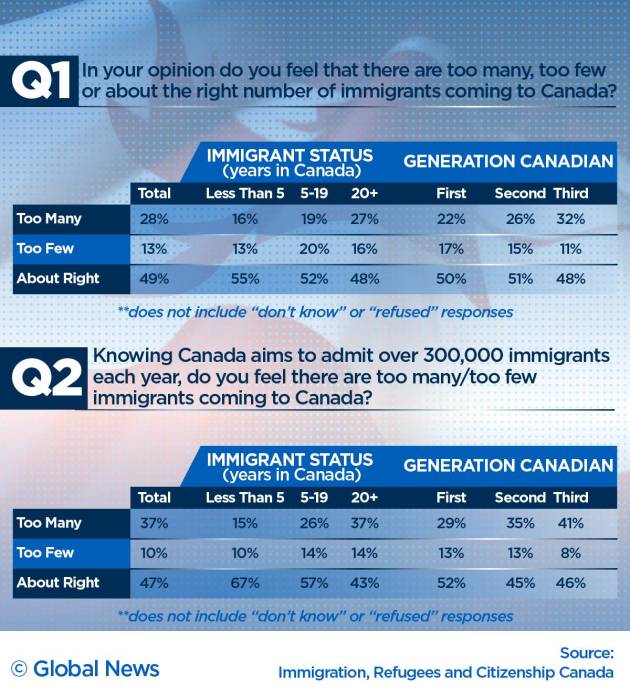
The longer an individual or their family have lived in Canada, the more critical their views may be towards immigration.

However, roughly half of Canadians are still broadly in favour, regardless of whether they’re newcomers or more established.
That appears to be one of the indications from a survey conducted for federal immigration officials, tracking Canadians’ views on immigrants and ultimately helping shape federal policy on the matter. It asked 2,800 Canadians for their views on immigration in August and September 2018 via landline and cellphone, and claims a margin of error of +/- 1.9 per cent, 19 times out of 20.

The 2018-19 Annual Tracking Survey conducted for Immigration, Refugees and Citizenship Canada asked respondents a number of questions, including whether “in your opinion, do you feel that there are too many, too few or about the right amount of immigrants coming to Canada?”

Twenty-seven per cent of immigrants in Canada for more than 20 years said they feel there are too many immigrants here.

That’s compared with 19 per cent of immigrants who have been here between five and 19 years, and 16 per cent of those here for less than five years.

Among those who identified as first, second or third-generation Canadian, there were also differences.

Thirty-two per cent of those who identified as third-generation Canadians said there are too many immigrants.

That compares to 26 per cent of those who identified as second-generation and 22 per cent of those who identified as first-generation who said the same.

Roughly half of respondents across all of those categories said the immigration levels in Canada right now are “about the right number.”

“It’s clearly a pattern that shows up pretty repeatedly, for a couple of fairly obvious reasons, but also some more subtle things. The obvious thing is the more salient the immigration experience is for you, the more sort of open to immigrants you will tend to be,”said Michael Donnelly, an assistant professor of political studies at the University of Toronto’s Munk School of Global Affairs.

“It’s also harder to stereotype immigrants if you are yourself a recent immigrant,” he continued, noting the effect of being more closely linked to immigration may also be reflected in the changes in views among those who said their families have been here longer.

“If your parents were immigrants, there’s at least some sort of family lore of that experience and it’s going to have some influence on you.”

Donnelly noted that while studies done in other countries have yielded similar results, he has seen suggestions of a link between how long someone has lived in Canada and their views on immigration in only “one or two” studies in Canada over the years.

Disapproval appeared to increase in all but one demographic category when respondents were asked specifically about their views on immigration in the context of the government’s plan to bring in 300,000 immigrants per year.

“Knowing Canada aims to admit over 300,000 immigrants each year, do you feel there are too many/too few immigrants coming to Canada?” the questionnaire conducted for the report asked.

The percentage of immigrants here more than 20 years who said they feel there are too many immigrants coming to Canada increased from 27 to 37 per cent when asked that question with reference to the specific number.

The same was true for immigrants here between five and 19 years, with the number who responded in kind increasing from 19 per cent to 26 per cent.

Among those born in Canada, disapproval of immigration levels rose roughly 10 per cent when asked about the specific plan.

Forty-one per cent of those who identified as third-generation Canadian and 35 per cent of second-generation Canadians said so, compared to 32 and 26 per cent when asked the same question without the reference to the number of immigrants planned.

Christina Clark-Kazak, an associate professor in the Graduate School of Public and International Affairs at the University of Ottawa, and President of the International Association for the Study of Forced Migration, offered an explanation as to why that appears to be the case.

“I think that as an abstract idea, people are not necessarily against immigration,” she said, noting 300,000 is not a large amount of immigration given Canada’s size and existing population.

“But I think that people are concerned about ‘too many’ people coming in, so as soon as you get any kind of number, it becomes real, it becomes concrete, and then consequently there is a discussion of whether or not it is too many.”

The survey also asked respondents for their views on the influx of irregular border crossers coming into Canada from the United States.

Clark-Kazak said she was surprised by the results.

“There’s been actually a lot of negative press and political pressure around the Safe Third Country Agreement and irregular border crossers and that doesn’t seem to be born out in the public opinion that’s expressed, at least in this,” she said.

The survey asked respondents to rate on a 10-point scale whether they agree or disagree with the following statements: first, that they are confident in the government’s handling of irregular migration; and second, that it is not the responsibility of Canada to accept asylum claims from those coming from the U.S.

But neither question yielded any marked differences among respondents.

A slightly higher percentage said they strongly disagreed with the first statement than strongly agreed (16 per cent versus 11 per cent).

The same was true for the second statement, with 19 per cent overall saying they strongly agree and 16 per cent saying they strongly disagreed.

The vast majority of respondents from all backgrounds fell in between.

Donnelly said that isn’t surprising given the way the question was asked.

“There’s a real temptation to self-moderate and put yourself in the middle unless you have a real sort of goal,” he said.

“We don’t often see huge numbers at either extreme on longer scales unless the scales are sort of concrete.”

Roughly 35,000 migrants have crossed the border from the United States into Canada at irregular points of entry since early 2017.

Under the terms of the Safe Third Country Agreement, asylum seekers who arrive in either country must make their claim in the first country they first arrived.

That means migrants who arrive in the United States but do not make their claim will be turned around at the border if they try to do so in Canada.

But that only applies if they try crossing the border at an official checkpoint.

Those that cross at unofficial points of entry along the border can make their claim due to a loophole in the agreement.

That has led to calls from the Conservatives over recent years for the government to close the loophole and reduce the incentive for people to cross the border irregularly. Federal immigration officials have also acknowledged that the Safe Third Country Agreement is “no longer working as intended.”

Patti Lenard, an associate professor at the University of Ottawa focusing on immigration and immigration policies, said she doesn’t think the data shows strong feelings or differences in opinion about immigration among any particular subsets of the Canadian population.

Specifically, she questioned whether the average Canadian is as caught up in concerns about irregular migration as politicians have been in recent years.

“These numbers don’t suggest people are very exercised about irregular migrants coming in or irregular asylum seekers coming in through the United States. Mostly, it suggests people don’t really care about it at all,” she said.

“If I were the government, I would think that this is a sign that unless the Conservatives decide to go after them, they wouldn’t have to worry about a population that was going to turn against them on immigration.”

Lenard says while she recognizes immigration is expected to form a significant part of the Conservative campaign in the fall election, she is skeptical that it will bring the results Conservative Leader Andrew Scheer may be chasing.

“I don’t expect him to get a lot of purchase on it.”

Source: The longer someone lives in Canada, the more critical they may be of immigration: federal survey

Sheema Khan: Quebec’s religious-symbols ban is stranger than fiction – but the pushback from society must be real

Another good column by Sheema Khan:

In a cold open for a 2017 episode of the ABC comedy Black-ish, protagonists Bow and Dre walk into a bakery to buy a gender-reveal cake. The bakery has every type of cake, the employee says – but not for gay weddings. Bow and Dre leave in disgust. At the next bakery, they cut to the chase: “You don’t discriminate against people based on race, gender or sexual orientation, do you?” To which the stern-looking baker replies: “Do not like French-Canadians.” Initially stunned by the random reply, Bow and Dre quickly indicate they can live with that, and proceed with the order.

What passed for laughs in America would never fly up here. But the mention of French-Canadians in juxtaposition with fundamental civil rights was downright prescient, if not ironic. In this fictitious TV show, everyone’s fundamental civil rights are worthy of protection – except if you’re French-Canadian.

The reverse is true in one major part of French Canada – and the Quebec government’s rhetoric and actions would be comedic, too, if they weren’t so tragic.

The Coalition Avenir Québec’s Bill C-21 seeks “religious neutrality” – that is, legalizing employment discrimination based on an individual’s religious expression. Civil servants, along with judges, police officers, prison guards and teachers, will be forbidden from exhibiting any religious affiliation while on the job. According to Premier François Legault, observant Sikhs, Jews and Muslims should look for another line of employment. Where else in the world has an elected leader told constituents to find another job because of their beliefs?

Recently, a councillor in the Montreal borough of Anjou, Lynne Shand, expressed her outrage at being treated by a doctor wearing a hijab, posting on Facebook: “If it hadn’t been an emergency, I would have refused to be treated by her. I’m angry because it’s really the Islamification of our country.”

While she later apologized, she clarified that she is against “visible” religious symbols, alluding to the proposed bill. It was irrelevant that the doctor’s service – according to Ms. Shand – was excellent.

This follows on the heels of similar outbursts by other Quebec politicians. CAQ Minister for the Status of Women Isabelle Charest unequivocally stated that the hijab is a sign of oppression, thereby proving that she is unfit to serve all women in her province. Gatineau deputy mayor Nathalie Lemieuxresigned after telling a French-language newspaper that Muslim immigrants don’t integrate, adding they “do bad things with their trucks … it’s normal to be afraid of them.”

First and foremost, the dangerous bill creates two tiers of citizens: those with full rights and opportunities, and those without. Since it uses the Charter of Rights and Freedoms’s notwithstanding clause to preclude any court action, the bill invites civil disobedience as the only means to fight against laws that deny fundamental freedoms. Furthermore, the bill gives licence to xenophobes to stigmatize and berate fellow Quebeckers. While Public Security Minister Geneviève Guilbault has backtracked on her warning that police would enforce C-21, it harked back all the same to the federal Conservatives’ proposed “snitch line” in the 2015 election.

And while it may be civil servants and employees in positions of authority today, who will it be tomorrow? Doctors providing service? Students at public schools, as was the case in France? Will the private sector follow the government’s lead? Finally, what other encroachments will there be on religious freedoms? Will Muslim students be barred from fasting during Ramadan, as was proposed by certain Quebec schools in 1995?

Before the rest of Canada gets smug, it should reflect on its own attitudes. Georgetown University’s comprehensive study on Islam, Muslims and Islamophobia, compiling Canadian data between 2004 and 2018, paints a glum picture. While the majority of Canadians acknowledge that anti-Muslim sentiment is a growing problem, most hold unfavourable views about Islam and Muslims. For example, last year more Canadians were worried about “homegrown radical Islamic terrorism” than violence from white-supremacist groups. In 2017, roughly half of all Canadians believed that Islam is the most “damaging” religion in the public sphere – even after six people were killed in a Quebec City mosque.

Now that there’s been a legislative assault on religious freedoms, will Anglo-Canadians stand up, too?

In the days since C-21 was introduced, there has been active opposition to it within Quebec, giving the lie to Mr. Legault’s Orwellian promise that the bill would bring Quebeckers together. Quebec civil society’s actions are reminiscent of the inspiring acts of solidarity by New Zealanders in the wake of the attacks at two mosques in Christchurch.

The difference in political leadership between Quebec and New Zealand, however, is like night and day.

As Martin Luther King Jr. once said: “Nothing in all the world is more dangerous than sincere ignorance and conscientious stupidity.” Looking at Quebec today, where reality is stranger – and far more dangerous – than fiction, and where a government works to effectively sanitize bigotry against its own people, his words ring too true.

Source: Quebec’s religious-symbols ban is stranger than fiction – but the pushback from society must be real Sheema Khan

Why Narendra Modi has an enduring Muslim problem in India

Interesting article on some of the underlying and long-standing tensions with and prejudices regarding Muslims in India and how PM Modi has increased them:

Lucille Eichengreen was a school girl in Hamburg. Like most children she had many friends and a carefree childhood. Her world changed overnight. “Hitler came to power in January 1933. The children that lived in the same building…no longer spoke to us. They threw stones at us, they called us names, and that was maybe three months after Hitler came to power, and we could not understand what we had done to deserve this…And when we asked at home the answer pretty much was, ‘Oh it’s a passing phase, it won’t matter, it will normalise.’ What that actually meant we did not know. But we could not understand the change.”

“Well, Levine, have you got your ticket to Palestine?”

She was not alone.  Eugene Levine used to study in a mixed religion school where, one day, he was taunted by a non-Jewish boy, who was his friend, “Well, Levine, have you got your ticket to Palestine?” Eugene was shocked. “But, you see, anti-Semitism’s always there beneath the surface.” These incidents are a part of a history that even the Germans don’t want to remember any longer. Both the statements, together, hint at a fact that is distasteful, dangerous and apocalyptical.

It is a lesserknown fact of history that Hindenburg who appointed Hitler as chancellor, had refused twice before to appoint him to the post. He had said in November 1932, that a presidential cabinet headed by Hitler would inevitably develop into a party dictatorship with all its consequences, resulting in a worsening of the antagonisms within the German people.

Unlike Hindenburg, Indian president Pranab Mukherjee did not have any choice but to obey the will of the people; and at that time if he had any reservations about the turn of events, he did not share it with anyone. But it is to be noted that a section of the intelligentsia had always viewed Modi as a polarising figure who unabashedly pursued Hindutva and did not hide his views vis-a-vis minorities. His image as a Hindutva icon was one of the major reasons for his success and he did not flinch in exploiting it to the hilt, though he did marry it with the utopia of development and the idea of making India great again.

He could succeed only because like in Germany prejudice against Muslims had been lying dormant in a section of Hindus for long. To be fair to Modi and the RSS (Rashtriya Swayamsevak Sangh), this prejudice against Muslims existed even before the RSS was formed in 1925.

The problem with the RSS is that it has failed to understand, that in independent India, two incidents—the demolition of Babri Masjid in 1992 and the 2002 Gujarat riots—have majorly impacted the Muslims’ collective psyche, scarred them emotionally, and shaken their belief in the Indian legal system.

Modi’s identification with Gujarat riots is too overwhelming in the Muslim community. And his rule since 2014 has not helped lessen the burden of history; rather it has created new fissures in their minds, inflicted much deeper emotional wounds and constructed a regime of alienation, helplessness and betrayal.

Modi’s identification with Gujarat riots is too overwhelming in the Muslim community.

The killing of Akhlaq, Pehlu Khan, Junaid and others by cow vigilantes; the subsequent collaboration of state machinery to save the perpetrators; no urgent and unequivocal condemnation of these incidents from Modi and Bhagwat; felicitation of mob lynching accused and convicted Hindutvavadis by central ministers; provocative statements by BJP/RSS leaders targeting Muslims; sudden closure of abattoirs in UP and other states without any opportunities for alternate ways of livelihood; forced ban on beef in northern and western states by BJP governments at a time when India is the leading beef exporter in the world; the arrest and brutal beatings of Muslim youth in the name of love jihad; insulting and intimidating Muslims who tried to offer namaaz in an open space; regular violations of the symbols of Muslim identity; a nonstop attempt to portray and lampoon them as terrorist and anti-national by the Hindutva Brigade on TV Channels and social media; the Modi government’s effort to abrogate instant triple Talaq and through that to build a narrative that the community is regressive, and so on, has built a perception in the community that the Indian state has become anti-Muslim in its ethos and practice.

Since 2014, a section of Hindus have rediscovered their Hindutva which if scratched a bit, reveals an anti-Muslim point of view. Flaunting an anti-Muslim attitude is definitely massively on the rise. The stereotyping of Muslims has increased manifold. The present status of Muslims in India, reminds me of Silvia Vesela, a Slovakian Jew, who was held in a temporary camp in 1942, where death was staring her in the face. She said, “It hurt, it really hurt when I, for example, saw many schoolmates shouting with fists raised, ‘It serves you right!’ Since that time I do not expect anything of people.”

Since Modi took over the reins of the government a paradigm shift has taken place. Muslims have started feeling that the state had now started interfering in matters of their religion and culture. Anwar Alam writes, “It is the religio-cultural alienation which might strengthen the process of radicalistion among Indian Muslims. The demolition of Babri masjid was a jolt to the faith of the Muslim community. Since 2014 when the present NDA government came into power at the Centre, it has initiated a series of policy measures including the issue of criminalising instant triple talaq and keeping a distance from sharing Muslim/Islamic symbolism in the public domain that deeply concerns the Muslim community: whether they are any longer free to practice their religion freely in this nation.”

“Hindus are not seen as religious enemies. The problem is the RSS and Hindutva.”

During research for this book I met many Muslim intellectuals and leaders. I could sense that there was a definite unease in the Muslim community vis-a-vis the Modi government, guarded by a rather deceptive silence. The present crisis is being perceived as an existential crisis. Therefore a lot of internal churning is going on. It has been acknowledged by the community that the traditional leadership of the Muslim community has let them down. Now, young and educated leaders are taking the lead and trying to organise the community. Older leaders are extremely cautious in articulating their views on issues related to politics, and it has been communicated to all, especially the youth to not get provoked, whatever be the nature of the provocation. Anand Vivek Taneja, assistant professor of anthropology and religious studies at the University of Vanderbilt, USA, had been touring areas such as Aligarh, Lucknow, Kolkata, Patna, Hyderabad and so on, across the country for his research on Muslims. During an interview with me, he said, “[The] Muslim community is definitely in a self -reflective mood and there is an extraordinary amount of restraint but (the) community also makes a clear distinction that the present problems it is facing is because of the current politics. There is no ill feeling against Hindus per se. Hindus are not seen as religious enemies. The problem is the RSS and Hindutva.”

Source: Why Narendra Modi has an enduring Muslim problem in India

Letter: The Trouble With Staying Silent on Ideological Extremism

Omer Aziz responds to Graeme Wood’s earlier piece in The Atlantic (After Christchurch, Commentators Are Imitating Sebastian Gorka). Good debate and discussion between the two.

And yes, needs to be said, ideas, words and speech matter:

After the tragedy at Christchurch, New Zealand, Graeme Wood wrote recently, a funny thing happened: “Everyone discovered, all at once, that ideology matters.” But just as important as this recognition, Wood argued, is the ability to differentiate on an ideological spectrum. To fail to do so “leads to catastrophic blunders”: In The New York Times, for instance, “Omer Aziz accused the neuroscientist and atheist Sam Harris, as well as the Canadian psychologist and lobster enthusiast Jordan Peterson, of complicity in mass murder for objecting to what they argued are overbroad applications of the word Islamophobia.”

“If we cannot distinguish Harris and Peterson from Richard Spencer, let alone Brenton Tarrant,” Wood wrote, “then our problems are bad indeed.”


There are several points I take contention with in Graeme Wood’s essay on the Christchurch massacre, which names me and two other writers for failing to make important ideological distinctions between the New Zealand killer and others who, strictly speaking, have nothing to do with him. Set aside the irony of taking writers to task for not making important ideological distinctions and then lumping in three diverse writers together, thereby failing to make those distinctions yourself. Wood’s major claim in the piece is that after Christchurch, “everyone discovered that ideology mattered”—white-nationalist and fascist ideology—and this was in contrast to the politically correct liberal response to jihadist violence, in which presumably these very same writers adequately distinguish Islamist terrorism from Muslims tout court.

Other writers can speak for themselves. In my case, I have written about the role that ideology and religion play in jihadist violence. Indeed, I have been influencedby Wood’s own work on this, and have discussed it with him, multiple times, in private and in public. I believe that there is always an ideological spectrum with respect to extremist violence, and the various shades of that spectrum ought to be interrogated, even if it makes people feel uncomfortable. That goes for Islamist violence, as it does for white-nationalist terror.

Wood takes especial issue with my mentioning of the neuroscientist Sam Harris in my piece for The New York Times. The exact words from that piece were:

People with millions of online followers have been incessantly preaching that Islamophobia is not the problem; Islam is. The Canadian intellectual Jordan Peterson has said that Islamophobia is a “word created by fascists.” The neuroscientist Sam Harris has called it an “intellectual blood libel” that serves only to shield Islam from criticism.

Note that there is not the slightest intimation here that Peterson or Harris shares liability, responsibility, or guilt for the New Zealand massacre. It simply acknowledges the salient fact that prominent thinkers have been in Islamophobia-denial for a long time, even after Muslims were specifically targeted because of who they were and for no other reason.

Jordan Peterson is more complex, and his thinking about Islam and Muslims requires its own separate treatment. But Harris has been propounding vicious misinformation about Muslims for a decade. Does Wood not have an opinion on someone who warned about the “ominous” Muslim birth rates in Europe and published misleading statistics about them, the very same birth rates that the New Zealand killer was so tormented by in his manifesto? (And why would it be “ominous” if there are more brown people in Europe? For what it’s worth, at maximal levels of immigration, Muslims would account for 14 percent of Europe’s population in 2050, according to Pew. Those worried about the coming hordes of brown bodies can relax somewhat.)

It is not wrong to call out people who have been denying that a particular form of racism exists when this very racism becomes the central motivation of a live-streamed lynching of vulnerable people. By the logic of Graeme Wood’s own piece (that ideology matters) and by the logic of Sam Harris’s own ontology of Islam (that there are concentric circles of extremism, with jihadists in the middle and their enablers on the outer rings), the ideological spectrum of Islamophobia ought to have been probed more thoroughly. Instead, Wood is silent, dismissing all this as self-evidently not worth mentioning. A spectrum of ideology for thee, but not for me.

If casual Islamophobia is not on the same ideological spectrum as violent Islamophobia, why not? Are overt warnings about Muslim birth rates and “deranged” Muslims so acceptable now that they fail to register as extreme? Yes, Islamophobia is an imperfect term; that does not alter the reality the term describes, which, like anti-Semitism, is a particular form of racism. The methodology of Wood’s piece—of transposing words to highlight hypocrisies—might help here. Swap Muslim with Jewish, and you get Harris warning about Jewish birth rates in Europe, calling the Jewish world “deranged,” and claiming that anti-Semitism is a made-up word. Anyone using such language would be rightly condemned as anti-Semitic. I wonder whether Wood would still be silent then.

There are many enablers of Islamophobia today, Harris among them, and their consistent propounding of anti-Muslim myths has put Muslim lives at risk. Of course, there is no causal link between the intellectual enablers of Islamophobia and the New Zealand killer. To my knowledge, no serious writer has sought to draw such a link. Again: We are not discussing culpability; we are discussing an ideological spectrum in which subtle bigotry toward Muslims has become mainstream. These ideological enablers create a permissive environment for more dangerous ideas to fester. Calling them out is not a controversial idea. It’s applied to Muslims all the time.

“To fail to differentiate leads to catastrophic blunders,” Wood writes. I heartily agree. And an even greater moral disaster is the willful blindness toward an ideological spectrum when a white man is the one pulling the trigger. When you are silent on the ideological extremism of your friends, you inevitably aid the violent extremism of your enemies. In this case, it is not your voice that gives them license, but your silence on matters that you have deliberately overlooked.

Source: Letter: The Trouble With Staying Silent on Ideological Extremism

Why hard-fought election at North America’s largest Sikh temple could be bad news for Liberals in next federal vote

We will know in October, but of course other factors will also be at play. And the sensitivity regarding the mention of Sikh extremism in a Public Safety report is also noteworthy:

When North America’s largest Sikh temple elects a new board of directors, it doesn’t fool around.

Candidates have campaign managers, cold-call voters and go door-knocking in the race for leadership of the Ontario Khalsa Darbar (OKD), a Toronto-area institution that functions as a place of worship, a community centre — and a nexus of political influence.

The Liberals have long been linked to the OKD, and arguably benefited from its status among the province’s Sikhs. But the election that wrapped up there early Monday morning may not bode well for the party.

A Grit-associated slate promoted by the fathers of Navdeep Bains, a star in Prime Minister Justin Trudeau’s cabinet, and MP Ruby Sahota was roundly defeated, and a controversial government report that suggested Sikh terrorism still poses a threat here may have played a role, say observers and campaign organizers.

That could have ramifications for Liberal support in several swing seats in and around Brampton, Ont., most of which flipped to the party from the Conservatives in the 2015 election.

“These local ridings will be affected by it,” said Balraj Deol, a Punjabi-language journalist in the area. “That is an advantage for Conservatives, and the NDP also. It’s a loss for the Liberals and it will be a gain for the other two.”

“This may be a sign,” said Jaspal Bal, campaign manager for the victorious side.

Even Trudeau was dragged into the race, with the winning group alleging his visit to the area last week was designed to bolster support for the other side.

But not everyone sees broader implications in the temple vote, no matter how intense the campaign became. Avtar Badyal, the losing presidential candidate, said Trudeau’s visit and Liberal policies had nothing to do with his team’s loss. The election was simply about which group voters believed could best manage an important spiritual institution, he said.

“This is not a political thing, it’s a religious thing,” said Badyal. “I don’t know why they are making this into something that it’s not.”

Another local journalist said he also doubts that broader politics played a role in the temple election, or will be affected by its outcome.

“Not at all,” said Yudhvir Jaswal, who hosts popular radio and TV shows on the local Y-Channel. “I think they are oversimplifying things.”

Regardless, when the ballots were all counted at about 3:30 a.m. Monday, the entire “Panthak Alliance” slate backed by the fathers of MPs Bains and Sahota had been defeated, every one of their 11 opponents elected by healthy margins.

To the winners goes control of a temple — or gurdwara — that boasts 3,700 members and a sprawling, 70-acre site near Toronto’s Pearson airport.

Underscoring the high stakes in such elections, a court battle between directors that began in 2006 forced a nine-year delay in voting and reportedly generated $5 million in legal bills.

Sikh temples are community focal points as well as religious institutions, and OKD includes 15 halls that are booked solid with weddings.

It also provides a potential platform for politicians eager to reach the region’s powerful Sikh voting bloc, said Deol, hosting gatherings that can attract tens of thousands of people.

“That gurdwara is the prime hub for everything,” said an organizer on the winning side, who asked not to be named. “It’s very influential.”

Liberals like Bains, the economic development minister, used to have ready access to the OKD stage, the person said. “That’s not going to happen any more, so that’s a big blow to them.”

Bains was among several Liberals of Sikh background who captured Brampton and Mississauga ridings in 2015, a key part of the Greater Toronto Area battleground that is itself crucial to winning federal elections.

But the community’s support for the party took a serious hit with the release in December of a Public Safety Canada report on terrorism that suggested “Sikh (Khalistani) extremism” remained a threat.

Sikh groups reacted with outrage, saying that using violence to support Punjabi independence was rejected long ago in Canada. The so-called Khalistani movement is entirely peaceful today, they argue.

Local MPs are expected to face a grilling this Sunday at a town-hall meeting about the report.

Many of the temple members who voted for the winning slate in Sunday’s gurdwara election did so to express their opposition to the terrorism statement, equating the other slate with the government, said Bal.

In fact, when a candidate on the opposing side promised to honour the four Sikh-Canadian ministers in the Trudeau cabinet at the gurdwara, the eventual winning slate gained more support, he said.

“People put aside their bickering and differences and said this is one of the issues that is uniting us to support these 11,” said Bal. “Because they have said they will not sit idle and wait with a garland to welcome the leaders who have declared us a terrorist threat.”

Source: Why hard-fought election at North America’s largest Sikh temple could be bad news for Liberals in next federal vote