Less than a week after the attack on the Twin Towers in New York on 11 September 2001, US President George W. Bush gave a remarkable speechabout America’s “Muslim Brothers and sisters”. “These acts of violence,” he declared, “violate the fundamental tenets of the Islamic faith.” After quoting from the Quran, he continued, “The face of terror is not the true faith of Islam. That’s not what Islam is all about. Islam is peace.”
This speech is remarkable, not only for its compassion towards Muslims in the face of the attack on the US, but also because Bush was contradicting what has been, since the beginnings of Islam, the standard Western perception of this religion – namely that it is, at its core, a religion of violence.
Since its beginnings in the Arabia of the 7th century CE, the religion of Muhammad the prophet had pushed against the borders of Christendom. Within 100 years of the death of Muhammad in 632 CE, an Arabian empire extended from India and the borders of China to the south of France. Militarily, early Islam was undoubtedly successful.
Since that time, for the Christian West, regardless of the Islamic precept and practice of religious tolerance (at least as long as non-Muslims did not criticise the prophet), Islam has remained often threatening, sometimes enchanting, but ever-present. Indeed, the West created its own identity against an Islam that it saw as totally other, essentially alien, and ever likely to engulf it.
Thus, from the 8th century to the middle of the 19th, it was the virtually unanimous Western opinion that Islam was a violent religion whose success was due to the sword.
That Islam is, at its core, a violent religion is an attitude still present among some today. In the aftermath of the horrific murder of 50 Muslims in Christchurch by an Australian right wing nationalist, the conservative Australian politician Fraser Anning declared (straight out of the West’s medieval playbook), “The entire religion of Islam is simply the violent ideology of a sixth century despot masquerading as a religious leader, which justifies endless war against anyone who opposes it and calls for the murder of unbelievers and apostates.” Any violence against Muslims, he suggested, was therefore their own fault.
Anning has been roundly condemned for his statements by both sides of politics. He is clearly wildly out of step with mainstream public opinion in Australia. A change.org petition with more than 1.4 million signatures has been delivered to Senator Mehreen Faruqi, Australia’s first Muslim senator.
Clearly, blaming innocent people at prayer for their deaths at the hands of a right wing zealot crossed all the boundaries. But Anning’s view of Islam does echo an historic Western emphasis on the use of force in Islam as an explanation for its success.
This was, of course, part of an argument about the relative truth of Christianity and Islam. According to this, the success of Islam was due solely to the sword. The success of Christianity, having renounced the sword, was due to divine favour. The one was godly, the other Satanic.
This Western image of a benign, peaceful Christianity against a malevolent, violent Islam was a mythical one. With few exceptions, its proponents ignored both the violence that often went along with the spread of Christianity and the religious tolerance that often accompanied the extension of Islam. But the myth did reflect the deep-seated Western horror, always potent in the collective imagination, of being literally overrun by the fanatical hordes.
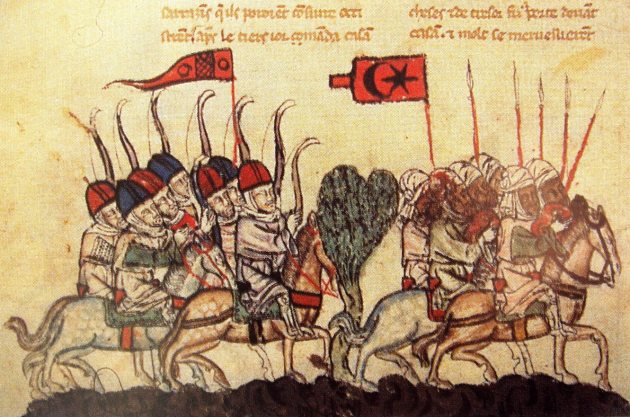
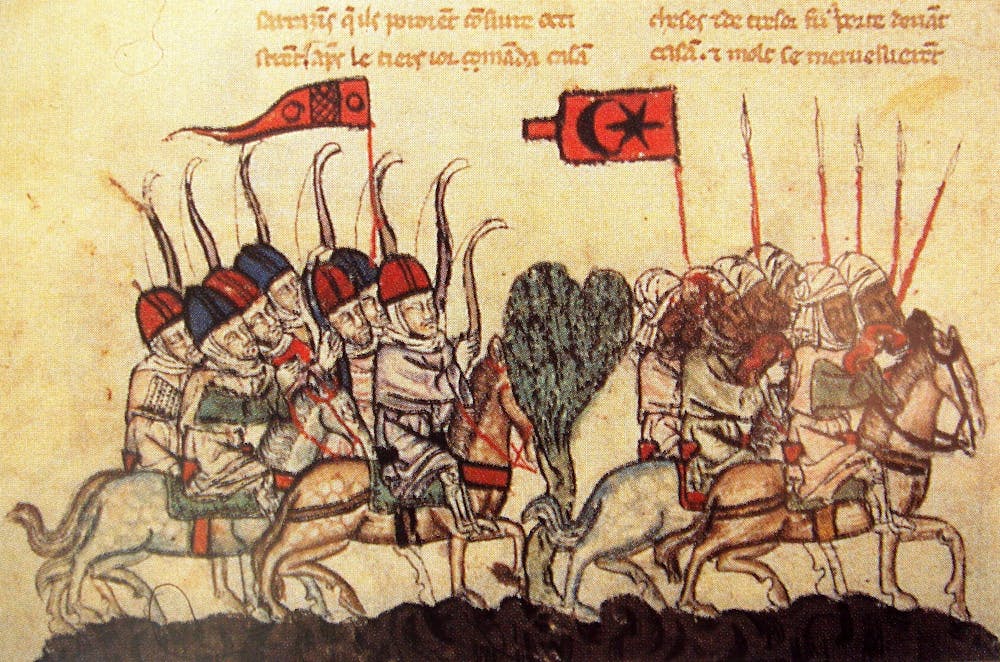
A 14th century miniature depicting Crusaders at The Battle of Wadi al-Khazandar (Battle of Homs) of 1299.Wikimedia Commons
Ripe for colonialism
In the 19th century, however, attitudes did begin to change. Muhammad was, on occasion, imagined not as the ambitious, profligate impostor of old but as a “silent great soul”, a hero who spoke “from Nature’s own heart”, as Thomas Carlyle called him. The Dublin University Magazine described him in 1873 as “one of the greatest ever sent on earth”.
Islam too now came to be seen more benevolently. The increasing cultural and global political power of the West rendered obsolete the traditional fear of being overwhelmed by Islam. The “religion of force” was now meeting a greater secular force, that of the imperial West. Islam no longer looked as threatening as it once had. The doctrine of Jihad (holy war), declared The Quarterly Review in 1877, “is not so dangerous or barbarous a one as is generally imagined”.
Islamic cultures now came to be seen as spheres of Western patronage, secular and religious. The image of a vibrant, active, progressive West against a passive, inert Islam was congenial to colonial enterprise. Ironically, the religion of aggressive action now came to be viewed as passively stagnant, decadent and degenerate, ripe for domination by an assertive West.
The inability of Western commentators in the 19th century to endorse a newly submissive Islam arose from a deep-seated Western incapacity to treat Islam on equal terms. Indeed, the greater value of the West over all those it variously characterised as backward, degenerate, or uncivilised was a central feature of most discussions of non-Western forms of life.
In short, Islam and progress were incompatible. And there was a strong tendency throughout the Victorian period to blame Islam for all the imagined ills of Oriental societies – the moral degradation of women, slavery, the physical and mental debilities of men, envy, violence and cruelty, the disquiet and misery of private life, the continual agitations, commotions, and revolutions of public life.
Contemporary times
Cut to the 21st century and a post-imperialist age, and Muslim nationalisms are again on the rise, not only in the Middle East and North Africa, but in Indonesia, India and Pakistan. The West once again feels under threat. The myth of Islam as essentially violent has re-surfaced. But, interestingly, it has done so in a different way.
On the one hand, the growth of terrorism has moved the imagined military threat of Islam from the borders of the West to its very centres – to London, Paris, New York.
On the other hand, Islam is now seen as a cultural threat as much as a military one. Even at its most benign, it is perceived as threatening Western values by virtue of the Muslims in its midst, stubbornly refusing to acquiesce to Western values. Thus the need to keep Muslims out. In December 2015, to the outrage of many Americans, then presidential candidate Donald Trump called for a ban on Muslims entering the US. Better the enemy kept outside the wall than the enemy within.
The refusal of the UK to allow Shamima Begum, the school girl who left London in 2015 to join ISIS, to return to England is the most recent example of the fear of home-grown terrorism and the enemy “within”. That she appears to endorse a violent Islam and is lacking in remorse has not helped her cause.
In addition, a new discourse has emerged of Islam as having failed to have a Reformation and an Enlightenment as did the West. Thus, for example, former Prime Minister of Australia Tony Abbott declared in December 2015 that Islam has never had its own version of the Reformation and the Enlightenment – the two events that seem to symbolise for Abbott the transition from barbarism to civilisation.
“It’s not culturally insensitive,” he declared, “to demand loyalty to Australia and respect for Western civilisation. Cultures are not all equal. We should be ready to proclaim the clear superiority of our culture to one that justifies killing people in the name of God.”
Does Islam need an Enlightenment like Europe had in the 18th century? Well yes, in the sense that European governments finally legislated freedom of religion to stop Catholics and Protestants slaughtering each other. Like Christianity in Europe in the 17th century, Islam in the 21st is as much at war with itself (especially in the conflict between Sunnis and Shiites) as it is at war with the West.
So, in the light of this history of Western attitudes to Islam, what are we to make of President Bush’s claim that Islam really is a religion of peace and that Muslim terrorists are, as a consequence, not true Muslims?
At its simplest, it is a recognition that there are vast numbers of Muslims, indeed the majority by far, both inside and outside the West, who endorse the virtues of tolerance, compassion, kindness and – simply put – just getting on with each other and with others.
It is also a recognition that multicultural and multi-religious societies thrive on unity and not divisiveness. As then Australian Prime Minister Malcolm Turnbull put it in March 2017, “What I must do, as a leader, and what all leaders should do in Australia, is emphasise our inclusivity, the fact that we are a multicultural society where all cultures, all faiths are respected and that is mutual. So, trying to demonise all Muslims is only confirming the lying, dangerous message of the terrorists.”
Many religions under one name
It is foolish to deny that there is a violent edge to Islam, as there is to Christianity and Judaism. In all these traditions, there is the tension between the idea of a God whose will is always good and a God whose will is always right.
And where God is seen as a being whose will can transcend the good (as he is in Islam, Christianity and Judaism), evil acts committed in his name can abound. Both peace and violence can equally find their justification in the Muslim, Christian and Jewish idea of God.
The willingness of the Islamic State group to accept reponsibility for the horrific bombings in Sri Lanka indicates their belief that such acts are in accord with the will of God.
That said, the question of whether Islam is essentially violent is not one that any longer makes much sense (if it ever did). The supposed fundamental oppositions between the West and Islam fail to map on to any reality.
“Islam” and “the West” are no longer helpful banners behind which any of us should enthusiastically rally. There really is no clash of civilisations here, not least because the notion of “civilisation”, Islamic or Western, really doesn’t have any purchase in a globalised world.
Moreover, we now know that it is difficult to identify the essence of any religion and futile to search for one. Any one religion is really many religions under the one name. So there are many Islams – Sunni and Shiite, but also Indonesian, Albanian, Malaysian, Moroccan, Pakistani, all culturally nuanced in quite different ways. This was evident in the many nationalities of those at prayer in the Christchurch mosques.
So too, there are many Christianities, often so different as to be hardly recognisable as parts of the same tradition – think Pentecostal snake handlers in the American south, Catholic peasants in Sicily devoted to the Virgin Mary, or cool Lutherans in Scandinavia.
The fault line in modern religion doesn’t go to a clash between civilisations or even to a clash between religions so much as to a struggle within religions and within cultures, between theologies, ethics, political ideologies, ethnicities, exclusivism and inclusivism.
It is a struggle between liberals and conservatives, fundamentalists and moderates, reason and revelation. It is a battle within theologies between a God who is thought to be knowable through nature, man and history and a God who is thought to be only knowable through the revelations contained in the inerrant pages of the Torah, the New Testament or the Quran.
It is a struggle within all religions between those who believe there are “many paths to Heaven”, endorse freedom of religion, encourage tolerance and support mutual respect against those who believe there is only “one way to Paradise” and desire to impose this on everyone else, whatever it takes.
Hard to argue against this but one wonders, with all the demands on curriculum, how educators will find time for meaningful treatment and the extent this complements or replaces existing Holocaust-based material which also had a broader perspective:
The tragic massacre of 50 Muslim worshippers in Christchurch, New Zealand, is one more horrific incident that confirms mass murder has spread to even the most peaceful of nations. Like a fire, massacres are fuelled by hate and ignorance, and are now broadcast through social media, with dozens of hate crimes reported daily around the world.
There is a chilling similarity to the underlying motives behind these global violent acts. Ignorance of “the other,” be it a racial or religious minority group, is often cited, leading to an unfounded fear of being “invaded” and overtaken by foreign cultures and values. Fear then devolves into a conviction that the foreign invader must be eliminated. This is justified by dehumanizing the community, labelling it as criminal and evil, or plotting a “white genocide.”
While we must denounce this senseless violence, we must do more than react. Ignorance and fear must be prevented through education of the next generation, before racist beliefs take root and destroy lives. As the founder of the Foundation for Genocide Education—made up of representatives from the Jewish, Rwandan, Armenian, and First Nations communities—I’m convinced that by teaching high school students about the consequences of hate, fear, and discrimination, future atrocities can be avoided. Our mission is to ensure that the study of all recognized genocides, and the steps leading to genocide, are made a permanent part of the high school curriculum across Canada.
My organization is not alone in recognizing the value of learning about genocide. In 2018, UNESCO published a policy guide on the importance of teaching genocide, specifically the Holocaust, as a means to prevent future atrocities, while helping the next generation to become responsible citizens who value human dignity. This is a step in the right direction, but the challenge remains translating theory into practice.
Shockingly, our foundation’s experience demonstrates that many Canadian students graduate high schools with little to no knowledge about past or present genocides. Some don’t even know the definition of the word.
Teachers across the country have told us that they lack the resources, time, and confidence to effectively educate their classes about this sensitive subject. Eight countries to date have made the study of genocide compulsory as part of their high school curriculums, but no Canadian province has yet done so.
How can we expect our children to recognize the dangers of intolerance and racism without proper education? How can they identify and react to online racist propaganda if they are unaware of how the media has been used historically by extremist groups to spread hate and violence?
The foundation is now partnering with Quebec’s education ministry to create a comprehensive, universal guide on teaching genocide. Once test-piloted by teachers this September, the guide will be available in every high school in Quebec by 2020. Introduced with accompanying training workshops and educational videos, it will serve to significantly build on the basic concepts of genocide already in place in the curriculum. Teachers need to be supported with the knowledge, resources, and skills required to teach about genocide and human rights, and this guide accomplishes that.
With this and next month’s commemoration days of the Armenian, Jewish, and Rwandan genocides, it’s an opportune time to reinforce the message of the devastating impact of unchecked hate. To hear the stories of survivors of the Armenian genocide, the Tutsi genocide in Rwanda, and the Holocaust, is to truly understand the chilling effects of racist propaganda that leads to dehumanization and, ultimately, genocide.
As a daughter of Holocaust survivors, I know all too well that we cannot afford to be complacent. My parents survived the Holocaust by hiding in attics and barns in Poland. My mother saw her own mother killed by machine gun in the squalid ghetto where Jews were forced to live before being deported to concentration camps such as Auschwitz. My family’s story is tragically not unique, and today’s students will undoubtedly benefit more from learning about these accounts than from the messages that are communicated by crazed white nationalist manifestos and live-streamed shooting of innocent victims.
By studying the consequences of unchecked hate, students will be equipped with the critical thinking skills to better understand racism and intolerance. We must not let another year go by without passing on this essential knowledge to our youth, the leaders of tomorrow.
The contrary view on diversity that focusses on the individual and discounts or ignores broader systemic factors at play, although there is merit to considering other aspects of diversity. Diversity of thought, of course, is the hardest one to measure and manage, including the question of limits:
If recent controversies over diversity hiring practices at Google and Microsoft are any guide, internal company message boards are the new culture war battleground.
This week, Quartz published a story about disagreements over diversity policies among Microsoft employees that were being aired on the company’s internal chatroom, Yammer. One of the posts criticized Microsoft’s diversity initiatives as “discriminatory hiring,” and suggested, “women are less suited for engineering roles.” “Many women simply aren’t cut out for the corporate rat race, so to speak, and that’s not because of ‘the patriarchy,’ it’s because men and women aren’t identical,” the employee wrote.
The plot twist? Unlike the now-infamous memo of former Google employee James Damore, these posts were written by a “female Microsoft program manager” who was ostensibly a beneficiary of such diversity initiatives.
The manager was straightforward about her concerns: “Does Microsoft have any plans to end the current policy that financially incentivizes discriminatory hiring practices? To be clear, I am referring to the fact that senior leadership is awarded more money if they discriminate against Asians and white men,” she wrote. “I have an ever-increasing file of white male Microsoft employees who have faced outright and overt discrimination because they had the misfortune of being born both white and male. This is unacceptable,” she argued.
Her questioning of Microsoft’s corporate diversity policies, coming from someone who stood to benefit from them herself, might have sparked a useful discussion about how the company defines “diversity.” Is it racial, ethnic, or religious minorities? Anyone non-male? Employees from different economic upbringings or countries other than the U.S.? It could have led to an examination of some of the costs of diversity initiatives as well as their benefits, and perhaps identified areas where such policies might be improved upon, or where they might have counterintuitive effects.
Instead, the employee, who wisely requested anonymity when speaking to the reporter, was reported to H.R. for expressing her opinion by angry employees who felt her words were themselves an assault on diversity. By allowing such opinions to be aired on a company message board, “HR isn’t trying to enforce the inclusive culture,” one employee said to Quartz. Others complained that “they weren’t aware of any action by the company in response, despite the comments being reported to Microsoft’s human resources department.”
To be sure, Quartz isn’t the most trustworthy source of reporting on gender issues in corporate America; in his article about Microsoft, reporter David Gershgorn reveals his ideological bias when he describes Damore’s memo as “pseudoscience.” (An earlier Quartz article about Damore’s lawsuit against Google had as part of its headline, “Cry Me a River.”)
Perhaps that’s why the piece makes no effort to take the Microsoft employee’s concerns seriously. Like other multicultural whistleblowers (such as Damore) Microsoft’s diversity dissenter is asking for a simple thing: evidence. As someone who manages other employees and is required to further the company’s broader diversity goals, she is asking for proof that such efforts actually benefit the company and do no harm to other employees.
But in doing so, she exposes the deep fault line between corporate diversity platitudes and corporate diversity reality. “Diversity makes us stronger” is the platitude, one everyone is expected to embrace because it makes Microsoft look like a responsible corporate citizen. The reality is a system that creates separate classes of employees based on the accident of their births, then ties executive bonuses to minority recruitment quotas, generating resentment among employees who are not included among the worthy minorities.
In other words, beyond providing a company with a warm glow of appearing “inclusive,” there’s not a lot of proof that corporate diversity programs either improve outcomes for their supposed beneficiaries nor make companies more profitable. And there’s plenty of proof that they produce bad feelings among non-minority employees.
Some research has shown that diversity policies have little impact on minorities’ sense of fair treatment, even as the policies protect the companies from lawsuits by making them appear more “inclusive.” Another study that examined longitudinal data from 700 companies concluded that there were few positive effects from corporate diversity training efforts and some negative outcomes, including a decrease in the number of black women in the companies surveyed. Other research has suggested some positive outcomes, including that a diverse workplace encourages more innovation (although the sample studied was small.)
But this is a small return given the investment of money and management time devoted to corporate diversity training. Why are companies like Microsoft still loathe to engage in stricter scrutiny of their own diversity efforts? Thinking outside the corporate box is supposed to be technology companies’ strength. As Joi Ito, the director of MIT’s Media Lab, argued in Wired,
“I believe at least some of Silicon Valley’s phenomenal success is because its culture places little value on conventional social and corporate values that prize age-based experience and conformity that dominates most of society and most institutions on the East Coast. It celebrates nerdy, awkward youth and has turned their super-human, ‘abnormal’ powers into a money-making machine that is the envy of the world.” In a parenthetical, however, Ito noted, “This new culture is wonderfully inclusive from a neurodiversity perspective but white-dude centric and problematic from a gender and race perspective.”
But it’s only “problematic” if your starting point is an abstract notion of “diversity” that values only certain identity categories (race, sex) and effectively denies equal opportunity to those groups, such as white or Asian men, who don’t meet that definition. It completely ignores other forms of diversity (such as age, experience, or education) that have just as much of an impact on an organization’s ability to thrive.
In this atmosphere, speaking up or asking questions is only acceptable if one is endorsing the status quo of corporate identity politics. Earlier in April, after some female Microsoft employees complained about sexual harassment at the company, CEO Satya Nadella promised change and said in a company-wide email, “I’m disappointed to hear about any behavior in our workplace that falls short of the diverse and inclusive culture we are striving to create . . . But I’m encouraged that people feel empowered to speak up and demand change.”
But woe to those speaking out to criticize diversity policy, as Nadella made clear: “This past year, we increased our commitment with a new core priority on inclusion for every employee. If you are not helping to create an inclusive culture, your rewards, your career trajectory, and possibly even your employment will be impacted,” Nadella wrote in his company-wide email.
And if you think being a member of an underrepresented minority will protect you if you question the policy, think again: Apple’s former diversity chief, Denise Young Smith, an African-American woman, was pushed out of her job (despite apologizing) after saying, “There can be 12 white, blue-eyed blonde men in a room and they’re going to be diverse too because they’re going to bring a different life experience and life perspective to the conversation.”
Conversation, criticism, and a free exchange of ideas clearly aren’t what corporations like Google, Apple, or Microsoft want when it comes to diversity.
Indonesia conducted its presidential election on April 17, the fourth direct presidential election since the country’s transition to democracy in 1998. The election pitted two long-term rivals against each other: incumbent President Joko Widodo (popularly known as “Jokowi”) and former Suharto-era General Prabowo Subianto. It was one of the most divisive elections in Indonesia’s 73-year old history as an independent nation. It also saw Islam being used as a tool to create divisions in the largest Muslim-majority country in the world—a political cleavage that could divide the fourth most populous country in the world for a generation or more.
Two distinct political camps have emerged from the election, largely based on different interpretations of Islamic political theology and regional identities. Jokowi, who is widely expected to win re-election according to preliminary returns, is supported by a coalition of moderate Muslims living in central and eastern Java, the most populous island in Indonesia. Many are members of Nadhlatul Ulama (NU), Indonesia’s largest Muslim organization. Jokowi also enjoys wide support among Indonesia’s substantial non-Muslim minority. Meanwhile, Prabowo is supported by conservative and hardline Muslims living primarily in the western coast of Java, as well as in the islands of Sumatera and Sulawesi.
During the eight-month campaign period, hardline Islamists within the Prabowo camp have portrayed Jokowi as a leader who lacks strong Islamic credentials and who is planning to implement policies to repress deeply religious Muslims. In return, NU members who supported Jokowi have portrayed these hardliners as religious extremists who wish to turn Indonesia into an Islamic or caliphate-based state.
Many of Prabowo’s Islamist supporters were former participants of 2016-17 Defending Islam movement (Aksi Bela Islam)—a movement to remove former Jakarta Governor Basuki Tjahaja Purnama (popularly known as “Ahok”), who was a former Jokowi ally. A Christian of Chinese descent, Ahok was accused of committing religious blasphemy after he misspoke in a campaign rally.
Up to one million Muslims participated in the rallies sponsored by the Defending Islam movement. They ranged from members of hardline groups like Islamic Defenders Front (FPI) and Islamic Community Forum (FUI) to those affiliated with Muhammadiyah—Indonesia’s second largest Islamic organization, which tends to be moderate theologically but is less inclined to support Jokowi’s policies (compared to NU). These rallies resulted in Ahok’s re-election defeat and subsequent conviction for religious blasphemy, for which he served two years in prison.
Emboldened by their success, former Defending Islam activists—now calling themselves “Alumni 212”—set their next political target: President Jokowi himself. They aligned themselves with Prabowo long before the presidential election campaign started in August 2018 by forming groups like #2019ChangePresident (#2019GantiPresiden), which staged mass rallies and protests against Jokowi between March and September 2018.
The president feared the #2019ChangePresident group so much that he ordered law enforcement officers to disband its rallies and brought criminal charges against some of the group’s leading figures, including NGO activist Ratna Sarumpaet and singer Ahmad Dhani. These resulted in a growing concern that Jokowi is responding to the challenge from hardline Islamists by using authoritarian measures.
Once the formal campaign period began, Alumni 212 aligned themselves with Islamic parties like the Prosperous Justice Party (PKS) and the National Mandate Party (PAN) to support Prabowo’s presidential bid. It formally endorsed Prabowo in September 2018, even though Prabowo reneged on his promise to pick an Islamic cleric (ulama) as his running mate. Prabowo selected billionaire Sandiaga Uno as his vice-presidential candidate instead.
Under pressure to increase his Islamic credentials, Jokowi chose Indonesia’s most senior Islamic cleric: Ma’ruf Amin, head of the Indonesian Council of Ulama (MUI), who was also NU’s supreme leader. It was done despite concerns from pro-democracy and human rights advocates regarding Amin’s track record on religious and other minorities. As long-term head of MUI’s religious edicts (fatwa) commission, Amin was thought to be responsible for the issuance of fatwas condemning Ahmadi Muslim minorities (2005) and LGBT people (2012), which resulted in increased number of communal violence and persecutions against the two groups in the last decade.
However, Amin’s selection as Jokowi’s vice-presidential nominee solidified the NU leadership’s support for Jokowi. He received endorsement from its leaders and leading clerics, who also campaigned heavily for his re-election.
Meanwhile, in addition to Alumni 212, PKS, and PAN, Prabowo also received endorsements from Indonesia’s leading popular ulama—such as Abdul Somad, Abdullah Gymnastiar, and Adi Hidayat. These ulama are active internet users to propagate their teachings and have millions of social media followers, particularly among young Muslims between the ages of 20 and 35.
The mobilization of mainstream Islamic groups like NU in Jokowi’s camp and Alumni 212 and other hardline groups in Prabowo’s camp caused this year’s presidential campaign to take an ugly turn. The hardliners painted Jokowi as a “non-devout Muslim” and an “anti-Islamic” leader who plans to impose new restrictions against Muslims’ religious freedom. Meanwhile, NU clerics have accused Prabowo of siding with radical Islamists, claiming he plans to turn Indonesia into a caliphate state.
Research by the Indonesia Program of the S. Rajaratnam School of International Studies (RSIS) in battleground provinces like Central Java, East Java, West Java, and South Sulawesi clearly shows that mobilization efforts done by hardline supporters of Prabowo were responsible for increasing Prabowo’s support among religious voters within these provinces. However, NU leaders’ portrayal these groups as radical Islamists with an extremist agenda also mobilized its followers—who mainly live in Central and East Java—to support Jokowi as well.
The polarized rhetoric used by both sides during this campaign might have contributed to the record voter turnout: estimated to be around 80 percent. It is now feared that the religiously-based polarization strategies used during the election might have long-term repercussions in Indonesian politics and society. Alumni 212 is now planning a new series of mass rallies to challenge the election results. Tough statements issued by Indonesian Armed Forces Chief Hadi Tjahjanto and National Police Chief Tito Karnavian in response to this plan indicated that Jokowi might be considering additional crackdown measures against these Islamists, in an effort to further marginalize them from Indonesia’s public sphere.
To conclude, a new axis of Islam and politics is emerging in Indonesia today. Hardline Islamists will continue to challenge Jokowi during his final five-year term as Indonesia’s president. However, if he decides to crack down against them, it might result in further deconsolidation of Indonesia’s democracy, which will be a setback in Indonesia’s trajectory as a Muslim-majority democratic nation.
When Volodymyr Zelensky, the Jewish comedian recently elected the president of Ukraine, announced that he was running, the chief rabbi for the eastern Ukrainian region where Mr. Zelensky grew up was shocked by the hostile reaction.
But the opposition, Rabbi Shmuel Kaminezki said, did not come from the Orthodox Church, a bastion of anti-Semitism in the past, or from a Ukrainian nationalist movement that collaborated with the Nazis during Hitler’s invasion of the Soviet Union. They could not seem to care less that Mr. Zelensky was a Jew, the rabbi recalled.
Instead, the hostility came from Mr. Zelensky’s fellow Jews, both secular and religious, for whom painful memories of czarist-era pogroms and the Holocaust are still very much alive.
“They said, ‘He should not run because we will have pogroms here again in two years if things go wrong,’” said Rabbi Kaminezki, the chief rabbi in Dnipro, the capital of Ukraine’s Dnipropetrovsk region.
Despite its scarred history, Ukraine today is no hotbed of anti-Semitism. It already has a Jewish prime minister, Volodymyr Groysman, and if he stays on after Mr. Zelensky is sworn in, Ukraine will be the only country outside of Israel where the heads of state and government are Jewish.
Religion barely came up during the campaign.
The reason, said Igor Shchupak, a Holocaust historian in Dnipro, is that past persecution of Jews was carried out mostly when Ukraine’s territory was under the control of foreign states, principally Russia and Germany, that made anti-Semitism official policy.
“We have anti-Semites today, but we have no anti-Semitism as a state policy,” he said.
A survey by the Pew Research Center found that only 5 percent of Ukrainians surveyed would not accept Jews as fellow citizens, compared with 18 percent of Poles, 22 percent of Romanians and 23 percent of Lithuanians. Ukraine now has the world’s third- or fourth-largest Jewish community, but estimates of its size vary wildly, ranging from 120,000 to 400,000 people, depending on who is counting.
“The times of pogroms are over,” Rabbi Kaminezki said. “This is not on anybody’s agenda here.”
The rabbi has known Mr. Zelensky for years and has joined him at birthday parties in Switzerland for a self-exiled Ukrainian billionaire, Ihor Kolomoisky, who is Jewish. He said he had been appalled that his own community, in its initial alarm over the Zelensky candidacy, was in effect siding with a small group of supporters of the incumbent president, Petro O. Poroshenko, and far-right nationalists who were trying in vain to make an issue of the comedian’s non-Christian roots.
Aside from a few posts on social media, which included a comment on Facebook by an adviser to Mr. Poroshenko that “the president of Ukraine must be Ukrainian and Christian,” Mr. Zelensky’s background played “zero role” in the election campaign, said Mr. Shchupak.
Interesting to watch in current US administration context:
Canada’s border agency is about to shake up the way it tracks sex and gender information — which could lead to some awkward conversations with Washington.
For the past two years, the federal government has been looking into how to introduce a third gender identifier across federal departments — something beyond checking off “male” or “female” on a form.
The new plan includes displaying gender information (how someone identifies) instead of sex information (biological characteristics) unless absolutely necessary, says an interim report prepared for the clerk of the Privy Council, a copy of which was obtained under access to information.
The draft plan encourages departments to offer M, F and X as identifiers.
It also says the policy overhaul would affect the NEXUS card, a program shared by the U.S. and Canada to help speed up border crossing for frequent, low-risk travellers.
However, changing the card will require negotiations with the Trump administration, which recently banned most transgender people from serving in its military.
Apart from the NEXUS card, the Canada Border Services Agency also issues ID cards for the Fast and Secure Trade Program (FAST) and corporate pilots.
CBSA spokesperson Rebecca Purdy said the department can’t force another country to follow its rules.
“As each of our domestic and international relationships are different (bilaterally and multilaterally), and we cannot impose our policies upon our partners, the CBSA will work to inform them of this government of Canada policy shift and hopefully reach a satisfactory solution wherever possible that respects Canadian laws and values,” she said in an email to CBC.
Frontline training needed
Helen Kennedy is the executive director of Egale Canada, a national LGBT advocacy group. She’s urging the government to put up a good fight with the Americans.
“I don’t think that we can be compromising our human rights, values and principles to accommodate anybody, quite frankly, regardless of who’s in the White House. I do know that there are a lot of governments around the world that are hostile, not just the U.S.,” she said.
“I would anticipate and hope that Canada would stand its ground and push for a more inclusive way of travelling for anybody who identifies as non-binary or trans, or whose gender expression doesn’t match the marker on their passport.”
Kennedy said the policy shift needs to come with training for those on the frontlines.
“It is incredibly stressful for trans and non-binary folk, and for people whose gender expression may not reflect the markers on their passports, to travel anywhere. I think that it’s a good initiative, but we also need to be aware of some of the complications that it brings with it,” she said.
“If we don’t provide the education and training to the folks who are reviewing these documents … if they don’t understand, if they don’t have the language, if they’re not comfortable or familiar with what an X marker can actually mean, then it can be very stressful for the traveller.”
The PCO report says a policy update also would bring the federal government in line with provinces that have made changes already. For example, people in Ontario and Alberta can choose an “X” identifier on their drivers’ licences.
Kennedy said she’d prefer if there were no gender markers at all, but supports the shift.
Immigration, Refugees and Citizenship Canada (IRCC) already has started down this path.
Gender ‘unspecified’
In 2017 it announced plans to offer a third option for Canadians to identify themselves on a passport. In the interim, people can ask that a free observation sticker be added to their passport or travel document that reads: “The sex of the bearer should read as ‘X,’ indicating that it is unspecified.”
IRCC said it doesn’t know how many Canadian travellers have been refused entry to foreign countries because of their gender identity.
“Before booking, travellers are advised to check with all the countries they are planning to visit or transit through so they can be aware of entry requirements that may affect them,” said a spokesperson in an email.
The PCO report said implementation of the new gender identifier policy could take years and would have significant financial and operational impacts.
It’s not clear when federal forms will be changed officially, but former clerk of the Privy Council Michael Wernick, whose last day on the job was Wednesday, has said he’s in favour of the current policy direction.
“Given domestic and international movement on this issue, it is clear that the government of Canada must be engaged and must coordinate action to respond at the federal level,” he wrote in a letter to the Treasury Board, also obtained by CBC.
The federal policy change also would affect military IDs, permanent resident and Indian Status cards, work permits, firearm licences and police record check letters.
Support for diversity is fundamental to the Canadian sense of identity, our patriotism and our economic success – so much so, that it can be easy to forget just how exceptional Canadians’ peaceful view of diversity is among Western nations.
The United States sees hate crimes jump 226 per cent in counties that play host to rallies by President Donald Trump. The Paris banlieue suburbs are ghettos of disaffected non-citizens resentful of an antagonistic domestic culture. And in her masterful 2012 study of Canadian exceptionalism on immigration during the era of the Harper government, Irene Bloemraad – a sociology professor at University of California, Berkeley – wrote that it was “remarkable how peacefully Canada’s major cities have transitioned from being predominantly Christian and white to highly multicultural and multireligious.”
But Dr. Bloemraad’s critical finding is this: “What at first seems a paradox – high support for immigration in a country with very high levels of new and existing migration – becomes an explanation. Immigrants to Canada generally feel welcomed. Given the predominantly permanent nature of Canadian immigration, government policy promotes integration because it is presumed that both sides are together for the long haul. At the same time, integration does not mean assimilation, given the policy and ideology of multiculturalism articulated by the government. Finally, the overwhelming majority of immigrants acquire citizenship, making it hard for anti-immigrant politicians to gain a foothold. Immigrant votes have consequences for electoral outcomes.”
This is the virtuous circle of Canadian immigration policy. Government policy promotes permanent migration over temporary; Immigrants feel welcomed; affinity with Canada overtakes the country of their birth; immigrants quickly become citizens and vote; political power of new Canadian voters mitigates anti-immigrant politics; the next group of migrants feels welcome in turn.
But now, the delicate cycle fuelling Canada’s exceptional success in creating a diverse and peaceful country of well-integrated newcomers – cultivated in no small part because of conservative parties that are moderate on immigration issues – may now be under threat.
In a new EKOS survey, 40 per cent of Canadians said too many of our immigrants are members of visible minorities, reflecting that “racial discrimination is now an equally important factor in views about immigration [as] the broader issue of immigration.” (The EKOS survey of 1,045 Canadians had a margin of error of plus or minus three percentage points, 19 times out of 20.)
The results are more startling when attitudes to non-white migrants are broken down by party support. Of voters who prefer the Conservative Party, 69 per cent said too many immigrants are visible minorities. In contrast, the number of Liberal voters saying too many is just 15 per cent, with those who prefer the New Democrats at 27 per cent. That 52 percentage-point gap between Conservatives and Liberals was, as recently as 2013, only 13 points. There has been, it seems clear, a rapid politicization of opposition to non-white immigration.
This is a break from the past. Canada’s successful conservative parties were pro-immigration and celebrated diversity. The Harper government was laudably pro-immigrant compared with other centre-right parties globally, as were the Diefenbaker, Clark and Mulroney governments. In Ontario, the coalition that elevated Doug Ford to the premiership was notably diverse.
That makes sense, given our country’s long-time approach to immigration. As U.S. president Lyndon B. Johnson said when he signed the Voting Rights Act in 1965, “The vote is the most powerful instrument ever devised by man for breaking down injustice.”
While politicians in the U.S. or Europe can run against migrant groups because they often don’t become citizens, immigrants to Canada do become citizens – and quickly. Conservatives can find support among new Canadians concerned about taxes or social policy, so long as their tone remains moderate on immigration and diversity generally.
Dr. Bloemraad concludes that “unless established immigrant Canadians completely turn their backs on would-be migrants, the significant share of immigrants in the voting population will likely mitigate radical anti-immigrant politics.”
Unfortunately, that might yet be happening. Max Bernier’s People’s Party received 11 per cent of the vote in diverse Burnaby, B.C., running on a slogan of “Canada for Canadians” and linking migrants with crime. Much of their support came from Chinese-Canadian voters. This is consistent with the EKOS survey that found just under one in five non-white Canadians felt there were too many visible minority migrants.
And it doesn’t require white nationalists with swastika tattoos to break the fragile virtuous circle. U.S. Senator Mitch McConnell is no racist, but he doesn’t hesitate to exploit immigration issues if it’s to the Republicans’ advantage, before and after Donald Trump was elected. The lesson from Europe and the U.S. is that if centre-right partisans succumb to anti-immigrant sentiment among potential voters, politicized hostility can create a vicious cycle of alienated migrants, assimilationist policy, low citizenship rates and fewer first-generation immigrant voters to oppose the next round of anti-immigrant campaigning.
Canada’s economic future depends on high levels of immigration, and continuing public permission for it requires great care by political leaders to avoid disrupting our unique and virtuous circle creating peaceful diversity.
For instance, when federal Conservative Leader Andrew Scheer inaccurately depicts a “crisis” of asylum-seekers, he also potentially inflames that specific issue and sours attitudes toward rule-following and highly skilled new Canadians. According to Dr. Bloemraad, support for all types of immigration can decline when issues of irregular migrants are in the political and media spotlight.
In Quebec, Premier François Legault has argued for a religious symbol ban, saying, “If we want to avoid things getting out of control as happened with Trump and Le Pen, we have to give something to those who are a bit worried.” His “something,” it appears, includes normalizing unconstitutional infringements of minority rights with the notwithstanding clause.
No political party should be complacent, either. More than one in four New Democrats and one in six Liberals raised concerns about visible minority immigration. In some by-elections, they could be tempted to play to this sentiment, too.
Any party using immigration as a political cudgel threatens the Canadian exceptionalism that allows us to enjoy peaceful diversity. Instead, parties need to compete to address the economic anxieties and sense of powerlessness of all Canadians who are struggling in our globalized world.
Suspect this is a minority view among Quebec Jews. Kay’s downplaying of the issues involved highlights her blind spots but she was right to call out Hampstead, Que., Mayor William Steinberg’s over-the-top characterization of Bill 21 as “ethnic cleansing”:
Like it or not, Quebec is a “distinct society.”
Anglophones and immigrants didn’t like it much in 1977 when Bill 101 came into effect (necessitating the use of the notwithstanding clause, since it abrogated English-Canadians’ language rights). Robert Libman, then a leading anglophone-rights advocate, said that Bill 101 “clearly established the fact that we were now second-class citizens.”
Legally speaking, he was right. But the majority of Quebecers wanted Montreal, whose emerging immigrant population favoured English, to show a robustly French face to the world. They willingly accepted social turmoil and a significant Anglo exodus as the price of cultural reinforcement. At the time, many emotionally charged critics vituperated against Bill 101, some even calling it a form of “ethnic cleansing.”
Four decades later: the anglophones who stayed are completely adjusted to the new normal; their children became fluently bilingual; immigrants learn French by default (and English however they can); the law undercut separatism’s only effective argument; we all get along very well; and Quebec remains a democracy.
As an authority figure, Hampstead, Que., Mayor William Steinberg should have taken the long view on Bill 21, the law that will ban visible religious symbols in many public-service jobs. Instead, he publicly stated that it is a form of “ethnic cleansing,” an attempt “to remove those who practice minority religions, leaving only non-believers and Christians in Quebec.” These incendiary comments were not only misleading, they were profoundly insulting to the majority of Quebecers who support Bill 21.
Nobody is being removed, the law will only affect new hires and Christians are subject to the same constraints as other religious groups. If the government wanted to drive minorities out, it would have banned religious symbols throughout the private sector, too. In European democracies, bans on face coverings and religious symbols in schools and government are commonplace. Moreover, such bans have been tested in the European Court of Human Rights, which adjudged them as reasonable for the “protection of the rights and freedoms of others.”
Steinberg did the Jewish community no favours in responding with such disproportionate alarmism and with such an ill-considered interpretation of the law’s motivation. It is neither racist nor irrational to ask that public servants reflect the guiding vision of the society they serve, and in this case, the vision is one of laicité – secularism – and integration into a common culture. Secularism posits that when citizens conduct state-sponsored transactions with each other, they meet and greet each other purely as fellow citizens, not as theological or ideological icons. There’s nothing nefarious in this vision.
Multiculturalism has been the prevailing ideology in the Rest of Canada for decades, and most Quebec anglophones identify with it as a matter of course. Many English-Canadians complacently accept Prime Minister Justin Trudeau’s futuristic characterization of Canada as “post-national.” Quebec’s identity is more territorial and historical. Far from sympathizing with the borderless one-worldism of the multiculturalists, Quebecers have a dramatically particularistic sense of who they are.
As Jews, we should be sympathetic to Quebec’s pride in its 400-year-old ethnohistory and its unique traditions. The Québécois are a real ethnicity, like the Jews, with a distinct language and roots in a distinct religion. Bill 101 was a response to language-erosion fears. Bill 21 is the outcome of cultural-erosion fears.
Quebec needs immigrants to counter low birth rates, but wants reassurances that demographic shifts don’t become ethnic shifts, the same reassurances Israel needs and acts on.
In forming their political opinions, anglophones focus on what is happening in North America. Francophone Quebecers tend to look to France and Europe. They are not sanguine about the silo effect of mass immigration from Islam-dominated countries, and Europeans’ sense of living under cultural siege.
Quebecers have no intention of becoming “post-nationalist.” I don’t call their melting-pot ideal racism; I call it tough love. I therefore support Bill 21.
The home secretary, Sajid Javid, is under mounting pressure to head off an immigration scandal that MPs have warned could be “bigger than Windrush”.
About 34,000 foreign students have had their visas cancelled or curtailed and more than 1,000 people were forcibly removed from the UK as a result of the English language testing scandal, which involved the government accusing tens of thousands of students who sat a Home Office-approved test of cheating.
The drive to find and deport potential cheats began during Theresa May’s tenure as home secretary, when she promised to create a “hostile environment” for migrants deemed to be in the country illegally.
Thousands of students who have remained in the UK to fight to clear their reputations have spent the past five years attempting to prove that they are not guilty of cheating, but most have struggled because the Home Office has told them they have no right of appeal in the UK and must leave the country.
Amid criticism from MPs, Javid is expected to rule on the fate of thousands of the targeted students this week.
Undercover filming in a Panorama documentary broadcast in 2014 revealed clear evidence of fraud in at least two testing centres, as students took the test, which is required as part of the student visa-renewal process.
In one, the invigilator was seen reading out the answers to a multiple choice test, while in another, fake candidates arrived to take the test on behalf of those who were due to sit the exam, with the invigilators fully aware that the students were being assisted by paid proxies.
There is no doubt that there was a well-organised cheating system operating in those centres when filming took place; what is less clear is how many people were involved in the fraud.
The Panorama reporter showed the footage to May, then the home secretary, who commented: “What Panorama has uncovered is extremely important. It’s very shocking and I want to do something about it.”
The Home Office cancelled the visas of tens of thousands of students who had taken the Toeic test, large numbers of whom protest that they did not cheat. More than 4,000 have left the country without an opportunity to prove their innocence, having been told that they could be arrested if they did not leave. Immigration enforcement officers visited the homes of more than 3,600 students, as the Home Office attempted to round up all those accused of cheating.
Many of those who believe they have been wrongly targeted have asked for an opportunity to sit a new English test, pointing out that they had no need to cheat as they speak fluent English. Some were studying for degrees in English literature, others were PhD students, and some were nearing the end of accountancy and law degrees.
Those who remained in the UK have been prevented from continuing to study and are unable to work while they attempt to prove their innocence. They are also unable to open bank accounts or rent properties. Many have had to rely on their families, who helped pay fees for their unfinished courses in the UK and are now funding their attempts to have their visas reinstated so that they can continue with their studies.
The allegation of cheating in the UK makes applying to study elsewhere extremely difficult. Most chose to study in the UK because of Britain’s international reputation as a country with good universities and a reliable justice system. Because the Toeic issue has never become headline news, many say their families at home have begun to believe they must have cheated, convinced the UK government could not make such an error.
Campaigners representing students contesting the Home Office’s allegation of cheating say most of those affected have been made unwell by the prolonged strain of attempting to prove their innocence. Many have been pushed into destitution. The organisation Migrant Voice, which has worked with dozens of those affected, says many have contemplated or attempted suicide.
Mike Gapes, the MP for Ilford South, who has advised a number of affected people in his constituency, describes this as “a bigger scandal than Windrush in terms of the number of individuals removed from the country and whose livelihoods are being destroyed by anguish and despair”. The issue has its roots in the same period at the Home Office under May, when officials were developing the hostile environment, under pressure to reduce net migration to the tens of thousands and show voters that the government was taking firm steps to control illegal immigration.
The American company that administered the test, Educational Testing Service (ETS), told the Home Office that it had conducted a voice analysis of recordings of all 58,458 tests taken in 96 test centres in the UK between 2011 and 2014 and concluded that 33,725 people cheated, and a further 22,694 people had “questionable results”. Only about 2,000 were found not to have cheated.
Stephen Timms, the Labour MP for East Ham, is sceptical about these findings. “It think it’s nonsense. There is no way that 90% of those who sat the test were cheating. Do they really believe they were presiding over a system in which over 90% were cheating? It doesn’t make sense. It’s completely implausible.
“Panorama established that a few dozen people cheated, but the way the government has responded has blighted the lives of thousands and thousands who did not cheat. All the people I’ve met feel mortified that anyone would think they would cheat.
“A number of them haven’t dared to tell their family at home they have been accused of cheating because the shame is so great. They are all in the most terrible situation. A lot of the victims are living in the shadows and are ashamed to talk about it. It is surprising there hasn’t been more uproar.”
Hundreds of court hearings have subsequently questioned the reliability of the evidence provided by ETS and the Home Office. Some students have been accused of sitting a test in one centre but have clear proof that they sat it in another. At least one of those accused never sat the Toeic test but has nevertheless had his visa cancelled with no opportunity to appeal.
Timms has been told by Javid’s office that the home secretary is still waiting for some answers before deciding how to proceed. During a meeting at the end of last year, Javid told Timms and two other MPs: “I am sympathetic.”
An all-party parliamentary group has been set up to campaign on the issue and will have its first meeting in May; MPs will talk to students, lawyers and immigration judges, researching a new investigation.
Javid told Timms in the Commons on 1 April that he was taking “this issue very seriously. I have asked my officials to review it.” Campaigners are hopeful that the home secretary may finally be on the brink of taking steps to rectify the matter.
Nazek Ramadan, the director of Migrant Voice, said: “It’s an outrage that thousands of students are still suffering, five years after the first wrongful allegations. In this country, you’re supposed to be innocent until proven guilty – but for these students, that principle was thrown out of the window.
“We’ve heard from students, lawyers and judges that the Home Office has failed to present any evidence at all in most cases. In other cases, the evidence they’ve presented has been totally flawed. The only solution now is a political one. This was a Windrush-style textbook example of bad decision-making, but the home secretary has the power to put some of it right and give these students their futures back.”
A Home Office spokesperson said: “The 2014 investigation into the abuse of English language testing revealed systemic cheating which was indicative of significant organised fraud … The home secretary has listened to the points raised by MPs and other groups and has asked for further advice from the department.”
An angle I hadn’t though about before – climate change reduction measures as “environmental racism” rather than focus on reducing the impacts on lower income groups. The reference to other environmental problems remains valid:
Clean drinking water. Lead paint abatement programs. Affordable energy bills. These are the day-to-day environmental justice issues that are vital to the health and financial well-being of communities – especially low-income families.
But as environmental battles rage across the country, thousands of African-American children and adults are paying a heavy price with their health as elite environmental organizations are overwhelmingly managed by white leaders who appear to ignore key issues that disproportionately impact low-income communities, where African-Americans and other people of color reside. As the diminishing African American voices for environmental justice becomes more prevalent, attention appears to be turning away from environmental hazards disparately plaguing urban areas dominated by Black people across the country such as the following
This February 2016 cover of Time magazine features a rash-covered child during the height of the Flint, Mich. water crisis.
• Cockroach allergens are detected in 85 percent of inner-city homes across the U. S. and 60 to 80 percent “of inner-city children with asthma are sensitized to cockroach based on the skin prick testing,” according to the U.S. Institute of Health.
• Approximately 11.2 percent of African-American children who live in urban areas are at risk for lead poisoning caused by lead-based paint, according to the Centers for Disease Control and Prevention.
• A Center for American Progress report found that water contamination disparately “plagues low-income areas and communities of color across the nation” and that studies have “documented limited access to clean water in low-income communities of color.”
These atrocities are being shoved aside by misaligned priorities. Instead of making a meaningful impact to health and pocketbooks, some environmental organizations focus on apparent vanity projects that garner media attention and money from well-heeled donors.
Among the best examples is an issue playing out in Minnesota, where national environmental groups – including Greenpeace, 350.org and the Natural Resources Defense Council – are waging a major battle described as “resistance against the oil pipelines.” They also are running major fundraising campaigns off of pipeline protests – even though the U.S. Department of Transportation’s Pipeline and Hazardous Materials Administration notes that pipelines are “one of the safest and least costly ways to transport energy products.”
Meanwhile, these organizations are all but ignoring the real issues facing Minnesotans. A report indicated that the state’s urban areas have unsuitable and outdated infrastructure, allowing storm water drainage to become a crisis. Yet another report found that the Twin Cities air pollution kills nearly 2,000 people a year taking its greatest toll on those in poverty, who also disproportionately shoulder the burdens of asthma, unclean drinking water, and lead poisoning.
While the environmental groups are shoving environmental health issues aside, they also are promoting an agenda that will drive energy bills even higher for Minnesotans who are already spending far too much of their hard-earned money on energy costs. Families in Clearwater County spend 45.9 percent of their income on energy bills, while Roseau County families spend 44.5 percent – and virtually every county across the state sees energy bills eating away at more than 30 percent of income.
The story is the same across the country, as Alabama families spend nearly 50 percent of their income on energy and Michigan families spend 30 percent and above.
Some believe that these skewed priorities may be happening in part because of the lack of diversity in the environmental movement. A study by Green 2.0 recently found that the movement is only “getting more white,” as it continues to leave out people of color.
The report indicated that nearly 70 percent of the Environmental Defense Fund’s (EDF) staff was White. It also concluded that “the top 40 environmental foundations have gotten more White across full time staff, senior staff, and board members.”
Green 2.0 is pressing to deal with the racial inclusion issue in order to infuse greater sensitivity into the environmental justice movement. Whitney Tome, executive director of Green 2.0, said in a statement, “Communities of color bring to bear experience and perspective on both problems and pathways to power building. As an organization, we plan to take a more aggressive approach to calling out the environmental movement for their lack of diversity.”
She continued, “For the past five years, we’ve been working to ensure that the environmental movement and its leaders reflect the current U.S. workforce demographics.”
These racial and economic disparities are happening around the country. For example, Louisiana ranks second-worst among U.S. states when examining a wide range of environmental indicators, including water and air quality, energy use and recycling, according to a recent analysis.
While some environmental groups in the area have used their presence to fight issues that impact everyone, such as air quality or safe drinking water, other organizations, with the backing of Greenpeace, are instead focusing on anti-pipeline and anti-energy activism in the state.
The singular focus on one environmental issue while appearing to ignore others implies the presence of environmental racism, a long-used description of the practice of allowing toxics to exist in communities of color.
Meanwhile African-American led organizations are pushing environmental justice agendas, underscoring the importance of such issues in communities of color.
“Clean water is a basic human right,” National Medical Association President Niva Lubin-Johnson, wrote in a commentary posted on Seattlemedium.com last fall. “At the National Medical Association (NMA), we see firsthand how this crisis in clean water creates a variety of healthcare problems for Black patients and their families.”
Instead of seeking ways to make energy more elusive and expensive for communities of color, activist groups could use their initiative to aid in the abating of these most fundamental challenges that continue to push headwinds against many Black families and other families of color.
“This is just the beginning,” says Tome of Green 2.0. “Environmental groups are now on notice.”

 Multicultural Meanderings