Note to David Frum: Americans Actually Really Like Immigrants

Pretty effective counterpart to Frum’s earlier missive by Jordan Weissman. His footnote is particularly strong:

Earlier this week, David Frum, the former George W. Bush speechwriter turned never-Trump scribbler, published a long article in the Atlanticarguing that the United States should massively reduce legal immigration by cutting the number of green cards it issues each year by about half. How come? Mostly because he thinks it might mollify white working-class voters, whose anti-immigrant rage he believes led them to back the authoritarian galoot who now occupies the Oval Office. “If liberals insist that only fascists will enforce borders, then voters will hire fascists to do the job liberals refuse to do,” Frum, who immigrated from Canada, writes.

Oddly, in all 7,800-ish words of his piece, Frum never once mentions that Republicans have introduced a piece of legislation that would do exactly what he’s recommending. It’s called the RAISE act. It was written by Sens. Tom Cotton and David Perdue in 2017 and backed by the president himself. Frum may not admit it out loud, but he’s basically arguing that the best way to defeat Trumpism is to cave on some of its most extreme policy demands. It’s Clintonian triangulation, but for white nationalism.

There are many reasons a reader might object to Frum’s argument.

One could object on moral grounds. If you believe that Trump’s immigration stance is racist and repugnant at its core, then accommodating it in the name of political expediency probably doesn’t sound like a hot idea.

Or one could object on economic grounds. Frum tries to downplay immigration’s benefits to growth, but the bottom line is that mainstream analyses of the RAISE Act have shown that it would make the country modestly poorer over the long term. (By 2040, the Penn Wharton Budget Model shows per capita GDP would be 0.3 percent lower.)

One could also object on political grounds. After all, Frum doesn’t actually provide any evidence that cutting immigration would make white working-class voters less likely to vote for demagogues like Trump in the future. He simply asserts that it might. Yet his own piece offers reasons to think otherwise. Early on, he cites academic evidence showing that white voters become more authoritarian in the face of ethnic change. Later on, he admits that ethnic change is already inevitable, even if we slash how many green cards Washington issues annually. “Under today’s policies, the U.S. will become majority-minority in about 2044,” he writes. “Even cutting immigration by nearly half would postpone that historical juncture by only one to five years.” Will giving caucasians an extra half-decade in the majority really be the magic bullet that saves us from being overrun by MAGA hats? Count me skeptical.

And finally, one could object to Frum’s piece on the simple grounds that most Americans really like immigration. Frum might think the whole Statue of Liberty, “Give me your tired, your poor”thing is just “nostalgia,” as he puts it, but just Thursday, the Pew Research Center released polling showing that 59 percent of Americans think immigration makes us a stronger country, while only 34 percent think it’s a burden. Most Americans also think immigrants want to assimilate culturally; only 19 percent think immigrants are more to blame for crime than native-born residents. You want an anti-immigrant country? Check out Poland, or Russia, or Greece, not the U.S.

Meanwhile, Gallup’s most recent survey results show that only 31 percent of Americans think immigration levels should be reduced, versus 30 percent who think they should be increased and 37 percent who believe they should be kept the same. Immigration restrictionists don’t even make up a plurality of this country, yet Frum thinks we should cater to them, largely on the hunch that it might make white voters less likely to back the next Fox-addled demagogue who runs for president.1 The U.S. electoral system might hand disproportionate power to a minority of voters in this country. But that doesn’t mean the rest of us should cave in on our values to them.

1 Frum does try to make a wider case about the downsides of immigration, but it is astonishingly weak—and mostly shows that once you strip away the Ann Coulter–style bile, there’s little left in the restrictionist position. He admits up top that immigrants are less likely to commit crimes or indulge in substance abuse than native-born Americans. He tries, halfheartedly, to cast doubt on the economics literature that has consistently shown that the arrival of new immigrants doesn’t hurt the wages of other workers much, if at all (other immigrants, or people without high school degrees, may see their wages drop slightly in the short term), before suggesting the issue isn’t that important. (“Neither the fiscal costs nor the economic benefits of immigration are large enough to force a decision one way or the other,” he writes.) He tries to claim that immigrants are lowering Americans’ average education and skill levels, but fails to mention that today’s new arrivals are now more likely to have a college or graduate degree than native-born Americans. In the end, he’s left arguing that the presence of unnaturalized immigrants has encouraged companies to abuse their employees—blame the victim, much?—while making the U.S. more hierarchical, sort of like Dubai. There’s also an odd Malthusian aside about how bringing more people to the United States could hasten global warming. Suffice to say, once you’ve given up on economics, public health, and public safety as battlegrounds for this subject, there isn’t a whole lot left to stake an argument on.

Source: Note to David Frum: Americans Actually Really Like Immigrants

Douglas Todd: Who cares about ‘winning’ the immigration debate?

Good for the Conference Board for inviting some more critical or sceptical voices like Todd (whose articles, as you know, I always find interesting).

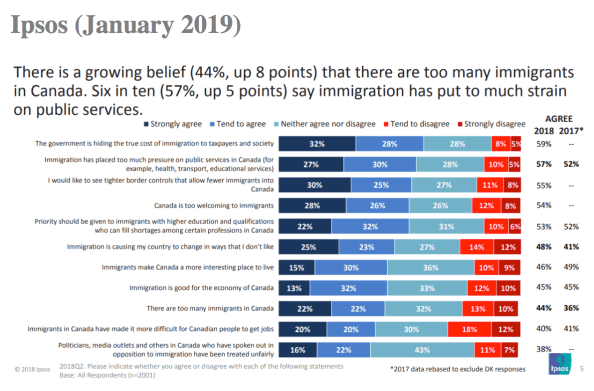
On polling data, the picture is more complex than simply presenting one polling firm where the timing, question phrasing and methodology may somewhat skew results (e.g., Environics and Pew present a more positive portrait than IPSOS).

And not sure that immigration policy is developed in any less transparent manner than any other area of government policy, and where stakeholder groups, who follow the issues carefully, have more influence:

Politicians and corporations that want more immigrants in Canada are mounting marketing campaigns to “win the immigration conversation.”

At least the CEOs, think tanks and civil servants are upfront about aiming to promote higher immigration levels, which aligns them with Prime Minister Justin Trudeau and the Liberals.

Where, however, does this leave all the Canadians in the mushy middle? That’s where most Canadians are at, according to immigration department officials and other migration experts who spoke at a Conference Board of Canada event held last week in Vancouver. The gathering was titled, “Winning the Immigration Conversation.”

Not many Canadians are extremists, either for or against current immigration policy or rates, polls suggest. The bulk of the population seems hazy about Trudeau’s plan to continue to increase immigration levels to 350,000 people a year by 2021, up from 260,000 when he was elected in 2015.

My sense is most Canadians are not eager to either “win” or “lose” the immigration discussion. Most of us don’t think immigration boils down to an either/or option. Some of us mostly want to know what’s going on, so we can be informed at the ballot box.

But as some speakers at the Conference Board event noted, Canada’s politicians and mandarins are almost unique in the obscure way they dictate the country’s powerful immigration policies from behind closed doors.

Kareem El-Assal, the senior immigration director for the Conference Board, asked me to speak at the “Winning the Immigration Conservation” conference so participants would not end up in the usual echo chamber, in which everyone basically agrees with each other.

El-Assal had seen my 2017 story on the clubby atmosphere that reigned among the more than 1,000 Canadians who work with immigrants, refugees and international students and attended Montreal’s Metropolis Conference. My article on that gathering was headlined, “The narrow view from the migration sector bubble.”

So I give credit to the corporate-sponsored Conference Board, a booster of high immigration levels, for welcoming diversity of opinion. It turned out some scholars, and even some civil servants, had their own skepticism about Canada’s immigration levels, which are arguably the highest per capita in the world.

I told participants I’m intrigued by philosophy’s two foundational questions: What is real? And how then shall we live? And I bring those questions to immigration matters.

What I’ve discovered in recent years on the migration beat is the vast majority of native Canadians (and to a lesser extent immigrants) don’t have a grasp on what is real about the increasing global migration of people, particularly into Canada. And it’s understandable.

Even though the Conference Board has launched its own campaign for increased immigration, El-Assal revealed data showing most Canadians don’t have the foggiest idea about a basic issue: How many immigrants come into Canada each year.

Only nine per cent of Canadians knew correctly it is between 150,000 and 300,000 annually. What’s worse, El-Assal said, when Canadians learn how many immigrants are actually entering the country, their support goes down.

“The populists may have a point,” Antje Ellerman, a political scientist at UBC, told the Conference Board gathering.

“Canada has a high degree of (immigration) policy-making behind closed doors.” The immigration agenda has “traditionally been dominated by the government and civil servants, and rarely engaged the public in meaningful ways.”

In addition, the complexities of immigration rules are not often covered by the media. That is the unfortunate case even though, for instance, almost half the populations of Toronto and Vancouver are foreign-born.

One concern is that if Canadians are purposely being kept in the dark about immigration developments, and even opposition politicians are afraid of raising the subject for fear of being labelled xenophobic or racist, how can the host society make wise choices about an issue that has defined the country?

Turns out many Canadians are concerned. Only 45 per cent believe immigration is “good for the economy,” according to a new Ipsos poll. Another 57 per cent believe “immigrants place too much pressure on public services,” be that health or transit systems. And almost 60 per cent say government is “hiding the true costs to taxpayers and society.”

Immigration officials are not alone in finding in the past couple of years that there has been a shift among Canadians about immigration. That is part of the reason Ottawa has launched a promotional campaign called #immigrationmatters.

Its public relations effort is getting out stories about immigration successes, especially at the neighbourhood level. Not a discouraging word will be heard from #immigrationmatters, of course, since it will support a major plank in this year’s Liberal campaign.

However, Ellerman is among those who think it unwise for governments in Canada, Europe or elsewhere to ignore the populist voices that worry about immigration. To do so, she said, could feed anti-immigration radicalism.

UBC economics professor David Green offered the audience some data-based realities about immigration.

One finding takes issue with frequent claims by Immigration Minister Ahmed Hussen that high immigration is the key to economic prosperity. Green highlighted how immigration has an almost imperceptible effect on long-term Canadian wages, not doing anything at all for per-capita income.

And although boosters of strong immigration frequently maintain it is absolutely necessary to counteract an aging Canadian labour force, Green’s studies show its effect is minimal, almost non-existent.

Immigration numbers would have to jump multiple times over to make even a small dent in the growing portion of seniors in Canada, Green said. In addition, most people who obtain citizenship status in Canada soon try to sponsor older family members to join them.

But immigration is not all about economics. Many of the speakers recognized reliable new opinion surveys show much of the public resistance to high immigration has mostly to do with culture.

Roughly one in two Canadians fear too many immigrants “do not adopt Canadian values.” Many in the host society feel they are losing command of their own cultural identities. Some migration specialists said such feelings should not necessarily be dismissed as xenophobic.

Give the swirl of powerful factors at play, what are we to make of efforts by Ottawa and its supporters to “win the immigration conversation”? Even though organizers of the Conference Board event said they came up with the title to be provocative, I’d say immigration policy needs more balanced attention than that found in win-lose campaigns.

In a democracy, the public could use as much information as possible about migration policy and trends. Who knows what would happen if Ottawa became more transparent? Reality has a funny way of surprising all of us.

Source: Douglas Todd: Who cares about ‘winning’ the immigration debate?

Canadians share most favourable view of immigrants, global study finds

Good summary of the latest Pew report (Global Opinions of Immigrants | Pew Research Center for full report):

Canadians have the most favourable opinion of immigrants among the world’s top migrant destination countries, viewing newcomers as a strength rather than a burden, says a new international survey.

The report by Washington-based Pew Research Center also found Canadians are the least likely to blame immigrants for crime or an increased risk of terrorism, among the respondents in 18 countries that together host half of the world’s migrants.

“Canada is on the top of the list in believing immigration is a plus to the country,” said Jeffrey Reitz, director of ethnic, immigration and pluralism studies at the University of Toronto’s Munk School of Global Affairs and Public Policy, who is not involved in the survey.

“It also shows Canada is less polarized than the other countries on immigration as all Canadian political parties are on board with immigration. Even those on our right are more positive about immigration than the left in many other countries.”

Sixty-eight per cent of Canadian respondents in the survey believed immigrants make the country stronger while only 27 per cent said newcomers are a liability because they take jobs and social benefits, said the report released Thursday.

Canada was followed by Australia, where 64 per cent of respondents favoured immigration; the United Kingdom and Sweden, both at 62 per cent; and with Japan, at 59 per cent, rounding up the top five. In Mexico, currently a destination and transit country for tens of thousands of migrants fleeing violence in Latin America, 57 per cent of people welcome migrants while 37 per cent considered them a burden.

In six European Union member states surveyed, public perception about immigration has shifted since 2014 after the arrival of hundreds of thousands of asylum seekers. In Greece, Germany and Italy, the share of adults in favour of immigrants dropped significantly.

“In most countries surveyed, those on the left of the ideological spectrum are more positive about immigration’s impact on their country than those on the right,” said the 24-page report.

“In many countries surveyed, those with higher levels of education, younger adults, and those with higher incomes are more likely to say immigrants make their countries stronger because of their work and talents.”

The survey interviewed 19,235 people in 18 countries, including 1,056 Canadians, with five questions focusing on public attitude towards immigrants, integration, crime, terrorism and deportation. The Canadian portion of the survey has a margin of error of plus or minus 3.7 percentage points

In Canada, people across the political spectrum share positive views of immigrants, with 81 per cent of left-leaning Canadians and 65 per cent of self-described conservative respondents in favour of newcomers. The 16 percentage-point gap was the second narrowest among the 18 countries.

In Greece, where the political gap was the narrowest, at just 13 percentage points, people were overwhelmingly opposed to immigration, with just 6 per cent of conservative respondents and 19 per cent of leftists in favour of migrants.

However, public attitudes are mixed on immigrants’ willingness to adapt to their new country’s customs and way of life, said the survey.

People in Japan, Mexico, South Africa, the United States, France and Sweden are more likely to say immigrants are inclined to integrate into their society, while their counterparts in Hungary, Russia, Greece, Italy, Germany, Poland, Israel and Australia all said the opposite. Canadians are split in their views on whether immigrants want to fit in or not.

Eighty per cent of survey respondents in Canada said immigrants are no more to blame for crime and 65 per cent said immigrants don’t increase the risk of terrorism, compared to 17 per cent and 35 per cent, respectively, who said otherwise.

The majority in most countries surveyed support the deportation of people who are in their homeland illegally, and Canada is no exception. While 53 per cent of Canadians said irregular migrants should be removed, only 37 per cent disagreed with the statement.

Percentage of people in various countries who supported the following statements:

Immigrants no more to blame for crime:

  • Canada: 80%
  • U.S.: 77%
  • France 76%
  • UK: 74%
  • Spain: 68%
  • 18-country median: 50%

Immigrants do not increase risk of terrorism:

  • Mexico: 65%
  • South Africa: 62%
  • Canada: 61%
  • Japan: 60%
  • France: 59%
  • U.S.: 56%
  • 18-country median: 48%

Immigrants are a strength:

  • Canada: 68%
  • Australia: 64%
  • UK: 62%
  • Sweden: 62%
  • Japan: 59%
  • U.S.: 59%
  • 18-country median: 56%

Source: Canadians share most favourable view of immigrants, global study finds

Why Is the Vatican Opening the Files on ‘Hitler’s Pope’?

Interesting analysis of this major and overdue decision:

When Pope Francis announced that he’d be opening the Vatican’s secret archives from the World War II papacy of Pius XII, many wondered, “Why now?”

Papal archives traditionally are opened at least 70 years after a pope’s death, meaning no one expected the secrets of Pius XII, who died in 1958, to be made accessible until 2028.

By deciding to open them on May 2, 2020, Francis seems to be sending a message, though no one is quite certain just what that is.

— Plaque on a building where Jews were held in sight of the Vatican walls

In his announcement, Francis acknowledged that the archives of Pius, who is often dubbed “Hitler’s Pope,” may not be entirely favorable, but he claimed the Church is “not afraid of history.” He said Pius had “moments of grave difficulties, tormented decisions of human and Christian prudence, that to some could appear as reticence.”

Whatever might be revealed in the secret archives, it remains an indisputable fact that thousands of Jewish people were pulled from their homes in Rome and taken to the concentration camps under the shadow of the Vatican. A poignant plaque on the Via Lungara, just a stone’s throw from the gates of Vatican City, still commemorates one of the most horrific incidents: “On 16 October 1943 entire Jewish Roman families were ripped from their homes and brought to this place and then deported to concentration camps. Of more than 2,000 people, only 16 survived.”

Rabbi Abraham Skorka, an Argentine rabbi and professor at the St. Joseph’s University Institute for Jewish-Catholic Relations in Philadelphia, is a longtime friend of the pope from the pontiff’s days as Cardinal Jorge Bergoglio in Buenos Aires. The two co-authored the 2000 book on contemporary theology On Heaven and Earth.

Skorka told The Daily Beast he is “not sure opening the archives will substantially modify the polemic” that still rages regarding the wartime actions of Pius XII, who some Catholics claim may actually have helped save Jewish lives by notcondemning Hitler publicly.

But Skorka says the simple answer is: promises made, promises kept. “He said he’d do it. It is that simple. This is further evidence of the commitment Bergoglio has with the truth itself, more than with the results that may emerge from any investigation of the material.”

Francis, who met with a delegation from the American Jewish Committee the day after announcing the opening of the archives in Rome, lamented recent incidents of anti-Semitism as part of a “climate of wickedness and fury, in which an excessive and depraved hatred is taking root.”

According to Skorka, “What Bergoglio says is, ‘We have to open the archives and see what really happened and the truth must flourish in all its aspects.’ He’s saying, ‘Let us move ahead and learn from history.’”

Francis said he is sure that upon further study, scholars would find “during periods of the greatest darkness and cruelty, the small flame lit of humanitarian initiatives, of hidden but active diplomacy.”

But Lorenzo Cremonesi, a member of the Vatican-appointed commission of Catholics and Jews that, in 2000, revealed that Pius XII knew about the Holocaust as early as June 1942, cautioned against giving the Catholic Church credit for “the initiatives of local churches in many countries who on their own took action to save Jews.”

“Church machinery,” he said, was something else.

Pius has been stalled on the Vatican trajectory towards sainthood since Pope Benedict XVI, a German, endorsed him in 2009 and thus made him “venerable.” Benedict was just 12 years old when Pius was elected, and he often has referred to him as “my first pope.” Benedict has been a long-time backer of Pius’s innocence during the war, and instead has consistently said that the pope worked behind the scenes to protect Jews.

Some believe the opening of these archives early is a special favor to the retired pope, whose health has been failing since he resigned in 2013. If the archives prove that Pius did work to protect Jews, his cause for sainthood would surely advance–he already has several miracles credited to him. A Vatican source told The Daily Beast that Benedict would love to be alive for the beatification of Pius, but that won’t happen until the archives of his papacy are opened.

For the old group of Argentine friends that remain in close contact with the current pope, Pius’ reputation seems of lesser interest than that of Francis. And Benedict’s legacy is of even less interest.

Another of Bergoglio’s old friends from Buenos Aires, Alberto Zimerman, head of interreligious dialogue for the umbrella association of Jewish organizations in Argentina (DAIA), said that Francis had decided upon this “risky course for the church” not having seen any of the classified documents himself.

“We could find anything there,” Zimerman told The Daily Beast, invoking the pope’s willingness to “undertake any challenge.”

For decades, scholars studying the World War II pope’s actions have argued that the Vatican did nothing to stop the atrocities, and while some Catholics tout Pius’s “secret diplomacy,” many Jews see it quite differently.

Rabbi David Rosen, the International Director of Interreligious Affairs for the American Jewish Committee, who has advocated for the archives’ opening for more than 30 years, and who met with Pope Francis last week, said that there was only “the greatest respect and collaboration” between Jewish groups and the Vatican team now cataloging the documents. But “in the end,” he told The Daily Beast, “there is a debate between the church and the Jewish people regarding what Pius XII did.”

“For the Catholic Church, he made a tactical decision he thought would be best,” Rosen says. “For Jews, the very thought that anything could be worse than the Holocaust means we will never have a shared historical view of this moment.”

Rosen specified that there are questions of historical fact still “lacking in clarity,” including “instructions emitted from the Vatican, areas where Pius XII may have been directly involved, and information transmitted and actions taken, not necessarily by the pope but by other agencies of the Vatican.”

The same Jewish group that met Francis in Rome last week has, for years, pressured the Vatican to reveal what many assume will be Pius XII’s blind eye to the atrocities that unfolded under the reign of both Adolf Hitler and Benito Mussolini during his papacy.

In a recent radio interview, David Kertzer, author of The Pope and Mussolini, likened the church’s approach to the atrocities of the Holocaust to those of the clerical sex abuse scandal now ravaging the church’s reputation.

“In this case maybe there’s some parallel to the more recent pederasty sex scandal in the Church,” Kertzer said. “The perspective of the Vatican was largely ‘the first priority has to be to protect the institutional Church and everything else comes second.’”

Kertzer told The Daily Beast that he would be among the first to visit the archives. He believes Pius was concerned that the Nazi regime would work against the church and so did what they could to work against its power base without taking into account the helpless victims caught in the middle. “I think we may well find more documentation that will show that this is exactly the kind of consideration that was overriding the Pope’s decision making at the time.”

Opening the archives will not satisfy everyone.  I think they will hide a lot of things,” says Cremonesi, a special envoy for the Italian daily Corriere della Sera and an expert on Vatican-Jewish relations. “We know that Pius XII was very open to the German cause—not to Hitler—but to Germany, because he saw the Germans as a bastion against the Communists, and the Communists were the primary concern of the Vatican.”

Explaining the church’s indifference to the genocide of European Jewry, Cremonesi said, “Pius really believed that the only good Jew was a converted Jew.”

Rabbi Israel Zolli, the Chief Rabbi of Rome, who famously survived the war under Vatican protection and later converted to Catholicism, “was the paragon for Pius,” Cremonesi says. “Perfection.”

While it will take a year for the Vatican to catalogue the hundreds of thousands of documents, there is still worry that the Vatican won’t be entirely up front. The entire archives are already indexed, a librarian with the Vatican archives told The Daily Beast on background. There would, in essence, be no way to cover up huge gaps since many historians are going to be checking the files against already available documents–unless those record were destroyed long ago.

Many countries that had diplomatic relations with the Holy See during World War II have already made those documents available. Now scholars want to know what internal memos the Vatican attached to notes it received at the time concerned that the Vatican was not doing enough.

“We know the attitude of the church,” Cremonesi said, using as an example the 1904 encounter between Pius X and Theodor Herzl, the founder of Zionism, who described the meeting in a detailed diary entry.

“When you go to the Vatican to look it up, there’s nothing,” Cremonesi said, chuckling. “No little note like you find in British archives saying ‘document classified,’ or even a line saying ‘this morning his Holiness held meetings.’ There is nothing.”

“I put my hands in fire,” he says: “If there is anything annoying in those papers, the Vatican will not reveal it.”

Skorka noted that Francis, 82, the first non-European pope, grew up in the melting pot of Buenos Aires, with Jewish friends from childhood. He recalled that during the conversations that led to the publication of their book, Bergoglio said that of the “many genocides in the 20th century”—he mentioned the Armenians—”the genocide of the Jews is singular. It set about to eliminate the Jewish people and the spirituality that transcended from its history.”

“For people like him and me, who believe in the God of Israel, it means the Holocaust was an attempt to destroy this God on earth,” Skorka said.

Pope Francis’ decision to open the Vatican archive, Skorka implied, is an attempt to restore that God for humanity.

Source: Why Is the Vatican Opening the Files on ‘Hitler’s Pope’?

Islamic State women defiant in face of lost caliphate

More relevant reporting:

As the battle against the Islamic State (IS) group in eastern Syria enters its final stages, the BBC’s Jewan Abdi says the mood amongst many of the jihadists’ supporters who have left the area, including many women, remains defiant.

The encampment in the village of Baghuz is barely more than a few holes in the dirt covered with blankets. It is squalid and filthy.

But above it flies the black Islamic State flag, fresh and clean. IS fighters had raised it only the day before, an act of defiance in the face of overwhelming odds.

“That’s a sign they will fight,” says a soldier belonging to the US-backed Syrian Democratic Forces (SDF) on the front lines battling the jihadists.

Just 24 hours later the battle resumed. It was the end of a ceasefire that had seen more than 12,000 leave in the preceding few days.

One day last week in the early morning, more than 20 trucks led by Humvees armed with machine guns went inside the tiny IS enclave to evacuate jihadist fighters and their families.

I followed these vehicles on their return journey to the desert where they were checked, separated, and sent on to camps run by the SDF forces. One military commander told me the total number of people evacuated was about 7,000.

The hunger and anger was evident on their faces. As I walked among them with my camera, trying to talk to them and film, several IS women suddenly attacked me and threw stones, dust and cans.

“Go film the brothers, don’t come here. Go. Leave. Go film them, we’re the woman of the Islamic State, Allahu Akbar, Allahu Akbar (God is greatest),” they said.

A few weeks ago, the SDF estimated the number of IS families and fighters left remaining in Baghuz to be between 1,500 and 2,000 people. But in just two days last week, 9,000 people emerged.

The final territory under IS’s control may be on its last legs in Syria, but the ideology remains strong among those who have left.

Many of the IS women I encountered threatened of violent jihad and raising their children to become jihadist fighters.

Two captors for one woman

Among the thousands of people turning up out of Baghuz, I also found victims of IS’s notorious brutality, including one Yazidi woman called Adiba.

A mother of two, Adiba was enslaved for five years after IS attacked her small village in Sinjar, northern Iraq, in 2014.

Her husband was one of the hundreds of Yazidi men killed by the jihadist group, and she – like thousands of Yazidi women – was forced to convert to Islam and was used as a sex slave.

She says she was enslaved by a Moroccan man who beat her constantly and raped her. He was the father of her two-year-old child.

“I had to marry him. When we were alone he wasn’t good to me, he was always angry with me, but in front of people he treated me well,” Adiba tells me.

After Adiba’s first captor died, she was taken by another Moroccan man named Ahmed – orders she says came from her first captor in the event of his death.

Ahmed, who surrendered to the SDF last week, has denied enslaving Adiba.

Most of the people evacuated from Baghuz recently, including many foreigners who travelled to Syria and Iraq to live under IS rule, have been transported to the SDF-controlled camp al-Hol, in the north-east of the country.

The camp was designed to accommodate 20,000 people but the UN says conditions there are dire as the numbers have risen to more than 66,000.

The global dream of an Islamic State caliphate – a state governed in accordance with Islamic law – is on the brink of collapse, with most of its leadership gone and many captured by the SDF and coalition forces.

Hundreds of IS fighters have surrendered. Separated from their families, they sit in long queues in an area inaccessible to journalists, where US Special Forces and SDF soldiers interrogate them and send them on to detention centres and prisons under Kurdish control.

After losing their self-proclaimed caliphate, a sense of sadness, anger and indignation was clear among these fighters who are stuck in the middle of the desert, waiting to be moved into detention camps, away from their wives and children.

Source: Islamic State women defiant in face of lost caliphate

Saudi Kingdom Tries To Prevent More Women From Fleeing

Not surprising:

After an 18-year-old Saudi woman, who said she feared death if deported to Saudi Arabia, arrived in Canada, she directed some of her first public commentsback home. Rahaf Mohammed Alqunun encouraged other women to flee family abuse and the oppressive controls imposed on them by the conservative kingdom.

She has just showed them how to do it.

Alqunun was offered asylum in Canada in January after she barricaded herself in a Bangkok hotel room, from where she mounted a sophisticated social media campaign that sparked international headlines and sympathy.

But in Saudi Arabia, Alqunun’s successful escape from a prominent family spurred harsh media attacks and a social media narrative accusing Western nations of using Saudi women to undermine the kingdom. Still, the domestic campaign is unlikely to deter other young women from fleeing the kingdom, say activists who are in touch with women planning to run.

The high-profile story is “going to set off copycat scenarios,” says Bessma Momani, a Middle East specialist at Canada’s University of Waterloo. “I think women will feel more emboldened.”

She explains that Alqunun’s story has provided a virtual road map for others and revealed a network of groups willing to work out logistics and offer escape strategies. “Rahaf’s story showed there is a quasi-organized group that is willing to help,” Momani says.

Alqunun’s asylum in Canada comes as Saudi Arabia’s Crown Prince Mohammed bin Salman, often referred to as MBS, portrays himself as the leader who is steering the country toward a more secular modernity.

Movie theaters have reopened. Saudi women can now drive cars and attend sports events. The kingdom says it has made it easier for women to enter the workplace.

“Any way you slice it, MBS has done more change than anyone in the last 50 years,” says Ali Shihabi, who heads the Arabia Foundation, a pro-Saudi think tank in Washington, D.C. Reform is “an art rather than a science,” he says, “and being an art, there are going to be mistakes. He can’t let the snowball get too big.”

The crown prince is also behind a harsh crackdown on political dissent. That includes jailing more than a dozen women’s rights activists who were vocally pushing for an end to Saudi Arabia’s guardianship system, which allows male relatives to control most aspects of a woman’s life.

“When MBS came, he made it clear: ‘You either listen to me, or you go to jail,’ ” says Yasmine Farouk, a visiting scholar in the Middle East Program at the Carnegie Endowment for International Peace in Washington.

“He is that much of a dictator that he is able to impose measures that other kings were too scared to impose on society. We are talking about a regime that wants to do everything under its control.”

But the growing number of Saudis seeking refuge abroad undermines Prince Mohammed’s international image as a leader bringing new personal freedoms to the kingdom, says 30-year-old Samah Damanhoori. She was granted asylum in the United States last year after she accused her family of abuse and declared she was no longer a Muslim.

“OK, we are going to let you drive — happy now? Stop running away,” she says, to explain her views on reforms introduced by Prince Mohammed. “But more women are running away. We have to do that to get them full rights.”

In Saudi Arabia, men wield vast powers over women. The guardianship system gives male relatives control over women’s travel, education, medical treatment and marriage. An app called Absher allows Saudi men to specify when and where a woman can travel. The service includes a message alert when a woman uses her passport at an airport or a border crossing.

Fleeing even an abusive home is a crime. If caught, a woman can be jailed or housed in a government-run shelter until her guardian permits her release.

Alqunun’s success was a “huge shake,” Damanhoori says, because she comes from a prominent family, the daughter of a powerful governor.

“The more powerful the family, the harder for a woman to escape, because of family connections. But she made it.”

Alqunun’s family status may explain why the Saudi government has ramped up a campaign to stem the flow. In recent weeks, the General Department for Counter Extremism released an online video as a warning. The animated message compares women who flee the country to young men who join terrorist groups — and blames a vast international conspiracy that it says is aiming to damage the kingdom’s image through its youth.

“Everyone who tried to escape, they compare her with ISIS — it’s horrible,” complains Damanhoori.

“This is not going to end,” says Hala Aldosari, a Saudi activist and writer based in New York. “It will get worse.”

Aldosari says the government blames “agents of the West” and “women activists” as the culprits of the alleged global plot to destabilize Saudi Arabia, “rather than the grievance of the women.” She says the common denominator among those trying to flee is that they are “women who come from controlling or abusive families” and who believe that running is the only way to survive.

The rise of social media has opened a window for people to compare Saudi women’s rights with women’s rights in other Gulf nations. “Saudi women are now more aware of the restriction they live with, and they take higher risks to escape,” Aldosari says.

Reliable statistics in Saudi Arabia on these escapes are hard to find. Some families don’t report a missing daughter for fear of social stigma in a society where a family’s honor is tied to the behavior of women.

Figures on Saudi asylum-seekers abroad, however, are known to have increased. Saudis made 815 asylum claims worldwide in 2017, compared with 195 in 2012, according to the latest tallies published in the United Nations Refugee Agency’s database. Their destinations include the U.S., Canada, Germany, Sweden, the U.K. and Australia.

In 2011, Manal al-Sharif was jailed for nine days in Saudi Arabia for protesting driving restrictions. Her activism cost her the custody of her son, she says. Now she is living in self-imposed exile in Sydney.

“These proclaimed reforms are just refurbishing a huge cage,” al-Sharif says of the changes in Saudi Arabia. “We can’t run a country when half of it is depending on the other half.”

But inside the kingdom, the crown prince is largely viewed as trying to change that equation, says Farouk at Carnegie. “It really is a paradox. It’s the strong man who is able to impose reforms without being afraid of the consequences.”

But Saudi officials know the consequences of the continued flight of women. That undermines the international message that Saudi Arabia is modernizing and that Prince Mohammed has opened a new era of freedoms.

Alqunun’s father, who is a governor, released a statement in January saying that the family had disowned the runaway and calling her “the mentally unstable daughter who has displayed insulting and disgraceful behavior.” That prompted the 18-year-old to drop her family name, she told reporters.

Her father reportedly denied physically abusing her or trying to force her into marriage, according to The Associated Press.

So far, Farouk says, the domestic response, even among women, is to condemn Alqunun’s escape as reckless.

“They don’t care,” Farouk says. “Things have changed in their daily life: They can drive to work, they can go to concerts, play sports. As long as their daily life has been made easier, why care about politics?”

But there is still a limit to personal freedoms. “They will care when they try to contest a policy at work,” she says. “They will be jailed or interrogated, or their fathers will have to get them out of the police station. They will care, but it will take time.”

Source: Saudi Kingdom Tries To Prevent More Women From Fleeing

Passed over, bullied, mistaken for janitorial staff. Black women sue Ontario public service alleging systemic racism

A case to watch:

Two Black women employed by the Ontario public service (OPS) are suing their unions and the provincial government, alleging they suffered years of systemic racism and discrimination while their complaints were ignored, disbelieved or met with reprisals — and ultimately led to them being suspended or forced from the workplace.

In a statement of claim filed Feb. 25 with the Ontario Superior Court of Justice, Jean-Marie Dixon and Hentrose Nelson accuse the provincial government of allowing an organizational culture that “fosters racism, dysfunction, discrimination, harassment, racial bullying, and abuse of authority/power.”

“Anti-Black racism, and racism in general, along with white privilege and white supremacy, are pervasive and entrenched within the OPS,” they allege, referring to the government workforce of more than 65,000 public servants employed by ministries, agencies and Crown corporations. (According to a glossary in their lawsuit, they define white supremacy as a “racist belief that white people are superior,” which is “ever-present in our institutional and cultural assumptions” and confers structural advantages to white people.)

They further allege that despite ongoing efforts to seek help from senior management, “Black and racialized employees, particularly Black women, continue to be subjected to individual, systemic, and institutional racial discrimination and racial harassment.”

Their unions, meanwhile, have failed to adequately represent them because they are influenced by the same “culture of systemic and institutional anti-Black racism,” according to their statement of claim.

Dixon and Nelson’s legal action comes one year after they organized a meetingbetween several OPS employees and government officials that triggered a temporary halt on the suspension of racialized employees — a moratorium that was quietly lifted in July.

Their lawsuit also intends to challenge the way these kinds of allegations are handled in Canada. Many of their claims relate to issues covered by their collective bargaining agreements, but the “law is designed to keep these sorts of disputes … out of the courts and sent instead to expert labour and human rights tribunals,” says David Doorey, a labour and employment law professor with York University who is not involved with the lawsuit.

But Dixon and Nelson allege their many attempts to seek justice — including through their unions, internal workplace processes and the human rights tribunal — have been “ineffective” so their “only viable recourse” is through the courts.

“It’s been very, very traumatic,” Dixon said in an interview. “When you’ve worked so hard, as I’ve worked — I put myself through school, I got here on my own and on my own merit. And someone can take that from you.”

“No dollar amount could fix the irreparable damage,” Nelson said. “I think about how my life has been altered; I can’t get it back.”

The lawsuit’s allegations have not been tested in court and the respondents — the provincial government, Association of Law Officers of the Crown (ALOC), and Association of Management, Administrative and Professional Crown Employees (AMAPCEO) — have yet to file statements of defence.

When reached by the Star, government spokesperson Craig Sumi with the cabinet office declined to comment on a matter subject to legal action but said “ending system (sic) racism” is a top priority.

“While the organization has made a lot of progress, we continue to hear that OPS programs and policies are not addressing the concerns of racialized employees, particularly Indigenous and Black employees,” Sumi said in an email. “The organization is committed to working with our employee networks to make significant progress toward building a more diverse, inclusive workplace where everyone feels comfortable and welcome and is able to fully contribute.”

Both unions named in the lawsuit said they take discrimination complaints “very seriously” and will continue to represent Dixon and Nelson, who remain members. But ALOC “strongly denies” allegations that it discriminated against Dixon and “will defend itself before the courts,” president Megan Peck wrote in an email.

“In representing Ms. Dixon, ALOC has always acted, and will continue to act in accordance with its legal responsibilities, which include the duty to represent Ms. Dixon without discrimination,” Peck said.

A spokesperson for AMAPCEO, Anthony Schein, declined to comment on Nelson’s case but said as a policy matter, the union’s view is that the OPS “continues to struggle with systemic discrimination.”

“For decades, AMAPCEO has been advocating for the OPS employer to end systemic discrimination within the OPS and promote equity in our members’ workplaces,” he wrote. “To this end, AMAPCEO ably responds to individual members’ situations through our dispute resolution process. We also push the employer to address systemic issues.”

In their 113-page statement of claim, Dixon and Nelson allege a pattern of anti-Black racism and harassment that followed them across departments and persisted throughout their public service careers.

Dixon and Nelson, both in their 40s, joined the OPS in 2002 and 2004, respectively. Dixon is a single mom and lawyer with the Ministry of the Attorney General whose office deals with seized property stemming from illegal activity. Nelson, a married mother of three, most recently worked for the Ministry of Citizenship and Immigration, where at one point she was “the only Black employee in an administrative role,” she writes in her claim.

Both women allege the racism they experienced took many forms, everything from bullying and micro-aggressions to racist comments, including from a white female manager who said she “feared” Black women and a colleague who complained about the “face” of the office changing after racialized women were newly hired.

Despite being diligent employees, they were denied professional opportunities, over-scrutinized and subjected to “anti-Black stereotypes and tropes,” according to their claim. Nelson, whose most senior role involved financial reporting and budget management, alleges she was once mistaken for janitorial staff and routinely given “office housework” that wasn’t assigned to non-Black staff — for example, cleaning a dirty basement storage room, or ordering taxi chits and monitoring print supplies, “while a white woman, junior to Hentrose, assumed more meaningful responsibilities.”

Dixon alleges she was also treated with unnecessary suspicion (for example, she was not trusted to maintain custody of valuable credit cards that had been seized for a case she was working on) and “unwarrantedly” labelled as “loud,” “rude” and “aggressive.” At one point, according to her claim, another Black lawyer told Dixon her office colleagues were “organizing or orchestrating acts of discrimination and harassment against her” and told him to “participate in marginalizing Jean-Marie or he would receive the same negative treatment.”

Both women sought help from managers, filed complaints with an internal workplace discrimination program, and grieved through their unions. But according to the claim, none of these measures were effective and speaking up only made matters worse.

Nelson alleges that “as a result of anti-Black racism,” she was demoted to a junior position in 2015 and ultimately forced from the workplace by “mobbing, harassment, discrimination, hostility and ongoing mistreatment.” According to her claim, she also became critically ill in 2011 and delivered her baby prematurely at six months.

Dixon alleges her complaints of anti-Black racism were interpreted as “reverse racism” against Caucasian people and caused her displacement across four ministries. According to her claim, managers eventually “engaged in reprisal” by initiating a workplace complaint against her on behalf of staff who “made false allegations” about her conduct — a complaint that led to her suspension in 2016.

Neither have since returned to work. Nelson is currently on an unpaid leave of absence and Dixon, despite being reinstated in October 2017, says she has been unable to return to work due to a workplace-induced disability. She is still being paid, however.

Both women allege they are now suffering from post-traumatic stress disorder, loss of income and other harms, and are seeking $26 million in damages, along with several public interest remedies.

When reached by email, their lawyer Ranjan Agarwal with the firm Bennett Jones, declined to comment on active litigation.

In recent years, OPS leadership has acknowledged the equity challenges within its own ranks, where racialized workers comprise 23 per cent of the workforce but only 17 per cent of directors, 12 per cent of assistant or associate deputy ministers, and 9 per cent of deputy ministers, according to a 2017 “diversity and inclusion” report. “To create an equitable OPS, we need to recognize that there are systemic racism barriers that prevent people from reaching their full potential,” the OPS stated in its anti-racism policy, released last year under then-secretary of cabinet Steve Orsini, who retired in January.

The anti-racism policy found that 23 per cent of Indigenous employees and 25 per cent of Black employees reported experiencing discrimination, compared to just 13 per cent of the general OPS population. Employee survey results have pointed to systemic issues as well and in 2017, Black employees reported discrimination at nearly twice the rate of OPS employees generally. Last year, according to more than 3,600 survey respondents, race was the leading cause of discrimination next to age.

A Star analysis of data obtained through freedom of information legislation also shows that provincial ministries were named in at least 136 complaints filed with the Human Rights Tribunal of Ontario between mid-2008 and 2017, where someone alleged employment discrimination based on race, ancestry, colour, ethnic origin or place of origin. These accounted for roughly a quarter of all employment-related human rights complaints filed against the Ontario government during this time period.

Black employees have been particularly vocal in raising concerns through various forums, including town hall meetings organized by the Black Ontario Public Service Employees Network. On Jan. 18, 2018, more than 20 Black employees, including Dixon and Nelson, also confronted government officials face-to-face, including Liberal MPP Michael Coteau, who was then leading Ontario’s anti-racism directorate.

During the emotional meeting, the group of mostly Black women described experiencing racism on the job and being systematically passed over for opportunities. They said their concerns were ignored or mishandled by senior managers and, in many cases, led to their own suspensions or firings.

“These people that are putting us through this … none of them are ever demoted. We are fired,” one woman said in a video of the meeting posted online. “There’s a lot of Black people in the same position as I am, where they have ambition and they want to be promoted, and they’re not promoted at the same levels as our white counterparts.”

At the meeting, the group demanded a moratorium on the suspension of racialized employees — which was publicly announced the following day by Orsini. Behind the scenes, his office also emailed government ministries to request a list of cases where “someone we presume to be a racialized employee is suspended or off work,” according to internal documents obtained through a freedom of information request. About a week later, 52 cases had been identified.

Sumi said the moratorium allowed the government’s Public Service Commission to “assess the scope of the issue” while providing a central mechanism to assess new cases involving possible suspensions. It was formally lifted on July 27, 2018 after the government completed its review, he said.

In their statement of claim, Dixon and Nelson point to numerous reports, surveys and investigations that suggest the government’s efforts to address systemic racism within the OPS have “proven futile.”

Among them is a confidential 2017 report leaked to the Star, which described a “toxic” work culture within the Ministry of the Attorney General’s civil law division, where Dixon’s office is based. According to Leslie Macleod, a lawyer and former bureaucrat hired by the government to conduct the report, racialized staff within the division reported being marginalized, over-scrutinized, and “perceived and treated as less able than their white counterparts.”

Some racialized staff were told they “got in” because of their race and people felt “unsafe and targeted by colleagues and insufficiently supported by management,” Macleod found. Racialized women felt particularly disadvantaged, she added.

“It was said that when racialized women do get good files, there is an undercurrent of ‘why is she getting good files?’ — something that is not questioned when a senior white male is assigned a high profile case,” Macleod wrote.

In November, the government also publicly released an external review of the government’s workplace discrimination and harassment prevention (WDHP) policy and program “through an anti-racism lens.”

The program is meant to resolve cases of workplace discrimination within the OPS but in their statement of claim, Dixon and Nelson — both of whom launched WDHP complaints — criticized such internal processes as “ineffective in addressing racism.” Lawyer Arlene Huggins, who was hired to conduct the external review, said the government triggered the probe because of its “strong perception” the WDHP program was actually “exacerbating or perpetuating the challenges” of employees struggling with racism.

For her final report, Huggins examined 72 cases and related files; she also chose 13 cases for closer examination, which primarily involved Black women with “significant years of service.” She said employees reported several issues, including WDHP advisers who did not seem to understand the program, lacked training in unconscious bias and anti-Black racism, or pressured employees into excluding important details from their complaints. Some people said they were “yelled at, interrogated and treated like a criminal,” according to Huggins’ report.

Employees also described negative experiences that were “particular to them being Black women,” Huggins wrote; for example, labelled “argumentative, difficult and unco-operative” when they articulated career goals, accused of playing the race card when they complained about unfair treatment, and perceived as ineffective managers.

The WDHP policy does not apply to systemic barriers, yet those barriers played a “material role” in these WDHP complaints, Huggins concluded. Participants she interviewed complained of an “inherent and unconscious bias and anti-Black (or anti-racialized) animus.”

“One complainant with almost 20 years experience reported 58 unsuccessful (job) competitions since 2008,” she said.

In their lawsuit, Dixon and Nelson write that the provincial government is one of Canada’s largest employers, “entrusted with extraordinary power and influence that affect and impact the lives of all Ontarians,” so its actions are particularly consequential.

“Racism is a public health emergency,” they write. “But based on the actual and lived experiences of Black people, there is much skepticism about the commitment or ability of current institutions to address systemic and structural anti-Black racism in Canada.”
Source: Passed over, bullied, mistaken for janitorial staff. Black women sue Ontario public service alleging systemic racism

Quebec’s plan to reduce immigration levels is ‘misguided,’ won’t help newcomers: study

More on Quebec immigration levels debate:

A Quebec think tank says the province’s plan to cut immigration levels is misguided and will not accomplish its intended goal of better integrating newcomers.

The Institut de recherche et d’informations socio-economiques published a study Wednesday concluding from publicly available data that immigrants are faring better in Quebec than the government claims.

Researcher Julia Posca said the employment rate among immigrants in Quebec has risen steadily to 79 per cent last year from about 70 per cent in 2009. She said almost 60 per cent of immigrants who arrive in Quebec are fluent in French or are bilingual.

“Based on those facts, you can say the integration of immigrants is going well, and there is no empirical evidence that tells us that if we lower the levels of immigrants that integration will be better,” Posca said in an interview.

Given the data, the proposed law is built on perceptions and prejudices about immigrants, Posca said: “The new policy of the government seems to be misguided.”

The institute said it is in favour of maintaining the province’s annual immigration level at 50,000, basing its argument on demographic and economic factors, given the province’s aging population and a shortage of workers.

The government plans to reduce immigration to about 40,000 people this year, with Premier Francois Legault telling reporters Wednesday in Quebec City the changes are necessary to respond to the needs of the workforce and to ensure new arrivals are comfortable functioning in French.

Quebec Immigration Minister Simon Jolin-Barrette tabled Bill 9 in February, proposing to overhaul the system for selecting newcomers to the province. The government says the legislation is aimed at better matching applicants to the needs of the labour market and ensuring immigrants speak French and respect Quebec values.

But it has been widely criticized since it was introduced. A recent court ruling forced the government to resume processing outstanding immigration applications that it had scrapped.

A spokesman for Jolin-Barrette said in a statement Wednesday the Coalition Avenir Quebec government was elected last October with a mandate to reform the immigration system. He said the employment rate for newcomers remains a problem.

While the 79 per cent employment rate for immigrants still lags behind that of Quebecers born in Canada — 87 per cent –Posca said part of the difference is attributable to how the province recognizes newcomers’ work and education experience, as well as discrimination.

“These are real issues that immigrants face and that impedes their full integration and the bill doesn’t propose anything to counter those problems,” she said.

Source: Quebec’s plan to reduce immigration levels is ‘misguided,’ won’t help newcomers: study

In These Divided Times, Is Civility Under Siege?

Good discussion of civility, both its strengths and weaknesses, and how historically calls for greater civility have been used to reinforce the status quo (right to vote for women, civil rights movement).

But more respectful civil discussion and debate, with less name calling, labelling, insults etc, along with social media restraint, is needed more than ever.

And like an earlier posted article on the limits of good faith (The Utility and Futility of Good Faith in Campus Speech Controversies), there are some persons or groups whose positions and attitudes are anything but civil:

It’s a time of deepening political divisions in the United States, with people on opposite ends of the political spectrum not only disagreeing but many really disliking the other side. That dislike has been growing for decades.

In the midst of all that division and dislike, there are growing calls for civility. One poll shows that a majority of Americans say incivility is a major problem. And anNPR/PBS NewsHour/Marist poll says that the country’s civility crisis is deepening and that a majority of Americans fear it will lead to violence.

But what does civility actually mean? It’s sometimes defined as simply being polite. It comes from the Latin root civilis, meaning “befitting a citizen.” It’s a term that’s a comfort to some and repressive to others. And while, yes, it can refer to politeness, it’s much more than that.

“Civility is the baseline of respect that we owe one another in public life,” says Keith Bybee, the author of How Civility Works. “And when people talk about a crisis in civility, they usually are reporting their sense that there is not a shared understanding of what that baseline of respect ought to be.”

Right now that social contract — a common agreement on what appropriate public behavior looks like and who deserves respect — feels broken. No one can agree on the facts, let alone on how to argue or what to argue about. With a president who uses terms like “loser,” “dumb as a rock” and “fat pig” to describe his critics and “animals” to describe undocumented immigrants, it feels like the tone for nasty behavior that’s seeping into everyday life is being set in Washington.

Some blame the Democrats, others the media — and many blame President Trump.

For some, this deep sense of division and dislike spells out danger. What’s at stake?

“The success of the country,” says Jonathan Haidt, a social psychologist at New York University’s Stern School of Business. “When we don’t trust each other, that means it’s very difficult for politicians to compromise. It’s very difficult to find win-win solutions or positive-sum games. And so there are so many problems that we could solve,” but we don’t.

“We become credulous, we become easily manipulated by our foreign enemies and our democracy becomes what? A beacon to the world as to what not to do,” he says.

The arrival of social media didn’t help, Haidt says. He sees it as an accelerant to spew outrage and anger faster and further into the world. It’s a tool that has empowered the powerless to topple dictators, but it’s also one that is used to manipulate, deceive and, well, be horrible to people online anonymously.

But the United States has survived even more divided times in the past — from the country’s founding to the Civil War, the civil rights movement and the Vietnam War.

Not only did the country endure, but sometimes the outcome of all the so-called incivility was a rewriting of that social contract to make it more inclusive of people who were discounted and dismissed in the past.

At the time, those sit-ins were dismissed, he says, as an “affront to racial etiquette.” In the late 1800s and early 1900s, women seeking the right to vote were uncivil. Rosa Parks? Uncivil. AIDS activists with ACT UP protesting in dramatic and disruptive ways? Uncivil. Black Lives Matter? Uncivil.

“Civility has been about making sure that the status quo, the hierarchy of the status quo at the moment, which means racial inequality, gender inequality, class inequality, stays permanent,” says Lynn Itagaki, an associate professor at the University of Missouri who writes on what she calls civil racism. She defines it as maintaining civility at the expense of racial equality.

It’s a fraught term, she says. It carries the echoes of that historical and bigoted definition of the civilized versus the savage.

Maybe this moment feels like a crisis, Itagaki says, but when people call for a restoration of civility, who gets to define it? Who gets to rewrite the social contract?

Right now hate crimes and hate groups are on the rise. The Southern Poverty Law Center blames the president for stirring fears about a country that is becoming less white and for sparking an immigration debate with racial overtones.

The calls for civility can feel like an effort to stifle people’s outrage over injustice or hate, because civility can be a tool to build or a weapon to silence.

“To what purpose is civility going to be used? Is it going to be more inclusive?” Itagaki asks. “Is it going to mean that you’re bringing more people’s voices into the political debates, or are you using civility as a way to go back to the old hierarchies and the status quo since the founding of the American republic, where you only had white male propertied free landowners who were able to vote?”

So for some, now is a time to take a step back and be civil to each other. For others, it’s imperative to be uncivil in a way that has led to social justice in the past.

Source: In These Divided Times, Is Civility Under Siege?