Le spectre du populisme

Good commentary by Manon Cornellier on the genuine motivations behind the convoy and the yellow vests, their exploitation by the far right, and the inability of Conservative politicians to denounce, or at a minimum, dissociate themselves from the anti-immigration rhetoric and other hateful speech:

Jusqu’où peut-on aller pour porter un message politique ? La question se pose de plus en plus devant la montée d’un certain populisme qui fouette les émotions et alimente même parfois la haine, involontairement ou non. Le Canada n’y échappe pas, avec le risque de voir le débat public dériver dans des eaux troubles d’ici les prochaines élections.

En décembre dernier, le symbole des gilets jaunes est apparu dans le paysage politique canadien, inspiré par le mouvement de ras-le-bol français face à la pression fiscale, les privilèges des élites et les difficultés financières des ménages modestes. Récupéré là-bas par diverses forces politiques, comme l’expliquait notre collègue Christian Riouxla semaine dernière, il subit le même sort au Canada.

Cela ne veut pas dire que nombre de Canadiens qui revêtent le fameux gilet ne partagent pas sincèrement les préoccupations initiales de leurs homologues français : coût de la vie élevée, revenus insuffisants, emplois en péril et ainsi de suite. Malheureusement, plusieurs de ceux qui, au Canada, utilisent ce symbole pour mobiliser sur la Toile ne s’arrêtent pas là. Tyler Malenfant, l’instigateur de la populaire page Facebook Yellow Vests Canada (YVC), qui compte plus de 100 000 membres, s’en prend à la taxe sur le carbone, mais aussi aux prétendues politiques tyranniques des Nations unies, en particulier en matière de migration.

Cet amalgame était en vue à Ottawa la semaine dernière lorsqu’un convoi de camions et de camionnettes, parti de l’Alberta, a bloqué une petite partie du centre-ville pour faire entendre l’inquiétude des gens affectés par les difficultés de l’industrie pétrolière. Les pancartes et banderoles pour les pipelines, contre la taxe sur le carbone ou le projet de loi fédéral sur l’évaluation environnementale dominaient. Mais il y avait aussi des placards sur lesquels des manifestants accusaient le premier ministre Justin Trudeau de trahison, dénonçaient une motion contre l’islamophobie ou encore le pacte onusien sur les migrations. Nombre d’entre eux, émules du président américain Donald Trump, portaient des casquettes marquées du slogan « Make Canada Great Again ».

Cela a malheureusement peu surpris, car depuis leurs débuts, plusieurs pages Facebook des gilets jaunes canadiens, en particulier celle de YVC, ont attiré des messages virulents, parfois haineux, contre entre autres les musulmans ou les migrants arrivés de façon irrégulière. On y a même retrouvé des menaces contre le premier ministre Trudeau, effacées après que le réseau de télévision Global en eut fait état.

Les partisans des gilets jaunes ont le droit de manifester et de s’exprimer, mais ce qui est troublant est de voir des politiciens participer à ces ralliements sans exprimer de réserves à l’égard des vues extrêmes. La semaine dernière, le chef conservateur, Andrew Scheer, quelques-uns de ses députés et le chef du nouveau Parti populaire, Maxime Bernier, ont publiquement offert leur soutien au convoi et à son message pour les hydrocarbures. Il n’y aurait aucun problème s’ils n’avaient pas agi comme si le reste n’existait pas, alors que, par leur présence, ils donnaient non seulement de la crédibilité et de la légitimité aux actions allant dans le sens de leurs critiques habituelles, mais aussi à l’ensemble de l’oeuvre. Ils se devaient de prendre leurs distances des propos ou des comportements d’intolérance, et d’affirmer leur désapprobation.

En lieu et place, un des leurs, le sénateur David Tkachuk, a invité les membres du convoi « à écraser jusqu’au dernier libéral qui reste dans ce pays » (« roll over every Liberal left in the country »). Une figure de style renvoyant aux élections, a-t-il dit par la suite sans s’excuser, mais, métaphore ou pas, cette déclaration était irresponsable de la part d’un parlementaire.

Rien n’indique que M. Scheer soit d’accord avec les idées d’extrême droite ou anti-immigration que certains véhiculent à ces occasions, mais il ne peut, par son silence, implicitement exploiter la colère de cette frange pour s’assurer des votes. On a trop vu ailleurs les effets de ce genre de stratégie politique, prisée par M. Trump, le Britannique Nigel Farage ou la Française Marine Le Pen.

La frustration et les préoccupations des citoyens ne doivent pas être ignorées, mais alimenter leur désarroi, au lieu d’y répondre avec des arguments et des solutions fondés, ne fait qu’entretenir la division, le cynisme et le mépris des institutions.

Source: Le spectre du populisme

David Pugliese: Nazi whitewash gathers momentum as memory of the Holocaust fades

Good article by Pugliese:

With the horrors of the Holocaust a distant memory, and many Canadians no longer aware of the crimes that took place in the name of the Third Reich, an opening has emerged for those who want to rewrite the history of Adolf Hitler’s regime and those who served it.

A movement is afoot to claim that the Nazi collaborators and the SS units made up of Ukrainians, Latvians and other eastern Europeans, were actually nationalistic heroes and in no way associated with the Nazis. I have written a number of articles exposing the role of these collaborators in the Holocaust and their complicity in murdering tens of thousands of Jewish men, women and children.

I have received emails from Ukrainians and Latvians who claim the Holocaust never took place. Others write that while Jews were indeed killed, they deserved the death and destruction the Nazis brought down on their communities.

And then there are others who claim that journalists who write articles about the Ukrainian and Latvian SS units – and the parades that are held in those nations to this day honouring these Nazi collaborators – are “pro-Russian” or somehow spouting Kremlin propaganda.

I’ve had the distinction of being singled out as such in a recent report on Russian disinformation by the Macdonald-Laurier Institute of Ottawa, a right-wing think-tank.

The report’s author, Marcus Kolga, claims my articles about the role of Ukrainians and Latvians in the Holocaust and their service in SS units has parroted the Kremlin’s narrative and has “been critical of Canada’s support for states targeted by Kremlin aggression.”

For starters, the articles I have written about Ukrainian and Latvian Nazis who butchered Jews don’t even mention Canada’s support for those two countries, let criticize that support.

My articles are about those who would deny that Ukrainians, Latvians, and others from eastern Europe eagerly participated in the Holocaust and supported Adolf Hitler. The articles also expose those who would declare these Nazi collaborators as some kind of heroes.

To be sure, the Ukrainian and Latvian governments were not happy about my articles, considering they exposed their nations’ dark past in supporting the wholesale slaughter of Jews.

And the Macdonald-Laurier Institute has received funding from the Latvian Ministry of Defence. In addition, the Embassy of Latvia in Canada has also provided sponsorship for the institute.

What is going on in Latvia and the Ukrainian and other east European nations is a Nazi whitewash designed to rehabilitate those from these countries who took part in some of the most heinous crimes in history.

Here’s how it works.

Ukrainian and Latvian militia and police units were among the most brutal in helping the Nazis hunt down and murder Jewish men, women and children.

They were good at killing defenceless people. So good, that the Holocaust Chronicle, published in 2003 and written by 7 top scholars in the field of Holocaust studies, noted that Ukrainians were also sent to help kill Jews during the Warsaw Ghetto uprising in April 1943. The Chronicle published a photo of two of Ukrainian SS members standing over the bodies of Jews murdered during that uprising. See the photo below:

SS General Jurgen Stroop, later executed as a war criminal, was very pleased with the Ukrainian, Latvian and Lithuanian volunteers who helped him and his men murder and hunt down 56,000 Jews. In his diary Stroop wrote that these killers were not only “nationalists and anti-Semites” but among his best troops. They were “wild at heart and with a tendency towards base things. But nevertheless obedient,” Stroop gushed about his Ukrainian, Latvian and Lithuanian killers.

The Ukrainian militias who murdered Jews in the ghetto and elsewhere went on to serve in a new SS unit created by the Nazis, the 14th SS Galizien Division. Stroop was brought on as an advisor to the newly created division.

A similar development happened in Latvia. The members of Latvia’s Arajs Kommando, who had killed an estimated 26,000 Jews for the Nazis, went on to serve in the Latvian SS legion.

These SS units were sent to fight the Russians as they closed in on the Third Reich.

Decades later the whitewash began. The Ukrainians and Latvians who fought for the SS – as the whitewash explains – weren’t really Nazis. They instead were nationalists fighting for their own country against the Russians. And of course none of them committed any type of crime, or so the whitewash explains, carefully ignoring the previous role of the individual members in these SS units in the mass murder of tens of thousands of Jews.

Last year, Karlis Eihenbaums, Latvia’s Ambassador to Canada, launched an attack on Canadian journalist Scott Taylor who wrote about the Latvian Legion (15th Waffen Grenadier Division of the SS (1st Latvian) et al) and Latvian killers like war criminal Herberts Cukurs as well as the members of the Arajs Kommando. Like the Macdonald-Laurier Institute, Eihenbaums suggested such articles were “fake news” and “disinformation.” And like the Macdonald-Laurier Institute, Eihenbaums tried to smear the journalist by suggesting he was under the “influence” of the Russian government. Eihenbaums also targeted my articles.

As I have written before, the eager participation of some Latvians in the Holocaust is not “fake news.” It is a well-documented historical fact that many of the killers from the Arajs Kommando went to the Latvian Legion. These Latvians, Ukrainians, Estonians and others from eastern Europe nations served Hitler and his war aims. No number of claims of “fake news” can change that fact.

These days there are parades in Latvia and Ukraine to honour these SS units who fought under the Swastika. These parades and memorials, which have attracted the support of Neo-Nazis and other fascist groups, have long been controversial and questioned by many throughout Europe. See the photo below and note the white pride shirt on the young Ukrainian with the Ukrainian SS veteran.

For instance, the controversy over the Latvian Legion and the annual parade held in Riga (each March) to celebrate these Nazi collaborators is well known and has been going on for two decades, long before the term “fake news” was even coined. In 1998 the parade caused a storm of protests around the world, particularly in Israel, where Holocaust survivors couldn’t understand Latvia’s desire to celebrate such ruthless killers. German Chancellor Helmut Kohl and French President Jacques Chirac were among those that year to protest the Latvian parade. The Times of Israel reported on last year’s Latvian SS parade in Riga, which took place mid-March.

So much for “fake news.” Did Helmut Kohl and Jacques Chirac spread Russian “disinformation” when they denounced the SS parade in Latvia? Of course not.

This whole issue isn’t about “fake news” or Russian “disinformation.” It is about individuals and nations trying to whitewash their Nazi collaboration and rewrite history, while attacking journalists and other organizations who don’t want to let that happen.

While the Macdonald-Laurier report carefully ignores the crimes of Ukrainians and Latvians who supported Hitler’s Third Reich and butchered Jewish men, women and children by the thousands, there are those in the U.S. Congress and Jewish community speaking out against the Nazi whitewash.

In late April 2018 more than 50 members of the U.S. Congress condemned the government of Ukraine’s ongoing efforts to glorify “Nazi collaborators.”

The letter, signed by both Republicans and Democrats, outlined concerns about ongoing ceremonies to glorify leaders of the Ukrainian Insurgent Army as well as 14th SS Galizien Division (aka 1stGalician/Galizien or the 1st Ukrainian Division). “It’s particularly troubling that much of the Nazi glorification in Ukraine is government-supported,” noted the letter to U.S. Deputy Secretary of State John Sullivan. The letter was initiated by Democratic Reps. Ro Khanna of California and David Cicilline of Rhode Island.

In the summer of 2018 B’nai Brith Canada’s chief executive officer Michael Mostyn called on Prime Minister Justin Trudeau to use his trip to Latvia that year to push back against that country’s glorification of Nazi collaborators as well as attempts to deny the nation’s role in the Holocaust.

Mostyn called on the Canadian government to speak out more forcefully to denounce parades in Latvia and other eastern European nations that honour units who fought with the Nazis during the Second World War.

“We must challenge all those who distort the historical record on governments, military units or organizations that fought with, supported or sympathized with the Nazis during World War II,” Mostyn wrote to Trudeau. “This includes government leaders who acquiesce in, or fail to condemn, a process of Nazi glorification that amounts to Holocaust distortion.”

“Those who glorify the record of such organizations or units cannot dismiss criticism as ‘fake news’ “,added Mostyn. “The fact is that some organizations and their leaders, now glorified for their fight against the Soviet army, were also involved in atrocities against Jewish civilians or embraced ideologies that were deeply anti-Semitic and perpetuated social hostility towards their Jewish populations. This is why B’nai Brith rejects any efforts to constrain historians and the media from researching what happened and publicly explaining it in an objective manner.”

These are words that those at the Macdonald-Laurier Institute should pay attention to.

Mostyn letter is here:

https://www.bnaibrith.ca/canada_must_counter_the_glorification_of_nazis_in_european_nato_countries

Source: Nazi whitewash gathers momentum as memory of the Holocaust fades

Immigrants who support People’s Party of Canada reject accusations of xenophobia in Burnaby South

More on populism and more on possible Chinese Canadian support for the PPC. Given the PPC received some 11 percent in Burnaby South, appears that the PPC did siphon some support from the Conservatives among Chinese Canadians:

When Ivan Pak went to Maxime Bernier’s first rally in Vancouver last November, he says he was “inspired” by the new party leader’s clear platform and policy commitments.

That’s the kind of leader Canada needs, he told Star Vancouver.

Bernier announced the “death of political correctness” via a Tweet last fall to his then 65,000 followers and launched the People’s Party of Canada, which has been gaining rapid traction. Widely viewed as aiming further right of the Conservative party, the PPC has been criticized for being anti-immigrant and espousing anti-globalist values and rhetoric.

But Pak, a first-generation immigrant from China, dispels those critiques as myths.

“Some people accuse the PPC of being a white people’s party of Canada, but for myself … I learned to speak English here. I’ve been here 22 years,” he said on Thursday, holding up PPC signs waiting for Bernier to make his first appearance in Burnaby South since Monday’s byelection was called in the riding.

“PPC welcomes people like me to be part of their party as long as we share the same Canadian values.”

But experts say core Canadian values are now divided and there’s very little common ground.

Michael Valpy is a senior fellow in public policy at the University of Toronto’s Munk School of Global Affairs and Public Policy and a former Globe and Mail journalist who has been tracking the rise of ordered populism in Canada — or what economists refer to as “drawbridge-up” thinking.

Its proponents are often hostile toward immigration, deeply pessimistic about their economic future, mostly male and mainly white, he said. At Bernier’s event on Thursday in Burnaby South, this demographic was also present.

Nathaniel Allen, 30, told the Star he was a BC Liberal — the provincial party widely known to embrace conservative policies — 12 years ago until he lost interest. It wasn’t until the PPC came along that he found himself civically engaged.

“It just felt like the most pragmatic decision I could make,” he explained.

A Star investigation found that far-right supporters have called on their members to infiltrate the PPC, whether the party is willing or not. As the extreme right has done elsewhere, they hope to move on a new party, bit by bit, to bring the political extreme toward the mainstream.

Meanwhile, the yellow vest faction — which started as a labour movement in France but has expanded in Canada beyond economic concerns, delving into anti-globalism, nationalism, anti-government sentiment and xenophobia — looks like it’s here to stay.

Bernier was there to greet the United We Roll convoy when it arrived in Ottawa last Tuesday. The former federal Conservative cabinet minister, standing beside a man in a yellow vest, told the crowd he was there to promote Canadian unity.

Canadians are increasingly opposed to more immigration — and it remains to be seen how that will play out in October’s federal election, Valpy said.

Anti-immigrant sentiments often depend on the makeup of neighbourhoods, he added, pointing to the suburban area surrounding Toronto, known as the 905 because of its area code, which is “quite strongly” anti-immigrant despite not being a white majority community.

That’s because if communities are homogenous — for instance, predominantly white, brown or Asian — anti-immigrant views can emerge. However, Valpy said, if neighbourhoods are mixed, anti-immigrant views are unlikely.

“Ethnic attachment is declining and has declined quite rapidly,” he explained in an interview, citing data from Ottawa-based pollster EKOS Research Associates. “It’s no longer important to us that all our friends are all white, or we live in a brown community.”

Valpy said unless there is some shift in inequality or people’s sense that progress is lost, ordered populism is here for the long haul.

According to Ivan Pak and the PPC, the principles guiding Canadian values are freedom, personal responsibility, respect and fairness.

Pak was a vocal opponent of the provincial education inclusion program for sexual identity and gender fluidity. He ran unsuccessfully on that platform for school trustee in Richmond in last fall’s municipal election. As president of the PPC Richmond Centre EDA, he isn’t eligible to vote in Monday’s byelection.

The PPC has promised to lower taxes, abolish corporate welfare and stop supply management. On Thursday, Bernier also said he would privatize Canada Post and abolish the CRTC.

The party has formed electoral district associations in all of Canada’s 338 ridings and Bernier has said he will run a full slate of candidates in October’s general election.

Pak said he was no longer keen on the Conservatives because the party has a “lack of leadership ability” (referring to its leader, Andrew Scheer) and “no clean platform.” He also slammed Prime Minister Justin Trudeau.

“When you ask a question in the House of Commons, he never answers it. Is the question period just a joke? It looks like drama,” he said. “Our country is in debt and that debt has to be paid somehow. It will be my children and grandchildren suffering.”

Pak was one of many other Chinese-Canadians greeting Bernier when he visited his Burnaby South byelection candidate — and one of his first picks under the new PPC banner — Laura-Lynn Thompson.

She is a former Christian radio host, anti-abortion activist and a vocal opponent of B.C.’s student education plan on sexual orientation and gender fluidity, with ties to several community churches.

Thompson told the Star last week she’s been able to mobilize the socially conservative Chinese-Canadian vote — and those ties may explain why.

During each byelection debate, Thompson directly appealed to prevalent anxieties in the riding about public safety as she repeatedly brought up the case of Marrisa Shen, a 13-year-old girl killed in a Burnaby South park in July 2017. A Syrian refugee has been charged with murder in her death.

Meanwhile, several PPC supporters at the event on Thursday told the Star they were “sick” of identity politics at play in Canada. Sherolinnah Eang said she became a full-fledged PPC supporter after hearing the messaging about “family values and free speech.”

“This is the first time I’ve come out for something like this, and I’ve lived in Canada for 45 years,” she said.

Burnaby has four distinct town “centres,” a long working-class history and a population density triple that of the region. Its demographics are increasingly young and non-white, according to the 2016 census, and the average age is several years below B.C.’s average, while 64 per cent of its population identifies as a visible minority.

On Thursday, Bernier argued diversity is not Canada’s strength — it’s unity. Asked how that message would land in such an ethnically diverse riding, he responded: “Yes, but they are Canadians first.”

The response prompted cheers from PPC supporters, with several shouting: “I’m an immigrant.”

Thompson, who uttered “Canadians first” at every byelection debate, will face off against federal NDP Leader Jagmeet Singh — vying for his first seat in the House of Commons — Liberal Richard Lee, Conservative Jay Shin and independents Valentine Wu and Terry Grimwood on Monday in Burnaby South.

Byelections will also be held that day in York—Simcoe, Ont. and in Outremont, Que.

David Moscrop, author of the new book Too Dumb for Democracy? Why We Make Bad Political Decisions and How We Can Make Better Ones, and a post-doctoral fellow in the University of Ottawa’s communications department, told the Star that while feelings of anti-globalism and xenophobia have always existed, they haven’t always had an electoral home.

Moscrop said this is the perfect time for the PPC to do well because it can focus on locking down a smaller segment of the electorate. And there’s enough disaffection, which could express itself as support for the right-wing party.

“This party didn’t even exist 15 minutes ago, so if (Laura-Lynn Thompson) can nab even 10 per cent, Bernier will be crowing for months,” he said.

“I wouldn’t be surprised if there are more likely PPC voters than would self-report … because sometimes people won’t admit something to a pollster. But behind the privacy of the voting screen? Many may mark an X for that candidate.”

Source: Star Vancouver | Immigrants who support People’s Party of Canada reject accusations of xenophobia in Burnaby South

Jason Kenney announces UCP immigration policy

Kenney does know the immigration file and focus on rural Alberta reflects ongoing concerns in rural communities across Canada and the focus on the Provincial Nominee Program makes sense.

One of the interesting apparent paradoxes is that rural Canadians tend to have more reservations about general immigration levels (particularly family and refugee class) and multiculturalism but yet recognize their demographic needs require more immigrants:

Kenney said the UCP plan would aim to bring approximately 10,000 newcomers in total to rural Alberta every year.

Kenney, who served as federal immigration minister from 2008 to 2013, said the plan is meant to address population decline in rural Alberta and reinvigorate the provincial economy.

It mirrors a recent move by the federal government aimed at placing more immigrants in rural communities across Canada.

While immigration is largely seen as a federal responsibility, it is shared between the provinces and Ottawa.

Each province and territory negotiates its own agreement, but that falls within a broader immigration policy set by the federal government.

Alberta immigration policy

In Alberta, there is both a comprehensive immigration agreement and an immigrant nominee program that allows the province to target would-be Albertans based on labour needs.

The federal government assigns a quota of approximately 5,000 positions for the Alberta nominee program.

Kenney says for each one of those positions, typically four people — family members of the nominee — settle in the province.

“I truly believe we have not been as proactive or energetic as we should be in this program,” said Kenney, as he outlined the UCP’s plan if it forms the next provincial government in an election that has not been called yet by Rachel Notley’s governing NDP.

Under Alberta legislation, the election must take place between March 1 and May 31, 2019, with a 28-day campaign.

Kenney’s plan calls for partnerships with rural communities, where referrals from those communities can help place immigrants into the provincial nomination process.

He estimates these changes could bring 8,000 newcomers to smaller communities each year.

Kenney says the plan is based on Manitoba’s system, where 20 per cent of newcomers now settle in rural areas.

Entrepreneur program could add 2,000 people to rural areas

The UCP would also create what it’s calling a rural entrepreneur stream.

It would set aside 500 position for immigration to the province for those who meet minimum income and investment thresholds and are willing to invest in businesses in rural communities.

Kenney says those immigrants would have to be active majority owners of those businesses.

He says the UCP estimates the entrepreneur program could mean an additional 2,000 people coming to rural communities each year.

That system is based on one in British Columbia.

Kenney said there are details that would have to be worked out before the immigration policy was established, based on what he said would be extensive consultations with immigrants, agencies, municipalities and more.

He also said Alberta under the UCP would push for a larger share of immigrants outside of the provincial policy.

“My goal would be to get a larger share of the federally selected immigrants by getting our economy back to work,” said Kenney.

Source: Jason Kenney announces UCP immigration policy

Kenan Malik: Antisemites use the language of anti-Zionism. The two are distinct

Important to note the distinctions and consequent implications:

Anti-Zionism is antisemitism. So claimed France’s President Emmanuel Macron in a speech last week in which he promised to change policing regulations to criminalise anti-Zionism.

The condemnation of anti-Zionism as antisemitism has a long history, but in recent years has become increasingly accepted by mainstream politicians and organisations. This shift in perspective has taken place against the background of rising antisemitism, from physical attacks to racist tweets, fuelled by both the resurgence of the far-right and the growth of antisemitism on the left. Particularly in sections of the left, anti-Zionism has more and more appropriated, often unrecognised, antisemitic tropes.

All this is undeniably true. Yet, it remains important to resist the equation of anti-Zionism and antisemitism.

Critics of anti-Zionism observe that Zionism simply expresses the right of Jewish people to self-determination. Just as other peoples, from Armenians to Zimbabweans, have the right to self-determination, so do Jews. To deny that is antisemitic because it is to deny Jews the rights accorded to others. However, the issue is more complex. When Scots voted in their independence referendum in 2016, all residents of Scotland who were over 16, and were British, EU or Commonwealth citizens, had the right to vote. The right to self-determination did not extend to all those of Scottish ancestry living outside Scotland.

The Zionist notion of “self-determination”, on the other hand, embodies the idea that Jews anywhere in the world “self-determine” and that such self-determination relates to a state in which the vast majority of Jews do not and will not live.

Zionism is a form of ethnic, as opposed to civic, nationalism. The distinction between the two is fiercely contested, and often blurred. Many modern states fuse elements of both in nationality and immigration laws. Nevertheless, the distinction between civic and ethnic nationalism is important because they embody contrasting conceptions of national belonging, citizenship, equality and rights.

Israel itself combines aspects of civic and ethnic nationalism. As the late historian Tony Judt put it in an essay for the New York Review of Books, Israel is both a democracy in which non-Jews can be citizens and “a state in which Jews and the Jewish religion have exclusive privileges from which non-Jewish citizens are forever excluded” and from which Palestinians grievously suffer. Judt faced great opprobrium for that essay, with many reviling him as “antisemitic” or a “self-hating Jew”.

To oppose Zionism but not other forms of ethnic nationalism would indeed be antisemitic. But to oppose Zionism because one opposes ethnic nationalism is a legitimate view.

Judt, who in early life was a Zionist, came eventually to accept that the only lasting solution would be a single, secular state in which both Jews and Palestinians were treated equally. For anti-Zionists like Judt, “self-determination” in that piece of contested land that is Israel/Palestine should adhere to principles of civic, not ethnic, nationalism; that is, be the self-determination of the people, and only the people, who live there, whether Jews or Palestinians.

This kind of anti-Zionism is very different from that which calls for the “destruction of the state of Israel”, usually (a not very veiled) code for the destruction of Jews. The latter is a form of anti-Zionism that refuses to acknowledge the presence of more than 6 million Jews in Israel/Palestine, whose rights, needs and aspirations are as central as those of Palestinians to any discussion of the region’s future.

There are, in other words, many forms of anti-Zionism, some progressive, some antisemitic. What has shifted is that leftwing ideas of anti-Zionism have become increasingly colonised by antisemitic forms. The reasons are complex, ranging from evolving notions of “anti-imperialism” to the mainstreaming of conspiracy theories.

One key development that has helped foster the shift is the growth of the politics of identity and of the tendency to see “good” and “bad” in terms of the group to which someone belongs and the privileges that they are supposed to possess.

Identity politics has led many to target Jews for being Jews, especially as they are seen as belonging to a group with many privileges to check, and to hold all Jews responsible for the actions of the state of Israel. Many who support the Palestinian cause, including many within the Labour party, seem genuinely unable to distinguish between criticising Israel and sowing hatred against a people.

The elision of anti-Zionism and antisemitism is a feature, then, of both sides of the debate. On the one side, it helps to legitimise antisemitism, on the other to close down debates about Israel and to criminalise genuine struggles for Palestinian rights. We should reject both.

Source: Antisemites use the language of anti-Zionism. The two are distinct

ICYMI: They Call Me George, Cecil Foster’s history of black train porters, provides a different perspective on Canada’s past

Important aspects of our history to remember as Black History Month comes to a close:

Cecil Foster has told the stories of Canada in just about every format that exists. He’s been a journalist in both print and radio, as well as a professor, an essayist and a novelist. An immigrant who came to Toronto from Barbados, in the early days of Canada’s official foray into multiculturalism, Foster had the courage to examine the realities of race in this country long before it was commonplace to do so: In 1996, A Place Called Heaven took a long look at whether Canada had lived up to the idea of a peaceable kingdom imagined by black immigrants from the time of the Underground Railroad to the late 20th century.

His most recent work focuses on one of the many black Canadian stories that are suspiciously absent from most history books. It’s all there in the title – They Call Me George: The Untold Story of Black Train Porters and the Birth of Modern Canada. After Indigenous displacement and Chinese labour allowed a shiny new railway to link a newly formed Canada, black men denied other employment options rode them from coast to coast. These sleeping car porters spent weeks away from home tending to riders on Canada’s new trains, often for no wages other than tips. Most passengers declined to learn their names, simply calling them all “George.”

When white unions refused to allow black workers into their ranks, the porters formed their own organizations to demand respect for their labour. These organizations then advocated for black people who wanted to be joined by friends and family members, eventually forcing the relaxation of racist immigration laws. In Foster’s view, Canadian multiculturalism rests on the shoulders of the sleeping car porters. He spoke with the Globe about his passion for documenting their lives, and the ongoing need to reconsider Canadian history.

Why did you decide this is a topic that you wanted to write a whole book on?

There’s very little in Canada about the people who work on the trains, although there’s a lot about the trains. The more I dug into the matter, the more I discovered this amazing story about the time when the only people who worked as sleeping-car porters were black people, and the harsh life that they encountered. I became fascinated by how these men banded together and really changed Canada.

The sleeping-car porters challenged the limitations on immigration to Canada, specifically from the West Indies. I never knew that there was a push to include the British West Indies in Canada dating back to at least Confederation.

Remember, there were very strong links between Nova Scotia, New Brunswick and the West Indies and the trade that went on between those ports. The idea was that all of these possessions would come together under the single flag, obviously in opposition to the Americans. But Canada always balked at the idea. It could not get over the notion that Canadians cannot be black.

Strong lobbying went on until well into the 1950s and the 60s. But the idea that the West Indies were primarily black, or black and Indian, worked against it. They never fulfilled that dream, from about 1776, that all of these possessions should be under one British flag. One interesting book on the topic is Canadian-West Indian Union: A Forty-Year Minuet by Robin W. Winks.

Do you have other recommendations for people who want to learn more about black history in Canada?

Well, there’s other stuff that I have written. I really strongly would recommend Austin Clarke’s Toronto trilogy. Austin’s trilogy was set in about the 1950s, 60s and 70s. It tells the story of what happened once these porters got the government to allow black women [into Canada].

Canada opened its doors to West Indians by bringing in West Indian women as domestic workers. So Austin Clarke’s trilogy tells the story of how those women came and really struggled. It gives a different dimension to the narrative of what is Canadian literature.

Part of what Black History Month is about, I think, is reframing what we’ve been told. For example, the Black Loyalists: When I went to school, the story was that they wanted to come here during the war with the Americans because of their deep love for the British Crown.

I felt so silly when I first heard it presented a different way – those people did not want to be enslaved any longer, and the Crown promised them freedom. That’s why they came. It’s so obvious. And yet that framing has lasted for 150 years.

That’s what I hope that this book would do, challenge some of that framing, to say, look, here’s another perspective. Here’s another way of viewing of how Canada arrived at what it is today.

One of the things that [the sleeping-car porters] had to deal with was that they were never considered to be genuine Canadians. That is a legacy that many of us face today and that our kids have to face. Even though the demography has changed significantly, there’s still the question of who really is a Canadian.

It’s increasingly becoming an unpleasant issue, with the emergence of Maxime Bernier’s party, or some of the messages that the federal Conservative party conveys about immigrants.

Exactly. And that’s why we need to tell these stories, to remind Bernier and remind [Andrew] Scheer and others that what they are presenting as the true Canada is not really the full story of Canada. I’m presenting an unromanticized story of Canada. Blacks have always been part of the Canadian story, but Canada did not always recognize the contributions that blacks have made.

What are you reading right now?

I’m reading a lot of academic stuff right now that would bore your readers. Esi Edugyan’s book Washington Black is on my bookshelf. I have identified that as the book that I really want to be engaged with next.

Did you have any challenges putting this together?

Sometimes you have one shot at telling a story and you try to cover so much. The book could easily have been broken down into several different books.

I can see, for example, writing on the relationship between blacks and the Jewish community. Sometimes we tend to forget that there was a very strong relationship between the various smaller communities, the Jewish community, the Chinese communities, the black communities. Back in the 1950s and beyond they formed clear bonds where they rallied together. That is a story that I think is really worth telling on its own.

Source: They Call Me George, Cecil Foster’s history of black train porters, provides a different perspective on Canada’s past

How Canadian populism is playing out in the Burnaby South byelection

Good coverage on the emerging role and tactics of the PPC along with Ekos pollster Frank Graves’ analysis of greater polarization among Canadians.

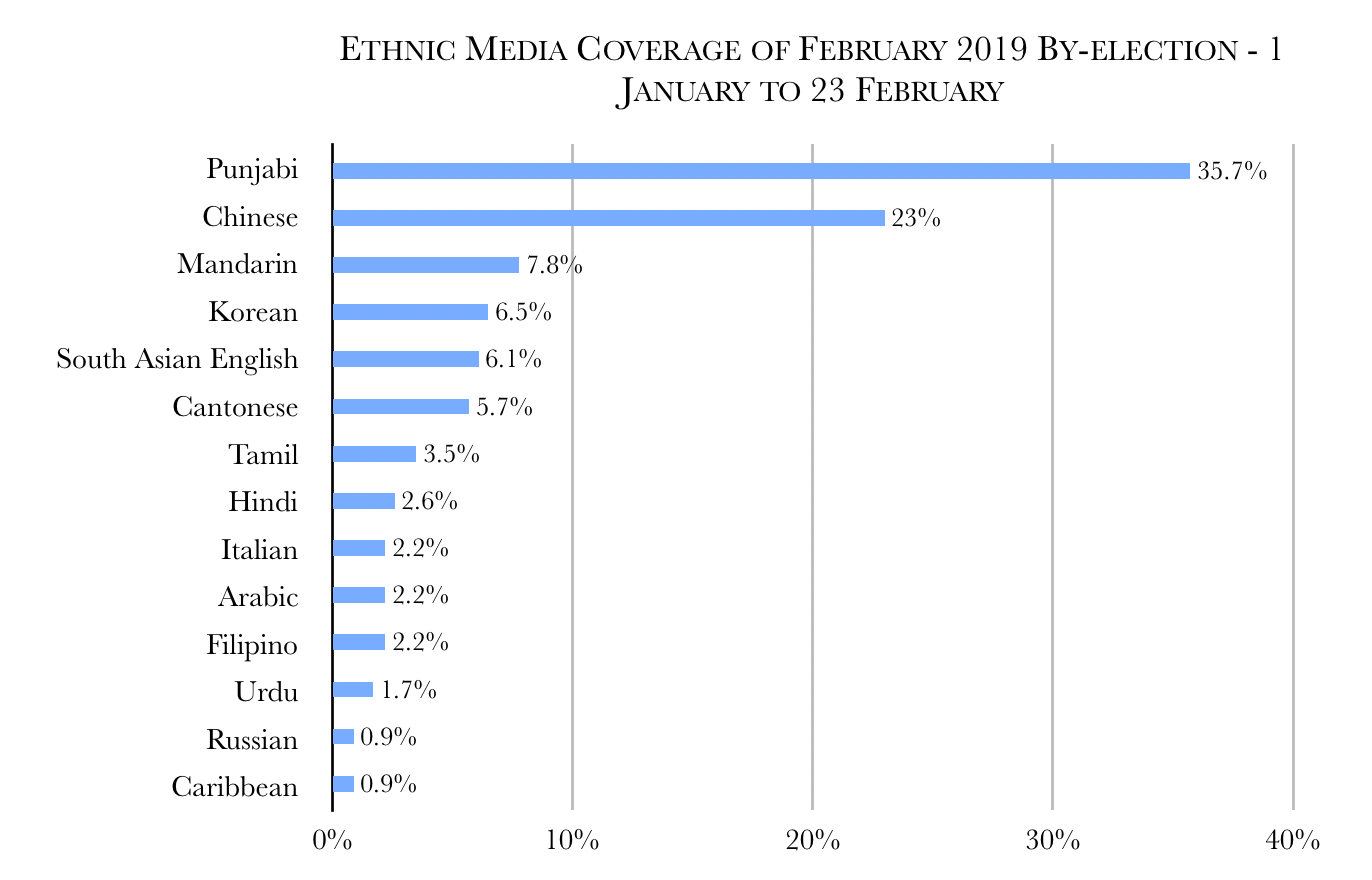
Ethic media is also picking up on the apparent attraction of some Chinese Canadians to the PPC (see the latest Diversity Votes — February By-elections: Matching Census Data with Ethnic Media Coverage (17-23 February 2019, last pre-election report):

Twenty minutes before the first Burnaby South byelection debate, a sudden influx of People’s Party of Canada supporters with shiny signs and newly minted pins filled all the remaining chairs in the room.

And they were ready to be heard, not just seen.

The following two debates — attended by roughly 100 people, on average — were dominated by this group’s grievances. They were louder and rowdier and far outnumbered the supporters of any other national party in the House of Commons.

The third debate descended into chaos when the topic of immigration arose, leading to finger-pointing and shrieking in the audience.

“Canadians first,” yelled several in the crowd, donning PPC pins. Roars from the crowd drowned out the candidates as others shouted “racist” and “fascist” in response.

This is one face of an increasingly visible populist movement in Canada. And experts say it’s not going anywhere any time soon. More and more, there is less common ground in what we consider to be Canadian values, and experts say the nation’s shift toward populism heralds a new chapter in Canada’s life. Political discourse is only expected to become more entrenched and vitriolic ahead of October’s general election.

Frank Graves is the president of Ottawa-based EKOS Research Associates. He’s been tracking what he calls “ordered populism” or what economists refer to as drawbridge-up thinking.

While populism can operate either on the left, right or even centre of the political spectrum, Graves said that is not what is emerging in Canada. Instead, it’s ordered populism which is bubbling up in the values of the right and far-right.

Its members are largely religious, have reservations about diversity, are deeply pessimistic about their economic future, are disdainful of media and government and are convinced that climate change matters far less than their own survival.

“What unifies populism is a dispute between the so-called pure people and the corrupt elite. And that is definitely what Trump, Brexit, Ford and the PPC is going after,” he told Star Vancouver.

Maxime Bernier, the leader of the PPC, is speaking a “far more authentic” version of what those in the ordered populist camp want to hear, Graves added.

“One of the big question marks for me (is) will that actually convert into impact in the next election?”

After a messy split with the Conservative Party last year following his loss in the leadership race, Bernier — an MP from Beauce, Que. and a former cabinet minister in the Stephen Harper era — announced the launch of the People’s Party of Canada, made official with Elections Canada this January. He’s since been touring the country.

Burnaby South’s Laura-Lynn Tyler Thompson — a former Christian radio host, anti-abortion activist and vocal opponent to British Columbia’s student education plan on sexual orientation and gender fluidity — was one of his first picks to run as a candidate. Her support could be an early indicator of the PPC’s chances in the upcoming general election.

Tyler Thompson will face off against federal NDP leader Jagmeet Singh — vying for his first seat in the House of Commons — Liberal Richard Lee, Conservative Jay Shin and independents Valentine Wu and Terry Grimwood on Monday in Burnaby South.

Byelections will also be held that day in York—Simcoe, Ont., a seat previously held by former Conservative cabinet minister Peter Van Loan, and in Outremont, Que. The latter riding was home to former NDP leader Thomas Mulcair.

Each time Tyler Thompson said “Canadians first,” — which occurred multiple times at every debate — the crowd would swell into visceral cheers. Thompson directly appealed to prevalent anxieties in the riding about public safety as she repeatedly brought up the case of Marissa Shen, a 13-year-old Burnaby South girl who was murdered in the region. A Syrian refugee, who was employed in Canada and had family here, is the accused. Allegations are still being tested in court.

Despite common assumptions that the populist movement camp is dominated by disaffected white males, Thompson’s supporters in Burnaby South are composed of a majority of Chinese-Canadians. She told the Star that’s because of her strong roots in some of the community’s churches.

In an interview with the Star on Thursday, Bernier said his party is indeed populist — but a “smart populist party.”

“Usually when you are a populist politician, you appeal to the emotion of people. I’m not playing with their emotion. I’m playing with their intelligence,” he explained, claiming the PPC is the only party with solid policy platforms. “We are the People’s Party working for the people … and I am proud of that.”

People are finding less and less common ground when it comes to Canadian values — and that is certainly going to matter in the upcoming election, Graves said.

While politics are often fickle and ever-changing, values change at a glacially slow pace. For instance, at the turn of the century Canadians were more “open” when it came to ideological orientation — which Graves said is a terrific predictor of values — 50 per cent of Canadians agreed that they were neither to the right or the left.

But now, Graves said that number has dwindled down to 10 per cent.

“Everybody has picked a side,” Graves said. “You live in two incommensurable Canadas, just as there’s two incommensurable Americas. And U.K. And Ontario. And that’s a daunting challenge.”

Values exist in the cultural realm and provide “moral goalposts” on what people prefer society to look like. Unlike discussions of policy issues, debates on values are emotionally engaging which is why Graves estimates the “narrative” of the right is beginning to dominate.

And on the left, the opposite end of the ideological spectrum, there has yet to emerge a populist movement with an equally emotive narrative. While the right begins to have its own conversations about values, Graves said the “open values” of the centre and left remain consistent between Liberals, NDP, and Greens.

Members of this “open society” outlook favour diversity, immigration, trade and globalization, are optimistic about the future, guided by evidence-based policy and believe that climate change is of high priority.

And the gaps between the two groups could not be larger, Graves said.

Source: How Canadian populism is playing out in the Burnaby South byelection

Diversity Votes — February By-elections: Matching Census Data with Ethnic Media Coverage (17-23 February 2019, last pre-election report)

For background data on the riding demographic, economic, social and political characteristics, see: February By-elections: Matching Census Data with Ethnic Media Coverage (1-18 January 2019). 

Note: While Chinese in the chart of ethnic media coverage refers to written media, Cantonese and Mandarin to broadcast oral media, I generally summarize all three as Chinese media except where indicated. 

Ethnic Media Coverage

All articles focussed on Burnaby South. Overall, coverage remained stable at 25 articles The chart below shows the by-election coverage by language from the start of the year. 

During the past week, Chinese (44 percent) and Punjabi (28 percent) media continued to comprise the majority of ethnic media coverage of the by-elections, with more articles in Korean media (16 percent) than in previous weeks.

Most stories focussed on NDP leader Singh’s campaign (7 articles, many focussing on his call for a public enquiry regarding the pressure placed on former Justice minister Wilson-Raybould regarding the SNC Lavalin case), PM Trudeau’s visit (6 articles) with Peoples Party of Canada leader Bernier’s visit also covered (2 articles in Mandarin media only). 

Stories of note included the dispute between PPC candidate Tyler Thompson and Conservative candidate Jay Shin regarding the PPC’s position on cannabis legislation (Chinese), the Conservative fundraiser in which he noted his challenge of wanting to be the first MP of Korean origin to be elected (Korean), the resignation of the NDP’s national communications director (Punjabi) and the lawsuit against the PPC against its use of the PPC name (Punjabi).

Two commentaries in Punjabi media focussed on the possible fall-out of the SNC Lavalin scandal, noting that recent polls had shown a decline for the Liberals. One commentary in Chinese media noted support for the PPC among Chinese Canadians, particularly regarding sex education, and that while the Conservative party appeared favoured to win the national election, Burnaby South Conservative candidate Shin had “almost no interaction” with the local community.

See the MIREMS blog for some of the stories being covered: MIREMS blog.

Next week news and commentary on the results.

A lot is riding on how we manage asylum seekers

Good overview of the challenges regarding to the increased number of asylum seekers with an almost wistful plea for increased federal-Ontario-Quebec cooperation.

No real discussion of what “workable solutions” to address the flow would entail or what form a greater formal provincial role in asylum seekers would entail apart from a “considerable injection of cash” (beyond what already provided in the Budget):

The next federal election is just eight months away. Immigration, and particularly asylum seekers and irregular border crossers coming from the US, is sure to be a thorny issue for the current federal government. These crossings, following on the heels of large numbers of Syrians seeking asylum in Europe, have stoked fears among many Canadians that the country is facing its own refugee “crisis.” Opponents have been quick to criticize the federal government, saying it is not doing enough to stem the flow of irregular border crossings. The Prime Minister’s rivals have repeatedly pointed to his January 2017 tweet saying that Canada will welcome those seeking refuge as the instigator of this increase in asylum claims. The Prime Minister faces stiff opposition from both his federal rivals and his provincial counterparts.

If Canada is to weather the inevitable ratcheting up of political rhetoric and the rise of anti-immigrant sentiment in the Western world, the federal and provincial governments will need to work together to manage asylum seekers. It is a tall order to ask politicians to take the high road and to find common ground on such a tricky file. It is even harder when immigration politics mixes with intergovernmental relations and fiscal federalism. But the survival of Canada’s immigration system may very well depend on it, and this election presents an opportunity for political leadership.

In 2018, 19,419 persons crossed the border between Canada and the United States outside of regular ports of entry. A majority did so with the hope of claiming refugee status in Canada. These movements are a reflection of the increasingly inhospitable global climate toward refugee resettlement and of the anti-immigration policies of U.S. President Donald Trump.

These border crossings are considered “irregular” because of Canada’s Safe Third Country Agreement with the United States, signed as part of a bigger package of reforms to coordinate border management policies after 9/11. Under the agreement, both countries are designated “safe third countries” because they allow and process refugee protection claims according to international standards and obligations. The core principle of the agreement is that persons should seek protection and asylum in the first safe country they arrive in. So, migrants who land first in the United States cannot claim asylum at a regular port of entry in Canada, and vice-versa. Significantly, the agreement does not apply outside of designated ports of entry. People crossing at locations that are not regular ports of entry, such as the now famous Roxham Road in Quebec, may therefore make asylum claims.

The well-publicized increase in total asylum claims over the past two years is not unprecedented in Canada: similar spikes occurred in the recent past. For example, there were 44,640 claims in 2001. But the numbers in the last two years are extraordinary: 50,390 claims in 2017 and 55,020 in 2018, a sharp rise from the recent low of 10,365 in 2013. The surge in crossings at non-designated ports has driven the increase: there were over 20,593 such crossings in 2017 and 19,419 in 2018. Arrivals are not distributed evenly across provinces; Quebec received more than 90 percent of “irregular” arrivals in 2017 and 2018, and Ontario is the destination of a large share of these individuals and families while they await status determination. In August 2017 alone, over 5,500 people crossed the border into Quebec. By 2018, though, the number of border crossers seemed to have levelled off to a more consistent flow of around 1,500 people a month.

The combination of drivers behind these arrivals means that there are no easy solutions to dealing with this new normal. Proposals range from making the entire border a port of entryto cancelling the Safe Third Country Agreement. Canada needs to find workable solutions that humanely manage the flow of asylum seekers crossing the Canada-US border without actively encouraging it.

While the focus is often on Ottawa’s response to asylum seekers, all three orders of government play critical roles. In addition to border security, the federal government is responsible for the initial intake and screening of asylum seekers, along with funding and managing their claims for refugee status. The provinces are responsible for providing housing and social services while people wait to hear if the Immigration and Refugee Board will approve their claims. Cities, particularly Toronto, face the significant challenge of having to find shelter space and provide on-the-ground services. For the system to work, the federal government has to take leadership and quickly process the claims to help resolve people’s status in Canada, while the provinces and municipalities provide the necessary support that allows them to settle into their new life and thrive in their communities. The sharp increase in asylum seekers in the past two years has exposed the weak points in the system and led to considerable federal-provincial conflict.

Conflict between the three main players — Ottawa, Quebec and Ontario — has largely defined the federal-provincial relationship in responding to the asylum issue. Quebec has been vocal in calling for support from Ottawa to help it deal with the costs associated with being the main point where the crossings are happening. Ontario — where a large portion of the asylum seekers are landing, particularly in the Greater Toronto Area — has repeatedly asked the federal government to help cover the cost of housing and social services for these individuals. Ottawa has dedicated approximately $150 million to help provinces and municipalities with the costs of resettlement, in addition to the estimated $1 billion it plans to spend over the next three years on processing asylum claims. It is also taking steps like reopening a previously closed Immigration and Refugee Board office to speed up processing. But these first moves have not gone far enough to resolve the tensions. The spat got so heated that Ontario pulled out of discussions on how to deal with the entire issue, a move that also signals the provincial government’s lack of desire to fully engage to find a mutually agreeable solution. The lack of engagement has led mayors from Toronto and other big cities to make their case directly with Ottawa.

This period of conflict is unusual. As our past research shows, immigration is an area where the federal and provincial governments have increasingly cooperated to develop policy. Throughout the 1990s and 2000s, the provinces expanded their role in selecting and settling migrants. And, in recent years, federal-provincial-territorial collaboration has been a defining feature of immigration policy. So, what is the difference when it comes to dealing with asylum seekers?

In the past, the provinces and the federal government largely agreed on the basic objectives of the immigration program. Expanding the provincial role in selecting migrants helped achieve a shared goal of streaming migrants away from settling mainly in Toronto, Montreal and Vancouver. It also helped ensure that the skills of migrants matched labour market needs. In short, there was a measure of consensus that the provinces needed to play a role in the program to ensure that the benefits of immigration were shared equally across the country and for migrants to succeed in their new lives. This consensus generated cooperation.

No such consensus on how to manage asylum seekers seems to have emerged yet. The lack of consensus reflects the traditional lack of provincial engagement in asylum policy, where the federal government has long taken the lead. Quebec, Ontario and Ottawa also have competing interests at the moment. Quebec is on the front line, and is understandably concerned with stopping irregular border crossings into its territory. Ontario — Toronto in particular — is facing a major challenge housing the influx of people. Ottawa is focused on dealing with the mounting backlog of refugee claims while ensuring the process remains rigorous and fair.

Politics, of course, is also playing into the conflict. Doug Ford wants to score points battling the federal Liberals. François Legault’s newly elected government is requesting that Ottawa support its plan to lower immigration levels and is asking for more powers under the 1991 Canada-Quebec immigration agreement. Justin Trudeau has built his brand on the value of pluralism and support for immigration, something that the Liberal Party has traditionally proposed must be achieved through centralization. These are difficult positions to reconcile. But political differences can be overcome to find workable solutions: the height of federal-provincial cooperation on immigration came when there was a Conservative federal government and Liberal governments in Ontario and Quebec.

The federal and provincial governments must work together once again. Their shared goal should be a balance between protecting the integrity of our immigration system and treating asylum seekers with compassion. Strong federal leadership is necessary to achieve this goal, along with a clear recognition of the interdependence of all three orders of government in successfully managing the file. The federal government needs to inject considerable cash into the entire system, chiefly focusing on speeding up the processing of asylum claims. Ottawa controls the principal levers, direct and indirect, to manage the influx of migrants — and so it needs to work with the provinces to find common ground on how it should wield these tools.

A federal-provincial agreement on the broader policy approach, as well as on funding the resettlement of claimants, would help establish this common ground. But this agreement needs to be more than a blank cheque from the federal government. The provinces must accept that they have a role and responsibility in supporting asylum seekers. If the benefits of economic migration are to be shared by all — as the provinces have fought hard for over the years — then the responsibility to assist humanitarian migration also needs to be shared by all.

Canada’s enviable immigration system relies on the public’s support. This backing is not the result of some unique Canadian openness to multiculturalism and pluralism — though these are important parts of our national identity. The public largely supports immigration because it is seen to be in the interests of the entire community. It is mainly a controlled process, bringing in skilled workers and family members.

Canada’s geopolitical position, with vast oceans on three sides and a relatively stable democracy to the south, means that the country has not been subjected to massive flows of asylum seekers. But this is a fragile situation. If the current and next governments don’t handle the new normal of consistent flows of asylum seekers properly, public support could erode, and the legitimacy of the entire Canadian immigration system could be put in jeopardy.

Source: A lot is riding on how we manage asylum seekers

Hearings on Quebec’s immigration bill stall as politicians hurl mud

Sigh. Should be possible to have agreement on witnesses with a range of views:

The province’s largest employer group says the government has bungled its immigration reform by failing to manage the thousands of applicants already in the hopper who hope to live and work in Quebec.

Without overtly criticizing the government for deciding to shred the files of 18,000 immigration applicants, the normally cautious Conseil du patronat du Québec said Thursday it “deplored” the lack of a transition plan to help people left on the sidelines in Quebec’s zeal to reform the system.

As it is, the Coalition Avenir Québec government has created a climate of uncertainty at a time when the province desperately needs workers and there are 118,000 employment vacancies.

Rather than being seen as an opportunity, the reforms are seen as a threat, the Conseil said in a brief presented to a committee of the legislature studying the CAQ’s immigration reform legislation, Bill 9.

“This undermines Quebec’s credibility on the international stage and reinforces cynicism towards our immigration system,” the Conseil said in its brief.

“The impact for employers has been major,” Conseil president Yves-Thomas Dorval told the committee later. “In reality, we need lots of people.”

Asked by an opposition party MNA if Quebec should have held off on plans to shred the files, Dorval was curt: “Ask the government that question.”

The Conseil’s blast was the least of Immigration, Diversity and Inclusiveness Minister Simon Jolin-Barrette’s troubles Thursday, as hearings into the bill — required by law — almost didn’t get off the ground.

In fact, the committee room was vacant for most of the day as an epic procedural battle — including choice mudslinging — unfolded between the CAQ and the opposition Liberals.

At issue officially was the list of people to be heard by the committee, but the background theme was pent-up mistrust between the two parties that resulted in the legislature being paralyzed for several hours.

Jolin-Barrette lashed out at the same time as saying the government is not trying to muzzle the ample opposition to the bill, which will be before the courts Friday as immigration lawyers seek an injunction to block it.

“The Liberals do not seem to have understood the message sent by the population: put an end to your arrogant ways,” Jolin-Barrette told reporters. “Quebecers sent them to the opposition benches to reflect, so it’s time they sat there and started reflecting.

“They refuse to put a bit of water in their wine to ensure the legislature works.”

Not so fast, responded Liberal interim leader Pierre Arcand, accusing the government of wanting to rig the sessions to avoid hearing from people opposed to the bill.

“We are now embarking into a judicial imbroglio (on the immigration issue), which is harming Quebec’s international image,” Arcand said. “The government can’t act in good faith on this issue because its ideology prevents it.

“It wants to hear from groups saying its bill is good.”

And so the war continued, leading Québec solidaire house leader Gabriel Nadeau-Dubois to say they were “fighting like cats and dogs.”

“Ludicrous,” added interim Parti Québécois leader Pascal Bérubé.

The list of witnesses had been in flux for days, with clerks handing out update after update all week.

The city of Quebec was supposed to address the committee Thursday morning, only to cancel, saying it did not have time to prepare.

At the last minute, the government tried to replace it with an appearance by the Barreau du Québec, which answered that with 24 hours’ notice they did not have enough time to prepare a brief either.

At 11 a.m. Thursday the two sides were still squabbling — even over when to break for lunch. When Jolin-Barrette proposed a delay to his opening remarks because there were no groups available to appear after him, the Liberals refused.

The committee finally got rolling at 3 p.m., hearing from veteran economist Pierre Fortin, who waded into the issue of how many immigrants Quebec welcomes a year.

He said a massive increase of immigrants will not solve Quebec’s labour shortages, but a more selective process — matching people with jobs in advance — makes sense. The CAQ is proposing just that.

A big influx could be more harmful because it would exceed Quebec’s ability to socially and culturally integrate them, Fortin said: “If we push too far, we fan the flames of intolerance.”

He said a bigger question for companies in Canada is how to put an end to the rampant discrimination when it comes to hiring immigrants.

As if to prove Jolin-Barrette’s point on not muzzling the opposition, the first group appearing before the committee next week is Quebec’s association of immigration lawyers, which is leading the legal challenge to the bill.

Source: Hearings on Quebec’s immigration bill stall as politicians hurl mud