Douglas Todd: Chinese students’ river of cash unlikely to dry up

Speculation, of course, but my guess:

A business college at the University of Illinois has taken out an insurance policy against the potential catastrophic loss of revenue from high-fee-paying students from China.

Educators and social-media commentators are expressing fears the river of money flowing from Chinese students into Canada, the U.S., Britain and Australia will dry up because of a brewing trade war and the arrest in Vancouver of Huawei’s chief financial officer, Meng Wanzhou.

The government of China has said it has more than 600,000 students studying abroad, the vast majority of them in English-language countries. Highly desired Canada has more than 186,000 of them, according to China’s Toronto consulate (the federal government’s figure is slightly lower). That means China’s young people make up roughly one in three of all 500,000 international students in Canada.

Despite China’s ambassador to Canada last week hammering English-speaking countries as “arrogant” and rife with “white supremacy” for their defence of Meng’s arrest, there is no sign that China’s leaders are ready to follow the lead of Saudi Arabia’s rulers, who reacted to Canada’s human rights comments last year by calling back most of the Saudi students in Canada.

“I don’t think the Chinese will be as petulant as the Saudis were, or as unsophisticated, although they may make more subtle changes over time,” Andrew Griffith, a migration researcher and former senior director in Canada’s Immigration Department, said.

Canada could even attract more Chinese students in the future in part because the number entering the U.S. appears to be flattening out, possibly because of President Donald Trump’s rhetoric about China and immigrants. That’s why Illinois business college dean Jeffrey Brown, realizing his school had become highly dependent on Chinese students’ money, took out an insurance policy with Lloyd’s of London.

Canada hosts eight times more Chinese students per capita than the U.S., suggesting this country’s educational institutions are more dependent on, if not addicted to, their fees than U.S. colleges. Some higher-education researchers are calling the phenomenon “academic capitalism.”

It’s the expanding trend in English-language countries to make up for steadily eroding taxpayer funding of schools, colleges and universities by capitalizing on the full fees paid by students from mostly well-off families from around the world, with China providing by far the biggest group.

Some Canadian educators, and researchers like Mengwei Su and Laura Harrison of Ohio University, say the intense concentration of Chinese students in Western schools brings with it drawbacks, however, mainly for the students themselves.

Even though Western universities welcome Chinese students as “a particularly lucrative market,” Su and Harrison found many of the young Chinese struggle with English and integrating into Western culture — partly because they are ending up in classrooms and living situations dominated by other students from China.

“Seventy per cent of the students in my class are from China,” one Chinese student told the Ohio researchers, describing the sense of social segregation. “The class is not much different from that in our country,” said another Chinese pupil. One young woman from China opted to study in the Netherlands rather than North America, saying, “I want to avoid too many Chinese students.”

Against a backdrop in which the taxpayer-funded proportion of the operating budgets of B.C.’s public universities has drastically declined in recent decades, more than half the foreign undergraduate students at Simon Fraser University, more than 2,700, now come from China.

The University of B.C. has 5,000 students from China, almost one third of its international student population. Scores of public high schools, colleges and two-room private language institutes also take in hefty fees from the roughly 50,000 Chinese students in B.C., mostly Metro Vancouver.

The dark blue at the top of this chart indicates more than half the undergraduate international students at Simon Fraser University since 2011 have come from China. (Source: SFU)

The federal Liberal government is busily wooing more Chinese students, however. Immigration Minister Ahmed Hussen is following the enthusiastic lead of former minister John McCallum and saying “We’ll do whatever we can” to bring in an increasing number of students from China.

Hussen maintains international students in Canada, whose numbers have been recently jumping by roughly one quarter annually, funnel $11.6 billion a year into Canada’s economy, adding they also enhance “cultural exchange.” To make it easier for more Chinese students to jet across the Pacific Ocean to Canada, the Liberal government recently opened seven new visa centres in China. Hussen acknowledged such students can contribute to the housing and rental squeeze in cities such as Toronto and Metro Vancouver, particularly since many offshore parents buy Canadian homes for their offspring.

Immigration Minister Ahmed Hussen says “We’ll do whatever we can” to bring in an increasing number of students from China.

Western “higher education institutions are slowly evolving into a corporate-like enterprise that pursues monetary gains, at times eclipsing their educational mission,” write Su and Harrison, of Ohio University, echoing growing sentiment among scholars of higher education.

The Ohio researchers found a key financial problem is that some overseas recruiting “agents” are exploiting international students, with more than half the Chinese students they surveyed hiring these advisers to navigate their complicated route to the West.

The trouble with agents dominating the field of global education, according to Su and Harrison, is many are providing misinformation to students, steering them to inappropriate schools and not warning them about how difficult it will likely be to learn workable English. Many students get stuck in never-ending English-remediation classes.

To root out abuse and increase overseas families’ trust in such agents, Australia, New Zealand, Britain and Ireland have developed a code to regulate them, say Thompson Rivers University researchers Victoria Handford and Halying Li.

But Canada has not signed on to the protocol, which is designed to ensure the agents behave more ethically.

Meanwhile, Canada’s recruiting continues apace.

Source: Douglas Todd: Chinese students’ river of cash unlikely to dry up

‘Bizarre, heavy-handed: Councils push back on changes to Australia Day citizenship ceremonies

Ongoing Australian debates, political positioning and virtue signalling continue to amaze me. That being said, we are seeing some similar pressures from Indigenous peoples here in Canada (Canada celebrates 150 but indigenous groups say history is being ‘skated over’):

The federal government has revised the citizenship code to make it compulsory for all councils to hold citizenship ceremonies on Australia Day – but some councils say the Morrison government should have consulted rather than applying a “heavy-handed and odd” approach.

Under changes to the Australian Citizenship Ceremonies Code to be introduced in 2020, councils will also have to hold a second citizenship ceremony on September 17 – Australian Citizenship Day – and new citizens will have to abide by a strict dress code that bans boardshorts and thongs.

The revised code will be sent to councils this week, Immigration, Citizenship and Multicultural Affairs Minister David Coleman announced.

“Australian citizenship is an immense privilege and fundamental to our national identity,” Mr Coleman said.

“As part of this update, the government will require that citizenship ceremonies be held on Australia Day across the nation.

“New citizens should be given the opportunity to become an Australian on our national day – Australia Day is an incredibly important part of our national calendar.”

On Sunday, Prime Minister Scott Morrison said the government will “protect our national day and ensure it is respected”.

“We believe all councils who are granted the privilege of conducting citizenship ceremonies should be required to conduct a ceremony on Australia Day,” he told the Sunday Telegraph newspaper.

In 2017, two Melbourne councils were stripped of the right to hold citizenship ceremonies after scrapping all Australia Day celebrations to recognise Indigenous sensitivities. Yarra City Council and neighbouring Darebin Council cited a groundswell of popular support for the move but were slapped down by the government.

Amid a growing push from some corners to change Australia’s national from January 26, several councils have already made plans to move or cancel traditional celebrations this year.

Victoria’s Darebin, Yarra and Moreland, Western Australia’s Fremantle and NSW’s Byron have already flagged a change of date, because January 26 is considered a day of mourning by many Indigenous and non-Indigenous people.

City of Sydney Labor Councillor Linda Scott said councils had an obligation to listen to community sentiment.

“The job of local governments is to listen to their communities and represent their views,” she told SBS News.

“Councils should be able to set the day of their citizenship ceremonies in line with the views of their community.”

She said other councils had shifted citizenship ceremonies from January 26 because of extreme heat, a lack of new citizenship applications or because of cultural sensitivity.

Australian Local Government Association president Mayor David O’Loughlin said most councils likely won’t be opposed to the government’s proposed changes to the Australian Citizenship Ceremonies Code but councils will have valid concerns.

“Most councils hold more than one citizenship ceremony a year, some as often as monthly – the Federal Government’s strong focus on drawing a link between Australia Day and citizenship ceremonies is bizarre,” he said.

“We do acknowledge that a small number of councils are in discussions with their communities about whether the 26th of January is the appropriate day to celebrate Australia Day.

“However, councils cannot move Australia Day – this is ultimately up to the Federal government – but it is our job to be responsive to our communities, including to their calls for prudence and advocacy.”

He said if the Morrison government had “bothered to consult” with council it would have found many Local Government Areas forgo citizenship ceremonies on Australia Day because of the heat.

“In some locations, it’s simply too hot for councils to hold ceremonies during the day, so they do it the evening before, just as the Federal Government does with its Australian of the Year Ceremony,” he said.

“Interestingly, the federal government has made no mention of any financial contribution towards the additional costs involved in running these ceremonies.”

More than 73,000 people have become Australian citizens on Australia Day in the past five years, according to government figures – despite there being no specific requirement for councils to hold ceremonies on January 26.

City of Darebin’s Mayor Susan Rennie told SBS News her council “will not be marking January 26 by holding any events on that day or surrounding days” for a second year running.

Ms Rennie said Darebin is “opposed to Australia’s national celebration being held on January 26 out of respect for local Aboriginal and Torres Strait Islander peoples, who have told us that they experience a day of sadness, pain and disconnection”.

Source: ‘Bizarre, heavy-handed: Councils push back on changes to Australia Day citizenship ceremonies

UK: Sadiq Khan demands plan to charge EU nationals to stay in UK changed

Bringing the London perspective to the UK immigration debate:

Sadiq Khan has written to the government to demand changes to its planned post-Brexit immigration policy, saying that forcing long-established EU nationals to pay fees to stay showed ministers had not learned the lessons of Windrush.

In a letter to the home secretary, Sajid Javid, the Labour mayor said the wider immigration policy, including plans to restrict immigration to people earning above £30,000 a year, would badly damage London’s economy.

Khan has been a critic of Theresa May’s Brexit plans. He also differs from official Labour policy on the subject, supporting a second referendum.

In the letter, Khan said the immigration white paper, published just before Christmas, was disappointing in content and tone. “The promised ‘new conversation on immigration’ is off to a poor start,” he wrote.

The mayor criticised the £65 fee millions of EU nationals will need to pay to apply for so-called settled status, likening it to errors that saw some members of the Windrush generation targeted for immigration enforcement when they could not prove their status.

“There are hundreds of thousands of young people who were born in the UK or, like the Windrush generation, brought here as young children, who are prevented from participating in the economic, social and political life of the UK by the prohibitive cost of applying for leave to remain or citizenship,” Khan wrote.

“While the previous home secretary rightly waived fees for the Windrush generation, the government clearly has not learnt the wider lessons. There are many others still at risk from the same policies that led to the Windrush generation experiencing discrimination, destitution, and deportation.

“The Home Office now faces the unprecedented task of registering 3.4 million EU citizens resident in the UK. Many people will find this process inaccessible and unaffordable. As a matter of fairness, the government should waive the settled status fee for EU nationals and their families who were resident in the UK before the referendum took place.”

Khan also argued that the plan to restrict immigration to skilled people with salaries of £30,000 or more “simply won’t allow London to continue to grow its economy and provide crucial public services”.

The mayor added that the official “shortage occupation list”, which would help people move to the UK to take roles that need to be filled, should be expanded to assist the needs of London, and possibly devolved to the city.

Jasmine Whitbread, the head of London First, a grouping of leading employers in the capital, said a decision to reduce the minimum salary to the London living wage, currently £20,155, would “avoid a recruitment cliff-edge, keep the UK open to a range of skills, and ensure workers are decently paid”.

Source: Sadiq Khan demands plan to charge EU nationals to stay in UK changed

Visible minorities form majority in 41 federal ridings, but experts say immigrants are politically diverse

Overview of some of the issues:
Abdikheir Ahmed vividly remembers casting his ballot for the first time in Winnipeg’s 2010 municipal election. Not only was he excited, he had an entourage.

“I brought my family. I brought my kids. I brought everyone,” Ahmed said. “It was the first time in my life that I voted.”

The 39-year-old Winnipeg resident arrived in Canada from Somalia as a refugee in 2003. It took several years before he could legally vote as a Canadian citizen, but he was eager to do so.

“I feel that I have a responsibility to decide the direction that this country goes in,” said Ahmed.

Now, he runs Immigration Partnership Winnipeg, an organization that helps immigrants and refugees get settled in that city. Visible minorities make up one-quarter of the population in Winnipeg, according to Statistics Canada, though not all are recent immigrants.

Volunteers with Immigration Partnership Winnipeg launch the ‘Got Citizenship? Go Vote!’ campaign in August 2018. (Submitted by Immigration Partnership Winnipeg)

It’s become conventional wisdom in Canadian politics that immigrant voters can have a powerful influence in elections.

According to Ahmed, immigrants — new or long-settled — are a potentially powerful block of voters.

“It actually makes sense to court the so-called immigrant vote because that is the determining factor, and it’s a growing population,” said Ahmed.

But as the battle begins for this year’s federal election, experts say no party has a monopoly on any particular ethnic group or religious minority.

Myth or reality?

Canada’s major parties have been competing for immigrant voters since the 1960s, according University of Toronto political science professor Phil Triadafilopoulos.

“The main sources of immigration were different then, but the dynamics were very similar. It’s an urban Canadian story,” said Triadafilopoulos.

In the 2019 federal election, ridings in Toronto and Vancouver are considered key battlegrounds that can make-or-break a party. Both have high Chinese and South Asian populations.

But they aren’t the only cities where politicians are courting ethnic voters.

Certain very racist policies, like the Barbaric Cultural Practices Act and tip line … woke up communities to actually say, ‘We cannot tolerate this in our country.’– Abdikheir Ahmed, Immigration Partnership Winnipeg

Andrew Griffith, a fellow of the Canadian Global Affairs Institute and the Environics Institute, says data on immigration and ethno-cultural diversity from the 2016 census shows many Canadian communities now have a larger percentage of visible minority residents than in 2011.

Of 338 federal ridings in Parliament, 41 have populations where visible minorities form the majority, compared with 33 five years earlier.

“Parties, when they’re developing their electoral strategies, take that into account in terms of how they advocate policies and programs to attract them,” said Griffith.

What’s more difficult is pinning down whether immigrant voters have partisan preferences.

New Canadians could once be counted on to vote Liberal, ever since Pierre Trudeau opened the door to more immigration in the 1970s, but that unwavering endorsement became less pronounced over the past decade.

Griffith says recent polling data suggests some ethnic communities still lean toward certain parties. Sikh-Canadians, for example, have a “general tendency” to vote Liberal and NDP, while Conservatives enjoy more support among Chinese-Canadians.

But, Griffith cautions, “We should never make the assumption that all members of the community are identical and behave the same way, whether it be in the polling booth or in other aspects.”

Encouraging newcomers to vote

In Winnipeg, Ahmed says it shouldn’t even be assumed new immigrants will exercise their franchise. He’s working to mobilize visible minority and newcomers who have earned citizenship to vote in this year’s federal election.

“Many newcomers have never voted in their own countries or have engaged in electoral processes that are not transparent, so do not actually trust the process and don’t see the importance of voting in it,” said Ahmed.

To encourage refugees and immigrants to vote in last fall’s municipal election, Ahmed’s non-partisan group launched a electoral campaign with the slogan “Got Citizenship, Go Vote.”

Immigration Partnership Winnipeg developed posters and videos on how and where to vote that were translated into 12 different languages, and concentrated on ethno-cultural community organizations to get the message out.

Ahmed’s impression is that immigrants don’t vote in blocks, but he says ethnic communities will respond electorally if they feel targeted by an issue.

For example, when the federal Tories campaigned in 2015 on policies such as banning the niqab at citizenship ceremonies or setting up a “barbaric cultural practices” tip line, Ahmed says it spurred newcomers to vote against them.

“The messaging from the Conservative Party came across as anti-immigrant,” said Ahmed.

“Certain very racist policies like the Barbaric Cultural Practices Act and tip line … woke up communities to actually say, ‘We cannot tolerate this in our country.'”

It’s a point echoed by Triadafilopoulos, who suggests large numbers of immigrant voters is one of the reasons Canada has not experienced the same kind of xenophobic populism sweeping Europe and the United States.

“The demographic and institutional facts [in Canada] just make it a losing proposition,” he said.

Source: Canadian politicians will court the ethnic vote, but will it benefit any one party?For years, the Liberals could count on votes from immigrant communities, but with visible minorities a majority in 41 federal ridings, experts say that newcomers are politically diverse — and offer no guarantees for any one party.Cross Country Checkup |3 hours ago|

NP View: Racism lurks in the supposedly ‘woke’ Liberals’ new impaired driving laws

Valid parallel to the biases of carding:

Has the self-styled “party of the Charter,” as Prime Minister Justin Trudeau still, curiously, calls the Liberals, actually even read the Charter? Have the Liberals, for that matter, paid much attention to what their own prime minister has been saying?

Canada’s impaired driving laws underwent a major overhaul last month, courtesy of the federal Liberal government. Some of the changes were necessary to recognize the changed reality of legalized cannabis. Others were simply intended to further reduce rates of impaired driving, by drug or alcohol, on our roads. This is a goal everyone shares — impaired driving is the leading criminal cause of death in Canada, way ahead of anything else. It’s a stubborn problem that governments are right to try to address, particularly a government that has recently legalized a whole new category of intoxicant.

But the new laws have given to police significant new powers. In a free society, that’s never something to be done lightly. And in this particular case, what is being done is especially bizarre because the Liberals are now insisting that such powers will not be abused even while insisting, in a slightly different context, that they inevitably will be.

One of the new powers given to police is the right, under certain circumstances, to demand a breath sample from someone who has not provided any sign that they might be impaired. Previously, a police officer needed at least some grounds to insist on such a test — the officer could have observed erratic driving before pulling the car over, for instance, or suspected a whiff of alcohol on a driver’s breath. Under the new law, a driver stopped by police for any lawful reason whatsoever (which is a very low bar) may be subjected to a breath test. Refusing to provide one is itself a criminal offence. Canadians effectively have no choice but to comply.

This is a meaningful expansion of police search powers, and it will absolutely be challenged — hopefully successfully — as a violation of Canadians’ fundamental protections against unreasonable searches. This is also an expansion of police authority that the Liberals were explicitly warned would result in abuses of power, most likely taking the form of racial discrimination. “There will be nothing random with this breath testing,” defence lawyer Michael Spratt told a parliamentary committee reviewing the bill before it became law. “Visible minorities are pulled over by the police more often for no reason. That’s what is going to happen here.” The Canadian Civil Liberties Association sounded a similar warning in its own filing, writing, “Experience has also unfortunately demonstrated that ‘random’ detention and search powers are too often exercised in a non-random manner that disproportionately targets African-Canadian, Indigenous, and other racial minorities.” It continued, “… the reality of racial profiling and the increased invasiveness that attends a mandatory alcohol screening means that the practice will adversely impact those disproportionately targeted by police for vehicular stops, in particular African-Canadian, Indigenous, and other racial minorities.”

The ratcheting-up of systemic racism might normally be an issue you would expect the gloriously woke federal Liberals to be falling all over themselves to fix, or at least to tweet piously about. That’s not the case here. The Liberals have readily acknowledged that they expect that this new law will be challenged in court, but say they will defend it, and are confident it will survive the challenges.

There’s reason enough to be alarmed at the expanded use of police powers, even if they weren’t bound to be targeted disproportionately at racial minorities. Random, groundless searches conducted by whim of the authorities are manifestly a gross violation of Canadians’ fundamental rights. Now that the law is finally being used, there are already unsettling stories of such mandatory searches starting to emerge: Global News reported this week that a Toronto-area man, who was not in the slightest bit impaired, was given a breath test after a police officer observed him returning empty beer bottles to a store for recycling, as if he’d knocked them all back on the way over in his car.

But the thing that makes this so especially strange is how the Liberals, not long ago, were embracing the very same arguments they now say concern them not at all. During the run-up to the legalization of cannabis, no less an authority on right-thinking Liberal values than Justin Trudeau himself explained that it was important that Canada legalize cannabis because of — wait for it — racial factors, that saw police applying marijuana laws with disproportion and discrimination against minorities. The prime minister even shared an anecdote about how his own late brother, Michel, after being arrested for possession of cannabis, was able to have that charge quietly taken care of. It helps to be a powerful white guy, the prime minister confessed, especially one as well-connected as the son of a prime minister. “That’s one of the fundamental unfairnesses of this current system is that it affects different communities in a different way,” he said in 2017, acknowledging that random screenings are rarely truly random, and that discretion is rarely equally applied.

The prime minister was right. So was Mr. Spratt and the CCLA. Beyond the basic offence to everyone’s rights constituted by such random and baseless searches, these expanded police powers will obviously be applied unevenly, and that is fundamentally unfair. Why was that so true for cannabis that the prime minister used it to justify why legalization was necessary, but the Liberals deem it to be of no concern whatsoever for impaired driving?

Source: NP View: Racism lurks in the supposedly ‘woke’ Liberals’ new impaired driving laws

Doug Saunders: The politics of border-crossing bogeymen are unwise – and dangerous

Valid points:

There’s a trick, long known to certain politicians, to get an electoral boost when you’re down in the polls: You declare that dangerous people are about to come across the border, and you latch onto a conspiracy theory claiming that the other political party, or some dark forces associated with them, are responsible.

It can be an effective tactic. Immigration is often a popular election issue, especially when it’s mixed with atavistic fears of mysterious predators entering your territory. It is also a profoundly dangerous tactic.

On Wednesday night, we heard the U.S. President attempt this trick, for the umpteenth time. Americans, Donald Trump declared in an address, are being “raped, murdered and beaten to death with a hammer” by nefarious figures streaming across the southern border, and “thousands more lives will be lost if we don’t act right now” to build his wall.

Never mind that the threat is an utter fiction – illegal border crossings from Mexico to the United States are at their lowest rate in almost half a century, and those who make the crossings are measurably less murder-prone than Americans.

It’s also based on a wild conspiracy theory. Mr. Trump has repeatedly told voters that migrants approaching the U.S. border include “criminals and unknown Middle Easterners,” as well as terrorists, even though his own immigration officials deny this. He’s said that their march on the border is being funded by mysterious Democratic-linked forces; in October, he publicly endorsed an anti-Jewish conspiracy theory blaming Hungarian-American philanthropist George Soros for the “caravan.”

But Canadians can’t watch this with any sense of superiority. For the first time in decades, this tactic has crept into mainstream Canadian politics.

Conservative leader Andrew Scheer shocked many members of his own party last month by taking up a cause that had emerged from the fringes, denouncing a United Nations document known as the Global Compact for Safe, Orderly and Regular Migration.

That document, if you bother to read it, is an anodyne, purely symbolic statement of principles intended to reduce overall immigration numbers, and especially to discourage irregular – that is, illegal – immigration. Like other such UN compacts, its main purpose is to provide principled-sounding statements for preambles of other documents.

Instead, Mr. Scheer claimed that the Compact “gives influence over Canada’s immigration system to foreign entities.” He then denounced the “crisis at our borders” and “chaos at our borders” caused by “illegal border crossers” – suggesting that cross-border chaos, danger and criminality would be products of this document.

Where did this weird theory come from? As Laurens Cerulus and Eline Schaart found out in an investigation this week for Politico, it was the product of a calculated social-media campaign by “a coalition of anti-Islam, far-right and neo-Nazi sympathizers” based in Europe. It was taken up in September by far-right parties in Europe, and by figures in Mr. Trump’s circle.

Mr. Scheer’s decision to join Mr. Trump in picking up this ugly thread might have seemed like an expedient way to turn immigration fears into anti-Liberal sentiment. Yet, the larger danger of such conspiracy theories is not just that they are absurdly false – but that some people really believe them.

In October, 11 people were shot to death in a Pittsburgh synagogue by a man shouting anti-Semitic slogans. To judge by his social-media posts and statements, the alleged shooter, Robert Bowers, had come to believe that criminal migrants headed to the Mexico-U.S. border were being funded and supported by Mr. Soros and other Jewish figures and organizations – the same conspiracy theory Mr. Trump endorsed. A few days earlier, a Trump supporter in Florida had sent pipe bombs to Mr. Soros and other Democratic-linked figures in apparent support of this theory.

These incidents, and others like them, followed a 2011 massacre in Norway orchestrated by Anders Breivik, who killed 77 people – many of them children – because he had come to believe a theory, promoted by European right-wing politicians, that “globalists” and “cultural Marxists” (including his victims) were conspiring to bring in threatening Muslim immigrants.

That conspiracy theory has now reached Canada. In January, 2017, Alexandre Bissonnette walked into a Quebec City mosque and shot 19 people, killing six. In his police interview, he said he had been spurred to action after watching reports about Mr. Trump’s proposed Muslim ban, and after hearing conspiracy theories about Canada’s Syrian refugees. “I saw that and I like lost my mind,” he said. “I don’t want them to kill my parents, my family.”

Nobody but these killers themselves are responsible for their actions. But they all had been led to believe fictions about border-crossing bogeymen and the figures who supposedly back them. Given the dangerous implications of such inventions, to amplify them in the name of momentary political gain wouldn’t just be profoundly unwise. It would be absolutely reckless.

Source: The politics of border-crossing bogeymen are unwise – and dangerous

Trump Claims There Is a Crisis at the Border. What’s the Reality?

Good analysis of the numbers:

President Trump has frequently called the situation at the southern border with Mexico a crisis and insists that building his long-promised border wall will fix it. Here are some of Mr. Trump’s most common assertions of a crisis, and the reality of what we know about immigrants and the border.

“We can’t have people pouring into our country like they have over the last 10 years.”

THE REALITY Illegal border crossings have been declining for nearly two decades. In 2017, border-crossing apprehensions were at their lowest point since 1971.

Total number of arrests for illegally crossing the Mexican border

Undetected illegal border crossings have dropped at an even faster rate, from 851,000 in 2006 to approximately 62,000 in 2016, according to estimates by the Department of Homeland Security.

However, there is one group of migrants that is on the rise: families. A record number of families have tried to cross the border in recent months, overwhelming officials at the border and creating a new kind of humanitarian crisis.

Number of arrests for illegally crossing the Mexican border

Asylum claims have also jumped, with many migrant families telling officials that they fear returning to their home countries. Seeking asylum is one way to legally migrate to the United States, but only 21 percent of asylum claims were granted in 2018, and many cases can take years to be resolved.

“Every week, 300 of our citizens are killed by heroin alone, 90 percent of which floods across from our southern border.”

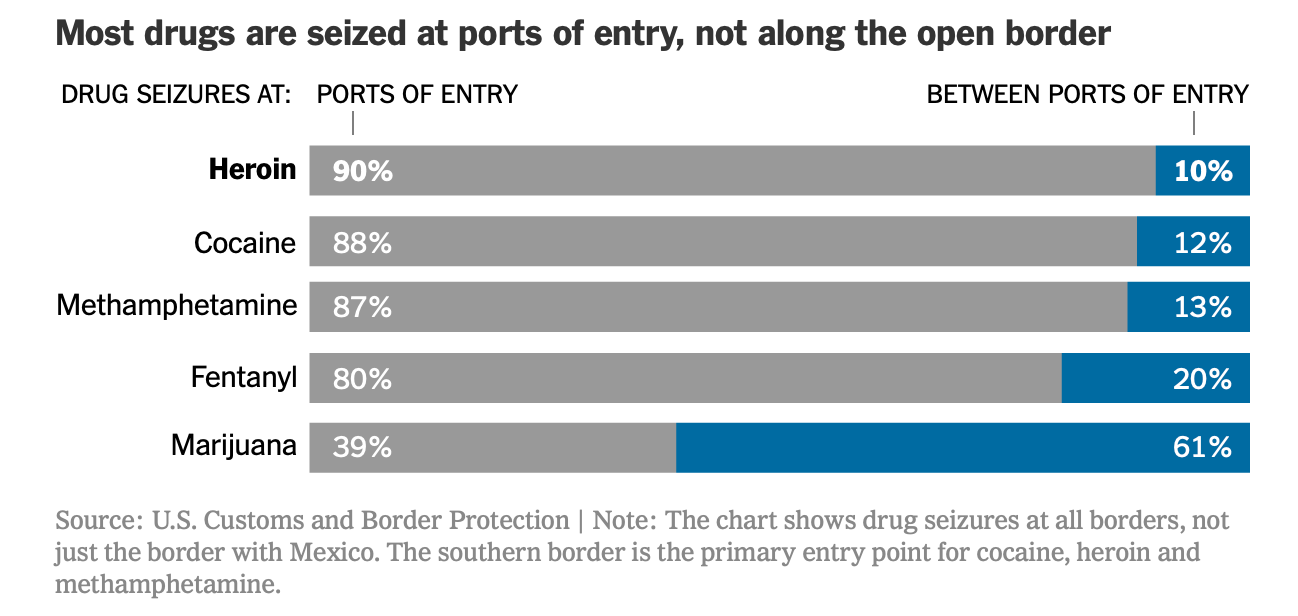
THE REALITY It is true that the majority of heroin enters the United States through the southern border, according to the Drug Enforcement Administration. But the D.E.A. also saysthat most heroin is brought into the country in vehicles entering through legal border crossings, not through the areas where walls are proposed or already exist.

Most drugs are seized at ports of entry, not along the open border

There are more than two dozen ports of entry along the southern border. Barriers are already present in Border Patrol sectors with the highest volumes of heroin seizures.

“Over the years, thousands of Americans have been brutally killed by those who illegally entered our country, and thousands more lives will be lost if we don’t act right now.”

THE REALITY It is difficult to assess the president’s claims that illegal immigration leads to more crime because few law enforcement agencies release crime data that includes immigration status. However, several studies have found no link between immigration and crime, and some have found lower crime rates among immigrants.

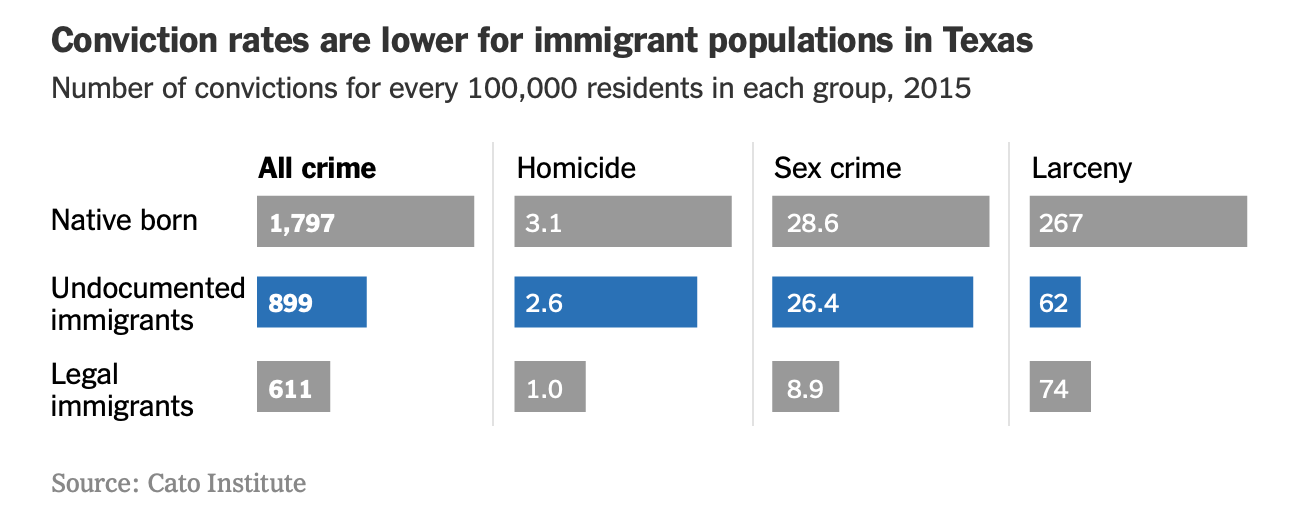
Texas, which has the longest border with Mexico and has one of the largest populations of undocumented immigrants of any state, keeps track of immigration status as part of its crime data. The Cato Institute, a libertarian research center, analyzed the Texas data in a 2015 study and found that the rate of crime among undocumented immigrants was generally lower than among native-born Americans.

Conviction rates are lower for immigrant populations in Texas

Some critics of the study argued that the reason undocumented immigrant conviction rates were low was because immigrants were deported after they served their sentences, which prevented them from committing another crime in the United States, reducing their rate of crime relative to native-born Americans.

Alex Nowrasteh, senior immigration policy analyst at the institute, addressed the complaint by comparing first-time criminal conviction rates among undocumented immigrants in Texas and native-born Americans in Texas. He found that undocumented immigrants still committed crimes at a rate “32 percent below that of native-born Americans.”

President Trump frequently tells the stories of Americans who have been killed by undocumented immigrants as examples of criminal behavior. These terrible crimes have happened, but there is no comprehensive data that shows whether these killings are happening at crisis levels.

Trump touts plan to change visas for skilled foreign workers

All those articles contrasting Canada vs US policies under Trump have provoked a reaction (factually incorrect as per usual practice):

U.S. President Donald Trump said on Friday he plans changes to the H-1B program that grants temporary visas for specialty occupations such as technology or medicine, but his administration said later he was referring to changes that were proposed last year.

“H1-B (sic) holders in the United States can rest assured that changes are soon coming which will bring both simplicity and certainty to your stay, including a potential path to citizenship,” Trump said on Twitter. “We want to encourage talented and highly skilled people to pursue career options in the U.S.”

It was unclear what Trump meant by a “potential path to citizenship” for H-1B visa holders, who already are eligible to be sponsored by employers for legal permanent residency, which would then make them eligible to become U.S. citizens.

When asked about Trump’s tweet, U.S. Citizenship and Immigration Services spokesman Michael Bars provided a statement about a formal proposal in December for changes to the H-1B process, which are likely to become final later this year.

The proposal is designed to increase by 5,340, or 16 percent, the number of H-1B beneficiaries who hold advanced degrees from American universities. It would also streamline the application process with a new electronic registration system.

“These proposed regulatory changes would help ensure more of the best and brightest workers from around the world come to America under the H-1B program,” Bars said.

Critics questioned why Trump tweeted about a month-old proposal at a time when he is battling with congressional Democrats over spending legislation to fund the federal government. Trump wants to include $5.6 billion for a wall along the border with Mexico, which he says will stem illegal immigration.

Democrats call the proposed wall expensive, ineffective and immoral. The dispute has led to a partial shutdown of the U.S. government that is now in its 21st day.

Doug Rand, a former White House official in the Obama administration who worked on immigration issues, said the proposed changes to the lottery selection process were at best modest and at worst could cause chaos. Some immigration experts do not believe the new registration system will be ready in time for the next lottery, which occurs in the spring.

“The odds that a complicated new electronic processing system will be effectively launched by DHS in time for the next lottery on April 1 is low probability and has nothing to do with a potential path to citizenship,” Rand said.

Trump backs off emergency declaration – for now

Throughout his presidency, Trump has sought to stem illegal immigration and to deport more immigrants living in the United States illegally. His administration has also worked to limit legal immigration, including through a proposal that would penalize aspiring immigrants who use public benefits.

Trump has also derided visas granted to family members of U.S. residents or citizens as “chain migration,” and backed a Republican proposal in 2017 that would have slashed legal immigration in half.

“The devil is in the details, said Todd Schulte, president of FWD.us, a nonprofit group which advocates for pro-immigration policies. He said his group, which was founded by tech executives including Facebook founder Mark Zuckerberg, remains “skeptical of vague pronouncements given the administration’s track record.”

U.S. companies often use H-1B visas to hire graduate-level workers in specialized fields including information technology, medicine, engineering and mathematics. But the visa program has also drawn criticism for being used heavily by foreign outsourcing companies that squeeze out American firms.

Source: Trump touts plan to change visas for skilled foreign workers

Supreme Court rules voting restrictions on expatriate citizens are unconstitutional

Well, that settles it, even if I disagree with the decision (Opinion: What should the voting rights of Canadian expatriates be).

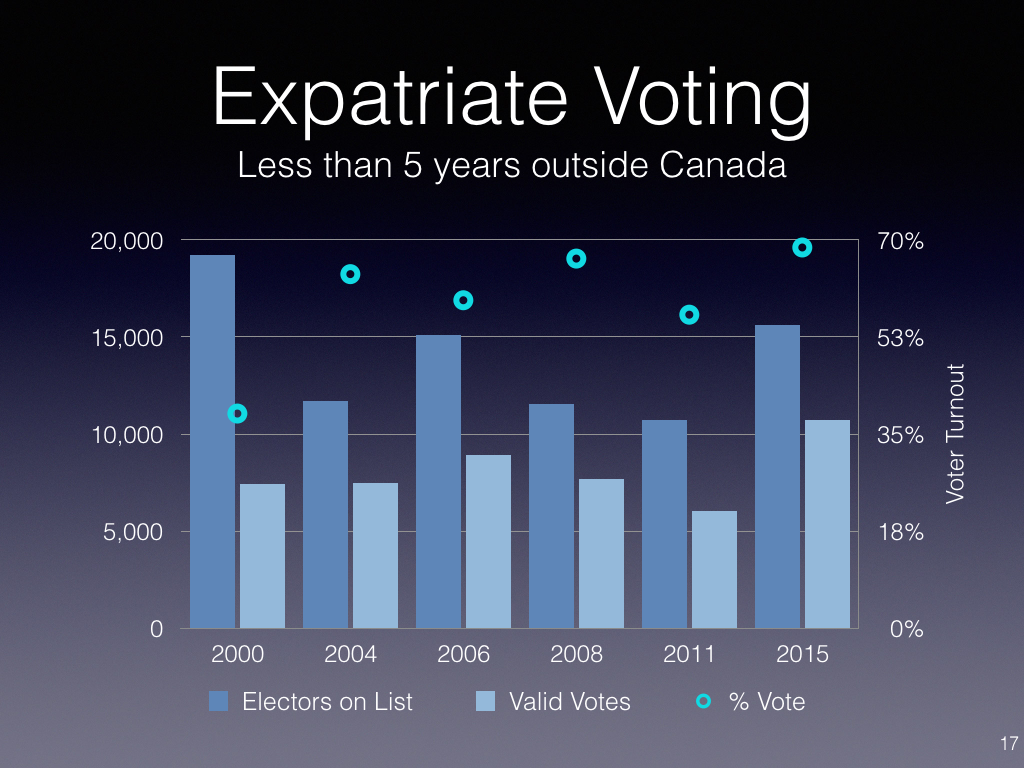
We will find out just how many of these previously disenfranchised citizens vote in the 2015 election (the chart above covers previous elections):

The Supreme Court of Canada has ruled voting restrictions on expatriate citizens are unconstitutional.

Two Canadians working in the United States, Gillian Frank and Jamie Duong, challenged federal voting restrictions after being unable to vote in the federal election of 2011. At the time, the law said non-resident citizens could not vote if they had lived more than five years abroad.

In December, a Liberal bill extending voting rights to long-term expatriates received royal assent. But at stake in the Supreme Court ruling was whether those voting rights could be taken away by a future government.

Dr. Frank, who was born in Toronto and was a Canadian Forces member, and now teaches American Studies at the University of Virginia, explained in an interview with The Globe and Mail on Thursday what it felt like not to be able to vote: “To watch democracy from the outside, it’s sort of like an injury, that acts up every once in a while.”

The court ruled 5-2 that the now-repealed law was unconstitutional. “The disenfranchisement of these citizens not only denies them a fundamental democratic right, but also comes at the expense of their sense of self-worth and their dignity,” Chief Justice Richard Wagner wrote for four of the judges in the majority. (A fifth judge wrote concurring reasons.) “These deleterious effects far outweigh any speculative benefits that the measure might bring about.”​

Mr. Duong, who left Canada in 2001 and works at Cornell University in Ithaca, N.Y., told The Globe on Thursday that he has a strong attachment to his native land. “I was born and raised in Canada; my parents still live in Canada. I’m a Canadian, and it’s my obligation to vote and participate in our democratic process.”

A lower-court judge had found the voting prohibition unconstitutional. But the Ontario Court of Appeal then ruled 2-1 that the law could stand, saying that non-residents do not live with the consequences of their votes on a daily basis. The dissenting judge said the restrictions had the effect of making non-resident Canadians second-class citizens. Dr. Frank and Mr. Duong appealed to the Supreme Court.

They are among 1.4 million Canadians who – as of 2009 – had been living abroad for more than five years.

The 1982 Charter of Rights and Freedoms says without qualification that every Canadian citizen has the right to vote.

Canada has always had residency restrictions on voting. During the First World War, the restrictions were eased to allow soldiers to vote. Advance voting was established in 1920 for salespeople and sailors. In 1945, proxy voting was allowed for prisoners of war. In 1970, diplomats and other public servants living abroad, and their dependents, were allowed to vote remotely. And in 1993, the vote was extended to citizens who had lived abroad for fewer than five years.

The federal Attorney-General’s office, in its Supreme Court filing, said the limit on expats’ right to vote is fair. “The legal responsibilities of long-term non-resident citizens under Canadian domestic law are much less than the responsibilities of resident Canadians,” it said. It added that similar limits on voting rights are common in other parliamentary systems derived from the British tradition.

Lawyers for Dr. Frank and Mr. Duong, in their written argument filed with the Supreme Court, said that Canadians who leave the country tend to do so for work-related reasons, but maintain their connection to Canada. “The inability to vote leaves them with no voice in the direction or well-being of the country, even though many of them have strong connections, including family in Canada, and wish to return.” Many of them have no right to vote anywhere, they said. They added that the voting restrictions harm the dignity and sense of belonging of expatriates.

The last major case on voting rights was in 2002, and it was one of the Supreme Court’s most controversial in the Charter era. The court ruled 5-4 that federal prisoners could not be denied the right to vote. “Denying citizen law-breakers the right to vote sends the message that those who commit serious breaches are no longer valued as members of the community, but instead are temporary outcasts from our system of rights and democracy,” then-Chief Justice Beverley McLachlin wrote for the majority.

Source: Supreme Court rules voting restrictions on expatriate citizens are unconstitutional
Ironically, the same day as this decision, the Globe published yet another op-ed (think it is the fourth) arguing against limiting voting rights for longer-term expatriates without the author, Yasmin Rafiei, or the Globe, acknowledging that the government had already changed the legislation.
Hardly a demonstration of being connected to Canadian political discourse and developments:

One of Justin Trudeau’s 2015 federal-election campaign lines was, “A Canadian is a Canadian, is a Canadian.”

Unless you live outside of Canada, it seems.

This Friday, the Supreme Court will decide if the democratic franchise of Canadians living overseas should be subject to a five-year limit. A voting ban – which denies Canadians the right to vote in elections after five years living overseas – was legislated in 1993 under Jean Chrétien, enforced under Stephen Harper, and has not yet been overturned under Mr. Trudeau. His government sought to repeal the five-year limit in 2016 via Bill C-33, but in the two years since its introduction, the bill has only achieved a first reading. Its tepid progress in Parliament has ushered the case into the hands of the Supreme Court, where it rests today.

The voting ban raises a fundamental question: What makes a Canadian a Canadian?

It’s a question I contend with in my daily life outside my homeland. I was born and raised in Canada and had only ever studied and worked in Canada until last year. If I have a personal geography, it is tied to my parents, whose immigration to Edmonton from Iran involved embracing every aspect of their new country. My dad had me on skis as soon as I could walk; we hosted neighbourhood street hockey on our driveway; Edmonton’s river valley was, to my mother’s consternation, my second home.

I was raised in our city’s public schools, graduated from the University of Alberta and delivered the faculty address at graduation. However, it was in leaving Canada that I fully came to terms with my national identity.

In 2017, I received a scholarship to study at University of Oxford, where I regularly encounter my identity, as it is perceived outside our national borders. Abroad, my primary identifier is no longer the province I grew up in or where my parents come from, but my nationality as a Canadian. Limiting my right to vote indicates I’ve lost touch with this national identity when, in fact, I renegotiate it every day against its reflection, mirrored to me in my international colleagues’ perceptions of Canada.

I’m hardly alone. A 2010 report by the Asia Pacific Foundation estimated that 2.8 million Canadians live abroad. Comprising about 9 per cent of our national population, our expat community is proportionately larger than that of Australia, the United States, China or India. This group, both substantial in size and highly skilled, should not be treated as a demographic anomaly.

The court’s coming decision demands our collective attention. Our citizenship is enshrined in our constitutional right to vote – in our ability to decide, at election time, what we would like the future of our country to be. By stripping this right away after five years, our government makes a resounding judgment that expatriates are less Canadian because we live abroad.

Limiting voting rights also discourages valuable expatriates from returning to Canada. My departure was incited by educational opportunity: After two years studying politics at Oxford, I’ll spend four years studying medicine at Stanford University. Despite my time away, my right to vote enables me to decide the state of the home I plan on returning to. Under the current legislation, I will have effectively exchanged my graduate and doctoral degrees for that right.

The critique frequently levelled against extending voting rights is that expats have broken the social contract: We do not pay taxes (although most do). But at the heart of this critique rests a dangerous assumption: that constitutional rights ought only to be afforded to those who can pay for them. By this logic, should the impoverished not vote? Do we give the rich more votes? This thinking could set an odious precedent for further excisions of voting rights.

And it would be to Canada’s benefit to expand voting rights beyond geographic boundaries. My status abroad, for instance, facilitates my work on the Ebola virus and antimicrobial resistance, biosecurity threats that don’t know borders. I study and work alongside Canadian expats driven to resolve climate change, cyberattacks, and mass migration – issues demanding global co-operation. A postnational Canada that enables citizens to vote outside of its borders provides international depth to civic engagement – but also supports citizens living overseas and confronting global challenges.

Beliefs that Canada is a nation-state bounded by its geography do more harm than good. Being Canadian is not about where you live: It’s about contributing to, improving, and stewarding a community forward through challenges, domestic and abroad. Whatever Canada is in the future, it is ours together – and our voting rights need to reflect that.

Source: Why should Canadian expats suffer for suffrage?

School agents benefit both Canada and China – The Conversation

The analysis of the numbers and practices is more interest than what appears to be shilling for education consultants while indicating a possible regulatory gap:

China is the No.1 source country of international students who come to study in Canada. According to the Canadian Bureau for International Education, 150,000 international students from China studied in Canada in 2017.

Any political impact on Canadian and Chinese relations is potentially serious for a wide global network with something at stake related to Chinese students in Canada — including students and their families, universities and services related to international study, such as education agents.

Education agents play a significant role in counselling and referring students to international education providers. They connect the people involved in international education, linking students, parents, education providers, visa offices, professional service providers such as language training institutions, academic program evaluation agencies, travel and accommodation providers and finance institutions to each other in order to facilitate study in another country.

As an education researcher focused on studying trust and leadership, and as part of my university’s recruitment efforts, I have studied how students and their families decide to invest in international education, including through using education agents.

I also supervised a student’s research project that investigated the role of education agents in China. The student, Haiying Li, helped to inform this article. Li worked as an education agent between 2001 and 2014 in various capacities: among her roles, she worked for our university, and as a consultant for Beijing-, and Guangzhou-based firms and at a program supporting Masters students based in Vancouver and Shanghai. This was before she became a student in Canada.

What I have seen is that education agents play a significant role in helping international students come from China to Canada, and the agents’ work benefits both countries’ economies and people.

How agents work

The agents provide services such as identifying the institution and course of study that meet the student’s needs, helping the students finish applications, submitting grade records and serving as a liaison. Some agencies may also provide training for required language proficiency tests. In some cases, after the student enrols the agent can play the role of cultural mediator.

Based on research conducted in 2014, 60 per cent of international students used an education agent to apply to Canadian colleges and universities.

Among the three different types of education agents, the first is an institution representative who receives a commission by the school they represent. The second type is the student’s representative; the student pays for advising services typically to apply to academic programs offered by the best-ranked universities.

The third type of agent may be remunerated by both a student and an institution. The student pays for the agent’s professional overseas study consulting service; the agent may also receive commission from schools who she or he works for.

Canada benefits

I teach and supervise many international students, including Chinese students. Students’ eagerness and wonder in a new place is common, yet no less beautiful each time it unfolds, reinforcing the significance of intercultural experiences.

International students bring Canadians the opportunity to begin to understand cultural differences and similarities and to become better equipped to live successfully in a multicultural global economy.

International students bring both more money and jobs to Canada, contributing more than $15.5 billion to Canada’s economy annually. They bring knowledge, information and skills to Canada.

The federal government reports that international student spending directly and indirectly supported 168,860 jobs in Canada in 2016, an increase of 38 per cent over 2014. Thus international students have direct impacts on GDP, jobs and tax revenue.

Agents working for schools recruit students to Canadian institutions but if they perform their role successfully, they also raise the brand image of the institutions.

These agents also market Canada. They show the advantages of Canada amid other prospective countries of study, empahsizing the quality of education, the multicultural nature of Canada, safety, the beautiful Canadian environment, the potential for new economic development, the high-quality life style and immigration pathways for international students.

A 2013 report commissioned by the Council of Ministers of Education Canada based on a voluntary survey of 145 elementary, secondary and post-secondary Canadian educational administrators, and government officials in education says that how schools use and manage agents varies significantly (of note: Québec survey responders reported minimal use of agents). More research about agents’ work in Canada would be helpful.

Agents in China

Consultants EY Parthenon report that the total agent market size in China is USD$1.2 billion. In 2017, according to the Chinese Ministry of Education, 608,400 Chinese students were going abroad.

Students who leave China to study internationally come from across the country, including from what China classifies as first-, second- and third-tier cities. China ranks these cities based on five indicators: availability of business resources, urban hubs, activity of urban people, lifestyle diversity and future plasticity.

From the perspectives of parents and international students, the education agent is a conduit. Working with an education agent is reassuring because the agent can understand parents, students and their families and speak their language and thus help navigate a huge emotional and financial decision.

Trustworthiness

Some existing studies suggest that students and their families often choose the institutions that the agents recommend.

But researchers Mengwei Su and Laura M. Harrison argue this reliance has not always been beneficial to students: they argue that in our globalized economy students may be exploited for economic gain and that “delegating recruitment to overseas agencies causes mismatches between host institutions and the Chinese students.”

In a context where Chinese study abroad has grown rapidly and not every country agrees on regulatory practices (Canada is not a signator to an 2012 agreement signed by the U.K., Australia, Ireland and New Zealand for best practices agents’ trustworthiness is a significant issue for families and schools.

Eight interviews recently conducted with people knowledgeable about agent work (one agent in China, one director of international marketing representative from a Canadian university, three mothers of international students and three international students) suggested some values and standards that could be probed in further research.

In creating trustworthy relationships between clients and agents, positive feedback from the client’s friends was significant: in other words, a word-of-mouth referral. Successful experiences shared by previous clients, coupled with objective comparisons of service price, service quality and personal qualities of the agents all mattered.

With the growing markets in international education, high-quality services by trustworthy professionals are essential.

Source: School agents benefit both Canada and China – The Conversation