Karen Robson: Why won’t Canada collect data on race and student success?
2019/01/07 Leave a comment
While I always favour more data to better understand the differences in outcomes between groups, I am puzzled by the assertions regarding data gaps made by Karen Robson in her recent opinion piece.
First, the OECD PISA study includes both first generation children, born abroad, and the second generation, born in the destination country, where issues related to racism and discrimination can be separated out more clearly from more basic integration issues (e.g., language fluency).
Secondly, while the visible minority category may not be perfect, it does provide a race-based breakdown in the Census with respect to education, along with other economic and social outcomes, which can be used to provide municipal level data at the census tract level. Toronto school board data uses largely comparable categories.
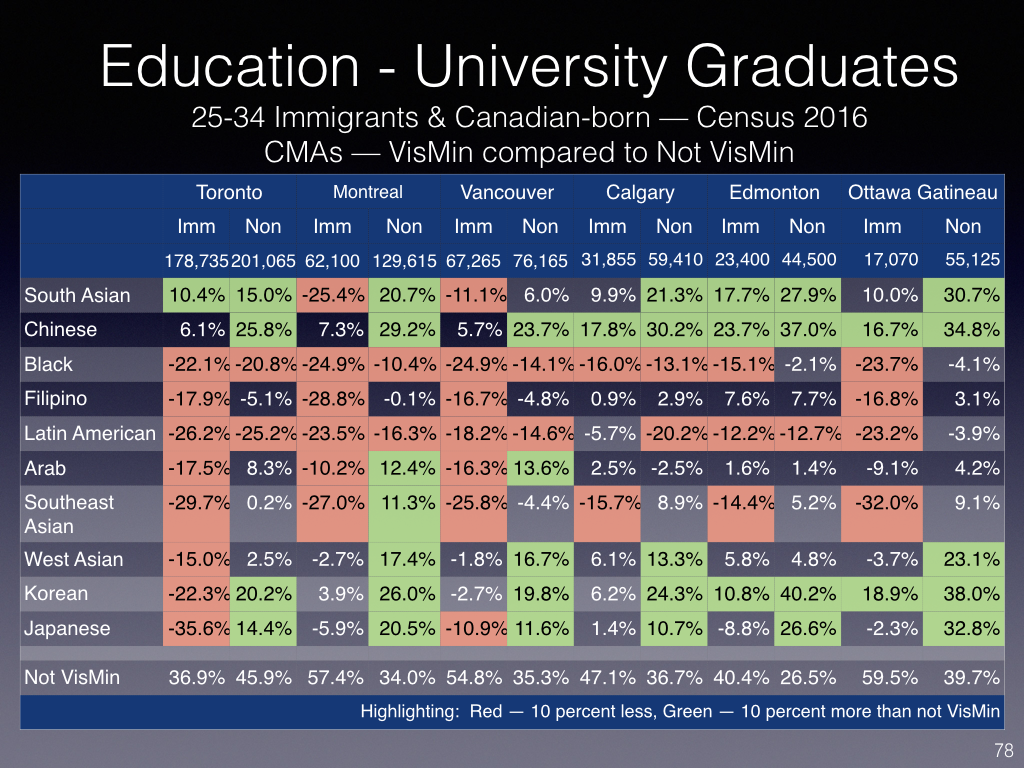
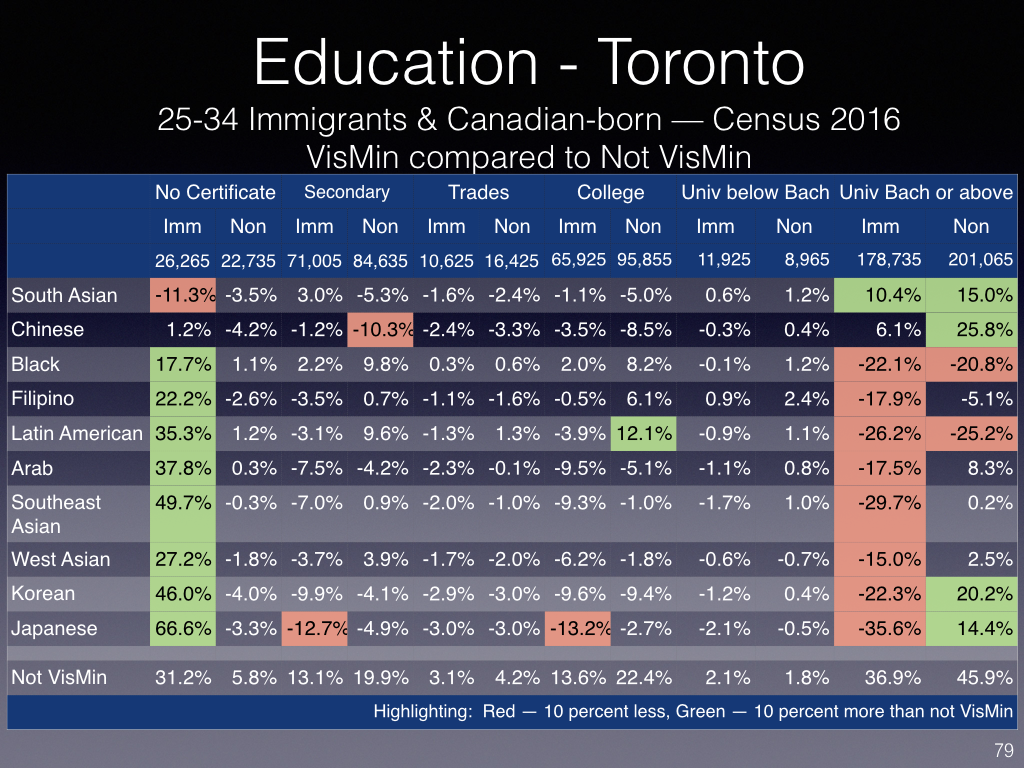
Ironically, the same pattern she cites with respect to Toronto, where the school board collects race-based data, can be seen nation-wide: Asian and South Asian students with stronger outcomes, Black and Latino weaker ones.
The following three charts illustrate this, looking at the highest level of education attainment for 25-34 year olds, or later than the high school data that she cites (i.e., the social and economic outcomes that reflect, in part, high school outcomes). The first looks at the university graduation rates for visible minorities, immigrant and non-immigrant (Canadian-born) compared to not visible minorities, the second provides a breakdown of the highest level of educational achievement for Toronto (I have done the same for the other cities) and the third looks at median employment income for university graduates:

Her academic article (journals.sfu.ca/cjhe/index.php…), on which this op-ed is based, doesn’t make these mistakes and is a comprehensive and interesting study of Toronto District School Board data.
But her arguments that the lack of comparable data to Toronto across the country is a significant data gap is less convincing.
Census data allows comparisons between municipalities (and down to the census tract level) and the richness of the data provides considerable scope for analysis. Whenever I find a blockage elsewhere (e.g., police force diversity numbers), I usually can find census data to respond to my key questions:
Although the impact of income inequality and gender on education outcomes is much discussed in Canadian government-level policy debates, factors of race and racism are seldom measured or addressed.
However, as an education researcher comparing student outcomes in Toronto, Vancouver, New York, Chicago and London, I can see Canada’s policy-makers have a big knowledge gap because they don’t deal with or have access to information regarding race.
Students are impacted by factors of income, gender and also race. The combinations of these identities undoubtedly shape how students experience access to education, work and other types of social mobility.
Research shows that low-income can be highly racialized, yet in Canadian cities, the patterns are not completely divided along racial lines. Therefore, examining income alone overlooks the many important ways that inequalities in education are not simply an issue of economics.
In the United States and the United Kingdom, research reports regularly provide summaries of student outcomes by various characteristics, including race.
In Canada, we have a tendency to focus exclusively on whether a student comes from immigrant parents. I believe this focus is problematic.
Canada has been deemed an education superpower because comparisons between the standardized test scores (PISA) of Canadian children with those in other OECD nations find Canada near the top. As well, the 2016 federal census revealed that Canada has the highest proportion of post-secondary graduates in all 36 member countries of the Organization for Economic Development (OECD). This mean that more than half of adult citizens in Canada between the ages of 25 and 64 have a college or university credential.
In particular, the success of immigrant children is used to argue that Canada is leading the way in equity.
In a country grappling with the heritage of colonialism, the success of immigrant children comes as good news to share and promote. This success can be interpreted as a sign that multiculturalism has been successful, that racism is not a barrier to education attainment and that immigrants are treated equally and have the same opportunities as children born in Canada.
This story continues in other arenas. Education researcher Trevor Gulliver analyzed citizenship guides for new Canadians and found that group identities in these education texts creates an idealized version of Canada as “Canada the redeemer.”
Such celebratory concepts of Canada need to be carefully considered.
There is a common misconception that racism is something that occurs in the U.S. and not in Canada.
One of the reasons that children of immigrants do so well in Canada is because of our immigration system which favours certain assets. The “points system” of immigration awards points to applicants who speak one of Canada’s official languages. Points are also awarded for job skills and level of education.
This is not to discount the work that teachers and schools do to integrate, educate and welcome students of immigrants; my point is that there are some reasons that such children who already speak an official language may be doing better than immigrants who arrive as refugees in another immigrant receiving country, like Sweden.
Focusing on the success of immigrants detracts from the problem of how systemic racism contributes to inequality in educational experiences and outcomes. Another common misconception is that race and immigrant status are equated; of course they are not the same thing.
The celebrated study about how well Canada did with global assessment scores only carries information on immigrant status, not race. With the exception of the Toronto District School Board, boards of education across the country do not record race data.
This lack of data has led to a dearth of studies examining the relationship between race and educational outcomes in Canada. Researchers simply do not have the data to analyze.
In response to research demonstrating a gap between Indigenous and non-Indigenous student outcomes in Canada, a Canadian think-tank reports that some provinces have pledged to begin asking Indigenous students attending mainstream schools to self-identify when provinces collect their PISA data. No known similar move is afoot, however, with regards to collecting data about racialized students or their income levels.
The Ministry of Education in B.C. has opted to ask students about the language students speak at home rather than their self-identified race.
Not only do we not have data on race, but it seems Canadians are also reluctant to talk about race. Even Statistics Canada defers to its old and outdated notion of “visible minority” when attempting to measure and discuss issues around race.
Lumping all non-whites together masks the huge differences we see in the educational outcomes of racialized students in Toronto.
Basically, this means comparisons are made between white and non-white people. This comparison happens even in areas like Toronto where “visible minorities” make up more than half of the population, making whites in fact, a minority. Further, the data tells us nothing about poverty by postal code.
In Toronto, where we do have data, the figures show that Asian and South Asian students trend toward having high marks and are more likely to go on to university. Black and Latino students trend toward lower grades and are more likely to be placed in the “applied” stream of high school courses (which are not eligible for university).
Considerable research in Toronto has identified Black males as having the lowest post-secondary opportunities due to their disproportionate placement in the “applied” stream of study.
These problems are not unique to Toronto; they are only measured in Toronto.
Lack of data does not mean lack of a problem. By not collecting data on race and other important sociodemographic factors of students, we fail to correct systemic barriers to success in our educational system.
By conflating immigrant success with a blanket commitment to equality, we blindly assume we are doing OK as we do not have any evidence to the contrary — because we haven’t taken the time to collect it.
Source: Karen Robson: Why won’t Canada collect data on race and student success?
 About Andrew
 Multicultural Meanderings