When the Dominican Republic Erased Birthright Citizenship

Useful history lesson, even if any proposal for change in Canada would not be retroactive:

This is a story about what happens when you limit birthright citizenship and stir up hate against a certain class of immigrants. It takes place in the Dominican Republic. Like most countries in the Americas, for a century and a half the Caribbean nation’s constitution guaranteed birthright citizenship for anyone born on its soil, with a couple of exceptions: the children of diplomats and short-term travelers. And like most other peoples in the Americas, Dominicans have had a more complicated relationship with immigration than the framers of that constitution might have anticipated.

The Dominican Republic has long been dependent on a steady stream of cheap immigrant labor that cuts its sugar cane, builds its buildings, and staffs the beach resorts that draw in billions of foreign dollars a year. Almost all of that labor comes from the only country close enough, and poor enough, to have people who want to immigrate in large numbers to the Dominican Republic: its Hispaniolan twin, Haiti. Some working-class Dominicans without clear Haitian roots resent poorer neighbors willing to accept lower wages and tough conditions. Many wealthy Dominicans who profit wildly off the cheap labor supply are eager to have strict immigration laws in place, too—not because they want less immigration, but because they want a freer hand. Immigrants in the country illegally have no protection from workplace regulations and can be rounded up, deported, and replaced whenever convenient—including right before payday. (Sound familiar?)

The Dominican Republic also has a long, brutal history of anti-Haitian racism. During his rule from 1930 to 1961, the fascist dictator Rafael Trujillo built a racialized concept of Dominican national identity on the fuzzy idea that the descendants of Spanish slavery on the eastern part of the island had higher levels of European ancestry than, and thus were superior to, the descendants of French slavery on the western part of the island. This rhetoric led to a 1937 rampage in which Dominican soldiers and allied citizens massacred thousands of people who they identified as Haitians. They forcibly separated people who’d long mixed together in vaguely delineated borderlands, consecrating a new national boundary that had been set largely by the occupying U.S. military a few years earlier, but which until then existed mostly on paper.

In the decades that followed, Haitian migrants in the Dominican Republic remained largely confined to isolated company towns in the cane fields, known as bateyes. But in the late 20th century, Haitian immigrants and their Dominican-born children left to work in other parts of the Dominican economy. Nationalists, who’d grown up learning Trujillo’s propaganda, began to rethink the law.

Because nationalists tend to be political conservatives, they often feel pressure to pretend that the radical changes they’re making aren’t changes at all. In the 1990s and early 2000s, right-wing Dominican politicians tried to stretch a tiny loophole in birthright citizenship into a chasm big enough to swallow anyone of Haitian descent. Their main strategy was to claim that everyone with Haitian roots was “in transit,” no matter how long they (or even their parents) had lived in the country. Authorities also refused to issue Haitians’ children birth certificates, or ripped up the ones they had. Sympathetic local media helped make synonymous the words ilegal, inmigrante (immigrant), extranjero (foreigner), and haitiano. Even foreign reporters got used to referring to people of Haitian descent in the Dominican Republic—an estimated 500,000 to 1 million people, or roughly 10 percent of the Dominican population—as “Haitian migrants,” even though that category includes an estimated 171,000 Dominican-born Dominicans with two Haitian parents, and another 81,000 people with one.

Courts did not like this. The Inter-American Court of Human Rights ruled that the Dominican government’s treatment of people of Haitian descent violated not only international human-rights law but also the Dominican constitution. Dominican presidents ignored the rulings, and ultimately pulled out of the treaty establishing the court. In 2010, the government called a constitutional convention, in large part to exclude a new group from the birthright-citizenship clause: the children of anyone “residing illegally in Dominican territory.” Given the spotty distribution of birth certificates, faulty census-taking, and lackluster registration efforts in the country’s impoverished areas, this change was bound to create widespread confusion. But the government’s target wasn’t poor people in general. It was people of Haitian descent.

Even that maneuver was not enough. Under all international or national norms, the new provision could only apply to people born after the new constitution came into force. But Dominican nationalists were more concerned about adults than newborns. Fortunately for them, the new loophole had a loophole: a new “constitutional tribunal”—separate from the existing supreme court—given the “definitive and irrevocable” right to interpret the constitution.

In one of its first acts, the tribunal justices—picked by former President Leonel Fernández and a small group of other leaders—took up the languishing case of a Dominican of Haitian descent named Juliana Deguis Pierre. She had sued when officials in her town refused to give her a national ID card—needed to vote and access social services—because, she said, of her dark skin and Haitian last name. Instead of ruling on whether she had been discriminated against, in 2013 the tribunal declared that Pierre should never have had citizenship in the first place because her parents didn’t have sufficient documentation to prove residency when she was born. Then it went even further, ruling that all those who could not prove that their parents had been legal residents when they were born—going all the way back to 1929, when the “in transit” exception was added to the constitution—were not citizens. Those affected were ordered to register with the government as foreigners by June 17, 2015.

Again, this order was clearly aimed at people of Haitian descent. Hundreds of thousands who had been Dominican citizens all their lives suddenly risked being rendered stateless and eligible for deportation.

It was obvious to human-rights groups, the United Nations, and pretty much anyone watching that the Dominican government was doing an end run around some of the most important principles of the rule of law—namely, that you can’t change the rules and then go around punishing people for having violated them in the past. The tribunal bent over backward to argue that nothing had changed, while taking 147 pages to explain the new situation.

A fundamental fact that sometimes gets missed in discussions about laws and court rulings is that they’re just words on paper. What those words signify to the people they govern is often just as important as what the law actually says. For instance, the original 1865 jus soli, or “place-of-birth,” birthright-citizenship provision in the Dominican Republic—enacted three years before the U.S. emerged from its Civil War with a Fourteenth Amendment and jus soli provision of its own—signaled a vision of the new Dominican state as a place open to just about everyone. As the historian Anne Eller has written, the provision came in a moment of heightened international cooperation when Haitians, who had thrown off French colonialism and slavery more than 60 years earlier, helped Dominicans win their final and lasting independence from Spain.

The 2010 constitution and the tribunal’s subsequent ruling signaled the opposite: that the Dominican Republic should be a place where poorer, blacker, more vulnerable workers—Haitians—were not welcome. And Dominican nationalists were determined to push that message to the hilt. Armed with the ruling now known simply as La Sentencia—literally “the verdict”—the whole country seemingly prepared itself for a mass expulsion. The military readied deportation buses and border-processing centers for the June 2015 registration deadline. Online trolls threatened critics and spread racist invective. Facebook and Twitter were filled with an ultranationalist, anti-Haitian narrative of Dominican history, which erased historic alliances and played up real and imagined abuses. Many pushed their completely unfounded belief that the true intention of Haitian immigrants and their children was to conquer the Dominican Republic and raise Haiti’s flag over the entire island.

Many Dominicans are not bigoted against immigrants. But as the deadline neared, the voices of liberals and moderates were drowned out in a sea of nationalist invective. The government framed the growing criticism of their policies as an “international campaign to discredit the Dominican Republic.” Nationalists simply branded those who disagreed with them as traitors. Emboldened by their government, sensing the moment was at hand, armed nationalists marched through Dominico-Haitian barrios and towns. In February of 2015, a Haitian man was lynched in the center of the country’s second-largest city, Santiago. When television footage of his body left dangling from a tree spread across the country, Santiago police blamed two undocumented Haitian immigrants for the crime. Dominican nationalists held a rally nearby and burned a Haitian flag.

Under pressure from the international community and fearing tourism boycotts, President Danilo Medina caved—somewhat. He proposed a second registration program that would offer a path back to citizenship to some of the people his government had just made stateless. The details were confusing, but that was the point. Hundreds of thousands of people of Haitian descent in the Dominican Republic now lived in a state of institutionalized terror, enforced by police, the military, and vigilante mobs. Instead of the feared one-day mass expulsions that had drawn so much attention, Dominican authorities took a quieter approach. They deported an estimated 70,000 to 80,000 people of Haitian descent—more than a quarter of the Dominico-Haitian population—piecemeal over the next three years, according to Human Rights Watch. Tens of thousands more felt they had no choice but to escape across the border on their own.

In late 2015, I went to the Haitian border to visit makeshift camps that were home to thousands of people who had fled for their lives. Many had never been to Haiti before and didn’t know where to go. They had taken shelter in shacks made of cardboard boxes, tree branches, old clothes, and whatever other scraps they could find. Food was scarce. The shacks frequently burned down. People were forced to get their water from a dirty river. I met a grieving couple whose son had just died from cholera.

Many in the camps told me that they hoped the situation would soon calm down, and that they would be able to return. I doubt many have. According to Human Rights Watch, the Dominican government has only restored citizenship documents to about 19,000 of those denationalized in the five years since La Sentencia. Violence continues to break out between nationalists and people of Haitian descent along the border. Fear runs high. One leader of the Dominican hard right has proposed building a border wall. (No word on who might pay for it.)

Nor are there any clear signs that the purges and intimidation have helped non-Haitian Dominicans. Thanks largely to the fact that Americans and Europeans still flock to the country’s all-inclusive resorts, the Dominican economy is still growing. But that growth has slowed.

On the eve of the feared mass expulsions, to drive home the absurdity and danger, the renowned Haitian American author Edwidge Danticat compared the situation to a wild hypothetical: “It’s as if the United States said, ‘Yes, everybody who has been here since 1930, you have to prove you’re a citizen. You have to go back to the place where you come from to get a birth certificate from there.’”

For some Americans, that was not a joke. It was an aspiration. Breitbartreaders roared their approval for the Dominican strategy under an article about the planned expulsions in June 2015. Several weighed in with racist invective about “the black Haitian people.” “Get Some, Dominican Republic!” one commenter wrote. Another felt inspired: “It is past time that we end birthright citizenship here in the US. I wouldn’t be as extreme as the DR was. Ending it retroactively for anyone born after 1929 seems a bit harsh but I would have no problem ending it for anyone born after 1980 … It is time for America to put Americans first.”

The day before the migrant registration deadline in the Dominican Republic, Donald Trump rode the gold escalator into the lobby of his New York office building and declared his candidacy for the White House with a racist tirade against immigrants. Before the summer was over, he announced his intention to end place-based birthright citizenship. As president, Trump has hired several opponents of jus soli birthright citizenship to immigration posts. One of them, Senior Immigration and Customs Enforcement (ice) Advisor Jon Feere, has praised the “clarity” of the Dominican Republic’s new immigration-limiting constitution.

Before the midterm elections, President Trump declared that he wanted to repeal the citizenship clause of the Fourteenth Amendment through an executive order. To anyone even passingly familiar with constitutional law, that seems like nonsense. Automatic place-based birthright citizenship has been a well-established practice for white immigrants since the United States was founded. It was enshrined as a universal right in the Fourteenth Amendment, and has been upheld for people of all races and classes since a Supreme Court decision in 1898. A U.S. president can’t just throw out part of the constitution—as even the outgoing Republican speaker of the House, Paul Ryan, noted.

But as Dominicans have ably shown, the most extreme rhetoric has a way of becoming real. And the consequences of inciting millions of people against vulnerable groups of immigrants are impossible to control. Representative Steve King—a freshly reelected white-supremacist Republican from Iowa who favorably retweets neo-Nazis—regularly introduces bills that are eerily similar to the Dominican law: denying birthright citizenship to anyone without a parent who is a citizen or “lawful permanent resident” of the United States. In late October, King crowed: “I am very happy that my legislation will soon be adopted by the White House as national policy.” And supposedly sober-minded conservatives may be little help. Days after criticizing the president, Ryan tried to walk back his comments, telling Fox News that he agreed the Fourteenth Amendment “should be reviewed.”

Source: When the Dominican Republic Erased Birthright Citizenship

Canadian citizenship and the challenges of birth tourism

A relatively neutral legal brief on birthright citizenship, noting that a proportionate response would likely not include ending birthright citizenship (but no mention of the Australian approach of qualified birthright citizenship). Stay tuned for my take:

The president of the United States recently indicated that he was preparing an executive order to end birthright citizenship in the U.S.  President Trump said that the United States was the “the only country in the world where a person comes in and has a baby, and the baby is essentially a citizen of the United States for 85 years, with all of those benefits.

In fact, the U.S. is not the only country in the world that grants birthright citizenship. Canada, Mexico and about 30 other countries grant citizenship to babies born in the country. Canadian citizenship can be acquired by birth pursuant to jus soli — “law of the soil,” which is codified in s. 3(1)(a) of the Citizenship Act.

Over the years, there have been calls to end birthright citizenship or limiting it to those born to at least one Canadian citizen or permanent resident parent because of a rising fear of “birth tourism.” Birth tourism is where pregnant visitors or non-residents give birth in Canada so that their babies can automatically be Canadian citizens.

It has been reported that there are a number of birthing hotels or baby houses in British Columbia where pregnant women pay thousands of dollars to come give birth in Canada so that their babies could be Canadian citizens by birth. Section 179 of the Immigration and Refugee Protection Regulationspermits visitors to travel to Canada, including pregnant women. Immigration Refugees and Citizenship Canada (IRCC) publishes its own instructions and guidelines clarifying that “there is no provision in the IRPA to refuse a temporary resident visa (TRV) solely on the basis of the intent of the applicant to give birth in Canada.”

Opponents view birth tourism as an abuse or loophole of Canadian immigration and citizenship laws. They see this as a way for some wealthy foreigners to “game” the system and buy Canadian passports for their babies. An extreme view is that it is an immigration fraud giving a way for people to jump the queue. It is often argued that the practice erodes the value of Canadian citizenship.

There is also concern that birth tourism is costly to taxpayers because it allows Canadian-born children access to publicly subsidized education, health care and social security programs, all without necessarily contributing to the funding of these systems and programs by paying taxes. Moreover, there is no obligation under international law to automatically give citizenship to babies born in Canada. Countries including Ireland, Australia and the United Kingdom have either eliminated or have limited birthright citizenship over the years.

Proponents of preserving birthright citizenship argue that the principles of jus soli are part of our national identity and embodies the idea that every child born in Canada is equal. Eliminating birthright citizenship would impose additional public expenses and complicate the process for verifying citizenship and risks having two-tiered citizenship.

It would be an expensive undertaking to develop and maintain a new verification system for a localized phenomenon or “problem” that may not be prevalent or widespread at all. Indeed, Statistics Canada data reports that there were 385 babies born in 2017 to mothers whose place of residence was outside Canada. While these numbers are most likely under reported and do not tell the whole story, it does underline that this issue of birth tourism may be a hyperbole.

The benefits of Canadian citizenship to the newborn child may be immediate, but for the parents, there is no guaranteed path to permanent residency or citizenship by virtue of their Canadian-born child. Having a Canadian-born child does not necessarily allow someone to be prioritized for permanent residence status or citizenship. Canadian-born children may eventually sponsor their parents, but sponsors must meet age and income requirements before becoming eligible sponsors.

Having Canadian-born children may provide the child with opportunities attributed to the benefits of citizenship rather than being a backdoor to Canada for parents. These babies may grow up to be assets to Canada and contribute to Canadian culture, society and the economy. Any immigration benefits to the parents may be decades down the road when the Canadian babies become adults and can sponsor their parents.

It must be remembered that there are limitations to jus soli. Under s. 3(2) of the Citizenship Act, children born in Canada to foreign diplomats, consular officers or representatives of a foreign government or international organization or their employees in Canada are not Canadian citizens despite being born in Canada.

The Supreme Court of Canada will hear the case of Minister of Citizenship and Immigration v. Alexander Vavilov [2016] 2 F.C.R. 39 in December. The court will determine issues of standard of review and also weigh in on the question of whether diplomatic immunity is required to trigger s. 3(2)(a) of the Citizenship Act. The Vavilov brothers are Canadian-born but were stripped of their Canadian citizenship after it was discovered that their parents were Russian spies. The parents were deemed to be “representatives or employees of a foreign government” at the time of their birth. As such, the brothers were not eligible for Canadian citizenship by birth pursuant to s. 3(2)(a).

While birthright citizenship in the United States is a constitutional right and amendments thereof would be subject to a constitutional process, in Canada, birthright citizenship is codified in the Citizenship Act which can be amended by an act of Parliament. The question is whether Canadian laws should be amended to limit or eliminate birthright citizenship or whether policy and regulations could be implemented to curb the practice of birth tourism at the local level.

The proportionate response to birth tourism may not necessarily require a complete end to jus soli.

Kelly Goldthorpe is an immigration lawyer at Green and Spiegel LLP and Caroline Mok is an articling student at the firm.
 

Source: Canadian citizenship and the challenges of birth tourism

A Defeat for White Identity What the midterms tell us about racial backlash and economic populism.

Ross Douthat’s take:

Running for president in 2016, Donald Trump sold two kinds of populism. One appealed to white tribalism and xenophobia — starkly in his early embrace of birtherism, recurrently in his exaggerations about immigrant crime, Muslim terrorism and urban voter fraud.

The other was an economic appeal, aimed at working-class voters hit hard by de-industrialization who found the existing Republican agenda too libertarian. Trump promised to protect entitlements and replace Obamacare with something more generous; his anti-immigration arguments were about jobs as well as crime; he promised lavish infrastructure spending and trade deals that would bring back factory jobs; he pledged to make the G.O.P. a “worker’s party.”

When this combination of appeals delivered victory, it set off an interminable debate about whether to look at Trumpian populism primarily through the lens of race or economics. Interminable, but crucial, because the answer would say a lot about whether a less tribal political alignment is possible — with Democrats winning back blue-collar whites or Republicans building a pan-ethnic nationalism — or whether we’re doomed to a permanent racial polarization of the parties.

The strongest argument for privileging economics is a simple one: Trump won millions of working-class white voters in the Midwest, the constituency and the region hit hardest by globalization, who had previously voted for Barack Obama. If you voted twice for the first black president, this argument goes, your main political motivation probably isn’t racism, and the fact that Trump ran as an economic populist seems like a more important explanatory fact.

The rebuttal, the case for privileging race, relies on a raft of studies, the most recent one summarized by Vox’s Zack Beauchamp just weeks before the midterms, which show that those Trump-Obama switchers were more likely to express racially conservative attitudes and hard-line anti-immigration views than they were to have suffered recent economic setbacks.

The hypothesis floated by these studies’ interpreters is that the combination of Obama’s presidency and Trump’s deliberate race-baiting had an activating effect on white anxiety. Racial backlash against the first black president was more limited in 2012 because Romney didn’t play to racial fears, but the backlash escalated, and flipped more white voters, once the next Republican nominee did.

I’ve taken swipes at these studies, but I’m more frustrated by the way they’re used by pundits than by the work itself, which does tell us two important facts — that Trump probably won getting-by-O.K., working-class Americans rather than the truly desperate, and that Obama-to-Trump switchers had to have a certain indifference to minority concerns (which is what many social-science measures of “racial conservatism” pick up) to tolerate his more bigoted appeals.

At the same time these kind of studies often treat immigration as a strictly-racial issue when it’s understood by many voters as an economic one (which is why African-American and native-born Hispanics can be immigration hard-liners). They elide the fact that you can base your vote on economic issues without being maximally economically anxious. (Given the G.O.P.’s historic brand as the party of business, you might expect a successful Republican economic-populist pitch to pick off the less anxious working class voters first.) And they encourage a slippage in liberal analysis where a voting bloc’s susceptibility to identity politics get described starkly as a “white nationalism” that implicitly places those voters beyond the reach of reason — even when they voted for Barack Hussein Obama four short years before.

Which brings me to the recent midterms, which offered a natural experiment in the race-versus-economics question — because, as president, Trump has been more plutocratic than populist on many issues, even as he has kept up the tribalist provocations and, just before the midterms, used the migrant caravan as an excuse for race-baiting.

If the Obama-Trump voters were primarily motivated by racial anxiety, you would expect his approach to consolidate them for the G.O.P. — especially with a strong economy, with the Democrats putting up lots of minority candidates, and so on.

But white identity politics failed to hold Trump’s gains. Some of the biggest swings against the G.O.P. were among middle and lower-income Americans, not just among affluent suburbanites. The Upper Midwest swung back toward Democrats. And among whites without college degrees, Democrats improved on Hillary Clinton’s showing by eight percentage points — identical to their gains among college-educated whites.

This doesn’t mean that the racial fears Trump stoked didn’t bring some Republican voters to the polls. But it proves that white-identity politics isn’t simply destiny, that Democrats can reach wavering white-working class voters instead of writing them off, and that if Republicans want to hold them, then actual economic populism — with its potential pan-ethnic rather than racially polarizing appeal — is a better bet than what we’ve gotten too often from his White House.

In what is not the most optimistic time for race relations in America, I call that good news.

Source: A Defeat for White Identity

Charlie Kirk’s Campus Battlefield—A Review

This is an amusing but pointed and scathing review of one the the young conservative entrepreneurs (could be applied to some others):

Charlie Kirk, founder and CEO of Turning Point USA, campus court jester, and pro-Trump parvenu, has a written a new book, Campus Battlefield: How Conservatives Can WIN the Battle on Campus and Why It Matters. As evinced by the title, Kirk purports to expose how colleges have become “leftist echo chambers” and explain what conservatives can do about it. It is a bad book, both in style and substance, failing as much on its own terms as any others. It’s not a book I expect too many to read, either, being a less-than-average offering in the already oversaturated, worse-than-average genre of nonfiction punditry.

Nevertheless, I do consider it a relatively useful book, at least insofar as what it augurs for conservatism, at present and going forward. Like it or not (and, I’ll disclose upfront, I do not), Charlie Kirk is a rising star within the GOP and American conservatism writ large. And he’s got the numbers to prove it: though only 25 years old last month, Kirk is a staple of right-wing nightly news and morning shows (“I’ve appeared on cable news shows more than five hundred times,” he brags in the book); boasts over 814,000 Twitter followers as of this writing (“I’m the second most powerful tweeter in conservative politics”); and, more importantly, he enjoys impressive access to the White House (“I have met with President Donald Trump more than fifteen times”) and first family—particularly Don Jr., who wrote the foreword to Campus Battlefield. Turning Point USA, the on-campus activism network Kirk founded in 2012, claims to reach over 130,000 students on more than 1,100 high school and college campuses and has raked in more than $30 million since its inception. Those curious about the next cohorts of conservatives—right-leaning students currently being reared in the age of Trump—should begin with Kirk and his organization.

What they find should concern them. Fundamentally unserious, unburdened with self-awareness, and gleefully engaged in stoking the fire of tribalism, Kirk is, above all things, a performer, peddling his own personal brand in the guise of training young conservatives and resisting liberal indoctrination on campus. It’s an act that’s had unsettling success in conference halls, on cable news, and on social media. But like most performances, it doesn’t work quite so well on paper. Campus Battlefield’s flaws are as apparent as they are numerous, and the book lays bare just how few clothes adorn Turning Point and its emperor.

*     *     *

It should not come as a shock to those who follow him on Twitter when I say Kirk’s is a poorly written book. There are so many grammatical errors and incoherencies—never mind the logical or factual ones—that it would be kinder to assume the editing process was skipped entirely than that someone at Post Hill Press actually reviewed the manuscript. These errors begin immediately, with Kirk misusing “alliteration” in place of “rhyme” on the very first page of the introduction, and carry through to the end. Particularly notable, for instance, is the inconsistent formatting of “ex cathedra”: a Latin phrase meaning “from the chair,” which is italicized the second time it appears but not the first. One error among many, the scholastic Latin nevertheless stands out among Kirk’s otherwise prosaic diction.

Counting its brief introduction, the book runs only about 150 pages. No fewer than 19 of these prominently feature block-quotes pulled from Kirk’s Twitter account (all of which are helpfully sourced: “—@charliekirk11”), further reducing the already risible amount of effort evidently put into the work. That Kirk, proud as he is of his presumed online influence, included his tweets is largely unremarkable. More surprising, however, is that from the nearly 42,000 tweets he had to choose from, he selected for his book one widely mocked tweet wherein he quotes himself quoting a hoary proverb misattributed to George Orwell. Even so, it’s a revealing moment—combining intellectual laziness, unoriginality, and Kirk’s characteristic tendency to spout erroneous banalities as if they were philosophical profundities. It’s a tremendous, meta-textual “self-own,” something Kirk does with more frequency than perhaps any other public person, with the possible exception of Chris Cillizza.

Though short, Campus Battlefield is far from concise. Of persistent annoyance are the gratuitous interjections and rhetorical questions Kirk peppers throughout—sometimes both at once: “…a conservative faculty member (how rare is that?)…” Even some of his interruptions have interruptions: “Here I’ll break in to say that apparently, these college professors are so ignorant of history—not surprising these days—that they don’t know…” The incessant repetition is worse. Irony is an ever-present motif, for example, appearing nearly a dozen times in the slim volume. And like a poor comedian needing to explain his punchline, Kirk constantly reiterates lest the reader miss his insights: “How ironic that all those lectures about the desperate need for campus safe spaces and trigger warnings…come from the Left. It’s ironic because liberals are most often the aggressors.”

Habits like these would be easier to forgive, of course, if Kirk had anything to say. As he writes in his introduction, the nominal purpose of Campus Battlefield is twofold: to “examine how the Left has pulled…off” their institutional dominance of colleges and universities, and to explain “how we can resurrect the heart and soul of our universities as—yes—safe places for the teaching and expression of all ideas” (Kirk’s emphasis). Neither one of these goals is accomplished; in fact, the former is hardly even attempted. In place of causal analysis, Kirk offers perfunctory sentences like, “How this leftist escapism took root is lost in the fog of time.” Kirk prefers simply to list instances of “leftist intolerance” documented by others and to promote Turning Point and its websites. There is a whole chapter dedicated to extoling the virtues of TPUSA’s neo-Orwellian “Professor Watchlist,” for example, in addition to the book’s final chapter—dramatically titled “Join Us in Our Fight for America’s Soul”—which is the literary equivalent of exiting through the gift shop.

Indeed, contrary to aiding his argument, the continual asides, pleonasms, and nakedly self-referential marketing attempts all serve to illustrate Kirk’s lack of substance. To say this book even has arguments is itself being generous. What it has instead are statements—piled up, one on top of another, variously adorned with clichés, and presented as if the heap constituted something with persuasive force. Perhaps my favorite example of Kirkian tautology occurs early in Chapter 5, where a single thought is repeated in five successive sentences:

Notably absent from [colleges’] idea of inclusion, however, are conservatives. Inclusion for so many college does not mean tolerating or welcoming anything that does not pass the muster of the liberal inclusion patrols. Inclusion only admits to the sacred circle the products of liberal, progressive, or socialist thinking. Colleges claim the high ground of inclusion, but it’s only lip service. Only liberal views are worthy of being fostered and nurtured. It is high-level hypocrisy.

Assuming this point has been proven, he asks in the next sentence, “How has this happened?” In another book, written by another author, this would be a question worth raising; for Kirk, it’s throat clearing. His answer is not an explanation but a syllogism: “Because higher education administrators have allowed it to happen.” Well then, case closed.

This is Kirk in a nutshell: say a lot while saying nothing, turn the subject with a rhetorical question or non sequitur, and cap it off with a quip or platitude. Kirk fancies himself a debater; but while he’s cribbed Ben Shapiro’s style, he’s lifted none of the underlying intelligence. His Twitter account is filled with slick, branded clips of him “DESTROYING” an opponent—most often, a liberal college student or professor ignorant enough to think they could ask a question and get a straight response. Typically, what happens is that Kirk—perched on stage, armed with a microphone, headlining the event in question (not dissimilar to the “power relationship” between liberal professors and conservative students he decries in the book)—faces down some audience member and interrupts, pivots, or mocks until he’s able to deliver a line that plays well to his friendly crowd or on social media. A perfect example of this occurred last month in a “must watch!” videoposted to his Twitter account, wherein a Reconstructionist rabbi attempts to ask Kirk a question during a Turning Point event. I say attempts, because the rabbi never makes it to his query. Instead, Kirk tries first to feint with an obvious set-up question, and when the rabbi sidesteps the bait, Kirk proceeds to interrupt him with shouts, profanity, and mocking statements about his interlocutor’s religion—all to laughter and scattered applause. (“[A]t Turning Point USA,” Kirk writes in Campus Battlefield, “civility and respect are as much a part of our approach as is a command of facts.” Indeed.)

What the book makes clear, by virtue of its medium if nothing else, is just how few rhetorical tools Kirk has at his disposal—and how evidently they’re employed to distract from how little he knows. In a speech or question-and-answer exchange, the deflections, ripostes, and barrage of empty logic can be easy to miss if you’re not looking for them; written down, the patterns are obvious to the point of condescension. Even if you broadly agree with Kirk’s points (many of which I do, generally speaking), as a reader you can’t help but feel disrespected: Just how stupid does he think I am?

Quite, I’d wager. Or, at least, Kirk understands that his audience is not really paying attention. He’s probably right—or those who are don’t seem to care. Like the president whose wave he has ridden to national prominence, Kirk has a rather tenuous relationship with the truth. A quick scan through Kirk’s Twitter feed will manifest nearly as many factual errors as there are tweets, and Campus Battlefield is hardly an improvement on this front. Many of these are minor—Kirk anachronistically writes in Chapter 1 that the American founders “struggled to find a better way to govern than…the anarchy of [France’s] bloody Reign of Terror,” for instance. This error, like the apocryphal Orwell quote, could have been avoided with a simple Google search. Others—such as his unsourced claim in Chapter 3 that “professors have no problem with the standard practice of students grading their teachers on their colleges’ websites”—are perhaps less obviously wrong, but remain untrue nonetheless. What’s worse is how Kirk marshals these errors. For example, he ludicrously presents that last assertion as if it somehow invalidates academics’ criticism of TPUSA’s “Professor Watchlist” or justifies the list’s creation by an organization purporting to uphold “free speech” and the sanctity of the academic classroom, “the very heart of intellectual inquiry.”

Indeed, Kirk is repeatedly disingenuous to the point of mendacity. The most obvious example of this is his repeated obfuscation of TPUSA’s campus reach. He boasts in Chapter 2, for instance, that he hears often “from our more than one thousand Turning Point USA campus chapters”—only to clarify in Chapter 16 that, “We have launched more than 350 TPUSA chapters and provided 750 like-minded students groups with resources.” In reality, these “like-minded student groups” are not actually TPUSA groups at all, but rather independent campus organizations like the College Republicans and other student free-speech groups who simply accept TPUSA-provided products. Which is why Kirk is elsewhere careful to use dissembling phrases such as “having representation on over 1,100 high schools and college campuses” when describing TPUSA’s reach.

While he otherwise avoids telling outright lies, Kirk is as unreliable a narrator you’ll find. At one point, he chides the president of Marquette University for referring to a graduate student who taught classes as simply a “student,” calling it “disingenuous.” Fair enough. Yet, not four pages later, Kirk does the same thing in reverse—referring to a then-University of Nebraska-Lincoln graduate student who taught classes as a “faculty member” and “professor.” In the introduction, Kirk valiantly writes that cancelling an event in the face of protests “and letting down the students who came to hear me with open or supportive minds was not an option.” Naturally, he doesn’t tell you of the time in May when he and Candace Owens, TPUSA’s communications director, bailed out of an event hosted by the TPUSA student chapter at Virginia Tech at the last minute so the pair could hang out with Kanye West instead.

Examples abound. “How often do conservatives harass liberals as they try to recruit students to their causes?” Kirk asks in another passage. “Not often, if ever.” Except that on April 16, 2016, Kirk himself joyously announced on Twitter, “Next semester Turning Point USA will be doing a nationwide ‘violate a safe space’ day. Bring it campus liberals!” Similarly, Kirk writes of the “nastiness, dishonesty, and silliness that infects the campus left-wing establishment.” He’s right that those things exist within the campus Left, of course (something I have written about extensively). Nevertheless, it takes an impressive level of hypocrisy for Kirk to accuse someone else of “silliness” when one of his TPUSA chapters hosted a rally last October, at which members wore diapers to protest safe spaces—to say nothing of the “nastiness” and “dishonesty” that flows near-daily from Kirk’s and, particularly, Owens’s Twitter accounts.

An illustrative episode of Kirk’s self-serving facade occurred recently with DePaul University. Kirk and Owens were set to speak to the DePaul TPUSA chapter on October 16 as part of their “Campus Clash Tour” (a title just dripping with civility), but were prohibited by the university from holding the event on campus. On October 9, the pair criticized DePaul for the move, accusing the university on Twitter of cancelling the event over concerns of “potentially violent” language. “The Left hates the idea there are other ideas,” Kirk wrote. “Hey DePaul, your fascism is showing.” Owens went further, tweeting that “DePaul is enslaving black minds.”

According to DePaul’s student-run newspaper, The DePaulia, however, what actually happened is far less suitable to their narrative. While the official decision letter sent to DePaul’s TPUSA chapter did mention concerns over the potential use of “hate speech,” the event was primarily cancelled due to ticketing and marketing concerns. “There was nothing unfair in the [DePaul administration’s] processing or the deadlines or the timelines. I just want to make that clear,” DePaul TPUSA’s vice president Ema Gavrilovic told The DePaulia. “The primary concern was Turning Point’s headquarters started issuing tickets and advertising for an event that was never originally even confirmed.” In fact, Gavrilovic explained, her campus chapter “really had no control or no say for what headquarters at the national level was doing,” stating, “We understand the DePaul administration’s reasoning for this exclusion because this was a primary concern that was voiced in the rejection letter.” Further, The DePaulia’s reporting makes clear, “DePaul TPUSA was made aware of the event’s cancellation in mid-September,” despite the fact that Kirk and Owens’s statements about it were not until October 9. Campus Battlefield was released October 10.

*     *     *

A favorite recent conceit among the more self-satisfied portions of the Left is that campus free speech, academic free inquiry, viewpoint diversity, and the like are simply McGuffins, and those trading in such issues nothing more than grifters. By and large, this notion is obtuse and scurrilous, often cynically employed by those wishing to avoid discussing the issues themselves. But those that do care about these issues—about free speech, the pursuit of truth, and the vitality of academe—would be wrong to ignore the evidence that gifters walk among us. For conservatives concerned about the decline of American education, doubly so.

Well-meaning or not—and I genuinely think he may be—Charlie Kirk is one such grifter. Leveraging his youth, talent for public speaking, and access to the White House, he’s fooled conservative donors into thinking he’s helping the cause of freedom on campus. Likewise, he’s fooled restless high school students and undergraduates into thinking performative victimhood and petty partisanship are epistemologically satisfying. Neither is true. Whether due to ignorance or indifference, Kirk and, by extension, his organization are hypocrites, and childish ones at that. And this petulant hypocrisy undermines not just legitimate indictments of higher education, but the intellectual development of young conservatives. The great irony of Campus Battlefield is how thoroughly Kirk paints this picture in his own words.

It’s evident that Kirk envisions himself as some grand general, leading his troops into the culture war. In reality, Kirk is a band director: his thoughts unoriginal and motions rehearsed, he trains his ensemble to play along to the tune of the day—currently, that of “owning the libs.” After all, the band’s job is to help cheer the team on to victory—a role Kirk performs with relish. And so he goes from campus to campus, conservatism’s fresh-faced Harold Hill, peddling his siren’s song to the kids in town until something better comes along.

In his brief, day-after review, the Weekly Standard’s Adam Rubenstein wrote sardonically, “the book may not be Kirk’s best work.” With respect to my friend Adam on this point, he could not be more wrong. On the contrary, I would contend that Campus Battlefield is Charlie Kirk’s best work, because it makes abundantly clear that this is the best he can do. More than that, however, it exemplifies just what it is that he is doing. Whether written by Kirk himself or an idiosyncratically talented ghostwriter, the monograph is a true expression of Kirk’s shtick—the shallow, facile affectation that lies at the heart of TPUSA’s most puerile ministrations. It’s an act to which conservatives—and their allies in the fight against academe’s decline—should no longer give any credence.

Source: Charlie Kirk’s Campus Battlefield—A Review

Elghawaby: Those who serve our country should not face discrimination of any kind


The Canadian Forces, like the RCMP, struggle with diversity:

Almost every public institution in our country claims it wants to better reflect the populations it serves. The same is true of our military. Parliament’s defence committee has even begun a study to determine which groups need better representation.

As the nation marks Remembrance Day, it’s important to reflect not only on those who have sacrificed their lives and well-being serving our nation, but those who have had to face racism and harassment in doing so. If such barriers continue to exist, efforts to recruit people of colour and people of various faiths and backgrounds will ultimately fail.

One needs only look to the very top to understand the challenge at hand.

Canada’s defence minister, Harjit Sajjan, has acknowledged facing significant racism throughout his long career in the Canadian Armed Forces. This has been his reality since joining the Forces in 1989 and even more recently. The first Sikh-Canadian to command a Canadian Army regiment has faced racist and vulgar comments on his personal Facebook page, as well as on the Forces’ official page. “I still can’t take this guy seriously as head of the armed forces!” posted one person. “Man, it’s not us! Sikh?”

Consider the case of Bashir Abdi, a Canadian of Somali descent who served for 10 years in the Forces. In 2013, Abdi says he obtained permission to attend Eid celebrations for the day. Yet, when he returned, he was fined and eventually convicted at a military summary trial for being “Absent Without Leave.” He was fired from his post and took his case to the Canadian Human Rights Tribunal. “As Canadian society and workplaces continue to grow and diversify,” reads his GoFundMe page, “it is imperative that we bring more attention to the issue of fair religious accommodation so that no one else has to experience Bashir’s humiliation.”

Canada’s defence minister, Harjit Sajjan, has acknowledged facing significant racism throughout his long career in the Canadian Armed Forces.

Or take the disturbing episode this past spring, when a group of officer cadets were expelled from the Royal Military College in Saint-Jean, Que., after video emerged of them desecrating a Qur’an with bacon and semen during a cottage party.

The head of Canada’s military, Gen. Jonathan Vance, has admitted that the Forces are struggling to identify those within the ranks who not only hold racist views, but who are actively engaged in white supremacist and right-wing activities. “Clearly it’s in here,” Vance said earlier this fall in an interview.

None of this makes joining the military a particularly endearing proposition, nor will it help improve the numbers. As of 2018, 15.4 per cent of the military were female, 2.7 per cent were Indigenous, and 8.1 per cent were visible minorities. The Department of National Defence has said that by 2026, it wants the military to comprise 25 per cent women, 3.5 per cent Indigenous peoples, and 11.8 per cent visible minorities.

“I used to wonder how Indigenous soldiers who went to residential school felt about serving for a country whose government discriminated against their people,” wrote Indigenous journalist Wawmeesh Hamilton in a recent online post.

At the very least, their contributions must be acknowledged, and existing challenges addressed. That begins with education as well as clear consequences for racist and anti-immigrant behaviours and attitudes.

Success looks like Capt. Barbara Helms, who joined the Forces as its first Muslim female chaplain this past April. And we can look as far back as 1996, when the late Wafa Dabbagh became the first Canadian Muslim woman to wear the headscarf in the Forces. In a 2008 media interview, Lt.-Commander Dabbagh described her experience as“95-per-cent positive.”

As defence committee chair Stephen Fuhr put it recently, “having a diverse, healthy, happy military personnel will have a direct impact on combat effectiveness. So we need to determine that we’re moving in the right direction.”

Among those we memorialize are those who defeated the very worst fascist and white supremacist forces of our time. Lest we forget.

Source: Elghawaby: Those who serve our country should not face discrimination …

An ancient community in Pakistan fades as conversions to Islam rise

Sad report regarding the fate of a small minority community:

For centuries, a small community of fair-skinned, blue-eyed people known as the Kalasha have inhabited a remote valley in northwest Pakistan, farming and raising animals.

Legend has it that their roots go back to Alexander the Great, whose forces passed through the mountainous region in the 3rd century B.C. But scientific studies describe them as a having “enigmatic” and “complex” origins, possibly being the first migrant group to reach the Indian subcontinent from Asia.

The Kalasha people, who speak a unique dialect, have no written religion or places of worship. Instead, they hold ritual celebrations of seasonal change every spring and fall, with colorful costumes and dancing that have long attracted visitors to their alpine home.

In recent years, however, a new outside influence — Sunni Islam — has started seeping into the valley, changing its way of life and dramatically reducing the number of non-Muslims. In the past three years, according to local surveys, 300 Kalashas have converted, reducing the number of non-converts from about 4,100 to 3,800. Local leaders fear their culture may be swallowed up and vanish.

The pace of conversions has accelerated, especially among young people, with Kalasha girls marrying Muslims and Muslim teachers urging students to convert. There also has been a boom in the construction of mosques, with at least 18 now in the valley.

“After hundreds of years, we have been turned into a minority on our own land,” said Shah Feroz, 27, a volunteer teacher in this hillside town of wooden chalets and steep lanes, located in Khyber Pakhtunkhwa province.

The religious inroads have become entwined with land disputes, especially over large tracts of forest that Kalasha communities own jointly as a matter of tradition. Last month, one court case over land rights reached the Supreme Court of Pakistan, which instructed the provincial courts to review the issue and report back in one month.

Last summer, the Kalasha gained their first-ever voice in government. Wazirzada Khan, 34, a political activist from the valley, was named to the provincial assembly under the law reserving seats for minorities. His nominator was Imran Khan, then a political leader in the province and now Pakistan’s prime minister.

“The Kalasha are the indigenous owners of the land, forests and mountains. We need laws to preserve our community,” Wazirzada Khan said. Kalashas who convert to Islam “do so willingly,” he added, but the community “should be declared a national heritage with special status.”

Other Kalasha activists said they were historically disdained by Muslims as “infidels,” along with a separate group of Kalashas in Afghanistan’s Nurestan province across the border.

Akram Hussain, 34, a social worker, described himself as “the sole Kalasha survivor in my family” after his mother died and his father married a Muslim woman.

“When a Muslim teacher warns you that you’re an infidel and will be burned in hell, a kid can’t evade this threatening influence,” he said. “I was told by my Muslim teachers to read [Islamic verses] that say it is compulsory to become a Muslim. But we don’t pressure our youths about our Kalasha beliefs.”

Feroz noted that all students in mixed schools are taught Islamic studies. On a recent morning, in the sixth-grade girls’ class at one local school, all Kalasha and Muslim students were reciting Koranic sayings. Feroz said community leaders want a substitute subject, such as ethics, to be taught.

“If you start reading Islamic subjects as compulsory from beginning through university level, then you will be influenced by Islamic teachings,” he said.

In recent years, the Kalasha have attracted European researchers and support, resulting in community benefits including a school that teaches the Kalasha dialect. But some visiting foreigners have also been victims of criminal and insurgent attacks.

According to local leaders, in 2002, a Spanish researcher living in the valley, Jordi Magraner, was found dead with his throat slit, along with two local residents. In 2009, a Greek scholar who helped build the Kalasha school, Athanasion Larounis, was kidnapped by Afghan Taliban forces but eventually freed and returned to Greece.

There have been other episodes of violence attributed to cross-border Taliban intruders. One farmer said two goat keepers had been brutally killed and thousands of goats stolen. “When we ask, we are told that the militants came from Nurestan,” he said.

Yet the larger clash here is the competition between a long-dominant culture with relaxed, secular values and an aggressively expanding faith with strict rules and conservative moral views.

The Kalasha grow grapes and offer free wine to visitors at festivals, where men and women dance together.

They also mourn their dead by dancing and leave them inside coffins above the ground, weighted down by stones with their valuables, though lately they have started burying them because of robbers.

One Kalasha farmer complained of hate speech broadcast through local mosque loudspeakers.

“We don’t make wine to sell, and we don’t force people to drink,” said Shahi Gul, 50, a mother of six. “We are blamed by the local clerics as using wine to tempt Muslim youth, which is not true. We do this as it is allowed in our religion and culture.”

Gul, whose sisters and niece converted to Islam, said she worries about the conversion of so many young Kalashas, especially through marriage. She said girls are “easily converted” by Muslim visitors who woo and marry them.

“We don’t force our children over marriage,” Gul said. “When a Kalasha girl wants to marry a Muslim, she accepts Islam and shifts to a Muslim family.”

Jamroz Khan, a Muslim cleric in the valley whose grandfather converted to Islam 70 years ago, considers Kalasha customs to be wicked, but he said no one in the valley has been converted by force.

“We do our preaching and convince them they should come to the right path,” he said. “We teach them that they are practicing infidelity by mixed gatherings, dancing and using alcohol. We ask them to stop these infidel practices.”

Khan noted with pride that several decades ago, “there was not a single Muslim family here, but now half of the village has accepted Islam,” he said. “All praise to Allah, we are preaching to convert all.”

To Lali Gul, a Kalasha woman who sells traditional costumes and caps, the spread of Islam across the valley will be hard to stop. Muslim tourists, she said, bring money as well as take brides. When her daughter met a Muslim visitor and converted to marry him, she did not try to dissuade her.

“We are free and open-minded people. We don’t interfere in our children’s decisions to be a Kalasha or Muslim,” Gul said. “But our community is shrinking. I fear that very soon, there will be no Kalasha left in this valley.”

Source: An ancient community in Pakistan fades as conversions to Islam rise

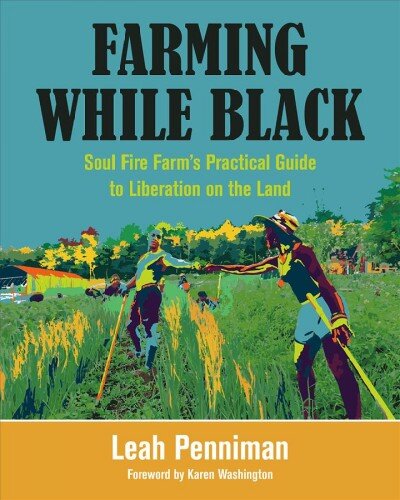
‘Farming While Black’: A Guide To Finding Power And Dignity Through Food

Interesting:

Leah Penniman was told she wasn’t welcome, from her first day in a conservative, almost all-white kindergarten.

“I remember this one girl teasing me and saying brownies aren’t allowed in this school … and that really continued, that type of teasing,” she recalls. “Every time I walked into an honors classroom, they would ask me if I was in the right room,” she says.

She enjoyed learning and did well, but she also found solace in the natural world.

“No one taught me what African traditional religion was when I was little, but my sister and I intuited it and so we would spend a lot of time in the forest giving reverence to mother nature as we called to her in the trees.”

Penniman later got a summer job farming in Boston, and she was hooked. She learned about sustainable agriculture and the African roots of those practices, but she also moved to Albany, N.Y., to a neighborhood classified as a food desert. To get fresh groceries from a farm share, she walked more than two miles with a newborn baby in a backpack and a toddler in the stroller, then walked back with the groceries resting on top of and around the sleeping toddler.

She made it her goal to start a farm for her neighbors, and to provide fresh food to refugees, immigrants and people affected by mass incarceration. She calls the lack of access to fresh food “food apartheid” because it’s a human-created system of segregation.

Penniman and her staff at Soul Fire Farm, located about 25 miles northeast of Albany, train black and Latinx farmers in growing techniques and management practices from the African diaspora, so they can play a part in addressing food access, health disparities, and other social issues. Penniman’s new book, Farming While Black: Soul Fire Farm’s Practical Guide to Liberation on the Land, details her experiences as a farmer and activist, how she found “real power and dignity” through food, and how people with zero experience in gardening and farming can do the same.

Back when Penniman was a beginner at various farms in the Northeast, she realized she was in a field where almost all people were white, and that the sustainable and organic farmers were using African techniques, without knowing where those came from.

For example, farmers grow marigolds and other beneficial flowers next to crops because those attract insects like ladybugs to do natural pest control. That’s called polyculture now, but it’s a practice that came from Nigerian and Ghanaian farmers, and Penniman’s book traces techniques like that back to their historic roots.

Farming While Black“A lot of the folks in the sustainable farming world get a lot of information through these conferences and sort of assume that … it’s either ahistorical or originated in a European community, which is an injustice and a tragedy,” Penniman says.

There are other instances of African contributions to farming technology that are not widely known.

Edda Fields-Black, an associate professor of history at Carnegie Mellon University, studies the history of West African rice farmers. She says the rice industry in South Carolina and Georgia would not have been possible without West African techniques of irrigation so that the rice fields have a good balance of salt water and fresh water to stop weeds from growing and keep the rice alive.

“We don’t always understand enough about all of the things that enslaved people built in the U.S. It’s not just brute labor, it’s not just brawn. This is technology, this is ingenuity, this is engineering, this is hydraulics. It’s all rooted in west Africa,” says Fields-Black.

She cites a 2018 report from the Southern Poverty Law Centerdetailing the “dismal” results of how little high school seniors know about the history of slavery, and says her work is about celebrating African technology, and “recovering the humanity of the enslaved.” That’s something she and Penniman have in common, she adds.

Penniman also writes that she would like her experience to help African-Americans heal from the trauma associated with farming. She details how black visitors to her farm almost all say they associate farming with slavery and plantations. One black farmer I interviewed in the past said that when he decided to quit a job in the tech industry to start a farm, part of his family thought he had lost his mind and was “going back to the plantation.”

That’s the universal experience … of being black in this country,” says Chris Bolden-Newsome, a farmer and educator at Sankofa Community Farm in Philadelphia, whom Penniman interviewed for her book.

Therefore, learning about Penniman’s book was “like a breath of fresh air,” Bolden-Newsome says. “High time that something like this be written to lift up the stories, the lived experiences and lived stories of black farmers and their descendants who are the powerhouse in America.”

Penniman and her coworkers at her farm also try to address social issues more directly. For example, she has a sliding scale of prices, where a third of her customers make more money and pay more, and that subsidizes prices for another third of her customers, who struggle to make ends meet. She has written a manual for how to develop such a system, and says that she knows of at least two farms in New York state with similar programs for low-income customers.

She says that just as her African ancestors braided seeds into their hair before boarding transatlantic slave ships, she hopes her book will inspire more people toward “picking up those seeds and carrying on that legacy about not forgetting where we come from and who we are.”

Her farm also started a youth justice program in 2013, which let young people from Albany County courts work on the farm for 50 hours in exchange for prison time.

“What was really powerful about it was these young folks said things like, ‘I’ve never been welcomed into someone’s home before, or this is the first time I’ve seen folks who look like me running their own businesses and following their dreams and owning their land,'” says Penniman.

“There’s a lot of crying that happens on our farm,” she adds.

Source: ‘Farming While Black’: A Guide To Finding Power And Dignity Through Food

Canadian-led movement aims to seize assets from dictators to remedy refugee crisis

The proposal will be one of the main recommendations of the World Refugee Council, a self-appointed body of two dozen global political figures, academics and civil-society representatives led by former Canadian foreign minister Lloyd Axworthy.

“We’ve put forward a proposition that where there are frozen assets they should be unfrozen through a proper legal process and reallocated to help the victims of the crime and corruption and instability that the bad guys create,” said Axworthy. “It’s a morality play. The bad guys have to pay to help their victims.”

The World Bank estimates the pool of cash to be worth $10 billion to $20 billion per year, Axworthy said in an interview.

The council was established last year by a Canadian think-tank, the Centre for International Governance Innovation, to find new ways to deal with the 21st century’s record-setting migration crisis — the 68.5 million displaced people driven from their homes by war, famine and disaster.

The United Nations will turn its attention to solving the problem at a special session later this fall, and the council plans to offer its input, using the weight of the last Canadian foreign minister to chair a Security Council meeting.

The UN has acknowledged in stark terms that as the number of homeless and stateless people continues to grow around the globe, their suffering is increased by the shrinking pool of money available to help them.

‘Proceeds put for the public good’

Axworthy says there are fundamental structural flaws in how the world’s institutions are set up to cope with the unprecedented forced migration of people, and a big one is how the bills are paid. The system is based on charity — the benevolent donations of people, countries and businesses — and is not sustainable, Axworthy said.

An October report by the United Nations refugee agency said it expected to raise 55 per cent of the $8 billion it needs to support refugees and internally displaced people this year.

Axworthy said the courts in several countries can be used to seize funds that have been frozen there. Canada, the United States and Britain have all passed legislation allowing them to impose sanctions on individual human-rights abusers. These “Magnitsky laws” are named after a Russian tax accountant who died in prison after exposing a massive fraud by state officials there.

The world could start spending the “tens of billions of dollars moulding away in a variety of banks and other places, purloined money from the warlords, from the bad guys, the dictators, the authoritarians,” Axworthy said.

Irwin Cotler, a former Liberal justice minister and human-rights lawyer who has championed Magnitsky-style legislation, said in a separate interview that these laws can allow to go beyond freezing funds, because once the assets are seized, there’s no point to returning them to their corrupt owners.

“What you want to do is have the proceeds put for the public good,” said Cotler, the founder of the Montreal-based Raoul Wallenberg Centre for Human Rights.

Legal precedent

Canada’s first round of sanctions under its Magnitsky Act targeted people in Russia, South Sudan and Venezuela, including Nicolas Maduro, the South American country’s president.

The refugee council’s most recent report, released last month, focused on the displacement of millions of people from Venezuela. That report urged the United States to take a leading role in seizing billions of “ill-gotten” assets in the country, including the $2 billion that the U.S. Treasury Department estimates has been stolen from Venezuela’s state-owned oil company.

Fen Hampson, who co-wrote the report and is head of the global security program at the Centre for International Governance Innovation, suggested governments need to go beyond their various Magnitsky laws to repurpose the seized assets of “Maduro and some of his henchmen … to help victims and the host countries that are reeling under this growing refugee and migration crisis.”

The Magnitsky Act, named after a Russian lawyer and auditor who was arrested on trumped-up charges and died in prison, has Russia threatening retaliation against Canada. The proposed law targets those responsible for human rights abuses and corruption. 2:15

The report said there is legal precedent to do this: a civil case against the son of the dictatorial leader of Equatorial Guinea resulted in a $30-million judgement, $20 million of which was later used by a charity to help the country’s people.

In Yemen, where most of the inhabitants of the port city of Hodeida were forced to flee Friday as Saudi Arabia’s three-year war on Shiite rebels continued, the UN World Food Program’s country director said a massive cash influx is needed to repair the battered economy and feed a population on the verge of starvation.

Stephen Anderson said it’s up to others, higher up in the UN, to decide whether that money should be siphoned from a warlord’s frozen bank account.

“We’re 100-per-cent voluntary funded,” Anderson said. “The economic issues need to be addressed urgently because that’s affecting the entire population of Yemen. They were the poorest in the Middle East before the conflict so there’s no safety net.”

Source: Canadian-led movement aims to seize assets from dictators to remedy refugee crisis

Black on the battlefield: Canada’s forgotten First World War battalion

Good Remembrance Day article and history lesson:

The year was 1914 and while the war was escalating in Europe, a different struggle took root in Canada.

Young black men determined to serve their country – men who had left jobs and uprooted families in pursuit of a military unit that might accept them – were being rejected by recruiters from Nova Scotia to British Columbia. One commanding officer in New Brunswick turned away 20 healthy black recruits at once because he believed his white soldiers should not “have to mingle with Negroes,” according to a letter he wrote to his superiors in Halifax.

This war, black Canadians were told, had no use for people of their colour.

That unofficial policy kept most black Canadians from enlisting for the better part of two years, although some did manage to convince sympathetic commanding officers to allow them into mostly white units. Black leaders and their white supporters were unwilling to accept being shut out en masse, though. After two years of lobbying – fighting to fight – a compromise was cautiously forged. Black Canadians were told they could enlist if they could muster enough men to form their own, segregated battalion, which would be based out of the way in tiny Pictou, a community on Nova Scotia’s North Shore that had no black residents.

Still, the plan was to recruit more than 1,000 men from across the country from Canada and, ultimately, the United States and the British West Indies.

But there was a catch: The battalion’s soldiers would not be given guns. Instead, they would be outfitted with shovels and forestry tools. Instead of fighting alongside Allied forces on the front lines, the Black Battalion – officially the No. 2 Construction Battalion, CEF, and the only segregated battalion formed – would ship out as a non-combat force trained to dig trenches, carry the dead, build prisons and fell trees in France’s Joux forest.

“In France, in the firing line, there is no place for a black battalion,” wrote Major-General W.G. Gwatkin, Chief of the General Staff in Ottawa, who derided black recruits in the same announcement he made to enable their service. Having black soldiers on the front line “would be eyed askance,” he wrote. “It would crowd out a white battalion; and it would be difficult to reinforce.”

Their second-class status was one of many difficult challenges faced by the Black Battalion, whose soldiers suffered some of the most oppressive conditions during the war but received little recognition for their sacrifice and service. They were not honoured as heroes when they returned to Halifax in 1919 nor when the battalion was officially disbanded in 1920. Their story went largely unacknowledged until 1986, when Senator Calvin Ruck published his book, The Black Battalion: Canada’s Best Kept Military Secret. The thin volume was the culmination of years of painstaking research. Even Mr. Ruck, who was born in Sydney, N.S., had never heard tell of the No. 2 Construction Battalion.

Formed in July, 1916, the unit recruited just more than 600 men, including about 300 from Nova Scotia, 350 from Ontario and a collection of Western Canadian, American and international recruits. Their first assignment was to dig up rail lines across New Brunswick. They eventually left from Halifax in March, 1917, on the troopship Southland. They landed in England and dug trenches for troops training there and repaired roads; within months, they were attached to the Canadian Forestry Corps and sent to France for logging and milling work, to carry out road repairs and to haul supplies.

“They were viewed as being mentally and physically inferior. They joined in obscurity. They trained in obscurity. They fought and served in obscurity,” said Douglas Ruck, a Halifax-based lawyer and Senator Ruck’s son. He recalls the family dining table being blanketed for years with the archival records his father had collected to piece together the Black Battalion’s story.

It is as much about their absence from most Canadian history books as it is about their role in the war. Although her father, Joseph Parris, served in the No. 2, Sylvia Parris grew up with no knowledge of the battalion. She learned much of the story after Mr. Ruck published his book and says it has helped her understand why her father and the rest of the battalion rarely told their stories, which were neither heroic nor prideful.

“They went to the war in the face of systemic and individual racism. They went because their country, however they came to it, was their country, too. They had families to protect,” she said, adding: “They came back to those same systemic issues. And they kept to themselves as a means of survival.”

Russell Grosse, executive director of the Black Cultural Centre for Nova Scotia, said few stayed in touch after the war despite the fact many lived near each other. In 1982, when Mr. Ruck and the BBC held a ceremony in Halifax to honour nine remaining veterans of the battalion, the men were practically strangers. But the recognition they received that night, Mr. Grosse said, showed the veterans and their families that they deserved a legacy.

“They were so abused and misused along the way. Every day was a struggle for them just to be a part of the organization,” said George Borden, a historian who grew up with several Black Battalion veterans in his Nova Scotia community. “They were the last to get supplied. They were the last to get paid. These were young men, but they were men,” he said. “It completely destroyed their self-pride.”

Official recognition of their service came in 1993, when Pictou’s Market Wharf, the site of the battalion’s first headquarters, was declared a national historic site.

Now, the job for the dwindling number of people who know the battalion’s story is to get it into history books and ensure their legacy does not disappear.

“I just want to respect them as having wanted to do the same job as everyone else wanted to do,” Mr. Borden said. “If anyone can be remembered, they should be remembered likewise.”

Source: Black on the battlefield: Canada’s forgotten First World War battalion

Trump Suspends Some Asylum Rights, Calling Illegal Immigration ‘a Crisis’

For the Conservatives arguing for closing the loophole in the Safe Third Country Agreement that does not return asylum seekers entering outside regular border crossings (i.e., Roxham Road) to the U.S., the constraints on the U.S. government doing the same for its Southern border may be instructive:

President Trump proclaimed on Friday that the illegal entry of immigrants across the southern border of the United States was detrimental to the national interest, spurring tough changes that will deny asylum to all migrants who do not enter through official border crossings.

The proclamation, issued just moments before Mr. Trump left the White House for a weekend trip to Paris, suspends asylum rights for all immigrants who try to cross into the United States illegally, though officials said it was aimed primarily at several thousand migrants traveling north through Mexico in caravans.

“The continuing and threatened mass migration of aliens with no basis for admission into the United States through our southern border has precipitated a crisis and undermines the integrity of our borders,” Mr. Trump wrote in the proclamation.

As he left the White House for the overseas trip, Mr. Trump said, “We want people to come into our country, but they have to come into the country legally.”

The American Civil Liberties Union filed a lawsuit on Friday within hours of the president’s proclamation, urging a federal judge to prohibit Mr. Trump from moving ahead with his plans to deny asylum to thousands of migrants who may cross the border.

In a legal filing in United States District Court in San Francisco, the A.C.L.U. said that the president’s move was “in direct violation of Congress’s clear command that manner of entry cannot constitute a categorical asylum bar.” The lawsuit also alleges that the administration enacted the rule “without the required procedural steps and without good cause for immediately putting the rule into effect.”

The lawsuit could set in motion another clash between Mr. Trump and the judicial system over the power of the presidency to control the nation’s borders. Officials at the Justice Department and the Department of Homeland Security did not immediately respond to questions about the lawsuit.

Administration officials said on Friday that the suspension of asylum rights would be in effect for at least 90 days, but could end sooner if Mexico’s government would sign an agreement allowing the United States to return those who illegally cross the border from Mexico, regardless of their home country — a proposal that Mexico has long rejected.

For decades, immigration law in the United States has required that officials allow migrants who fear persecution in their home countries to seek asylum regardless of whether they entered the United States legally or illegally.

Mr. Trump’s proclamation is a radical departure from that tradition. With the exception of children arriving without parents, officials said that all migrants who cross illegally would automatically be denied asylum. Advocates for migrants condemned the policy shift as meanspirited and unconstitutional.

“Issuing a presidential proclamation effectively denying vulnerable families protection from violence is contrary to our laws and values,” said Kevin Appleby, a senior director at the Center for Migration Studies. “In the long run, it will not deter asylum seekers who are fleeing for their lives. On this one, the emperor has no clothes.”

Across the world, nations have for years agreed to consider asylum protections for those fleeing violence and persecution, even if they cross borders illegally. Human rights advocates said on Friday that the United States should be a leader in supporting that idea.

“One thing that unites a majority of Americans is a belief in the principle of asylum,” Ali Noorani, the executive director of the National Immigration Forum, said in a statement. “Eroding that principle means eroding a defining value of our nation.”

Administration officials insisted that the new rules would remain consistent with United States obligations to the rest of the world because seeking asylum is not the only way for someone fleeing persecution to receive protection.

Officials said migrants would be allowed to seek other protections if they could prove a risk of being tortured in their home countries. However, they conceded that those claims were purposely much harder to prove and that fewer people were likely to qualify to stay in the United States than would have by receiving asylum. The only way to seek asylum will be to arrive at an official border crossing.

But officials conceded that many of the crossings from Mexico into the United States — known as ports of entry — were over capacity and already had trouble processing the number of asylum claims being made by migrants there. Under the new policy, many more are expected to arrive at the crossings.

In the proclamation, Mr. Trump acknowledged the problem and directed his administration “to commit additional resources to support our ports of entry at the southern border to assist in processing those aliens.”

Mr. Trump’s proclamation drew on the same powers to control the nation’s borders that he cited when he banned travel from several predominantly Muslim nations shortly after becoming president. The Supreme Court upheld a later version of that ban after a nearly year-and-a-half legal fight.

The new proclamation is certain to ignite a similar legal battle.

For months before the midterm elections, Mr. Trump cast the group of migrants as a threat to national security, claiming — without evidence— that among them are criminals and “unknown Middle Easterners.”

Mr. Trump’s proclamation puts into effect regulatory changes announced Thursday afternoon that effectively overhaul deep-rooted asylum laws that sought to provide a safer life in America for people fleeing violence and persecution in their home countries. Officials said the changes would take effect early Saturday morning.

Most of the migrants in the caravan come from Honduras and other Central American nations, where they say they fear for their lives because of continuing violence.

Mr. Trump has been seething for months about the increase of immigrants crossing into the United States from Mexico and the caravan of several thousand migrants whose travels have drawn news media attention. The president ordered more than 5,000 active-duty troops to the border to prevent the migrants from crossing.

By early this week, that caravan still had about 4,000 or 5,000 people and had made it to Mexico City.