As India Eases Citizenship Path for Hindus, Rohingya Muslims Fear Expulsion

Legacies of partition?

Nar Singh can vividly recall the day in 2014 when Narendra Modi promised to provide refuge to Hindus suffering around the world. The 39-year-old shop owner sat awestruck inside his two-bedroom house in Pakistan’s eastern Mirpur Khas district, as Modi’s voice boomed from the television during his successful campaign to become India’s prime minister.

“If there are atrocities on Hindus in Fiji, where will they go? Should they not come to India? If Hindus are persecuted in Mauritius, where should they go? Hindustan!” Modi declared to a roaring crowd.

For Singh, whose grandfather had been born in British-ruled India before the bloody partition that led to the creation of Pakistan in 1947, Modi’s words resonated deeply. “He spoke so wholeheartedly, it felt like a warm invitation,” said Singh. “I was so proud and happy.”

Living in Muslim-majority Pakistan, where Hindus say they often face religious discrimination and hate crimes, Singh had always felt drawn toward India. Seven months ago, he and his family stepped off a train in India’s border state of Rajasthan with a 25-day pilgrimage visa and no intention of returning. They now live in a hut on government-owned land on the outskirts of Jodhpur city, alongside about 150 other Hindu families from Pakistan.

He is hopeful he will be granted Indian citizenship – a process that, for immigrants such as Singh, would become much easier under a bill likely to be debated in India’s parliament next month. Drafted by the Modi administration, it would tweak the law to relax rules for Hindus and other non-Muslim minorities from Afghanistan, Pakistan and Bangladesh to become Indian citizens.

Critics say the bill is blatantly anti-Muslim and have called it an attempt by the ruling Hindu nationalist Bharatiya Janata Party (BJP) to increase its Hindu voter base ahead of a national election next year. Protests have erupted in recent weeks in the border state of Assam, where a movement against illegal immigrants from Bangladesh has simmered for decades.

While the BJP denies the bill is discriminatory, it offers no concessions to Muslim asylum-seekers, whatever their predicament. That is evident in the tourist city of Jaipur, some 200 miles east of Singh’s new home in Jodhpur, where about 80 Muslim Rohingya families eking out a living share none of his optimism.

The group, among the estimated 40,000 Rohingya who live in India after fleeing waves of violence in Buddhist-majority Myanmar, have recently been asked to submit personal details that they fear will be used to deport them back to the country where they say they face persecution.

“We have no option but to fill these out,” said 38-year-old Rohingya community leader Noor Amin as he looked at a stack of forms handed to them by police last week.

Amin fled Myanmar in 2008, when he says his madrassa was shut down by the authorities and harsh restrictions on travel for Rohingya made it impossible for him to continue studying.

Bouts of violence in Myanmar’s western Rakhine state have continued for many years, culminating in a sweeping military campaign unleashed in August 2017 in response to militant attacks. That crackdown has forced more than 720,000 Rohingya to flee to Bangladesh, in what the United Nations’ human rights agency has called “a textbook example of ethnic cleansing”. Myanmar has denied almost all the accusations made by refugees against its troops, who is said engaged in legitimate counterinsurgency operations.

The Modi government has said the Rohingya in India are illegal immigrants and a security threat. It deported the first seven Rohingya men back to Myanmar last month, despite warnings by rights groups that conditions in Myanmar were not safe for their return and the move was a violation of international law.

“They were sending a message to the whole world about what they really think about us,” said Sayadi Alam, another Rohingya leader in Jaipur.

Alam fled Myanmar a decade ago, hoping for a better life in India. Like many of the Rohingya in Jaipur, he started off picking up scrap and selling it for recycling, but now he drives an electric rickshaw.

“We are not asking for citizenship. We are not asking for anything more,” he said. “Just let us stay here. At least don’t send us back to Myanmar.”

Such is the fear of deportation among the Rohingya in India that some families have fled for Bangladesh in recent weeks, according to community leaders in the capital New Delhi.

CITIZENSHIP LAW

If the Modi government bill passes, critics say it would for the first time seal into law the ruling party’s disregard for Muslims, and take the BJP a step closer to achieving its often-stated ambition to make India a Hindu nation.

“On the one hand the government says it doesn’t want illegal immigrants. Then why are they taking X refugees and not Y?” said Tridivesh Maini, a foreign policy analyst with the Jindal School of International Affairs.

Arun Chaturvedi, a BJP minister in Rajasthan, defended the bill, saying it was meant for persecuted minorities from specific countries. “This is not a dustbin,” he said. “Everyone cannot come here to claim citizenship. Rohingyas have to be deported because they are staying here illegally.”

Modi set up a task force shortly after coming to power in 2014 to speed up the process of granting Pakistani Hindus citizenship. In 2016 the government gave seven states, including Rajasthan, powers to issue citizenship to Hindus and other religious minorities from neighboring Muslim countries, and allowed them to seek driving licenses and national identity cards.

As a result, the number of Pakistani nationals who received Indian citizenship rose to 855 in 2017 from 508 in 2015, according to home ministry data. The number getting long-term visas increased to 4,712 in 2017 from 890 in 2015.

Immigrants like Singh are a meaningful vote base for the BJP. Of the roughly 500,000 Pakistani Hindus who have arrived in Rajasthan since the India-Pakistan war of 1965, some 200,000 are now registered voters, said Hindu Sodha, who runs the Seemant Lok Sangathan non-profit for Pakistani Hindus out of Jodhpur.

India is home to hundreds of thousands of immigrants and refugees, but does not have a legal framework for dealing with them and has not signed the 1951 UN Convention for Refugees. Successive governments have dealt with immigrants on an ad hoc basis.

While the citizenship bill has been pegged as a humanitarian effort by the Modi government, some experts said the government would draft a refugee policy or sign the convention if it was serious about the issue.

“Hindus from Pakistan will understandably seek refuge in India, and they deserve to get citizenship, but that doesn’t mean you turn a blind eye to the fate of other oppressed communities,” said Maini.

It is unclear how many Hindus move to India, but until 2014 that number was roughly 5,000 a year, said Rakesh Vankwani, patron of the Karachi-based Pakistan Hindu Council and a politician in the ruling Pakistan Tehreek-i-Insaaf.

Many of those living around Singh’s settlement told stories of harassment and discrimination in Pakistan to explain their move.

One recent afternoon, Singh scrolled through photos on his smartphone of his life back home: a shiny white sedan, fully stocked general stores, and several acres of land.

Singh now sews t-shirts at a factory. He recently fulfilled his father’s dying wish by immersing his ashes in the Ganges, a river considered holy in Hinduism.

Water is scarce, and there is no electricity in the area yet. Still, he says he is much happier than he was in Pakistan.

“I had a big house and lived comfortably, but there was no mental peace because there was no freedom of religion,” he said. “We can be accused of blasphemy any time there. We cannot wear what we want, and our women are not safe there.”

Source: As India Eases Citizenship Path for Hindus, Rohingya Muslims Fear Expulsion

Citizenship schemes should be ‘phased out as soon as possible’

Hard not to agree with this recommendation of  the European Parliament:

Schemes which offer citizenship or residency by investment should be phased out as soon as possible, a European Parliament special committee has said.

In a draft report released on Tuesday, the Special Committee on Financial Crimes and Tax Evasion expressed concerns about Malta’s Individual Investor Programme, saying it could “potentially pose” high risks.

Their concerns came following an analysis by the Organisation for Economic Co-operation and Development, which found Malta could potentially offer a back-door to money-launderers and tax evaders.

Read: Malta at ‘high’ risk of being used for money laundering

Following continued revelations over the past year, including the Panama Papers and Paradise Papers, the European Parliament decided to set up a special committee on financial crimes, tax evasion and tax avoidance.

After many months of expert hearings, studies and fact-finding missions, the committee presented its findings on Wednesday.

The report, put forward by Czech MEP Luděk Niedermayer and Danish MEP Jeppe Kofod, calls for an urgent reform of outdated and international tax rules.

“Anti-money laundering provisions in Europe are a loose patchwork blanket of EU and national rules. The blanket clearly doesn’t cover all it needs to, and the patches don’t quite line up, leaving loopholes,” Mr Kofod said.

In a statement, the EPP also came out strongly against schemes offering citizenship or residences for investment.

These schemes were being abused and posed a security threat to the rest of the EU, MEP Dariusz Rosati, EPP group spokesman in the committee said.

In his reaction, PN MEP Francis Zammit Dimech said concerns related to proper lack of due diligence meant countries were facing “totally unnecessary security risks”.

Nationalist MEP Francis Zammit Dimech

“This is why we shall keep on insisting on the full and clear disclosure of the names of all persons acquiring citizenship and not try to hide those names from public attention and scrutiny,” he said.

The draft report will be discussed on November 27.

And in other citizenship-by-investment news, this editorial in the Jordan Times regarding recent Jordanian proposals:
The government decided on Sunday to have another look at the regulations governing granting of the Jordanian nationality to foreigners by raising the financial stakes for their eligibility.

Depositing $1.5 million with the Central Bank of Jordan, purchasing no less than $1.5 million worth of Jordanian treasury bonds or even buying stakes in Jordanian companies worth $1.5 million are all well and good revisions, but making the price of citizenship higher does not go far enough. The Jordanian nationality has no price and cannot be measured in US dollars or Jordanian dinars. There must be something much more important and valuable for obtaining the Jordanian nationality.

One would have thought, therefore, that the government would revisit other factors for citizenship qualification that go beyond money. What about having potential citizen take a test, like all countries do when they grant citizenship to foreigners, with a view to determining the extent of their knowledge of the history of the country and its goals and aspirations.

Potential citizens must be also sensitive to the culture of the country, and its regional and international challenges. Above all, there is a need to gauge the extent of their solemn loyalty to the country.

None of these non-material testing grounds appear to figure highly in the process leading to granting citizenship to foreign applicants. And come to think of it, why not invite Parliament to have a look also at the citizenship process for foreign applicants. The people’s representatives need to have voice in this important policy.

Being a Jordanian is a very serious matter and taking it should not be for serving applicants’ immediate needs. Otherwise, the Jordanian nationality would become a citizenship of convenience.

Jordanians at large would want to make sure that no one is contemplating taking Jordan for a ride, to serve their own immediate and perhaps temporary goals. This whole process of granting citizenship to investors requires another look, a look that is deeper and multidimensional.

Source: Citizenship is not a commodity

Stupid Is as Stupid Writes – Good writing advice

Not as concise as the classic Orwell piece, Politics and the English Language, but some good experiments that show the advantages in writing simply:

Most writing experts agree that “direct, declarative sentences with simple common words are usually best.”1 However, most undergraduates admit to intentionally using complex vocabulary to give the impression of intelligence to their readers. Does using complex vocabulary in writing actually increase the perception of higher author intelligence among readers? According to Carnegie Mellon University professor Daniel M. Oppenheimer, the answer is No.2 Oppenheimer’s 2006 article published in the journal Applied Cognitive Psychology, “Consequences of Erudite Vernacular Utilized Irrespective of Necessity: Problems with Using Long Words Needlessly,” effectively makes the case against needless complexity in writing. The paper includes five experiments: the first three show the negative influence of increased complexity on perceived author intelligence, and the latter two investigate the role of fluency (ease of reading) more generally on judgments about author intelligence.

Oppenheimer’s work provides valuable information on how to avoid the common pitfalls of trying to sound smart when writing. The research also provides an insightful framework to explore how needless complexity may be harming public perception at larger scales, such as the perception of academic journals and disciplines. In what follows, I will briefly outline the experiments and findings in Oppenheimer’s paper and apply them to academia to show how disciplines vary in the degree of unnecessary complexity. This complexity comes at a cost, and fields like gender studies are paying the price.

*     *     *

Experiment 1: Does Increasing the Complexity of Text Make the Author Appear More Intelligent?

In the first experiment, Oppenheimer showed that using longer words causes readers to view the text and its author more negatively. Six personal statements for graduate admission in English Literature were taken from writing improvement websites that varied greatly in quality and content. Excerpts were taken from the six essays and three versions of each were prepared. Highly complex versions were made by replacing every noun, verb, and adjective with their longest respective entry in the Microsoft Office thesaurus. Moderately complex versions were made by only altering every third eligible word, and an original was left unchanged. Each of the 71 participants read one excerpt and decided whether or not to accept the applicant and to rate both the confidence in their decision and how difficult the passage was to understand.

The more complex an essay was, the less likely students were to accept the applicant regardless of the quality of the original. Interestingly, controlling for difficulty of reading nearly eliminated the relationship between complexity and acceptance. The opposite is not true, however, suggesting that differences in fluency are what cause the negative relationship between complexity and acceptance. Complex texts are rated poorly because they are hard to read.

Experiment 2: Is the Perceived Intelligence of the Author Affected by the Complexity of the Translation Used?

Even geniuses sound unintelligent when they use big words. Concerns about the word replacement algorithm in experiment one hurting the quality of the text due to imperfectly matched meanings led the author to a second, more natural test. One of two different translations of the first paragraph of Rene Descartes Meditation IV were given to 39 participants. Two independent raters agreed that one of the translations was considerably more complex despite comparable word counts. Participants read the text and rated both the intelligence of the author and how difficult the passage was to understand. In order to investigate the effects of a prior expectation of intelligence, half were told the author was Descartes and half were told it was an anonymous author.

Readers rated the author intelligence higher in the simple translation, whether or not they knew the author was Descartes. As in experiment 1, loss of fluency appeared to be the cause of poor ratings for the complex translation, but statistical significance was not reached for its mediating influence in this case.

Experiment 3: Does Decreasing the Complexity of Text Make the Author Appear More Intelligent?

Have a big vocabulary? Dumbing it down with this method might improve your writing. A dissertation abstract from the Stanford sociology department with an unusual number of long words (nine or more letters) was selected for the experiment. A simplified version of the text was made by replacing every long word with its second shortest entry in the thesaurus. The 85 participants were instructed to read one of the abstracts and rate both the intelligence of the author and how difficult the passage was to understand.

Readers rated the author intelligence higher and the difficulty of understanding lower in the simplified version. Again, fluency had the predicted effect, but failed to reach statistical significance. This supports experiment 1 by showing that a word replacement algorithm does not necessarily impair the quality of work and make it harder to understand. The message is clear—complex texts are harder to read and get rated more poorly.

Experiment 4: Does Any Manipulation that Reduces Fluency Reduce Intelligence Ratings?

This experiment is a compelling argument against using silly fonts (I’m looking at you, Comic Sans). Presenting text in a hard to read font is an established way of reducing fluency. The unedited version of the highest quality essay from the first experiment was given to 51 participants in one of two fonts: italicized “Juice ITC” or normal “Times New Roman.” See below for a comparison:
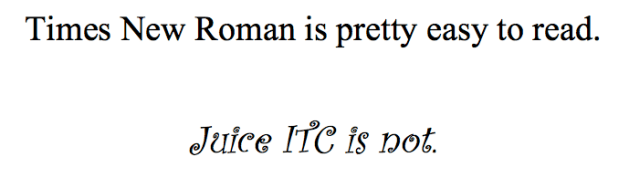
The participants were instructed to read the text and rate the author’s intelligence. All of the instructions and rating scales were written in the corresponding text to prevent readers from assuming the author had chosen the font, which could be taken as a hint about their intelligence.

Readers who received the “Juice ITC” version rated the author as less intelligent than those who read it in “Times New Roman.” This establishes the effect of fluency independent of complexity, and supports the idea that complex texts are rated poorly because they reduce fluency.

Experiment 5: Do Manipulations of Fluency Have the Same Effect if the Source of the Decreased Fluency is Obvious?

People tend to discount the role of fluency when it has an obvious source. For example, Tversky and Kahneman found that although people typically use fluency as a cue for estimating surname frequency, if they are in the presence of obvious causes for fluency (personal relevance, famous name) they stop using fluency and even overcompensate.3 To test this, 27 participants were given an unedited essay from experiment one that was either printed normally, or with low toner in the printer making it light, streaky, and hard to read. Readers were asked to decide if they would accept the applicant as well as rate the confidence of their decision and the author’s intelligence.

Participants who read low toner texts were more likely to recommend acceptance than those who read the normal version. They also rated the intelligence of the author more highly in the low toner condition. When the source of fluency is obvious, people become aware of their bias and overcorrect.

*     *     *

The implications of the first four experiments can be neatly summarized: “Keep it simple, stupid.” As experts have long recommended, you should use short, common words and easy to read fonts. Someone who makes good points, but relies on complex words and jargon to do so, likely pays a price in terms of the perceived quality of their work and mind. Reading Oppenheimer’s paper made me wonder if the same rules hold true on the broader scale of academic disciplines. If a field tends to use needlessly complex language more than other fields, is it viewed as less credible?

To test this hypothesis I set out to compare the complexity of the top journals from various fields to their perceived credibility using average word length as a proxy for complexity and SCImago Journal Rank (SJR) as a proxy for credibility. Specifically, I chose to compare the top journal in astrophysics, biochemistry, sociology, and gender studies. To estimate word length I sampled the first five full articles from the latest issue of each journal and divided the number of characters by the word count. Each journal’s complexity score reflects the average word length of the five selected papers.

There was no relationship between SJR and complexity score (names of the journals and papers used for the analysis, as well as results, can be found here.) This could be for a number of reasons: the top journal of a field is not necessarily reflective of the field as a whole, average word length could be a bad proxy for complexity, SJR could be a bad proxy for credibility, small sample size, etc.

Or, could it be that I was confusing complexity with needless complexity?

The complexity score is similar for Gender and Society (5.5) and Annual Review of Astronomy and Astrophysics (5.3), but is the difficulty of understanding for the underlying content the same? Almost certainly not. Previous research has developed a Hierarchy of the Sciences that uses objective bibliometric criteria to assess the “softness” of an academic field.4 Unsurprisingly, the ranks are as follows, from hardest to softest science: physical (physics, mathematics), biological-hard (molecular biology, biochemistry), biological-soft (plant and animal sciences, ecology), social (psychology, economics), and humanities (archaeology, gender studies). The authors state that as you progress from mathematics to humanities there is “a proportional loss of cognitive structure and coherence in their literature background.” In other words, Gender and Society uses equally complex language to describe “softer” phenomena. Therefore, the degree of needlesscomplexity is higher than in similarly complex texts where the underlying difficulty of the concepts is greater.

The point is clarified by the following examples taken from papers analyzed for this article. Excerpt 1 comes from an abstract in the Annual Review of Astronomy and Astrophysics,5excerpt 2 comes from an abstract in Gender and Society.6

  1. In our modern understanding of galaxy formation, every galaxy forms within a dark matter halo. The formation and growth of galaxies over time is connected to the growth of the halos in which they form. The advent of large galaxy surveys as well as high-resolution cosmological simulations has provided a new window into the statistical relationship between galaxies and halos and its evolution.
  2. In Hegemonic Masculinity: Formulation, Reformulation, and Amplification, James Messerschmidt provides a comprehensive and nuanced explanation of hegemonic masculinity, including the sociohistorical context of its development, and an incisive analysis of research that has utilized the tricky concept.

I applied the methodology of experiment 3 from Oppenheimer’s paper to both (simplified long words). Let’s see how they change.

  1. In our modern understanding of galaxy creation, every galaxy forms within a dark matter halo. The creation and growth of galaxies over time is linked to the growth of the halos in which they form. The advent of large galaxy surveys as well as high-resolution cosmological models has provided a new window into the statistical link between galaxies and halos and its evolution.
  2. In Powerful Maleness: Design, Redesign, and Expansion, James Messerschmidt provides a full and nuanced account of powerful maleness, including the sociohistorical context of its development, and an incisive analysis of research that has utilized the tricky concept.

In the first excerpt there were nine words that had nine or more letters, and four could be replaced with a shorter word without distorting the meaning. In the second excerpt there were more long words, despite the fact that the passage is much shorter (38 vs. 64 words). Of the 12 words that met the criteria in excerpt 2, nine of them could be replaced without altering the meaning. Therefore, the density of both long words and needlessly long words is higher in the second excerpt.

Does this needless complexity harm the public perception of gender studies? Yes. Good luck convincing laymen about the oppression of women using terms like “subalterneity” and “phallogocentrism.” It will be difficult to understand, and therefore judged negatively. Take, for example, a passage from one of the most influential works from arguably the most influential gender theorist, “Performative Acts and Gender Constitution: An Essay in Phenomenology and Feminist Theory” by Judith Butler.7 

“When Beauvoir claims that ‘woman’ is a historical idea and not a natural fact, she clearly underscores the distinction between sex, as biological facticity, and gender, as the cultural interpretation or signification of that facticity. To be female is, according to that distinction, a facticity which has no meaning, but to be a woman is to have become a woman, to compel the body to conform to an historical idea of ‘woman,’ to induce the body to become a cultural sign, to materialize oneself in obedience to an historically delimited possibility, and to do this as a sustained and repeated corporeal project.”

The above is a reasonable argument for separate definitions of sex and gender that is totally obscured by jargon and wordiness. It could be reworded as follows without losing any meaning:

“According to Beauvoir, to be a woman is more than to be biologically female. It also involves behaving in the way women are expected to based on historical precedent.”

*     *     *

In summary, a lack of fluency (often caused by needlessly complex words) causes readers to negatively judge a text and its author. The degree of needless complexity varies across academic fields and this needless complexity likely harms public perceptions of the fields where it is most pronounced. All of this raises one last question: why do disciplines like gender studies insist on needless jargon? Three hypotheses seem most likely: historical coincidence, physics envy, and conscious deception.

The first two hypotheses suggest well-meaning authors. It is possible that the early writers of certain fields like gender studies set a bad precedent by coining long, unintuitive words that are now important to the field, while other disciplines were fortunate to have such tractable terms as black holes and dark matter. Alternatively, given the widespread attitude (at least in some circles) that the humanities and social sciences are softer, less challenging, or less valuable than other fields of inquiry, one could see academics in those fields internalizing a sense of inferiority. This attitude is known as physics envy. In order to prove their intelligence, to themselves and to others, they might be tempted to complicate simple ideas and use complex vocabulary to describe them—just like the Stanford undergraduates interviewed by Oppenheimer.

The third hypothesis, that they are consciously deceiving readers, brings us back to Oppenheimer’s fifth experiment. If you recall, participants in that experiment rated more highly the text quality and author intelligence of text printed with low toner. It was obvious to them that the low toner was biasing their judgements in a negative way, so they overcompensated. The question remains, what sources of poor fluency are obvious enough to hit the inflection point where instead of hurting perception they begin to help it? Does heavy use of complex academic jargon count as an obvious enough source and, if so, are writers incentivized to use it? If laymen are self-aware of the jargon reducing fluency, they may give the text and the author benefit of the doubt when it is undeserved.

Ultimately, this is an empirical question waiting to be answered. In the meantime, if the writers who are producing needlessly complex pieces are doing so to deceive the public, we can take solace in the fact that it isn’t working very well— there is only one sociology journal in the top 100 (Administrative Science Quarterly, #78), and one gender studies journal in the top 1,000 (Gender and Society, #975) of journals ranked by SJR.

Source: Stupid Is as Stupid Writes

Latinos Increasingly Concerned About Their Place In U.S. Society, Survey Finds

Hardly surprising given the language of President Trump and the impact of his policies:

One out of every two Latinos in the United States says that life has become more difficult for them in the past year, according to a recent survey by the Pew Research Center, a nonpartisan think tank in Washington, D.C.

Mark Lopez, director of global migration and demography research at Pew and a co-writer of the survey, says the findings reflect a turn “towards being pessimistic about the country, about the direction of the country and also the future for their own children.”

Lopez says Latinos have traditionally been more optimistic than the general U.S. population about life in the United States. “But that’s changed,” he says.

Nearly 4 in 10 Latinos say they experienced some kind of harassment related to their ethnicity in the past year.

Chart showing that four-in-ten Latinos experienced an incident and heard expressions of support tied to their background in the past year.

Yet a similar number say they have also heard expressions of support for Latinos.

The experience of 38-year-old Janet Sadriu illustrates both of these findings.

Sadriu was driving on a two-lane, 35 mile-an-hour city street in Houston recently when a driver passed her on the right, pulled next to her and started yelling obscenities at her at a red traffic light. She pulled out her phone and started recording him.

Houston resident Janet Sadriu recorded this video when a driver started yelling obscenities at her at a red traffic light.

“I don’t know him,” says Sadriu, “but he automatically assumed I’m Hispanic. I have black hair, I’m not blue-eyed and white.”

“Learn English,” he rants in the video. “It’s my country. Get out.”

Sadriu was born in Mexico. She’s a U.S. citizen and has lived in the United States since 2009.

“I was shocked and shaken,” she says. “I was afraid that this man was going to follow me and pull out a gun.”

Sadriu, whose 2-year-old daughter was in the car with her, filed a police report.

Sadriu says she was angry when she posted her video on social media. “I was thinking of other immigrants who are out of status,” she explained, “and who are afraid to speak up or ashamed and would not expose this man’s ugly behavior.” But she’s also hoping for change, so that “by the time my daughter is older, she is going to live in a world where all the racism and hate and bullying is gone.”

She says the response has been overwhelmingly kind and supportive.People from all over don’t agree with this type of behavior,” she says.

According to the Pew survey, 38 percent of Latino respondents experienced similar incidents in the past year. Some said they were asked not to speak Spanish in public or were told to go back to their country.

Nearly two-thirds of Latino respondents say that Trump administration’s policies have been harmful to their communities. The survey found many Latinos are more worried about deportation and family separation. They are also more concerned about their personal finances than in past years, even though the country’s economy is doing well and Latino unemployment is at historic lows, according to Pew.

Social media documents harassment

Other recent examples of harassment include an incident in May, when a lawyer in Manhattan threatened to call ICE agents on the kitchen staff making his lunch.

Last month, a Colorado woman harassed two women for speaking Spanish at a supermarket.

At Andy’s Restaurant in Lovettsville, Va., in October, a Guatemalan family was accosted by a white woman finger-wagging at them for speaking Spanish. In the video, the woman is heard demanding, “show me your passports,” followed by, “go back to your f****** country.”

A response to the belligerent woman was posted on Andy’s Facebook pageby the restaurant owners. “Thank you for thinking that you have a right to express your venomous and vitriolic views — no matter how odious and ignorant — wherever and whenever you desire,” they posted. “Thank you —and we mean this with all the aforementioned respect that you rightfully deserve — for never returning to Andy’s. You are not welcome.”

Comments to Andy’s Facebook post quickly poured in from all over the country with words of support like Caroline Hart’s: “Thank god for human beings like you.”

Janet Sadriu, the Houston mom who experienced verbal harassment while driving “just for my looks,” has a message for Hispanics who encounter such harassment. She urges them “not to be afraid and speak up.” There are more good than bad people out there, she says.

Source: Latinos Increasingly Concerned About Their Place In U.S. Society, Survey Finds

John Ivison: Neither left nor right should politicize Canada’s immigration system

Naive to expect that parties will not politicize immigration and related issues.

The question is how they do so, what language they use, and the extent to which and how they virtue signal and practice identity politics.

The major parties largely stay within reasonable bounds. Bernier, as Ivison notes, does not:

The personal pronoun is best avoided, even by opinion columnists. In this instance it is necessary, to provide some context.

I was in a sombre mood on Remembrance Day, having posted a tribute on Twitter to three generations of my family who wore a uniform so I didn’t have to.

As I scrolled through the flotsam on my feed, I came across a tweet by Maxime Bernier, the former Conservative leadership candidate who recently broke away to form his own party. He was lamenting the case of Asia Bibi, the Pakistani Christian woman who spent eight years on death row charged with blasphemy and who, after being acquitted by Pakistan’s Supreme Court, is now at risk of extra-judicial assassination.

Bernier was quite rightly decrying the “barbarism” on the streets of Karachi. But he twisted his condemnation for his own political ends, calling for the need to “protect our society” from a threat that patently does not exist on the streets of Canadian cities.

“Radical multiculturalism is the misguided belief that all values and cultures can co-exist in one society. They cannot,” his tweet said.

The tweet came across as a transparent ploy to attract support by espousing views which, if sincerely held, he kept to himself for 15 years as part of a government that regularly expanded the number of immigrants coming to Canada from countries like Pakistan. The fact that he expressed such intolerance on Remembrance Day amplified its effect.

Some time later, I came across a video of two Eritrean children who were new to Canada and were discovering the sheer delight of their first snowfall. With Bernier’s comments still disturbing my mood, I rattled off a tongue-in-cheek retweet: “This is the kind of extreme, radical multiculturalism we’ve been hearing about. Clearly, a grave threat to our way of life.”

My comment touched a nerve, going viral with about 10,000 people “liking” it. Some people got into the spirit of it: “They are going to take our spots on the toboggan hills — I’m afraid there won’t be enough snow left for the rest of us,” wrote Rudy Reimer, not entirely seriously.

On reflection, perhaps it sullied something that should not have been politicized. “Too bad you had to use such a happy, carefree occasion to take a political swipe at some conservatives who have a genuine concern over Canada’s immigration policy,” Eric Nissen responded.

Many, many people criticized me for glibness, and, in turn, federal immigration policy, accusing it of importing “criminals and terrorists.” The father was probably busy making a bomb, one brave individual wrote behind the cloak of a ridiculous pseudonym.

The 2019 election will be won by the party that can best address the anxieties voters are feeling about the affordability of housing, wages and the cost of living. But as this little incident highlighted, deep political cleavages over cultural diversity are hardening as the consensus over mass immigration comes under increased pressure.

The nation is split on the issue as never before in recent memory. Research by Abacus Data suggests there is a 55-45 per cent divide between those who think immigration is a net positive versus those who think it is a net negative.

Conservative voters are most concerned — 63 per cent agreed with the statement that immigrants are a burden on our country because they take our jobs, housing and healthcare. But so did 32 per cent of Liberal supporters and 42 per cent of NDP voters.

The divisions and anxieties may not be as sharp as in the U.S. and parts of Europe, but Canada is not immune from the culture wars.

I’m an immigrant but I have concerns about the risks of the system being politicized. The Liberal Party is intent on raising the proportion of family-class permanent residents and refugees because it plays well in certain ridings.

There are also legitimate concerns about the integrity of the system as migrants seeking a better life stream across the Canada-U.S. border. The number of Nigerians claiming refugee status in Canada surged by 300 per cent in the first six months of 2018. Further, there very real worries that the models used to set immigration levels in the coming decades have not taken account of artificial intelligence and its impact on labour markets.

But these are not the concerns we are hearing from Bernier. “We must start pushing back against this politically correct nonsense that is destroying our society and our culture,” he said in a speech in Calgary last weekend.

Is our society being destroyed? Is Remembrance Day under threat? It didn’t seem that way on Sunday, as millions of Canadians paid their respects to those who made the ultimate sacrifices for our freedoms.

Bernier was using ultrasonic messaging, playing on a prospect frightening to many Canadian-born voters: that they will end up as a minority population in their own country.

Canada has long been said to suffer from a range of neuroses, from separation anxiety to an inferiority complex. But the real fear for many in English and French Canada in 2018 is that “the elites” are ignoring their concerns in favour of protecting the rights of minorities. Gains for immigrants are seen as losses for the native-born, who already see themselves as being under financial pressure.

There are racists and fascists out there — I spent a busy morning blocking them on Twitter. But most people who feel unease at higher immigration levels don’t see themselves as racist. Many could be persuaded to reassess, if our leaders could articulate a vibrant Canadian cultural identity that benefits from newcomers.

We certainly need a rallying call more convincing than Justin Trudeau’s contention that “there is no core identity, no mainstream in Canada” — the world’s “first post-national state,” as he told the New York Times Magazine.

The former is demonstrably untrue, the latter gibberish.

It requires real leadership to articulate and promote the consensus that still exists over cultural diversity. Canadian identity is built on hockey, maple syrup, snow and lumberjacks. But it goes beyond that, as Shane Koyczan noted in his wonderful poem, We Are More.

Canada is “an experiment going right for a change,” he wrote.

“We are an idea in the process of being realized,
We are young,
We are cultures strung together,
Then woven into a tapestry,
And the design is what makes us more
Than the sum total of our history.”

Amen to that.

Source: John Ivison: Neither left nor right should politicize Canada’s immigration system

Supreme Court to grapple with murky legal rights of immigration detainees

A case to watch:

Should an immigration detainee have the same right to challenge their ongoing detention as their criminally convicted peers?

That’s the quandary at the centre of a Supreme Court of Canada case opening on Wednesday in Ottawa.

While Canadian citizens serving a jail sentence are entitled to argue their case before a judge, foreign nationals held for immigration violations must appear before a federal tribunal, which has been criticized for rubber-stamping their continued incarceration.

Canada’s highest court is being asked to clarify if immigration detainees are protected by the Charter of Rights and Freedoms and can access what is legally known as habeas corpus — a legal recourse that allows anyone held by the state to challenge the lawfulness of their detention.

Until now, immigration detention has been a murky area of law between two levels of authority — the federal government, which is responsible for immigration matters and runs the tribunal, and the provinces, which are in charge of detention facilities.

Provincial courts often defer to the Federal Court to deal with immigration detention through judicial reviews, but these reviews only examine if any legal errors are made by immigration officials in detaining or releasing an individual. The federal judges don’t consider the lawfulness of an immigration detention, and all they can do is send a case back for a new decision.

The Supreme Court case is centred on Pakistani immigration detainee Tusif Ur Rehman Chhina, who had been held for almost 30 months while officials tried to deport him.

In Ontario, long-time immigration detainees have been asking the provincial court to release them on habeas corpus since 2015. In September, Ebrahim Toure, who had been held for 5-1/2 years, won his freedom on the same grounds.

“What we are saying is it’s advantageous and preferable for immigration detainees to have direct access to habeas corpus,” said Barbara Jackman, one of the three lawyers representing Chhina. “Habeas corpus is a right, not a discretion.”

Chhina arrived in Canada in 2006 and was soon granted asylum. However, he was ordered deported in December 2010 after a series of criminal convictions here. Border officials made three failed attempts to obtain travel documents from Pakistan for Chhina’s deportation while keeping him behind bars.

In 2016, Chhina claimed to the Alberta provincial court that his lengthy detention was unlawful. The request was denied after a judge ruled the matter was beyond the provincial court’s jurisdiction.

Chhina’s lawyer Nico Breed then took the case to the Alberta appeal court and won. His client was finally deported in September 2017, but the Public Safety Minister and Attorney General of Canada proceeded with the appeal to the Supreme Court.

In their submissions, government lawyers said immigration detainees are entitled to regular independent reviews, which must justify their continued detention or grant their release.

“In immigration matters, provincial superior courts ought to decline the exercise of jurisdiction to grant prerogative relief, including habeas corpus,” the federal government argued in its submission to the Supreme Court.

“There is no need to depart from that approach when reviewing immigration detention decisions of allegedly lengthy and uncertain duration.”

However, immigration lawyers have argued the odds are stacked against detainees the longer they are held.

“The system is structurally against the detainee. The tribunal looks at the reason the person is held and racks up more reasons not to release him,” said Jackman.

Even if the Supreme Court rules in favour of her client, Jackman said she doesn’t believe provincial courts will be inundated by immigration detainees because the majority are released in under three months.

Last year, 3,557 people were held in immigration detention in Canada. Eighty-eight per cent of detainees were released within 90 days. But in 80 cases, people were held for more than a year.

Source: Supreme Court to grapple with murky legal rights of immigration detainees

Hate crimes in U.S. up 17 per cent in 2017, third consecutive year with increase

Latest numbers (Canadian numbers should be out shortly):

Hate crimes in the United States rose 17 per cent last year, the third consecutive year that such crimes increased, according to newly released FBI data.

Law enforcement agencies reported 7,175 hate crimes occurred in 2017, up from 6,121 in 2016. That increase was fueled in part by more police departments reporting hate crimes data to the FBI, but overall there is still a large number of departments that report no hate crimes to the federal database.

More than half of such crimes, about 3 of 5, targeted a person’s race or ethnicity, while about 1 of 5 targeted their religion.

Of the more than 7,000 incidents reported last year, 2,013 targeted black Americans, while 938 targeted Jewish Americans. Incidents targeting people for their sexual orientation accounted for 1,130 hate crimes, according to the FBI.

The FBI has urged local police departments to provide more complete information about hate crimes in their jurisdictions.

Of the more than 7,000 hate crime incidents in 2017, more than 4,000 were crimes against people, ranging from threats and intimidation to assault, to murder. More than 3,000 were crimes against property, ranging from vandalism to robbery to arson.

Acting Attorney General Matthew Whitaker said the new figures are “a call to action – and we will heed that call. The Department of Justice’s top priority is to reduce violent crime in America, and hate crimes are violent crimes. They are also despicable violations of our core values as Americans.”

Whitaker said he was “particularly troubled by the increase in anti-Semitic hate crimes,” which are already the most common type of religious hate crime in the United States.

Anti-Semitic hate crimes rose 37 per cent in 2017. Anti-Islamic hate crimes declined 11 per cent last year, with 273 such incidents, the data show.

Source: Hate crimes in U.S. up 17 per cent in 2017, third consecutive year with increase

How Stan Lee and His Marvel Superheroes Fought Against Racism

One of the better articles out regarding Stan Lee’s anti racism messages in his stories:

“It’s an extension of the fairy tales we read as kids. Or the monster stories or stories about witches and sorcerers. You get a little older, and you can’t bother with fairy tales and monster stories anymore, but I don’t think you ever outgrow your love for things that are fantastic, that are bigger than you are—the giants or the creatures from other planets or people with superpowers who can do things you can’t.” – Stan Lee

Stan Lee has passed away at age 95, and the famed “Smilin’ Stan” that the world knows as the face of Marvel Comics leaves behind a towering legacy. Lee created characters and told stories that reflected the struggle in American society between the idealized way we view ourselves and the harsh ugliness in our culture that is impossible to ignore. Born Stanley Martin Lieber in New York City, the beloved comics legend co-created iconic superheroes like Spider-Man, the Fantastic Four, The Incredible Hulk, Daredevil, the Avengers, the X-Men and Black Panther in the 1960s, helping to establish Marvel Comics as the foremost rival to longstanding D.C. Comics.

Lee’s characters and stories reflected the pathos in ‘60s culture—giving voice to adolescent angst via Spider-Man just as the youth culture boom of the decade was beginning to take hold; addressing then-current anxieties about space exploration via the Fantastic Four; using the Hulk as a metaphor for repression and government shadiness; and the X-Men functioned as a symbol for marginalized citizens’ fight for their right to exist. Alongside fellow luminaries such as Jack Kirby and Steve Ditko, Lee set Marvel apart not only by placing its super-powered protagonists in the middle of real-world troubles but beyond that, by giving voice to those issues. To fully appreciate what that means, one has to understand the cultural landscape when Lee rose through the ranks at Marvel.

In the mid-1950s, watchdog groups derided comic books as a scourge—a corrupting element in youth culture that promoted the occult, violence and deviancy. Lee and Kirby debuted Black Panther in 1966 in the pages of Fantastic Four. Marvel’s first black hero was prince of a fictional African nation called Wakanda and, despite some unfortunate characterizations (The Thing refers to the country as “Tarzan land” in an early panel), the presentation of a black superhero from Africa with supreme intellect and advanced technology was groundbreaking and indicative of what made Lee’s tenure special.

“Marvel has always been and always will be a reflection of the world right outside our window,” Lee said in a popular 2017 video. “That world may change and evolve, but the one thing that will never change is the way we tell our stories of heroism.

“Those stories have room for everyone, regardless of their race, gender or color of their skin. The only things we don’t have room for are hatred, intolerance and bigotry.”

Lee has talked about the popular X-Men as a metaphor for black Americans’ struggle for civil rights. In Marvel canon, the X-Men are part of a human subspecies called mutants, born with superhuman abilities and hated by much of humanity for what they are. It has been widely accepted that Charles Xavier, the X-Men’s idealistic founder, was loosely based on Martin Luther King, Jr.; while the team’s most famous foe, Magneto, was drawn from Malcolm X. Xavier believes that humans and mutants can peacefully coexist; Magneto believes mutants must overthrow humans before they are decimated by their hateful oppressors.

“I did not think of Magneto as a bad guy,” Lee once said. “He was just trying to strike back at the people who were so bigoted and racist. He was trying to defend mutants, and because society was not treating them fairly, he decided to teach society a lesson. He was a danger of course, but I never thought of him as a villain.”

“[Magneto] was just trying to strike back at the people who were so bigoted and racist. He was trying to defend mutants, and because society was not treating them fairly, he decided to teach society a lesson.”

Lee understood how comic books reflected and affected those who read them. He also understood that great storytelling connected with the times. It should be noted that the dynamic between Xavier and Magneto, in particular, evolved over time, and in the hands of various other writers like Chris Claremont, the parallels with King and X became more apparent. Lee was uneasy about Black Panther being associated with the revolutionary party of the same name (so much so that the character was almost rechristened “Black Leopard”) and Magneto’s background as a Holocaust survivor was another Claremont development. As was the case with many iconic, long-running comics heroes, Lee’s original vision was expanded upon, but the history of collaboration has often led to commentary about how much credit should go to Marvel’s most iconic creator.

Lee loved the fans and loved the spotlight, to the point where there was criticism that he was a glory hound. His penchant for self-promotion spawned criticism from former colleagues and observers, especially those who felt he’d overshadowed and taken credit from collaborators like Jack Kirby and Spider-Man co-creator Steve Ditko. Kirby, whose artwork came to define the Fantastic Four and X-Men, was a freelancer, as opposed to a Marvel employee like Lee.

“There was never a time when it just said ‘by Stan Lee,’” Lee told Playboyin 2015. “It was always ‘by Stan Lee and Steve Ditko’ or ‘by Stan Lee and Jack Kirby.’ I made sure their names were always as big as mine. As far as what they were paid, I had nothing to do with that. They were hired as freelance artists, and they worked as freelance artists. At some point they apparently felt they should be getting more money. Fine, it was up to them to talk to the publisher. It had nothing to do with me. I would have liked to have gotten more money, too.”

“Bigotry and racism are among the deadliest social ills plaguing the world today…The only way to destroy them is to expose them—to reveal them for the insidious evils they really are.”

Regardless of ongoing controversy surrounding the contributions of Kirby and others, Lee should be remembered for being an agent of change in his medium. A 1968 post from Lee’s mail column has been making the rounds in the wake of his death. In it, Lee makes plain his stance on racism.

“Let’s lay it right on the line. Bigotry and racism are among the deadliest social ills plaguing the world today. But, unlike a team of costumed super-villains, they can’t be halted with a punch in the snoot, or a zap from a ray gun. The only way to destroy them is to expose them—to reveal them for the insidious evils they really are. The bigot is an unreasoning hater—one who hates blindly, fanatically, indiscriminately. If his hang-up is black men, he hates ALL black men. If a redhead once offended him, he hates ALL redheads. If some foreigner beat him to a job, he’s down on ALL foreigners. He hates people he’s never seen—people he’s never known—with equal intensity—with equal venom.

“Now, we’re not trying to say it’s unreasonable for one human being to bug another. But, although anyone has the right to dislike another individual, it’s totally irrational, patently insane to condemn an entire race—to despise an entire nation—to vilify an entire religion. Sooner or later, we must learn to judge each other on our own merits. Sooner or later, if man is ever to be worthy of his destiny, we must fill our hearts with tolerance. For then, and only then, will we be truly worthy of the concept that man was created in the image of God—a God who calls us ALL—His children.”

Stan Lee’s creative voice helped reshape the role of comics in American society and helped affect how American society saw comics. In doing so, Lee helped challenge his readers and his peers. His characters live now as part of the fabric of our culture—in blockbuster movies, acclaimed TV shows, video games and a host of other media. Generations of comic-book lovers saw themselves in those characters, and that was what he’d wanted all along. As some quarters of America tell themselves that politics have no place in pop art, the proof in Stan Lee’s history reminds us that the message has always been a part of the medium. Those who believe otherwise maybe have to consider that they aren’t the “good guy” in the story. After all—you can’t be a hero if you don’t stand for anything.

Source: How Stan Lee and His Marvel Superheroes Fought Against Racism

The anti-semitism intersectionality gap

While I dislike the term “intersectionality,” I haven’t found an alternative term that describes how the interactions between race, class, gender and religion and their complexities.

But conflating Jews with Whites misses the commonalities of discrimination and prejudice, even if they play out differently with respect to Jews compared to other groups:

My mom is stoic and rarely ever cries. Last week she FaceTimed me from California, dewy-eyed, while I was in the subway in New York. She mentioned the news—11 Jews shot in a synagogue in Pennsylvania. I had already read about it in the morning, but talking about it with my mom forced me to feel it.

She told me, “It’s okay to feel sad.”

I forget sometimes that I’m allowed to feel sad for Jews. The discourse in the School of Social Work around anti-Semitism has dwindled in large part due to the hyperbolic conflation of Jewishness with whiteness. I am therefore quick to forget that Columbia often fails to treat anti-Semitism with the legitimacy it deserves. My mom’s simple acknowledgement allowing me to feel Jewish pain reminded me that it was ok to feel so deeply.

My experience in the Columbia School of Social Work has often made me feel hollow. It can seem like I have no role as a Jew in both the course curriculum and in class discussions. “How Jews Became White Folks” is my school’s single mandatory reading regarding Jewish people in contemporary society. And, even though this piece takes a dive into important assimilation markers of the American Jew, this is only a 20-page reading shoved in among the several books and 40 articles that make up our curriculum. In discussions, fellow classmates have confessed that they have become frustrated when Jewish people speak up about their experiences. On one occasion, I tried to explain to a close peer how my Jewishness guides my social justice work and she told me that I needed to stop talking, since my white privilege dominated any authentic form of solidarity I could claim as a Jewish person. During my time at Columbia, I often wonder if I truly belong at the School of Social Work.

Why do my peers dismiss my Jewish identity due to my white skin? Why do I feel so disingenuous for being Jewish in social justice work?

This message from my peers, that Jews are white, isolates the Jewish people from the broader cultural context. It creates an assumption that renders the dialogue around anti-Semitism obsolete and minimizes the Jewish experience. Not only is this generalization detrimental to understanding the nuances and diversity of Jewish identity, but it also inhibits an honest conversation about the ways being Jewish has been contextualized in discourses of race, ethnicity, and culture. Frankly, perceiving Jewishness as a mere form of whiteness or as just a religion is ignorant. Holocaust survivor Elie Wiesel knew this, and cautioned us against these toxic and reductive comparisons when he said, “No human race is superior; no religious faith is inferior. All collective judgments are wrong. Only racists make them.”

Intersectionality—the interrelation between race, class, and gender—is a central theme in our curriculum that promotes a solidarity-driven approach to social justice. Unfortunately, it seems that this ideology is not being taught to address issues pertaining to anti-Semitism. Social workers are often so concerned about abiding by these pre-established intersectionality guidelines that they unintentionally perpetuate the very kinds of discrimination that they supposedly oppose. Thus, Jewish students whisper to each other in the secrecy of dimly lit dive bars about our shared experiences of anti-Semitism, but we don’t risk speaking out in class. An intersectionality gap exists between engaging in discussions of anti-Semitism and those pertaining to other forms of racism. Rather than avoiding discussions of anti-Semitism, we must break the silence by discussing solidarity.

Before this shooting happened, people didn’t seem to care about the plight of the Jew. But I have found myself obsessed with the topic and unable to stop writing about it in different forms. I’m calling upon Columbia School of Social Work and schools of social justice everywhere to break this silence and take meaningful action to change their current practices of omitting Jewish identity and experience from their classrooms and conversations.

Source: The anti-semitism intersectionality gap

Gurski: Linking immigration and terrorism is wrong, in Canada and elsewhere

Good column by Gurski:

I never knew my maternal grandfather. He emigrated to Canada in the early part of the 20th century from western Ukraine (or eastern Poland, the details on that are fuzzy) and settled in Montreal where he worked at the CPR’s Angus workshops, along with a great many other immigrants, I imagine. He married and had four children, including my mother, and toughed it out during the Great Depression. He died in the mid-1940s.

I seldom think of him but his memory came back to me last week when I read of a new documentary, That Never Happened, by Saskatoon native Ryan Boyko, which premiered at Ottawa’s Bytowne Cinema among other venues. The film deals with the internment of thousands of Ukrainian immigrants in camps in remote areas of Canada from 1914-1920. These men were seen as citizens of the Austro-Hungarian Empire, with which we were at war, and hence they were viewed as enemies of the state. My grandfather is believed to have been one of those internees at the Spirit Lake detention site in northern Quebec (I have a copy of my grandfather’s passport which says he was tied to the Austro-Hungarian Empire).

The round-up of thousands of Ukrainian immigrants, and the monitoring of tens of thousands more, was the product of fear: fear of the other. In fairness, I suppose, Canada was at war and those were different times, but fear is still largely irrational and often unjustified. Nor has it gone away – as there are still those who paint immigrants as threats today.

To see this, we do not have to cast our eyes even as far as the shameful depiction by U.S. President Donald Trump of the thousands of desperate migrants making their way through Central America to the southern states as “terrorists and criminals.” An example closer to home is La Meute (the “Wolfpack”), a racist Francophone anti-immigrant group, doing the same thing in Quebec regarding the irregular migrants seeking to leave an increasingly unstable U.S. and showing up at Canada’s border .

Whatever you think of people on the move – and there are valid concerns over how the government is dealing with, and should deal with, these migrants – what is quite clear is that they present a very low to non-existent national security threat. Yes, it is always possible that there are unsavoury characters in the mix who may engage in criminal activities in Canada, but shrill fear-mongering about a wave of terrorists seeking to sow mayhem in our cities is unsubstantiated.

U.S. intelligence agencies, for instance, have stated publicly that Trump’s conviction that ISIL is using the cover of refugee flows to infiltrate the U.S. is false. In other words, the president’s own intelligence services have taken the rare step to openly tell Americans that there is no “there” there, despite Trump’s demagoguery.

I am neither naïve nor ignorant of the real terrorist threat, having spent 15 years with CSIS as a strategic terrorism analyst and having written four books on the topic. It is always possible that malefactors use the immigration system to enter Canada – and we have had examples in the recent past. At the same time, however, there is simply no evidence that this represents a significant risk for our country. Our intelligence and other government organizations are on top of this, and they will advise the proper authorities when they come across solid information about a real risk so that action can be taken.

The rest of us – yes, that includes members of La Meute and other anti-immigrant and Islamophobic groups – need to start trusting in those agencies and stop irrationally hitting the panic button on immigration. Canada needs more people for its economic and social development and immigration is one way to get those people. Immigration is a strength, not a weakness.

Besides, no one should have to endure what my grandfather did. No one.

Source: Gurski: Linking immigration and terrorism is wrong, in Canada and elsewhere