Quebec wants to expand religious symbol ban, blocking Muslim garments in civil service

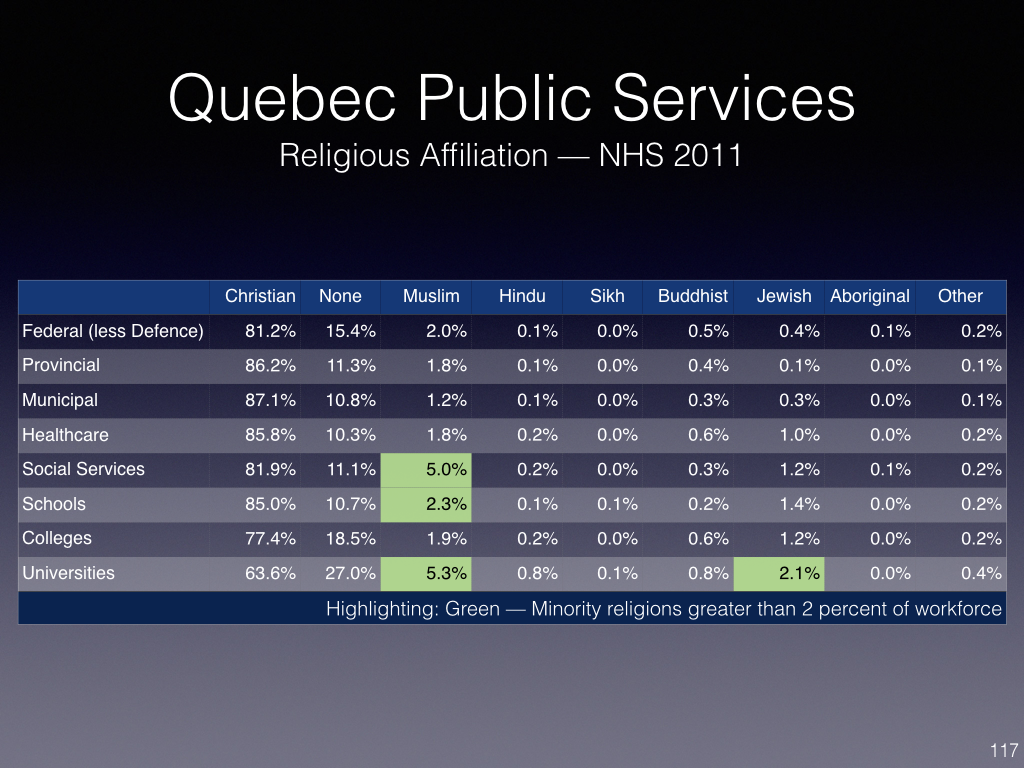
The 2011 National Household Survey, indicated a very small number of Muslim Quebecois in the public service (along with other religious minorities):

Quebec’s new government is planning to block Muslim women who work in the civil service from wearing the chador, a shawl-like piece of clothing that covers the head and body, and the niqab, which also covers the face.

Coalition Avenir Québec ​Premier François Legault has already made clear his intention to prohibit those who hold positions of authority including teachers from wearing religious symbols, such as the hijab, a Muslim headscarf.

The ban on the chador and niqab, however, would extend to all employees in the public sector. A representative from the CAQ couldn’t say how many people such a ban would affect.

Immigration Minister Simon Jolin-Barrette, the government’s point person when it comes to ensuring the secularism of the state, said Wednesday the government plans to “move quickly” to introduce a law.

“It was always our position to prohibit the chador in the public service,” said Jolin-Barrette, in response to questions following a report in the Journal de Montréal about the government’s stance.

There is no mention of banning the garments in the CAQ’s online platform, but the party has played up its commitment to such a policy in the past.

In 2016, the CAQ said on Twitter that it would “defend Quebec values” by banning the chador, unlike its rivals, the Liberals and the Parti Québécois.

Jolin-Barrette said it was too early to provide details on exactly how and when the law would be implemented.

Later on Wednesday, Legault said a law prohibiting religious symbols isn’t “a priority” for the CAQ, which created some confusion about the issue.

“One important value is equality between men and women, so we want to protect that. Now, is this a priority? No,” he said.

‘Surreal’ debate

Montreal lawyer Shahad Salman, who wears a hijab, said she is discouraged the new government — and the media —  continues to focus on identity issues “rather than talking about real issues.”

“It’s so surreal that we’re talking about this again, honestly,” she said. Salman said such debates are counterproductive if politicians want minorities to become more integrated into Quebec society.

As it stands, when it comes to minorities in Quebec’s civil service, the percentage doesn’t reflect the overall population.

Visible minorities made up 9.4 per cent of the province’s public workforce in 2017, although they constitute 13 per cent of the overall population, according to a study by the Institut de recherche et d’informations socio-économiques,

The chador, which covers the head and body but leaves the face exposed, is a garment commonly worn in Iran, where this photograph was taken. (Hasan Sarbakhshian/Associated Press)

The CAQ’s planned ban on religious symbols has been criticized by civil rights advocates who contend the policy will further marginalize vulnerable minorities.

Charles Taylor, author of a landmark 2008 report on the accommodation of religious minorities in the province, called the proposal “either very ignorant or very intellectually dishonest.”

In a recent interview, he pointed out that his report explicitly recommended against including teachers in a ban on the wearing of religious garb.

“We meant it to apply only to people with functions that we called ‘coercive authority’ — police and judges. Functions that can put you in jail,” Taylor said.

Lacking ‘coherent plan,’ Liberals say

The CAQ won a decisive majority in the Quebec election earlier this month, beating out Philippe Couillard’s Liberals.

Pierre Arcand, the interim leader for the Liberals, said the CAQ doesn’t appear to have a “coherent plan” when it comes to religious symbols.

The new government appears to be floating a new trial balloon every day, he said.

Arcand said he would reserve comment until a bill is tabled.

Source: Quebec wants to expand religious symbol ban, blocking Muslim garments in civil service

Australian senator who called for ‘final solution’ to immigration expelled from party

Too extreme even for Pauline Hanson, the leader of the right-wing nativist One Nation party, found his comments too extreme:

Katter’s Australian party has ejected its only senator, Fraser Anning, from the party over his statements about “non-European” migration two months after he made a speech calling for a “final solution” to immigration.

Despite the party leader, Bob Katter, backing Anning’s comments in August, the party drew the line on Thursday, ejecting Anning for ignoring directives not to distinguish between “European” and “non-European” migration because to do so was clearly racist.

The party was under increasing pressure to ditch Anning due to a withdrawal of union support and then a threat by the Labor party to direct preferences away from the Katter party in response to the racial furore.

In his first Senate speech in August, Anning praised the White Australia policy, called for an end to Muslim migration and invoked the term “final solution”. Katter, the federal leader of Katter’s Australian party, declared the speech had his “1,000% support”.

In a statement on Thursday, the president of Katter’s Australian party, Shane Paulger, said that “99% of what Senator Anning has been saying is solid gold” but “1% … is totally unacceptable”.

Paulger revealed that both he and Katter had told Anning “there was to be no more use of words like ‘Europeans’ and ‘non-Europeans’”.

“Clearly that is racist; clearly our policies are anti-racist,” he said.

Paulger said that in the title of his plebiscite (restricting non-European migration) bill and a proposed press release, Anning “used the same racial language” despite warnings of “extreme hostility” if he persisted.

“Clearly his divide of ‘European’ and ‘non-European’ would prevent, for example, Sikhs and Filipinos coming to this country,” he said. “His bill said the people should have the last say and that Australia’s policies should favour European migration. Both these things are true.”

Paulger defended the party’s decision to back Anning after his inaugural speech, noting that its policy supported favouring “people who can integrate into our community” and because they felt they knew “what he was getting at” with his warnings against Muslim migration.

He said that 640,000 people that came to Australia every year “overwhelmingly” come from countries without democracy, the rule of law, industrial awards, egalitarian traditions and “Judeo-Christian spiritual belief systems”.

Paulger said Katter’s Australian party supported bringing “persecuted minorities” from the Middle East and North Africa including Christians, Jews and Sikhs, and there should be “no restrictions” on Pacific Islanders coming to Australia.

“In spite of the most severe and clear warnings, Senator Anning has continued down this pathway and consequently we announce the termination of his endorsement by the KAP,” he said. “Clearly Fraser wants the freedom to pursue his crusade. And we think it is best for he and the party to give him this freedom.”

Anning responded to his expulsion from the party in a statement on Thursday night, saying Katter’s press came as a surprise to him.

“I never asked to join KAP,” Anning said. “Bob and other senior party members repeatedly asked me to do so and I only agreed on the grounds that I was free to speak out on immigration, the United Nations undue influence on Australia, stopping foreign aid and the persecuted white South Africans.

“At the time I made my maiden speech, Bob said he supported it 1,000% and Shane Paulger and KAP backed me. I haven’t changed my position but it seems that they have.”

Anning denied being told not to talk about “European” and “non-European” immigration by his party. “How can calling for a plebiscite on a predominantly European immigration program be ‘pure gold’ when I gave my maiden speech on 14 August and somehow ‘racist’ two months later?”

With the exception of Katter’s Australian party, Anning’s first speech was universally panned. Even Pauline Hanson, the leader of the rightwing nativist One Nation party that helped elect Anning to the Senate, decried it as “straight from Goebbels’ handbook from Nazi Germany”.

The speech was criticised by the then prime minister, Malcolm Turnbull, the current deputy Liberal leader, Josh Frydenberg, Labor and the Greens.

Source: Australian senator who called for ‘final solution’ to immigration expelled from party

Editorial: Trump’s cruel rule to strip H-1B spouses of the right to work

The Trump administration is moving forward with its much-criticized plan to strip working rights from about 100,000 foreign citizens in the U.S., many of whom live in the Bay Area.The Department of Homeland Security has announced that its new rule to ban the spouses of H-1B visa holders from working will be issued next month.

“Some U.S. workers would benefit from this proposed rule by having a better chance at obtaining jobs that some of the population of the H-4 workers currently hold,” the department said in the notice, as way of explanation for its actions.

In other words, this move is part of President Trump’s “Buy American, Hire American” executive order, which was signed in 2017.

The Trump administration has already slowed the flow of H-1B visas,which are a linchpin of the Bay Area’s technology industry.

Trump himself has made it clear that he wants to make major changes to the controversial visa program. But it’s particularly cruel for his administration to launch a broadside against H-1B visa holders by banning their spouses from working.

Researchers at the University of Tennessee have estimated that 93 percent of H-4 visa holders are women from India.

Many of these women are highly educated; most are in their prime working years. By stripping H-4 visa holders of their right to work, the Trump administration is effectively denying a discrete group of women the opportunity to have economic independence and to provide for their families.

The rule change will also have an outsize impact on the Bay Area.

Many Bay Area residents who hold H-4 visas have told news organizations that, should the Trump administration go forward with this rule change, they and their families will probably have to leave the area or even the U.S.

That’s a brain drain this dynamic region can ill afford.

The Trump administration must leave the H-4 visa program alone.

Source: Editorial: Trump’s cruel rule to strip H-1B spouses of the…

Canada deemed U.S. a safe country for asylum-seekers

My assumption is that the review, conducted over a year ago, is likely under continuous review given the ongoing changes in US immigration policies under the Trump administration, as suggested in the article:

Canadian immigration officials have determined that the United States remains a safe country for asylum-seekers, despite the Trump administration’s crackdown on what it terms illegal aliens.

Documents obtained by the Canadian Press under access-to-information law show Canada was concerned about the changes in U.S. immigration policy and conducted a review of its Safe Third Country Agreement with the U.S. from January to March of 2017.

The review came after U.S. President Donald Trump issued a number of executive orders on immigration, including one aimed at beefing up border security to “end the abuse of parole and asylum provisions” that delay and complicate the removal of undocumented migrants to the U.S.

Canada’s analyses of these U.S. policies were redacted from the documents. However, the overall conclusion reached by Canadian officials was that the United States “continues to meet the requirements for designation as a safe third country.”

The Safe Third Country Agreement between Canada and the U.S. is based on the core principle that someone seeking refugee protection must file his claim in the first safe country he arrives in, unless he qualifies for one of a few exceptions.

The other core tenet is that Canada considers the United States a safe country for refugees. So, if an asylum-seeker comes to Canada at an official border crossing from the U.S. and tries to claim refugee protection, she will be refused entry and encouraged to make her claim in the U.S. — the “safe country” from which she just came.

For a country to be designated safe, it must comply with the United Nations Convention against Torture and the UN’s Convention Relating to the Status of Refugees, and it must maintain a good human rights record.

Internal government documents show that in 2015, Canada decided to continue monitoring its designation of the United States as a safe country. Any developments in the U.S. that could prevent it from meeting this designation — notably, any changes to policy or practices that could “significantly weaken asylum protections provided by the United States and its human rights record” — are regularly monitored, according to a briefing note prepared for Immigration Minister Ahmed Hussen in March 2017.

Just one month after completing one of those regular reviews in December 2016, immigration officials undertook another in the wake of Trump’s 2017 executive orders and new guidelines that were issued to U.S. border officials on how to handle asylum-seekers.

As part of this review, detailed policy-directive memos from then-U.S. secretary of homeland security John Kelly were examined.

The memos, which were sent to the heads of all U.S. agencies that deal with immigration and border security, detail strict and heavy-handed enforcement measures that were to be unleashed against asylum-seekers in the U.S., including automatic detention of migrants — whom Kelly refers to as “aliens” and “illegal aliens” — pending a final determination of whether they would be ordered for removal.

Other measures outlined in Kelly’s directive included: a surge in deployment of immigration judges and asylum officers to hasten adjudication of claims; expedited removal processes; and greater scrutiny of those who claim fear of persecution if they are returned to their home countries.

U.S. Homeland Security also suspended privacy rights for non-U.S. citizens and unlawful residents, and ordered that more data on migrants be released to the public, including a requirement to publish the number of “apprehended aliens” who are convicted criminals or gang members, and the nature of their offences.

Canada reviewed these memos and Immigration deputy minister Marta Morgan provided an analysis to Hussen. Details were redacted from the documents released to the Canadian Press.

Ultimately, Canada’s 2017 review concluded that the U.S. continued to meet the necessary requirements to be designated a safe third country.

The Canadian government has faced mounting pressure to suspend the agreement in recent months — calls that escalated over the summer amid concerns about child migrants in the U.S. being separated from their parents and held in detention facilities.

Trump ultimately reversed that policy, but it remains unclear whether ongoing developments in the U.S. have prompted any further internal reviews of the Safe Third Country Agreement.

In response to requests for comment, the immigration department says it has “carefully analyzed recent developments in the United States, including the executive orders related to immigration and refugee matters, and continues to consider the United States a safe country for asylum claimants to seek protection there.”

“Details of assessments are not shared in consideration of our bilateral relationship and the ongoing nature of our analysis,” department spokesperson Beatrice Fenelon added.

Meanwhile, internal emails also obtained through the Access to Information Act show immigration officials have continued to raise concerns about the agreement, and are closely measuring public perceptions about Canada’s irregular migrant influx.

In April of this year, following a 466 per cent increase in irregular migrants crossing irregularly into Canada over the Easter weekend compared to the same period in 2017, immigration officials began deep-diving into statistics to determine why this was happening and to decide how they should publicly respond.

One internal memo pointed to the Safe Third Country Agreement as a key culprit, noting the agreement only applies at official border entry points, which is “creating an incentive for migrants to cross our border illegally between ports of entry.”

“In 2017, Canada intercepted 21,000 migrants who crossed illegally into Canada at the Canada-U.S. land border. This trend continues in 2018 and is a significant concern for the integrity of our shared border,” the internal memo states.

Sections of this document were redacted, but it does say the agreement is “antiquated” and that “there is additional and important work that needs to be done to ensure there continues to be orderly migration within the North American perimeter.”

Source: Canada deemed U.S. a safe country for asylum-seekers

No plans to change citizenship laws for children born in Ireland to foreign parents, says Justice Minister

Consistent with most of Europe:

There are no plans to change citizenship laws for children born in Ireland to foreign parents.

Justice Minister Charlie Flanagan says the current rules that someone born here to foreign parents does not get automatic citizenship were approved by a majority of people in a 2004 referendum.

It follows the case of a Co Wicklow nine-year-old who faces deportation to China after being born and raised here.

Eric Zhi Ying Xue, who is in 4th class in St Cronan’s school in Bray, was born and has lived all his life in Ireland.

His mother has had her application to remain in the State rejected.

Justice Minister Charlie Flanagan says the government won’t be taking another look at the laws around deportation orders.

“I see no plans,” said Mr Flanagan. “I have no plans at present to revisit the 27th Amendment of Bunreacht na hÉireann which was passed by an overwhelming majority of the people back in 2004.

“The changes made to the legislation after the referendum, these were put through the Dáil and the Seanad at the time.

“What they did do, was to bring Ireland into line with the vast majority of states across the European Union.”

Source: No plans to change citizenship laws for children born in Ireland to foreign parents, says Justice Minister

France’s ban on full-body Islamic veil violates human rights: UN rights panel

Not surprising but still find their reasoning regarding its impact on “attaining the goal of ‘living together’ in society” as whatever the individual reasons for wearing a niqab, it is a symbol of separation, not integration:

The U.N. Human Rights Committee said on Tuesday that France’s ban on the niqab, the full-body Islamic veil, was a violation of human rights and called on it to review the legislation.

France had failed to make the case for its ban, the committee said, giving Paris 180 days to report back to say what actions it had taken. The panel’s findings are not legally binding but could influence French courts.

“In particular, the Committee was not persuaded by France’s claim that a ban on face covering was necessary and proportionate from a security standpoint or for attaining the goal of ‘living together’ in society,” it said.

The panel of 18 independent experts oversees compliance with the International Covenant on Civil and Political Rights (ICCPR). Implementation of its decisions is not mandatory, but under an optional protocol of the treaty, France has an international legal obligation to comply “in good faith”.

There was no immediate reaction from French authorities.

The same committee came to similar conclusions on the 2008 case of a woman sacked by a creche for wearing a veil. In September, a top French judge was quoted by newspaper Le Monde as saying that while not binding, the panel’s decisions might still influence French case law.

RISK OF MARGINALIZATION

In 2014, the European Court of Human Rights, whose rulings are binding, upheld France’s ban on full-face veils in public, saying it did not violate religious freedom.

But the U.N. Human Rights Committee disagreed with this in its statement on Tuesday, saying the ban disproportionately harmed the right of women to manifest their religious beliefs and could lead to them being confined at home and marginalized.

The committee’s findings come after complaints by two French women convicted in 2012 under a 2010 law stipulating that “No one may, in a public space, wear any article of clothing intended to conceal the face.”

In its findings the panel said the ban had violated the two women’s human rights and called on France to pay them compensation.

Under the ban, anyone wearing the full-face veil in public is liable to a fine of 150 euros or lessons in French citizenship.

The committee’s chair Yuval Shany said that he and several others on the 18-member panel considered it a form of oppression.

Several countries in Europe have introduced legislation on Islamic dress. Denmark’s parliament enacted a ban on wearing of face veils in public in May. Belgium, the Netherlands, Bulgaria and the German state of Bavaria have also imposed some restrictions on full-face veils in public places.

France has the largest Muslim minority in Europe, estimated at 5 million or more out of a population of 67 million. The place of religion and religious symbols worn in public can be a matter of controversy in the staunchly secular country.

According to French media Metronews, some 223 fines were handed out in 2015 for wearing a full veil in public.

Source: France’s ban on full-body Islamic veil violates human rights: UN rights panel

Why no one really knows how many jobs automation will replace

Even though I have argued that immigration planning needs to factor in the possible impact of AI and automation, this note of caution should also be part of that analysis:

Tech CEOs and politicians alike have issued grave warnings about the capability of automation, including AI, to replace large swaths of our current workforce. But the people who actually study this for a living — economists — have very different ideas about just how large the scale of that automation will be.

For example, researchers at Citibank and the University of Oxford estimated that 57 percent of jobs in OECD countries — an international group of 36 nations including the U.S. — were at high risk of automation within the next few decades. In another well-cited study, researchers at the OECD calculated only 14 percent of jobs to be at high risk of automation within the same timeline. That’s a big range when you consider this means a difference of hundreds of millions of potential lost jobs in the next few decades.

Of course, technology also has the capability to create new jobs — or just change the nature of the work people are doing — rather than eliminate jobs altogether. But sizing the scope of sheer job loss is an important metric, because for every job lost, a member of the workforce will have to find a new one, oftentimes in an entirely different profession.

Even within the scope of the U.S., the estimates for how many jobs could be lost in a single year vary widely. Earlier this year, MIT Technology Review analyzed and plotted dozens of across-the-board predictions from researchers at places like McKinsey Global Institute, Gartner and the International Federation of Robotics. Here, we’ve charted some of the data they compiled, with some of our own analysis from additional reports:

So why do these predictions cover so much range? Recode asked leading academics and economists in the field and found some of the challenges in sizing how automation and similar technology will change the workforce:

Just because a technology exists doesn’t mean it’s going to be used

Even as new groundbreaking tech becomes available, there’s no guarantee that it will be implemented right away. For example, while autonomous-vehicle technology could one day eliminate or change the jobs of the estimated five million workers in the U.S. who drive professionally, there’s a long road ahead to getting legal clearance to do that.

“The fact that a job can be automated doesn’t mean it will be,” Glenda Quintini, a senior economist at the OECD, told Recode. “There’s a question of implementing, the cost of labor versus technology, and social desirability.”

Jobs involve a mix of tasks

Take the job of a waiter. A robot may be able to take over some aspects of that job, like taking orders, serving the food or handling payments. But other parts, like dealing with an angry customer, maybe less so. Some studies, such as the OECD report, assess the likelihood of each task within an occupation, while the Oxford studies make an overall assessment of each job.

There’s a debate among academics about which methodology makes more sense. The authors of the OECD report say that the granularity in their approach is more accurate, while the Oxford report authors argue that for most occupations, the detailed tasks don’t matter: As long as technology like AI can do the critical portion of the work, it ultimately has a binary “yes” or “no” capability to be automated.

The data isn’t good enough because it only measures what we know

To model the future, researchers have to start with data from the present — which is not always perfect. Economists do their best to take inventory of all the jobs out there and what tasks they involve, but this list admittedly isn’t exhaustive.

“There’s no assurance in the end that that we’ve captured every aspect of those jobs, so inevitably we might be overlooking some things,” said Carl Benedikt Frey, an economist at the University of Oxford.

It helps to know just how these experts make the predictions to fully understand the room for human error. In the case of the Oxford study, researchers gathered a list of hundreds of occupations and asked a panel of machine learning experts to make their best judgment as to whether or not some of those jobs were likely to be computerized. The researchers weighed in on only 70 out of the about 702 total jobs that they were most confident they could assess.

For the rest of the occupations, the researchers used an algorithm that attributed a numerical value to how much each job included tasks that are technology bottlenecks — things like “the ability to come up with unusual or clever ideas” or “persuading others to change their minds or behavior.” But ultimately, even that algorithmic modeling isn’t perfect, because not everybody agrees on just how socially complex any given job is. So while quantitative models can help reduce bias, they don’t eliminate it completely, and that can trickle down into differences in the final results.

For all these reasons, some academics prefer not to forecast an exact number of jobs lost in a specific timeframe, but instead focus on the relative percentage of jobs in an economy at risk.

“All of these studies that have tried to put a number on how many jobs are going to be lost in a decade or two decades or five years — they’re trying to do something that is just impossible,” Frey said.

Economist John Maynard Keynes famously said that by 2030, due to rapid advancements in technology, we’d see widespread “technological unemployment” and be working an average of only 15 hours a week. It was a positive vision for a world where mankind would finally have “freedom from pressing economic cares” and live a life of leisure. Those estimates seem widely overblown now. While Keynes was right that technology has helped increase productivity in entirely new industries, the average workweek in the U.S. hasn’t declined since the 1970s.

Thanks in large part to persistent wage stagnation and rising income inequality in the last few decades, most people still have to work just as many hours as they did before in order to make ends meet.

Keynes’s comments remind us that there’s a bad track record of punditry in this field, and that even the greats can be wrong when it comes to predicting just how much, or how fast, technology will impact the workforce.

Source: Why no one really knows how many jobs automation will replace

Douglas Todd: How radical environmentalists view immigration

Interesting debate. There is also another school that warns that environmental pressures such as climate change will increase substantially migrant flows:

One of the first signs that North American environmentalists were uneasy about high immigration rates came from one of its best-known eco-warriors, David Suzuki.

The Vancouver-based founder of the influential Suzuki Foundation was quoted in a French magazine in 2013  saying Canada’s immigration policy was disgusting because “we plunder southern countries by depriving them of future leaders, and we want to increase our population to support economic growth. … It’s crazy!”

Like some European environmentalists, Suzuki maintained “Canada is full” because most population growth occurs in congested cities. While praising Canadian multiculturalism and supporting welcoming more refugees, Suzuki’s main arguments zeroed in on how Canada is contributing to the brain drain from developing countries and that population growth is an environmentally destructive way to prop up Western economies.

The public reaction in Canada to Suzuki’s reflections was vociferous, focussing on shaming him. The Conservative government and corporate leaders seized on the remarks  to try to humiliate the troublesome environmentalist. Then-immigration minister Jason Kenney was among those labelling him “xenophobic” and worse.

Suzuki was upbraided again after he spoke off the cuff to a Vancouver Sun reporter, saying North American “politicians make the quick assumption they have to keep the economy growing by keeping the population growing.” Suzuki called it disgraceful that Canada was “selectively going after very highly trained people from Pakistan, India and South Africa, like doctors. Now why would one of the richest countries be ripping off the developing world for the people they desperately need?”

Since 2013, as far as I am aware, Suzuki has given up trying to raise the ethical issues inherent in immigration. He didn’t return my calls for an interview and, when he gave a speech on multiculturalism and migration at the Chan Centre in 2014, he pulled his punches, pleasing the crowd with his customary denunciation of economic globalization.

Another noted Canadian environmentalist, however, is picking up where Suzuki left off. John Erik Meyer has been filling in the details of a conservationists’ view of how high immigration rates complicate the fight against population growth, climate change, resource depletion, over-consumption and what it takes to truly assist people in developing countries.

Meyer’s extensive analysis was this year published in The Humanist Perspective. It’s a noted Canadian publication devoted to atheism, “rationalism,” “the cultivation of ethical and creative living” and to fostering “well-reasoned discussions of important human issues.”

As with Suzuki’s critique of Canada’s immigration policy, Meyer’s green reasoning is sure to offend many. But some of his radical analysis of class and power may appeal to those open to unconventional, big-concept responses to looming environmental disaster.

In the month in which the UN’s climate-change panel warned humanity has only 12 years to cut the risk of extreme heat, drought, floods and poverty, Meyer said in an interview he believes his perspective could soon gain more momentum. At the least his eight-page essay offers a provocative thought-experiment, which there is no good reason to ban from the marketplace of ideas.

Throughout history, desperate people have often emigrated for a better life, Meyer argues — just as Europeans fled to North America in the 18th and 19th centuries when their continent was rife with war, persecution, inequality and poverty. Their arrival in North America, however, crushed Indigenous cultures.

Europeans stopped coming en masse to Canada and the U.S. after their home countries became stable.

The lesson Meyer draws is that the most responsible thing for the West is to improve the lot of people in struggling countries instead of offering a lifeline to the relative few who win the immigration lottery.

“Although migration does indeed represent salvation for many migrants, it exacerbates existing problems in the receiving nations and, on a planetary basis, is the literal equivalent of throwing gasoline on the fire of environmental decline,” says Meyer, president of Canadians for a Sustainable Society.

One of Meyer’s central warnings is that when people move from developed countries to high-consumption ones, they create a larger ecological footprint.  A typical immigrant to Canada, he says, ends up emitting 4.2 times the carbon emissions that they did in their country of origin.

Even though migration is now occurring on an “unprecedented scale,” Meyer also says the mass movement of people will make no dent on the disastrous population explosions occurring in Africa and the Middle East.

Meyer cites a long list of problems that high migration also causes Western host nations (most Eastern countries generally don’t accept immigrants). They include greater energy use, increased pollution, suppression of wages, urban congestion, higher social-service costs and elevated housing prices.

Meyer wryly observes much of the support for Canadian immigration, which is triple that of the U.S. on a per capita basis, comes from those who directly or indirectly gain from it. The boosters, he says, invariably stake out “the moral high ground” by claiming immigration lifts up the disadvantaged.

Meyer argues there are more effective ways to help people in struggling countries.

“In terms of genuinely saving the world, Canada’s rate of foreign aid to GDP is about one-fifth that of Sweden. It’s actually dropped by four per cent under the Liberal government. Why this very weak performance, despite the rhetoric? The most powerful interests in Canada do not profit from foreign aid. They profit from growth in the domestic commercial economy and asset inflation.”

The main policy goals of advanced countries, he says, should be to help poorer countries reduce population growth and, generally, to eliminate the problems that cause people to want to migrate. “In order to save themselves from the chaos of growing and endless migration, developed countries are going to have to make it their business to establish better living conditions and sustainability in the poorest areas of the world.”

As if these arguments weren’t irritating enough, Meyer knows many in the West will not like to hear another environmental message about the need for self-restraint. “It is necessary to address the root causes of migration by drastically reducing consumption levels in more developed countries via very strong conservation measures,” he says. “This can well be seen as painful and extremely politically difficult, but the alternatives are vastly more destructive.”

Source: Douglas Todd: How radical environmentalists view immigration

The CAQ wants to create two tiers of Quebeckers: Sheema Khan

Khan looks at the individual impact. Will be interesting to see the actual legislation and whether some of the initial backtracking – existing employees would be grandfathered – continues or not:

Imagine having a job that you love. You believe you can make a positive difference to society through your chosen career. You have invested heavily in education to arrive at your current position. You can’t imagine yourself elsewhere. Then one day, you are threatened with dismissal.

Not due to a bad performance review – in fact, quite the contrary. Not because of downsizing. Not for lack of qualifications. No, the reason is your expression of faith – although you have never proselytized at work. In fact, you have contributed towards a respectful, inclusive workplace. Your co-workers are like family; you’re closer to some than others. Along the way, you’ve collectively shared life’s burdens and joys, as you try to build a stable life for you and your family.

But your new employer has decided that you are no longer welcome. Is it a foreign multinational, eager to impose its own vision at the expense of local workers?

No. It’s a new provincial government making good on its promise to impose an exclusionary brand of laïcité. And it is willing to fire individuals from certain professions whose attire falls outside its definition of state “neutrality.” Unfortunately, through no fault of your own, your chosen career is a central target. The government is even eager to trample on your individual Charter rights. And there is nothing that you – a law-abiding, tax-paying, individual – can do about it. What’s more vexing is that some of your co-workers and neighbours have voted for this government and its policies that are harmful for you.

It doesn’t matter if you’re a recent immigrant or if you’ve lived here for generations. It doesn’t matter that you believe in the future of this province, having made the conscious decision to build roots here. It is either your faith or your job.

Welcome to Quebec, where the preceding scenario is a distinct reality. The recently elected Coalition Avenir Québec announced that it would invoke the notwithstanding clause to ban religious symbols for employees in “positions of authority” – including teachers, police officers and prison guards. Examples of offending attire include kippahs, turbans and hijabs.

Following a huge outcry against its plan to fire teachers who wear religious symbols, the CAQ backtracked, offering a kinder, gentler version of discrimination: It will only ban new hires from any expression of faith. Imagine putting yourself through teacher’s college or a police training program, preparing to dedicate yourself to a profession you hold in high esteem – only to be told to discard an integral part of your identity, or choose a different career path.

The CAQ is the third consecutive governing party to threaten a ban of religious attire in the public service. The PQ proposed its infamous Values Charter in 2013, while the Liberal Party’s restrictions on face-coverings were suspended by a provincial court in June.

These efforts reflect the wider debate of defining laïcité, which is distinct from secularism – partly due to the different philosophies of Jean-Jacques Rousseau and John Locke. According to Rousseau, the individual gains freedom through the state, which has the right to regulate the public sphere of religion. Locke, on the other hand, placed freedom of conscience as the cornerstone of individual rights, which guarantees freedom from the state. These opposing views have permeated societies with French and British roots.

The CAQ’s approach will create two unequal classes of citizens. An overwhelming majority will be free to choose any field of employment, while a minority will have its choices restricted. There was a time not too long ago when women were barred or discouraged from certain professions. Why is the government repeating the folly of denying employment based on an individual’s identity, while ignoring a worker’s abilities and qualifications?

Furthermore, employment restriction is a slippery slope. What’s next? Use of the notwithstanding clause to override the suspension of Bill 62, thus denying niqab-wearing women access to library privileges, public transportation and health-care clinics?

However, the larger question is: Why create two tiers of Quebeckers in the first place? It sends a dangerous message of fundamental inequality enshrined as government policy. No wonder the CAQ has been lauded by European xenophobic parties.

The people of Quebec have an opportunity to forge a distinct version of laïcité, shaped by cultural heritage, linguistic identity and the contemporary reality of living in a fully anglicized North American milieu shaped by Lockean roots. The question is whether it will be inclusive or exclusionary.

Opinion The CAQ wants to create two tiers of Quebeckers: Sheema Khan

In search of ‘cultural harmony’ in Richmond, B.C. — North America’s most Asian city

Interesting long read regarding some of the tensions (the Mayor was just re-elected):

Mayor Malcolm Brodie likes to boast that his city — home to Canada’s largest immigrant population — is a “model for cultural diversity and harmony.”

At the annual Richmond World Festival this summer, there seemed to be ample evidence to support the claim: colourful Bhangra dancers charmed the crowds as onlookers sampled Syrian sweets, Indigenous bannock burgers and Brazilian cheese rolls. The music ranged from Celtic folk-rock to Cantonese opera.

But behind the veneer, this Vancouver suburb of 200,000 is locked in a perpetual state of intercultural disharmony, some say. Among the flashpoints: What to do about businesses that advertise mostly, or — in exceptional cases — entirely in Chinese characters? How to clamp down on a thriving underground ride-hailing industry that caters only to Chinese speakers? And how to respond to birth tourists — non-resident expectant mothers who come here to secure Canadian citizenship for their babies?

The tension has been manifest in the municipal election campaign that concludes Saturday, with accusations that certain activist groups are lobbying residents to vote only for Chinese candidates. And it can be seen in the dozens of vitriolic emails received by the city clerk’s office over the past year, some decrying the “invasion” of the city by Asians.

One racially charged letter was so hateful the city’s intercultural advisory committee questioned whether the clerk’s office’s practice of not responding “may be seen as legitimizing these perspectives,” committee minutes show.

In an effort to bring the community together, Richmond is developing a strategy for what it calls “cultural harmony.” It’s a still-vague concept that seems to aspire to the elusive sweet spot between cultural accommodation and American-style assimilation.

But there isn’t a lot of consensus about how to get there, and whoever voters elect to city council Saturday will be pressed to figure it out. Ideas so far include everything from throwing more neighbourhood block parties and intercultural festivals to giving more money to immigrant settlement agencies to providing more diversity training at city hall. Some incumbent city councillors have been accused of not helping matters by fomenting an us-versus-them mentality.

What is clear is that as Canada’s visible minority population grows, handwringing over what municipalities can do to ensure residents of all backgrounds not only get along but engage meaningfully with one another, will only intensify.

“This is a challenge for our communities,” said Andy Yan, director of The City Program at Simon Fraser University. “Are they going to dissolve into tribal villages or are they going to unite into a transcultural metropolis?”

***

Though Chinese, Japanese and South Asian settlers have been part of this community’s storied agricultural, fishing and canning past since the mid-1800s, its reputation as a “gateway” to the Asia-Pacific really began to take off in the 1990s when the British handover of Hong Kong to China fuelled a surge in migration.

While Vancouver and several surrounding suburbs have achieved “majority minority” status, nowhere has the demographic shift been more pronounced than here.  According to an analysis by Yan, Richmond has the distinction of being the “most Asian” city in North America; 71 per cent of the population is of Asian descent. Census figures show Richmond also boasts the highest proportion of immigrants in Canada — at 60 per cent. The largest minority group — at 53 per cent — is Chinese, also the highest in Canada, followed by South Asian and Filipino.

Richmond’s city centre now teems with Asian-themed shopping centres, strip malls and karaoke bars and some 400 Asian eateries catering to every palate.

But Asian-American scholar Wei Li, who teaches at Arizona State University, says we should resist the temptation to think of Richmond as a “suburban Chinatown.”

Unlike ghettos or enclaves of the past, which were the result of forced segregation and in which Chinese wielded little economic power, today’s “ethnoburbs,” Li writes, are linked to the globalization of capital and set up voluntarily to maximize personal and social networks, as well as business connections.

And like ethnoburbs outside Los Angeles and Toronto, Richmond has seen its share of clashes between long-term and newer residents.

Last September, amid persistent complaints about Chinese-language business signs, city council put into writing a policy of encouraging businesses to have at least 50 per cent English on signs.

That didn’t satisfy residents who favoured a stricter approach.

“My wife and I understand that the world is changing. However, when our ancestors came over and took on Canadian citizenship, they took on the customs, languages and day-to-day Canadian practices,” one person wrote to Brodie. “We are losing what Canada was — and longstanding mayors such as yourself are letting it happen.”

Another person, who identified himself as a 50-year resident, wrote: “The last time I looked, Richmond is in Canada, not China. Why do you not stand up for the rights of the White minority.”

The language debate isn’t limited to signs. This week the B.C. Human Rights Tribunal had been set to hear the case of a Richmond townhouse complex strata council (condo board) that started to carry out its official business exclusively in Mandarin. But the parties reached a last-minute confidential settlement.

The man behind the complaint, Andreas Kargut, who has since moved out of the city, had written on a GoFundMe page that the council “destroyed our ability to live together respectfully in a multicultural environment.”

Ray Arnold, who attended high school in Richmond in the 1950s and came back in the mid-1990s to retire, compares the state of community relations to tiles in a mosaic: combined, they create a nice picture, but individually they merely co-exist.

“They don’t meld together,” says Arnold, whose name appears often in the letters section of the local paper. “One of the things about multiculturalism … is it gives people who are not particularly eager to assimilate to a new culture too many excuses not to do that.”

Arnold’s biggest beef is the rise in “affluent ghost towns” — offshore investors building “pseudo-mansions” and leaving them deserted much of the year.

“When you have a community that is unoccupied or mostly deserted, it no longer qualifies as what we traditionally have called a neighbourhood.”

***

Some of Richmond’s longtime Chinese-Canadian residents don’t disagree.

Hong Kong native Amelia Ho, owner of the busy Bridgeport Sports Club tennis table centre and a Richmond resident for nearly four decades, says she sees too many newcomers who constantly fly in and out of Canada  and who don’t really engage with the rest of the community.

“If you want to be a citizen you should have loyalty to your country,” she said.

Henry Beh, a retired accountant who recently stepped down as executive director of the Richmond Chinese Community Society, moved to the city from Malaysia in the mid-1970s. In his opinion, recent immigrants, who hail mostly from mainland China, have been slower to integrate than previous generations from Hong Kong or Taiwan.

Because many stores and banks are staffed by Mandarin speakers, a lot of newcomers don’t think they need to learn English, he says. “I think they should learn to speak. … You won’t get the local people here upset.”

Some of Richmond’s newer immigrants told the National Post they just need time.

Sitting in a boardroom at Richmond Multicultural Community Services, an immigrant settlement agency, Jennie Chen, who moved to Richmond from Wuhan two years ago, says new residents “want to integrate, become a part of Canada” but just don’t know how.

“I think the government should provide more information,” she said.

Flora Jiao, who came to Richmond from Beijing a decade ago, acknowledges the city is “very convenient for those who don’t speak English fluently.” Speaking in Mandarin, Jiao told the Post she was surprised when the local hospital provided a translator during a check-up.

That’s not to say she isn’t trying. “I have recently been reading stories and some simple newspaper articles,” she said.

Jiao added she would like to see more cultural exchanges and “more people — people from here — learning Chinese too.”

When it comes to the sign debate, Jessie Wang, manager of Venus Furniture — a high-end retail store whose windows are covered with posters describing, in Chinese characters, brands and deals inside — takes a pragmatic view. The decision to advertise primarily in Chinese is to give customers — especially those with limited English — a sense of familiarity.

“When they feel familiar, they come to your store. It’s that simple,” she said in Mandarin.

Justin Tse, a long-time Richmond resident and researcher specializing in Asian-American studies, wonders if outrage over Chinese-language signs isn’t just a “manufactured crisis” that stems from frustration over the lack of affordable housing.

“As an observer it seems to me the real flashpoint is the housing crisis and that the real scapegoats are ‘Chinese money,’” he says, referring to the purported link between the flood of capital from China and skyrocketing house prices.

***

Whatever the reason, some city councillors have been candid about the state of intercultural relations.

At a January council meeting, Councillor Chak Au said immigrants need to know what’s expected of them, “how do we expect them to integrate … and do their part, such as acquiring the language, knowing the culture and become part of us.”

Asked what he meant by “us,” Au told the Post someone who has put down roots in the community, as opposed to someone who is always “looking back, as if (they) have another alternative.”

Councillor Carol Day told the same meeting too many newcomers were “imposing self-segregation.”

Asked what proof she had, Day told the Post she could tell by the people who “hold their head down and only perk up when they see someone from their own ethnic background.”

“We want to open the door to possibilities. Yes, you can just play table tennis with only Chinese people or you can come to the seniors’ centre to learn wood-carving, come to a social media class and learn to do videos.”

But there are fears some of the rhetoric could be sowing greater discord.

“Dark undertones” are pervading discourse at city hall, said Councillor Derek Dang. He pointed to a meeting of the city’s community safety committee during which Day wondered whether a spike in property crimes in a neighbourhood might be because wealthy Chinese residents with expensive cars were attracting thieves.

“I think it’s blatantly identifying one group as a cause for concern when really the whole issue isn’t that simple. … She’s ignoring all the people who have contributed to this community and brushing over everybody with one thoughtless comment,” Dang said.

Day insists she saw nothing wrong with the question and was simply expressing concern for residents in that area. Enough with the political correctness, she said.

Councillor Harold Steves was also scolded earlier this year for something he tweeted during debates over whether to build a temporary modular housing project for homeless people and whether to limit the size of homes that can be built on agricultural land.

“500 Asian people go to a Public Information meeting. The librarian gets Karate Kicked by an opponent to housing for homeless people. South Asian landowners are campaigning for 10,764 sq ft houses … Is this multiculturalism?” he wrote.

Records showed the person who kicked the librarian was not part of the meeting. Steves initially stood by his remarks, telling the Richmond News he was merely pointing out that “we have certain culture groups with different beliefs than others.”

He later apologized.

That heated rhetoric is of a piece with what motivated Kerry Starchuk’s decision to run for a council seat. She is one of the loudest agitators on the issue of Chinese-language signs and is behind a petition to end birth tourism, saying it has “debased the value of Canadian citizenship.”

In an interview, Starchuk recounted how her activism started years ago.

“I went to the Sears shoe department. A whole bunch of people were speaking Mandarin, I guess, they were just yelling. I asked them to speak quietly and if they could speak English. They got mad at me.”

What gets her now, she said, are “the noveau-riche that have come with a ton of money.”

“When I was growing up, all the corner stores were run by the Chinese families. They were humble, grateful, nice. My best friend is fourth-generation Chinese. I couldn’t ask for a nicer friend. … But the ones that have come from mainland China have been very difficult to carry on conversations with them from a neighbourly point of view. It’s been very hard. I’ve tried. I’ve brought flowers, cookies.”

Speaking to a women’s church group recently on the theme of “loss of community,” Starchuk said she is sometimes accused of being racist but insisted she is not anti-immigrant.

“I love Richmond, but I don’t like what’s happened to Richmond,” she said.

It’s not just white residents who have been accused of stirring up division. In June, the Richmond News reported that mayoral candidate and lawyer Hong Guo held a campaign launch that was entirely in Mandarin and outside the view of mainstream media.

A narrated video shown at the event stated that the voice of Chinese residents had been “ignored” and their rights “obliterated,” the newspaper reported.

“Only Chinese people can understand what Chinese people want. …Today, Richmond politics has finally heard a Chinese voice, Hong Guo.”

An editorial in the Richmond News said Guo had engaged in dangerous race-based politics.

In an email, Guo told the Post that like many residents, she is a native Chinese speaker, and she has to “choose the best means of communicating my message to as many voters as possible.” Guo, whose campaign literature calls for an end to the “politics of division,” noted many of her campaign videos are delivered in English.

The argument the Chinese community’s voice has been ignored isn’t without merit, says Ivan Pak, who is running for school trustee. Earlier this year, he was part of a vocal group opposed to the temporary modular housing project, which was ultimately approved by council.

“People from China or Hong Kong, they have less sympathies for people who become homeless and addicted to drugs,” Pak said. “In the Chinese culture, we think this is your personal responsibility to take care of yourself, to be less burden to society.”

Pak says parents were also not adequately consulted when the Richmond school board voted to support a Sexual Orientation and Gender Identity program aimed at bullying prevention.

Of most Chinese parents, he says: “They want traditional values.”

***

City staff face a daunting challenge to find a path to “cultural harmony.”

A report setting out the strategy’s guiding principles contains a lot of feel-good phrases like “intercultural interaction,” “cultural inclusion” and “community engagement,” but details are scant.

The Post filed an FOI request for some of the initial findings, but they were withheld entirely.

Internal emails and interviews suggest the city’s goal is two-fold: enhance the way the city welcomes new immigrants and their perspectives, while also educating new immigrants about their community and integrating them to civic life.

“Definitely we’re not looking at assimilation as a goal, but I do think inclusiveness is a two-way street,” Ted Townsend, the city’s spokesman, said. “One way is making sure people don’t feel isolated in their community but also making sure that people are part of the community and not isolating themselves.”

Brodie, the mayor, whose campaign ads in the ethnic press adopt the first part of a Chinese folk saying (“A long road tests the strength of a horse; a long time tests the nature of a person’s heart”), stressed the city is not looking to force immigrants into doing anything they don’t want. “I wouldn’t say it’s a push to get involved but certainly making it apparent to them there is every opportunity for them to be involved.”

He added: “I don’t want a series of small communities in Richmond. I want one community.”

But the strategy, which was supposed to be done by now, is not expected until next year. That’s because a Winnipeg consulting firm the city contracted for $44,000 was dropped in February.

The firm had been asked to examine best practices in other Canadian cities, review Richmond’s policies and programs, interview community leaders, and deliver recommendations.

“Our needs weren’t being met,” said Kim Somerville, the city’s manager of community social development.

Some wonder why the city chose a firm based in Manitoba. It would’ve made more sense to choose consultants “who live here and have a stake in the community,” said Tse, a visiting professor at Northwestern University.

The city has now hired Connie Baxter, former director of Richmond’s museum, to complete the project.

One of the things under review is the extent to which the city should accommodate newcomers who are not fluent in English. The city produces a newcomers’ guide in multiple languages, but decisions about translating other city documents are made on a case-by-case basis.

When the city notified residents in February about an information session concerning the proposed temporary modular housing project, it was written in English — except for a message at the top in Chinese that read: “THIS IS AN IMPORTANT NOTICE. PLEASE HAVE SOMEONE TRANSLATE IT FOR YOU.”

Tse says such translations should be automatic because it fosters inclusivity.

In California, state law requires public agencies serving a substantial number of non-English speakers must ensure they have access to government information and services through the use of bilingual speakers, interpreters and translated materials.

Tse says it’s noteworthy the city doesn’t use its own staff to assist with translation or interpretation work. Instead, records show, the city often turns to a downtown Vancouver firm, Chinese Informedia.

“If Richmond is 55 per cent Chinese, there’s something called hiring people who can read and write Chinese — it should not be difficult,” he said.

Maybe, he quipped, it’s city hall that needs to integrate into Richmond.

In 2014, Eliana Chia, then a master’s candidate at UBC’s school of community and regional planning, wrote a report on civic engagement in Richmond. Among her conclusions: city hall, for some immigrants, can be an  unwelcoming and intimidating place due to a perceived lack of staff from their racial background; staff struggle to provide translations due to a lack of resources and clear corporate guidelines; and when engaging immigrants in planning decisions, staff lack facilitation skills to carry out meaningful discussions.

While claiming a “large increase” in staff diversity over the last decade, the city could not provide the Post with a breakdown of ethnicities or languages spoken. Townsend said the city hires based on merit and, besides, setting diversity goals can be tricky.

“We’ve got Filipino staff who are of Chinese descent who might identify themselves as Filipino, as Chinese, as Canadian or all of the above. So if you’re going to set a goal of hiring based on culture, who’s going to define who fits those goals?” he said.

Townsend noted some community members are adamant that city business be carried out only in English or French. “Even some leaders in the Chinese community say the more you do (to accommodate other languages), the more you promote isolation. What we’re trying to determine is: what is the happy medium?”
***

Music composer Chris Ludwig, who’s lived in the city 15 years and moderates community roundtables, doesn’t get what the fuss is about.

On the proliferation of Chinese–language signs? Let the free market sort it out, he says. On lack of integration by newcomers? The government can’t force it; let it evolve organically.

“When I’m in the playground, say there’s another mom there and my son is playing with them, and let’s say they’re from Beijing or wherever. (I might say), ‘What’s your husband doing over there? Oh, he’s doing that.’ You hear about why they’re here, why they love Canada. You really get to understand that people are just people, right? I think that’s the way we connect is person to person.”

The notion of community building through one-on-one engagement seemed to hold promise during a community roundtable this spring at the Richmond library.

Among the participants was Diann McGrath, 78, a longtime resident who admits she is frustrated by all the foreign languages spoken in the city.

“I found that when the people come here from other countries, they don’t speak to us. They speak in their own language … and we have no communication. They seem to be very unfriendly,” she said.

“I feel like I don’t really belong here anymore because I’m outnumbered by all these Asian people.”

Sitting next to her was Vivian, a recent immigrant from China. She wondered if there were any informal meet-ups in the community so she could practice her English.

It seemed like Vivian and Diann had hit it off and they exchanged phone numbers.

Months later, the Post asked McGrath if they stayed in contact. They hadn’t.

“To pal around with somebody you don’t know is difficult,” she confessed. “What am I going to talk to them about?”

Source: In search of ‘cultural harmony’ in Richmond, B.C. — North America’s most Asian city